INTRODUCTION
Women with ovarian cancer face a poor prognosis. The majority of cases are diagnosed at stage III or IV, resulting in a 5-year survival rate of approximately 20%. Although most patients respond successfully to initial treatment, between 70% and 75% will recur and eventually die of their disease (Sugimoto & Thomas, Reference Sugimoto, Thomas, Kavanah, Singletary and Einhorn1998; Armstrong et al., Reference Armstrong, Bundy and Wenzel2006). The median duration of overall survival of late-stage ovarian cancer patients ranges from 29.3 to 65.6 months, depending on factors such as volume of residual disease after surgery, treatment regimen, and time to recurrence (Armstrong et al., Reference Armstrong, Bundy and Wenzel2006). Their treatment tends to involve multiple chemotherapy regimens.
Despite enduring surgery and chemotherapy, most ovarian cancer patients remain ambulatory throughout their treatment and report only small decrements in physical functioning during the nonadministration weeks of their chemotherapy cycle (Basen-Engquist et al., Reference Basen-Engquist, Bodurka-Bevers and Carmack2001; Ferrell et al., Reference Ferrell, Smith and Cullinane2003). For example, in a sample of primarily ovarian cancer patients with advanced disease and at least 1 year of continuous or intermittent chemotherapy, 70.8% reported minimal to no discomfort with the side effects of their treatment (Lutgendorf et al., Reference Lutgendorf, Anderson and Rothrock2000). Given that patients' survival is measured in years rather than months and that a significant portion of this period is marked by relatively high functioning, end-of-life issues for women with ovarian cancer are not adequately addressed in the palliative care literature, as the preponderance of these studies focus on hospice inpatients with prognoses of less than 3 months. Ovarian cancer patients' thoughts and feelings regarding the prospect of dying are complex and have not been adequately studied. There is a need to understand the processes and factors associated with patients' underlying fears of facing death, which could enhance communication between oncologists and their patients and thus potentially reduce fear and anxiety and improve patient quality of life. This study explores the demographic, medical, and psychosocial factors associated with patients' fear of dying and loss of hope.
METHODS
Design
The results reported in this article are a secondary analysis of cross-sectional data from a larger study assessing screening and intervention methods for depression. This study was approved by the Institutional Review Board at The University of Texas M.D. Anderson Cancer Center. Informed consent was obtained from all participants.
Sample
The participants met the following eligibility criteria: (1) ovarian cancer patients who were undergoing either the first or second cycle of chemotherapy on a new chemotherapy regimen either at The University of Texas M. D. Anderson Cancer Center or a local private practice, Gynecologic Oncology of Houston; (2) were 18 years old or older; (3) spoke English at least at a seventh grade level; and (4) had a Karnofsky performance status of at least 2. Women were not excluded on the basis of disease stage or disease status (i.e., whether their disease was newly diagnosed, recurrent, or progressive). Thirty-eight patients were found to be ineligible for reasons such as inability to speak English, no longer being on active chemotherapy, or beyond the first two chemotherapy cycles of the current regimen. None of the ineligible patients were disqualified due to having a Karnofsky performance status lower than 2. During the 4-year data collection period, 471 eligible women were approached for participation during their chemotherapy clearance, and 338 women agreed and were consented (71.7%). The most prevalent reasons for refusal were not specified (38.0%), disinterest in the study topic (27.6%), and competing time demands (22.8%). Three hundred and six women completed and returned their questionnaires. The first 52 women on our study were given a pilot version of the questionnaire, which did not include the items asking about fear of dying and loss of hope, and so they were not included in the final analysis. The remaining 254 women were included in the analysis.
Refusal Data
For 51 out of 133 women who refused, the research assistant completed a brief refusal questionnaire that assessed demographics, disease status, and depression status. Compared with women who agreed to participate, those who refused were more likely to be older (66.5 years versus 59.2 years, p = .000) but were not significantly different in terms of disease stage (p = .39), education level (p = .22), or race (p = .92). Depression level could not be compared because the refusal questionnaire used a single 4-point Likert item to assess overall depression. Just 2% of those who refused acknowledged moderate depression or higher, and 13.6% acknowledged “a little” depression.
Procedures
Eligible patients were recruited and consented when they arrived for their scheduled chemotherapy clearance appointment. The majority of baseline questionnaires were completed within a few days of recruitment and mailed back to the study research assistant. Participants were categorized as noncompleters if they did not return their completed questionnaires within the first two cycles of their current chemotherapy regimen.
Measures
Subscales and items from the Functional Assessment of Cancer Therapy–Ovarian (FACT-O) were used to measure various quality-of-life (QOL) concerns for ovarian cancer patients. This 38-item questionnaire consists of the four subscales of the Functional Assessment of Cancer Therapy–General (physical, social, functional, and emotional well-being) and a subscale measuring ovarian cancer-specific concerns. Subscale scores ranged from 0 to 28, with the exception of emotional well-being, which ranged from 0 to 24, with higher scores indicating worse QOL. Overall, the FACT-O has good test–retest (r = .81) and internal reliability (Cronbach's α = .92), and demonstrated good convergent, divergent, and criterion validity in addition to being sensitive to changes in performance status (Cella et al., Reference Cella, Tusky and Gray1993; Basen-Engquist et al., Reference Basen-Engquist, Bodurka-Bevers and Carmack2001).
Worry about dying was measured with a 5-point Likert response single item from the emotional well-being subscale of the FACT-O, “I worry about dying.” Each of the questions on the FACT-O asks the patient to rate the degree of agreement with the item stem with responses ranging from “not at all” to “very much” within the last 7 days. Because the distribution for the item's responses was equal between those who endorsed “not at all” versus the remaining four response levels, the responses to this item were dichotomized into two groups, that is, “not at all” versus “a little bit,” “somewhat,” “quite a bit,” and “very much.”
Loss of hope was measured with a 5-point Likert response single item from the FACT-O, “I am losing hope in the fight against my illness.” As with the fear of dying outcome, the responses to this item were dichotomized into two groups, women who answered “a little bit,” “somewhat,” “quite a bit,” and “very much” were compared with those who answered “not at all.”
Social support/well-being was measured with the Social Well-being subscale of the FACT-O. Its seven items assess patients' perception of the degree and quality of emotional and social support received from family and friends as well as the quality of their communication with their family.
The Physical Well-being subscale of the FACT-O uses seven items to assess symptoms such as pain, nausea, fatigue, malaise, physical functioning, and time forced to stay in bed. It has been well validated in cancer patients (Cella et al., Reference Cella, Tusky and Gray1993) as well as ovarian cancer patients and has demonstrated good internal consistency (α = .88; Basen-Engquist et al., Reference Basen-Engquist, Bodurka-Bevers and Carmack2001).
Depressive symptomatology (depression) was measured with the Physician's Health Questionnaire-9 (PHQ-9). The self-report PHQ-9 asks about the nine criteria for major depressive episodes described in the Diagnostic and Statistical Manual for Mental Disorders (DSM-IV). Each item asks whether during the previous 2 weeks, the symptoms bother them “not at all,” “several days,” “more than half the days,” or “nearly every day.” The PHQ-9 has good sensitivity and high specificity in diagnosing major depressive disorder (Kroenke & Spitzer, Reference Kroenke and Spitzer2002).
Demographic and medical information was obtained through self-report and medical chart review. Each participant signed a form for release of medical information so we could confirm their diagnosis and review charts for necessary information. Age was a continuous variable. Due to the small numbers of minority participants in the sample, ethnicity was dichotomized into White and non-White. Education was categorized into four levels ranging from less than a high school degree to bachelor's degree plus graduate work/graduate degree. Marital status was dichotomized into living with a significant other versus living alone, and number of children at home was dichotomized into children living at home versus children living outside the home (whether children lived at home). Affiliation with a religious organization was assessed with single dichotomous item (“do you belong to a church, synagogue, or other religious organization?”).
Stage of disease at diagnosis was categorized into four levels (stages I–IV). Patients' status of disease (newly diagnosed, progressive, or recurred) was also recorded. Patients' number of prior chemotherapy treatments was a continuous variable.
Analysis
To explore the association between fear of dying and loss of hope with demographic, medical, and psychosocial variables, separate logistic regression analyses were performed with each. For each analysis, all demographic and medical variables as well as the physical well-being subscale from the FACT-0 were entered as the first step into the model, and all psychosocial variables were entered as the second step of the model to determine whether the psychosocial variables explained any additional variance. Overall chi-square, −2 log likelihood, or deviance, classification tables, and percentage variance accounted for in the model (Nagelkerke R 2) were examined to ensure that the models fit well with the data. Collinearity diagnostic tests were also performed to test for multicollinearity between independent variables.
RESULTS
Demographic and Disease-Related Information
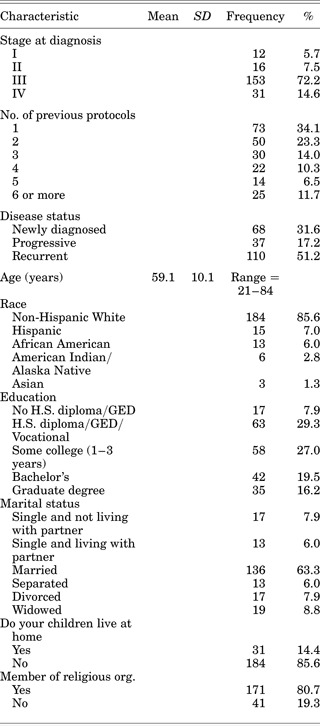
The average age of our sample was 59 years (SD = 10.1 years) and 85.6% were non-Hispanic White. The women in our study tended to have at least some college education or higher (64.4%), and the majority were married (63.3%). Approximately half of our sample (51.2%) had had at least one episode of recurrence; an additional 17.2% had progressive disease. The majority of women had been diagnosed at stage III (62.8%) or stage IV (13.0%; see Table 1 for demographics and medical information).
Demographics

Prevalences of the Outcome and Independent Variables
Regarding worry about dying, 44.2% reported that they did not worry about dying at all, versus a total of 55.8% who endorsed this item with responses ranging from “a little bit” to “very much.” Regarding losing hope in the fight against their illness, 68.4% reported not losing hope at all versus a total of 31.6% who endorsed this item with responses ranging from “a little bit” to “very much.” Regarding depression, 14.9% of the women scored above the cutoff, indicating the need to follow up with further assessment for major depressive disorder. Regarding physical well-being, 53.5% denied any feelings of illness, and an additional 23.7% reported feeling minimally ill, despite the fact that these measurements were taken during the week immediately after chemotherapy administration, typically the week with the most symptoms during the chemotherapy cycle. Self-report ratings for pain, nausea, and time spent being bedridden were similarly low.
Logistic Regression with Worry about Dying
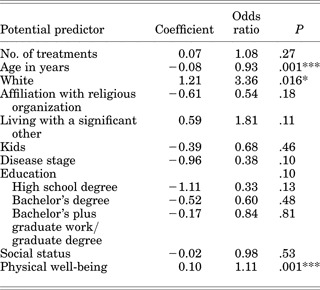
The overall chi-square for the logistic regression model was significant with all the independent variables given in Table 2, p < .0001, and the percent variance accounted for was .317 (Nagelkerke R 2). The overall model correctly predicted 65.3% of those women who did not endorse worry about dying and correctly predicted 79.5% of the women who did. Collinearity tests indicated a problem of multicollinearity between depression and physical well-being; exploratory factor analysis indicated that these two variables loaded highly onto a general malaise factor. A comparison of the −2 log likelihood or, equivalently, the deviance (a measure of model fit; see definition in McCullagh & Nelder, Reference McCullagh and Nelder1989) between models with depression included and with physical well-being included suggested a better fit of the latter model. Note that, due to the multicollinearity problem, neither of the variables showed a significant effect on worry about dying when the other was controlled for. The finding coincides with the notion that the physical well-being variable covered more QOL domains such as pain, nausea, fatigue, and feeling ill than the depression subscale did, resulting in a stronger association with worry about dying. As a result, the depression variable was dropped from the model. Similarly, number of prior treatments was highly correlated with disease status (newly diagnosed vs. recurrent vs. progressive); thus, the disease status variable was dropped from the model.
Logistic regression analysis of Worrying about Death (N = 207)

*p < .05; ***p ≤ .001.
Being younger (p = .001), being of non-Hispanic White ethnicity (p = .026), and having poorer physical well-being (p = .000) were significantly associated with worry about dying. Stage, number of treatments, educational level, having children living at home, living with a significant other, religious affiliation, and social well-being/support were all not associated with worry about dying when controlling for the other independent variables (see Table 2 for the parameter estimates).
Logistic Regression with Loss of Hope
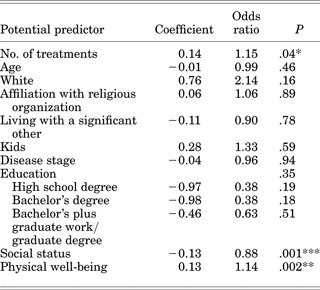
The overall chi-square for the logistic regression model was significant with all the independent variables given in Table 3, p < .0001, and the percent variance accounted for by the model was .321 (Nagelkerke R 2). The overall model correctly predicted 89.9% of those women who did not endorse worry about dying and correctly predicted 47.1% of the women who did. A likelihood ratio test (McCullagh & Nelder, Reference McCullagh and Nelder1989) indicated a strong association between loss of hope and both depression and physical well-being when controlling for the other independent variables (both p < .0001). As with the previous logistic regression, the depression and physical well-being variables were multicollinear (multicollinearity diagnostic tests of independent variables are not affected by the dependent variable). A similar comparison of the −2 log likelihood as with worrying about death suggested a better fit of the model by including depression instead of physical well-being as an independent variable.
Logistic regression analysis of Loss of Hope (N = 214)

*p < .05; **p < .01; ***p ≤ .001.
Depressive symptoms (p = .002), lack of social support/well-being (p = .001), and number of treatments (p = .04) were significantly associated with the tendency to endorse losing hope in the fight against one's illness. Stage of disease, education, age, living with a significant other, having children at home, ethnicity, and membership in a religious organization were all nonsignificant (see Table 3 for the parameter estimates).
DISCUSSION
This study is one of the largest multivariable studies to examine end-of-life concerns in a homogeneous sample of advanced cancer patients. Ovarian cancer patients have a poor prognosis, yet live for several years with relatively high physical functioning after diagnosis. Simply acknowledging the existence of these feelings is difficult for cancer patients (Jones et al., Reference Jones, Huggins and Rydall2003). Many experience well-intentioned pressure from family members to deny distress about end-of-life concerns (Quill, Reference Quill2000). This study is a first step in the exploration of demographic, medical, and psychosocial variables' association with worry about dying and loss of hope in a sample of ovarian cancer patients in active treatment. To address these issues during treatment with curative intent is clearly important, as over half of our sample indicated worry about death and almost a third indicated a feeling of losing hope in the fight against their illness.
Overall, results indicate that the logistic model for predicting fear of dying in women with ovarian cancer had acceptable accuracy, whereas the model for predicting loss of hope was less so, as it was accurate about half the time in positively predicting women who endorsed losing hope. We discuss each of these findings separately.
Worry about Dying
It was somewhat surprising that the objective indices of disease (stage of disease and number of prior treatments) were not associated with worry about dying. Rather, patients' subjective sense of physical well-being, which encompassed questions about pain, nausea, and fatigue, were much more strongly associated with worry about dying. It may be that patients interpret physical symptoms as signs of worsening disease status, thus making them more likely to have concerns about death. However, due to the multicollinearity between the depression and physical well-being variables and the fact that both variables loaded onto a single underlying factor, depression could also be interpreted as being significantly associated with worry about dying. Certainly, depressed patients are more likely to experience such negative cognitions (Beck, Reference Beck1995).
It was also somewhat surprising that the variables of living alone and whether or not children lived in the home were not significantly related to worry about dying. In a qualitative study of 20 advanced-stage ovarian cancer patients in active treatment, concern for family and especially for young children was both the most prevalent and most important factor identified by patients as negatively impacting their quality of life (Houck et al., Reference Houck, Avis and Gallant1999). There is also a burgeoning literature documenting the various deleterious effects of living alone in cancer patients (Konski et al., Reference Konski, Pajak and Movsas2006). For example, Kugaya et al. (Reference Kugaya, Akechi and Okuyama2000) found that head and neck cancer patients who lived alone had an increased odds ratio of 4.83 for depressive disorders.
In our study, affiliation with a religious organization was not significantly associated with worry about dying (p = .18). McClain-Jacobson et al. (2004) found that spirituality was associated with lower levels of end-of-life despair in 276 terminally ill cancer patients. However, Grumman and Spiegel (Reference Grumman and Spiegel2003) found no difference in death anxiety when comparing hospice patients with strong religious faith versus those without in an interview-based study of 12 terminally ill patients. The nonsignificant effect for religious affiliation in our study may have been due to the fact that our measure was a single-item measure assessing membership in a religious organization only; Fortner and Neimeyer's (Reference Fortner and Neimeyer1999) quantitative review of 49 community studies with older adults indicated that religious beliefs rather than religious behaviors were associated with death anxiety. A longer and better validated measure of religiosity and spirituality would likely have been more sensitive in detecting potential differences in our outcome variables.
Our results show that non-White participants were 3.3 times less likely to worry about dying compared with White participants. A careful analysis of multicollinearity confirmed that this association was independent of the influence of affiliation with a religious organization. One possible explanation may be that the minority participants were higher in cancer fatalism (Powe & Finnie, Reference Powe and Finnie2003); however, this cannot be confirmed because we did not measure fatalism in our study. In a community self-report survey of death anxiety in 197 men and women with an average age of 69.4 years, Caucasian participants displayed significantly higher levels of anxiety regarding the process of dying than did African American participants (Depaola et al., Reference Depaola, Griffin and Young2003). Our finding that increased age was associated with decreased worry about dying was consistent with studies with advanced-stage cancer patients and in several non-cancer community samples (Feroz & Beg, Reference Feroz and Beg1987; Depaola et al., Reference Depaola, Griffin and Young2003).
Losing Hope
Among the medical variables, for every additional prior treatment in the patient's medical history, the subsequent risk of losing hope was increased by 0.15, or 15%. This finding was expected and indicated that patients understood that their chances for cure diminished with each new chemotherapy regimen. Neither stage of disease nor any of the demographic variables were significantly related to losing hope. In contrast, McGill and Paul (Reference McGill and Paul1993) reported that elderly cancer patients with higher education and economic status had higher levels of hope. Ringdal's (Reference Ringdal1995) study of 253 cancer inpatients also found that economic status was associated with hopelessness, along with age and physical functioning. Both studies assessed hopelessness in samples with various types of cancer and treatment modalities. In our study, depression and social support/well-being were entered as a second step into the model after the demographic and medical variables to see whether they explained any additional variance. Higher levels of depression and lower levels of social support/well-being were both independently associated with a higher risk for losing hope (every unit increase in the depression resulted in a 0.11 increased risk, whereas every unit decrease in social support/well-being on the FACT-O subscale resulted in a 0.22 increased risk). Our findings closely mirrored Gil and Gilbar's (Reference Gil and Gilbar2001), who assessed 113 newly diagnosed and recurrent patients with various disease sites and found that hopelessness was related to depression and lack of social support, but not stage of disease.
Limitations
This study has several limitations that should be noted in interpreting the findings. First, because it is a secondary analysis of data from a larger study, we needed to use data from the measures already being used in the study rather than choosing the ideal measures. As a result, the outcomes of losing hope and worry about dying were assessed with single items from the FACT-O. There are better validated measures of hopelessness and death anxiety among cancer patients such as the Beck Hopelessness scale (Beck & Steer, Reference Beck and Steer1988) and the Schedule of Attitudes toward a Hastened Death (Breitbart et al., Reference Breitbart, Rosenfeld, Pessin and Kaim2000) or the Death Anxiety scale (Templer, Reference Templer1970). Similarly, our measure for religiosity was a single item; a more detailed and better validated measure such as the Functional Assessment of Chronic Illness Therapy–Spiritual Well-Being Scale (Brady et al., Reference Brady, Peterman and Fitchett1999) may have been more sensitive in picking up differences among those who had strong religious or spiritual beliefs versus those who did not. Another limitation is that we had insufficient numbers of patients in the various non-White ethnic groups to make comparisons among those groups. Our study found that being of non-White ethnicity was associated with less worry about dying, but this is difficult to interpret without being able to compare the different ethnic groups. Future studies should involve more diverse samples with sufficiently large numbers of ethnic minorities to support comparison among the groups. Finally, women who refused to participate in our study tended to be older and may have been less depressed. These two potential sources of selection bias may have resulted in an overinflated rate of end-of-life concerns with our study.
Clinical Implications
Hopelessness has important clinical implications for cancer patients. In their study of 224 mixed cancer nonpalliative inpatients, Jones et al. (Reference Jones, Huggins and Rydall2003) found that patients with increased hopelessness were more likely to experience the desire for hastened death even after controlling for demographics, pain, physical symptoms, stage of disease, and time since diagnosis. Additionally, Dimatteo's (Reference DiMatteo, Lepper and Croghan2000) meta-analysis of adherence studies in cancer patients found a strong negative effect size for hopelessness. These findings, especially among those who have experienced several chemotherapy protocols already, underscore the importance of addressing depressed mood and lack of social support in nonpalliative cancer patients.
Our results underscore the need for physicians and family members to acknowledge patients' fears and concerns about dying and losing hope, even when the clinical focus is still on curative treatment. Simply signaling a willingness to discuss end-of-life issues can greatly alleviate the unintended isolation that patients sometimes feel as a result of family members' encouragement to maintain a positive and fighting spirit.
Furthermore, our study shows that many factors that could be construed to have an impact on ovarian cancer patients' fears and hopes, such as stage at diagnosis and whether children lived at home, were not necessarily associated. Rather, the relationship between demographic, psychosocial, and medical treatment factors with these two end-of-life concerns are complex and warrant further exploration in future studies.
ACKNOWLEDGMENTS
Funding was provided through NCI CA093512. This research was also supported by a grant from the Lance Armstrong Foundation.