INTRODUCTION
The protozoan Toxoplasma gondii infects virtually all warm-blooded animals, including birds, humans, livestock and marine mammals (Dubey, Reference Dubey2010). Humans become infected post-natally by ingesting tissue cysts from undercooked meat, or by consuming food or drink contaminated with oocysts. However, only a small percentage of exposed adult humans or other animals develop clinical signs of disease (Robert-Gangneux and Dardé, Reference Robert-Gangneux and Dardé2012). It is unknown whether the severity of toxoplasmosis in immunocompetent hosts is due to the parasite strain, host variability or to other factors. Recently, attention has been focused on the genetic variability among T. gondii isolates from apparently healthy and sick hosts (Grigg and Sundar, Reference Grigg and Sundar2009; Robert-Gangneux and Dardé, Reference Robert-Gangneux and Dardé2012). Severe cases of toxoplasmosis have been reported in immunocompetent patients in association with atypical T. gondii genotypes (Ajzenberg et al. Reference Ajzenberg, Bañuls, Su, Dumètre, Demar, Carme and Dardé2004; Demar et al. Reference Demar, Ajzenberg, Maubon, Djossou, Panchoe, Punwasi, Valery, Peneau, Daigre, Aznar, Cottrelle, Terzan, Dardé and Carme2007; Elbez-Rubinstein et al. Reference Elbez-Rubinstein, Ajzenberg, Dardé, Cohen, Dumètre, Yera, Gondon, Janaud and Thulliez2009; Robert-Gangneux and Dardé, Reference Robert-Gangneux and Dardé2012). Type II strains are the most prevalent in Europe and the USA (Su et al. Reference Su, Khan, Zhou, Majumdar, Ajzenberg, Dardé, Zhu, Ajioka, Rosenthal, Dubey and Sibley2012; Shwab et al. Reference Shwab, Zhu, Majumdar, Pena, Gennari, Dubey and Su2014). Type II strains are also associated with congenital toxoplasmosis in children and in animals in Europe (Ajzenberg et al. Reference Ajzenberg, Cogné, Paris, Bessières, Thulliez, Filisetti, Pelloux, Marty and Dardé2002b ; Jokelainen, Reference Jokelainen and Djakovic2012).
Historically, T. gondii was considered clonal with low genetic diversity and grouped into 3 major lineages named types I, II, III based on analysis of 106 isolates from North America and Europe using 6 PCR-restriction length polymorphism (RFLP) markers (Howe and Sibley, Reference Howe and Sibley1995). However, recent studies have revealed a greater genetic diversity of T. gondii, particularly isolates from Brazil (Dubey et al. Reference Dubey, Lago, Gennari, Su and Jones2012; Su et al. Reference Su, Khan, Zhou, Majumdar, Ajzenberg, Dardé, Zhu, Ajioka, Rosenthal, Dubey and Sibley2012; Shwab et al. Reference Shwab, Zhu, Majumdar, Pena, Gennari, Dubey and Su2014). The most T. gondii isolates reported so far were typed using 10 PCR-RFLP markers, and a total of 189 genotypes were identified from 1457 isolates. These genotypes were deposited into the public database in ToxoDB and therefore designated as ToxoDB PCR-RFLP genotypes (Shwab et al. Reference Shwab, Zhu, Majumdar, Pena, Gennari, Dubey and Su2014). Based on RFLP typing of 10 markers, most T. gondii strains from Europe and North America are considered type II with little genetic variability. Microsatellite (MS) typing provides additional information with respect to genetic diversity (Ajzenberg et al. Reference Ajzenberg, Bañuls, Su, Dumètre, Demar, Carme and Dardé2004). With respect to genotypes of T. gondii strains in Europe, most information is from France (Ajzenberg et al. Reference Ajzenberg, Bañuls, Tibayrenc and Dardé2002a , Reference Ajzenberg, Cogné, Paris, Bessières, Thulliez, Filisetti, Pelloux, Marty and Dardé b , Reference Ajzenberg, Yera, Marty, Paris, Dalle, Menotti, Aubert, Franck, Bessières, Quinio, Pelloux, Delhaes, Desbois, Thulliez, Robert-Gangneux, Kauffmann-Lacroix, Pujol, Rabodonirina, Bougnoux, Cuisenier, Duhamel, Duong, Filisetti, Flori, Gay-Andrieux, Pratlong, Nevez, Totet, Carme and Bonnabau2009; Aubert et al. Reference Aubert, Ajzenberg, Richomme, Gilot-Fromont, Terrier, de Gevigney, Game, Maillard, Gibert, Dardé and Villena2010; Halos et al. Reference Halos, Thébault, Aubert, Thomas, Perret, Geers, Alliot, Escotte-Binet, Ajzenberg, Dardé, Durand, Boireau and Villena2010; Fekkar et al. Reference Fekkar, Ajzenberg, Bodaghi, Touafek, Le Hoang, Delmas, Robert, Dardé, Mazier and Paris2011). Only limited information is available with respect to T. gondii strains from Africa and other countries in Europe (Prestrud et al. Reference Prestrud, Åsbakk, Mørk, Fuglei, Tryland and Su2008; Richomme et al. Reference Richomme, Aubert, Gilot-Fromont, Ajzenberg, Mercier, Ducrot, Ferté, Delorme and Villena2009; Halos et al. Reference Halos, Thébault, Aubert, Thomas, Perret, Geers, Alliot, Escotte-Binet, Ajzenberg, Dardé, Durand, Boireau and Villena2010; Herrmann et al. Reference Herrmann, Pantchev, Vrhovec, Barutzki, Wilking, Fröhlich, Lüder, Conraths and Schares2010, Reference Herrmann, Maksimov, Maksimov, Sutor, Schwarz, Jaschke, Schliephake, Denzin, Conraths and Schares2012b ; Mercier et al. Reference Mercier, Devillard, Ngoubangoye, Bonnabau, Banuls, Durand, Salle, Ajzenberg and Darde2010; Craeye et al. Reference Craeye, Speybroeck, Ajzenberg, Dardé, Collinet, Tavernier, Van, Dorny and Dierick2011; Costache et al. Reference Costache, Colosi, Blaga, Gyorke, Pastiu, Colosi and Ajzenberg2013; Stajner et al. Reference Stajner, Vasiljevic, Vujic, Markovic, Ristic, Micic, Pasic, Ivovic, Ajzenberg and Djurkovic-Djakovic2013; Shwab et al. Reference Shwab, Zhu, Majumdar, Pena, Gennari, Dubey and Su2014). The reasons why the type II T. gondii genotype dominates in Europe are still unknown. Previous studies in France using MS markers showed genetic variations among the type II strains. These markers may be useful to explore genetic variation on a broader geographical regions and to reveal transmission pattern of this lineage in Europe and the rest of the world.
Limited information about T. gondii is available from Portugal, Austria and Israel and we had the cryovials of previously isolated and characterized only at SAG2 locus. With the aim of increasing our knowledge about biological and genetic diversity of T. gondii, we decided to apply both low and high polymorphic genetic markers on available isolates. Here we report genetic characterization of 90 T. gondii strains from Portugal, Israel and Austria using 10 nested PCR-RFLP genetic markers and 15 MS markers (Ajzenberg et al. Reference Ajzenberg, Bañuls, Tibayrenc and Dardé2002a ; Su et al. Reference Su, Shwab, Zhou, Zhu and Dubey2010). The high discriminatory power of the 25 (RFLP and MS) markers resulted in a better genetic differentiation of these strains and a higher genetic diversity than previously reported. MS markers exhibit multiple alleles and their hypervariable allelic polymorphisms are generated by accumulation of length mutations by intra allelic polymerase slippage on MS sequences during replication. Microsatellites markers are the best available tool to reveal whether two T. gondii isolates are genetically identical or different, i.e. to identify a common source of infection in an outbreak, a laboratory contamination, and mixed infections (Ajzenberg et al. Reference Ajzenberg, Collinet, Mercier, Vignoles and Dardé2010). Previous MS analyses showed that outbreaks of toxoplasmosis in humans (Demar et al. Reference Demar, Ajzenberg, Maubon, Djossou, Panchoe, Punwasi, Valery, Peneau, Daigre, Aznar, Cottrelle, Terzan, Dardé and Carme2007) and in animals (Carme et al. Reference Carme, Ajzenberg, Demar, Simon, Dardé, Maubert and de Thoisy2009) were caused by single strains. This study demonstrated that the MS markers can be potentially used to track transmission of the type II T. gondii in Europe.
MATERIALS AND METHODS
Revival of T. gondii isolates
Isolation of 102 T. gondii isolates from free range (FR)/backyard chickens was previously reported (Dubey et al. Reference Dubey, Salant, Sreekumar, Dahl, Vianna, Shen, Kwok, Spira, Hamburger and Lehmann2004, Reference Dubey, Edelhofer, Marcet, Vianna, Kwok and Lehmann2005, Reference Dubey, Vianna, Sousa, Canada, Meireles, Correia da Costa, Marcet, Lehmann, Dardé and Thulliez2006). For the present study, attempts were made to revive the isolates from cryopreserved strains. We succeeded in reviving all 67 isolates from Austria (Dubey et al. Reference Dubey, Edelhofer, Marcet, Vianna, Kwok and Lehmann2005), 15 of 16 from Portugal (Dubey et al. Reference Dubey, Vianna, Sousa, Canada, Meireles, Correia da Costa, Marcet, Lehmann, Dardé and Thulliez2006) and only 7 of 19 from Israel (Dubey et al. Reference Dubey, Salant, Sreekumar, Dahl, Vianna, Shen, Kwok, Spira, Hamburger and Lehmann2004). Additionally 1 T. gondii isolate (B1) from an aborted bovine fetus in Portugal (Canada et al. Reference Canada, Meireles, Rocha, da Costa, Erickson and Dubey2002) was also revived. For revival, liquid nitrogen cryopreserved materials were incubated for 2 min at 37 °C and then inoculated subcutaneously into two gamma interferon gene knock out (KO) mice. All infected KO mice died of toxoplasmosis. Lungs or brains of infected KO mice were homogenized and seeded on to African green monkey cells (CV1 cells) using Roswell Park Memorial Institute medium, (RPMI-1640). Tachyzoites were propagated in cell culture and harvested for cryopreservation, and DNA extraction.
Extraction of DNA and multilocus PCR-RFLP genotyping of T. gondii
Toxoplasma gondii DNA was extracted from cell culture derived tachyzoites. For this, tachyzoites were pelleted, washed with phosphate buffer saline (PBS) and subjected to DNA extraction. Genomic DNA was isolated using DNeasy Blood and Tissue Kit (Qiagen, Valencia, CA, USA) according to manufacturer's instructions. DNA quantification and quality were determined by Thermo Scientific NanoDrop Lite Spectrophotometer (Thermo Scientific, Waltham, MA, USA).
The multiplex PCR of T. gondii isolates were performed using the 10 PCR-RFLP genetic markers, SAG1, SAG2 (5′−3′ SAG2, alt.SAG2), SAG3, BTUB, GRA6, c22-8, c29-2, L358, PK1 and Apico as previously described (Su et al. Reference Su, Shwab, Zhou, Zhu and Dubey2010).
Genotyping with MS markers
MS markers TUB2, W35, TgM-A, B18, B17, M33, MIV.1, MXI.1, M48, M102, N60, N82, AA, N61 and N83 distributed on 10 of 14 chromosomes were used, as described previously (Ajzenberg et al. Reference Ajzenberg, Collinet, Mercier, Vignoles and Dardé2010). Briefly, for each primer pair, the forward primer was 5′-end labelled with fluorescein to allow sizing of PCR products that were separated by electrophoresis in an automatic sequencer. PCR was carried out in a 25 μL reaction mixture consisting of 12·5 μL of 2X QIAGEN Multiplex PCR Master Mix (Qiagen, France), 5 pmol of each primer, and 5 μL of template DNA. Cycling conditions were 15 min at 95 °C; 30 s at 94 °C, 3 min at 61 °C, and 30 s at 72 °C for 35 cycles followed by 30 min at 60 °C. PCR products were diluted 1:10 with deionized formamide. One microliter of each diluted PCR product was mixed with 0·5 μL of a dye-labelled size standard ROX 500 (Applied Biosystems, France) and 23·5 μL of de-ionized formamide (Applied Biosystems). The mixture was denatured at 95 °C for 5 min and then electrophoresed using an ABI PRISM 3130xl automatic sequencer (Applied Biosystems). The sizes of the alleles in bp were estimated using GeneMapper analysis software v4·0 (Applied Biosystems).
Data analysis
The profiles of DNA fragments found after restriction endonucleases digestion were compared with the reference strains profiles in a virtual database ToxoDB (http://www.toxodb.org) (Su et al. Reference Su, Shwab, Zhou, Zhu and Dubey2010). Neighbour joining phylogenetic network was constructed based on multilocus MS typing data as the method previously described (Rajendran et al. Reference Rajendran, Su and Dubey2012). Mantel test was performed to determine the association of MS genetic distance matrix with geographic distance matrix of the samples. The statistical significance was analysed based on permutation of 10 000 times and the results showed significant Mantel correlation between the genetic and geographic distances (two-tailed, P = 0·0001) (Rosenberg and Anderson, Reference Rosenberg and Anderson2010).
Ethics
All research was conducted following protocols approved by the US Department of Agriculture guidelines.
RESULTS
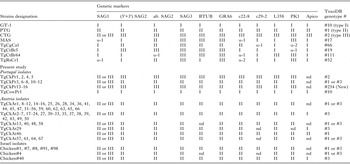
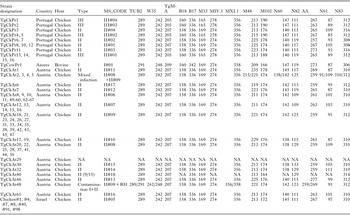
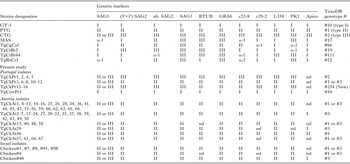
In total 90 T. gondii isolates (16 from Portugal, 67 from Austria and 7 from Israel) were successfully revived in KO mice and propagated in cell culture. The PCR-RFLP results of T. gondii isolates from Portugal, Austria and Israel are summarized in Table 1 and MS analysis in Table 2. We were able to amplify and type using 10 PCR-RFLP markers except BTUB, c29-2, PK1 and Apico for some samples. Genotyping of all isolates and comparisons to those listed in ToxoDB revealed mainly all 3 clonal types; type I (ToxoDB #10), type II (ToxoDB #1 or #3) and type III (ToxoDB #2) and 1 new genotype (ToxoDB #254).
PCR-RFLP genotyping of T. gondii isolates from Portugal, Austria and Israel
MS analysis of T. gondii isolates from Portugal, Austria and Israel
Genetic typing of individual T. gondii isolates from Portugal's FR chickens revealed different genotypes infection across the country; 4 of 15 isolates were type III (Table 1), and 7 of 15 isolates were type II. Four isolates were a new genotype with main combinations of types II and III specific alleles. This new genotype had type II pattern at BTUB, GRA6, c22-8 and L358 loci and type III pattern at SAG1, SAG2, SAG3, c29-2 and PK1 loci (Table 1) and designated here as ToxoDB PCR-RFLP genotype #254; we were not able to amplify Apico locus for this new genotype. The isolate (TgCowPr1) from bovine from Portugal was type I (ToxoDB #10) at all RFLP loci.
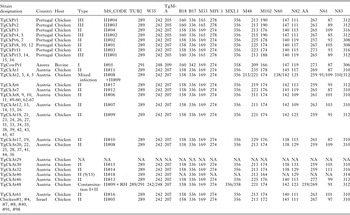
The MS analysis of Portugal's chicken isolates revealed more diversity of T. gondii than identified by PCR-RFLP typing; 7 of 15 isolates were type II genotype and 8 of 15 were type III genotype (including 4 genotype #2, and 4 of genotype #254). Both analysis markers have their independent locus and recombination events were seen in one kind of markers on some locus but not in other kinds. The results suggested the low recombination frequency in the nature during given time period. TgCkPr3 was misidentified as type III and TgCkPr4 as type II based on SAG2 PCR-RFLP in the original paper (Dubey et al. Reference Dubey, Vianna, Sousa, Canada, Meireles, Correia da Costa, Marcet, Lehmann, Dardé and Thulliez2006). The high discriminatory power of the 15 MS markers showed that certain type II or III genotypes (MS codes II#03, II#04, III#03 and III#04) were identified in only 1 isolate (TgCkPr11, TgCkPr3, TgCkPr2 and TgCkPr1, respectively), whereas some other type II or III genotypes (MS codes II#02, II#01, III#02 and III#01) were common to two or more isolates (TgCkPr6-7, TgCkPr8, 10, 12, TgCkPr4-5 and TgCkPr13-16, respectively). Isolates that share a common genotype with 15 MS markers were likely to be different isolates of a single strain collected from various hosts at the same place (Table 2). The TgCowPr1 isolate from Portugal was type I (Table 2).
Our results show that all T. gondii positive chickens in Austria and Israel were infected with type II strains (ToxoDB #1 or 3). PCR-RFLP analysis revealed genotype II at all loci except 1, Apico which display genotype I allele (Table 1). None of the isolates was identified to clonal type I and type III from Austria and Israel. The result was identical from both countries, Austria and Israel.
MS analysis also revealed that all isolates from Austria were type II genotype (Table 2). These isolates had constant size of type II genotype pattern at TUB2, W35, TgM-A, B18, B17, M33, MIV.1 and MXI.1 loci. The most polymorphic MS markers (M48, M102, N60, N82, AA, N61 and N83) revealed that the 67 type II isolates from Austria consisted of only 13 different genotypes (MS codes II#06-18). Eight of these genotypes were retrieved from only 1 isolate (MS codes II#11-18) whereas 5 genotypes were common to 2 or more isolates (MS codes II#06-10). Three type II genotypes (MS codes II#06, 8 and 9) were over-represented in the Austrian collection with 22, 12 and 20 isolates, respectively (Table 2). The isolates obtained by cat bioassay (TgCkAt2, 3, 4 and 5) in which the myocardium of certain chickens were pooled and fed to the cat were identified as mixed infection by MS analysis suggesting that more than one chicken in a pool was positive and infected with different strains. According to the MS data, these 4 mixed infections involved two of the three most common genotypes in this Austrian collection (MS codes II#08 and 9). One isolate (TgCkAt48) from Austria was contaminated with RH strain (Table 2). All seven isolates from Israel had constant size of type II genotype pattern at all 15 MS loci suggesting that there were seven clones of a single strain circulating in the sampled area (Table 2).
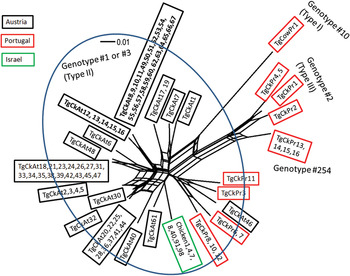
Phylogenetic network analysis of MS markers was summarized in Fig. 1. In total 25 MS genotypes among 90 T. gondii isolates were identified. Among the 16 isolates from Portugal, one isolate TgCowPr1 from cow belongs to RFLP genotype #10 (type I). Four isolates (TgCkPr1, 2, 4 and 5) that belong to RFLP genotype #2 (type III) were further divided into three closely related MS types, three isolates (TgCkPr2, 4 and 5) were isolated from the same location. Four isolates (TgCkPr13, 14, 15 and 16) that belong to RFLP genotype #254 revealed only one MS type; and all four isolates were from the same location. Seven isolates (TgCkPr3, 6, 7, 8, 10, 11 and 12) that belong to RFLP genotype #1 or #3 (type II) were further divided into four MS types, all isolates except TgCkPr3 were from the same location.
Neighbour joining phylogenetic network of T. gondii isolates from Portugal, Austria and Israel. A total of 25 MS genotypes among 90 T. gondii isolates were identified. The isolates from same country were more closely related and were identical or closely related from same location.
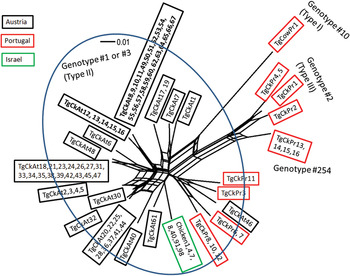
The 67 chicken isolates from Austria belong to RFLP genotype #1 or #3 (together as type II); they are further divided into 15 MS types. All these isolates except TgCkAt46 are more closely related to each other than to the type II isolates from Portugal. The 7 isolates from a single farm in Israel belong to RFLP genotype #1 or #3 and only revealed a single MS type.
DISCUSSION
Previous studies showed predominance of type II and type III with rare type I infection in animals from Portugal (Lopes et al. Reference Lopes, Dubey, Darde and Cardoso2014; Vilares et al. Reference Vilares, Gargate, Ferreira, Martins, Julio, Waap, Angelo and Gomes2014). The results were based on SAG2 PCR-RFLP and/or few MS markers of T. gondii isolates from pig (Sousa et al. Reference Sousa, Ajzenberg, Canada, Freire, Correia da Costa, Dardé, Thulliez and Dubey2006), chickens (Dubey et al. Reference Dubey, Vianna, Sousa, Canada, Meireles, Correia da Costa, Marcet, Lehmann, Dardé and Thulliez2006), brain extract of urban pigeons (Waap et al. Reference Waap, Vilares, Rebelo, Gomes and Ângelo2008; Vilares et al. Reference Vilares, Gargate, Ferreira, Martins, Julio, Waap, Angelo and Gomes2014), and brain homogenates of cats (Vilares et al. Reference Vilares, Gargate, Ferreira, Martins, Julio, Waap, Angelo and Gomes2014), or serotyping based on GRA6 and GRA7 derived peptides (Sousa et al. Reference Sousa, Canada, da Costa and Dardé2010). Our results obtained from FR chickens also revealed different genotypes; 4 of those 15 isolates were type III (ToxoDB #2), the genotype most prevalent in animals. The other 7 isolates were type II (ToxoDB #1 or #3), the genotype most prevalent in Europe and the USA. The bovine isolate from Portugal was genotype I which was isolated from the Azores Island not from the mainland of Portugal (unlike the chicken isolates) which is quite far from mainland of Portugal with a very different environment, climate and fauna. This information could explain the presence of unusual type I genotype in our sampling. Another type I strain was previously found in 1 urban pigeon from Lisbon, Portugal (Waap et al. Reference Waap, Vilares, Rebelo, Gomes and Ângelo2008).
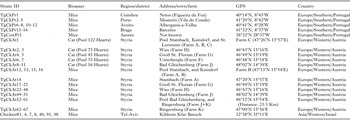
In the present study, 4 of 16 chicken isolates were identified as new genotypes and have mainly combinations of types II and III specific alleles, this new genotype may be derived by sexual recombination of clonal types II and III and represent evolutionary separated lineages. Many recombinant clones having type II and type III specific alleles were isolated from a single naturally infected cat fecal samples was reported previously (Herrmann et al. Reference Herrmann, Bärwald, Maksimov, Pantchev, Vrhovec, Conraths and Schares2012a ). Isolates TgCkPr8, 10, 12, and TgCkPr13–16 were derived from two different farms (Table 3) and share a common genotype with 15 MS markers respectively suggesting that the individual farm was contaminated by only one cat, i.e. by only one strain. The MS analysis of chickens isolates from Portugal and Austria revealed more diversity and discriminative results than classical typing by PCR-RFLP analysis. The result indicated that type II strains from Portugal and Austria were diverse and the strains from same country were more closely related. The strains from the same location were likely to be identical or closely related. However, TgCkAt46 isolate has several MS alleles that are unique in the sampling of Austrian isolates and one allele (225 at M48 marker) is common in the Portuguese isolates, this is why the neighbour-joining analysis did not cluster this isolate with the Austrian isolates. Adding isolates from other parts of Europe in the phylogenetic analysis would probably better clarify the position of this isolate in the phylogenetic tree. Type II isolates are genetically so similar that PCR-RFLP markers or intron sequencing usually fail to differentiate them.
Samples collection and T. gondii isolation from Portugal, Austria and Israel
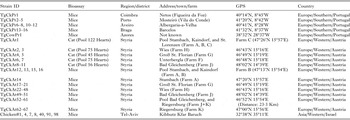
The results of the present study indicate that all three clonal types and recombinant genotypes are circulating in domestic animals in Portugal that are part of human food chain. Based on GRA6 derived peptide, Sousa et al. (Reference Sousa, Ajzenberg, Vilanova, Costa and Dardé2008) (Sousa et al. Reference Sousa, Ajzenberg, Vilanova, Costa and Dardé2008) found comparatively higher prevalence of serotype I/III among Portuguese patients (15%) than among French patients (2%). Under natural conditions the mixed clonal type's strains are likely natural recombinants and they could arise when a felid ingests prey parasitized simultaneously with more than one clonal strains of T. gondii (Su et al. Reference Su, Howe, Dubey, Ajioka and Sibley2002; Saeij et al. Reference Saeij, Boyle, Coller, Taylor, Sibley, Brooke-Powell, Ajioka and Boothroyd2006; Sibley and Ajioka, Reference Sibley and Ajioka2008). Such natural recombination among the clonal lineages occurs rarely (less than 5%) and generates separated strains from parental types and acquired new biological properties such as possible cause of severe clinical manifestations (Khan et al. Reference Khan, Su, German, Storch, Clifford and Sibley2005; Saeij et al. Reference Saeij, Boyle, Coller, Taylor, Sibley, Brooke-Powell, Ajioka and Boothroyd2006; Taylor et al. Reference Taylor, Barragan, Su, Fux, Fentress, Tang, Beatty, El Hajj, Jerome, Behnke, White, Wootton and Sibley2006; Grigg, Reference Grigg, Ajioka and Soldati2007). The geographic diversity of sampling in Portugal is higher than in Austria. In Table 3, we can see that the sampling of isolates in Portugal was done in 5 different regions (including the Azores island which is very far from mainland Portugal) whereas it was done in only one region (Styria) in Austria. Furthermore, the GPS coordinates indicate that the distance between two sampled farms in Austria is often very short (distance between farms A and B = 17·7 km and between farms J and K = 23·3 km).
Genotyping of T. gondii isolates from Austria is limited with only few reports of parasite isolation and seroprevalence of T. gondii (Edelhofer, Reference Edelhofer1994; Dubey et al. Reference Dubey, Edelhofer, Marcet, Vianna, Kwok and Lehmann2005; Edelhofer and Prossinger, Reference Edelhofer and Prossinger2010). All 67 T. gondii strains isolated from different areas of Austria were genotype II (ToxoDB #1or #3), suggesting the clonal population structure. These results was similar with previous findings reporting the predominance of T. gondii type II in cats in bordered countries, Germany and France (Herrmann et al. Reference Herrmann, Pantchev, Vrhovec, Barutzki, Wilking, Fröhlich, Lüder, Conraths and Schares2010; Fekkar et al. Reference Fekkar, Ajzenberg, Bodaghi, Touafek, Le Hoang, Delmas, Robert, Dardé, Mazier and Paris2011; Maksimov et al. Reference Maksimov, Zerweck, Dubey, Pantchev, Frey, Maksimov, Reimer, Schutkowski, Hosseininejad, Ziller, Conraths and Schares2013). MS analysis of 67 type II isolates from Austria consisted of only 13 different genotypes. Eight genotypes (MS codes II#11–18) have only one isolate (TgCkAt1, 6, 7, 30, 32, 40, 46 61) and these isolates came from three different farms (Table 3), whereas five genotypes (MS codes II#06–10) were common to two or more isolates. Most of over-represented Austrian isolates that share common genotypes (MS codes II#06, 8, and 9) were different isolates of a single strain collected from various hosts at the same place. This would not be surprising to find identical genotypes in various hosts from same or very close farms. We can assume the individual farms were contaminated by only one cat, i.e. by only one strain.
According to the MS data, the isolates obtained by cat bioassay (TgCkAt2, 3, 4 and 5) revealed mixed infections involving two of the three most common genotypes in this Austrian collection (MS codes II#08 and 9). These results suggest that more than one chicken in a pool was positive and infected with different strains. It is not recommended to pool the isolates to avoid the problem of mixed infection that have been missed by RFLP markers. Only MS markers can detect a mixed infection with two type II strains in this ‘artificial’ case but also in a naturally infected host.
Our results, in both PCR-RFLP genotyping and MS analysis showed that all seven T. gondii isolates from chickens in Israel were type II (ToxoDB #1 or #3). Type II strain is evolutionary important in expansion of T. gondii population and mostly associated with human toxoplasmosis (Darde et al. Reference Darde, Bouteille and Pestrealexandre1992; Howe and Sibley, Reference Howe and Sibley1995; Howe et al. Reference Howe, Honoré, Derouin and Sibley1997; Ajzenberg et al. Reference Ajzenberg, Cogné, Paris, Bessières, Thulliez, Filisetti, Pelloux, Marty and Dardé2002b ). A variant of type II (NE-II) was recently found associated with prematurity and severe disease at birth in congenitally infected children in the USA (McLeod et al. Reference McLeod, Boyer, Lee, Mui, Wroblewski, Karrison, Noble, Withers, Swisher, Heydemann, Sautter, Babiarz, Rabiah, Meier and Grigg2012). Type II strains are most abundant in domestic animals and humans while type I strains are relatively rare in agriculture and wild animals from North America (Howe and Sibley, Reference Howe and Sibley1995; Mondragon et al. Reference Mondragon, Howe, Dubey and Sibley1998; Dubey et al. Reference Dubey, Graham, Silva, Lehmann and Bahia-Oliveira2003). Geographical patterns of T. gondii genetic diversity across the continents was recently reviewed (Shwab et al. Reference Shwab, Zhu, Majumdar, Pena, Gennari, Dubey and Su2014) using the published results until the end of 2012, it has shown the overwhelming dominance of type II strains in Europe, northern Africa and North America. Chickens are considered as sentinel for T. gondii oocysts contamination in the local environment and they are important part in human food chain. Even restricted sampling from chicken in the present study, provides clues about the possible risk to human infection and local environmental contamination. Further studies encourage including other domestic animals at the local community level.
In conclusion, the type II (ToxoDB #1 and #3) T. gondii strains are dominant in chickens from Portugal, Austria and Israel. MS markers revealed additional difference among the type II strains from Portugal and Austria, and showed that all 7 isolates from Israel were identical. Future studies of the type II strains by MS markers will be useful to reveal transmission patterns in different regions.