In contrast to the nuclear family-centered view of kinship in modern Japan, the landscape of familial relations prior to the Meiji period (1868–1912) was strikingly diverse. Characters in pre-Meiji narratives reflect this, as they are often related to one another in complex ways because of the prevalence of polygyny, consanguineous marriage, concubinage, fosterage, and adoption among the ruling class.Footnote 1 For instance, in Murasaki Shikibu's eleventh-century magnum opus Genji monogatari (The Tale of Genji, ca. 1008), not only is the eponymous hero a cousin to his best friend, Tō no Chūjō, but Genji is also the other's brother-in-law, the father-in-law to his daughter, and the adoptive father to his illegitimate daughter.
As essential as the ties mediated by blood or matrimony in premodern Japan was “milk kinship”—relations between a highborn figure and two close attendants: a menoto 乳母 (wet nurse) and a menotogo 乳母子 (foster sibling).Footnote 2 By the tenth century, the three-way connection of the mother-child duo and their mutual charge or yōkun 養君 (lord/mistress to the foster) often resulted in long-term semibiological kinship via breastmilk, the bodily fluid that produces intimacy without the restriction of incest taboo.Footnote 3 Through the formation of milk kinship, which at least sometimes involved the menoto's erotic labor and/or sexual relationship with a male yōkun and/or his father, two families achieved hierarchical political-affective alliances. I call this interfamilial trade of political, social, cultural, and sexual capital the “menoto system,” drawing an analogy with the interdomain, lateral codependency between the aristocracy and Buddhist institutions, known as the “chigo system” (Atkins Reference Atkins2008, 951).Footnote 4 In this state-sanctioned fosterage, the son of an elite family received a premier education during his adolescence as a chigo 稚児 (acolyte) under the care of a high priest in exchange for emotional and erotic labor (Schmidt-Hori Reference Schmidt-Hori2009, Reference Schmidt-Hori2015, Reference Schmidt-Hori2021). Thus, formally arranged non-natal kinship played a significant role in the political landscape of premodern Japan.
With the menoto system being a normative component of mainstream society, menoto and menotogo are extremely common in pre-Meiji literary and dramatic texts. Highborn protagonists of romantic tales often rely on their milk kin as intermediaries for courtship, while more feudalistic narratives, such as the kabuki/bunraku play Troubles in the Date Clan (Meiboku sendai hagi, 1778), depict the menoto as a fierce paragon of loyalty who sacrifices her own son to save her yōkun. Despite the omnipresence of milk kinship in classical texts and its far-reaching implications for modern readers, research on this essential trope has been limited in scope in the Japanese-language academia and almost nonexistent in Anglophone scholarship.Footnote 5
An unintended consequence of the paucity of serious academic inquiry is that menoto and menotogo are equated, respectively, with “wet nurses” and “foster siblings” through translation.Footnote 6 Doing so risks the possibility of obscuring the fundamental differences between what the Japanese and English terms signify. For example, unlike “wet nurses,” historical menoto were not always required to breastfeed their young charges.Footnote 7 This was not an issue because, in the long span of service, breastfeeding was a small fraction of what a menoto did for her yōkun. Further, when a menoto is mentioned in a tale, she is never referred to as “a former menoto” even if she is no longer in service, indicating that menoto is closer to a kinship term than an occupation title like “wet nurse.” One always becomes someone's menoto rather than a menoto. Also, contrary to the commonly shared image of “foster siblings,” yōkun and their menotogo did not always grow up together, since menoto often entrusted their own children to other menoto (Yoshikai Reference Yoshikai1995, 13–30; Reference Yoshikai2008, 45). Most obviously, it is unlikely for one to associate “wet nurses” with erotic labor; indeed, sexuality is the perspective that is largely missing in the existing scholarship on milk kinship despite its significance. This missing perspective contradicts the fact that sexuality and politics always went hand-in-hand for the ruling class of pre-Meiji Japan, most famously exemplified by the regency politics of the Fujiwara (858 to early eleventh century).Footnote 8
Given this underexamined dimension of milk kinship, this essay will reconstrue the intimacy between yōkun and their milk kin depicted in classical Japanese texts through the lens of erotic desire. To this end, in what follows, I will first discuss how milk kinship functioned as a power-generating engine of society in premodern Japan. Second, I will illustrate the stark gap between the inherently erotic ontology of menoto and the asexual image of menoto characters in literary texts. I will elucidate this chasm by demonstrating that the menoto is a part of an overarching imaginary concept of “mother” along with the birth mother and the stepmother. In my view, the triad of mother figures in fiction embodies varying and complementary dimensions of female sexuality. The birth mother occupies womanly desirability and the stepmother represents fertility and vigor, whereas the menoto embodies homely motherliness and her erotic subjectivity is “transferred” to the menotogo.
Third, based on the proposed theoretical frameworks, the reminder of the essay will analyze the erotic agencies of menotogo characters in Ochikubo monogatari (The Tale of Ochikubo, tenth century), Genji monogatari, Heike monogatari (The Tales of the Heike, ca. fourteenth century), and Chigo no sōshi (Booklet of Acolytes, fourteenth century). On the one hand, Ochikubo and Genji feature a motif of double coupling that I call a “love square”: two pairs of vertically connected milk siblings joining laterally through sex and/or marriage. On the other hand, Heike and Chigo no sōshi each depicts a homoerotic bond of milk brothers. In all cases, the erotically charged milk siblinghood powerfully subverts the prevalent motif of the “love triangle” that bonds two equal-status men through their mutual pursuit of a woman. In excavating the erotics of milk kinship, this study sheds light on the fluid and eclectic understanding of familial relations observable in these texts. Such flexible and utilitarian notions of the familial were likely shared to a degree by the historical actors of Heian and medieval societies and played a significant role in their collective social imagination and cultural fantasies.
Fictional Menoto as Benevolent, Asexual Quasi-Mothers
A kind, aged widow and/or nun who deeply cares about her yōkun—this is the standard image of menoto captured in Heian monogatari (vernacular tales) and other types of fiction. Nevertheless, this seemingly fitting, asexual image does not align with the ontology of menoto, considering that sexuality was an integral part of what made a woman menoto. Most obviously, she was normally employed because of her ability to breastfeed the employer's child, which she earned as a result of sexual intercourse, followed by pregnancy, childbirth, and lactation. Also, the menoto's role sometimes extended to teaching their adolescent male yōkun the art of lovemaking. A well-known case is Emperor Takakura (1161–81), whose first child was born to his menoto (Saeki Reference Saeki2009, 18). Another is retired emperor Go-Fukakusa, whose first sexual experience was with his menoto, according to Towazugatari (Confessions of Lady Nijō, thirteenth century), the memoir written by Lady Nijō, whose mother was Go-Fukakusa's menoto (Shinpen Nihon koten bungaku zenshū [hereafter SNKBZ] 47, 355).Footnote 9
Furthermore, it is known that historical menoto were at times chosen from the live-in concubines of the infant's father/grandfather (Kimura Reference Kimura2009, 6). For instance, Fujiwara no Kaneie's (929–90) attendant-qua-lover served his grandson as menoto (SNKBZ 31, 113). This means that in some cases, a menoto's sexual labor was part of the preexisting condition of her positionality vis-à-vis the employing family, rather than the by-product of her new role as menoto.Footnote 10 Under such circumstances, the interfamilial alliances created by the menoto system were strengthened by the menoto's sexual relations with two generations of male superiors. Thus, menoto were historically integrated into the reproductive economies of the hierarchical codependency. In this system, the dominant family could “milk” the lactating, erotic body of the woman from the subordinate family as the quasi-mother of their offspring. Simultaneously, the menoto and her family attained special privileges by forging an intimate kin-like bond with the higher-ranking family (Conlan Reference Conlan2005).
To return to the literary representations of the two erotic fosterage systems, it is always the parental figures—namely, the menoto and the high priest—who are routinely de-eroticized.Footnote 11 A typical example is Genji's favorite nurse, Daini no Menoto, who first appears in the “Yūgao” chapter, already as an old, sickly, widowed nun, ruminating over her impending death (SNKBZ 20, 136–37). However standard, this type of characterization of menoto is not an accurate representation of historical reality. Given that archetypal romantic protagonists are in their late teens or twenties, their menoto are more likely to be in their late thirties or early forties, yet most menoto are portrayed as if they are in their seventies. In this vein, Daini no Menoto makes a vivid contrast with Genji's late mother, Lady Kiritsubo, who died young and thus remains permanently beautiful and graceful in the tale.Footnote 12 In other words, mothers and menoto tend to share positive personal traits, but when it comes to sexual attractiveness, it is usually the former's monopoly. Why is this the case?
Before attempting to conjecture potential answers to this question, however, I shall note that discrepancies between reality and fiction are something to be expected. This is especially true for Heian and medieval monogatari, as they tend to heavily rely on stock characters and recurrent motifs. The de-eroticization of menoto is but one of the established literary conventions whose inception cannot be attributed to a singular external factor. Nonetheless, it is possible to observe and analyze the effects of presenting certain characters in stereotypical manners.
To examine the asexual image of the menoto, it is useful to think of this construct not in isolation but within the constellation of different motherly figures. As I demonstrate in another study (Schmidt-Hori Reference Schmidt-Hori2020), the notion of “mother” during the eighth century was overarching and did not clearly distinguish birth mothers and female caregivers. By the tenth century, however, as a result of the historical evolutions of marriage and family structures among the elite class, the conceptual distinctions between biological mothers, menoto, and stepmothers came to be more pronounced. This “triangulation” of motherhood in the monogatari tradition beginning in the mid-tenth century seems to have molded the three mother figures into distinct and complementary archetypes. They are (1) the attractive and loving birth mother, who often dies young after bearing her only child (i.e., the protagonist); (2) the malevolent and vigorous stepmother, who tends to have multiple children; and (3) the benevolent, selfless, old, and asexual menoto.
Out of the triad of motherly figures, the menoto is the most motherly, insofar as she exists only in relation to her yōkun (and, to a much lesser extent, her child) but not as a wife/lover of a man. This, of course, contributes to the characterization of the menoto as a devoted attendant/surrogate mother of her yōkun. In contrast, the birth mother and stepmother also exist as wives, despite the chasm in their perceived attractiveness. On the one hand, the desirability of the protagonist's birth mother plays the role of signaling the hereditary attractiveness of the hero/heroine as well as her strong marital/sexual bonds with her husband. On the other hand, the stepmother is not usually known for her beauty, but she is a woman of (hostile) vigor who also produces many children and overpowers her family, including her husband. Thus, each motherly prototype plays a complementary role according to her prescribed manifestation of sexuality to together drive the narrative forward.Footnote 13
With that being said, I shall note that the routine de-eroticization is applied mostly to the menoto of young adults (usually the protagonist). If a woman is to serve a child of the male protagonist, she can very well be seen in an erotic light. In the “Miotsukushi” chapter, for example, Genji appoints a woman to become his young daughter's menoto. After the arrangement is finalized through intermediaries, Genji goes through the trouble of visiting this woman to fulfill a singular goal. At her dilapidated home, Genji is said to be unable to “take his eyes off her” (SNKBZ 21, 288) and sleeps with her, an act that Kimura Saeko (Reference Kimura2009, 46) describes as “some sort of ritual to turn her into an equivalent of his wife.” Put differently, rather than choosing her daughter's menoto from one of his attendant-qua-lovers, he first found a menoto and then turned her into his lover.
This last point clarifies that de-eroticization of the menoto has little to do with stigmatization of female sexuality but is predicated upon the functions she plays. When the context and perspective change, as in the case of the “Miotsukushi” chapter, menoto's erotic subjectivity surfaces. In short, monogatari variously exploit allusions, genre-based conventions, established topoi, and stock characters to present a world that their imagined readers are expected to comprehend and appreciate. The same holds true for the genre of chigo monogatari. Even though what lies in the backdrop of chigo monogatari is the erotic fosterage of teenage boys, each story downplays the master priest's erotic subjectivity. In most chigo monogatari, the focus of the stories is the boy's infidelity with a young monk, a woman, or, in the case of the first episode of Chigo no sōshi, his own male menotogo.
I contend that something similar, albeit more subtle, happened to menoto's erotic subjectivity in literary texts. That is, the erotic dimension of menoto's ontology was redirected to its derivative construct of menotogo. As I will illustrate in the following sections, menotogo in four different monogatari are depicted as young men and women who valorize their erotic agencies to benefit their yōkun.
The “Love Square” of Milk Siblings: Ochikubo and Genji
Among the oldest courtly tales of Japan, Ochikubo monogatari is a deeply riveting and touching masterwork, a tale that vividly delineates the bond of milk kinship. The first half of the story illustrates the plight of the heroine, Lady Ochikubo, the only child of Middle Counselor Tadayori and his secondary wife. Upon the death of this wife, Tadayori brings their eight-year-old daughter and her menotogo, Akogi, to the mansion where he and his primary wife (Kita no Kata) live.Footnote 14 Kita no Kata coldly separates the milk sisters and makes Akogi serve her third daughter (San no Kimi). She then confines her stepdaughter in a dungeon-like “sunken” (ochikubo) room and keeps the world from knowing of her existence. As the heroine matures, Kita no Kata finds comfort in the imprisonment of her stepdaughter, who has surpassed her four biological daughters in beauty, poise, and talents. The perpetual dire state finally starts to shift when Akogi falls in love with Tachihaki, a retainer of San no Kimi's husband (Kurōdo no Shōshō). After they consummate their union, Akogi confides to Tachihaki that her lovely mistress is trapped in a dark corner of the mansion and mutters, “I will somehow find a perfect gentleman and have him rescue my Lady” (SNKBZ 17, 21).
This vignette piques the curiosity of Tachihaki's other lord, Michiyori—the handsome, up-and-coming nobleman who is the eldest son of a powerful courtier and older brother of the imperial consort. Some time after the unofficial, secret wedding of Lady Ochikubo and Michiyori inside the ochikubo room, an opportunity for escape arises during the Kamo Festival. Michiyori and his men break into the empty mansion and bring her to an estate in Nijō that belongs to his mother. In the second half of the story, Michiyori orchestrates an elaborate retaliation scheme against the Kita no Kata and her accomplices. Michiyori eventually attains the highest nonroyal court position (dajō daijin), the Lady bears him seven dazzlingly beautiful and precocious children, all of whom soon rise to power, and their eldest daughter becomes the primary consort of the emperor.
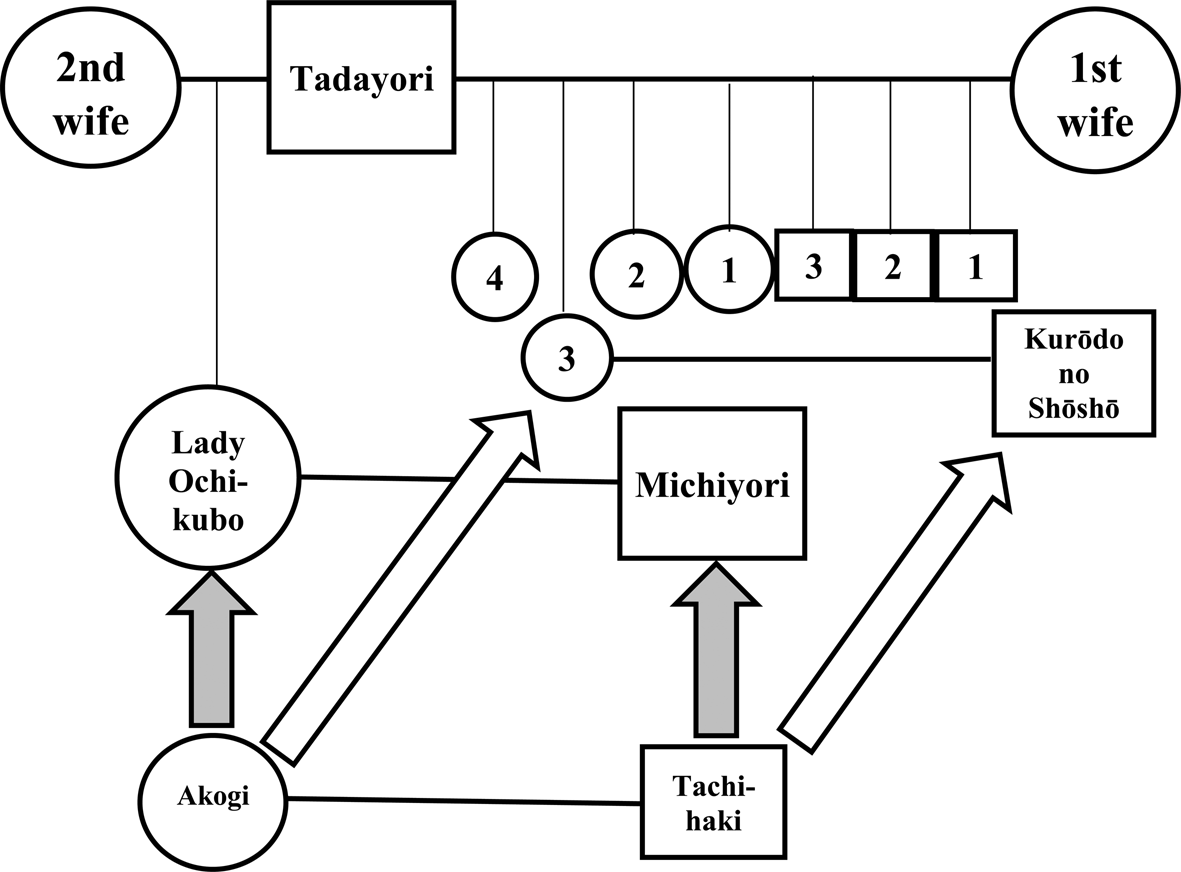
Tachihaki is Michiyori's menotogo.Footnote 15 Milk siblinghood being a privately arranged dyad, menotogo, especially men, serve other officially appointed charges (Yoshikai Reference Yoshikai2008, 71). As figure 1 exhibits, the relationship between the heroine and Akogi forms a perfect parallel with the two milk brothers. Just as Tachihaki has an official, contractual lord (indicated by the white arrow) and serves Michiyori in a more informal capacity (gray arrow), Akogi, too, formally attends to San no Kimi while privately waiting on Lady Ochikubo.
Relations of major characters in Ochikubo monogatari.

The two sets of vertically connected milk siblings are now laterally joined through sexual unions, forming what I call a “love square.” The love square interlocks four individuals’ devotions and desires into a configuration of perfect harmony. Thus, Ochikubo monogatari can be read as a triumphant story of a female menotogo whose sexual capital becomes the impetus for turning her predicament into far-reaching happiness for her mistress, her husband Tachihaki, Michiyori, and Michiyori's family.
After the heroine's mother dies, the two young milk sisters are brought to the unhappy place. Every day, they lament their plight with no prospect for a better future. All they have is each other. Then, one day, Akogi's blossoming charm catches a man's attention, and the couple falls in love. From Akogi to Tachihaki, from Tachihaki to Michiyori, and from Michiyori to Lady Ochikubo, love spreads, and the love square slowly comes into being. The dark and desolate space, which has confined the Lady, her well-being, and her feminine sexuality for many years, begins to crack, fracture, and crumple. At last, on the festive day of the dramatic rescue, the floodgates finally burst open.
Having arrived at the Nijō estate, Michiyori and his wife enter the mansion and they “lie down together” (fushi-tamainu, a euphemism for having sex); the narrator informs the reader that Tachihaki and Akogi are also “lying in bed together” (SNKBZ 17, 137–38). The two couples make love, not too far away from each other, to celebrate their great escape, the end of the Lady's hellish life, and her bright future. The four individuals appear to be sharing their pleasure, both emotional and sexual, not only with their spouses but also with their milk siblings.
The love square is a motif that is also employed in Genji monogatari twice. The first instance happens in the “Yūgao” chapter, when Genji pursues his best friend's (Tō no Chūjō) former lover, Yūgao. To assist his yōkun, Genji's menotogo, Koremitsu (son of Daini no Menoto), starts a casual affair with one of Yūgao's menotogo, the wife of Yōmei no Suke. Through this connection, Koremitsu sets up a tryst between Genji and his love interest (SNKBZ 20, 150; see also Furuta Reference Furuta2014, 282).
The other occurrence is depicted in the “Ukifune” chapter; this episode seems to allude to the rendezvous in the “Yūgao” chapter on multiple levels.Footnote 16 The milk brothers are Genji's grandson, Prince Niou, and his menotogo, Tokikata. Niou is intrigued by a woman known as Ukifune, a lover of his best friend Kaoru (Tō no Chūjō's grandson by blood), creating an archetypal love triangle.Footnote 17 Niou first sneaks into the riverside villa in Uji, where Kaoru has been hiding Ukifune, and seduces her into becoming his lover. After Niou returns to the capital, his obsession for Ukifune escalates, though it is not easy for a prince to travel outside of the capital, let alone to spend time with his best friend's lover. Then, Tokikata offers an empty house in Uji, owned by his uncle, to his yōkun so that he and his secret lover can share private moments. Tokikata brings his lord, Ukifune, and her attendant named Jijū, on a boat to the other side of the Uji River, while Ukifune's menotogo, Ukon, stays behind at the villa in case Kaoru or Ukifune's mother shows up.Footnote 18 At the desolate, empty house, Niou and Ukifune savor their time together. Meanwhile, Tokikata and Jijū, too, relish each other's company (SNKBZ 25, 153). This means that, rather than Tokikata utilizing his erotic currency to aid his lord, he first helps Niou with setting up a tryst, and, consequently, he is rewarded with sexual pleasure.
Naming the trope of dual coupling a love square provides a vivid schema that allows us to conceptualize and visualize the erotic connection and carnal pleasure shared by milk siblings. Yet the two Heian monogatari with distinct ethos utilize the trope differently. On the one hand, Ochikubo monogatari operates under the conventions of the “stepchild tale” framework, consisting of the law of poetic justice, monogamous marriage of the protagonists, and an auspicious fairy-tale ending. In this vein, Akogi and Tachihaki's loyalty to their respective yōkun and the two couples’ strong conjugal unions push the narrative in a single direction to achieve the prescribed outcome of secular happiness and prosperity.
Genji monogatari, on the other hand, puts the spotlight on the entanglements of men's and women's conflicting desires and their (often futile) quests for solace in the polygynous society with the Buddhist truth of transience looming in the backdrop. Unlike in Ochikubo, each of the love squares in Genji is juxtaposed with the more familiar motif of the love triangle. One is Genji and Tō no Chūjō's long-term friendship/rivalry mediated by Yūgao, and the other is the “frenemy” dyad of the two men's grandsons, which is also mediated by a woman of humble origin, Ukifune. Typically, a love triangle drawn by two equally powerful men and a lower-ranking woman is a prescription for disaster, and Genji monogatari is no exception. As for Yūgao, her untimely death ends her asynchronous affairs with the two noblemen. Yet, many years later, her legacy resurface as a quasi-familial, quasi-erotic triangle that newly binds Genji, Tō no Chūjō, and Tamakazura (Tō no Chūjō's daughter with Yūgao). In contrast, Ukifune is caught in a double bind in her lifetime, and to escape this plight, she is compelled to drown herself. When this fails, she resorts to renouncing the world. Unlike the double marriage of the Ochikubo characters that engenders a continuous stream of virtuous cycle, the two love squares in the Genji encapsulate the fleeting pleasure that sows the seeds of future heartaches and sorrow.
The visual schema of the love square also lets us see the intersectionality of status/class, gender, and sexuality between the two sets of milk siblings in the Ochikubo and Genji. The male yōkun, situated in one of the upper corners of the square, occupies the most privileged position of this interpersonal dynamic. He is socially and culturally entitled to form a sexual relationship with all the other corners (i.e., his wife/female lover, her menotogo, and his own menotogo), if he so wishes. Indeed, we can find examples of men's sexual involvement with their own female menotogo in historical texts. Famous cases include the aforementioned retired emperor Go-Fukakusa and the author of Towazugatari, as well as retired emperor Kazan (968–1008) and his menotogo-lover Nakatsukasa (SNKBZ 31, 191). In the rest of this essay, I will examine fictional and semifictional examples of erotic milk brothers represented in two literary texts.
The first text is the “Kiso no saigo” (Death of Lord Kiso) chapter of the military tale Heike monogatari. This famous episode effectively adds another layer—a homoerotic bond—onto Kiso (Minamoto) Yoshinaka (1154–84) and Imai Kanehira's (1151?–84) lord-vassal dyad and milk brotherhood. This triple connection intensifies the poignance of the men's demises depicted in this vignette. The other is a short story that I call “An Unusually Benevolent Chigo” from the collection of five eroto-comedic illustrated narratives known as Chigo no sōshi, a variant of chigo monogatari. The blatantly depicted sexual interactions of a chigo and his male menotogo through narration, dialogues, and paintings function as a humorous and subversive play on multiple literary tropes and stereotypes.
Milk Brothers with Benefits: “Death of Lord Kiso” and “An Unusually Benevolent Chigo”
In premodern Japan, elites and those who waited on them coexisted in largely single-gender, homosocial spaces within official and private domains. The battlefield being a prime example of a male-dominant realm, military tales such as Heike monogatari depict the good, bad, and ugly of male-male interactions, only occasionally punctuated by the presence of female characters.Footnote 19 Another overtly androcentric domain is Buddhist monasteries, out of which the homoerotic fosterage of the chigo system emerged and was institutionalized. Set in such male-centered loci, the “Kiso no saigo” chapter of the Heike and “An Unusually Benevolent Chigo” braid the homosocial lord-vassal loyalty, homoerotic desire, and kin-like intimacy into triply bonded dyads. In so doing, each narrative exploits the male bond as a vehicle for skillfully conveying distinct affects to the audiences.
Before diving into “Kiso no saigo,” however, I shall note that scholars generally have not regarded Kiso Yoshinaka and Imai Kanehira as lovers. There are at least three factors that perpetuate the heteronormative reading of their intimacy. First, the notion of homosociality, which became widely known thanks to Eve Sedgewick's 1985 book Between Men, has often been misrepresented within academic discourses. That is, many scholars have misconstrued a homosocial relationship as antithetical to male homoerotic desire (Vincent Reference Vincent2012, 1–15), despite Sedgewick's (Reference Sedgwick1985, 1) assertion that the two ends of male-male intimacy are not mutually exclusive. Along these lines, the quintessential homosocial domain of the battlefield may have discouraged scholars from reading Kiso Yoshinaka and Imai Kanehira in “Kiso no saigo” as lovers. Second, the fact that the two milk brothers are close in age may have also prevented readers from considering the potential existence of homoerotic desire between them, given that male homoeroticism is robustly associated with coupling of an adult man and an adolescent boy in premodern Japanese literature.Footnote 20 Finally, the modern notion of “sexual orientation,” which tends to categorize individuals’ sexuality as innate and unchanging, may prompt readers to think of Kiso, who has a wife and female lovers, as a “straight” man.Footnote 21
However, none of these factors is at odds with reading the milk brotherhood as homoerotic in the context of medieval Japan. Most obviously, the sheer existence of the chigo system demonstrates that male homoeroticism and male homosociality were not mutually exclusive. It was also normative for married men to have male lovers (Gomi Reference Gomi1984; Tōno Reference Tōno1979). As for the lack of an age gap between Kiso and Imai, I would propose a hypothesis that yōkun-menotogo pairing is analogous with transgenerational male-male love because of the similarly hierarchical interpersonal dynamic, one based on class and the other based on age. Given the existence of “An Unusually Benevolent Chigo,” whose protagonists are milk brothers and lovers, my hypothesis is not farfetched.
“Kiso no saigo” is one of the most famous episodes of the Heike, known for its moving plot. At this point in the Genpei War, General Kiso is fighting a losing battle against the troops deployed by his own commander in chief, Minamoto no Yoritomo, because of the former's alleged disloyalty against his own blood kin. Cognizant with his imminent demise, Kiso's foremost concern is to ensure issho no shi 一所の死 (dying in the same place) with Kanehira (SNKBZ 46, 174). To this end, Kiso first heads for Seta, where Kanehira has been fighting a battle.
They recognized each other from a hundred yards apart. The lord and vassal hurried their horses and they were reunited at the midpoint. Kiso grabbed Kanehira's hand and said, “I was going to die on the riverbank at Rokujō. But I could not—because I missed you and wanted to know what had become of you (nanji ga yukue no koishisa ni). So I broke through swarms of enemies and managed to remain alive thus far” (SNKBZ 46, 176).
To this, the menotogo reassures his lord that their feelings are mutual. Delighted, Kiso exclaims, “Our chigiri (oath) has yet to wither, it sounds!” (SNKBZ 46, 176).
The words that stand out in this passage are chigiri 契り and koishisa 恋しさ. Lord Kiso and Kanehira repeatedly call their promise to die together chigiri. This term often appears in a romantic context, as it can be a euphemism for marriage and/or sex, and it tends to be more personal and affective than yakusoku, which Taira no Tomomori uses when referring to his plan to die with his menotogo in a later chapter (SNKBZ 46, 389). Also, the yōkun explains to Kanehira that he did not plan to commit suicide because of nanji ga yukue no koishisa. The noun koishisa (longing) is derived from the adjective koishii, which, in turn, is derived from the verb kou (to long for, beg, or miss), whose gerund form is koi (love). Although chigiri and koi can be individually used in platonic contexts, the juxtaposition of them in the discourse of issho no shi and the physical touch between the men vividly evokes strong emotions. These intense emotions seem to have sprung from their shared desire, not simply to die together and disappear from this world, but to continue to be with each other in the afterlife.Footnote 22
The moment Kiso's small troops die out except for him and Imai, the menotogo urges his lord to go into the woods and kill himself. Although Kiso insists on committing double suicide, Kanehira manages to convince his lord to follow the protocol set for someone of his rank. Sadly, as Kiso urges his horse, it accidentally steps onto a rice paddy. As he sinks into the deep mud, Kiso turns his head to look for Kanehira. At this moment, an enemy's arrow pierces his face, and his head is swiftly taken. Hearing the announcement of Kiso's death, Kanehira commits suicide by flinging himself off his mount with the tip of his sword in his mouth (SNKBZ 46, 182). Thus, the milk brothers’ wish ultimately comes true, though Kiso owes this success entirely to Kanehira's willingness to perform junshi 殉死 (following one's lord in death), an act of samurai ideal frequently evoked yet rarely practiced in the Heike.Footnote 23
Another important fact suggesting the men's extraordinary commitment is that Yoshinaka chooses Kanehira to be his partner in death over several other possibilities. One is his other menotogo, Higuchi Kanemitsu (Kanehira's elder brother). Though Kanemitsu is almost as visible as Kanehira throughout the Kakuichi-bon text, the younger brother is clearly their mutual lord's favorite. This can be inferred from the fact that “Yoshinaka's Supreme Four Retainers” (Yoshinaka Shi-tennō) are listed in the order of “Imai, Higuchi, Tate, and Nenoi” (SNKBZ 46, 163). Other possible choices may include Kiso's non-menotogo retainers, blood kin, and wife. Above all, the most obvious contender to be Kiso's partner in death other than Kanehira is Tomoe: the beautiful female warrior who appears to be Kiso's lover.Footnote 24
Tomoe is Kiso Yoshinaka's retainer, first appearing at the outset of “Kiso no saigo.” Although Kiso supposedly “always makes [her] his co-general of his troops” (SNKBZ 46, 175), this narration seems contradictory because she has never been mentioned prior to this chapter and is never mentioned again. This incongruity stands for the very discord between the ostensible reason of her existence (i.e., to fight the enemy) and what function she actually plays: to become a foil for Kanehira.
Tomoe's sudden appearance in “Kiso no saigo” is immediately followed by a series of praises for this woman warrior. With her skin so pale and black hair so long, her overall splendor is described as “truly supreme.” Moreover, Tomoe's incredible gift both as a mounted archer and swordfighter is dubbed “matched for a thousand soldiers” (SNKBZ 46, 175). For an elite man to be closely served by a gorgeous woman alone is a telltale signal to imply their sexual relationship (if such intention was absent, the text would de-eroticize Tomoe). Further, she is loyal, mighty, and courageous—a perfect partner to join Lord Kiso in death, although his intention is apparently different.Footnote 25 With the very real possibility that Tomoe, the supreme fighter, might outlive all of his other retainers and himself, Kiso has no choice but to eliminate her not long after her entrance into the narrative. Curiously, he does so by resorting to a reason she cannot contest, namely, her female gender.
Because you are a woman, you should leave. [ . . . ] I intend to die here—if they don't kill me, I will kill myself. I just don't need anyone saying I had a woman with me at my last moment! (SNKBZ 46, 178)
Why does Kiso lie to Tomoe, his retainer-lover? Why not tell her she should excuse him and Kanehira and move on with her life? What would have been her reaction that Kiso wanted to avert? Because the Heike characters usually wish to die with someone dear to them, Kiso's choosing Imai Kanehira over Tomoe speaks more to his affection than his assessment of which of the two is the superior warrior. It is undeniable that Tomoe appeared out of the blue and quickly disappeared in this short vignette for the purpose of performing a singular task, namely, to dispel any uncertainty about Kiso and Kanehira's status as lovers.
Therefore, “Kiso no saigo” depicts the end of the two warriors in a compelling manner. Instead of turning into another episode of a love triangle in which two men bond through the pursuit of a woman, the story disallows this possibility and runs with the milk brothers’ firm determination to execute issho no shi. Unlike Sedgewick's (Reference Sedgwick1985) concept of homosocial desire that posits two males of equal status, this hierarchical couple simply pursues each other and does so without a mediation of Tomoe. The men's mutual yearning to be together now and in the netherworld over their respective wives, children, parents, and siblings is on display matter-of-factly. “Kiso no saigo” seeks to add another affective layer to their lord-vassal loyalty and brotherhood through milk, rending their deaths extremely poignant.Footnote 26
Thus, creators of narratives variously capitalize on the milk kinship trope and its erotic connotation by tweaking and fine-tuning its manifestation within the texts. On the one hand, a protagonist's own menoto is conventionally de-eroticized so as to foreground her innocuous homeliness that suits her role as a devoted confidante of her yōkun. On the other hand, authors may highlight the erotic nuance of milk siblinghood to enhance the effect of storytelling. Moreover, as we see next, the erotic tension between milk brothers, or, rather, outright sensual vigor of a yōkun-menotogo couple can be deployed to create a carnivalesque catharsis that subverts various preconceived notions about gender, sexuality, status, and religiosity. The first episode of Chigo no sōshi is such a story.
Chigo no sōshi is one of fourteen extant texts of the medieval chigo monogatari genre and its only sexually explicit variant (Aoki Reference Aoki2007, 95). Commissioned by a high-ranking figure associated with Daigoji, a mecca of the chigo system, this illustrated narrative consists of five short stories accompanying vivid images of the youths’ secret affairs with priests who are not their teachers. The only exception is the opening story, “An Unusually Benevolent Chigo,” whose protagonist has sex with his menotogo, Chūta, ostensibly to help his elderly, impotent master.Footnote 27 The plot of the first episode is as follows:
There once was a highly revered priest. Among his many chigo, he was particularly fond of one youth and always took him to bed at night. But it was becoming increasingly difficult for the priest to achieve an erection due to his advanced age. To help his teacher, the chigo enlisted his menotogo, Chūta, to dilate and soften his anus. Thanks to the milk brothers’ diligent effort, the priest was able to have smooth intercourse. (Inagaki Reference Inagaki1977, 7)
This eroto-comedic short story accompanies five sensual images, four of which depict different techniques that Chūta employs to dilate the chigo's anus: penetration with his own penis, penetration with a dildo, applying clove oil for anaesthetization, and warming up the chigo's bottom with a small stove.
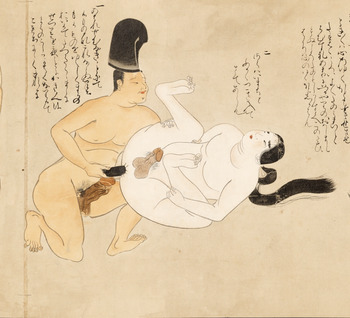
Also in the illustrations are inscriptions of the two subjects’ dialogues. For instance, the first image, in which Chūta is anally penetrating the chigo, the inscriptions convey the menotogo thanking his lord for the rare opportunity to be the inserter, for he is usually the recipient of intercourse. To this the chigo replies, “If this is all you want, sure. [ . . . ] You are so impatient! Fine, just screw me all you want!” However, Chūta soon loses his erection and the chigo commands Chūta to switch to using a dildo. The second illustration of the scroll depicts the couple relying on a dildo, despite Chūta's regained erection (see figure 2).
Chūta dilates his lord's anus using a dildo.

In this obviously fictional and quite absurd narrative, the author technically could have chosen anyone to be the chigo's aid, from his fellow chigo and a priest to a meal server and a secret female lover. Yet the author's choice of a menotogo to be the chigo's assistant is reasonable. This is because doing so aligns with a number of long-standing tropes, including the presumed intimacy of pseudo-brothers, their built-in class-based hierarchy, and the erotic connotation of milk kinship. Further, this story aptly integrates the two institutions of erotic fosterage: the chigo system and the menoto system. While I can only propose to read Kiso Yoshinaka and Imai Kanehira as lovers based on what the text suggests, the example of the chigo and Chūta adds to my argument that milk brotherhood in a homosocial milieu was also likely associated with homoerotic desire in medieval Japan.
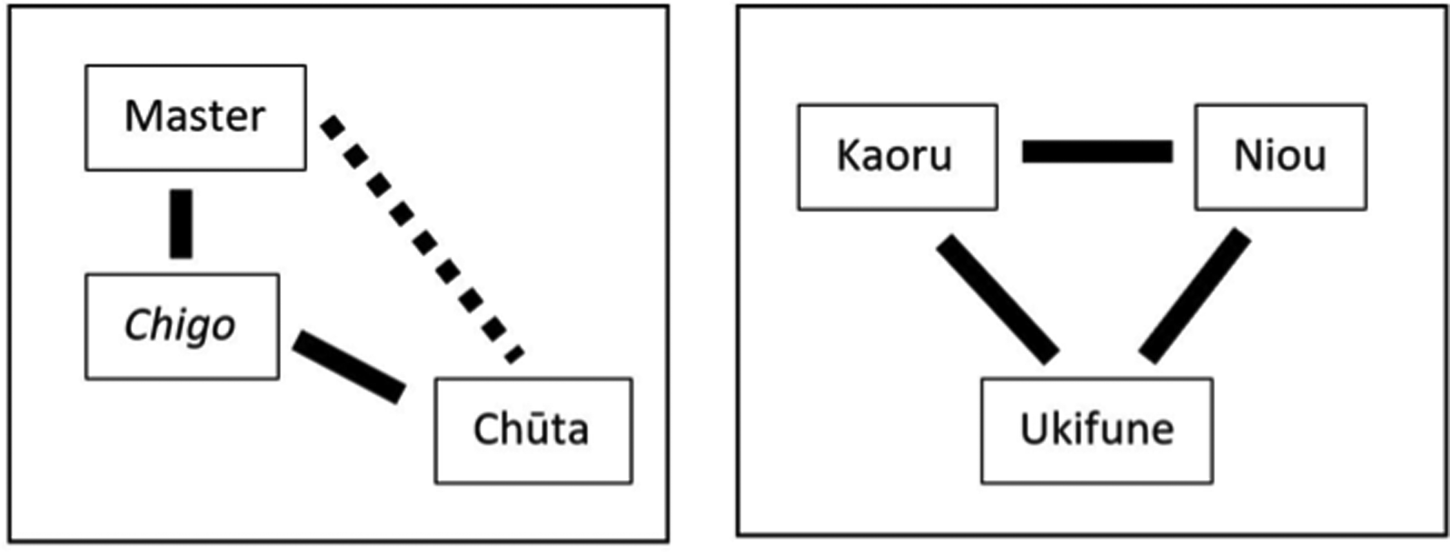
Most significantly, this vignette consists of two socially prescribed hierarchical dyads, the master and his chigo and the milk brothers, which hinge on the chigo. This interpersonal power dynamic, intricately enmeshed with gender, sexuality, and desire, results in a curious, misshapen love triangle (figure 3, left). To put the asymmetrical triangle in perspective, let us compare it with the aforementioned archetype (figure 3, right) from the Uji chapters of the Genji, involving two equal-status men of royal birth, Kaoru and Niou, and their mutual love interest, Ukifune, of humble upbringing.Footnote 28 Ukifune, whose sobriquet stands for “floating boat,” is caught in this precarious double bind, for she cannot be with both Kaoru and Niou, nor can she disgrace either one of them. Her inability to escape the predicament exacerbates her shame and guilt, while the noblemen's desire for Ukifune is intensified by their mimetic desire. Once the entanglement of sorrows, yearnings, and resentments reaches a boiling point within the inverted triangle, the bottom point caves in, expunging Ukifune into the Uji River. When her attempted suicide fails, she takes the holy vow to become a nun and never sees the men again.
The love triangle in Chigo no sōshi (left) and Genji monogatari (right). Adapted from Schmidt-Hori (Reference Schmidt-Hori2021).

In contrast, “An Unusually Benevolent Chigo” draws a three-sided shape dissimilar to the Uji chapters’ symmetrical, upside-down triangle with a fragile bottom point. The two men who share a love for the chigo are not social equals, and the connection between the priest and Chūta is flimsy (indicated by the dotted line in figure 3). In fact, the chigo's two lovers are on the opposite ends of numerous spectrums: social status, age, physical attractiveness, sexual vigor, and reversibility of sex position. One is an elderly, sagacious monk who is a designated penetrator—even the age-induced erectile dysfunction cannot convert him into an insertee. The other is a handsome young layman of humble birth with a high-functioning genital, and, just like the chigo, he is an ambidextrous lover.
Evidently, this lopsided triangle is a well-oiled machine. The center of desire is the chigo, who is in total control of the triad, unlike the heroine of the Uji chapters. He knows exactly what he needs to give and not give to his two partners. With his master, who possesses economic, social, and cultural capital, the unusually benevolent disciple provides the only thing the priest is missing in his life, that is, effortless penetration. We can also see how masterfully the chigo wraps Chūta around his little finger. The menotogo is kept in a state of suspended frustration and is only occasionally gratified with the “special reward” he craves. Even when he is given such an opportunity, the story informs us, as soon as his performance declines, the yōkun ruthlessly orders Chūta to switch to a dildo and refuses him a second chance.
Another crucial aspect of this three-way relationship is that there is no sense of rivalry or jealousy between the chigo's master and retainer. For Chūta, whose priority is his lord's well-being, it is in his best interest to do everything possible to safeguard the mutually beneficial master-acolyte arrangement. This means that the high priest's happy sex life is synonymous with Chūta's own bliss. Furthermore, he has no reason to feel jealous of the high priest; the chigo's erotic labor is, after all, labor. However loyal the youth may be to his teacher, his devotion is unlikely driven by sexual attraction, not to mention that Chūta knows the priest cannot achieve intercourse without his indirect assistance. Would the priest be jealous of Chūta? The night the elderly priest successfully has intercourse with his beloved, he must realize that someone has kindly prepared the chigo's bottom and that that someone was probably the chigo's personal attendant. Therefore, the master priest would not mind this benevolent infidelity. Thanks to these well-balanced interdependencies that the chigo has forged with his two partners, as well as the very loose tie connecting the master and Chūta, every party's satisfaction is ensured. There is no emotional buildup or eruption in this unusual yet harmonious and gleeful love triangle.
Meanwhile, the audience of this illustrated narrative witnesses a complete demolition of the typically romantic, religious, and poignant chigo monogatari world. The renowned monk's declining virility and still-unflinching libido, the chigo's innovative assistance for his dear master and his hypermasculine speech style being juxtaposed with his femininely made-up corporeality and sex positions, and Chūta's exhilaration and disappointment in his assistance for the high priest by, essentially, cuckolding him—these are some of the memorable aspects of this story. Whereas there is no semblance of absolute, unshakable top-down power, this does not result in the collapse of order. Even after the small crisis in the master's bedchamber, things return to normal thanks to the discrete desires of the three parties that scaffold each other. What we see is the collaborative symbiosis within the misshapen love triangle.
As this section has demonstrated, the coexistence of a menotogo and his male yōkun's in a homosocial space likely inspired the people of medieval Japan to imagine triply strong connections between the two men. In the narrative of Kiso and Kanehira's tragic demise and the overly sensual story of the chigo and Chūta, the characters manifest themselves as pairs of men who are deeply and enthusiastically bound by milk kinship, vassalage, and mutual homoerotic desire. In each scenario, the milk brother pair involves a third person (Tomoe and the aged master) to evoke the possibility of fierce romantic rivalry. Nevertheless, the narrative defies this familiar storyline and lets the reader experience something far more riveting and memorable.
Conclusion
This essay has examined the representations of milk kinship in premodern Japanese literary texts of varying forms and contents: Ochikubo, Genji, Heike, and Chigo no sōshi. What is common across the four discrete texts is the erotic subjectivity of menotogo, which indirectly or directly gratifies their yōkun. In Ochikubo and Genji, two sets of milk siblings come together and dovetail into the configuration of the love squares. In contrast to the more prevalent, androcentric topos of the love triangle, which often tokenizes the female, the love square seems to reward all parties involved, especially with shared sexual pleasure. Heike and Chigo no sōshi, in turn, present the milk brothers as triply bonded couples (milk brothers, lord/retainer, and lovers) while unambiguously rejecting the clichéd love triangle model.
This study began by exploring the intersectionality of sexuality, gender, and kinship. Out of the many unwritten rules that make up the premodern Japanese literary tradition, sexual intercourse between parent and child and between siblings is one of the most apparent taboos. Whether crossing these boundaries violates a religious belief, societal order, or something we cannot articulate in absolute terms, one must compartmentalize intimacy, blood ties, and sexual desire. Conversely, arranged familial bonds enable kin to enjoy psychological proximities as well as to act on their erotic desire. The menoto system and chigo system thus create, sustain, and fortify the power dynamics between two hierarchical families and between two elite domains (lay and religious), respectively, through the practice of erotic fosterage. The specific configurations of gender, sexuality, and class attached to the two systems serve different purposes, as well. On the one hand, a menoto's heteronormative sexuality is prized not only for creating long-lasting bonds with her male superiors but also for producing the means to nourish her young yōkun. On the other hand, the short-term homoerotic relationship of the high priest and his acolyte benefits from its inability to produce offspring.
The vital import of sexuality in the menoto and chigo systems notwithstanding, literary texts conventionally avoid illuminating the parent figure's sexual subjectivities and instead habitually “transfer” their erotic energy onto their younger counterparts. This does not indicate that the texts are attempting to conceal some unspeakable, scandalous truths, however. To the contrary, menoto and master priests are at times seen in a sexual light. One example I provided is the woman whom Genji hires to serve his infant daughter as menoto. The other is the aged master monk in “An Unusually Benevolent Chigo.” In this latter context, the story evolves into a carnivalesque eroto-comedy where prescribed hierarchies of acolyte/master, old/young, lord/vassal, penetrator/penetrated, masculine/feminine bear no meanings. Yet the outcome is far from a testosterone-infused competition, purging of the vulnerable, or shaming of the impotent foster father. Rather, what we see in this story is a harmonious merging of two erotic fosterage systems.
This essay is a part of my ongoing research on the representations of “arranged kinship” through fosterage, adoption, and step-parenting in pre-1600 literary texts of Japan. Through this line of research, I aim to elucidate not only the affective dimensions of kinship but also the highly “practical” and even “utilitarian” view of family observable in premodern Japanese literature. Perhaps such pragmatic notions of family are not particular to premodern times, as the “rental family” industry seems to be thriving in today's Japan and same-sex couples have long arranged kinship through adoption. Further, whereas it is common for us to describe an organization or institution as a “family” to convey the presumed intimacy among its members, real families can share intense animosities. The seemingly salient image of “family,” after all, may not be as apparent as we may think in our everyday life. I hope this article and my future research will be able to help deepening our collective understanding of familial relations in various historical and cultural contexts.
Acknowledgments
I would like to thank Charlotte Eubanks and Stephen Poland, who read earlier versions of this paper, for their invaluable feedback. I also want to thank the anonymous reviewers; their suggestions and comments significantly improved this paper.