Introduction
The migration of adult children from rural areas is an integral component of the socio-economic transformations that are taking place throughout the developing world. How this migration affects the wellbeing of older-age parents who remain behind is keenly debated. Mass media accounts and international forums that advocate for older persons, including the second United Nations Organisation (UNO) World Assembly on Ageing, tend to see the dispersion of children, especially to urban areas, as undermining the family, with the absent children leading to the loss by elderly parents of economic, social and psychological support and personal care (French Reference French2006; UNO 2002: para. 16 and 29). Similar statements of concern are common in the literature on ageing in developing countries (e.g. Jamuna Reference Jamuna1997; Kosberg and Garcia Reference Kosberg and Garcia2004; Sen Reference Sen1994: 10). Indeed, the frequent use of the term ‘left behind’ to describe the family members of migrants who remain in the place of origin conveys an impression of desertion (e.g. Nguyen, Yeoh and Toyota Reference Nguyen, Yeoh and Toyota2006). Moreover, the reduced number of children available for support of those now approaching old age – a result of declines in fertility during past decades – is assumed to compound the deleterious effects of migration on older parents (Zimmer and Korinek Reference Zimmer and Korinek2008). These negative portrayals are consistent with a broader argument that the general process of ‘modernisation’ or ‘development’, of which urbanisation is an integral part, undermines the extended family and its function as a source of old-age support (Aboderin Reference Aboderin2004; Hermalin Reference Hermalin and Hermalin2003; Hendricks and Yoon Reference Hendricks, Yoon, Hendricks and Yoon2006; Kabir, Szabehely and Tishelman Reference Kabir, Szabehely and Tishelman2002).
In the academic literature, especially on the developing world, both theoretical arguments and empirical studies have tended to depict migration more positively. Migration is viewed as economically benefiting both those who leave and the family members ‘left behind’, and authors stress the ability of families to adapt to changing circumstances. Migration is typically seen as part of a household strategy to mediate material risks for families and to benefit both migrant and non-migrant members, including in many cases older parents (e.g. Cai Reference Cai2003; Osaki Reference Osaki2003; Stark and Bloom Reference Stark and Bloom1985; Stark and Lucas Reference Stark and Lucas1988; Vanwey Reference Vanwey2004). Few studies, however, have specifically addressed the impacts on older parents in developing country settings or the contributions they make to their migrant children (for exceptions seeColes Reference Coles2001; Giles and Ren Reference Giles and Ren2007; Sando Reference Sando1986; Sorensen Reference Sorensen1986). In addition, the focus of most migration studies is typically limited to the implications for economic exchanges rather than the full range of support that children provide to their parents, including social interaction, assistance with daily living, and care-giving related to ill-health and functional limitations.
One perspective that does consider a broader range of impacts focuses on how changes in family relations and structure through the ‘modified extended family’ respond to the changing socio-economic context. Implicit in this perspective is that parents and adult children exercise human agency to adapt to the changes in their socio-economic environment in ways that maintain family relationships and support exchanges. Rather than modernisation leading to the demise of the family, a modified family form emerges that is adapted to the changed circumstances, including the dispersion of its members (Litwak Reference Litwak1960; Litwak and Kulis Reference Litwak and Kulis1987; Smith Reference Smith1998). According to this view, advances in technology, especially in transport and personal communications, permit family members to maintain close contact and to fulfil some, if not all, of the responsibilities to each other that previously required geographical proximity, including filial obligations to older parents. The proponents of this view recognise that different forms of support vary in their dependence on geographical proximity. The key influences include the extent to which face-to-face contact is required and the frequencies and durations of contacts needed to make support effective. Support and services dependent on frequent face-to-face contact over long durations clearly require proximity and are most at risk from migration. At the same time, monetary transfers can readily be implemented over any distance, while social contacts and emotional support can be sustained over the phone, by email or text messaging, without face-to-face interaction. Also some services that require face-to-face contact but for only a limited period, such as care during an acute illness, can be met by short visits of children who live at a distance and take temporary leave from work – these are increasingly enabled by modern, faster means of transport.
So far, the concept of a ‘modified extended family’ has mainly been discussed in the context of economically-advanced Western countries, especially in the United States of America (for exceptions seeDe Vos, Solis and De Oca Reference De Vos, Solis and De Oca2004; Knodel and Saengtienchai Reference Knodel and Saengtienchai2007). Nevertheless, the modes through which important family functions can be fulfilled remotely and the extent to which they are maintained in a changing society merit exploration in the developing world, but to date systematic empirical assessments using broadly representative data of the impact of adult children's migration on older people's wellbeing have been few (Kreager Reference Kreager2006). Such research will be relevant for theoretical issues concerning both migration and the family. The objective of the present study is to provide a descriptive analysis of the relationship between the migration of adult children and various dimensions of older parents' wellbeing in rural and peri-urban areas of Thailand. We draw on a unique and innovative survey designed specifically for this purpose.
The Thai setting
Thailand provides a particularly interesting context for a study of the impact of migration on older people. Substantial population ageing is under way, the migration of adult children is increasing, and the family size of those reaching older ages is falling. These features, while shared by a number of other developing countries in Asia and elsewhere, are pronounced in Thailand. The share of the Thai population aged 60 or more years has increased from only 5 per cent in the 1960s to over 12 per cent currently, and is anticipated to attain more than one-in-four in just a few decades. Improvements in old-age mortality are leading to longer periods of shared life between successive generations, while at the same time adult children have fewer siblings to help take responsibility for their parents. A series of nationally-representative surveys of older people between 1986 and 2007 have identified a number of the associated implications.
Rural-to-urban migration has been extensive for decades in Thailand, and has made a major contribution to the rise in the urban population that currently constitutes approximately one-third of the total (UNO 2008). As a consequence, a substantial and rising share of adult children live outside their parents' provinces. This is especially true for children of rural parents – the percentage rose from 29 in 1995 to 38 in 2007 (Knodel and Chayovan Reference Knodel and Chayovan2008). This trend reflects the better employment opportunities in urban areas and the fact that rural young adults need to migrate to take advantage of them. The average number of an older person's living children has been declining as a result of the decline in the Total Fertility Rate (TFR), from above 6.0 in the 1960s to its current level of below 2.0. The effect is clearly evident in variations in family size by age of parent. For example, among those aged 75 or more years in 2007, the mean number of living children was 4.8, compared to 3.4 for those aged 60–64 years, and 2.5 for those aged 50–54 years. Moreover, given that the TFR has been below 2.0 for some time, the mean family size of older Thais will continue to decline through cohort succession. The increase in migration of adult children and the reduction in family size has resulted in a steady decline in the co-residence of older people with adult children during the last two decades, from 77 per cent in 1986 to 59 per cent in 2007. In contrast, the share of older people living alone or only with a spouse (so independently of children and other relatives) increased from 11 per cent just over two decades ago to almost one-quarter in 2007.
Thailand has undergone a considerable shift in official concern about population ageing (Jitapunkul and Wiwatwanich Reference Jitapunkul and Wiwatwanich2009; Knodel and Chayovan Reference Knodel and Chayovan2008). Before the early 1990s, the government's response was relatively slow and passive (Warnes Reference Warnes and Phillips1992, Reference Warnes, Lloyd-Sherlock and Johnson1996), but more recently it has become far more active and progressive. This includes the formulation of a new national plan on ageing, the enactment of laws and regulations concerning elderly wellbeing, and measures to encourage the consideration of ageing-related issues in all government programmes. Virtually free (to the patient) government medical services have been available to older people since the early 1990s. Although previously government-guaranteed retirement benefits were limited to civil service and state-enterprise employees, the situation is rapidly changing. In 1999, the national social security system that covers private-enterprise employees incorporated provisions for old-age pensions. Plans are being made to establish a national voluntary retirement savings programme in 2010 that will initiate government contributions for the large numbers of farmers and informal-sector workers and others in the labour force not covered by other plans (Chantanusornsiri Reference Chantanusornsiri2009). There is debate, however, about the sustainability of the funding mechanisms. In addition, as of 2009, welfare allowances of 500 baht per month (about US $15), originally intended for indigent older persons, have been made available to virtually all those aged 60 or more years, thus serving as a universal if modest social-pension scheme (HelpAge International 2009).
Data source and sample characteristics
The Migration Impact Survey (MIS) was conducted in Thailand in late 2006, using a questionnaire that focused on the impact of migration on the older parents who remained in rural areas. The content was guided by a conceptual framework that was based on prior qualitative research by the investigators as well as the theoretical perspectives that have been reviewed. The framework refers to both the benefits and disadvantages for rural parents of their adult children's migration, as well as decisions about initial and return migration in response to changes in the parents' and children's situations (seeKnodel and Saengtienchai Reference Knodel and Saengtienchai2007). The MIS targeted three age groups of parents (50–54, 60–64 and 70–79 years) because they differ in terms of the number of living children and health status, features that likely condition the impacts of children's migration. The sample was drawn from three provinces, two in the Northeast and one in the lower North.Footnote 1 Highly urbanised areas were excluded, thus limiting the sample to parents living in areas with a greater need to migrate to find employment.Footnote 2 The provinces were purposively selected for different economic levels and as sufficiently distant from major migration destinations to ensure substantial geographical separation between parents and many of the migrant children. Within each province, two sample sites (defined in terms of health centres' jurisdictional areas) in each of three districts were selected proportional to size.Footnote 3 A total of 1,011 interviews were completed with approximately equal numbers for each age group in each province. Details of the sample design and implementation as well as the questionnaire are provided elsewhere (seeKnodel et al. Reference Knodel, Kespichayawattana, Wiwatwanich and Saengtienchai2007).
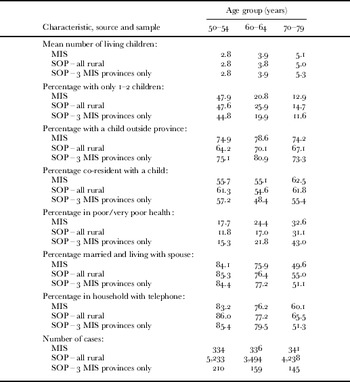
By design the MIS does not constitute a probability sample of the specified age groups of rural parents in Thailand as a whole or even of the three selected provinces. Nevertheless, comparisons with the large nationally-representative Survey of Older Persons (SOP) in 2007 indicate that in a number of relevant respects the MIS sample closely matched its sample (see Table 1).Footnote 4 For the SOP, both national results as well as results limited to the three MIS provinces are provided. Both sources show marked differences in mean family sizes for the three age groups. Moreover, the mean number of children for each age group was similar in both sources, as was the percentage with only one or two children. Both the MIS and SOP show that very substantial majorities of all three age groups had children living outside the province. They also show similar levels of co-residence with a child. In both sources, the proportion of respondents who assessed their own health as ‘poor’ or ‘very poor’ increased with age, and the percentages that were married and lived with their spouse declined substantially with age and through similar levels. Finally, there was close agreement as to the percentage of respondents that lived in households with access to a telephone, an important means for maintaining social contact between parents and migrant children, and both surveys found that telephones were most prevalent in the households of the youngest age group of parents and least prevalent in those of the oldest.
Selected characteristics of older people with at least one living child in non-metropolitan Thailand from two surveys in 2006/07

Notes and sources: MIS: 2006 Migration Impact Survey. SOP: 2007 Survey of Older Persons. For details of both surveys see text. The numbers of SOP cases are unweighted but all SOP results shown were weighted.
Table 1 confirms that the MIS research design fulfilled its rationale. As anticipated, those aged 50–54 years had by far the smallest mean family size, while in contrast, those aged 70–79 years had by far the worst self-assessed health. Those aged 60–64 years were in an intermediate position between better and worse health and between being economically active and having reduced or ceased activity. As well as detailed profiles of the parents, the MIS solicited information on the location and characteristics of each living child and on support exchanges with children aged 16 or more years, and additional information was asked about children who had ever moved from the parents' district for at least one year. We consider those who moved across district boundaries but remained in the same province as ‘short-distance migrants’, those who went beyond the province as ‘long-distance migrants’, and those who left the household but remained in the district as ‘local movers’ rather than migrants.
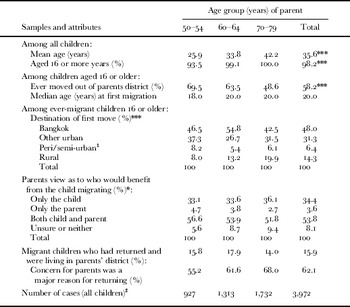
As Table 2 indicates, there were large differences in the mean ages of the children by the age of the parents: those of parents aged 70–79 years were on average 16 years older than those of parents aged 50–54 years.Footnote 5 Nevertheless, even among children of the youngest parents, over 90 per cent were aged at least 16 years, the minimum legal age for most employment, and only four respondents in the age group had no child aged 16 or more years. Almost 60 per cent of the respondents' children had moved at some time outside their parents' district, and about one-half did so before passing 20 years of age. Despite the younger age of children of the parents aged 50–54 years, they were the most likely to have ever migrated, reflecting the increasing tendency of young adults to migrate, especially from rural areas. Their lower median age at first migration is likely an artefact of their younger average age and shorter exposure to the risk of migration compared to the children of older parents.
Migration of children by age group of parent, three Thailand provinces, 2006

Notes: 1. Includes peri-urban (tetsabaan tambol) areas and areas reported as semi-urban. 2. Includes a small number of children for whom age or migration status is unknown.
Source: 2006 Migration Impact Survey (for details see text).
Significance levels: * p=0.05, *** p=0.001. Tests of statistical significance are for either analysis of variance or chi-squared tests.
Each respondent was asked whether, at the time of a child's first migration, they thought it would lead to a better life for the child, and whether it would enable the child to support him or her financially. As Table 2 indicates, among parents of children who ever moved out of their district, over one-half (54%) thought that the move would benefit both the child and themselves, and about one-third thought that the child would benefit but not necessarily themselves. Overall, therefore, the parents thought that the vast majority of the children's lives would improve. Only a few parents thought that only they would benefit, and some respondents were unsure about the consequences or thought it would benefit neither party. Overall, the differences by age group in these assessments were not pronounced. A substantial minority (16%) of children who moved out of their parents' district subsequently returned and were present at the time of the survey. Overall, the respondents said that concern about the parents' welfare was a reason for returning in just over 60 per cent of the returns; this percentage was highest among the oldest age group of parents, perhaps reflecting their greater frailty and lesser ability to support themselves through paid work.
Living arrangements
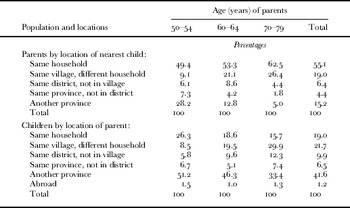
A commonly expressed concern about migration from rural areas is that it leaves aged parents with no adult children living near enough to provide personal care and assistance with household chores and economic activities. This is particularly so in societies such as Thailand where adult children traditionally have been a prime source of old-age support (Cowgill Reference Cowgill1968; Knodel, Saengtienchai and Werasit Reference Knodel, Saengtienchai and Werasit1995). Table 3 examines the location of the MIS respondents and their children in relation to each other – only children aged 16 or more years are considered, since younger children are below the legal working age, unlikely to migrate, and less able to provide meaningful support. The results indicate that the impact of migration on living arrangements was greatest by far for the youngest age group of parents and least for the oldest. Both the percentage who lived with at least one child aged 16 or more years and the percentage with a child not co-resident but living locally (i.e. in the same village) increased with the age of the parent.Footnote 6 Almost 90 per cent of the oldest age group of parents, compared to less than 60 per cent of the youngest, either lived with a 16+ child or had one living locally. In contrast, over one-third of the youngest age group had no 16+ child living in the same district, and 28 per cent had none living in the same province, compared to 7 and 5 per cent, respectively, of those aged 70–79 years.
Locations of parents and their children aged 16 or older by age of parents

Notes: Excludes four respondents aged 50–54 years with no child aged 16 or older. Differences between cohorts are statistically significant at p<0.001 level for both sets of distributions based on chi-squared tests.
Source: 2006 Migration Impact Survey.
Among the respondents' 16+ children, almost one-fifth were living with their parents and two-fifths either co-resided or lived in the same village. The children of the youngest age group of parents were far more likely to live in their parents' household than in a different household in the village, however, while the reverse was true for children of the oldest parents, and the children of parents aged 60–64 years were intermediate in this respect. These differences reflect the different lifecourse stages of the children, particularly in relation to marital status. The older the parent, the greater was the chance that their children had married and moved away (although many had established households in the same locality). Among 16+ children that had left the parents' village, most were in a different province, but this varied by parental age, with just over one-half of the children of parents aged 50–54 years no longer in the same province, compared to only one-third of the children of parents aged 70–74 years. Among the few that lived elsewhere in the same province, many were in the same district as their parents and so not very distant. Among those living outside the parents' province, the vast majority were in Thailand and only 1 per cent lived abroad.
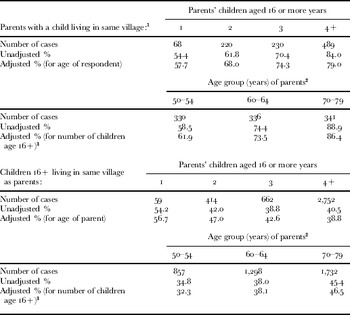
The impact of migration on living arrangements depends not only on the likelihood of a child migrating but also on family size. To elaborate, the low proportion of the children of the youngest age group of parents that lived with their parents or in the same village resulted from both the greater tendency of the children to migrate and the parents' smaller family sizes, although as Table 4 indicates, the high migration rate seems more important. The upper two panels of Table 4 indicate the percentage of respondents with a 16+ child that had at least one such child living in the same village (including in the same household). The topmost panel shows the association with respondents' number of 16+ children. The crude results and those statistically adjusted for the age group of the respondent are shown. The more 16+ children there were, the greater the chance that at least one lived in the same village. Moreover, although somewhat less pronounced, this relationship was still strong after controlling for the age group of the respondent. The second panel shows the prevalence of a child living in the same village by the age group of the respondents, both unadjusted and adjusted for the number of 16+ children. It shows clearly that the association between age and the percentage with a 16+ child living in the same village remained very strong even after controlling for the number of children. Thus the smaller family sizes of the cohort of parents aged 50–54 years at the time of the study accounted to only a modest degree for their low likelihood of having a child living locally – the main reason was the greater tendency for their children to move elsewhere regardless of family size.
Parents and their children aged 16 or more years living in the same village as each other

Notes: Statistical adjustment by Multiple Classification Analysis. All differences across rows are statistically significant at p<0.001 based on analysis of variance except unadjusted results by number of children (p>0.05) and the adjusted results by number of children (p<0.01). 1. Among respondents with at least one child 16 or more years. 2. Age of the parent who was the survey respondent. 3. Number of children of the parent.
Source: 2006 Migration Impact Survey.
The lower two panels of Table 4 are based on children 16+ as the units for analysis and show the percentage that lived in the same village as the parents. The first panel shows the association with number of children (or siblings), both unadjusted and adjusted for the parents' ages. The most striking feature of these results is that, regardless of adjustment, those who were the only child aged 16+ years (i.e. with no siblings) were considerably more likely than those with siblings to remain in the parents' village. Moreover, after controlling for parental age group, the adjusted results show a consistent inverse relationship between the probability of remaining in the parents' village and number of siblings. These results suggest that concerns about parental living arrangements influence migration decisions. The fact that the departure of a child with no grown siblings would leave the parents with no grown child living nearby apparently inhibits children from leaving. While this association did not eliminate the impact of family size on living arrangements, as indicated by the first two panels in the table, there was a moderating effect. The last panel shows that 16+ children of the youngest parental age group were the least likely and those of the oldest parental age group the most likely to still be in their parental village. Controlling for differences in the number of siblings between children of these different parental age groups has little impact on this relationship, which surely reflects the trend towards increased migration.
Migrant children's support to aged parents
Material support and services
In Thailand, as shown by nationally-representative surveys of older people, among older people dependence on children as a main source of material support increases with age while dependence on their own or their spouse's work decreases (Knodel and Chayovan Reference Knodel and Chayovan2008). This pattern is clear in the MIS results. Work was cited as their main source of support by 82 per cent of the parents aged 50–54 years, 59 per cent of those aged 60–64 years, and 26 per cent of those aged 70–79 years. In contrast, only 16 per cent of 50–54-year-old parents cited children (or grandchildren) as their main source of support, compared to 35 per cent of those aged 60–64 years and 63 per cent of 70–79 year-olds.Footnote 7 Nationally-representative surveys have indicated little change over the last two decades in the percentage of people aged 60 or more years that cite children as their main source of income (Knodel and Chayovan Reference Knodel and Chayovan2009). The differences by the age group of parents in dependence on children more likely reflect age and lifecourse stage-related changes rather than a temporal trend of reduced support of parents by children.
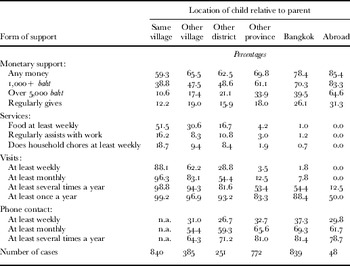
Even when children are not the main source of support, many contribute money and other types of material support to parents. In the case of co-resident children, the interpretation of such support is necessarily ambiguous given that they often share meals and a common household budget. Although contributions from non-coresident children differ in this respect, especially if they have migrated from the locality, in cases where their parents are caring for grandchildren who are children of the migrant, the monetary contribution may be more for the support of the grandchildren than the parents. Table 5 shows the variations in several types of non-coresident children's support of parents by location relative to the parents. It is clear that financial support was most likely from migrant children, particularly those at greater distances. Regardless of their location, the majority of children provided some money, although sometimes the amount was less than 1,000 baht and therefore unlikely to have a great effect on the parents' material wellbeing. Regardless of the amount provided, there was a clear tendency for proximate children to be less likely to provide money than distant children. In particular, those living in Bangkok and the small number abroad contributed the most. In general, only a minority of non-coresident children provided money monthly or regularly, with again a tendency for those in Bangkok or abroad to be most likely to do so. For all measures of monetary support, non-coresident children who lived in the same village as the parents ranked the lowest compared to children in other locations.
Prevalence of support for and social contact with parents during the prior year among non-coresident children aged 16 or more years by location of child

Notes: n.a.: not applicable. All differences across rows are statistically significant at the 0.001 level except weekly phone contact (significant at the 0.05 level) based either on analysis of variance or chi-square tests.
Source: 2006 Migration Impact Survey.
The fact that migrant children in Bangkok were more likely than those elsewhere in Thailand to provide substantial monetary support suggests that migration to urban areas had particular financial advantages for the parents, very likely because of the economic opportunities and higher earnings in the capital city. Although not shown in the table, this is borne out by a direct comparison between non-coresident children in rural and urban areas. Regardless of whether the child was a local mover remaining in the same district or a short- or long-distance migrant, those in urban areas were considerably more likely than those in rural areas to have given over 5,000 baht (about US $125–140) during the past year (Knodel et al. Reference Knodel, Kespichayawattana, Wiwatwanich and Saengtienchai2007). At the same time, those in urban areas outside the parents' province were far more likely to have sent significant amounts than local movers or short-distance migrants.
In contrast to financial support, the closer children lived to the parent, the more likely they were to provide services that required personal contact. On all three measures shown in Table 5 (providing food at least weekly, regular assistance with work or business, and help with household chores at least weekly), non-coresident children in the village ranked distinctly higher than children living elsewhere. In general, the percentage of children providing regular help on each of these dimensions declined with distance from parents and was extremely low for children living beyond the province. These results clearly reflect the practical difficulty that geographical distance presents for providing services that require face-to-face contact. Previous research has indicated that besides routine financial support, it is not unusual for migrant children to pay for major household appliances or motor vehicles, occasionally to make expensive gifts including gold, and to provide major financial assistance to parents with major expenses, such as building a new house or making major improvements to a house (Knodel and Saengtienchai Reference Knodel and Saengtienchai2007). MIS results not included in the table bear this out; for example, one-third of the respondents reported that a child living outside their district had bought a television for them, almost one-quarter had been bought a refrigerator, and one-fifth a telephone. Moreover, 18 per cent said that children living outside the district at the time had given gold or expensive gifts, and 21 per cent that such children had helped with the costs of building or improving their house.
Social contact
Interaction with grown children is a valued and important source of social and emotional support for most older parents. Although the migration of children greatly reduces opportunities for frequent face-to-face interactions, geographical separation does not preclude visits or keeping in touch by phone. As the third panel of results in Table 5 shows, the further away a child lived, the less frequent the visits. The vast majority of children who lived in the same village saw their parents at least weekly and many every day. In contrast, few who lived in a different province and none who lived abroad saw their parents more than several times a year. Nevertheless, the strong tradition in Thailand to return home to pay respects to parents during the three-day Thai New Year holiday (Songkran) ensures that only rarely does a migrant child not see a parent at least annually (excepting children who are abroad).
During the last few years, the newly ubiquitous inexpensive mobile telephones and the widespread installation of the base stations or cells has revolutionised the ability of rural parents and their migrant children to keep in contact. Many older Thais apparently now believe that phone contacts substitute for visits when children live far away. Over 80 per cent of the MIS respondents agreed with the statement, ‘Children who live far away do not need to visit frequently if they often call their parents on the phone’. As noted, a substantial majority of MIS respondents lived in households where at least one member had a phone (see Table 1). Moreover, among the 27 per cent living in households with no phone, 93 per cent knew someone living nearby who had a phone and over three-quarters had used that phone. In addition, the vast majority (88%) of children living outside the parents' village had a phone. This contrasts sharply with the situation only a few years ago when few older people or their children had easy access to a phone. For example, in 1994 in rural areas, only 4 per cent of those aged 60 or more years lived in a household with a phone, while in 2007 the percentage was 71 (authors' calculation from the 1994 and 2007 Surveys of Older Persons).
Unlike visits, the frequency of phone calls with parents varied only modestly with distance. Approximately one-third of all children outside the village had at least weekly phone contact with the parent during the past year.Footnote 8 Among those who did not speak weekly with the parent, many still had occasional phone contact. Thus most children had at least monthly telephone contact, including two-thirds or more of those living in a different province or in Bangkok, and the large majority had phone contact at least several times in the year. Even children who lived abroad had a similar frequency of phone contact as those who remained in Thailand. Although not shown in the table, there was little difference in this measure between migrants in Bangkok and in other Thai urban areas, but both were more likely than those who had moved to non-urban areas to have frequent telephone conversations with their parents, partly because those in urban areas were more likely to have phones of their own.
Health-care assistance
Daily personal care for an elderly parent who is chronically ill, has functional limitations or is otherwise disabled requires residential proximity if not co-residence and normally cannot be provided by children who live at a distance. The MIS respondents were generally tolerant of physical separation as long as they were healthy but were much less so if they were not. Almost 90 per cent agreed with a statement that as long as social contact is maintained and parents are in good health, it is acceptable for children to live away, but over 70 per cent disagreed with a statement that when parents are not well, it is acceptable for children to hire others to care for them rather than provide care themselves. Moreover, in situations where no children are nearby and a parent is in poor health, over 80 per cent agreed it is better for children to move back to care for parents than for parents to move to join children. Thus the prospect of frail health changes older people's acceptance of living without a child nearby, and implies that if all the children have moved away, at least one is expected to return.
While the migrant children were not in a position to provide long-term care, they were not totally detached from assisting with their parents' health care. Our previous qualitative research revealed that for rural parents, there might even be health benefits from having a migrant child. Children in Bangkok and other urban areas learn that health facilities and services are better in the cities than in their parents' localities, and many can provide information, advice and guidance and even facilitate access to superior services and facilities when serious illnesses or health conditions develop (Kespichayawattana and Wiwatwanich Reference Kespichayawattana and Wiwatwanich2005). Almost one-quarter of the MIS respondents with a migrant child reported that a child living elsewhere helped them get medical care outside the parents' own area. In addition, although children who live beyond a convenient commuting distance from parents are unable to provide long-term care, they still can return at times of a serious acute health problem. Among the approximately 40 per cent of respondents with a migrant child who had ever been seriously ill, about one-half reported that a child had returned to provide care.
Chronic illness and frailty among parents pose more intractable barriers to assistance from migrant children. As research elsewhere has shown, separation by even a short distance simply makes it impractical for a child to provide the day-to-day care that someone who is frail or chronically ill requires (Litwak and Kulis Reference Litwak and Kulis1987). Among the oldest age group of MIS parents, this posed only a modest problem because a large majority had an adult child living with them or in the same locality. Nor was it a problem for the youngest age group, because most were in reasonable health and did not need personal care. Their future situation is uncertain, however, given the strong likelihood that a far higher proportion of succeeding cohorts will have no children nearby when they reach an advanced age and health problems become more common.
Parents' contributions to migrant children
Exchanges of material support and services between parents and adult children are typically mutual or flow in both directions (Kabir, Szabehely and Tishelman Reference Kabir, Szabehely and Tishelman2002). Numerous surveys in Thailand have made clear that parents rarely provide routine monetary support to adult children who leave the household. According to the 2007 Survey of Older Persons, only 7 per cent of parents aged 60 or more years who had non-coresident children reported giving money to one in the prior 12 months, and only 4 per cent reported giving as much as 5,000 baht (Knodel and Chayovan Reference Knodel and Chayovan2008). Nevertheless, as earlier qualitative research has shown, in emergencies or when special circumstances arise, some parents are an important source of financial support, as with the funds to establish a business, pay grandchildren's school fees, or buy a house or property. In addition, some parents contribute to a migrant child's material wellbeing by providing rice or other produce from their farm or village, especially to children living in urban areas (Knodel and Saengtienchai Reference Knodel and Saengtienchai2007).
Unlike most surveys of older persons in Thailand that have asked only about material support to children during the previous year, the MIS included questions about financial assistance ever provided. The respondents were asked if they had ever provided loans or gifts or had paid for an expense (excluding costs for education) valued at 5,000 or more baht with regards to each of their children. Among the 87 per cent of respondents who had a child that ever moved beyond the respondent's district, 35 per cent had provided at least one with major financial help while the child was living away. Overall, 20 per cent of migrant children had received such help. Moreover, besides direct financial support, over one-half of the parents reported they sometimes gave migrant children rice or other produce. Parents also provided useful services for their migrant children, with the care of grandchildren being particularly important because it freed the migrant to engage in economic activity and eliminated the need to seek childcare elsewhere. In many such cases, parents virtually fostered the grandchildren and took near full responsibility for raising them.
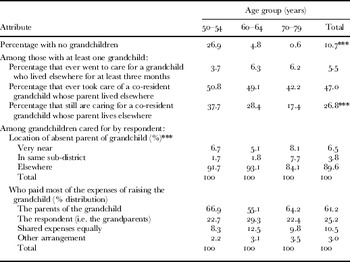
As Table 6 shows, the vast majority of MIS respondents had grandchildren, although understandably relatively fewer aged 50–54 years were grandparents than among those who were older. Among those with grandchildren, few had moved to the migrant child's location to provide grandchild care for an extended time (i.e. at least three months). In contrast, close to one-half reported that they had cared for a grandchild whose parent was absent, and in over half of these cases they were still doing so. This last situation was far more common for the youngest age group of parents, likely reflecting that their grandchildren were far more likely to be very young. In addition the older age groups, especially the oldest, appeared to have lower lifetime experiences of caring for a grandchild of an absent parent. Table 6 also makes clear that grandchild care begins early, typically before the child's first birthday. In the vast majority of cases of grandchild care in the absence of a parent, the parents had left the grandparents' district. At the same time, de facto fostering grandchildren was not necessarily an economic burden, for in most cases the grandchild's parents were the main contributor to the expenses, and in only about one-quarter of the cases was the respondent paying most expenses. This finding is consistent with the fact that 61 per cent of migrant children who left a child in the care of a respondent remitted more than 5,000 baht during the prior year, compared to only 32 per cent of those with no child under the respondent's care (figures not in table). Remittances from the migrant parent of the grandchildren, however, may largely be for expenses associated with the grandchildren rather than of direct benefit to the migrant's parents.
Grandchild care by age of older parents

Notes: For all age groups, the median age of the grandchild was less than one year when care began.
Source: 2006 Migration Impact Survey.
Significance level: *** p=0.001. Tests of statistical significance are based on chi-squared tests.
Impacts on parental wellbeing
Net balance of material exchanges
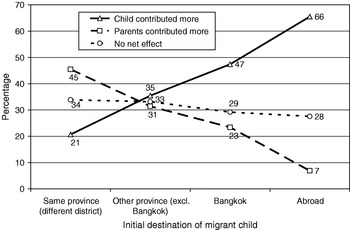
Exchanges of material support and related services between parents and migrant children typically occur over an extended period during which the net balance can be in either direction and can change. The MIS respondents were asked to assess the overall net balance of exchanges with each migrant child during the entire time that the child had lived away. Overall, the respondents assessed the balance to be in their favour in 39 per cent of the cases, and in the child's favour in 29 per cent of the cases. For the remaining 31 per cent, the exchanges were said to be balanced or there were no exchanges. As Figure 1 shows, however, the results varied substantially with the initial destination of the migrant child. For short-distance migrants, the child was far more likely to be the net beneficiary, but the further away the migrant child, the more likely that the material exchanges favoured the parents. This was especially so for the few children who went abroad. Among the migrant children who remained in Thailand, those who went to Bangkok were most likely to have transferred substantial sums to the parents than those who went elsewhere (see Table 5), and the parents reported higher remittances from children living in urban areas other than Bangkok compared to those outside urban areas (not shown). Overall, the migration of children to urban areas appeared to benefit rather than undermine parents' economic wellbeing.
Percent distributions of children who ever migrated according to net balance of material exchanges with parents during entire period away, by initial destination.

When the net balances are examined by the age group of the parents, substantial differences are evident (not shown). The most favourable balance for parents was among children of the oldest age group, with almost twice as many having contributed more support to their parents than they received (40% versus 22%). In contrast, among children of parents aged 50–54 years, the relative percentages were inverted (33% versus 40%). One factor that contributed to the unfavourable balance for the youngest age group of parents was that a substantial share (16%) of their migrant children were still in school and dependent on parental support. When these children are excluded, parents of this age group were almost as likely to be the net gainer as the migrant children (35% versus 37%). In addition, the differences in the net balances by parental age likely reflect the increasing need for support among the oldest. Whether or not the balance of intergenerational support relationships will shift more in favour of the younger parents as they age is, of course, not yet known.
Satisfaction with children
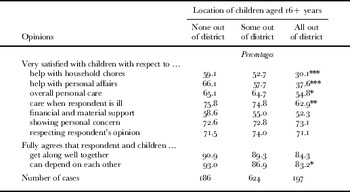
The MIS respondents were asked about their satisfaction with various dimensions of support and assistance from their children as well as the amount of concern and respect their children showed. Since the questions were asked in relation to all rather than individual children, direct comparisons between migrant and non-migrant children are not possible, but a comparison can be made between, on the one hand, the respondents whose children were all outside the district (i.e. current migrants) and, on the other hand, the respondents whose children were either all living in their district or scattered both in and outside the parents' district. This comparison provides an indirect indication of how migration affects several key dimensions of the parents' wellbeing.Footnote 9 As Table 7 shows, differences between the percentage that were very satisfied on most dimensions were quite modest between those whose children all lived in their district and those who had children both in and out of the district.Footnote 10 For some dimensions, distinctly lower percentages of parents were very satisfied with their children that were all out of the district.
Satisfaction and relations with children by current location of children aged 16 and over

Notes: Excludes four respondents with no child aged 16 or older.
Source: 2006 Migration Impact Survey.
Significance levels: * p=0.05, ** p=0.01, *** p=0.001. Tests of statistical significance are for F in analysis of variance.
Among parents whose children were all migrants, the percentage that was very satisfied with their children was much lower with respect to help with household chores and personal affairs than among those with all or some children still in their district. This finding is consistent with geographical proximity being a necessary condition for the provision of these forms of support. Less pronounced but still clear were differences in satisfaction with respect to overall personal care and care during illness. As noted in the introduction, care during acute illnesses or occasional checkups and treatments can be provided by migrant children through short-term visits. Care for parents with chronic illness and frailty, however, requires long presences and is impractical from a distance. Unlike the four dimensions just discussed, having all children currently out of the district was only modestly associated with lower satisfaction with the material and financial support provided by children. This likely reflects that remittances can readily be provided from a distance. In addition, regardless of the migration status of their children, close to three-quarters of the respondents said they were very satisfied with the level of personal concern and the level of respect they received. We note that neither requires geographical proximity and that both can be conveyed during visits or by telephone, which is consistent with another recent study that found that the out-migration of children is not associated in Thailand with a greater level of depression among older parents (Abas et al. Reference Abas, Punpuing, Jirapramukpitak, Guest, Tangchonlatip, Leese and Prince2009).
Desertion by children
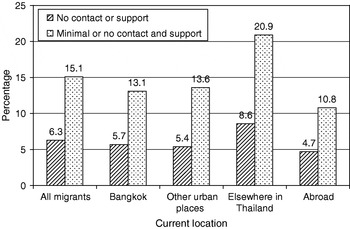
A potentially devastating consequence of the migration of adult children for the parents is that they are abandoned, but the assertions that migration leads to significant levels of desertion of elderly parents are typically based on anecdote. The MIS provides systematic empirical evidence on the issue. Here desertion is defined in terms of the frequency of social contact and the extent of material support provided during the previous year. Since desertion is actually a matter of degree, we use alternative measures. The first refers to situations where there had been no contact or support during the prior year, the most extreme cases. The second refers to situations in which contact was limited to only one visit, less than monthly phone contact, material support of less than 1,000 baht, and no substantial food gift, which encompasses situations that might be considered as neglect rather than desertion. Assessments of the extent of desertion can be addressed from the perspective of either the children or the parents: the former indicates the prevalence of a child deserting the parents, while the latter indicates how many parents are deserted by all their children. Figure 2 examines desertion from the perspective of migrant children. Overall, only 6 per cent of children living outside the district of their parents neither had contact with nor had provided any material support to parents during the previous year. Even based on the broader indicator of desertion, only 15 per cent had only minimal or no contact and provided little if any material support. Migrant children who lived outside urban areas were distinctly most likely to have had little or no contact and to have provided no consequential material support.
Indicators of desertion of parents by current location of migrant child.

When assessing desertion from the parents' perspective, it is important to recognise that among the MIS respondents who had a migrant child aged 16+ years currently living outside their district, many had more than one child. Thus, even if one was neglectful, another may have remained in contact or provided material support. Moreover, just over one-half of the MIS respondents with migrant children co-resided with another child, and just over 70 per cent had at least one child who either co-resided or lived in the same locality. Thus while the desertion or neglect by one or more migrant children may be a cause of distress, it by no means implies that a parent is deserted by all their children. In short, the percentage of deserted parents is considerably less than the percentage of children who desert parents.
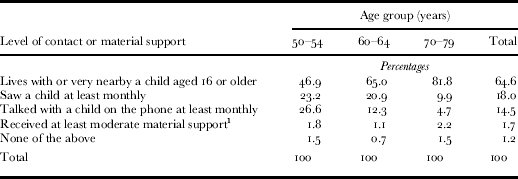
Table 8 presents a hierarchical index of social contact and material support to assess the extent to which migration led to the desertion of parents. The first category includes respondents who lived with or very near a child aged 16 or older and thus almost certainly had frequent if not daily contact. The second category includes respondents who saw a child at least monthly even though they did not live with or nearby a child. The third category is the respondents who had at least monthly phone contact with one or more children even though they did not see a child monthly. The fourth category is parents who lacked monthly contact with any child but received meaningful material support from at least one (defined as at least 1,000 baht, regular monetary contributions, or at least monthly provision of food during the prior year). The final residual category is parents who neither had monthly contact with nor received substantial material support from any child and thus can be considered as deserted by all their children.
Level of social contact or material support by at least one child during the previous year for parents with at least one child living in another district, by age of parents
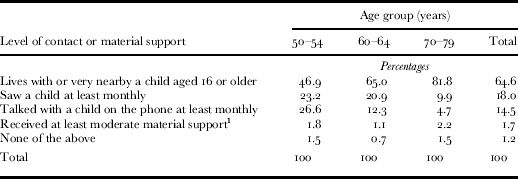
Notes: Categories of social contact or material support are hierarchical in that cases falling in a prior category are excluded from subsequent categories. 1. Moderate material support includes any of the following: receiving at least 1,000 baht, regular monetary support, or at least monthly provision of food during the prior year.
The figures make clear that very few Thai parents with migrant children had been deserted by all their children. Overall, almost two-thirds lived with or very nearby a child, and the vast majority of the remainder either saw or had phone contact with one at least monthly. This leaves only 3 per cent who did not have monthly contact with at least one child; and more than half of these had received at least moderate material support during the past year from at least one. Even among the 19 per cent of respondents whose children all lived outside the district, only 10 per cent had less than monthly contact with a child, and only 5 per cent had neither monthly contact nor received at least moderate material assistance (not in table). Thus few older parents in rural Thailand had been totally deserted, even if some of their migrant children had deserted them. While the share of parents out of social contact with any child differed little among the three age groups, the type of social contact varied substantially. Over four-fifths of the oldest age group had at least one child living with or very nearby them, compared to two-thirds of the intermediate age group and less than half of the youngest. For both the youngest and the intermediate age groups, much of the difference was compensated by frequent visits from a child. Particularly important for the youngest age group was reliance on phone contact, likely reflecting the fact that among respondents who did not live with or very nearby a child, the youngest age groups of parents were least likely to have a child living in the same village or district (19% versus 41% and 54% for the two older age groups). The experience of the parents aged 50–54 years indicates that the recent spread of telephones, especially cell phones, is mitigating what would otherwise be more prevalent social isolation among older parents with no children living within easy visiting distance.
Discussion and conclusions
The presented findings are broadly inconsistent with and contradict the ‘alarmist’ view referred to in the paper's introduction that in developing countries the massive migration of young adults to cities leads to the widespread desertion of older parents. While some rural Thai older people have lost contact with their children and been ‘left behind’ to fend for themselves, such situations are rare. Rather, a large majority of migrant children in Thailand maintain social contact with their parents, and most provide at least modest financial support. Moreover, children who have moved to urban areas, especially Bangkok, are more likely to provide significant remittances than children who moved elsewhere in Thailand, undoubtedly reflecting the higher earnings in cities. They are also at least as likely to maintain social contact. Fears that urban settings, or the process of urbanisation, particularly erode the filial allegiances of migrant children seem therefore to be unwarranted.
The ‘household strategy’ perspective views the migration of rural adults as a way of diversifying and combating the rural household's economic constraints and risks, and as benefiting both the migrants and the family members who remain behind. Since migrant children in the non-agricultural sector are subject to different cycles of economic risk than rural parents in agricultural households, each provides a form of insurance for the other and contributes to each other's material welfare. Our findings provide some support for this view. More than one-half of the MIS respondents thought that, at the time of a child's move, the migration would benefit both the child and themselves. Moreover, many migrant children provided parents with remittances and paid for major household appliances and home improvements, while some parents provided farm produce and occasional major financial assistance. Thus the exchanges between rural parents and their migrant children appeared to benefit both. Nonetheless, the parents' satisfaction with regards to services from children that require proximity was lower if all their children had migrated. Since migration reduces the pool of children living nearby, it increases the chances that in old age, parents have to forgo the benefits associated with proximate residence. In this respect, the findings are somewhat at odds with the ‘household strategy’ perspective.
Quite consistent with our results is the ‘modified extended family’ postulate that although migration associated with development leads extended family members to be geographically dispersed, the advances in transport and communication technologies and infrastructure that accompany development permit members to maintain family ties and assistance in modified forms. Our findings clearly document how important cellular network phones have become in Thailand for enhancing the ability of migrant children and their parents to maintain contact and social support despite geographical separation. The greatly improved ability to communicate by phone also means that parents can reach geographically dispersed children quickly in a health crisis and that the children can readily communicate with each other to co-ordinate responses. Improved roads and the wider availability of motor vehicles are also enabling children living elsewhere to reach and provide assistance to their parents more rapidly, and to provide care at least temporarily if no sibling lives nearby.
Clearly the consequences of the migration of adult children from rural areas for the ‘left behind’ parents are multifaceted and complex, and the benefits and disadvantages vary with the lifecourse stages of both parties. Given that the data we have analysed are cross-sectional and most of the presented information has been descriptive, the causal connections are uncertain. Nevertheless, the results suggest that in rural Thai families, parents and adult children exercise human agency to adapt to the changes in the social and economic environment brought about by development in ways that are not necessarily detrimental to intergenerational relations. For example, although the youngest age group of the parents are members of a cohort that have had relatively few children and were least likely to co-reside with a grown child, they were at least as likely as the older age groups to say that they were very satisfied with their children in terms of all the forms of support and assistance asked about in the survey. In addition, social contact between migrant children and parents, both in terms of visits and phone calls, was more frequent for this age group than for the older parents. Overall, most rural-based parents and their migrant children appeared to be adapting to the increasing need to live separately in ways that maintain family relationships and enable mutual support.
It is uncertain to what extent the presented findings can be generalised beyond Thailand or indeed to Thailand in the future. As noted, some of the major socio-demographic forces with implications for the wellbeing of older people, including rapid population ageing, the increasing rural–urban migration of working-aged adults, and a decline in the mean family size of future cohorts of older people, are shared by other developing countries in South-East Asia and elsewhere. The described forces and trends are more pronounced in China, where some observers are very concerned about migration's effect on elderly parents (e.g. French Reference French2006). Yet research in China has produced mixed findings (e.g. Biao Reference Biao2007; Cheung and Kwan Reference Cheung and Kwan2009; Guo, Chi and Silverstein Reference Guo, Chi and Silverstein2009; Silverstein, Cong and Li Reference Silverstein, Cong and Li2006). Thus whether the ‘alarmist’ perspective is more pertinent elsewhere remains an open question, at least for now. Thailand has unique features that will have conditioned the findings of the present study. Thai adult children's migrations are overwhelmingly within the country and few emigrate, which contrasts greatly with other countries in the region, most notably the Philippines (Semyonov and Gorodzeisky Reference Semyonov and Gorodzeisky2008). Thailand also has its own unique cultural setting that is strongly characterised by a value system derived from Theravada Buddhism, a feature shared by only a few other countries in the region. Still, the sense of filial obligation is widespread across South-East and East Asia including in countries where other religions predominate (Asis et al. Reference Asis, Domingo, Knodel and Mehtha1995).
How the socio-economic development of Thailand will proceed is uncertain. The rapid transition to low fertility several decades ago will challenge the maintenance of the ‘modified extended family’ among the coming cohorts of elderly parents with fewer adult children. One current arrangement, by which some siblings remain with elderly parents and others migrate, will probably become less common. This could substantially change the implications of migration for the wellbeing of the parents, especially after illness or frailty sets in and daily personal assistance is needed. Extensions of later life may result in increased numbers of parents reaching more advanced ages and, for example, contracting dementia with its enhanced need for personal care assistance. Nevertheless it is premature to conclude that the balance between positive and negative effects of migration for rural Thai elders will necessarily become less favourable. Many other changes will accompany the shift in family size, including the expansion of and improvements in public and private health provision, social security and other forms of formal support. As elsewhere in much of the developing world, the potential adverse effects of changes in the extent and form of filial obligations may be offset by benefits from economic growth that enable the expansion of formal support (Silverstein, Bengtson and Litwak Reference Silverstein, Bengtson, Litwak, Biggs, Lowenstein and Hendricks2003). Technological changes will also continue to be influential, including rapidly increasing computer literacy and the associated means of information gathering and communication. Moreover, the educational level of both adult children and their older parents will improve with cohort succession. Thus modifications in intergenerational family forms will occur in a changing social, economic and technological context. The fact that the cultural roots of filial obligation still appear to remain strong in Thailand suggests that some accommodation to this changing situation is likely to emerge.
Acknowledgements
The research for this paper was assisted by an award from the Thailand Research Fund–National Health Foundation and support from the UNFPA Thailand office.