


Post-traumatic stress disorder (PTSD) exists among medical professionals during terror campaigns. Reference North, Tivis, McMillen, Pfefferbaum, Cox, Spitznagel, Bunch, Schorr and Smith1 Clinicians with PTSD may provide poor care. Reference Hoge, Terhakopian, Castro, Messer and Engel2 Psychological interventions have been advocated but doctors might be reluctant to receive them. Reference Hammond and Brooks3
Previously, we demonstrated that 16% of hospital doctors practising during suicide-bombing attacks in Jerusalem suffered PTSD symptoms. Reference Weiniger, Shalev, Ofek, Freedman, Weissman and Einav4 No association was found between PTSD symptoms and professional exposure to victims of terror inside the hospital. Here we test the hypothesis that the presence of PTSD may be associated with exposure to other variables and that it may indicate the presence of coexisting psychological effects that may negatively affect work performance and a reluctance to receive psychological assistance.
Method
In our original study, Reference Weiniger, Shalev, Ofek, Freedman, Weissman and Einav4 conducted in the two Hadassah medical centres in Jerusalem (tertiary and district), a questionnaire-based survey of hospital doctors working in a mix of departments was conducted during staff meetings. Reference Weiniger, Shalev, Ofek, Freedman, Weissman and Einav4 Complimentary and confidential access to a neutral body offering cognitive–behavioural therapy was offered to those electing to be identified and found to be in need.
The questionnaires Reference Weiniger, Shalev, Ofek, Freedman, Weissman and Einav4 included the Post-traumatic Symptom Scale–Self-Report (PSS–SR), the Maslach Burnout Inventory (MBI), the Brief Symptom Inventory (BSI), the Brief COPE, exposure-to-trauma questionnaires and the Mastery Scale. The PSS–SR defined the study/control groups (PTSD/non-PTSD). Doctors who had a DSM–IV-defined traumatic event, who endorsed qualifying PTSD symptoms on the PSS–SR and who reported significant distress/impairment in functioning (PSS–SR items 18 and 19), were defined as having probable PTSD symptoms. All others were defined as not having PTSD. Outcome measures were: prevalence of causes of PTSD other than those described previously (exposure out of work, previous trauma, working hours); Reference Weiniger, Shalev, Ofek, Freedman, Weissman and Einav4 association of PTSD symptoms with additional comorbidities (symptoms following trauma (i.e. reduced functioning (Mastery Scale), stress-induced symptoms (BSI), suffering (PSS–SR item 20)), negative feelings (General Well-Being Schedule, item 27), burnout (MBI), poor coping (Brief COPE)); and adherence to therapy.
Data were analysed using SPSS 10.0 for Windows by H.O. and S.E. Factor analysis was performed for exposure to terror, burnout and coping strategies. Reference Hammond and Brooks3 Comparisons were performed as follows.
-
(a) Demographic characteristics: chi-squared was used for categorical variables, Fisher's exact test for dichotomies, and multivariate analysis of variance (MANOVA) for interval variables based on the appropriateness of parametric methods found in the inspection of the distributions.
-
(b) Alternative causes of PTSD: MANOVA for the degree of exposure to terror overall and one-way post hoc ANOVA for breakdown of this comparison to exposure in/outside of work and workload assessment. Chi-squared for the prevalence of prior trauma.
-
(c) Comorbidities: MANOVA was used for all comparisons: burnout, coping, functioning, stress-induced symptoms and feeling (on the General Well-Being Schedule Reference Weiniger, Shalev, Ofek, Freedman, Weissman and Einav4 ).
-
(d) Compliance with submitting personal details: chi-squared. Several models (linear, quadratic, cubic, logarithmic and inverse) representing the percentage of PTSD symptoms as a function of the percentage of compliance with questionnaire response were examined and ranked by their goodness of fit measured by r 2. Models requiring logarithmic transformation of the outcome variable (percentage of PTSD) could not be computed because of cases with non-positive values.
Results
Three-quarters of the doctors approached completed the questionnaires (212 out of 281, 75.4%). Thirty-three (15.6%) had PTSD symptoms. Post-traumatic stress disorder as a cause for bias in questionnaire completion was ruled out by demonstrating that the rate of PTSD symptoms remained proportional to the rate of questionnaire completion; the linear regression fitted best for the percentage of PTSD as a function of the percentage of responders (r 2=0.353, P=0.01)
The non-PTSD group comprised more Jewish (P=0.001), married participants (P=0.02) with higher incomes (P=0.001) who had performed army service (P=0.001). The groups had similar male:female ratios (22:11 PTSD, 144:35 non-PTSD; P=0.14). The participants' age, number and age of their children, number of years living in Israel and number of years in clinical practice were also similar.
Participants with PTSD symptoms were more exposed to terror out of work (P<0.001). The prevalence of lifetime exposure to traumatic events potentially predisposing to PTSD was similar (48.4% (n=16) among PTSD v. 42.1% (n=72) among non-PTSD; P=0.62). Although the actual working hours reported by the two groups were similar, the PTSD group felt their workload was greater (P=0.052).
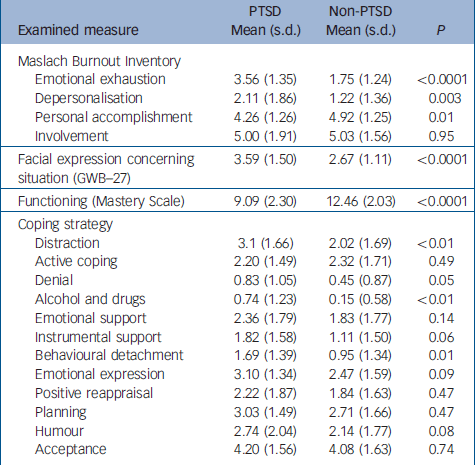
Upper-third scores in both the Emotional Exhaustion and Depersonalisation subscales of the MBI were taken to indicate the presence of burnout (Table 1). Reference Grassi and Magnani5 Burnout was significantly more prevalent among doctors with PTSD than among doctors without (51.5% (17 out of 33) v. 13.4% (24 out of 155) respectively; P<0.001). Doctors with PTSD manifested more symptoms such as depression, anxiety, phobicanxiety, hostility, paranoidideation, psychotism, loss of appetite, sleep disturbances, death thoughts, guilt feelings, somatisation, obsessive–compulsive symptoms and interpersonal sensitivity (P<0.0001 for each). Negative coping strategies were more frequently used by doctors with PTSD symptoms (P<0.01) (Table 1). Functioning was significantly reduced among doctors with PTSD symptoms (P<0.0001). The incidence of participants submitting personal details for access to psychological intervention was similar for doctors with (20 out of 33, 61%) and without (89 out of 179, 50%) PTSD (P=0.33). Only three doctors with PTSD symptoms and who had identified themselves actually attended therapy (15%, 3 out of 20).
Differences between the PTSD and non-PTSD groups in burnout and coping strategies
| Examined measure | PTSD Mean (s.d.) | Non-PTSD Mean (s.d.) | P |
|---|---|---|---|
| Maslach Burnout Inventory | |||
| Emotional exhaustion | 3.56 (1.35) | 1.75 (1.24) | <0.0001 |
| Depersonalisation | 2.11 (1.86) | 1.22 (1.36) | 0.003 |
| Personal accomplishment | 4.26 (1.26) | 4.92 (1.25) | 0.01 |
| Involvement | 5.00 (1.91) | 5.03 (1.56) | 0.95 |
| Facial expression concerning situation (GWB—27) | 3.59 (1.50) | 2.67 (1.11) | <0.0001 |
| Functioning (Mastery Scale) | 9.09 (2.30) | 12.46 (2.03) | <0.0001 |
| Coping strategy | |||
| Distraction | 3.1 (1.66) | 2.02 (1.69) | <0.01 |
| Active coping | 2.20 (1.49) | 2.32 (1.71) | 0.49 |
| Denial | 0.83 (1.05) | 0.45 (0.87) | 0.05 |
| Alcohol and drugs | 0.74 (1.23) | 0.15 (0.58) | <0.01 |
| Emotional support | 2.36 (1.79) | 1.83 (1.77) | 0.14 |
| Instrumental support | 1.82 (1.58) | 1.11 (1.50) | 0.06 |
| Behavioural detachment | 1.69 (1.39) | 0.95 (1.34) | 0.01 |
| Emotional expression | 3.10 (1.34) | 2.47 (1.59) | 0.09 |
| Positive reappraisal | 2.22 (1.87) | 1.84 (1.63) | 0.47 |
| Planning | 3.03 (1.49) | 2.71 (1.66) | 0.47 |
| Humour | 2.74 (2.04) | 2.14 (1.77) | 0.08 |
| Acceptance | 4.20 (1.56) | 4.08 (1.63) | 0.74 |
Discussion
The prevalence of PTSD among our hospital doctors practising during a terror campaign Reference Weiniger, Shalev, Ofek, Freedman, Weissman and Einav4 is similar to that found among doctors working in trouble spots elsewhere in the world Reference Hodgetts, Broers, Godwin, Bowering and Hasanovic6 and approximates that described among the Israeli civilian population during the same period. Reference Shalev, Tuval, Frenkiel-Fishman, Hadar and Eth7 Expression of PTSD symptoms was not related to professional exposure to terror victims Reference Weiniger, Shalev, Ofek, Freedman, Weissman and Einav4,Reference Hodgetts, Broers, Godwin, Bowering and Hasanovic6 but neither was it related to previous lifetime predisposing events or working hours. The only situation-specific predisposing variable associated with PTSD symptoms in our study was exposure to terror out of work. Doctors with PTSD symptoms demonstrated psychological effects such as increased burnout, general distress and negative coping strategies and were reluctant to seek help.
Stress and burnout are common among doctors (25–32%). Reference Grassi and Magnani5 Burnout is related to overload and may coexist with depression, Reference Shanafelt, Bradley, Wipf and Back8 dissatisfaction in professional relationships Reference Ramirez, Graham, Richards, Cull and Gregory9 and suboptimal patient care. Reference Shanafelt, Bradley, Wipf and Back8 The perception of increased workload among the PTSD group may have contributed to burnout. Traumatic workplace experiences are associated with coping problems. Reference van der Ploeg, Dorresteijn and Kleber10 Posttraumatic stress disorder is related to horror, grief and anxiety, and has also been associated with poor work performance. Reference North, Tivis, McMillen, Pfefferbaum, Cox, Spitznagel, Bunch, Schorr and Smith1 Burnout, reduced functioning, poor coping and PTSD coexist in our doctors continuing to provide care.
The precipitating condition is not identified in this study and PTSD symptoms may be confounding intermediaries as the relationship between comorbidities is not examined. The existence of prior trauma was only superficially addressed, albeit found equally in both groups. Regardless, it demonstrates that PTSD symptoms may flag those doctors requiring help. Training and debriefing may reduce the incidence of PTSD among doctors working in terror zones. Reference Lubin, Sids, Vishne, Shochat, Ostfield and Shmushkevitz11
As organised acts of aggression against civilian populations spread worldwide, doctors with PTSD symptoms may be found in any hospital. Administrators should be alert to possible manifestations of PTSD among their staff and promote early intervention when necessary.
Acknowledgements
Financial support for this work was provided by an anonymous donation to Hadassah Medical Organization from a private individual who had no access or influence on the study or its results. A.Y.S.'s work was supported by an NIMH grant (R34-MH-71651).




eLetters
No eLetters have been published for this article.