INTRODUCTION
The fitness of a mutant is crucial to both theoretical and practical perspectives. Indeed, knowing the fitness of a mutant allows prediction of its prevalence during a species’ evolution. Similarly, for economically important mutants, breeders need to know its seed viability in order to design plant-breeding programmes adequately. In maize, several mutants have economic importance because they produce chemical, morphological and physiological changes in the seed endosperm. Such is the case of the recurrent mutant sugary1 (su1), located in chromosome 4, the primary gene for sweetness in maize (Tracy et al. Reference Tracy, Whitt and Buckler2006). The su1 gene codes for an isoamylase affecting starch synthesis in maize endosperm (Rahman et al. Reference Rahman, Wong, Jane, Myers and James1998). Homozygous su1 increases levels of the water soluble polysaccharides (WSP) that give su1 endosperm the smooth texture and creaminess characteristic of traditional sweet corn varieties (James et al. Reference James, Denyer and Myers2003). Sweet corn varieties are cultivated all over the world with some restrictions in areas with cold springs and short summers. However, sweet corn is expected to expand its cultivated area due to climate change (Ceccarelli et al. Reference Ceccarelli, Grando, Maatougui, Michael, Slash, Haghparast, Rahmanian, Taheri, Al-Yassin, Benbelkacem, Labdi, Mimoun and Nachit2010).
Sweet corn has some limitations from a maize-breeding perspective. First, the narrow genetic base of sweet corn limits its improvement (Haber Reference Haber1954; Tracy Reference Tracy1990). Additionally, heterotic groups are not well defined in sweet corn (Revilla & Tracy Reference Revilla and Tracy1997; Revilla et al. Reference Revilla, Rodríguez, Malvar, Butrón and Ordás2006b ). The usefulness of field maize genotypes (Su1) to broaden sweet corn genetic base and to improve its performance has been the focus of several theoretical studies (Haber Reference Haber1954; Tracy Reference Tracy1990; Cartea et al. Reference Cartea, Malvar, Revilla and Ordás1996a , Reference Cartea, Malvar, Revilla and Ordás b ; Malvar et al. Reference Malvar, Cartea, Revilla and Ordás1997a , Reference Malvar, Revilla, Cartea and Ordás b ; Revilla et al. Reference Revilla, Malvar, Cartea and Ordás1998). However, practical results can be disappointing because undesirable genetic factors could be incorporated into the new sweet corn genotype (Tracy Reference Tracy1990; Revilla et al. Reference Revilla, Malvar, Abuin, Ordás, Soengas and Ordás2000, Reference Revilla, Malvar, Rodriguez, Butron, Ordás and Ordás2006a , Reference Revilla, Malvar, Ordás, Rodríguez and Ordás2010).
The allele su1 can be lethal or near lethal when it is introgressed into some field maize genetic backgrounds, being maintained only in heterozygotes, but it survives well enough in other genetic backgrounds. Sweet corn lines homozygous for this allele often have nearly 1·00 germination (Tracy Reference Tracy1990).
The gene and genotype frequencies of su1 and su1 su1 individuals, respectively, were monitored throughout five successive generations of Su1×su1 by Martins & Da Silva (Reference Martins and Da Silva1998); the gene frequency of su1 was steadily reduced across generations, indicating a directional selection against the allele. Revilla et al. (Reference Revilla, Malvar, Abuin, Ordás, Soengas and Ordás2000) studied seed viability of su1 in crosses between Su1 and su1 populations; su1 frequency was reduced across recombinations in all crosses and interaction of Su1 and su1 genetic backgrounds affected seed viability of su1 significantly: Corn Belt Dent Su1×Stowell's Evergreen su1 was the most favourable combination. According to Revilla et al. (Reference Revilla, Rodríguez, Malvar, Butrón and Ordás2006b ), the reduction of su1 gene frequency depends on specific sweet corn×field maize interaction but is not related to the field maize heterotic groups.
The mutants whose seed viability shows great heterogeneity and whose seed-viability values show both excess and deficiency are probably being influenced by genetic background (Butler Reference Butler1977). The opportunity for a mutation to invade a population can vary dramatically depending on the context in which this mutation occurs (Le Gac & Doebeli Reference Le Gac and Doebeli2010). Recent studies were carried out to understand the factors that affect variation of mutant fitness in Drosophila. Magwire et al. (Reference Magwire, Yamamoto, Carbone, Roshina, Symonenko, Pasyukova, Morozova and Mackay2010) reported that mutations in the same gene can be associated with either an increase or a decrease in Drosophila lifespan, depending on genetic background and environmental factors. Furthermore, Yamamoto et al. (Reference Yamamoto, Anholt and Mackay2009) confirmed that the size of the genetic effects in wild backgrounds was highly correlated with the size of the main effects of mutations, indicating evolutionary potential for enhancing or suppressing effects of single mutations. These studies demonstrate that the chance of mutant seed viability can only be understood in the light of its genetic and environmental interactions.
The previous works mentioned above suggest that seed viability is not solely a function of the mutant gene but it is probably affected by genetic background effects. The genetic regulation of mutant fitness is still poorly understood, and further research should be carried out in order to identify the genetic factors underlying su1 fitness. The aims of the present research were: (1) to evaluate the effect of diverse field maize genetic backgrounds on su1 fitness, and (2) to estimate the genetic effects on su1 fitness.
MATERIALS AND METHODS
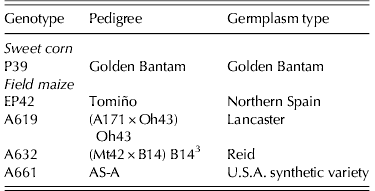
Four field maize inbred lines were used that differentially affected seed viability of su1 individuals (Revilla et al. Reference Revilla, Rodríguez, Malvar, Butrón and Ordás2006b ): A632 and EP42 are field maize parents previously identified as having higher seed viability of su1 than A661 and A619. Inbred lines belong to diverse heterotic groups (Table 1).
Pedigree and germplasm types of the field maize inbred lines homozygous for Su1 and the sweet corn genotype used as donor of su1

Two separate designs of mean generation analyses were developed to analyse genetic effects (Mather & Jinks Reference Mather and Jinks1982). One of the designs involved two inbreds from the same genetic background (Corn Belt): A619 and A632, while unrelated inbreds were used for the second design: A661 (Corn Belt) and EP42 (European Flint). Crosses between each pair of inbred lines started in 2001. Crosses were self-pollinated and backcrossed, obtaining six generations per design: the two parents, F1, F2, BC1 and BC2. The 12 entries were crossed with P39 as donor of su1 allele.
All crosses to P39 were successively selfed in 2006, 2007, 2008, 2009 and 2010 in Pontevedra, Spain (42°24′, 8′38′N, 20 m asl), a location in the northwest of Spain where annual rainfall is in the range of 1600–1700 mm. Around 100 plants from each of the 12 entries were self-pollinated by hand, harvested and conserved in bulk. From each bulk, a sample of 150 kernels was sown in blocks 3 m long, spaced 0·8 m apart; plants within the row were 0·20 m apart. The self-pollination generations were repeated up to 5 years.
The frequency of mutant su1 kernels was determined in three samples of 500 kernels from each bulk. The allelic frequency q of su1 was calculated as the square root of the frequency of the homozygote kernels in the first selfed generation, while for the other generations the frequency was calculated as follows:

where N is the observed number of su1 kernels in the total of 1500 kernels, C is the proportion of individuals with one su1 among the non-su1 kernels (2/5, 2/9, 2/17 and 2/33 for the 2nd, 3rd, 4th and 5th selfed generations, respectively).
Linear and quadratic regressions of the gene frequency on the number of selfed generations were computed for each cross. The coefficients of regression (b) were tested for homogeneity. For each selfed generation, the expected number of su1 kernels was calculated from the number of the su1 kernels in the previous generation and was compared with the observed number using the χ 2 test. In order to estimate fitness, the selective value (s) of su1 was calculated as 1 minus the proportion of the contribution of offspring to the next generation (1−s) (Falconer Reference Falconer1981). In order to estimate the effects of the proportion of unfavourable genotypes on the fitness of su1, A619×A632 and EP42×A661, one unfavourable and one favourable parent were defined within each cross, concerning the effects on the fitness of su1 when this mutant is introduced through backcrosses. From these crosses the respective F1, F2, BC1 and BC2 were developed, which carried different proportions of the genome of the unfavourable parent: P1=1, P2=0, F1=0·50, F2=0·50, BC1=0·75 and BC2=0·25. Regression analyses of the selective value (s) along the successive generations on the proportion of unfavourable genotypes were carried out for each design and across designs.
For the mean generation analyses, the coefficients of regression were used as an estimator of su1 seed viability and each design was considered a separate experiment. Data from each generation were subjected to regression analyses. Adjustment of the generation means to a genetic model was tested with a χ 2 test. The test was applied to the simplest model and, if it revealed a lack of fit, the next model was tried. The models considered were the following: a model with only the mean, an additive model, an additive-dominance model, an additive-dominance model with epistasis, an additive-dominance model with environmental effects and interactions and, finally, an additive-dominance model with both epistasis and environmental effects and interactions. The genetic parameters estimated were m=mean, a=additive effect, d=dominance effect, aa=additive×additive effect, ad=additive×dominance effect and dd=dominance×dominance effect (Mather & Jinks Reference Mather and Jinks1982; Kearsey & Pooni Reference Kearsey and Pooni1996).
The variance of the generation means (s 2 i ) are not the same; this heterogeneity among variances was adjusted in the analyses by weighting the means differently; these weights being the reciprocals of the squared standard errors (Mather & Jinks Reference Mather and Jinks1971). In addition, weight was taken into account when solving for m, a, d, aa, ad and dd. For the six basic generations (P1, P2, F1, F2, BC1 and BC2) the solution is obtained in the form of a matrix by the SAS (SAS Institute 2005) statistical package using PROC IML as follows:

where Y=6×1 vector of generation means, C=6×z depending on the genetic model, W=6×6 diagonal matrix weight, C=the transpose of C matrix and −1 represents the inverse of a matrix.
RESULTS
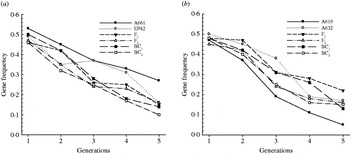
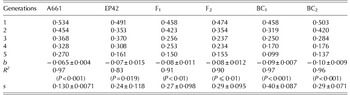
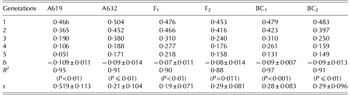
In both designs, A661×EP42 (Table 2) and A619×A632 (Table 3), the reduction of su1 frequency across self-pollination generations was less important in the first generation. In the first design, the frequencies in all generations (P1, P2, F1, F2, BC1 and BC2) decreased linearly and showed a continuous and pronounced fall from 0·534 to 0·270 and from 0·491 to 0·161 in A661 and EP42, respectively (Fig. 1 a). The same tendency was observed for the second design, i.e. there was a reduction of su1 frequency from 0·466 to 0·051 in A619 and 0·504 to 0·171 in A632 (Fig. 1 b). The χ 2 test for comparison between observed and expected number of su1 kernels revealed significant differences for almost all crosses across self-pollination generations (data not shown).
Change of gene frequency across five selfing generations of crosses between the su1 inbred P39 and six basic generations (P1, P2, F1, F2, BC1, and BC2) derived from crosses between two pairs of field maize inbred lines: (a) first design and (b) second design.

Frequencies of su1 through five selfing generations of crosses between the su1 inbred P39 and six basic generations (P1, P2, F1, F2, BC1 and BC2) derived from crosses between two field maize inbred lines, coefficient of regression (b±s.e.), coefficient of determination (R2) and selective value (s±s.e.)

Frequencies of su1 through five selfing generations of crosses between the su1 inbred P39 and six basic generations (P1, P2, F1, F2, BC1 and BC2) derived from crosses between two field maize inbred lines, coefficient of regression (b±s.e.), coefficient of determination (R2) and selective value (s±s.e.)

For both designs, the coefficients of regression were all negative and significantly different from zero. The coefficients of determination were above 0·90, except for EP42 and the segregating population F2 involving A619 and A632. The quadratic regression was not significant in any case (data not shown). The reduction on frequency of su1 for EP42 fluctuated more across years than for A661. However, the behaviour of A619 and A632 concerning su1 fitness was more stable across years.
The coefficients of regression for each generation in the first design were not homogeneous; seed viability of su1 mutant was higher for A661 than that for the backcross to EP42 with b=−0·065 and b=−0·097, respectively. Regression coefficients for EP42, F1, F2 and the backcross of A661 were not heterogeneous; however, the backcross of A661 had the most unfavourable coefficient (b=−0·086) for su1 seed viability. In addition, the coefficients of regression for F1 (b=−0·078) and F2 (b=−0·075) were higher than the coefficients for both parents.
The coefficients of regression in the second design were not heterogeneous; therefore, the frequency of the su1 mutant was similarly reduced across the five self-pollination generations. All genotypes have negative selection against su1 and the highest reduction was for A619 (b=−0·109). The comparison between the four inbred lines employed in the present work show that the parent least favourable for su1 seed viability was A619 and the best was A661.
The selective value s of su1 is also used as an estimator of seed viability and differed between parents and derived populations. The selection against su1 occurs in the same direction in both designs (Tables 2 and 3). The coefficient of selection s varied from 0·130 to 0·397 in the first design and from 0·193 to 0·519 in the second design.
The selection effect against su1 depended on the field maize genotype. EP42 (s=0·235) had a larger negative selection effect against su1 than A661(s=0·130), but differences were not significant. However, the selection effects in F1, F2, BC1 and BC2 were above the values in the parents. For the second design, A619 (s=0·519) was worse than A632 (s=0·213).
Mean generation analysis was used to determine the genetics effects and their type of action on su1 fitness using the coefficients of regression as parameters of seed viability. As shown above, the differences among generations were significant only in the first design (A661×EP42) and, for this reason, only the genetic parameters were estimated for this cross. The mean generation analysis has shown that the additive model explained adequately the variation observed (χ (4) 2=6·75, with P=0·149) with m=−0·08±0·004 and a=0·013±0·005.
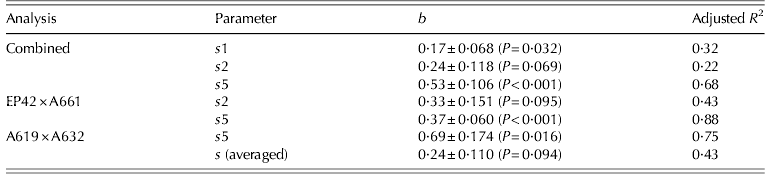
The coefficient of selection against the mutant showed a tendency to increase along the selfed generations. The combined-over-designs regression analysis and both individual analyses for each design showed that the coefficient of selection of the fifth generation of inbreeding (s5) was consistently significant. In addition, coefficients of selection were significantly affected by the contribution of unfavourable genotypes, particularly in the second self-pollination generation (s2) in the combined analysis and in the first design (Table 4).
Significant regressions (b±s.e.) of the selective value (s) on the proportion of the unfavourable genotype in six basic generations (P1, P2, F1, F2, BC1 and BC2) across five selfing generations of crosses between the su1 inbred P39 and two pairs of field maize inbred lines

DISCUSSION
It is generally assumed that most mutants are less fit than the wild-type. Accordingly, the su1 frequency was reduced steadily across five self-pollination generations in both designs. The present results confirm previous reports showing that su1 allele is less viable than the wild-type (Tracy Reference Tracy1990; Martins & Da Silva Reference Martins and Da Silva1998; Revilla et al. Reference Revilla, Malvar, Abuin, Ordás, Soengas and Ordás2000).
The tendency of su1 gene frequency reduction occurred in both designs but with different intensities depending on the field maize inbred lines involved, as previously reported by Revilla et al. (Reference Revilla, Malvar, Rodriguez, Butron, Ordás and Ordás2006a , Reference Revilla, Malvar, Ordás, Rodríguez and Ordás2010). Three background types were used in the present study; A619 and A632 were released from Lancaster and Reid (Corn Belt Dent race), while A661 was released from Corn Belt germplasm different from Reid or Lancaster and EP42 comes from a European flint population genetically distinct from the American germplasm pools. Seed viability of su1 mutant was lower in the Reid and Lancaster inbreds than in the cross involving inbreds with different genetic backgrounds, A661 and EP42. These dynamic aspects of the su1 gene frequency have been reported by Revilla et al. (Reference Revilla, Rodríguez, Malvar, Butrón and Ordás2006b , Reference Revilla, Malvar, Ordás, Rodríguez and Ordás2010), who concluded that seed viability of su1 gene depends on specific su1×field maize interactions. Sweet corn breeders are aware of the unfavourable effects of base germplasm on su1 seed viability (Tracy Reference Tracy1990) and the present results suggest that it could be worthwhile searching for favourable field maize genotypes for sweet corn breeding outside the current sources, for example, in hard endosperm maize (Alonso Ferro et al. Reference Alonso Ferro, Malvar, Revilla, Ordás, Castro and Moreno-Gonzalez2008). However, previous results are not encouraging, at least for European germplasm (Cartea et al. Reference Cartea, Malvar, Revilla and Ordás1996a , Reference Cartea, Malvar, Revilla and Ordás b ; Malvar et al. Reference Malvar, Cartea, Revilla and Ordás1997a , Reference Malvar, Revilla, Cartea and Ordás b ; Revilla et al. Reference Revilla, Malvar, Cartea and Ordás1998).
A net selection was revealed acting against su1, with the fitness of the mutant allele highly dependent of the field maize inbred line, being A619 less unfavourable than the other field maize inbred lines. Selection against su1 may operate firstly through factors related to seed viability (germination, early vigour, etc.) (Ordás et al. Reference Ordás, Rodríguez, Romay, Malvar, Ordás and Revilla2010) and after that, by factors related to pollination and grain formation or fertility in general (Cisneros-López et al. Reference Cisneros-López, Mendoza-Onofre, Zavaleta-Mancera, Gonzalez-Hernandez, Mora-Aguilera, Cordova-Tellez and Hernandez-Martinez2010; Zhang et al. Reference Zhang, Li and Lian2011). Martins & Da Silva (Reference Martins and Da Silva1998) found that germination and gametophytic factors might be involved in the reduction of the fitness of su1. In the present experiment, all plants in the first generation were heterozygous (Su1/su1) and there was no selection in favour or against su1 until the production of gametes, because all plants had wild phenotype. For that reason, the change in frequency in the first generation of selfing was only due to fertility factors. It was found that the reduction of su1 frequencies in the first generation was not important and for some genotypes su1 frequency was above the expected value, which indicates that gametophytic or fertility factors were probably of small importance for the fitness of the su1 allele in the present experiment. Therefore, the important reduction of the mutant frequency that was found after the first generation was probably due to a lower seed viability of the mutant allele compared to the wild type.
The coefficient of selection (s) against the su1 mutant increased along the selfing generations, i.e. selection intensity was lowest in the first generation and highest in the last. This can be attributed to the increased homozygosity. The fitness of su1 was probably variable due to environmental factors. All results suggest that fitness depends on environmental circumstances but these effects do not hide the genetic effects. Although it is not possible to state unequivocal conclusions concerning the environmental effects on su1 fitness, the present results and previous observations suggest that there is an important genotype×environment interaction on su1 fitness.
Mean generation analysis was carried out to identify genetic effects on the fitness of su1. The additive effect was the most important for su1 seed viability in the crosses involving A661 and EP42, which belong to different groups of germplasm. In contrast, genetic effects were not significant for the genotypes involving the Corn Belt inbred lines A619 and A632. This material manifests a more consistent and stable behaviour than the first design on su1 fitness probably due to the lack of genetic variation between the two inbred lines because of the similar genetic origin.
In congruence with the additive effects of the genotypes on the fitness of su1, it was found that the variation of the proportion of the unfavourable genotype explains a considerable part of the variation observed for the selective value (s), particularly in the last generation where the mutant is expected to have the highest exposure as a consequence of homozygosity advance. These results suggest that the fitness of a mutant depends on the genetic background in general rather than on single genes. Magwire et al. (Reference Magwire, Yamamoto, Carbone, Roshina, Symonenko, Pasyukova, Morozova and Mackay2010) used Drosophila as a model system to provide an explanation of genetic and environmental factors that affect variation in lifespan and senescence, concluding that variations observed were especially due to genetic background and epistatic effects. The present research also confirms the suggestion of Yamamoto et al. (Reference Yamamoto, Anholt and Mackay2009) that the variation in the magnitude of the genetics effects among the wild genetic backgrounds could have evolutionary implications. Furthermore, the ability of genotypes for moderating the fitness costs of new genetic variants has been hypothesized by Raymond et al. (Reference Raymond, Wright and Bonsall2011). Altogether, these evidences and the current data suggest that genotypes could modulate the fitness of new mutations.
In conclusion, the present results confirm that the fitness of su1 is under genetic control with significant additive effects that are probably due to minor contributions of multiple genes. It is proposed that the interaction of genetic backgrounds with alleles could have evolutionary implications by increasing or decreasing the change of mutant fixation.
This research was supported by the Spanish Plan I+D (AGL2007-64218/AGR, AGL2010-22254) and the Excma. Diputación Provincial de Pontevedra. A. Djemel acknowledges his fellowship from the Spanish Council for Scientific Research (CSIC).