There is no question that language learning can be an anxiety-provoking experience for many learners. Research on language anxiety began to be published in the 1970s (Scovel, Reference Scovel1978), flourished in the 1980s (Horwitz et al., Reference Horwitz, Horwitz and Cope1986), and has continued to occupy a prominent space in the literature on second language learning and communication (MacIntyre, Reference MacIntyre, Gkonou, Daubney and Dewaele2017). The bulk of the work on language anxiety takes an individual difference (ID) perspective, examining language anxiety as a situation-specific factor that correlates with other ID factors such as language achievement (Al-Shboul et al., Reference Al-Shboul, Ahmad, Nordin and Rahman2013; Teimouri et al., Reference Teimouri, Goetze and Plonsky2019), motivation (Gardner, Reference Gardner2010), willingness to communicate (WTC; Yashima, Reference Yashima, Lamb, Czizér, Henry and Ryan2019), personality (Moskowitz et al., Reference Moskowitz, Dewaele and Resnik2022), and many other variables. As an ID factor, language anxiety is defined by repeatedly experiencing an unwelcome state of emotional and physiological arousal, disruptive task-irrelevant cognition, and avoidant behavior that together impact the ability to learn, demonstrate second language skills, and use the language for authentic communication (MacIntyre & Gardner, Reference MacIntyre and Gardner1991; Zhang, Reference Zhang2019).
In the first part of this paper, we will briefly review the existing literature on language anxiety as an ID factor by focusing on recent meta-analyses. This review sets the groundwork for the second part of the paper, examining the inner workings of language anxiety from an intraindividual perspective consistent with complex dynamic systems theory (Gregersen, Reference Gregersen2020; Larsen-Freeman & Cameron, Reference Larsen-Freeman and Cameron2008); that is, we examine the uniquely personal, emotional experience of anxiety and how its patterns may change over time for an individual learner. Research that adopts an intraindividual approach is relatively new in the SLA literature (Pfenninger, Reference Pfenninger2021). Despite its scarcity relative to an ID approach, the intraindividual approach to language anxiety is contributing new research questions and accounts of the processes involved, with considerable promise for future development (Lowie & Verspoor, Reference Lowie and Verspoor2019; Mardian & Nushi, Reference Mardian and Nushi2022; Pfenninger et al., Reference Pfenninger, Bülow, Werth and Schiegg2021).
Context of Language Anxiety Research
Language anxiety is a complex emotional reaction (Gkonou et al., Reference Gkonou, Daubney and Dewaele2017; MacIntyre, Reference MacIntyre and Young1999). Emotions are defined as short-lived reactions to a combination of external and internal events, including the specific context, memories, and imagined future, helping to shape the quality of the ongoing experience and guide behavioral adaptation in the situation (Cabanac, Reference Cabanac2002; Izard, Reference Izard2009; Mulligan & Scherer, Reference Mulligan and Scherer2012). Emotions are fundamental throughout human lives because they integrate physiological arousal with a sense of goals and purpose, specific thought processes, feeling states, and social expression (Reeve, Reference Reeve2015). In general, anxiety can be associated with increased heart rate, elevated energy in the classroom, the desire to protect oneself from embarrassment or threats to self-esteem, self-deprecating cognition, avoidance of communication activities or testing situations, and at times, the concern that one might lose control of their emotional reaction in a situation (Horwitz et al., Reference Horwitz, Horwitz and Cope1986; Tóth, Reference Tóth2011).
As ongoing reactions to events, emotions are omnipresent, integrating low-level physiological systems with higher-order cognitive and social systems (Maloney et al., Reference Maloney, Sattizahn and Beilock2014). Emotional reactions are pervasive, ranging in intensity from mild to extreme, and at their peak, they demand immediate attention. Extreme emotional reactions (e.g., a panic attack) can be all-consuming, effectively commandeering thought and behavior until the intensity of the emotion subsides (Roy-Byrne et al., Reference Roy-Byrne, Craske and Stein2006). It is therefore not surprising that emotions such as anxiety, at all levels of intensity, are intimately connected to motivation, giving energy and direction to behavior.
Substantial literature has emerged on language anxiety, enough to allow several recent meta-analyses (Botes et al., Reference Botes, Dewaele and Greiff2020; Teimouri et al., Reference Teimouri, Goetze and Plonsky2019; Zhang, Reference Zhang2019). We will refer to the studies captured by these meta-analyses, which used questionnaire measures of language anxiety such as the FLCAS (Horwitz et al., Reference Horwitz, Horwitz and Cope1986), as “traditional ID research” because they make up most of the literature in this area. Each study contributes valuable data to the literature of language learning anxiety while focusing on slightly differing facets or measurements (e.g., FLCAS, skills, achievement, WTC). The meta-analyses were completed based on different selection criteria for articles and dissertations (see Table 1). Overall, these meta-analyses produced consistent findings, each reporting a significant, negative average correlation (r = −.34, Zhang, Reference Zhang2019; r = −.36, Teimouri et al., Reference Teimouri, Goetze and Plonsky2019; and r = −.39, Botes et al., Reference Botes, Dewaele and Greiff2020) between second/foreign language learning and academic achievement or language performance. Zhang's (Reference Zhang2019) meta-analysis examines the relationship between language anxiety and overall performance (course grade and language tests), but also the correlation with specific FL skills (i.e., reading [r = −.23], listening [r = −.53], and testing [r = −.27]). The meta-analysis by Botes et al. (Reference Botes, Dewaele and Greiff2020) also investigated foreign language classroom anxiety (FLCA), alongside academic achievement—which was subtyped into reading (r = −.34), writing (r = −.44), listening (r = −.53), and speaking (r = −.26). In contrast, Teimouri et al. (Reference Teimouri, Goetze and Plonsky2019) investigated second language anxiety (describing trait, state, and situation-specific anxiety types) and achievement (broken into course grades (r = −.34), language tests (r = −.36), self-assessments (r = −.47), and GPAs (r = −.26)). The meta-analyses leave little doubt that language anxiety, as an ID factor, consistently is negatively related to achievement, though its effects are heterogeneous across studies and language skills.
Comparison of Three Meta-analyses Focused on Language Anxiety

Additional meta-analyses have been conducted, showing significant relationships with other ID variables. Elahi Shirvan et al. (Reference Elahi Shirvan, Khajavy, MacIntyre and Taherian2019) report a significant negative correlation (r = −.29) showing higher language anxiety is associated with WTC, but also evidence of variability in the strength of the relationship across studies. Zhou et al. (Reference Zhou, Chiu, Dong and Zhou2022) reported a strong average negative correlation between language anxiety and language self-efficacy (r = −.70), suggesting that as learners’ confidence in their abilities increases, their anxiety may decrease, or vice versa. They also reported significant heterogeneity in the size of the relationship across studies. Finally, Piniel and Zólyomi's (Reference Piniel and Zólyomi2022) meta-analysis found a small tendency for female learners to experience slightly more anxiety than male learners, but the reviewed literature shows the effect of gender is not consistent (significant) due to the mixed patterns of results.
As an analytic technique, meta-analyses that summarize ID correlations, and the many individual studies underlying them, provide essential information about the relationships between language anxiety and language performance. Given the size and diversity of the research literature, additional meta-analytic studies likely can be expected in the future. The size of the correlation emerging from meta-analysis is informative, but it is important not to overlook the significant variability around the estimates of the average correlations observed in all of the meta-analyses reviewed here. Some of the variability in correlation estimates can be attributed to measurement or sampling error. At least a portion of that variance also might be interpreted as showing that the size and strength of the relationships between language anxiety and other ID variables can change from one research context to another. For example, although the amount of anxiety experienced by learners can change significantly with age and greater experience (Teimouri et al., Reference Teimouri, Goetze and Plonsky2019), it is a separate question to consider how anxiety correlates or interacts with other ID variables. The relationship between anxiety and achievement is “complex and possibly dynamic” (Botes et al., Reference Botes, Dewaele and Greiff2020, p. 47), indicating that how and why anxiety correlates with achievement can change as well.
Whereas it is informative to gather quantitative summaries of how learners experience this phenomenon, there are two major issues with reducing data describing emotion-related phenomena to a single numerical value: (1) the loss of information about how individuals experience anxiety in qualitatively differently ways, and (2) information on how the dynamics of emotional adaptation are coordinated in real time with other processes, from details of vocabulary retrieval to broad patterns of sociocultural communication, on multiple timescales.
The first issue with a meta-analytic approach to ID research is simultaneously its major strength and limitation: summarizing data from thousands of learners provides the general trend across numerous samples but necessarily loses the individuality beneath all of those data points. Almost sixty years ago, near the end of his influential career, personality trait theorist Gordon Allport (Reference Allport1962, p. 409) said “…we spend scarcely 1% of our research time discovering whether these dimensions of personality are, in reality, relevant to Bill's personality, and if so, how are they patterned together to compose the Billian quality of Bill?” Applied to anxiety research, Allport's comment suggests that, unless we investigate individual experiences, we will not know which of the myriad causes, consequences, and correlates of language anxiety are relevant to an actual person, or how those factors might apply to any individual learner in situ. The underlying issue is the ergodicity problem: group-level results rarely apply to individuals (Molenaar & Campbell, Reference Molenaar and Campbell2008). Ergodicity runs in the opposite direction to the generalizability problem—that individual results cannot be taken to be group-level results. Essentially, group-level and individual-level results address completely different research questions, and their answers can be diametrically opposed (as in Simpson's paradox, see Fisher et al., Reference Fisher, Medaglia and Jeronimus2018). In psychology, like SLA, Allport's challenge has never been fully met, as authors have repeatedly called for more integrated, holistic, individual-level accounts of learners’ psychological processes (Molenaar, Reference Molenaar2015; Pfenninger, Reference Pfenninger2021).
Inarguably, the literature on the psychology of the learner is incomplete without greater emphasis on intraindividual variability (Molenaar, Reference Molenaar2015; Molenaar & Campbell, Reference Molenaar and Campbell2008). Lu (Reference Lu2022) highlights the importance of dissecting the student experience such that each moment of their situation-specific anxiety is recorded, enabling researchers to account for individual differences, and thus discovering the emotional trajectory for each learner. When following the emotional journey of a single student, one can observe the inciting causes of anxiety, see how accompanying emotions influence or color their anxiety, note anxiety's impact on performance, and gain the individual's perception of the entire event. While anxiety experiences vary widely between students, there is insight to be gained from their subjective lenses and idiosyncratic approaches to understanding themselves as learners (Lowie & Verspoor, Reference Lowie and Verspoor2019).
The second issue with the ID tradition in SLA is based on the nature of emotion processes. The function and quality of emotional reactions implies adaptation and change over a short period of time, often measured in seconds or minutes (Fredrickson, Reference Fredrickson, Devine and Plant2013; Reeve, Reference Reeve2015). Traditional ID scale items summarize emotional reactions, but details of the dynamics of changes within specific emotions over a brief time frame are lost, as are developmental changes within a person over a long period of time. Assessing dynamic changes in emotion within individuals is not a common feature of the studies that underlie the meta-analytic results reviewed above. Anxiety reactions are experienced as a suite of intercoordinated, dynamic processes. Cognitively, the individual may interpret the situation as threatening and experience disorganized or intrusive thoughts about their situation (e.g., rumination, fear of failure or judgment) which prevents executive functioning and problem-solving skills from working effectively (Maloney et al., Reference Maloney, Sattizahn and Beilock2014; Snyder et al., Reference Snyder, Kaiser, Whisman, Turner, Guild and Munakata2014). Further, social concerns, such as negative evaluations from one's peers or authority figures, may spike when one feels a loss of control over their situation or worries about embarassing themselves. These social concerns may lead the individual to fear losing social status or affect their self-esteem, and thus, they may be more likely to avoid re-entering a similar situation (Maloney et al., Reference Maloney, Sattizahn and Beilock2014). Physiological responses, such as sympathetic nervous system activity (e.g., increased heart rate and blood pressure, perspiration, shakiness) may amplify negative cognitions and negative emotions, leading to a sense of feeling overwhelmed, or fueling escape behaviors (Hoehn-Saric & McLeod, Reference Hoehn-Saric and McLeod2000; Maloney et al., Reference Maloney, Sattizahn and Beilock2014).
In the data analysis typical of traditional ID studies, respondent perspectives and experiences which deviate from a mean score tend to be discarded as extraneous noise and are counted as error variability, if they are retained as data points at all. However, departures from group trends may be invaluable to both theoretical models and practical interventions (Gregersen & MacIntyre, Reference Gregersen, MacIntyre, Gkonou, Daubney and Dewaele2017a). As an example, since Scovel's (Reference Scovel1978) early review, the literature on language anxiety occasionally refers to the notion of facilitating anxiety, suggesting that anxiety might sometimes energize or improve performance (Horwitz, Reference Horwitz, Gkonou, Daubney and Dewaele2017; Scovel, Reference Scovel1978). However, the meta-analyses reported here consistently show that anxiety tends to be negatively correlated with performance—it is debilitating. Results showing facilitating effects would be unexpected or unusual. But unusual responses at the individual level tell us something about processes that potentially relate to an event even if they contradict general patterns at the group level (Molenaar, Reference Molenaar2015). Unusual or atypical responses have value in understanding how anxiety works. To capture individual trajectories in the dynamics of emotional reactions, a new methodological approach is required that changes the research question from “What is the correlation between anxiety and another ID factor?” to questions such as “What happens to language during an anxiety reaction?” or “How and why do changes in anxiety relate to the many other processes involved in language learning and use?”
Applications of Complex Dynamic Systems theory (CDST) have greatly facilitated the granular, contextualized, individual-level, process-oriented approach to emotional reactions we are recommending (see de Bot & Larsen-Freeman, Reference de Bot, Larsen-Freeman, Verspoor, de Bot and Lowie2011; Gregersen, Reference Gregersen2020; Larsen-Freeman & Cameron, Reference Larsen-Freeman and Cameron2008; MacIntyre, Reference MacIntyre, Gkonou, Daubney and Dewaele2017). A CDST approach to language anxiety focuses on how the anxiety reaction emerges continuously from the coordinated interactions of physiological, cognitive, social, and other relevant systems (Huynh, Reference Huynh2021), including other co-occurring emotions (such as enjoyment; see Boudreau et al., Reference Boudreau, MacIntyre and Dewaele2018). The onset of an emotional reaction can occur rapidly and change over a short period of time because emotions serve an adaptive function (Reeve, Reference Reeve2015). Continuous changes in systems associated with emotions allow patterns of relationships to form and dissolve; some patterns will be regularly occurring, and other patterns will be rare or unexpected (see Gregersen et al., Reference Gregersen, MacIntyre and Meza2014). The traditional ID approach offers a summary of typical patterns. It does not focus on the dynamic changes in anxiety within a person or how one person changes over time. A full account of how anxiety affects language learning and communication, both regular and unusual patterns, requires an examination of its detailed inner workings.
The Inner Workings of Language Anxiety
The issues identified above highlight analysis of the complete individual as the missing piece of the ID research literature. The idiodynamic method has been developed to help address this gap (MacIntyre, Reference MacIntyre2012; MacIntyre & Ducker, Reference MacIntyre and Ducker2022). The method investigates the changes in learners’ reactions in real time by recording a specific communication event on video and having the individual use specialized computer software to continuously rate their level of a specific affective variable, such as anxiety, as they watch the video (MacIntyre & Gregersen, Reference MacIntyre and Gregersen2022). The method produces a continuous line graph showing how the individual rated themselves on the variable of interest during the communication event. This approach has several benefits when researching the interaction of a person's emotions with a learning experience. It has been used to examine ID factors such as WTC (MacIntyre & Legatto, Reference MacIntyre and Legatto2011), motivation (MacIntyre & Serroul, Reference MacIntyre, Serroul, Dörnyei, MacIntyre and Henry2015), enjoyment (Elahi Shirvan & Talebzadeh, Reference Elahi Shirvan and Talebzadeh2018), speech fluency (Wood, Reference Wood2016), and other topics. Two separate reviews of the idiodynamic approach in second language acquisition (Lu, Reference Lu2022; Mardian & Nushi, Reference Mardian and Nushi2022) concluded that the method provides rich data on the unique, dynamic complexity of individual learners. By examining learners in detail, the method retains the integrated, holistic, ever-changing quality of a learner's emotional experience (MacIntyre & Ducker, Reference MacIntyre and Ducker2022; MacIntyre & Gregersen, Reference MacIntyre and Gregersen2022).
An idiodynamic approach can combine physiological and self-rating research methods (Gregersen et al., Reference Gregersen, MacIntyre and Meza2014), contrast the internal and external observers’ perspectives (Gregersen & MacIntyre, Reference Gregersen, MacIntyre, Gkonou, Daubney and Dewaele2017a), and test interventions as part of an experiment. The method allows researchers to observe how varying elements of language learning situations affect learners over time. For instance, if students are assigned a variety of language performance tasks, the use of heart rate variability allows for the observation of the moment when a student becomes anxious/excited, or bored/relaxed with their task (Gregersen et al., Reference Gregersen, MacIntyre and Meza2014; Thrasher, Reference Thrasher2022). In doing so, the process may be graphed to reveal when students are comfortable or concerned with their tasks. When respondents are interviewed about their experiences, their interpretation provides insights as to the accompanying cognitions and emotions during the event.
Given that anxiety has been shown to correlate negatively with a variety of aspects of the language learning experience, it would be beneficial to understand the nitty-gritty details of the potential causes of anxiety at the individual level. However, because such causes may be numerous, and the experience of anxiety will vary depending on the individual experiencing it, the specific inciting events and patterns in their experience will be at least partially open questions. Certainly, regular anxiety triggers have been identified, including fear of negative evaluation by other people, concern about self-expression, and test-taking (Horwitz, Reference Horwitz, Gkonou, Daubney and Dewaele2017; MacIntyre, Reference MacIntyre and Young1999). However, idiodynamic studies are revealing that outliers (i.e., experiences of anxiety outside the group average) and unanticipated, context-dependent anxiety triggers occur (Elahi Shirvan & Talebzadeh, Reference Elahi Shirvan and Talebzadeh2017; Gregersen et al., Reference Gregersen, MacIntyre and Meza2014; MacIntyre, Reference MacIntyre2019; MacIntyre & Gregersen, Reference MacIntyre and Gregersen2022). Both typical and unusual causes of anxiety are valid experiences that can inform theory. In the correlational studies described above, the meaning of unusual cases is not often considered, and outliers may be removed from the data entirely. Idiodynamic research allows for investigators to examine the specific experience of an individual, observing an in-depth perspective on how particular elements of the process influence emotional experience, including anxiety and their performance. By asking about a specific emotion (such as anxiety), respondents will invariably draw in many other cognitive, physiological, linguistic, social, and contextual factors relevant to the experience, including additional emotions, which offer a more complete account of different anxiety experiences.
Take, for instance, the issue of so-called facilitating anxiety, a topic coved by Scovel (Reference Scovel1978) in his original review of the literature (MacIntyre, Reference MacIntyre, Gkonou, Daubney and Dewaele2017). A few studies have reported positive correlations between anxiety and performance or achievement (Chastain, Reference Chastain1975; Hewitt & Stephenson, Reference Hewitt and Stephenson2012; Ito, Reference Ito2008; Klienmann, Reference Kleinmann1977; Yang, Reference Yang2021). As an emotion, anxiety can be experienced along a continuum from mild to intense. The terms facilitating and debilitating capture differences in the learner's qualitative experience of anxiety. Horwitz (Reference Horwitz, Gkonou, Daubney and Dewaele2017) identified this as a conceptually thorny issue, suggesting that anxiety is usually an unwelcome and debilitating experience, and she was concerned that teachers avoid deliberately arousing anxiety in the hope of finding its facilitating effects. From a CDST perspective, we suggest that other emotions accompanying anxiety, aroused in the same situation, may significantly color the experience and change its quality. Physiological arousal may be interpreted as facilitative or debilitative to performance, depending on the nature of the other emotions present (Kirchner, Reference Kirchner2011). Therefore, if the context is interpreted as an appropriately challenging and mildly stressful event, the individual might experience emotions such as confidence, happiness, and a willingness to demonstrate prepared skills—a state that might reasonably be thought of as facilitating anxiety. However, in such a situation, anxiety is not the ingredient most relevant to performance. More often, anxiety is associated with emotions such as fear, inadequacy, and frustration, and these are more likely to be strongly associated with the debilitating effects of anxiety. The complexity of emotions experienced by adults means that they are rarely experienced in their pure, isolated, definitional states (Izard, Reference Izard2007). Instead, adults tend to experience individualized emotion schemas (Edwards & Wupperman, Reference Edwards and Wupperman2019). With respect to an individual's schema for language anxiety, experiences, cultural interpretations, skillsets, cognitions, and beliefs of the individual are key to understanding the interactions between anxiety, its accompanying emotions, and performance (Izard, Reference Izard2009). Anxiety accompanied by shame, fear, and discouragement will differ substantially and qualitatively from anxiety accompanied by enjoyment, pride, or happiness. Without considering the underlying and accompanying emotions present during anxiety, the use of generalizations with correlations may not capture the essential quality of the experience. Exceptions to the general rule, including the possibility of facilitating anxiety, may be better understood as a combination of anxiety plus other, more influential positive emotions.
Five Propositions on Intraindividual Differences
Research on intraindividual differences is showing novel insights (Lu, Reference Lu2022; Mardian & Nushi, Reference Mardian and Nushi2022). Several idiodynamic studies have been examining individual-level data over a brief time, furthering the understanding of individuals’ short-term progress, emotions, and outlier experiences. In the remaining pages, we capture five propositions linked with CDST that are emerging from the rapidly developing literature.
Proposition 1: People Change Over Time as Language Develops
The process of developing language proficiency, by definition, is constantly changing (Verspoor et al., Reference Verspoor, de Bot and Lowie2011). However, the analysis of choice for traditional ID research has been the correlation coefficient and more complex procedures that build on it (including factor analysis, structural equation modeling, and meta-analysis). Further, most ID research has been cross-sectional in design, meaning that one or more groups of learners are tested at the same time. The core data for most of these studies comes from multi-item scales, instruments designed to assess respondent's summaries of their typical experience. An example item from Horwitz et al.'s (Reference Horwitz, Horwitz and Cope1986) well-known FLCAS measure is “I get nervous and confused when I am speaking in my language class.” To respond to this, and the other items on the scale, respondents provide a summary of their typical experience by indicating how strongly they agree or disagree that the item describes them, most often using a 5-point Likert scale. Over time, as experience accumulates and skills develop, response to anxiety items may change (Dewaele & MacIntyre, Reference Dewaele and MacIntyre2014). Learners with more experience tend to report lower anxiety, but it is never going to disappear completely (Dewaele & Dewaele, Reference Dewaele and Dewaele2017). In addition to the developmental changes, individual differences in personality and temperament suggest that learners at similar levels of proficiency may have very different trajectories of change in anxiety reactions, similar to rapid or gradual changes in WTC (Henry & MacIntyre, Reference Henry and MacIntyrein press).
Studies using qualitative methods provide insight into a variety of co-occurring variables at play from a single interview, such as an individual's goals, emotions, and culture, all of which influence their progress over time. For instance, Yan and Horwitz (Reference Yan and Horwitz2008) describe students’ learning methods changing frequently over time due to the presence of their classmates, whose individual techniques inspire them to alter their own style. These findings (and the findings from similar qualitative studies) are blended among the impacts of individual students’ cultures, motivations, anxieties, and so forth, as each of these variables influence each other, culminating in a unique experience of progress (Cheng, Reference Cheng2002; Young, Reference Young1992).
Proposition 2: Emotions Are Themselves Coordinated, Potentially Opposing Processes That Change Over Short Timescales
If we consider the physical, cognitive, emotional, and social-behavioral changes that occur during emotional reactions over a short timescale, there is a clear, rapid progression that takes place. After an initial burst of anxiety in response to an event, an opponent process begins that calms the person and returns the system to a baseline emotional state (Soloman & Corbit, Reference Solomon and Corbit1978). Physiologically, after initially increasing, the heart rate begins to slow under the effects of the parasympathetic nervous system. Cognitively, self-deprecating and fear-related thoughts can start to give way to task-focused thoughts and concrete plans for dealing with anxiety (MacIntyre, Reference MacIntyre and Robinson2002; Stevens, Reference Stevens1991). Feelings associated with anxiety start to wane in intensity as the person habituates and adapts to the experience (Soloman & Corbit, Reference Solomon and Corbit1974). Finally, the behavior changes typical of anxiety often lead people to seek solace or support, and the presence of other people can substantially modify the anxiety reaction, sometimes amplifying an adverse response (e.g., behavioral contagion, Polansky et al., Reference Polansky, Lippitt and Redl1950).
Though there may be a general trend in the presence of anxiety as a learner attends classes, there are considerable variations in experience depending on the context and the individual. Moreover, each individual may experience a variety of anxiety types depending on underlying emotions or situations. Boudreau et al.'s (Reference Boudreau, MacIntyre and Dewaele2018) idiodynamic study reports a succinct example of the self-exacerbating quality of anxiety. A respondent described her struggles with a build-up of anxiety:
It was just kind of like, got worse and worse and worse and I kept forgetting more and more. So, my anxiety just kind of increased, and I could feel that emotion, and it just made things worse. I was comfortable starting, but then I got uncomfortable and then it just kind of went to an extreme uncomfortable where it just blocked anything I could think of to say. (p. 161)
Fluctuations that occur during anxiety reactions change the experience of anxiety over the course of seconds and minutes. Responses to traditional ID anxiety scales summarize the essence of these fluctuations across repeated occurrences, but do not document changes within an event with the detail the above brief narrative does.
Proposition 3: Fully Integrated Anxiety Experiences Blend Cognition, Emotion, Interpersonal, Cultural, Personality, Meta-cognitive, and Other Processes
The complex nature of anxiety implicates a set of coordinated underlying processes that coalesce into a coherent experience. In CDST terminology, anxiety is soft-assembled into a state that is easily recognized. The details of systems that are assembled can change from one anxiety reaction to another, even with the same person over time, as subtle changes in a situation can bring qualitatively different responses. On the positive side, experiences of “flow” optimally blend skills and challenges to produce an emotional state that is harmoniously balanced, but always with a tenuous quality as developing skills are tested, which implies the possibility of a setback at any moment (in language learning, it might be loss of continuity based on an unknown vocabulary item or idiom, or inappropriate nonverbal expression, lacking cultural knowledge, and so on). The delicate balance of a flow state can be disrupted in a moment by a spike in anxiety.
Everyday experiences in the language classroom blend multiple interacting systems, as with the case of a respondent noted above who was typically low in anxiety but had an unexpected anxiety reaction (Gregersen et al., Reference Gregersen, MacIntyre and Meza2014). In an idiodynamic oral interview following a classroom presentation, the respondent was asked, “What triggered your anxiety?” She said,
You've got me hooked up to this thing [heart rate monitor] (1) with a camera rolling (2) recording me speaking a language that is not mine (3) in front of a group of people (4) with the teacher grading me. Wouldn't that put you on edge a bit? (p. 584)
The striking point of this brief account is how relatable and understandable is the convergence of the factors this student indicated contributed to her anxiety, which, based on her questionnaire responses, was an unusual experience for her.
Proposition 4: Soft Assembly of Incompatible States Is Informative About the Process and Captures Both the General Rule and Exceptions to It
The meta-analyses reviewed above can be seen as describing the typical or most frequently encountered patterns; they document the “general rule.” Idiodynamic data documents patterns that conform to this general rule but also show exceptions to it. In a typical ID study, exceptions to the rule are dismissed as unexplained “error” or residual variation. This is a sensible approach if the research question asks about typical patterns of relationships, as in the familiar question “Does anxiety correlate with language performance?” However, to understand the inner workings of anxiety, we must change the nature of the research question. Instead of asking about the value of a correlation, it also is possible to examine changing values of correlations as conditions change and soft assembled states reorganize themselves.
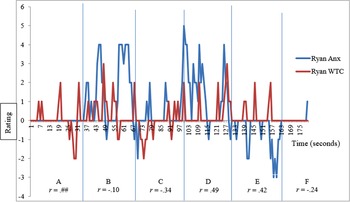
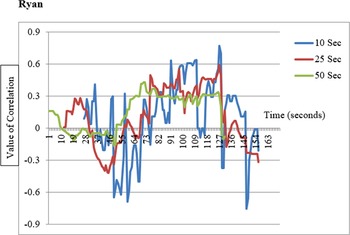
MacIntyre and Gregersen (Reference MacIntyre and Gregersen2022) examined idiodynamic data from two learners to document the changing relationship between anxiety and willingness to communicate. They used “moving window correlation” analysis (Verspoor et al., Reference Verspoor, de Bot and Lowie2011), which involves selecting a window of a certain size, in this case three different-sized windows measured in seconds (10s, 25s, and 50s). As the window is moved down the dataset, row by row, the trends in the data change, as does the size and even the positive/negative direction of the correlation. The data in Figure 1 reflect one learner's idiodynamic ratings of anxiety and WTC; the moving window correlations in this data between anxiety and WTC, based on windows of 10s, 25s, and 50s are presented in Figure 2.
Ryan's idiodynamic ratings of WTC and anxiety.

Three moving window correlations from Ryan's idiodynamic ratings.

Results in Figure 2 show that correlations between language anxiety and WTC vary widely, especially when taken over a brief timespan (10s) with individuals. Greater stability is observed over the longest timespan (50s). As the window spans more and more time (moving to timespans of months and years), the trend toward greater stability in the correlations between anxiety and WTC can be seen to continue. Averaged over many learners, we have the types of stability in correlations found in the meta-analysis discussed above. The key point here is that, over a brief time, anxiety can be positively or negatively related to WTC; similar findings were reported by Boudreau et al. (Reference Boudreau, MacIntyre and Dewaele2018) who found positive, negative, and near-zero correlations between anxiety and enjoyment. Sometimes the positive/negative correlation between anxiety and enjoyment changed within the same individual as communication topics changed and difficulties were encountered and resolved.
Proposition 5: Information in Exceptional Cases, Otherwise Lost to Error, Can Provide a Fuller Account of Language Learning Processes
Before considering anxiety and intraindividual factors, it is worth considering what the term “error” means in statistical analysis. In a statistical analysis, error is not a mistake. Rather, error is the measure of the unexplainable portion a variance in the data. If we examine a correlation or regression analysis on real data, perfect measurement and prediction is unimaginable, and thus there always will be some degree of error, unreliability, or unpredictability in the data. The correlation coefficient captures the predictable linear trend, and the deviations from that trend are unexplained error. Similarly, group comparisons examine differences between groups based on group means, acknowledging that there will be some unexplained variability around those means as captured in the standard deviation within each group. Those standard deviations help form the denominator of the frequently used t-test and F-test statistics, and they reflect error or unexplained variability around the means. In more extreme cases, highly unusual cases or outliers may be discarded from the analysis altogether (Tabachnick & Fidell, Reference Tabachnick and Fidell2018).
Intraindividually, variability has been conceptualized as a sign of progress as learners move from one level of understanding to another (Butler, Reference Butler2017; Lewis, Reference Lewis2000). Language skills will inevitably be developed and honed at different timeframes depending on individual learners’ comprehension, leading to different phase shifts beginning and ending in an overlapping rather than organized timeframe. Relatedly, the nature of one's anxiety is highly contextual and personal, as the underlying emotions and cognitions of each learner vary both between their experiences, and within their own day-to-day experiences. If we are to pursue the inner workings of anxiety beyond what a correlation can tell us, we must account for the intricate relationships between anxiety and other factors.
Inner Workings of Anxiety Involve Other Intraindividual Factors
MacIntyre and Serroul (Reference MacIntyre, Serroul, Dörnyei, MacIntyre and Henry2015) offered a holistic and integrated account of how anxiety coordinates with other processes. They identify the factors as “the four horsemen,” referring to coordinated patterns of anxiety, motivation, perceived competence, and WTC. Their account of the data showed that multiple interacting processes are coordinated in real time in a self-organizing pattern (Larsen-Freeman & Cameron, Reference Larsen-Freeman and Cameron2008). The model suggests that, initially during heightened anxiety, the process of vocabulary retrieval and assembling a message can be disrupted (Gass & Mackey, Reference Gass and Mackey2006). The lack of having something to say or an appropriate way to express it disturbs the expected timing of communication. Communication difficulties initiate a “not-okay” checking mode (Gray & McNaughton, Reference Gray and McNaughton2000) accompanied by increasing emotional arousal, similar to perceiving a threat, that further disrupts cognition. Internally, the individual begins to worry about embarrassment and think about how to avoid negative consequences of disrupted communication. In addition, external cues from the reactions of the interlocutor(s) are closely monitored for signs of understanding, approval, and encouragement, or for signs of misunderstanding, disapproval, and a chance to escape the conversation. With divided attention, the process of noticing relevant linguistic material and attention to language use is diminished further (Dörnyei & Tseng, Reference Dörnyei, Tseng, Mackey and Polio2009; Gass & Mackey, Reference Gass and Mackey2006). If the learner's ongoing appraisals of their own competence (MacIntyre & Ayers-Glassey, Reference MacIntyre, Ayers-Glassey, Lowie, Michel, Rousse-Malpat, Keijzer and Steinkrauss2020) suggest that the situation demands more from the learner than should be expected, then pressure is reduced because the learner does not feel responsible for the communication breakdown. But if competence appraisals suggest the individual ought to be able to communicate their thoughts but cannot, the emotional stakes are raised yet again.
As anxiety increases, coping efforts are initiated. If coping is successful, the person returns to an “okay” state, and the four horsemen settle into a calmer pattern. However, if coping efforts are perceived to be unsuccessful and difficulties persist for more than a few seconds, the speaker is likely to experience a fuller anxiety reaction. With elevated anxiety comes avoidance motivation, lower perceived competence, and declining WTC. Further pressure is placed on vocabulary retrieval and grammar/syntax processes as the learner struggles to deal with increasingly unpleasant levels of anxiety arousal. Physiologically, the fight-flight-or-freeze response of the sympathetic nervous system becomes perceptible. This response brings with it the familiar physical symptoms of physiological arousal such as increasing heart rate, skin flushing, perspiration, and stomach discomfort. Cognitively, distracting and often self-deprecating cognition is exacerbated as the person thinks to themselves, “I should know how to say this, what's wrong with me, this is embarrassing, other people are noticing, I want out of this situation,” and so on. MacIntyre & Serroul (Reference MacIntyre, Serroul, Dörnyei, MacIntyre and Henry2015) indicate that:
(t)his is not a state in which the person will tend to remain; it is a repeller state for the interpersonal communication system. There are a number of verbal and nonverbal coping strategies that might resolve the difficulties. Code switching to another language, changing the topic, using nonverbal behaviour such as gestures, or face saving humour can extract a person from a difficult situation, and possibly restore or increase levels of approach motivation. Some persons are highly adept at using strategies and some language teachers will choose to teach them, as a way of keeping conversation going. (p. 130–131)
This process-oriented account integrates more than the four ID variables for which it was named, and idiosyncratic variations are to be expected as some people feel engulfed by emotional volatility, and others maintain a steadier state.
Taken together, the general patterns and exceptions provide a more complete picture than either does alone. Language anxiety research has focused on its connection to performance, willingness to communicate, and self-efficacy, but it has not considered hundreds of other potentially relevant ID variables that could be studied. Individuals experience anxiety as fully integrated with other factors—vocabulary retrieval, self-assessment, goals, social evaluation, and other emotions, to name a few.
Pedagogical Implications of Using the Idiodynamic Method
When teachers are instructing a class, awareness of the average classroom experience of anxiety would be beneficial to ensure the class is taught with the average anxiety trend and effects in mind, catering to as many students as possible. However, it is vital to consider the perspectives that vary from the trend as well, to ensure no students are left behind. For example, there could be a few students whose experiences do not align with the majority, where their anxiety differs in cause, manifestation, or effects on their learning. Sometimes, the individual is unsure of how their issues arise and may not fully grasp the extent of its effects on their learning. Moreover, there may be students whose anxiety does not impair either their enjoyment or performance, and reducing their emotional experience could have a disadvantageous impact on them.
How can a teacher respond to individual needs? The idiodynamic software is freely available and can be integrated into lessons that require brief communication events (Gregersen & MacIntyre, Reference Gregersen, MacIntyre, Gregersen and MacIntyre2017b). If a learner complains of debilitating anxiety, reviewing the video and idiodynamic anxiety ratings for a specific language lab assignment or interpersonal event might help a teacher identify the relevant patterns of anxiety for that specific learner. These one-on-one conversations are structured around the data provided by the learner and may be an important support for the teacher's actions in the classroom. When teachers are aware of the potential for a wide variety of individual experiences like those described in idiodynamic studies, they may be better equipped to aid in the reduction of debilitating anxieties, building facilitating experiences to allow for a greater classroom and language learning experience for the individuals in their classroom.
Conclusion
Examining the inner workings of anxiety means taking a more process-oriented account of the specific ways anxieties are experienced by an individual, then comparing the accounts of different individuals to extract commonalities while, at the same time, being able to explain individual variations and outlier cases. Fundamentally, individual-level data challenge the researcher to provide a more complete account than traditional ID studies. One of the hallmarks of Complex Dynamic Systems Theory is dealing with open systems in which all the relevant factors impinging on an individual's anxiety-arousal system are difficult or impossible to predict in advance (Larsen-Freeman & Cameron, Reference Larsen-Freeman and Cameron2008). Experience with the idiodynamic method suggests that unexpected influences are likely to be found in every study in which data collection is undertaken (MacIntyre & Ducker, Reference MacIntyre and Ducker2022). Rather than being a limitation or problematic, such results are an embarras de richesses for research into language anxiety because both general patterns and exceptions to the rule can be identified using the same analytic approach.