INTRODUCTION
In studies of recent prehistory in the northeast of the Iberian Peninsula, the association between incineration rituals and ceramics with grooved decorations has, practically until today, been considered paradigmatic. Ceramic vessels decorated with grooves have been valued as one of the main “guiding fossils” of the Late Bronze Age (1300–700 BC). This has generated discussion whenever such ceramics, linked to inhumations, have been discovered because inhumation belongs to earlier chronological stages. In cases where this association has been documented, therefore, there has been no hesitation in assigning a more modern chronology than usual to this burial ritual or in associating it with the beginning of the Late Bronze Age and the urnfield culture of certain regions of the northeastern Iberian Peninsula. In this way, the survival of autochthonous rituals such as inhumation has been linked to the arrival of foreign cultural items such as grooved pottery.
Today, however, we know this is not true. In recent years, intensive reviews have been conducted of the chronologies of the Late Bronze Age in this region (Barceló Reference Barceló2008). It has thus been verified that grooved pottery appears in contexts that can be traced back to the 13th century BC, while the oldest-known incinerations cannot be dated earlier than 1000 BC. This obliges scholars to revise the chronological schemes that define this final period of peninsular prehistory and establish new chrono-cultural frameworks that delimit this period much more accurately.
At the very least, the lack of absolute dating has enabled archaeological sites with surviving and divergent cultural parameters, such as the Cova de Marcó in Tivissa (Ribera d’Ebre, Tarragona), where traditional elements (inhumations) coexist with novelties (grooved ceramics), to become “model” sites for explaining the connection points between different cultural phases as well as between autochthonism (represented by the ritual of inhumation) and the external (such as, in this case, grooved pottery) (Vilaseca Reference Vilaseca1954, Reference Vilaseca1973; Vilaseca et al. Reference Vilaseca, Solé and Mañé1963).
We believe that dating techniques such as radiocarbon (14C) analyses are essential for clarifying these earlier-accepted associations, which generate serious problems in relation to chronology and to such diverse cultural relationships as funeral rituals and the adoption of new ceramic models. For this reason, we decided to directly date the human remains recovered at the Cova de Marcó using the accelerator mass spectrometry (AMS) 14C technique to clarify the site’s chronology and shed light on these concerns.
HISTORICAL BACKGROUND
Between the first periodization studies on the recent prehistory of the northeastern Iberian Peninsula, conducted by Pere Bosch Gimpera, and the research conducted by López Cachero (Reference López Cachero2008), the Late Bronze Age in this region has been explained by invasionist models (e.g., Bosch Gimpera 1915–1920, Reference Bosch Gimpera1932; Maluquer Reference Maluquer de Motes1945–1946; Almagro Basch Reference Almagro Basch1952), diffusionist models (e.g., Vilaseca et al. Reference Vilaseca, Solé and Mañé1963), acculturationist models (e.g., Almagro Gorbea Reference Almagro Gorbea1977; Maya Reference Maya1978; Pons Reference Pons1984; Ruiz Zapatero Reference Ruiz Zapatero1985), or autochthonist models (e.g., Junyent Reference Junyent2002) ranging from the broadest of generalizations to more regional schemes. From the beginning, the main characterization of this stage was defined by the adoption and generalization of a new funerary ritual associated with the incineration or cremation of the deceased. The acculturating discourse proposed that small contingents or infiltrations of populations arrived in the northeastern Iberian Peninsula from the Southern France became architects for the cultural dissemination of the urnfield phenomenon and the establishment of the new funerary ritual among the communities and regional groups making up the local substratum and contributed a new material culture characterized by the presence of grooved ceramic vessels. This association also made these vessels the main element for dating the presence of these settlers in the region and, in particular, for dating the introduction of the funerary ritual of cremation.
Since the 1990s, however, the results of radiocarbon dating from several necropolises in the northeastern Iberian Peninsula have placed the introduction of cremation in the late 11h century BC, while, as we mentioned earlier, the presence of grooved pottery is documented from at least the 13th century BC (López Cachero Reference López Cachero2005, Reference López Cachero2007 and Reference López Cachero2008; López Cachero and Pons Reference López Cachero and Pons2008; López Cachero and Rovira Reference López Cachero and Rovira2016; Capuzzo Reference Capuzzo2014; Capuzzo and López Cachero Reference Capuzzo and López Cachero2017), since when it became adopted gradually and at different rhythms (López Cachero Reference López Cachero2005). Radiocarbon dating techniques applied at necropolises such as Can Bech de Baix (Arnal et al. Reference Arnal, Bouscaras, Dedet, Fiches, Gasco, Jully, Junyent, Montjardin, Nickels, Pons, Prades, Py, Rancoule, Riols, Rouquette, Taffanel and Vallon1975:17, 66), Els Castellets de Mequinensa (Royo Reference Royo1994–1996), El Pi de la Lliura (Pons and Solés Reference Pons and Solés2008), Can Piteu-Can Roqueta (Sabadell) (López Cachero Reference López Cachero2005) and Can Barraca (Martín Reference Martín2006) confirm the falseness of the supposed contemporaneous relationship reported earlier. Grooved pottery alone, therefore, is no longer understood as being “synonymous” with urnfields, and the presence of grooved vessels as funerary urns must be documented to definitively link this ceramic item with the new incineration ritual.
In southern Catalonia this problem has been more acute because the general lack of radiocarbon dating means that the funerary record from the Late Bronze Age is still interpreted largely according to the traditional chronologies proposed in the archaeological periodizations formulated since the mid-20th century (Vilaseca, Solé and Mañé Reference Vilaseca, Solé and Mañé1963; Almagro Gorbea Reference Almagro Gorbea1977; Ruiz Zapatero Reference Ruiz Zapatero1985; Rafel Reference Rafel1991, Reference Rafel1993, Reference Rafel1994–1996). In fact, except for the analyses conducted by P.V. Castro Martínez (Reference Castro Martínez1994), which were not too enlightening since they failed to take into account the possibility of regional particularities (Rafel and Armada Reference Rafel and Armada2008:149; Rafel et al. Reference Rafel, Belarte, Graells and Noguera2012:27), the only radiocarbon-dating results available are those from the necropolises of Calvari (El Molar) and Coll del Moro (Gandesa), which date the oldest graves in the 9th century BC (Rafel and Armada Reference Rafel and Armada2008; Rafel et al. Reference Rafel, Belarte, Graells and Noguera2012), and the necropolis of Sebes (Flix), which dates them to the late 9th or early 8th century BC (Belarte et al. Reference Belarte, Malgosa, Noguera, Olmos and Piga2013).
Everything therefore seems to indicate that in the Ebro region, as in other areas of the northeastern Iberian Peninsula, the practice of incineration began at an advanced period of the Late Bronze Age, and to suggest that Les Obagues in Ulldemolins (which may date from the 10th century cal BC) is the most ancient incineration necropolis in southern Catalonia (Rafel et al. Reference Rafel, Belarte, Graells and Noguera2012:28).
In addition to revisions conducted in the south of France, which suggest an early presence of grooved pottery as far back as 1400 cal BC (Gascó Reference Gascó1995) and a much later generalization of incineration necropolises (never before 1000 BC: Janin Reference Janin1992; Mazière Reference Mazière2005), these updated data enable scholars to separate these two items, thus definitively disproving the cultural homogeneity previously attributed to urnfields (López Cachero and Rovira Reference López Cachero and Rovira2016). In recent years, these new approaches have supported the suggestion that cave inhumations in the northeastern Iberian Peninsula survived until very late periods of the Bronze Age (such as the Final Bronze Age), as is evidenced by the existence of burial cavities that occasionally contain grooved ceramics as accompanying vessels—for example, at Roc Mirador (St. Martí de Llemana), El Roc d’Orenetes (Queralbs), Caves N and D (Arbolí) and the Cova de Marcó (Tivissa) (López Cachero Reference López Cachero2008:142).
Indeed, the Cova de Marcó is included in this list because of the earlier-mentioned lack of radiocarbon dating and is due to the systematization proposed by S. Vilaseca, who set it as a cultural reference: “It is suggested that Ligurians, Celts, Illyrians and Ambrons introduced the culture of cemeteries of cinerary urns, though there must have been a transitional period (Hallstatt A or B) in which the ritual burial of corpses continued to be practised, as, for example, in the above-mentioned Cova de Marcó” (Vilaseca Reference Vilaseca1954:71). Vilaseca thus established a rationalization for the ‘Tarragona urns’ whereby the first phase was represented by “the Janet and Marcó caves of Tivissa, 10th and 9th centuries. These vessels are typical of urnfields and are the oldest and undoubtedly the best fabricated and best decorated in all of Catalonia,” though he associated them with the ritual of inhumation: “It is interesting that in one of these caves (Cova de Marcó), the inhumation of human corpses was still practised” (Vilaseca Reference Vilaseca1954:78).
This is how Vilaseca’s proposal came to be accepted until today, even becoming a paradigm for the association between autochthonism (burial rites) and the introduction of new materials (grooved pottery) in the early Late Bronze Age. Indeed, this proposal has not met criticism from more current authors such as Noguera (Reference Noguera2006:90–91) or López Cachero (Reference López Cachero2008), though in some cases a degree of scepticism, especially when it comes to the Cova de Marcó, has been noted: “The very description of the sites, the existence of numerous fragments of storage jars, and the fact that the author himself found no evidence of burial apart from the scattered remains of human bones suggest that perhaps another interpretation should be found for these sites” (Noguera Reference Noguera2006:90, note 17). Only by establishing new dating will this problem be solved.
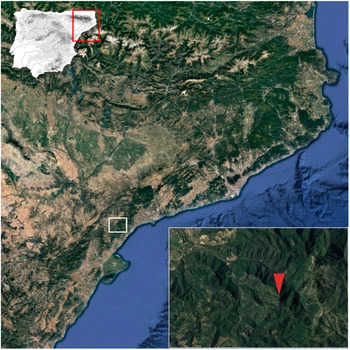
Geographical location: Cova de Marcó (Tivissa, Tarragona, Catalonia, Spain).

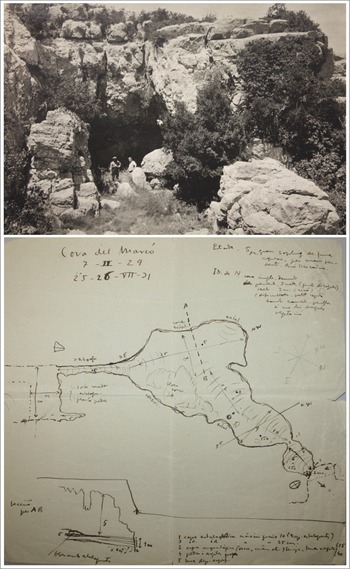
Cova de Marcó: view of the entrance at the time of its discovery and planimetry of the excavation made by S. Vilaseca in 1931 (Arxiu del Museu de Reus, fons Salvador Vilaseca, Reus, Tarragona).

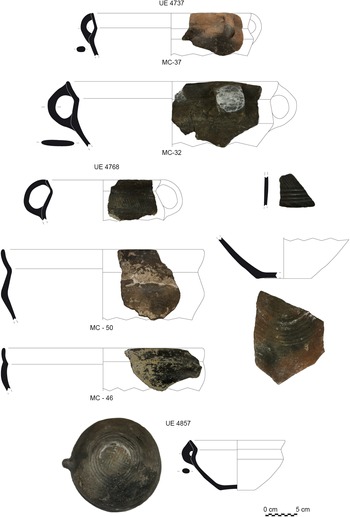
Cova de Marcó: pottery with grooved decoration from the time of the last occupation (Late Bronze Age).

THE SITE
The Cova de Marcó in Tivissa (Ribera d’Ebre, Tarragona) is located at La Mola del Perelló (Figure 1). It has two openings, one of which is located above “Canal de la Biscaïna” facing southeast and is the easier to enter. It comprises a spacious, rectangular entrance 8 m wide and 5 m deep. Two corridors are projected from this entrance: one on the right which drops to 5 m in height and one on the left which is roughly 15 m long and half a meter wide. The latter corridor slopes down steeply before ending at the largest chamber in the cave, which is roughly 25 m wide, 8 m deep, and 6 m high. Other chambers lead to an opening roughly 2 m high that communicates with the exterior (Vilaseca Reference Vilaseca1939:170). The cave was discovered in 1929 by Manel Mata, who found the first archaeological remains. It was then excavated by Salvador Vilaseca (Figure 2), whose interventions comprised the entire stratigraphy, though they were mainly conducted in the great chamber, where five levels were defined (Vilaseca Reference Vilaseca1939:170–171):
-
1. a stalagmite layer with a thickness of roughly 10 cm,
-
2. an archaeological level roughly 15 cm thick, in which a wide range of archaeological materials were discovered,
-
3. a discontinuous stalagmite layer with a thickness of roughly 15–20 cm,
-
4. an archaeological level roughly 40 cm thick, and
-
5. a sterile layer of earth and stones.
Materials were extracted from the archaeological strata without specifying their stratigraphy. Among these were lithic remains (retouched flint, porphyry, ochre, and limestone), organic remains (animal bones, some of which had been worked, horns, and mollusks), human bones scattered in complete disarray around the cave with no evidence of burial, and pottery from various periods, including: large containers decorated with smooth, incised and digitated cords typical of the Middle Bronze Age; fragments of vessels of perhaps an even earlier origin with incised decorations; and numerous fragments of grooved pottery typical of the Late Bronze Age, including a hemispherical vessel with an everted rim and several fragments of biconical urns that perhaps dated from the 10th century BC (Figure 3).
Material, Methods, and 14C results
Three human teeth, each belonging to a different individual, were dated. Two of these were taken out from the mandibles nº 1 and 2 from the excavations conducted by Salvador Vilaseca (Vilaseca Reference Vilaseca1939), held at the Salvador Vilaseca Museum in Reus, while the other was taken from a fragment of maxilla from a private collection belonging to a resident of Capçanes, a town located close to the site.
One root was cut from each tooth using a rotary tool provided with a micro-diamond cutting wheel. The samples were sent for AMS dating purposes to the Beta Analytic Laboratory (www.radiocarbon.com) in the United States.
The pretreatment used to extract the bone collagen was a proprietarily modified Longin Collagen Extraction Method (Longin Reference Longin1971) by Beta Analytic (Chris Patrick, personal communication). The concentrations of the chemicals used, as well as the duration and number of extractions, were based on factors such as initial size, level of preservation, burial conditions (if known), and the reaction level of the collagen extract to the pretreatment process while it was being performed. As the latter is unique to each bone sample, there is no specific stepwise pretreatment regime, which must be modified for each sample based on the Beta Analytic experiment and its observations.
The process comprised an initial cleaning stage in which each tooth was washed and then abraded with a rotatory tool to remove surface contamination from dirt, stains, surface debris, or oils from prior handling, among others. The teeth were then placed in 0.2N Hydrochloric Acid (HCl) at roughly 21°C to dissolve the mineral fraction. After 12–24 hr in the initial HCl bath, the sample surfaces were again abraded to remove the outermost layers, which could have contained embedded dirt or rootlet materials that penetrated below the surface during burial. This material was discarded provided sufficient bone remained for dating.
The collagen from each tooth was periodically scraped away for several days as the surface mineral fraction dissolved. Once a sufficient amount of collagen had been recovered, this step was terminated, and the collagen was rinsed to neutral. A solution of 1–2% alkali (50/50 wt/wt % NaOH) was applied carefully and re-applied under observation at room temperature until the solution became clear (which indicates that secondary organics such as humic acids have been successfully removed). After the collagen was rinsed to neutral, a final acid wash was applied to remove any adsorbed CO2. Throughout this process, all the roots, organic debris and minerals were eliminated. The purified collagen was then rinsed to neutral, dissected and microscopically examined for cleanliness and uniformity.
The clean gelatinous collagen extract was then dried by vacuum desiccation prior to combustion. The extracted collagen was analysed by IRMS for the δ13C, δ15N ratios, and the CN, %C and %N values were checked to see whether they lay within the expected ranges. As these values were normal, the samples were combusted to CO2 graphitized and AMS counted.
The 14C dates presented in this paper are given in BP (before present), which means years before 1950, and are calibrated (cal BP and cal BC), to provide absolute calendar ages, using OxCal v.4.4 software (Bronk Ramsey Reference Bronk Ramsey2009) against the IntCal20 curve (Reimer et al. Reference Reimer, Austin, Bard, Bayliss, Blackwell, Ramsey, Butzin, Cheng, Edwards and Friedrich2020). The results of the calibration are shown as cal BP and cal BC (2σ; 95.4% probability). To verify the preservation state of the collagen in the teeth to be dated, the C:N ratio, %C and %N values were evaluated. The C:N ratio should be between 2.9 and 3.6 (Ambrose Reference Ambrose1990; van Klinken Reference Van Klinken1999; Higham et al. Reference Higham, Douka, Wood, Bronk Ramsey, Brock, Basell, Camps, Arrizabalaga, Baena and Barroso-Ruiz2014). Once the samples met the criteria for collagen quality, they were graphitized and dated according to Beta Analytic methods.
The radiocarbon dates obtained from the human remains of Cova de Marcó show that the inhumations were conducted during the Chalcolithic period (Table 1), not during the Late Bronze Age as had been proposed from the presence of grooved pottery in the cave (Vilaseca Reference Vilaseca1939).
AMS radiocarbon dates from the human remains of Cova de Marcó*.

* All ages were calibrated with OxCal v4.4 software (Bronk Ramsey Reference Bronk Ramsey2009) against the IntCal20 curve, which provided a probability range of 95.4% (Reimer et al. Reference Reimer, Austin, Bard, Bayliss, Blackwell, Ramsey, Butzin, Cheng, Edwards and Friedrich2020). For the samples, we included the isotopic values and C:N ratios. Beta = Beta Analytic Inc. BP = before present (years before 1950). cal BP = calibrated years before present. cal BC = calibrated years before Christ (all probability ranges are expressed at 95.4%: 2σ).
CONCLUDING DISCUSSION
Radiocarbon analyses have shown that the ceramic materials from the Late Bronze Age and the buried human remains from the Cova de Marcó in Tivissa do not belong to the same chronological period and that their association is the result of defects in the intervention process or the interpretation of results. We have therefore shown that this Cave was used from the Chalcolithic period to the Late Bronze Age, though for different purposes. We have also shown that the inhumations carried out there were not connected with the grooved pottery recovered from the site.
These new data oblige us to reconsider traditional approaches relating to funerary practices employed in the northeastern Iberian Peninsula during the Late Bronze Age. Specifically, our data dispute the suggestion of an initial transition phase in which the practice of cave inhumations coexisted with the introduction of new items associated with the incineration ritual, such as grooved pottery.
Indeed, the results from the radiocarbon dating of human remains from the Cova de Marcó in Tivissa indicate that these burials were conducted during the Chalcolithic period, not as has traditionally been suggested, during the Late Bronze Age. The record documented at the Cova de Marcó therefore indicates that the cave was used as a place for funerary rituals during the third millennium BC and later frequented during the Late Bronze Age. It was during this later frequenting of the cave that the deposition of the ceramic vessels with their characteristic grooved decorations took place. These grooved vessels therefore cannot be interpreted as being accompanying burial goods.
These data oblige us to reconsider the suggestion that cave burials persisted until the final period of the Late Bronze Age and present the possibility for new hypotheses on the continued frequenting of certain burial caves at different stages of recent prehistory. They also invite scholars to launch more extensive studies that include analyses of human remains documented at other burial caves that also record the occasional presence of grooved pottery. These include the caves of Roc Mirador (St. Martí de Llèmana), El Roc d’Orenetes (Queralbs), and Caves N and D (Arbolí). In conclusion, there is an undeniable need to apply radiocarbon dating methods and use the optimal results these methods provide to solve certain issues and further our knowledge of opaque aspects from earlier archaeological studies, some of which were carried out in the first half of the 20th century.
ACKNOWLEDGMENTS
The dating of human remains from the Cova de Marcó is funded by the “Ayuda a la aplicación de metodologías y técnicas de las ciencias experimentales/analíticas en arqueopaleontología 2019–2021” program of the Fundación Palarq. This research has been conducted with financial support from the Department of Culture (Projectes Quadriennals de Recerca en Materia d’Arqueologia CLT009/18/00053) and the AGAUR Agency (SGR 2017 1040) of the Generalitat de Catalunya (government of Catalonia). The Institut Català de Paleoecologia Humana i Evolució Social (IPHES-CERCA) has received financial support from the Spanish Ministry of Science and Innovation through the “María de Maeztu” program for Units of Excellence (CEX2019-000945-M).
We wish to express our special thanks to the staff of the Salvador Vilaseca Museum in Reus and to Màrius Sedó of Capçanes for enabling us to sample and study archaeological materials from the Cova de Marcó.