The great powers can influence the votes of nonpermanent members of the United Nations Security Council (UNSC) in three ways. Whereas the first two, vote-buying (Kuizemko and Werker Reference Kuziemko and Werker2006; Vreeland and Dreher Reference Vreeland and Dreher2014) and diplomatic pressure (Chapman Reference Chapman2011, 13; Lai and Lefler Reference Lai and Lefler2017, 602), have attracted the attention of researchers in recent years, the promotion of loyal countries to UNSC seats has not been studied adequately. In the third situation, the great powers directly intervene in UNSC elections, expecting that the supported country will work in their favor while serving in the Council. Recent research interest clearly shows that permanent members of the UNSC intervened in the election of nonpermanent members thereby influencing the outcome (Balci Reference Balci2022a; Eldar Reference Eldar2008; Malone Reference Malone2000, 17–18). However, it is not known whether the great powers achieved their desired results from their interventions in UNSC elections. The most important reason for the relative dearth of studies on this subject is the scarcity of data about how and to what extent the great powers intervened in the elections of UNSC nonpermanent members. Even if there are exceptions—such as the US campaign to deny Sudan and Venezuela from a Council seat in 2000 and 2006, respectively—the great-power campaigns and efforts to promote a targeted country to a Council seat often have taken place behind closed doors.
Fortunately, diplomatic archives provide necessary data about the great-power interventions in UNSC elections. Although United Nations General Assembly (UNGA) Rule 92 imposes a secret ballot for elections of nonpermanent members, diplomatic archives provide some data—albeit incomplete—about the votes and negotiations between great powers and the countries with voting rights in the UNGA. Therefore, the period before the expansion of the UNSC provides a perfect laboratory for answering whether meddling in elections is beneficial for the great powers. A detailed reading of the US diplomatic archives reveals those countries for which Washington campaigned. Given that votes in the UNSC are open to the public, data on the elections of nonpermanent members make it possible to measure whether the United States achieved its desired results from its interventions in UNSC elections. This can be measured in a rather simple way. How close were the countries that Washington campaigned for with the United States in the votes that they cast in the UNSC? This voting data on the UNSC, as well as data on elections, provide a rich laboratory for measuring whether election interventions are a lucrative business.
The article is organized as follows. First, the importance of nonpermanent members during the early Cold War is debated and Washington’s motivation for intervening in the elections of those members is elaborated. Second, the article introduces data for dependent variables (i.e., votes in the UNSC) and independent variables (i.e., US interventions in elections and other control variables, alliance relations, and political affinity). Third, the econometric equation through which the effect of electoral dynamics on the voting behavior of nonpermanent members can be measured is then presented. Finally, the results of the ordinary least squares regressions are described.
NONPERMANENT MEMBERS DO MATTER
Unlike the expectation of the vote–power analyses that find the effect of nonpermanent members’ votes on UNSC resolutions to be minimal (O’Neill Reference O’Neill1996, 223; Schwoidiauer Reference Schwoidiauer1968, 10; Shapley and Shubik Reference Shapley and Shubik1954, 791), Washington made a great effort to elect its loyal allies to the UNSC during the early Cold War. Rather than the arithmetical weight of nonpermanent members’ votes on the outcome, US diplomats prioritized the symbolic effect of their votes, thereby minimizing international support for Soviet positions. It was important for the United States to reject the Soviet proposals and to ensure that they received a minimum number of votes. Therefore, Washington expended much diplomatic energy to keep the voting margin in its favor and the UNSC at its maximum (Balci Reference Balci2022a, 263, 265). It was this voting margin that pushed the Soviet Union to cast a negative vote (i.e., veto) and reassured the United States in rejecting the Soviet proposal without applying its veto power (Todd Reference Todd1969, 75–76). The Soviets’ frequent use of the veto allowed Washington to characterize its rival as an obstacle to the peaceful resolution of international problems. With this motivation, Washington prioritized electing loyal states to the UNSC, even if the number of their votes would not have much influence in the outcome.
Rather than the arithmetical weight of nonpermanent members’ votes on the outcome, US diplomats prioritized the symbolic effect of their votes.
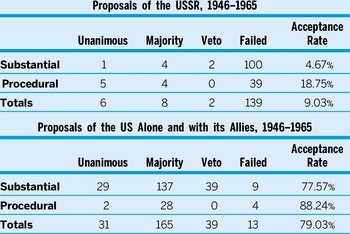
Table 1 demonstrates the outcome of the US policy of maintaining a wider voting margin in its favor in the UNSC. The first part shows USSR proposals (excluding proposals made with the United States) between 1946 and 1965. The acceptance rate of Soviet proposals was less than 5% in resolution-related issues. Only two Soviet proposals reached the required majority to pass, which necessitated the veto power of permanent members to defeat them. Of eight other Soviet proposals that reached the required majority to pass, none received a negative vote from the United States. The second half of table 1 lists proposals submitted by both the United States alone and with its allies (excluding proposals made with the USSR) between 1946 and 1965. The acceptance rate of US proposals dramatically increased to 77.5% in resolution-related issues. In summary, table 1 clearly demonstrates that the United States, with more allies in the UNSC, defeated the majority of USSR proposals without resorting to its veto power. However, the USSR had no opportunity to defeat US proposals with the help of other Council members; therefore, it often resorted to its veto power to defeat those that were contrary to its interests.
Acceptance Rates of USSR and US Proposals in the UNSC, 1946–1965

The recently burgeoning literature focuses on the importance of nonpermanent members and their votes in the UNSC (Balci Reference Balci2022a; Farrall et al. Reference Farrall, Loiselle, Michaelsen, Prantl and Whalan2020; Nick Pay and Postolski Reference Nick Pay and Postolski2021). A permanent member with more allies from the elected members has two crucial advantages. First, a higher number of affirmative votes increases the international legitimacy of a resolution supported by this permanent member. Even if a draft resolution fails through veto, the high number of affirmative votes can legitimize the standing of the proposers in international politics (Claude Reference Claude1966, 375; Krisch Reference Krisch, Lowe, Roberts, Welsh and Zaum2008, 139; Tago and Ikeda Reference Tago and Ikeda2015). The primary aim of the United States was to prevent “international support for Soviet positions” in the UN platforms during the early Cold War (Foreign Relations of the United States 1959); therefore, distancing elected members from Soviet positions was the key target of US diplomats in promoting some countries to UNSC seats.
Second, the vote of nonpermanent members is crucial in procedural matters for which permanent members have no veto power. Before the expansion of the UNSC in 1965, adopting the agenda required seven affirmative votes without a right to veto for permanent members. Therefore, permanent members with more allies among nonpermanent members had the capacity to dominate the agenda of and debates in the Council. For these two reasons, the United States had important motivation in screening and promoting candidates that were likely to support its position in the Council (Lai and Lefler Reference Lai and Lefler2017, 591).
DATA
To measure the influence of US interventions in elections on the voting behavior of nonpermanent members, three groups of data were needed: (1) proximity of countries in terms of votes they cast in the UNSC; (2) names of countries for which Washington campaigned; and (3) other potential determinants of the voting preferences of nonpermanent members. For econometric analysis of variables, the approach recently employed by major scholars in the UNSC vote-buying literature subfield (Dreher et al. Reference Dreher, Lang, Peter Rosendorff and Vreeland2021) was used and then electoral intervention and other relevant variables were added. Considering that the United States made an effort to elect already-loyal countries to the Council, two control variables were used to minimize this effect on the results: alliance relations and political proximity.
Dependent Variable
What is the primary indicator of loyalty? In the UNSC context, the measurable indicator of loyalty is the distance between the votes of the paired countries. Voting similarities of countries in the UNGA were used extensively to explain interstate conflicts (Gartzke Reference Gartzke1998) and aid allocation (Alesina and Dollar Reference Alesina and Dollar2000). Aligned with this literature, this study measured the loyalty of nonpermanent members to any great power through their distance scores based on votes cast in the UNSC. For this, we used the comprehensive dataset covering all resolution-related votes in the UNSC from the first session in 1946 until the enlargement of the Council to 15 members in 1965.
In our dataset, we compiled 1,061 clear observations about votes in the UNSC between 1946 and 1965 (Balci Reference Balci2022b; Balci and Hazar Reference Balci and Hazar2020). Unlike the only available dataset (Dreher et al. Reference Dreher, Lang, Peter Rosendorff and Vreeland2021) that provided data on successful resolutions, vetoed resolutions, and failed resolutions due to insufficient votes, we covered voting on amendments to the draft resolution and partial voting of resolutions. Also, the DLRV (i.e., the first letters of the study authors’ surnames) dataset recorded few “failed majorities” because “the minutes prior to 1966 are not machine-readable in a reliable way.” Because we collected data by reading every meeting record, we were able to include many more failed majorities in the dataset. Whereas unanimous votes are not effective in differentiating affinity scores between countries, disputed results are more decisive in this regard. Therefore, an increase in the number of observations with disputed results would provide more reliable and meaningful distance scores. Compared to the DLRV dataset, the number of unanimous observations in our dataset increased by 1.3 times, the number of majority decisions by 2.5 times, and the number of failed-majority observations by 8.9 times.
…an increase in the number of observations with disputed results would provide more reliable and meaningful distance scores.
The key challenge was to measure voting distance between UNSC members. Unlike the UNGA, well-developed measurement methods of votes in the UNSC did not exist until recently. The most recent and replicable voting-distance indexes applied to UNSC votes are from Dreher et al. (Reference Dreher, Lang, Peter Rosendorff and Vreeland2021). One of those measurements calculates the share of votes against the United States. If country i always voted in line with country j in a given year, the percentage of against votes is 0%. If country i always voted opposite to country j in a given year, the percentage of against votes is 1%. In this way, we generated yearly interval measures of voting similarities between the paired members. According to this calculation, the distance between the United States and itself is 0, and the closer other members are to 0, the more loyal they are to the United States. Alternatively, the closer other members are to 1, the less loyal they are to the United States.
Explanatory Variable
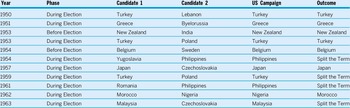
We expected UNSC members elected with the diplomatic support of Washington to vote in parallel with the United States. Therefore, our first explanatory variable was the US campaign for member states during the electoral process. By the “US campaign,” we mean attempts by Washington to meddle in UNSC elections for a particular candidate. Although voting for one candidate is not an election interference, influencing other countries’ votes and forcing one candidate to withdraw can be considered an electoral interference. For Washington’s electoral interventions between 1946 and 1964, we relied on Balci’s (Reference Balci2022a) study and also consulted the US diplomatic archive. These relevant sources revealed that the United States intervened in the elections in three ways. First, it prevented the candidacy of some countries before an election, allowing the country that it did support to enter the election unopposed. For example, in the 1954 elections, US diplomats pursued intense diplomacy to prevent Sweden’s candidacy so that Belgium—whose opposition to communism was more robust—could win (Foreign Relations of the United States 1954). Second, Washington promoted loyal countries to run against pro-Soviet candidates. For example, in the 1954 elections, US diplomats persuaded reluctant Turkish diplomats to run Turkey as a candidate against Poland. Third, Washington put diplomatic pressure on its allies to vote for the candidate it supported (Balci Reference Balci2022a). Table 2 lists US campaigns and interventions for a particular candidate in UNSC elections between 1946 and 1965.
US Campaigns for Candidates to a UNSC Seat, 1946–1965

Because of a limited number of cases (i.e., a total of only 11), we stress caution regarding the results of this study. Nevertheless, we have plausible justifications to study the small number of cases. The US diplomatic archive is not available for subsequent decades, and the archival documents that are open to the public include only the 11 viable cases. Although we witnessed two cases in the early 2000s, we only learned of them through journalistic reports rather than archival documents. Moreover, because the motivation of the United States to intervene in 11 elections was different from its motivation in two relatively recent cases (punishing the unwelcome candidate), the voting behavior of the promoted country may differ. Therefore, these 11 cases provide a near-perfect laboratory in which important exogenous dynamics are omitted.
Control Variables and Robustness Test
A great power chooses the countries that it will support in the elections from among the loyal countries. Therefore, we needed to isolate the impact of the campaign from that of loyalty relations. Existing studies reveal that alliance relations (Lai and Lefler Reference Lai and Lefler2017, 601) and political proximity (Dreher et al. Reference Dreher, Lang, Peter Rosendorff and Vreeland2021, 17–18) influence the voting preferences of elected members. Whereas political proximity is measured through voting similarity in the UNGA, alliance relations are a product of defense alliances between the paired states. With these two variables, we aimed to control whether the associations between voting distance in the UNSC and the US campaign were due to US diplomatic efforts during the election. Data on alliance relations were coded by Alliance Treaty Obligations and Provisions (Leeds et al. Reference Leeds, Ritter, Mitchell and Long2002). We used ideal-point data based on states’ voting behavior in the UNGA to measure political proximity between the paired states (Bailey, Strezhnev, and Voeten Reference Bailey, Strezhnev and Voeten2017).
For robustness tests, we used a different dataset on the UNSC votes (Dreher et al. Reference Dreher, Lang, Peter Rosendorff and Vreeland2021). Unlike our measurement of vote distance, Dreher et al. (Reference Dreher, Lang, Peter Rosendorff and Vreeland2021) developed alternative measurement methods. One method was similar to ours and examined how an elected country is different from the United States in voting behavior. By calculating only disputed vote results (i.e., the exclusion of unanimous votes), they measured the distance of other UNSC members from the United States using values ranging from 0 to 1. If a member country’s score was close to 0, it meant that it voted in parallel with the United States.
ECONOMETRIC ANALYSIS
We considered a variable that measures the share of votes against the United States as the dependent variable. Given the nature of our main research question, we were primarily interested in the effect of the US campaign on the votes of elected members. Therefore, our variable of interest was the US campaign. Previous studies (e.g., Vreeland and Dreher Reference Vreeland and Dreher2014) highlighted two important dynamics that affect the voting behavior of nonpermanent members of the UNSC. Therefore, we added defensive alliance relations and political proximity as control variables to our estimation to estimate the following regression equation:
 $$ {AgainstUS}_{it}={\displaystyle \begin{array}{l}{\beta}_0+{\beta}_1{Campaign}_{it}+{\beta}_4{Proximity}_{it}\\ {}+\hskip2px {\beta}_3{Alliance}_{it}+{\gamma}_i+{\delta}_t+{\varepsilon}_{it}\end{array}} $$
where
 $ {AgainstUS}_{it} $
measures the percentage of elected member (i) votes against the United States in the UNSC in a year (t);
 $ {Campaign}_{it} $
is the variable of interest;
 $ {Alliance}_{it} $
and
 $ {Proximity}_{it} $
are control variables;
 $ {\delta}_t $
is year fixed effects;
 $ {\gamma}_i $
is entity fixed effects; and
 $ {\varepsilon}_{it} $
is a stochastic error term.
RESULTS
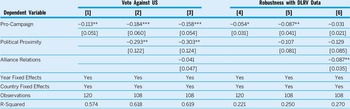
In the first three variables of table 3, coefficients are negative for all variables of interest. This indicates that Washington’s campaign for a candidate in the elections decreases the distance between the supported member and the United States in the UNSC voting. That is, the support of the United States in the election campaign has the effect of moving the vote distance of the elected member from the United States closer to 0. Whereas the coefficient in the first column reaches the 5% level of statistical significance, coefficients in the second and third columns reach the 1% level. The first column in table 3 shows the results of the association between Washington’s election campaign and voting distance between the United States and supported members. It demonstrates that Washington’s supportive campaign moves the elected member 0.11% closer to the US position in the UNSC voting. The second and third columns include control variables (i.e., alliance relations and political proximity). When we added political proximity to the second column and political proximity and alliance relations to the third column, the coefficient of interest remained negative and statistically significant. This suggests that the campaign-related association is not due to elected countries’ nonelectoral relations with the United States.
Washington’s campaign for a candidate in the elections decreases the distance between the supported member and the United States in the UNSC voting.
Campaign Effects on UNSC Votes

When we conducted a robustness test with an alternative measure of distance based on the DLRV dataset, our results held. Associations between pro-campaign and distance from the United States remained negative in each specification. Although the fourth and fifth columns reached the 5% and 1% levels of statistical significance, respectively, the pro-campaign coefficient in the sixth column was not significant at traditional levels. The results of this robustness test, despite varying measures of importance in each variable, yielded the same pattern as in the main empirical analysis.
CONCLUSION
Electoral interventions by the great powers in the domestic setting (Bubeck and Marinor Reference Bubeck and Marinov2019; Bush and Prather Reference Bush and Prather2018; Levin Reference Levin2016, Reference Levin2021) and international organizations (Iwanami Reference Iwanami2018, 13–14) are of recent interest in international relations. This study contributes to this burgeoning literature by showing that electoral interventions in international institutions are beneficial for the great powers. Although our case study is historical, electoral intervention remains relevant today. The United States overtly intervened in UNSC elections in 2000 and 2006 in favor of Mauritius and Guatemala. As the global power competition among the United States, Russia, and China escalates, great-power interventions will continue in the elections in many international institutions, especially the UNSC. Another important contribution of this study is to show the undemocratic character of international institutions (Vreeland Reference Vreeland2019). Great powers influence the votes of nonpermanent members not only by economic aid but also by interfering in the elections of those members.
ACKNOWLEDGMENTS
I thank Valentin Lang, Ayşe Hazar, and the PS: Political Science & Politics anonymous reviewers for helpful comments and suggestions, and Constance Burt for her outstanding copyediting. I also thank my classmates—Talha İsmail Duman, Serra Can, Furkan Halit Yolcu, Müberra Dinler, and Cahit Çelik—and the instructor, Mücahit Aydın, of the six-week econometrics course in Autumn 2022. I am grateful to Türkiye Bilimler Akademisi (TUBA-GEBIP 2019) for funding the course.
DATA AVAILABILITY STATEMENT
Research documentation and data that support the findings of this study are openly available at the Harvard Dataverse at https://doi.org/10.7910/DVN/FX5C2X.
CONFLICTS OF INTEREST
The author declares that there are no ethical issues or conflicts of interest in this research.