For several decades, political science has suffered deep divisions over its methods and direction. These disputes seem deeper and more enduring than found in other academic fields. At times, virtual civil war has broken out. These disputes have been centered on particular research methodologies. In the 1960s, with the “behavioral revolution,” quantitative methods seemed to be taking over the discipline. A movement for a “new political science” arose to recover more engagement with political issues.Footnote 1 In the 2000s, the vogue for rational choice provoked the “perestroika” movement to defend methodological pluralism.Footnote 2
I offer a different diagnosis: Political science is becoming scholastic. That term originally referred to medieval philosophy, but it has come to connote academic work that is over refined at the expense of substance. It is said that some medieval scholastics debated how many angels could dance on the head of a pin. Similarly, today's political scientists often address very narrow questions, and they are often preoccupied with method and past literature. The changes affect all areas of political science. Scholars are focusing more on themselves, less on the real world. That has harmed the realism of their work and the audience for it.
Critics attack the specific methodologies. They say that quantitative modeling or rational choice misconstrues the nature of politics. Or they argue that no one analytic method is sufficient to understand politics.Footnote 3 That may be true, yet the greater problem is the narrowing of inquiry itself. Research questions are getting smaller, and data-gathering is contracting. Inquiry is becoming obscurantist and ingrown. The dominance of quantitative methods or rational choice is objectionable mainly to the extent it reflects this wider change. As I will show, even if these methods were eliminated, trends toward scholasticism would remain.
I seek here mainly to define scholasticism more closely and document its growth. More briefly, I discuss the implications. The trends have shifted the values served by research. Today's political science seeks to be rigorous in a manner modeled on the natural sciences, but this has come at the expense of relevance to political problems and issues as non-academics perceive them. The shift, I suspect, is one cause of the discouragement of many political scientists about their discipline. A return to broader, more realistic, and more relevant research seems essential to restore morale.
Scholastic Trends
The following four trends constitute what I mean by scholasticism. I have observed them strengthening ever since I joined the Politics Department at New York University in 1979. They also have advanced at other universities where I have taught or know well, including Harvard, Princeton, and Wisconsin.
Specialization
Most political scientists today are far more specialized than they once were. Formerly, scholars teaching in American politics or international relations covered that entire field. Today, Americanists are likely to “do” only public law or public opinion, not all of American politics; internationalists will do perhaps international political economy, but not all of IR. Specialists' research is only in those subjects, and their intellectual world has also contracted. They interact with other academics, go to conferences, or review manuscripts mainly in these specialties. Their work is also read mainly by other specialists doing the same kind of research.
Methodologism
Attention to methodology has sharply increased. Much more attention is paid now to research design and data analysis than formerly. In itself, that would be a gain, but the cost is that political scientists today often are interested mainly in methodology or statistics, rather than in the subject of analysis. For many, politics or government is something to model, not important in itself. The same is true of graduate students, who today often have strong backgrounds in methods but know less about their subject than they used to. Methodology has itself become a field within political science, perhaps the most prestigious. Methodologists have become censors of the discipline, criticizing past research and setting standards for others.Footnote 4
The older research style pursued a subject using various methods. One read up on secondary sources, interviewed people, perhaps directly observed the phenomenon of interest, such as an election or a Congressional debate. Only then did one come up with a question and a research design. Research aimed to uncover some reality about politics. That truth was to be discovered “out there,” beyond the researcher, and all methods might contribute. Today, typically, background knowledge counts for much less. One seeks not a reality but a finding. It is not to be discovered but constructed by some deliberate procedure. No truth is thought to exist apart from this.
Academic discourse has also changed. Formerly, giving a paper at a seminar or conference would lead to questions about the argument and then a wide-ranging discussion of the issues raised. Today, the questions are much more about methodology, and there is little interest in the argument otherwise. Compared to their predecessors, today's political scientists are more skilled technically but less knowledgeable about politics and government and less intellectual. They have a method, but they often have little to say apart from it. They seldom construct whole arguments from scratch. Rather, they generate findings using a recognized methodology developed mostly by others.
Nonempiricism
The emphasis on method has tended to thin out the evidence behind research. The older, more catholic research produced a lot of information. It yielded a picture of politics that was robust but unsystematic. Observers outside academe could recognize it. But this sort of scholarship is non-rigorous. It cannot give an exact account of its inferences, so it has been discredited. Today, the preference is for mathematical analyses that can be precisely explained and defended. The cost is that less evidence is generated or consulted. Many published articles rest on a single, bulletproof analysis of a single data base. At the extreme, the empirical dimension of research disappears entirely, as in formal models of politics that are not verified.
There is much less “hands-on” inquiry such as reading documents, conducting interviews, or field observation—direct observation of a subject unmediated by a specific methodology. This journalistic dimension to research has almost disappeared. Instead, most research is done entirely from behind a computer. Political scientists learn a particular methodology and a data base in graduate school, and in their later careers they continue to generate papers based on these. They seldom have much first-hand contact with government.
Without qualitative research, however, findings can become unrealistic. Hypotheses tend to be based on past research or on academic theory, usually economics, rather than contact with actual politics. Political science has largely adopted the view of many economists that analyses need only account for outcomes in the sense of predicting them; they need not be realistic in any broader sense.Footnote 5 One common error is that analysts often exaggerate how goal-oriented behavior is. Actors are imagined to calculate and maneuver, when anyone with direct knowledge of government would more likely cite inertia or bureaucratic rules, factors that do not appear in the data bases. Unrealistic images persist in the literature because common sense, general knowledge, or field observation have lost the authority to discredit them.Footnote 6
Today what we call research is mostly confined to data analysis. For their empirical content, political scientists usually rely entirely on data bases gathered by others, particularly the National Election Studies and other surveys. Such data is systematic. One can precisely define and defend inferences based on it. But it actually contains very limited information. No data base, however rich, contains more than a fraction of the information conveyed by direct contact with politics or government. It is like comparing a laser, which illuminates in a highly specific way, to the midday sun, which floods all of reality.
Observers note that some subjects in political science are exhaustively studied, generating many publications, while others are neglected. In the American field, for example, public opinion or incumbency advantage in Congressional elections have received much attention, while urban politics, bureaucracy, and program implementation have received little, notwithstanding their substantive importance. The explanation is that data is already available on the popular subjects, whereas on the neglected ones one would have to leave one's computer and engage in onerous, low-tech information gathering out in the world.Footnote 7 To generate new data would more likely add to knowledge, but has little academic standing today.
Literature Focus
Finally, political scientists orient far more than they once did to the literature in their specialty. Before, scholars formed their own impression of a research problem based on general knowledge or earlier study. They might cite past studies and extend them, yet their inquiry rested on an independent appraisal of the problem. Today, however, the entire structure of the analysis will likely be dictated by past research. One takes sides in some existing controversy among specialists, or one seeks to resolve it with some definitive test.
Today's scholars often are expert primarily about the literature on a subject, rather than the subject itself. To them, the subject is the literature, and research often turns into a form of literary criticism. Much of what they study and talk about is this body of past work, rather than politics or government directly. In academic papers, literature review plays a growing role. In graduate school, students study not so much a question as the literature on that question. Their ambition, in their dissertations and afterwards, is to add something that the specialty will recognize and reward. One effect is to conservative research. It is difficult to advance any genuinely new idea or approach, since all assumptions and hypotheses are already set in “the literature.”
Illustrations
Two examples will help underline the contrast between the older political science and the new, more scholastic style. In the 1970s, Samuel H. Beer published several influential articles on American federalism. Public officials at all levels, he argued, had collaborated to expand federal programming and spending, and this was difficult for the general public to restrain. Beer's specific research was on general revenue sharing, but he reasoned more broadly about problems of political control in a federal democracy.Footnote 8 This eclectic, confident, but unconscious research style was typical of the earlier era. Much in contrast, a recent paper on intergovernmental relations presents it as a debate between two literatures. One of these treats “multi-level governance” in terms of subordinate but general units of government, the other in terms of special-purpose districts.Footnote 9 The focus is on academic issues rather than on a widely perceived problem or the stakes for the broad public.
In 1988, Mark Roelofs published an essay on religion and political radicalism. He contended that liberation theology was based less on Marxism than on the Biblical tradition. He referred to Latin American base communities as expressing that heritage, but his main point was the radical potential of Biblical faith itself.Footnote 10 In contrast, a study of churches in Florida analyzed how they shape members' political beliefs. An elaborate methodology measured that influence, and the authors positioned their work within the literature on “contextual” determinants in politics.Footnote 11 Both papers are about religious community, but Roelofs assumes that the political facts of religion are clear, and the main task is to interpret them. The other paper generates more rigorous findings, but it covers much less ground. The question and the inquiry have radically contracted.
I believe that wide-ranging research of the sort seen in Beer or Roelofs has become less common in recent decades. More rigorous but narrower research now dominates. My sense is that the shift has affected all fields in our discipline, from political theory to international relations. While the nature of evidence and methods differs by field, all are becoming more self-conscious and self-protective. More attention is paid to addressing past arguments and to anticipating criticism, less to making a fresh argument. That inevitably narrows the scope of inquiry.
I do not suggest that the shift is universal. In every era, political scientists deploy a range of methods from the less to the more rigorous. Decades ago, some political scientists were already highly systematic, just as today some prominent figures still address broad questions in more eclectic ways. My contention is only that the mode has shifted. There are relatively more political scientists addressing narrow issues with narrow, focused methods today than was true several decades ago.
Documenting the Trends
How does one document that change? Ideally, one would survey the types of research done by political scientists and track shifts over time, a practical impossibility. I offer more limited evidence here. It strongly suggests, at least, that many political scientists today are indeed more likely to be narrow specialists and to publish research on smaller questions than they did 40 years ago.
The growth in specialization is the easiest trend to document and the one that has elicited the most comment to date. Critics say that political science is breaking up into cliques pursuing separate specialties and methods, with little communication between them.Footnote 12
Journals
One sign of this is the growing number of political science journals. General journals are the most prominent, among them the American Political Science Review, the American Journal of Political Science, and Journal of Politics. However, there are many others, and the number has sharply risen in recent decades. Figure 1 shows the cumulative number of political science journals listed in JSTOR by the date when they began publishing. The number grows from one in 1886 (Political Science Quarterly) to 42 today, with especially sharp increases in the 1970s.Footnote 13 The less exclusive Social Science Citation Index lists no fewer than 160 titles under political science and public administration. Beyond these lie various ad hoc collections of papers available on the web.
Cumulative Political Science Journals in JSTOR
Note: Journals are shown by first year of publication of the journal or its predecessors.

Since many of the newer journals are specialized, the effect has been to promote research on narrow subjects. As a recent APSR editor remarks, it is now “more likely that a given paper will be selected for publication because it passes muster among a narrow range of specialists rather than because it is considered to be of potentially great interest and importance to a broad range of readers.”Footnote 14 Even the APSR itself under its current editorship has partially devolved decisions about manuscripts to area specialists.
Organized Sections
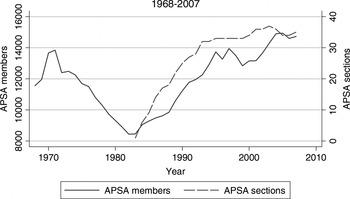
The American Political Science Association has increasingly fragmented into subunits. Already in the 1970s, the association faced pressures to recognize subspecialties. Most of these were narrower than the fields long recognized in the discipline—political theory, American politics, comparative politics, and international relations. The APSA council approved organized sections in 1981, and from 1983 they expanded explosively.Footnote 15 Figure 2 shows the trends for both APSA membership and sections. By 2007, there were 35 organized sections, covering traditional subjects such as the presidency or comparative politics but also “conflict processes,” “political communication,” “politics, literature, and film,” and so on.
Trends in APSA Membership and Sections
Source: APSA Executive Director reports from PS and PS: Political Science and Politics various years

From one viewpoint, the sections suggest vitality. Perhaps they helped reverse the worrisome decline of APSA membership in the 1970s.Footnote 16 However, they also helped fragment the discipline.
Conference Divisions
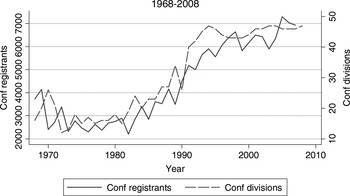
As the sections grew, so did specialties recognized at the annual APSA conference. The program committee traditionally allocated groups of panels to certain subjects. The number of these “divisions” expanded sharply from the 1980s. Figure 3 shows the trends for both divisions and registrants at the conference. Again, the picture might suggest vitality. The rise in divisions closely tracks the more-than-doubling in the size of the conference since 1980. Perhaps more political scientists are attending the conference because it recognizes more specific interests. However, the effect again was to emphasize narrow specialties.
Trends in APSA Conference Registrants and Divisions
Source: Preliminary programs and, if unavailable, calls for papers from PS and PS: Political Science and Politics, various years

The growth in divisions of the official program actually understates the trend, because meanwhile the organized sections were holding their own panels. Conference managers allocated some panels to the official divisions but also to the sections and even to “unaffiliated groups.” Furthermore, the sections claimed some role on the official program committee. Ordinarily, the head of a section became the program committee member for the equivalent division. This diluted the power of the program chair. Messy compromises emerged where the program chair and the sections shared power to name committee members, the details varying from year to year.Footnote 17 Nothing could be more scholastic than these internecine battles over subfield preferment, entirely invisible to the outside world.Footnote 18
The result was the fragmentation of the conference. In 1972, it had organized 142 panels, but by 1987 this had mushroomed to 659, counting official program panels, section sessions, and unaffiliated groups together. An ad hoc committee on the conference reported that this has produced a “scheduling nightmare,” and also that attendance at some panels had become “low to non-existent.”Footnote 19 Anyone who has attended recent APSA conferences knows that the “audience” for many panels, even on the official program, is now no more than the panelists themselves. That is true to what scholasticism means—the reference of specialists primarily to themselves. In recent years, organizers have tried to restrain the proliferation, so far to little effect.
An Analysis of the APSR
Scholastic trends other than specialization are harder to document. To suggest their growth, I offer an analysis of the American Political Science Review, the leading journal in our discipline. Over its history the APSR shows trends toward greater methodological rigor and sophistication. Articles based on mere narrative or “barefoot empiricism” have declined in number while those based on quantitative analysis, survey data, or formal analysis have increased.Footnote 20 These are the shifts that provoked protests. They need not correspond, however, to scholasticism as I have defined it—a focus on narrow subjects, methodological interests, or the literature.
I coded the articles published in the APSR in the years 1968, 1978, 1988, 1998, and 2007 according to whether they showed scholastic features. The coding covered all research articles and articles about controversies but excluded book reviews and review essays, a total of 259 papers. I operationalized each of the four trends mentioned earlier as follows. The definitions were conservative, designed to minimize the number of articles scored positively under each heading: I illustrate each feature with examples drawn from the coded articles:
• Specialization: An article was coded “1” if in my judgment it was of interest mainly to other specialists working on this subject, “0” if it would interest political scientists generally. A nonspecialized article thus had to interest other political scientists but not the general public. Two examples of specialization: Saxonhouse (Reference Saxonhouse1988), on the theory of tyranny in the ancient Greek polis, and Powell (Reference Powell2007), an analysis of anti-terrorism strategy with limited resources.
• Methodologism: An article was coded “1” if it offered a major methodological innovation or made general arguments about how to conduct inquiry on its subject, “0” if it did not. To be methodological, an article had to make a point about method, not only be methodologically advanced. Two examples: Gerber (Reference Gerber1998), a reestimation of the effects of campaign spending on Senate elections using instrumental variables, and Jenco (Reference Jenco2007), a new approach to the study of non-Western political theory.
• Nonempiricism: An article was coded “1” if it discussed an empirical question but did not offer any serious evidence about it, “0” if it did offer such evidence. Standards for evidence were lenient, accepting arguments grounded in any substantial way on factual material.Footnote 21 Two examples: Smith (Reference Smith1988), a discussion of “new institutionalist” approaches to public law, without evidence; and Lax (Reference Lax2007), a model of appellate court opinion writing which is unverified.
• Literature focus: An article was coded “1” if it took its structure from past literature, “0” if it was based on an independent assessment of the problem. Literature focus required that an analysis be framed in terms of past research, not simply that it refer to or add to that research. Two examples: Almond (Reference Almond1988a), a critique of recent rehabilitations of the “state” based heavily on a literature review, and Timpone (Reference Timpone1998), a study of voting turnout that takes its departure from the literature.
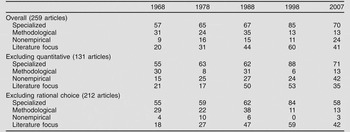
Trends in the four indicators are shown in figure 4 and the top panel of table 1. The share of articles that were specialized or focused on the literature grows dramatically. While 57 percent of articles were specialized even in 1968, the figure climbs to 85 percent by 1998, before falling to 70 percent in 2007. For articles focused on the literature, the comparable figures were 20, 60, and 41 percent. The share of articles judged nonempirical ran lower, rising irregularly from 9 to 24 percent. The share of articles with a methodological argument was also lower and actually fell, from 35 percent in 1988 to 13 percent in 1998 and 2007.Footnote 22 Scholasticism has somewhat abated in the last decade, perhaps in reaction to the “perestroika” controversy.Footnote 23 Overall, however, it has still increased greatly in the last 40 years.
Scholastic Trends in APSR Articles
Note: Figures are averages for years shown based on the coding explained in the text.

Incidence of scholastic features in APSR articles, 1968–2007, overall and excluding particular methodologies (percent)

Source: Coding of American Political Science Review articles as explained in text.
I also coded the articles for whether they fell into the traditional fields of political theory, American politics, comparative politics, or international relations. As I had expected, trends toward scholasticism were roughly similar in all the fields (details not shown). As in the overall results, trends toward specialization and a literature focus were the strongest and clearest, and scholasticism tended to decline from 1998 to 2007. Results were similar whether one included or excluded rational choice articles seeming to fall into these fields.Footnote 24
Of course, these ratings represent merely my personal judgments.Footnote 25 However, they proved stable in repeated passes over the articles.Footnote 26 Another coder using these categories might score more of fewer articles positively than I have. The trends, however, would presumably be similar, and that is what I focus on here.
The results also show that scholasticism cannot be blamed on the recent controversial methodologies. I also coded the articles in terms of:
• Quantitative methods: An article was coded “1” if it presented data with statistical methods more advanced than simple univariate statistics, averages, or percents, such as significance levels, correlations, regression, or other multivariate methods. Other articles were coded “0.”Footnote 27
• Rational choice: An article was coded “1” if it analyzed politics in terms of game theory or actors optimizing their utilities, with or without formal mathematical analysis. Other articles were coded “0.”
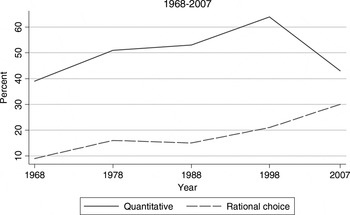
Figure 5 shows the trends in these articles. Quantitative work has dominated the APSR, but has declined recently. Rational choice has been less dominant than many perceive, but increased to 30 percent of the articles by 2007.
Quantitative and Rational Choice Articles in APSR

Sixty-one percent of rational choice articles were also judged nonempirical, but except for this neither rational choice nor quantitative methods correlated strongly with the four scholasticism measures. Thus, even if these methods were eliminated, scholastic trends would remain. The lower panels of table 1 show the shares of articles judged scholastic by the four measures if one excludes first the quantitative and then the rational choice articles.Footnote 28 As one might expect, the incidence of nonempiricism is higher without the quantitative articles and lower without rational choice, but otherwise the trends are little changed.
Has scholasticism grown outside political science? Informal discussions with academics in other subjects suggest that it has. In other disciplines, too, research is becoming more specialized and rigorous, but also more ingrown, less realistic, and focused more on issues among researchers than on problems perceived by the outside world.
Academic Values
The scholastic trends reflect an idea that political science, and social science generally, should be modeled on the physical sciences. The point of research is to hypothesize relationships between variables and then test them definitively. That logic should apply to any inquiry, either qualitative or quantitative.Footnote 29 Critics respond that there must also be exploratory research in order to define terms and imagine causal linkages, in advance of modeling. There is thus a role for case studies to help grasp a problem even though evidence drawn from single cases cannot prove anything.Footnote 30
That is true, but defensive. It still accepts that the final purpose in research is to infer one variable as strictly as possible from another. If that is the goal, scholasticism will march on. There is no inherent limit to it, no hard floor of precision after which the narrowing stops. Complete precision is illusory. However exact one is, there will always be further issues about method, measurement, inference, and so on. The pursuit of precision leads inexorably to the narrowing of research I have described. That process could continue indefinitely until “research” becomes entirely mathematical and all contact with common-sense reality is lost.
To limit scholasticism one must step back and question the values it serves—those of rigor. One seeks to draw conclusions about reality in ways that draw the least question. Under the norm of rigor, one ideal is proof—demonstrating conclusions, not simply asserting them. Hence the appeal of mathematical methods, where inferences are precise. Another ideal is transparency. One's conclusions should follow strictly from the data rather than from contestable judgments, so that in principle others could replicate them.Footnote 31 These values may seem unobjectionable, even laudable, but to realize them usually requires limiting inquiry to very narrow questions, addressed usually using single data sources. The result is the sort of work that now dominates the journals—analyses of jewel-like precision that, however, generate only minor findings and arouse little interest beyond specialists.
In contrast, nonscholastic research serves the values of relevance. Under that norm, one ideal is realism—addressing problems as they appear in the real world of politics, as against the narrower issues that academics may define. Another ideal is audience—to speak to all those interested in a problem rather than just the researchers. When papers are presented, there should be people in the audience not from that field who take an interest. The point is not that research must be useful or applied. Research with theoretical goals need not justify itself by utility. Yet neither can it be entirely self-justifying. Inquiry should address the political issues that lay observers—not just academics—talk about, and it should do so in ways that draw some attention from beyond scholars themselves.
At its best, political science accepts a tension between rigor and relevance, serving both values to some extent. In the American field, which I know best, scholars sometimes have advanced bold new arguments about what makes American government tick. One example is David Mayhew's work, which contends that only reelection really matters to members of Congress, and that divided government makes little difference to Washington's ability to legislate.Footnote 32 Another is the work of Morris Fiorina, who contends that Congress members use casework and benefits to buy elections, and that the voters favor divided government in order to restrain the politicians.Footnote 33 All these arguments addressed concerns that were current in the political class at the time they were made, thus serving the cause of relevance. At the same time, all were somewhat overstated, leading to rejoinders based on more precise research, thus serving the value of rigor.Footnote 34 Political science advances best when it rides both of these horses.
Do these examples suggest that scholasticism is not, after all, so serious? Perhaps more relevant work is published in books like those of Mayhew or Fiorina, more rigorous work in the journals. But the results given here show a scholastic trend even within the APSR. And my impression is that academic books are becoming more scholastic as well. Several editors from academic presses have told me that the books they publish are becoming more specialized and technical. They fear they are losing their audience, weakening the economic basis of their enterprise.
Scholasticism has risen, in part, because the values of rigor have often met no convincing reply. The idea prevailed that precision could be pursued “all the way down” with only scholarly gain, and no loss. That is an illusion. One avoids subjective judgment in inference only by enormous, arbitrary judgments to limit the scope of inquiry. Values of relevance choose the other horn of the dilemma. Researchers accept more judgment about findings, in the interests of less judgment about the subject. Broader questions dictate multiple methods and information sources, and thus more judgment in reaching conclusions. Real-world complexities are allowed into the research rather than excluded by the ways problems and methods are defined.
Restoring Morale
Political scientists are uncommonly disillusioned with their discipline. One survey from the 1980s found them less excited about recent developments in their subject than the followers of 31 other disciplines. In another poll, 43 percent of political scientists rarely found anything of interest in their leading journal, the highest figure for any field surveyed.Footnote 35
Much of the upset, I suspect, is rooted in scholasticism. Many political scientists resist current academic incentives, which require them to become pedants in order to publish and not perish. They may respect the values represented by scholastic rigor, but they want the values of relevance to be honored as well. This recent trends in the discipline have refused to do. Specialization might appear to be popular because of the rapid growth in organized sections. But only about half of APSA members belong to sections.Footnote 36 Section leadership is also narrow, comprising mainly the most committed leaders of a specialty and often becoming self-perpetuating.Footnote 37
That scholasticism is unpopular is suggested by the fact that the most widely read political science is generally broader than what is now published. Table 2 shows how I rated the twenty APSR articles most often cited, using the same measures as earlier. Compared to the APSR generally and in recent years, these papers were notably less specialized and less literature-focused, although more methodological. That may be partly because many of these articles are older “classics.” I also rated the twenty APSR articles most often downloaded from the Cambridge University Press web site since 2001. They look a good deal more scholastic.
Features of APSR articles and of twenty most-cited and twenty most-downloaded articles since 2001 (percent)

Sources: APSR coding as explained in text: Most cited: Sigelman 2006b. Most down-loaded since 2001: APSA web site.
One reason for disillusionment might be that, even if political scientists are able to publish in the journals, they are likely to remain invisible. Most articles published even in the APSR, Lee Sigelman writes, have “rarely if ever been cited.” Of 2,628 articles ever published in the APSR through 2005, only 155 were cited even 100 times. How much more obscure are articles in lesser journals? In the above polls, sociologists appear almost as disillusioned as political scientists, but they do have a wider audience. More than twice as many articles in the American Sociological Review achieved 100 citations, even though political science is a much larger discipline. That is because sociology gets more attention from outside the discipline.Footnote 38
To reduce scholasticism, the values of relevance in research must receive more weight. One way to do that is for political scientists to seek greater engagement with government. In policy research, in my experience, there is also pressure toward scholasticism, but it is weaker than in academic disciplines. Work published by scholars at think tanks in Washington is markedly less scholastic than what appears in academic journals. Typically, it is rich in information, simple in method. That probably is because policy researchers care about government. They seek a hearing in Washington or state capitals. Thus, they are willing to accept problem definitions that come from the political world, rather than from academic specialties. Most also are willing to present their work in forms accessible to nonacademic audiences. They also are not forced to publish in the journals. All these differences strengthen the values of relevance. Recent APSA efforts to speak to public issues thus help lead us away from scholasticism.Footnote 39
The other necessity is to broaden the research published in the journals. Perspectives on Politics is supposed to publish broader work than the APSR, so its inauguration in 2003 was another step forward. Equally important would be to appoint editors to other journals—including the APSR—who will shift research somewhat away from rigor and toward relevance.
The scholastic emphasis on rigor supposedly serves the interests of science. But taken to recent extremes, specialized research becomes self-referential—preoccupied with the researchers themselves and their issues. Nonscholastic research is less ambitious methodologically but more humble. The focus is on the real world and its problems rather than the researchers, and ultimately this makes for better science.
Supplementary Materials
Explanatory File http://journals.cambridge.org/pps2010008
Journal Data for Figure 1 http://journals.cambridge.org/pps2010009
APSA Member and Section Data for Figures 2 and 3 http://journals.cambridge.org/pps2010010
APSR Articles by Methodological Orientation and Field http://journals.cambridge.org/pps2010011
Averages from APSR Coding for Figures 4 and 5 http://journals.cambridge.org/pps2010012