




No CrossRef data available.
CAN SECOND LANGUAGE GRAMMAR BE LEARNED THROUGH LISTENING?: An Experimental Study
Published online by Cambridge University Press: 07 June 2005
Abstract
This study examines whether aural processing of input in a situation of implicit instruction can build a knowledge base that is available for both comprehension and production tasks. Fifty-five Dutch students learned a miniature linguistic system based on Spanish. Three training conditions were compared in which noun-adjective gender agreement was the learning target. The first group of participants received receptive training, the second group received receptive and productive training, and a third group served as a control. The control group received no training of the target structure and only read an explanation of the target structure rule. Receptive knowledge was assessed with a self-paced listening test, a match-mismatch test, and a grammaticality judgment task. Productive knowledge was tested with a picture description task in single- and dual-task conditions. A postexperimental questionnaire tested whether any explicit knowledge had been induced. Results suggest that the receptive and receptive + productive training programs succeeded in building a knowledge base that was used in comprehension but much less so in production. These results will be interpreted in light of processing and the distinction between implicit and explicit knowledge.I would like to express my gratitude to Jan Hulstijn and Rob Schoonen from the University of Amsterdam for their supervision. I would also like to thank the two anonymous SSLA reviewers for their comments and Nick Ellis for taking time to discuss this project with me.
Information
- Type
- Research Article
- Information
- Copyright
- © 2005 Cambridge University Press
Learners involved in instructed SLA traditionally are given a rule and then engage in comprehension and production tasks that employ the presented rule. After a long period of practice and through devices such as error correction by others or self-monitoring and self-correction, learners might eventually reach a stage of fluent, errorless production (Kelly, 1969; Titone, 1968). Many other scenarios for language acquisition in instructed settings have been proposed. Some did away with explanation of grammar rules; others focused on either comprehension or production as the most effective direction of training. In the 1980s, for instance, a number of researchers proposed the postponement of production until after an initial silent period (e.g., Asher, 1982; Davies, 1980; Krashen & Terrell, 1983; Nord, 1980, 1981; Winitz, 1981a, 1981b). Later, VanPatten and others (VanPatten, 2002a; VanPatten & Cadierno, 1993a, 1993b; VanPatten & Oikkenon, 1996) argued for the importance of input processing in acquisition. In response, DeKeyser and Sokalski (1996) and DeKeyser (1997) claimed that both comprehension and production training were indispensable. New insights into the representation, processing, and acquisition of linguistic knowledge were presented by researchers such as N. Ellis (2002, 2003, this issue) and Hulstijn (2002). These accounts imply that learning starts out receptively and that explicit knowledge of grammar cannot (directly) influence acquisition of implicit knowledge. The notions of implicitness of knowledge and learning are discussed in the following section, as are some research findings on processing of input as a basis for language acquisition.
The goals of the present study are (a) to examine receptive training without explicit instruction, comprising instantiations of the target structure in which many utterances containing instantiations of the target structure are processed, and (b) to investigate whether early introduction of production tasks will either hinder or promote acquisition. Both receptive and productive performances are assessed.
IMPLICITNESS AND EXPLICITNESS IN SLA
Because no information about grammar was given to the learners, the treatment in the present study is one of implicit instruction. Furthermore, this study targeted implicit learning and knowledge. An important criterion for implicitness of learning in the literature on both SLA and psychology is awareness: Explicit learning is often defined as learning with awareness at the point of learning, whereas implicit learning is characterized almost without exception as learning without awareness (DeKeyser, 2003; R. Ellis, 1994; Krashen, 1994; Schmidt, 1994a, 1994b; Sharwood Smith, 1994; Williams, 1999). Additionally, implicit learning is often said to be unintentional.
Awareness is also a key criterion in assessing the explicit or implicit nature of language knowledge. Knowledge is considered explicit when it involves conscious awareness of the formal properties of the target language, which can be verbalized on demand. This knowledge could be expressed in metalinguistic terms or in everyday language. On the other hand, implicit knowledge is often considered to be the result of implicit learning, which lacks awareness and intentionality. Thus, language users are not (immediately) aware of the existence and nature of the knowledge they have acquired and are not able to verbalize it. As a result, implicit knowledge can only be attested in performance. Often, the absence of the ability to verbalize knowledge in combination with accurate performance is taken as an indication of implicitness. However, this does not mean that the ability to verbalize knowledge only entails explicit knowledge; implicit knowledge might also be present. In contrast to implicit knowledge, which is learned incidentally, some researchers claim that explicit knowledge is learned intentionally (e.g., Krashen, 1994; Paradis, 1994). Others consider intentionality to be related to—but in principle separate from—the notion of implicitness (Hulstijn, this issue; Robinson, this issue).
Associative accounts of language learning exemplified by N. Ellis (2002, 2003, this issue) and Hulstijn (2002) provide the rationale for the present studies. N. Ellis (2002, this issue) argued for an interpretation of implicit learning as the formation and strengthening of representations and associations. It starts out at low, concrete levels—for instance, as representations of phonemes or words. After a (large) number of instances of these low-level representations have been processed, associations with frequently co-occurring elements will start to form. This associative learning process is called chunking. It operates at all levels of representations, from phonology to discourse and from small and concrete representations to larger and more abstract ones. Eventually, chunking might lead to the formation of abstract categories and symbols, which might resemble categories known from syntactic theories, such as noun or verb phrase. This means that although learning starts out at low, subsymbolic levels, symbolic chunks might also evolve. It is important to note, however, that although processing of these symbolic chunks could eventually come to appear rulelike, according to this view, no rules as such are represented in the network of representations and associations. Thus, these chunks will not be rule-governed.
In this article, knowledge in the form of networks will be considered implicit knowledge. Learners might become aware of the implicit knowledge they have acquired. For instance, after having processed a large number of instantiations of nominal plural forms in English, a learner of English as a second language could become aware of the fact that plurals are often formed by adding /s/, /z/, or

(orthographically -s or -es) to the stem of a noun. When learners become aware of this, they might consciously attempt to induce a rule and thus gain explicit knowledge. In this way, implicit learning can lead to explicit knowledge, but it has been mediated by implicit knowledge.
If learning, as N. Ellis (2002, 2003, this issue) argued, starts out at low, concrete levels, it can be argued that implicit learning and knowledge have their origins in explicit knowledge. This explicit knowledge, as representations of, for instance, phonemes or words, is stored and forms connections with other representations. On the other hand, explicit knowledge of (metalinguistic) rules does not play a role in acquisition of implicit knowledge because the formation of representations and the adjustment of the connections between them can only be established by processing of input or output.
KNOWLEDGE AND PROCESSING IN COMPREHENSION AND PRODUCTION
Associative accounts of language learning, such as those put forward by N. Ellis (2002, 2003, this issue), imply that receptive processing is most important, at least in the initial stages of acquisition, because connections must be tuned to (co-)occurrences in the input. The resulting implicit knowledge base should be, to a certain extent, available for production. However, this point is not explicitly addressed, which is also the case in many other accounts of first language (L1) or second language (L2) knowledge and processing. Most of these accounts fail to indicate whether the same knowledge base—implicit or explicit—and the same set of processing mechanisms are drawn upon in comprehension and production.
Thornton and MacDonald (2003) provided some results that suggested that comprehension and production indeed share knowledge and processing mechanisms. They found an effect of plausibility in L1 subject-verb agreement processing that was similar in comprehension and production. However, it was stressed that comprehension and production are fundamentally different tasks: They pose different demands on processing and, therefore, differentially affect behavior.
Many language learning studies only concern either comprehension or production and not their relation. Of those who directly addressed that issue, Bates and MacWhinney (1989) held that comprehension and production make use of the same system of representations but that the real-time exigencies of processing might be quite different. A similar claim was made by Izumi (2003) in order to explain the differences between receptive and productive processing of relative clauses in L2 English. Different types of relative clause might put different demands on processing, which results in hierarchies of processing difficulty. However, because memory demands for each type of relative clause might be different for comprehension and production, there might be a different hierarchy for each direction. Izumi made tentative claims that productive knowledge lags behind receptive knowledge and that productive ability is more susceptible to processing difficulty than is receptive ability.
DeKeyser (1997) addressed the comprehension-production asymmetry from the perspective of Anderson's ACT theory of skill learning, which asserts that skill learning starts out by turning declarative knowledge into qualitatively different procedural knowledge (e.g., Anderson, 1983, 1993; Anderson & Fincham, 1994). Declarative knowledge is flexible and can be used in different types of task. Procedural knowledge, on the other hand, is skill-specific, as it can only be used in the direction commensurate with practice. Because of this skill-specificity of procedural knowledge, the skills of comprehension and production each require separate practice. In contrast, VanPatten (e.g.,VanPatten, 2002a; VanPatten & Cadierno, 1993a, 1993b; VanPatten & Oikkenon, 1996) interpreted training effects from the perspective of the theories of Krashen (1982) and Schwartz (1993), who posited a single acquired language competence to be the basis for comprehension as well as production. It should be noted, however, that Schwartz (1999) later argued that although there is a shared knowledge base, there are separate computational modules for comprehension and production.
The Effect of Training on Receptive and Productive Performance
The research conducted by VanPatten and associates has addressed the effect of processing of input on performance in both comprehension and production tasks (e.g.,VanPatten, 2002a; VanPatten & Cadierno, 1993a, 1993b; VanPatten & Oikkenon, 1996). In particular, these studies have focused on the effects of processing instruction (PI). PI attempts to alter the way in which input is processed, so that the underlying implicit system of knowledge is adjusted and performance improves in comprehension as well as production tasks. This altering of input processing is done by increasing the communicative value of the structure to be learned; as such, the formation of form-meaning connections is facilitated. In this account of acquisition, output fulfills two roles: It is a focusing device and it is necessary to develop fluency and accuracy.
Processing instruction has been compared to traditional instruction (TI), which comprises explicit instruction about the target rule and a series of mechanical, meaningful, and communicative output activities. The original PI study by VanPatten and Cadierno (1993a) compared the effect of PI and TI. The experiment, in which the target was the acquisition of direct object clitics in Spanish, showed that PI resulted in better comprehension skills than the traditional, output-focused instruction but that learners achieved equal levels of production skills following both instruction types. The authors claimed that PI led to acquired competence, whereas TI only resulted in learned competence. To determine the role of rule explanation in PI, VanPatten and Oikkenon (1996) replicated the study of VanPatten and Cadierno. This replication included a group receiving explanation only, one receiving structured input activities only, and one receiving PI (i.e., explanation as well as structured input activities). After training, only the PI and the structured input groups had improved their scores on the comprehension task; the explanation group had not. On the production tasks, no interaction between treatment and time was found, which indicates that all groups had improved equally. VanPatten and Oikkenon concluded that PI resulted in changes in the developing system but that explicit information did not play a significant role; it was the structured input that drove the improvement. However, the authors could not rule out the possibility that participants in the structured-input-only group spontaneously induced explicit knowledge, which might have affected the results.
DeKeyser and Sokalski (1996) argued that the findings in the VanPatten and Cadierno (1993a) study were attributable to imperfections in the design. Therefore, DeKeyser and Sokalski conducted a similar experiment in which the grammar explanation and the required amount of attention to meaning and forms were kept constant for both training conditions. Two target structures were chosen: (a) direct object clitics, which were thought to be easy for comprehension but difficult for production, and (b) conditional forms of the verb, which were assumed to be easy for production but difficult for comprehension. Comprehension and production tests revealed mixed results. In immediate posttests, input practice was generally better for comprehension, and output practice was better for production when direct object clitics were concerned. For the conditional verb forms, however, output practice was generally more efficient than input practice. Delayed posttests showed no significant differences among the groups for either structure. It seems that neither training condition had led to an acquired competence that was available for both comprehension and production. DeKeyser and Sokalski acknowledged that the amount of practice in their study was limited, which made it less likely that knowledge had been proceduralized or, in other words, that implicit knowledge had been acquired. They claimed that any transfer between comprehension and production had occurred via declarative (i.e., explicit) knowledge. In short, participants might not have relied on implicit knowledge during the tests, but, rather, on explicit knowledge.
This same caveat can be applied to the studies of VanPatten and Cadierno (1993a, 1993b) and VanPatten and Oikkenon (1996): It is not clear what type of knowledge drove performance in comprehension and production tasks. Although VanPatten (2002b) stressed that PI studies have never addressed the explicit-implicit distinction, he claimed that acquisition results in an implicit knowledge system (e.g., VanPatten, 2002a, p. 796). Therefore, this claim commits him to provide evidence for the implicitness of the knowledge in the assessment tasks. Unfortunately, firm conclusions could not be drawn as to the type of knowledge involved in any of the PI studies referred to by VanPatten. DeKeyser, Salaberry, Robinson, and Harrington (2002) clearly highlighted this shortcoming. First, they noted that participants in all conditions might have had access to explicit knowledge: They either read explicit information about the target structure or had the opportunity to induce a rule from the structured input activities. Second, conclusions in these studies are based only on scores on offline tests that gave participants the opportunity to use explicit knowledge.
This issue has been addressed by Sanz (1997), who showed that PI can also lead to improvement in tasks with higher memory demands (e.g., tasks that require larger amounts of production). Because higher memory demands leave less space available for controlled processes, only knowledge that has been automatized can be used for production. Results showed that performance improved on assessment tasks with lower memory demands (written sentence completion) as well as with higher memory demands (written video retelling). However, on the task with the highest memory demands (oral video retelling), there was no significant improvement. Therefore, an alternative explanation is possible. Because implicit knowledge is usually considered to not rely on controlled processes, the lack of improvement on the oral video retelling task could lead to the conclusion that performance was the result of explicit rather than implicit knowledge. So, again, no clear evidence that a change occurred in the underlying implicit system has been provided.
In sum, VanPatten (2002a, 2002b) stressed that PI leads to results superior to TI in several studies and that this effect shows up on a variety of assessment tasks. However, the exact causes could not be identified because PI and TI differ in more than one respect, including the direction of training (comprehension or production), the content of the explicit information provided, and the type of knowledge (implicit or explicit) favored by training. It has not been shown that performance was based on implicit knowledge, and it is also not likely that implicit knowledge was acquired, considering the short duration of training. In all of these studies, there is a feasible alternative explanation that attributes the results to practice with (given or induced) explicit knowledge. This means that the claim that PI can alter the underlying implicit knowledge system has not been supported and, therefore, it cannot be claimed that the same implicit knowledge was used in comprehension as well as production.
A study with a longer, more substantial training and with online tests was conducted by DeKeyser (1997). Three groups of participants received 8 weeks of comprehension training (not PI), production training, or a mixed comprehension + production training. Speed and accuracy improved for all groups, although the greatest gains were found in the direction that had been practiced. Improvements achieved by the comprehension and production groups in their respective trained skills were equaled by the mixed-training group. However, the mixed group's performance was better than that of the comprehension and production groups in the direction these groups had not trained (e.g., the mixed group performed better than the comprehension training group on the production task). Therefore, DeKeyser claimed that comprehension and production do not rely on the same knowledge system and processing mechanisms and that both skills have to be practiced.
This contrasts with an associative point of view, which implies that—at least in the initial stages of acquisition—receptive processing is most important because connections must be tuned to (co-)occurrences in the input. To a certain extent, the resulting knowledge base should be available for production. Therefore, it seems reasonable to assume that if production is called for too early, learners have to fall back on incomplete or incorrect knowledge, on knowledge of a first or other language, or on explicit knowledge. How explicit knowledge can play a role during production and how it can affect the acquisition of implicit knowledge is described by N. Ellis (this issue). When production leads to incorrect output, acquisition of correct knowledge might be hindered. Consequently, it seems that only after correct implicit or explicit knowledge of a structure has been sufficiently established receptively should production of that structure take place to further tune the existing network and to establish any processes specific to production.
The Present Study
In an attempt to answer two research questions, the present study directly addresses the issues of learning through processing of input and the direction of training and testing. First, can training aimed at learning through receptive processing of many instantiations of a target structure build a knowledge base (explicit or implicit) that is available in comprehension as well as production? Second, does early introduction of tasks that call for production of the target structure hinder the building of such a knowledge base? If it is found that both questions are answered affirmatively, the following two hypotheses will be supported: (a) receptive training—in comparison to control conditions—will result in high processing speed in comprehension tasks and possibly also in high accuracy in production tasks and (b) early introduction of production—in comparison to a receptive training—will result in slow processing speed in comprehension tasks and low accuracy in production tasks.
To assess the influence of any spontaneously induced explicit knowledge, performance of the trained groups was compared to that of a control group that had read an explanation of the rule but had not received any comprehension or production training of the target structure.
METHOD
Participants
A total of 59 L1 speakers of Dutch from various institutions of higher education participated in this study, which was described to them as concerning language processing and understanding and speaking language. All participants were studying subjects not related to language but had learned English, German, and French in secondary school for a period of 3 to 6 years. They had little or no prior knowledge of any Romance language other than French. Data from four participants were eliminated from the analyses for reasons related to illness, insufficient vocabulary knowledge, technical problems, or incompleteness, leaving 55 complete datasets for analysis. All participants received 30 € for their participation.
Materials
Language.
Spanish provided the basis for a miniature language system. The target structure was noun-adjective gender agreement on attributive and predicative adjectives. For each adjective position, one type of carrier sentence was constructed to be used in the training and test tasks. Sentences were generated using the vocabulary presented in Appendix A. Neither natural gender nor plural forms were used. Four adjectives did not show overt agreement (invariable adjectives) and four others showed overt agreement (overtly agreeing adjectives) with word-final /-o/ marking masculine and word-final /-a/ marking feminine. For example, azul “blue” and verde “green” were part of the invariable adjectives, whereas rojo/a “red” and negro/a “black” were included as overtly agreeing adjectives. None of the nouns ended in /-o/ or /-a/, so that agreement by merely matching overt gender markers was not possible. Examples include el guante “the glove-masc” and la fuente “the fountain-fem.” Twelve out of 20 nouns occurred in the agreement training; the others occurred only in the production posttests to examine whether knowledge was generalizable to new items. Example sentences with attributive adjectives are presented in (1) and (2) and with predicative adjectives in (3) and (4). Examples (1) and (3) contain overtly agreeing adjectives, whereas (2) and (4) contain invariable adjectives. All examples are presented with both masculine and feminine forms, respectively.

The reader with knowledge of Spanish might find the use of the verb volverse in these sentences unusual. However, it must be stressed that this is of no major importance to the logic of the experiment. The participants had no prior knowledge of the target language and will probably interpret this verb as the equivalent of the verb worden “to turn, to become” in Dutch, their L1.
Stimuli Construction and Apparatus.
Aural stimuli were spoken by a native speaker of Spanish and recorded in a soundproof recording booth. In all aural stimuli, the pause between the offset of the adjective (e.g., azul) and the onset of the second verb (e.g., dice) was approximately 100 ms. Headsets were used to present the aural stimuli and to record all oral responses.
Because no translations were given, visual stimuli were used to clarify meaning in all training and test tasks. The visual stimuli were line drawings made by a professional graphics designer. The actions described by the verbs to appear and to turn were represented visually by the appearing or changing of color (see Appendix B for screenshots). All visual stimuli were preceded by a 400-ms fixation mark (+) in the middle of the presentation area.
The software for this experiment was developed by the experimenter using Authorware 6 (McGraw, Tew, & Williams, 2000; Schmidt, 2001) and was run on Gateway Pentium II personal computers.
Procedure
Participants were randomly assigned to one of three groups. Two groups received training containing the target structures. The first group (n = 18) received receptive training only (group R). The second group (n = 19) received both receptive and productive training (group R + P). Finally, a third group (n = 18) acted as a control group (group C): This group performed comprehension and production tasks that did not include the target structure and read an explanation of the target structure immediately before the posttests.
All training and test tasks were presented aurally and oral responses were provided by the participants: No written forms were given or required. Training and testing took place in a computerized setting during a period of 2 weeks in four 90-minute sessions. The breakdown of training and testing into four sessions is shown in (5).

Because none of the participants had prior knowledge of Spanish, vocabulary training was necessary. To monitor vocabulary knowledge, receptive and productive vocabulary tests were administered at the end of session 1, at the beginning of sessions 2 and 3, and before the posttests in session 4. Sessions 2 and 3 started with vocabulary warm-up tasks (e.g., word-picture matching; see the Training Tasks section for description). The entire first session and all subsequent vocabulary tasks were identical for participants in all groups.
The aim of the second session was to familiarize participants with the procedure and the sentences of the target structure training. This session was identical for all groups. No overtly agreeing adjectives were presented: In the sentences, only invariable adjectives occurred (see (2) and (4)). The session consisted of two sequences of comprehension tasks and one sequence of production tasks. Each sequence consisted of four parts: (a) an attributive training task, (b) an attributive test task, (c) a predicative training task, and (d) a predicative test task.
The aim of the third session was to train the target structures in the R and R + P conditions. Each group performed a different set of tasks. In the training tasks for groups R and R + P, overtly agreeing adjectives were present (e.g., rojo/a and negro/a). The agreement training of both groups started with a sequence of identical comprehension tasks. Following the first sequence, group R continued with two sequences of comprehension tasks, whereas group R + P completed two sequences of production tasks. Group C engaged in a comprehension task and two production tasks, all with invariable adjectives (e.g., azul and verde). At the beginning and end of this session, all groups performed sentence comprehension and production tests with invariable adjectives.
The fourth session consisted of two parts. The aim of the first part was to continue training. It started with vocabulary warm-up tasks for all groups (match-mismatch, see the Training Tasks section for description) and continued with further sentence training tasks. Group R performed two sequences of comprehension tasks with overtly agreeing adjectives. Group R + P performed one sequence of comprehension tasks and one of production tasks, both of which included overtly agreeing adjectives. Finally, group C performed one sequence of comprehension tasks and one of production tasks that both included invariable adjectives.
Training Tasks
The goal of the study was to assess the effect of processing, not of rule induction. For this reason, it was preferable to minimize chances that participants would adopt an explicit learning attitude. All training tasks could therefore be performed on the basis of meaning alone, without attention to formal aspects. Accuracy was encouraged in pretask instructions. Feedback about accuracy consisted of a green check mark or a red cross and was provided after each response in all receptive training tasks.
The activities that made up the vocabulary tasks—word-picture matching, match-mismatch, and picture naming—corresponded as much as possible with those of the sentence tasks, so they will be described together when possible in the following subsections.
Vocabulary Presentation.
The vocabulary training session started with listening tasks in which each word was presented once coupled with a picture to clarify its meaning. No response was required.
Comprehension Training Task.
Participants received vocabulary and the target structure training receptively with the same task: a word-picture matching task for vocabulary and a sentence-picture matching task for the target structure. The participants saw two pictures and indicated which picture matched the aurally presented word or sentence by pressing a key on a keyboard. In the sentence-picture matching task, only one word was crucial for the decision: Either the noun, the noun in the prepositional phrase, the adjective, or the verb in the main clause provided the information necessary for the participant to decide between the two pictures (cf. (1)–(4)). In half of the trials, the crucial word for the decision was the verb in the main clause (dice or cree), which immediately followed the last element of the target structure (i.e., the adjective ending). This required participants to process as much of the sentence as possible—and, therefore, the entire target structure—before responding. All sentences were grammatically correct. These tasks consisted of 24 items in the first comprehension sequence in sessions 3 and 4, and 48 items in all other sequences. The word-picture matching tasks consisted of 20, 32, and 16 trials for nouns, adjectives, and other words, respectively.
Production Training Task.
Participants received productive training on vocabulary and the target structure with the same task—a picture description task eliciting either individual words or sentences. Responses were recorded into 4- or 8-second files. After the participants' response, a model response was presented aurally and the participants were to indicate whether they thought their answer was correct. To facilitate self-assessment, participants listened to a recording of their own response after the model response in the vocabulary training. In the vocabulary training task, each word occurred once. Participants were expected to name nouns with the corresponding article, and adjectives in the masculine forms. The productive sentence training task always consisted of 24 items. As each item contained 1 sentence produced by the participants and 1 model response, the total number of sentences in one task was 48, equal to the number of stimulus sentences in the receptive training task. In the productive vocabulary task, each word occurred twice.
Test Tasks
In the test tasks, speed as well as accuracy were encouraged in the pretask instructions and by presentation of the reaction times after each trial and after each block. Feedback about accuracy was provided as in the training tasks.
Rationale.
It is difficult to find pure and sensitive measures to discriminate between implicit or explicit knowledge (cf. DeKeyser, 2003, pp. 319–320; R. Ellis, this issue). Accuracy and reaction time data by themselves will not show which type of knowledge is used, but changes in performance over time and comparisons between different training and test tasks might shed some light on this matter. In the present study, performance of the two trained groups during the posttests was compared to that of the control group, which had only explicit knowledge of the target structure. Also, production performance was compared between single- and dual-task conditions; it was expected that the dual-task condition would be most detrimental to performance based on explicit knowledge. A similar paradigm was used by DeKeyser (1997).
Vocabulary Tests.
A match-mismatch task was used to test vocabulary knowledge: The participants pressed a key to indicate whether the presented picture and word matched (cf. match-mismatch task for sentences). A picture naming task was used to test productive vocabulary knowledge (cf. productive training task). In this test, no feedback was given. All words were included in the tests.
Criteria for speed and accuracy were set only for vocabulary tasks at the end of session 1 and the beginning of sessions 2 and 3 (receptive: 100% accuracy and mean reaction time < 1000 ms for nouns and adjectives and < 1200 ms for the other words; productive: > 75% accuracy and reaction time < 4 seconds). If the criteria were not met, the test was restarted. No criteria were set in the vocabulary tests immediately prior to the sentence posttests.
Self-Paced Listening Test.
Two online comprehension measures were used. Whereas offline tasks require responses after the input has been processed and are considered to measure knowledge (either implicit or explicit), online tasks require responses while the input is still being processed and are considered to be a measure of the speed of input processing.
The first online comprehension task in this study was the self-paced reading or listening technique (moving window). This technique typically involves the visual presentation of sentences word-by-word or sometimes phrase-by-phrase. Participants read the word or phrase and press a button to go on to the next one. They are asked to do this as quickly as possible; thus, participants are still trying to understand the meaning of the sentence when they call up the next segment, which might be checked by a plausibility judgment after completion of the sentence. Latencies are expected to increase as processing difficulties arise—for instance, as a result of ungrammaticality or ambiguity resolution. This usually happens on the site of the ungrammaticality or ambiguity resolution. When the effect shows up on one or more words immediately following the ungrammaticality or ambiguity, this is referred to as the spillover effect. The task has been used before to provide a measure of the processing load of a whole array of phenomena, including processing of subject-verb agreement, verb-argument structure, relative clauses, and noun phrase arguments and adjuncts (Caplan & Waters, 2003; Deevy, 2000; Ferreira, Henderson, Anes, Weeks, & McFarlane, 1996; Juffs, 1998; Kennison, 2002; Konieczny, 2000; Pearlmutter, Garnsey, & Bock, 1999; Thornton & MacDonald, 2003; Weyerts, Penke, Münte, Heinze, & Clahsen, 2002).
In the present study, the task was used in the auditory mode (self-paced listening). The participants pressed a key to hear the next words of the sentence. Each sentence was split into five phrases, as illustrated in (6) and (7). Each phrase was spoken with an intonation as if it were part of a sentence. Participants were asked to go through each sentence as quickly as possible. Afterward, they were to indicate whether the sentence and picture matched by pressing a key. In each sentence, one word was crucial for the decision: the noun, the noun in the prepositional phrase, the adjective, or the verb in the last phrase. The task consisted of 24 trials, half of which required match responses; only data from correct match responses were analyzed. All sentences were grammatically correct.

It was expected that slower processing of the target structure would be reflected by longer listening times of its last element, the adjective. Whereas in most studies grammaticality, ambiguity, or complexity of the input material are varied, in the present study a difference is expected between sentences with and without the target structure (overtly agreeing and invariable adjectives) and between different manifestations of the target structure (masculine and feminine adjective endings).
Match-Mismatch Test.
The second online measure based on the same rationale was the match-mismatch task. It was designed to provide a slightly more natural task tapping the same knowledge and processing as the self-paced listening task. Although the same content and procedure were maintained, the aural stimulus was presented as one uninterrupted sentence in the match-mismatch task. Reaction times for the correct match responses were analyzed for the sentences in which the cue to the answer was the second verb, which immediately followed the offset of the last element of the target structure (i.e., the adjective ending). It was expected that longer reaction times would reflect slower processing of gender agreement. To the best of my knowledge, this type of task has not been used in this way previously.
Speeded Grammaticality Judgment Test.
A speeded grammaticality judgment test was included in the posttests. The participants pressed a key as soon as they heard “something wrong” in the sentence. The following errors were included in the test: agreement violation involving incorrect adjective ending (24 trials), incorrect article (7 trials), incorrect position of the adjective (attributive instead of predicative, or vice versa; 3 trials), and missing word or word part (2 trials). The remaining 24 trials contained correct sentences. The task consisted of 60 trials per adjective position. No instruction was given to pay attention to agreement violations. Accuracy of detecting violations of the target structure and accepting the correct sentences provided a measure of knowledge of the target structure. This task was given only at the end of the last session, because it contained ungrammatical input and focused on form, which could have influenced acquisition.
Production Tests.
The productive test tasks had the same procedure as the productive training task, but did not include the model response and self-assessment. The production posttests each contained 24 trials. Half of the trials contained nouns that had not appeared in training, in order to test generalizability. To test the extent to which explicit knowledge was used, the posttest included a dual-task condition. In the dual-task paradigm, which is common in psychological research, two tasks are performed simultaneously: If performance of one task affects performance of the other, this indicates the type of knowledge or processing involved. For instance, Gilhooly, Logie, and Wynn (1999) tested different types of secondary tasks to assess what type of working memory subsystems were involved in syllogistic reasoning. DeKeyser (1997) used the paradigm to test the amount of automatisation of language skills, reasoning that “the more a skill is automatized, the less it should interfere with a secondary task or show interference from it” (p. 203).
In the present study, the dual-task condition included finger tapping as a concurrent secondary task: Before the visual stimulus appeared, participants tapped along with six clicks at 600-ms intervals and continued tapping as they spoke. It was expected that the tapping task would require attention and, thus, interact mainly with processing of explicit knowledge.
Questionnaires.
At the end of the first session, participants filled out a computerized background questionnaire that included questions about their age, education, and language knowledge. Immediately following the posttests in the last session, they filled out a questionnaire about their explicit knowledge of the target structure. The first question asked whether participants had noticed a rule during the experiment and asked them to provide a description of the rule—even if they had to think up a rule on the spot. The second question was more guided: A formulation of the rule was given and participants filled in the blanks with the letters corresponding to the adjective endings (see Appendix C).
Coding and Analyses
Vocabulary Tests.
An analysis of variance with repeated measures was used to analyze data from the vocabulary tasks. The dependent variables were reaction times for the comprehension tasks and accuracy for the production tasks. Gender (masculine or feminine nouns) and adjective type (overtly agreeing or invariable adjectives; see Appendix A) were the within-subject variables and group (R, R + P, or C) was the between-subject variable.
Self-Paced Listening Test.
The meaning-based decisions in this task were expected to be reasonably undemanding because vocabulary and carrier sentences were pre-trained. Therefore, accuracy was expected to be nearly perfect in all groups, and analyses were performed on the listening time data of correct answers to target trials (hits). Responses in the self-paced listening task were analyzed using an analysis of variance with repeated measures. The dependent variable was the listening time for the adjectives. Adjective position (attributive or predicative), gender (masculine or feminine), and adjective type (overtly agreeing or invariable) were the within-subject variables. Finally, group (R, R + P, or C) was the between-subject variable.
Match-Mismatch Test.
Reaction time measurement in the match-mismatch test started at the cue to the answer (i.e., the beginning of the last phrase). Any responses given before the cue were coded as incorrect. In line with the analysis of the self-paced listening test, only reaction times of correct answers to target trials were analyzed, using an analysis of variance with repeated measures. Reaction time was the dependent variable. Adjective position (attributive or predicative), gender (masculine or feminine), and adjective type (overtly agreeing or invariable) were the within-subject variables. Finally, group (R, R + P, or C) was the between-subject variable.
Grammaticality Judgment Test.
Responses in the grammaticality judgment test were also analyzed with an analysis of variance with repeated measures. The dependent variable was the proportion of correct responses to target trials. Adjective position (attributive or predicative), gender (masculine or feminine), and violation (no violation or agreement violation) were the within-subject variables. Group (R, R + P, and C) was the between-subject variable.
Production Tests.
All responses were listened to twice by the author. Pronunciation errors were ignored as long as words and endings were recognizable. Responses in which any element was difficult to understand were checked by a second coder: When codes did not correspond, the trial was discarded from the analyses (32 out of 64 judgments; 0.5% of all judgments). Sentences in which all elements except the adjective ending were correct (not repaired) were tagged as analyzable sentences. Of these analyzable sentences, accuracy of the adjective ending—and, therefore, of gender agreement—was analyzed.
The accuracy data of the production posttests were analyzed using an analysis of variance with repeated measures. The dependent variable was agreement accuracy in otherwise correct sentences, as data of the primary task proved more informative than data of the secondary task. Adjective position (attributive or predicative), gender (masculine or feminine), and cognitive load (single task or dual task) were the within-subject variables and group (R, R + P, or C) was the between-subject variable. To retain a sufficient number of trials per cell, familiarity of the noun (trained or untrained) was not included in the analysis. An analysis not reported here showed that scores for untrained nouns were not significantly lower than for trained nouns.
All Tests.
As proportions and reaction times often have a non-Normal distribution, transformations can help to achieve a more Normal distribution (Stevens, 1996, p. 246). For proportions, the arcsine transformation

was used, in which p is the proportion of correct responses. For reaction times, the log-function 10log(rt) was used, in which rt is reaction time. Subsequently, for the reaction times, outliers were discarded and all missing values (outliers and misses) were replaced using the expectation maximization technique in SPSS 11.
2Outliers on the self-paced listening task totaled 0.46%. Outliers on the match-mismatch test totaled 0.31%
Reliability of the comprehension tasks was high, ranging between α = .94 and α = .97. In the production tests, the spread of the unanalyzable sentences over items and participants made it impossible to compute accurate reliability figures. An alpha level of .05 was used for all statistical tests.
RESULTS
Vocabulary Knowledge
To rule out any vocabulary knowledge effects, the sentence posttests in session 4 were preceded by receptive and productive vocabulary tests. Speed in comprehension tests and accuracy in production tests were high for all word categories (comprehension: mean reaction time of 544 ms; production: mean accuracy of 95%). Analyses of variance revealed that group R responded somewhat faster to invariable adjectives than to overtly agreeing adjectives and produced somewhat fewer correct feminine nouns than masculine.
Posttests
Comprehension.
The mean accuracy score in the self-paced listening posttest was 93% and there was no significant correlation between the accuracy scores and reaction times. Table 1 shows the listening times for the adjectives. The analysis of variance revealed that there was no overall effect for group, and there were significant effects for adjective type, gender, and adjective position. Additionally, interactions of Group × Adjective type and Gender × Adjective type were found.
Listening time means and standard deviations of self-paced listening posttest (in ms)

The interaction of interest was Group × Adjective type, F(2, 52) = 9.128, p < .001, ηp2 = .260. This interaction shows that in the invariable adjective condition there were no differences between the groups, whereas in the agreeing adjective condition, there was a main effect for group, F(2, 52) = 4.856, p < .05, ηp2 = .157. This suggests that the presence of overtly agreeing adjectives caused the differences between the groups. Post hoc analyses of variance revealed these differences: groups R and R + P both took less time to listen to the overtly agreeing adjectives than group C, F(1, 53) = 7.135, p < .01, ηp2 = .119, and the two experimental groups did not differ from each other. Furthermore, groups R and R + P took less time to listen to overtly agreeing adjectives than to invariable adjectives, F(1, 52) = 14.673, p < .001, ηp2 = .220 and F(1, 52) = 4.880, p < .05, ηp2 = .086, respectively, whereas group C showed the opposite effect, F(1, 52) = 4.123, p < .05, ηp2 = .073. This suggests that the presence of overt agreement slowed down the processing speed of group C.
The Gender × Adjective type interaction, F(1, 52) = 13.401, p < .001, ηp2 = .205 shows that listening times were shorter for masculine overtly agreeing adjectives as compared to feminine overtly agreeing adjectives and all invariable adjectives. This suggests that the presence of overtly agreeing adjectives slowed down the processing of agreement with feminine forms. Finally, the effect of adjective position indicates that listening times were longer for attributive adjectives than for predicative adjectives, F(1, 52) = 19.550, p < .001, ηp2 = .273.
The interactions with adjective type indicate that both the group and gender effects were related to the presence of agreement. The absence of interactions with adjective position shows that none of the effects is different for attributive or predicative adjectives.
The mean accuracy score in the match-mismatch posttest was 97%, and there was no significant correlation between the accuracy scores and reaction times. Table 2 shows the reaction time data. The analysis of variance revealed that there were significant effects for group, adjective type, and adjective position, and interactions of Gender × Adjective position, Adjective type × Adjective position, Adjective type × Group, Adjective type × Gender, and Adjective type × Gender × Group.
Reaction time means and standard deviations of match-mismatch posttest (in ms)

For this study, the most relevant interaction is the Adjective type × Gender × group, F(2, 52) = 3.277, p < .05, ηp2 = .112. This three-way interaction shows again that differences among the groups only show up in the overtly agreeing adjectives condition: Group R responded significantly faster than group C with both genders and faster than group R + P with masculine forms. Additionally, the interaction reveals that the groups were differentially affected by gender and by the presence of overtly agreeing adjectives: Group R remained unaffected by gender and the presence of overtly agreeing adjectives, whereas groups R + P and C were slowed down by masculine forms of overtly agreeing adjectives.
The interactions of Gender × Adjective position, F(1, 52) = 21.512, p < .001, ηp2 = .293, and Adjective type × Adjective position, F(1, 52) = 26.737, p < .001, ηp2 = .340, together show that processing was slowed down mainly by masculine forms of overtly agreeing predicative adjectives. Taken together, the results of these two comprehension tasks show that the presence of overtly agreeing adjectives did not slow down group R's processing speed, whereas it slowed down processing for the two other groups. This slowing effect was more pronounced for group C than for group R + P.
Grammaticality Judgment.
Table 3 shows the accuracy scores on the grammaticality judgment task in the no-violation and agreement-violation conditions. The analysis of variance revealed that there was only a significant effect for violation condition: Accuracy was higher in the agreement-violation condition than in the no-violation condition, F(1, 52) = 7.507, p < .01, ηp2 = .126. In other words, violation of agreement was detected more often than correct agreement.3
An anonymous SSLA reviewer suggested there might have been a set effect because there were twice as many agreement violation items as distracter items. However, this does not seem to be the case. The mean accuracy scores for the distracter items show that participants attended to more than just agreement violations: They correctly rejected on average 77% of the sentences with incorrect articles, 51% of the sentences of the incorrect type, and 95% of the sentences with missing words or word parts.
Accuracy score means and standard deviations of grammaticality judgment task

Production.
Table 4 shows the accuracy scores from the production posttests. One participant from group R, one from group R + P, and two from group C were removed from this analysis because they produced too few analyzable sentences (fewer than 65% overall). Of the remaining data, 88% of the sentences could be analyzed. The test included both trained and untrained nouns, so that generalizable rule(-like) knowledge could be tested (for an analysis including familiarity as a factor and an analysis of the performance on the secondary task, see De Jong, 2005).
Accuracy score means and standard deviations of production posttests

The analysis of variance revealed that there were main effects for group, F(2, 48) = 6.568, p < .01, ηp2 = .215, and gender, F(1, 48) = 34.927, p < .001, ηp2 = .421, and significant interactions for Gender × Group, F(2, 48) = 4.820, p < .05, ηp2 = .167, and Gender × Adjective position, F(1, 48) = 4.029, p = .05, ηp2 = .077. Interestingly, there was no significant effect for cognitive load or any interaction with it.
The interaction of Gender × Group is important because it reveals that there were differences between the groups, although only with respect to feminine forms, F(2, 48) = 6.251, p < .01, ηp2 = .207. Post hoc analyses of variance showed that groups R and R + P together produced fewer correct feminine forms than group C, F(2, 49) = 6.327, p < .05, ηp2 = .114, and that group R produced fewer than group R + P, F(2, 33) = 4.760, p < .05, ηp2 = .126. Furthermore, unlike group C, groups R and R + P produced fewer correct feminine forms than masculine forms: group R: F(1, 48) = 34.655, p < .001, ηp2 = .419 and group R + P: F(1, 48) = 8.013, p < .01, ηp2 = .143.
The interaction between gender and adjective position showed that there was a difference between the adjective positions only for feminine nouns, in that more correct attributive adjectives were produced than predicative adjectives, F(1, 48) = 4.668, p < .05, ηp2 = .089.
In summary, all groups achieved some accuracy in producing gender agreement. There were differences between the groups, although only with respect to the feminine forms: The largest number of correct feminine forms was produced by group C and the least by group R. Furthermore, more correct feminine forms were produced in attributive position than in predicative position. Crucially, accuracy was not affected by the secondary tapping task.
Questionnaire.
Table 5 shows the accuracy with which participants described the grammatical rule that they thought was the subject of the experiment. More than half of the participants provided at least a partially correct description of the rule. In the second, guided question, the rule was presented on screen and participants only filled in the adjective endings. Of the 34 participants who had not given a correct rule description in the unguided question, 7 did not provide the correct adjective endings in the guided question (4 participants in group R, 2 in group R + P, and 1 in group C). Only one participant (in group R) claimed not to have detected the target rule at any time during training. She did not demonstrate explicit knowledge of the target structure, nor did she produce any feminine adjectival forms in the production tasks. In short, all but one participant had detected the target structure, and more than half of them had induced at least some verbalizable explicit knowledge of the rule.
Number of participants demonstrating explicit rule knowledge as displayed by responses to unguided question

DISCUSSION
The main results of this study can be summarized as follows. The sentence-comprehension posttests showed that participants in the receptive condition processed sentences with overtly agreeing adjectives fastest, whereas those in the control group had the slowest processing times. The fact that reaction time differences between groups and genders were found almost exclusively with overtly agreeing adjectives suggests that these differences result from the presence of agreement. The grammaticality judgment task showed that to, a large extent, participants in all groups could identify correct and incorrect noun-adjective gender agreement. The questionnaire demonstrated that nearly all participants had explicit knowledge of the target rule. In the production posttests, differences between the groups appeared only for the feminine forms. Contrary to expectation, the receptive group produced the fewest correct feminine adjectival forms, and the control group produced the most. The fact that a larger number of correct attributive as opposed to predicative adjectives were produced appears to reflect the difference in distance between noun and adjective. This fits in with the pattern found in the match-mismatch comprehension task, where the presence of overt agreement slowed down processing more in the predicative condition than in the attributive condition. Finally, accuracy in production was not affected by a concurrent finger tapping task. The absence of such an effect for the control group, which could rely only on explicit knowledge, suggests that the secondary task was not sufficiently demanding to hinder use of explicit knowledge significantly.
The first hypothesis was that receptive training—in comparison to the control condition—would result in high processing speed in comprehension tasks and, possibly, also in high accuracy in production tasks. In comparison to both the control group and to sentences with invariable adjectives, participants in the receptive group did indeed show fast receptive processing of sentences with overtly agreeing adjectives. Nevertheless, they made a relatively large number of errors in production. Thus, it seems that the receptive training had built a knowledge base—whether implicit or explicit—that was available for comprehension, but it could not prevent errors in the production tasks. Furthermore, the grammaticality judgment task showed that participants in the receptive training group were able to detect agreement violations, and questionnaire data showed that they had induced explicit knowledge. It must be stressed that there was some success in production of gender agreement: For feminine forms, the participants in the receptive training condition achieved just under 50% accuracy, whereas for masculine forms, accuracy approached 100%. If the participants had had no knowledge of the target rule at all, they would have used only masculine forms, resulting in an accuracy of 100% for masculine and 0% for feminine forms. Alternatively, they could have randomly chosen masculine and feminine forms, resulting in an accuracy of roughly 50% for both genders. This was clearly not the case for all but two participants, who produced masculine forms exclusively.
The second hypothesis was that early introduction of production—in comparison to a receptive training—would result in slow processing speed in comprehension tasks and low accuracy in production tasks. The reaction times of group R + P in the comprehension tests were indeed somewhat slower than those of the R group. However, group R + P performed significantly more accurately in the production test than group R with respect to feminine forms. Thus, it seems that early introduction of production tasks did not hinder building a knowledge base. Both groups showed comparable performance on the grammaticality judgment task as well as on the questionnaire.
In sum, the proposed receptive training seems to have succeeded in helping learners to build a knowledge base but was not as successful as expected in terms of production accuracy. On the other hand, the early introduction of production practice did not hinder acquisition, although reaction times of group R + P in the comprehension tasks were somewhat slower than those of group R.
What do these results tell us about the type of knowledge used (implicit vs. explicit)? Given that the control group only read an explicit grammar explanation, any knowledge held must have been explicit. The two trained groups had induced explicit knowledge, as shown by the questionnaire data. Their relatively fast processing in the comprehension tasks, in comparison to the control group, indicates that these groups either processed their explicit knowledge quickly or used implicit knowledge. Not only were there differences in performance between the two experimental groups and the control group but there were also differences between the two experimental groups. Group R's reaction times were slightly faster in one of the comprehension tasks as compared to those of the R + P group. It is conceivable that this is a reflection of the difference in the amount of input that instantiated the target structure during training. It is important to bear in mind that participants in the two trained groups might have induced rule knowledge only when rule knowledge was elicited in the postexperimental questionnaire; this knowledge might not have influenced performance on the comprehension and production tests.
Taken together, the results suggest an effect of the direction of processing (comprehension or production) for the two experimental groups. Although they outperformed the control group in terms of receptive processing speed, neither their implicit knowledge (if they had any) nor their explicit knowledge was available for production easily enough for the trained groups to match the accuracy of the control group. Notice that the directionality effect is not an all-or-nothing matter: The trained groups performed well in the practiced mode but also showed some accuracy in the reverse direction.
Three possible explanations for the directionality in this study will be presented here. The first explanation is in line with an argumentation made by DeKeyser (1997). In his study, he claimed that transfer could be attributed to the use of proceduralized knowledge in the trained direction and the use of declarative knowledge in the reverse direction. Likewise, it can be argued that participants in the present study used implicit knowledge in the trained directions and explicit knowledge in the untrained direction. Because both directions were untrained for the control group, they could only use explicit knowledge in either direction. Especially problematic in this explanation is the fact that the control group performed better in the production task than group R + P: Both groups had explicit knowledge, but the production training group should have shown the advantage of the opportunity to proceduralize knowledge during the production training in the form of higher accuracy in the production tests.
A second explanation for the effect of processing direction might be a differential flow of information through a network of representations. Whereas in comprehension a participant can compare information about gender provided by the article, noun, and adjective ending, in production only the noun provides information about gender. Thus, in production, the noun alone must serve as a basis for selection of the correct article and adjective ending. This would mean that implicit knowledge in the form of networks is not necessarily bidirectional and might require training to fine-tune processing specific for each direction. The finding that group R + P produced more correct adjective endings than group R might reflect the former group's production practice of the target structure, which might have made the processes for the production of overt agreement more efficient. The explicit knowledge of the control group might have functioned as an even more efficient shortcut.
A third explanation for the directionality effect in this study might be related to attention. The attention of the control group was explicitly directed at the gender agreement structure by the explicit instruction concerning the target structure. The attention of group R + P was indirectly focused at the target structure because these learners assessed their own accuracy during production training. However, as a result, their attention was also focused on other aspects, such as vocabulary and pronunciation. Participants in the receptive condition did not receive a description of the target structure, nor was their attention directed to the target structure through self-assessment or instruction (as could have been accomplished by asking participants to pay attention to the adjective endings). Therefore, this group is most likely to have divided attention over gender agreement and other aspects of their output, such as word choice, word order, and pronunciation.
A further factor that might have played a role in the receptive condition was an unintentional side effect of the design. In an attempt to avoid a disadvantage for the participants in the receptive condition due to the lack of production training, they were given the opportunity to practice producing sentences without the target structure. However, this might be the explanation for their less accurate performance in the production posttest: During the production training tasks with sentences containing only invariable adjectives, participants might have learned not to process the target structure in production. Although the receptive + productive and control groups also performed these tasks, they received production practice or rule instruction to counteract this potential effect.
Finally, let us return to the question posed in the title of this article: Can second language grammar be learned through listening? This study cannot give a straightforward affirmative answer. First, as only one aspect of grammar has been studied, no generalizations can be made to other aspects of grammar. Second, despite the variety of measures, no firm conclusions can be drawn as to the type of knowledge—implicit or explicit—that was acquired. What is more, as DeKeyser (2003) pointed out, training studies of short duration are biased in favor of explicit learning. Implicit learning is a long process, as it requires processing large numbers of instantiations, probably more than the few hundred in the learning conditions of the present study. Nevertheless, this study suggests that some L2 grammar knowledge can be learned through listening, although it might not prevent grammatical errors in production.
APPENDIX A: VOCABULARY IN TRAINING AND TEST TASKS

Note. Words indicated with * were not used in the training, but only in the production posttests, in order to test generalization ability.
APPENDIX B: SCREENSHOTS

Screenshot of a trial in the sentence-picture matching task. Auditive stimulus: “En el círculo aparece la fuente roja, dice José” (response: left).

Screenshots of trials in the match-mismatch task with attributive adjectives (left) and predicative adjectives (right) during the visualization of appearing and changing color. Auditive stimulus (left): “En el cuadro aparece el reloj rojo, cree Javier.” Auditive stimulus (right): “El reloj en el cuadro se vuelve rojo, dice José.”
APPENDIX C: EXPLICIT KNOWLEDGE PROBE QUESTIONS IN QUESTIONNAIRE
Open-Ended Question Concerning Explicit Rule Knowledge

Guided Question Concerning Explicit Rule Knowledge
Please try to give the correct answers. Type in the correct letter(s):
After an object with ‘el’ some colors end in the sound ___.
After an object with ‘la’ some colors end in the sound ___.
This only applies to colors that you have initially learned with the last sound ___.
Other colors always keep the same form.
Note 1. In the guided question, each line appeared only after the preceding answer was given.
Note 2. In the instructions for the tasks included in the experiment, nouns were always referred to as objects and adjectives as colors. No reference had been made to the determiners or adjective endings before the rule explanation for the control group or before the postexperimental questionnaire for the two experimental groups.
References
REFERENCES
Anderson, J. R.
(1983).
The architecture of cognition.
Cambridge, MA:
Harvard University Press.
Anderson, J. R.
(1993).
Rules of the mind.
Mahwah, NJ:
Erlbaum.
Anderson, J. R., &
Fincham, J.
(1994).
Acquisition of procedural skills from examples.
Journal of Experimental Psychology,
20,
1322–1340.Google Scholar
Asher, J. J.
(1982).
Learning another language through actions: The complete
teacher's guidebook (
2nd ed.).
Los Gatos, CA:
Sky Oaks Productions.
Bates, E., &
MacWhinney, B.
(1989).
Functionalism and the competition model. In
B. MacWhinney &
E. Bates (Eds.),
The crosslinguistic study of sentence processing (pp.
3–73).
New York:
Cambridge University Press.
Caplan, D., &
Waters, G.
(2003).
Online syntactic processing in aphasia: Studies with auditory moving
window presentation.
Brain and Language,
84,
222–249.Google Scholar
Davies, N. F.
(1980).
Putting receptive skills first: an experiment in sequencing.
Canadian Modern Language Review,
36,
461–467.Google Scholar
De Jong, N.
(2005).
Learning second-language grammar by listening.
Unpublished doctoral dissertation,
University of Amsterdam,
The Netherlands.
Deevy, P. L.
(2000).
Agreement checking in comprehension: Evidence from relative
clauses.
Journal of Psycholinguistic Research,
29,
69–79.Google Scholar
DeKeyser, R. M.
(1997).
Beyond explicit rule learning: Automatizing second language
morphosyntax.
Studies in Second Language Acquisition,
19,
195–221.Google Scholar
DeKeyser, R. M.
(2003).
Implicit and explicit learning. In
C. J. Doughty &
M. H. Long (Eds.),
The handbook of second language acquisition (pp.
313–348).
Oxford:
Blackwell.
DeKeyser, R. M.,
Salaberry, R.,
Robinson, P., &
Harrington, M.
(2002).
What gets processed in processing instruction? A commentary on Bill
VanPatten's “Processing instruction: An update.”
Language Learning,
52,
805–823.Google Scholar
DeKeyser, R. M., &
Sokalski, K. J.
(1996).
The differential role of comprehension and production
practice.
Language Learning,
46,
613–642.Google Scholar
Ellis, N. C.
(2002).
Frequency effects in language processing: A review with implications
for theories of implicit and explicit language acquisition.
Studies in Second Language Acquisition,
24,
143–188.Google Scholar
Ellis, N. C.
(2003).
Constructions, chunking, and connectionism: The emergence of second
language structure. In
C. J. Doughty &
M. H. Long (Eds.),
The handbook of second language acquisition (pp.
63–103).
Oxford:
Blackwell.
Ellis, R.
(1994).
The study of second language acquisition.
Oxford:
Oxford University Press.
Ferreira, F.,
Henderson, J. M.,
Anes, M. D.,
Weeks, P. A., &
McFarlane, D. K.
(1996).
Effects of lexical frequency and syntactic complexity in
spoken-language comprehension: Evidence from the auditory moving-window
technique.
Journal of Experimental Psychology: Learning, memory, and
cognition,
22,
324–335.Google Scholar
Gilhooly, K. J.,
Logie, R. H., &
Wynn, V.
(1999).
Syllogistic reasoning tasks, working memory, and skill.
European Journal of Cognitive Psychology,
11,
473–498.Google Scholar
Hulstijn, J. H.
(2002).
Towards a unified account of the representation, processing and
acquisition of second language knowledge.
Second Language Research,
18,
193–223.Google Scholar
Izumi, S.
(2003).
Processing difficulty in comprehension and production of relative
clauses by learners of English as a second language.
Language Learning,
53,
285–323.Google Scholar
Juffs, A.
(1998).
Some effects of first language argument structure and morphosyntax
on second language sentence processing.
Second Language Research,
14,
406–424.Google Scholar
Kelly, L.
(1969).
Twenty-five centuries of language teaching.
Rowley, MA:
Newbury House.
Kennison, S. M.
(2002).
Comprehending noun phrase arguments and adjuncts.
Journal of Psycholinguistic Research,
31,
65–81.Google Scholar
Konieczny, L.
(2000).
Locality and parsing complexity.
Journal of Psycholinguistic Research,
29(6),
627–645.Google Scholar
Krashen, S. D.
(1982).
Principles and practice in second language acquisition.
London:
Pergamon Press.
Krashen, S. D.
(1994).
The input hypothesis and its rivals. In
N. C. Ellis (Ed.),
Implicit and explicit learning of languages (pp.
45–77).
San Diego, CA:
Academic Press.
Krashen, S. D., &
Terrell, T. D.
(1983).
The natural approach.
London:
Pergamon.
McGraw, K. O.,
Tew, M. D., &
Williams, J. E.
(2000).
The integrity of web-delivered experiment: Can you trust the
data?
Psychological Science,
11,
508–512.Google Scholar
Nord, J. R.
(1980).
Developing listening fluency before speaking: an alternative
paradigm.
System,
8,
1–22.Google Scholar
Nord, J. R.
(1981).
Three steps leading to listening fluency: A beginning. In
H. Winitz (Ed.),
The comprehension approach to foreign language instruction
(pp.
69–100).
Rowley, MA:
Newbury House.
Paradis, M.
(1994).
Neurolinguistic aspects of implicit and explicit memory:
Implications for bilingualism and SLA. In
N. C. Ellis (Ed.),
Implicit and explicit learning of languages (pp.
393–419).
San Diego, CA:
Academic Press.
Pearlmutter, N. J.,
Garnsey, S. M., &
Bock, K.
(1999).
Agreement processes in sentence comprehension.
Journal of Memory and Language,
41,
427–456.Google Scholar
Sanz, C.
(1997).
Experimental tasks in SLA research: Amount of production, modality,
memory, and production processes. In
W. R. Glass &
A. T. Pérez-Leroux (Eds.),
Contemporary perspectives on the acquisition of Spanish: Vol. 2.
Production, processing, and comprehension (pp.
41–56).
Somerville, MA:
Cascadilla Press.
Schmidt, R.
(1994a).
Deconstructing consciousness in search of useful definitions for
applied linguistics.
AILA Review,
11,
11–26.Google Scholar
Schmidt, R.
(1994b).
Implicit learning and the cognitive unconscious: Of artificial
grammars and SLA. In
N. C. Ellis (Ed.),
Implicit and explicit learning of languages (pp.
165–209).
San Diego, CA:
Academic Press.
Schmidt, W. C.
(2001).
Presentation accuracy of Web animation methods.
Behavior Research Methods, Instruments, & Computers,
33,
187–200.Google Scholar
Schwartz, B. D.
(1993).
On explicit and negative data effecting and affecting
competence and linguistic behavior.
Studies in Second Language Acquisition,
15,
147–163.Google Scholar
Schwartz, B. D.
(1999).
Let's make up your mind: “Special nativists”
perspectives on language, modularity of mind, and nonnative language
acquisition.
Studies in Second Language Acquisition,
21,
635–655.Google Scholar
Sharwood Smith, M. A.
(1994).
The unruly world of language. In
N. C. Ellis (Ed.),
Implicit and explicit learning of languages (pp.
33–43).
San Diego, CA:
Academic Press.
Stevens, J.
(1996).
Applied multivariate statistics for the social sciences.
Mahwah, NJ:
Erlbaum.
Thornton, R., &
MacDonald, M. C.
(2003).
Plausibility and grammatical agreement.
Journal of Memory and Language,
48,
740–759.Google Scholar
Titone, R.
(1968).
Teaching foreign languages: An historical sketch.
Washington, DC:
Georgetown University Press.
VanPatten, B.
(2002a).
Processing instruction: An update.
Language Learning,
52,
755–803.Google Scholar
VanPatten, B.
(2002b).
Processing the content of input-processing and processing
instruction research: A response to DeKeyser, Salaberry, Robinson, and
Harrington.
Language Learning,
52,
825–831.Google Scholar
VanPatten, B., &
Cadierno, T.
(1993a).
Explicit instruction and input processing.
Studies in Second Language Acquisition,
15,
225–243.Google Scholar
VanPatten, B., &
Cadierno, T.
(1993b).
Input processing and second language acquisition: A role for
instruction.
Modern Language Journal,
77,
45–57.Google Scholar
VanPatten, B., &
Oikkenon, S.
(1996).
Explanation versus structured input in processing
instruction.
Studies in Second Language Acquisition,
18,
495–510.Google Scholar
Weyerts, H.,
Penke, M.,
Münte, T. F.,
Heinze, H.-J., &
Clahsen, H.
(2002).
Word order in sentence processing: An experimental study of verb
placement in German.
Journal of Psycholinguistic Research,
31,
211–268.Google Scholar
Williams, J. N.
(1999).
Memory, attention, and inductive learning.
Studies in Second Language Acquisition,
21,
1–48.Google Scholar
Winitz, H. (Ed.).
(1981a).
Native language and foreign language acquisition.
New York:
New York Academy of Sciences.
Winitz, H.
(1981b).
A reconsideration of comprehension and production in language
training. In
H. Winitz (Ed.),
The comprehension approach to foreign language instruction
(pp.
101–140).
Rowley, MA:
Newbury House.
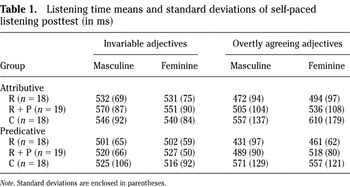
Listening time means and standard deviations of self-paced listening posttest (in ms)
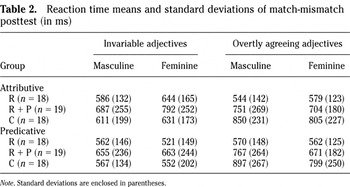
Reaction time means and standard deviations of match-mismatch posttest (in ms)
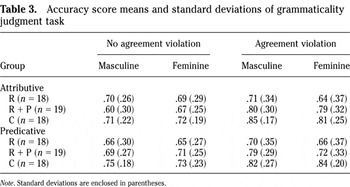
Accuracy score means and standard deviations of grammaticality judgment task
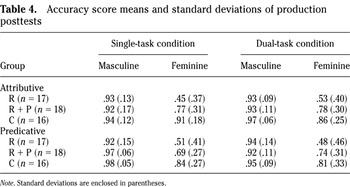
Accuracy score means and standard deviations of production posttests
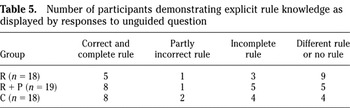
Number of participants demonstrating explicit rule knowledge as displayed by responses to unguided question
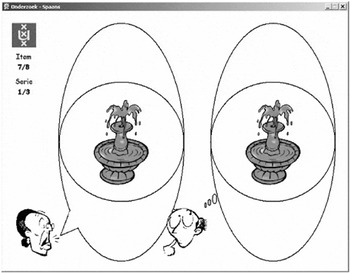
Screenshot of a trial in the sentence-picture matching task. Auditive stimulus: “En el círculo aparece la fuente roja, dice José” (response: left).
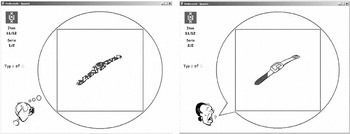
Screenshots of trials in the match-mismatch task with attributive adjectives (left) and predicative adjectives (right) during the visualization of appearing and changing color. Auditive stimulus (left): “En el cuadro aparece el reloj rojo, cree Javier.” Auditive stimulus (right): “El reloj en el cuadro se vuelve rojo, dice José.”
 You have
Access
- 46
- Cited by