Introduction
In the past decade, elders with mild cognitive impairment (MCI) or with cognitive impairment no dementia (CIND) have been extensively studied because of their increased risk of developing dementia (Palmer et al., Reference Palmer, Wang, Backman, Winblad and Fratiglioni2002; Reference Palmer, Backman, Winblad and Fratiglioni2008; Fisk et al., Reference Fisk, Merry and Rockwood2003). The common basis of these potential predementia states is that they fundamentally refer to older adults who display cognitive performance below what it is expected for their age and education level without reaching the threshold for dementia. Numerous definitions of MCI or CIND have been previously employed. In this paper, MCI will refer to the concept proposed by Petersen (Reference Petersen2004) – namely, subjective cognitive complaints in addition to objective cognitive deficits and preserved general cognitive function and functional activities – and CIND will refer to objective cognitive deficits that do not meet dementia criteria. Several subtypes of MCI are recognized according to the nature of cognitive deficits and the underlying etiology of cognitive difficulties differ between MCI subtypes (e.g. amnestic MCI is deemed to represent preclinical Alzheimer's disease in most individuals, whereas non-amnestic MCI would be due to non-Alzheimer forms of dementia). Conversely, CIND is a more inclusive concept, not restricted to elders with cognitive complaints, aimed at studying characteristics of the whole population at high risk of dementia regardless of underlying etiology. Thus, it has substantial value for epidemiologic purposes.
Previous studies have indicated that neuropsychiatric symptoms are highly prevalent in MCI and CIND (Lyketsos et al., Reference Lyketsos, Lopez, Jones, Fitzpatrick, Breitner and DeKosky2002; Apostolova and Cummings, Reference Apostolova and Cummings2008). In one of the few population-based studies investigating a wide range of neuropsychiatric symptoms, the most common manifestations observed in CIND were, in order of prevalence, dysphoria, apathy, irritability, sleep disturbance, agitation, and appetite/weight alteration (Lyketsos et al., Reference Lyketsos, Lopez, Jones, Fitzpatrick, Breitner and DeKosky2002). One should note that most of these symptoms can be part of a major depressive episode (MDE). Dysphoria (depressed mood) and anhedonia (markedly diminished interest/pleasure in most daily activities), which is closely linked to apathy, are essential symptoms of MDE, while sleep disturbance, appetite/weight alteration, and agitation are non-essential symptoms of MDE (NESD; American Psychiatric Association, 2000). Many neuropsychiatric symptoms observed in elders with CIND could be related to a MDE or a “subthreshold” depressive episode, a cluster of depressive symptoms not meeting all criteria for MDE. However, many of the neuropsychiatric symptoms associated with CIND are NESD which are not specific to mood disorders and which can occur in various neuropsychiatric conditions in the absence of the essential symptoms of depression. For example, insomnia is a symptom found in 19 diagnostic criteria of Axis 1 disorders in the DSM-IV (American Psychiatric Association, 2000).
At present, the associations between neuropsychiatric symptoms and potential predementia states are unclear and there are important overlaps between CIND and psychiatric disorders. On one hand, several neuropsychiatric symptoms in elders with CIND can be part of MDE or subthreshold MDE. On the other hand, elders with MDE or minor depression commonly display cognitive deficits (Herrmann et al., Reference Herrmann, Goodwin and Ebmeier2007). Moreover, if NESD occur with CIND in absence of essential symptoms of MDE, they cannot be considered as part of a depressive syndrome such as MDE or subthreshold MDE. It is not known whether NESD in absence of dysphoria/anhedonia occur in older adults at high risk of dementia. Only one previous study investigated the links between a predementia state (MCI) and each MDE symptoms (Kumar et al., Reference Kumar, Jorm, Parslow and Sachdev2006). However, this study did not distinguish between NESD in the presence or absence of essential MDE symptoms. To better understand the psychiatric symptomatology observed in elders at high risk of dementia, it is necessary to verify whether NESD occur in absence of a MDE or subthreshold MDE. The context in which NESD appear is also essential to determine appropriate diagnosis and treatment. In other words, whether NESD are encountered or not within a clinical syndrome such as MDE might have different treatment implications (American Psychiatric Association, 2000). Using data from the ESA study (Préville et al., Reference Préville2008), the current study aimed to examine the relations between CIND and NESD in community-dwelling elders who had not experienced dysphoria/anhedonia during the year before the interview.
Methods
ESA study
Data for this cross-sectional study were obtained from the Enquête sur la Santé des Aînés (ESA study), a population-based study on elders' mental health (Préville et al., Reference Préville2008). The aim of the ESA study was to assess the prevalence of mood and anxiety disorders of elders in the province of Québec, Canada. In 2005–2006, a sample (n = 2811) of community-dwelling French-speaking adults (95% of the Québec population speak French; Statistics Canada, 2006), aged 65 years or older and living in the province of Québec, were recruited. The sampling frame of the study used a random dialing method with a stratification of households according to geographical areas (metropolitan, urban, and rural) and the 16 administrative regions of the province of Québec. A random sampling method was also used to select one elder within the household. The response rate was 66.5%.
Data were collected through in-home semi-structured interviews conducted by research nurses who received two days of training by the principal investigator (MP) in the administration of the ESA computer-assisted questionnaire (ESA-Q). The respondents' mental health status was measured by a section of the ESA-Q based on the DSM-IV criteria for mood and anxiety disorders (American Psychiatric Association, 2000). The detailed diagnoses procedures have beenpreviously published (Préville et al., Reference Préville2008) and this section of the ESA-Q is similar to the Diagnostic Interview Schedule and the Composite International Diagnostic Interview, which have demonstrated satisfactory reliability and validity to make psychiatric diagnoses (Robins et al., Reference Robins, Helzer, Croughan and Ratcliff1981; Wittchen et al., Reference Wittchen, Robins, Cottler, Sartorius, Burke and Regier1991). Cognitive functioning was assessed with the Mini-mental State Examination (MMSE; Folstein et al., Reference Folstein, Folstein and McHugh1975). The interview was completed only with participants who scored 22 or higher on the MMSE (26 participants with a MMSE score <22 were excluded). Data from the ESA study were linked with medical records from the Régie de l'assurance maladie du Québec (RAMQ; Québec's public health insurance plan) for a period covering one year before and one year after the interview. The RAMQ coverage is universal and all Québec residents are registered and entitled to a variety of medical services. Respondents were offered $15 compensation for their participation. Written informed consent was obtained from all participants before the beginning of the interview. Research procedures were previously reviewed and authorized by the ethics committee of the Institut universitaire de gériatrie de Sherbrooke.
Study sample
Figure 1 presents a flow chart of study enrollment and exclusion criteria. Medical records from the RAMQ were available for 2494 individuals and only these participants were included in the present study. The missing data from the RAMQ records relate to a refusal of consent to provide medical records, moving outside Québec, or having additional drug insurance. Participants excluded because of missing RAMQ data did not differ statistically from those included in the study in terms of mean MMSE score and prevalence of psychiatric diagnoses (data not shown). According to the medical records, participants who received a diagnosis of dementia from a medical doctor and/or were taking an approved pharmacological treatment for dementia (memantine, donepezil, galantamine or rivastigmine) during the year before or the year following the interview were excluded from the sample (n = 48). To study NESD that are not part of a MDE or subthreshold depression, participants who experienced one essential symptom of MDE during the year before the interview were excluded. Hence, subjects who had two weeks of dysphoria (depressed mood) and/or anhedonia (markedly diminished interest/pleasure in most daily activities) were removed from sample (n = 397). Moreover, nine participants were excluded because their education level was unknown and 12 others were excluded because they did not complete the interview on depressive symptoms. The final sample size used in the present study comprised 2028 individuals.
Flow chart of the ESA study and the study sample enrollment.

Psychiatric symptoms
The NESD in the present study are those included in the DSM-IV (American Psychiatric Association, 2000) criteria for MDE: appetite alteration (increase/decrease), sleep disturbance (insomnia/hypersomnia), psychomotor alteration (agitation/retardation), fatigue or loss of energy, and cognitive complaints (reporting either impaired ability to think, concentrate, make decisions, or memory difficulties). The section of the ESA-Q used to assess NESD in elders without dysphoria/anhedonia was identical to the one used to assess MDE, except for the duration of the symptoms. The participants without dysphoria/anhedonia were asked if they had experienced each NESD for at least six months in the past year.
Definition of CIND
The procedure to identify CIND was a quantitative approach similar to that used in studies from the Kungsholmen Project group (e.g. Palmer et al., Reference Palmer, Wang, Backman, Winblad and Fratiglioni2002). Probable CIND cases were defined based on MMSE cut-offs stratified for age, education and sex. The cut-off criterion used by others (Palmer et al., Reference Palmer, Wang, Backman, Winblad and Fratiglioni2002) was an MMSE score below one standard deviation. Because the distribution of MMSE scores was negatively skewed in the present study, the “one standard deviation” criterion would have overestimated the number of individuals with probable CIND. Therefore, we adopted the criterion of a score below the 15th percentile within each age, sex and education subgroup, which is equivalent to a score below one standard deviation in a normal distribution. Four categories of age (65–69, 70–74, 75–79, 80 years and over) and three categories of education (primary or less, secondary, postsecondary) were used to allow sufficient numbers of participants in each group. Depending on the age, sex and education levels stratifications, the MMSE median varied between 27 and 30 while the criterion for probable CIND varied between scores below 25 and 28. Potential dementia cases were excluded by two procedures previously described. First, participants with a MMSE score below 22 were excluded. Second, according to public medical records, participants with a diagnosis of dementia or who were receiving a pharmacological treatment for dementia during the year preceding or the year following the interview, were excluded.
Covariates
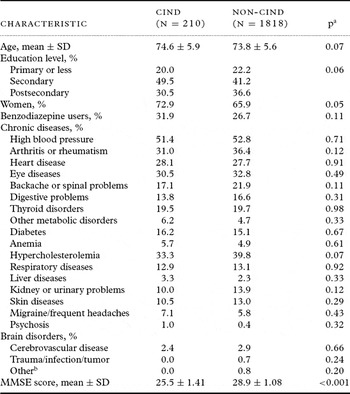
Variables potentially associated with cognitive functioning and/or psychiatric symptoms included age, education level, sex, benzodiazepine use, brain disorders and chronic diseases. Age was used as a continuous variable while education was categorized as in Table 1. The use of benzodiazepines was measured using the RAMQ medical records and was defined as at least one prescription of this medication during the year before the interview. The number of chronic diseases according to the International Classification of Diseases (ICD-10) was measured by asking participants if they had any of the following chronic health problems: high blood pressure, arthritis or rheumatism, heart diseases, eye diseases, backache or spinal problems, digestive problems, thyroid disorders, other metabolic disorders, diabetes, anemia, hypercholesterolemia, asthma or emphysema or chronic bronchial diseases, liver diseases, kidney or urinary problems, skin diseases, migraine or frequent headaches, schizophrenia and other forms of psychosis. The presence of brain disorders was assessed by the RAMQ medical records covering the year preceding the interview for the following disorders: cerebrovascular disease, brain trauma/tumor/infections, multiple sclerosis, Parkinson's disease, and epilepsy.
Characteristics of participants with probable cognitive impairment no dementia and cognitively intact participants (N = 2028)

CIND = probable cognitive impairment no dementia;. Non-CIND = normal cognitive functioning. MMSE = Mini-mental State Examination
a p value from t-tests or χ2.
b Includes Parkinson's disease, epilepsy and multiple sclerosis.
Statistical analysis
Differences in characteristics between participants with probable CIND and participants with normal cognitive functioning were tested by χ2 and t-tests. Associations between each NESD and probable CIND were first described by bivariate odds ratios (OR). For each NESD, potential sex interaction was tested using the Breslow-Day test for homogeneity of odds ratios. These associations were then assessed by adjusted ORs computed using logistic regression analyses with NESD as predictors. Each NESD was coded as present or absent. All logistic models were adjusted for age, education level, sex, benzodiazepine use, the presence of a brain disorder and the number of chronic diseases. Outliers and multicollinearity among predictors were verified. Analyses were performed using SPSS software (version 16.0) with the alpha level set at a two-tailed 5% divided by the number of regressions (p = 0.008).
Results
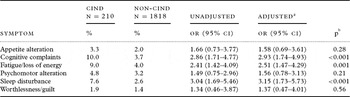
The procedure to identify participants with probable CIND revealed that 210 participants met the criteria. Table 1 shows the characteristics of the participants with probable CIND and those with normal cognitive functioning. Participants with probable CIND did not differ from those without probable CIND in terms of age, education level, sex, benzodiazepines use, chronic diseases, and brain disorders. Participants with probable CIND had significantly lower MMSE scores than participants with normal cognitive functioning. Table 2 indicates the prevalence of NESD without dysphoria/anhedonia in elders with probable CIND and elders without CIND. Results revealed that symptoms of sleep disturbance, fatigue/loss of energy, and cognitive complaints were significantly related to CIND. Adjustments for potential confounders did not significantly improve any of the logistic regression models and did not modify the results of the crude odds ratios (Table 2). Finally, no significant sex interaction was revealed by the Breslow-Day tests for any of the NESD, the closest p value to significance being 0.44 for cognitive complaints.
Non-essential symptoms of depression and probable cognitive impairment no dementia in community-dwelling elders without dysphoria/anhedonia (N = 2028)

Notes: CI = confidence interval; CIND = cognitive impairment no dementia; Non-CIND = normal cognitive functioning; OR = odds ratio.
a ORs and 95% CI were estimated by a multivariate logistic regression adjusted for age, education, sex, benzodiazepine use, brain disorders, and chronic diseases. The p values were obtained by Wald F statistics with df = 1.
b The critical p value after correction for the number of regressions is 0.008.
Discussion
This study investigated whether NESD were related to probable CIND in a community sample of older adults without dysphoria/anhedonia. The results revealed that fatigue, sleep disturbance and cognitive complaints were significantly related to the presence of probable CIND. Moreover, sex was not found to be an effect modifier in the relation between any NESD and CIND. These results indicated that symptoms of fatigue, sleep disturbance and cognitive complaints in absence of MDE or subthreshold MDE are an important symptomatology in older adults at high risk of dementia.
Previous studies have demonstrated that neuropsychiatric symptoms are highly prevalent in elders with MCI or CIND (Lyketsos et al., Reference Lyketsos, Lopez, Jones, Fitzpatrick, Breitner and DeKosky2002; Apostolova and Cummings, Reference Apostolova and Cummings2008), with the most frequent symptoms being dysphoria, apathy, irritability, sleep disturbance, agitation, and appetite/weight alteration (Lyketsos et al., Reference Lyketsos, Lopez, Jones, Fitzpatrick, Breitner and DeKosky2002). Most of these symptoms could merely be part of a MDE or subthreshold MDE. Only one previous study investigated the prevalence of each DSM-IV depressive symptom in a group of elders at high risk of dementia (Kumar et al., Reference Kumar, Jorm, Parslow and Sachdev2006). Although this study did not distinguish between NESD that were met in presence or absence of dysphoria/anhedonia, Kumar et al. demonstrated that “trouble concentrating”, “felt slowed up” and “lack of energy” had a higher prevalence in elders with MCI compared to those without MCI. It is important to note that in the present study, participants with probable CIND did not meet Petersen's criteria for MCI (Petersen, Reference Petersen2004) since global cognitive functioning in these elders was slightly below what is expected for age and education level (MCI criteria require normal global cognitive functioning). However, the results of the present study provide innovative findings on the psychiatric symptomatology of elders at high risk of dementia. That is, NESD in the absence of essential symptoms of MDE were found to be more prevalent in elders with probable CIND than in older adults with intact global cognitive functioning.
The results of the current study suggest that objective and subjective cognitive difficulties are significantly related in elders without dysphoria/anhedonia. Subjective cognitive complaint is one of the criteria proposed by Petersen (Reference Petersen2004) to classify older adults as having the predementia state “MCI”. Despite the fact that subjective cognitive complaint is central in the MCI concept, previous work revealed that cognitive complaints in elders do not consistently reflect objective cognitive functioning (Reid and Maclullich, Reference Reid and Maclullich2006) and the value of this criterion for MCI is debated (see Busse et al., Reference Busse, Bischkopf, Riedel-Heller and Angermeyer2003; Mitchell, Reference Mitchell2008). Several factors such as personality and mental health status appear to influence subjective cognitive functioning in older adults (Reid and Maclullich, Reference Reid and Maclullich2006). Similar results were also observed in neurological conditions that are not specific to aging, such as mild traumatic brain injury (Stulemeijer et al., Reference Stulemeijer, Vos, Bleijenberg and van der Werf2007). These results showed that objective and subjective cognitive functioning were not significantly related and that lower educational levels, emotional distress, personality, and poorer physical functioning were associated with cognitive complaints. Thus, one's perception of one's own cognitive functioning can be influenced by many factors, making it difficult to identify specific conditions in which subjective and objective cognitive functioning are significantly linked. Despite the numerous factors related to subjective cognitive functioning, our results suggest that cognitive complaints are a significant aspect of the symptomatology of community-dwelling elders with CIND without MDE or a subthreshold MDE.
Previous studies established that sleep disturbance was related to cognitive functioning (Nebes et al., Reference Nebes2001) and MCI (Artero et al., Reference Artero2008; Beaulieu-Bonneau and Hudon, Reference Beaulieu-Bonneau and Hudon2009). Data in healthy elders revealed that those with poorer sleep quality have poorer performance on neuropsychological tests compared to those with better sleep quality (Nebes et al., Reference Nebes2001). Artero et al. (Reference Artero2008) found that insomnia was associated with MCI in women, but not in men. In the current study, sex did not significantly modify the association between probable CIND and sleep disturbance. Moreover, another study, which used a two-year follow-up, indicated that chronic insomnia without depression was associated with minor cognitive decline in men, but not in women (Cricco et al., Reference Cricco, Simonsick and Foley2001). Furthermore, in men, the presence of chronic insomnia, in addition to depression, had a stronger relation with minor cognitive decline than depression alone, but this was not the case in women. Moreover, the causes of sleep disturbance are various (e.g. primary insomnia, sleep apnea, restless legs syndrome, etc.) and they were not examined in the current study or in the previous ones (Cricco et al., Reference Cricco, Simonsick and Foley2001; Artero et al., Reference Artero2008). Further studies should investigate the source of sleep disturbance associated with cognitive deficits and cognitive decline, as it could lead to hypotheses on mechanisms underlying these associations.
In the present study, fatigue/loss of energy was one of the symptoms linked to CIND in absence of dysphoria/anhedonia. Fatigue is a complex manifestation associated with multiple acute and chronic diseases (DeLuca, Reference DeLuca2005). Not much is known about the relations between fatigue and cognitive functioning, but fatigue is commonly observed in several neurological conditions (e.g. cerebrovascular disease, Parkinson's disease, traumatic brain injury, and multiple sclerosis; DeLuca, Reference DeLuca2005). In agreement with our results, fatigue was related to cognitive deficits in adults with traumatic brain injury (Ziino and Ponsford, Reference Ziino and Ponsford2006; Bushnik et al., Reference Bushnik, Englander and Wright2008). Furthermore, individuals presenting increased fatigue in the first two years following the injury had a poorer outcome in cognitive functioning. Cognitive deficits are also present in individuals with chronic fatigue syndrome. In fact, cognitive deficits are symptoms included for the diagnosis of chronic fatigue syndrome by the International Chronic Fatigue Syndrome Study Group (Fukuda et al., Reference Fukuda, Straus, Hickie, Sharpe, Dobbins and Komaroff1994). Further studies are needed to better understand the links between fatigue and cognitive functioning in older adults.
Previous data indicated that sleep efficiency in healthy elders is moderately correlated with fatigue (Alapin et al., Reference Alapin, Fichten, Libman, Creti, Bailes and Wright2000) and that adults with sleep disorders have higher scores on fatigue scales compared to normal values (Lichstein et al., Reference Lichstein, Means, Noe and Aguillard1997). Moreover, results suggest that fatigue can originate from sleep disorders since the treatments of sleep apnea and periodic leg movements/restless legs syndrome significantly lower the level of fatigue (Mosko et al., Reference Mosko1989). In the current study, since both fatigue and sleep disturbance were related to probable CIND, one could argue that most elders with probable CIND who reported sleep disturbance were also complaining of fatigue. Actually, one third of the participants with probable CIND who had sleep disturbance also reported fatigue. Furthermore, the relation between probable CIND and combined sleep disturbance/fatigue (OR: 6.74 CI: 2.81–16.19) was stronger than that between probable CIND and either symptom alone (Table 2). Thus, sleep disturbance and fatigue are interrelated symptoms that are both associated with impairment in global cognitive functioning, and the magnitude of their associations with CIND in the absence of dysphoria/anhedonia appears to be additive. This is also true for subjective cognitive complaints since elders with combined sleep disturbance, fatigue, and cognitive complaints displayed an even stronger association with CIND (OR: 13.56 CI: 4.76–38.38). These results suggest that sleep disturbance, fatigue, and cognitive complaints represent a cluster of symptoms occurring in elders at high risk of dementia. Moreover, this cluster of symptoms differs from depression syndrome since it does not involve dysphoria or anhedonia.
This study has a number of strengths. First, potential selection bias was prevented by randomly recruiting a large sample of older adults in the community with a good response rate. Second, many potential confounders were taken into account in the statistical analyses (age, education, sex, benzodiazepine use, brain disorders, and chronic diseases). However, none of them was significantly related to CIND. Since the procedure to identify probable CIND cases was done according to age, education, and sex, it is not surprising that these variables were not significantly linked with probable CIND. Moreover, none of the health problems tested as potential confounders was significantly associated with probable CIND, indicating that most probable CIND cases were not due to cardiovascular conditions, cerebrovascular diseases or other brain disorders such as Parkinson's disease, epilepsy and multiple sclerosis.
This study also has some limitations. First, two procedures were used to exclude potential dementia cases: MMSE score below 22 and dementia diagnosis according to medical records during the year preceding and the year following the interview. Despite these measures, it is possible that a few cases of dementia were still part of the sample. However, it has been established that the prevalence of dementia in community-dwelling Canadians aged 65 years and over is 2.8% (Graham et al., Reference Graham1997) and our procedures to eliminate potential cases of dementia resulted in the exclusion of 2.6% of the total sample. Therefore, it is likely that most of the dementia cases did not form part of the study sample. Second, individuals with probable CIND were classified according to their MMSE score, which is a screening instrument and is somewhat limited in detecting mild cognitive deficits. Nevertheless, this limit was minimized since we used cut-offs stratified for education, age, and sex, which are superior to an absolute cut-off. Moreover, the data used from the ESA study assessed the presence of NESD in the previous year. It is possible that participants with probable CIND, especially those with memory deficits, might have underestimated the symptoms encountered during the year preceding the interview. Thus, this could result in lowering the magnitude of the associations observed. Finally, information on physical disabilities such as activities of daily functioning can be linked with cognitive functioning, but such information was not available in the ESA study. Therefore, physical disability as a potential confounder could not be taken into account in the statistical analyses.
In summary, fatigue, sleep disturbance, and cognitive complaints were symptoms associated with CIND in the absence of dysphoria/anhedonia. These results provide a better understanding of the psychiatric symptoms associated with elders at high risk of dementia. Neuropsychiatric symptoms occurring in the absence of essential features of depression should receive particular attention in primary health care practice since these manifestations can be linked to cognitive difficulties and vice versa.
Conflict of interest
None.
Description of authors' roles
Olivier Potvin performed the analyses and wrote the paper. Carol Hudon, Sébastien Grenier and Michel Préville revised the paper and contributed to its content and to the interpretation of data. Michel Préville developed the research design.
Acknowledgments
This study was supported by research grants from the Canadian Institutes of Health Research (200403MOP) and the Fonds de recherche en santé du Québec (FRSQ; ref: 9854). Olivier Potvin was supported by a postdoctoral trainee award from the FRSQ and Alzheimer Society of Canada Partnership Program. Sébastien Grenier was supported by a postdoctoral trainee award from the FRSQ. Michel Préville was supported by a Senior Research Scientist Award from the FRSQ.