Introduction
During the 20th century vigorous attempts were made, through international norms and state regulations, to ensure that every individual had one, but just one citizenship. Migrants were expected and asked to renounce their former nationality in order to become naturalized in the receiving country and thus to prove their undivided loyalty to the new home country. At the turn of the 21st century, this changed dramatically. An increasing number of states worldwide now permit dual or multiple citizenship and many people use the opportunity to formalize their multiple affiliations. Even many states that do not permit it officially now tolerate it (Brondsted-Sejersen, Reference Brondsted-Sejersen2008; Vink and de Groot, Reference Vink and de Groot2010).Footnote 1
This increasing acceptance of dual citizenship, however, should not gloss over the fact that important normative and empirical concerns persist. In many states, dual citizenship is (still) forbidden and is highly contested. Opponents argue that ‘one cannot serve two masters’ and are concerned that loyalty towards the state, national cohesion, and democracy are undermined by dual citizenship (see Faist and Gerdes, Reference Faist and Gerdes2008: 13). In contrast, proponents underline that allowing dual citizenship is a sign of welcoming newcomers while acknowledging their additional ties; they say it increases the willingness to naturalize and encourages political integration (Bauböck, Reference Bauböck2003: 31). Thus, both the normative desirability and the empirical consequences of dual citizenship are disputed.
However, fears and hopes about dual citizens are often built on speculation. The rare empirical studies on this specific group are inconclusive and often struggle with insufficient data (Cain and Doherty, Reference Cain and Doherty2006; Staton et al., Reference Staton, Jackson and Canache2007a; Wong, Reference Wong2008; Mügge, Reference Mügge2012). Based on comparative data on dual citizens in Switzerland, we want to make an empirical contribution to the question whether dual citizenship endangers the political integration of dual citizens and their loyalty to the residence country. A second passport might offer an easy exit option, but dual citizens can also express their ‘voice as a function of loyalty’ (Hirschman, Reference Hirschman1970: 77). We understand loyalty as a two-dimensional phenomenon: first, it signifies a ‘tie that binds’ (Campbell, Reference Campbell2003: 43) or affective political attachment (Shklar, Reference Shklar1993: 188), closely related to feelings of belonging or identity. Second, as Royce (Reference Royce1967: 235) suggests, loyalty is an ‘attitude [which] makes a man give himself to the active service of a cause’. Loyalty to a democratic community can also be expressed by various forms of political participation. Thus, the guiding research question is whether dual citizens systematically differ from mono citizens in respect to their level of identification and political participation in the country of residence. This analysis will help to elucidate the broader question of whether immigration states gain from allowing dual citizenship or whether, by contrast, they pay a price by creating citizens who, because of their dual affiliation, feel less attached, are less involved and overall less loyal.
The paper is structured in four parts. First, we provide a definition of the central concept of citizenship and a brief overview of the debate on dual citizenship, allowing us to derive a set of hypotheses about its consequences for identification and political participation. In the second part, we specify our operationalization and describe the methods applied and the data, which is based on a survey among dual citizens and control groups in Switzerland conducted in 2013. The empirical third part includes descriptive analyses illustrating the extent of their identification and political participation in Switzerland in comparison with mono citizens. Furthermore, multivariate analyses will investigate the robustness of the relationships once relevant controls are introduced. A discussion of our findings and their implications in the fourth part, together with the conclusion and some suggestions for future research, rounds off the paper.
Dual citizenship and its consequences
Definition of citizenship
In general, citizenship, defined as membership of a political community, can be understood in a narrower or a broader sense. It concerns first of all a formal legal status that has an important symbolic value and comes with a bundle of rights and duties (for the Swiss case, see Hainmüller and Hangartner, Reference Hainmüller and Hangartner2013: 5). In this sense, citizenship or nationalityFootnote 2 marks the difference between being a tolerated resident and being a full member with equal rights (Koopmans et al., Reference Koopmans, Statham, Giugni and Passy2005: 31; Bellamy, Reference Bellamy2008: 12).Footnote 3 Beyond a legal status and related rights, citizenship, in a broader sense, encompasses other dimensions as well, namely a set of responsibilities and practices that support democratic self-government and a shared collective identity (Faist, Reference Faist2007; Bauböck, Reference Bauböck2008: 3; Bloemraad et al., Reference Bloemraad, Korteweg and Yurdakul2008: 154–156; Jakobson and Kalev, Reference Jakobson and Kalev2013; Schlenker and Blatter, Reference Schlenker and Blatter2014).
Within the context of the Westphalian system of nation-states, it was commonly assumed that all dimensions are necessarily connected and congruent for an adequate understanding of citizenship (Cohen, Reference Cohen1999: 249). Although this has always been a theoretical assumption in need of empirical investigation, it is particularly challenged by the recently booming literature on transnationalism, which underlines the continuing social ties and linkages of immigrants across national borders (Glick Schiller et al., Reference Glick-Schiller, Basch and Blanc-Szanton1992; Basch et al., Reference Basch, Glick Schiller and Szanton Blanc1994: 7). Constituting a legal tie that connects an individual to two countries, dual citizenship contradicts the classic understanding of citizenship as single and exclusive affiliation to one state. The implications of this transnational statusFootnote 4 for the other dimensions of citizenship, citizenship practices and identities and political loyalty in the country of residence are a matter of heated debate. After the following brief overview of this debate, our empirical analysis will trace the different dimensions of citizenship separately and analyze the relationships between them – (dual) formal status and related rights on the one hand, and identification, political participation and overall loyalty on the other hand.
A brief overview of the debate on dual citizenship
For a long time, (multiple) membership of political communities was not an issue of concern as belonging was determined by estates rather than by nation-states. However, this has changed since the second half of the 19th century, when nationality became more exclusive. After that, dual citizenship was a situation to be avoided. One reason was a concern that issues of diplomatic protection of dual nationals could result in conflicts between states. A second and related concern involved the matter of military service (Koslowski, Reference Koslowski2003). Concerns over diplomatic protection are less relevant in an era of international sensitivity to human rights, and the matter of military service is increasingly regulated by treaties between countries. Still, where borders are contested and former empires like Hungary and Russia grant dual citizenship to ethnic kin people in neighbouring states, which in turn fear for their integrity, this can become a major source of tension (Bauböck, Reference Bauböck2010; Riedel, Reference Riedel2012). But also in Western European countries such as Germany and the Netherlands, dual citizenship is still a highly controversial and politically salient issue (Schröter et al., Reference Schröter, Mengelkamp and Jäger2005; Faist, Reference Faist2007; Naujoks, Reference Naujoks2009).Footnote 5 In contrast and, in light of the rather exclusive citizenship regime, surprisingly, the acceptance of dual citizenship in Switzerland in 1992 did not trigger a broad debate, although the right-wing Swiss People’s Party (SVP) attacked this right repeatedly.Footnote 6
The question whether dual citizenship should be accepted is debated first and foremost from two angles: as a matter of justice, on the one hand, and as a matter of consequences, on the other. Proponents of dual citizenship argue that the rules of inclusion in the political community should be accessible and welcoming in order to diminish the existing incongruence between residents subject to law and citizens who are entitled to participate in law-making. As only full citizenship provides immigrants with the right to vote in national elections – only a few countries worldwide grant this right to resident non-citizensFootnote 7 – its accessibility and thus equal opportunities for migrants are interpreted as a matter of justice. In contemporary nation-states, even those with a federal system, the national level is (still) the most decisive arena for political decision making, which highlights the importance of citizenship. Furthermore, granting citizenship is seen as an act of recognition by which the receiving community welcomes the immigrant (Bauböck, Reference Bauböck2003: 31). Critics of dual citizenship, however, reply that the right to vote in two countries is unjust: first, because one cannot live in two countries simultaneously. Dual citizens who are entitled to participate in law-making in the country of origin do not have to face the consequences of their decisions. Second, their easy exit option would create differently committed political choices in the country of residence (e.g. Naujoks, Reference Naujoks2009). And lastly, such unjustified double voting rights would undermine the basic principle of equality of citizens, expressed by ‘one person, one vote’ (Goodin and Tanasoca, Reference Goodin and Tanasoca2014).Footnote 8
When dual citizenship is debated as a matter of consequences, the discussion focuses especially on its potential effects on the integration of immigrants. This concerns, on the one hand, possible consequences for their socio-economic integration such as employment or income. There is an empirically well-founded consensus that naturalization has strong potential to improve immigrants’ economic situation (e.g. Bevelander and Pendakur, Reference Bevelander and Pendakur2012; Steinhardt, Reference Steinhardt2012). Whether this positive relationship is affected by the retention or renunciation of the citizenship of origin is, however, not clear (Mazzolari, Reference Mazzolari2009; Vink and Schmeets, Reference Vink and Schmeets2013).
On the other hand, an even more debated question is whether dual citizenship has an impact on the political and socio-psychological integration of immigrants. There is considerable evidence that the acceptance of dual citizenship lowers obstacles to naturalization and thus increases naturalization rates (Schröter et al., Reference Schröter, Mengelkamp and Jäger2005; Vink et al., Reference Vink, Prokic-Breuer and Dronkers2013). However, findings on the impact of naturalization on identification and political participation in the country of residence when the former nationality is retained are ambiguous. Several studies conclude that dual nationals are less attached to the country of residence and less politically involved than naturalized immigrants who have not kept their former nationality. In the US context, Cain and Doherty (Reference Cain and Doherty2006) found that dual citizens are significantly less likely to vote in comparison with mono US citizens. This finding is strengthened by Staton et al. (Reference Staton, Jackson and Canache2007a), who also report that dual citizens are less likely to participate in non-electoral political activities, to express high levels of civic duty, to identify as Americans and to consider the United States their homeland. Both studies use data on first-generation Latinos. Interestingly, the disconnecting effect of dual citizenship did not hold beyond the first generation (Staton et al., Reference Staton, Jackson and Canache2007b).
In contrast, Ramakrishnan (Reference Ramakrishnan2005: 93–94) found that dual nationality increases the likelihood of voting among immigrants (except for Cubans) in the United States. Evidence from Canada also revealed that dual citizenship does not diminish civic participation and the sense of belonging to Canada (Wong, Reference Wong2008: 87). While dual citizens seem to engage less in political participation, the author points to significant differences between ethnic groups in this respect. Analysing Turkish and Surinamese immigrants in the Netherlands, Mügge even concludes that ‘migrants with dual nationality are more likely to participate in the host country’s political life than those who only have Dutch nationality’ (Mügge, Reference Mügge2012: 15).
Thus, the empirical evidence on the impact of dual citizenship on identification and political participation in the country of residence is inconclusive. While most studies concentrate on the US context, quantitative and representative data on dual citizens in Europe – at least to our knowledge – does not yet exist.Footnote 9 Furthermore, the existing studies analyze first-generation immigrants and are based on small sample sizes. Cain and Doherty’s (Reference Cain and Doherty2006) results, for example, are based on 157 dual citizens from very different countries of origin. This makes it impossible to control for the impact of the second or former nationality. The present study, based on data from a recent survey designed especially for the purpose, helps to close this research gap. In the following section, based on the arguments in the lively political and normative debate, we present two hypotheses on the relationship between dual citizenship and loyalty expressed by identification and political participation.
Hypotheses on dual citizens’ identification and political participation
One of the major objections to dual citizenship is a suspected conflict of loyalty. Formal ties to more than one country run counter to the widespread expectation that immigrants should not only ‘share the national identity of the receiving society’, but ‘accept it as overriding all other affiliations’ (Bauböck, Reference Bauböck2002: 11). Especially in the event of conflict or war, a state depends on the undivided loyalty of its nationals, who are called to arms in its service. But even without such an extreme event, many fear that dual citizenship is similar to ‘bigamy’ and promotes a betrayal of one’s commitment to the country of residence (e.g. Renshon, Reference Renshon2005).Footnote 10 Thus, a first set of arguments is based on the communitarian understanding of citizenship (Blatter, Reference Blatter2011): dual nationals endanger collective identity, loyalty, and solidarity among members of the political community because they have an easy exit option, dissipating patriotism (Renshon, Reference Renshon2005: 54–78, 167–191; also Huntington, Reference Huntington2004). This may even lead to the dilution of state-based identities (Spiro, Reference Spiro2008) or at least to the devaluation of citizenship when multiple passports are simply managed and used at one’s convenience (Ong, Reference Ong1999).
A second set of arguments focuses on rather liberal and deliberative concerns. Individuals’ limited (time) capacities make it very likely that those who are members of two polities at the same time have less time and fewer resources to become thoroughly informed about the issues in each polity in comparison with those who belong to just one. In consequence, they are also less inclined to participate (Renshon, Reference Renshon2005: 150; Cain and Doherty, Reference Cain and Doherty2006: 93). Huntington (Reference Huntington2004: 212), for example, suggests that dual citizens either focus their effort on politics in one state, ignoring their duties in the other, or neglect their responsibilities in both. Thus, if dual nationality has an influence on political involvement, it is a negative one, diverting attention, motivation, and loyalty. This sceptical stance towards dual citizenship can be called the traditional or assimilationist view based on (exclusive) affiliation and assimilation in the country of residence (see also Staton et al., Reference Staton, Jackson and Canache2007a). It basically assumes a zero-sum or antagonistic relationship between different affiliations in the sense that those who (still) have another nationality are necessarily less loyal to their country of residence (Tsuda, Reference Tsuda2012: 635; Erdal and Oeppen, Reference Erdal and Oeppen2013: 878). According to this view, we can expect that:
Hypothesis 1 Dual citizens identify less with the country of residence and participate less in its politics than mono citizens.
On the other hand, proponents of liberal naturalization regulations and dual citizenship deny any negative effect of transnational ties on national integration (e.g. Hammar, Reference Hammar1985). They see the acceptance of dual citizenship as an instrument that not only facilitates the socio-economic and cultural integration of immigrants but also stimulates their political involvement. ‘By encouraging naturalization of immigrants and expanding the ‘training ground’ in which people learn transferable political skills’ (Bloemraad et al., Reference Bloemraad, Korteweg and Yurdakul2008: 168), it can have an activating effect on political participation and also on identification (e.g. Bloemraad, Reference Bloemraad2004; Bevelander and Pendakur, Reference Bevelander and Pendakur2010: 75; De Rooij, Reference De Rooij2012: 460). Instead of exit, voice is then an important means to express political preferences, which are also more likely to be taken into consideration by politicians (Faist and Gerdes, Reference Faist and Gerdes2008: 9). The right to vote, beyond being a matter of justice as discussed above, is also assumed to induce political interest and other forms of political participation, irrespective of whether this right is held in multiple countries. From this perspective, the status of (dual) citizenship is seen as a regulatory institution that has the effect of socializing new members in political practices (Gerdes and Faist, Reference Gerdes and Faist2007: 63–64). In addition, political socialization and skills learned in one context can be transferred to another. As participation in any political community enhances the (sense of) individual autonomy, it can be a trigger for political participation in other contexts too (Portes, Reference Portes1999: 471).
Beyond the positive effect of the acceptance of dual citizenship on naturalization rates (Vink et al., Reference Vink, Prokic-Breuer and Dronkers2013) and of naturalization on political integration, the former can also be perceived as an act of recognition by which the receiving community welcomes and accepts the immigrant, encompassing his/her past and continuing ties to the country of origin (Bauböck, Reference Bauböck2003: 31). This in turn encourages a sense of belonging to the country of residence and boosts political involvement. Creating equal opportunities for migrants to be fully fledged citizens in multiple countries is likely to increase the other dimensions of citizenship as well (Castles and Davidson, Reference Castles and Davidson2000; Aleinikoff and Klusmeyer, Reference Aleinikoff and Klusmeyer2002). With full membership and an increased sense of empowerment and self-worth, immigrants may feel more attached, more efficacious and interested in dealing with the affairs of the host country while simultaneously maintaining transnational ties (e.g. Østergaard-Nielsen, Reference Østergaard-Nielsen2003; Smith, Reference Smith2007).Footnote 11 Thus, from this transnationalist perspective, dual citizenship is not negatively related to political integration, but may, instead, actually foster identification and participation in the country of residence. This account assumes that loyalty towards two political communities can co-exist or even that transnational engagement in two countries is positively reinforcing (Tsuda, Reference Tsuda2012: 635), synergistic (Erdal and Oeppen, Reference Erdal and Oeppen2013: 878) or simply complementary (Dekker and Siegel, Reference Dekker and Siegel2013: 4). Thus, even the more cautious assumption suggests a negation of the traditional hypothesis elaborated above:
Hypothesis 2 Dual citizens do not identify less with the country of residence and do not participate less in its politics than mono citizens.
Operationalization, data and methods
Operationalization
In general, dual citizenship is acquired by three avenues: first, migrants who successfully apply for citizenship are allowed to keep their former nationality. Second, children of multinational couples are eligible for the nationalities of their parents. Third, children born to foreign parents in a country with birthright citizenship receive the nationality of their country of residence and can apply for the nationality of their parents. Our analysis includes the first two categories (naturalized dual citizens and those who acquire dual citizenship by birth). Switzerland does not accept the birthright principle for citizenship; children born to foreign parents on Swiss territory do not automatically receive Swiss citizenship.
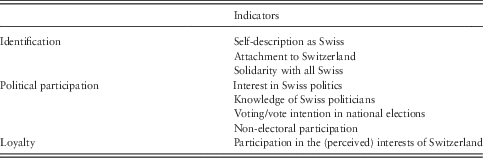
We operationalize our dependent variables along the following lines: the kind of collective identity we are interested in here refers to an individual’s identification with a political community (e.g. Brewer, Reference Brewer2001). According to social psychology (e.g. Tajfel, Reference Tajfel1981), this involves two operations: first, the individual cognitively ascribes him/herself to this community (self-description); second, this belonging is emotionally relevant (attachment). Third, such identification should also be relevant to the relations towards other members of the community, creating special ties in the sense of obligation. This relational aspect of collective identity will be assessed by feelings of solidarity. We thus assess identification in three ways: by self-description, attachment, and solidarity.
Political participation is conceived broadly and is measured by various indicators. They include two indicators, which can also be considered preconditions of political participation. First, we assess the extent of interest paid to politics at the national and lower levels (see, e.g. Huddy and Khatib, Reference Huddy and Khatib2007). Second, political knowledge is measured by a multiple-choice question asking whether respondents know the name of the current Swiss minister of finance. Furthermore, we assess various common forms of political participation covering, first of all, stated and intended participation in elections as well as non-electoral forms of participation such as contacts to politicians or media (Verba and Nie, Reference Verba and Nie1972). As introduced by Barnes et al. (Reference Barnes1979), unconventional forms of political participation are also relevant, namely legal protest activities such as participating in demonstrations and signing petitions (see also Jennings et al., Reference Jennings, van Deth, Barnes, Fuchs, Heunks, Inglehart, Kaase, Klingemann, Thomassen, Kriesi, Koopmans, Duyvendak and Giugni1990). The different forms of non-electoral participation will be combined by constructing a scale.
Finally, we also include a measure, which can be regarded as an indicator of loyalty itself, combining identification and participation. Identification should ultimately guide behaviour in the group’s interests and, vice versa, political participation can best be regarded as a function of loyalty to a political community when it is actively serving its cause (Royce, Reference Royce1967: 235). We will assess this by asking in the interest of which country individuals act when they participate in politics. Table 1 gives a (simplified) overview of our operationalization (for question wordings, see Appendix).
Operationalization of the dependent variables

Data
Our analysis is based on quantitative, cross-sectional data from a survey among dual citizens, mono citizens, and foreign residents in Switzerland financed by the Swiss National Science Foundation and conducted by a professional survey institute (LINK). Many international and national surveys include indicators of identification and political participation but not dual nationality. The questions customarily used in these surveys served as a basis for the questionnaire for our own survey, to ensure that the results were comparable with existing findings while assessing all relevant dimensions of citizenship.
We chose Switzerland as country of residence as it has been a frontrunner in Europe in accepting dual citizenship, doing so back in 1992. Dual citizens now make up a significant percentage of the Swiss population. The 2000 census revealed that more than 10% of the seven million Swiss citizens have a second passport (Bundesamt für Statistik, 2011).Footnote 12 The large population of foreign nationals (21% in 2009) and the fact that 36% of marriages in 2009 were bi-national ensure that this already significant number of dual citizens in Switzerland will continue to grow steadily.
In order to have sufficient numbers from one national background to control for it, we selected three countries of originFootnote 13 with very different migratory ties to Switzerland: Germany as, currently, the major source of new and mostly highly qualified migrants, Italy as the most important country of origin of former, less qualified ‘Gastarbeiter’, and Kosovo as one of the main sources of refugees and newer, less qualified labour migrants. By selecting these different nationalities (in addition to the Swiss), which make up the largest share of immigrants into Switzerland and which are often the focus of considerable media interest, we hoped to capture the range of possibilities while simultaneously facilitating comparative analyses.
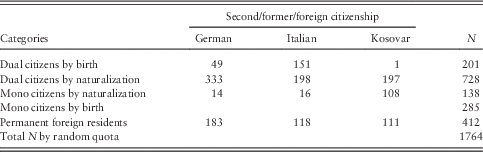
Unfortunately, as in many other countries, dual citizenship is not documented in any official register in Switzerland. Our sampling procedure, however, was designed to reach enough dual citizens and relevant control groups, namely mono citizens and foreign residents with a permanent residence permit (Permit C). For quantitative analyses, we aimed at around 100 respondents per category for each group. In order to draw a randomly selected sample, we received generous support from two Swiss authorities: for contacts to naturalized and foreign immigrants from the selected three nationalities, addresses from the official register of the Federal Office for Migration were randomly selected. Gender (equally distributed) and age (minimum 18) were also taken into account. Autochthonous Swiss citizens were randomly selected from the sampling register of the Federal Office for Statistics. Both samples included mono and dual citizens, who were afterwards assigned to the respective categories. In a first round, we contacted 3855 individuals. In order to reach our quota of dual citizens, we contacted an additional 600 naturalized citizens in a second round. Due to the small percentage of dual citizens by birth among the general Swiss population, they were the most difficult target group. Fortunately, we were able to contact another 492 dual citizens by birth via the online panel of LINK.
We were able to reach or exceed our target for most categories, except for naturalized mono Swiss of German and Italian origin, most of whom have kept their former nationality, and for dual citizens by birth of Kosovar descent.Footnote 14 Field work was undertaken between April and July 2013 and was carried out in German, French, Italian, and Albanian.Footnote 15 The overall response rate was ∼35.5%, which is not an unusually low rate among individuals with migration backgrounds (see Lipps et al., Reference Lipps, Laganà, Pollien and Gianettoni2013). The sample for this analysis includes, overall, 1764 respondents: 929 dual citizens, 423 mono Swiss citizens, and 412 foreign residents (Table 2).Footnote 16
Sample by category

Methods
Our research design is factor-centric (Sieberer, Reference Sieberer2011). In order to single out the main independent variable (dual citizenship), we differentiate between dual citizens and those with only Swiss citizenship and those without Swiss citizenship. As also the dependent variables (identification and political participation) take the individual as the level of analysis, we have to control for other potentially relevant factors on the individual level. Two factors are closely related to status, thus constituting possibly confounding variables. First, we control for the difference between those who are Swiss citizens by birth and those who are naturalized. Second, we control for the second or former nationality. Furthermore, due to the (personal or inherited) migration background of our target group, we will take generation and linguistic competence into account as important influences on integration in general, and on identification (Staton et al. Reference Staton, Jackson and Canache2007a) and political participation (Leighley and Vedlitz, Reference Leighley and Vedlitz1999) in particular. A dummy variable is constructed that distinguishes first-generation immigrants from those who live in the country in the second generation or longer.Footnote 17 Linguistic integration is assessed with sensitivity to the different language regions in Switzerland. In addition, feelings of discrimination may exert influence on political participation and even more on identification (e.g. Schildkraut, Reference Schildkraut2005), especially where a salient minority is concerned, such as Muslims in Switzerland; 78% of our Kosovar respondents reported to be Muslim.Footnote 18 Finally, the usual socio-demographic variables are included, such as gender and age, as well as variables from the ‘standard socio-economic status model’ (Verba and Nie, Reference Verba and Nie1972; Barnes et al., Reference Barnes1979). Individuals with high levels of education and socio-economic resources are more likely to adopt psychological orientations that motivate their political participation (for a review, see Leighley, Reference Leighley1995). Income is a sensitive question in Switzerland, which many of our respondents did not answer. As income and education level usually correlate, we opt for education as a control variable.Footnote 19
In order to check the reliability of the results, we will in a second step analyze a reduced sample of only foreign-born Swiss. This sample, thus, will not represent the general population the majority of which are native born citizens. This reduced sample allows us to evaluate whether the results are robust when analysing more comparable groups of respondents who all have an immigration background. This sample also allows the inclusion of the transnational dimension in the sense of an identification with and political participation in the country of descent.Footnote 20 This final set of control variables will thus assess whether our results on the transnational status of dual citizens change once we also include transnational identities and practices.
The following empirical part will include descriptive results (comparisons of percentages and means with t-tests) and multivariate analyses based on logistic and linear regressions. We are aware of the fact that analysing the effect of (dual) citizenship is difficult because of the selective nature of the naturalization process.Footnote 21 Possible effects of citizenship may be caused by characteristics inherent in the individual who becomes naturalized, rather than by the status of citizenship (Vink and Schmeets, Reference Vink and Schmeets2013: 9–10). They may also be caused by the specific selection criteria applied by the country of residence and inherent in the established rules for naturalization, such as civics tests or direct democratic decisions.Footnote 22 As Switzerland has one of the most exclusive citizenship regimes based on a primarily ethnic definition (Giugni and Passy, Reference Giugni and Passy2004), citizenship is seen as a reward for a successful integration process.Footnote 23 We can thus assume that there is strong (self-)selection of naturalized (dual) citizens who are more integrated than foreign residents. Overall, we do not claim to establish causal relationships, but aim to discover systematic differences between dual and mono citizens.
Results
Identification
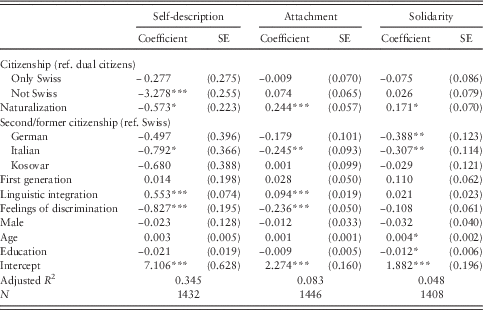
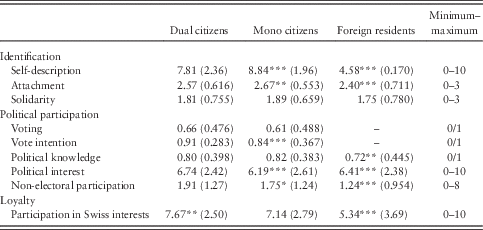
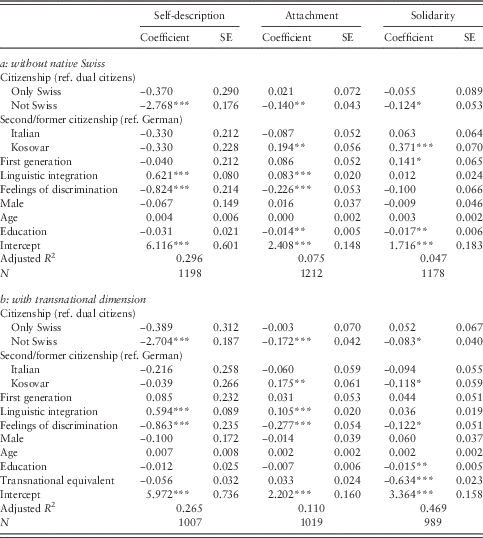
At first sight, dual citizenship seems to matter for (cognitive) self-description and attachment. While mono Swiss clearly describe themselves as Swiss (on average indicating 8.8 out of 10 points) and feel strongly attached to Switzerland (2.7 out of 3 points), dual citizens are slightly more hesitant, especially in respect to describing themselves as Swiss (m=7.8 in self-description and 2.6 on attachment) Footnote 24 . However, the significant differences between dual and mono citizens disappear once control variables are introduced (Table 3).Footnote 25 Multivariate regression analyses reveal that dual citizens do not significantly differ from mono Swiss neither concerning self-description, nor in attachment or solidarity. Also, analysing the reduced sample of only foreign-born residents, dual citizenship does not seem to matter (Table A3a). Not surprisingly, foreign residents are clearly less likely to describe themselves as Swiss; they are, however, equally likely to report attachment to Switzerland and solidarity with all Swiss.Footnote 26 What seems to matter beyond the formal status, is not whether one has one or two passports, but whether one is Swiss by birth or by naturalization. Being naturalized considerably reduces the propensity to describe oneself as Swiss, while it increases attachment and solidarity. Furthermore, a former or second Italian passport goes along with less identification with Switzerland and less solidarity, while a German background only matters for solidarity.Footnote 27 Two additional factors related to migration background also seem relevant in this respect: linguistic integration increases identification with Switzerland, while feelings of discrimination reduce it. This finding can be set in relation with others’ perceptions in this respect: the more individuals are perceived as ‘foreigners’, the less they identify with the country of residence.Footnote 28
Multivariate analysis of identification

Method: Linear regression, listwise deletion. Entries are unstandardized regression coefficients; standard errors in parentheses.
***P<0.001; **P<0.01; *P<0.05; all others are not significant.
Including identification with the country of descent in the analysis of the reduced sample of foreign-born residents only (Table A3b) the same overall pattern comes up: dual citizens do not differ from mono citizens, while they clearly identify more with Switzerland than foreign residents. This analysis further reveals that there is no systematic and significant relationship between self-description as Swiss and self-description as German, Italian, or Kosovar; the same applies to attachment to both countries. Apparently there is no trade-off between these measures of transnational identification. In contrast, we discover such a trade-off in respect to solidarity: those who feel solidarity towards co-nationals of their country of descent are less likely to feel obliged towards all Swiss. Thus, while simultaneous identification with two countries seems unproblematic, potentially more resource-related feelings of obligation seem to be less easily combined.
Political participation
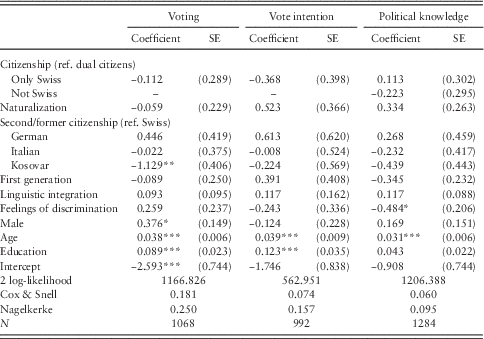
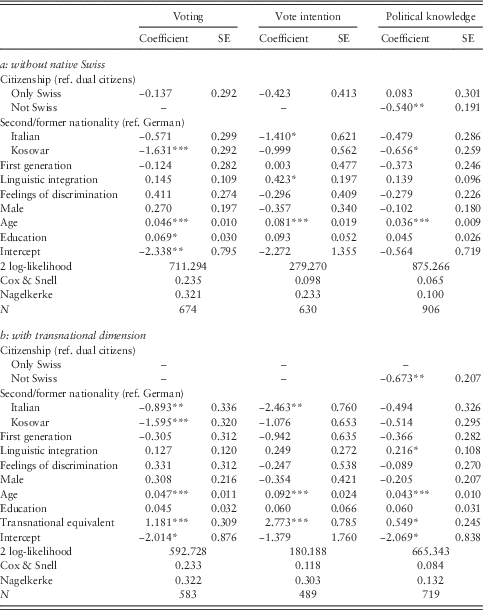
About 66% of dual citizens report having participated in the last national elections in Switzerland, which is about 5% more than the percentage of mono citizens. In their intention to vote in the next national election (91% have this intention), they also surpass mono citizens by 7 percentage points. The general problem of social desirability in surveys urges us to interpret self-reported electoral participation carefully as it may be perceived as a civic duty.Footnote 29 Again, there is no significant difference between dual and mono citizens when control variables are introduced in binary logistic regressions (Table 4).Footnote 30 Among the control variables, having a Kosovar second or former citizenship significantly reduces the propensity to vote, while being male, older and better educated increases it. Also concerning political knowledge, there is no systematic difference: dual citizens are no less likely to be informed than mono citizens.Footnote 31 Controlling for voting and knowledge in the country of descent, we even find a positive relationship between their occurrence in both countries.Footnote 32
Multivariate analysis of political participation I

Method: Binary logistic regression, listwise deletion. Entries are unstandardized regression coefficients; standard errors in parentheses.
***P<0.001; **P<0.01; *P<0.05; all others are not significant.
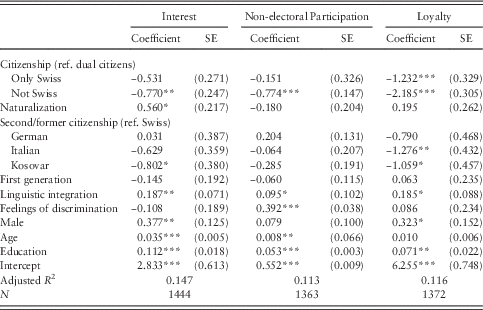
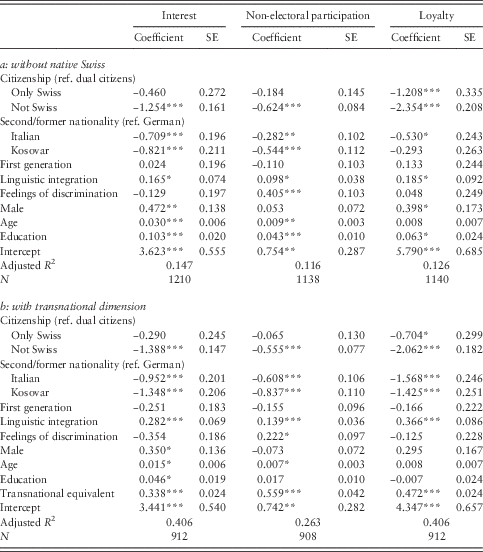
Concerning interest in Swiss politics, dual citizens express in absolute numbers, with a mean of 6.7 on a 10 point scale, slightly more interest than mono Swiss with a mean of 6.1. The results of multivariate analyses, however, again reveal that dual citizens do not differ from mono citizens in respect to political interest; here, key factors are again whether respondents are citizens at all – foreign residents being significantly less interested – and whether they are naturalized or Swiss by birth (Table 5). Being naturalized significantly increases the propensity to express political interest. Being of Kosovar descent or having an additional Kosovar passport reduces this likelihood, while linguistic integration increases it. Among the other control variables, the usual suspects – older and better educated men – are more likely to express interest in politics.
Multivariate analysis of political participation II

Method: Linear regression, listwise deletion. Entries are unstandardized regression coefficients; standard errors in parentheses.
***P<0.001; **P<0.01; *P<0.05; all others are not significant.
Also in respect to non-electoral political participation, which is at a relatively low level for all respondents, dual citizens seem at first sight to be more involved than mono citizens, with a mean of 1.9- on an 8-point scale in comparison with 1.7 for mono Swiss and 1.2 for foreign residents. However, in the multivariate analysis, dual citizens again do not differ from mono citizens. Only foreign residents are significantly less likely to be politically involved in this way. Among our control variables, linguistic integration and feelings of discrimination, as well as age and education, are tied to more non-electoral participation.
The diverse forms of political participation are certainly more resource- and time-consuming than feelings of belonging. Even if one accepts that it is easier for dual citizens to combine or duplicate such feelings in the sense of a transnational approach and that a dual status therefore does not decrease identification with the country of residence, the traditional approach would assume that a dual status has at least a negative impact on political participation in the country of residence. Our results, however, indicate that dual citizenship does not reduce such political participation; in this respect too, they thus run counter to the traditionalist hypothesis and strengthen the transnationalist one. This interpretation is further strengthened by our reliability analyses of the reduced sample of foreign-born residents (Tables A5a and A5b), which reveal the same pattern. In addition, they show that political interest and non-electoral participation in Switzerland is not reduced by equal involvement in the country of descent; on the contrary, they are positively related.
Finally, the high scores of dual citizens on political involvement in the country of residence increase the importance of the question of whose cause is actively served. Our data reveals that dual citizens participate in politics even more in the (perceived) interest of Switzerland than mono Swiss or foreign residents (m=7.6, 7.1, and 5.3, respectively). This positive association of dual citizenship to more ‘loyalty’, measured in this way, is robust even when we introduce the same control variables as above (Table 5).Footnote 33 Given that some critics fear that dual nationals could vote according to the will of the government of their other nationality (Naujoks, Reference Naujoks2009: 3), these results clearly undermine any assumption of ‘directed voting’. A second passport seems to go along with increased loyalty towards the country of residence and not with less or divided loyalty.
Discussion
This analysis concentrated on associations of dual citizenship with identification and political participation and is thus more correlational than causal and uni-directional. As we do not find any significant negative association of dual nationality with any measure of citizenship identities and practices, however, we can conclude that a dual status does not trigger negative consequences for political loyalty to and integration in the country of residence. Our results clearly run counter to the traditional or assimilationist perspective that expected a trade-off or zero-sum relationship and gives empirical backing to the transnationalist perspective on dual citizenship. It even seems to go along with increased loyalty, in the sense that dual citizens are more likely to report taking Swiss interests into consideration in their political participation. Our results are thus in line with Mügge’s (Reference Mügge2012) findings on the Netherlands and deliver counter-evidence to what Cain and Doherty (Reference Cain and Doherty2006) and Staton et al. (Reference Staton, Jackson and Canache2007a) found in the US context.
Furthermore, in line with the findings of other studies (Bevelander and Pendakur, Reference Bevelander and Pendakur2010; De Rooij, Reference De Rooij2012), our results underline the relevance of naturalization, which does not seem to be reduced by the retention of a second nationality. Those naturalized expressed more attachment, solidarity, and political interest than foreign residents and those who are Swiss by birth. This result is certainly, to a large extent, due to the (self-) selection of those who successfully naturalize in Switzerland (see also Hainmüller and Hangartner, Reference Hainmüller and Hangartner2013). Indeed, many of our respondents indicated that feelings of belonging and interest in political participation were important reasons to naturalize.Footnote 34 These orientations prior to naturalization feed into the generally high level of political participation of naturalized (dual) citizens in Switzerland. While there are considerable differences between the nationalities in this respect,Footnote 35 second or former nationality seems not to be important for many of our variables once controls are introduced. In light of the immense diversity of the selected groups in our study, this is an additional important finding.Footnote 36
The differences found between native and naturalized citizens may also be caused by social desirability. We are aware of the problem, which plagues all surveys, especially those conducted among individuals with a migration background, as these are particularly sensitive populations in a survey context (Lipps et al., Reference Lipps, Laganà, Pollien and Gianettoni2013). This general sensitivity is assumed to be heightened by direct questions concerning identity, solidarity, and loyalty. In Switzerland, it is not just the right-wing SVP that repeatedly bases its political agenda on nationalist or racist topics. Due to the politization and polarization of immigration, our results may therefore overestimate the loyalty of non-native Swiss respondents.Footnote 37 It is all the more important that also the analyses of a reduced sample of only foreign-born residents, in which this bias should be equally distributed, revealed similar patterns of no difference between dual and mono citizens in all respects, except for the question in whose interest they participate, where we even found a positive relationship.
That there are no significant differences in identification and political participation between dual and mono citizens when migration-related and socio-demographic control variables are included contradicts any fears of divided loyalty caused by dual citizenship. Among the myriad factors that influence loyalty, a dual status does not seem to play a major role.Footnote 38 Concerning alternative influences, our analysis did not reveal any difference between first-generation immigrants and others, in contrast to that of Staton et al. (Reference Staton, Jackson and Canache2007a, b). What seems relevant in our case is linguistic integration, which increases identification with Switzerland. By contrast, feelings of discrimination understandably reduce it. This finding underlines the role the receiving society and majority population play in the political integration of immigrants in general. While socio-demographic and socio-economic factors are not relevant for feelings of belonging, they proved important for almost all indicators of political participation, which is in line with previous research on political participation (Leighley, Reference Leighley1995).
The transnationalist account is strengthened by further results. Additional analyses showed that the occurrence of non-formal dimensions of transnational citizenship also do not decrease loyalty towards the country of residence. Except for solidarity, there seems to be no trade-off or antagonistic relationship between identification with and political participation in two countries. On the contrary, loyalty to both countries seems to co-exist simultaneously or is even mutually reinforcing (Tsuda, Reference Tsuda2012) or complementary (see also Dekker and Siegel, Reference Dekker and Siegel2013). They may co-exist for different and unrelated reasons. Those who feel that they belong to two countries usually do so for different reasons (Tsuda, Reference Tsuda2012: 643). Also political engagement is often encouraged by the country of residence and the country of descent for their own reasons. Alternatively there might be a positively reinforcing relationship: as Tsuda (Reference Tsuda2012: 638) underlines, ‘a certain amount of resources and stature in the host country is necessary to become actively engaged in home country politics’.Footnote 39
Other studies also show that the acquisition of citizenship by immigrants does not weaken transborder political engagement back home and may in fact increase it (Itzigsohn and Saucedo, Reference Itzigsohn and Saucedo2002: 25; Guarnizo et al. Reference Guarnizo, Portes and Haller2003). Conversely, transnational ties do not necessarily weaken political integration in the country of residence; Gershon and Pantoja (Reference Gershon and Pantoja2014), for example, even found that they positively impact Latino immigrants’ political integration in the United States.Footnote 40 We therefore maintain, with Tsuda (Reference Tsuda2012: 643), that ‘strong immigrant identifications with their homelands certainly do not preclude dual national (i.e. transnational) loyalties, unless the home and host countries are in a highly antagonistic international relationship’.
Conclusion
Based on comparative data on dual citizens, mono citizens and foreign residents in Switzerland, we can conclude that dual citizens in Switzerland are not less attached and politically involved than mono citizens. Controlling for relevant alternative factors, dual citizenship does not trigger any consequences in respect to most dimensions of loyalty. When directly asked in whose interest they politically participate, dual citizens are even more likely to act in the (perceived) interest of Switzerland. We thus find no evidence of dissipated patriotism among dual citizens (Renshon, Reference Renshon2005), dilution of state-based identities (Spiro, Reference Spiro2008) or a hollowing out of citizenship as such (Ong, Reference Ong1999). Membership of multiple national communities apparently does not hinder identification with and political participation in the country of residence. Thus, fears about divided loyalty are not backed by our data. Consequently, the already considerable number of dual citizens in Switzerland and the further growth of this number will not cause major problems for national integration or loyalty in Switzerland. On the contrary, because the acceptance of dual nationality promotes naturalization and our results also confirm previous findings that naturalization goes along with stronger feelings of belonging and political involvement, citizenship of the country of residence is important for these central elements of democracy, irrespective of a second passport.Footnote 41
The similar extent of identification and political participation in the country of residence of dual citizens compared with mono citizens does not come at the expense of weak feelings of belonging and low political involvement in the country of their second nationality. In contrast to Jakobson and Kalev (Reference Jakobson and Kalev2013), our results do not suggest a zero-sum relationship. Dual citizens in Switzerland are transnationally involved, as scholars of transnationalism suggest (e.g. Vertovec, Reference Vertovec2009). While transnational identification seems to co-exist without a trade-off, transnational political participation even seems mutually reinforcing: political participation in one country may help citizens to become more resourceful and efficacious in the other.
Before generalizing these results, however, we have to take the Swiss context into account. Compared with other countries, Switzerland has a relatively open institutional context, offering citizens diverse avenues and frequent opportunities to participate. The combination of open political institutions and inclusive political strategies characterizes, according to Kriesi et al. (Reference Kriesi1995), the Swiss form of political integration in general. This might facilitate the political integration of dual citizens that we found. However, the specific political opportunity structures for migrants in Switzerland are rather closed due to its exclusive citizenship regime, with the acceptance of dual citizenship being an exception to the otherwise exclusive rule (Giugni and Passy, Reference Giugni and Passy2004). The exclusivity of the Swiss national community may counteract the inclusive effect of open political institutions for people with a migration background even after naturalization; or, alternatively, it may further increase identification and participation once they are full citizens. Cross-national analyses with comparable data would be needed in order to situate our results on Switzerland in a broader context.
As we do not find any negative consequences of dual citizenship for political loyalty, our results do not give any empirical backing to the demand that nationality should be singular in principle. As long as there is no conflict between legal norms, rights, and obligations tied to the two nationalities and as long as state borders are not called into question by expansive neighbours, dual citizenship should be accepted as the default position (Bauböck, Reference Bauböck2002: 13). Under such circumstances, not tolerance but open acceptance of a dual status may also set into motion processes of self-transformation of national identities toward more pluralistic forms. Immigration countries can thus benefit from recognizing their citizens’ multicultural origins (Koskelo, Reference Koskelo2012). Instead of demanding exclusive loyalty, which is inappropriate in an age of migration, loyalty can be overlapping and overarching, reflecting the manifold transnational interdependencies of today’s world.
Furthermore, overcoming one single national frame for identification and political involvement may promote even broader, supranational forms. In a next step, we will therefore analyze dual citizens’ supranational identification and political involvement in order to find out whether dual citizenship not only does not hinder national integration and is compatible with involvement in another country, but in addition may even promote involvement in supranational arenas. By taking transnational ties adequately into account, we may be able to gain a better understanding of new forms of citizenship that are substantially grounded and simultaneously outwards directed, offering significant potential for the advancement of democracy in a globalizing world.
Acknowledgements
The author would like to thank Joachim Blatter for his valuable comments on earlier drafts of this manuscript and Samuel Schmid for his dedicated research assistance. The author is also grateful to Anita Manatschal and the anonymous reviewers of EPSR for their helpful comments and for inspiring discussions at the General Conference of the ECPR in Bordeaux in 2013 and at the General Assembly of the Swiss Political Science Association in Berne in 2014. This paper could not have been written without the generous support from the Swiss National Science Foundation, which finances our ongoing study on dual citizens, including the large-scale survey. The quality of the data also owes a lot to the support from the Swiss Federal Office for Migration and the Federal Statistical Office.
Appendix
Items and question wordings

Comparison of means in extent of identification and political participation by status (standard deviations in parentheses)

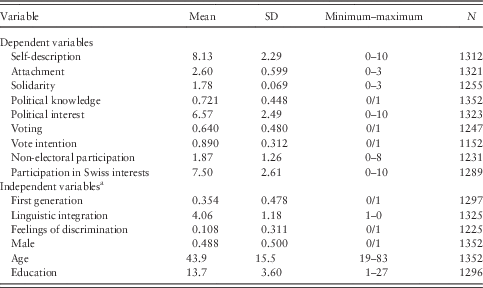
Summary statistics

Multivariate analysis of identification

Multivariate analysis of participation I

Multivariate analysis of participation II