Introduction
The collapse of the socialist systems
Before the collapse of the socialist systems in 1989, Cuba's agriculture was based on high levels of external inputs, which caused high external dependence. Agriculture was specialized on just a few crops cultivated in large-scale monocultures. Food production was underrated and the government favored an export-oriented economic modelReference Nova, Funes, García, Bourque, Pérez and Rosset 1 , Reference Funes-Monzote 2 . Most of the domestic food requirements were therefore covered by importsReference Wright 3 . The strong relationships with the Eastern European countries and the Soviet Union strengthened Cuba's green revolution model. However, the ecological, economic and social problems associated with this model led to increased unsustainability and vulnerability of Cuba's agricultural systemReference Funes, Funes, García, Bourque, Pérez and Rosset 4 .
The loss of the most important markets after the collapse affected Cuba's ability to purchase agricultural inputs such as agrochemicals, petrol, machinery and spare parts. Thus, the agricultural sector struggled to maintain its productivityReference Wright 5 . Compared to the input availability before the crisis, the imports of agrochemicals dropped by 80%, diesel imports fell by 47% and petrol by 75% within a period of 2–4 years after the collapse. Furthermore, food imports were cut by halfReference Wright 6 . As a result of the resource shortages, Cuba's economy suffered from a decline in agricultural production that brought the island to the brink of a food crisis—with alarming impacts on human health. In addition, the United States trade embargo exacerbated the situationReference Alvarez, Bourque, Funes, Martin, Nova, Rosset, Rosset, Patel and Courville 7 .
Adaptation strategies by the Cuban government
Cuba's government implemented economic austerity measures and emergency changes to face the crisis. The strategy included a new domestic economic policy, allowing foreign investments, liberalization of the dollar and granting licenses for private work in different sectorsReference Enríquez 8 . Structural changes and adjustments also influenced Cuba's agriculture since 1990 9 .
Cuba's recent history has been shaped by steady changes that have influenced economic and social life of the citizens. The Cuban government enabled access to fallow land in usufruct in the early days of the crisis to boost food production. Then, in 2008 the government decided to facilitate even more the access to land and called for willing people to produce foodReference Altieri and Funes-Monzote 10 . In 2011, the Cuban Communist Party adopted a resolution that included 313 measures to improve the country's economy. One of most remarkable measures, with considerable impact on society, was the granting of licenses for self-employed work. For the agriculture sector, the measures included further strategies to reduce fallow land, to increase agricultural productivity, to reduce imports and to prioritize domestic food production, with the aim of achieving a higher degree of self-sufficiency 11 .
Through all these adaptation strategies Cuba's decision-makers managed to overcome the worst of the crisis. Food production was stimulated by initiating a nationwide transition towards a sustainable agricultural model based on the principles of agroecology 11 – Reference Altieri and Uphoff 14 . Sustainable agriculture refers to the development of multifunctional agro-ecosystems that take advantage of the integration of plant and animal biodiversity. The aim is to enhance biological efficiency, to maintain agro-ecosystem productivity and its self-regulating capacityReference Pretty and Uphoff 15 . Besides food and non-food products for peasants’ families and markets, sustainable agriculture also provides public goods such as clean water, biodiversity conservation and soil fertilityReference Ruttan, Hatch and Swisher 16 . The shift towards agricultural sustainability is an evolutionary process depending on political, economic and social conditionsReference Altieri, Companioni, Cañizares, Murphy, Rosset, Bourque and Nicholls 17 .
The Cuban government facilitated location-specific production strategies, participatory research and extension approaches, institutional decentralization, the promotion of organic and locally available inputs, more localized production–consumption networks and the development of the urban agriculture movementReference Wright 3 , Reference Funes, Funes, García, Bourque, Pérez and Rosset 4 , Reference Rosset and Medea 18 . Emphasis was also put on diversification of agriculture and markets, downsizing large state farms, increasing post-harvest efficiency, raising farm gate prices and improving rural conditions to avoid depopulation of rural areas. State subsidies for agriculture dropped between 50 and 90% from 1990 to 1996. The government reduced direct control over food production and distribution, and encouraged local initiatives and activities at grassroots levelReference Wright 5 .
Experiments with integrated pest management, biological pest control, vermiculture, farm diversification, cover cropping, intercropping and other agroecological practices became successful strategies to avert grave shortages in food suppliesReference Simón Reardon and Pérez 19 . Through input substitution and more efficient use of local resources, Cuba has reached a high degree of agricultural sustainabilityReference Funes-Monzote 2 , Reference Funes, Funes, García, Bourque, Pérez and Rosset 4 , Reference Simón Reardon and Pérez 19 – Reference Rosset and Altieri 22 . Organizational changes in the structure of the agricultural sector resulted in a new land-tenure distribution. Many state farms were split into smaller production units. Land tenure was divided into the state and the non-state sectors. The non-state sector included individual agricultural producers with private or usufruct land-tenure, private cooperatives and collective farms with usufruct tenureReference Alvarez, Bourque, Funes, Martin, Nova, Rosset, Rosset, Patel and Courville 7 .
The role of farmers in mitigating the crisis
The changes initiated by the state or by a lack of choice focused on technologies and practices based on local knowledge, skills and resourcesReference Wright 5 . Small farmers, who privately owned their land, showed high adaptability to the challenges emerging from resource scarcity during the crisis. They never abandoned traditional practices such as crop rotation, intercropping or seed conservation. In certain regions of the country oxen have always been used for animal traction despite high levels of mechanization in the rest of the island. These peasants became crucial resources for national training programs. Their local knowledge of traditional practices was a key element in adaptation to the new circumstancesReference Wright 5 , Reference Ríos, Funes, García, Bourque, Pérez and Rosset 21 . Private farmers played a major role in the transition process towards more agricultural sustainability as their farming model was aimed more at local and diversified production than large state farms. They had greater control of farm management and were less dependent on external inputsReference Funes-Monzote 2 . Also citizens without practical experience in agriculture started to produce food—they either entered the urban agriculture movement or moved to the countryside. Many of the new food producers were well educated and some even held university degreesReference Enríquez 8 .
Over the past 20 years Cuba's economic situation has gradually improved but the US trade embargo still affects resource availability. Thus, sustainable agriculture based on low external inputs remains an important strategy for Cuban food productionReference Simón Reardon and Pérez 19 . Today, Cuba's agriculture is far removed from high levels of agrochemical inputs. Peasant farming is characterized by a relatively small farm size, mixed farming systems, polyculture, crop rotation, animal traction, family labor, local distribution of products and minimal use of off-farm resources. Thus, peasant farming in Cuba draws close to low external input sustainable agriculture (LEISA). Although an increasing number of farmers experiment with sustainable practices and technologiesReference Rosset, Machín Sosa, Roque Jaime and Ávila Lozano 13 , export-oriented agriculture is still based on chemical inputs and only a few domestic products would meet organic certification standards. Furthermore, farmers' commitment to agroecology should not be taken for grantedReference Wright 5 , Reference Nelson, Scott, Cukier and Galán 12 .
Defining farmers' experiments
An experiment is ‘the action of trying anything, or putting it to proof; a test, trial; an expedient or remedy to be tried; a tentative procedure’ 23 . Farmers' experiments are activities that involve close observation. These activities are often triggered by changing circumstances and opportunities. In their experiments, many farmers want to prove something to others or want to check what others say. Experimenting is also understood as comparison of something known to something unknownReference Stolzenbach, Prain, Fujisaka and Warren 24 , Reference Kummer 25 . It means to come up with something new and then to implement it and try itReference Hocdé, Veldhuizen, Waters-Bayer, Ramirez, Johnson and Thompson 26 . Experiments and innovations are different but complementary conceptsReference Saad 27 . Experimenting can be seen as the process, by which an innovation is generated, tested and/or evaluatedReference Pretty 28 – Reference Rajasekaran, Prain, Fujisaka and Warren 30 . Thus, farmers' experiments refer to informal trials or tests that potentially result in innovationsReference Wortmann, Christiansen, Glewen, Hejny, Mulliken, Peterson, Varner, Wortmann and Zoubek 31 . An innovation is ‘an idea, practice, or object that is perceived as new by an individual or other unit of adoption’. It matters little whether or not the innovation is objectively new. The perceived newness for the individual determines the innovative character of the idea, practice or objectReference Rogers 32 .
By experimenting, farmers generate or discover new knowledge and combine it with already existing local knowledgeReference Critchley 33 . Farmers' experiments and innovations have been part of agriculture for thousands of years and were important means through which advances in agriculture were madeReference Haverkort, Haverkort, Kamp and Waters-Bayer 34 . Testing new methods and technologies has been an integral element of farmers' daily working routineReference Rajasekaran, Prain, Fujisaka and Warren 30 , Reference Scheuermeier, Van Veldhuizen, Waters-Bayer, Ramírez, Johnson and Thompson 35 – Reference Risbey, Kandlikar, Dowlatabadi and Graetz 38 . The history of agriculture has been characterized by frequent changes at the biophysical, agroecological, socio-economic, socio-cultural and political levels. Farmers have faced an array of changing contexts that required adaptation processesReference Sturdy, Jewitt and Lorentz 39 . In such a dynamic scenario, experimenting is an important strategy in order to adapt farming systems to changing conditions.
The process of experimenting
Changing conditions challenge farmers and may trigger adaptation strategies. Experimenting often aims at improving the current situationReference Bunch, Haverkort, Kamp and Waters-Bayer 40 . Farmers contrast and combine local knowledge with new ideas. Their own ideas are important sources for experiments but extension agents, scientists or other farmers also introduce ideas that trigger experimentsReference Sumberg and Okali 29 , Reference Rajasekaran, Prain, Fujisaka and Warren 30 , Reference Richards, Suazo and Tripp 37 , Reference Quiroz, Prain, Fujisaka and Warren 41 .
The motives to initiate an experiment are as diverse as the topics themselves. Economic considerations, improving pest control, reducing work load or increasing self-sufficiency motivate farmers to experimentReference Haverkort, Haverkort, Kamp and Waters-Bayer 34 , Reference Richards, Suazo and Tripp 37 , Reference Zigta, Waters-Bayer, Reij and Waters-Bayer 42 . Personal motives and environmental considerations also drive farmers' decisions to experimentReference Saad 27 , Reference Bentley 36 , Reference Nielsen, Reij and Waters-Bayer 43 .
Experiments are mainly based on locally available, physical and biological resources, such as local seeds, manure or laborReference Rajasekaran, Prain, Fujisaka and Warren 30 . Most of the farmers' experiments are technical but some experiments also deal with economic, social and institutional issues. Common technical topics are related to new crops or varieties, soil preparation and fertility, sowing methods and crop densityReference Wortmann, Christiansen, Glewen, Hejny, Mulliken, Peterson, Varner, Wortmann and Zoubek 31 , Reference Connell, Haverkort, van de Kamp and Waters-Bayer 44 .
Experiments vary from very easy to very complexReference Saad 27 . The farmers' research process involves the experimental design, monitoring processes and the assessment of resultsReference Rajasekaran, Prain, Fujisaka and Warren 30 . Farmers usually conduct their experiments on small plots and try to maintain them on a simple level to reduce the risk of failureReference Stolzenbach, Van Veldhuizen, Waters-Bayer, Ramírez, Johnson and Thompson 45 . They rarely have a fixed anticipation of the outcomes straight from the beginning, and according to the course of the experiment they decide whether to continue, stopReference Ortiz, Ríos, Ponce, Acosta, Miranda, Martin, Moreno, Martínez, Calves, Fe, Angarica, Gil, Quintero, Chaveco, Rodríguez, Valdes, Yero, Padron, Mari, Ruz, Rivas and Estrada 46 or modify the ongoing experiment.
Continuous observation is the most common and practical way to evaluate an experiment. Farmers are usually self-critical when evaluating their experiments as they rarely benefit from whitewashing their resultsReference Stolzenbach, Van Veldhuizen, Waters-Bayer, Ramírez, Johnson and Thompson 45 .
Farmers' experiments can either result in hard or soft innovations. Hard innovations are physical and visible, such as tools, irrigation systems, crops, substances for pest control and so on. Soft innovations are intangible such as new knowledge, communication strategies or marketing attemptsReference Waters-Bayer 47 .
Institutional context of farmers' experiments in Cuba
Farmers' experiments in Cuba are embedded in a specific and influential institutional context. The National Small Farmers' Association (ANAP) plays an important role in the widespread dissemination of agroecological practices through farmer-to-farmer extension. The association represents smallholders’ interests to the government. ANAP is a member of the transnational peasant movement La Vía Campesina. In 1997, the association decided to implement the farmer-to-farmer methodology, which had already been in use in other Latin American countriesReference Rosset, Machín Sosa, Roque Jaime and Ávila Lozano 13 . The Agroecological Movement Farmer-to-Farmer (MACAC) has been attractive to farmers: more than 110,000 rural households belong to the movement and apply agroecological practices to manage their farming systems. Farmers' experiments and exchange of experiences using the farmer-to-farmer methodology are key elements of the movementReference Machín Sosa, Roque Jaime, Ávila Lozano and Rosset 48 .
The Programme for Local Agricultural Innovation (PIAL) that was implemented by the National Institute of Agricultural Sciences (INCA) also supports sustainable agriculture practices in Cuba. The program has its origin in a participatory plant-breeding project that started in 2000. Environmental issues have been a permanent element throughout the project. PIAL promotes the design, construction, implementation and evaluation of local agricultural technologies. Staff members encourage peasants to experiment and to become the main protagonists of local agricultural innovation processes. Knowledge exchange among farmers and between farmers and scientists during workshops and innovation or biodiversity fairs facilitate mutual learningReference Ortiz, Ríos, Ponce, Acosta, Miranda, Martin, Moreno, Martínez, Calves, Fe, Angarica, Gil, Quintero, Chaveco, Rodríguez, Valdes, Yero, Padron, Mari, Ruz, Rivas and Estrada 46 , Reference Ríos Labrada 49 . In 2010 around 50,000 farmers participated in the PIAL project 50 .
Contextual framework for studying farmers' experiments
The structural changes in Cuba's agricultural sector since 1990 and the nationwide, large-scale experiment with sustainable agricultureReference Funes-Monzote 2 , Reference Wright 3 , Reference Enríquez 8 built the contextual framework for this paper. The break-up of trade relations with former socialist countries in Eastern Europe triggered coping strategies by the government and by private persons. To overcome the worst of the emerging food crisis, Cuban farmers have become innovative and farmers' experiments have been an indispensable element for adapting to the changing conditions. In such a context, farmers' capacity to experiment represented an essential precondition for the conversion to sustainable agricultureReference Kroma 51 . Farmers' experiments are still an integral part of Cuba's agriculture and constitute farmers' means of dealing with the multiple challenges emerging from food productionReference Leitgeb, Funes-Monzote, Kummer and Vogl 52 . However, detailed descriptions of farmers' experimental processes are scarce. This raises the question of how farmers actually experiment to achieve applicable outcomes. To answer this question, we examine the topics, resources, sources, motives, methods, outcomes and the dissemination of farmers' experiments in Cuba. Based on our findings, we discuss the significance of Cuban farmers' experiments and their potential contribution to adapting to changing conditions.
Methods
Field research in Cuba was carried out in 2007 and 2008. In each year, 5 months of field research were conducted with a student's visa under an official agreement between the University of Natural Resources and Life Sciences, Vienna (BOKU), the Experimental Station ‘Indio Hatuey’ (EEIH) and the National Institute of Agricultural Sciences (INCA).
The municipalities selected for field research differed in topography, climate and agricultural structure. In addition, La Palma, a municipality in Pinar del Rio, was selected due to its participation in the PIAL program. In Sancti Spiritus province, various municipalities were chosen because of the active and widespread farmers' participation in the MACAC. Field research was also carried out in the municipality of Baracoa in Guantanamo, where the Swiss Research Institute of Organic Agriculture (FiBL) promoted certified organic farming for export. Interviews were also conducted in the provinces of Matanzas and Havana with rural farmers and urban producers, due to recommendations of the research counterparts.
Interviews with farmers were carried out with official authorization. Informants were selected through a purposeful sampling combined with a snowball samplingReference Bernard 53 . Pre-tested semi-structured interview guides were used and complemented by informal and unstructured interviews in situations where semi-structured interviews were not feasible. The interviews were conducted face to face at the respondents' farms with 72 male and female farmers during up to two visits per farm.
Living in the study area and working with farmers as key informantsReference Beer and Fischer 54 facilitated additional insights into farmers' perceptions of their own experimental activities and deepened the understanding of farmers' experiments. Participant observation was realized when working with farmers, at farmers' workshops, cooperative meetings, scientific and semi-scientific conferences, innovation award forums and university courses. Selected relevant phases were digitally recorded. Field notes were written during participant observation and when working with farmers. A research diary was kept to document and reflect on the research process. Expert interviews were conducted to obtain additional insights into the situation of organic farming, farmers' experiments and innovations, and the knowledge and communication network in Cuba. Secondary data such as articles in local newspapers, manuals and leaflets of development projects, documents of the Cuban innovation award forum and other relevant media were used to contextualize farmers' experiments and innovations within societyReference Schlehe and Beer 55 .
Most interviews were recorded with a digital voice recorder and transcribed in original Spanish with the software Express Scribe. Transcripts were coded thematically and analyzed with the software Atlas.ti using a combination of content analysis and grounded theory based on deductive and inductive codingReference Miles and Huberman 56 . According to the research questions, thematic categories were defined and formed the basis for the coding process. Data were categorized into descriptive and thematic code families. Some of these families were based on the research questions, whereas others emerged from comparing and contrasting similarities and differences in the interview dataReference Schlehe and Beer 55 . In addition to the coding procedure, analytic memos were written to narrow down information from data. Memoing was done to keep track of relevant ideas concerning the research theory and its connection to codes. Operational memos were used to reflect on practical matters during the research process. The next step was a quantitative analysis of qualitative data. This involved turning written text into numbers. Profile matrices were elaborated for thematic code families to examine the number of occurring codes. Finally, univariate analysis was carried out to elaborate frequency distributions of the attributes relevant to assess the experimental processReference Bernard 53 .
Results
Farmers' definition of experiments
With the term ‘experiment’ Cuban farmers associated informal or formal trials on their farm. The terms respondents used most often when talking about an experiment were: trying, searching, observing, inventing, proving, experimenting and knowing. To these farmers experimenting meant trying something new at farm level and learning from the results. It was seen as a way to search for solutions of farm-specific problems. Observation formed an integral part of the experimental process and contributed to increase experience. Through experimenting, interviewees tried to remove doubts by proving or disproving what others say or recommend.
Topics of farmers' experiments
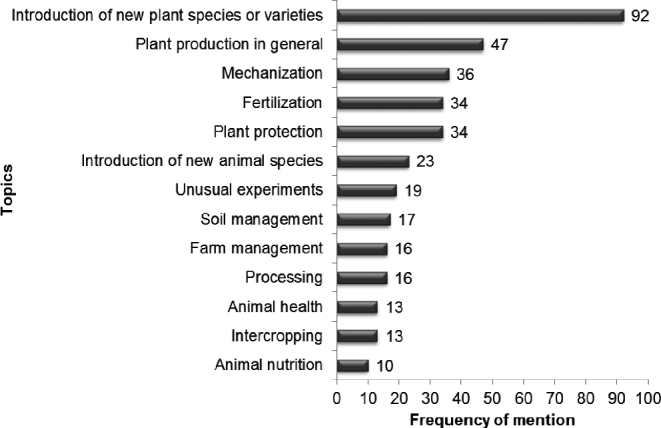
Respondents mentioned a total of 370 farmers' experiments (Fig. 1). Upon the first authors’ request, each respondent explained at least one experiment in detail except one female farmer who did not mention any experiment. A respondent who was experimenting very actively mentioned 32 different experiments.
Topics of farmers' experiments in Cuba (n = 72; frequency of mention; multiple answers per respondent possible).

The majority of the experiments were related to the introduction of new crops or varieties. Most of the introduced crops were common in the respective area and respondents benefitted from the experiences of neighboring farmers and general knowledge in the region. Only a few interviewees experimented with special crops that were unusual in the region (e.g., cinnamon (Cinnamomum verum), anis (Pimpinella anisum), ginger (Zingiber officinale), potato (Solanum tuberosum), napa cabbage (Brassica rapa subsp. Pekinensis) and broccoli (Brassica oleracea var. italica)). They mostly received the seeds for free and planted them on a small scale, avoiding financial risk. Additionally, INCA encouraged farmers participating in the PIAL program to test different varieties to identify the most suitable for the local conditions. The respondents experimented to increase yields, avoid pests and diseases, and identify the varieties that were best suited for cooking and tasted better than the traditional ones. One respondent mentioned that she cultivated 106 different bean varieties. Another farmer enjoyed planting cassava varieties and was proud of the 44 different varieties he was cultivating on his farm.
Experiments related to plant production included variation in sowing dates, and distances, trying new sowing methods, different ways of crop rotation, grafting, trying different harvesting methods and dates, as well as different forms of seed conservation. Four farmers experimented with plant nurseries. Some of the interviewees who participated in PIAL were engaged in plant-breeding activities and even developed new varieties of beans or maize. One respondent explained that she put a plastic bag around the bunch of bananas to shorten the ripening time. Another respondent used biogas for seed conservation. An urban producer experimented with Trichoderma sp. to improve plant vitality.
Mechanization, as another subject, included experiments with tools, machinery and other farm equipment. Farmers either recreated or modified already existing tools. In a few cases, the respondents invented new machinery such as a multi-plough with 28 different uses, an irrigation programming system that runs without electricity or fossil energy, or a sowing tool built from recycled material. Other experiments related to farm equipment included the construction of mills, wells, a drier or a disc plough. Tools that were developed through experimentation included rakes, crowbars or harvesting tools. Mechanization also referred to simple innovations that made daily work easier. One respondent perforated a small plastic medicine tin to reduce plant damage when irrigating.
Organic fertilization was a frequent concern of many farmers. Thus, many respondents experimented with compost making, vermicompost, worm humus tea, green manure or manure from bats or chicken. Elaboration of vermicompost was also promoted by MACAC and the urban agriculture movement. Apart from the elaboration of different compost types, respondents experimented with the application of organic fertilizers on different crops.
Experiments related to plant protection included the elaboration and application of natural insecticides such as neem (Azadirachta indica) and tobacco (Nicotiana tabacum) or mechanical treatments such as boiling water against ants. Coconut palms (Cocos nucifera) were occasionally infested by the coconut mite (Aceria guerreronis) and respondents tried to eliminate the mites by burning infested material or by pealing the trunk in the form of a ring. Other experiments for pest control were sowing repellent plants, setting up traps with attracting colors or other baits. One respondent applied grease on the borders of a raised bed to prevent snails and bugs from entering the plot.
By introducing new animal species on the farm, respondents gathered first experiences with unfamiliar tasks. They were hardly aware of the experimental character of the undertaking. One interviewee experimented with free-range pig keeping because he wanted his animals to plough the soil. Women were often responsible for small animal breeding such as chicken, turkeys or rabbits. Three female respondents mentioned that they tried to put the eggs of another chicken breed, of guinea fowls or pheasants into chicken nests to let the chicken hatch the eggs.
Unusual experiments referred to agronomic trials that did not fit into any other category because of their extraordinary character. Such experiments included the elaboration and application of effective micro-organisms, the use of magnetized water, testing the influence of the lunar cycle, or trials with pyramidal energy to improve seed quality. One farmer realized several experiments on the feeding of effective micro-organisms to pigs and rabbits, and presented his findings in scientific and semi-scientific conferences. Experiments related to the lunar cycle involved planting or harvesting, making cuttings and neutering boars or bulls according to the moon. Other experiments in this category were the precise and daily documentation of weather conditions, establishing an outdoor meeting place for workshops, and introducing a so-called idea meeting where farm workers were encouraged to present their plans for the coming year.
Farmers' experiments that affected a whole farming system were the introduction of a new activity such as establishing raised beds for organic vegetable production (organoponico) or starting with livestock-keeping, introducing fixed rotational grazing pastures or digging a drainage system. These undertakings often included a series of interrelated experiments to gather experience. Construction of farm infrastructure, such as buildings or fences, also included experimental steps, especially when resources became scarce. The search for the best growing site on a farm for a specific crop also affected the whole farm and led to changes in farm segmentation.
Experiments related to soil management referred to different tillage methods or the introduction of living or non-living barriers to avoid erosion. One respondent tried to improve the fertility of his sandy soils by applying organic matter. Over time, he was able to grow a greater variety of plants.
Experiments to process farming products were prevalent in urban agriculture and among female farmers. These experiments included wine production, clearing up wine, producing vinegar, sauces and fruit juices or fruit pulps.
Respondents who faced animal health problems had to search for alternative treatments due to a lack of purchasing opportunities. Experiments to maintain animal health included the use of natural medicine such as mamey (Pouteria sapota) for superficial application or cilantro (Coriandrum sativum) for internal use. One respondent, a veterinarian, mentioned four experiments with natural substances to eliminate parasites.
Intercropping was a way to make the most out of the space available. Some combinations worked out well, while others did not. Most respondents tried combinations that were generally known among local farmers, such as maize and beans. Some respondents experimented with unusual combinations such as sunflower and cucumber.
Experiments with animal nutrition aimed at optimizing the daily feed rations or using locally available resources for feeding. One respondent tried to feed pineapple skins to chicken, while another farmer experimented to identify the optimal amount of coconut flakes in rabbit fodder without increasing the risk of heart attacks caused by too much fat. Another respondent separated a group of pigs and fed them with additional soybean in the fodder ration. After 45 days, he concluded that the pigs fed with additional soybean fodder ration increased more in weight than pigs without soya feeding.
Resources for farmers' experiments
Farmers relied on physical and non-physical inputs to conduct experiments and develop innovations. Physical inputs involved materials such as seeds or wood and the tools necessary to perform the experiment. Non-physical inputs were knowledge, time and labor. Resource scarcity determined the materials and tools used during the experimental process. Searching for inputs was often a precondition for experimenting. Just a few respondents had all the resources required for the experimental process. Participation in a development project, such as PIAL or MACAC, facilitated the farmers' access to resources.
Lack of resources (e.g., tools, material or money) often required the use of recycled material. Most of the interviewees were frequently searching for secondary uses of bottles, tubes, cans or other devices. However, discarded material seldom exactly matched their specific needs, thus farmers had to be creative when implementing the available resources.
Most of the experiments in the sample were based on physical inputs, such as seeds, plants, animals, wood, cans, plastic bottles, plastic bags, iron, wire, engines or barrels. For social experiments, such as testing the feasibility of a farmers' meeting for the exchange of ideas, or for methodological experiments, such as new ways for the assessment of pest damage, farmers needed non-physical inputs, for example knowledge.
With the anticipated experiment in mind, the respondents often started thinking about the required material. In most of the cases (74%), the first step in the search for material was to check the resources available on the farm. The rest began to search for material outside the farm. In total 64% of the respondents claimed to combine on-farm and off-farm material when experimenting. The rest used either material from the farm or from outside. Communication skills and personal contacts, persistence and also luck facilitated the farmers' search for discarded material. More than half of the respondents (54%) used discarded materials for experimenting. The rest either relied on locally available plant material and seeds or had to purchase the required inputs.
Experiments in crop production required plant material. Respondents derived seeds and seedlings for experimentation, e.g., from propagating their own crops, or they received the material from other farmers, from the agricultural state enterprise or from research entities; the plants were given as a gift or had to be purchased. Other experiments (e.g., the use of a natural insecticide) were based on wild plants or plants that grew on the farm anyway.
Those farmers who participated in a development project, especially, dedicated certain plots exclusively for experimentation. However, others who experimented with new plants or varieties also devoted farmland to experimentation. Respondents usually conducted their experiments on their own farm. Just 4% of the interviewees experimented partly outside their farms when working with special machinery or tools.
Information was an important element and resource before or during the experiment. The majority of the respondents (83%) claimed that they actively searched for or received information. The most important sources of information were other farmers, extension workers or scientists. Farmers with access to technical literature actively searched in books or magazines for information about the topic of the experiment. In cases such as the construction of a specific tool or machine, farmers consulted professional experts, for example craftsmen, carpenters or blacksmiths. Those respondents who expressed not having used external information claimed that they were the experts on the topic of the experiment. These experiments were based on the farmers' own ideas, intuition and local knowledge. Occasionally, farmers drew on knowledge from their childhood, knowledge gathered during education or information from TV, radio or written texts.
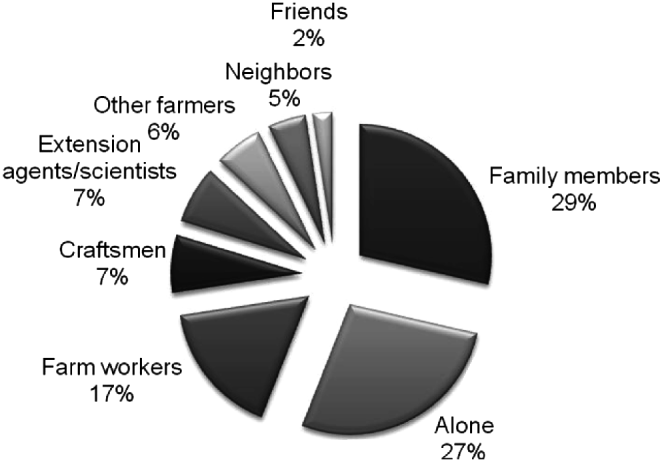
Labor was a key input for performing experiments. Respondents worked alone in cases where the experiment was easily manageable (Fig. 2). However, the more complex the experiment and the higher the workload, the bigger was the respondents' need for help. Family members were the main assistants in the experiments. They were most often present when the respondent experimented and therefore could give valuable feedback. Occasionally respondents received help from farm workers, craftsmen, extension agents or scientists, other farmers, neighbors and friends.
Distribution of the workload during farmers' experiments (n = 72; 100% = total of all answers given by the respondents on people contributing with labor to the farmers' experiments).

Limited availability of technical equipment for experimenting increased the farmers' demands for specialized external labor. Blacksmiths or carpenters had special facilities, machinery or tools at their disposal and, in addition, could provide expertise. Work orders included construction of specific spare parts for tools or machinery, welding of metal or woodwork.
Farmers willing to participate in an innovation award forum or a conference frequently asked for help to prepare a written document about the experiment, scientific or semi-scientific posters and computer presentations. In these cases, local extension agents, office assistants from the farming cooperative, scientific staff members or family members with access to computers helped out.
The time required for conducting an experiment depended strongly on the topic, the commitment to the experiment, its complexity, the motivation and the need to finish. In most cases initial considerations and reflection processes led the way to experimentation. However, respondents also mentioned spontaneous experiments.
Farmers either experimented in their spare time or during their daily working routine. Agricultural production had priority over spending time on experiments with uncertain outcomes. Thus, farmers' experiments were more likely a side activity of agricultural production. Higher commitment increased their willingness to spend additional time and effort to achieve satisfying outcomes. Interviewees who were actively involved in a participatory research project spent more time setting up and evaluating the experiments than most of the other farmers. Respondents who aimed at presenting their results to a wider audience spent additional time on documentation.
Time input also depended on the need to obtain applicable results. Under certain circumstances, respondents required immediate results. Experiments with very short time requirements indicated improvised solutions for suddenly occurring problems, e.g., a broken tool. These solutions met short-term demands and occasionally lasted for a long period of time, such as the construction of a ditch to avoid fodder losses during heavy rainfalls. In comparison, the establishment of integrated-farming systems was accompanied by continuous and selective experimentation and could last for years to reach the desired outcomes. Respondents who experimented with permanent crops could only assess the results after some years. The construction or modification of tools or machinery required material that occasionally was difficult to obtain. The construction took little time compared to the time necessary to find the material. One respondent searched for the material to build a disc plough for half a year. After compiling a variety of different recycled materials he started to experiment by creatively putting together the useful items and finished the disc plough within one day.
Most respondents required tools and equipment for experimenting. The topic and the complexity of the experiment determined the tools needed. Standard farm inventory, such as a machete, hoe or crowbar, was most frequently used during experimentation. Farmers who were engaged in the construction of agricultural machinery, such as sowing machines or ploughs, had to use special tools. Research-minded farmers sometimes owned these tools but they mostly belonged to craftsmen. Occasionally, respondents made recourse to machinery of the farming cooperative, for example when building a pond or when incorporating green manure. Farmers who conducted scientific or semi-scientific experiments with the aim of participating at an innovation award forum or at a conference required calculators, digital cameras or computers for analysis. Only few farmers owned the necessary equipment. They had to borrow the equipment from friends or relatives, or they asked extension agents for help. In contrast, some respondents even got along without any tools, such as one breeding experiment with chickens.
Only 16% of the respondents required money to conduct their experiments. Money was necessary to purchase-specific inputs, for services of craftsmen or to pay farm workers. If experimentation was done during working time, some respondents mentioned a loss of income because of experimenting.
Sources of ideas for experimenting
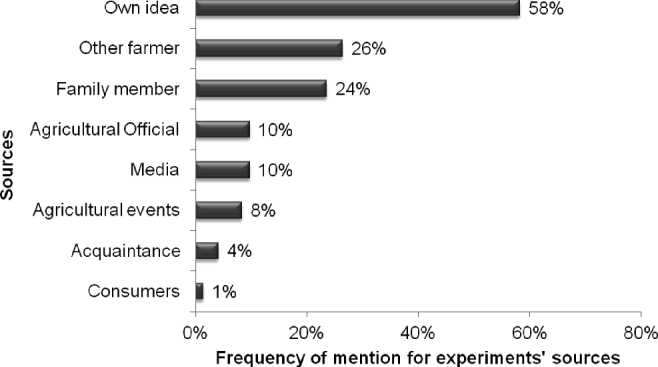
The ideas for experiments often had multiple sources. They were either based on the respondents' own ideas or on a combination with external sources (Fig. 3). Most of the interviewees (58%) claimed that it was their own idea to start a specific experiment. However, external information often influenced decision-making before or during the experimental process. Some respondents reported that the experiences of previous experiments or innovations triggered new experiments. Others expressed that their idea was influenced by experiences they had in their childhood. Two farmers mentioned that the idea to start experimenting was a result of coincidence. Unswayable circumstances at farm level triggered the farmers' decisions to take further action. One respondent mentioned the lack of resources that triggered the experimental process.
Sources of farmers' experiments (n = 72; 100% = the total of all answers given by the respondents; multiple answers possible).

Opportunities to meet other farmers favored knowledge exchange and appropriation, and were crucial for gathering new ideas about potential experiments. Neighboring farmers usually shared similar knowledge, culture and social status with the respondent. Thus, knowledge transfer was characterized by mutual trust about agricultural experiences. However, some respondents also questioned statements or recommendations of others and tried to gather their own experiences.
Family members played an important role in decision making and frequently provided ideas for experiments. The generation gap between family members in two cases (planting distance of coco palms; planting sweet potatoes according to the lunar cycle) prompted experiments that were conducted to rebut the opinion of the elder. In these cases, finally, the respondents had to accept that the experiences of their elders were trustworthy.
Most respondents mentioned regular contact with agricultural officials affiliated to farmers' associations, research institutes or agricultural enterprises. These officials enjoyed a high level of credibility and were the impetus for several experiments.
Especially respondents with higher education or research-minded farmers mentioned media as a source for their experiments, whereby books and brochures were the most important media. Just one respondent mentioned the internet as a source for his experiment.
Agricultural events such as fieldtrips, workshops and scientific or semi-scientific events provided new insights and ideas for some of the respondents. Especially, respondents who participated in MACAC or PIAL gathered ideas during related events.
In three cases acquaintances and friends without a farming background gave the respondents the idea to experiment. One respondent mentioned consumer demands as a source.
Motives for experimenting
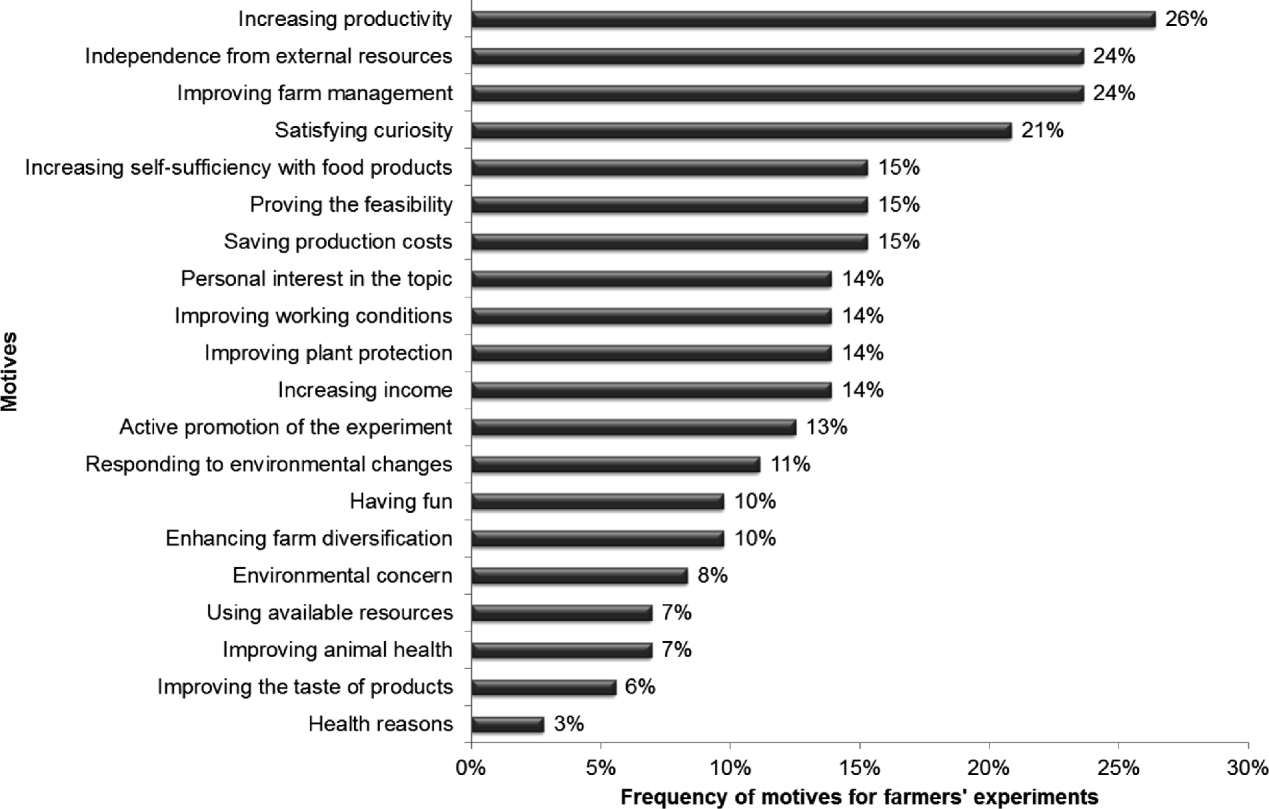
Most respondents mentioned various motives for one single experiment. The most important motive to start experimenting was to increase agricultural productivity (Fig. 4). Respondents tried to increase productivity either by introducing new crops or animals, by searching for better-adapted varieties to achieve higher yields, by intensification of crop production or by introducing or diversifying elaborated products. Experiments with agricultural facilities such as irrigation, drainage, sowing tools or ploughs finally also resulted in higher productivity.
The frequency of mentioned motives for farmers' experiments (n = 72; 100% = the total of all answers given by the respondents; multiple answers possible).

Reducing dependency from external resources was mentioned by several interviewees, mainly because of limited access to these resources or high prices of farm inputs. Curiosity was another important driving force for experimentation. Respondents claimed that they started to experiment because they wanted to know how the experiment performed and what the outcomes would look like. Improving farm management referred to specific farming situations that required the farmers' attention and called for improvement.
Increasing self-sufficiency of food products was often related to cost reduction or the wish to diversify the diet. Some agricultural products were hardly available on the official farmers' markets. Thus, farmers chose to produce them themselves when they had the chance to obtain seeds. Gathering their own experiences from experimenting was crucial for the respondents who tried to assess the validity of external information. Some interviewees wanted to oppose the opinion of relatives, other farmers or extension workers and experimented to prove that a certain technology or farming practice was viable. Others experimented to demonstrate the applicability of a technology or practice they were convinced of. Some respondents mentioned that they enjoyed farming and claimed that trying new plants was an integral part of agriculture.
Improving working conditions included facilitating work, reducing working time and improving occupational safety. Problems with pests or diseases triggered experiments to find better ways for plant protection. Farmers tried to improve their economic situation by experimenting with promising alternatives.
Occasionally other farmers, extension agents or scientists actively promoted experiments with new technologies or practices. Active promotion of an experiment mostly complemented the respondents' own motives. Some respondents claimed that environmental changes (e.g., irregular precipitation, heavy rainfall, droughts and floods) motivated them to experiment because they wanted to maintain a productive system.
Some farmers stressed their commitment and the gratification they received from farming. These respondents were enthusiastic experimenters and enjoyed trying out new things. Some respondents expressed that they started to experiment because they realized that diversified farming systems were more resilient. Their motive was to diversify the agroecological systems to be prepared for changes.
Some respondents held a deep understanding of environmental interactions and mentioned that environmental concerns motivated them to experiment with sustainable agricultural practices. Making the most of locally available resources was also a motive for experimentation. Ensuring animal health was a motive for those who had to treat animals when injured or ill. Some farmers wanted to improve the taste of agricultural products. A few interviewees also mentioned that health reasons triggered their experiments.
Methods applied by experimenting farmers
Respondents hardly worked according to a fixed agenda or rigid methods. Moreover, when repeating an experiment in the field, environmental conditions probably changed. Thus, adaptation of the applied methods was essential to improve the experiment. Continuous reflection on the performance of the experiment was important to adapt the methods and to achieve applicable outcomes. About one-third of the respondents adapted the methods during the course of the experiment.
Expectations
Before starting to experiment, respondents potentially developed expectations of the outcomes. High resource input usually meant higher risk of financial losses. Thus, confidence to succeed was more important for input-intensive experiments. If experimenting required few inputs, there was little to lose and respondents even experimented with negative expectations. These expectations were influenced by previous experiences or indications from other persons. Most respondents (68%) were convinced or hoped that the experiment would finally lead to applicable results. Some respondents (26%) just wanted to see if the experiment was feasible, positive or negative expectations were missing. A few respondents (6%) had negative expectations and believed that the experiment would fail. Most of these respondents wanted to disprove statements of others.
Planning
More than the half of all respondents (58%) started without having a detailed written or mental plan in advance but made some basic considerations about the experiment before starting. They specified their plan step by step. Few respondents (4%) experimented spontaneously without any plan. Thirty-eight percent of the experimenting farmers elaborated a concrete plan before they started. They balanced the pros and cons of initiating the experiment, reflected upon the appropriate approach and anticipated the steps necessary to achieve applicable results. Some of these respondents produced a written document (6%), a draft (6%) or a model (4%) before starting to experiment. Respondents stated that having a draft helped them to anticipate the desired outcomes, and building a model enhanced their imagination and made the idea more tangible. Four percent of the respondents relied on a written document or a draft elaborated by extension agents or scientists. Some respondents who conducted scientific and semi-scientific experiments claimed to use random sampling. One respondent conducted an experiment with crotalaria as green manure and measured the biomass production during 5 years. Every year he took various randomly selected samplings of one square meter from a one-hectare field. He explained that he entered the field and spontaneously chose the areas for the sampling. Another farmer, a former employee of a plant protection institute, experimented with four different salad varieties to assess yield differences. He cooperated with a scientist from an agricultural research institute who provided seeds and occasionally technical advice. However, the farmer himself elaborated the experimental design and realized the experiment. He set up four repetitions of each variety and took randomly selected samplings of one square meter from each variety to assess yield differences.
Scale
Starting on a small scale, with few plants or animals, was a way to minimize risks and to gather first experiences for most of the respondents (90%). Respondents built on the experiences they gathered and, if necessary, adapted the experiment accordingly. Finally, they applied the results on a larger scale, proceeded on a small scale, or rejected the findings. Step-by-step experimentation (8%) mostly concerned technical experiments. During technical experiments, respondents tinkered with the item and evaluated the intermediary outcomes.
Farmers started an experiment on a large scale (10%) when they were convinced that the experiment would succeed and estimated that little risk was involved in the undertaking. If the information source was trustworthy and respondents confided in the feasibility of the experiment, they dared to start on a large scale. Starting on a large scale also depended on the selling value of the potential outcomes. Economic dependency on the outcomes led to increased precaution and lowered their willingness to start using large-scale experiments. Furthermore, starting on a large scale depended on the topic of the experiment.
Observation
Direct observation was the most important instrument to assess the performance and the outcomes of the experiment and to gather experience. Eighty-nine percent of the interviewees used observation to draw a conclusion. Several respondents claimed that attentive observation was a farmer's most effective tool to analyze experiments. Most experiments were embedded in working routine, and daily observation was part of it. Some respondents (11%) also conducted systematic observations. They checked the performance of the experiment regularly and kept specific parameters under review. Other experiments just allowed observation of the final results, such as transplanting root vegetables, or observation at an advanced moment of the experiment, as in the case of the transplanting distance of coconuts. Several years after transplanting, the farmer could say that the distance was too short and concluded the negative effects of his experiment. Observation of technical experiments differed from cropping or livestock experiments and required step-by-step improvement and adaptations.
Comparison was another effective way to assess the performance and the outcomes of an experiment. Most respondents (60%) made direct comparisons with the traditional production on their own farm or with the outcomes of other farmers. The rest of the respondents conducted experiments without comparison.
Repetitions
Repetition of farmers' experiments referred to repeating the same or a modified version of the experiment at a subsequent date. Few farmers set up scientific experiments with repetitions of the same treatment at the same time but on different plots. Repetitions were often complementary to direct comparison. Almost half of the respondents (49%) repeated the experiment at least once until it was converted into a regular farming practice. One farmer experimented with effective micro-organisms. In the first experiment he treated young rabbits. Then he conducted the same experiment but with adult animals. One respondent claimed that he repeated the experiment of planting two sprouts of yucca instead of one. In the first year he tried it on a slope and the subsequent year he tried it on a level field and additionally he paid attention to the moon phase. This indicates that respondents modified parameters of experiments to improve the performance and still could be accurate about the validity of the outcomes. The construction or modification of farm equipment by itself was mostly a dynamic process of repeating the working steps in a different way until satisfying results were achieved.
Some respondents (13%) received hints from scientists or extension agents on how to conduct scientific experiments and repeated the same experiment on similar plots and at the same time. These farmers also achieved statistical results, which were valid for presentation at scientific and semi-scientific conferences. One respondent mentioned that he and his wife attended a lecture where they learned about experimental design. Scientific repetitions during one growing season were also done in an urban agriculture cooperative with academic staff responsible for experimentation or involved in participatory research projects.
Only a few respondents (6%) worked with control groups during their experiments. Experimenting was based on empirical experience, which influenced the evaluation of the experiments. Also without a control group, respondents were able to tell whether the results of an experiment were valuable or not.
Documentation
About three-quarters of the interviewed farmers confided in their memory and did not document their experiments. To their opinion, the benefits of writing down experiences hardly justified the efforts. In addition to observing and memorizing details of the experiment, some farmers considered written notes important for the experimental process. Twenty-six percent of the respondents claimed to take written notes. With increasing complexity of the experiment, documentation became more important. Respondents who participated in a development project took notes more frequently because of recommendations from scientists or extension agents. Respondents who wrote down their observations used note pads or notebooks. One respondent used the wooden wall of his house to document pig births. In participatory research projects, staff members systematically took notes of the experiment. Just a few farmers (7%) were able to document their experiment with photographs or using a video camera. Using private computers to document experiments was possible for very few farmers (4%).
In cases where production was delivered to the state procurement and delivery agency (Acopio), respondents measured their results quantitatively. Otherwise only farmers who conducted scientific or semi-scientific experiments measured parameters such as pest infestation, weight increase or yield per area. One respondent systematically measured the weight increase of rabbits every 10 days when applying effective micro-organisms. Two respondents were working on the same experiment about farmers' attitudes towards biological pest control and distributed questionnaires randomly. They analyzed the answers statistically.
Outcomes of farmers' experiments
Farmers categorized the outcomes of their experiments as being either positive or negative. Some experiments were still in progress and respondents could not yet assess the outcomes. The interviewees usually expected positive outcomes. Negative outcomes did not contribute to improve agricultural production and were therefore not applied. Nevertheless, negative outcomes increased the respondents' knowledge on the topic.
Furthermore, the interviewed farmers distinguished between innovations and inventions. They defined an innovation as something new on the farm that improved the situation, which means solving a problem by changing something to improve it and to achieve positive results. By innovating, farmers increased their experience about something new. However, an innovation might already exist but might be new to the farmer. An invention was defined as something ‘absolutely new’.
Some respondents conducted experiments to prove or disprove a hypothesis. Other experiments happened incidentally and the farmer gathered unexpected experience as a side effect.
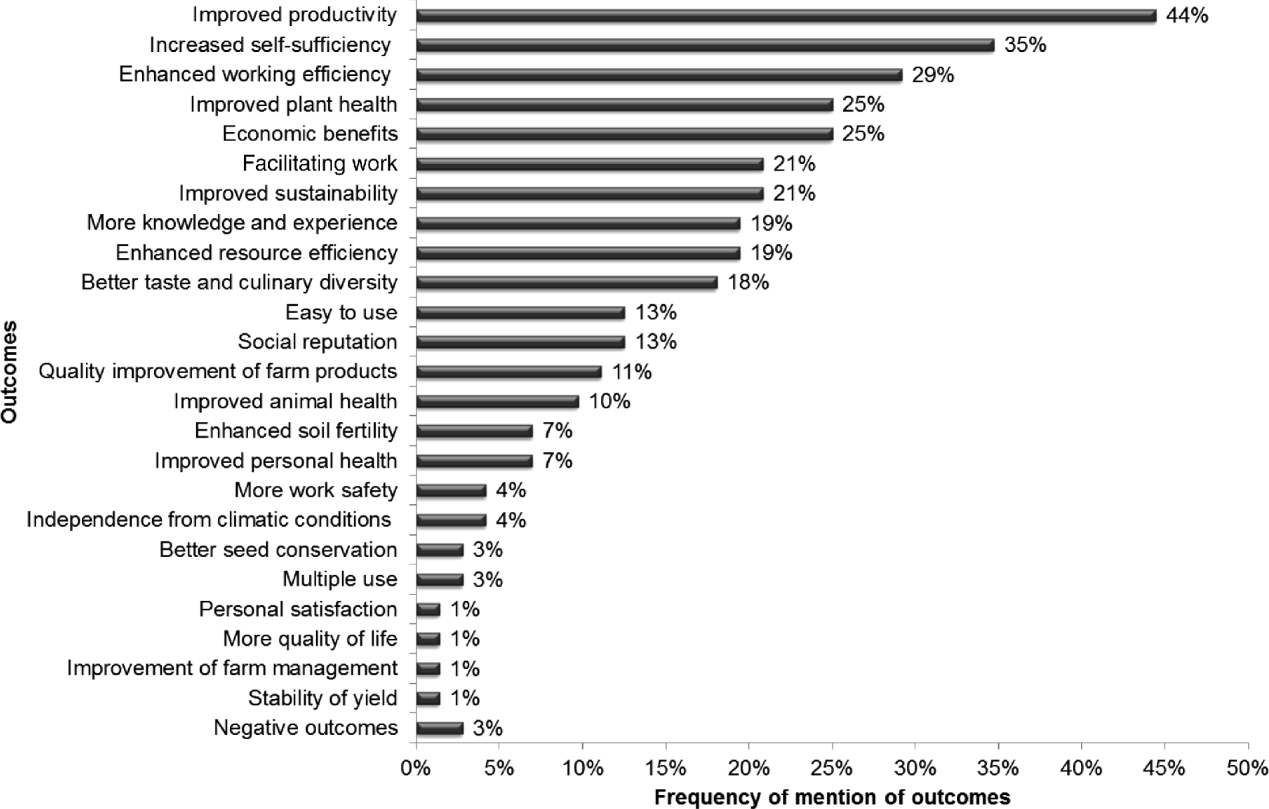
Outcomes were often context-specific and depended on the individual experiments. One single experiment could have various benefits for the farmer (Fig. 5).
Outcomes of farmers' experiments (n = 72; 100% = the total of all answers given by the respondents; multiple answers possible).

Most interviewees mentioned improved productivity as an outcome of their experiments. Experiments that increased the degree of self-sufficiency represented important contributions to family livelihood and welfare. All respondents relied on manual work as a crucial element of farming activities. Thus, enhancing working efficiency by reducing the workload was a major benefit of farmers' experiments. Respondents also mentioned improved plant health as a positive outcome of an experiment. Economic benefits included cost savings and income increase. Work facilitation was realized by making the labor more comfortable. Some respondents mentioned that the outcomes protected the environment and contributed to increased sustainability. Some respondents saw experimenting as a way to gather their own experiences and to learn about the topic. They figured out better ways of farming and thereby enhanced their local knowledge.
Respondents benefitted from experiments by improving the efficiency of resource applications and thereby economized production. Respondents acknowledged being independent from external food supply and appreciated diversifying their food choices. Experiments occasionally resulted in culinary benefits, which included better taste of farm products, easier preparation or higher food variety. Easy applicability of the outcome was another advantage mentioned.
A welcome side effect of an experiment's outcome was social reputation among the farmers' colleagues, extension agents or scientists. Respondents were proud of good working outcomes and enjoyed acknowledgement from others.
Interviewees reported higher quality of farm products because of their experiment. They observed improved animal health after experimenting with natural remedies and enhanced soil fertility after applying organic matter or worm compost. Respondents also mentioned health aspects as benefits. Experiments' outcomes decreased negative effects of agricultural production and thereby improved personal health. Higher work safety was also a benefit of experimenting.
Some experiments contributed to achieve independence from climatic conditions. Improved seed conservation, multiple uses of the outcomes for other purposes, personal satisfaction, better life quality, improved farm management and stability of the yield were less important benefits of the outcomes.
A few respondents mentioned experiments with negative outcomes, but they still reported to have benefitted in the form of increased knowledge about the experiments' topics. Even if farmers benefitted from their experiments, they also reported disadvantages. One important disadvantage was the resource input necessary to conduct an experiment with uncertain outcomes. Respondents dedicated working time to experimenting, which was deducted from regular farm work or spare time.
Dissemination of experiences
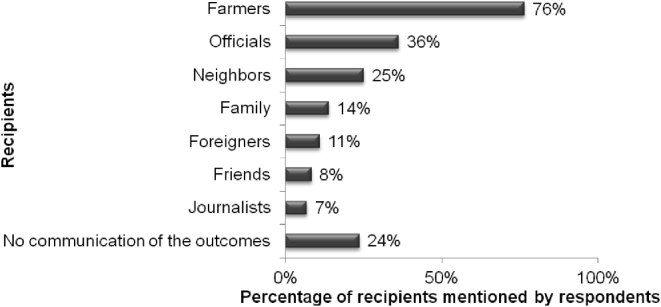
Respondents were usually proud of the outcomes and communicated them to others. Furthermore, outcomes that improved agricultural production awakened other farmers' interests. Local dissemination mainly took place within the farmers' peer network. Personal communication with other farmers was the most frequent channel for dissemination (Fig. 6).
Dissemination of farmers' experiments in Cuba: people to whom respondents communicated the outcomes (n = 72; 100% = the total of all answers given by the respondents; multiple answers possible).

Often, first recipients were other farmers within the family, close friends working in agriculture or neighboring farmers. After receiving positive feedback, farmers disseminated the outcomes on a larger scale. Most respondents addressed farmers' colleagues and other like-minded persons who lived in the same area and were supposed to benefit from the experiment. Agricultural officials, including advisors and scientists, also received information about the experiments’ outcome. Interviewees also mentioned their outcomes when talking to neighbors and family members not working in the field of agriculture. Some respondents received visits from foreigners and explained the outcomes to them. Furthermore, a few respondents talked about the experiment with friends who did not work in agriculture. Some farmers explained their experiment to journalists.
Accepting farm visits and showing the outcomes to others reinforced the validity of the experiment. Visitors were mostly individual farmers or organized groups of farmers, extension agents, agricultural officials and representatives from farmers' associations. Some respondents presented their experiments in workshops organized by farmers' associations, research associations or by farmers themselves. Outstanding experiments or innovations appeared in magazines, journals or books written by scientists or journalists, or by farmers themselves.
Various Cuban institutions promoted farmers' participation at scientific and semi-scientific conferences to upgrade farmers' experiments. Farmers who developed remarkable innovations or inventions even participated at international conferences outside Cuba.
Some farmers wrote a text about their experiment on their own or with the help of extension agents or scientists to fulfill the requirements for participating at a conference or at Cuba's innovation award forum. Also, the monthly cooperative meeting represented a platform for knowledge exchange and dissemination of outcomes. Particularly active experimenters gave interviews for newspapers, radio or TV.
Farmers usually avoided talking about preliminary or negative outcomes to evade defamation or derision. Respondents preferred to go public only when they could provide evidence of the outcomes’ validity and applicability. Experiments that had already been conducted by a majority of the local population were hardly communicated and respondents considered active promotion as redundant. Some interviewees considered their experiments as insignificant and refrained from dissemination. Farmers who applied for a patent and waited for a decision were more reserved when talking about the outcomes because they felt the need to protect their intellectual property.
Most experiments bear upon the local context, either upon farm level or upon community level. Occasionally, experiments were disseminated on a larger scale. Especially, participation at the innovation award forum, at workshops or conferences facilitated widespread dissemination and upgraded dissemination rates.
Discussion
Cuba's agriculture has undergone a series of structural changes during the course of its recent historyReference Enríquez 8 , Reference Nelson, Scott, Cukier and Galán 12 . Experimenting has been the farmers' approach to improve farming situations and livelihood conditions. The government's efforts to boost agricultural production have included the dissemination of technological innovations 57 . Experiments are farmers' means to adapt these innovations to site-specific conditionsReference Wortmann, Christiansen, Glewen, Hejny, Mulliken, Peterson, Varner, Wortmann and Zoubek 31 . The broad diversity of topics and methods of farmers' experiments in Cuba results in a broad repertoire of potential adaptation strategies. Through experimenting farmers learn how to deal with multiple challenges of farming and increase the possible responses to changes that affect agricultural production.
The potential of farmers to experiment and their innovative capacity are widely accepted within the scientific communityReference Stolzenbach, Prain, Fujisaka and Warren 24 – Reference Wortmann, Christiansen, Glewen, Hejny, Mulliken, Peterson, Varner, Wortmann and Zoubek 31 , Reference Critchley 33 – Reference Bentley 36 , Reference Bunch, Haverkort, Kamp and Waters-Bayer 40 – Reference Nielsen, Reij and Waters-Bayer 43 , Reference Stolzenbach, Van Veldhuizen, Waters-Bayer, Ramírez, Johnson and Thompson 45 , Reference Johnson 58 – Reference Bunch, Chambers, Pacey and Thrupp 66 . Most farmers are regularly and actively engaged in a wide range of different experimentsReference Stolzenbach, Van Veldhuizen, Waters-Bayer, Ramírez, Johnson and Thompson 45 . Also in Cuba, farmers' experiments are an integral part of agriculture. Almost all farmers have engaged in activities with an experimental character on a diversity of topics and methods, and using a wide range of resources.
Increasing farm diversity is crucial to improve sustainability of agricultural systemsReference Simón Reardon and Pérez 19 . Diversified production systems provide more opportunities to experiment and increase the farmers' capacity to experiment with different topics and methods. The amount of different stimuli per se provides multiple opportunities to learn how to deal with change.
Farmers' experiments are embedded in the local context, integrating locally available resourcesReference Haverkort, Haverkort, Kamp and Waters-Bayer 34 , Reference Stolzenbach, Van Veldhuizen, Waters-Bayer, Ramírez, Johnson and Thompson 45 . Resource availability in Cuba has been affected by economic constraints that have resulted in resource shortagesReference Kilcher 67 . The farmers' way to deal with these constraints has been the search for alternative uses and reuses of discarded material. Farmers' experiments in Cuba were characterized by the use of locally available and often recycled resources. Cuban farmers showed creativity in recombining the available resources to improve their situation.
To initiate an experiment, farmers were most often driven by their own idea. However, respondents also mentioned a diversity of external ideas and factors as sources (other farmers, family members, agricultural officials, media, agricultural events, acquaintances and consumers). The farmers' own idea was also mentioned by most of the farmers in studies in East AfricaReference Sumberg and Okali 29 , AustriaReference Kummer 25 and CubaReference Leitgeb, Funes-Monzote, Kummer and Vogl 52 . Sumberg and OkaliReference Sumberg and Okali 29 found that farmers in Zimbabwe were experimenting based on external ideas, while farmers in Ghana claimed that experiments were based on their own ideas. Other authors referred to extension workers, research institutions and other farmers as sources of ideas for experimentingReference Bunch, Haverkort, Kamp and Waters-Bayer 40 , Reference Padel 68 .
Most Cuban farmers started their experiments on a small scale to minimize risk. Small-scale experiments allowed the farmers to keep the experiment manageable. Small-scale experimentation was promoted by MACACReference Rosset, Machín Sosa, Roque Jaime and Ávila Lozano 13 . Other authors also mentioned small-scale experimentsReference Sumberg and Okali 29 , Reference Rajasekaran, Prain, Fujisaka and Warren 30 , Reference Connell, Haverkort, van de Kamp and Waters-Bayer 44 , Reference Padel 68 , Reference König 69 . By conducting small-scale experiments, farmers gather experiences without the risk of threatening their sources of livelihood.
Direct observation was the most effective way for farmers to evaluate an experiment. Even farmers who applied scientific methods did not renounce careful observation. Some farmers used random sampling or repetitions during the experimental process. These procedures were mostly applied due to the academic background of the respondent and often adapted to their own requirements. Thus, expecting standardized methods would misconstrue the very nature of farmers' experiments. They are hardly comparable to standardized experimentation applied in academic research. Flexibility and adaptability of methods are key elements of farmers' experiments. Farmers have developed their own valid procedures to conduct and evaluate their experiments, and these are particularly suited to deal with the complexity of diverse farming activities and reflect the local conditionsReference Hoffmann, Probst and Christinck 70 . However, the institutional influence on farmers' experiments in Cuba, with MACAC and PIAL leading the way, shaped somehow the experimental process of farmers participating in their activities.
The experiments’ outcomes usually improved the prevailing situation. The most important benefits were increased production and self-sufficiency followed by working efficiency, improved plant health, economic benefits, improved ease of work and sustainability, more knowledge and resource efficiency. Increased self-sufficiency and enhanced resource efficiency, especially, are linked to the resource scarcity triggered by the crisis. Even negative outcomes had their positive aspects. Learning from mistakes was an important step in adaptation processes. Farmers identified wrong approaches and learned how to improve, based on their experiences. At the same time, their accumulated experiences coalesced to a repertoire of local knowledge and practice. In our achievement-oriented society, mistakes have negative connotation, but they are crucial for learning, improvement and development.
Farmers gain and accumulate experience through their experiments. They integrate new experiences into the already existing knowledge pool and thereby amplify their local knowledge. Thus, farmers' experiments are means of learning on a self-paced basis according to their own perception of necessity. Farmers determine the intensity and velocity of this learning processReference Hagmann and Chumab 71 . Demonstrating and discussing experiments facilitate communication among farmers. When talking about their experiments, farmers make their knowledge and experiences explicit and thus exchangeableReference Hocdé, Veldhuizen, Waters-Bayer, Ramirez, Johnson and Thompson 26 . Farmers' experiments in Cuba were embedded in the local agricultural communication network. Personal interaction facilitated the transmission and exchange of knowledge. In addition, knowledge exchange platforms, such as workshops or innovation fairs, organized by members of MACAC or the PIAL project, facilitated dissemination of experiments’ outcomes. Participation in these platforms potentially may trigger other experiments.
Dissemination of experiences from farmers' experiments in Cuba mainly took place within the farmers' peer network. Other farmers were the most important recipients of experiences. Cuban farmers also communicated their results to extension workers or scientists. Farmers' knowledge and their communication networks are key elements to enhance their adaptive capacityReference Hagmann and Chumab 71 . Informal and formal collaboration of farmers constitute encounters for knowledge exchange and represent an important base for adaptation strategiesReference Tompkins and Adger 72 .
Farmers' experiments can be apparently insignificant activities, such as putting a seed into the ground. Even common agricultural practices can express experimental characteristics. The farmer's experience with the experiment's topic and the setting determine its experimental character. The experimental character might appear only if the experiment fails. In the case that everything works out fine, the farmer might not even be aware of the experimental character. Farmers might also experiment with common agricultural practices, which are widely known within the respective farming population. However, site-specific conditions usually differ from setting to setting. Therefore farmers' experiments are unique for the specific setting.
Conclusion
Farming conditions have changed constantly during the course of timeReference Johnson 58 . Thus, the adaptive capacity of farmers is crucial to cope with such changing conditionsReference Tompkins and Adger 72 , Reference Milestad, Dedieu, Darnhofer, Bellon, Darnhofer, Gibbon and Dedieu 73 . Experimenting allows farmers to increase their adaptive capacityReference Kummer 25 . However, farmers' experiments are unique for a specific setting, and transmission into another setting requires again adaptation to the new conditions. What needs to be transmitted is not so much the topic of an experiment or its outcome, but the spirit of being an experimenter and the methods for experimentation.
Farmers deal with experimental processes in a systemic way. By experimenting, they learn how to approach farm-specific problems and they increase their ability to assess various options for further activities. By doing so, they adapt and improve their farming system and contribute to agricultural development. Thus, farmers' experiments might be able to buffer disturbance of socio-ecological systems and represent crucial elements in preparing agriculture for prospective changes. Therefore, the empowerment of rural people as key actors for achieving long-term sustainability of agriculture and food systems must have priority in policy agendas.
In order to develop the full potential of farmers' experiments and innovations, decision makers have to recognize and support grassroots experimental activities. The Cuban experience of mitigating a food crisis and resource scarcity is an example of how farmers' experiments and innovations have been taken up as an important strategy to cope with severely changing conditions. Such strategies should be observed alertly, as similar situations might also affect other countries in the near future.
Acknowledgements
The authors thank the Austrian Science Foundation (FWF) for financing the project ‘Organic Farmers' Experiments', including its funding of field research in Cuba. The field work in Cuba was done thanks to a student visa under an official agreement between the University of Natural Resources and Life Sciences, Vienna (BOKU), the Experimental Station Indio Hatuey in Cuba (EEIH) and the Cuban National Institute of Agricultural Sciences (INCA). This research would not have been possible without the intensive support from our Cuban colleague, Humberto Ríos. We also thank Elena Sanz Soro, May Ling Chan, Eduardo Freire, Lukas Kilcher and Racheli Ninio for the inspiring discussions about the subject of our paper. Finally, I want to thank the Hofkollektiv Wieserhoisl for supporting me during writing up the results.