Introduction
The last year of life (LYOL) is a particularly vulnerable period for patients and their relatives, during which they usually come into contact with various health and social care structures (Bekelman et al., Reference Bekelman, Halpern and Blankart2016; McDermott et al., Reference McDermott, Engelberg and Woo2019). Studies suggest that patients in their LYOL and their relatives frequently do not feel that existing healthcare structures adequately address their needs and individual challenges (Weber et al., Reference Weber, Claus and Zepf2012; Robinson et al., Reference Robinson, Gott and Ingleton2014; Bussmann et al., Reference Bussmann, Muders and Zahrt-Omar2015; Bainbridge et al., Reference Bainbridge, Giruparajah and Zou2018). In this context, general patient satisfaction often varies greatly depending on the particular care setting. Hospices and specialized palliative care services are perceived more positively than care in acute hospitals (Addington-Hall and O'Callaghan, Reference Addington-Hall and O'Callaghan2009; Bainbridge and Seow, Reference Bainbridge and Seow2018).
Informal caregivers play an integral part in the care of patients in their LYOL, gaining valuable insight into their specific needs and challenges in the last phase of life. Their experience can thus serve as a substantial help for the improvement of end-of-life care structures (Bussmann et al., Reference Bussmann, Muders and Zahrt-Omar2015; Bainbridge et al., Reference Bainbridge, Bryant and Seow2017, Reference Bainbridge, Giruparajah and Zou2018; DiGiacomo et al., Reference DiGiacomo, Hatano and Phillips2017; Donnelly et al., Reference Donnelly, Prizeman and Coimín2018; Zavagli et al., Reference Zavagli, Raccichini and Ercolani2019). Seeking the views of bereaved relatives should be considered to ascertain the quality of care by both quantitative and qualitative approaches. One way to gain insight into the care experiences of patients in their LYOL is to analyze free-text comments from the perspective of informal caregivers. In addition to the use of quantitative data, the analysis of free texts allows a deeper understanding of individual experiences, shows potential improvement possibilities of care deficits, and generates possible new research approaches (Riiskjær et al., Reference Riiskjær, Ammentorp and Kofoed2012).
The Last-Year-of-Life-Study-Cologne (LYOL-C) is a cross-sectional, mixed-methods study exploring the LYOL until the death of patients deceased in the greater Cologne area (Germany). Cases are investigated regardless of patients’ age, underlying diagnosis, or healthcare facility used, aiming to gain insights into the optimization of healthcare processes and structures (Strupp et al., Reference Strupp, Hanke and Schippel2018). It is one of three research projects initiated within the Cologne Research and Development Network (CoRe-Net) (Karbach et al., Reference Karbach, Ansmann and Scholten2018).
This paper seeks to qualitatively explore unmet needs in terms of unsolved problems and unwanted decision-making in the care of patients in their LYOL from the perspective of informal caregivers.
Methods
Study design, population, and data collection
This qualitative analysis is based on free-text answers to a postal survey of informal caregivers of deceased patients conducted as part of the LYOL-C. Further data obtained from the questionnaire were analyzed in a separate publication (Voltz et al., Reference Voltz, Dust and Schippel2020).
Participants were a purposive sample of relatives, friends, and voluntary workers acting as proxy respondents (all will be referred to as “informants” hereafter). Inclusion criteria required informants to be aged 18 years and older, to have recently cared for a person who lived their LYOL in the Cologne area and to have returned the questionnaire by the closing date of the data collection (November 2017 data collection start, October 2018 data submission deadline). We excluded deaths of people under the age of 18, as well as accidental and suspicious deaths. Informants were free to choose scope of time and location for completing the postal questionnaire. The methods for the full survey are described in more detail elsewhere (Voltz et al., Reference Voltz, Dust and Schippel2020).
The self-completed questionnaire consisted of a German version of the Views of Informal Caregivers' Evaluation of Services–Short Form (VOICES-SF) (Hunt et al., Reference Hunt, Richardson and Darlington2019; Voltz et al., Reference Voltz, Dust and Schippel2020). The questionnaire comprises a total of 106 items, of which 103 are exclusively quantitative, two are mixed, and one is a qualitative item in the form of an open question. Furthermore, on the last page of the questionnaire, the informants were given a chance to make general comments on the survey in free-text form.
The items of the questionnaire with a qualitative dimension relevant to the research question were as follows:
-
– Item no. 101: “Looking back over the entire last year of life, were any decisions made regarding the care that your relative did not want?” (mixed item; possible answers: yes, probably yes, probably no, no, do not know, and invitation for additional free-text comment if answer “yes” or “probably yes”)
-
– Item no. 102: “Looking back over the entire last year of life, were there any problems regarding the care that could not be solved?” (mixed item; possible answers: yes, probably yes, probably no, no, do not know, and invitation for additional free-text comment if answer “yes” or “probably yes”)
-
– Item no. 106: “Do you have any comments on the care of your relative in the last year of life?” (exclusively qualitative item)
-
– Free-text field without specific question with option for further comments on topics considered relevant by informants.
The items of the questionnaire were numbered chronologically according to their appearance in the postal questionnaire, so that items 101, 102, and 106 with the option of free-text comments could be found in the posterior part of the questionnaire. Included in the qualitative analysis of this paper were the informants who used at least one of the four free-text fields for comments in bullet point or sentence form (items 101, 102, 106, free-text field for additional comments on the last page of the questionnaire). In addition, the demographic data of the deceased relatives as well as the informants of this subgroup (participation in at least one of the four free-text fields) are provided.
Analysis
Free-text comments were analyzed using MAXQDA version 2018.1. Demographic data of informants and deceased relatives were analyzed using SPSS Statistics version 25 (IBM Corp., Armonk, NY, USA).
By using qualitative content analysis, we analyzed the free-text content and developed a qualitative category system with main and subcategories in a multi-step process (Garcia et al., Reference Garcia, Evans and Reshaw2004; Elo and Kyngäs, Reference Elo and Kyngäs2008; Mayring, Reference Mayring2014). GD and NiS designed the survey instrument and collected data. JK coded and analyzed the entire data set as agreed upon with GD and JS. GD and JS familiarized themselves with a random sample of the responses. Afterwards, the codes and categories were discussed and negotiated between the authors (JK, GD, JS) to reach consensus and adjustments were made if necessary.
First, the original free-text comments were prepared for coding by identifying relevant text passages to the research question (“unmet needs in terms of unsolved problems and unwanted decision-making in the LYOL”). Then we divided comments with several relevant aspects into text modules for individual coding. Following this, preliminary codes were developed by inductive analysis of the relevant text passages previously identified for the research question. In the course of further analysis, we continually compared, critically discussed, and re-evaluated newly emerging codes and summarized thematically identical text passages in preliminary categories. After coding all text passages, they were sorted thematically, repeatedly refined in terms of intercategorial distinctiveness, and main and subcategories were established for a higher level of abstraction.
Information was collected on the frequency of text passages assigned to the main categories and subcategories. Exemplary free-text quotes were selected by the team based on the criteria of representativeness, thematic frequency, and verbal expressiveness. Occurring differences of opinion in the development of the category system were resolved by critical discussion and, in the case of continuing differences of view, by majority opinion.
Results
From a total of 351 questionnaires collected in the LYOL-C, free-text data of informants could be analyzed in 240 cases (68%) which means that 240/351 informants added comments to at least one of the four available free-text fields in their questionnaires (Voltz et al., Reference Voltz, Dust and Schippel2020). There were 64/351 (18%) responses to free-text item 101, 113/351 (32%) responses to free-text item 102, and 179/351 (51%) responses to free-text item 106. Besides, 89/351 (25%) informants used the voluntary option to make general comments on the survey in free-text form on the last page of the questionnaire.
Of the informants to item 101, 63/351 (18%) answered “yes” or “probably yes,” with 59/63 (94%) of these informants subsequently writing a free-text comment. The higher number of total free-text responses (n = 64) is explained by the fact that five informants also decided to enter free text, even though they had previously answered “probably no” or “no.”
As for item 102, 116/351 (33%) of informants answered “yes” or “probably yes,” with 106/116 (91%) of these informants then writing a free-text comment. The higher number of total free-text responses (n = 113) is due to the fact that seven informants also opted to provide free-text comments, even though they had previously answered “probably no” or “no.”
The survey results reflect informants’ experiences from January 2015 to July 2018. Table 1 presents demographic data of survey informants and their deceased relatives.
Demographics and characteristics of LYOL-C subgroup (n = 240/351)

a Multiple responses were possible.
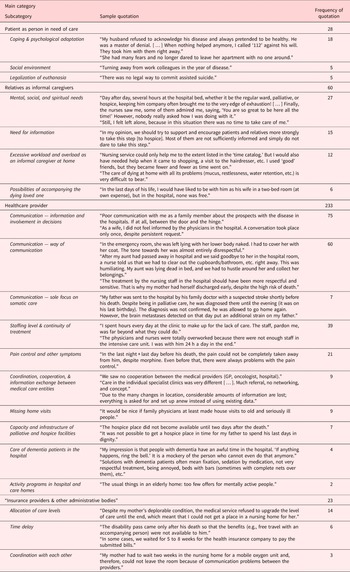
The developed category system for the analysis of unsolved problems in the LYOL comprises a total of 5 main categories and 20 subcategories and for the analysis of unwanted decisions in the LYOL a total of 2 main and 2 subcategories. The main categories represent protagonists in the LYOL, such as patients, caregivers, and health professionals. Subcategories subsume thematic motives and complexes associated with protagonists from the perspective of the bereaved informants. To provide a better illustration of the category system in our publication, we opted for the tabular presentation with representative citations for each subcategory (see Tables 2 and 3). In addition, in the continuous text, each paragraph of a main category is preceded by a selected citation.
Unsolved problems regarding care in the LYOL

Unwanted decision-making regarding care in the LYOL

Information on the frequency of citations in each main and subcategory was collected and describes the number of text fragments from the informants’ comments that could be assigned to the respective main and subcategories. The number of citations assigned to a main category is the sum of citations assigned to the subcategories of that main category. These allow the identification of recurring themes but do not necessarily indicate the importance of the thematic complexes mentioned by informants (Garcia et al., Reference Garcia, Evans and Reshaw2004).
Informants most often addressed the following unsolved problems: poor communication with medical and nursing staff, insufficient professional support for informal caregivers, inadequate support for patients with psychological coping, and poor management of pain and other symptoms. The most frequently cited care decision against the patient's preference was to be cared for and to die outside his or her own home.
Main category: Patient as person in need of care
“He wanted to die at home, but it was practically impossible.”
This category focuses on the deceased patient in his/her LYOL as the protagonist. A large number of informants stated that the central wish of their deceased relative was to be cared for and to die at home, but this was usually not possible due to a lack of medical and nursing care services. As a result, they had to resort to inpatient care. Some informants reported burdening unsolved conflicts in the patient's family or private environment, and in some cases, also former social contacts turning away from the deceased patient in the course of the disease. Others described patients’ inadequate psychological coping with the disease and lacking respective support offers during the LYOL. Denial of their disease, social withdrawal, and anxiety and depressive disorders were mentioned. Some of the informants also raised the issue of their seriously ill relatives’ desire for physician-assisted suicide.
Main category: Relatives as informal caregivers
“What was completely missing, however, was the offer of psycho-oncological/psychological support or further support measures. In this situation (for us altogether more than three years), we felt overwhelmed as a family and especially left alone in the end.”
Many informants found themselves and other caregivers faced with a variety of unsolved psychological, social, and spiritual issues in the last year of the deceased patient's life. Recurring themes were lacking offers of conversations to process experiences and grief, neglecting one's own needs, and dealing with spiritual questions. In our study, some informants expressed the wish to have obtained more information about the way the healthcare system works, which they did not seem to sufficiently understand and which often led to a feeling of helplessness and being at the mercy of others. Several informants also reported that their situation as caregiving relatives often pushed them to the limits of their resilience and beyond. Occasionally, informants complained about a lack of ways to accompany their relatives adequately when they were dying.
Main category: Healthcare provider
“His neurologist was only interested in MRI images and blood counts. He was less interested in human beings in any way.”
This category centers around the role of physicians and nurses as protagonists in the last year of a patient's life. It addresses various aspects of problems in care from the perspective of the informants. We could attribute most of the quotations of the entire analysis to the motive “communication.” In particular, many informants saw significant deficits in the way physicians and nurses communicate, “shared decision-making” not being practiced, and a sole focus on somatic care. Recurring themes include impersonal and unemphatic communication, a general lack of time for discussions, an inappropriate setting for communication, insufficient information about the patient's state of health and treatment options or prospects, missing participation in therapeutic decisions, and a feeling of disinterest in the patient's psychological well-being.
Furthermore, some informants mentioned a strong understaffing in hospitals and nursing homes, which primarily affected seriously ill patients and patients with dementia, as they are unable to care for themselves. Other informants described deficits in pain management and other symptoms like dyspnea, nausea, pruritus, and obstipation in the last year of the deceased patient's life. Likewise, life-prolonging measures in the dying process were often viewed critically. Some study informants also reported a lack of cooperation and coordination between different medical providers and loss of information when switching between different providers. They criticized as well that many physicians did not offer home visit services for severely ill patients. Some informants saw a further problem in the inadequate care of patients who have dementia in hospitals and in the lack of activating services for older people in hospitals and nursing homes. Furthermore, experiences with overtherapy and treatment against the will of the patient were mentioned.
A large number of study informants commented very positively on the palliative and hospice care of their relatives in the LYOL, despite the explicit question about unsolved problems and unwanted decision-making. However, some complained about too few available places in palliative care facilities and hospices, so that their relatives had to wait a long time or could not be accommodated.
Main category: Insurance providers and other administrative bodies
“Delivery of the hospital bed was delayed by the health insurance company to the extent that it was only delivered five days before my husband's death.”
This category comprises problems in the care of patients in the LYOL by health insurance companies, authorities, and other relevant administrative institutions. Several informants perceived applying for the care levelFootnote 1 for their relatives to the health insurers as not satisfactory and associated with obstacles. Often the assessment of the need for nursing care by the medical service of the health insurers was considered inadequate to the actual severity of the disease. As a result, they granted less financial assistance for nursing services than would have been necessary for adequate care according to the informants’ opinion. In many cases, the time taken to process applications for assistance was perceived as too long, resulting in care services and aids not being provided in time (sometimes even after the applicant has passed away). Moreover, there were reports of poor coordination between the individual providers, which also delayed and hindered the provision of care services.
Discussion
Based on free-text comments, this qualitative analysis was able to identify five key themes that may have a negative influence on the quality of life and care of patients in their LYOL and their social environment from the perspective of bereaved informal caregivers. The results of this paper confirm deficits in the care of patients at the end of life, which have been reported in the previous research literature, adding regional facets and providing a comprehensive panorama of unsolved problems and unwanted decision-making of patients and their relatives in the LYOL.
Communication with medical and nursing staff
Previous studies emphasize the benefits of adequate and early communication with patients at the end of life and their families following their individual need for information and participation in treatment decisions so that conversation training has become part of global guidelines in palliative care, as, for example, in the national guidelines in Germany (Brighton and Bristowe, Reference Brighton and Bristowe2016; Brighton et al., Reference Brighton, Koffman and Hawkins2017; Alt-Epping et al., Reference Alt-Epping, Bausewein and Voltz2020). The results of our study, in which most of the quotations of informants addressed deficits in communication with physicians and nurses, confirm the central importance of successful communication between medical providers and patients in their LYOL. In particular, the patient's feeling of having been treated with dignity and respect, of being involved in therapeutic decisions, and the consideration of psychosocial needs were key indicators of patient satisfaction in the previous study of our research team (Voltz et al., Reference Voltz, Dust and Schippel2020).
While physician–patient communication in hospice and palliative care facilities usually met patients’ needs, informants often described their experiences in acute hospitals as impersonal and disrespectful. As one possible explanation for this phenomenon and a target for intervention, we suspect a work culture often prevalent in acute hospitals that places a greater emphasis on somatic components and neglects a holistic approach, encompassing psychosocial elements, when treating patients. In view of the fact that the hospital is still the most frequent place of death for patients in the Western world, it might be useful to raise awareness among healthcare professionals working in acute hospitals regarding the specific psychosocial needs of patients in their LYOL and, based on this, to communicate in a way that is appropriate to their needs (Cross and Warraich, Reference Cross and Warraich2019; Dasch and Zahn, Reference Dasch and Zahn2021). Sinuff and colleagues developed a set of quality indicators related to end-of-life communication and decision making that can serve as a guide for educating healthcare professionals and evaluating communication with patients in their LYOL in daily clinical practice (Sinuff et al., Reference Sinuff, Dodek and You2015).
Care and death at home
For patients in our study, the hospital was the most common place of death, and only about 30% of them were able to have their wish of dying at home fulfilled (Voltz et al., Reference Voltz, Dust and Schippel2020). Informants stated that the wish of their loved one to die at home often could not be realized due to insufficient or unavailable medical and nursing care services. Wherever available, palliative home care services were favored in the free-text commentaries compared to others and predominantly perceived positively. Our findings underline the central desire of the majority of patients to die in their own homes and encourage efforts for establishing a comprehensive infrastructure of outpatient palliative care.
Unmet needs of informal caregivers
Caring relatives play a key role in end-of-life care. They are exposed to a variety of physical, emotional, and social demands that can harm their health and lead to increased mortality (Schulz and Beach, Reference Schulz and Beach1999; Ullrich et al., Reference Ullrich, Ascherfeld and Marx2017; Zavagli et al., Reference Zavagli, Raccichini and Ercolani2019). These results are reflected in the experiences of informants in our study. The informants describe several situations in the care of their relatives in their LYOL that repeatedly brought them to the limits of their physical and psychological capacity.
Previous work has shown that the quality of life of caring relatives and that of end-of-life patients are interdependent, which means that patients in their LYOL also benefit from interventions to improve the quality of life of informal caregivers (O'Hara et al., Reference O'Hara, Hull and Lyons2010; Krug et al., Reference Krug, Miksch and Peters-Klimm2016). These insights make it all the more important to identify informal caregivers of patients at the end of life as targets for interventions at an early stage and to create barrier-free access. A validated assessment tool for analyzing informal caregivers’ need for assistance in different domains is the evidence-based Carer Support Needs Assessment Tool (CSNAT). This tool enables healthcare professionals working in palliative and end-of-life care to identify caregivers with a need for intervention and to provide them with targeted, tailored support (Ewing et al., Reference Ewing, Brundle and Payne2013; Ewing and Grande, Reference Ewing and Grande2013). Another validated assessment tool to quantify caregiver burden is a short form of the Zarit-Burden interview specifically adapted for the palliative setting by Kühnel et al. (Reference Kühnel, Ramsenthaler and Bausewein2020) Klicken oder tippen Sie hier, um Text einzugeben. A 2013 Cochrane Review provides an overview of the evidence regarding a variety of supportive interventions in terms of their effect on the physical and psychological health of informal caregivers (Candy et al., Reference Candy, Jones and Drake2011).
Coping and psychological adaptation
Insufficient psychological coping by patients at the end of life correlates strongly with their subjective quality of life and can also negatively influence the perception of physical symptoms such as pain, shortness of breath, or nausea (Block, Reference Block2006; van Laarhoven et al., Reference van Laarhoven, Schilderman and Bleijenberg2011). Based on the results of our study, we assume that the inadequate psychological coping with the disease in several patients in their LYOL aggravated the experience of physical symptoms and significantly affected their quality of life. In this context, it seems all the more important to raise the awareness of patients in their LYOL and their relatives about available psychosocial support services to keep access as low threshold as possible.
Pain control and other symptoms
Pain and dyspnea are among the most common and most feared symptoms of seriously ill patients in the LYOL. There is evidence that adequate pain and symptom management is still not achieved in many patients at the end of life (Bhatnagar and Gupta, Reference Bhatnagar and Gupta2016; Frankenhauser et al., Reference Frankenhauser, Geist and Weigand2017). In our study, informants likewise report deficits in the symptom management of the deceased patients. In comparison with hospices and palliative care units, the pain management of general wards in hospitals and at home is perceived as of lower quality (Voltz et al., Reference Voltz, Dust and Schippel2020). This suggests a relationship between clinicians’ competence and experience in effective symptom management and the degree of successful symptom relief in patients in their LYOL.
Research so far has identified several barriers faced by patients and healthcare providers that prevent effective assessment and treatment of pain and other symptoms at the end of life. On the part of patients, these include fears and mistaken assumptions about the effects and side effects of pain medications and the lack of communication of symptomatic conditions. Deficits among healthcare providers comprise clinicians’ lack of knowledge and experience in effective symptom management, as well as systemic barriers such as higher prioritization of curative over palliative care, restrictive use of high-cost medications, or staff shortages that prevent adequate patient care (Fineberg et al., Reference Fineberg, Wenger and Brown-Salzman2006; Imhof and Kaskie, Reference Imhof and Kaskie2008; Schrader et al., Reference Schrader, Nelson and Eidsness2009; Wilkie and Ezenwa, Reference Wilkie and Ezenwa2012).
Strengths and limitations of the study
With a high participation rate of 240 informants, our free-text analysis gave detailed and immediate insight into unsolved problems and unwanted decision-making regarding care provided to patients in their LYOL from the perspective of their bereaved relatives. To the best of our knowledge, our publication is one of the first qualitative works expanding the time frame of analysis of care experiences and needs of patients and their social environment to a whole year before death, regardless of the place of death, the underlying diagnosis, and the care providers involved. The method of qualitative content analysis of free texts used here enabled us to gain a deeper and more detailed understanding of individual experiences of patients in the LYOL, complementing the quantitative analysis of questionnaire data we published elsewhere (Voltz et al., Reference Voltz, Dust and Schippel2020).
The informants’ retrospective perspective serves as an approximation of the patient's own experience, but it is not equal to it and may be influenced by the quantity of time spent together, the quality of the interpersonal exchange between informants and patients in the LYOL, as well as socio-psychological phenomena such as social desirability, individual expectations, or limited and selective memory (Baddeley, Reference Baddeley1990; Funk et al., Reference Funk, Stajduhar and Cohen2012). Nonetheless, it can be assumed that a certain level of agreement between the patient and informant will emerge in the long term concerning the perception of experiences, although other accentuations are possible (Tang and McCorkle, Reference Tang and McCorkle2002; McPherson and Addington-Hall, Reference McPherson and Addington-Hall2003).
Furthermore, readers should keep in mind that our analysis is based on free-text answers that were collected in a more comprehensive questionnaire. In this context, participation and depth of content similar to that of comparable analyses based on personal interviews may not have been achieved, and informants may have limited themselves to a few aspects that they considered should be given the highest priority. Since it was necessary to speak German to participate in the study, specifically migrant perspectives may also be missing or underrepresented.
Discrepancies regarding the demographic data of the total group of deceased relatives respectively the informants of the postal questionnaire (n = 351) and the subgroup of the study (n = 240) which was used for this qualitative analysis were at most smaller/larger than 5% in each category. The exception to this is the proportion of deceased relatives with at least one neuropsychological disorder which was more than twice as high in the subgroup for this qualitative analysis as in the general group (67.9% vs. 32.8%). In this respect, it may be the case that the results of our analysis are disproportionately affected by this patient population. For a detailed presentation of the demographic data of the general group of the study (n = 351), refer to the publication by Voltz et al. (Reference Voltz, Dust and Schippel2020).
Finally, it should be noted that the results of this study reflect the experiences of informants from the greater city of Cologne, Germany, with an established palliative care infrastructure and hospice facilities. Our results may not be fully transferable to countries and regions with different healthcare structures. For a detailed description of the set-up of the palliative and hospice infrastructure in Cologne, Germany, also see the publication by Voltz et al. (Reference Voltz, Dust and Schippel2020).
Conclusion
Our findings suggest the necessity for greater awareness of patients’ and their relatives’ needs in their LYOL. The findings reveal that patients and their relatives faced diverse problems affecting their care and that they were not involved in decisions about their care as much as they wanted. There is a need to identify patients to be in their LYOL and consider their needs, especially outside hospice and palliative care structures. Integrating palliative care concepts in acute hospitals and other structures of regular health care can ensure that patients receive high-quality care.
Acknowledgments
This study was made possible by the collaborative efforts of health and social care practitioners in Cologne. We thank everyone who contributed their time and expertise, in particular the study participants, the CoRe-Net co-applicants, and our research assistant Christian von Reeken.
Collaborators
The CoRe-Net co-applicants: Holger Pfaff; Professor Dr. Christian Albus, Department of Psychosomatics and Psychotherapy, Faculty of Medicine (FM), University Hospital Cologne (UHC); Professor Dr. Lena Ansmann, Department of Health Services Research, School of Medicine and Health Sciences, Carl von Ossietzky University Oldenburg; Professor Dr. Frank Jessen, Department of Psychiatry and Psychotherapy, FM, UHC; Professor Dr. Ute Karbach, Sociology in Rehabilitation, Faculty of Rehabilitation, Technical University Dortmund; Professor Dr. Ludwig Kuntz, Department of Business Administration and Health Care Management, Faculty of Management, Economics and Social Sciences (FMESS), University of Cologne (UoC); Dr. Ingrid Schubert, PMV Health Care Research Group, FM, UoC; Professor Dr. Frank Schulz-Nieswandt, Institute for Sociology and Social Psychology, FMESS, UoC; Professor Dr. Stephanie Stock, Institute for Health Economics and Clinical Epidemiology, FM, UHC.
Contributors
JK and GD are joint first authors and act as guarantors. RV, JS, and CR are principal investigators and responsible for the study design, project management, data analysis, and dissemination. GD and NiS designed the survey instrument and collected data. JK, GD, and AK analyzed data. JK wrote the manuscript. RV, JS, GD, and AK edited the manuscript. All authors read and approved the final manuscript.
Conflict of interest
All authors have completed the ICMJE uniform disclosure form at www.icmje.org/coi_disclosure.pdf and declare no support from any organization for the submitted work, no financial relationships with any organizations that might have an interest in the submitted work in the previous 3 years, and no other relationships or activities that could appear to have influenced the submitted work.
Data sharing
Data are available on request from the corresponding author.
Ethical approval
The Ethics Commission of the Faculty of Medicine of the University of Cologne, Germany, approved all procedures for this study (#17-188). Participants gave written informed consent before taking part.
Transparency declaration
The lead authors (JK and GD) affirm that this manuscript is an honest, accurate, and transparent account of the study being reported; that no important aspects of the study have been omitted; and that any discrepancies from the study as planned (and, if relevant, registered) have been explained.