


Introduction
Magical Thinking (MT) has been defined as the process of subscribing to beliefs that are inconsistent with culturally accepted scientific laws of causality or transfer of information, such as spiritualism, precognition and telepathy (Bocci and Gordon, Reference Bocci and Gordon2007; Bolton, Dearsley, Madronal-Luque and Baron-Cohen, Reference Bolton, Dearsley, Madronal-Luque and Baron-Cohen2002; Eckblad and Chapman, Reference Eckblad and Chapman1983). Although it is believed to characterize the pre-operational stage of normal cognitive development in children (Piaget, Reference Piaget1929), normal adults may resort to magical or superstitious thinking in times of stress, to provide a sense of control (Moulding and Kyrios, Reference Moulding and Kyrios2006; Zebb and Moore, Reference Zebb and Moore2003).
The Magical Ideation Scale (MIS) (Eckblad and Chapman, Reference Eckblad and Chapman1983), which measures beliefs in a number of magical influences, such as thought transmission and good luck charms, was originally designed to be a measure of schizotypy. The latter construct refers to a cluster of personality traits that may be associated with a greater risk of developing psychotic symptoms at the extreme end of the spectrum (Claridge, Reference Claridge1997). However, the MIS has more recently been used as a tool to assess magical beliefs in Obsessive-Compulsive Disorder (OCD) (Einstein and Menzies, Reference Einstein and Menzies2004a, Reference Einstein and Menziesb, Reference Einstein and Menzies2006). MT may explain some of the unique neutralizing behaviours seen in OCD that appear to defy scientific laws of causality and distinguish it from other anxiety disorders (Amir, Freshman, Ramsey, Neary and Brigidi, Reference Amir, Freshman, Ramsey, Neary and Brigidi2001; Einstein and Menzies, Reference Einstein and Menzies2004a, Reference Einstein and Menziesb, Reference Einstein and Menzies2006). Scores on the MIS have been shown to be significantly related to atypical obsessions, such as aggressive and religious obsessions (Norman, Davies, Malla, Cortese and Nicholson, Reference Norman, Davies, Malla, Cortese and Nicholson1996; Tolin, Abramowitz, Kozak and Foa, Reference Tolin, Abramovitz, Kozak and Foa2001) and hoarding and counting compulsions (Einstein and Menzies, Reference Einstein and Menzies2004a; Samuels et al., Reference Samuels, Bienvenu, Pinto, Fyer, McCracken and Rauch2007; Tolin et al., Reference Tolin, Abramovitz, Kozak and Foa2001). The results of studies comparing levels of MT in washing and checking OCD subtypes are equivocal; however, the weight of evidence suggests that checkers may engage in more MT than washers (Bolton et al., Reference Bolton, Dearsley, Madronal-Luque and Baron-Cohen2002; Einstein and Menzies, Reference Einstein and Menzies2004b, Reference Einstein and Menzies2008; Zebb and Moore, Reference Zebb and Moore2003).
Despite the strong correlations observed between MT and certain obsessive compulsive symptoms, the nature of the relationship between MT and OCD is still unclear. Einstein and Menzies (Reference Einstein and Menzies2008) found that high pre-treatment MIS scores are associated with high levels of treatment intractability, while Lee, Cougle and Telch (Reference Lee, Cougle and Telch2005) suggested that high levels of MT may increase an individual's vulnerability to OCD. Others authors (e.g. Bocci and Gordon, Reference Bocci and Gordon2007) have suggested that MT may be a consequence of OCD, as it has been shown to be experimentally induced in non-clinical individuals whose sense of control has been removed. Interestingly, Einstein and Menzies (Reference Einstein and Menzies2008) have recently demonstrated an association between improvement in MT and an improvement in OCD symptoms.
Although the research on MT and OCD is still in its infancy, the related concept of thought-action fusion (TAF), which refers to the tendency to assume an erroneous causal relationship between one's own thoughts and external reality, has been greatly researched in the context of OCD. TAF has been described as a specific form of a general MT tendency, which may be a prominent feature of many individuals with OCD and possibly other anxiety disorders, such as Generalized Anxiety Disorder (GAD) and Panic Disorder (PD) (Abramowitz, Whiteside, Lynam and Kalsy, Reference Abramowitz, Whiteside and Lynam2003; Amir et al., Reference Amir, Freshman, Ramsey, Neary and Brigidi2001; Barrett and Healy, Reference Barrett and Healy2003; Borkovec, Hazlett-Stevens and Diaz, Reference Borkovec, Hazlett-Stevens and Diaz1999; Hazlett-Stevens, Zucker and Craske, Reference Hazlett-Stevens, Zucker and Craske2002; Rassin, Diepstraten, Merckelbach and Muris, Reference Rassin, Diepstraten, Merckelbach and Muris2001; Rassin, Merckelbach, Muris and Schmidt, Reference Rassin, Merckelbach, Muris and Schmidt2001). However, whereas individuals with other anxiety disorders respond to TAF biases by using avoidance strategies, those with OCD tend to use a range of neutralizing strategies, such as reassurance seeking and compulsive rituals (Berle and Starcevic, Reference Berle and Starcevic2005).
Einstein and Menzies’ (Reference Einstein and Menzies2006) study is the only one to date that has examined MT in an anxiety disorder other than OCD. They compared the MIS scores of 71 individuals across four groups who were matched, where possible, for gender and age. The groups were comprised of 11 OCD cleaners, 20 OCD checkers, 19 PD patients and 21 normal controls. The results of a one-way ANOVA with four planned contrasts revealed that OCD participants’ mean MIS score was significantly higher than the PD group. They therefore proposed that a general MT tendency is not likely to be a key feature in other anxiety disorders, unless individuals have comorbid OCD. However, there are no studies to date comparing magical thinking in OCD and GAD, despite the interest in the overlapping features of the cognitive processes in the two disorders (Brown, Moras, Zinbarg and Barlow, Reference Brown, Moras, Zinbarg and Barlow1993; Turner, Beidel and Stanley, 2002). The hallmark of GAD is excessive and uncontrollable worry about a number of events or activities occurring more days than not for a period of at least 6 months (APA, 2000). Considerable overlap has been documented between the worries in GAD and the obsessions central to OCD and more recent conceptualizations of GAD and OCD have also emphasized the similarities between the functions of worries in GAD and compulsions in OCD (Comer, Kendall, Franklin, Hudson and Pimental, Reference Comer, Kendall, Franklin, Hudson and Pimental2004). However, the two disorders are generally distinguished by the fact that the worries in GAD are more excessive concerns about realistic situations, while the obsessions in OCD are considered to be alien to the individual (i.e. ego-dystonic) and more bizarre in nature (Barlow, Reference Barlow2002). In view of the evidence that TAF, a closely related construct, which was originally believed to distinguish OCD from other anxiety disorders, has been associated with both OCD and GAD, the present study aimed to compare levels of MT in OCD and GAD in order to determine whether MT is specific to OCD or whether it is a feature of GAD that may need to be considered in its conceptualization.
The primary hypothesis was that the MIS scores of the OCD sample would be significantly elevated compared to those of the GAD sample as the safety behaviours in GAD, like PD, are typically not of the same magical nature as those often seen in OCD (Townsend et al., Reference Townsend, Weissbekker, Barbee, Peña, Snider, Tynes, Tynes, Boudoin, Green-Leibovitz and Winstead1999). Furthermore, due to the lack of consistent findings of studies comparing MT in OCD subtypes, a secondary aim was to compare MT in OCD washers and checkers. Based on the bulk of evidence to date, the second hypothesis was that OCD checkers are more prone to MT than OCD washers.
Method
Participants and procedure
Based on a power analysis, our intention was to recruit 50 participants with OCD and 20 in each of the other groups, which would have given >80% power to detect a medium to large effect size (d = 0.65).
Following ethical approval, the clinical participants were recruited from a variety of research sites, including National Health Service (NHS) adult community mental health teams, NHS Psychology and Psychotherapy Departments in South Wales, local GP surgeries, national OCD charity support groups, and anxiety disorder websites. Participants in the clinical sample were individuals between the age of 18 and 65 with a known diagnosis of OCD or GAD. Participants were excluded if they had both a diagnosis of OCD and GAD. Of the 67 clinical participants recruited, 6 were excluded from the study as they reported both a diagnosis of OCD and GAD.
The normal control group was recruited from both administrative and clinical NHS staff members in locality mental health teams. Volunteers needed to be between the ages of 18 and 65 and have no known current or previous diagnosis of OCD or GAD.
Those volunteers who agreed to participate were given a research pack consisting of six self-report questionnaires and asked to return the completed forms in the prepaid envelope.
Measures
Five empirically validated self-report questionnaires and one biographical questionnaire were used to obtain the data for this study.
Beck Anxiety Inventory (BAI; Beck and Steer, Reference Beck and Steer1990) is a widely used 21-item self-report scale to measure the severity of anxiety. The respondent is asked to rate how much the listed symptoms have bothered them in the last week and the total score can range from 0 to 63. The BAI has been found to have excellent levels of internal consistency and test-retest reliability, in addition to good concurrent and discriminant validity (Beck, Epstein, Brown and Steer, Reference Beck, Epstein, Brown and Steer1988). Although it is not a diagnostic tool, its simplicity makes it a useful tool to screen for the presence of an anxiety disorder (Leyfer, Ruberg and Woodruff-Borden, Reference Leyfer, Ruberg and Woodruff-Borden2006).
Penn State Worry Questionnaire (PSWQ; Meyer, Miller, Metzger and Borkovec, Reference Meyer, Miller, Metzger and Borkovec1990) is a 16-item self-report inventory that is used to assess pathological worry characteristic of GAD. Individuals with a diagnosis of GAD score significantly higher on the PSWQ than those who only meet some of the GAD criteria (Brown, Anthony and Barlow, Reference Brown, Anthony and Barlow1992; Meyer et al., Reference Meyer, Miller, Metzger and Borkovec1990). It has adequate internal consistency, test retest reliability, and construct validity in both clinical and non-clinical samples (Molina and Borkovec, Reference Molina, Borkovec, Davey and Tallis1994).
Maudsley Obsessional Compulsive Inventory (MOCI; Hodgson and Rachman, Reference Hodgson and Rachman1977) is a 30-item questionnaire that assesses a range of obsessive compulsive symptoms. Four subscales may be derived from the items: checking, cleaning, slowness, and doubting. The total score and the washing and checking subscales have adequate convergent validity (Taylor, Reference Taylor, Swinson, Antony, Rachman and Richter1998), internal consistency (Norman, Davies, Malla, Cortese and Nicholson, Reference Norman, Davies, Malla, Cortese and Nicholson1996) and predictive validity (Sternberger and Burns, Reference Sternberger and Burns1990).
Obsessive Compulsive Inventory – Revised (OCI-R; Foa et al., Reference Foa, Huppert, Leiberg, Langner, Kichic and Hajcak2002) is an 18-item self-report measure of obsessive compulsive symptoms. In addition to providing a total score, it also contains six subscales: washing, checking, ordering, hoarding, neutralizing, and obsessing. It has been found to demonstrate excellent convergent validity and discriminate validity between diagnostic groups (Foa et al., Reference Foa, Huppert, Leiberg, Langner, Kichic and Hajcak2002; Abramowitz and Deacon, Reference Abramowitz and Deacon2006).
Magical Ideation Scale (MIS; Eckblad and Chapman, Reference Eckblad and Chapman1983) is a 30-item self-report questionnaire that measures beliefs in magical influences, such as telepathy and astrology, which are regarded as invalid by the dominant culture. Scores range from 0 to 30, with higher scores being indicative of more pronounced MT. Internal consistency is adequate (Norman et al., Reference Norman, Davies, Malla, Cortese and Nicholson1996).
Biographical questionnaire. The biographical questionnaire consisted of five questions to elicit relevant demographic and clinical variables, including age, gender, diagnosis, age of onset of symptoms, and age when treatment was first sought.
Further participant screening
Inclusion in the final OCD sample required volunteers’ scores on the MOCI to exceed a cut-off of 11 (Shafron, Thordarson and Rachman, Reference Shafron, Thordarson and Rachman1996; Einstein and Menzies, Reference Einstein and Menzies2004a, Reference Einstein and Menziesb, Reference Einstein and Menzies2006). Inclusion in the final GAD sample required volunteers to score above 10 on the BAI (Beck and Steer, Reference Beck and Steer1990) and above 45 on the PSWQ (Meyer et al., Reference Meyer, Miller, Metzger and Borkovec1990). Participants in both the GAD and normal control groups needed to obtain a MOCI score below a cut-off of 11 in order to screen out comorbid OCD diagnoses. In addition, the PSWQ scores of the normal control group needed to be below 62 to screen out possible undiagnosed GAD. This higher cut-off was chosen to avoid false positives and erred on the side of specificity (Behar, Alcaine, Zuellig and Borkovec, Reference Behar, Alcaine, Zuellig and Borkovec2003). A total of six participants who returned questionnaires were excluded from the analysis on the basis of these screening criteria.
As one of proposed aims of the study was to compare MT in OCD washers and checkers, a larger number of participants were recruited in the OCD group. However, the classification process based on that of Einstein and Menzies (Reference Einstein and Menzies2006) yielded inadequate numbers of OCD subtypes. Therefore all OCD participants were treated as a single group and correlational measures were used instead to explore potential relationships with washing and checking. The final sample included 40 individuals with OCD, 15 with GAD, and 19 normal controls.
Results
Biographical information
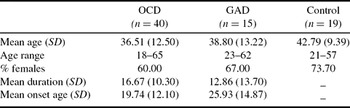
A summary of the participant biographical information gathered on all three groups is presented in Table 1. The groups did not differ significantly in age, F (2, 70) = 1.77, p >.05 or gender, χ2 (2, N = 74) = 1.10, p >.05. There was no significant difference between groups in terms of age of onset and mean duration of illness.
Descriptive statistics for clinical and control groups

Note: SD = standard deviation.
OCD and anxiety measures
Between-group comparisons were conducted using one-way ANOVAs for each clinical measure. Because significant heterogeneity of variance existed among the three groups for most of the clinical measures and their subscales, non-parametric tests (Kruskal-Wallis) were also conducted. These revealed the same significant between-group differences as the ANOVAs and confirmed that the differences were not a function of the heterogeneity of variance. The results of the ANOVAs are, therefore, reported.
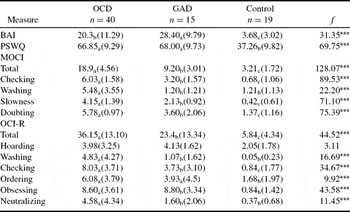
Significant between-group differences on all the OCD and anxiety measures and their subscales were evident (all ps <.001), with the exclusion of the OCI-R hoarding subscale. These results are shown in Table 2. Post hoc comparisons, using Tukey HSD tests, were subsequently conducted to examine these differences in more detail. These results are also included in Table 2.
Mean scores on OCD and anxiety measures

Notes: BAI = Beck Anxiety Inventory; MOCI = Maudsley Obsessional Compulsive Inventory; OCI-R = Obsessive Compulsive Inventory–Revised; PSWQ = Penn State Worry Questionnaire. Within each row, different subscripts indicate significant differences (p < .001) in the Tukey honestly significant difference comparisons (a >b > c). *** p < .001.
It is worth noting that there was no significant difference between the PSWQ scores of the OCD and GAD group (p> .05) and both groups scored significantly higher than the normal control group (ps< .001). Although high PSWQ scores are not uncommon for individuals with OCD (Molina and Borkovec, Reference Molina, Borkovec, Davey and Tallis1994), this result is inconsistent with previous findings where individuals with GAD have scored significantly higher than those with OCD (Brown et al., Reference Brown, Anthony and Barlow1992).
Comparison of levels of MT in OCD, GAD and non-clinical controls
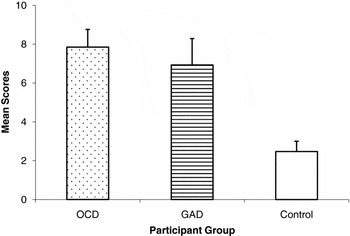
The results of a one-way ANOVA revealed a significant between-group difference in levels of MT, F (2, 68) = 7.91, p< .01. Post hoc analyses using Tukey HSD tests revealed no significant difference in mean MIS scores between the OCD and GAD group; however, as shown in Figure 1, both groups’ MIS scores were higher than that of the non-clinical control group (both ps< .01).
Mean scores on the MIS

Relationships between MIS and OCD scales
In the OCD group, MIS scores demonstrated a significant correlation with the OCI-R total score (r = .40, p< .05). This is consistent with the findings of Einstein and Menzies (Reference Einstein and Menzies2004a) and suggests that MT is related to OCD severity. However, no significant relationship was evident between MIS scores and the MOCI total score, which is contrary to Einstein and Menzies’ (Reference Einstein and Menzies2004b) findings in a non-clinical sample.
No significant correlations were evident between MIS scores in the OCD group and the washing and checking subscales of the MOCI and OCI-R (max. r = 0.20). These relationships remained non-significant when controlling for checking and washing scores respectively (max. r = 0.21). These results are partly consistent with the findings of Einstein and Menzies (Reference Einstein and Menzies2004a) where no significant correlation was seen between MIS scores and the OCI-R checking subscale. However, Einstein and Menzies (Reference Einstein and Menzies2004b) demonstrated positive correlations between MIS scores and the checking subscale of the MOCI, which differs from the present results.
Relationships between MIS scores and clinical variables
Regression analyses were used to explore whether MIS scores were related to age of onset and/or duration of illness in the OCD and GAD groups, controlling for severity of OCD (MOCI total) or anxiety (BAI total) respectively.
In the OCD group, age of onset was a significant predictor of MIS scores (t-2.12, p<.05), but duration of illness was not. Therefore, the earlier the age of onset, the higher the MIS score, independent of the duration or severity of OCD.
The opposite pattern of results was seen in the GAD group. Here, GAD duration was a significant predictor of MIS scores (t = 3.08, p<.01) but age of onset was not. This implies that an individual's thinking tends to become more magical the longer they have been anxious, independent of the age of onset or severity of anxiety. However it is also possible that episodes of anxiety may be longer in people with higher initial levels of MIS. A longitudinal study is needed to resolve this issue.
Discussion
MT in GAD
The findings did not support the primary hypothesis that the mean MIS scores of the OCD group would be significantly elevated compared to the GAD group. Instead, there was no significant difference between the mean MIS scores of the OCD and GAD groups. Furthermore, the MIS scores of the GAD group, like those of the OCD group, were significantly higher than those of the non-clinical control group. This finding was unexpected in view of previous findings where MT distinguished individuals with OCD from those with PD (Einstein and Menzies, Reference Einstein and Menzies2006) and suggest that MT may not be specific to OCD and may also be a feature in GAD. These findings are consistent with the suggestion that TAF, a derivative of MT, may also not be unique to OCD but feature in GAD. Superstitious metacognitive beliefs in GAD, such as, “If I worry about my health, I am less likely to get sick”, have been viewed as an expression of TAF beliefs as they imply that worry can influence external events (Borkovec et al., Reference Borkovec, Hazlett-Stevens and Diaz1999). These findings reinforce the magical quality of some worries reported by individuals with GAD. The results of the current study therefore add weight to previous claims that GAD is the closest neighbour to OCD amongst the various anxiety and mood disorders (Brown et al., Reference Brown, Anthony and Barlow1992). Although the worries in GAD and obsessions in OCD have been consistently distinguished in terms of their form and content (APA, 1994; Turner et al., Reference Turner, Beidel and Stanley1992), there is research to show that some obsessive thoughts may overlap with common worry themes in GAD, such as health (Wells and Papageorgiou, Reference Wells and Papageorgiou1998). Interestingly, the OCD group in this study did not score lower than the GAD group on the PSWQ, which suggests that some individuals with OCD may also worry excessively in addition to their OCD symptoms. These results support Tallis and De Silva's (Reference Tallis and De Silva1992) conclusions that worry may fuel obsessive compulsive behaviours.
It has also been questioned as to whether pathological worry in GAD may represent a mental ritual to neutralize anxiety, which would serve a similar purpose to that of covert compulsions in OCD by reducing distress and a feared outcome. Evidence in support of this hypothesis is the fact that worry has been found to act as a cognitive mechanism of avoidance of emotional experience (Borkovec, Reference Borkovec, Davey and Tallis1994). As both worrying and checking aim to prevent future harm, this has led to speculation that worry may be a cognitive variant of checking behaviour (Borkovec and Inz, Reference Borkovec and Inz1990).
Overt compulsive behaviours in GAD have also been found to be more prevalent than previously believed (Craske, Rapee, Jackel and Barlow, Reference Craske, Rapee, Jackel and Barlow1989; Shut, Castonguay and Borkovec, Reference Shut, Castonguay and Borkovec2001). A subset of GAD patients have been found to report checking behaviours in response to their worries, such as telephoning family members to confirm their safety or repeatedly making lists (Mackenzie, Christenson and Kroll, Reference Mackenzie, Christenson and Kroll1990). The results of the present study provide support for the presence of checking rituals in individuals with GAD, as the GAD group's mean scores on the OCI-R and MOCI checking scales were significantly higher than those of the non-clinical control group. Interestingly, checking behaviours have been significantly correlated with MT (Einstein and Menzies, Reference Einstein and Menzies2004a, Reference Einstein and Menziesb, Reference Einstein and Menzies2008). This may explain why MT is a feature of some individuals with GAD.
Clinically, these findings suggest that MT should be considered when conceptualizing GAD. Furthermore, it may be beneficial to assess levels of MT in individuals with GAD presenting for treatment as this cognitive bias may need to be targeted first to allow the individual to be more receptive to standard treatment for GAD. If individuals believe that their worries have the magical power to avert negative outcomes, the perceived risks associated with changing their behaviour may outweigh the benefits. This fear of changing may result in treatment failure. CBT techniques used to address TAF in OCD, such as behavioural experiments to challenge magical beliefs and historical reviews of disconfirmatory experiences (Wells, Reference Wells1997) may be useful in such instances. Some authors (e.g. Moulding and Kyrios, Reference Moulding and Kyrios2006; Fairfax, Reference Fairfax2008) have also suggested mindfulness-based CBT (Segal, Williams and Teasdale, Reference Segal, Williams and Teasdale2002) to address high levels of MT in OCD. This may therefore be appropriate for individuals with GAD and high levels of MT. This approach promotes a non-judgemental attitude to one's thoughts, which may indirectly reduce their salience and hence the need to control them or act upon them. This yielding of the need for control may reduce the need for MT and/or associated rituals (Moulding and Kyrios, Reference Moulding and Kyrios2006).
A further implication of the above finding is that it suggests that treatment for individuals with comorbid OCD and GAD and high levels of MT may be enhanced by addressing this common cognitive bias underlying both disorders.
MT in OCD
We had hypothesized that OCD checkers would have higher MIS scores than washers because contamination fears and their associated rituals may not necessarily require magical beliefs. However, a correlational analysis between MIS scores and the scores on the washing and checking subscales of the OCD measures did not reveal any significant relationships. This finding is counter to previous studies that have found either washers or checkers to have higher MIS scores (Einstein and Menzies, Reference Einstein and Menzies2004b, Reference Einstein and Menzies2006, Reference Einstein and Menzies2008). Despite the lack of a significant difference between these subtypes, the OCD group as a whole was characterized by significant levels of MT when compared to normal controls. This could suggest that MT could be a prominent feature of any symptom pattern in OCD if the individual has a general tendency to think magically.
Potential roles of MT in OCD and GAD
Regression analyses revealed that the greater the MIS scores in the OCD group, the younger the age of onset. This was independent of the duration and severity of the OCD. One explanation for this finding could be that elevated MT is likely to trigger likelihood TAF beliefs in individuals who are biologically predisposed to develop OCD, and thereby precipitate an earlier age of onset (Lee et al., Reference Lee, Cougle and Telch2005). These TAF beliefs may subsequently transform normal obsessions into abnormal obsessions and elicit neutralizing rituals in an attempt to avert negative outcomes.
In the GAD group, regression analyses implied that the longer individuals had suffered from GAD, the more they tended to endorse MT. This pattern was independent of their age of onset or severity of GAD. This possible increase in MT over time may be due to the reinforcement of superstitious positive beliefs related to worry, as the occurrences of feared events happen rarely (Borkovec, Hazlett-Stevens and Diaz, Reference Borkovec, Hazlett-Stevens and Diaz1999). Another possibility is that MT may be fuelled by the sense of the uncontrollability of worries in GAD, as MT is known to help individuals regain a sense of control (Bocci and Gordon, Reference Bocci and Gordon2007).
In summary, these results, albeit limited, convey that although MT may be a feature of both disorders, its exact role may differ.
Limitations and suggestions for future research
One limitation of this study was that structured diagnostic interviews were not conducted to confirm participants’ diagnoses and screen for comorbidity. However, standardized measures with recognized cut-off scores were used to confirm the diagnoses of OCD and GAD and screen for OCD in the control groups, which strengthened the design.
The unequal number of participants in the GAD (n = 15) and OCD group (n = 40) may reduce the strength of the findings. This difference was not intentional, as it was originally proposed that the OCD participants would be divided into subgroups of washers and checkers. However, insufficient participants met subgroup criteria and the OCD participants were therefore treated as a single group, which was considerably larger than either control group.
Inferences about the role of MT in OCD and GAD were conducted using regression analyses. These are, however, tentative and do not provide evidence of causality. Furthermore, the results of the regression analysis with the GAD group are of limited value due to the small sample size (n = 15), although this was sufficient to reveal a strong relationship between MT and duration of illness. Further research using larger sample group sizes is recommended to elucidate the differing roles that MT may play in OCD in GAD.
Our most important finding was that MT was prominent in a group of individuals with GAD and minimal obsessive compulsive symptoms. Replication of this study is recommended to confirm these findings and to explore both the presence and potential role of MT in a larger group of GAD participants. Furthermore, as MT was not found to be specific to OCD, future research is indicated to investigate this construct in other anxiety disorders, such as health anxiety, which has also been shown to be characterized by some superstitious beliefs (Berle and Starcevic, Reference Berle and Starcevic2005).
This study yielded some preliminary evidence to suggest that MT may increase an individual's vulnerability to develop OCD, but longitudinal research, such as that conducted by Abramowitz, Nelson, Rygwall and Khandker (Reference Abramowitz, Nelson, Rygwall and Khandker2007), is required to assess a causal hypothesis. Individuals could be assessed for the presence of MT and then followed up subsequent to a critical event that would be expected to produce intrusive thoughts, to determine whether or not they have developed OCD.
Finally, the finding that MIS scores correlated significantly with age of onset in individuals with OCD lends itself to further research comparing MT in individuals with early onset and late onset OCD.



Comments
No Comments have been published for this article.