INTRODUCTION
Due to major advances in the treatment of cancer, survival rates of cancer patients has increased and cancer patients are often being treated for prolonged periods of time. Hence, more patients and survivors are being taken care of by informal caregivers (Maguire & Pitceathly, Reference Maguire and Pitceathly2003; Yabroff & Kim, Reference Yabroff and Kim2009). Caregiving was found to have adverse effects on the quality-of-life of spouses who serve as primary informal caregivers to cancer patients (Maguire & Pitceathly, Reference Maguire and Pitceathly2003; Yabroff & Kim, Reference Yabroff and Kim2009; Northouse et al., Reference Northouse, Williams and Given2012), especially during advanced stages of the disease (Northouse et al., Reference Northouse, Mood and Montie2007). The demands of providing care for a person with cancer and coping with the implications of cancer within the family can lead to lower quality-of-life, emotional strain, and higher psychological stress among the caregivers. Finding meaning in the caregiving process may serve as a protective buffer against these effects.
The study described here focuses on finding meaning during the caregiving process among spouses of patients actively being treated with chemotherapy for colorectal cancer. Specifically, the study assesses the role of attachment styles and perceived social support from different agents as potential contributors to finding meaning in caregiving. Additionally, the study explores gender differences within this suggested process. The conceptualization of finding meaning as a positive outcome is in concordance with the psycho-oncology research that underscores the importance of assessing positive outcomes such as post-traumatic growth, finding benefits, hope and meaning for both patients and spouses (McClement & Chochinov, Reference McClements and Chochinov2008; Bellizzi & Blank, Reference Bellizzi and Blank2006; Kim et al., Reference Kim, Schultz and Carver2007).
CAREGIVING AND FINDING MEANING
Frankl's (Reference Frankl1967; Reference Frankl1978) theory of existentialism suggests that finding meaning is a basic motivational force and that meaning can be found in difficult situations that are not controllable. Coping with cancer might be perceived as a threatening, uncontrollable life event. As such, the diagnosis of cancer evokes existential thoughts and feelings (Kim et al., Reference Kim, Schultz and Carver2007) that challenge the perceived meaning of life. Finding meaning is an important aspect of coping with cancer for both patient and spouse. In the last decade, finding meaning was studied within the area of psycho-oncology (e.g., Ramfelt et al., Reference Ramfelt, Severinsson and Lützén2002; Yanez et al., Reference Yanez, Edmondsonm and Stanton2009) and served as the basis for the development of effective interventions for cancer patients (Greenstain & Breitbart, Reference Greenstein and Breitbart2000; Breitbart, Reference Breitbart2002; Breitbart et al., Reference Breitbart, Poppito and Rosenfeld2012).
In a context of caregivers of dementia patients, Farran et al. (Reference Farran, Miller and Kaufman1999) demonstrated the applicability of Frankl's assumptions about finding meaning (Frenkel, 1970; 1982) for the caregiver experience. In their conceptualization of caregiving, they emphasized the choices of the caregiver (e.g., reacting to the patient and caring for him or her), the values and responsibility of the caregiver for his or her actions (e.g., values regarding taking care within the family). They also stressed that the caregiver could find both provisional and ultimate meaning in the caregiving process (Farran et al., Reference Farran, Miller and Kaufman1999). Research on caregivers of cancer patients have shown that finding meaning is related to lower depression among spousal caregivers in hospice (Haley et al., Reference Haley, LaMode and Han2003).
Although the relationship between social support and meaning was not directly studied among cancer patients and their caregivers, studies in other contexts show that there is evidence for the ongoing construction of meaning as related to social support among elderly people (Krause, Reference Krause2007) and immigrants (Dunn & O'Brien, Reference Dunn and O'Brien2009). According to Dobbins (Reference Dobbins, Josselson, Liblich and McAdams2007), meaning is constructed within a social context and develops from ongoing interactions. As such, the stress of the caregiver does not stem from what the caregivers do but rather from the meaning they ascribe to what they do (Dobbins, Reference Dobbins, Josselson, Liblich and McAdams2007; Ayres, Reference Ayres2000).
SOCIAL SUPPORT, ATTACHMENT, AND CAREGIVING
Social support was found to be positively related to the well-being of both cancer patients and their caregivers (Hasson-Ohayon et al., Reference Hasson-Ohayon, Goldzweig and Braun2010; Rodin et al., 2007). Studies have demonstrated that among caregivers social support was related to less depression and higher life satisfaction (Haley et al., Reference Haley, LaMode and Han2003; Kim et al., Reference Kim, Schultz and Carver2007). Given that meaning, as mentioned above, is constructed within social contexts, social support may serve as an important facilitator of finding meaning for patients and caregivers.
In the context of cancer care, social support was discussed as conveyed through different agents: spouses, families, friends, and religious belief-based support (Goldzweig et al., Reference Goldzweig, Hasson-Ohayon and Meirovitz2010; Hasson-Ohayon et al., Reference Hasson-Ohayon, Goldzweig and Braun2010; Goldzweig et al., Reference Goldzweig, Andritsch and Hubert2009; Shelby et al., Reference Shelby, Crespin and Wells-Di Gregorion2008; Baider et al., Reference Baider, Ever-Hadani and Goldzweig2003). Spousal support and marital satisfaction was found to be related to lower depression among cancer patients (Braun et al., Reference Braun, Mikulincer and Rydall2007). It is important to note that while spouses were found to be an important source of support for the patients, they are also individuals who suffer and cope with the consequences of the illness of their loved ones (Petrie et al., Reference Petrie, Logan and DeGrasse2001; Braun et al., Reference Braun, Mikulincer and Rydall2007). Thus, the availability of the spouse as an agent of support for the patient may be limited by his or her own psychological distress and need for meaning and support.
The ability of the caregivers to utilize social support may be at least partially dependent on their attachment style. Research has shown that attachment orientation is important in understanding the caregivers' psychological outcomes (Kim et al., Reference Kim, Carver and Deci2008; Braun et al., Reference Braun, Mikulincer and Rydall2007). Specifically, it was found that secure attachment style is positively related to autonomous motives for and finding benefit in caregiving (Kim et al., Reference Kim, Carver and Deci2008). It was also found that anxious attachment style is positively related to depression among caregivers (Braun et al., Reference Braun, Mikulincer and Rydall2007). Studies of cancer patients that assessed both attachment and social support showed that the relationship between attachment styles and distress or depression is mediated by social support (Goldzweig et al., Reference Goldzweig, Hasson-Ohayon and Meirovitz2010).
CAREGIVER'S GENDER AND SOCIAL CONTRIBUTORS TO FINDING MEANING
Since there are gender differences in socialization factors that encourage women to nurture and be attentive to the needs of others (Baider & Bengel, Reference Baider and Bengel2001), it is reasonable to assume that men and women would experience the process of finding meaning in caregiving differently. Based on the socialization of women toward assuming the caregiver role it might be that for women social support would provide a greater basis for finding meaning in caregiving. Since attachment style was shown to be related to social support (Goldzweig et al., Reference Goldzweig, Hasson-Ohayon and Meirovitz2010), it might also be that it affects more the female spouse's finding meaning process than the male spouse's finding meaning process.
STUDY AIMS AND HYPOTHESES
The current study explores the relationship between attachment styles, social support, and finding meaning in caregiving among spousal caregivers of colorectal cancer patients. In addition, the study examines whether gender plays a moderating role in the relationship between attachment styles, social support, and finding meaning among caregivers. Based on the above literature review, it is hypothesized that (1) social support will be positively correlated with finding meaning among caregivers; (2) anxious and avoidance attachment styles will be negatively related to finding meaning among caregivers; (3) the interactions between social support and gender, and attachment style and gender will both be related to finding meaning. It is expected that for female caregivers the relationships between finding meaning and attachment and social support will be higher than for male caregivers.
METHODS
Participants
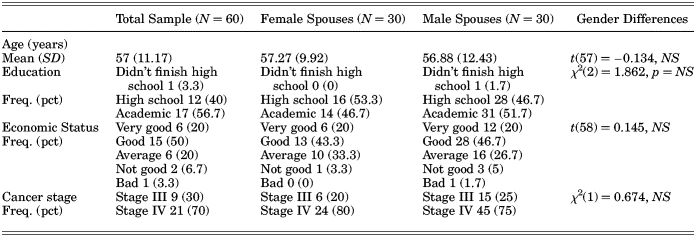
Participants recruited for this study were 60 spousal-caregivers (30 women and 30 men) of patients with colorectal cancer in Stages III or IV, recruited from two hospitals in Israel. Inclusion criteria were: (1) being married or having an obligatory relationship with the patient; (2) living with the patient; (3) being able to complete self-report in Hebrew; and (4) having a spouse who coped with cancer for at least three months. Response rate is estimated to be 70%, with no data collected regarding the refusals since it was not approved by the ethics committees (see limitations section). Socio-demographic data relating to the participants, as well as medical data regarding their spouses' illness, are presented in Table 1. No significant differences between male spouses and female spouses were found in any of the sample characteristics. In addition, no significant correlations were found between the socio-demographic variables and the study variables.
Socio-demographic data of participants and medical data of their spouses' illness

Procedure
The study was approved by the ethics committees of the two participating hospitals. In the first stage of the study, patients were approached by the research coordinator with the help of the oncology staff in the daycare units. The study aims were explained to the patients and permission to approach their spouses was obtained. Spouses' caregivers who agreed to participate were given an informed consent form and self-report questionnaires.
Instruments
Cancer Perceived Agents of Social Support (CPASS) (Goldzweig et al., Reference Goldzweig, Hasson-Ohayon and Meirovitz2010) is a 12-item questionnaire that combines two theoretical content facets of social support (agent of support: spouse, family, friends, spiritual community), and type of support (emotional, cognitive, instrumental). Each question assesses both facets. For example, the item “To what extent do you feel you are supported emotionally by your spouse?” represents the combination of emotional support (type of support) and spouse (agent of support). The answers are given on a five-point Likert scale (from 1 = not at all to 5 = a lot). The scale was found to be valid and reliable for both patients and spouses (Goldzweig et al., Reference Goldzweig, Hasson-Ohayon and Meirovitz2010; Hasson-Ohayon et al., Reference Hasson-Ohayon, Goldzweig and Braun2010). In the current study, we used the agent of support facet and calculated mean for each agent. The internal reliability values (Cronbach's Alpha) for the current study were found to be satisfactory and ranged from 0.78–0.93 for the various agents of support.
Experience in Close Relationship Scale (ECR) (Brennan et al., Reference Brennan, Clark, Shaver, Simpson and Rholes1998) is a 36-item scale that assesses avoidance and anxious attachment. Items include statements regarding emotions in relationships and participants are asked to rate their level of agreement with each statement on a seven-point Likert scale with 1 representing “strongly not agree”; 18 items assess avoidance attachment, and 18 items assess anxious attachment. In the current study, internal reliability values (Cronbach's Alpha) were found to be satisfactory: 0.89 for the anxious attachment subscale and 0.80 for the avoidance attachment subscale.
Finding Meaning through Caregiving Scale (FMTC) (Farran et al., Reference Farran, Miller and Kaufman1999) is a scale that was originally developed and used among caregivers of patients with Alzheimer's disease. The scale assesses positive aspects of caregiving and the meaning that accompanies the process. In the current study, the provisional subscale was used in order to focus on finding meaning in the daily life of caregiving. The scale consist of 19 items that represent statements regarding emotions while caregiving (e.g., “taking care of my partner brings meaning into my life”). Participants are asked to rate the level of agreement with each statement on a five-point Likert scale with 1 representing “strongly not agree.” In the current study, internal reliability value (Cronbach's Alpha) was found to be 0.92.
Statistical Analysis
Study variables were compared between male and female caregivers by means of multivariate analysis of variance (MANOVA). In addition, we calculated correlations between the study variables separately for men and women. As a final stage we conducted moderator analysis for gender by calculating separate regression equations for men and women (for use of regression in order to detect moderation effect, see Barron & Kenny, Reference Baron and Kenny1986). Finding meaning was the dependent variable and attachment styles and social support were the independent variables. In order to examine the difference between the slopes of the predictors in the two regression equations, we calculated a third regression for the whole sample in which we entered the predictors and the interactions between social support and attachment style with gender.
Power Considerations
Power calculations were based on Cohen's definitions for effect-size (Cohen, Reference Cohen1988) and were made using “G*Power” computer software (Faul et al., Reference Faul, Erdfelder, Lang and Buchner2007). We calculated power for regression equation with finding meaning as a dependent variable and seven predictors (gender, avoidance attachment, anxious attachment, social support, interaction between avoidance attachment and gender, interaction between anxious attachment and gender, interaction between social support and gender), given the sample of 60 participants, medium-large effects size (f 2 = 0.25) and alpha of 0.05, the power for the regression equation was 76%.
RESULTS
Descriptive Statistics of the Study Variables
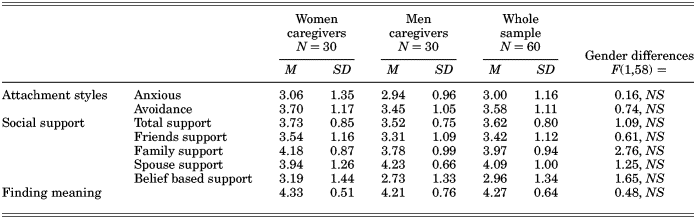
Means and standard deviations of the study variables are presented in Table 2. No significant gender differences were found with regard to these variables. Male and female caregivers reported similar levels of avoidance attachment, anxious attachment, social support and finding meaning.
Descriptive statistics of attachment styles, social support provided from different agents and finding meaning through caregiving

MANOVA for gender differences over all variables was not significant, F(7,52) = 1.50, P < 0.19
Correlations between Attachment Styles, Social Support Provided from Different Agents, and Finding Meaning
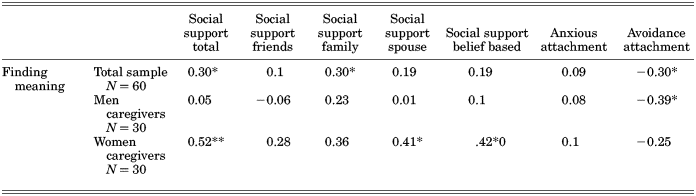
Pearson's correlation coefficients were calculated between finding meaning and the other study variables for the whole sample and separately for male and female caregivers (Table 3). As hypothesized, for the whole sample finding meaning was found to have significant, positive correlation with social support (total score and family subscale) and significant negative correlation with avoidance attachment style. No relationship was found between anxious attachment style and finding meaning among the whole sample.
Pearson correlations between attachment styles, social support and finding meaning

*P < 0.05; **P < 0.01; ***P < 0.001;
For men, no significant correlations were found between finding meaning and social support. For female caregivers, total social support, spouse support, and belief-based support were found to be significantly related to finding meaning. Friends and family social support were also found to be positively correlated to finding meaning, but the correlations did not reach significance. For both male and female caregivers, avoidance attachment style was found to be negatively correlated to finding meaning but the correlation was significant only for male caregivers.
Attachment Styles and Social Support and Gender as Possible Contributors to the Caregiving Meaning: Moderation Analysis
Table 4 presents multiple regressions for men and women. The predicted variable was finding meaning and the predictors were anxious attachment, avoidance attachment, and the amount of social support. The decision to use an aggregated measure of social support was based on the high internal consistency of the scale (Cronbach's Alpha = 0.87). All variables were centered prior to the analysis.
Regression of avoidance attachment, anxious attachment, social support and finding meaning among women and men caregivers

*P < 0.05, **P < 0.01.
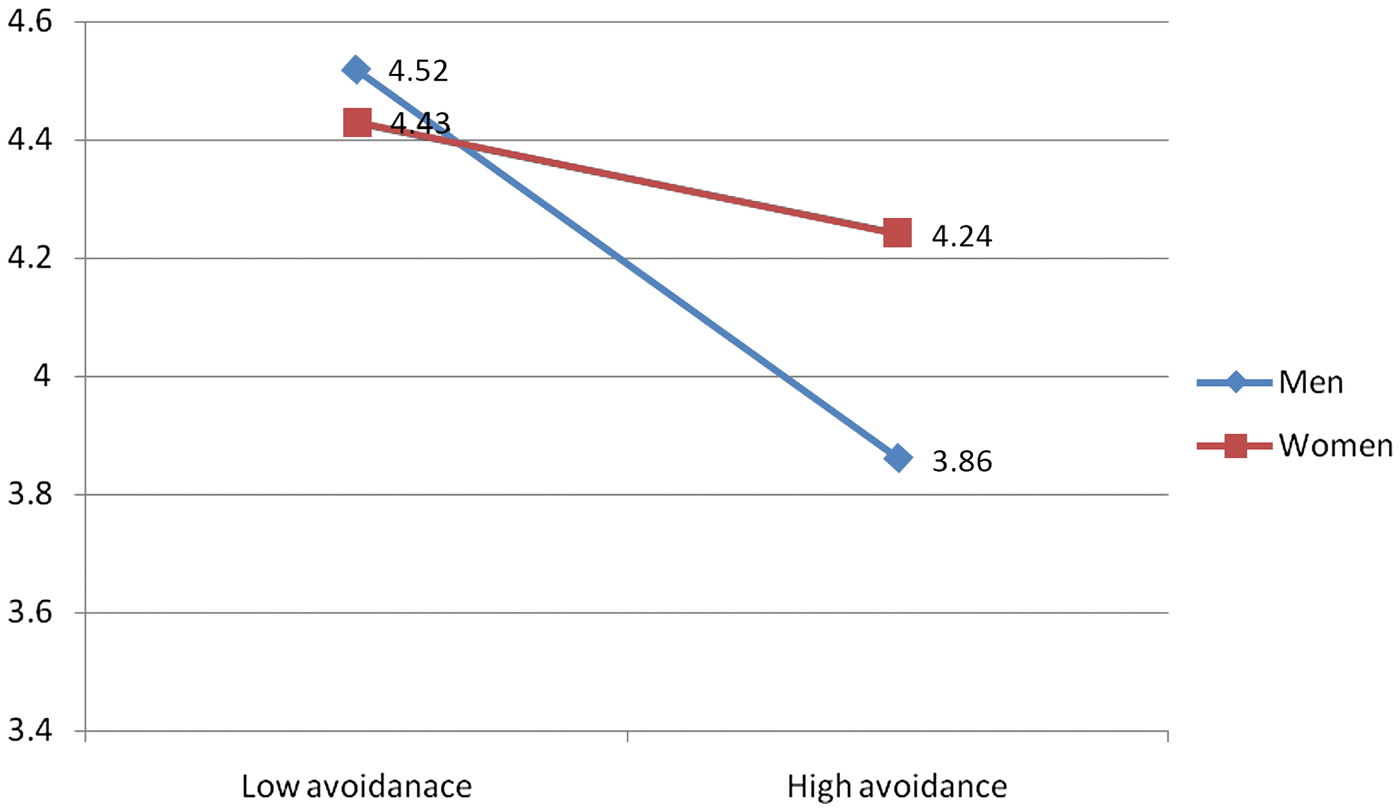
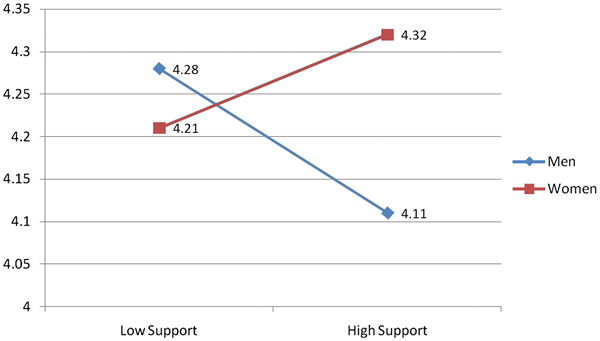
Both regression equations were found to be significant (men: adjusted R 2 = 0.18, F(3,26) = 3.06, p < 0.046; women: adjusted R 2 = 0.29, F(3,26) = 3.06, p < 0.030). As can be seen in Table 4, avoidance attachment was the only significant predictor of finding meaning among men, while social support was the only significant predictor of finding meaning among women. In order to test the differences between the slopes (Bs) of the predictors in the equations, we calculated a general regression equation for the total sample with gender, attachment styles, social support, and interaction between social support and gender as predictors for finding meaning. Interactions were calculated as products of gender (men = 0, women = 1) and the relevant variables. The interaction of gender and avoidance attachment and social support were the only significant interactions (gender × avoidance attachment: t = 2.50, p < 0.016; gender × social support: t = 2.27, p < 0.028). Figures 1 and 2 demonstrate the interaction effect of gender and avoidance attachment and of gender and social support. The sample was split according to the median of avoidance attachment (Fig. 1) and according to the median of social support (Fig. 2), and the mean of finding meaning was calculated separately for men and women in each half of the sample.
Levels of finding meaning by gender and avoidant attachment.

Levels of finding meaning by gender and social support.

DISCUSSION
The current study examines the possible relationships between attachment styles, social support, and finding meaning among spouses-caregivers of colorectal cancer patients. It also tested the possible moderating role of gender with regard to the relationships between these three variables. Results showed that among the total sample, avoidance attachment is related negatively to finding meaning while anxious attachment does not play a role in finding meaning. It also shows the different roles that social support and avoidance attachment play in finding meaning among men and women.
For the total sample it seems that avoidance attachment and social support share similar characteristics in explaining caregiving meaning (avoidance is negatively related to finding meaning while social support is positively related to finding meaning). Thus, finding meaning is related to the attachment style as well as to the here and now perceived support of the caregiver. But, examination of interactions between gender and social support and avoidance attachment revealed that social support plays a major (positive) role in finding meaning among women while avoidance attachment plays a major (negative) role in finding meaning among men.
Attachment-Related Avoidance and Finding Meaning in Caregiving
Two possible explanations may account for the negative relationship between avoidance attachment and finding meaning through caregiving and the lack of relationship between anxious attachments and finding meaning through caregiving. The first explanation refers to the ability of the spouse to seek support from agents outside the patient-caregiver dyad. The lack of relationship between anxious attachment and finding meaning, together with literature that emphasizes meaning as constructed through social interactions (Dobbins, Reference Dobbins, Josselson, Liblich and McAdams2007), suggests that anxious attachment to others does not necessarily result in reduced social support and therefore does not impact on meaning construction. Caregivers with high anxious attachment style may still take part in social interactions, while caregivers with high avoidance style are less likely to take part in social interactions that could provide them with support and ways of constructing meaning. This idea is consistent with the tendency of people with attachment-related avoidance toward self-reliance and emotional distance (Mikulincer & Shaver, Reference Mikulincer and Shaver2007). In comparison, persons with attachment-related anxiety are concerned with their desire for closeness and insecurity (Mikulincer & Shaver, Reference Mikulincer and Shaver2007) and this desire for intimacy may facilitate meaning construction through interaction.
The second additional explanation refers to the ability of the spouse to provide support within the dyad framework. Coping with a spouse's cancer is a stressful process that encompasses challenges to the well-being of the caregiver. Since stressful events activate the attachment internal models and different forms of providing and seeking support (Mikulincer & Shaver, Reference Mikulincer and Shaver2007) it is reasonable that caregivers with anxious attachment seek to be close to their spouses who are coping with cancer.
By comparison, caregivers with avoidance attachment style might perceive the needs of their spouse (e.g., expecting him or her to provide emotional support) as threatening and interfering. This perception may challenge the process of finding meaning while caregiving since the lack of intimacy with their spouse reduces the ability to construct meaning. This idea is consistent with studies showing that avoidance attachment is related to less involvement in caregiving among couples (Carnelley et al., Reference Carnelley, Pietromonaco and Jaffe1996). Studies on caregiving in cancer (Kim & Carver, Reference Kim, Schultz and Carver2007) and on caregiving in other medical settings (Carpenter, Reference Carpenter2001; Crispi et al., Reference Crispi, Schiaffino and Berman1997) have shown that the extent of difficulties in caregiving is related to attachment orientations and that caregivers with secure attachment are more comfortable with providing support to their cancer patient spouse. Thus, caregivers with secure attachment who feel comfortable in providing support are more likely to find meaning in this process.
Gender Differences, Attachment, Social Support and Finding Meaning in Caregiving
A review of studies on attachment and relationship satisfaction conducted by Mikulincer and Shaver (Reference Mikulincer and Shaver2007) suggests that anxious and avoidance attachment styles are both predictive of women's satisfaction, whereas avoidance attachment is more predictive of men's satisfaction from the relationship than anxious attachment. They suggest that gender socialization that emphasizes men as independent and less emotional is exacerbated by attachment avoidance (Mikulincer & Shaver, Reference Mikulincer and Shaver2007).
The finding in the current study that discovering meaning in caregiving among male spouses is affected by their avoidance attachment seems to comply with the above idea that gender and avoidance attachment interact in their effects on outcome. An interaction between gender and avoidance attachment was also found by Kim and Carver (Reference Kim, Schultz and Carver2007) in their study on caregiving and attachment. They found that among male spouses (though not among female spouses), avoidance attachment was related to the emotional care of the patient (Kim & Carver, Reference Kim, Schultz and Carver2007).
While avoidance attachment seems to be an important contributor to finding meaning among male caregivers, social support seems to have the same effect among female caregivers. The effect of social support on the psychological outcome of caregivers of cancer patients has been studied and discussed extensively (e.g., Haley et al., Reference Haley, LaMode and Han2003; Kim et al., Reference Kim, Schultz and Carver2007). This important role of social support seems most relevant when assessing caregiving meaning since this meaning is suggested to have been constructed via social interactions (Dobbins, Reference Dobbins, Josselson, Liblich and McAdams2007). However, the current study suggests that for female caregivers meaning construction is more affected by their social exchanges than the meaning construction of male caregivers. Thus, women, in comparison to men, utilize their social support as a way of constructing their meaning in performing the caregiver role. This implies that the degree of social support by itself is not a sufficient indicator of psychological outcome but rather the way it is utilized. As mentioned, in this study, the impact of social support was found to be moderated by gender.
STUDY LIMITATIONS AND FUTURE DIRECTIONS
Several limitations of the current study should be taken into consideration. First, the study's cross-sectional design does not rule out the possibility that finding meaning affects social support and attachment style. Although this possibility seems less likely, it might be that other factors impact finding meaning and that this meaning impacts the caregivers' social interactions. Second, the study sample was composed of 60 spousal-caregivers (30 women and 30 men) of patients with colorectal cancer in Stages III or IV. This sample might be too small to allow for other results to appear. In addition, this sample is homogenous in terms of illness stage and type of cancer and conclusions might differ in different stages and types of illness. In addition, accrual rate of the sample is estimated to be 70%, with no data collected regarding the refusals since collecting this data wasn't approved by the ethics committee. Accordingly, future longitudinal studies conducted among a larger and more heterogeneous sample that would examine additional possible factors impacting caregiving meaning should be conducted to further explore the important process of constructing meaning while caregiving. It might also be important to add outcome variables of distress, such as depression, to obtain a broader picture of finding meaning implications, and to examine the possible moderating role of duration of relationship between partners.
CONCLUSIONS AND STUDY'S IMPLICATIONS
Exploring and understanding the caregiver experience, and its psychological consequences and contributors to it is important in light of the growing caregiver population. In addition, having meaning while caregiving seems to be a significant feature of this experience, yet limited research has been conducted to examine factors that contribute to it. The current research suggests that avoidance attachment, and not anxious attachment, is negatively related to caregiving meaning. In addition, both social support and avoidance attachment interact with gender in explaining caregiving meaning. For male caregivers, avoidance attachment contributes to finding meaning, while for women social support contributes to finding meaning. These gender differences imply that meaning-based psychological interventions might benefit from tailoring specific considerations for male and female caregivers. For example, women may be empowered to develop and maintain social support, while men may need to explore other resources that will enable meaning construction. In addition, considering gender and attachment while tailoring interventions for caregivers was also suggested by Kim and Carver (Reference Kim, Schultz and Carver2007). These kinds of considerations should play a key role in evidence-based tailored interventions for caregivers who may improve the quality-of-life of both the caregiver and the patient. These considerations should be integrated with the conclusions of a recent review on the effectiveness of interventions for informal caregivers (Applebaum & Breitbart, Reference Applebaum and Breitbart2012) that stress the feasibility and effectiveness of a structured, goal oriented, integrative and time limited interventions.