Over the last decade, the notion of “encounter” has been gaining momentum in the social sciences, in general, and in urban geography, in particular. The term has been broadly used in scholarly work to portray interest in social diversity, urban difference and prejudice, and how people negotiate difference in their everyday lives.Footnote 2 According to Helen F. Wilson, the term “encounter” is “far from a general term for meeting,”Footnote 3 but is rather “a distinctive event of relations” that should be “placed firmly within the remits of difference, rupture and surprise,”Footnote 4 and which has the ability to touch upon multiple dimensions of reality simultaneously, such as history, materiality, race, and space. By reviewing the work of various researchers, Wilson notes: “scholars working in this area have also paid considerable attention to the spaces of encounter, to consider how encounters shape space but are also shaped by it.”Footnote 5 These scholars have examined encounters as they happened across a variety of spaces such as schools and universities, malls, public places, transit infrastructures, streets and plazas, and spaces of leisure and socializing. The sum of these interactions led to Wilson's conclusion that “the city is not a container in which encounters occur but is rather made from encounters.”Footnote 6 Indeed, the scholarly work on the geographies of encounter has focused attention on the city and its spaces; but what kind of encounters take place in “other” spaces, like a refugee camp? And how much of an impact do these encounters have on space?
Encounters in Camps
One of the most obvious and expected types of encounters in a refugee camp are those between refugees and humanitarian workers. These encounters are usually shaped by power relations constructed and practiced within the space of the camp itself: the refugees act simultaneously as the victim, the assisted, and the governed, while the humanitarian workers are positioned as the active aid providers and governors.Footnote 7 Scholars argue that these power dynamics render the encounters between refugees and humanitarian workers as relations based on “mistrust.”Footnote 8 Nonetheless, recent research highlights alternative theories of camp encounters. For instance, Stavinoha and Ramakrishnan noticed that the presence of volunteers in camps, or what they call the “refugee-volunteer” encounter, have a subversive impact on power relationship between refugees and aid providers. They suggest that the “everyday refugee-volunteer encounters contrast in subtle but significant ways with the relations traditionally enacted by aid workers.”Footnote 9 Subsequently, the “volunteers’ presence plays an important role in re-humanizing and re-politicizing these spaces, thereby challenging – even if momentarily – dominant humanitarian logics.”Footnote 10 Stavinoha and Ramakrishnan therefore address the impact of these new actors within camps on the traditional “refugee-humanitarian” encounter, and highlight the importance of assessing shifting relations of power relations within the camps.
Another less explored type of encounter in camps are the “refugee-refugee” encounters. Elena Fiddian-Qasmiyeh's research in the Beddawi refugee camp in Lebanon shows how the expected “refugee-humanitarian” encounters were replaced by “refugee-refugee” encounters, where Syrian and Palestinian-Syrian refugees were hosted by Palestinian-Lebanese refugees. Her focus on these sorts of inter-refugee encounters drew attention to the overlapping nature of displacement, which has led to a “blurring of the categories of ‘displaced person’ and ‘host’”Footnote 11 and has situated the refugee in an entangled relationship between state sovereignties,Footnote 12 borders, spaces of containment, and the transnational networks of mobility. While Fiddian-Qasmiyeh's observations on the “refugee-refugee” encounter opens the door for further research, she does not fully explore the complexities and conditions in which these encounters happen. Moreover, further observations on the “refugee-refugee” encounters can be traced – but rather subtly – in the ethnographic work of Julie Peteet,Footnote 13 Liisa Malkki,Footnote 14 and Jennifer Hyndman.Footnote 15 Therefore, a committed and deep focus on “encounters” in refugee camps, and their impact on space and materiality, is still lacking.
This paper aims to highlight the significance of encounters in refugee camps by uncovering the multiplicity of these encounters, their characteristics, and their impact on space. Taking Zaatari camp in Jordan as a case study, it underscores three types of encounters: “refugee-refugee,” the “refugee-humanitarian,” and the “refugee-more-than-human.” Each of these encounters is explored in relation to its own characteristics and features. For instance, the “refugee-refugee” encounters are discussed against the backdrop of humanitarian mappings and refugees’ “population profile.” By contrasting refugees’ testimonies with these mappings, the importance of sociocultural and urban identities is highlighted. These identities, it will be argued further, are to be understood not as static but instead as dynamic and hybrid.
Conversely, the “refugee-humanitarian” encounters accentuate the unfolding of power relations between refugees and humanitarian workers in camps. The humanitarian language, vocabulary, and trainings affect refugees by introducing “foreign” elements that can be traced in refugees’ everyday lives. In their extreme form, however, these encounters can have a spatial impact on the camp, a one that reinforces the boundaries of separation between refugees and humanitarian workers and aims to reenact the disciplinary power relations expected to take place in that context. Lastly, building on Swanton's concept of the “more-than-human” encounters,Footnote 16 “refugee-more-than-human” encounters allow us to revisit the ways in which refugees develop relations with new materials and spatial typologies found in camps. In that regard, shelter, with its spaces and materialities and other “humanitarian innovations,” plays an important role. Drawing on the examples given for each type of encounter, the paper argues that the core purpose of “encounters” is to generate learnings (i.e., knowledge), upon which decisions with regard to space are taken. These decisions can either reinforce boundaries based on race and ethnicity – such as the cornering of Bedouins in Zaatari camp – or they can allow new hybrid spatial and material realities to emerge – such as the dwellings constructed out of shelters. Based on that, this paper suggests that “encounter” is a crucial point for understanding – from a human angle, not theoretical – the complex socio-spatial and material composition of refugee camps. While it focuses on the camp space, it also shows that “encounter” is an important notion that needs to be explored further in other contexts – inside and outside camps. Moreover, the paper shows how various kinds of encounters can lead to concrete changes within the camp space. It is thusly incumbent on architects and planners to allow for the “new” and the “unexpected” to emerge spontaneously as a result of these encounters and, accordingly, to give more flexibility and adaptability to the camp's design and planning.
Methodology and Approach
This paper draws on Wilson's understanding of encounters as events characterized by a sense of rupture, shock, and surprise,Footnote 17 and it also builds on my embedded knowledge as a resident of Syria before 2011. During this period, I was able to familiarize myself with sociocultural differences between Syrians, especially in regard to urban identities, dialects, ways of dressing, lifestyle, and traditions. In her book The Battle for Home Marwa Al-Sabouni sheds light on how the urbanization of a city like Homs was influenced by the different urban identities and distinctions between Sunnis, Christians, and Alawites who settled on the periphery of the city. These urban identities, and how they have spatially contributed to dividing Syrian cities, were considered to have played a role in the eruption of civil war.Footnote 18 Finally, the findings presented here are the result of various periods of fieldwork conducted between 2014 and 2018 focusing on the relationship between refugees and urban space in Zaatari camp. This work included 15 semi-structured interviews and 2 informal discussions, as well as participatory observations and walk-along interviews with refugees and over 10 semi-structured interviews with humanitarian workers.Footnote 19
Zaatari Camp and the Problem of Humanitarian Mappings
Since its establishment in July 2012 in Jordan, Zaatari camp has turned into a socio-spatial and managerial experiment. The camp was initially opened to host around 10,000 Syrian refugees who arrived at the borders without official documents. However, a few months later, and as people started settling in tents, the number of arrivals grew significantly, and the size of the camp expanded. In mid 2013, the camp grew to the size of a small city rather than a village, with over 200,000 refugees, and the camp management gradually replaced its initial tent structures with prefabs and caravans. Finally, around 2014, the number of refugees stabilized at around 80,000.
During this process, humanitarian organizations began to collect statistics and conduct mappings to keep track of the flows of refugees. In one of the latest surveys of the camp's population, in 2014, it was shown that 83.1% of refugees originated from the governorate of Daraa, 14% from the governorate of Rural Damascus, 1.8% from the governorate of Homs, 1.1% from the governorate of Damascus, and 0.8% from other areas. Of the 83.1% of the refugees who came from the governorate of Daraa, 48.6% came from the sub-governorate of Daraa, 29.6% from Izraa, and 21.8% from As-Sanamayn.Footnote 20 These statistical categories offer no clues about the life of these refugees or their cultural backgrounds. For instance, a sub-governorate like Daraa includes cities, towns, and small villages with tight-knit communities as well as Bedouin communities that have distinctive habits and cultural mores centered around a nomadic lifestyle. Therefore, while these statistics are designed as a “population profile” to assist relief organizations in managing the camp, they still flatten a diverse population under homogenous and dehistoricized categories.Footnote 21
Refugees Encountering Refugees
The encounters between Syrian refugees in Zaatari camp, or the “refugee-refugee” encounters, cannot be understood without regard to their respective cultures and backgrounds. In fact, Wilson's notion of “difference, rupture and surprise”Footnote 22 appeared clearly in the ways Syrians perceived “others” who they thought expressed different cultural preferences and habits. City dwellers, for instance, had difficulties integrating with the majority demographic of the camp population: rural dwellers coming from different areas in southern Syria. For example, Omar, a 27-year-old refugee from Damascus, described the weddings of his peer villagers as such:
I don't go to their weddings anymore . . . I find it weird. Even the songs and chanting I don't understand . . . I feel like a stranger. . . . I'm afraid to act something so I would be wrongly understood. I was asked to go to a wedding the other day, but I refused! I can't integrate with them even though I tried! The other day I had to go to a wedding of a close friend of mine. I simply did not like it. . . . A guy playing keyboard loudly all day, and people dancing Dabkeh, and noise! Two days of dancing, and then three days after wedding ceremonies. Is that normal? This is not a wedding; this is a ‘party’ [in English]. Our weddings in Damascus were not like this, two hours, rings, and a small event, that's it.
Here, Omar clearly shows his prejudice towards the culture and traditions of his fellow camp dwellers from the countryside. In that sense, he made a clear-cut distinction between the culture of the city and that of the village; however, this rural-urban divide is not always as simple as it may seem. Some encounters between refugees caused them to question their own identity and cultural preconceptions. Take for instance the story of Nidal, a 32-year-old raised in the suburbs of Damascus, who hailed from the small town of Sheikh Maskeen in Daraa. Moving to the camp with his relatives, he was confronted with his “difference” in an unexpected way:
I tried to integrate and make people think that I am just like them. . . . I always repeat I am like you; I'm also from Daraa . . . But they keep treating me differently. Whatever happens they say immediately: you are Ibn al-Sham [a Damascene]!Footnote 23 Maybe it is true, I am different. . . . People from cities are different. . . . When you live in Damascus you are used to a certain lifestyle. You might have lots of friends and social relations outside, but when you come back home and close the door, it means you are by yourself, and nobody has the right to disturb you or interfere with your life. Here, I started to hear people gossiping, oh, she made this, and she made that. . . . Rural society is much more open towards each other than in cities, they know each other much more and have stronger relations. . . . But this made my life miserable here. They kept interfering in my choices. Even the Zinco I put to prevent my door from being exposed to the main street, they ask me why I put it there! I regret that I came to this area . . . although I am next to my relatives.
Though there are endless encounters in a camp like Zaatari taking place between refugees, these aforementioned examples give glimpses into the importance of sociocultural and urban/rural identity in unpacking the “refugee-refugee” encounters in the context of a camp. The former examples show the difficulty of understanding the impact and meanings of these encounters without closer consideration of the refugees’ particular backgrounds, culture, and sometimes “hybrid” urban identities.
Refugees Encountering Humanitarian Workers
As mentioned above, Zaatari camp has become over time a social and managerial experiment and thus a destination for filmmakers, journalists, movie stars, ambassadors, politicians, and, most importantly, humanitarian workers from all over the world, employed at one of the many NGOs operating in the camp. The “refugee-humanitarian” encounters, therefore, occurred on a daily basis and in countless ways. For instance, many Syrians in Zaatari camp began learning English in order to communicate with humanitarian workers with international backgrounds and to secure higher “volunteering”Footnote 24 positions at the various NGOs,Footnote 25 while others began to acquire a new “humanitarian vocabulary.” For instance, while I stood with a refugee woman and her six-year-old son, she pushed him to show off his vocabulary to me: “Explain to ‘mmo [uncle] what al-Nūʿ al-Ijtimāʿi means!” While the term literally translates into Arabic as the “social type,” it is an academic translation of the term “gender,” and is rarely used in colloquial Arabic. The absurdity of a highly academic term coming from the mouth of a poor refugee child conveyed the strangeness of some “refugee-humanitarian” encounters and their parachuted programs on refugees.
Moreover, the “refugee-humanitarian” encounters expose refugees to new realities that existed outside the normal course of life in pre-war Syria. As a young male refugee explained while placing his certificates on the ground: “I have done over 40 workshops and courses with different NGOs in the camp, and I am only 21. You know, it is an opportunity that one wouldn't have had in Syria.” In that sense, the “refugee-humanitarian” encounters offer refugees new opportunities that would be difficult to find in other spaces. These encounters are multi-faceted and take place at different times and locations and with different intensities; but they are always power permeated. Particularly because they are conditioned by the fact that the humanitarian worker is always the giver, and the caretaker, and the refugee is the receiver, and the victim. The attempt to reverse this equation can lead to conflicts, especially that “the active refugee is a scandalous hypothesis.”Footnote 26 For example, between 2012 and 2013, some “refugee-humanitarian” encounters in Zaatari camp escalated into riots. Tensions between refugees and aid providers was due in part to over-population and the resulting lack of sufficient humanitarian assistance.Footnote 27 These riots have frightened humanitarian workers, leading to the erection of extensive fencing around the camp facilities and NGO spaces. The camp manager Kilian Kleinschmidt explained this spatial practice as a defensive approach to protect the safety of humanitarian actors in the camp on which he was responsible. “What else do you expect us to do! If we don't do that [build double fences with a barrier in between], refugees will cut through the fences or dig in the ground and come to us!” he explained.Footnote 28 Such fears have also influenced the planning of facilities such as gas-cylinder dispensation areas. As the engineer explained to me: “I was asked to make sure that humanitarian workers delivering the gas cylinders to refugees are safe. So, I designed the center in a way that refugees have to stand in a narrow line and will only receive their gas cylinder after reaching a room with two windows. On one of the sides, the humanitarian worker would place the gas cylinder and on the other, a refugee would be able to pick up, so I reduced the contact between the two.”
In sum, “refugee-humanitarian” encounters can be diverse. They can be charged with fear and mistrust, effecting the use of space in a negative way. But they can also offer new opportunities and exposure to different realities (vocabulary, languages, culture of practice) that would not have been available for refugees in their places of origin. One of these aspects is also the “exceptional” materiality of the camp.
Refugees Encountering the “More-than-Human”
Until recently, literature on “encounters” has focused on human-human interactions. Dan Swanton, however, suggests that encounters cannot be separated from non-human elements as well:
There is a tendency to focus primarily on the coming together of human strangers in much of this literature, and yet in cities we never only encounter other human bodies. Everyday urban experience is made up of all kinds of other encounters with myriad material things (architecture, infrastructures, everyday design and technologies, non-human bodies); visual cultures (from ubiquitous advertisements to signs and other technologies of instruction); soundscapes; smells; atmospheres; ‘structures of feeling’; memories; ghosts. . . . As such, my concern is that we risk missing something when we forget, or diminish, these other urban encounters.Footnote 29
Indeed, in addition to encountering humanitarian workers and other refugees, refugees also encounter “more-than-human” elements, including shelters, spaces, and materialities in the camp. Inside the camp, they meet new architectures and “humanitarian innovations.” For instance, it is often left unsaid that many of the refugees, who are living temporarily in tents, had never previously encountered a tent. Such encounters often unfold with absurdity and shock, as Yasmine, 40, explained: “We used to live in a house in Homs, you know, a flat with walls. Imagine if you were suddenly asked to live in a tent! We didn't even know how to erect it and set it up, but my husband and I had to learn how to do so.” Encountering the tent, therefore, resulted in a novel form of learning about spatial typology.
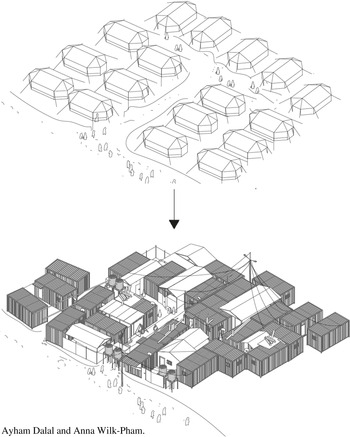
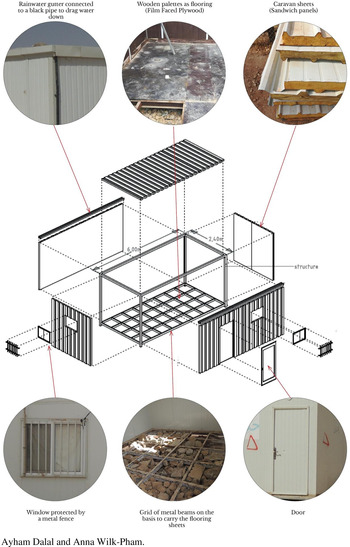
Many refugees also encounter the caravan (or the prefab) for the first time while living in the camp. As a new type of shelter, caravans were offered to refugees as a substitute for tents. Initially, this shelter typology – which resembles an empty room of around 5 × 3×2 meters was also new to refugees. Due to its simple geometry, it was used as a private living or sleeping room. However, later on, the multiple encounters with this “new” type of shelter resulted in a unique form of knowledge about space and materiality that is unique to the space of the camp. This knowledge, emerging from “more-than-human” encounters, helped refugees transform their shelters into dwellings [Figure 1].Footnote 30 For instance, refugees’ encounters with the caravan pushed them to think about and question its capacities and characteristics, and adapt accordingly. While the caravans are not made to be mobile (they are delivered to the camp with a trailer truck), refugees found ways of making them so. As 32-year-old Mona commented: “You would see the caravan walking around the camp with legs on its own!” That is because refugees learned how to move the caravans by taking away their floors and carrying the prefab from its underground metal structure. Similar ingenious learnings were made in regard to the caravan structure [Figure 2]. For instance, refugees became experts in adapting and repurposing their caravans by learning how to shorten its structure, use its sheets as building materials, cut through it, replace its windows, and use it as a structural weight system to install metallic roof structures and fences. Through countless encounters, these lessons in space and materiality formed a distinctive and unique body of knowledge about caravans and how they can be used architectonically as living structures. While this knowledge evolved into a profession held by so-called “caravan realtors,” as they later became known, a reverse impact of these encounters was also possible. For instance, young refugees who were born in Zaatari camp had less encounters with normal architectures. A young refugee who had left the camp for the first time to visit Amman had exclaimed: “Look mom, people here are smarter than us! They are putting their caravans above each other!” Here, the “refugee-more-than-human” encounters encouraged this young boy to directly compare his dwelling, made of flat containers, with the apartment buildings encountered in the city, seeming to the child like “caravans” stacked on top of each other in tall columns. Encounters offer the opportunity to reflect, compare, and learn.
The transition from tented settlement to caravanized dwellings in Zaatari camp.

The anatomy of the caravan as a new form of knowledge resulting from the “refugee-more-than-human” encounter.

Other examples of “more-than-human” encounters involve the dwellings constructed by refugees and the materials they choose for that purpose, in addition to using the caravans. According to Swanton, the “more-than-human” encounters are often associated with processes of racialization and differentiation.Footnote 31 This appears in the case of Leila, a 23-year-old from the Damascene suburbs. She observed the different way in which her friend's family constructed their dwelling:
I was surprised to see how my friend from Inkhil [village] lives. Their house is open to their auntie's house, and their auntie's house is open to the other auntie's house . . . it is like a salon opened to another salon, to another salon. . . . After all, they are tribes from Daraa . . . they are comfortable to live with each other! For us it is different. If a guy gets married, he needs to move out. In Daraa, they like that al-Kinneh [sister-in-law] remains in the house. Well, we like it as well, but for a short period. But, if you enter their house [in the camp] anytime, you find Mart al-ʿmm [mother-in-law], al-Selfeh [sister-in-law], and Ibn al- Selfeh [siblings-in-law]! For us this was impossible! In Syria we stayed with our auntie two months before coming to the camp, and we barely handled it! We are also rural people, but not like this.
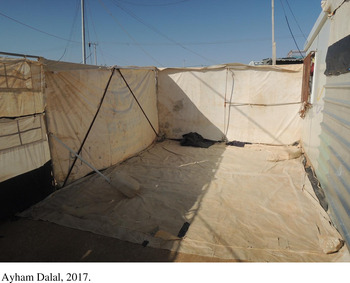
This shows how the “refugee-refugee” encounters are interwoven with, and inseparable from, space. While Leila had scarcely thought of her friend as “different,” since both of them hailed from rural areas, the encounter with her familial living space suddenly highlighted the “difference.” This distinction was also associated with materiality. For instance, rural and city dwellers both made the observation that, although the camp has been generally “caravanized” (i.e., its structures replaced with caravans and metal sheets), Bedouin communities continued to use remnants of tents and plastic sheets (Mshammʿ) in the construction of their dwellings [Figure 3]. As Omar noticed:
Bedouins are everywhere in this area. . . . If you want to know how to recognize them, just look around and you will see houses wrapped with Mshammʿ [plastic sheets], bags, wires. . . . You would recognize them mostly from the Mshammʿ they keep using, although caravans and metal sheets are available for construction.
From that perspective, the “refugee-more-than-human” encounters resulted in a new type of learning – one associated with cultures, identities and the construction of differences. A dwelling wrapped with tents and plastic sheets was, in Omar's view, most likely to belong to a Bedouin family. These examples illuminate the significance of Swanton's insight into the ubiquity of “more-than-human” encounters and their impact on space itself.
A dwelling built by a Bedouin family using remnants of tents.

Learning and the Impact of Encounters on Space
As shown so far, encounters in a refugee camp are multiple, yet can be categorized in three helpful ways: “refugee-refugee,” “refugee-humanitarian,” and “refugee-more-than-human.” The common feature of these encounters is their ability to produce new types of learning – whether about space, culture, identity, language, architecture, or race. The process of learning from these myriad encounters with other people and other objects impact space in the refugee camp in two primary ways: it either reifies existing boundaries between different groups or it opens up new and hybrid spaces.
For example, the tenser “refugee-humanitarian” encounters during the first years of the Zaatari camps’ existence led to the reinforcement of boundaries through double fencing and the addition of wrapped wire and spikes around certain camp structures to more tightly control the points of contact between humanitarian workers and refugees. Similarly, in some “refugee-refugee” encounters, both rural and city dwellers found the Bedouin cultures and habits in the camp to be problematic and disturbing. As Omar, the city dweller, explained:
Bedouins have a different lifestyle . . . they have no problem with leaving their kids running outside in the streets barefoot and naked, or pissing outside and playing in mud! This is not acceptable for us. We are conservative communities.
Yet, villagers perceived these encounters – with their subsequent tensions – as an extension of the historical relations between the two communities. This comports with Wilson's suggestion that “encounters are not free from history and thus whilst the taking-place of encounters might be momentary, they fold in multiple temporalities.”Footnote 32 For Muhammad, a 30-year-old villager from Sheikh Maskeen, the tensions resulted from encounters that predated the history of the camp itself:
Some say that the tension started due to Ṭalṭīsh [sexual harassment] but that's not the reason. You know why? There is a famous proverb that says: Who is the enemy of the Arabs [the tribes]? The Fallaḥīn [the peasants]!
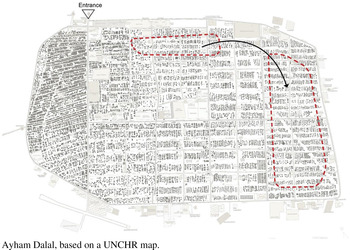
As a result, the “refugee-refugee” encounters here, although they might have generated knowledge about the “other,” also contributed to decisions to push the “other” away. Consequently, Bedouin communities were relocated with the help of the Jordanian police to the least populated area in the camp; and their encounters with refugees from rural/urban origins, or the Ḥaḍar,Footnote 33 were subsequently reduced [Figure 4].
A map showing the relocation of Bedouins to the less populated part of Zaatari camp.
Source: Ayham Dalal, based on a UNHCR map. Source: Ayham Dalal, based on a UNHCR map.

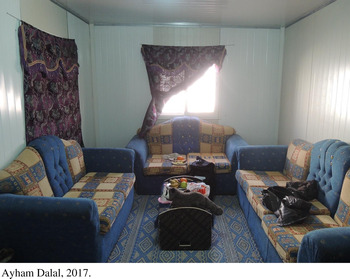
In contrast, “encounters” can also produce new and hybrid realities and cultural forms. As one refugee student explained: “I don't know what dialect I'm speaking anymore. If somebody speaks to me with a Homsi accent, I reply with a Homsi accent, if they talk in Aleppean accent I respond in Aleppean, if they speak Daraaoui dialect, I respond with Daraaoui.” This hybridity is expressed spatially as well by the ways in which refugees constructed their dwellings. For instance, the “refugee-more-than-human” encounters produced much knowledge about caravans and how to use them for reinventive construction purposes. Fences, walls, and roofs built out of sandwiched sheets extracted from the caravan itself; furniture, wardrobes, and kitchens constructed out of wooden plates extracted from the caravans; rooms, low fences, and roofs made out of worn-out tents with humanitarian logos – all are new and hybrid architectures, unique shapes formed from the kaleidoscopic encounters that take place in the camp. Additionally, the way that the “refugee-more-than-human” encounters were combined with refugees’ culture, lifestyle, and memory added to their hybridity. An example of this would be Nidal who insisted on maintaining his cultural footprint within the limited space of the caravan [Figure 5]:
People from cities are different. I noticed that in the decoration for example. We like to make things nice and tidy . . . they would just do it way faster. You know they lived in villages, so their houses were open to everyone, but for us, it is not the same. People need to inform me before paying me a visit!
This example and many others show both the novelty and hybridity of spaces resulting from the various encounters, both human and nonhuman, in Zaatari camp.
A well-decorated guest room placed inside a container measuring 5 × 3 meters.

Conclusion
The admittedly commonplace nature of everyday “encounters,” have a particular significance in refugee camps. The camp assembles architectures, actors and socioeconomic structures in one place. Refugees are suddenly put in touch with new and unexpected realities and camps are thus “sites of enduring organization of space, social life and system of power that exist nowhere else.”Footnote 34 This exceptionality of the camp incites both new modes of being through encounter and new modes of analyzing fluctuating power relations.
Thus, encounters in refugee camps have the ability to unpack the meaning of immobility– a notion that is gaining momentum within migration studies.Footnote 35 Refugees arrive in camps to escape war and persecution. They embark on a journey in search of a safe haven and in doing so, they challenge the global regimes of mobility. They produce ruptures by fleeing from regimes but then enter a new state of being in camps that isolates them from a growing global network of mobility.Footnote 36 Punished for breaking these rules of mobility, refugees are gathered, maintained and governed within camps. In that sense, the camp becomes the space where the global logics and structures of distancing are broken and experienced through encounters. This applies for camps in the Global North as well. In Berlin's Tempohomes, for instance, Syrian refugees began to learn about those who were formerly distanced from their own experiences such as Afghani, Kenyan, Ethiopian, Iranian, Iraqi, Russian and many other populations. A refugee camp has the ability to bring immobile people together and these encounters yield new transformations. Identities of refugees are not fixed but rather contested, re-situated, re-negotiated, re-structured, and re-presented. Analyzing encounters in refugee camps can therefore challenge the fixed categories of mobile and immobilized populations.
Finally, while researchers and social scientists ought to analyze encounters and their role in refugee camps, architects and planners in charge of designing new camps also need to take them into consideration as well. As shown in the previous examples, every type of encounter led to some form of learning. But refugees’ encounter with the “more-than-human” and particularly with shelter and the space of the camp are highly beneficial to understanding these new technologies. What kinds of knowledge emerge from these encounters? And how can this knowledge help the architect and the planner to design better camps? The significance of these encounters in refugee camps, therefore, is their ability not only to produce new forms of knowledge that would eventually impact space, but also to illustrate the power of humans to fashion familiar, creative, soulful habitats out of the abstractedly-conceived, homogeneously-planned, and officiously-governed space of a typical refugee camp.