Introduction
Juvenile nasopharyngeal angiofibroma (JNA) is a rare type of head and neck tumour, but is still the commonest benign nasopharyngeal tumour in adolescent boys and young men. The definition covers a heterogeneous group of locally invasive and highly vascularised skull base tumours that classically present with profuse epistaxis and/or troublesome intra-operative haemorrhage. The treatment of choice for this debilitating disease is surgical excision. However, owing to the substantial risk of haemorrhage, surgical resection is usually only carried out in specialised centres. There is a wide variation in incidence worldwide,Reference Mishra and Mishra 1 and the disease is characterised by variable clinical characteristics in terms of degree of bleeding, symptom severity, and disease progression and recurrence, consistent with its heterogeneous and debated aetiology. Many researchers have tried to predict the outcome (e.g. recurrence) based on clinical parameters, but wide variations have been reported among studies. Controversy about JNA aetiopathogenesis may reflect variations in its clinical characteristics. Accordingly, the molecular changes may better reflect the underlying disease process rather than clinical parameters per se. Stratifying disease severity according to molecular alterations may therefore help in predicting prognosis and planning against aggressive biology. Hence, molecular characterisation of clinical subsets may help in estimating the expected risk of aggressive biology and customising the treatment protocol (including molecular targeted therapy). Unfortunately, molecular studies of JNA have been limited, mainly by very small sample sizes and a lack of appropriate methodology for identifying changes in molecular signalling cascades. Furthermore, large geographical variations have limited attempts at global standardisation.Reference Mishra and Mishra 1 Hence, proper evaluation of the molecular characteristics of JNA is necessary before collaborative, multicentre, controlled molecular studies can be performed. The present study was performed in a well-established centre that treats the largest number of JNA patients worldwide (according to Scott Brown's Otolaryngology: Rhinology).Reference Chew, Kerr and Groves 2 The current authors have observed a fourfold increase in JNA incidence over the past 10 years,Reference Mishra and Mishra 1 and have tracked its changing clinical features over the last 7 decades. For example, JNA is no longer restricted to adolescent age groups and androgen receptors are not always up-regulated. Hence, an increased incidence along with variable pre- vs post-adolescent presentation and unpredictable outcome probably indicates changes in the molecular mechanisms underlying this heterogeneous disease. Regional variations in the expression of 10 molecular markers have already been published.Reference Pandey, Mishra, Tripathi, Verma, Trivedi and Singh 3 This review aims to summarise the current status of molecular markers in JNA in a geographical context and to briefly describe molecular variations within a regional population.
Materials and methods
A comprehensive search of the PubMed database was performed to investigate the clinical implications of molecular markers in JNA, including various growth factors, tumour suppressor genes, oncogenes and cytokines. Search terms included ‘juvenile nasopharyngeal angiofibroma’, ‘nasopharyngeal angiofibroma’ and ‘angiofibroma’, and all results were short-listed for analysis. Relevant abstracts of recent global publications in this area were also retrieved. Information on altered expression (up- or down-regulation) of various molecular markers along with statistical power (indicated by sample size) was recorded. The geographical distribution of molecular changes was also analysed.
Although JNA-associated changes in the expression of 10 molecular markers (AR, BFGF, HRAS, IL6, c-Kit, MYC, PDGFA, TP53, VEGFA messenger ribonucleic acid (mRNA) and beta-catenin protein) in the local population (i.e. the population of Uttar Pradesh and adjoining areas) have already been published,Reference Pandey, Mishra, Tripathi, Verma, Trivedi and Singh 3 this review was intended to summarise variations in their expression. Thus, the distribution (percentage) of JNA patients within different quartiles of molecular expression (i.e. fold difference in activation) is shown for all markers. The previous study described the methodology used for reverse transcription polymerase chain reaction analysis of mRNA expression for all markers (except for beta-catenin). The sample size was 23 for IL6 and AR analyses, 16 for beta-catenin analysis, 12 for platelet-derived growth factor (PDGF) analysis, 13 for HRAS analysis, 9 for P53 analysis and 14 for all others. All markers except for AR were significantly up-regulated (based on a greater than twofold increase in mRNA expression compared with controls).
Results
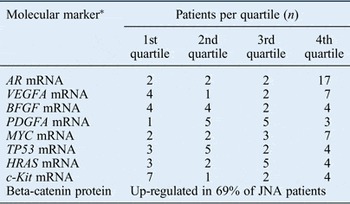
Analysis of regional trends revealed significant involvement of HRAS and a role for IL6 in JNA.Reference Pandey, Mishra, Tripathi, Verma, Trivedi and Singh 3 Although expression of all markers except for AR was previously found to be increased in our population,Reference Pandey, Mishra, Tripathi, Verma, Trivedi and Singh 3 there was an interesting trend in expression level in JNA patients (Table I). There was minimal AR and IL6 mRNA up-regulation in most JNA patients. The highest percentages of JNA patients with up-regulated c-Kit and BFGF are in the first quartile. In contrast, most JNA patients had VEGFA mRNA expression levels within the first or fourth quartile. Beta-catenin expression is increased in only 69 per cent of patients (by qualitative comparison of protein levels in western blots).Reference Mishra, Singh, Verma, Pandey, Trivedi and Singh 4 Except for AR and IL6 mRNA, there was a wide variation in the expression levels of these markers within the patient cohort, suggesting that signalling pathway activity and cross-talk are highly variable in JNA patients.
Variations in molecular marker expression in juvenile nasopharyngeal angiofibroma patients

*Expression levels of all markers except for beta-catenin were determined by reverse transcription polymerase chain reaction; beta-catenin expression was quantified by western blotting. 1st quartile = highest expression level; 2nd quartile = second highest expression level; 3rd quartile = second lowest expression level; 4th quartile = lowest expression level
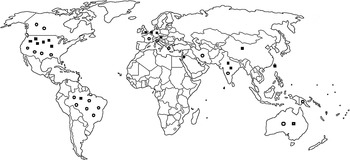
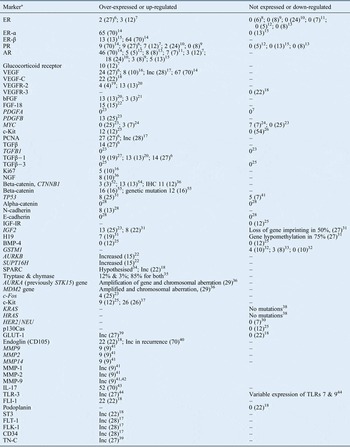
The current status of molecular markers according to the global literature is shown in Table II. Levels of up- and down-regulation of molecular markers are shown along with cohort sample sizes for each study. The most widely studied molecular markers are steroid receptors (androgen receptor (AR; encoded by the AR gene), oestrogen receptor (ER) and progesterone receptor (PR)), followed by vascular endothelial growth factor (VEGF). Although trends in levels of marker expression were seen, the small number of studies prevented definite conclusions being made, particularly in a global context. As JNA is a rare disease, it is difficult to report a larger case series. Figure 1 shows the uneven global distribution of clinical studies reporting 5–20 cases according to the largest systematic review.Reference Boghani, Husain, Kanumuri, Khan, Sangvhi and Liu 5
Map showing global reporting of juvenile nasopharyngeal angiofibroma studies that include 5–20 cases (Boghani et al.Reference Boghani, Husain, Kanumuri, Khan, Sangvhi and Liu
5
).  = study including 5–10 cases from a particular country;
 = study including 11–20 cases from a particular country

Current evidence of molecular changes in juvenile nasopharyngeal angiofibroma

*Global data is depicted by the number of positive (or negative) samples out of the total sample size (shown in brackets). ER = oestrogen receptor; 0 = no expression or no significant difference in expression (compared with controls); PR = progesterone receptor; AR = androgen receptor; VEGF = vascular endothelial growth factor; Inc = significantly enhanced expression (qualitative data); VEGFR = vascular endothelial growth factor receptor; bFGF = basic fibroblast growth factor; FGF = fibroblast growth factor; PCNA = proliferating cell nuclear antigen; TGF = transforming growth factor; NGF = nerve growth factor; IHC = immunohistochemistry; IGF-IR = insulin-like growth factor I receptor; BMP-4 = bone morphogenetic protein 4; SPARC = secreted protein acidic and rich in cysteine; GLUT-1 = solute carrier family 2, facilitated glucose transporter member 1; CD = cluster of differentiation; MMP = matrix metalloproteinase; IL-17 = interleukin 17; TLR = Toll-like receptor; FLI-1 = Friend leukemia integration 1 transcription factor; ST3 = stromelysin-3; FLT-1 = vascular endothelial growth factor receptor 1; FLK-1 = vascular endothelial growth factor receptor 2; TN-C = tenascin C
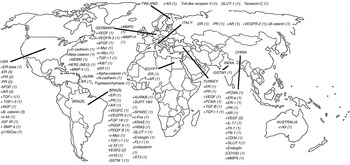
There are fewer reports of molecular data for JNA compared with clinical characteristics. The major contributors were from the USA, Brazil, Germany and China; including additional reports from 7 other countries, the existing molecular data represents only 11 countries worldwide. Figure 2 shows which markers have been studied across 10 of these countries (Croatia was deliberately omitted because an article from that country hypothesised, rather than demonstrated, that secreted protein acidic and rich in cysteine (SPARC) is a JNA marker). Notably, many potential markers have been reported in single studies only, for example Toll-like receptor 3 (TLR-3),Reference Renkonen, Cardell, Mattila, Lundberg, Haglund and Hagström 44 endoglin (CD105),Reference Nonogaki, Campos, Butugan, Soares, Mangone and Torloni 18 , Reference Wang, Sun, Hu, Liu, Yu and Li 40 friend leukemia integration 1 transcription factor (FLI-1),Reference Nonogaki, Campos, Butugan, Soares, Mangone and Torloni 18 SPARC,Reference Nonogaki, Campos, Butugan, Soares, Mangone and Torloni 18 solute carrier family 2, facilitated glucose transporter member 1 (GLUT-1),Reference Renkonen, Heikkilä, Haglund, Mäkitie and Hagström 39 VEGF receptor 1 (FLT-1),Reference Zhang, Sun, Yu, Hu and Wang 17 VEGF receptor 2 (FLK-1),Reference Zhang, Sun, Yu, Hu and Wang 17 tenascin C (TN-C),Reference Renkonen, Heikkilä, Haglund, Mäkitie and Hagström 39 matrix metalloproteinases 9 and 14 (MMP-9, MMP-14)Reference Duerr, Wendler, Aigner, Karosi and Schick 41 , Reference Sun, Guo, Wang, Yu, Wang and Meng 43 proteins, and MMP2, MMP9 and MMP14 mRNA.Reference Duerr, Wendler, Aigner, Karosi and Schick 41
Map showing molecular markers in juvenile nasopharyngeal angiofibroma studied in 10 countries worldwide.

Discussion
Marked variations in the expression of all 10 markers were seen in the JNA population of Uttar Pradesh and adjoining areas. Similar variations were shown in an analysis of global trends, providing further evidence for the molecular heterogeneity of this disease. It is possible that changes in molecular mechanisms or the expression of molecular markers may account for the observed explosion in JNA cases seen at King George Medical University, Lucknow, contributing to the changing patterns of clinical presentation.Reference Mishra and Mishra 1 A preliminary clinico-molecular correlation analysis suggests that beta-catenin protein is absent in post-adolescent JNA patients but increased in patients with facial disfigurementReference Mishra, Singh, Verma, Pandey, Trivedi and Singh 4 ; however, these data need further validation. Similarly, different clinical phenotypes have been recorded in patients with the highest or lowest levels of other molecular markers (these data will be published separately, but the interested reader is referred to a published summaryReference Pandey, Mishra, Tripathi, Verma, Trivedi and Singh 3 ). The current analyses did not find significantly increased AR mRNA expression (in contrast to previous analyses) and the JNA population is no longer restricted to adolescent age groups.Reference Pandey, Mishra, Tripathi, Verma, Trivedi and Singh 3
The countries making the largest contribution to defining the molecular status of JNA patients are USA, Brazil, Germany and China. Other smaller contributors include Turkey, Italy, Finland and Egypt, and a single molecular study has been reported from each of India, Australia and Croatia. However, most putative molecular markers still need to be validated. This caveat also applies to the observation of a 10 000-fold increase in HRAS expression in the current population.Reference Pandey, Mishra, Tripathi, Verma, Trivedi and Singh 3 It is ironic that the countries most affected by JNA (such as India) are among the poorest contributors of molecular studies worldwide. Similarly, the African sub-continent is represented only by Egypt. Comparison of the available clinical and molecular data (Figures 1 and 2) revealed some consistent trends, but there is a great deal of geographical variability in molecular marker expression. These data provide further evidence that JNA is a heterogeneous disease with variable aetiopathogenesis. Despite the paucity of reports, it seems reasonable to assume that wide racial, ethnic and geographical variations in molecular marker expression will be found. About 58 markers have been studied so far. The best-validated marker globally (apart from steroid receptors) is VEGF. Although a detailed discussion of every marker is beyond the scope of this review, the best-studied markers will be discussed.
The predominance of JNA in adolescent boys suggests that sex hormone imbalance contributes to its aetiopathogenesis.Reference Johns, MacLeod and Cantrell 8 , Reference Schiff 45 – Reference Johnsen, Kloster and Schiff 47 Sex hormone receptor expression has been demonstrated in tumour tissue,Reference Brentani, Butugan, Oshima, Torloni and Paiva 7 – Reference Gatalica 13 and is hence expected to influence disease development.Reference Brentani, Butugan, Oshima, Torloni and Paiva 7 , Reference Lee, Rao, Meyer, Prioleau and Bauer 9 , Reference Kumagami 48 , Reference Kumagami 49 A recent report described the recurrence of JNA 20 years after tumour excision in a 36-year-old patient on testosterone supplement therapy.Reference Riggs and Orlandi 50 Therefore, there is general consensus on a role for androgen-mediated stimulationReference Schiff 45 and oestrogen-mediated regression.Reference Johns, MacLeod and Cantrell 8 , Reference Schiff 45 , Reference Johnsen, Kloster and Schiff 47 , Reference Kuttner, Katekamp and Stiller 51 Reported levels of oestrogen receptor protein have been inconsistent over time, probably due to improvements in assay specificity over the last four decades. Oestrogen receptor assays currently use a monoclonal antibody against oestrogen receptor alpha that may not detect oestrogen receptor beta, hence accounting for reported discrepancies in oestrogen receptor expression.Reference Montag, Tretiakova and Richardson 15 The combined (rather than individual) effect of androgen and oestrogens appears to influence disease development. High AR mRNA expression and low expression or absence of oestrogen and progesterone receptors are common findings. Johns et al. proposed that oestrogens may reduce tumour size by decreasing hypothalamic gonadotropin-releasing hormone secretion and therefore testosterone production.Reference Johns, MacLeod and Cantrell 8 Despite the co-occurrence of JNA with other hormonal disorders, wide variations in AR and ER protein expression in tissue and the absence of significant alterations in serum hormone (oestradiol and testosterone) levelsReference Lee, Rao, Meyer, Prioleau and Bauer 9 , Reference Farag, Ghanimah, Ragaie and Saleem 11 mean that the nature of hormonal influence on JNA remains debatable.Reference Johns, MacLeod and Cantrell 8 – Reference Farag, Ghanimah, Ragaie and Saleem 11 , Reference Gatalica 13 , Reference Schiff 45 – Reference Johnsen, Kloster and Schiff 47 The current JNA population also did not have significantly increased AR mRNA expression. However, the current manifold increase in JNA incidence in patients at the extremes of the age range (8–26 years) presenting at King George Medical University, Lucknow, suggests that the role of AR in JNA causation may be changing.
Vascular endothelial growth factor is associated with cell proliferation and increased vessel density; in JNA, it is predominantly seen in proangiogenic stromal cells and vessels (80 per cent).Reference Mishra and Mishra 1 Enhanced VEGF expression was noted in 80% of cases in one study,Reference Brieger, Wierzbicka, Sokolov, Roth, Szyfter and Mann 16 and in all recurrent cases in another.Reference Saylam, Yucel, Sungur and Onerci 6 VEGFA was the most potent proangiogenic growth factor in the present JNA population (i.e. it had the maximum fold increase in mRNA expression). The release of proangiogenic factors by a benign tumour is reported to lead to vessel growth with minimal or no impact on tumour progression.Reference Arbiser, Arbiser, Cohen and Gal 52 , Reference Juric, Zarkovic, Nola, Tillian and Jukić 53 Accordingly, increased VEGF expression in JNA may result in higher vessel densities rather than the development of a large, aggressive tumour. A role for increased androgen levels (mediated by VEGF up-regulation) in angiogenesis has also been suggested. Haggstrom et al. provided supportive evidence for this mechanism by their observations that testosterone stimulated endothelial cell proliferation and vascular growth in rat prostate cells.Reference Haggstrom, Lissbrant, Bergh and Damber 54 Increased levels of other potent proangiogenic factors such as basic fibroblast growth factor (bFGF; encoded by BFGF), transforming growth factor β1 (TGFβ−1) and VEGF receptor 2 (VEGFR-2) proteins are reported to be associated with high vessel densities in JNA.Reference Schuon, Brieger, Heinrich, Roth, Szyfter and Mann 20 Basic fibroblast growth factor mainly functions in angiogenesis, tissue development, cell differentiation and modulation of neural function.Reference Russell, Bennett and Stricker 55 Schiff et al. reported evidence for bFGF expression in three JNA patients,Reference Schiff, Gonzalez, Ong and Baird 21 while Schuon et al. reported high bFGF levels in stromal cells from 13 patients.Reference Schuon, Brieger, Heinrich, Roth, Szyfter and Mann 20 In the present JNA population, BFGF was the second most potent proangiogenic factor (after VEGFA).Reference Pandey, Mishra, Tripathi, Verma, Trivedi and Singh 3 Both VEGF and bFGF are heparin-binding proteins that accumulate in the extracellular matrix and are released by proteases. Therefore, the postulation that vasculogenesis is induced by angiogenic factors under the stimulation of androgens such as testosterone through an autocrine mechanismReference Brieger, Wierzbicka, Sokolov, Roth, Szyfter and Mann 16 provides further support for the involvement of bFGF and TGFβ−1 in JNA.Reference Schiff, Gonzalez, Ong and Baird 21 , Reference Dillard, Cohen, Muller, Del Gaudio, Reichman and Parrish 27 Furthermore, BFGF is also expressed by endothelial cells. Since AR was not significantly up-regulated in the present population, this gene may not have an important role in angiogenesis. Hence, in the context of JNA, bFGF is likely to synergise specifically with VEGF to potentiate angiogenesis. The only study to investigate these two factors simultaneously found that both are up-regulated in JNA.Reference Schuon, Brieger, Heinrich, Roth, Szyfter and Mann 20 Interplay among AR, VEGF and hypoxia-inducible factor-1 (HIF) in prostate cancer has been proposed,Reference Kimbro and Simons 56 and may also occur in JNA. In contrast, a role for PDGF was suggested by a single study that found PDGFB mRNA over-expression in 50 per cent of JNA samples.Reference Nagai, Butugan, Logullo and Brentani 23 Platelet-derived growth factor subunit B has a mitogenic effect on capillary endothelial cells and stimulates extracellular matrix synthesis. Therefore, it may have a role in neovascularisation and fibrosis in JNA. However, PDGF appears to have a smaller angiogenic role than FGF and VEGF in the present JNA population.
The c-Myc oncogene (encoded by MYC) has potent angiogenic activity via inducing fibroblasts to form an immature vascular network,Reference Pelengaris, Khan and Evan 57 and is involved in cell proliferation and growth, de-differentiation, and apoptosis.Reference Liu and Levens 58 Nagai et al. found no difference in c-Myc expression in JNA tumour vs normal tissue,Reference Nagai, Butugan, Logullo and Brentani 23 while Schick et al. found MYC mRNA over-expression in three out of seven JNA patients (by reverse transcription polymerase chain reaction) and loss of the MYC gene in seven patients (by fluorescence in situ hybridisation).Reference Schick, Wemmert, Jung, Steuder, Montenarh and Urbschat 24 c-Myc is commonly deregulated in malignancies,Reference Levens 59 and cross-talk among beta-catenin, AR and proto-oncogene c-Myc has been suggested.Reference Amir, Barua, McKnight, Cheng, Yuan and Balk 60 However, regional observations in the present study revealed a significant general increase in MYC mRNA expression, which did not appear to parallel the expression patterns of AR mRNA and beta-catenin protein. In contrast, c-Kit expression was significantly increased in the present JNA population. However, mast/stem cell growth factor receptor Kit (SCFR; also known as proto-oncogene c-Kit) protein and activation of the c-Kit gene in JNA has been suggested in only two studies. While one study reported strong immunohistochemical c-Kit staining in stromal cells in JNA tissue,Reference Zhang, Weber, Liang, Pasha and LiVolsi 25 another study did not find this expression pattern in a case series.Reference Pauli, Gundelach, Vanelli-Rees, Rees, Campbell and Dubey 61 Hence, this result needs further validation.
RAS gene mutations are associated with a wide range of human solid tumours,Reference Barbacid 62 but there is no evidence that they occur in JNA. The RAS gene family encodes several related p21 proteins with important roles in mitogenic signalling.Reference Bos 63 A single report into HRAS gene mutations in 28 JNA patients (assessed by polymerase chain reaction-coupled single-strand conformation polymorphism and DNA sequencing) found insufficient evidence of a pathogenic role.Reference Coutinho, Bassini, Gutiérrez, Butugan, Kowalski and Brentani 38 In contrast, the present population had markedly increased HRAS mRNA expression (by 10 000 fold),Reference Pandey, Mishra, Tripathi, Verma, Trivedi and Singh 3 indicating very different molecular characteristics. However, this observation needs further validation. Previous studies into TP53 genetic alterations in JNA reported increased mRNA expression in 32 per cent of patientsReference Nagai, Butugan, Logullo and Brentani 23 and TP53 deletion in five out of seven patients.Reference Schick, Veldung, Wemmert, Jung, Montenarh and Meese 30 The latter study, however, did not detect TP53 mutations in JNA patients. In contrast, the present cohort had a moderate (but significant) increase in expression.Reference Pandey, Mishra, Tripathi, Verma, Trivedi and Singh 3 However, further studies are also needed to establish a definite role for TP53 in JNA.
A reported association of JNA with familial adenomatous polyposis suggested that the APC gene and beta-catenin protein may be involved in JNA pathogenesis. Genetic evidence that JNA is an integral familial adenomatous polyposis tumour and two frameshift mutations in beta-catenin-binding regions of the APC gene have been demonstrated,Reference Valanzano, Curia, Aceto, Veschi, De Lellis and Catalano 64 although Klockars et al. refuted such an association.Reference Klockars, Renkonen, Leivo, Hagström and Mäkitie 65 Beta-catenin is implicated in most Western cases of sporadic JNAs, but the present observations in the Indian population suggest that it is associated with only a subset of cases.Reference Mishra, Singh, Verma, Pandey, Trivedi and Singh 4 Beta-catenin functions as an AR coactivator; hence, the effect of combined beta-catenin and AR up-regulation may lead to JNA in adolescent males.Reference Schick, Brunner, Praetorius, Plinkert and Urbschat 66 The absence of beta-catenin expression in post-adolescent JNA patients, as seen in the present population, suggests that other factors other than androgens might be causative in that age group.
Both TGFβ−1Reference Saylam, Yucel, Sungur and Onerci 6 , Reference Schuon, Brieger, Heinrich, Roth, Szyfter and Mann 20 , Reference Nagai, Butugan, Logullo and Brentani 23 , Reference Dillard, Cohen, Muller, Del Gaudio, Reichman and Parrish 27 and the IGF2R geneReference Nagai, Butugan, Logullo and Brentani 23 have been implicated in JNA development. Transforming growth factor β−1 is produced by fibroblasts, macrophages and endothelial cells and has roles in extracellular matrix production and angiogenesis. It has been implicated in blood vessel growth promotion in JNA,Reference Schuon, Brieger, Heinrich, Roth, Szyfter and Mann 20 and has also been detected in the nuclei and cytoplasm of stromal cells.Reference Dillard, Cohen, Muller, Del Gaudio, Reichman and Parrish 27 However, Nagai et al. did not detect different levels of TGFB1 mRNA expression in 18 JNA and normal tissue samples, although protein expression in endothelial and fibroblast cells suggests a role in fibrogenesis.Reference Nagai, Butugan, Logullo and Brentani 23 In contrast, IGF2R mRNA is reported to be over-expressed in 53 per cent of JNA patients,Reference Nagai, Butugan, Logullo and Brentani 23 although insulin-like growth factor 1 receptor expression has not been detected.Reference Zhang, Weber, Liang, Pasha and LiVolsi 25 Coutinho-Camillo et al. investigated a possible mechanism involving insulin-like growth factor II receptor by studying genomic imprinting and the methylation status of the IGF2 and H19 genes, and suggested that alterations in the IGF2–H19 imprinted region contribute to JNA pathogenesis.Reference Coutinho-Camillo, Brentani, Butugan, Torloni and Nagai 31
Regarding the less well validated markers, 100 per cent positivity for proliferating cell nuclear antigen (PCNA) was found for 27 samples,Reference Saylam, Yucel, Sungur and Onerci 6 and confirmed in another cohort of 28 patients.Reference Zhang, Sun, Yu, Hu and Wang 17 Proliferating cell nuclear antigen is a proliferation marker that is used to predict tumour behaviour and prognosis.Reference Saylam, Yucel, Sungur and Onerci 6 Among the non-validated markers showing significant changes in expression in JNA tissue samples, nerve growth factor (NGF) expression in fibroblast stromal and endothelial cells suggests that its function is related to vascular proliferation.Reference Zhang, Weber, Liang, Pasha and LiVolsi 25 Similarly, the c-Fos oncogene was reported to be over-expressed in 14 per cent of JNA samples.Reference Nagai, Butugan, Logullo and Brentani 23 In addition, expression of GSTM1 mRNA (which encodes glutathione S-transferase M1, a protein involved in detoxification) was undetectable in three out of eight samples in one study.Reference Gautham, Ogale, Shraddha and Ajay 33 In addition, the presence of multiple combinations of various polymorphisms in GST genes has been reported in patients at a high risk of JNA.Reference Mohr, Rodgers and Silvestri 67 A detailed description is beyond the scope of this review, but many potentially important markers have been shown to have no involvement in JNA pathogenesis. Zhang et al. reported strong over-expression of bone morphogenetic protein 4 (BMP-4) and TGFβ−3 proteins in JNAs; however, expression levels in nasal polyps were not significantly different.Reference Zhang, Weber, Liang, Pasha and LiVolsi 25 Similarly, although amplification of the HER2 (NEU) oncogene has been reported in several tumour types,Reference Smith, Kantoff, Mendelsohn, Howley, Israel and Liotta 68 no evidence of this was demonstrated in seven JNA samples by fluorescence in situ hybridisation.Reference Schick, Brunner, Praetorius, Plinkert and Urbschat 66 Moreover, no immunohistochemical evidence of p130Cas protein expression in JNA tissue samples was found.Reference Zhang, Weber, Liang, Pasha and LiVolsi 25 Finally, there is no conclusive evidence for GSTM1 mutationReference Maniglia, Ribeiro, Costa, Jacomini, Carvalho and Molina 32 or altered podoplaninReference Nonogaki, Campos, Butugan, Soares, Mangone and Torloni 18 and GLUT-1Reference Renkonen, Heikkilä, Haglund, Mäkitie and Hagström 39 protein expression in JNA tissues. As there has only been a single study into each potential marker, further validation of these potential markers is needed.
Conclusion
Owing to the paucity of reports on both global JNA incidence and molecular markers, along with a wide variability in patients from the same geographical region, the molecular status of the disease remains poorly understood. Further research is necessary, and establishing the molecular epidemiology of JNA remains a distant goal. Identification of the drivers and core pathways involved in JNA development might be a better goal, which might be achieved by comparing whole genome expression profiles (transcriptomics and proteomics) between JNA and normal nasal mucosal tissue. Hence, global multicentre collaborative studies will be necessary to reveal the aetiopathogenesis and help establish the molecular epidemiology of JNA.
Acknowledgements
The authors would like to acknowledge Dr S Kumar and Dr P Pandey, Otorhinolaryngology Department, King George Medical University, for their assistance with PubMed searches.