Introduction
The meat and eggs from waterfowls (duck and goose) have high nutritional value and consumers mostly prefer them for their taste and nutritional value and the fact that they contain good quantities of essential amino and fatty acids. In recent times duck production has seen major growth, as farmers, entrepreneurs and researchers have been in search of alternate poultry species. In Asian countries, the popularity of duck is more pronounced compared to other parts of the world. Asian countries alone account for 84.2% of total duck meat produced in the world (FAO, 2017). Duck meat has been considered a delicacy in Europe and America. In recent years, China has become the highest duck meat-producing country in the world and has dominated more than half of the word duck meat production.
Ducks have a number of advantages over other poultry species, in particular disease tolerance. They are hardy, easy to manage and are excellent foragers and easy to herd, particularly in wetlands, where they tend to flock together (Omojola, Reference OMOJOLA2007). In spite of their important contribution to the agriculture economy in many Asian countries, ducks are still considered one of the neglected avian species and need more commercial exploitation. This review has been prepared to highlight the nutritive value of duck meat, current global demands, particularly in Asia, and technological interventions required to meet the consumers’ demands through processing of different ready-to-eat duck meat products.
Status and potential of duck meat production
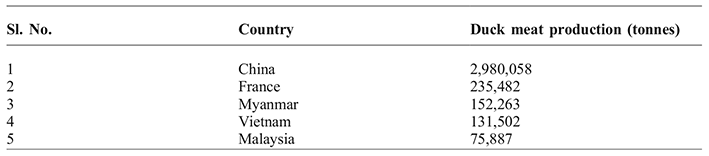
In Asia, ducks are still raised in a traditional system of herding and scavenging by small-scale farmers, and are viewed as an ‘extra activity’ in between crop farming, and hence provide an additional income to the household. However, in many developed countries, large-scale production has been prevalent, and chilled/frozen duck meat and processed eggs have become major export commodities. Table 1 lists the top five duck meat producing countries in the world and Figure 1 shows share of duck meat production by region in 2017.
Top 5 duck meat producing countries (FAOSTAT, 2017).

Production share of duck meat by region (FAOSTAT, 2017).

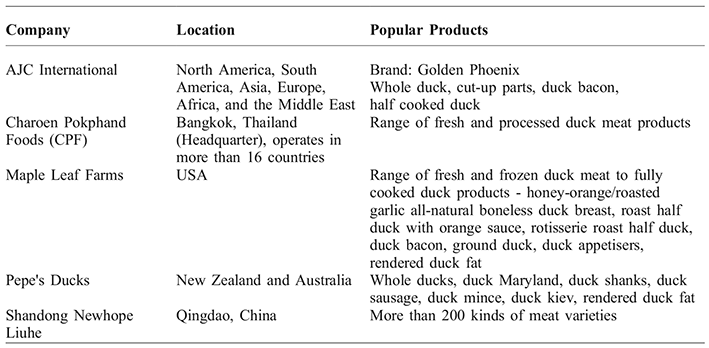
Duck meat is traded by countries across the globe. Germany was the top most importer of duck meat in 2016, valued at $156.35 million. The Netherlands was recorded as the leading exporter in the world in 2016, with a share of 16.8% of total exports, followed by Poland (13.2%), Malaysia (12.3%), France (10.3%) and Hungary (8.8%). The global duck meat market, by revenue in 2016, was valued at $8.98 billion and is expected to reach a value of about $11.23 billion in the next five years. The global duck meat market is expected to grow at a steady pace, driven by the demand for processed and packaged foods among consumers. The top five leading vendors that are expected to impact the market during 2017-2021 are listed in Table 2.
Top 5 global duck meat market players.

The poultry population in India is 729.21 million which includes 692.65, 23.54 and 13.02 million chickens, duck and turkeys, respectively. Due to geophysical consideration, Eastern and Southern provinces of the countries, the duck population is mainly concentrated in coastal regions with a relatively high number of non-descriptive indigenous stocks. West Bengal has the highest duck population followed by Assam, Tamil Nadu, Andhra Pradesh, Bihar, Kerala, Odisha, Jammu and Kashmir and Tripura (BAHS, 2017). There are many important Indian breeds, such as Sylhet mete and Maheswari, in the Eastern region, Chara and Chamballi in Kerala, Desi breeds in West Bengal and other states. ‘Pati’ is the only registered breed of duck found in Assam and is dual-purpose for meat and egg production. Among improved varieties, distinct breeds for egg and meat production are available. The Khaki Campbell and Indian Runner are the most popular breeds for egg laying. White Pekin, Muscovy and Aylesbury are best known for meat production. The Pekin duck is the predominant breed used for commercial meat production worldwide (Stein, Reference STEIN2012). High-laying strains of ducks are available from the Central Duck Breeding Farm, Hessarghatta, Bangalore. In India, ducks are mainly reared for laying purposes. After laying, when the spent duck meat becomes available for human consumption, it is less juicy and tougher, which are the major reasons for lower acceptance of the duck meat by consumers. Moreover, small-scale duck producers are constrained by poor access to appropriate technologies, market and support services, which could otherwise be translated into improved productivity, increased income, and more sustainable duck production systems.
Faced with strong competition worldwide, developed countries have expanded duck meat processing as a major industry, aiming to achieve premium-quality duck products. Certification and traceability systems have been introduced for duck products to assure food safety. With implementation of the right programs and policy support from the government and private enterprises, duck farming has great potential as a commercial entity.
Duck meat quality - a comparative study
Week eight of life is considered the optimum slaughter age of meat-producing ducks; (Mazanowski and Bernacki Reference MAZANOWSKI and BERNACKI2004; Adamski et al., Reference ADAMSKI, BERNACKI and KUZNIACKA2005), because, at this age, the meat content of the carcass is highest and the meat to fat ratio is the most favourable. Ducks, particularly Muscovy ducks, have approximately 74% carcass yield from intensive management systems (Etuk et al., Reference ETUK, OJEWOLA and ABASIEKONG2006; Wawro et al., Reference WAWRO, WILKIEWICZ-WAWRO, KLECZEK and BRZOZOWSKI2004). Pekin ducks have lower dressing percentages, at 72% for males and 71% for females (Solomon et al., Reference SOLOMON, AUSTIN, CUMBERBATCH, GONSALVES and SEAFORTH2006).
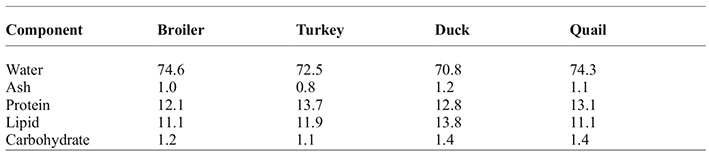
The composition of duck meat is different from that of chicken and turkey meat (Table 3). The percentage of fat in duck meat is relatively higher than other common poultry meats. Compared to chicken or turkey, duck meat has higher lipid levels and oxidative energy metabolism (Baeza, Reference BAEZA2006). In a study related to the sensory characteristics of duck meat, it was found that the flavour was positively correlated with lipid content (Chartrin et al., Reference CHARTRIN, METEAU, JUIN, BERNADET, GUY, LARZUL, REMIGNON, MOUROT, DUCLOS and BAÉZA2006) and the higher fat content may cause the stronger flavour in duck meat. However, the higher fat content in duck meat can make the meat more prone to oxidation compared to chicken meat. Duck meat is a good source of polyunsaturated fatty acids, particularly those made up of 20 and 22 carbon atoms. The major fatty acids in liver and in the meat of breast and leg are C16:0 (18-22%), C18:0 (12-22%), C18:1 (17-34%), C18:2 (13-23%) and C20:4 (8-19%) (Cobos et al., Reference COBOS, VEIGA and DÍAZ2000). The fatty acids C14:0, C16:0, C16:1, C18:2 and C18:3 are significantly higher while C18:0 is significantly lower in duck breast compared to chicken (Ali et al., Reference ALI, KANG, YANG, JEONG, HWANG, PARK and JOO2007). Due to the higher content of unsaturated fatty acids in duck, oxidation and degradation products of fat are important during processing such as dry-curing and roasting. Volatile compounds developed from the raw duck meat at room temperature have been estimated by gas chromatography-mass spectrometry (Soncin et al., Reference SONCIN, CHIESA, CANTONI and BIONDI2007), and alcohols, with the predominance of 1-hexanol, as well as 3-hydroxybutanone and 2-pentylfuran are present in significant amounts. The major compounds in the analysed fractions were alcohols, derived from the reduction of aldehydes (particularly important for imparting a ‘fatty’ flavour), due to the oxidation of lipids and amino acids. Analysis of flavour compounds showed that the total amounts of aromatic hydrocarbons, hexanal and 2,3-octanedione in older duck meat were higher than that from in younger, broiler ducks (Liu et al., Reference LIU, PAN, YE and CAO2013). Russell et al. (Reference RUSSELL, LYNCH, GALVIN, LYNCH and KERRY2003) reported that supplementation of antioxidants in the diet had a protective effect on meat lipid oxidation during frozen storage. The skin of ducks is particularly high in fat content.
Approximate composition of poultry meat (g/100g) (USDA, 2006a).

The protein content of duck breasts and legs are 20.8 and 19.6%, respectively (Cobos et al., Reference COBOS, VEIGA and DÍAZ2000), which is lower than levels in chicken (Jaturasitha et al., Reference JATURASITHA, SRIKANCHAI, KREUZER and WICKE2008) and turkey meat (Maruyama et al., Reference MARUYAMA, SOLOMON and ONO1996). These reports indicated that the protein content of chicken breasts and thighs is 23.6-24.8% and 20.1-21.7%, respectively, whereas the protein content in breasts and thighs of turkey meat is 25.0 and 21.0%, respectively. The amino acid profile of the breasts and thighs of Peking and Muscovy ducks were analysed by Aronal et al. (Reference ARONAL, HUDA and AHMAD2012). Among all the amino acids, glutamic acid had the highest concentration in both the breeds, and lysine and methionine showed the highest concentration among all the essential amino acid groups. Concentration of methionine was relatively higher when compared to that of chicken or ostrich meat.
Daun and Åkesson (2003) compared total and soluble selenium from four species (chicken, duck, turkey, and ostrich) and observed that total content was higher in duck muscles (0.149 mg/kg) than in chicken (0.117 mg/kg), ostrich (0.106 mg/kg) or turkey (0.110 mg/kg).
Duck has more muscle fibre in the breast compared to chicken and is hence considered as a red meat (Smith et al., Reference SMITH, FLETCHER, BUHR and BEYER1993; Ali et al., Reference ALI, KANG, YANG, JEONG, HWANG, PARK and JOO2007). Duck breast contains almost 70-90% oxidative red fibres (Type IIA) (Baeza, Reference BAEZA1995) compared with 100% white fibres (Type IIB) in chicken breast (Smith and Fletcher, 1992; Smith et al., Reference SMITH, FLETCHER, BUHR and BEYER1993). As a result, duck breast meat has higher redness (a*), but lower lightness (L*) values compared to chicken. The pH of duck meat is in the range 5.4 to 6.3 (Erisir et al., Reference ERISIR, POYRAZ, ONBASILAR, ERDEM and OKSUZTEPE2009). Cooking losses are higher in duck breast compared to chicken breast after storage at 4°C. Joseph et al. (Reference JOSEPH, BALOGUN and FAMUYIWA1992) stated that duck muscles have comparatively lower water holding capacity than chicken, resulting in greater cooking loss and less emulsion stability. Shear force decreases with increasing storage time in both chicken and duck breast meat, and decreased rapidly in duck breast compared to chicken breast (Ali et al., Reference ALI, KANG, YANG, JEONG, HWANG, PARK and JOO2007).
Technological interventions for value addition to duck meat
traditional duck meat products
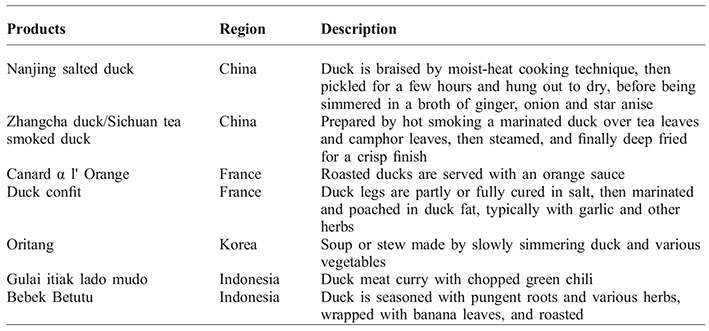
Compared to chicken and turkey meats, the demand of duck is relatively low. Duck meat is usually provided in the form of frozen meat in the supermarket to avoid the loss of unsold duck meat over time (USDA, 2006b). Poor acceptance and low preference by consumers may be due to certain constraints, such as unavailability of animals, the inability to slaughter ducks, lack of demand and weakness of market system for selling meat products (Oteku et al., Reference OTEKU, IGENE and YESSUF2006). Some of the traditional duck meat products (Huda et al., Reference HUDA, PUTRA and AHMAD2011) are popular in many countries and are listed below in Table 4.
Traditional duck meat products.

Apart from these recipes, roasted Pekin duck, crispy duck skin, ginger-root duck, herb duck, pressed salt duck, smoked duck steak, duck roll, tea smoked duck, salted duck eggs, salted duck gizzards, marinated duck tongues are consumed in Asia (Tai and Tai, Reference TAI and TAI2001). Satay is another popular duck meat product of Southeast Asia, especially in Indonesia and Malaysia. The higher fat content of duck meat offers a variation in taste and imparts a stronger aroma.
Roasted duck
Roast duck is popular in Chinese catering, and 100 years of development have resulted in two main styles: Cantonese or Beijing roast duck (Zhou et al., Reference ZHOU, XIE, WANG, TANG, ZHOU and XIAO2014). Cantonese roast duck is famous for its taste; and is treated with a sauce that contains some crude spices, including aniseed, prickly ash peel, cassia, sweetgrass and liquorice (Wu and Liou, Reference WU and LIOU1992; Chen et al., Reference CHEN, SONG and MA2009). Beijing roast duck is one of the most famous Chinese traditional foods prepared from specially bred Beijing force-fed ducks. The duck is completely roasted in a large oven, using a smokeless hardwood fuel and heated to about 250°C for 40 min. The final product is characterised by its crisp skin, alluring taste, colour (which is gloriously dark red) and tender meat shining with oil (Chen et al., Reference CHEN, SONG and MA2009). High temperatures in the oven promotes the formation of desirable flavour compounds, generated through the lipid oxidation process, Maillard reactions and interactions between these reaction products which greatly contributes to its overall acceptance (Estévez et al., Reference ESTÉVEZ, MORCUENDE, VENTANAS and CAVA2003).
Cooked and dry cured duck
Gaoyou duck is mainly used to produce the famous Nanjing cooked or dry-cured duck, which are well accepted by consumers in China and Southeast Asia due to its delicate flavour and texture (Xu et al., Reference XU, XU, ZHOU, WANG and LI2008; Wang et al., Reference WANG, XU, XU, ZHOU, ZHU, LI and YANG2009). Proteolysis and lipolysis have an impact on the final sensory quality - proteolysis releases free amino acids related to flavour development (Ordóñez et al., Reference ORDÓÑEZ, HIERRO, BRUNA and HOZ1999), whereas lipolysis increases free fatty acid content and catalyses oxidation, which is responsible for the characteristic flavour (Yang et al., Reference YANG, MA, QIAO, SONG and DU2005). Dry cured duck is produced by marinating, piling and drying naturally, but the period of its production is shorter than that of hams. In addition, dry-cured duck breast is a good source of certain macrominerals and trace elements, such as magnesium, phosphorus, iron, zinc, and copper (Lorenzo et al., Reference LORENZO, PURRIÑOS, TEMPERAN, BERMÚDEZ, TALLÓN and FRANCO2011).
Foie gras
Foie gras is a popular French dish, which is prepared from the liver of specially fattened geese or ducks. It is considered as a delicacy with high added value, and its flavour is described as rich, buttery and delicate (Lavilla et al., Reference LAVILLA, OLABARRIETA, LASA, MARTÍNEZ, SERRANO, ADURIZ and MARTÍNEZ-DE-MARAÑÓN2019). It is sold whole, as a fresh product for pan frying, or sterilised in a glass jar or metal can. It can be sold in a sterilised or pasteurised form as a spreadable emulsion or pâté (Saucier et al., Reference SAUCIER, GIL, SANCHEZ-CARILLO and RATTI2016).
development of value-added ready-to-eat products from duck meat
The traditional consumption of duck meat cannot stimulate rapid growth in this sector. Diversification of duck meat products in many forms is needed to attract new consumers. Much effort has been made to improve the quality of ready-to-eat duck meat products on a market scale, which will increase duck meat consumption worldwide. The general characteristics of spent duck meat are tough, dark in colour and strong in odour, which are objectionable to most of the consumers. Thus, grinding and comminution of spent duck meat and processing it into emulsion-type products can maximise its utilisation.
In an attempt to improve meat quality by tumbling and massaging, restructured pressed smoked duck steak with soy protein and carrageenan was prepared and both these ingredients reduced drip losses, increased binding ability and water holding capacity and improved flavour (Huang et al., Reference HUANG, WANG, HUANG and LIN2001). A recent study by Kim et al. (Reference KIM, SHIM, HWANG, KIM, SUNG, PAIK and CHOI2018) revealed that cooking losses, emulsion stability and overall acceptability were improved in duck hams restructured with hydrocolloids (1% alginate or 0.5% alginate + 0.5% konjac). Bhattacharyya et al. (Reference BHATTACHARYYA, BISWAS and SINHAMAHAPATRA2004) conducted a study to compare the quality of duck sausages prepared from prime cuts (breast, thigh and drumstick) and non-prime cuts (neck, wing, back and organ meats) of spent ducks, and suggested that low value or non-prime cuts can be utilised for processing of value-added meat products. A study was conducted to compare and assess the quality of chicken and duck patties prepared from broilers, spent hens and ducks by Biswas et al. (Reference BISWAS, CHAKRABORTY and SARKAR2006a). Fat content was significantly higher in duck patties. Based upon oxidative, microbial and sensory qualities, all the patties were acceptable up to the 14th day of refrigerated storage (4 ± 1°C). No major drawbacks were observed in patties prepared from spent hen or duck meat in comparison to those of broilers. Vijayakumar and Biswas (Reference VIJAYAKUMAR and BISWAS2006) undertook an experiment to study the quality and storage stability of enrobed duck cutlet. A significant decrease in organoleptic scores was seen, whereas oxidation, tyrosine value and microbial count were increased with longer storage period. The cutlets were acceptable up to 14 days at a refrigeration temperature of 4 ± 1°C. The effect of storage periods at ambient (25 ± 1°C) or refrigeration temperatures (4 ± 1°C) on the quality of duck sausages and patties was studied by Biswas et al. (Reference BISWAS, VIJAYKUMAR, JANA, BHATTACHARYYA and SINHAMAHAPATRA2006b; Reference BISWAS, CHAKRABORTY, PATRA and DHARGUPTA2011). The authors concluded that duck sausages were consumable up to 14 days when stored under refrigeration, whereas patties prepared from spent duck meat were acceptable up to seven days under refrigeration. An acceptability study on sausages (stuffed in natural and artificial casings) made from broiler meat, spent hen meat and spent duck meat has been carried out (Bhattacharyya et al., Reference BHATTACHARYYA, SINHAMAHAPATRA and BISWAS2007). Spent duck sausages were in the range of standard nutritional values and well accepted by the sensory panellists. Sausages stuffed in natural casing were preferred by the consumers. Almost all of the sensory parameters of spent duck sausages were found to be similar to those for sausages prepared with broiler and spent hen meat during storage.
A more desirable, low-fat duck sausage was prepared by replacing 10% of meat content with hydrated cereal flours (rice, wheat, corn, millet and barley), reducing the off-flavours associated with pure duck meat (Yang et al., Reference YANG, ALI, JEONG, MOON, HWANG, PARK and JOO2009). Among the cereal flours, rice flour had the most desirable effect on overall acceptability of sausages. The effects of addition of different flours (tapioca, wheat, sago and potato) on the physicochemical properties of duck sausages were explored by Muthia et al. (Reference MUTHIA, NURUL and NORYATI2010). Sausages formulated with wheat flour had greater proximate composition values and improved colour characteristics, whereas, sausages formulated with sago flour had better gelation properties and sensory scores. Duck surimi like material (DSLM) was utilised along with cryoprotectants to prepare burgers, and their properties were compared with burgers made out of chicken and duck meat (Ramadhan et al., Reference RAMADHAN, HUDA and AHMAD2012). Duck meat burgers had a lower moisture content and higher fat content and cooking losses compared with other samples. Although chicken burgers were judged the best in terms of colour and texture parameters, physicochemical and sensory characteristics of burgers prepared from DSLM were comparable to chicken burgers. Researchers have reported that DSLM had significantly improved water holding capacity, colour and textural properties compared to untreated duck meat (Nurkhoeriyati et al., Reference NURKHOERIYATI, HUDA and AHMAD2011, Ramadhan et al., Reference RAMADHAN, HUDA and AHMAD2014).
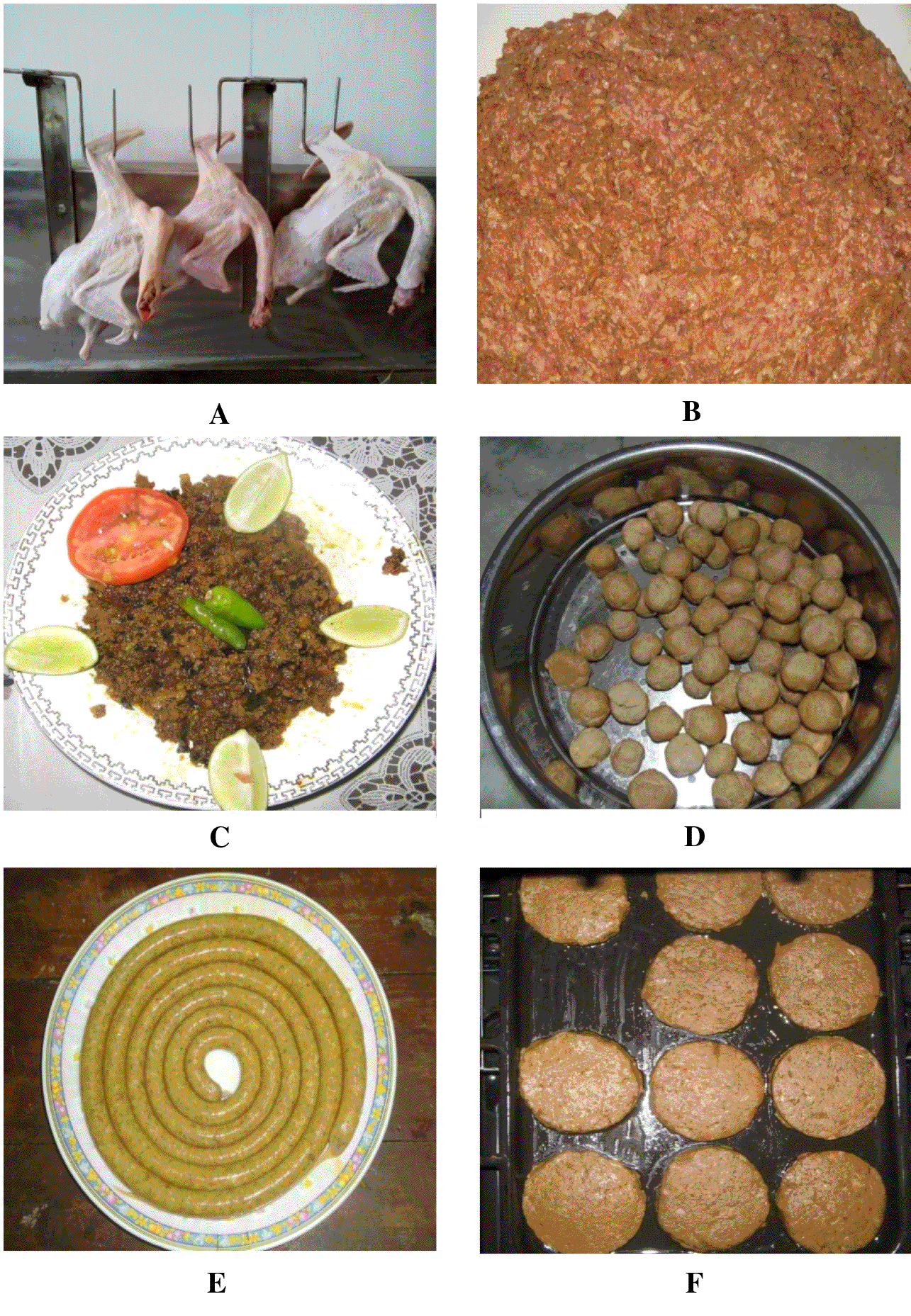
To estimate optimum storage conditions for sausages prepared from spent duck throughout the retail chain, Bhattacharyya et al. (Reference BHATTACHARYYA, SINHAMAHAPATRA and BISWAS2013) used PET/Poly packaging and a laminate of metallised PET/Poly with polyethylene pouches under aerobic and vacuum packaging and stored them under refrigerator (4 ± 1°C) and freezer (-18 ± 1°C) conditions. Freezer temperature enhanced product quality up to the 3rd and 5th month against 20th and 40th day of refrigerated storage in aerobic and vacuum packaging respectively. Studies were conducted to assess the comparative quality of nuggets (Kumar et al., Reference KUMAR, BISWAS, BHATTACHARYYA, RAM and SINGH2014) and sausages (Kumar et al., Reference KUMAR, BISWAS, SINGH, RAM and KALIMUDDIN2016) prepared from different combinations of spent duck and spent hen meats in terms of physico-chemical and sensory attributes. Value added duck meat products, developed at Livestock Products Technology, West Bengal University of Animal and Fishery Sciences, Kolkata, are presented in Figure 2. Quality of a ready-to-eat, Nanjing-style salted duck meat product was improved when exposed to a combination of high pressure (200 MPa) and heat (70°C) treatment (Khan et al., Reference KHAN, ALI, ABID, AHMAD, ZHANG, TUME and ZHOU2014), whereby water retention was enhanced and appearance, tenderness and microbial safety were improved. In a similar study by Khan et al. (Reference KHAN, ALI, YANG, KAMBOH, AHMAD, TUME and ZHOU2019), a ready-to-eat, water-cooked salted-duck meat product was prepared using high pressure (400 MPa) at 70°C for a reduced cooking time (10 or 20 min). High pressure-heat treatment improved colour, whilst reducing lipid and protein oxidation of duck breast samples. Moreover, it reduced the microbial contamination levels (CFU/g) by more than 2 log units compared with the heated control (80°C at 0.1 MPa).
Future scope and conclusion
Duck farming significantly contributes to the livelihood of farmers in terms of nutrition and income. In some developing economies, duck farms still operate under traditional systems with low productivity and without access to commercial breeding farms. However, a changing technical, social and economic environment in has increased interest in intensification of this sector in recent years. Research and development as well as market and support services are critical to boost the economic importance of duck rearing, especially where small scale production is prevalent. The development of commercial strains, feeding strategies and product innovations must be strengthened, and regulations and standards need to be implemented for sustainable small-scale duck production. Farmers can be organised into cooperatives to facilitate efficient supply management, technology diffusion, improved production and access to markets.
To promote organised and larger units for duck meat and egg processing, intensive duck farm management monitoring, sanitation, surveillance, biosecurity, emergency disease response systems, food safety and traceability should be addressed. Marketing duck meat and its products requires innovation to attract consumers and increase market demand. Interventions for the production of low-fat duck meat and the development of ready-to-cook or ready-to-eat duck meat-based products are required to popularise duck meat. Further processing of duck by-products may become a profitable business. A persuasive approach by researchers to solve various problems and good policies from the government to popularise duck meat as a food choice will hopefully attract consumers to use duck meat in greater quantities.
Primary processing and development of value-added duck meat products at Department of Livestock Products Technology, West Bengal University of Animal and Fishery Sciences, Kolkata, India: A. Dressed carcass; B. Duck meat emulsion; C. Duck meat pickle; D. Duck meatballs; E. Duck meat sausage; F. Duck meat patties.

Acknowledgements
The authors would like to thank Department of Science and Technology (DST), Govt. of West Bengal for financial assistance though the project on ‘New Dimension in agriculture marketing and rural employment generation through value added duck meat products’ (Grant no. 434/ST/P/S&T/1G-24/2010)