



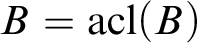
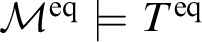


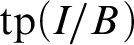



The notion of SOP
 $_1$
(one-strong order property) has been introduced by Shelah in [Reference Shelah16]. Recently theories not having SOP
 $_1$
(NSOP
 $_1$
) have been intensively studied. In the beginning of the studies, specific examples of NSOP
 $_1$
structures have been investigated. Namely in [Reference Chatzidakis4],
 $\omega $
-free PAC fields are examined and in [Reference Granger7], vector spaces over an algebraically closed field equipped with bilinear forms are studied. In those examples the presence of certain well-behaving independence notions is verified.
Later in [Reference Kaplan and Ramsey10], the genuine theoretical progress on the whole class of NSOP
 $_1$
theories is made. More precisely it is proved that Kim-independence, which corresponds to the independence notions in aforementioned examples, satisfies symmetry and type-amalgamation over models in any NSOP
 $_1$
theory T. In [Reference Dobrowolski, Kim and Ramsey6], the results are extended to ‘over arbitrary sets’ when T has existence. Moreover in [Reference Kaplan and Ramsey11], transitivity of Kim-independence over models is shown in T, and again in [Reference Chernikov, Kim and Ramsey5], that is extended to ‘over any sets’ in T with existence. Consequently more algebraic/combinatorial examples not having SOP
 $_1$
are found. Notably we refer to the examples in [Reference Kruckman and Ramey14], the model companions of the empty theory in arbitrary languages, which will be investigated further in this paper.
As is well-know all simple theories are NSOP
 $_1$
having existence, and all stable theories are simple. Moreover in a simple T, Shelah’s forking-independence coincides with Kim-independence. In a stable T, given a stationary type p, its canonical base is well-described as the collection of all names of
 $\varphi $
-definitions in
 $p(x)$
, where
 $\varphi (x,y)$
ranges over all the formulas. When T is simple then given a Lascar type p, its canonical base exists as a hyperimaginary, an equivalence class modulo a type-definable equivalence relation. If T is supersimple then the canonical base of p is described as, similarly to the case of stable theories, the collection of all names of
 $\varphi $
-definitions in
 $p(x)$
, where
 $\varphi (x,y)$
ranges over all p-stable formulas. In the study of simple theories, the existence of canonical bases for Lascar types plays a key role in advancing its theoretical progress. Studying groups in simple structures, generalized amalgamations, group configurations, geometries of forking-independence, Hrushovski constructions, and more can not even be imagined without the existence of canonical bases, as summarized for example in [Reference Kim12].
While the class of NSOP
 $_1$
theories is considered as that on which suitable theoretical developments can be made in parallel with those on simple theories, so far there is no clue how to find canonical bases for types over models in NSOP
 $_1$
theories. In this paper we attempt to investigate this issue and achieve partial success.
Basic facts and definitions for this paper are summarized in §1. In §2, we present several more properties on Kim-independence over sets in an NSOP
 $_1$
theory T with existence (we keep the same T in the rest of this paragraph), which will be used in the following sections. In particular strengthened type-amalgamation over sets (Theorem 2.7) holds by which base monotonicity is somewhat recovered. In §3, we study collinearity of indiscernible sequences. Two indiscernible sequences are said to be collinear if they are contained in a common indiscernible sequence. We show that in T, the transitive closure
 $\approx $
of collinearity of an indiscernible sequence I is type-definable (Theorem 3.3), so
 $I/{\approx} $
is a hyperimaginary. This is a key result in this paper. Relying on this, in §4, we study weak canonical bases of
 $p=\operatorname {tp}(c/B)$
in T where B is algebraically closed in
 ${\mathcal M}^{\operatorname {eq}}$
. The weak canonical bases of p, written
 $\operatorname {wcb}(p)$
or
 $\operatorname {wcb}(c/B)$
, is the smallest algebraically closed subset of B over which p does not Kim-fork. We show that given a total
 $\mathop {\smile \hskip -0.9em ^| \ }^K$
-Morley sequence I in p,
 $\operatorname {wcb}(I/B)=\operatorname {acl}(I/{\approx} )$
whenever
 $I/{\approx} $
is eliminable to a sequence of imaginaries. We also supply criteria for the existence of
 $\operatorname {wcb}(p)$
. In particular it is (if exists) the intersection of
 $\operatorname {wcb}(I/B)$
where I ranges over all the total
 $\mathop {\smile \hskip -0.9em ^| \ }^K$
-Morley sequences in p. In addition, we show that weak canonical bases satisfy finite character (Proposition 4.7). We investigate several examples in §5 in relation with weak canonical bases. In [Reference Kruckman and Ramey14], the model companion
 $T^\emptyset _L$
of the empty theory in a language L is shown to be NSOP
 $_1$
with existence. We point out that these are typical examples having weak canonical bases, as well. However, contrary to the case of simple theories, given a total
 $\mathop {\smile \hskip -0.9em ^| \ }^K$
-Morley sequence I in p,
 $\operatorname {wcb}(c/B)$
and
 $\operatorname {wcb}(I/B)$
need not be interalgebraic in an example of
 $T^\emptyset _L$
. In §6, we introduce a notion of independence
 $\mathop {\smile \hskip -0.9em ^| \ }^c$
in T having weak canonical bases. Namely we let
 $c\mathop {\smile \hskip -0.9em ^| \ }^c_AB$
if
 $\operatorname {wcb}(c/\operatorname {acl}(AB))\subseteq \operatorname {acl}(A)$
, and we present several properties of
 $\mathop {\smile \hskip -0.9em ^| \ }^c$
. In particular,
 $\mathop {\smile \hskip -0.9em ^| \ }^c$
satisfies finite character, base monotonicity, and transitivity. On the other hand, in any non-rosy T,
 $\mathop {\smile \hskip -0.9em ^| \ }^c$
fail to have symmetry and left-transitivity. We expect the notion of
 $\mathop {\smile \hskip -0.9em ^| \ }^c$
in conjunction with that of
 $\mathop {\smile \hskip -0.9em ^| \ }^K$
will be useful in advanced studies of NSOP
 $_1$
theories.
1 Introduction
Throughout this paper, we work with
 $T=\operatorname {Th}({\mathcal M})$
with
 ${\mathcal M}={\mathcal M}^{\operatorname {eq}}$
in a language
 ${\mathcal L}={\mathcal L}^{\operatorname {eq}}$
, and as usual,
 $a,b,c,\dots $
and
 $ A, B, C,\dots $
are from
 ${\mathcal M}$
(unless they are hyperimaginaries). For infinite
 $x, a$
, a formula
 $\varphi (x,a)$
obviously means
 $\varphi (x^{\prime },a^{\prime })$
for suitable finite
 $x^{\prime }\subseteq x$
and
 $a^{\prime }\subseteq a$
. The choices of
 $x^{\prime }$
and
 $a^{\prime }$
from x and a, respectively, will be clear from the context. For a set A,
 $\overline A$
denotes
 $\operatorname {acl}(A)$
. In the rest of this section, we recall definitions and facts from [Reference Chernikov, Kim and Ramsey5, Reference Dobrowolski, Kim and Ramsey6, Reference Kaplan and Ramsey10, Reference Kaplan and Ramsey11, Reference Kim12, Reference Shelah16], which will be freely used in the paper.
-
(1) We say a formula
 $\varphi (x,a_0)$
divides over A if there is an A-indiscernible sequence
$\langle a_i\mid i<\omega \rangle $
such that
$\{\varphi (x,a_i)\mid i<\omega \}$
is inconsistent. A formula forks over A if the formula implies some finite disjunction of formulas, each of which divides over A. Then we say a type divides/forks over A if the type implies a formula which divides/forks over A.
-
(2) We write
$A\mathop {\smile \hskip -0.9em ^| \ }_BC$
if for any finite
$a\in A$
,
$\operatorname {tp}(a/BC)$
does not fork over B. An A-indiscernible sequence
$\langle a_i\mid i<\omega \rangle $
is said to be Morley over A (or A-Morley) if
$a_i\mathop {\smile \hskip -0.9em ^| \ }_A a_{<i}$
for each
$i<\omega $
. -
(3) We say the Lascar types of
$a,b$
over A are equal, written
$a\equiv _A^Lb$
, if the Lascar distance between
$a,b$
over A is finite, that is there are
$a=a_0,\dots , a_n=b$
such that
$a_ia_{i+1}$
begins an A-indiscernible sequence for each
$i<n$
. We say the KP (Kim–Pillay)-types of
$a,b$
over A are equal, written
$a\equiv ^{KP}_Ab$
, if
$a,b$
are in the same class of the finest A-type-definable equivalence relation having at most
$2^{|T|+|A|+|a|}$
-classes. Strong types of
$a,b$
over A are equal (
$a\equiv ^{s}_Ab$
) if
$a\equiv _{\overline A}b$
holds. It follows that
$a\equiv _A^L b \ \Rightarrow \ a\equiv _A^{KP}b\ \Rightarrow \ a\equiv ^s_A b \ \Rightarrow \ a\equiv _Ab$
, that is
$\operatorname {tp}(a/A)=\operatorname {tp}(b/A)$
. -
(4) A hyperimaginary is an equivalence class of an
$\emptyset $
-type-definable equivalence relation. We say T has elimination of hyperimaginaries (e.h.i.) if any hyperimaginary
$\boldsymbol d$
is interdefinable with some sequence d of imaginaries, that is, given any automorphism f, f fixes the class
$\boldsymbol d$
setwise if and only if it fixes d pointwise.


We will freely use the fact that an A-indiscernible sequence is
 $\overline A$
-indiscernible as well. In particular in any T, a formula divides/forks over A iff it divides/forks over
 $\overline A$
. We state the following easy observation as we do not see it in the literature.
Remark 1.2. (T any)
 $c\mathop {\smile \hskip -0.9em ^| \ }_AB$
iff
 $c\mathop {\smile \hskip -0.9em ^| \ }_{\overline A} B$
: (
 $\Rightarrow $
) We prove this contrapositively. Suppose that there is a formula
 $\varphi (x;a_0,b)\in \operatorname {tp}(c/\overline {A} B)$
with finite
 $a_0\in \overline {A}$
and
 $b\in B$
such that
 $\varphi (x;a_0,b)$
forks over
 $\overline A$
. Now there are maximal conjugates
 $a_0,\dots ,a_m$
of
 $a_0$
over
 $AB$
. Then it follows
 $\bigvee _{i\leq m} \varphi _i(x;a_i,b)$
is definable over
 $AB$
, so we rewrite it as
 $\psi (x,d)$
with
 $d\in AB$
. Obviously
 $\psi (x,d)\in \operatorname {tp}(c/AB)$
, and
 $\psi (x,d)$
forks over A as well. Hence we have
 $c\mathop { \not \smile \hskip -0.9em ^| \ }_AB$
.
(
 $\Leftarrow $
) Its contraposition follows directly.
Hence a sequence I is A-Morley iff I is
 $\overline A$
-Morley; similarly we have
 $c\mathop {\smile \hskip -0.9em ^| \ }_AB$
iff
 $c\mathop {\smile \hskip -0.9em ^| \ }_A\overline {B}$
.
Fact 1.3.
-
(1) (Base monotonicity) For
$A\subseteq B\subseteq C$
if
$a\mathop {\smile \hskip -0.9em ^| \ }_AC$
holds then
$a\mathop {\smile \hskip -0.9em ^| \ }_BC$
follows. -
(2) (Left transitivity) If
$a\mathop {\smile \hskip -0.9em ^| \ }_AB$
and
$b\mathop {\smile \hskip -0.9em ^| \ }_{aA}B$
then we have
$ba\mathop {\smile \hskip -0.9em ^| \ }_AB$
. -
(3) (Extension) For
$A\subseteq B\subseteq C$
, if
$a\mathop {\smile \hskip -0.9em ^| \ }_AB$
then there is
$a^{\prime }\equiv _{B}a$
such that
$a^{\prime }\mathop {\smile \hskip -0.9em ^| \ }_AC$
. -
(4) The following are equivalent.
-
(a) Any type over a set does not fork over the set.
-
(b) For any
$p\in S(A)$
there is a Morley sequence in p. -
(c) Any consistent formula
$\varphi (x,a)$
does not fork over its finite parameter a.
We say T has existence if one of the above equivalent conditions holds.
-


Definition 1.4 (T has existence)
-
(1) A formula
$\varphi (x,a_0)$
Kim-divides over A if there is an A-Morley sequence
$\langle a_i\mid i<\omega \rangle $
such that
$\{\varphi (x,a_i)\mid i<\omega \}$
is inconsistent. A formula Kim-forks over A if the formula implies some finite disjunction of formulas, each of which Kim-divides over A. A type Kim-divides/forks over A if the type implies a formula which Kim-divides/forks over A. -
(2) We write
$A\mathop {\smile \hskip -0.9em ^| \ }^K_BC$
if for any finite
$a\in A$
,
$\operatorname {tp}(a/BC)$
does not Kim-fork over B. Obviously
$A\mathop {\smile \hskip -0.9em ^| \ }_BC$
implies
$A\mathop {\smile \hskip -0.9em ^| \ }^K_BC$
. Given an A-indiscernible sequence
$\langle a_i\mid i<\omega \rangle $
we say it is
$\mathop {\smile \hskip -0.9em ^| \ }^K$
-Morley over A (or A-
$\mathop {\smile \hskip -0.9em ^| \ }^K$
-Morley) if
$a_i\mathop {\smile \hskip -0.9em ^| \ }^K_A a_{<i}$
for each
$i<\omega $
; and we say it is a total
$\mathop {\smile \hskip -0.9em ^| \ }^K$
-Morley sequence over A if
$a_{\geq i}\mathop {\smile \hskip -0.9em ^| \ }^K_A a_{< i}$
holds for each
$i<\omega $
. Recall that a Morley sequence over A is a total
$\mathop {\smile \hskip -0.9em ^| \ }^K$
-Morley sequence over A.


Remark 1.5 (T has existence)
-
(1) Whether a formula or a type Kim-divides/Kim-forks over a set only depends on the solution set of the formula or the type.
-
(2) (Extension for
$\mathop {\smile \hskip -0.9em ^| \ }^K$
) If a partial type p over C does not Kim-fork over a set then there is a completion of p over C which does not Kim-fork over the set. In particular, for
$A\subseteq B\subseteq C$
, if
$a\mathop {\smile \hskip -0.9em ^| \ }^K_AB$
then there is
$a^{\prime }\equiv _{B}a$
such that
$a^{\prime }\mathop {\smile \hskip -0.9em ^| \ }^K_AC$
. -
(3) By (similar proofs as in) Remark 1.2, we have that a formula Kim-divides/forks over A iff it does over
$\overline A$
;
$c\mathop {\smile \hskip -0.9em ^| \ }^K_AB$
iff
$c\mathop {\smile \hskip -0.9em ^| \ }^K_{\overline A} B$
iff
$c\mathop {\smile \hskip -0.9em ^| \ }^K_A \overline {B}$
iff
$c\mathop {\smile \hskip -0.9em ^| \ }^K_{\overline A} \overline {B}$
; and a sequence I is
$\mathop {\smile \hskip -0.9em ^| \ }^K$
-Morley over A iff I is
$\mathop {\smile \hskip -0.9em ^| \ }^K$
-Morley over
$\overline A$
.


Definition 1.6. We say a formula
 $\varphi (x,y)\in {\mathcal L}$
has SOP
 $_{1}$
if there is a tree of tuples
 $\{a_{\eta }\mid \eta \in 2^{<\omega }\}$
such that
-
(1) for all
$\xi \in 2^{\omega }$
,
$\{\varphi (x,a_{\xi \lceil \alpha }) \mid \alpha < \omega \}$
is consistent; and -
(2) for all
$\eta \in 2^{<\omega }$
, if
$\nu \unrhd \eta ^{\smallfrown } \langle 0 \rangle $
, then
$\{\varphi (x;a_{\nu }), \varphi (x;a_{\eta ^{\smallfrown } \langle 1\rangle })\}$
is inconsistent,


where
 $\unlhd $
denotes the tree partial order on
 $2^{<\omega }$
. We say T has SOP
 $_{1}$
if some formula has SOP
 $_{1}$
in T, and say T is NSOP
 $_{1}$
if T does not have SOP
 $_1$
.
We say T is simple if nonforking satisfies local character: For any set A and finite a, there is
 $A_0\subseteq A$
with
 $|A|\leq |T|$
such that
 $a\mathop {\smile \hskip -0.9em ^| \ }_{A_0}A$
. As is well known, in simple T,
 $\mathop {\smile \hskip -0.9em ^| \ }=\mathop {\smile \hskip -0.9em ^| \ }^K$
and existence holds. Any simple T is NSOP
 $_1$
. Moreover, T is simple or NSOP
 $_1$
iff so is
 $T^{\operatorname {eq}}$
, respectively (see for example [Reference Kim12, 2.3.8]). However it is not known yet whether existence holds in any NSOP
 $_1$
theory.
Unless said otherwise, for the rest of this paper we assume T is NSOP
 $_{1e}$
, that is NSOP
 $_1$
having existence. We collect the following properties of
 $\mathop {\smile \hskip -0.9em ^| \ }^K$
holding in T, which will be freely used throughout this paper. (The facts below are true when the base sets are models in an NSOP
 $_1$
theory, regardless of existence. See [Reference Kaplan and Ramsey10, Reference Kaplan and Ramsey11]).
Fact 1.7.
-
(1) (Kim’s lemma for
$\mathop {\smile \hskip -0.9em ^| \ }^K$
) A formula
$\varphi (x,a_0)$
Kim-divides over a set A iff for any Morley sequence
$\langle a_i\mid i<\omega \rangle $
over A,
$\{\varphi (x,a_i)\mid i<\omega \}$
is inconsistent. -
(2) A formula Kim-divides over A iff the formula Kim-forks over A. In particular,
$c\mathop {\smile \hskip -0.9em ^| \ }^K_A\overline A$
hold for any set A. -
(3) (Symmetry for
$\mathop {\smile \hskip -0.9em ^| \ }^K$
) For any sets
$A, B, C$
we have
$A\mathop {\smile \hskip -0.9em ^| \ }^K_BC$
iff
$C\mathop {\smile \hskip -0.9em ^| \ }^K_BA$
. -
(4) (Transitivity for
$\mathop {\smile \hskip -0.9em ^| \ }^K$
) For
$B\subseteq C\subseteq D$
, if
$A\mathop {\smile \hskip -0.9em ^| \ }_BC$
and
$A\mathop {\smile \hskip -0.9em ^| \ }_CD$
then
$A\mathop {\smile \hskip -0.9em ^| \ }_BD$
holds. -
(5) (Type-amalgamation for
$\mathop {\smile \hskip -0.9em ^| \ }^K$
) Assume
$A_0\mathop {\smile \hskip -0.9em ^| \ }^K_BA_1$
,
$c_0\equiv ^L_{B} c_1$
, and
$c_i\mathop {\smile \hskip -0.9em ^| \ }^K_BA_i$
for
$i=0,1$
. Then there is
$c\equiv ^L_{BA_i}c_i$
such that
$c\mathop {\smile \hskip -0.9em ^| \ }^K_BA_1A_2$
. This implies that T is G-compact over any set, that is
$a\equiv ^L_A b$
iff
$a\equiv ^{KP}_Ab$
, for any
$a,b,A$
. -
(6) (Chain condition) Assume that
$c\mathop {\smile \hskip -0.9em ^| \ }^K_A b_0$
and
$I=\langle b_i\mid i<\omega \rangle $
is
$\mathop {\smile \hskip -0.9em ^| \ }^K$
-Morley over A. Then there is
$c^{\prime }\equiv ^L_{Ab_0} c$
such that
$c^{\prime }\mathop {\smile \hskip -0.9em ^| \ }^K_AI$
and I is
$c^{\prime }A$
-indiscernible. -
(7) (Witnessing)
$\varphi (x,a_0)$
Kim-divides over A iff for some/any
$\mathop {\smile \hskip -0.9em ^| \ }^K$
-Morley sequence
$\langle a_i\mid i<\omega \rangle $
over A,
$\{\varphi (x,a_i)\mid i<\omega \}$
is inconsistent. -
(8) Given
$p(x)\in S(A)$
, there is a type
$\Gamma (x,y)$
over A such that
$ab\models \Gamma $
iff
$a\mathop {\smile \hskip -0.9em ^| \ }^K_Ab $
and
$a\models p$
. Thus that
$\langle x_i\mid i<\omega \rangle $
is
$\mathop {\smile \hskip -0.9em ^| \ }^K$
-Morley over A in p is A-type-describable.


But
 $\mathop {\smile \hskip -0.9em ^| \ }^K$
satisfies base monotonicity iff T is simple. We lastly point out the following useful fact which will be freely used. A proof can be found in, say [Reference Kim12].
Fact 1.8. Given
 $\kappa $
, there is
 $\lambda = \lambda (\kappa )$
such that for any sequence
 $I=\langle a_i: i<\lambda \rangle $
of
 $\leq \kappa $
-sized tuples and any set A of size
 $\leq \kappa $
, there is an A-indiscernible sequence
 $\langle b_i: i<\omega \rangle $
which is finitely based on I over A, i.e., for any
 $b_{\leq n}$
there are
 $a_{i_{\leq n}}$
with
 $i_0<\dots <i_n\in \lambda $
such that
 $ b_{\leq n}\equiv _A a_{i_{\leq n}}$
.
2 More properties on
$\mathop {\smile \hskip -0.9em ^| \ }^K$

In this section, we establish more flexible type-amalgamation (Theorem 2.5) generalizing Fact 1.7(5) and lifting properties of
 $\mathop {\smile \hskip -0.9em ^| \ }^K$
over sets. Results in this section will be used in the following sections. We make use of ideas from [Reference Kaplan and Ramsey11] and [Reference Kruckman and Ramey14] where the results of this section over models or in other variations are proved earlier. However proofs are considerably simplified, in particular we do not use the notion of ‘tree-Morley sequences’. We recall the following fact.
Fact 2.1. [Reference Chernikov, Kim and Ramsey5, 2.3]. Let
 $a_0\mathop {\smile \hskip -0.9em ^| \ }^K_AB$
with
 $A\subseteq B$
. Then there is a total
 $\mathop {\smile \hskip -0.9em ^| \ }^K$
-Morley sequence
 $J=\langle a_i\mid i<\omega \rangle $
over A such that
 $J\mathop {\smile \hskip -0.9em ^| \ }^K_AB$
and J is
 $\mathop {\smile \hskip -0.9em ^| \ }^K$
-Morley over B.
Note that due to Fact 1.7(8), once such J in Fact 2.1 exists then we can enlarge the length of J by compactness.
Proposition 2.2. Let
 $a_0\mathop {\smile \hskip -0.9em ^| \ }^K_AB$
with
 $A\subseteq B$
and let
 $I=\langle a_i\mid i<\omega \rangle $
be
 $\mathop {\smile \hskip -0.9em ^| \ }^K$
-Morley over A. Then there is
 $I^{\prime }\equiv _{Aa_0}I$
such that
 $I^{\prime }\mathop {\smile \hskip -0.9em ^| \ }^K_AB$
and
 $I^{\prime }$
is
 $\mathop {\smile \hskip -0.9em ^| \ }^K$
-Morley over B.
Proof. By Fact 2.1, there is a total
 $\mathop {\smile \hskip -0.9em ^| \ }^K$
-Morely sequence J over A beginning with
 $a_0$
such that
 $J\mathop {\smile \hskip -0.9em ^| \ }^K_AB$
and J is
 $\mathop {\smile \hskip -0.9em ^| \ }^K$
-Morley over B.
Claim. There is a sequence
 $I_0=\langle a^{\prime }_i\mid i<\omega \rangle \equiv ^L_{A} I$
in
 $\operatorname {tp}(a_0/B)$
with
 $a^{\prime }_0=a_0$
such that
 $I_0\mathop {\smile \hskip -0.9em ^| \ }^K_AB$
and
 $a^{\prime }_i\mathop {\smile \hskip -0.9em ^| \ }^K_B a^{\prime }_{<i}$
for each
 $i\in \omega $
.
Proof of Claim. Assume we have found
 $a^{\prime }_{\leq n}\equiv ^L_{A} a_{\leq n}$
with
 $a^{\prime }_0=a_0$
such that
 $a^{\prime }_{\leq n}\mathop {\smile \hskip -0.9em ^| \ }^K_AB$
,
 $a^{\prime }_i\equiv _B a_0$
, and
 $a_i\mathop {\smile \hskip -0.9em ^| \ }^K_B a_{<i}$
for each
 $i\leq n$
. (Putting
 $a^{\prime }_0=a_0$
works for
 $n=0$
.) Now there is
 $a^{\prime }$
such that
 $a^{\prime }_{\leq n}a^{\prime }\equiv _A^La_{\leq n+1}$
. Then since
 $a_0\equiv ^L_A a_{n+1}\equiv ^L_A a^{\prime }$
, there is
 $J_0B_0$
such that
 $a_0JB\equiv ^L_A a^{\prime }J_0B_0$
. Moreover since
 $a^{\prime }_{\leq n} \mathop {\smile \hskip -0.9em ^| \ }^K_Aa^{\prime }$
, by Fact 1.7(6) there is
 $J^{\prime }\equiv ^L_{Aa^{\prime }}J_0$
such that
 $(a^{\prime }\in )J^{\prime }$
is
 $Aa^{\prime }_{\leq n}$
-indiscernible and
 $a^{\prime }_{\leq n}\mathop {\smile \hskip -0.9em ^| \ }^K_A J^{\prime }$
. Moreover for
 $B'$
with
 $B'J^{\prime }\equiv ^L_{Aa^{\prime }}B_0J_0$
, we have
 $B'\mathop {\smile \hskip -0.9em ^| \ }^K_AJ^{\prime }$
, and
 $J^{\prime }$
is
 $\mathop {\smile \hskip -0.9em ^| \ }^K$
-Morley over
 $B'$
. Hence by type-amalgamation there is
 $$ \begin{align*}B''\models \operatorname{Ltp}(B'/AJ^{\prime})\cup \operatorname{Ltp}(B/Aa^{\prime}_{\leq n})\end{align*} $$
such that
 $B^{\prime \prime }\mathop {\smile \hskip -0.9em ^| \ }^K_AJ^{\prime } a^{\prime }_{\leq n}$
. By moving
 $B^{\prime \prime }$
to B over
 $Aa^{\prime }_{\leq n}$
, we find
 $J^{\prime \prime }B\equiv ^L_{Aa^{\prime }_{\leq n}}J^{\prime }B^{\prime \prime }$
such that
 $B\mathop {\smile \hskip -0.9em ^| \ }^K_A J^{\prime \prime }a^{\prime }_{\leq n}$
, and
 $J^{\prime \prime }$
is
 $\mathop {\smile \hskip -0.9em ^| \ }^K$
-Morley over B.
Now by assuming the length of
 $J^{\prime \prime }$
is sufficiently large, we can find
 $c\in J^{\prime \prime }$
such that infinitely many elements in
 $J^{\prime \prime }$
have the same type as c over
 $B a^{\prime }_{\leq n}$
. Then
 $B\mathop {\smile \hskip -0.9em ^| \ }^K_A a^{\prime }_{\leq n}c$
, and by Fact 1.7(7), we have
 $c\mathop {\smile \hskip -0.9em ^| \ }^K_B a^{\prime }_{\leq n}$
. Note also that
 $J^{\prime \prime }B\equiv J^{\prime }B'\equiv JB$
and hence
 $c\equiv _B a_0$
. Moreover since
 $J^{\prime \prime }$
is
 $A a^{\prime }_{\leq n}$
-indiscernible, we have
 $c\equiv ^L_{A a^{\prime }_{\leq n}}a^{\prime } $
and
 $a^{\prime }_{\leq n}c\equiv ^L_Aa^{\prime }_{\leq n}a^{\prime }\equiv ^L_A a_{\leq n+1}$
. Hence by putting
 $a^{\prime }_{n+1}=c$
, the induction step for
 $n+1$
is established, completing the proof of Claim.
Notice now that the existence of such
 $I_0$
in the claim is type-describable over B, and hence by compactness and Ramsey we can additionally assume
 $I_0$
is B-indiscernible. Then by moving the initial component of
 $I_0$
to
 $a_0$
over B we obtain a desired sequence
 $I^{\prime }$
.⊣
The following Lemma enables us to strengthen Proposition 2.2 via Corollary 2.4, which is used in proving Theorem 2.5.
Lemma 2.3. Let
 $I=\langle a_i\mid i<\omega \rangle $
be
 $\mathop {\smile \hskip -0.9em ^| \ }^K$
-Morely over A. For any tuple b, there is an
 $\mathop {\smile \hskip -0.9em ^| \ }^K$
-Morley sequence
 $\langle a_ib_i\mid i<\omega \rangle $
over A such that
 $b\equiv _{Aa_0}b_0$
.
Proof. We claim the following first.
Claim. There is a sequence
 $\langle a^{\prime }_ib^{\prime }_i\mid i<\omega \rangle $
such that
 $\langle a^{\prime }_i\mid i<\omega \rangle \equiv _A I$
and for each
 $i<\omega $
, we have
 $a^{\prime }_ib^{\prime }_i\equiv _A a^{\prime }_0b^{\prime }_0= a_0b$
and
 $a^{\prime }_ib^{\prime }_i\mathop {\smile \hskip -0.9em ^| \ }^K_A a^{\prime }_{<i}b^{\prime }_{<i}$
.
Proof of Claim. Put
 $a^{\prime }_0b^{\prime }_0=a_0b$
and assume we have chosen
 $a_{\leq n}b^{\prime }_{\leq n}$
such that
 $a^{\prime }_{\leq n}\equiv _A a_{\leq n}$
and for each
 $i\leq n$
,
 $a^{\prime }_ib^{\prime }_i\equiv _A a^{\prime }_0b^{\prime }_0$
and
 $a_ib^{\prime }_i\mathop {\smile \hskip -0.9em ^| \ }^K_A a_{<i}b^{\prime }_{<i}$
. Since
 $a^{\prime }_{\leq n}\equiv _A a_{\leq n}$
and
 $a_{n+1}\mathop {\smile \hskip -0.9em ^| \ }^K_Aa_{\leq n}$
, by extension there is
 $a^{\prime }_{n+1}$
such that
 $a^{\prime }_{\leq n+1}\equiv _A a_{\leq n+1}$
and
 $a^{\prime }_{n+1}\mathop {\smile \hskip -0.9em ^| \ }^K_A a^{\prime }_{\leq n}b^{\prime }_{\leq n}$
. Then again by extension there is
 $b^{\prime }_{n+1}$
such that
 $a^{\prime }_{n+1}b^{\prime }_{n+1}\equiv _A a^{\prime }_0b^{\prime }_0$
and
 $a^{\prime }_{n+1}b^{\prime }_{n+1}\mathop {\smile \hskip -0.9em ^| \ }^K_A a^{\prime }_{\leq n}b^{\prime }_{\leq n}$
. This shows the induction step for
 $n+1$
completing the proof of Claim.
Now in the claim, by moving
 $\langle a^{\prime }_i\mid i<\omega \rangle $
to I over A, we find
 $b_i$
’s such that for each
 $i<\omega $
,
 $a_ib_i\equiv _Aa_0b$
and
 $a_ib_i\mathop {\smile \hskip -0.9em ^| \ }^K_A a_{<i}b_{<i}$
. Then by compactness and Ramsey, or applying Fact 1.8 after assuming the length of I is sufficiently large, we can additionally assume
 $\langle a_ib_i\mid i<\omega \rangle $
is A-indiscernible, and hence
 $\mathop {\smile \hskip -0.9em ^| \ }^K$
-Morley over A as wanted.⊣
Corollary 2.4. Let
 $a_0\mathop {\smile \hskip -0.9em ^| \ }^K_AB$
with
 $A\subseteq B$
and let
 $I=\langle a_i\mid i<\omega \rangle $
be
 $\mathop {\smile \hskip -0.9em ^| \ }^K$
-Morley over A. Then there is
 $I^{\prime }\equiv ^L_{Aa_0}I$
such that
 $I^{\prime }\mathop {\smile \hskip -0.9em ^| \ }^K_AB$
and
 $I^{\prime }$
is
 $\mathop {\smile \hskip -0.9em ^| \ }^K$
-Morley over B.
Proof. Let b be a tuple enumerating a model containing
 $a_0A$
. Then by Lemma 2.3, there is
 $\mathop {\smile \hskip -0.9em ^| \ }^K$
-Morley
 $J=\langle a_ib_i\mid i<\omega \rangle $
over A such that
 $b_0\equiv _{Aa_0} b$
. By applying Proposition 2.2 to J, we find
 $J^{\prime }=\langle a^{\prime }_ib^{\prime }_i\mid i<\omega \rangle \equiv _{Aa_0b_0}J$
such that
 $J^{\prime }\mathop {\smile \hskip -0.9em ^| \ }^K_AB$
and
 $J^{\prime }$
is
 $\mathop {\smile \hskip -0.9em ^| \ }^K$
-Morley over B.
Notice that since
 $b_0$
is a model containing
 $a_0A$
, in fact
 $J^{\prime }\equiv ^L_{Aa_0}J$
. Thus putting
 $I^{\prime }=\langle a^{\prime }_i\mid i<\omega \rangle $
finishes the proof.⊣
Theorem 2.5. Let
 $a,b_0,c$
be pairwise Kim-independent over A. Then there is b such that
 $b\equiv ^L_{Aa} b_0$
,
 $b\equiv ^L_{Ac} b_0$
and
 $b\mathop {\smile \hskip -0.9em ^| \ }^K_{Aa}c$
,
 $b\mathop {\smile \hskip -0.9em ^| \ }^K_{Ac}a$
hold. Thus by transitivity of
 $\mathop {\smile \hskip -0.9em ^| \ }^K$
, it follows that
 $a\mathop {\smile \hskip -0.9em ^| \ }^K_A bc$
,
 $b\mathop {\smile \hskip -0.9em ^| \ }^K_A ac$
, and
 $c\mathop {\smile \hskip -0.9em ^| \ }^K_A ab$
.
Proof. We show the second statement. Now by Proposition 2.2, there is a sequence
 $I_a=\langle b_i\mid i<\omega \rangle $
which is
 $\mathop {\smile \hskip -0.9em ^| \ }^K$
-Morley over both
 $A $
and
 $Aa$
, and
 $I_a\mathop {\smile \hskip -0.9em ^| \ }^K_A a$
. Now then by Corollary 2.4, there is a sequence
 $I_c$
starting with
 $b_0$
such that
 $I_c\equiv ^L_{Ab_0}I_a$
(so
 $I_c\equiv ^L_A I_a$
),
 $I_c$
is
 $\mathop {\smile \hskip -0.9em ^| \ }^K$
-Morley over A and over
 $Ac$
, and
 $I_c\mathop {\smile \hskip -0.9em ^| \ }^K_A c$
. Now by type-amalgamation there is
 $$ \begin{align*}I\models \operatorname{Ltp}(I_a/Aa)\cup \operatorname{Ltp}(I_c/Ac)\end{align*} $$
such that
 $I\mathop {\smile \hskip -0.9em ^| \ }^K_A ac$
. Thus I is
 $\mathop {\smile \hskip -0.9em ^| \ }^K$
-Morley over
 $Aa$
and over
 $Ac$
. Moreover by assuming the length of I is sufficiently large, we can find
 $b\in I$
such that for infinitely many
 $b^{\prime }\in I$
,
 $b\equiv _{Aac} b^{\prime }$
. Hence by witnessing,
 $b\mathop {\smile \hskip -0.9em ^| \ }^K_{Aa}c$
and
 $b\mathop {\smile \hskip -0.9em ^| \ }^K_{Ac}a$
hold as wanted. Moreover since
 $I\equiv ^L_{Aa} I_a$
and
 $I\equiv ^L_{Ac} I_c$
, we have
 $b\equiv ^L_{Aa}b_0$
and
 $b\equiv ^L_{Ac}b_0$
as required.⊣
Question 2.6. In Theorem 2.5, can we find such b which additionally satisfies that
 $a\mathop {\smile \hskip -0.9em ^| \ }^K_{Ab}c$
?
Now we yield the following strengthened type-amalgamation, which is essentially a result of the authors of [Reference Kruckman and Ramey14], as we have critically used ideas from there.
Theorem 2.7. Assume
 $A_0\mathop {\smile \hskip -0.9em ^| \ }^K_BA_1$
,
 $c_0\equiv ^L_{B} c_1$
, and
 $c_i\mathop {\smile \hskip -0.9em ^| \ }^K_BA_i$
for
 $i=0,1$
. Then there is
 $c\equiv ^L_{BA_i}c_i$
such that
 $c\mathop {\smile \hskip -0.9em ^| \ }^K_BA_0A_1$
,
 $c\mathop {\smile \hskip -0.9em ^| \ }^K_{BA_0}A_1$
and
 $c\mathop {\smile \hskip -0.9em ^| \ }^K_{BA_1}A_0$
.
Proof. By type-amalgamation there is
 $c^{\prime }\equiv ^L_{BA_i}c_i$
(
 $i=0,1$
) such that
 $c^{\prime }\mathop {\smile \hskip -0.9em ^| \ }^K_BA_0A_1$
, Then we apply Theorem 2.5 to
 $A_0, c^{\prime }, A_1$
over B and get
 $c\equiv ^L_{BA_i}c^{\prime }$
such that
 $c\mathop {\smile \hskip -0.9em ^| \ }^K_{BA_0}A_1$
,
 $c\mathop {\smile \hskip -0.9em ^| \ }^K_{BA_1}A_0$
, and
 $c\mathop {\smile \hskip -0.9em ^| \ }^K_BA_0A_1$
.⊣
Theorem 2.5 and 2.7 will be used in §3.
Contrary to the case of simple theories, an
 $\mathop {\smile \hskip -0.9em ^| \ }^K$
-Morley sequence over A need not be a total
 $\mathop {\smile \hskip -0.9em ^| \ }^K$
-Morley sequence over A. See [Reference Kaplan and Ramsey11, §3.1] or Example 5.3. We now aim to show Theorem 2.14 about total
 $\mathop {\smile \hskip -0.9em ^| \ }^K$
-Morley sequences, which is analogous to Proposition 2.2 on
 $\mathop {\smile \hskip -0.9em ^| \ }^K$
-Morley sequences. Theorem 2.14 will be used in §4.
We recall the notions of
 ${\mathcal T}_\alpha $
-tree and tree indiscernibility from [Reference Kaplan and Ramsey10, Reference Kaplan and Ramsey11, Reference Kim, Kim and Scow13]. In this paper, by a tree we mean a set
 ${\mathcal T}$
with a partial order
 $\unlhd $
such that for every
 $x\in {\mathcal T}$
, the set
 $\{y \mid y \unlhd x\}\subseteq {\mathcal T}$
is linearly ordered by
 $\unlhd $
; and for any
 $x,y\in {\mathcal T}$
, there is a
 $\unlhd $
-greatest element
 $z=x\wedge y \unlhd x,y$
, which we call the meet of x and y. Trees in this paper also possess suitable notions of level and
 $<_{\operatorname {lex}}$
. For example for ordinals
 $\alpha , \gamma $
, we can see
 $\gamma ^{\leq \alpha }$
as a tree in the language
 $L_{s,\alpha }:=\{ \unlhd , \wedge ,<_{\operatorname {lex}}, (P_{\beta })_{\beta \leq \alpha } \}$
with the usual interpretations of
 $\unlhd , \wedge ,<_{\operatorname {lex}}$
, and
 $P_{\beta }=\{\eta \in \gamma ^{\leq \alpha }\mid |\eta |(=\operatorname {dom}(\eta ))=\beta \} $
, the set of elements with level
 $\beta $
. In the rest, all the
 $L_{s,\alpha }$
-structures we will consider are only trees.
Definition 2.8. Suppose that an
 $L_{s,\alpha }$
-structure I is given.
-
(1) We say
$(a_{i} : i \in I)$
from
${\mathcal M}$
is s-indiscernible over A if whenever
$(s_{0}, \ldots , s_{n})$
,
$(t_{0}, \ldots , t_{n})$
are tuples from I with then we have
$$ \begin{align*}\text{qftp}_{L_{s,\alpha}}(s_{0}, \ldots, s_{n}) = \text{qftp}_{L_{s,\alpha}}(t_{0}, \ldots, t_{n}), \end{align*} $$
$a_{s_{0}}\ldots a_{s_{n}}\equiv _A a_{t_{0}}\ldots a_{t_{n}}.$
-
(2) We say
$(b_i\mid i\in I)$
is locally based on
$(a_{i} : i \in I)$
over A if given any finite set of formulas
$\Delta $
from
${\mathcal L}(A)$
and a finite tuple
$(t_{0}, \ldots , t_{n})$
from I, there is a tuple
$(s_{0}, \ldots , s_{n})$
from I such that and
$$ \begin{align*} \text{qftp}_{L_{s,\alpha}} (t_{0}, \ldots, t_{n}) =\text{qftp}_{L_{s,\alpha}}(s_{0}, \ldots , s_{n}) \end{align*} $$
$$ \begin{align*} \text{tp}_{\Delta}(b_{t_{0}}\ldots b_{t_{n}}/A) = \text{tp}_{\Delta}(a_{s_{0}} \ldots a_{s_{n}}/A). \end{align*} $$
-
(3) We say I-indexed trees have the modeling property if given any tree
$(a_{i} : i \in I)$
indexed by I and any set A there is s-indiscernible
$(b_{i} : i \in I)$
over A locally based on
$(a_{i} : i \in I)$
over A.


Fact 2.9. [Reference Kim, Kim and Scow13, Theorem 4.3] (s-modeling theorem) In any (not necessarily NSOP
 $_{1e}$
) theory, every
 $\omega ^{<\omega }$
-indexed tree has the modeling property, where
 $\omega ^{<\omega }$
is considered as an
 $L_{s,\omega }$
-structure.
We now recall from [Reference Kaplan and Ramsey10] the definition of
 $\mathcal {T}_{\alpha }$
, an
 $L_{s,\alpha }$
-tree. For an ordinal
 $\alpha $
, we write
 $[\alpha ]:=\{\beta \leq \alpha \mid \beta \mbox { is } 0 \mbox { or a successor}\}$
.
Definition 2.10. Suppose
 $\alpha $
is an ordinal. We define
 $\mathcal {T}_{\alpha }$
to be the set of functions f such that
-
(1)
$\text {dom}(f)$
is an end-segment of
$\alpha $
of the form
$[\beta ,\alpha )$
for
$\beta \in [\alpha ]$
, -
(2)
$\text {ran}(f) \subseteq \omega $
, and -
(3) (finite support) the set
$\{\gamma \in \text {dom}(f) : f(\gamma ) \neq 0\}$
is finite.


We interpret
 $\mathcal {T}_{\alpha }$
as an
 $L_{s,\alpha }$
-structure as follows.
-
• We put
$f \unlhd g$
if
$f \subseteq g$
. Write
$f \perp g$
if
$\neg (f \unlhd g)$
and
$\neg (g \unlhd f)$
. -
•
$f \wedge g := f\lceil {[\beta , \alpha )} = g\lceil {[\beta , \alpha )}$
where (note that
$$ \begin{align*}\beta = \text{min}\{ \gamma \leq \alpha : f\lceil {[\gamma, \alpha)} =g\lceil {[\gamma, \alpha)}\}\end{align*} $$
$\beta \in [\alpha ]$
, by finite support).
-
• Put
$f <_{\operatorname {lex}} g$
if
$f \vartriangleleft g$
or,
$f \perp g$
with
$\text {dom}(f \wedge g) = [\gamma +1,\alpha )$
and
$f(\gamma ) < g(\gamma )$
. -
• For all
$\beta \leq \alpha $
,
$P_{\beta } = \{ f \in \mathcal {T}_{\alpha } : \text {dom}(f) = [\beta , \alpha )\}$
. Note that
$P_{0}$
is the top level. For a non-limit
$\alpha $
,
$P_{\alpha }=\{\emptyset \}$
is the level for the root of the tree; while for a limit
$\alpha $
,
$P_\alpha =\emptyset $
so rootless.


We remark that at the end of Definition 2.10(1) one may replace “
 $\beta \in [\alpha ]$
” by “
 $\beta \leq \alpha $
” to allow the root
 $\emptyset $
for any
 ${\mathcal T}_\alpha $
. This alternative seems more natural and is closer to Kaplan and Ramsey’s first version of [Reference Kaplan and Ramsey10] which appeared in 2017. There, however, still
 ${\mathcal T}_\alpha $
is rootless for a limit
 $\alpha $
. With the alternative, in the inductive construction with sets of tuples indexed by the trees
 ${\mathcal T}_\alpha $
, one only needs to mind to find a suitable root element with index
 $\emptyset $
, even for a limit
 $\alpha $
. But such a root element for a limit
 $\alpha $
is also found in the induction step for
 $\alpha +1$
with the above definition, which creates a root element with countable copies of a set indexed by
 ${\mathcal T}_\alpha $
. Thus essentially the two definitions yield the same inductive construction for a cardinal
 $\kappa $
. In this paper we keep the definition above in order not to confuse the reader who might already be familiar with it.
Definition 2.11. Suppose
 $\alpha ,\beta $
are ordinals.
-
(1) (Concatenation) Suppose that
$\eta :[\beta ,\alpha )\to \omega $
is given where
$\beta \leq \alpha $
. For
$i < \omega $
, we let
$\eta ^{\smallfrown } \langle i \rangle $
denote the function
$\eta \cup \{(\gamma ,i)\}:[\gamma ,\alpha )\to \omega $
, if
$\beta =\gamma +1$
; while we let
$\langle i \rangle ^{\smallfrown } \eta $
denote the function
$\eta \cup \{(\alpha ,i)\}:[\beta ,\alpha +1)\to \omega $
.Notice that if
$\beta \in [\alpha ]$
then always
$\langle i \rangle ^{\smallfrown } \eta \in {\mathcal T}_{\alpha +1}$
, even if
$\langle i\rangle :=\emptyset ^{\smallfrown }\langle i\rangle $
is not in
${\mathcal T}_{\alpha +1}$
for a limit
$\alpha $
. -
(2) (Canonical inclusions) If
$\beta < \alpha $
, we define the map
$\iota _{\beta \alpha } : \mathcal {T}_{\beta } \to \mathcal {T}_{\alpha }$
by
$\iota _{\beta \alpha }(f) := f \cup \{(\gamma , 0) : \gamma \in [\beta ,\alpha )\}$
. Note that due to finite support, for a limit
$\alpha $
and
$g\in {\mathcal T}_\alpha $
there is
$\beta <\alpha $
and
$f\in {\mathcal T}_\beta $
such that
$\iota _{\beta \alpha }(f)=g$
, and hence
${\mathcal T}_\alpha =\bigcup _{\beta <\alpha } \iota _{\beta \alpha }({\mathcal T}_\beta )$
. -
(3) (The all
$0$
’s path) If
$\beta \in [\alpha ]$
, then
$\zeta _{\beta }\in {\mathcal T}_\alpha $
denotes the function with
$\text {dom}(\zeta _{\beta }) = [\beta , \alpha )$
and
$\zeta _{\beta }(\gamma ) = 0$
for all
$\gamma \in [\beta ,\alpha )$
.


Definition 2.12. Suppose
 $C=(a_{\eta }\mid {\eta \in \mathcal {T}_{\alpha }})$
is a tree of tuples, and A is a set from
 ${\mathcal M}$
.
-
(1) We say
$(c_i\mid i\in [\alpha ])$
is a path or a branch in C if there is
$\eta \in {\mathcal T}_\alpha $
with
$\operatorname {dom}(\eta )=[0,\alpha )=\alpha $
such that
$c_i=a_{\eta \lceil [i,\alpha )}$
. For example
$(a_{\zeta _i}\mid i\in [\alpha ])$
is a path in C. -
(2) We say C is
$\mathop {\smile \hskip -0.9em ^| \ }^K$
-spread out over A if for all
$\eta \in \mathcal {T}_{\alpha }$
, with
$\text {dom}(\eta ) =[\beta +1,\alpha )$
for some
$\beta +1 \in [\alpha ]$
, the sequence of cones
$(a_{\unrhd \eta ^{\smallfrown } \langle i \rangle }\mid i < \omega )$
is
$\mathop {\smile \hskip -0.9em ^| \ }^K$
-Morley in
$\mathrm {tp}(a_{\unrhd \eta ^{\smallfrown } \langle 0 \rangle }/A)$
, where for
$\nu :[\beta ,\alpha )\to \omega $
,
$a_{\unrhd \nu }$
is a tuple enumerating
$\{a_{\xi } : \nu \subseteq \xi \in \mathcal {T}_{\alpha }\}$
.


We recall that due to compactness applied to Fact 2.9 we have the following modeling theorem for
 ${\mathcal T}_\alpha $
trees.
Fact 2.13 (T is any theory)
For any ordinal
 $\alpha $
, all
 ${\mathcal T}_\alpha $
-indexed trees have the modeling property.
The following is proved in [Reference Kaplan and Ramsey11] when
 $A, B$
are models. We largely follow the proof while simplifying the arguments.
Theorem 2.14. Let
 $a_0\mathop {\smile \hskip -0.9em ^| \ }^K_AB$
with
 $A\subseteq B$
. Then for any total
 $\mathop {\smile \hskip -0.9em ^| \ }^K$
-Morley sequence
 $I=\langle a_i\mid i<\omega \rangle $
over A, there is
 $I^{\prime }\equiv _{Aa_0}I$
such that
 $I^{\prime }\mathop {\smile \hskip -0.9em ^| \ }^K_AB$
and
 $I^{\prime }$
is a total
 $\mathop {\smile \hskip -0.9em ^| \ }^K$
-Morley sequence over B.
Proof. Let
 $p(x)=\operatorname {tp}(a_0/B)$
. Fix a sufficiently large
 $\kappa $
and assume the length of I is
 $\kappa $
and I is indexed by
 $[\kappa ]$
. Without loss of generality we can also assume
 $I\mathop {\smile \hskip -0.9em ^| \ }^K_AB$
and I is B-indiscernible.
Claim. By induction on
 $\alpha <\kappa $
, we can construct trees
 $C^\alpha =\langle c^\alpha _\eta \mid \eta \in {\mathcal T}_\alpha \rangle $
and sequences
 $ I^\alpha =\langle d^\alpha _i\mid i\in [\kappa ] \rangle $
in p satisfying the following:
-
(1)
$C^\alpha $
is
$\mathop {\smile \hskip -0.9em ^| \ }^K$
-spread out over B; and for any
$\beta <\alpha $
,
$C^\beta $
is a canonical subtree of
$C^\alpha $
, i.e., for any
$\eta \in {\mathcal T}_\beta $
, we have
$c^\beta _\eta = c^\alpha _{\iota _{\beta \alpha }(\eta )}$
; -
(2)
$I^0=I$
, and for all
$i\in [\alpha ]$
,
$c^\alpha _{\zeta _i}=d^\alpha _i$
so that
$I^\alpha _{\leq \alpha }\subseteq C^\alpha $
; moreover
$C^\alpha I^\alpha \mathop {\smile \hskip -0.9em ^| \ }^K_A B$
; -
(3) for any
$\beta <\alpha $
,
$ I^\beta \equiv _{AC^\beta } I^\alpha $
; and for a successor
$\alpha $
,
$( c^\alpha _{\unrhd \langle i\rangle }\mid i<\omega )$
is
$AI^\alpha _{\geq \alpha }$
-indiscernible; and -
(4)
$I^\alpha _{>\alpha }$
is
$BC^\alpha $
-indiscernible, so that
$C^\alpha \mathop {\smile \hskip -0.9em ^| \ }^K_A I^\alpha _{>\alpha }$
.


Proof of Claim. For
 $\alpha =0$
, putting
 $C^0=a_0$
and
 $I^0=I$
works. Assume we have chosen
 $C^0 I^0,\dots , C^\alpha I^\alpha $
in p satisfying the above conditions. We now need to find
 $C^{\alpha +1}I^{\alpha +1}$
satisfying the conditions.
Since
 $C^\alpha \mathop {\smile \hskip -0.9em ^| \ }^K_AB$
, by Proposition 2.2, there is a sequence
 $J=\langle C^\alpha _i\mid i<\omega \rangle $
with
 $C^\alpha _i=(c^\alpha _{\eta ,i}\mid \eta \in {\mathcal T}_\alpha , \ i\in \omega )$
and
 $C^\alpha _0=C^\alpha $
(i.e.,
 $c^\alpha _{\eta ,0}=c^\alpha _\eta $
) such that J is
 $\mathop {\smile \hskip -0.9em ^| \ }^K$
-Morley over A and over B (so J is chosen in p), and
 $J\mathop {\smile \hskip -0.9em ^| \ }^K_A B$
. Now for for
 $\eta \in {\mathcal T}_{\alpha }$
and
 $i\in \omega $
we let
 $c^{\alpha +1}_{\langle i\rangle ^{\smallfrown } \eta }:=c^\alpha _{\eta ,i}$
, and hence
 $c^{\alpha +1}_{\iota _{\alpha \alpha +1}(\eta )}=c^\alpha _\eta $
and
 $c^{\alpha +1}_{\unrhd \langle i\rangle }=C^\alpha _i$
. It remains to find
 $c^{\alpha +1}_\emptyset $
, the root for
 $C^{\alpha +1}$
. However (regardless of finding the root) already
 $C^{\alpha +1}$
is
 $\mathop {\smile \hskip -0.9em ^| \ }^K$
-spread out over B and
 $C^\alpha $
is a canonical subtree of
 $C^{\alpha +1}$
. Hence due to the induction hypothesis, the conditions in (1) for
 $\alpha +1$
are satisfied.
Now in order to obtain (2) for
 $\alpha +1$
, we should put
 $I^{\alpha +1}_{\leq \alpha }:= I^\alpha _{\leq \alpha }$
, and it remains to find
 $I^{\alpha +1}_{>\alpha }$
(we will put
 $c^{\alpha +1}_\emptyset =d^{\alpha +1}_{\alpha +1}$
) such that
 $C^{\alpha +1} I^{\alpha +1}\mathop {\smile \hskip -0.9em ^| \ }^K_A B$
.
Note that since
 $C^\alpha \mathop {\smile \hskip -0.9em ^| \ }^K_A I^\alpha _{>\alpha }$
, by extension there is
 $L^\alpha _{>\alpha }B'\equiv ^L_{AC^\alpha }I^\alpha _{>\alpha }B$
such that J is
 $AL^\alpha _{>\alpha }$
-indiscernible and
 $J\mathop {\smile \hskip -0.9em ^| \ }^K_A L^\alpha _{>\alpha }$
. By (2) we have
 $C^\alpha L^\alpha _{>\alpha }\mathop {\smile \hskip -0.9em ^| \ }^K_A B'$
. Then by type-amalgamation, there is
 $$ \begin{align*}B^{\prime\prime}\models \operatorname{Ltp}(B/AJ)\cup \operatorname{Ltp}(B'/AL^\alpha_{>\alpha})\end{align*} $$
such that
 $B^{\prime \prime }\mathop {\smile \hskip -0.9em ^| \ }^K_A JL^\alpha _{>\alpha }$
. We now move
 $B^{\prime \prime }$
to B over
 $AJ$
, and find desired
 $I^{\alpha +1}_{>\alpha }$
such that
 $B^{\prime \prime }L^\alpha _{>\alpha }\equiv _{AJ}BI^{\alpha +1}_{>\alpha }$
. Hence
 $B\mathop {\smile \hskip -0.9em ^| \ }^K_AJI^{\alpha +1}_{>\alpha }$
holds. We note that
 $JI^{\alpha +1}_{>\alpha }$
is chosen in p since
 $BI^{\alpha +1}_{>\alpha }\equiv B'L^\alpha _{>\alpha } \equiv BI^\alpha _{>\alpha }$
. We have chosen
 $C^{\alpha +1}I^{\alpha +1}$
(as said we put
 $c^{\alpha +1}_\emptyset =d^{\alpha +1}_{\alpha +1}\in I^{\alpha +1}_{>\alpha }$
) preserving (2) for
 $\alpha +1$
, since as a set
 $C^{\alpha +1}=Jd^{\alpha +1}_{\alpha +1}$
.
Moreover the conditions in (3) for
 $\alpha +1$
hold, since
 $I^{\alpha }\equiv _{AC^\alpha }I^\alpha _{\leq \alpha }L^\alpha _{>\alpha }\equiv _{AC^\alpha }I^{\alpha +1}$
; and
 $J=(c^{\alpha +1}_{\unrhd \langle i\rangle }\mid i<\omega )$
is indiscernible over
 $AL^\alpha _{>\alpha }$
, so over
 $AI^{\alpha +1}_{>\alpha }$
as well.
Note now since the length
 $\kappa $
of
 $I^{\alpha +1}_{>\alpha +1}$
is sufficiently large we can assume (for example via Fact 1.8)
 $I^{\alpha +1}_{>\alpha +1}$
is
 $C^{\alpha +1}B$
-indiscernible. Then since
 $I^{\alpha +1}_{>\alpha +1}$
is a total
 $\mathop {\smile \hskip -0.9em ^| \ }^K$
-Morley sequence over A, by witnessing we also have
 $C^{\alpha +1}\mathop {\smile \hskip -0.9em ^| \ }^K_A I^{\alpha +1}_{>\alpha +1}$
satisfying (4) for
 $\alpha +1$
.
For a limit
 $\alpha $
with induction hypotheses for all
 $\beta <\alpha $
, we simply take
 $C^\alpha :=\bigcup _{\beta <\alpha } C^\beta $
. Notice that
 $C^\alpha $
is canonically indexed by
 ${\mathcal T}_\alpha $
, i.e., for
 $\xi \in {\mathcal T}_\alpha $
with
 $\operatorname {dom}(\xi )=[\beta , \alpha )$
, put
 $c^\alpha _\xi :=c^\gamma _{\eta \lceil [\beta ,\gamma )}$
for some (any)
 $\gamma $
with
 $\beta \leq \gamma <\alpha $
such that
 $\xi ([\gamma , \alpha ))=0$
. This is well-defined due to finite support and (3). Hence for
 $i\in [\alpha ]$
, we should put
 $d^\alpha _i:=d^i_i$
. We have chosen
 $C^\alpha I^\alpha _{<\alpha }$
. Now the existence of
 $I^\alpha _{>\alpha }$
satisfying the remaining conditions is type-describable over
 $BC^\alpha I^\alpha _{<\alpha }$
, and is guaranteed by compactness with the induction hypotheses. This completes our proof of Claim.
We put now
 $C^\kappa :=\bigcup _{\alpha <\kappa } C^\alpha $
which is again canonically indexed by
 ${\mathcal T}_\kappa $
. Notice that due to (1) in the Claim, for any
 $\eta \in {\mathcal T}_\kappa $
with level
 $\beta \in [\kappa ] $
, it is not hard to see that
 $c^\kappa _{\unrhd \eta }\equiv _B C^\beta $
(*). It also follows from (3), and finite support that for any path
 $L^{\prime }$
in
 $C^\kappa $
, we have
 $L^{\prime }\equiv _A \langle d^i_i\mid i\in [\kappa ]\rangle \equiv _A I$
.
Now due to Fact 2.13, there is an s-indiscernible tree
 $D^\kappa $
over B locally based on
 $C^\kappa $
over B. Thus
 $D^\kappa $
indexed by
 ${\mathcal T}_\kappa $
is chosen in p. Now let
 $L=\langle b_i\mid i\in [\kappa ]\rangle $
be a path in
 $D^\kappa $
. Then we have
 $L\equiv _A I$
. Moreover due to (1) in the Claim with (*) above, and s-indiscernibility of
 $D^\kappa $
over B, witnessing implies that
 $b_{< i}\mathop {\smile \hskip -0.9em ^| \ }^K_B b_{\geq i}$
for each
 $i\in [\kappa ]$
. We now apply Fact 1.8 to L over B and obtain a desired B-indiscernible
 $I^{\prime }$
in p of length
 $\omega $
. Then
 $I^{\prime }\equiv _A a_{<\omega }$
and
 $I^{\prime }$
is a total
 $\mathop {\smile \hskip -0.9em ^| \ }^K$
-Morley sequence over B. By moving the initial element of
 $I^{\prime }$
to
 $a_0$
over B, we can additionally assume that
 $I^{\prime }\equiv _{Aa_0}a_{<\omega }$
as required.⊣
3 Collinearity
We keep working in
 ${\mathcal M}={\mathcal M}^{\operatorname {eq}}$
. In this section,
 $I,J,K,L,\dots $
are indiscernible sequences over
 $\emptyset $
with infinite index sets, and
 $\ell (I,J)$
means
 $I^{\smallfrown } J$
is indiscernible. Obviously
 $\ell (\bar x, \bar y)$
(
 $\bar x, \bar y$
disjoint) is
 $\emptyset $
-type-definable (once the order types of
 $\bar x, \bar y$
are given). However
 $\ell (I,J)$
and
 $\ell (J,K)$
need not imply
 $\ell (I,K)$
, even if the order types of
 $I,J,K$
are the same.
Definition 3.1.
-
(1)
$Q(I,I^{\prime },J,J^{\prime },L)$
means
$\ell (I,I^{\prime }), \ell (J,J^{\prime })$
, and
$\ell (I^{\prime },L), \ell (J^{\prime },L)$
hold. -
(2)
$I\approx J$
means
$Q(I,I^{\prime },J,J^{\prime },L)$
holds for some
$I^{\prime },J^{\prime },L$
. -
(3)
$Q_0(I,I^{\prime },J,J^{\prime };L)$
means
$Q(I,I^{\prime },J,J^{\prime };L)$
holds, and any
$K\in A=\{I^{\prime },J, J^{\prime }, L\}$
is
$IA\setminus \{K\}$
-indiscernible. -
(4) Similarly
$Q_1(I,I^{\prime },J,J^{\prime };L)$
means
$Q(I,I^{\prime },J,J^{\prime };L)$
holds, and any
$K\in B=\{I,I^{\prime },J^{\prime },L\}$
is
$JB\setminus \{K\}$
-indiscernible -
(5) We say
$I,J$
are collinear if there is an
$\emptyset $
-indiscernible sequence containing
$I,J$
as increasing subsequences.


Clearly both
 $\approx $
and collinearity are reflexive and symmetric. Note that since
 $\ell (\bar x, \bar y)$
is
 $\emptyset $
-type-definable, so are Q and
 $\bar x \approx \bar y$
, given the order-types. Collinearity of sequences is studied for example in [Reference Adler2, Reference Buechler3, Reference Shelah15]. In particular, the relation
 $\approx $
in Definition 3.1 is suggested in [Reference Buechler3], and using the notion an attempt is made there to show the existence of weak canonical bases for simple theories. However the basic arguments there are not clear and incorrect, although we are inspired by the description.
Clearly if
 $I,J$
are collinear then
 $I\approx J$
. Conversely
 $I\approx J$
implies that they satisfy the transitive closure relation of collinearity. We will show in Theorem 3.3 that
 $\approx $
is an equivalence relation, so the transitive closure of collinearity. This is a key result in this paper, which will be used in the remaining sections. For this goal we will freely use the type-amalgamation results in §2, in particular Theorems 2.5 and 2.7.
We now fix the type
 $q(x_i\mid i<\omega )$
of an indiscernible ordered by
 $\omega $
.
Remark 3.2.
-
(1) Suppose that
$I\approx J$
holds with
$I,J\models q$
. By compactness we can find
$I^{\prime },J^{\prime },L\models q$
such that
$Q(I,I^{\prime },J,J^{\prime },L)$
holds. Moreover for any linearly ordered
$(\omega \subseteq )\Lambda $
, obviously by compactness there are indiscernibles
$(I\subseteq )I_0$
,
$(J\subseteq )J_0$
, and
$I^{\prime }_0,J^{\prime }_0,L_0\equiv I_0$
indexed by
$\Lambda $
such that
$Q(I_0,I^{\prime }_0,J_0,J^{\prime }_0,L_0)$
, implying
$I_0\approx J_0$
. -
(2) In the proof of Theorem 3.3, we extend indiscernibles realizing q to those indexed by
$\mathbb {Z}$
, in order to hold the following: Assume that
$I_0,I_1$
are indiscernibles indexed by
$\mathbb {Z}$
, and
$\ell (I_0,I_1)$
holds. Then due to finite satisfiability and symmetry of
$\mathop {\smile \hskip -0.9em ^| \ }^K$
,
$I_i$
is a total
$\mathop {\smile \hskip -0.9em ^| \ }^K$
-Morley sequence over
$I_j$
where
$\{0,1\}=\{i,j\}$
. Moreover, due to witnessing, if in addition
$I_i$
is
$AI_j$
-indiscernible then
$I_i\mathop {\smile \hskip -0.9em ^| \ }^K_{I_j} A$
follows.


Theorem 3.3.
 $\approx $
is transitive in q.
Proof. Assume
 $I_1\approx J$
and
 $J\approx K_1$
hold witnessed by indiscernibles realizing q. We need to show
 $I_1\approx K_1$
. Clearly there are indiscernibles I and K indexed by
 $\mathbb {Z}$
such that
 $I\approx J$
,
 $J\approx K$
, and
 $I_1,K_1$
are non-negative part subsequences of
 $I,K$
, respectively. We now fix the type
 $q'(x_i\mid i\in \mathbb {Z})$
of
 $I(\equiv K)$
.
Claim 1. There are
 $U, I^{\prime },J^{\prime },L,J_0,K_0,L_0\models q'$
such that
 $J^{\prime }$
is
 $UK$
-indiscernible (so
 $J^{\prime }\mathop {\smile \hskip -0.9em ^| \ }^K_UK$
) and
 $$ \begin{align*}Q_0(I,I^{\prime},U,J^{\prime},L),\ Q_1(U,J_0,K,K_0,L_0) \mbox{ hold:}\end{align*} $$
Proof of Claim 1. Since
 $I\approx J\approx K$
, there are
 $\boldsymbol I^{\prime },\boldsymbol J^{\prime },\boldsymbol L,\boldsymbol J_0,\boldsymbol K_0,\boldsymbol L_0\models q'$
such that
 $Q(I,\boldsymbol I^{\prime }, J,\boldsymbol J^{\prime },\boldsymbol L)$
and
 $Q(J, \boldsymbol J_0, K,\boldsymbol K_0,\boldsymbol L_0)$
hold. Now by compactness there is
 $\boldsymbol U$
such that
 $|\boldsymbol U|=\lambda (\omega )$
in Fact 1.8, and both
 $\ell (\boldsymbol U, \boldsymbol J^{\prime })$
,
 $\ell (\boldsymbol U, \boldsymbol J_0)$
hold. Hence now
 $Q(I,\boldsymbol I^{\prime }, \boldsymbol U,\boldsymbol J^{\prime },\boldsymbol L)$
,
 $Q(\boldsymbol U, \boldsymbol J_0, K,\boldsymbol K_0,\boldsymbol L_0)$
hold (*).
Now again by compactness, while keeping the condition (*), we consecutively replace
 $\boldsymbol J^{\prime }, \boldsymbol J_0$
;
 $\boldsymbol I^{\prime }, \boldsymbol K_0$
; and
 $\boldsymbol L,\boldsymbol L_0$
by larger indiscernibles (but reassigning the same names) as follows. First enlarge
 $\boldsymbol J^{\prime }, \boldsymbol J_0$
while keeping (*), so that
 $|\boldsymbol J^{\prime }|=|\boldsymbol J_0|=\lambda (|\boldsymbol U|)$
in Fact 1.8. Then keeping (*) enlarge
 $\boldsymbol I^{\prime }, \boldsymbol K_0$
to have
 $|\boldsymbol I^{\prime }|=|\boldsymbol K_0|=\lambda (|\boldsymbol J^{\prime }|)$
, and lastly we assume
 $|\boldsymbol L|=|\boldsymbol L_0|=\lambda (|\boldsymbol I^{\prime }|)$
in Fact 1.8.
Then as in the fact, we replace
 $\boldsymbol L$
by some countable L which is
 $I\boldsymbol {I^{\prime }UJ^{\prime }}$
-indiscernible and finitely based on
 $\boldsymbol L$
over
 $I\boldsymbol {I^{\prime }UJ^{\prime }}$
so that
 $Q(I,\boldsymbol I^{\prime },\boldsymbol U,\boldsymbol J^{\prime },L)$
holds. Similarly replace
 $\boldsymbol L_0$
by a countable and
 $\boldsymbol {UJ_0}K\boldsymbol K_0$
-indiscernible
 $L_0$
satisfying
 $Q(\boldsymbol U, \boldsymbol J_0, K, \boldsymbol K_0, L_0)$
. Then we replace
 $\boldsymbol I^{\prime }$
(
 $\boldsymbol K_0$
, resp.) by a countable
 $I^{\prime }$
(
 $K_0$
, resp.) which is finitely based and indiscernible over
 $I\boldsymbol U \boldsymbol {J^{\prime }}L$
(
 $\boldsymbol {UJ_0}K L_0$
, resp.), preserving
 $Q(I, I^{\prime },\boldsymbol U,\boldsymbol J^{\prime },L)$
(
 $Q(\boldsymbol U,\boldsymbol J_0,K,K_0,L_0)$
, resp.). Then again replace
 $\boldsymbol J^{\prime }$
and
 $\boldsymbol J_0$
by some countable
 $J^{\prime }$
and
 $J_0$
resp., which are finitely based and indiscernible over
 $II^{\prime }\boldsymbol ULK$
and
 $\boldsymbol UKK_0L_0$
resp., so that
 $Q(I, I^{\prime },\boldsymbol U, J^{\prime },L)$
,
 $Q(\boldsymbol U, J_0,K,K_0,L_0)$
hold and
 $J^{\prime }$
is
 $\boldsymbol U K$
-indiscernible. Finally replace
 $\boldsymbol U$
by a countable U finitely based and indiscernible over
 $IKI^{\prime }J^{\prime }J_0K_0LL_0$
. Due to our choices of finitely based indiscernibles, it follows that
 $Q_0(I, I^{\prime }, U, J^{\prime },L)$
,
 $Q_1(U, J_0,K,K_0,L_0)$
, and
 $J^{\prime }$
is
 $UK$
-indiscernible. Since the existence of indiscernibles described in Claim 1 is type-describable over
 $IK$
, by compactness we can further assume that the chosen
 $U, I^{\prime },J^{\prime },L,J_0,K_0,L_0$
realizes
 $q'$
, and hence
 $J^{\prime }\mathop {\smile \hskip -0.9em ^| \ }^K_UK$
by Remark 3.2. We have proved Claim 1.
We work with the chosen sequences in Claim 1. Since it suffices to show
 $I\approx K$
, we use U and neglect J.
Claim 2. By moving
 $L_0,K_0$
(while keeping other indiscernibles, so
 $J^{\prime }\mathop {\smile \hskip -0.9em ^| \ }^K_UK$
), we can assume
 $K\mathop {\smile \hskip -0.9em ^| \ }^K_{U}J_0K_0$
;
 $L_0\mathop {\smile \hskip -0.9em ^| \ }^K_{U}J_0K_0$
;
 $L_0\mathop {\smile \hskip -0.9em ^| \ }^K_{J_0}U$
; and still
 $Q(U, J_0,K,K_0,L_0)$
(but possibly losing
 $Q_1(U, J_0,K,K_0,L_0)$
):
Proof of Claim 2. We will freely use Remark 3.2(2). Since
 $Q_1(U,J_0,K,K_0,L_0)$
holds, for example, we have
 $L_0\mathop {\smile \hskip -0.9em ^| \ }^K_{J_0} U$
,
 $L_0\mathop {\smile \hskip -0.9em ^| \ }^K_{J_0}KK_0$
, and
 $U\mathop {\smile \hskip -0.9em ^| \ }^K_{J_0}KK_0$
. That is
 $\{L_0, U, KK_0\}$
is pairwise Kim-independent over
 $J_0$
. Then we apply Theorem 2.5, described in detail as follows. (In the rest of the proof we keep using the theorem by the similar manner.) In the theorem, we put
 $A=J_0$
,
 $a=L_0$
,
 $c=U$
and
 $b_0=KK_0$
. Hence we find
 $b=K^*K^*_0$
such that
 $K^*K^*_0\equiv _{J_0L_0} KK_0$
,
 $K^*K^*_0\equiv _{J_0U} KK_0$
,
 $K^*K^*_0\mathop {\smile \hskip -0.9em ^| \ }^K_{J_0U} L_0$
and
 $K^*K^*_0\mathop {\smile \hskip -0.9em ^| \ }^K_{J_0L_0} U$
. Now there is a
 $J_0U$
-automorphism
 $\sigma $
such that
 $\sigma (K^*K^*_0)=KK_0$
. Note that
 $L_0KK_0\equiv _{J_0}L_0K^*K^*_0\equiv _{J_0}\sigma (L_0)KK_0$
. In summary, by moving
 $L_0$
(i.e., renaming
 $\sigma (L_0)$
as
 $L_0$
), we have
 $KK_0\mathop {\smile \hskip -0.9em ^| \ }^K_{J_0L_0}U$
and
 $KK_0\mathop {\smile \hskip -0.9em ^| \ }^K_{J_0U}L_0$
(*), while keeping the set
 $UKK_0J_0$
and
 $\operatorname {tp}(L_0/U;J_0)$
,
 $\operatorname {tp}(L_0/KK_0;J_0)$
, so still
 $ Q(U, J_0,K,K_0,L_0)$
holds.
Since
 $\operatorname {tp}(L_0/KK_0J_0)$
is kept, we still have
 $J_0\mathop {\smile \hskip -0.9em ^| \ }^K_{L_0}K_0$
,
 $J_0\mathop {\smile \hskip -0.9em ^| \ }^K_{L_0}K$
, and
 $K_0\mathop {\smile \hskip -0.9em ^| \ }^K_{L_0} K$
(Remark 3.2) as well. Thus by transitivity
 $K_0\mathop {\smile \hskip -0.9em ^| \ }^K_{L_0}UJ_0$
and
 $K\mathop {\smile \hskip -0.9em ^| \ }^K_{L_0}UJ_0$
hold. Hence now
 $\{K_0,K,UJ_0\}$
is pairwise Kim-independent over
 $L_0$
. Then again by Theorem 2.5, by moving
 $K_0$
we can assume
 $K_0\mathop {\smile \hskip -0.9em ^| \ }^K_{L_0UJ_0}K$
, while keeping the set
 $KUJ_0L_0$
, and
 $\operatorname {tp}(K_0/K;L_0)$
,
 $\operatorname {tp}(K_0/UJ_0;L_0)$
, so still
 $Q(U, J_0,K,K_0,L_0)$
. Note by (*), we kept
 $L_0\mathop {\smile \hskip -0.9em ^| \ }^K_{UJ_0}K$
, and hence
 $K_0\mathop {\smile \hskip -0.9em ^| \ }^K_{UJ_0}K$
holds. Notice that we have kept the set
 $J_0UK$
(and of course
 $II^{\prime }J^{\prime }L$
) and
 $\operatorname {tp}(L_0/UJ_0)$
from the beginning. Hence it follows
 $J_0\mathop {\smile \hskip -0.9em ^| \ }^K_U K$
(Remark 3.2), so
 $K\mathop {\smile \hskip -0.9em ^| \ }^K_{U}J_0K_0 $
. Moreover since
 $\operatorname {tp}(K_0/UJ_0;L_0)$
is preserved, we kept
 $L_0\mathop {\smile \hskip -0.9em ^| \ }^K_{UJ_0}K_0$
by (*). Since
 $J_0\mathop {\smile \hskip -0.9em ^| \ }^K_UL_0$
, we have
 $L_0\mathop {\smile \hskip -0.9em ^| \ }^K_{U}J_0K_0$
too. Finally,
 $L_0\mathop {\smile \hskip -0.9em ^| \ }^K_{J_0} U$
is kept as well. We have proved Claim 2.
Claim 3. By further moving
 $K_0,J_0,L_0$
while keeping other indiscernibles, in addition to the properties in Claim 2, we can further assume that
 $K\mathop {\smile \hskip -0.9em ^| \ }^K_{UJ^{\prime }}K_0$
and
 $J^{\prime }\mathop {\smile \hskip -0.9em ^| \ }^K_{UK}J_0K_0L_0$
.
Proof of Claim 3. As in Claims 1,2, we have
 $J^{\prime }\mathop {\smile \hskip -0.9em ^| \ }^K_UK$
. Moreover by extension there is
 $K^{\prime }_0\equiv _{UK}K_0$
such that
 $K^{\prime }_0\mathop {\smile \hskip -0.9em ^| \ }^K_{UK}J^{\prime }$
. Hence by transitivity and Claim 2,
 $\{J^{\prime }, K,K^{\prime }_0\}$
is pairwise Kim-independent over U. Then due to Theorem 2.5, there is
 $$ \begin{align*}K^{\prime\prime}_0\models \operatorname{tp}(K^{\prime}_0/UJ^{\prime})\cup \operatorname{tp}(K^{\prime}_0/UK)\end{align*} $$
such that
 $K^{\prime \prime }_0\mathop {\smile \hskip -0.9em ^| \ }^K_{UJ^{\prime }}K$
and
 $K^{\prime \prime }_0\mathop {\smile \hskip -0.9em ^| \ }^K_{UK}J^{\prime }$
hold.
Note that by extension there is
 $J^{\prime \prime }_0L^{\prime \prime }_0$
such that
 $J^{\prime \prime }_0L^{\prime \prime }_0K^{\prime \prime }_0\equiv _{UK}J_0L_0K_0$
, and
 $J^{\prime }\mathop {\smile \hskip -0.9em ^| \ }^K_{UK}J^{\prime \prime }_0K^{\prime \prime }_0L^{\prime \prime }_0$
. Renaming
 $J^{\prime \prime }_0L^{\prime \prime }_0K^{\prime \prime }_0$
as
 $J_0L_0K_0$
finishes the proof of Claim 3.
Now due to Claim 2,3 and transitivity we have
 $J^{\prime }\mathop {\smile \hskip -0.9em ^| \ }^K_U J_0K_0$
. Note that since
 $\ell (U,J^{\prime }),\ell (U,J_0)$
, we have that
 $J^{\prime }\equiv ^L_U J_0$
. Hence there is
 $L^{\prime }_0$
such that
 $J^{\prime }L_0^{\prime }\equiv ^L_U J_0L_0$
. By Claim 2,
 $L_0\mathop {\smile \hskip -0.9em ^| \ }_U J_0K_0$
so
 $L^{\prime }_0\mathop {\smile \hskip -0.9em ^| \ }_UJ^{\prime }.$
Hence by Theorem 2.7, there is
 $$ \begin{align*}L^{\prime}\models \operatorname{tp}(L^{\prime}_0/J^{\prime};U)\cup \operatorname{tp}(L_0/J_0K_0;U)\end{align*} $$
such that
 $L^{\prime }\mathop {\smile \hskip -0.9em ^| \ }^K_U J^{\prime }J_0K_0$
and
 $L^{\prime }\mathop {\smile \hskip -0.9em ^| \ }^K_{U J^{\prime }}J_0K_0$
(**). Since
 $\ell (J_0,L_0), \ell (K_0,L_0)$
, we have
 $\ell (J^{\prime },L^{\prime }),\ell (K_0,L^{\prime })$
and
 $Q(U,J^{\prime },K,K_0,L^{\prime })$
. Due to extension we can further assume by moving
 $K_0J_0L_0L^{\prime }_0L^{\prime }$
over
 $UJ^{\prime }K$
that
 $$ \begin{align*}II^{\prime}L\mathop{\smile \hskip -0.9em ^| \ }^K_{UJ^{\prime}K} K_0J_0L_0L^{\prime}_0L^{\prime} \mbox{ \ (***)}.\end{align*} $$
Claim 4. It follows that
 $I^{\prime }\mathop {\smile \hskip -0.9em ^| \ }^K_{J^{\prime }} K_0$
.
Proof of Claim 4. By Claim 3, we have
 $K\mathop {\smile \hskip -0.9em ^| \ }^K_{UJ^{\prime }}K_0$
. Hence by (***) and transitivity,
 $I^{\prime } \mathop {\smile \hskip -0.9em ^| \ }^K_{UJ^{\prime }}K_0$
and since
 $U\mathop {\smile \hskip -0.9em ^| \ }^K_{J^{\prime }} I^{\prime }$
(Remark 3.2), we have
 $I^{\prime }\mathop {\smile \hskip -0.9em ^| \ }^K_{J^{\prime }} K_0$
. Claim 4 is proved.
Note that L is
 $I^{\prime }J^{\prime }$
-indiscernible and
 $L\mathop {\smile \hskip -0.9em ^| \ }^K_{J^{\prime }}I^{\prime }$
. Moreover as before we see that
 $L\equiv ^L_{J^{\prime }}L^{\prime }$
. Now as in (**), we have
 $L^{\prime }J^{\prime }U\equiv L^{\prime }_0J^{\prime }U\equiv L_0J_0U$
, so
 $L^{\prime }\mathop {\smile \hskip -0.9em ^| \ }^K_{J^{\prime }}U$
since
 $L_0\mathop {\smile \hskip -0.9em ^| \ }^K_{J_0}U$
as in Claim 2. Thus
 $L^{\prime }\mathop {\smile \hskip -0.9em ^| \ }^K_{J^{\prime }}K_0$
follows from (**). Then by Claim 4, we can apply type-amalgamation to find
 $$ \begin{align*}L^{\prime\prime}\models \operatorname{tp}(L/I^{\prime};J^{\prime})\cup \operatorname{tp}(L^{\prime}/K_0;J^{\prime}).\end{align*} $$
Thus
 $\ell (I^{\prime },L^{\prime \prime }),\ell (K_0,L^{\prime \prime })$
since we have
 $\ell (I^{\prime },L),\ell (K_0,L_0),\ell (K_0,L^{\prime })$
. Therefore
 $Q(I,I^{\prime }, K,K_0, L^{\prime \prime })$
holds and
 $I\approx K$
as required.⊣
We conclude that in an NSOP
 $_{1e}$
theory,
 $\approx $
is the transitive closure of collinearity.
4 Weak canonical bases in
$\mathrm{NSOP}_1$
theories

In this section, we keep working in
 ${\mathcal M}={\mathcal M}^{\operatorname {eq}}$
in an NSOP
 $_{1e}$
theory T.
Definition 4.1. Assume that
 $p(x)=\operatorname {tp}(c/B)$
is a Lascar type, i.e.,
 $c\equiv ^L_B c^{\prime }$
for any
 $c^{\prime }\models p$
.
-
(1) Let
By a canonical base of p, written
$$ \begin{align*}{\mathcal B}:=\Big\{ A\subseteq \operatorname{dcl}( B)\Big| c\mathop{\smile \hskip -0.9em ^| \ }^K_A B \mbox{ and } \operatorname{tp}(c/A) \mbox{ is a Lascar type}\Big\}.\end{align*} $$
$\operatorname {cb}(p)$
or
$\operatorname {cb}(c/B)$
, we mean the smallest element (up to definable closures) in
${\mathcal B}$
, that is
$\operatorname {cb}(p)\in {\mathcal B}$
and
$\operatorname {cb}(p)\in \operatorname {dcl}(A)$
for any
$A\in {\mathcal B}$
. We say T has canonical bases if so have all Lascar types in T. Obviously
$\operatorname {cb}(p)$
is unique (if exists) up to interdefinability.
-
(2) We additionally assume
$B=\overline B$
. Let By the weak canonical base of p, written
$$ \begin{align*}\mathcal{WB}:=\Big\{ A\subseteq B \Big| c\mathop{\smile \hskip -0.9em ^| \ }^K_A B \mbox{ and } A=\overline A\Big\}.\end{align*} $$
$\operatorname {wcb}(p)$
or
$\operatorname {wcb}(c/B)$
, we mean the unique smallest set in
$\mathcal {WB}$
(if exists), that is
$\operatorname {wcb}(p)\in \mathcal {WB}$
and
$\operatorname {wcb}(p)\subseteq A$
for any
$A\in \mathcal {WB}$
. When B is not algebraically closed then
$\operatorname {wcb}(c/B)$
means
$\operatorname {wcb}(c/\overline B)$
. We say T has weak canonical bases if
$\operatorname {wcb}(c/B)$
exist for all
$c,B$
.


As is well known a canonical base for a Lascar type in a simple theory exists as a hyperimaginary (see [Reference Hart, Kim and Pillay8] or [Reference Kim12, §4.3]). Hence for full generality, one may need to define canonical bases in terms of hyperimaginaries. However, there are a couple of reasons why we choose not to work with hyperimaginaries in this paper. One may produce results for
 $\mathop {\smile \hskip -0.9em ^| \ }^K$
among hyperimaginaries, parallel with those for sets from
 ${\mathcal M}$
, under the assumption of existence for hyperimaginaries (that is,
 $a\mathop {\smile \hskip -0.9em ^| \ }_cc$
(see [Reference Kim12, 4.2.2]) holds for each pair of hyperimaginaries
 $a,c$
). But we will not try this plausible job in this paper. While we may not reach full generality we maintain our paper exact by only working in
 ${\mathcal M}^{\operatorname {eq}}$
, in which every result we have used is confirmed to be true. Moreover, the known proof of existence of canonical bases for simple theories heavily uses base monotonicity and
 $D_{\varphi ,k}$
-ranks fully reflecting
 $\mathop {\smile \hskip -0.9em ^| \ }^K$
in the simple theories, and it is not clear how to utilize the proof in the context of NSOP
 $_{1e}$
theories.
Therefore instead, for the rest of this section we additionally assume T has e.h.i., in particular,
 $a\equiv ^L_Ab$
iff
 $a\equiv _{\overline A} b$
in
 ${\mathcal M}={\mathcal M}^{\operatorname {eq}}$
. We further fix
 $B=\overline {B}$
and
 $p(x)=\operatorname {tp}(c/B)$
. Note that if
 $\operatorname {cb}(p)$
exists then
 $\operatorname {wcb}(p)=\overline {\operatorname {cb}(p)}$
. We now let
 $I=\langle c_i\mid i<\omega \rangle $
with
 $c_0=c$
be a total
 $\mathop {\smile \hskip -0.9em ^| \ }^K$
-Morley sequence over B. Clearly there is
 $J=\langle c_{\omega +i}\mid i<\omega \rangle $
such that
 $I^{\smallfrown } J$
is a total
 $\mathop {\smile \hskip -0.9em ^| \ }^K$
-Morley sequence over B. We also fix a sequence of imaginaries e, which is interdefinable with
 $I/\approx \ =J/\approx $
. Due to e.h.i., there is such e. Hence
 $e\in \operatorname {dcl}(I)\cap \operatorname {dcl}(J)$
. We aim to show that
 $\overline e=\operatorname {wcb}(I/B)$
(Theorem 4.4).
Proposition 4.2. Suppose that
 $I\mathop {\smile \hskip -0.9em ^| \ }^K_AB$
for some
 $A=\overline A\subseteq B$
.
-
(1) If
$I_0\equiv _A I$
then
$I\approx I_0$
. -
(2)
$e\subseteq A$
.


Proof. (1) Note that by transitivity
 $I \mathop {\smile \hskip -0.9em ^| \ }^K_A J$
, and hence
 $I^{\smallfrown } J$
is a total
 $\mathop {\smile \hskip -0.9em ^| \ }^K$
-Morley sequence over A as well. Now since
 $I_0\equiv _A I$
, there is
 $J_0$
such that
 $I_0J_0\equiv _A IJ$
. Moreover by extension, there is
 $I^{\prime }J^{\prime }\equiv _A IJ$
such that
 $I^{\prime }J^{\prime }\mathop {\smile \hskip -0.9em ^| \ }^K_AIJI_0J_0$
. Since
 $A=\overline A$
, we have that
 $I\equiv ^L_A I^{\prime }\equiv ^L_A I_0$
. Then by type-amalgamation, there are
 $J_1,J_2$
such that
 $$ \begin{align*}J_1 \models \operatorname{tp}(J^{\prime}/AI^{\prime})\cup \operatorname{tp}(J/AI) \mbox{ and } J_2 \models \operatorname{tp}(J^{\prime}/AI^{\prime})\cup \operatorname{tp}(J_0/AI_0).\end{align*} $$
Hence
 $\ell (I,J_1),\ell (I^{\prime },J_1),\ell (I^{\prime },J_2), \ell (I_0,J_2)$
hold, so I and
 $I_0$
are in the transitive closure of collinearity. In particular
 $I\approx I_0$
.
(2) Let f be an A-automorphism and let
 $I_0:=f(I)$
. Then by (1),
 $I\approx I_0$
and e is fixed by f. Thus
 $e\subseteq \operatorname {dcl}(A)=A$
.⊣
Proposition 4.3. It holds that
 $J\mathop {\smile \hskip -0.9em ^| \ }^K_IB$
,
 $J\mathop {\smile \hskip -0.9em ^| \ }^K_eI$
,
 $J\mathop {\smile \hskip -0.9em ^| \ }^K_eIB$
,
 $I\mathop {\smile \hskip -0.9em ^| \ }^K_e B$
and
 $c\mathop {\smile \hskip -0.9em ^| \ }^K_eB$
. In particular I is a total
 $\mathop {\smile \hskip -0.9em ^| \ }^K$
-Morley sequence over e.
Proof. Due to finite satisfiability and symmetry of
 $\mathop {\smile \hskip -0.9em ^| \ }^K$
, we have J is a total Morley sequence over I. Then since J is
 $BI$
-indiscernible, we have
 $J\mathop {\smile \hskip -0.9em ^| \ }^K_I B$
. Obviously
 $e\in \operatorname {dcl}(I)$
, and hence
 $J\mathop {\smile \hskip -0.9em ^| \ }^K_{eI}B$
(Remark 1.5(3)). Then since
 $e\subseteq B$
(Proposition 4.2) and
 $c\equiv _B c^{\prime }$
for any component
 $c^{\prime }$
in J, if we show
 $J\mathop {\smile \hskip -0.9em ^| \ }^K_{e} I$
, then the rest follow by transitivity with
 $e\in \operatorname {dcl}(I)\cap B$
, and indiscernibility of
 $IJ$
over B.
Claim. There are U and L such that
 $U\equiv _{e}I$
,
 $U\mathop {\smile \hskip -0.9em ^| \ }^K_{e} I$
, and
 $\ell (I,L)$
,
 $\ell (U,L)$
hold:
Proof of Claim. By finding a negative part there exists an e-indiscernible
 $(I\subseteq ) I_0$
indexed by
 $\mathbb {Z}$
. Then by extension there is
 $U_0\equiv _{e}I_0$
such that
 $U_0\mathop {\smile \hskip -0.9em ^| \ }^K_{e} I_0$
. Since
 $U^{\geq 0}_0\approx I$
,
 $I_0$
and
 $U_0$
are also in the transitive closure of collinearity, and hence
 $I_0\approx U_0$
.
We first find e-indiscernible sufficiently large
 $\boldsymbol U_0$
containing
 $U_0$
such that
 $\boldsymbol U_0\mathop {\smile \hskip -0.9em ^| \ }^K_e I_0$
. This is possible by compactness and Fact 1.7(8). Then by the argument in the proof of Claim 1 in Theorem 3.3, we can assume (while shrinking
 $\boldsymbol U_0$
) there are
 $I^{\prime },J^{\prime },K\equiv U_0$
such that
 $Q_0(I_0,I^{\prime },U_0,J^{\prime };K)$
holds (in addition to
 $I_0\mathop {\smile \hskip -0.9em ^| \ }^K_{e} U_0$
,
 $I_0\equiv _e U_0$
). In particular we have
 $U_0\mathop {\smile \hskip -0.9em ^| \ }^K_{J^{\prime }} I_0I^{\prime }$
and
 $K\mathop {\smile \hskip -0.9em ^| \ }^K_{J^{\prime }}U_0I_0I^{\prime }$
. Hence
 $K, U_0, I_0I^{\prime }$
are pairwise Kim-independent over
 $J^{\prime }$
.
Now then by Theorem 2.7, we can assume
 $U_0\mathop {\smile \hskip -0.9em ^| \ }^K_{J^{\prime }K}I_0$
, while keeping
 $\operatorname {tp}(K/U_0;J^{\prime })$
,
 $\operatorname {tp}(K/I_0I^{\prime };J^{\prime })$
and the set
 $U_0I_0I^{\prime }J^{\prime }$
(but
 $Q_0(I_0,I^{\prime },U_0,J^{\prime };K)$
need not wholly be preserved). Thus
 $J^{\prime }\mathop {\smile \hskip -0.9em ^| \ }^K_KU_0$
and
 $I^{\prime }\mathop {\smile \hskip -0.9em ^| \ }^K_KI_0$
still hold since
 $\ell (J^{\prime },K)$
,
 $\ell (I^{\prime },K)$
,
 $J^{\prime }$
is indiscernible over
 $KU_0$
, and
 $I^{\prime }$
is indiscernible over
 $KI_0$
. Then it follows
 $U_0\mathop {\smile \hskip -0.9em ^| \ }^K_KI_0$
by transitivity. Since
 $J^{\prime }\equiv ^L_KI^{\prime }$
, again by type-amalgamation, there is
 $$ \begin{align*}L\models \operatorname{tp}(J^{\prime}/U_0;K) \cup \operatorname{tp}(I^{\prime}/I_0;K).\end{align*} $$
Therefore
 $\ell (U_0,L)$
and
 $\ell (I_0,L)$
hold. Since we kept
 $U_0I_0$
, if we take U as the non-negative part of
 $U_0$
, it follows obviously
 $U\mathop {\smile \hskip -0.9em ^| \ }^K_e I$
and
 $\ell (I,L),\ell (U,L)$
. We have proved the claim.
Now by compactness, enlarging the length of L (while keeping
 $\ell (I,L)$
,
 $\ell (U,L)$
) sufficiently large and then applying Fact 1.8, there is no harm to assume that L in above Claim is
 $IU$
-indiscernible. In particular,
 $L\mathop {\smile \hskip -0.9em ^| \ }^K_UI$
holds. Since
 $U\mathop {\smile \hskip -0.9em ^| \ }^K_eI$
and
 $e\in \operatorname {dcl}(U)$
, by transitivity we have
 $L\mathop {\smile \hskip -0.9em ^| \ }^K_eI$
. Moreover since
 $\ell (I,L),\ell (I,J)$
, we have
 $L\equiv _IJ$
as
 $\omega $
-indexed sequences. Thus
 $L\equiv _{Ie}J$
, and we conclude
 $J\mathop {\smile \hskip -0.9em ^| \ }^K_eI$
as wanted.⊣
Theorem 4.4. The weak canonical base of the type of a total
 $\mathop {\smile \hskip -0.9em ^| \ }^K$
-Morley sequence over an algebraically closed set exists. Namely,
 $\overline e =\operatorname {wcb}(I/B)$
. Moreover if
 $\operatorname {wcb}(p)$
exists then
 $\operatorname {wcb}(p)\subseteq \overline e$
.
Proof. Since
 $I\mathop {\smile \hskip -0.9em ^| \ }^K_BB$
, by Proposition 4.2 we have
 $\overline e\subseteq B$
. As in Proposition 4.3 (with Remark 1.5(3)),
 $I\mathop {\smile \hskip -0.9em ^| \ }^K_{\overline e}B$
. Moreover for
 $A=\overline A\subseteq B$
, if
 $I\mathop {\smile \hskip -0.9em ^| \ }^K_AB$
then again by Proposition 4.2,
 $\overline e\subseteq A$
. Therefore
 $\overline e =\operatorname {wcb}(I/B)$
. On the other hand since
 $c\mathop {\smile \hskip -0.9em ^| \ }^K_{\overline e} B$
, if
 $\operatorname {wcb}(p)$
exists then
 $\operatorname {wcb}(p)\subseteq \overline e$
.⊣
As is well-known, if T is simple then any Morley sequence in p is
 $\mathop {\smile \hskip -0.9em ^| \ }^K$
-Morley and is a total
 $\mathop {\smile \hskip -0.9em ^| \ }^K$
-Morley sequence due to base monotonicity; T (with e.h.i) has canonical bases; and
 $\overline {e}= \overline {\operatorname {cb}(p)}$
: Let
 $e^{\prime }=\operatorname {cb}(p)$
. As in Theorem 4.4,
 $e^{\prime }\subseteq \overline e$
. Moreover
 $c\mathop {\smile \hskip -0.9em ^| \ }^K_B c_{>0}$
. Thus by transitivity,
 $c\mathop {\smile \hskip -0.9em ^| \ }^K_{e^{\prime }}Bc_{>0}$
and
 $c_i\mathop {\smile \hskip -0.9em ^| \ }^K_{e^{\prime }}Bc_{>i}$
. Thus by base monotonicity we have
 $I\mathop {\smile \hskip -0.9em ^| \ }^K_{e^{\prime }}B$
. Therefore
 $e\subseteq \overline {e^{\prime }}$
as well. (However in general
 $e\in \operatorname {dcl}(\operatorname {cb}(p))$
need not hold in a simple unstable theory (with e.h.i). See [Reference Adler2, 3.26-28].)
The situation is more complicated when T is NSOP
 $_1$
. Note that e depends not only on p but on
 $\operatorname {tp}(I/B)$
as well. We will see in Example 5.3 that for another total
 $\mathop {\smile \hskip -0.9em ^| \ }^K$
-Morley sequence
 $I^{\prime }$
in p,
 $\operatorname {wcb}(I/B)$
and
 $\operatorname {wcb}(I^{\prime }/B)$
need not be interalgebraic, contrary to the case of simple theories. Furthermore, it is not clear whether
 $\operatorname {wcb}(p)$
exists, and we only observe the following.
Remark 4.5. For
 $p(x)=\operatorname {tp}(c/B)$
, we let
 $$ \begin{align*}\boldsymbol e:=\bigcap\{\operatorname{wcb}(L/B)\mid L \text{ is a total }\mathop{\smile \hskip -0.9em ^| \ }^K\text{-Morley sequence in }p\}.\end{align*} $$
-
(1) Assume
$g=\operatorname {wcb}(p)(\subseteq B)$
exists.-
(a) Now
$c\mathop {\smile \hskip -0.9em ^| \ }^K_{g} B$
holds and by Theorem 2.14, there is
$L_0=\langle c_i\mid i<\omega \rangle $
with
$c=c_0$
such that
$L_0\mathop {\smile \hskip -0.9em ^| \ }^K_{g}B$
and
$L_0$
is a total
$\mathop {\smile \hskip -0.9em ^| \ }^K$
-Morley sequence over both g and B. Then
$g=\operatorname {wcb}(L_0/B)$
: Due to Theorem 4.4,
$e_0:=\operatorname {wcb}(L_0/B)(\subseteq B)$
exists and
$L_0 \mathop {\smile \hskip -0.9em ^| \ }^K_{e_0} B$
so
$c\mathop {\smile \hskip -0.9em ^| \ }^K_{e_0} B$
, and hence
$g\subseteq e_0$
. Moreover since
$L_0\mathop {\smile \hskip -0.9em ^| \ }^K_{g}B$
, we have
$e_0\subseteq g$
and
$e_0= g$
. -
(b) In fact,
$g=\boldsymbol e$
: Due to (a), we have
$\boldsymbol e\subseteq g$
. Moreover for
$e_L:=\operatorname {wcb}(L/B)$
, we have
$L\mathop {\smile \hskip -0.9em ^| \ }^K_{e_L} B$
so
$c\mathop {\smile \hskip -0.9em ^| \ }^K_{e_L}B$
. Hence
$g\subseteq e_L$
, so
$g\subseteq \boldsymbol e$
and
$g=\boldsymbol e$
follow.
-
-
(2) Conversely if
$c\mathop {\smile \hskip -0.9em ^| \ }^K_{\boldsymbol e}B$
then
$\boldsymbol e=\operatorname {wcb}(p)$
: Note that
$\boldsymbol e=\overline {\boldsymbol e}\subseteq B$
. Now suppose that
$c\mathop {\smile \hskip -0.9em ^| \ }^K_AB$
with
$A=\overline A\subseteq B$
. Then by Theorem 2.14, there is a total
$\mathop {\smile \hskip -0.9em ^| \ }^K$
-Morley sequence
$(c\in ) L$
over both A and B such that
$L\mathop {\smile \hskip -0.9em ^| \ }^K_AB$
. Hence for
$e_L=\operatorname {wcb}(L/B)$
, we have
$\boldsymbol e\subseteq e_L\subseteq A$
.


Proposition 4.6. The following are equivalent.
-
(1) For
$p(x)=\operatorname {tp}(c/B)$
,
$\operatorname {wcb}(p)$
exists. -
(2) There is a total
$\mathop {\smile \hskip -0.9em ^| \ }^K$
-Morley sequence
$L=\langle c_i\mid i<\omega \rangle $
over B with
$c=c_0$
such that for any
$A(\subseteq B)$
with
$c\mathop {\smile \hskip -0.9em ^| \ }^K_AB$
, some
$L^{\prime }(\equiv _c L)$
with
$L^{\prime }\approx L$
is a total
$\mathop {\smile \hskip -0.9em ^| \ }^K$
-Morley sequence over A.


Proof. (1)
 $\Rightarrow $
(2) Let
 $g=\operatorname {wcb}(p)$
. As in Remark 4.5(1),
 $g=e_L:=\operatorname {wcb}(L/B)$
where
 $(c\in )L$
is a total
 $\mathop {\smile \hskip -0.9em ^| \ }^K$
-Morley sequence over g and B such that
 $L\mathop {\smile \hskip -0.9em ^| \ }^K_g B$
. Now let
 $c\mathop {\smile \hskip -0.9em ^| \ }^K_AB$
. Hence
 $g\subseteq \overline A$
and
 $c\mathop {\smile \hskip -0.9em ^| \ }^K_g \overline A$
. Thus by Theorem 2.14 there is
 $L^{\prime }\equiv _{cg} L$
such that
 $L^{\prime }$
is a total
 $\mathop {\smile \hskip -0.9em ^| \ }^K$
-Morley sequence over A. Now since
 $g=e_L $
, we have
 $L^{\prime }\equiv _{e_L}L$
and hence
 $L^{\prime }\approx L$
.
(2)
 $\Rightarrow $
(1) Let
 $g:=\operatorname {wcb}(L/B)$
, where
 $(c\in )L$
is a total
 $\mathop {\smile \hskip -0.9em ^| \ }^K$
-Morley sequence in p as in (2). Thus
 $g\subseteq B$
and
 $c\mathop {\smile \hskip -0.9em ^| \ }^K_gB$
. Now let
 $c\mathop {\smile \hskip -0.9em ^| \ }^K_AB$
with
 $A=\overline A\subseteq B$
. Then there is
 $L^{\prime }\equiv _c L$
such that
 $L^{\prime }\approx L$
and
 $L^{\prime }$
is a total
 $\mathop {\smile \hskip -0.9em ^| \ }^K$
-Morley sequence over A. Let
 $g^{\prime }=\operatorname {wcb}(L^{\prime }/A)\subseteq A$
. Note that
 $L^{\prime }/\approx =L/\approx $
is interalgebraic with
 $g^{\prime }$
so
 $g= g^{\prime }\subseteq A$
. Therefore
 $g=\operatorname {wcb}(p)$
.⊣
In particular, suppose that there is a total
 $\mathop {\smile \hskip -0.9em ^| \ }^K$
-Morley sequence I in p such that I still is a total
 $\mathop {\smile \hskip -0.9em ^| \ }^K$
-Morley sequence over
 $A(\subseteq B)$
as long as
 $c\mathop {\smile \hskip -0.9em ^| \ }^K_AB$
(if T is simple then any Morley sequence in p will do). Then Proposition 4.6(2) holds. On the other hand we will see in Example 5.3 that there is a total
 $\mathop {\smile \hskip -0.9em ^| \ }^K$
-Morley sequence
 $L=\langle c_i\mid i<\omega \rangle $
over a model M such that
 $c_0\mathop {\smile \hskip -0.9em ^| \ }^K_AM$
holds for some
 $A\subseteq M$
, while no
 $L^{\prime }(\equiv _{c_0} L)$
can be a total
 $\mathop {\smile \hskip -0.9em ^| \ }^K$
-Morley sequence over A. Again this phenomenon cannot happen if T is simple.
However as in a simple theory, the finite character of weak canonical bases holds if T has weak canonical bases.
Proposition 4.7. Assume T has weak canonical bases. Then
-
(1)
$\operatorname {wcb}(c/B)=\operatorname {acl}(\operatorname {wcb}(c^{\prime }/B)\mid c^{\prime }\mbox { is a finite subtuple from }c)$
and -
(2) for some
$A=\overline A\subseteq B$
, if
$\operatorname {wcb}(c/Ab^{\prime })\subseteq A$
for every finite
$b^{\prime }\subseteq B$
, then
$\operatorname {wcb}(c/B)\subseteq A$
.


Proof. (1) Let
 $U=\operatorname {wcb}(c/B)(\subseteq B)$
, and let V be the right hand side set. Now let
 $(c_j\mid j\in F)$
be the collection of all finite subtuples of c, and let
 $W=(w_j\mid j\in F)$
where
 $w_j=\operatorname {wcb}(c_j/B)$
. Hence
 $V=\overline W$
. Note that
 $c\mathop {\smile \hskip -0.9em ^| \ }_{U}B$
holds, so
 $c_j\mathop {\smile \hskip -0.9em ^| \ }^K_U B$
, Hence
 $w_j\subseteq U$
and
 $V\subseteq U$
.
To show
 $U\subseteq V$
, due to Remark 1.5(3) it suffices to prove
 $c\mathop {\smile \hskip -0.9em ^| \ }^K_{W}B$
. We now let
 $q(x,Wc^0)=\operatorname {tp}(B/Wc)$
with
 $c^0=c$
, and let
 $(c^i\mid i<\omega )$
be an
 $\mathop {\smile \hskip -0.9em ^| \ }^K$
-Morley sequence over W. Due to Kim’s Lemma it is enough to see that
 $\bigcup _{i<\omega } q(x,Wc^i)$
is consistent (*). Now given
 $w_{j_0},\dots , w_{j_{n-1}}\in W$
and
 $c_{j_{n}},\dots ,c_{j_m} (j_{\leq m}\in F)$
, there is
 $k\in F$
such that
 $c_k=c_{j_{\leq m}}$
. Since
 $c_k\mathop {\smile \hskip -0.9em ^| \ }^K_{w_k}B$
, again we see that
 $w_{j_{<n}}\subseteq w_k$
. Hence by compactness in order to prove (*), it is enough to see that
 $\{\varphi (x,w_k,c^i_k)\mid i<\omega \}$
is consistent for (any)
 $k\in F$
, where
 $\varphi (x,w_k,c^0_k)\in q(x, W, c^0)$
with
 $c^0_k=c_k$
, and
 $c^i_k$
is the corresponding subtuple of
 $c^i$
so that
 $\varphi (x,w_k,c^i_k)\in q(x, W, c^i)$
.
Note now that
 $c_k\mathop {\smile \hskip -0.9em ^| \ }^K_{w_k}B$
so
 $c_k\mathop {\smile \hskip -0.9em ^| \ }^K_{w_k} W$
and hence by transitivity,
 $(c^i_k\mid i<\omega )$
is
 $\mathop {\smile \hskip -0.9em ^| \ }^K$
-Morley over
 $w_k$
. Then by the chain condition applied to
 $c_k\mathop {\smile \hskip -0.9em ^| \ }^K_{w_k}B$
, we see that
 $\{\varphi (x,w_k,c^i_k)\mid i<\omega \}$
is consistent as wanted.
(2) Due to (1) it suffices to prove this when c is finite. We use similar ideas as in the proof of (1). Let
 $(b_j\mid j\in P)$
be the collection of all finite subtuples of B, and let
 $R=(r_j\mid j\in P)\subseteq A$
where
 $r_j=\operatorname {wcb}(c/Ab_j)$
. Again it suffices to show
 $c\mathop {\smile \hskip -0.9em ^| \ }^K_RB$
. We let now
 $t(x, Rc)=\operatorname {tp}(B/Rc)$
and let
 $t_j(x_j,Rc)=\operatorname {tp}(b_j/Rc)$
where
 $x_j$
is the corresponding finite subtuple of x, so that
 $t=\bigcup _{j\in P} t_j$
. We also choose a Morley sequence
 $\langle c_i\mid i<\omega \rangle $
over R with
 $c=c_0$
. We want to see that
 $\bigcup _i t(x,Rc_i)$
is consistent. By the same argument as in the proof of (1), it is enough to verify that given
 $k\in P$
and
 $\psi (x_k,r_kc)\in t_k(x_k, Rc)$
,
 $\{\psi (x_k,r_kc_i)\mid i<\omega \}$
is consistent. Now since
 $c\mathop {\smile \hskip -0.9em ^| \ }^K_{r_k}Ab_k$
we get
 $c\mathop {\smile \hskip -0.9em ^| \ }^K_{r_k}R$
, and again by transitivity,
 $(c_i\mid i<\omega )$
is
 $\mathop {\smile \hskip -0.9em ^| \ }^K$
-Morley over
 $r_k$
. Then since
 $c\mathop {\smile \hskip -0.9em ^| \ }^K_{r_k}b_k$
,
 $\{\psi (x_k,r_kc_i)\mid i<\omega \}$
is realized by some
 $b^{\prime }_k\equiv _{cr_k} b_k$
.⊣
More properties on weak canonical bases (when they exist) are stated in Section 6.
5 Examples
In this section we examine examples in relation with the results of previous sections. Again we consider
 ${\mathcal M}={\mathcal M}^{\operatorname {eq}}$
with
 $T=\operatorname {Th}({\mathcal M})$
being NSOP
 $_{1e}$
. When we want to distinguish the home-sort of the model we denote it by
 ${\mathcal M}^=$
. Almost all arguments here are already in the existing literature. Recall that
 $A\mathop {\smile \hskip -0.9em ^| \ }^a_BC$
means
 $\overline B=\overline {AB}\cap \overline {BC}$
.
Remark 5.1. Assume that
 $\mathop {\smile \hskip -0.9em ^| \ }^K=\mathop {\smile \hskip -0.9em ^| \ }^a$
in T, i.e.,
 $A\mathop {\smile \hskip -0.9em ^| \ }^K_BC$
iff
 $A\mathop {\smile \hskip -0.9em ^| \ }^a_BC$
, for any sets
 $A, B,C$
. (Notice that the right hand side implication holds in any T, and the equivalence holds in every simple one-based theory with e.h.i.) Then T has weak canonical bases: Given c and
 $B=\overline B$
, for
 $e=\overline c\cap B$
, we have
 $c\mathop {\smile \hskip -0.9em ^| \ }^a_eB$
, so
 $c\mathop {\smile \hskip -0.9em ^| \ }^K_eB$
. Moreover for any
 $A=\overline A\subseteq B$
, if
 $c\mathop {\smile \hskip -0.9em ^| \ }^K_AB$
so
 $A=B\cap \overline {cA}$
then
 $e\subseteq A$
. Hence
 $e=\operatorname {wcb}(c/B)$
.
In addition if any complete type over an algebraically closed set is a Lascar type (equivalently, the Independence Theorem holds over algebraically closed sets: For any sets
 $a_i, B, C_i$
(
 $i=0,1$
), if
 $a_i\mathop {\smile \hskip -0.9em ^| \ }^K_{B}C_i$
,
 $C_0\mathop {\smile \hskip -0.9em ^| \ }^K_BC_1$
, and
 $a_0\equiv _{\overline B}a_1$
, then there is
 $a^{\prime }\equiv _{\overline B}a_i$
such that
 $a^{\prime } \equiv _{\overline {BC_i}}a_i$
and
 $a^{\prime }\mathop {\smile \hskip -0.9em ^| \ }^K_BC_0C_1$
), e.g., if T is low [Reference Chernikov, Kim and Ramsey5], then for any indiscernible I,
 $I/\approx $
is equivalent to a sequence of imaginaries: Let
 $\boldsymbol e$
be the hyperimaginary
 $I/\approx $
. Choose a sequence J such that
 $I^{\smallfrown } J$
is indiscernible, and let
 $e=\operatorname {dcl}(I)\cap \operatorname {dcl}(J)$
. It is shown in [Reference Adler2, §3.2] that, in any theory,
 $e\in \operatorname {dcl}(\boldsymbol e)$
(i.e., any automorphism fixing the class
 $\boldsymbol e$
fixes e pointwise) and
 $\overline e=\overline {I}\cap \overline J$
. Then due to for example [Reference Kim12, 4.1.5(1)], it suffices to see that
 $\boldsymbol e$
is definable over
 $\overline e$
. Now by the assumption, we have
 $I\mathop {\smile \hskip -0.9em ^| \ }^K_{\overline e} J$
. Suppose an automorphism f fixes
 $\overline e$
and
 $I^{\prime }J^{\prime }=f(IJ)$
. Now there is
 $I_0J_0\equiv _{\overline e}IJ$
such that
 $I_0\mathop {\smile \hskip -0.9em ^| \ }^K_{\overline e}II^{\prime }$
. Then we can apply the Independence Theorem over
 $\overline e$
, and find
 $$ \begin{align*}J_1\models \operatorname{tp}(J_0/\overline eI_0)\cup \operatorname{tp}(J/\overline eI) \mbox{ and } J_2\models \operatorname{tp}(J_0/\overline eI_0)\cup \operatorname{tp}(J^{\prime}/\overline eI^{\prime}).\end{align*} $$
Therefore
 $I\approx I_0\approx I^{\prime }$
and we conclude
 $\boldsymbol e\in \operatorname {dcl}(\overline e)$
.
Example 5.2. Given any language L, the empty L-theory has a model completion, which is written as
 $T^{\emptyset }_L$
. In [Reference Kruckman and Ramey14], Kruckman and Ramsey study
 $T^{\emptyset }_L$
and show that: if
 $\widetilde {T}$
is any completion of
 $T^{\emptyset }_L$
then it is NSOP
 $_{1}$
and
 $\mathop {\smile \hskip -0.9em ^| \ }^K=\mathop {\smile \hskip -0.9em ^| \ }^a$
over models from
 ${\mathcal M}^=\models \widetilde {T}$
; and for a set A from
 ${\mathcal M}^=$
,
 $\operatorname {dcl}(A)=\langle A\rangle =\operatorname {acl}(A)$
if computed in
 ${\mathcal M}^=$
. It also follows that
-
(1)
$\widetilde {T}^{\operatorname {eq}}$
has existence and -
(2)
$\mathop {\smile \hskip -0.9em ^| \ }^K=\mathop {\smile \hskip -0.9em ^| \ }^a$
over any sets from
${\mathcal M}^{\operatorname {eq}}\models \widetilde {T}^{\operatorname {eq}}$
, and hence
$\widetilde {T}^{\operatorname {eq}}$
has weak canonical bases, and for any indiscernible I in
${\mathcal M}^{\operatorname {eq}}$
,
$I/\approx $
is equivalent with a sequence of imaginaries:


(1) It is proved in [Reference Kruckman and Ramey14, Proposition 3.22] that
 $\widetilde T$
has weak elimination of imaginaries. In particular for a set A from
 ${\mathcal M}^{\operatorname {eq}}$
, we have
 $\overline A=\operatorname {dcl}(A^=)$
where
 $A^= =\overline {A}\cap {\mathcal M}^=$
(taken in
 ${\mathcal M}^{\operatorname {eq}}$
). Now let
 $c, A$
be given from
 ${\mathcal M}^{\operatorname {eq}}$
. Then due to [Reference Kruckman and Ramey14, Proposition 3.18],
 $\operatorname {tp}(c^=/A^=)$
does not fork over
 $A^=$
. Thus by Remark 1.5(3),
 $\operatorname {tp}(c/A)$
does not fork over A.
(2) The Kim–Pillay style criterion for
 $\mathop {\smile \hskip -0.9em ^| \ }^K$
over sets, described in [Reference Chernikov, Kim and Ramsey5], is already verified for
 $\widetilde T^{\operatorname {eq}}$
in [Reference Kruckman and Ramey14], and [Reference Hodge9] or [Reference Adler1]. We explain this more precisely.
(Strong finite character for
 $\mathop {\smile \hskip -0.9em ^| \ }^a$
) This holds over any sets in any theory. Namely, if
 $a\mathop { \not \smile \hskip -0.9em ^| \ }^a_Cb$
then there is is a formula
 $\varphi (x,b,c)$
with
 $c\in C$
realized by a such that for any
 $a^{\prime }\models \varphi (x,b,c)$
we have
 $a^{\prime }\mathop { \not \smile \hskip -0.9em ^| \ }^a_Cb$
. This is observed in [Reference Kruckman and Ramey14, Lemma 2.7] when C is a model but the same proof works for an arbitrary base set.
(Existence and Extension for
 $\mathop {\smile \hskip -0.9em ^| \ }^a$
) In any theory, clearly
 $a\mathop {\smile \hskip -0.9em ^| \ }^a_CC$
holds. Extension (For sets
 $B\subseteq C\subseteq D$
, if
 $a\mathop {\smile \hskip -0.9em ^| \ }^a_BC$
then there is
 $a^{\prime }\equiv _Ca$
such that
 $a^{\prime }\mathop {\smile \hskip -0.9em ^| \ }^a_BD$
) is proved for any T in [Reference Hodge9, Theorem 6.4.5] or [Reference Adler1, Proposition 1.5].
(Monotonicity for
 $\mathop {\smile \hskip -0.9em ^| \ }^a$
) Clearly
 $A_0\mathop {\smile \hskip -0.9em ^| \ }^a_BA_1$
implies
 $A^{\prime }_0\mathop {\smile \hskip -0.9em ^| \ }^a_BA^{\prime }_1$
for any
 $A^{\prime }_i\subseteq A_i$
(
 $i=0,1$
).
(Symmetry for
 $\mathop {\smile \hskip -0.9em ^| \ }^a$
)
 $\mathop {\smile \hskip -0.9em ^| \ }^a$
is symmetric by the definition.
(The Independence Theorem for
 $\mathop {\smile \hskip -0.9em ^| \ }^a$
) This is proved in [Reference Kruckman and Ramey14, Theorem 3.12] for sets from
 ${\mathcal M}^=$
. But as said above,
 $\widetilde T$
has weak elimination of imaginaries. Therefore the Independence Theorem over algebraically closed sets in
 ${\mathcal M}^{\operatorname {eq}}$
holds (stated in Remark 5.1).
Thus by [Reference Chernikov, Kim and Ramsey5, Theorem 5.1], we conclude that
 $A\mathop {\smile \hskip -0.9em ^| \ }^K_BC$
iff
 $A\mathop {\smile \hskip -0.9em ^| \ }^a_BC$
for any sets
 $A,B,C$
from
 ${\mathcal M}^{\operatorname {eq}}$
, and the rest follow as pointed out in Remark 5.1.
It is also shown in [Reference Kruckman and Ramey14, Proposition 3.14] that
 $\widetilde T$
is not simple if the language L contains any n-ary function symbol (
 $n\geq 2$
). On the other hand if L has no function symbol or only unary function symbols then
 $\mathop {\smile \hskip -0.9em ^| \ }^a$
satisfies base monotonicity in
 ${\mathcal M}^=$
because for sets
 $A, B$
from
 ${\mathcal M}^=$
we have
 $\langle A\cup B\rangle =\langle A\rangle \cup \langle B\rangle $
; thus
 $\widetilde T$
is simple.
Example 5.3. Now we investigate examples of total
 $\mathop {\smile \hskip -0.9em ^| \ }^K$
-Morely sequences of types in
 $T^\emptyset _L$
and their weak canonical bases, whose behaviors are different from those in the context of simple theories.
Let f be a binary function symbol, and let
 $T_f$
be the model completion of the empty theory in
 $L=\{f\}$
.
 $T_f$
is a complete theory. In [Reference Kaplan and Ramsey11, Example 3.7], already an
 $\mathop {\smile \hskip -0.9em ^| \ }^K$
-Morley sequence of a type over a model in
 $T_f$
which is not a total
 $\mathop {\smile \hskip -0.9em ^| \ }^K$
-Morley sequence of the type is constructed. By a similar manner, given a countable model M of
 $T_f$
, we find
 $p\in S_1(M)$
and total
 $\mathop {\smile \hskip -0.9em ^| \ }^K$
-Morley sequences
 $I_0, I_1$
in p such that each of
 $\operatorname {wcb}(I_0/M)$
and
 $\operatorname {wcb}(I_1/M)$
is not algebraic over the other, as follows:
-
(1) Choose distinct
$m_0, m_1\in M^1$
such that
$f(m_i,m_i)=m_i$
(
$i=0,1$
). -
(2) By the property of
$T_f$
, there are sets
$B_0,B_1$
from
${\mathcal M}^=$
such that-
(a)
$M, B_0, B_1$
are pairwise disjoint, while
$|B_i|=\omega $
; -
(b)
$f(x,x)=f(x,m)=f(m,x)=x$
, for all
$x\in B_0\cup B_1$
and all
$m\in M$
; and -
(c)
$f\lceil B_i^*=\{m_i\}$
(*) where
$B_i^*:= \{(x,y)\mid x,y\in B_i, \ x\ne y\} (i=0,1).$
-
-
(3) Now let
$\mathcal {D}_{B_i}$
be a non-principal ultrafilter on
$MB_i$
concentrating on
$B_i$
, and let
$q_i=\operatorname {Av}(\mathcal {D}_{B_i}, {\mathcal M}^=)$
.


We now let
 $I_i=\langle b^i_j\mid j<\omega \rangle \models q_{i}^{\otimes \omega }\lceil MB_i$
be a Morley sequence in
 $q_i$
over
 $MB_i$
. Note that due to (2), for
 $i=0,1$
,
 $f\lceil (\{b^i_0\}\times M\cup M\times \{b^i_0\})=\{b^i_0\}$
and
 $f(b^i_0,b^i_0)=b^i_0$
. Hence
 $b^0_0\equiv _Mb^1_0$
by quantifier elimination and we can assume
 $b:=b^0_0=b^1_0$
.
Note that since
 $f(x,y)=m_i$
with distinct
 $x,y\in B_i$
, it follows
 $f(b^i_j,b^i_k)=m_i$
for
 $j\ne k$
(*). Then by the similar arguments in [Reference Kaplan and Ramsey11, 3.7] or Example 5.2, the following hold. For
 $i=0,1$
,
 $\langle b^i_{\leq j}M\rangle \cap \langle b^i_{>j}M \rangle = b^i_{\leq j}M\cap b^i_{>j}M =M$
for any
 $j\in \omega $
, and hence
 $I_i$
is a total
 $\mathop {\smile \hskip -0.9em ^| \ }^K$
-Morley sequence in
 $p=\operatorname {tp}(b/M)$
. Similarly due to (2) and (*), we have
 $\operatorname {wcb}(p)=\emptyset $
, but
 $\operatorname {wcb}(I_i/M)=\{m_i\}$
. Hence
 $\operatorname {wcb}(I_0/M)$
and
 $\operatorname {wcb}(I_1/M)$
are not interalgebraic. As pointed out in the remark after Theorem 4.4, this phenomenon would not happen in a simple theory. Note also that each
 $I_i$
is
 $\mathop {\smile \hskip -0.9em ^| \ }^K$
-Morley in
 $\operatorname {tp}(b/\emptyset )$
but not a total
 $\mathop {\smile \hskip -0.9em ^| \ }^K$
-Morley sequence over
 $\emptyset $
. Moreover for any
 $J\equiv _b I_i$
, J can not be a total
 $\mathop {\smile \hskip -0.9em ^| \ }^K$
-Morley sequence over
 $\emptyset $
. Hence in Proposition 4.6(2), an arbitrary total
 $\mathop {\smile \hskip -0.9em ^| \ }^K$
-Morley sequence L over B need not work.
6 Independence induced from weak canonical bases
In this section we keep working in
 ${\mathcal M}={\mathcal M}^{\operatorname {eq}}$
with
 $T=\operatorname {Th}({\mathcal M})$
being NSOP
 $_{1e}$
(unless said otherwise). We additionally assume that T has weak canonical bases, and introduce a notion of independence relying on the assumption. Namely we write
 $d\mathop {\smile \hskip -0.9em ^| \ }^c_AB$
if
 $\operatorname {wcb}(d/AB)\subseteq \overline {A}$
. Hence
 $d\mathop {\smile \hskip -0.9em ^| \ }^K_AB$
implies
 $d\mathop {\smile \hskip -0.9em ^| \ }^c_AB$
, and if T is simple (with e.h.i.) then of course
 $\mathop {\smile \hskip -0.9em ^| \ }^c=\mathop {\smile \hskip -0.9em ^| \ }^K=\mathop {\smile \hskip -0.9em ^| \ }$
.
Remark 6.1. The following properties of
 $\mathop {\smile \hskip -0.9em ^| \ }^c$
hold.
-
(1) By the definition of
$\mathop {\smile \hskip -0.9em ^| \ }^c$
, we have
$d\mathop {\smile \hskip -0.9em ^| \ }^c_AB$
iff
$d\mathop {\smile \hskip -0.9em ^| \ }^c_{\overline A}B$
iff
$d\mathop {\smile \hskip -0.9em ^| \ }^c_A\overline B$
iff
$d \mathop {\smile \hskip -0.9em ^| \ }^c_{\overline A}\overline B$
. -
(2) Let
$d\mathop {\smile \hskip -0.9em ^| \ }^c_AB$
. Then
$\operatorname {wcb}(d/A)=\operatorname {wcb}(d/AB)$
: Let
$w=\operatorname {wcb}(d/AB)$
and
$w^{\prime }=\operatorname {wcb}(d/A)$
, so
$w,w^{\prime } \subseteq \overline A$
. Now we have
$d\mathop {\smile \hskip -0.9em ^| \ }^K_wAB$
and hence
$d\mathop {\smile \hskip -0.9em ^| \ }^K_wA$
. Thus
$w^{\prime }\subseteq w$
and
$d\mathop {\smile \hskip -0.9em ^| \ }^K_{w^{\prime }}w$
. Then by transitivity,
$d\mathop {\smile \hskip -0.9em ^| \ }^K_{w^{\prime }}AB$
, so
$w\subseteq w^{\prime }$
and
$w=w^{\prime }$
. -
(3)
$\mathop {\smile \hskip -0.9em ^| \ }^c$
satisfies the following.-
(a) (Monotonicity) Let
$dd^{\prime }\mathop {\smile \hskip -0.9em ^| \ }^c_Abb^{\prime }$
. Thus
$w^{\prime }:=\operatorname {wcb}(dd^{\prime }/Abb^{\prime })\subseteq \overline A$
and
$dd^{\prime }\mathop {\smile \hskip -0.9em ^| \ }^K_{w^{\prime }}Abb^{\prime }$
, so
$d\mathop {\smile \hskip -0.9em ^| \ }^K_{w^{\prime }}Abb^{\prime }$
. Then
$w:=\operatorname {wcb}(d/Abb^{\prime })\subseteq w^{\prime }\subseteq \overline A$
and
$d\mathop {\smile \hskip -0.9em ^| \ }^c_Abb^{\prime }$
. Moreover by (2) we have
$w=\operatorname {wcb}(d/A)=\operatorname {wcb}(d/w)$
, and
$d\mathop {\smile \hskip -0.9em ^| \ }^K_wAb$
. Hence again by (2),
$w=\operatorname {wcb}(d/Ab)$
and
$d\mathop {\smile \hskip -0.9em ^| \ }^c_Ab$
. -
(b) (Finite character) Assume that
$d\mathop {\smile \hskip -0.9em ^| \ }^c_Ab$
. By monotonicity,
$d^{\prime }\mathop {\smile \hskip -0.9em ^| \ }^c_Ab^{\prime }$
for any finite
$d^{\prime }\subseteq d$
and finite
$b^{\prime }\subseteq b$
. Conversely assume that for any finite
$d^{\prime }\subseteq d$
and finite
$b^{\prime }\subseteq b$
, we have
$d^{\prime }\mathop {\smile \hskip -0.9em ^| \ }^c_Ab^{\prime }$
, i.e.,
$\operatorname {wcb}(d^{\prime }/Ab^{\prime })\subseteq \overline A$
. Then due to Proposition 4.7, it follows that
$\operatorname {wcb}(d/Ab)\subseteq \overline A$
and
$d\mathop {\smile \hskip -0.9em ^| \ }^c_Ab$
. -
(c) (Existence and extension) Clearly
$d\mathop {\smile \hskip -0.9em ^| \ }^c_AA$
. Now let
$d\mathop {\smile \hskip -0.9em ^| \ }^c_Ab$
, so
$d\mathop {\smile \hskip -0.9em ^| \ }^K_wAb$
where
$w=\operatorname {wcb}(d/Ab)\subseteq \overline A$
, and there is
$d^{\prime }\equiv _{\overline {Ab}}d$
such that
$d^{\prime }\mathop {\smile \hskip -0.9em ^| \ }^K_wAbc$
. Hence
$w=\operatorname {wcb}(d/w)=\operatorname {wcb}(d^{\prime }/w)=\operatorname {wcb}(d^{\prime }/Abc)$
and
$d^{\prime }\mathop {\smile \hskip -0.9em ^| \ }^c_Abc$
. -
(d) (Base monotonicity) Let
$A\subseteq B\subseteq C$
and let
$d\mathop {\smile \hskip -0.9em ^| \ }^c_AC$
, that is,
$\operatorname {wcb}(d/C)\subseteq \overline A$
. Then clearly,
$d\mathop {\smile \hskip -0.9em ^| \ }^c_BC$
. -
(e) (Transitivity) Let
$d\mathop {\smile \hskip -0.9em ^| \ }^c_Ab$
and
$d\mathop {\smile \hskip -0.9em ^| \ }^c_{Ab}c$
. By (2),
$\operatorname {wcb}(d/Abc)=\operatorname {wcb}(d/A)\subseteq \overline A$
. Hence
$d\mathop {\smile \hskip -0.9em ^| \ }^c_Abc$
. -
(f) (Local character) Local character for
$\mathop {\smile \hskip -0.9em ^| \ }^K$
is proved in [Reference Chernikov, Kim and Ramsey5]. Namely for any finite d there is
$A_0\subseteq A$
with
$|A_0|\leq |T|$
such that
$d\mathop {\smile \hskip -0.9em ^| \ }^K_{A_0}A$
holds, so
$d\mathop {\smile \hskip -0.9em ^| \ }^c_{A_0}A$
. Then by base monotonicity and finite character it follows for any D there is
$A_1\subseteq A$
with
$|A_1|\leq |T|\cdot |D|$
such that
$D\mathop {\smile \hskip -0.9em ^| \ }^c_{A_1}A$
. -
(g) (Anti-reflexivity) Assume
$b\not \subseteq \overline A$
. Note that
$b\mathop {\smile \hskip -0.9em ^| \ }^K_bA$
, so
$w:=\operatorname {wcb}(b/Ab)\subseteq \overline b$
. Moreover since
$b\mathop {\smile \hskip -0.9em ^| \ }^K_wbA$
, we must have
$b\subseteq w$
, thus
$w=\overline b$
. Hence
$b\mathop { \not \smile \hskip -0.9em ^| \ }^c_Ab$
. -
(h) (Intersection) Assume
$d\mathop {\smile \hskip -0.9em ^| \ }^c_{A_i}A$
for
$A_i\subseteq \overline A$
(
$i=0,1$
). Thus
$\operatorname {wcb}(d/A)\subseteq \overline {A_0}\cap \overline {A_1}$
and hence
$d\mathop {\smile \hskip -0.9em ^| \ }^c_{\overline {A_0}\cap \overline {A_1}}A$
. -
(i) Given an infinite regular cardinal
$\kappa $
, due to the above axioms it follows straightforwardly that for any set A and finite d, there is
$A_0\subseteq A$
such that
$|A_0|<\kappa $
and
$d\mathop {\smile \hskip -0.9em ^| \ }^c_{A_0}A$
, if and only if, there is no finite d with an increasing sequence
$\langle A_i\mid i<\kappa \rangle $
of sets such that
$d\mathop { \not \smile \hskip -0.9em ^| \ }^c_{A_i}A_j$
for any
$i<j\in \omega $
.Hence by local character, there is no finite d with an increasing sequence
$\langle A_i\mid i<|T|^+\rangle $
such that
$d\mathop { \not \smile \hskip -0.9em ^| \ }^c_{A_i}A_j$
whenever
$i<j\in |T|^+$
.
-


In [Reference Adler1, Reference Adler2], it is shown that in any theory (not necessarily NSOP
 $_1$
) if any ternary automorphism invariant relation
 $\mathop {\smile \hskip -0.9em ^| \ }^*$
among sets fulfills the above axioms (a) to (f), then
 $\mathop {\smile \hskip -0.9em ^| \ }^*$
further satisfies symmetry (
 $d\mathop {\smile \hskip -0.9em ^| \ }^*_Ab$
iff
 $b\mathop {\smile \hskip -0.9em ^| \ }^*_Ad$
) if and only if it satisfies left-transitivity (
 $b\mathop {\smile \hskip -0.9em ^| \ }^*_Ad$
and
 $c\mathop {\smile \hskip -0.9em ^| \ }^*_{Ab}d$
imply
 $cb\mathop {\smile \hskip -0.9em ^| \ }^*_Ad$
). Recall that T is rosy if there is an invariant ternary relation
 $\mathop {\smile \hskip -0.9em ^| \ }^*$
in
 ${\mathcal M}^{\operatorname {eq}}$
satisfying the axioms (a)–(g) and symmetry. In particular any simple theory is rosy. Therefore if our NSOP
 $_{1e}$
theory T is not rosy then
 $\mathop {\smile \hskip -0.9em ^| \ }^c$
fails to hold symmetry and left-transitivity.
In fact in the remark before [Reference Kruckman and Ramey14, Proposition 3.17], it is pointed out that any
 $T^\emptyset _L$
with the language L containing n-ary function symbol
 $(n\geq 2)$
is neither simple nor rosy. We already checked in §5 that it has weak canonical bases. Hence symmetry and left-transitivity for
 $\mathop {\smile \hskip -0.9em ^| \ }^c$
do not hold in such
 $T^\emptyset _L$
. Let us see this more substantially in
 $T_f$
in Example 5.3, where f is a binary function symbol. Due to the property of
 $T_f$
we can choose distinct
 $a,b,c,d,e$
in a model of
 $T_f$
such that
 $f(a,b)=f(c,d)=e$
, while
 $f(x,x)=x$
so that
 $\langle x \rangle =x$
for any
 $x\in \{a,b,c,d,e\}$
, and
 $\langle c,d\rangle =\{c,d,e\}$
,
 $\langle a,b\rangle =\{a,b,e\}$
,
 $\langle b,c,d\rangle =\{b,c,d,e\}$
,
 $\langle a,b,d\rangle =\{a,b,d,e\}$
. Then by the arguments in Example 5.2, we see that
 $\operatorname {wcb}(a/bcd)=\emptyset $
and so
 $a\mathop {\smile \hskip -0.9em ^| \ }^c_b cd$
, but
 $cd\mathop { \not \smile \hskip -0.9em ^| \ }^c_ba$
since
 $\operatorname {wcb}(cd/ab)=\{e\}$
. Also
 $d\mathop {\smile \hskip -0.9em ^| \ }^c_ba$
and
 $c\mathop {\smile \hskip -0.9em ^| \ }^c_{db}a$
so left-transitivity fails.
In regard to the examples one may ask the following question.
Question 6.2. Is there a rosy non-simple NSOP
 $_{1}$
theory?
Regardless of the answer of the question, with the notion of
 $\mathop {\smile \hskip -0.9em ^| \ }^c$
one may expect further development on the study of NSOP
 $_1$
theories having weak canonical bases. For example a class of super-NSOP
 $_1$
or
 $1$
-based theories, parallel to that of supersimple or one-based simple theories, and suitable rank notions relying on
 $\mathop {\smile \hskip -0.9em ^| \ }^c$
can be introduced. In relation with canonical bases, studies on parallelism classes, definability, and more, analogous to those in stable/simple theories, might be possible.
Acknowledgments
The author was supported by NRF of Korea grants 2018R1D1A1A02085584 and 2021R1A2C1009639.



