



1. Introduction
Free-discontinuity problems are minimization problems for functionals of the form
 \begin{equation}
\int_{A}f(x,\nabla u)\, dx+\int_{J_u}g(x,[u],\nu_u)\, d{\mathcal H}^{d-1},
\end{equation}
where
• A is a bounded open set in
 ${{\mathbb R}}^d$,
• f and g are two given scalar functions,
• the unknown u is a function defined in A with values in
${{\mathbb R}}^k$,• Ju is the
$(d-1)$-dimensional essential discontinuity set of u, whose location and size are unknown,•
$\nabla u$ is the gradient of u in
$A\setminus J_u$,• νu is the measure theoretical unit normal to Ju,
•
$[u]=u^+-u^-$, where
$u^+ $ and
$u^-$ are the traces of u on both sides of Ju,•
${\mathcal H}^{d-1}$ is the
$(d-1)$-dimensional Hausdorff measure.


Since the function u exhibits an essential discontinuity set, a suitable framework to study these problems is the space  $BV(A;{{\mathbb R}}^k)$ of functions of bounded variation. Problems of this type in
 $BV(A;{{\mathbb R}}^k)$ have been extensively studied (see, for instance, [Reference Ambrosio, Fusco and Pallara7, Chapter 4.6] and [Reference Braides11]).
In his pioneering work [Reference Griffith34], Griffith introduced the idea that the crack growth in an elastic material is determined by the competition between the stored elastic energy and the energy spent to open a new portion of the crack. Adopting this point of view, Francfort and Marigo proposed in [Reference Francfort and Marigo29] a variational model to study crack growth which includes the requirement that at each time t > 0 the displacement u(t) of the elastic body minimizes a free-discontinuity functional of the form (1.1), where g also depends on the cracks present before t. In these models, the crack at time t is the union of  $J_{u(s)}$ for
 $s\leqslant t$, the volume integral represents the stored elastic energy, while the surface integral is related to the energy spent to produce the crack. For an overview on this subject, we refer to [Reference Bourdin, Francfort and Marigo10].
In cohesive models of fracture mechanics, it is natural to assume that the function g satisfies the following growth conditions
 \begin{equation}
c(|\zeta|\land 1)\leqslant g(x,\zeta,\nu)\leqslant C(|\zeta|\land1),
\end{equation}
for suitable constants  $0 \lt c\leqslant C$, where for
 $s,t\in{\mathbb R}$,
 $s\land t=\min\{s,t\}$. In particular, the Dugdale model [Reference Dugdale26] can be reformulated in the language of [Reference Bourdin, Francfort and Marigo10], using
 $g(\zeta):= a(|\zeta|\land b)$, for suitable constants
 $a,b\in[0,+\infty)$. Unfortunately, under hypotheses (1.2), the functional (1.1) is never lower semicontinuous in
 $BV(A;{{\mathbb R}}^k)$ with respect to the weak
 $^*$ convergence. Under suitable hypotheses (see, for instance, [Reference Bouchitté, Braides and Buttazzo8, Theorem 3.1] and [Reference Bouchitté, Fonseca and Mascarenhas9]), its lower semicontinuous envelope has the form
 \begin{equation}
\int_{A} f(x,\nabla u)\, dx+\int_A f^\infty\Big(x,\frac{dD^cu}{d|D^cu|}\Big)\, d|D^cu|+\int_{J_{u}\cap A} g(x, [u],\nu_u)\,d{\mathcal H}^{d-1},
\end{equation}
for different functions f and g, where f satisfies the growth conditions
 \begin{equation}
c(|\xi|-1)\leqslant f(x,\xi)\leqslant C(|\xi|+1) \quad \text{for every}\ x\in{{\mathbb R}}^d\ \text{and}\ \xi\in{\mathbb R}^{k\times d},
\end{equation}
and  $f^\infty$ is its recession function with respect ξ. Here and in the rest of the paper D cu is the Cantor part of the measure Du (see [Reference Ambrosio, Fusco and Pallara7, Definition 3.91]), and
 $dD^cu/d|D^cu|$ is the Radon–Nikodým derivative of D cu with respect to its total variation.
Since condition (1.2) does not allow us to control the total variation of  $|Du|(A)$ along a minimising sequence, to gain coerciveness it is convenient to extend the functional to a space larger than
 $BV(A;{{\mathbb R}}^k)$, where all terms of (1.3) can still be defined. We choose to extend these functionals to the space
 $GBV_\star(A;{{\mathbb R}}^k)$, studied by the second author in [Reference Donati24], and defined using the scalar version
 $GBV_\star(A)$ introduced in [Reference Dal Maso and Toader19]. This is a vector space and, although Du is not defined for every
 $u\in GBV_\star(A;{{\mathbb R}}^k)$, one can always define
 $\nabla u$ and D cu in a convenient way. Moreover, the bounds for a minimising sequence obtained from (1.2) are enough to apply a suitable compactness result with respect to convergence
 ${\mathcal{L}}^d$-a.e. (see [Reference Dal Maso and Toader19, Theorem 5.4], [Reference Dal Maso and Toader20, Theorem 7.13], and [Reference Donati24, Theorem 4.8]).
In this paper, we study the Γ-convergence with respect to the convergence in measure of sequences of functionals of the form (1.3), where f and g satisfy (1.4) and (1.2). We first prove a compactness result (Theorem 4.1), which shows that under suitable hypotheses (see Definitions 3.1 and 3.3) on the integrands fn and gn corresponding to a sequence of functionals  $(E_n)_n$, there always exists a subsequence Γ-converging to a functional E, whose volume and jump terms can be written as integral functionals associated to some functions f and g (see Theorem 5.16).
To obtain a complete integral representation of E as in (1.3), it remains to deal with the term depending on the Cantor part. This requires stronger hypotheses on fn and gn, studied in Section 6, concerning quantitative estimates on the behaviour of fn and gn near  $\infty$ and near 0, respectively. Under these assumptions, we show that f and g can be obtained by taking suitable limits of the infima of some minimization problems for
 $E_n(\cdot,Q)$ on suitable small cubes Q and that, if f is independent of x, we have the integral representation
 \begin{equation*}
E(u,A)= \int_{A} f(\nabla u)\, dx+\int_A f^\infty\Big(\frac{dD^cu}{d|D^cu|}\Big)\, d|D^cu|+\int_{J_{u}\cap A} g(x, [u],\nu_u)\,d{\mathcal H}^{d-1}.
\end{equation*}
These results are then applied to the case of homogenization, where the functionals  $E_n(u,A)$ are given by
 \begin{equation}
\int_{A} f\Big(\frac{x}{\varepsilon_n},\nabla u\Big)\, dx+\int_A f^\infty\Big(\frac{x}{\varepsilon_n},\frac{dD^cu}{d|D^cu|}\Big)\, d|D^cu|+\int_{J_{u}\cap A} g\Big(\frac{x}{\varepsilon_n}, [u],\nu_u\Big)\,d{\mathcal H}^{d-1},
\end{equation}
for a sequence  $\varepsilon_n\to 0^+$. We determine general conditions on f and g which imply that the Γ-limit
 $E_{\rm hom}(u,A)$ of this sequence of functionals exists and has the form
 \begin{equation}
\int_{A} f_{\rm hom}(\nabla u)\, dx+\int_A f_{\rm hom}^\infty\Big(\frac{dD^cu}{d|D^cu|}\Big)\, d|D^cu|+\int_{J_{u}\cap A} g_{\rm hom}( [u],\nu_u)\,d{\mathcal H}^{d-1},
\end{equation}
for some functions f hom and g hom independent of x. These functions f hom and g hom are obtained by taking the limits of infima of certain minimization problems for En, with  $\varepsilon_n=1$, on cubes whose sides tend to infinity.
Thanks to these properties, we can apply the previous results to stochastic homogenization problems, where f and g are random integrands satisfying suitable properties (see Definition 9.3). Under these assumptions, we show that the sequence  $E_n\ \Gamma$-converges to E given by (1.6) almost surely.
These results were obtained in the scalar case in [Reference Dal Maso and Toader20, Reference Dal Maso and Toader21]. In these papers, the truncation  $u^{(m)}:=(u\land m)\lor(-m)$ and the corresponding estimates for the functionals are frequently used. The main difficulty in the vector-valued setting is that these truncations have to be replaced by a sort of smooth truncations of the form
 $\psi_{m}^i\circ u$,
 $i\in\{1,...,m\}$ for suitable functions
 $\psi_m^i\in C^{\infty}_c({{\mathbb R}}^k;{{\mathbb R}}^k)$ satisfying
 \begin{equation*}
\psi_m^i(y)=y \quad \text{for}\ |y|\leqslant R_m \quad \text{and} \quad \psi_m^i(y)=0 \quad \text{for}\ |y|\geqslant \sigma^mR_m,
\end{equation*}
where the sequence  $R_m\to +\infty$ and the constant σ > 2 are prescribed. These types of truncations were already considered in previous works (see, for instance, [Reference Braides, Defranceschi and Vitali12, Reference Cagnetti, Dal Maso, Scardia and Zeppieri13, Reference Celada and Dal Maso16, Reference Fonseca and Müller28, Reference Fusco and Hutchinson31]). The main difficulty here is that an estimate for
 $E_n({\psi_m^i\circ u},A)$ in terms of
 $E_n(u,A)$ cannot be obtained for every
 $i\in\{1,...,m\}$, but only for a suitable choice of i, depending on
 $n,m, u,$ and A. This requires deep changes in many technical results of [Reference Dal Maso and Toader20] and [Reference Dal Maso and Toader21], which introduce new terms depending on m and which cannot be neglected (see, for instance, Lemma 5.9 and Proposition 6.15).
Our results can be considered as a preliminary step for the study of the asymptotic behaviour of the crack growth in a heterogeneous cohesive material, when the size of the grains tends to zero. Indeed, according to the approach of [Reference Mielke, Roubíček and Stefanelli40] (see also [Reference Mainik and Mielke36, Reference Mielke and Roubíček38, Reference Mielke and Roubíček39, Reference Mielke and Timofte41]), in the variational theory of rate-independent problems the convergence of the quasi-static evolutions requires the Γ-convergence of the corresponding energy-dissipation functionals and the existence of a joint recovery sequence. Our results give a complete answer to the first part of this program in the case of cohesive models for fracture. In this paper, we do not address the construction of a joint recovery sequence.
The problem of homogenization of free-discontinuity functionals has already been addressed in a wide variety of cases. In the now classical work [Reference Braides, Defranceschi and Vitali12], Braides, Defranceschi, and Vitali first dealt with the deterministic periodic case for integrands f and g satisfying
 \begin{eqnarray}&\displaystyle c|\xi|^p\leqslant f(x,\xi)\leq C(1+|\xi|^p)\quad \text{for every}\ x\in{{\mathbb R}}^d\ \text{and}\ \xi\in{\mathbb R}^{k\times d},
\end{eqnarray}
 \begin{eqnarray}
&\displaystyle c(1+|\zeta|)\leqslant g(x,\zeta,\nu)\leq C(1+|\zeta|)\quad \text{for every }x\in{{\mathbb R}}^d, \zeta\in{{\mathbb R}}^k,\nu\in{\mathbb S}^{d-1}
\end{eqnarray}
for some suitable constants  $c,C \gt 0$ and for p > 1. Under these growth conditions, one can use the compactness results on SBV by Ambrosio [Reference Ambrosio5, Theorem 2.1] (see also [Reference Ambrosio4, Reference Ambrosio6]) and the functionals to homogenize are of type (1.1). The main result of their paper is a periodic homogenization theorem for such functionals. They also show that, in this case, the bulk integrand f hom of the Γ-limit is determined only by f and the surface integrand g hom is determined only by g.
Later Giacomini and Ponsiglione studied the scalar case k = 1 in [Reference Giacomini and Ponsiglione32], assuming that f satisfies (1.7) and that g does not depend on ζ and
 \begin{equation*}
c\leqslant g(x,\nu)\leqslant C \quad \text{for every } x\in{{\mathbb R}}^d\ \text{and}\ \nu\in\mathbb{S}^{d-1}.
\end{equation*}
Note that in their result, no periodicity assumption on f and g is made. As in the periodic case studied by Braides et al. [Reference Braides, Defranceschi and Vitali12], under these hypotheses, they are able to show that f hom depends only on f and that g hom depends only on g.
More recently, Cagnetti et al. considered the vectorial case  $k\geqslant 1$ in [Reference Cagnetti, Dal Maso, Scardia and Zeppieri13] with non-periodic integrands f and g, where f satisfies (1.7) and g satisfies
 \begin{equation}
c\leq g(x,\zeta,\nu)\leq C(1+|\zeta|)\quad \text{for every}\ x\in{{\mathbb R}}^d, \zeta\in{{\mathbb R}}^k, \text{and}\ \nu\in{\mathbb S}^{d-1}.
\end{equation}
In a subsequent work [Reference Cagnetti, Dal Maso, Scardia and Zeppieri14], the results of [Reference Cagnetti, Dal Maso, Scardia and Zeppieri13] are then employed to deal with the stochastic homogenization of free-discontinuity integral functionals satisfying growth conditions (1.7) and (1.9). Under the standard assumptions of stochastic homogenization, they prove an almost sure Γ-convergence result for functionals of type (1.1).
Building on the techniques devised in [Reference Cagnetti, Dal Maso, Scardia and Zeppieri13, Reference Cagnetti, Dal Maso, Scardia and Zeppieri14], the same authors tackled in [Reference Cagnetti, Dal Maso, Scardia and Zeppieri15] the problem of deterministic and stochastic homogenization for sequences of type (1.5) under the hypotheses that both f and g have linear growth. In this case, the underlying function space becomes  $BV(A;{{\mathbb R}}^k)$ and the integral depending on the Cantor part of the derivative has to be considered in (1.5).
Recently, the problem of homogenization of free-discontinuity functionals was also addressed in the context of functions of bounded deformation. In [Reference Friedrich, Perugini and Solombrino30], Friedrich, Perugini, and Solombrino tackled in dimension d = 2 the Γ-convergence with respect to the convergence in measure of functionals En given by
 \begin{equation}
E_n(u,A)=\int_{A}f\Big(\frac{x}{\varepsilon_n},\mathcal{E}u\Big)\, dx+\int_Ag\Big(\frac{x}{\varepsilon_n},[u],\nu_u\Big)\, d{\mathcal H}^{d-1},
\end{equation}
where  $A\subset{\mathbb R}^2$ is open and bounded,
 $u\in GSBD^p(A;{\mathbb R}^2)$, and
 $\mathcal{E}u=(\nabla u+\nabla u^T)/2$ is the approximate symmetric gradient of u, assuming that the integrand
 $f\colon {\mathbb R}^2\times {\mathbb R}^{2\times 2}_{\rm sym}\to [0,+\infty)$ has p-growth and that g is bounded from below by a positive constant.
In a recent work [Reference Donnarumma and Friedrich25], the stochastic homogenization of functionals of type (1.10) restricted to piecewise rigid functions, i.e., functions  $u(x)=\sum_{i=1}^\infty (R_ix+b_i)\chi_{E_i}$ for
 $R_i\in {\mathbb R}^{d\times d}$ skew-symmetric,
 $b_i\in{\mathbb R}^d,$ and Ei of finite perimeter, was tackled in dimensions
 $d=2,3$.
The rest of this paper is organized as follows. In Section 2, we fix the notation and lay out the basic tools used throughout the paper. We then introduce in Section 3, the collections of volume integrands  $\mathcal{F}$ and surface integrands
 $\mathcal{G}$, which will be the object of our study; we also introduce a class of abstract functionals
 $\mathfrak{E}$ which contains the integral functionals corresponding to integrands in
 $\mathcal{F}$ and
 $\mathcal{G}$.
Section 4 is devoted to proving a compactness result for sequences of integral functionals. In Section 5, we investigate the properties of the class  $\mathfrak{E}$, by proving an integral representation result for
 $\mathfrak{E}$, showing that if
 $E\in\mathfrak{E}$ is lower-semicontinuous with respect to the convergence in measure then its “absolutely continuous part” Ea and its “jump part” Ej can be represented by integral functionals, with integrands
 $f\in\mathcal{F}$ and
 $g\in\mathcal{G}$, respectively.
In Section 6, we introduce two smaller collections of integrands  $\mathcal{F}^\alpha$ and
 $\mathcal{G}^\vartheta$ and study the Γ-limits of sequences of integral functionals associated with them. We then prove in Section 7 that under some suitable hypotheses these Γ-limits can be fully represented as the sum of three integral functionals as in (1.3), including the term depending on the Cantor part.
In Section 8, we exploit the representation result of Section 7 to give a necessary and sufficient condition for the Γ-convergence of sequences of functionals of the form (1.3) with  $f\in\mathcal{F}^\alpha$ and
 $g\in\mathcal{G}^\vartheta$. Finally, Section 9 is devoted to the study of the Γ-limit of functionals of type (1.5). As an application, these results are then employed in the final part of Section 9 to deal with stochastic homogenization.
2. Notation and preliminaries
In this section, we fix the notation and introduce the basic tools used in the rest of the paper.
(a) Let
$n\in{\mathbb N}$. The scalar product in
$\mathbb{R}^n$ is denoted by · and the Euclidean norm of
$\mathbb{R}^n$ is denoted by
$|\,\,|$. Given
$x\in\mathbb{R}^n$, the i-th component of x is denoted by xi. For every ρ > 0 and
$x\in{\mathbb R}^n$ the open ball of radius ρ and centre x is denoted by
$B_\rho(x)$.(b) We fix once and for all two positive integer numbers
$d\geqslant 1$,
$k\geqslant 1$. The unit sphere in
${{\mathbb R}}^d$ is denoted by
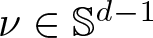
$\mathbb{S}^{d-1}:=\{\nu\in{{\mathbb R}}^d: |\nu|=1\}$. We also set
$\mathbb{S}^{d-1}_{\pm}:=\{\nu\in\mathbb{S}^{d-1}: \pm \nu_{i(\nu)} \gt 0\}$, where
$i(\nu)\in\{1,...,d\}$ is the largest index such that
$\nu_{i(\nu)}\neq 0$.(c) Vectors in
${{\mathbb R}}^d$ are identified with
$1\times d$ matrices, while
${\mathbb R}^{k\times d}$ is identified with the space of all k × d matrices. For
$\xi\in{\mathbb R}^{k\times d}$ and
$x\in{{\mathbb R}}^d\ \xi x\in{{\mathbb R}}^k$ is defined by the usual rules of matrix multiplication and ξ i is the i-th row of ξ. Given a matrix
$\xi=(\xi_{ij})\in{\mathbb R}^{k\times d}$, its Frobenius norm is defined by
\begin{equation*}|\xi|:=\Big(\sum_{i=1}^k\sum_{j=1}^d\xi_{ij}^2\Big)^{1/2}.\end{equation*}(d) For ρ > 0 we set
$Q(\rho):=\{y\in{{\mathbb R}}^d: |y\cdot e _i| \lt \rho /2\}$, where
$(e_i)_{i=1}^d$ is the canonical basis of
${{\mathbb R}}^d$. Given
$x\in{{\mathbb R}}^d$, we set
$Q(x,\rho):=x+Q(\rho)$.(e) For
$n\in{\mathbb N}$ the space of all n × n orthonormal matrices R with
$\text{det}(R)=1$ is denoted by SO(n). For every
$\nu\in\mathbb{S}^{d-1}$ we fix once and for all an element
$R_\nu\in SO(d)$ such that
$R_{\nu}(e_d)=\nu$. We suppose that
$R_{e_d}=I$, the identity matrix, that the restrictions of
$\nu\to\mathbb{S}^{d-1}$ to
$\mathbb{S}^{d-1}_{\pm}$ are continuous, and that
$R_\nu(Q(\rho))=R_{-\nu}(Q(\rho))$ for every
$\nu\in\mathbb{S}^{d-1}$ (see [Reference Cagnetti, Dal Maso, Scardia and Zeppieri14, Example A.1] for the proof of the existence of such
$\nu\mapsto R_\nu$).(f) For
$x\in{{\mathbb R}}^d$,
$\nu\in\mathbb{S}^{d-1}$,
$\lambda\geqslant 1$, and ρ > 0, we consider the rectangle
\begin{equation*}
Q^\lambda_\nu(x,\rho):=x+R_\nu\Big(\Big(-\frac{\lambda\rho}{2},\frac{\lambda\rho}{2}\Big)^{d-1}\times\Big(-\frac{\rho}{2},\frac{\rho}{2}\Big)\Big);
\end{equation*}we omit the indication of λ when λ = 1.
(g) Given an open set
$\Omega\subset {{\mathbb R}}^d$,
$\mathcal{A}(\Omega)$ (resp.
$\mathcal{B}(\Omega)$) is the collection of all open (resp. Borel) sets
$A\subset\Omega$. Given
$A,B\in\mathcal{A}(\Omega)$,
$A\subset\subset B$ means that A is relatively compact in B. We set
$\mathcal{A}_c(\Omega):=\{A\in\mathcal{A}(\Omega)\colon \,A\subset\subset\Omega\}$.(h) For every
$x\in{{\mathbb R}}^d$,
$\xi\in{\mathbb R}^{k\times d}$,
$\zeta\in{{\mathbb R}}^k$, and
$\nu\in\mathbb{S}^{d-1}$ the two functions
$\ell_\xi\colon {{\mathbb R}}^d \to{{\mathbb R}}^k$ and
$u_{x,\zeta,\nu}\colon {{\mathbb R}}^d\to{{\mathbb R}}^k$ are defined for every
$y\in{{\mathbb R}}^d$ by
\begin{eqnarray*}
&\displaystyle \nonumber \ell_\xi(y):=\xi y,\\
&\displaystyle\nonumber
\end{eqnarray*}
\begin{eqnarray*}
u_{x,\zeta,\nu}(y):=\begin{cases}
\zeta \quad \text{if }(y-x)\cdot \nu\geqslant 0,\\
0 \quad \text{if }(y-x)\cdot \nu \lt 0.
\end{cases}
\end{eqnarray*}Moreover, we set
$\Pi^\nu_x:=\{y\in{{\mathbb R}}^d\colon (y-x)\cdot \nu=0\}$.(i) Given
$A\in\mathcal{A}({{\mathbb R}}^d)$, the space of
${\mathbb R}^n$-valued bounded Radon measures on A is denoted by
$\mathcal{M}_b(A;\mathbb{R}^n)$. If n = 1 we omit the indication of
${\mathbb R}^n$. If
$\mu \in\mathcal{M}_b(A;{\mathbb R}^{k\times d})$ and
$\lambda\in \mathcal{M}_b(A)$ is non-negative,
$d\mu/d\lambda$ denotes the Radon–Nikodým derivative of µ with respect to λ. The Lebesgue measure is denoted by
${\mathcal{L}}^d$ and the
$(d-1)$-dimensional Hausdorff measure is denoted by
${\mathcal H}^{d-1}$. For
$\mu\in\mathcal{M}_b(A;{\mathbb R}^{k\times d})$ the total variation
$|\mu|$ is computed with respect to the Frobenius norm.(j) For every
$A\in\mathcal{A}({{\mathbb R}}^d)$,
$L^0(A;{\mathbb R}^n)$ is the space of all
${\mathcal{L}}^d$-measurable functions
$u\colon A\to{{\mathbb R}}^k$ with the topology induced by the convergence in measure. We recall that such topology is metrisable and separable. When n = 1 the indication
${\mathbb R}^n$ is omitted.(k) Given an
${\mathcal{L}}^d$-measurable set
$E\subset \Omega$, a point
$x\in \Omega$ such that
\begin{equation*}
\limsup_{\rho\to 0^+}\frac{{\mathcal{L}}^d(E\cap B_\rho(x))}{\rho^d} \gt 0,
\end{equation*}and an
${\mathcal{L}}^d$-measurable function
$u\colon E\to{{\mathbb R}}^k$, we say that
$a\in {{\mathbb R}}^k$ is the approximate limit of u at x, in symbols
\begin{equation*}
\underset{\underset{y\in E}{y\to x}}{\text{ap}\lim \,}u(y)=a,
\end{equation*}if for every ɛ > 0, we have
\begin{equation*}
\lim_{\rho\to 0^+}\frac{{\mathcal{L}}^d(\{|u-a| \gt \varepsilon\} \cap B_\rho(x))}{\rho^d}=0,
\end{equation*}where
$\{|u-a| \gt \varepsilon\}:=\{y\in E\colon |u(y)-a| \gt \varepsilon\}$.(l) Given
$A\in\mathcal{A}({{\mathbb R}}^d)$ and an
${\mathcal{L}}^d$-measurable function
$u\colon A\to{{\mathbb R}}^k$, the jump set Ju is the set of all points
$x\in A$ such that there exists a triple
$(u^+(x),u^-(x),\nu_u(x))\in{{\mathbb R}}^k\times{{\mathbb R}}^k\times\mathbb{S}^{d-1}$, with
$u^+(x)\neq u^-(x)$, such that, setting
\begin{equation*}
H^{\pm}:=\{y\in A\colon \, \pm(y-x)\cdot \nu_u(x) \gt 0\},
\end{equation*}we have
\begin{equation*}
\underset{\underset{y\in H^+}{y\to x}}{\text{ap}\lim \,}u(y)=u^+(x)\text{\,\,\, and } \,\,\,\underset{\underset{y\in H^-}{y\to x}}{\text{ap}\lim \,}u(y)=u^-(x).
\end{equation*}The triple
$(u^+(x),u^-(x),\nu_u(x))$ is well-defined up to interchanging the roles of
$u^+(x)$ and
$u^-(x)$ and swapping the sign of
$\nu_u(x)$.(m) Given
$A\in\mathcal{A}({{\mathbb R}}^d)$ the symbol
$BV(A;{{\mathbb R}}^k)$ denotes the space of
${{\mathbb R}}^k$-valued functions with bounded variation on A. We refer the reader to [Reference Ambrosio, Fusco and Pallara7] (see also [Reference Braides11, Reference Evans and Gariepy27, Reference Giusti and Williams33]) for an exhaustive introduction to this function space. We recall that if
$u\in BV(A; {{\mathbb R}}^k)$ then for
${\mathcal H}^{d-1}$-a.e.
$x\in A\setminus J_{u}$ there exists
\begin{equation*} \tilde{u}(x):=\underset{\underset{y\in A}{y\to x}}{\text{ap}\lim \,}u(y).\end{equation*}We recall also that if
$u\in BV(A;{{\mathbb R}}^k)$, then Ju is a
$(d-1)$-countably rectifiable set, and for
${\mathcal H}^{d-1}$-a.e.
$x\in J_{u}$ the vector
$\nu_u(x)$ is a measure theoretical normal to Ju. For every
$x\in J_{u}$ we set
\begin{equation*}[u](x):=u^+(x)-u^-(x).\end{equation*}A change of sign of
$\nu_u(x)$ obviously implies a change of sign in
$[u](x)$.(n) Given
$u\in BV(A;{{\mathbb R}}^k)$, its distributional derivative Du, which is by definition a bounded
${\mathbb R}^{k\times d}$-valued Radon measure, can be decomposed as
\begin{equation*}Du=\nabla u{\mathcal{L}}^d +D^cu+([u]\otimes\nu_u){\mathcal H}^{d-1} \mathbf{\unicode{x221F}} \mathbin J_{u},\end{equation*}where
•
$\nabla u\in L^1(A;{\mathbb R}^{k\times d})$ is the approximate gradient of u, that is, the only
${\mathbb R}^{k\times d}$-valued function such that for
${\mathcal{L}}^d$-a.e
$x\in A$, we have
(2.1)\begin{equation}
\underset{\underset{y\in A}{y\to x}}{\text{ap}\lim \,}\frac{u(y)-\tilde{u}(x)-\nabla u(x)(y-x)}{|y-x|}=0,
\end{equation}• D cu, called the Cantor part of Du, is a measure singular with respect to
${\mathcal{L}}^d$ and vanishing on all Borel sets
$B\in\mathcal{B}(A)$ with
${\mathcal H}^{d-1}(B) \lt +\infty$,• ⊗ denotes the tensor product defined by
$(a\otimes b)_{ij}=a_ib_j$ for
$a\in{{\mathbb R}}^k$,
$b\in{{\mathbb R}}^d$,
${\mathcal H}^{d-1}\mathbin{\mathbf{\unicode{x221F}}}J_{u}$ is the Borel measure on A defined by
$({\mathcal H}^{d-1}\mathbin{\mathbf{\unicode{x221F}}} J_u)(B):={\mathcal H}^{d-1}(B\cap J_{u})$ for every
$B\in\mathcal{B}(A)$, and
$([u]\otimes\nu_u){\mathcal H}^{d-1}\mathbin{\mathbf{\unicode{x221F}}}J_{u}$ denotes the measure with density
$[u]\otimes\nu_u$ with respect to
${\mathcal H}^{d-1}\mathbin{\mathbf{\unicode{x221F}}}J_{u}$.


We briefly recall the definition and the main properties of the space  $GBV_\star(A;{{\mathbb R}}^k)$, introduced in the scalar setting by the first author and Toader in [Reference Dal Maso and Toader19] and in the vectorial setting by the second author in [Reference Donati24]. For
 $s,t\in{\mathbb R}$ we set
 $s\land t=\min\{s,t\}$ and
 $s\lor t=\max\{s,t\}$. For every
 $t\in{\mathbb R}$,
 $a\in{{\mathbb R}}^k$ and m > 0, we set
 $t^{(m)}:=(t\land m)\lor (-m)$ and
 $a^{(m)}:=(a_1^{(m)},...,a_k^{(m)})$. In the rest of the section,
 $A\subset{{\mathbb R}}^d$ will always be a bounded open set.
Definition 2.1. Let  $u\in L^0(A;{{\mathbb R}}^k)$. Then
 $u\in GBV_\star(A;{{\mathbb R}}^k)$ if and only
 $u^{(m)}\in BV(A;{{\mathbb R}}^k)$ for every m > 0 and there exists M > 0 such that
 \begin{equation}
\sup_{m \gt 0}\int_A|\nabla u^{(m)}|\, dx+|D^cu^{(m)}|(A)+\int_{J_{u^{(m)}}}|[u^{(m)}]|\land 1\,d\mathcal{H}^{d-1}\leqslant M.
\end{equation}
 $GBV_\star(A)$ is defined similarly for scalar functions.
Remark 2.2. It follows immediately from the definition that u belongs to  $GBV_\star(A;{{\mathbb R}}^k)$ if and only if each component ui belongs to
 $GBV_\star(A)$. By [Reference Dal Maso and Toader20, Theorem 3.9] this implies that
 $GBV_\star(A;{{\mathbb R}}^k)$ is a vector space.
To characterize  $GBV_\star(A;{{\mathbb R}}^k)$ by means of smooth truncations, we introduce the following functions.
Given a positive constant σ > 2, we fix a smooth radial function  $\psi\in C^\infty_c({{\mathbb R}}^k;{{\mathbb R}}^k)$ satisfying
 \begin{equation}\begin{cases}\psi(y)=y&\text{if }|y|\leqslant 1,\\
\psi(y)=0&\text{if }|y|\geqslant \sigma,\\|\psi(y)|\leqslant \sigma,\\ \text{Lip}(\psi)=1.\end{cases}\end{equation}
It is not difficult to construct such a function (see, for instance, [Reference Cagnetti, Dal Maso, Scardia and Zeppieri13, Section 4]).
Given R > 0, we set
 \begin{equation}\psi_{R}(y):=R \psi\Big(\frac{y}{R}\Big)\quad \text{for every}\ y\in{{\mathbb R}}^k.
\end{equation}
Note that ψR satisfies
 \begin{equation}\begin{cases}\psi_R(y)=y&\text{if }|y|\leqslant R,\\
\psi_R(y)=0&\text{if }|y|\geqslant \sigma R,\\|\psi_R(y)|\leqslant \sigma R,\\ \text{Lip}(\psi_R)=1.\end{cases}
\end{equation}
The following proposition characterizes  $GBV_\star(A;{{\mathbb R}}^k)$ in terms of smooth truncations.
Proposition 2.3. ([Reference Donati24, Proposition 3.8])
For every  $u\in GBV_\star(A;{{\mathbb R}}^k)$ there exists a constant
 $C_u \gt 0$ such that for every Lipschitz function ϕ with compact support the function
 $v:=\phi\circ u$ belongs to
 $BV(A;{{\mathbb R}}^k)$ and satisfies the inequality
 \begin{equation}
\int_A|\nabla v|\, dx+|D^cv|(A)+\int_{J_{v}}|[v]|\land 1\,d\mathcal{H}^{d-1}\leqslant C_u(\text{Lip}(\phi)\lor 1).
\end{equation}
Conversely, if  $u\in L^0(A;{{\mathbb R}}^k)$ and there exists a constant
 $C_u \gt 0$ such that for every integer R > 0 (2.6) holds with
 $v=\psi_R\circ u$ and
 $\phi=\psi_R$ then
 $u\in GBV_\star (A;{{\mathbb R}}^k)$.
In the following proposition, we recall the fine properties of functions in  $GBV_\star(A;{{\mathbb R}}^k)$.
Proposition 2.4. Let  $u\in GBV_\star(A;{{\mathbb R}}^k)$. Then
(a) for
${\mathcal H}^{d-1}$-a.e
$x\in A\setminus J_{u}$ there exists
\begin{equation*}\tilde{u}(x):=\underset{{y\to x}}{\text{ap}\lim \,}u(y);\end{equation*}(b) there exists a Borel function
$\nabla u\in L^1(A;{\mathbb R}^{k\times d})$ such that for
${\mathcal{L}}^d$-a.e.
$x\in A $ formula (2.1) holds true; moreover, for every R > 0, we have
\begin{equation*}
\nabla u(x)=\nabla (\psi_R\circ u)(x) \quad \text{for}\ {\mathcal{L}}^d\text{-a.e. }x\in \{|u|\leqslant R\};
\end{equation*}(c) there exists a unique Radon measure
$D^cu\in\mathcal{M}_b(A;{\mathbb R}^{k\times d})$ such that for every R > 0, we have
$D^cu(B)=0$ for every
$B\in\mathcal{B}(A)$ with
${\mathcal H}^{d-1}(B\setminus J_{u})=0$ and
$D^cu(B)=D^c(\psi_R\circ u)(B)$ for every Borel set
$B\subset \widetilde{A}^{R}_{u,0}:=\{x\in A\colon \, \widetilde{u}(x) \text{exists and }|\widetilde{u}(x)|\leqslant R\}$; moreover, for every
$B\in\mathcal{B}(A)$, we have
(2.7)\begin{eqnarray}
&\displaystyle
D^cu(B)=\lim_{R\to +\infty} D^c(\psi_{R}\circ u)(B),
\end{eqnarray}(2.8)\begin{eqnarray}
&\displaystyle |D^cu|(B)=\lim_{R\to +\infty} |D^c(\psi_{R}\circ u)|(B);
\end{eqnarray}(d) for every R > 0, we have
$J_{\psi_R\circ u}\subset J_{u}$ up to an
${\mathcal H}^{d-1}$-negligible set and
$|[\psi_R\circ u]|\leqslant|[u]|$ on
$J_{\psi_R\circ u}\cap J_{u}$. Moreover, for
${\mathcal H}^{d-1}$-a.e x in Ju and every
$R \gt |u^+(x)|\lor|u^-(x)|$, we have
$|[\psi_R\circ u](x)|=|[u](x)|$.


For the proof of these facts, we refer the reader to [Reference Donati24, Proposition 3.7].
We conclude this section by recalling some useful facts related to the Cantor part of compositions with smooth functions with compact support.
Proposition 2.5. Let  $A\in\mathcal{A}_c({{\mathbb R}}^d)$,
 $u\in GBV_\star(A;{{\mathbb R}}^k)$ and
 $\phi\in C^1_c({{\mathbb R}}^k;{{\mathbb R}}^k)$. Then
(i)
$\nabla(\phi\circ u)=\nabla \phi(\widetilde{u})\nabla u \quad {\mathcal{L}}^d\text{-a.e. in}\ A;$(ii)
$D^c(\phi \circ u)=\nabla \phi(\widetilde{u})D^cu$ as Radon measures on A;(iii) for every R > 0, we have
\begin{equation*}
\frac{dD^c(\psi_{R}\circ u)}{d|D^c(\psi_{R}\circ u)|}=\frac{dD^cu}{d|D^cu|} \quad |D^cu|\text{-a.e. in}\ \ \widetilde{A}^R_{u,0},
\end{equation*}where
$\widetilde{A}^R_{u,0}:=\{x\in A\colon \widetilde{u}(x)\text{exists and } |\widetilde{u}(x)|\leqslant R\}$. As a consequence, we have
\begin{equation*}
\lim_{R\to+\infty} \frac{dD^c(\psi_{R}\circ u)}{d|D^c(\psi_{R}\circ u)|}=\frac{dD^cu}{d|D^cu|} \quad |D^cu|\text{-a.e. in}\ A.
\end{equation*}


For the proof, we refer the reader to [Reference Donati24].
In accordance with the notation of [Reference Dal Maso and Toader20, Reference Dal Maso and Toader21] and [Reference Donati24], we introduce two functionals on  $L^0({{\mathbb R}}^d;{{\mathbb R}}^k)$ closely related to the space
 $GBV_\star(A;{{\mathbb R}}^k)$.
Definition 2.6. Given  $u\in L^0({{\mathbb R}}^d;{{\mathbb R}}^k)$, with components
 $u_1,...,u_k$, for every
 $A\in\mathcal{A}_c({{\mathbb R}}^d)$ we define
 \begin{equation*}
V(u,A):=\sum_{i=1}^k\Big(\int_A|\nabla u_i|\, dx+|D^cu_i|(A)+\int_{J_{u_i}\cap A}|[u_i]|\land 1\,d {\mathcal H}^{d-1}\Big),\\
\end{equation*}
if  $u|_A \in GBV_\star(A)$ and we set
 $V(u,A)=+\infty$ otherwise. The definition is then extended to
 $A\in\mathcal{A}({{\mathbb R}}^d)$ by setting
 \begin{equation*}
V(u,A):=\sup\{V(u,A'):\,\, A'\subset A, \,\,A'\in\mathcal{A}_c({{\mathbb R}}^d)\}
\end{equation*}
and then to  $B\in\mathcal{B}({{\mathbb R}}^d)$ by setting
 \begin{equation*}
V(u,B):=\inf\{V(u,A):\,\, B\subset A, \,\, A\in\mathcal{A}({{\mathbb R}}^d)\}.
\end{equation*}
Definition 2.7. Given  $u\in L^0({{\mathbb R}}^d;{{\mathbb R}}^k)$, for every
 $A\in\mathcal{A}_c({{\mathbb R}}^d)$ we define
 \begin{equation*} \nonumber V_{\rm vec}(u,A):=\int_A|\nabla u|\, dx+|D^cu|(A)+\int_{J_{u}\cap A}|[u]|\land 1\,d {\mathcal H}^{d-1},
\end{equation*}
if  $u\in GBV_\star(A;{{\mathbb R}}^k)$ and we set
 $V_{\rm vec}(u,A)=+\infty$ otherwise. The definition is then extended to every Borel set as in Definition 2.6.
Remark 2.8. Let  $A\in\mathcal
A_c({{\mathbb R}}^d)$ and let
 $u\in L^0({{\mathbb R}}^d;{{\mathbb R}}^k)$. It follows immediately from Remark 2.2 that
 \begin{equation*}
u|_A\in GBV_\star(A;{{\mathbb R}}^k) \text{\,\,if and only if\,\, } V(u,A) \lt +\infty.
\end{equation*}
Remark 2.9. It follows from [Reference Bouchitté, Braides and Buttazzo8, Theorem 2.1] and [Reference Dal Maso and Toader19, Theorem 3.11] that the functional V of Definition 2.6 is lower semicontinuous with respect to the topology of  $L^0({{\mathbb R}}^d;{{\mathbb R}}^k)$. We do not know whether this property holds for the functional V vec of Definition 2.7. Indeed, the standard proof of lower semicontinuity by slicing (see [Reference Bouchitté, Braides and Buttazzo8]) does not apply to the functional V vec, unless we use the operatorial norm in
 $|\nabla u|$ (see [Reference Donati24, Corollary 4.6]).
3. Volume and surface integrands
Throughout the rest of the paper, we fix six constants  $c_1,...,c_6\geqslant 0$ and a bounded continuous function
 $\tau\colon [0,+\infty)\to[0,+\infty)$. We assume that
 \begin{align}
&\displaystyle0 \lt c_1\leqslant 1\leqslant c_3\leqslant c_5,\,\,\,\, c_6\geqslant (c_3/c_1)k^{3/2},\\
&\displaystyle \nonumber
\end{align}
 \begin{align*}
\tau(0)=0\,\,\,\,\text{and\,\,\,\, }\tau(t)\geqslant c_3(t\land1)\,\,\,\text{for every}\ t\geqslant 0.
\end{align*}
We now introduce the collection of volume integrands considered in this paper.
Definition 3.1. Let  $\mathcal{F}$ be the space of functions
 $f\colon{{\mathbb R}}^d\times{\mathbb R}^{k\times d}\to [0,+\infty)$ satisfying the following conditions:
(f1) f is Borel measurable;
(f2)
$c_1\sum_{i=1}^k|\xi_i|-c_2\leqslant f(x,\xi)$ for every
$x\in{{\mathbb R}}^d$ and
$\xi\in {\mathbb R}^{k\times d}$;(f3)
$f(x,\xi)\leqslant c_3\sum_{i=1}^k|\xi_i|+c_4$ for every
$x\in{{\mathbb R}}^d$ and
$\xi\in {\mathbb R}^{k\times d}$;(f4)
$|f(x,\xi)-f(x,\eta )|\leqslant c_5|\xi-\eta|$ for every
$x\in{{\mathbb R}}^d$ and
$\xi,\eta\in {\mathbb R}^{k\times d}$.


Remark 3.2. It follows from the inequalities  $|\xi|\leqslant\sum_{i=1}^k|\xi_i|\leqslant k^{1/2}|\xi|$ that
1. (f2
$'$)
$c_1|\xi|-c_2\leqslant f(x,\xi)$ for every
$x\in{{\mathbb R}}^d$ and
$\xi\in {\mathbb R}^{k\times d},$2. (f3
$'$)
$f(x,\xi)\leqslant c_3k^{1/2}|\xi|+c_4$ for every
$x\in{{\mathbb R}}^d$ and
$\xi\in {\mathbb R}^{k\times d}$.


The following definition introduces the collection of surface integrands considered in this paper.
Definition 3.3. Let  $\mathcal{G}$ be the space of functions
 $g:{{\mathbb R}}^d\times{{\mathbb R}}^k\times\mathbb{S}^{d-1}\to[0,+\infty) $ that satisfy the following conditions:
(g1) g is Borel measurable;
(g2)
$c_1\sum_{i=1}^k(|\zeta_i|\land 1)\leqslant g(x,\zeta,\nu)$ for every
$x\in{{\mathbb R}}^d$,
$\zeta\in {{\mathbb R}}^k$, and
$\nu\in\mathbb{S}^{d-1}$;(g3)
$g(x,\zeta,\nu)\leqslant c_3\sum_{i=1}^k(|\zeta_i|\land 1)$ for every
$x\in{{\mathbb R}}^d$,
$\zeta\in {{\mathbb R}}^k$, and
$\nu\in\mathbb{S}^{d-1}$;(g4)
$|g(x,\zeta,\nu)-g(x,\theta,\nu)|\leqslant \tau(|\zeta-\theta|)$ for every
$x\in{{\mathbb R}}^d$,
$\zeta,\theta\in {{\mathbb R}}^k$, and
$\nu\in\mathbb{S}^{d-1}$;(g5)
$g(x,-\zeta,-\nu)=g(x,\zeta,\nu)$ for every
$x\in{{\mathbb R}}^d$,
$\zeta\in {{\mathbb R}}^k$, and
$\nu\in\mathbb{S}^{d-1}$;(g6) for every
$\zeta,\theta\in{{\mathbb R}}^k$ with
$c_6k|\zeta|\leqslant |\theta|$, we have
$g(x,\zeta,\nu)\leqslant g(x,\theta,\nu)$ for every
$x\in{{\mathbb R}}^d$ and
$\nu\in\mathbb{S}^{d-1}$.




Remark 3.4. A variant of property (g6) was already used in [Reference Cagnetti, Dal Maso, Scardia and Zeppieri13]. Combining (g2) and (g3), it is easy to show that  $g(x,\zeta,\nu)\leqslant c_3/c_1g(x,\theta,\nu)$ whenever
 $\sum_{i=1}^k|\zeta_i|\leqslant\sum_{i=1}^k|\theta_i|$. Arguing as in [Reference Cagnetti, Dal Maso, Scardia and Zeppieri13, Remark 3.2], we can show that this property and (g6) are weaker than monotonicity in
 $|\zeta|$ of g.
Definition 3.5. For every  $f\colon{{\mathbb R}}^d\times{\mathbb R}^{k\times d}\rightarrow[0,+\infty)$, the recession function
 $f^\infty\colon{{\mathbb R}}^d\times{\mathbb R}^{k\times d}\rightarrow[0,+\infty]$ (with respect to ξ) is the function defined by
 \begin{equation}
f^\infty(x,\xi):=\limsup_{t\to +\infty}\frac{f(x,t\xi) }{t}
\end{equation}
for every  $x\in{{\mathbb R}}^d$ and for every
 $\xi\in{\mathbb R}^{k\times d}$.
Remark 3.6. For every  $x\in{{\mathbb R}}^d$ the function
 $\xi\mapsto f^\infty(x,\xi)$ is positively 1-homogeneous. If for every
 $x\in{{\mathbb R}}^d$ the function
 $\xi\mapsto f(x,\xi)$ is convex, the
 $\limsup$ in (3.2) is a limit. If f satisfies (f2) and (f3), then
 $f^\infty$ satisfies
 \begin{equation}
c_1|\xi|\leqslant c_1\sum_{i=1}^k|\xi_i|\leqslant f^\infty(x,\xi)\leqslant c_3k^{1/2}|\xi|\quad \text{for every}\ x\in{{\mathbb R}}^d\ \text{and}\ \xi\in{\mathbb R}^{k\times d}.
\end{equation}
If f satisfies (f4), then  $f^\infty$ satisfies
 \begin{equation*}
|f^\infty(x,\xi)-f^\infty(x,\eta)|\leqslant c_5|\xi-\eta|\quad\text{for every}\ x\in{{\mathbb R}}^d\ \text{and}\ \xi,\eta\in{\mathbb R}^{k\times d}.
\end{equation*}
In Section 8, we will also consider integrands g 0 that do not belong to  $\mathcal{G}$. For this reason, in the following definition, we do not assume
 $g\in\mathcal{G}$.
Definition 3.7. Given  $f\in\mathcal{F}$ and a Borel function
 $g\colon {{\mathbb R}}^d\times {{\mathbb R}}^k\times \mathbb{S}^{d-1}\to[0,+\infty)$ satisfying (g5), the functional
 $E^{f,g}:L^0({{\mathbb R}}^d;{{\mathbb R}}^k)\times\mathcal{B}({{\mathbb R}}^d)\to[0,+\infty]$ is the functional defined for
 $A\in\mathcal{A}_c({{\mathbb R}}^d)$ by
 \begin{equation*}
E^{f,g}(u,A):=\int_A\!\!f(x,\nabla u)\, dx+\int_A\!\!f^\infty\!\Big(x,\frac{dD^cu}{d|D^cu|}\Big)d|D^cu|+\int_{J_{u}\cap A}\!\!\!\!g(x,[u],\nu_u)\, d{\mathcal H}^{d-1},
\end{equation*}
if  $u|_A\in GBV_\star(A;{{\mathbb R}}^k)$, and by
 $E^{f,g}(u,A)=+\infty$ otherwise. The definition is then extended to
 $A\in\mathcal{A}({{\mathbb R}}^d)$ by setting
 \begin{equation*}
E^{f,g}(u,A):=\sup\{E^{f,g}(u,A'):\,\, A'\subset A, \,\,A'\in\mathcal{A}_c({{\mathbb R}}^d)\},
\end{equation*}
and then to  $B\in\mathcal{B}({{\mathbb R}}^d)$ by setting
 \begin{equation*}
E^{f,g}(u,B):=\inf\{E^{f,g}(u,A):\,\, B\subset A, \,\, A\in\mathcal{A}({{\mathbb R}}^d)\}.
\end{equation*}
To study the integral representation of Γ-limits of sequences of functionals of the form  $E^{f,g}$ with
 $f\in\mathcal{F}$ and
 $g\in\mathcal{G}$, it is convenient to study the properties of functionals
 $E^{f,g}$ that pass to the Γ-limit. This leads to define an abstract space
 $\mathfrak{E}$ of functionals defined on
 $L^0({{\mathbb R}}^d;{{\mathbb R}}^k)\times \mathcal{B}({{\mathbb R}}^d)$. We shall prove that the Γ-limit of a sequence of functionals in
 $\mathfrak{E}$ belongs to
 $\mathfrak{E}$ (see Theorem 4.1) and that for every lower semicontinuous functional in
 $\mathfrak{E}$ the volume and surface part admit and integral representation of the form
 \begin{equation*}
\int_Af(x,\nabla u)\, dx\quad \text{and } \quad \int_{J_u} g(x,[u],\nu_u)\, d{\mathcal H}^{d-1}
\end{equation*}
with integrands  $f\in\mathcal{F}$ and
 $g\in\mathcal{G}$ (see Theorem 5.16).
For technical reasons, in the definition of the space  $\mathfrak{E}$, we consider the behaviour of the functionals with respect to some smooth truncations. To this aim, for every R > 0 and every integer
 $i\geqslant 1$ we consider the function
 $\psi_R^i$ defined by (2.4) with R replaced by
 $\sigma^{i-1}R$ and
 \begin{equation}
\sigma=c_6k+2.
\end{equation}
Note that by (2.5) for every integer  $i\geqslant 1$, we have
 \begin{equation}
\begin{cases}
\psi^i_R(y)=y&\text{if }|y|\leqslant \sigma^{i-1}R,\\
\psi^i_R(y)=0&\text{if }|y|\geqslant \sigma^i R,\\
|\psi^i_R(y)|\leqslant \sigma^i R,\\
\text{Lip}(\psi_R)=1.
\end{cases}
\end{equation}
We are now in a position to introduce the space of abstract functionals  $\mathfrak{E}$.
Definition 3.8. Let  $\mathfrak{E}$ be the space of functionals
 $E\colon L^0({{\mathbb R}}^d;{{\mathbb R}}^k)\times\mathcal{B}({{\mathbb R}}^d)\to [0,+\infty]$ satisfying the following conditions:
(a) for every
$A\in\mathcal{A}({{\mathbb R}}^d)$ and for every
$u,v\in L^0({{\mathbb R}}^d;{{\mathbb R}}^k)$ with
$u=v\ {\mathcal{L}}^d$-a.e. in A, we have
$E(u,A)=E(v,A)$;(b) for every
$u\in L^0({{\mathbb R}}^d;{{\mathbb R}}^k)$ the set function
$B\mapsto E(u,B)$ is a non-negative Borel measure on
${{\mathbb R}}^d$ and for every
$B\in\mathcal{B}({{\mathbb R}}^d)$, we have
(c1) for every
\begin{equation*}
E(u,B)=\inf\{E(u,A)\colon A\in\mathcal{A}({{\mathbb R}}^d)\text{and } B\subset A \};
\end{equation*}
$u\in L^0({{\mathbb R}}^d;{{\mathbb R}}^k)$ and
$B\in\mathcal{B}({{\mathbb R}}^d)$, we have
(c2) for every
\begin{equation*}
c_1V(u,B)-c_2{\mathcal{L}}^d(B)\leqslant E(u,B);
\end{equation*}
$u\in L^0({{\mathbb R}}^d;{{\mathbb R}}^k)$ and
$B\in\mathcal{B}({{\mathbb R}}^d)$, we have
\begin{equation*}
E(u,B)\leqslant c_3V(u,B)+c_4{\mathcal{L}}^d(B);
\end{equation*}(d) for every
$u\in L^0({{\mathbb R}}^d;{{\mathbb R}}^k)$,
$B\in\mathcal{B}({{\mathbb R}}^d)$, and
$a\in{{\mathbb R}}^k$, we have
\begin{equation*}E(u+a,B)=E(u,B); \end{equation*}(e) for every
$u\in L^0({{\mathbb R}}^d;{{\mathbb R}}^k)$,
$\xi\in{\mathbb R}^{k\times d}$,
$B\in \mathcal{B}({{\mathbb R}}^d)$, we have
\begin{equation*}
E(u+\ell_\xi,B)\leqslant E(u,B)+ c_5|\xi|{\mathcal{L}}^d(B); \end{equation*}(f) for every
$u\in L^0({{\mathbb R}}^d;{{\mathbb R}}^k)$,
$B\in\mathcal{B}({{\mathbb R}}^d)$,
$x\in{{\mathbb R}}^d $,
$\zeta\in{{\mathbb R}}^k$, and
$\nu\in\mathbb{S}^{d-1}$, we have
\begin{equation*}
E(u+u_{x,\zeta,\nu},B)\leqslant E(u,B)+\tau(|\zeta|){\mathcal H}^{d-1}(B\cap\Pi_x^\nu),
\end{equation*}where τ is the function introduced at the beginning of this section;
(g) for every
$m\in{\mathbb N}$,
$u\in L^0({{\mathbb R}}^d;{{\mathbb R}}^k)$,
$B\in\mathcal{B}({{\mathbb R}}^d)$,
$w\in W^{1,1}_{\rm loc}({{\mathbb R}}^d;{{\mathbb R}}^k)$, and R > 0, we have
\begin{align*}
\nonumber \frac{1}{m}\sum_{i=1}^mE(w+\psi^i_R&\circ (u-w),B) \leqslant E(u,B) + c_3k^{1/2}\int_{B^R_{u,w}}\!\!\!\!|\nabla w|\, dx+c_4{\mathcal{L}}^d(B^R_{u,w})
\end{align*}(3.6)\begin{align}
& \quad +\frac{C}{m}\Big(E(u,B) + {\mathcal{L}}^d(B) + \int_B|\nabla w|\, dx \Big),
\end{align}where
$B^R_{u,w}:=\{x\in B\colon |u(x)-w(x)|\geqslant R\}$ and
$C:=\max\{\tfrac{9c_3k}{c_1},2c_3k^{1/2},c_4\}$;(h) for every
$0 \lt \lambda\leqslant 1/(c_6k)$,
$R\in SO(k)$,
$B\in\mathcal{B}({{\mathbb R}}^d)$, and
$u\in L^0({{\mathbb R}}^d;{{\mathbb R}}^k)$, we have
\begin{equation*}
E(\lambda Ru,B)\leqslant E(u,B)+(c_4+c_2){\mathcal{L}}^d(B).
\end{equation*}


The subspace of all functionals  $E\in\mathfrak{E}$ such that for every
 $A\in\mathcal{A}({{\mathbb R}}^d)$ the functional
 $E(\cdot,A)$ is lower semicontinuous with respect to the topology of
 $L^0({{\mathbb R}}^d;{{\mathbb R}}^k)$ is denoted by
 $\mathfrak{E}_{\rm sc}$.
Remark 3.9. Let  $E\in\mathfrak{E}$,
 $A\in\mathcal{A}({{\mathbb R}}^d)$, and
 $u\in L^0(A;{{\mathbb R}}^k)$. We can define
 $E(u,B)$ for every
 $B\in\mathcal{B}(A)$ by extending the function u to a function
 $v\in L^0({{\mathbb R}}^d;{{\mathbb R}}^k)$ and setting
 $E(u,B):=E(v,B)$. The value of
 $E(u,B)$ does not depend on the chosen extension, thanks to the locality property (a) of Definition 3.8.
Remark 3.10. Inequalities (c1) and (c2) imply that
 \begin{equation}
c_1V_{\rm vec}(u,B)-c_2{\mathcal{L}}^d(B)\leqslant E(u,B)
\end{equation}
 \begin{equation}
E(u,B)\leqslant c_3kV_{\rm vec}(u,B)+c_4,
\end{equation}
for every  $u\in L^0({{\mathbb R}}^d;{{\mathbb R}}^k)$ and
 $B\in\mathcal{B}({{\mathbb R}}^d)$. This follows from the elementary inequalities
 $|\xi|\leqslant\sum_{i=1}^k|\xi_i|\leqslant k^{1/2}|\xi|$ and
 $|\zeta|\land 1\leqslant \sum_{i=1}^k|[\zeta_i]|\land 1\leqslant k(|\zeta|\land 1)$, where ξi is the i-th row of the matrix ξ and ζi is the i-th component of ζ.
Remark 3.11. The technical condition (g) replaces the simpler condition (g) of [Reference Dal Maso and Toader20, Definition 3.1], which in the particular case  $w_1=-m$ and
 $w_2=m$ reads as
 \begin{equation}
E(u^{(m)},A)\leqslant E(u,A)+{\mathcal{L}}^d(\{|u| \gt m\}).
\end{equation}
Although this truncation procedure is still available in the vector-valued case (see [Reference Donati24, Definition 3.1, Proposition 3.8]), acting component-wise, an estimate of the form (3.7) does not hold for k > 1, even for the prototypical integral functional V vec. This is one of the main difficulties in generalising these results to the vector-valued case. The new condition (g) of Definition 3.8 is crucial to introduce a different type of truncation operators with good estimates. The presence of an average in the left-hand side of inequality (3.6) makes it easy to select a truncation level with the desired properties (see, for instance, the proof of Lemma 3.16, where this property is used for the first time). Similar smooth truncations were already considered in [Reference Braides, Defranceschi and Vitali12, Reference Cagnetti, Dal Maso, Scardia and Zeppieri13, Reference Celada and Dal Maso16, Reference Evans and Gariepy27, Reference Fusco and Hutchinson31].
Remark 3.12. Condition (h) is of a technical nature and will be used in Proposition 5.14 to show that, when  $E\in\mathfrak{E}$ admits a (partial) integral representation, its surface integrand satisfies (g6).
Remark 3.13. It follows directly from Remark 2.8 and from Definition 3.8 that if  $A\in\mathcal{A}_c({{\mathbb R}}^d)$ and
 $u\in L^0({{\mathbb R}}^d;{{\mathbb R}}^k)$ then
 \begin{equation*}
E(u,A) \lt +\infty\,\,\,\text{if and only if }\,\,\, u|_A\in GBV_\star(A;{{\mathbb R}}^k).
\end{equation*}
The following proposition shows that functionals of type  $E^{f,g}$ belong to
 $\mathfrak{E}$.
Proposition 3.14. Let  $f\in\mathcal{F}$ and
 $g\in\mathcal{G}$. Then the functional
 $E^{f,g}$ belongs to
 $\mathfrak{E}$ and for every
 $A\in\mathcal{A}_c({{\mathbb R}}^d)$ and
 $u\in GBV_\star(A;{{\mathbb R}}^k)$, we have
 \begin{equation*}
E^{f,g}(u,B)=\int_B\!\!f(x,\nabla u)\, dx+\int_B\!\!f^\infty\!\Big(x,\frac{dD^cu}{d|D^cu|}\Big)d|D^cu|+\int_{J_{u}\cap B}\!\!\!\!\!g(x,[u],\nu_u)\, d{\mathcal H}^{d-1}
\end{equation*}
for every  $B\in\mathcal{B}(A)$.
Proof. The proof of the equality and of the fact that  $E^{f,g}$ (a)-(f) of Definition 3.8 may be deduced from the proof of [Reference Dal Maso and Toader20, Proposition 3.11], with minor changes.
We are left with showing that  $E^{f,g}$ enjoys properties (g) and (h) of Definition 3.8. We begin proving (g). Since
 $E^{f,g}$ satisfies properties (a) and (b), it is enough to prove (3.6) for every
 $A\in\mathcal{A}_c({{\mathbb R}}^d)$. Without loss of generality, we may assume that
 $u|_A\in GBV_\star(A;{{\mathbb R}}^k)$. Let
 $w\in W^{1,1}_{\rm loc}({{\mathbb R}}^d;{{\mathbb R}}^k)$, let R > 0, let
 $m\in{\mathbb N}$, and let
 $i\in\{1,...,m\}$. We set
 $v^i_R:=w+\psi^i_R\circ (u-w)$ and note that
 $v_R^i|_A\in GBV_\star(A;{{\mathbb R}}^k)$, thanks to Proposition 2.3 and to the fact that
 $GBV_\star(A;{{\mathbb R}}^k)$ is a vector space.
Consider the set  $A_{\rm reg}:=\{x\in A\colon \widetilde{u}(x),\,\widetilde{w}(x)\,\,\, \text{exist}\}$. We observe that by Proposition 2.4 A reg and Ju are Borel sets and that
 ${\mathcal H}^{d-1}(A\setminus (A_{\rm reg}\cup J_{u}))=0$. We set
 \begin{eqnarray*}
&&\displaystyle A_{\rm in}^i:=\{x\in A_{\rm reg}\colon|\widetilde{u}(x)-\widetilde{w}(x)|\leqslant \sigma^{i-1}R\},\\
&&\displaystyle A^i:=\{x\in A_{\rm reg}\colon\sigma^{i-1}R \lt |\widetilde{u}(x)-\widetilde{w}(x)| \lt \sigma^{i}R\},\\
&&\displaystyle A^i_{\rm out}:=\{x\in A_{\rm reg}\colon|\widetilde{u}(x)-\widetilde{w}(x)|\geqslant \sigma^{i}R\}.
\end{eqnarray*}
Thanks to (i) of Proposition 2.5, for every  $i\in\{1,...,m\}$, we have that
 \begin{eqnarray*}
&\nonumber \displaystyle \nabla v^i_R= \nabla u \quad {\mathcal{L}}^d\text{-} \text{a.e. in } A^i_{\rm in},
\end{eqnarray*}
 \begin{eqnarray}
&\displaystyle\nabla v^i_R=\nabla w +\nabla\psi^i_R\circ(u-w)(\nabla u-\nabla w)\quad {\mathcal{L}}^d\text{-} \text{a.e. in } A^i,
\end{eqnarray}
 \begin{eqnarray*}
&\nonumber \displaystyle \nabla v^i_R=\nabla w \quad {\mathcal{L}}^d\text{-} \text{a.e. in } A_{\rm out}^i.
\end{eqnarray*}
Therefore,
 \begin{equation}
\int_Af(x,\nabla v^i_R)\,dx=\int_{A^i_{\rm in}}f(x,\nabla u)\,dx+\int_{A^i}f(x,\nabla v^i_R)\,dx+\int_{A^i_{\rm out}}f(x,\nabla w)\,dx.
\end{equation}
Exploiting (f2 $'$), (f3
 $'$), and (3.8), and recalling that
 $\text{Lip}(\psi_R^i)= 1$, we obtain
 \begin{align*}
\int_{A^i}f(x,\nabla v^i_R)\,dx&\leqslant 2c_3k^{1/2}\int_{A^i}|\nabla w|\, dx+c_3k^{1/2}\int_{A^i}|\nabla u|\, dx+c_4{\mathcal{L}}^d(A^i)\\
&\leqslant 2c_3k^{1/2}\int_{A^i}|\nabla w|\, dx+\frac{c_3k^{1/2}}{c_1}\int_{A^i}f(x,\nabla u)\,dx+c_4{\mathcal{L}}^d(A^i),\\
\int_{A^i_{\rm out}}f(x,\nabla w)\,dx&\leqslant c_3k^{1/2}\int_{A^R_{u,w}}|\nabla w|\, dx+c_4{\mathcal{L}}^d(A_{u,w}^R).
\end{align*}
These inequalites and (3.9) lead to
 \begin{eqnarray*}
\nonumber \sum_{i=1}^m\int_{A}f(x,\nabla &v^i_R)\, dx\leqslant m\Big(\int_A f(x,\nabla u)\, dx +c_3k^{1/2}\int_{A_{u,w}^R}|\nabla w|\, dx+c_4{\mathcal{L}}^d(A_{u,w}^R)\Big)
\end{eqnarray*}
 \begin{eqnarray}
&+\frac{c_3k^{1/2}}{c_1}\int_{A}f(x,\nabla u)\, dx+
2c_3\int_{A}|\nabla w|\, dx+c_4{\mathcal{L}}^d(A).
\end{eqnarray}
To estimate the term depending on D cu in  $E^{f,g}$, we use Proposition 2.5(ii) to rewrite
 \begin{align*}
\int_{A}f^\infty\Big(x,\frac{dD^cv^i_R}{d|D^cv^i_R|}\Big)\,d|D^cv^i_R|=\int_{A_{\rm in}^i}f^\infty\Big(x,\frac{dD^cu}{d|D^cu|}\Big)\,d|D^cu| \nonumber\\
+\int_{A^i}f^\infty\Big(x,\frac{\nabla\psi_R^i(\widetilde{u}-\widetilde{w})}{|\nabla\psi_R^i(\widetilde{u}-\widetilde{w})|}\frac{dD^cu}{d|D^cu|}\Big)\,|\nabla\psi_R^i(\widetilde{u}-\widetilde{w})| d|D^cu|+\int_{A^i_{\rm out}}f^\infty(x,0)\,d|D^cu|
\end{align*}
 \begin{equation*}
\leqslant \int_{A}\!\!f^\infty\!\Big(x,\frac{dD^cu}{d|D^cu|}\Big)d|D^cu|+\int_{A^i}\!\!f^\infty\!\Big(x,\frac{\nabla\psi_R^i(\widetilde{u}{-}\widetilde{w})}{|\nabla\psi_R^i(\widetilde{u}{-}\widetilde{w})|}\frac{dD^cu}{d|D^cu|}\Big)\!|\nabla\psi_R^i(\widetilde{u}{-}\widetilde{w})| d|D^cu|,
\end{equation*}
where we have used that  $w\in W^{1,1}_{\rm loc}({{\mathbb R}}^d;{{\mathbb R}}^k)$ and that
 $f^\infty(x,0)=0.$ Taking advantage of (3.3) and of
 $\text{Lip}(\psi_R^i)=1$, we infer that
 \begin{eqnarray*}
\int_{A^i}f^\infty\Big(x,\!\!\!&&\frac{\nabla\psi_R^i(\widetilde{u}-\widetilde{w})}{|\nabla\psi_R^i(\widetilde{u}-\widetilde{w})|}\frac{dD^cu}{d|D^cu|}\Big)\,|\nabla\psi_R^i(\widetilde{u}-\widetilde{w})| d|D^cu|\\ &&
\leqslant c_3k^{1/2}\int_{A^i}|\nabla\psi_R^i(\widetilde{u}-\widetilde{w})|d|D^cu|\leqslant \frac{c_3k^{1/2}}{c_1}\int_{A^i}f^\infty\Big(x,\frac{dD^cu}{d|D^cu|}\Big)\,d|D^cu|.
\end{eqnarray*}
Together with the previous inequalities, this leads to
 \begin{eqnarray*}
\nonumber\sum_{i=1}^m\int_{A}f^\infty\Big(x,\frac{dD^cv^i_R}{d|D^cv^i_R|}\Big)\,d|D^cv^i_R|&\leqslant & m\int_{A}f^\infty\Big(x,\frac{dD^cu}{d|D^cu|}\Big)\,d|D^cu|
\end{eqnarray*}
 \begin{eqnarray}
& + \frac{c_3k^{1/2}} {c_1}\int_{A}f^\infty\Big(x,\frac{dD^cu}{d|D^cu|}\Big)\,d|D^cu|.
\end{eqnarray}
We now estimate the surface term in  $E^{f,g}$. To this scope, we first remark that for
 ${\mathcal H}^{d-1}$-a.e.
 $x\in J_{v^i_R}$, we have the inclusion
 $J_{v^i_R}\subset A\setminus A_{\rm reg}$ and that for
 ${\mathcal H}^{d-1}$-a.e
 $x\in J_{v^i_R}$, we have
 $\nu_{v^i_R}(x)=\nu_{u}(x)$. Moreover, since
 $w\in W^{1,1}_{\rm loc}({{\mathbb R}}^d;{{\mathbb R}}^k)$, for
 ${\mathcal H}^{d-1}$-a.e.
 $x\in A$ the approximate limit
 $\widetilde{w}(x)$ exists, so that for
 ${\mathcal H}^{d-1}$-a.e. every
 $x\in J_{v^i_R}$, we have
 \begin{eqnarray}
&&\displaystyle (v^i_R)^+(x)=\widetilde{w}(x)+\psi_R^i(u^+(x)-\widetilde{w}(x)),
\end{eqnarray}
 \begin{eqnarray}
&&\displaystyle (v^i_R)^-(x)=\widetilde{w}(x)+\psi_R^i(u^-(x)-\widetilde{w}(x)).
\end{eqnarray}
For  $i\in\{1,...,m\}$ we introduce a partition of
 $\widetilde{J}_{v^i_R}:= \{{x\in J_{v^i_R}}\colon \widetilde w(x) \text{exists}\} $:
 \begin{eqnarray*}
&\displaystyle S^i_1:=\{x\in \widetilde{J}_{v^i_R}\colon |u^+(x)-\widetilde{w}(x)| \lt \sigma^{i-1}R,\,|u^{-}(x)-\widetilde w(x)| \lt \sigma^{i-1}R\},\\
&\displaystyle S^i_2:=\{x\in \widetilde{J}_{v^i_R}\colon |u^+(x)-\widetilde{w}(x)|,|u^{-}(x)-\widetilde{w}(x)|\in[\sigma^{i-1}R,\sigma^{i}R]\},\\
&\displaystyle S^i_3:=\{x\in \widetilde{J}_{v^i_R}\colon |u^+(x)-\widetilde{w}(x)| \gt \sigma^{i}R,\,|u^{-}(x)-\widetilde{w}(x)| \gt \sigma^{i}R\}\},\\
&\displaystyle S^i_4:=\{x\in \widetilde{J}_{v^i_R}\colon |u^+(x)-\widetilde{w}(x)| \lt \sigma^{i-1}R,\,|u^{-}(x)-\widetilde{w}(x)| \gt \sigma^{i}R\},\\
& \displaystyle S^i_5:=\{x\in \widetilde{J}_{v^i_R}\colon |u^+(x)-\widetilde{w}(x)| \gt \sigma^{i}R,\,|u^{-}(x)-\widetilde{w}(x)| \lt \sigma^{i-1}R\},
\\ &\displaystyle S^i_6:=\{x\in \widetilde{J}_{v^i_R}\colon |u^+(x)-\widetilde{w}(x)|\in[\sigma^{i-1}R,\sigma^iR],\,\, |u^-(x)-\widetilde{w}(x)|\notin[\sigma^{i-1}R,\sigma^iR]\},\\
&\displaystyle S^i_7:=\{x\in \widetilde{J}_{v^i_R}\colon \,|u^{+}(x)-\widetilde{w}(x)|\notin[\sigma^{i-1}R,\sigma^iR], \,\,
|u^-(x)-\widetilde{w}(x)|\in [\sigma^{i-1}R,\sigma^iR]\}.
\end{eqnarray*}
Note that for  $\ell\in\{2,6,7\}$
 \begin{equation*}
\displaystyle \text{if } S^i_\ell\cap S^j_\ell\neq \emptyset \text{\,\,\,\,then\,\,}\ |i-j|\leqslant 1,
\end{equation*}
so that
 \begin{equation}\sum_{i=1}^m(\chi_{S^i_2}+\chi_{S^i_6}+\chi_{S^i_7})\leqslant 9.
\end{equation}
By definition of S i1 and of S i3, recalling (3.12) and (3.13), we have
 \begin{eqnarray}
&\displaystyle\int_{S_1^i}g(x,[v^{i}_R],\nu_{v^i_R})\,d{\mathcal H}^{d-1}=\int_{S_1^i}g(x,[u],\nu_u)\,d{\mathcal H}^{d-1},
\end{eqnarray}
 \begin{eqnarray}
&\displaystyle\int_{S_3^i}g(x,[v^{i}_R],\nu_{v^i_R})\,d{\mathcal H}^{d-1}=\int_{S_3^i}g(x,0,\nu_u)\,d{\mathcal H}^{d-1}=0.
\end{eqnarray}
Since  $\text{Lip}(\psi_R^i)=1$, we have
 $|[\psi_R^i(u-w)]|\leqslant |[u-w]|=|[u]|$ in
 $\widetilde{J}_{{v^i_R}}$. Hence, by (g2) and (g3) we deduce that
 \begin{eqnarray*}
\nonumber
\int_{S_2^i\cup S_6^i\cup S_7^i}g(x,[v^{i}_R],\nu_{v^i_R})\,d{\mathcal H}^{d-1}&\leqslant&
c_3k \int_{S_2^i\cup S_6^i\cup S_7^i}|[\psi_R^i(u-w)]|\land 1\,d{\mathcal H}^{d-1}
\end{eqnarray*}
 \begin{eqnarray}
\leqslant c_3k \int_{S_2^i\cup S_6^i\cup S_7^i}|[u]|\land 1\,d{\mathcal H}^{d-1}
&\leqslant&
\frac{c_3k}{c_1} \int_{S_2^i\cup S_6^i\cup S_7^i}g(x,[u],\nu_u)\,d{\mathcal H}^{d-1}.
\end{eqnarray}
We are left with estimating the surface integral over  $S_4^i$ and S i5. By definition, if
 $x\in S^i_4$ then
 $|u^+(x)-\widetilde{w}(x)| \lt \sigma^{i-1}R$ and
 $|u^{-}(x)-\widetilde{w}(x)| \gt \sigma^{i}R.$ Therefore,
 \begin{equation}
\begin{aligned}
|[u](x)|=|u^+(x)-u^-(x)|&\geqslant &|u^-(x)-\widetilde{w}(x)|-|u^+(x)-\widetilde{w}(x)|\\
&\geqslant &\sigma^iR-\sigma^{i-1}R=\sigma^{i-1}R(\sigma-1)\geqslant c_6k\sigma^{i-1}R,
\end{aligned}
\end{equation}
where we have used that thanks to (3.4) we have  $\sigma \gt c_6k+1$. On the other hand,
 $[v^i_R](x)=u^+(x)-\widetilde{w}(x)$ so that
 \begin{equation*}
c_6k|[v^i_R]|= c_6k|u^+(x)-\widetilde{w}(x)|\leqslant c_6k\sigma^{i-1}R.
\end{equation*}
From these inequalities, we deduce that  $c_6k|[v^i_R]|\leqslant |[u]|$, which by (g6) implies
 \begin{equation*}
g(x,[v^i_R],\nu_{v^i_R})\leqslant g(x,[u],\nu_{v^i_R})=g(x,[u],\nu_u) \quad {\mathcal H}^{d-1}\text{-a.e. in }S^{i}_4.
\end{equation*}
The same argument shows that  ${\mathcal H}^{d-1}$-a.e. in S i5 it holds
 \begin{equation*}
g(x,[v_R^i],\nu_{v^i_R})\leqslant g(x,[u],\nu_u).
\end{equation*}
From these last two inequalities, we get
 \begin{equation}
\int_{S_4^i\cup S^i_5}g(x,[v^{i}_R],\nu_{v^i_R})\,d{\mathcal H}^{d-1}\leqslant \int_{S_4^i\cup S^i_5}g(x,[u],\nu_{u})\,d{\mathcal H}^{d-1}.
\end{equation}
Combining (3.15)-(3.17) and (3.19), we obtain
 \begin{align*}
\int_{J_{v^i_R}}g(x,[v^i_R],\nu_{v^{i}_R})\,d{\mathcal H}^{d-1}\leqslant &\int_{J_u}g(x,[u],\nu_u)\,d{\mathcal H}^{d-1}\\ &+\frac{c_3k}{c_1}\int_{S^i_2\cup S^i_6\cup S^i_7 }g(x,[u],\nu_u)\,d{\mathcal H}^{d-1},
\end{align*}
which, in light of (3.14), implies that
 \begin{equation}
\sum_{i=1}^m\int_{J_{v^i_R}}g(x,[v^i_R],\nu_{v^{i}_R})\,d{\mathcal H}^{d-1}\leqslant \Big(m+\frac{9c_3k}{c_1}\Big)\int_{J_u}g(x,[u],\nu_u)\,d{\mathcal H}^{d-1}.
\end{equation}
Finally, from (3.10), (3.11), and (3.20) we deduce that
 \begin{eqnarray*}
\frac1m\sum_{i=1}^mE^{f,g}(v^i_R,A) &\leqslant& E^{f,g}(u,A) + c_3k^{1/2}\int_{A^R_{u,w}}|\nabla w|\, dx+c_4{\mathcal{L}}^d(A^R_{u,w})\\
&&+\frac{C}{m}\left( E^{f,g}(u,A) + {\mathcal{L}}^d(A) +\int_A|\nabla w|\, dx \right),
\end{eqnarray*}
where  $C:=\max\{9c_3k/c_1,2c_3k^{1/2},c_4\}$. This shows that
 $E^{f,g}$ satisfies (g).
To see that  $E^{f,g}$ satisfies (h) it is enough to verify it for
 $A\in\mathcal{A}_c({{\mathbb R}}^d)$ and for
 $u|_A\in GBV_\star(A;{{\mathbb R}}^k)$. Let
 $\lambda \leqslant 1/c_6$ and let
 $R\in SO(k)$. Note that by (3.1) we also have
 $\lambda \leqslant (c_1/c_3)k^{-1/2}$. We set
 $v:=\lambda Ru$. By (f2
 $'$), (f3), and (g6) we can estimate
 \begin{eqnarray*}
E^{f,g}(v,A)&=&\int_{A}\!\!f(x,\nabla v)\, dx+\int_{A}\!\!f^\infty\!\Big(x,\frac{dD^cv}{d|D^cv|}\Big) d|D^cv|+\int_{A\cap J_{u}}g(x,[v],\nu)\, d{\mathcal H}^{d-1}\\ &\leqslant&
c_3k^{1/2}\lambda\Big( \int_A|\nabla u|\, dx+|D^cu|(A)\Big)+\int_{A}g(x,[u],\nu)\,d{\mathcal H}^{d-1}+c_4{\mathcal{L}}^d(A)\\
&\leqslant&
E^{f,g}(u,A)+(c_4+c_2){\mathcal{L}}^d(A),
\end{eqnarray*}
concluding the proof.
Remark 3.15. It follows from Remark 2.9 and Proposition 3.14 that the functional V of Definition 2.6 belongs to  $\mathfrak{E}_{\rm sc}$.
The following lemma provides an estimate for smooth truncations of the form  $\psi_R\circ u$, which can be considered as an extension to the vector-valued case of the simpler inequality (3.7), valid in the scalar case. The proof heavily relies on property (g) of Definition 3.8. More refined versions of the following result will be presented in the forthcoming sections.
Lemma 3.16. Let  $A_1,A_2\in\mathcal{A}_c({{\mathbb R}}^d)$, let
 $u_1\in L^0(A_1;{{\mathbb R}}^k)$ and
 $u_2\in L^0(A_2;{{\mathbb R}}^k)$, and for
 $j=1,2$ let
 $E(\cdot,A_j)\colon L^0(A_j;{{\mathbb R}}^k)\to [0,+\infty]$ be a lower semicontinuous functional satisfying (
 $\mathrm{c}2'$) of Remark 3.10 and (g) of Definition 3.8 with
 $B=A_1$ and
 $B=A_2$. Then there exists a strictly increasing sequence
 $R_m \gt 0$, with
 $R_m\to +\infty$ as
 $m\to+\infty$, such that
 \begin{equation}
\lim_{m\to+\infty}E(\psi_{R_m}\circ u_j,A_j)=E(u_j,A_j)
\end{equation}
for  $j=1,2$.
Proof. For every sequence  $R_m\to+\infty$ as
 $m\to+\infty$, we have that
 $\psi_{R_m}\circ u\to u_j$ in
 $L^0(A;{{\mathbb R}}^k)$ as
 $m\to+\infty$, so that the lower semicontinuity of
 $E(\cdot,A_j)$ with respect to the topology of
 $L^0(A_j;{{\mathbb R}}^k)$ implies that
 \begin{equation}
E(u_j,A_j)\leqslant \liminf_{m\to+\infty}E(\psi_{R_m}\circ u_j,A_j)
\end{equation}
for  $j=1,2.$
Assume now that  $E(u_1,A_1)$ and
 $E(u_2,A_2)$ are both finite. We can choose a sequence rm converging to
 $+\infty$ as
 $m\to+\infty$ such that
 \begin{equation*}
c_4{\mathcal{L}}^d(A_{u_j,0}^{r_m})\leqslant \frac{1}{m}\quad \text{for every }m\in{\mathbb N}\ \text{and for}\ j=1,2,
\end{equation*}
where  $A^{r_m}_{u_j,0}:=\{x\in A: |u_j(x)|\leqslant r_m \}$, in agreemeent with (g) of Defintion 3.8, with w = 0. From that property applied with w = 0, we obtain that there exists
 $i(m)\in\{1,...,m\}$ such that
 \begin{align*}
\nonumber
E(\psi_{r_m}^{i(m)}\circ u_1,A_1)&+ E(\psi_{r_m}^{i(m)}\circ u_2,A_2)\leqslant E(u_1,A_1)+E(u_2,A_2)\\ &\nonumber
\end{align*}
 \begin{align*}
+\frac{2+C(E(u_1,A_1)+E(u_2,A_2))+{\mathcal{L}}^d(A_1)+{\mathcal{L}}^d(A_2))}{m}.
\end{align*}
We now set  $R_m:=\sigma^{i(m)}r_m$, so that
 $\psi^{i(m)}_{r_m}=\psi_{R_m}$. Hence, the previous inequality gives
 \begin{equation*}
\limsup_{m\to+\infty}(E(\psi_{R_m}\circ u_1,A_1)+E(\psi_{R_m}\circ u_2,A_2))\leqslant E(u_1,A_1)+E(u_2,A_2).
\end{equation*}
Combining this last inequality with (3.22), we obtain (3.21) in the case where  $E(u_1,A_1)$ and
 $E(u_2,A_2)$ are both finite. A simpler proof yields the result in the other cases.
4. A compactness result
The main result of this section is the following compactness theorem for  $\mathfrak{E}$.
Theorem 4.1. Let  $(E_n)_n\subset \mathfrak{E}$ be a sequence of functionals. Then there exists a subsequence of
 $(E_n)_n$, not relabelled, and a functional
 $E\in\mathfrak{E}_{\rm sc}$ such that for every
 $A\in\mathcal{A}_c({{\mathbb R}}^d)$ the sequence
 $E_n(\cdot,A)\ \Gamma$-converges to
 $E(\cdot,A)$ in the topology of
 $L^0({{\mathbb R}}^d;{{\mathbb R}}^k)$.
Proof. The strategy adopted here is that of [Reference Dal Maso and Toader20, Lemma 3.24], which is based on the classical localization method for Γ-convergence (see [Reference Dal Maso17, Chapters 15,16,18,19]). As already mentioned, the main difference in the proof of this compactness result in the vectorial case lies in the different type of truncation used, which is dealt with in Lemma 4.5 below.
Given  $A\in\mathcal{A}({{\mathbb R}}^d)$, we set
 \begin{gather}
\displaystyle E'(\cdot,A):=\Gamma\text{-}\liminf_{n\to+\infty}E_n(\cdot,A)\,\,\text{and }\,\,E^{\prime\prime}(\cdot,A):=\Gamma\text{-}\limsup_{n\to+\infty}E_n(\cdot,A),
\end{gather}
 \begin{gather}\displaystyle E'_-(\cdot,A):=\sup_{A'\in\mathcal{A}_c(A)}E'(\cdot,A)\,\,\text{and }\,\, E^{\prime\prime}_-(\cdot,A):=\sup_{A'\in\mathcal{A}_c(A)}E^{\prime\prime}(\cdot,A'),
\end{gather}
where the  $\Gamma\text{-}\liminf$ and the
 $\Gamma\text{-}\limsup$ are computed with respect to the topology of
 $L^0({{\mathbb R}}^d;{{\mathbb R}}^k)$. Given
 $u\in L^0({{\mathbb R}}^d;{{\mathbb R}}^k)$, it is immediate to check that
 $E'(u,\cdot)$,
 $E^{\prime\prime}(u,\cdot)$,
 $E'_-(u,\cdot),$ and
 $E_-^{\prime\prime}(u,\cdot)$ are all increasing set functions.
By a compactness theorem for Γ-convergence of increasing functionals (see [Reference Dal Maso17, Theorem 16.9]), there exists a subsequence of  $(E_n)_n$, not relabelled, such that
 \begin{equation}
E(u,A):=E'_-(u,A)=E^{\prime\prime}_-(u,A)\quad \text{for}\ u\in L^0({{\mathbb R}}^d;{{\mathbb R}}^k)\ \text{and } A\in\mathcal{A}({{\mathbb R}}^d) .\\
\end{equation}
Thus, we can define  $E\colon L^0({{\mathbb R}}^d;{{\mathbb R}}^k)\times\mathcal{B}({{\mathbb R}}^d)\to[0+\infty]$ as
 \begin{equation}
E(u,B)=\inf\{E(u,A):\,\,A\in\mathcal{A}({{\mathbb R}}^d),\,\,B\subset A \}\quad \text{for every } B\in\mathcal{B}({{\mathbb R}}^d).
\end{equation}
In Lemma 4.9 we shall prove that
 \begin{equation}
E(u,A):=E'(u,A)=E^{\prime\prime}(u,A)\quad \text{for}\ u\in L^0({{\mathbb R}}^d;{{\mathbb R}}^k)\ \text{and }A\in\mathcal{A}_c({{\mathbb R}}^d) .\\
\end{equation}
This implies that for every  $A\in \mathcal{A}_c({{\mathbb R}}^d)$ the sequence
 $(E_n(\cdot,A))_n\ \Gamma$-converges to
 $E(\cdot,A)$ in the topology of
 $L^0({{\mathbb R}}^d;{{\mathbb R}}^k)$. We are left with proving that
 $E\in\mathfrak{E}_\textit{sc}$.
From some general Γ-convergence results (see [Reference Dal Maso17, Proposition 16.15]), it follows that E satisfies property (a) of Definition 3.8. Property (b) is much more difficult and will be obtained in Lemma 4.8.
Property (c1) can be obtained by using the lower semicontinuity of V, stated in Remark 2.9, which gives
 \begin{equation*}
c_1 V(u,A)-c_2{\mathcal{L}}^d(A)\leqslant E(u,A)\quad \text{for every}\
u\in L^0({{\mathbb R}}^d;{{\mathbb R}}^k)\ \text{and}\ A\in\mathcal{A}_c({{\mathbb R}}^d).
\end{equation*}
By inner regularity the inequality can be extended to  $ \mathcal{A}({{\mathbb R}}^d)$ and to
 $\mathcal{B}({{\mathbb R}}^d)$, recalling (4.4). This completes the proof of (c1). Properties (c2)-(f) can be derived arguing as in [Reference Dal Maso and Toader20, Theorem 3.16].
Property (g) for E in  $\mathcal{A}_c({{\mathbb R}}^d)$ is a consequence of Lemma 4.4 and 4.9, while (h) is trivial. The extension of (g) and (h) to all Borel sets can easily be obtained using (4.4).
Finally, by [Reference Dal Maso17, Proposition 6.8] for every  $A\in\mathcal{A}_c({{\mathbb R}}^d)$ the functionals
 $E'(\cdot,A)$ and
 $E^{\prime\prime}(\cdot,A)$ are lower semicontinuous with respect to the convergence of
 $L^0({{\mathbb R}}^d;{{\mathbb R}}^k)$. Since
 $E=E'=E^{\prime\prime}$, we conclude that
 $E\in\mathfrak{E}_{\rm sc}$. This concludes the proof.
It remains to prove Lemmas 4.8 and 4.9. To prove Lemma 4.8, we use the De Giorgi–Letta Criterion for measures [Reference De Giorgi and Letta22] (see also [Reference Dal Maso17, Theorem 14.23]), whose main assumption is that  $E(u,\cdot)$ is subadditive. The proof of this property will be done in several steps (see Lemmas 4.2-(4.7)). The first ingredient is the following estimate, where the ambient space
 $L^0({{\mathbb R}}^d;{{\mathbb R}}^k)$ is replaced by
 $L^1_{\rm loc}({{\mathbb R}}^d;{{\mathbb R}}^k)$. For the proof, we refer to [Reference Dal Maso and Toader20, Lemma 3.19], since the arguments in the vectorial case are the same as in the scalar case. This is due to the fact that no truncation is used.
Lemma 4.2. [Reference Dal Maso and Toader20, Lemma 3.19]
Let  $(E_n)\subset \mathfrak{E}$ be a sequence of functionals and let
 $A',A^{\prime\prime},A,U\in\mathcal{A}_c({{\mathbb R}}^d)$, with
 $A'\subset\subset A^{\prime\prime}\subset\subset A$. Let
 $u\in L^1_{\rm loc}({{\mathbb R}}^d;{{\mathbb R}}^k)$ and let
 $(w_n)_n,(v_n)_n\subset L^1_{\rm loc}({{\mathbb R}}^d;{{\mathbb R}}^k)$ be two sequences converging to u in
 $L^1_{\rm loc}({{\mathbb R}}^d;{{\mathbb R}}^k)$ and such that
 $(w_n|_A)_n\subset BV(A;{{\mathbb R}}^k)$,
 $(v_n|_U)_n\subset BV(U;{{\mathbb R}}^k)$. Then for every δ > 0 there exists a sequence
 $(\varphi_n)_n\subset C^\infty_c({{\mathbb R}}^d,[0,1])$, with
 $\text{supp}(\varphi_n)\subset A^{\prime\prime}$ and
 $\varphi_n=1$ in a neighbourhood of
 $\overline{A}'$, such that the functions un defined by
 \begin{equation*}
u_n:=\varphi_nw_n+(1-\varphi_n)v_n
\end{equation*}
converge to u in  $L^1_{\rm loc }({{\mathbb R}}^d;{{\mathbb R}}^k)$,
 $u_n|_{A'\cup U}\in BV(A'\cup U;{{\mathbb R}}^k)$, and
 \begin{eqnarray*}
&\displaystyle \liminf_{n\to+\infty}E_n(u_n,A'\cup U)\leqslant(1+\delta)\liminf_{n\to+\infty}(E_n(w_n,A)+E_n(v_n,U))+\delta,\\
&\displaystyle \limsup_{n\to+\infty}E_n(u_n,A'\cup U)\leqslant(1+\delta)\limsup_{n\to+\infty}(E_n(w_n,A)+E_n(v_n,U))+\delta.
\end{eqnarray*}
The previous lemma allows us to consider the truncated functions  $\psi_R\circ u$ and to prove that
 $E'(\psi_R\circ u,\cdot)$ and
 $E^{\prime\prime}(\psi_R\circ u,\cdot)$ satisfy a sort of weak subadditivity inequality.
Lemma 4.3. Let  $(E_n)_n\subset\mathfrak{E}$ be a sequence of functionals, let E
 $^{\prime}$ and E
 $^{\prime}$
 $^{\prime}$ be the functionals defined by (4.1), let
 $u\in L^0({{\mathbb R}}^d;{{\mathbb R}}^k)$, and let
 $A',A,U\in\mathcal{A}_c({{\mathbb R}}^d)$, with
 $A'\subset\subset A$. Then for every R > 0,
 $m\in{\mathbb N}$, we have
 \begin{eqnarray}
&\displaystyle E'(\psi_R\circ u,A'\cup U)\leqslant E^{\prime\prime}(\psi_R\circ u,A)+E'(\psi_R\circ u,U),
\end{eqnarray}
 \begin{eqnarray}
&\displaystyle E^{\prime\prime}(\psi_R\circ u,A'\cup U)\leqslant E^{\prime\prime}(\psi_R\circ u,A)+E^{\prime\prime}(\psi_R\circ u,U).
\end{eqnarray}
Proof. We prove (4.6). Without loss of generality, we assume that  $E^{\prime\prime}(\psi_R\circ u,A)$ and
 $E'(\psi_R\circ u,U)$ are both finite. Let
 $(w_n)_n,(v_n)_n\subset L^0({{\mathbb R}}^d;{{\mathbb R}}^k)$ be two sequence of functions converging in
 $L^0({{\mathbb R}}^d;{{\mathbb R}}^k)$ to
 $\psi_R\circ u$ and such that
 \begin{equation}
\limsup_{n\to+\infty}E_n(w_n,A)=E^{\prime\prime}(\psi_R\circ u,A)\,\,\text{and }\,\, \liminf_{n\to+\infty}E_n(v_n,U)=E'(\psi_R\circ u,U).
\end{equation}
We fix a subsequence  $(E_{n_h})_{h}$ of
 $(E_n)_n$ such that
 \begin{equation*}
\lim_{h\to+\infty}E_{n_h}(v_{n_h},U)=\liminf_{n\to+\infty}E_n(v_n,U)=E'(\psi_R\circ u,U).
\end{equation*}
Without loss of generality, we may assume that there exists a constant M > 0 such that  $ E_{n_h}(w_{n_h},A) \lt M$ and
 $E_{n_h}(v_{n_h},U) \lt M$ for every
 $h\in{\mathbb N}$. Remark 3.13 then implies
 $(w_{n_h}|_A)_h\subset GBV_\star(A;{{\mathbb R}}^k)$,
 $(v_{n_h}|_U)_h\subset GBV_\star(U;{{\mathbb R}}^k)$. By property (g) of Definition 3.8 for every
 $h,m\in{\mathbb N}$ we can find
 $i_{h,m}, j_{h,m}\in\{1,...,m\}$ such that
 \begin{eqnarray}
&\displaystyle E_{n_h}(\psi^{i_{h,m}}_{\sigma R}\circ w_{n_h},A)\leqslant E_{n_h}(w_{n_h},A)+c_4{\mathcal{L}}^d(A^{\sigma R}_{w_{n_h},0})+C\frac{M+{\mathcal{L}}^d(A)}{m},
\end{eqnarray}
 \begin{eqnarray}
&\displaystyle E_{n_h}(\psi^{j_{h,m}}_{\sigma R}\circ v_{n_h},U)\leqslant E_{n_h}(v_{n_h},U)+c_4{\mathcal{L}}^d(U^{\sigma R}_{v_{n_h},0})+C\frac{M+{\mathcal{L}}^d(U)}{m}.
\end{eqnarray}
Since  $\|\psi_{\sigma R}^{i_{h,m}}\|_{L^\infty({{\mathbb R}}^d;{{\mathbb R}}^k)}\leqslant \sigma^{m+1}R$,
 $\|\psi_{\sigma R}^{j_{h,m}}\|_{L^\infty({{\mathbb R}}^d;{{\mathbb R}}^k)}\leqslant \sigma^{m+1}R $,
 $\|\psi_R\circ u\|_{L^\infty({{\mathbb R}}^d;{{\mathbb R}}^k)}$
 $ \leqslant \sigma R$, and
 $w_{n_h}$ and
 $v_{n_h}$ converge in
 $L^0({{\mathbb R}}^d;{{\mathbb R}}^k)$ to
 $\psi_R\circ u$ as
 $h\to+\infty$, for every
 $m\in{\mathbb N}$ we infer that
 \begin{eqnarray*}
& \displaystyle \nonumber \psi_{\sigma R}^{i_{h,m}}\circ w_{n_h}\to \psi_R\circ u\,\,\, \text{in }L^1({{\mathbb R}}^d;{{\mathbb R}}^k)\, \text{ as }h\to+\infty,\\
&\displaystyle \nonumber
\end{eqnarray*}
 \begin{eqnarray*}
\psi_{\sigma R}^{j_{h,m}}\circ v_{n_h}\to \psi_R\circ u\,\,\, \text{in }L^1({{\mathbb R}}^d;{{\mathbb R}}^k)\, \text{ as }h\to+\infty,
\end{eqnarray*}
 \begin{eqnarray}
&\displaystyle\lim_{h\to\infty}{\mathcal{L}}^d(A^{\sigma R}_{w_{n_h},0})=
{\mathcal{L}}^d(A_{\psi_R\circ u,0}^{\sigma R})=0,
\end{eqnarray}
 \begin{eqnarray}
&\displaystyle \lim_{h\to\infty}{\mathcal{L}}^d(U^{\sigma R}_{v_{n_h},0})=
{\mathcal{L}}^d(U_{\psi_R\circ u,0}^{\sigma R})=0.
\end{eqnarray}
For every  $V\in\mathcal{A}({{\mathbb R}}^d)$ we set
 \begin{equation}
\widehat{E}'(\cdot,V):=\Gamma\text{-}\liminf_{h\to\infty}E_{n_h}(\cdot,V)\,\,\text{and }\,\,\widehat{E}^{\prime\prime}(\cdot,V):=\Gamma\text{-}\limsup_{h\to\infty}E_{n_h}(\cdot,V),\\
\end{equation}
and observe that
 \begin{equation}
E'(\cdot,V)\leqslant \widehat{E}'(\cdot,V)\quad \text{and }\quad \widehat{E}^{\prime\prime}(\cdot,V)\leqslant E^{\prime\prime}(\cdot,V).
\end{equation}
By (4.8)-(4.12), we deduce that
 \begin{eqnarray}
&\displaystyle\limsup_{h\to\infty}E_{n_h}(\psi^{i_{h,m}}_{\sigma R}\circ w_{n_h},A)\leqslant E^{\prime\prime}(\psi_R\circ u,A)+C\frac{M+{\mathcal{L}}^d(A)}{m},
\end{eqnarray}
 \begin{eqnarray}
&\displaystyle \liminf_{h\to\infty}E_{n_h}(\psi^{j_{h,m}}_{\sigma R}\circ v_{n_h},U)\leqslant E'(\psi_R\circ u,U)+C\frac{M+{\mathcal{L}}^d(U)}{m}.
\end{eqnarray}
By Proposition 2.3, we have that  $\psi_{\sigma R}^{i_{h,m}}\circ w_{n_h}|_{A}\in BV(A;{{\mathbb R}}^k)$ and that
 $\psi_{\sigma R}^{j_{h,m}}\circ v_{n_h}|{U}\in BV(U,{{\mathbb R}}^k)$ for every
 $h\in{\mathbb N}$. Thus, for δ > 0 and for every
 $m\in{\mathbb N}$ we may apply Lemma 4.2 to obtain a sequence of functions
 $(u^m_{h})_h\subset BV(A'\cup U;{{\mathbb R}}^k)$ such that
 $u^m_{h}\to \psi_R\circ u$ in
 $L^1_{\rm loc}({{\mathbb R}}^d;{{\mathbb R}}^k)$ as
 $h\to+\infty$ and such that
 \begin{eqnarray*}
&&\displaystyle\liminf_{h\to+\infty}E_{n_h}(u^m_{h},A'\cup U)\\
&&\leqslant (1+\delta)\liminf_{h\to\infty}\Big(E_{n_h}(\psi^{i_{h,m}}_{\sigma R}\circ w_{n_h},A)+E_{n_h}(\psi_{\sigma R}^{j_{h,m}}\circ v_{n_h},U)\Big)+\delta\\
&&\displaystyle\leqslant (1+\delta)\limsup_{h\to\infty}E_{n_h}(\psi^{i_{h,m}}_{\sigma R}\circ w_{n_h},A)+(1+\delta)\liminf_{h\to+\infty}E_{n_h}(\psi_{\sigma R}^{j_{h,m}}\circ v_{n_h},U)+\delta.
\end{eqnarray*}
These inequalities, combined with (4.15), and (4.16), yield
 \begin{equation*}
\liminf_{h\to\infty}E_{n_h}(u^m_{h}
,A'\cup U)\leqslant (1+\delta)\Big(E^{\prime\prime}(\psi_R\circ u,A)+E'(\psi_R\circ u,U)+\frac{S}{m}\Big)+\delta,
\end{equation*}
where S is a positive constant independent of m. Recalling that  $u^m_h\to \psi_R\circ u$ as
 $h\to+\infty$, by (4.13) and (4.14) we obtain that
 \begin{align*}
E'(&\psi_R\circ u,A'\cup U)\leqslant \widehat{E}'(\psi_R\circ u,A'\cup U)\\ &\leqslant (1+\delta)\Big(E^{\prime\prime}(\psi_R\circ u,A)+E'(\psi_R\circ u,U)+\frac{S}{m}\Big)+\delta.
\end{align*}
Letting  $m\to +\infty$ and
 $\delta\to0^+$, we obtain (4.6).
A similar, but easier, argument shows that (4.7) holds true.
To extend the previous lemma to  $E'(u,\cdot)$ for a general
 $u\in L^0({{\mathbb R}}^d;{{\mathbb R}}^k)$ we will approximate
 $E'(u,A)$ by
 $E'(\psi_R\circ u,A)$ for suitable choices of R > 0. For technical reasons, this approximation result is obtained using property (g) of Definition 3.8 for E
 $^{\prime}$, which is proved in the following lemma.
Lemma 4.4. Let  $(E_n)_n$ be a sequence in
 $\mathfrak{E}$, let E
 $^{\prime}$ be the functional defined by (4.1), let
 $A\in\mathcal{A}_c({{\mathbb R}}^d)$,
 $u\in GBV_\star(A;{{\mathbb R}}^k)$, and let
 $w\in W^{1,1}_{\rm loc}({{\mathbb R}}^d;{{\mathbb R}}^k)$. Then for every R > 0 and
 $m\in{\mathbb N}$, we have
 \begin{equation}
\begin{aligned}
\frac{1}{m}\sum_{i=1}^mE'(w+\psi^i_R\circ (u-w),A)\leqslant E'(u,A) + c_3k^{1/2}\int_{A^R_{u,w}}|\nabla w|\,dx+c_4{\mathcal{L}}^d(A^R_{u,w}) \\
+\frac{C}{m}\left(E'(u,A)+ {\mathcal{L}}^d(A)+\int_A|\nabla w|\, dx \right),
\end{aligned}
\end{equation}
where  $C=\{9c_3k/c_1, 2c_3k^{1/2},c_4\}$.
Proof. Let us fix  $u\in L^0({{\mathbb R}}^d;{{\mathbb R}}^k)$ and
 $w\in W^{1,1}_{\rm loc}({{\mathbb R}}^d;{{\mathbb R}}^k).$ Without loss of generality, we may assume that
 $E'(u,A) \lt +\infty$. Let
 $(u_n)_n\subset L^0({{\mathbb R}}^d;{{\mathbb R}}^k)$ be a sequence of functions converging to u in
 $L^0({{\mathbb R}}^d;{{\mathbb R}}^k)$ and such that
 \begin{equation}
\liminf_{n\to+\infty}E_n(u_n,A)=E'(u,A).
\end{equation}
Fix R > 0 and  $m\in{\mathbb N}$. For every
 $i\in\{1,...,m\}$, we set
 $v^i_n:=w+\psi_R^i\circ (u_n-w)$ and
 $v^i:=w+\psi^i_R\circ(u-w)$. Note that for every
 $i\in\{1,...,m\}$ the sequence
 $(v^i_n)_n$ converges to vi in
 $L^0({{\mathbb R}}^d;{{\mathbb R}}^k)$, so that by Definition of E
 $^{\prime}$, we have
 \begin{equation}
\frac{1}{m}\sum_{i=1}^mE'(v^i,A)\leqslant \frac{1}{m}\sum_{i=1}^m\liminf_{n\to+\infty}E_n(v^i_n,A)\leqslant \liminf_{n\to+\infty}\frac{1}{m}\sum_{i=1}^mE_n(v^i_n,A).
\end{equation}
By property (g) and by (4.18) we get
 \begin{align*}
\nonumber
\frac{1}{m}\sum_{i=1}^mE_n(v^i_n,A) &\leqslant E_n(u_n,A)+
\frac Cm\Big(\displaystyle E_n(u_n,A)+{\mathcal{L}}^d(A)+\int_A|\nabla w|dx\Big)\\ &\nonumber
\end{align*}
 \begin{align*}
\,\,\,\,\,\,
+c_3k^{1/2}\int_{A_{u_n,w}^R}|\nabla w|\,dx+c_4{\mathcal{L}}^d(A_{u_n,w}^R).
\end{align*}
By (4.18), this inequality gives
 \begin{align*}
\nonumber
\frac{1}{m}\sum_{i=1}^mE'(v^i,A)&\leqslant E'(u,A)+
\frac Cm\Big(\displaystyle E'(u,A)+{\mathcal{L}}^d(A)+\int_A|\nabla w|dx\Big)
\end{align*}
 \begin{align}
& \,\,\,\,\,
+\limsup_{n\to+\infty}\Big(c_3k^{1/2}\int_{A_{u_n,w}^R}|\nabla w|\,dx+c_4{\mathcal{L}}^d(A_{u_n,w}^R)\Big).
\end{align}
Since  $u_n\to u$ in
 $L^0({{\mathbb R}}^d;{{\mathbb R}}^k)$, we have that
 \begin{equation*}
\limsup_{n\to+\infty}\chi_{A^R_{u_n,w}(x)}\leqslant \chi_{A^R_{u,w}}(x)\quad \text{for }\ {\mathcal{L}}^d\text{-}\text{a.e. } x\in A.
\end{equation*}
Thus, from Fatou’s Lemma, we deduce that
 \begin{equation}
\limsup_{n\to+\infty}\Big(\int_{A_{u_n,w}^R}|\nabla w|\, dx+{\mathcal{L}}^d(A^R_{u_n,w})\Big)\leqslant \int_{A^R_{u,w}}|\nabla w|\, dx+{\mathcal{L}}^d(A^R_w),
\end{equation}
To obtain the weak subadditivity of  $E^{\prime}(u,\cdot)$, we show that
 $E'(u,A)$ can be approximated by
 $E'(\psi_R\circ u,A)$ for a suitable choice of R.
Lemma 4.5. Let  $(E_n)_n$ be a sequence in
 $\mathfrak{E}$, let E
 $^{\prime}$ be the functional defined by (4.1), let
 $A_1,A_2\in\mathcal{A}_c({{\mathbb R}}^d)$,
 $u_1\in L^0(A_1;{{\mathbb R}}^k)$ and
 $u_2\in L^0(A_2;{{\mathbb R}}^k)$. Then there exists an increasing sequence
 $R_m \gt 0$, with
 $R_m\to+\infty$ as
 $m\to+\infty$, such that
 \begin{equation}
\lim_{m\to+\infty}E'(\psi_{R_{m}}\circ u_j,A_j)=E'(u_j,A_j)
\end{equation}
for  $j=1,2.$
Proof. It is immediate to check that E  $^{\prime}$ satisfies property (c2), and by Lemma 4.4, we have that E
 $^{\prime}$ satisfies property (g) for
 $B=A_1$ and
 $B=A_2$. Since the functional
 $E'(\cdot,A_j)$ is lower semicontinuous with respect to the topology of
 $L^0(A_j;{{\mathbb R}}^k)$ for
 $j=1,2$ (see [Reference Dal Maso17, Proposition 6.8]), an application of Lemma 3.16 then proves the claim.
We now prove a weak subadditivity inequality for  $E'(u,\cdot)$.
Lemma 4.6. Let  $(E_n)_n$ be a sequence of functionals in
 $\mathfrak{E}$ and let
 $E', E^{\prime\prime}$ be defined by (4.1). Assume that there exists a functional
 $E\colon L^{0}({{\mathbb R}}^d;{{\mathbb R}}^k)\times \mathcal{A}({{\mathbb R}}^d)\to[0,+\infty]$ such that (4.3) holds. Let
 $u\in L^0({{\mathbb R}}^d;{{\mathbb R}}^k)$, and
 $A',A,U\in\mathcal{A}_c({{\mathbb R}}^d)$ with
 $A'\subset\!\subset A$. Then, we have
 \begin{equation}
E'(u,A'\cup U)\leqslant E'(u,A)+E'(u,U).
\end{equation}
Proof. By [Reference Dal Maso17, Proposition 15.15] we may choose  $A^{\prime\prime}\in \mathcal{A}_c({{\mathbb R}}^d)$, with
 $A'\subset\subset A^{\prime\prime}\subset\subset A$, such that
 \begin{equation}
E^{\prime\prime}(v,A^{\prime\prime})=E'(v,A^{\prime\prime})=E(v,A^{\prime\prime}) \quad \text{for every }v\in L^0({{\mathbb R}}^d;{{\mathbb R}}^k).
\end{equation}
Lemma 4.5 implies that there exists  $R_m\to +\infty$ as
 $m\to+\infty$ such that
 \begin{eqnarray} &\displaystyle \lim_{m\to+\infty}E'(\psi_{R_m}\circ u,A^{\prime\prime})=E'(u,A^{\prime\prime}),
\end{eqnarray}
 \begin{eqnarray}&\displaystyle \lim_{m\to+\infty}E'(\psi_{R_m}\circ u,U)=E'(u,U).
\end{eqnarray}
Thanks to Lemma 4.3, we obtain that
 \begin{align*}
E'(\psi_{R_m}\circ u,A'\cup U)&\leqslant E^{\prime\prime}(\psi_{R_m}\circ u,A^{\prime\prime})+E'(\psi_{R_m}\circ u,U)\\ &\leqslant E'(\psi_{R_m}\circ u,A)+E'(\psi_{R_m}\circ u,U),
\end{align*}
where in the second inequality, we have used (4.24). Since  $\psi_{R_m}\circ u\to u$ in
 $L^0({{\mathbb R}}^d;{{\mathbb R}}^k)$ as
 $m\to+\infty$, by the lower semicontinuity of E
 $^{\prime}$, (4.25), and (4.26) we obtain
 \begin{equation*}
E'(u,A'\cup U)\leqslant E'(u,A^{\prime\prime})+E'(u,U)\leqslant E'(u,A)+E'(u,U),
\end{equation*}
concluding the proof.
We are now ready to prove the subadditivity of  $E(u,\cdot)$ on
 $\mathcal{A}({{\mathbb R}}^d)$.
Lemma 4.7. Let  $(E_n)_n$ be a sequence in
 $\mathfrak{E}$ for which (4.3) holds for some functional E. Then for every
 $u\in L^0({{\mathbb R}}^d;{{\mathbb R}}^k)$ and
 $A,U\in\mathcal{A}({{\mathbb R}}^d)$, we have
 \begin{equation*}
E(u,A\cup U)\leqslant E(u,A)+E(u,U).
\end{equation*}
Proof. The result follows from Lemma 4.6 and by standard arguments (see, for instance, the proof of [Reference Dal Maso17, Lemma 18.4]).
The following result shows that  $B\mapsto E(u,B)$ is a Borel measure.
Lemma 4.8. Let  $(E_n)_n$ be a sequence in
 $\mathfrak{E}$ for which (4.3) and (4.4) hold for some functional E. Then for every
 $u\in L^0({{\mathbb R}}^d;{{\mathbb R}}^k)$ the set function
 $B\mapsto E(u,B)$ defined by (4.3) and (4.4) is a non-negative Borel measure on
 ${{\mathbb R}}^d$ and for every
 $B\in\mathcal{B}({{\mathbb R}}^d)$, we have
 \begin{equation*}
E(u,B)=\inf\{E(u,A)\colon A\in\mathcal{A}({{\mathbb R}}^d)\text{and } B\subset A \};
\end{equation*}
Proof. Let us fix  $u\in L^0({{\mathbb R}}^d;{{\mathbb R}}^k)$. By the De Giorgi–Letta Criterion for measures [Reference De Giorgi and Letta18] (see also [Reference Dal Maso17, Theorem 14.23] for the particular version of the theorem employed here) it is enough to show that for every
 $u\in L^0({{\mathbb R}}^d;{{\mathbb R}}^k)$ the function
 $B\mapsto E(u,B)$ is increasing, inner regular, subadditive, and superadditive. It has already been observed that the set function
 $E(u,\cdot)$ is increasing, while the inner regularity follows from the definition of
 $E(u,\cdot)$. The subadditivity is proved in Lemma 4.7, whereas the superadditivity is a consequence of [Reference Dal Maso17, Proposition 16.12] and of the fact that En satisfies (b) of Definition 3.8. This concludes the proof.
Finally, we show that  $(E_n(\cdot,A))_n\ \Gamma$-converges for every
 $A\in\mathcal{A}_c({{\mathbb R}}^d)$.
Lemma 4.9. Let  $(E_n)_n$ be a sequence of functionals in
 $\mathfrak{E}$, let
 $E', E^{\prime\prime}$ be the functionals defined by (4.1). Assume that there exists a functional E such that (4.3) holds. Then
 $E(u,A)=E'(u,A)=E^{\prime\prime}(u,A)$ for every
 $u\in L^0({{\mathbb R}}^d;{{\mathbb R}}^k)$ and
 $A\in\mathcal{A}_c({{\mathbb R}}^d)$.
Proof. Fix  $u\in L^0({{\mathbb R}}^d;{{\mathbb R}}^k)$ and
 $A\in\mathcal{A}_c({{\mathbb R}}^d)$. We first show that
 $E(u,A)=E'(u,A)$. Since
 $E(u,A)\leqslant E'(u,A)$, it is enough to show the converse inequality. Without loss of generality we may suppose that
 $E(u,A) \lt +\infty$. It is immediate to check that E
 $^{\prime}$ and E satisfy property (c2) in Definition 3.8 on
 $\mathcal{A}({{\mathbb R}}^d)$ and using Remark 2.9 we check that E
 $^{\prime}$ and E also satisfy (c1) on
 $\mathcal{A}({{\mathbb R}}^d)$. Hence
 $V(u,A) \lt +\infty$. This implies that, given ɛ > 0, there exists a compact set
 $K\subset A$ such that
 \begin{equation}
c_3V(u,A\setminus K)+c_4{\mathcal{L}}^d(A\setminus K)\leqslant \varepsilon.
\end{equation}
Consider now  $A',A^{\prime\prime}\in\mathcal{A}_c(A)$ with
 $K\subset A'\subset \subset A^{\prime\prime}$ and let
 $U=A\setminus K$. Note that
 $A'\cup U=A$. Hence, by Lemma 4.6 we obtain
 \begin{equation}
E'(u,A)\leqslant E'(u,A^{\prime\prime})+E'(u,A\setminus K)\leqslant E(u,A)+\varepsilon,
\end{equation}
where in the last inequality, we have used (4.3), property (c2) for E  $^{\prime}$ and (4.27). These arguments show that
 $E(u,A)=E'(u,A)$ for every
 $u\in L^0({{\mathbb R}}^d;{{\mathbb R}}^k)$ and
 $A\in\mathcal{A}_c({{\mathbb R}}^d)$.
We now prove that  $E(u,A)=E^{\prime\prime}(u,A)$. Since
 $E(u,A)\leqslant E^{\prime\prime}(u,A)$ it is enough to show that
 $E^{\prime\prime}(u,A)\leqslant E(u,A)$. It is not restrictive to assume that
 $E(u,A) \lt +\infty$, so that
 $u\in GBV_\star(A;{{\mathbb R}}^k)$. Given R > 0, we can exploit the same argument used to obtain (4.28), replacing (4.23) of Lemma 4.6 with (4.7), to show that for every ɛ > 0
 \begin{equation}
E^{\prime\prime}(\psi_R\circ u,A)\leqslant E(\psi_R\circ u,A)+\varepsilon=E'(\psi_R\circ u,A)+\varepsilon,
\end{equation}
where we have used the equality  $E=E'$. By Lemma 4.5, there exists a positive sequence
 $R_m\to+\infty$ such that
 \begin{equation*}
\lim_{m\to+\infty} E'(\psi_{R_m}\circ u,A)=E'(u,A)=E(u,A).
\end{equation*}
Since  $\psi_{R_m}\circ u\to u$ in
 $L^0({{\mathbb R}}^d;{{\mathbb R}}^k)$ as
 $m\to +\infty$, exploiting the lower semicontinuity of E
 $^{\prime}$
 $^{\prime}$ and this last equality, we deduce from (4.29) that
 \begin{equation*}
E^{\prime\prime}(u,A)\leqslant E(u,A)+\varepsilon.
\end{equation*}
Since ɛ > 0 is arbitrary, we get  $E^{\prime\prime}(u,A)\leqslant E(u,A)$, concluding the proof.
5. Partial integral representation
In this section, we present and prove a (partial) representation result for functionals in  $\mathfrak{E}_{\rm sc}$. We postpone the full representation to Section 7, where we will work with functionals in
 $\mathfrak{E}_{\rm sc}$ satisfying an additional property.
We introduce a splitting of E that mimics the structure of functionals in  $E^{f,g}$.
Definition 5.1. Let  $E\colon L^0({{\mathbb R}}^d;{{\mathbb R}}^k)\times\mathcal{B}({{\mathbb R}}^d)\to[0,+\infty]$ be a functional satisfying (b) and (c2) of Definition 3.8, and let
 $A\in\mathcal{A}_c({{\mathbb R}}^d)$. For every
 $u\in L^0({{\mathbb R}}^d;{{\mathbb R}}^k)$, we introduce
 $E^a(u,\cdot)$,
 $E^s(u,\cdot)$,
 $E^c(u,\cdot)$, and
 $E^j(u,A)$ as the Borel measures on
 $\mathcal{B}(A)$ defined as:
 \begin{eqnarray*}
&\displaystyle E^a(u,\cdot)\,\, \text{is the absolutely continuous part of}\ E(u,\cdot) \text{with respect to }{\mathcal{L}}^d, \\
&\displaystyle E^s(u,\cdot)\,\, \text{is the singular part of}\ E(u,\cdot)\ \text{with respect to }{\mathcal{L}}^d,\\
&\displaystyle E^j(u,B)=E^s(u,B\cap J_{u})\,\,\text{for every }B\in\mathcal{B}(A),\\
&\displaystyle E^c(u,B)=E^s(u,B\setminus J_{u}) \,\,\text{for every }B\in\mathcal{B}(A).
\end{eqnarray*}
Note that by arguing as in [Reference Dal Maso and Toader20, Remark 4.2], we see that when  $u\in GBV_\star(A;{{\mathbb R}}^k)$, the measures
 $E^j(u,\cdot)$ and
 $E^c(u,\cdot)$ are the absolutely continuous parts with respect to
 ${\mathcal H}^{d-1}\mathbin J_{u}$ and
 $|D^cu|$, respectively. Additionally, for every
 $A\in\mathcal{A}_c({\mathbb R})$ it holds
 \begin{equation*}
E(u,\cdot)=E^{a}(u,\cdot)+E^{c}(u,\cdot)+E^j(u,\cdot)\,\,\,\text{on }\mathcal{B}(A).
\end{equation*}
The aim of this section is to show that for every  $A\in\mathcal{A}_c({{\mathbb R}}^d)$ and for every
 $u\in GBV_\star(A;{{\mathbb R}}^k)$ we may represent the two measures
 $E^a(u,\cdot)$ and
 $E^j(u,\cdot)$ as integrals.
As in [Reference Dal Maso and Toader20], the idea is to take advantage of the representation results of [Reference Bouchitté, Fonseca and Mascarenhas9] for functionals on  $BV(A;{{\mathbb R}}^k)$ with linear growth. These results cannot be directly applied to
 $E^a(u,\cdot)$ and
 $E^j(u,\cdot)$, since functionals in
 $\mathfrak{E}$ are not bounded from below by the total variation measure
 $|Du|$. This difficulty is treated by restricting our attention first to functions
 $u\in BV(A;{{\mathbb R}}^k)\cap L^\infty(A,{{\mathbb R}}^k)$, and by considering the perturbed functionals
 $E^\delta(u,A):=E(u,A)+\delta|Du|(A)$. The absolutely continuous part and the jump part of E δ can then be represented by means of an integral thanks to [Reference Bouchitté, Fonseca and Mascarenhas9]. We then show that it is possible to pass to the limit as
 $\delta\to 0^+$ and to recover an integral representation of
 $E^a(u,\cdot)$ and of
 $E^j(u,\cdot)$ for every
 $u\in BV(A;{{\mathbb R}}^k)$.
The following result then allows us to obtain the result for a general  $u\in GBV_\star(A;{{\mathbb R}}^k)$.
Lemma 5.2. Let  $E\in\mathfrak{E}_{\rm sc}$, let
 $A\in\mathcal{A}_c({{\mathbb R}}^d)$, let
 $u\in GBV_\star(A;{{\mathbb R}}^k)$, and let
 $(R_m)_m$ be a sequence with
 $R_m \gt 0$ and
 $R_m\to+\infty$. Then
 \begin{eqnarray}
&\displaystyle \lim_{m\to +\infty}\Big( \frac{1}{m} \sum_{i=1}^mE(\psi^{i}_{R_m}\circ u,B)\Big)=E(u,B),
\end{eqnarray}
 \begin{eqnarray}
&\displaystyle\lim_{m\to+\infty}\Big( \frac{1}{m} \sum_{i=1}^mE^b(\psi^{i}_{R_m}\circ u,B)\Big)=E^b(u,B),
\end{eqnarray}
for every  $B\in\mathcal{B}(A)$, where the letter b stands for one of the letters
 $a,s,j$, and c.
Proof. For every  $m\in{\mathbb N}$ we set
 \begin{equation*}
\mu_m(B):=\frac{1}{m}\sum_{i=1}^{m}E(\psi_{R_m}^i\circ u,B) \,\,\, \text{for every } B\in\mathcal{B}(A)
\end{equation*}
and note that this defines a finite Radon measure, being  $u\in GBV_\star(A;{{\mathbb R}}^k)$.
Let  $U\in\mathcal{A}(A)$. Thanks to property (g) of Definition 3.8, we have that
 \begin{equation*}
\mu_m(U)\leqslant E(u,U)+c_4{\mathcal{L}}^d(U_{u,0}^{R_m})
+\frac{C}{m}\left(E(u,U) +{\mathcal{L}}^d(U) \right).
\end{equation*}
Taking the limsup for  $m\to+\infty$ in the previous inequality, we get
 \begin{equation*}
\limsup_{m\to+\infty}\mu_m(U)\leqslant E(u,U).
\end{equation*}
For every  $m\in{\mathbb N}$, there exists
 $i(m)\in\{1,...,m\}$ such that
 \begin{equation*}
E(\psi^{i(m)}_{R_m}\circ u,U)\leqslant \mu_m(U).
\end{equation*}
Since  $\psi^{i(m)}_{R_m}\circ u\to u$ in
 $L^0({{\mathbb R}}^d;{{\mathbb R}}^k)$ when
 $m\to+\infty$ and
 $E(\cdot,U)$ is lower semicontinuous with respect to the topology of
 $L^0({{\mathbb R}}^d;{{\mathbb R}}^k)$, we have
 \begin{equation*}
E(u,U)\leqslant \liminf_{m\to+\infty} E(\psi^{i(m)}_{R_m}\circ u,U)\leqslant \limsup_{m\to+\infty}\mu_m(U)\leqslant E(u,U),
\end{equation*}
so that (5.1) holds for every  $U\in\mathcal{A}(A)$. From [Reference Dal Maso and Toader20, Lemma 4.4] we then deduce that (5.1) holds for every
 $B\in\mathcal{B}(A)$.
To show that (5.2) with b = a holds true, consider a set  $N\in\mathcal{B}(A)$, with
 ${\mathcal{L}}^d(N)=0$, such that for every
 $B\in\mathcal{B}(A)$, we have
 $E^a(u,B)=E(u,B\setminus N)$ and
 $\mu^a_m(B)=\mu_m(B\setminus N)$ for every
 $m\in{\mathbb N}$, where µ a is the absolutely continuous part of µ with respect to
 ${\mathcal{L}}^d$. By (5.1), we have that
 \begin{equation*}
\lim_{m\to+\infty}\mu_m^a(B)=\lim_{m\to+\infty}\mu_m(B\setminus N)=E(u,B\setminus N)=E^a(u,B),
\end{equation*}
which proves (5.2). Taking the difference of (5.1) and (5.2), we obtain (5.2) with b = s.
Finally, equalities (5.2) for b = c and b = j can be obtained arguing as in [Reference Dal Maso and Toader20, Proposition 4.3], replacing Theorem 2.2(d) with our Proposition 2.4(d).
The following result shows that the singular part Es satisfies a simplified version of property (g) of Definition 3.8.
Lemma 5.3. Let  $E\in\mathfrak{E}$,
 $A\in\mathcal{A}_c({{\mathbb R}}^d)$,
 $u\in GBV_\star(A;{{\mathbb R}}^k)$, R > 0,
 $m\in{\mathbb N}$,
 $B\in\mathcal{B}(A)$, and
 $w\in W^{1,1}_{\rm loc}({{\mathbb R}}^d;{{\mathbb R}}^k)$. Then
 \begin{equation*}
\frac{1}{m}\sum_{i=1}^mE^s(w+\psi^i_R\circ (u-w),B)\leqslant \Big(1+\frac{C}{m}\Big)E^s(u,B),
\end{equation*}
where  $C=\max\{9c_3k/c_1,2c_3k^{1/2},c_4\}$.
Proof. Let 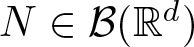 $N\in\mathcal{B}({{\mathbb R}}^d)$ be a Borel set, with
 ${\mathcal{L}}^d(N)=0$, such that
 $E^s(u,B)=E(u,B \cap N)$ and
 $E^s(w+\psi^i_R\circ (u-w),B)=E(w+\psi^i_R\circ (u-w),B\cap N)$ for every
 $i\in\{1,...m\}$, and for every
 $B\in\mathcal{B}(A)$. Since (3.6) holds for every Borel set
 $B\in\mathcal{B}(A)$, we get
 \begin{eqnarray*}
&&\frac{1}{m}\sum_{i=1}^mE^s(w+\psi^i_R\circ (u-w),B)= \frac{1}{m}\sum_{i=1}^mE(w+\psi^i_R\circ (u-w),B\cap N)\\
&&\quad \leqslant E(u,B\cap N) + \int_{B^R_{u,w}\cap N}(c_3k^{1/2}|\nabla w|+c_4)\, dx\\ &&\qquad+\frac{C}{m}\Big( E(u,B\cap N)+ \int_{B\cap N}(|\nabla w|+1)\, dx \Big)\\
&&\quad =E(u,B\cap N)+\frac{C}{m}E(u,B\cap N)=\Big(1+\frac{C}{m}\Big)E^s(u,B),
\end{eqnarray*}
which proves the claim.
We now introduce the perturbed functionals Eδ, which will play a fundamental role in the proof of our representation result for functionals in  $\mathfrak{E}$.
Definition 5.4. Let  $E\in\mathfrak{E}$ and let
 $A\in\mathcal{A}_c({{\mathbb R}}^d)$ be given. For every δ > 0 the functional
 $E_{\delta}\colon BV(A;{{\mathbb R}}^k)\times \mathcal{B}(A)\to[0,+\infty)$ is defined for every
 $u\in BV(A;{{\mathbb R}}^k)$ and
 $B\in\mathcal{B}(A)$ as
 \begin{equation}
E_{\delta}(u,B):=E(u,B)+\delta|Du|(B).
\end{equation}
Given  $u\in BV(A;{{\mathbb R}}^k)$, the measures
 $E_{\delta}^a(u,\cdot)$,
 $E^s_{\delta}(u,\cdot)$,
 $E^j_{\delta}(u,\cdot)$, and
 $E_{\delta}^c(u,\cdot)$ are defined as in Definition 5.1 with E replaced by Eδ.
Remark 5.5. Let  $E\in \mathfrak{E}$,
 $A\in\mathcal{A}_c({{\mathbb R}}^d)$, and δ > 0. Thanks to (c1
 $'$) and (c2
 $'$) of Remark 3.10, we have that for every
 $u\in BV(A;{{\mathbb R}}^k)$ it holds
 \begin{equation*}
\delta|Du|(A)-c_2{\mathcal{L}}^d(A)\leqslant E_\delta(u,A)\leqslant (c_3k+\delta)|Du|(A)+c_4{\mathcal{L}}^d(A).
\end{equation*}
Definition 5.6. Let  $A\in\mathcal{A}_c({{\mathbb R}}^d)$ and let
 $E\colon BV(A;{{\mathbb R}}^k)\times\mathcal{B}(A)\to[0,+\infty]$. For every
 $U\in\mathcal{A}(A)$ with Lipschitz boundary and
 $w\in BV(U;{{\mathbb R}}^k)$, we set
 \begin{equation}
m^E(w,U):=\inf\{E(u,U):u\in BV(U;{{\mathbb R}}^k),\, \text{tr}_Uu=\text{tr}_Uw\},
\end{equation}
where  $\text{tr}_U\colon BV(U;{{\mathbb R}}^k)\to L^1_{{\mathcal H}^{d-1}}(\partial U;{{\mathbb R}}^k)$ is the trace operator. Given t > 0, we set
 \begin{equation}
m^E_t(w,U):=\inf\{E(u,U):u\in BV(U;{{\mathbb R}}^k),\,\, \text{tr}_Uu=\text{tr}_Uw,\,\|u-w\|_{L^\infty}\leqslant t\}.
\end{equation}
We now introduce some functions which will play a crucial role in the integral representation of the bulk part Ea and the surface part Ej of a functional  $E\in \mathfrak{E}_{\rm sc}$. We recall that the cubes
 $Q(x,\rho)$ and
 $Q_\nu(x,\rho)$ are defined in (f) of Section 2, while the functions
 $\ell_\xi$ and
 $u_{x,\zeta,\nu}$ are defined in (h) of Section 2.
Definition 5.7. Let  $E\in\mathfrak{E}$ and δ > 0. We define the functions
 $f \colon{{\mathbb R}}^d\times{\mathbb R}^{k\times d}\to [0,+\infty)$ and
 $g\colon {{\mathbb R}}^d\times{{\mathbb R}}^k\times\mathbb{S}^{d-1}\to [0,+\infty)$ as
 \begin{eqnarray}
&&\displaystyle f(x,\xi):=\limsup_{\rho\to0^+}\frac{m^{E}(\ell_\xi,Q(x,\rho))}{\rho^d} \quad \text{for }x\in{{\mathbb R}}^d \text{and }\xi\in{\mathbb R}^{k\times d},
\end{eqnarray}
 \begin{eqnarray}
&&\displaystyle g(x,\zeta,\nu):=\limsup_{\rho\to0^+}\frac{m^{E}(u_{x,\zeta,\nu},Q_\nu(x,\rho))}{\rho^{d-1}}\,\,\,\,\text{for }x\in{{\mathbb R}}^d, \,\zeta\in{{\mathbb R}}^k, \nu\in\mathbb{S}^{d-1}.
\end{eqnarray}
The functions fδ and gδ are defined by replacing E by Eδ in (5.6) and (5.7).
Remark 5.8. It is immediate to check that the functions  $\delta\mapsto f_\delta(x,\xi)$ and
 $\delta\mapsto g_\delta(x,\zeta,\nu)$ are non-decreasing and that
 \begin{equation*}
f(x,\xi)\leqslant f_\delta(x,\xi) \,\,\,\text{and }\,\,\,g(x,\zeta,\nu)\leqslant g_\delta(x,\zeta,\nu)
\end{equation*}
for every δ > 0,  $x\in{{\mathbb R}}^d$,
 $\xi\in{\mathbb R}^{k\times d}$,
 $\zeta\in{{\mathbb R}}^k$, and
 $\nu\in\mathbb{S}^{d-1}$.
When  $E\in\mathfrak{E}_{\rm sc}$, we shall see that the functions fδ and gδ will be used in the integral representation of
 $E^a_\delta$ and
 $E_\delta^j$ thanks to the results of [Reference Bouchitté, Fonseca and Mascarenhas9]. This will lead to an integral representation of Ea and Ej by means of the functions (see the proof of Theorem 5.16)
 \begin{eqnarray}
&\displaystyle \hat{f}(x,\xi):=\inf_{\delta \gt 0}f_\delta(x,\xi)\quad \text{for every}\ x\in{{\mathbb R}}^d,\ \xi\in{\mathbb R}^{k\times d},\\
&\displaystyle \nonumber
\end{eqnarray}
 \begin{eqnarray*}
\hat{g}(x,\zeta,\nu):=\inf_{\delta \gt 0}g_\delta(x,\zeta,\nu)\quad \text{for every}\ x\in{{\mathbb R}}^d,\ \zeta\in {{\mathbb R}}^k, \nu\in \mathbb{S}^{d-1}.
\end{eqnarray*}
For the applications to homogenization it is important to prove that  $\hat{f}=f$ and
 $\hat{g}=g$, so that by (5.6) and (5.7) the integrands used in the bulk and surface part can be obtained by solving some auxiliary minimum problems on small cubes.
The proof of the equality  $\hat{f}=f$ is not direct and requires a lot of technical tools, one of which is the following truncation lemma. For future use, we prove the result also for the rectangles
 $Q^\lambda_\nu(x,\rho)$, defined in (f) of Section 2. Given
 $\xi\in{\mathbb R}^{k\times d}$ and
 $m\in{\mathbb N}$, we set
 \begin{equation}
c_{\xi,m}:=(\sigma^m+1)d^{1/2}\Big(|\xi|+\frac{c_2+c_4+1}{c_1}\Big)
\end{equation}
Lemma 5.9. Let  $E\in\mathfrak{E}$. Assume that there exists a function
 $\hat{f}\in\mathcal{F}$ such that
 \begin{equation}
E^a(u,A)=\int_A\hat{f}(x,\nabla u)\, dx,
\end{equation}
for every  $A\in\mathcal{A}_c({{\mathbb R}}^d)$ and
 $u\in BV(A;{{\mathbb R}}^k)$. Then there exists a set
 $N\in\mathcal{B}({{\mathbb R}}^d)$, with
 ${\mathcal{L}}^d(N)=0$, satisfying the following property: for every
 $x\in{{\mathbb R}}^d\setminus N$,
 $m\in {\mathbb N}$,
 $\xi\in{\mathbb R}^{k\times d}$,
 $\nu\in\mathbb{S}^{d-1}$, and
 $\lambda\geqslant 1$ there exists
 $\rho^{\lambda,\nu}_{m,\xi}(x) \gt 0$ such that for every
 $\rho\in (0,\rho^{\lambda,\nu}_{m,\xi}(x))$ and
 $u\in BV(Q^{\lambda}_\nu(x,\rho);{{\mathbb R}}^k)$, with
 $\text{tr}_{Q^\lambda_\nu(x,\rho)}u=\text{tr}_{Q^\lambda_\nu(x,\rho)}\ell_\xi$, there exists
 $v\in BV(Q^\lambda_\nu(x,\rho);{{\mathbb R}}^k)$, with
 $\text{tr}_{Q^\lambda_\nu(x,\rho)}v=\text{tr}_{Q^\lambda_\nu(x,\rho)}\ell_\xi$ and
 $\|v-\ell_\xi\|_{L^\infty(Q_\nu^\lambda(x,\rho);{{\mathbb R}}^k)}\leqslant c_{\xi,m}\lambda\rho$, satisfying the inequality
 \begin{equation}
\displaystyle E(v,Q^\lambda_\nu(x,\rho))\leqslant \Big(1+\frac{C}{m}\Big) E(u,Q^\lambda_\nu(x,\rho))+\frac{C}{m}\lambda^{d-1}\rho^d,
\end{equation}
where C is a constant depending only on the structural constants  $c_1,c_2,c_3,c_4, c_5$, and k. Moreover, if f is continuous on
 ${{\mathbb R}}^d\times{\mathbb R}^{k\times d}$, then
 $N=\varnothing$. Finally, if
 $\hat{f}$ is independent of x, then
 $\rho^{\lambda,\nu}_{m,\xi}(x)=+\infty$.
Proof. Let us fix  $m\in{\mathbb N}$. Arguing as in [Reference Dal Maso and Toader20, Lemma 4.16], one can construct a Borel function
 $\omega_m:{{\mathbb R}}^d\to{\mathbb R}^{k\times d}$ such that
 \begin{equation}
f(x,\omega_m(x))\leqslant f(x,\xi)+\frac{1}{m}
\end{equation}
for every  $x\in{{\mathbb R}}^d$ and every
 $\xi\in{\mathbb R}^{k\times d}$. Note that (f2
 $'$), (f3), and (5.12) imply that for every
 $x\in{{\mathbb R}}^d$ one has
 \begin{equation}
|\omega_m(x)|\leqslant \frac{c_2+c_4+1}{c_1}.
\end{equation}
Since  $\omega_m\in L^\infty({{\mathbb R}}^d;{\mathbb R}^{k\times d})$, by the Lebesgue Differentiation Theorem there exists
 $N_m\in\mathcal{B}({{\mathbb R}}^d)$, with
 ${\mathcal{L}}^d(N_m)=0$, such that for every
 $x\in{{\mathbb R}}^d\setminus N_m$,
 $\nu\in\mathbb{S}^{d-1}$, and
 $\lambda\geqslant 1$ there exists
 $\rho^{\lambda,\nu}_{m,\xi}(x) \gt 0$ such that for every
 $\rho\in(0,\rho^{\lambda,\nu}_{m,\xi}(x))$, we have
 \begin{equation*}
\int_{Q^\lambda_\nu(x,\rho)}|\omega_m(x)-\omega_m(y)|\,dy\leqslant \frac{1}{m}\rho^d\lambda^{d-1}.
\end{equation*}
We set  $N:=\bigcup_{m\in{\mathbb N}}N_m$ and note that
 ${\mathcal{L}}^d(N)=0$. Using (f5) we get that for every
 $x\in{{\mathbb R}}^d\setminus N$,
 $m\in {\mathbb N}$,
 $\xi\in{\mathbb R}^{k\times d}$,
 $\nu\in\mathbb{S}^{d-1}$ and
 $\rho\in(0,\rho^{\lambda,\nu}_{m,\xi}(x))$ we have
 \begin{equation}
\int_{Q^\lambda_\nu(x,\rho)}|\hat{f}(y,\omega_m(x))-\hat{f}(y,\omega_m(y))|\,dy\leqslant \frac{c_5}{m}\rho^d\lambda^{d-1}.
\end{equation}
For every  $y\in Q^\lambda_\nu(x,\rho)$ and
 $i\in\{1,...,m\}$ we set
 \begin{eqnarray*}
&\displaystyle \nonumber w(y):=\omega_m(x)(y-x)+\ell_\xi(x),
\end{eqnarray*}
 \begin{eqnarray}
&\displaystyle R:=d^{1/2}\Big(|\xi|+\frac{c_2+c_4+1}{c_1}\Big)\lambda\rho,
\end{eqnarray}
 \begin{eqnarray*}
&\displaystyle \nonumber v^i(y):=w(y)+\psi_R^i (u(y)-w(y)).
\end{eqnarray*}
Note that with this choice of R, we have  $|\text{tr}_{Q^\lambda_\nu(x,\rho)}(u-w)|\leqslant R$
 ${\mathcal H}^{d-1}$-a.e. on
 $ \partial Q^{\lambda}_\nu(x,\rho)$. Recalling (3.5), we obtain
 $\text{tr}_{Q_\nu^\lambda(x,\rho)}v^i=\text{tr}_{Q_\nu^\lambda(x,\rho)}\ell_\xi$ and
 \begin{equation*}
\|v^i-\ell_\xi\|_{L^\infty(Q^\lambda_\nu(x,\rho);{{\mathbb R}}^k)}\leqslant (\sigma^m+1) R=c_{\xi,m}\lambda\rho.
\end{equation*}
We claim that there exists  $i\in\{1,...,m\}$ such that (5.11) holds with
 $v=v^i.$ To this aim, for every
 $i\in\{1,...,m\}$ we consider the following partition of
 $Q^\lambda_\nu(x,\rho)$:
 \begin{align*}
& Q^i_{\rm in}:=\{y\in Q^\lambda_\nu(x,\rho)\colon |u(y)-w(y)|\leqslant \sigma^{i-1}R\},\\
& Q^i:=\{y\in Q^\lambda_\nu(x,\rho)\colon \sigma^{i-1}R \lt |u(y)-w(y)| \lt \sigma^iR\},\\
& Q^i_{\rm out}:=\{y\in Q^\lambda_\nu(x,\rho)\colon |u(y)-w(y)|\geqslant \sigma^iR \}.
\end{align*}
Using (b) of Definition 3.8 we may write
 \begin{equation*}
E(v^i,Q^\lambda_\nu(x,\rho))=E(v^i,Q^i_{\rm in})+E(v^i,Q^i)+E(v^i,Q^i_{\rm out}).
\end{equation*}
Recalling (3.5) and (5.15), from (5.10) we obtain
 \begin{equation*}
E^a(v^i,Q^\lambda_\nu(x,\rho))=\int_{Q^i_{\rm in}}\!\!\!\hat{f}(y,\nabla u(y))\,dy
+\int_{Q^i}\hat{f}(y,\nabla v^i(y))\,dy+\int_{Q^i_{\rm out}}\!\!\!\!\!\hat{f}(y,\omega_m(x))\,dy.
\end{equation*}
Taking advantage of (5.13)-(5.15), by (f2 $'$) and (f3) we get
 \begin{align*}
\int_{Q^i}\hat{f}(y,& \nabla v^i(y))\, dy\leqslant c_3k^{1/2}\int_{Q^i}|\omega_m(x)+\nabla \psi^i_R(u(y){-}w(y))(\nabla u(y){-}\omega_m(x))|\, dy\\
&+c_4{\mathcal{L}}^d(Q^i) \leqslant c_3k^{1/2}\int_{Q^i}|\nabla u(y)|\, dy+(2c_3k^{1/2}|\omega_m(x)|+c_4){\mathcal{L}}^d(Q^i)
\\ &\leqslant
\frac{c_3k^{1/2}}{c_1}\int_{Q^i}\hat{f}(y,\nabla u(y))\,dy+\Big(2c_3k^{1/2}\frac{c_2+c_4+1}{c_1}+c_2+c_4\Big){\mathcal{L}}^d(Q^i).
\end{align*}
 \begin{align*}
\int_{Q^i_{\rm out}}\hat{f}(y,\omega_m(x))\,dy&\leqslant \int_{Q^i_{\rm out}}\hat{f}(y,\omega(y))\,dy +\frac{c_5}{m}\lambda^{d-1}\rho^d\\ &\leqslant \int_{Q^i_{\rm out}}\hat{f}(y,\nabla u(y))\,dy+\frac{c_5+1}{m}\lambda^{d-1}\rho^d.
\end{align*}
From the previous inequalities, we get
 \begin{eqnarray*}
E^a(v^i,Q^\lambda_\nu(x,\rho))\leqslant \int_{Q^i_{\rm in}}\hat{f}(y,\nabla u(y))\,dy+ \frac{c_3k^{1/2}}{c_1}\int_{Q^i}\hat{f}(y,\nabla u(y))\,dy\\ {+}\, C_1{\mathcal{L}}^d(Q^i) +\int_{Q^i_{\rm out}}\!\!\!\!\hat{f}(y,\nabla u(y))\,dy+\frac{c_5+1}{m}\lambda^{d-1}\rho^d,
\end{eqnarray*}
for some constant C 1 depending only on  $c_1,c_2,c_3,c_4,c_5$, and k.
Summing over  $i\in\{1,...,m\}$ and dividing by m, we obtain
 \begin{equation}
\frac{1}{m}\sum_{i=1}^mE^a(v^i,Q^\lambda_\nu(x,\rho))\leqslant\Big(1+\frac{C}{m}\Big) E^a(u,Q^\lambda_\nu(x,\rho))+\frac{C}{m}
\lambda^{d-1}\rho^d,
\end{equation}
for some constant C depending only on  $c_1,c_2,c_3,c_4,c_5$, and k, which we may assume to be larger than the constant of Lemma 5.3. Finally, using that lemma, we get
 \begin{equation}
\frac{1}{m}\sum_{i=1}^mE^s(v^i,Q^\lambda_\nu(x,\rho))\leqslant \Big(1+\frac{C}{m}\Big)E^s(u,Q^\lambda_\nu(x,\rho)),
\end{equation}
so that combining (5.16) with (5.17) we obtain that there exists  $i\in\{1,...,m\}$ such that (5.11) holds with
 $v=v^i$.
Suppose now that  $\hat{f}$ is continuous in
 ${{\mathbb R}}^d\times{\mathbb R}^{k\times d}$. Thanks to (f2
 $'$) and (f4), we have that for every
 $x\in{{\mathbb R}}^d$ there exists
 $\omega(x)$ which minimizes the continuous function
 $\xi\mapsto\hat{f}(x,\xi)$.
Since  $\hat{f}\in\mathcal{F}$, we also have that
 $|\omega(x)|\leqslant \frac{c_2+c_4}{c_1}.$ This inequality, together with the uniform continuity of
 $\hat{f}$ on compact sets of
 ${{\mathbb R}}^d\times{\mathbb R}^{k\times d}$, implies that there exists a
 $\rho^{\lambda,\nu}_{m}(x) \gt 0$ such that for every
 $\rho\in(0,\rho^{\lambda,\nu}_{m}(x))$ one has
 \begin{equation}
|\hat{f}(y,\xi)-\hat{f}(x,\xi)|\leqslant \frac{1}{m}
\end{equation}
for every  $y\in Q^\lambda_\nu(x,\rho)$ and
 $|\xi|\leqslant (c_2+c_4)/c_1$. In particular, we have
 \begin{equation}
|\hat{f}(y,\omega(x))-\hat{f}(x,\omega(x))|\leqslant \frac{1}{m}.
\end{equation}
Exploiting these inequalities and the minimality of  $\omega(x)$, we obtain that
 \begin{equation}
\hat{f}(y,\omega(x))\leqslant \hat{f}(y,\xi)+\frac{2}{m}
\end{equation}
for every  $y\in Q^\lambda_\nu(x,\rho)$ and
 $\xi\in{\mathbb R}^{k\times d}$. Indeed, if
 $|\xi|\leqslant (c_2+c_4)/c_1$, we apply (5.18) twice to get
 \begin{equation*} \hat{f}(y,\omega(x))\leqslant \hat{f}(x,\omega(x))+\frac{1}{m}\leqslant \hat{f}(x,\xi)+\frac{1}{m}\leqslant \hat{f}(y,\xi)+\frac{2}{m}.\end{equation*}
If  $|\xi| \gt (c_4+c_2)/c_1$, recalling the minimality of
 $\omega(x)$, by (f3) and (f2
 $'$), we have
 $\hat{f}(x,\omega(x))\leqslant\hat{f}(x,0)\leqslant c_4\leqslant \hat{f}(y,\xi) $, which, together with (5.19), implies (5.20). As in the previous part of the proof, for every
 $y\in{{\mathbb R}}^d$, we set
 $w(y):=\omega(x)(y-x)+\ell_\xi(x)$. We can replace (5.14) by (5.20) in the argument that we used in the case where
 $\hat{f}$ was not assumed to be continuous on
 ${{\mathbb R}}^d\times{\mathbb R}^{k\times d}$ and this leads to the existence of
 $i\in\{1,...,m\}$ such that
 \begin{equation*}
E(w+\psi^i_R\circ(u-w),Q^\lambda_\nu(x,\rho))\leqslant \Big(1+\frac{C}{m}\Big) E(u,Q^\lambda_\nu(x,\rho))+\frac{C}{m}
\lambda^{d-1}\rho^d.
\end{equation*}
In the case where  $\hat{f}$ does not depend on x, the same is true for ω and (5.20) holds for every ρ > 0, since it is a direct consequence of the minimality.
The next result follows immediately from Lemma 5.9. Given  $\xi\in{\mathbb R}^{k\times d}$, we set
 \begin{equation}
C_\xi:=2c_3k^{1/2}C|\xi|+2C(c_4+1),
\end{equation}
where C is the constant of Lemma 5.9. We also recall that the constant  $c_{\xi,m}$ is given by (5.9).
Corollary 5.10. Let  $E\in\mathfrak{E}$ and assume that there exists a function
 $\hat{f}\in\mathcal{F}$ satisfying (5.10). Then there exists a set
 $N\in\mathcal{B}({{\mathbb R}}^d)$, with
 ${\mathcal{L}}^d(N)=0$, such that for every
 $x\in{{\mathbb R}}^d\setminus N$,
 $m\in{\mathbb N}$,
 $\xi\in{\mathbb R}^{k\times d}$,
 $\nu\in\mathbb{S}^{d-1}$, and
 $\lambda\geqslant 1$ there exists
 $\rho^{\nu,\lambda}_{m,\xi
}(x) \gt 0$ such that for every
 $\rho\in(0,\rho^{\nu,\lambda}_{m,\xi}(x))$ there exists
 $u\in BV(Q^\lambda_\nu(x,\rho);{{\mathbb R}}^k)\cap L^\infty(Q^\lambda_\nu(x,\rho);{{\mathbb R}}^k)$, with
 $\text{tr}_{Q_\nu^\lambda(x,\rho)}u={\text{tr}_{Q_\nu^\lambda(x,\rho)}}\ell_\xi$ and
 $\|u-\ell_\xi\|_{L^\infty(Q^\lambda_\nu(x,\rho);{{\mathbb R}}^k)}\leqslant c_{\xi,m}\lambda\rho$, such that
 \begin{equation}
E(u,Q^\lambda_\nu(x,\rho))\leqslant m^E(\ell_\xi,Q^\lambda_\nu(x,\rho))+\frac{C_\xi\lambda^{d-1}\rho^d}{m}.
\end{equation}
In particular for  $t=c_{\xi,m}\lambda$, we have
 \begin{equation}
m_{t\rho}^E(\ell_{\xi},Q^{\lambda}_\nu(x,\rho))\leqslant m^E(\ell_\xi,Q^\lambda_\nu(x,\rho))+\frac{C_\xi \lambda^{d-1}\rho^d}{m}.
\end{equation}
Moreover, if  $\hat{f}$ is continuous in
 ${{\mathbb R}}^d\times{\mathbb R}^{k\times d}$ then
 $N=\varnothing$. Finally, if
 $\hat{f}$ is independent on x then
 $\rho^{\eta,\lambda}_{\xi,\nu}(x)=+\infty$.
Proof. Let  $N\in\mathcal{B}({{\mathbb R}}^d)$ and
 $\rho^{\nu,\lambda}_{m,\xi}(x) \gt 0$ be as in Lemma 5.9. Consider a
 $v\in BV(Q^\lambda_\nu (x,\rho);{{\mathbb R}}^k)$, with
 $\text{tr}_{Q^\lambda_\nu(x,\rho)}v=\text{tr}_{Q^\lambda_\nu(x,\rho)}\ell_\xi$, such that
 \begin{equation*}
E(v,Q^\lambda_\nu(x,\rho))\leqslant m^E(\ell_\xi,Q^\lambda_\nu(x,\rho))+\frac{\lambda^{d-1}\rho^d}{m}.
\end{equation*}
Since the function  $\ell_\xi$ is a competitor for the minimization problem in the right-hand side of the previous inequality, we also get
 \begin{equation*}
E(v,Q^\lambda_\nu(x,\rho))\leqslant (c_3k^{1/2}|\xi|+c_4+1)\lambda^{d-1}\rho^d.
\end{equation*}
Thus, we may apply Lemma 5.9 to obtain a function  $u\in BV(Q^\lambda_\nu(x,\rho);{{\mathbb R}}^k)\cap L^\infty(Q^\lambda_\nu(x,\rho);{{\mathbb R}}^k)$, with
 $\text{tr}_{Q_\nu^\lambda(x,\rho)}u={\text{tr}_{Q_\nu^\lambda(x,\rho)}}\ell_\xi$ and
 $\|u-\ell_\xi\|_{L^\infty(Q^\lambda_\nu(x,\rho);{{\mathbb R}}^k)}\leqslant c_{\xi,m}\lambda\rho$, such that (5.22) holds, concluding the proof.
The following proposition shows that under the hypotheses of Lemma 5.9 the functions fδ and  $f^\infty_\delta$ converge
 ${\mathcal{L}}^d$-a.e. as
 $\delta\to 0^+$ to f and
 $f^\infty$ (see Definition 3.5).
Proposition 5.11. Let  $E\in\mathfrak{E}$. Assume that there exists
 $\hat{f}\in\mathcal{F}$ such that (5.10) holds. Then
 \begin{eqnarray}
& \displaystyle f(x,\xi)=\lim_{\delta\to 0^+} f_\delta(x,\xi)\quad {\rm \, for\,\, } {\mathcal{L}}^d\text{-} {\rm a.e}.\, x\in{{\mathbb R}}^d {\rm\,\, and \,\,for\,\, every }\,\xi\in{\mathbb R}^{k\times d},
\end{eqnarray}
 \begin{eqnarray}
&\displaystyle f^\infty(x,\xi)=\lim_{\delta\to 0^+} f^\infty_\delta(x,\xi)\quad {\rm for\,\, } {\mathcal{L}}^d\text{-} {\rm a.e.}\, x\in{{\mathbb R}}^d {\rm\,\,and \,\,for\,\, every }\,\xi\in{\mathbb R}^{k\times d}.
\end{eqnarray}
Proof. From Remark 5.8, we deduce that the limits in the right-hand side of (5.24) and of (5.25) exist and that  $\displaystyle f(x,\xi)\leqslant \inf_{\delta \gt 0} f_\delta(x,\xi)$,
 $\displaystyle f^\infty(x,\xi)\leqslant \inf_{\delta \gt 0} f^\infty_\delta(x,\xi).$
We are left with proving that the converse inequality also holds. Let  $N\in\mathcal{B}({{\mathbb R}}^d)$ be the
 ${\mathcal{L}}^d$-negligible set of Corollary 5.10, let
 $ x\in{{\mathbb R}}^d\setminus N$,
 $m\in{\mathbb N}$,
 $\xi\in{\mathbb R}^{k\times d}$, and
 $t\geqslant 1$. By (5.6), for ρ > 0 small enough, we have
 \begin{equation}
\frac{m^E(t\ell_{\xi},Q(x,\rho))}{t\rho^d}\leqslant \frac{f(x,t\xi)}{t}+\frac{1}{tm}.
\end{equation}
We can now apply Corollary 5.10, with ξ replaced by  $t\xi$, to obtain a function
 $u\in BV(Q(x,\rho);{{\mathbb R}}^k)$, with
 $\text{tr}_{Q(x,\rho)}u=\text{tr}_{Q(x,\rho)}t\ell_\xi$ and
 $\|u-t\ell_{\xi}\|_{L^\infty(Q(x,\rho);{{\mathbb R}}^k)}\leqslant c_{t\xi,m}\rho$, such that (5.22) holds with ξ replaced by
 $t\xi$. By taking ρ > 0 small enough, we may also suppose that
 $\|u-t\ell_{\xi}\|_{L^\infty(Q(x,\rho);{{\mathbb R}}^k)}\leqslant 1/2$. Inequality (5.26) then yields
 \begin{equation*}
\frac{E(u,Q(x,\rho))}{t\rho^d}\leqslant \frac{f(x,t\xi)}{t}+\frac{C_{t\xi}+1}{tm}\leqslant \frac{f(x,t\xi)}{t}+\frac{C_\xi+1}{m},
\end{equation*}
where  $C_{\xi} \gt 0$ is the constant given by (5.21). Note that in the last inequality, we have used the estimate
 $C_{t\xi}\leqslant tC_\xi$ for every
 $t\geqslant 1$.
We now compare  $E_\delta(u,Q(x,\rho))$ and
 $E(u,Q(x,\rho))$. Since
 $\|u-t\ell_{\xi}\|_{L^\infty}\leqslant 1/2$ and
 $[u-t\ell_\xi]=[u]$, we have
 $|[u]|\leqslant 1\ {\mathcal H}^{d-1}$-a.e. on Ju. Hence, by (c1
 $'$) we get
 \begin{eqnarray*}
E_\delta(u,Q(x,\rho))&=& E(u,Q(x,\rho))+\delta|Du|(Q(x,\rho))\\ &\leqslant& E(u,Q(x,\rho))+\delta \int_{Q(x,\rho)}|\nabla u| \, dx+\delta|D^cu|(Q(x,\rho))
\\ &&+\,\delta \int_{J_{u}}|[u]|\land 1\, d{\mathcal H}^{d-1}
\leqslant \Big(1+\frac{\delta}{c_1}\Big)E(u,Q(x,\rho))+\frac{c_2\delta }{c_1}\rho^d.
\end{eqnarray*}
Letting δ be so small that  $\delta /c_1\leqslant 1/m$ and
 $\delta c_2/c_1\leqslant 1/m,$ we then obtain
 \begin{equation*}
\frac{E_\delta(u,Q(x,\rho))}{t\rho^d}\leqslant\Big(1+\frac1m\Big)\frac{E(u,Q(x,\rho))}{t\rho^d}+\frac1m\leqslant \Big(1+\frac1m\Big)\Big(\frac{f(x,t\xi)}{t}+\frac{C_\xi+1}{m}\Big)
\end{equation*}
and, recalling that  $\text{tr}_{Q(x,\rho)}u=\text{tr}_{Q(x,\rho)}t\ell_\xi$, we get
 \begin{equation*}
\frac{m^{E_\delta}(\ell_{t\xi},Q(x,\rho))}{t\rho^d}\leqslant \Big(1+\frac1m\Big)\Big(\frac{f(x,t\xi)}{t}+\frac{C_\xi+1}{m}\Big).
\end{equation*}
Evaluating this last inequality at t = 1 and taking the  $\limsup$ as
 $\rho \to 0^+$, we deduce
 \begin{equation*}
f_\delta(x,\xi)\leqslant \Big(1+\frac1m\Big)\Big(f(x,\xi)+\frac{C_\xi+1}{m}\Big),
\end{equation*}
while taking the  $\limsup$ as
 $\rho\to 0^+$ first and letting then
 $t\to+\infty$, we obtain
 \begin{equation*}
f^\infty_\delta(x,\xi)\leqslant \Big(1+\frac1m\Big)\Big(f^\infty(x,\xi)+\frac{C_\xi+1}{m}\Big).
\end{equation*}
Finally, letting  $\delta\to 0^+$ first and then taking the limit for
 $m\to+\infty$, we conclude the proof.
We now pass to the study of the minimization problems used to define the integrands for the surface terms.
Lemma 5.12. Let  $E\in\mathfrak{E}$,
 $x\in{{\mathbb R}}^d$,
 $\nu\in\mathbb{S}^{d-1}$,
 $m\in{\mathbb N}$,
 $\zeta\in{{\mathbb R}}^k$, and ρ > 0. Then there exists
 $u\in BV(Q_\nu(x,\rho);{{\mathbb R}}^k)\cap L^\infty(Q_\nu(x,\rho);{{\mathbb R}}^k)$, with
 $\text{tr}_{Q_\nu(x,\rho)}u=\text{tr}_{Q_\nu(x,\rho)}u_{x,\zeta,\nu}$ and
 $\|u\|_{L^\infty(Q_\nu(x,\rho);{{\mathbb R}}^k)}\leqslant \sigma^m|\zeta|$, such that
 \begin{equation}
E(u,Q_\nu(x,\rho))\leqslant m^E(u_{x,\zeta,\nu},Q_\nu(x,\rho))+\frac{K(|\zeta|\land 1)}{m}\rho^{d-1}+K\rho^{d},
\end{equation}
where  $K:=\max\{c_3kC,(2C+c_4+1)\}$ and C is the constant in Definition 3.8(g).
Proof. By (5.4) there exists  $v\in BV(Q_\nu(x,\rho);{{\mathbb R}}^k)$, with
 $\text{tr}_{Q_\nu(x,\rho)}v=\text{tr}_{Q_\nu(x,\rho)}u_{x,\zeta,\nu}$, such that
 \begin{equation}
E(v,Q_\nu(x,\rho))\leqslant m^E(u_{x,\zeta,\nu},Q_\nu(x,\rho))+
\rho^{d}\leqslant c_3k(|\zeta|\land 1)\rho^{d-1}+\rho^d,
\end{equation}
where the second inequality follows from (c2 $'$) and the fact that
 $u_{x,\zeta,\nu}$ is a competitor for the minimization problem.
Let us choose  $R=|\zeta|$ and for
 $i\in\{1,...,m\}$ let
 $u^i:=\psi_R^i\circ v$. Note that with this choice of R by (3.5), we have
 $\text{tr}_{Q_\nu(x,\rho)}u^i=\text{tr}_{Q_\nu(x,\rho)}u_{x,\zeta,\nu}$ and
 $\|u^i\|_{L^\infty(Q_\nu(x,\rho);{{\mathbb R}}^k)}\leqslant \sigma^m|\zeta|$. By property (g) of Definition 3.8 and (5.28) there exists
 $i\in\{1,...,m\}$ such that
 \begin{eqnarray*}
E(u^i,Q_\nu(x,\rho))&\leqslant& E(v,Q_\nu(x,\rho)) \, +c_4\rho^d +\frac{C}{m}\left(E(v,Q_\nu(x,\rho))+\rho^d\right)\\
&\leqslant& m^E(u_{x,\zeta,\nu},Q_\nu(x,\rho))+(2C+c_4+1)\rho^d+\frac{c_3kC(|\zeta|\land 1) }{m}\rho^{d-1},
\end{eqnarray*}
concluding the proof.
We are now ready to prove that gδ converges to g.
Proposition 5.13. Let  $E\in\mathfrak{E}$,
 $ x\in{{\mathbb R}}^d,\ \zeta\in{{\mathbb R}}^k,$ and
 $\nu\in\mathbb{S}^{d-1}$. Then
 \begin{equation}
g(x,\zeta,\nu)=\lim_{\delta\to 0^+}g_\delta(x,\zeta,\nu).
\end{equation}
Proof. Thanks to Remark 5.8, the limit in the right-hand side of (5.29) exists and
 \begin{equation*}
g(x,\zeta,\nu)\leqslant \lim_{\delta\to 0^+}g_\delta(x,\zeta,\nu).
\end{equation*}
We now prove that the converse inequality holds true as well. Let us fix  $m\in{\mathbb N}$. By (5.7) for ρ > 0 small enough, we have that
 \begin{equation}
\frac{m^E(u_{x,\zeta,\nu},Q_\nu(x,\rho))}{\rho^{d-1}}\leqslant g(x,\zeta,\nu)+\frac{1}{m}.
\end{equation}
We can now apply Lemma 5.12 to obtain a function  $u\in BV(Q_\nu(x,\rho);{{\mathbb R}}^k)\cap L^\infty(Q_\nu(x,\rho);{{\mathbb R}}^k)$, with
 $\text{tr}_{Q_\nu(x,\rho)}u=\text{tr}_{Q_\nu(x,\rho)}u_{x,\zeta,\nu}$ and
 $\|u\|_{L^\infty(Q_\nu(x,\rho):{{\mathbb R}}^k)}\leqslant \sigma^m|\zeta|$, such that
 \begin{equation*}
E(u,Q_\nu(x,\rho))\leqslant m^E(u_{x,\zeta,\nu}.Q_\nu(x,\rho))+\frac{K}{m}\rho^{d-1}+K\rho^d.\end{equation*}
From (5.30) we then deduce that
 \begin{equation*}
\frac{E(u,Q_\nu(x,\rho))}{\rho^{d-1}}\leqslant g(x,\zeta,\nu)+\frac{K+1}{m}+K\rho.
\end{equation*}
To conclude, we compare  $E_\delta(u,Q_\nu(x,\rho))$ with
 $E(u,Q_\nu(x,\rho))$. Since
 $\|u\|_{L^\infty(Q_\nu(x,\rho);{{\mathbb R}}^k)}\leqslant \sigma^m{|\zeta|}$, we have
 $|[u]|\leqslant 2\sigma^m{|\zeta|}(|[u]|\land 1).$ Hence, we get
 \begin{align*}
E_\delta&(u,Q_\nu(x,\rho))= E(u,Q_\nu(x,\rho))+\delta|Du|(Q_\nu(x,\rho))
\\ &\leqslant E(u,Q_\nu(x,\rho))+\delta\int_{Q_\nu(x,\rho)}\!\!\!\!\!|\nabla u|\, dx+\delta|D^cu|(Q_\nu(x,\rho))\\\,&+2\delta \sigma^m|\zeta|\int_{J_{u}}\!\!\!\!\!|[u]|\land 1\, d{\mathcal H}^{d-1}
\\ & \leqslant \Big(1+\frac{2\delta \sigma^m(|\zeta|\lor 1 )}{c_1}\Big)E(u,Q_\nu(x,\rho))+\frac{2c_2\delta\sigma^m(|\zeta|\lor 1)}{c_1}\rho^d.
\end{align*}
Letting δ be so small that  $2\delta
\sigma^m(|\zeta|\lor 1)/c_1\leqslant 1/m$ and
 $2c_2\delta
\sigma^m(|\zeta|\lor 1)/c_1\leqslant 1$, we get
 \begin{equation*}
\frac{E_\delta(u,Q_\nu(x,\rho))}{\rho^{d-1}}\leqslant \Big(1+\frac1m\Big) g(x,\zeta,\nu)+\frac{2K+2}{m}+\Big(2K+1\Big)\rho.
\end{equation*}
Recalling the definition of  $m^{E_\delta}$, from this last estimate we deduce that
 \begin{equation*}
\frac{m^{E_\delta}(u_{x,\zeta,\nu},Q_\nu(x,\rho))}{\rho^{d-1}}\leqslant \Big(1+\frac1m\Big) g(x,\zeta,\nu)+\frac{2K+2}{m}+\Big(2K+1\Big)\rho.
\end{equation*}
Taking the limsup as  $\rho\to 0^+$, we obtain
 \begin{equation*}
g_\delta(x,\zeta, \nu)\leqslant \Big(1+\frac1m\Big) g(x,\zeta,\nu)+\frac{2K+2}{m}.
\end{equation*}
Taking first the  $\limsup$ for
 $\delta\to0^+$, and then the limit for
 $m\to+\infty$ then, we conclude the proof.
As the following proposition shows, the functions f and g defined by (5.6) and (5.7), belong to  $\mathcal{F}$ and to
 $\mathcal{G}$, respectively.
Proposition 5.14. Let  $E\in\mathfrak{E}_{\rm sc}$, f,
 $\hat{f}$, and g be the functions defined by (5.6), (5.8), and (5.7), respectively. Then
 $\hat{f}, f\in\mathcal{F}$,
 $g\in\mathcal{G}$.
Proof. The proof of the inclusions  $\hat{f}$,
 $f\in\mathcal{F}$, and of properties (g1)-(g5) for g, can be obtained by adapting the arguments of [Reference Dal Maso and Toader20, Section 5], with minor changes.
We are left with proving that g satisfies (g6). To see this, let  $\zeta_1,\zeta_2\in{{\mathbb R}}^k\setminus\{0\}$ with
 $c_6k|\zeta_1| \leqslant |\zeta_2|$. We set
 $\lambda:=|\zeta_1|/|\zeta_2|$ and note that
 $\lambda\leqslant 1/(c_6k)$. Let
 $R\in SO(k)$ be a rotation that maps
 $\lambda \zeta_2$ to ζ 1. Let
 $x\in{{\mathbb R}}^d$,
 $\nu\in\mathbb{S}^{d-1}$, and
 $m\in{\mathbb N}$. By (5.7) there exists
 $u\in BV(Q_\nu(x,\rho);{{\mathbb R}}^k)$, with
 $\text{tr}_{Q_\nu(x,\rho)}u=\text{tr}_{Q_\nu(x,\rho)}u_{x,\zeta_2,\nu}$, such that
 \begin{equation}
E(u,Q_\nu(x,\rho))\leqslant m^E(u_{x,\zeta_2,\nu},Q_\nu(x,\rho))+\rho^d.
\end{equation}
We set  $v:=\lambda Ru$ and note that
 $\text{tr}_{Q_\nu(x,\rho)}v=\text{tr}_{Q_\nu(x,\rho)}u_{x,\zeta_1,\nu}$. Then, by means of (h) of Definition 3.8, we have
 \begin{equation*}
E(v,Q_\nu(x,\rho))\leqslant E(u,Q_\nu(x,\rho))+(c_4+c_2)\rho^d,
\end{equation*}
so that, by (5.31), we infer
 \begin{equation}
E(v,Q_\nu(x,\rho))\leqslant m^E(u_{x,\zeta_2,\nu},Q_\nu(x,\rho))+(c_4+c_2+1)\rho^d.
\end{equation}
Dividing this last inequality by  $\rho^{d-1}$ and taking the
 $\limsup$ for
 ${\rho\to 0^+}$, we obtain
 \begin{equation*}
\limsup_{\rho\to 0^+} \frac{E(v,Q_\nu(x,\rho))}{\rho^{d-1}}\leqslant g(x,\zeta_2,\nu),
\end{equation*}
which, in light of the fact that  $\text{tr}_{Q_\nu(x,\rho)}v=\text{tr}_{Q_\nu(x,\rho)}u_{x,\zeta_1,\nu}$, implies
 \begin{equation*}
g(x,\zeta_1,\nu)\leqslant g(x,\zeta_2,\nu),
\end{equation*}
which concludes the proof.
Using the results of [Reference Bouchitté, Fonseca and Mascarenhas9], we can now establish an integral representation both for the absolutely continuous part and the jump part of the perturbed functionals Eδ. This representation is achieved by means of the functions fδ and gδ defined above.
Proposition 5.15. Let  $E\in\mathfrak{E}_{\rm sc}$,
 $A\in\mathcal{A}_c({{\mathbb R}}^d)$, and δ > 0. Let
 $E_\delta^a$ and
 $E^j_\delta$ be the functionals introduced in Definition 5.4 and let fδ and gδ as in Definition 5.7. Then
 \begin{eqnarray}
&\displaystyle E^a_\delta(u,B)=\int_{B}f_\delta(x,\nabla u)\, dx,
\end{eqnarray}
 \begin{eqnarray}
&\displaystyle E_\delta^j(u,B)=\int_{B\cap J_{u}}g_\delta(x,[u],\nu)\, d{\mathcal H}^{d-1},
\end{eqnarray}
for every  $u\in BV(A;{{\mathbb R}}^k)$ and for every
 $B\in\mathcal{B}(A)$.
Proof. The result follows from [Reference Bouchitté, Fonseca and Mascarenhas9], using the same arguments of [Reference Dal Maso and Toader20, Theorem 6.1].
With this proposition at hand, we are ready to prove the integral representation of Ea and of Ej.
Theorem 5.16. Let  $E\in\mathfrak{E}_{\rm sc}$,
 $A\in\mathcal{A}_c({{\mathbb R}}^d), $ and let f and g be the functions defined by (5.6) and (5.7), respectively. Then
 \begin{eqnarray}
&\displaystyle E^a(u,B)=\int_{B}f(x,\nabla u)\, dx,
\end{eqnarray}
 \begin{eqnarray}
&\displaystyle E^j(u,B)=\int_{J_{u}\cap B}g(x,[u],\nu)\, d{\mathcal H}^{d-1}
\end{eqnarray}
for every  $u\in GBV_\star(A;{{\mathbb R}}^k)$ and for every
 $B\in\mathcal{B}(A)$.
Proof. Let  $\hat{f}$ be the function defined by (5.8). We first show that
 \begin{equation}
E^a(u,B)=\int_B\hat{f}(x,\nabla u)\, dx\,\,\, \text{for every}\ u\in BV(A;{{\mathbb R}}^k)\ \text{and}\ B\in\mathcal{B}(A).
\end{equation}
To this aim, we begin by noting that  $E^a_\delta(u,B)=E^a(u,B)+\delta\int_B|\nabla u|dx$ for every
 $u\in BV(A;{{\mathbb R}}^k)$ and for every
 $B\in\mathcal{B}(A)$, so that
 \begin{equation*}
E^a(u,B)=\inf_{\delta \gt 0}E_\delta^a(u,B)=\lim_{\delta \gt 0}E_\delta^a(u,B).
\end{equation*}
By the definition of fδ, we have that
 \begin{equation*}
f_\delta(x,\xi)\leqslant (c_3k^{1/2}+\delta)|\xi|+c_4,
\end{equation*}
for every  $x\in{{\mathbb R}}^d$ and for every
 $\xi\in{\mathbb R}^{k\times d}$, so that by invoking the Dominated Convergence Theorem, we obtain (5.37).
We now prove that
 \begin{equation}
E^j(u,B)=\int_{B}g(x,[u],\nu_u)\, d{\mathcal H}^{d-1}\,\,\, \text{for}\ u\in BV(A;{{\mathbb R}}^k)\ \text{and}\ B\in\mathcal{B}(A).
\end{equation}
To show this, note that  $E_\delta^j(u,B)=E^j(u,B)+\delta\int_{J_u\cap B} |[u]|d{\mathcal H}^{d-1}$ for every
 $u\in BV(A;{{\mathbb R}}^k)$ and
 $B\in\mathcal{B}(A)$; therefore,
 \begin{equation*}
E^j(u,B)=\inf_{\delta \gt 0}E_\delta^j(u,B)=\lim_{\delta \gt 0}E_\delta^j(u,B).
\end{equation*}
It is immediate to see that for every  $x\in{{\mathbb R}}^d$,
 $\zeta\in{{\mathbb R}}^k$, and
 $\nu\in\mathbb{S}^{d-1}$, we have
 \begin{equation*}
g_\delta(x,\zeta,\nu)\leqslant (c_3k+\delta)|\zeta|\land 1.
\end{equation*}
Hence, recalling Proposition 5.13 and using (5.34), by the Dominated Convergence Theorem we obtain (5.36).
Consider now  $u\in GBV_\star(A;{{\mathbb R}}^k)$. Let
 $R_m \gt 0$ with
 $R_m\to +\infty$. By Lemma 5.2, (5.2) with b = a and b = j hold for every
 $B\in\mathcal{B}(A)$. To conclude, it is enough to show that
 \begin{eqnarray}
&\displaystyle \lim_{m\to+\infty}\frac1m\sum_{i=1}^mE^a(\psi_{R_m}^{i}\circ u,A)=\int_Af(x,\nabla u)\,dx,
\end{eqnarray}
 \begin{eqnarray}
&\displaystyle \lim_{m\to+\infty}\frac1m\sum_{i=1}^mE^j(\psi_{R_m}^{i}\circ u,A)=\int_{J_{u}\cap A}g(x,[u],\nu_u)\,d{\mathcal H}^{d-1}.
\end{eqnarray}
Since for every  $i\in\{1,...m\}$, we have that
 $ \psi_{R_m}^{i}\circ u\in BV(A;{{\mathbb R}}^k)\cap L^\infty(A;{{\mathbb R}}^k)$, from (5.35) and (5.38) we deduce that
 \begin{eqnarray*}
&\displaystyle E^a(\psi_{R_m}^{i}\circ u,A)=\int_Af(x,\nabla (\psi_{R_m}^{i}\circ u))\, dx,\\
&\displaystyle E^j(\psi_{R_m}^{i}\circ u,A)=\int_{J_{\psi_{R_m}^{i}(u)}\cap A}\!\!\!g(x,[\psi_{R_m}^{i}\circ u],\nu_u)\, d{\mathcal H}^{d-1}.
\end{eqnarray*}
By (3.5), we have  $|\nabla(\psi_{R_m}^{i}\circ u)|\leqslant |\nabla
u|$ for every
 $m\in{\mathbb N}$ and
 $i\in\{1,...,m\}$. Morover,
 $\nabla u\in L^1({{\mathbb R}}^d;{\mathbb R}^{k\times d})$ by Proposition 2.4(a). For every
 $m\in{\mathbb N}$ there exists
 $i(m),j(m)\in\{1,...,m\}$ such that
 \begin{equation*}
\int_Af(x,\nabla (\psi_{R_m}^{i(m)}\circ u))\, dx\leqslant\frac1m\sum_{i=1}^mE^a(\psi_{R_m}^{i}\circ u,A)\leqslant\int_Af(x,\nabla (\psi_{R_m}^{j(m)}\circ u))\, dx.
\end{equation*}
We observe that both  $\nabla(\psi_{R_m}^{i(m)}\circ u)$ and
 $\nabla(\psi_{R_m}^{j(m)}\circ u)$ converge to
 $\nabla u$ pointwise
 ${\mathcal{L}}^d$-a.e. in A as
 $m\to+\infty$. Hence, recalling that by Proposition 5.14 the function f belongs to
 $\mathcal{F}$, the Dominated Convergence Theorem implies (5.39).
As for (5.40), by Proposition 2.4(d), for every  $i\in\{1,...,m \}$, we have that
 $|[\psi_{R_m}^{i}\circ u]|\land1\leqslant |[u]|\land 1$ and that
 $[\psi_{R_m}^{i}\circ u](x)\to [u](x)$ for
 ${\mathcal H}^{d-1}$-a.e.
 $x\in J_{u}$. For every
 $m\in{\mathbb N}$ we choose
 $i(m),j(m)\in\{1,...,m\}$ such that
 \begin{align*}
\int_{J_{u}\cap A}g(x,[\psi_{R_m}^{i(m)}\circ u],\nu_u)\, d{\mathcal H}^{d-1}&\leqslant\frac1m\sum_{i=1}^mE^j(\psi_{R_m}^{i}\circ u,A)\\ &\leqslant\int_{J_{u}\cap A}g(x,[\psi_{R_m}^{j(m)}\circ u],\nu_u)\, d{\mathcal H}^{d-1}.
\end{align*}
Since by Proposition 5.14 the function g belongs to  $\mathcal{G}$, an application of the Dominated Convergence Theorem yields (5.40), concluding the proof.
6. A smaller collection of integrands
As the scalar case studied in [Reference Dal Maso and Toader20] and [Reference Dal Maso and Toader21] suggests, to recover a full integral representation for functionals in  $\mathfrak{E}_{\rm sc}$ it is convenient to consider a smaller collection of integrands, whose definition is closely related to those studied in [Reference Cagnetti, Dal Maso, Scardia and Zeppieri15]. In particular, we will show that the Cantor part Ec can be represented as an integral functional whenever
 $E\in\mathfrak{E}_{\rm sc}$ is the Γ-limit of a sequence of functionals associated to integrands in this smaller class and the volume integrand corresponding to E does not depend on x (see Theorem 7.1).
In the rest of the paper, we fix two new constants  $c_7 \gt 0$ and
 $\alpha\in (0,1)$. Moreover, we fix a continuous non-decreasing function
 $\vartheta\colon [0,+\infty)\to [0,+\infty)$ such that
 \begin{equation}
\vartheta(0)=0\,\,\,\text{and }\,\,\,\vartheta(t)\geqslant \frac{c_1}{c_3}t-1\quad\text{for every }t\geqslant 0.
\end{equation}
The smaller collection of volume integrands is introduced in the following definition.
Definition 6.1. Let  $\mathcal{F}^\alpha$ be the collection of functions
 $f\in\mathcal{F}$ such that
 \begin{equation}
\Big|\frac{f(x,s\xi)}{s}-\frac{f(x,t\xi)}{t}\Big|\leqslant \frac{c_7}{s}f(x,s\xi)^{1-\alpha}+\frac{c_7}{s}+\frac{c_7}{t}f(x,t\xi)^{1-\alpha}+\frac{c_7}{t}
\end{equation}
for  ${\mathcal{L}}^d$-a.e.
 $x\in{{\mathbb R}}^d$ and for every
 $s,t \gt 0$ and
 $\xi\in{\mathbb R}^{k\times d}$.
Remark 6.2. Arguing as in [Reference Dal Maso and Toader21, Remark 4.3], one can show that  $f\in\mathcal{F}^\alpha$ if and only if for
 ${\mathcal{L}}^d$-a.e.
 $x\in{{\mathbb R}}^d$ and for every
 $\xi\in{\mathbb R}^{k\times d}$, we have
 \begin{equation*}
f^\infty(x,\xi)=\lim_{s\to+\infty}\frac{1}{s}f(x,s\xi),
\end{equation*}
and
 \begin{equation}
\Big|\frac{1}{s}f(x,s\xi)-f^\infty(x,\xi)\Big|\leqslant \frac{c_7}{s}+\frac{c_7}{s}f(x,s\xi)^{1-\alpha}
\end{equation}
for  ${\mathcal{L}}^d$-a.e.
 $x\in{{\mathbb R}}^d$, for every
 $\xi\in{\mathbb R}^{k\times d}$ and for every s > 0. This is closely related to condition (H4) of [Reference Bouchitté, Fonseca and Mascarenhas9].
We now introduce the smaller collection of surface integrands.
Definition 6.3. Let  $\mathcal{G}^\vartheta$ be the collection of functions
 $g\in\mathcal{G}$ such that
 \begin{equation}
\Big|\frac{g(x,s\zeta,\nu)}{s}-\frac{g(x,t\zeta,\nu)}{t}\Big|\leqslant \vartheta (s|\zeta|)\frac{g(x,s\zeta,\nu)}{s}+\vartheta(t|\zeta|)\frac{g(x,t\zeta,\nu)}{t},
\end{equation}
for every  $s,t \gt 0$,
 $x\in{{\mathbb R}}^d$,
 $\zeta\in{{\mathbb R}}^k$, and
 $\nu\in\mathbb{S}^{d-1}$.
Remark 6.4. The arguments of [Reference Dal Maso and Toader21, Remark 4.5] show that  $g\in\mathcal{G}^\vartheta$ if and only if for
 $x\in{{\mathbb R}}^d$,
 $\zeta\in{{\mathbb R}}^k$ and
 $\nu\in\mathbb{S}^{d-1}$, we have that the limit
 \begin{equation}
\displaystyle g^0(x,\zeta,\nu):=\lim_{s\to 0^+}\frac{1}{s}g(x,s\zeta,\nu)
\end{equation}
exists and
 \begin{equation}
\Big|\frac1s g(x, s\zeta, \nu) - g^0(x, \zeta, \nu)\Big|\leqslant\vartheta(s|\zeta|)\frac1sg(x, s\zeta,\nu) \leqslant c_3k\vartheta(s|\zeta|)|\zeta|
\end{equation}
for every s > 0,  $x\in{{\mathbb R}}^d$,
 $\zeta\in{{\mathbb R}}^k$, and
 $\nu\in\mathbb{S}^{d-1}$. By [Reference Cagnetti, Dal Maso, Scardia and Zeppieri15, Remark 3.5], this is closely related to condition (g5) of that paper.
Remark 6.5. Condition (6.2) is crucial in Lemma 6.12, which is a key instrument in the proof of the integral representation of the Cantor part (see Theorem 7.1). Moreover, conditions (6.3) and (6.6) will be used in Section 9 to obtain the homogenization formulas.
Remark 6.6. The class  $\mathcal{G}^\vartheta$ is non-empty, since the function
 $(x,\zeta,\nu)\mapsto \sum_{i=1}^k((c_1|\zeta_i|)\land c_3)$ belongs to
 $\mathcal{G}^\vartheta$. Arguing as in [Reference Dal Maso and Toader21, Remark 4.7], it is possible to show that
 $\mathcal{G}^\vartheta\neq \emptyset$ if and only if ϑ satisfies (6.1) .
As in Section 3, we introduce a space of functionals  $\mathfrak{E}^{\alpha,\vartheta}$ containing
 $E^{f,g}$ for every
 $f\in\mathcal{F}^\alpha$ and
 $g\in\mathcal{G}^\vartheta$.
Definition 6.7. Let  $\mathfrak{E}^{\alpha,\vartheta}$ be the space of functionals
 $E\in \mathfrak{E}$ satisfying the condition
 \begin{equation}
\begin{aligned}
\Big|\frac{E(su,A)}{s}-\frac{E(tu,A)}{t}\Big|\leqslant \frac{c_7}{s}{\mathcal{L}}^d(A)^\alpha E(su,A)^{1-\alpha}+\vartheta(su^A)\frac{E(su,A)}{s}+\frac{c_7}{s}{\mathcal{L}}^d(A)\\
+\frac{c_7}{t}{\mathcal{L}}^d(A)^{\alpha}E(tu,A)^{1-\alpha}+\vartheta(tu^A)\frac{E(tu,A)}{t}+\frac{c_7}{t}{\mathcal{L}}^d(A),
\end{aligned}
\end{equation}
for every  $t,s \gt 0$,
 $A\in\mathcal{A}_c({{\mathbb R}}^d)$, and
 $u\in BV(A;{{\mathbb R}}^k)\cap L^\infty(A;{{\mathbb R}}^k)$, where
 $u^A:=\text{osc}_Au:=\text{ess}\sup_{x,y\in A}|u(x)-u(y)|$. We also set
 $\mathfrak{E}^{\alpha,\vartheta}_{\rm sc}:=\mathfrak{E}^{\alpha,\vartheta}\cap \mathfrak{E}_{\rm sc}.$
Proposition 6.8. Let  $f\in\mathcal{F}^\alpha$ and
 $g\in\mathcal{G}^\vartheta$. Then the functional
 $E^{f,g}$ of Definition 3.7 belongs to
 $\mathfrak{E}^{\alpha,\vartheta}$.
Proof. The result is proved as in [Reference Dal Maso and Toader21, Proposition 4.9], replacing Remark 2.9 therein by our Proposition 3.14.
To study the Γ-limit of sequences of functionals  $(E_n)_n\subset \mathfrak{E}^{\alpha,\vartheta}$, given
 $A\in\mathcal{A}_c({{\mathbb R}}^d)$ and a function
 $u\in BV(A;{{\mathbb R}}^k)\cap L^\infty(A;{{\mathbb R}}^k)$, it is important to be able to find approximate recovery sequences for u which are bounded in
 $L^\infty(A;{{\mathbb R}}^k)$. This is taken care of in the next lemma.
Lemma 6.9. Let  $m\in{\mathbb N}$,
 $A\in\mathcal{A}_c({{\mathbb R}}^d)$,
 $u\in BV(A;{{\mathbb R}}^k)\cap L^\infty(A;{{\mathbb R}}^k)$,
 $E\in\mathfrak{E}$, and
 $(E_n)_n\subset\mathfrak{E}$, with
 $E_n(\cdot,A)\ \Gamma$-converging to E in the topology of
 $L^0({{\mathbb R}}^d;{{\mathbb R}}^k)$. Then there exist sequences
 $(u_n)_n\subset BV(A;{{\mathbb R}}^k)$ and
 $(v_n)_n\subset BV(A;{{\mathbb R}}^k)$ converging to u in
 $L^1(A;{{\mathbb R}}^k)$ such that
 \begin{eqnarray}
&\displaystyle u^A_n\leqslant 4\sigma^{m}u^A \,\, \text{and }\,\, \|v_n\|_{L^\infty(A;{{\mathbb R}}^k)}\leqslant 2\sigma^m\|u\|_{L^\infty(A;{{\mathbb R}}^k)} \,\, \text{for every } n\in{\mathbb N},
\end{eqnarray}
 \begin{eqnarray}
&\displaystyle \limsup_{n\to+\infty }E_n(u_n,A)\lor \limsup_{n\to+\infty } E_n(v_n,A)\leqslant E(u,A)+C\frac{E(u,A)+{\mathcal{L}}^d(A)}{m},
\end{eqnarray}
where C is the constant in Definition 3.8(g).
Proof. By property (d) of Definition 3.8, it is not restrictive to assume that  $u^A=\|u\|_{L^{\infty}(A;{{\mathbb R}}^k)}$. By Γ-convergence there exists a sequence
 $(w_n)\subset L^0({{\mathbb R}}^d;{{\mathbb R}}^k)$ converging to u in
 $L^0({{\mathbb R}}^d;{{\mathbb R}}^k)$ such that
 \begin{equation}\lim_{n\to+\infty}E_n(w_n,A)=E(u,A).
\end{equation}
Let us fix  $R:=2\|u\|_{L^\infty(A;{{\mathbb R}}^k)}$. By property (g) of Definition 3.8 for every
 $n\in{\mathbb N}$ there exists an index
 $i(n)\in\{1,...,m\}$ such that
 \begin{equation*}
E_n(\psi_R^{i(n)}\circ w_n,A)\leqslant E_n(w_n,A)+C\frac{E(u,A)+{\mathcal{L}}^d(A)}{m}+c_4{\mathcal{L}}^d(A^R_{v_n,0}).
\end{equation*}
Since  $w_n\to u$ in
 $L^0({{\mathbb R}}^d;{{\mathbb R}}^k)$, by our choice of R, we have
 ${\mathcal{L}}^d(A_{w_n,0}^{R})\to 0$. Setting
 $u_n:=\psi_R^{i(n)}\circ w_n$, we deduce from (6.10) and the previous inequality that
 \begin{equation*}
\limsup_{n\to+\infty}E_n(u_n,A)\leqslant E(u ,A)+C\frac{E(u,A)+{\mathcal{L}}^d(A)}{m}.
\end{equation*}
We conclude by noting that by (3.5), we have the inequality  $u_n^A\leqslant 2\|u_n\|_{L^\infty(A; {{\mathbb R}}^k)}\leqslant 4\sigma^{m}\|u\|_{L^\infty(A;{{\mathbb R}}^k)}=4\sigma^mu^A$ and
 $u_n\to u$ in
 $L^1(A;{{\mathbb R}}^k)$.
The construction of vn is similar.
We now want to study Γ-limits of sequences of functionals in  $\mathfrak{E}^{\alpha,\vartheta}$. To this aim, it is convenient to introduce a family of subspaces of
 $\mathfrak{E}$, in which (6.7) holds in a weaker form. Given
 $m\in{\mathbb N}$, we set
 \begin{equation}
\vartheta_m(t):=\vartheta(4\sigma^mt)
\end{equation}
for every  $t\geqslant 0$.
Definition 6.10. Given  $m\in{\mathbb N}$, we denote by
 $\mathfrak{E}^{\alpha,\vartheta_m}_m$ the space of functionals
 $E\in\mathfrak{E}$ satisfying the condition
 \begin{align*}
\Big|\frac{E(su,A)}{s}{-}\frac{E(tu,A)}{t}\Big|\leqslant \frac{c_7}{s}{\mathcal{L}}^d(A)^\alpha E(su,A)^{1-\alpha}+\vartheta_m(su^A)\frac{E(su,A)}{s}+\frac{c_7}{s}{\mathcal{L}}^d(A)\\
+\frac{c_7}{t}{\mathcal{L}}^d(A)^{\alpha}\!E(tu,A)^{1-\alpha}\!\!+\vartheta_m(tu^A)\frac{E(tu,A)}{t}\!+\frac{c_7}{t}{\mathcal{L}}^d(A)\!+R_{m,s}(u,A)+R_{m,t}(u,A)
\end{align*}
for every  $t,s \gt 0$,
 $A\in\mathcal{A}_c({{\mathbb R}}^d)$,
 $u\in BV(A;{{\mathbb R}}^k)\cap L^\infty(A,{{\mathbb R}}^k)$, where ϑm is the function defined by (6.11) and
 $R_{m,t}(u,A)$ is defined for every t > 0 by
 \begin{equation}
C\frac{1+\vartheta_m(tu^A)}{t}\frac{E(tu,A)+{\mathcal{L}}^d(A)}{m}
+C^{\alpha }\frac{c_7}{t}\Big(\frac{E(tu,A)+{\mathcal{L}}^d(A)}{m}\Big)^{1-\alpha}{\mathcal{L}}^d(A)^\alpha,
\end{equation}
with C as in Definition 3.8(g). We also set  $\mathfrak{E}^{\alpha,\vartheta}_{w}:=\Big(\bigcap_{m=1}^\infty\mathfrak{E}^{\alpha,\vartheta_m}_m\Big)\cap\mathfrak{E}_{\rm sc}$.
While in the scalar case the Γ-limit of sequences in  $\mathfrak{E}^{\alpha,\theta}$ belong to the same space (see [Reference Dal Maso and Toader21, Proposition 6.9]), in the vector case we can only prove that they belong to the larger space
 $\mathfrak{E}^{\alpha,\vartheta}_w$.
Proposition 6.11. Let  $(E_n)_n$ be a sequence of functionals in
 $\mathfrak{E}^{\alpha,\vartheta}$ and let
 $E\in\mathfrak{E}$. Assume that for every
 $A\in\mathcal{A}_c({{\mathbb R}}^d)$ the sequence
 $E_n(\cdot,A)\ \Gamma$-converges to
 $E(\cdot,A)$ with respect to the topology of
 $L^0({{\mathbb R}}^d;{{\mathbb R}}^k)$. Then
 $E\in\mathfrak{E}^{\alpha,\vartheta_m}_m\cap \mathfrak{E}_{\rm sc}$ for every
 $m\in{\mathbb N}$. In particular,
 $E\in\mathfrak{E}^{\alpha,\vartheta}_{w}$.
Proof. By the semicontinuity of Γ-limits, we have  $E\in\mathfrak{E}_{\rm sc}$. Thus, given
 $m\in{\mathbb N}$, we only need to prove that
 $E\in\mathfrak{E}^{\alpha,\vartheta_m}_m$.
By the continuity of ϑm and exchanging the roles of s and t, to conclude it is enough to show that
 \begin{align*}
\nonumber
(1&{-}\vartheta_m(su^A))\frac{E(su,A)}{s}-\frac{c_7}{s}{\mathcal{L}}^d(A)-\frac{c_7}{s}{\mathcal{L}}^d(A)^\alpha E(su,A)^{1-\alpha}
\end{align*}
 \begin{align}
&\leqslant (1{+}\vartheta_m(tu^A))\frac{E(tu,A)}{t}
+\frac{c_7}{t}{\mathcal{L}}^d(A)+\frac{c_7}{t}{\mathcal{L}}^d(A)^\alpha E(tu,A)^{1-\alpha}\!+R_{m,t}(u,A),
\end{align}
assuming that the left-hand side is strictly positive.
Let  $A\in\mathcal{A}_c({{\mathbb R}}^d)$,
 $u\in L^\infty(A;{{\mathbb R}}^k)$, and
 $s,t \gt 0$. By Lemma 6.9, there exists a sequence
 $(u_n)_n\subset BV(A;{{\mathbb R}}^k)\cap L^\infty(A;{{\mathbb R}}^k)$ such that
 $u_n\to u$ in
 $L^1(A;{{\mathbb R}}^k)$,
 $u_n^A\leqslant 4\sigma^mu^A$, and
 \begin{equation}
\limsup_{n\to+\infty}E_n(tu_n,A)\leqslant E(tu,A)+C\frac{E(tu,A)+{\mathcal{L}}^d(A)}{m}.
\end{equation}
Since  $u_n\in BV(A;{{\mathbb R}}^k)\cap L^\infty(A;{{\mathbb R}}^k)$, by (6.7) we get
 \begin{multline*}
(1-\vartheta(su_n^A))\frac{E_n(su_n,A)}{s}-\frac{c_7}{s}{\mathcal{L}}^d(A)-\frac{c_7}{s}{\mathcal{L}}^d(A)^\alpha E_n(su_n,A)^{1-\alpha}\\
\leqslant (1+\vartheta(tu_n^A))\frac{E_n(tu_n,A)}{t}
+\frac{c_7}{t}{\mathcal{L}}^d(A)+\frac{c_7}{t}{\mathcal{L}}^d(A)^\alpha E_n(tu_n,A)^{1-\alpha}.
\end{multline*}
Taking the limsup as  $n\to+\infty$ and using the monotonicity of ϑ and (6.14), we deduce that
 \begin{align*}
\nonumber&\limsup_{n\to+\infty }\Big((1-\vartheta_m(su^A))\frac{E_n(su_n,A)}{s}-\frac{c_7}{s}{\mathcal{L}}^d(A)-\frac{c_7}{s}{\mathcal{L}}^d(A)^\alpha E_n(su_n,A)^{1-\alpha} \Big)
\end{align*}
 \begin{align*}
\nonumber &\leqslant\limsup_{n\to+\infty } \Big((1-\vartheta(su_n^A))\frac{E_n(su_n,A)}{s}-\frac{c_7}{s}{\mathcal{L}}^d(A)-\frac{c_7}{s}{\mathcal{L}}^d(A)^\alpha E_n(su_n,A)^{1-\alpha}\Big)
\end{align*}
 \begin{align*}
\nonumber &\leqslant\limsup_{n\to+\infty}\Big(1+\vartheta(tu_n^A))\frac{E_n(tu_n,A)}{t}
+\frac{c_7}{t}{\mathcal{L}}^d(A)+\frac{c_7}{t}{\mathcal{L}}^d(A)^\alpha E_n(tu_n,A)^{1-\alpha}\Big)
\end{align*}
 \begin{align}
&\leqslant (1{+}\vartheta_m(tu^A))\frac{E(tu,A)}{
t} +\frac{c_7}{t}{\mathcal{L}}^d(A)+\frac{c_7}{t}{\mathcal{L}}^d(A)^\alpha E(tu,A)^{1-\alpha}\!+R_{m,t}(u,A),
\end{align}
where  $R_{m,t}(u,A)$ is defined by (6.12). To deal with the first term in the previous chain of inequalities, we introduce the function Φ defined for every
 $z\in[0,+\infty)$ as
 \begin{equation*}
\Phi(z):=(1-\vartheta_m(su^A))\frac{z}{s}-\frac{c_7}{s}{\mathcal{L}}^d(A)^{1-\alpha}z^{1-\alpha}-\frac{c_7}{s}{\mathcal{L}}^d(A).
\end{equation*}
Since the left-hand side of (6.13) is strictly positive, we have that  $\Phi(E(su,A)) \gt 0$, which implies
 $(1-\vartheta_m(su^A)) \gt 0$. We set
 $z_0:=c_7^{1/\alpha}(1-\vartheta_m(su^A))^{-1/\alpha}{\mathcal{L}}^d(A)$ and observe that Φ is increasing on
 $(z_0,+\infty)$ and that if
 $\Phi(z) \gt 0$ then
 $z \gt z_0$; in particular,
 $E(su,A) \gt z_0$. Finally, from the Γ-convergence of
 $E_n(\cdot,A)$ to
 $E(\cdot,A)$ and from the convergence of un to u in
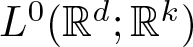 $L^0({{\mathbb R}}^d;{{\mathbb R}}^k)$, we deduce that
 \begin{equation*}
E(su,A)\leqslant\liminf_{n\to+\infty}E_n(su_n,A),
\end{equation*}
which, by the monotonicity of Φ, implies  $\displaystyle
\Phi(E(su,A))\leqslant\liminf_{n\to+\infty}\Phi(E_n(su_n,A)).$ Recalling the definition of Φ, from this inequality and (6.15) we obtain (6.13), concluding the proof.
The next technical results will be used in the proof of the representation theorem presented in Section 7. Given  $\xi\in{\mathbb R}^{k\times d}$ and
 $m\in{\mathbb N}$, we set
 \begin{equation}
\kappa_{\xi,m}:=2c_{\xi,m}+2d^{1/2}|\xi|,\\
\end{equation}
where  $c_{\xi,m}$ is the constant defined by (5.9).
Lemma 6.12. For every  $\xi\in{\mathbb R}^{k\times d}$ there exists a constant Mξ, depending only on
 $|\xi|$ and on the structural constants
 $c_1,...,c_7$,k, and α, such that for every
 $m\in{\mathbb N}$ and
 $E\in \mathfrak{E}^{\alpha,\vartheta_m}\cap \mathfrak{E}_{\rm sc}$ there exists a set
 $N_m\in\mathcal{B}({{\mathbb R}}^d),$ with
 ${\mathcal{L}}^d(N_m)=0$, satisfying the following property: for every
 $x\in{{\mathbb R}}^d\setminus N_m$,
 $\lambda\geqslant 1$,
 $\nu\in\mathbb{S}^{d-1}$,
 $s, t \gt 0$, and
 $\xi\in{\mathbb R}^{k\times d}$ there exist
 $\rho^{\nu,\lambda}_{m,\xi,t,s}(x) \gt 0$ such that for every
 $\rho\in(0,\rho^{\nu,\lambda}_{m,\xi,t,s}(x))$, we have
 \begin{eqnarray*}
\nonumber
&& \Big|\frac{m^{E}(s\ell_\xi,Q^\lambda_\nu(x,\rho))}{s}-\frac{m^{E}(t\ell_\xi,Q^\lambda_\nu(x,\rho))}{t}\Big|
\end{eqnarray*}
 \begin{eqnarray*}
&&\nonumber \,\,\leqslant\frac{c_7}{s}\lambda^{\alpha(d-1)}\rho^{d\alpha}m^E(s\ell_\xi,Q^\lambda_\nu(x,\rho))^{1-\alpha}+\vartheta_{m}\!\Big(\frac{s\kappa_{\xi,m}\lambda\rho}{(s\land 1)(t\land 1)}\Big)\frac{m^E(s\ell_\xi,Q^\lambda_\nu(x,\rho))}{s}
\end{eqnarray*}
 \begin{eqnarray*}
&&\nonumber \quad +\frac{c_7}{t}\lambda^{\alpha(d-1)}\rho^{d\alpha}m^E(t\ell_\xi,Q^\lambda_\nu(x,\rho))^{1-\alpha}+\vartheta_{m}\!\Big( \frac{t\kappa_{\xi,m}\lambda\rho}{(s\land 1)(t\land 1)}\Big)\frac{m^E(t\ell_\xi,Q^\lambda_\nu(x,\rho))}{t}
\end{eqnarray*}
 \begin{eqnarray*}
&&\!\!\!\!\nonumber
+\frac{c_7}{s}\lambda^{d-1}\rho^d+\Big(1+\vartheta_m\!\Big(\frac{s\kappa_{\xi,m}\lambda\rho}{(s\land 1)(t\land 1)}\Big)\Big)\frac{M_\xi}{(s\land 1)m}\lambda^{d-1}\rho^d
\nonumber +\Big(\frac{1}{s^\alpha}{+}\frac{1}{s }\Big)\frac{M_\xi}{m^{1-\alpha}}\lambda^{d-1}\rho^{d}
\end{eqnarray*}
 \begin{eqnarray*}
&&\!\!\!\!\nonumber+ \frac{c_7}{t}\lambda^{d-1}\rho^d+\Big(1+\vartheta_m\!\Big(\frac{t\kappa_{\xi,m}\lambda\rho}{(s\land 1)(t\land 1)}\Big)\Big)\frac{M_\xi}{(t\land 1)m}\lambda^{d-1}\rho^d
+\Big(\frac{1}{t^\alpha}{+}\frac{1}{t }\Big)\frac{M_\xi}{m^{1-\alpha}}\lambda^{d-1}\rho^{d},
\end{eqnarray*}
where  $\kappa_{\xi,m}$ is the constant defined by (6.16). If, in addition the function f defined by (5.6) does not depend on x, we have
 $N_m=\emptyset$ and
 $\rho^{\nu,\lambda}_{m,\xi,t,s}(x)=+\infty$.
Proof. By hypothesis  $E\in\mathfrak{E}_{\rm sc}$, so that by Theorem 5.16, the function f defined by (5.6) satisfies (5.10) for every
 $A\in\mathcal{A}_c({{\mathbb R}}^d)$ and
 $u\in BV(A;{{\mathbb R}}^k)$. Hence, we may apply Corollary 5.10 to obtain a set
 $N_m\in\mathcal{B}({{\mathbb R}}^d)$, with
 ${\mathcal{L}}^d(N_m)=0$, satisfying the following property: for every
 $x\in {{\mathbb R}}^d\setminus N_m$,
 $\xi\in{\mathbb R}^{k\times d}$, t > 0,
 $\nu\in{\mathbb S}^{d-1}$, and
 $\lambda\geqslant 1$ there exists
 $\rho^{\nu,\lambda}_{m,t\xi}(x)$ such that for every
 $\rho\in(0,\rho^{\nu,\lambda}_{m,t \xi}(x))$, there exists
 $u\in BV(Q^\lambda_\nu(x,\rho);{{\mathbb R}}^k)\cap L^\infty(Q^\lambda_\nu(x,\rho);{{\mathbb R}}^k)$, with tr
 $_{Q^\lambda_\nu(x,\rho)}u=$tr
 $_{Q^\lambda_\nu(x,\rho)}\ell_{\xi}$ and
 $\|u-\ell_{\xi}\|_{L^\infty(Q^\lambda_\nu(x,\rho);{{\mathbb R}}^k)}\leqslant \frac1tc_{t\xi,m}\lambda\rho\leqslant \frac{1}{t\land 1}c_{\xi,m}\lambda \rho$, such that
 \begin{align*}
\nonumber
E(tu,Q^\lambda_\nu(x,\rho))&\leqslant m^E(t\ell_{\xi},Q^\lambda_\nu(x,\rho))+\frac{C_{t\xi}}{m}\lambda^{d-1}\rho^d
\end{align*}
 \begin{align}
&\leqslant m^E(t\ell_{\xi},Q^\lambda_\nu(x,\rho))+\frac{(t\lor 1)C_{\xi}}{m}\lambda^{d-1}\rho^d ,
\end{align}
where Cξ is defined by (5.21). Note that the oscillation of u satisfies
 \begin{equation}
u^{Q^\lambda_\nu(x,\rho)}\leqslant \big(\frac{2}{t\land 1}c_{\xi,m}+\frac{2}{t\land 1}d^{1/2}|\xi|\big)\lambda\rho=\frac{\kappa_{\xi,m}}{t\land 1}\lambda\rho.
\end{equation}
We can estimate  $m^E(t\ell_{\xi},Q^\lambda_\nu(x,\rho))$ by evaluating
 $E(\cdot,Q^\lambda_\nu(x,\rho))$ at
 $t\ell_{\xi}$. Recalling (6.17) and (c2
 $'$) of Definition 3.8, this leads to
 \begin{equation}
E(tu,Q^\lambda_\nu(x,\rho))\leqslant \big(c_3k^{1/2}t|\xi|+c_4+(t\lor 1)C_\xi\big)\lambda^{d-1}\rho^d.
\end{equation}
Since  $E\in\mathfrak{E}^{\alpha,\vartheta_m}_m$, by Definition 6.10 for every s > 0, we have that
 \begin{eqnarray*}
&& \nonumber (1-\vartheta_m(su^{Q^\lambda_\nu(x,\rho)}))\frac{E(su,Q^\lambda_\nu(x,\rho))}{s}-\frac{c_7}{s}(\lambda^{d-1}\rho^d)^{\alpha} E(su,Q^\lambda_\nu(x,\rho))^{1-\alpha}
\end{eqnarray*}
 \begin{eqnarray*}
&& \qquad-\frac{c_7}{s}\lambda^{d-1}\rho^d -R_{m,s}(u,Q^\lambda_\nu(x,\rho))
\end{eqnarray*}
 \begin{eqnarray*}
&& \nonumber \leqslant (1+\vartheta_m(tu^{Q^\lambda_\nu(x,\rho)}))\frac{E(tu,Q^\lambda_\nu(x,\rho))}{t} +\frac{c_7}{t}(\lambda^{d-1}\rho^d)^{\alpha} E(tu,Q^\lambda_\nu(x,\rho))^{1-\alpha}
\end{eqnarray*}
 \begin{eqnarray}
&& \qquad +\frac{c_7}{t}\lambda^{d-1}\rho^d
+R_{m,t}(u,Q^\lambda_\nu(x,\rho)),
\end{eqnarray}
where R is defined by (6.12). Using the monotonicity of ϑm, (6.17), (6.18), (6.19), and the subadditivity of the function  $z\mapsto z^{1-\alpha}$ on
 $[0,+\infty)$ we see that the left-hand side of (6.20) can be bounded from below by
 \begin{eqnarray*}
&& \nonumber \Big(1-\vartheta_{m}\!\Big(\frac{s\kappa_{\xi,m}\lambda\rho}{t\land 1}\Big)\Big)\frac{E(su,Q^\lambda_\nu(x,\rho))}{s}-\frac{c_7}{s}\lambda^{\alpha(d-1)}\rho^{\alpha d} E(su,Q^\lambda_\nu(x,\rho))^{1-\alpha}
\end{eqnarray*}
 \begin{eqnarray*}
&&\nonumber-\frac{c_7}{s}\lambda^{d-1}\rho^d
-C\Big(1+\vartheta_m\!\Big(\frac{s\kappa_{\xi,m}\lambda\rho}{t\land 1}\Big)\Big)\frac{E(su,Q^\lambda_\nu(x,\rho))+\lambda^{d-1}\rho^d}{sm}
\end{eqnarray*}
 \begin{eqnarray}
&&-C^\alpha\frac{c_7}{s}\frac{E(su,Q^\lambda_\nu(x,\rho))^{1-\alpha}\lambda^{\alpha(d-1)}\rho^{\alpha d}+\lambda^{d-1}\rho^d}{m^{1-\alpha}},
\end{eqnarray}
while the right-hand side of (6.20) can be bounded from above by
 \begin{eqnarray*}
&& \nonumber \Big(1+\vartheta_m\!\Big(\frac{t\kappa_{\xi,m}\lambda\rho}{t\land 1}\Big)\Big)\frac{m^E(t\ell_{\xi},Q^\lambda_\nu(x,\rho))}{t} +\frac{c_7}{t} m^E(t\ell_{\xi},Q^\lambda_\nu(x,\rho))^{1-\alpha}\lambda^{\alpha(d-1)}\rho^{\alpha d}
\end{eqnarray*}
 \begin{eqnarray*}
&&\nonumber +\frac{c_7}{t}\lambda^{d-1}\rho^d+\Big(1+\vartheta_m\!\Big(\frac{t\kappa_{\xi,m}\lambda\rho}{t\land 1}\Big)\Big)\frac{C(c_3k^{1/2}|\xi|+c_4+C_\xi+1)+C_\xi}{(t\land 1)m}\lambda^{d-1}\rho^d
\end{eqnarray*}
 \begin{eqnarray}
&&+\Big(C^\alpha\frac{c_7}{t^\alpha}+\frac{c_7}{t }\Big)\frac{\big(c_3k^{1/2}|\xi|+c_4+C_\xi\big)^{1-\alpha}+1+C_\xi^{1-\alpha}}{m^{1-\alpha}}\lambda^{d-1}\rho^{d}.
\end{eqnarray}
Therefore, by (6.20)-(6.22) there exists a constant Mξ, independent of m, such that
 \begin{eqnarray*}
&&\nonumber \Big(1{-}\vartheta_{m}\!\Big(\frac{s\kappa_{\xi,m}\lambda\rho}{t\land 1}\Big)\Big)\frac{E(su,Q^\lambda_\nu(x,\rho))}{s}-\frac{c_7}{s}\lambda^{\alpha(d-1)}\rho^{\alpha d} E(su,Q^\lambda_\nu(x,\rho))^{1-\alpha}
\end{eqnarray*}
 \begin{eqnarray*}
&&-\frac{c_7}{s}\lambda^{d-1}\rho^d \nonumber
-C\Big(1{+}\vartheta_m\!\Big(\frac{s\kappa_{\xi,m}\lambda\rho}{t\land 1}\Big)\Big)\frac{E(su,Q^\lambda_\nu(x,\rho)){+}\lambda^{d-1}\rho^d}{sm}
\end{eqnarray*}
 \begin{eqnarray*}
&&\nonumber -C^\alpha\frac{c_7}{s}\frac{E(su,Q^\lambda_\nu(x,\rho))^{1-\alpha}\lambda^{\alpha(d-1)}\rho^{\alpha d}{+}\lambda^{d-1}\rho^d}{m^{1-\alpha}}
\end{eqnarray*}
 \begin{align}
&\leqslant \nonumber \Big(1{+}\vartheta_m\!\Big(\frac{t\kappa_{\xi,m}\lambda\rho}{t\land 1}\Big)\Big)\frac{m^E(t\ell_{\xi},Q^\lambda_\nu(x,\rho))}{t} +\frac{c_7}{t} m^E(t\ell_{\xi},Q^\lambda_\nu(x,\rho))^{1-\alpha}\lambda^{\alpha(d-1)}\rho^{\alpha d}\nonumber\\
& \quad \!\!+\frac{c_7}{t}\lambda^{d-1}\rho^d{+}\Big(1{+}\vartheta_m\!\Big(\frac{t\kappa_{\xi,m}\lambda\rho}{t\land 1}\Big)\!\Big)\frac{M_\xi}{(t\land 1)m}\lambda^{d-1}\rho^d
+\Big(\frac{1}{t^\alpha}{+}\frac{1}{t }\Big)\frac{M_\xi}{m^{1-\alpha}}\lambda^{d-1}\rho^{d}.
\end{align}
We claim that the previous inequality still holds replacing  $E(su,Q^\lambda_\nu(x,\rho))$ by
 $m^E(s\ell_\xi,Q^\lambda_\nu(x,\rho))$. To prove the claim, for given
 $s,t \gt 0$ we introduce the function Φ defined for every
 $z\in[0,+\infty)$ as
 \begin{multline*}
\Phi(z):=\Big(1-\vartheta_m\!\Big(\frac{s\kappa_{\xi,m}\lambda\rho}{t\land 1}\Big)\Big)\frac{z}{s}-\frac{c_7}{s}\lambda^{\alpha(d-1)}\rho^{\alpha d}z^{1-\alpha
}-\frac{c_7}{s}\lambda^{d-1}\rho^d\\
-C\Big(1+\vartheta_m\!\Big(\frac{s\kappa_{\xi,m}\lambda}{t\land 1}\rho\Big)\Big)\frac{z+\lambda^{d-1}\rho^d}{sm}
-C^\alpha\frac{c_7}{s}\frac{z^{1-\alpha}\lambda^{\alpha(d-1)}\rho^{\alpha d}+\lambda^{d-1}\rho^d}{m^{1-\alpha}},
\end{multline*}
so that the left-hand side of (6.23) is equal to  $\Phi(E(su,Q^\lambda_\nu(x,\rho))$ and our claim is that the number
 $\Phi(m^{E}(s\ell_{\xi},Q^{\lambda}_\nu(x,\rho)))$ is less than or equal to the right-hand side of (6.23). Since this right-hand side is larger than or equal to zero, the claim is trivial when
 $\Phi(m^{E}(s\ell_{\xi},Q^{\lambda}_\nu(x,\rho)))\leqslant 0$. Therefore, to prove the claim, we may assume
 $\Phi(m^{E}(s\ell_{\xi},Q^{\lambda}_\nu(x,\rho))) \gt 0.$ Note that this positivity condition implies that
 $1-\vartheta_m(\frac{s\kappa_{\xi,m}\lambda\rho}{t\land 1}) \gt 0$. To prove the claim, we show that
 \begin{equation}
\Phi(m^{E}(s\ell_{\xi},Q^{\lambda}_\nu(x,\rho)))\leqslant \Phi(E(su,Q^{\lambda}_\nu(x,\rho))),
\end{equation}
assuming that  $\Phi(m^{E}(s\ell_{\xi},Q^{\lambda}_\nu(x,\rho))) \gt 0.$ Some straightforward computations, show that if
 $\Phi(z) \gt 0$ then
 $z \gt z_0$, where z 0 is defined by
 \begin{equation*}
c_7^{1/\alpha}\Big((1-\vartheta_m\!\Big(\frac{s\kappa_{\xi,m}\lambda\rho}{t\land 1}\Big)\Big)-\Big(\Big(1+\vartheta_m\!(\frac{s\kappa_{\xi,m}\lambda\rho}{t\land 1}\Big)\Big)\frac{C}{m}\Big)^{-\tfrac{1}{\alpha}}\Big(1+\frac{C^\alpha}{m^{1-\alpha}}\Big)^{\tfrac{1}{\alpha}}\lambda^{d-1}\rho^d.
\end{equation*}
One can also see that Φ is increasing on  $(z_0,+\infty)$. Since
 $\text{tr}_{Q^{\lambda}_\nu(x,\rho)}su=\text{tr}_{Q^{\lambda}_\nu(x,\rho)}s\ell_\xi$, we obtain that
 \begin{equation}
m^{E}(s\ell_{\xi},Q^{\lambda}_\nu(x,\rho)))\leqslant E(su,Q^{\lambda}_\nu(x,\rho)).
\end{equation}
Since we assumed that  $\Phi(m^{E}(s\ell_{\xi},Q^{\lambda}_\nu(x,\rho))) \gt 0$, we have
 $m^{E}(s\ell_{\xi},Q^{\lambda}_\nu(x,\rho)) \gt z_0$. Hence, recalling that Φ is increasing on
 $(z_0,+\infty)$, from (6.25) we obtain that (6.24). Thus, in (6.21) we can substitute
 $E(su,Q^\lambda_\nu(x,\rho))$ by
 $m^E(s\ell_\xi,Q^\lambda_\nu(x,\rho))$. This new inequality, together with
 \begin{equation*}
\frac{m^{E}(s\ell_{\xi},Q^{\lambda}_\nu(x,\rho))}{s}\leqslant \frac{c_3k^{1/2}|\xi|+c_4}{s\land 1}\lambda^{d-1}\rho^d,
\end{equation*}
implies that
 \begin{eqnarray*}
&& \nonumber \Big(1-\vartheta_{m}\!\Big(\frac{s\kappa_{\xi,m}\lambda\rho}{t\land 1}\Big)\Big)\frac{m^E(s\ell_\xi,Q^\lambda_\nu(x,\rho))}{s}-\frac{c_7}{s}\lambda^{\alpha(d-1)}\rho^{\alpha d} m^E(s\ell_\xi,Q^\lambda_\nu(x,\rho))^{1-\alpha}
\end{eqnarray*}
 \begin{eqnarray*}
&&-\frac{c_7}{s}\lambda^{d-1}\rho^d
\nonumber
-\Big(1+\vartheta_m\!\Big(\frac{s\kappa_{\xi,m}\lambda\rho}{t\land 1}\Big)\Big)\frac{M_\xi}{(s\land 1)m}\lambda^{d-1}\rho^d
-\frac{1}{s}\frac{M_\xi}{m^{1-\alpha}}\lambda^{d-1}\rho^d
\end{eqnarray*}
 \begin{eqnarray*}
&&\leqslant \nonumber \Big(1+\vartheta_m\!\Big(\frac{t\kappa_{\xi,m}\lambda\rho}{t\land 1}\Big)\Big)\frac{m^E(t\ell_{\xi},Q^\lambda_\nu(x,\rho))}{t} +\frac{c_7}{t} m^E(t\ell_{\xi},Q^\lambda_\nu(x,\rho))^{1-\alpha}\lambda^{\alpha(d-1)}\rho^{\alpha d}
\end{eqnarray*}
 \begin{eqnarray*}
&&+\frac{c_7}{t}\lambda^{d-1}\rho^d+\Big(1+\vartheta_m\!\Big(\frac{t\kappa_{\xi,m}\lambda\rho}{t\land 1}\Big)\Big)\frac{M_\xi}{(t\land 1)m}\lambda^{d-1}\rho^d
\nonumber +\Big(\frac{1}{t^\alpha}+\frac{1}{t }\Big)\frac{M_\xi}{m^{1-\alpha}}\lambda^{d-1}\rho^{d}.
\end{eqnarray*}
Exchanging the roles of s and t, this gives the inequality in the statement of the lemma.
If, in addition, the function f defined by (5.6) does not depend on x, then in Corollary 5.10, we have  $N_m=\emptyset$ and
 $\rho^{\nu,\lambda}_{m,t\xi}(x)=\rho^{\nu,\lambda}_{m,s\xi}(x)=+\infty $, concluding the proof in this case.
The following lemma deals with the case with boundary conditions related to the jump functions  $u_{x,\zeta,\nu}$.
Lemma 6.13. There exists a positive constant M > 0, depending only on the structural constants  $c_1,...,c_7$, k, and on α, such that for every
 $m\in{\mathbb N}$,
 $E\in\mathfrak{E}^{\alpha,\vartheta_m}_m\cap\mathfrak{E}_{\rm sc}$,
 $x\in{{\mathbb R}}^d$,
 $\zeta\in{{\mathbb R}}^k$,
 $\nu\in\mathbb{S}^{d-1}$,
 $s,t \gt 0$, and ρ > 0, we have
 \begin{eqnarray*}
&& \nonumber \Big|\frac{m^{E}(su_{x,\zeta,\nu},Q_\nu(x,\rho))}{s}-\frac{m^{E}(tu_{x,\zeta,\nu},Q_\nu(x,\rho))}{t}\Big|
\end{eqnarray*}
 \begin{align}
& \leqslant\frac{c_7}{s}\rho^{d\alpha}m^E(su_{x,\zeta,\nu},Q_\nu(x,\rho))^{1-\alpha}
+\vartheta_{2m}(s|\zeta|)\frac{m^E(su_{x,\zeta,\nu},Q_\nu(x,\rho))}{s}+\frac{c_7}{s}\rho^d\nonumber\\
& +\frac{c_7}{t}\rho^{d\alpha}m^E(tu_{x,\zeta,\nu},Q_\nu(x,\rho))^{1-\alpha}
+\vartheta_{2m}(t|\zeta|)\frac{m^E(tu_{x,\zeta,\nu},Q_\nu(x,\rho))}{t}+\frac{c_7}{t}\rho^d\nonumber\\
& +(1+\vartheta_{2m}(s|\zeta|))\Big(\frac{M|\zeta|}{m}\rho^{d-1}+\frac{M}{sm}\rho^d\Big)+\frac{1}{s^{\alpha}}\frac{M|\zeta|^{1-\alpha}}{m^{1-\alpha}}\rho^{d-1+\alpha}+\frac{1}{s}\frac{M}{m^{1-\alpha}}\rho^d\nonumber\\
& +(1+\vartheta_{2m}(t|\zeta|))\Big(\frac{M|\zeta|}{m}\rho^{d-1}{+}\frac{M}{tm}\rho^d\Big)+\frac{1}{t^{\alpha}}\frac{M|\zeta|^{1-\alpha}}{m^{1-\alpha}}\rho^{d-1+\alpha}{+}\frac{1}{t}\frac{M}{m^{1-\alpha}}\rho^d.
\end{align}
Proof. By Lemma 5.12 for every  $x\in{{\mathbb R}}^d$,
 $\zeta\in{{\mathbb R}}^k$, t > 0,
 $\nu\in{\mathbb S}^{d-1}$, and ρ > 0 there exists a function
 $u\in BV(Q_\nu(x,\rho);{{\mathbb R}}^k)\cap L^\infty(Q_\nu(x,\rho);{{\mathbb R}}^k)$ such that
 $\text{tr}_{Q_\nu(x,\rho)}u=\text{tr}_{Q_\nu(x,\rho)}u_{x,\zeta,\nu}$,
 $\|u\|_{L^\infty(Q_\nu(x,\rho);{{\mathbb R}}^k)}\leqslant\sigma^m|\zeta|$, and
 \begin{equation}
E(tu, Q_\nu(x,\rho))\leqslant m^{E}(tu_{x,\zeta,\nu},Q_\nu(x,\rho))+\frac{t K|\zeta|}{m}\rho^{d-1}+K\rho^d,
\end{equation}
where K > 0 is the constant in Lemma 5.12. Note that the oscillation of u satisfies  $u^{Q_\nu(x,\rho)}\leqslant 2\sigma^m|\zeta|$. We now estimate
 $m^{E}(tu_{x,\zeta,\nu},Q_\nu(x,\rho))$ by evaluating
 $E(\cdot,Q_\nu(x,\rho))$ at
 $tu_{x,\zeta,\nu}$ and by (c2) we get
 \begin{equation*}
m^{E}(tu_{x,\zeta,\nu},Q_\nu(x,\rho))\leqslant c_3kt|\zeta|\rho^{d-1}+c_4\rho^d,
\end{equation*}
so that from (6.27) we deduce
 \begin{equation}
E(tu, Q_\nu(x,\rho))\leqslant t|\zeta|\Big(c_3k+\frac{K}{m}\Big)\rho^{d-1}+(c_4+K)\rho^d.
\end{equation}
Since  $E\in\mathfrak{E}^{\alpha,\vartheta_m}_m$, by Definition 6.10 for every s > 0, we have that
 \begin{gather*}
\nonumber
(1-\vartheta_m(su^{Q_\nu(x,\rho)}))\frac{E(su,Q_\nu(x,\rho))}{s}-\frac{c_7}{s}\rho^{\alpha d} E(su,Q_\nu(x,\rho))^{1-\alpha}
\end{gather*}
 \begin{gather*}
\nonumber-\frac{c_7}{s}\rho^d
-R_{m,s}(u,Q_\nu(x,\rho))
\leqslant (1+\vartheta_m(tu^{Q_\nu(x,\rho)}))\frac{E(tu,Q_\nu(x,\rho))}{t}
\end{gather*}
 \begin{gather} +\frac{c_7}{t}\rho^{\alpha d}E(tu,Q_\nu(x,\rho))^{1-\alpha}+\frac{c_7}{t}\rho^d+R_{m,t}(u,Q_\nu(x,\rho)).
\end{gather}
Using the inequality  $u^{Q_\nu(x,\rho)}\leqslant 2\sigma^m|\zeta|$, the monotonicity of ϑm, and the subadditivity of
 $z\mapsto z^{1-\alpha}$, we deduce that the left-hand side of the last inequality can be estimated from below by
 \begin{eqnarray*}
&& \nonumber (1-\vartheta_{2m}(s|\zeta|))\frac{E(su,Q^\lambda_\nu(x,\rho))}{s}-\frac{c_7}{s}\rho^{\alpha d} E(su,Q_\nu(x,\rho))^{1-\alpha} -\frac{c_7}{s}\rho^d\\ && \nonumber
\end{eqnarray*}
 \begin{eqnarray*}
-C(1+\vartheta_{2m}(s|\zeta|))\frac{E(su,Q_\nu(x,\rho))+\rho^d}{sm}
-C^\alpha\frac{c_7}{s}\frac{E(su,Q_\nu(x,\rho))^{1-\alpha}\rho^{\alpha d}+\rho^d}{m^{1-\alpha}}.
\end{eqnarray*}
Moreover, we see that there exists a positive constant M > 0, depending only on the structural constants  $c_1,...,c_7$, k, and on α, such that the right-hand side of (6.29) can be bounded from above by
 \begin{multline*}
(1+\vartheta_{2m} (t|\zeta|))\frac{m^E(tu_{x,\zeta,\nu},Q_\nu(x,\rho))}{t}
+\frac{c_7}{t}m^E(tu_{x,\zeta,\nu},Q_\nu(x,\rho))^{1-\alpha}\rho^{\alpha d}+\frac{c_7}{t}\rho^{d}\\
+(1{+}\vartheta_{2m}(t|\zeta|))\frac{M|\zeta|}{m}\rho^{d-1}{+}\frac{(1{+}\vartheta_{2m}(t|\zeta|))}{t}\frac{M}{m}\rho^d{+}
\frac{1}{t^\alpha}\frac{{M|\zeta|^{1-\alpha}}}{m^{1-\alpha}}\rho^{d-1+\alpha}{+}\frac{1}{t}\frac{M}{m^{1-\alpha}}\rho^d,
\end{multline*}
so that, combining the previous two inequalities, we obtain
 \begin{eqnarray*}
&& \nonumber (1-\vartheta_{2m}(s|\zeta|))\frac{E(su,Q_\nu(x,\rho))}{s}-\frac{c_7}{s}\rho^{\alpha d} E(su,Q_\nu(x,\rho))^{1-\alpha} -\frac{c_7}{s}\rho^d \\ && \nonumber
-C(1+\vartheta_{2m}(s|\zeta|))\frac{E(su,Q_\nu(x,\rho))+\rho^d}{sm}
-C^\alpha\frac{c_7}{s}\frac{E(su,Q_\nu(x,\rho))^{1-\alpha}\rho^{\alpha d}+\rho^d}{m^{1-\alpha}}\\
&&\leqslant (1+\vartheta_{2m} (t|\zeta|))\frac{m^E(tu_{x,\zeta,\nu},Q_\nu(x,\rho))}{t}
+\frac{c_7}{t}m^E(tu_{x,\zeta,\nu},Q_\nu(x,\rho))^{1-\alpha}\rho^{\alpha d}+\frac{c_7}{t}\rho^{d}\\ && \!\!
+(1{+}\vartheta_{2m}(t|\zeta|))\frac{M|\zeta|}{m}\rho^{d-1}{+}\frac{(1{+}\vartheta_{2m}(t|\zeta|))}{t}\frac{M}{m}\rho^d{+}
\frac{1}{t^\alpha}\frac{{M|\zeta|^{1-\alpha}}}{m^{1-\alpha}}\rho^{d-1+\alpha}{+}\frac{1}{t}\frac{M}{m^{1-\alpha}}\rho^d,
\end{eqnarray*}
Arguing as in the proof of Lemma 6.12 we may substitute  $E(su,Q_\nu(x,\rho))$ by
 $m^{E}(su_{x,\zeta,\nu},Q_\nu(x,\rho))$, so that, taking into account the estimate
 \begin{equation*}
m^{E}(su_{x,\zeta,\nu},Q_\nu(x,\rho))\leqslant c_3s|\zeta|\rho^{d-1}+c_4\rho^d,
\end{equation*}
we obtain
 \begin{eqnarray*}
&& (1+\vartheta_{2m} (s|\zeta|))\frac{m^E(su_{x,\zeta,\nu},Q_\nu(x,\rho))}{s}
+\frac{c_7}{s}m^E(su_{x,\zeta,\nu},Q_\nu(x,\rho))^{1-\alpha}\rho^{\alpha d}+\frac{c_7}{s}\rho^{d}\\ &&
{+}(1{+}\vartheta_{2m}(s|\zeta|))\frac{M|\zeta|}{m}\rho^{d-1}{+}\frac{(1{+}\vartheta_{2m}(s|\zeta|))}{s}\frac{M}{m}\rho^d{+}
\frac{1}{s^\alpha}\frac{{M|\zeta|^{1-\alpha}}}{m^{1-\alpha}}\rho^{d-1+\alpha}{+}\frac{1}{s}\frac{M}{m^{1-\alpha}}\rho^d\\
&&\leqslant (1+\vartheta_{2m} (t|\zeta|))\frac{m^E(tu_{x,\zeta,\nu},Q_\nu(x,\rho))}{t}
+\frac{c_7}{t}m^E(tu_{x,\zeta,\nu},Q_\nu(x,\rho))^{1-\alpha}\rho^{\alpha d}+\frac{c_7}{t}\rho^{d}\\ &&
{+}(1{+}\vartheta_{2m}(t|\zeta|))\frac{M|\zeta|}{m}\rho^{d-1}{+}\frac{(1{+}\vartheta_{2m}(t|\zeta|))}{t}\frac{M}{m}\rho^d{+}
\frac{1}{t^\alpha}\frac{{M|\zeta|^{1-\alpha}}}{m^{1-\alpha}}\rho^{d-1+\alpha}{+}\frac{1}{t}\frac{M}{m^{1-\alpha}}\rho^d.
\end{eqnarray*}
Exchanging the roles of  $s,t$, we obtain (6.26).
We now investigate the properties of the integrands f and g associated with functionals in  $\mathfrak{E}^{\alpha,\vartheta}_{w}$.
Proposition 6.14. Let  $E\in\mathfrak{E}^{\alpha,\vartheta}_{w}$. Then the function f defined by (5.6) belongs to
 $\mathcal{F}^\alpha$.
Proof. For every  $m\in{\mathbb N}$ let
 $N_m\in\mathcal{B}({{\mathbb R}}^d)$ be the
 ${\mathcal{L}}^d$-negligible set of Lemma 6.12 and let
 $N:=\bigcup_{m\in {\mathbb N}}N_m$. By the same lemma for every
 $x\in{{\mathbb R}}^d\setminus N$,
 $\xi\in{\mathbb R}^{k\times d}$,
 $m\in{\mathbb N}$,
 $s,t \gt 0$, and every ρ small enough, we have
 \begin{eqnarray*}
\nonumber
&& \Big|\frac{m^{E}(s\ell_\xi,Q(x,\rho))}{s}-\frac{m^{E}(t\ell_\xi,Q(x,\rho))}{t}\Big|
\end{eqnarray*}
 \begin{eqnarray*}
&&\nonumber \,\,\leqslant\frac{c_7}{s}\rho^{d\alpha}m^E(s\ell_\xi,Q(x,\rho))^{1-\alpha}+\vartheta_{m}\Big(\frac{s\kappa_{\xi,m}\rho}{(s\land 1)(t\land 1)}\Big)\frac{m^E(s\ell_\xi,Q(x,\rho))}{s}+\frac{c_7}{s}\rho^d
\end{eqnarray*}
 \begin{eqnarray*}
&&\nonumber \quad +\frac{c_7}{t}\rho^{d\alpha}m^E(t\ell_\xi,Q(x,\rho))^{1-\alpha}+\vartheta_{m}\Big( \frac{t\kappa_{\xi,m}\rho}{(s\land 1)(t\land 1)}\Big)\frac{m^E(t\ell_\xi,Q(x,\rho))}{t}+ \frac{c_7}{t}\rho^d
\end{eqnarray*}
 \begin{eqnarray*}
&&\nonumber \quad
+\Big(1+\vartheta_m\Big(\frac{s\kappa_{\xi,m}\rho}{(s\land 1)(t\land 1)}\Big)\Big)\frac{M_\xi}{(s\land 1)m}\rho^d
\nonumber +\Big(\frac{1}{s^\alpha}+\frac{1}{s }\Big)\frac{M_\xi}{m^{1-\alpha}}\rho^{d}
\end{eqnarray*}
 \begin{eqnarray}
&&\quad +\Big(1+\vartheta_m\Big(\frac{t\kappa_{\xi,m}\rho}{(s\land 1)(t\land 1)}\Big)\Big)\frac{M_\xi}{(t\land 1)m}\rho^d
+\Big(\frac{1}{t^\alpha}+\frac{1}{t }\Big)\frac{M_\xi}{m^{1-\alpha}}\rho^{d},
\end{eqnarray}
where  $\kappa_{\xi,m}$ is the constant defined by (6.16). Since ϑm is continuous and
 $\vartheta_m(0)=0$, we have that
 \begin{eqnarray*}
&\displaystyle \limsup_{\rho\to 0^+} \Big(\vartheta_m\Big(\frac{s\kappa\rho}{(s\land 1)(t\land 1)}\Big)\frac{m^E(s\ell_\xi,Q(x,\rho))}{s\rho^d}\Big)=0, \\
&\displaystyle
\limsup_{\rho\to 0^+} \Big(\vartheta_m\Big(\frac{t\kappa\rho}{(s\land 1)(t\land 1)}\Big)\frac{m^E(t\ell_\xi,Q(x,\rho))}{t\rho^d}\Big)=0.
\end{eqnarray*}
Therefore, dividing (6.30) by ρ d and taking the limsup as  $\rho\to 0^+$, we obtain
 \begin{eqnarray*}
\nonumber
\frac{f(x,s\xi)}{s}&\leqslant& \frac{f(x,t\xi)}{t} +\frac{c_7}{s}f(x,s\xi)^{1-\alpha}+ \frac{c_7}{s}+f(x,t\xi)^{1-\alpha}+\frac{c_7}{t}\\ && +
\frac{M_\xi}{(s\land 1)m}
\nonumber
\end{eqnarray*}
 \begin{eqnarray*}
+\Big(\frac{1}{s^\alpha}+\frac{1}{s }\Big)\frac{M_\xi}{m^{1-\alpha}}+
\frac{M_\xi}{(t\land 1)m}
+\Big(\frac{1}{t^\alpha}+\frac{1}{t }\Big)\frac{M_\xi}{m^{1-\alpha}}.
\end{eqnarray*}
Letting  $m\to+\infty$ and exchanging the roles of s and t, we recover (6.2), which concludes the proof.
Proposition 6.15. Let  $E\in\mathfrak{E}^{\alpha,\vartheta}_{w}$,
 $m\in{\mathbb N}$,
 $x\in{{\mathbb R}}^d$,
 $\zeta\in{{\mathbb R}}^k$,
 $\nu\in\mathbb{S}^{d-1}$, and
 $s,t \gt 0$. Then the function g defined by (5.7) satisfies
 \begin{eqnarray*}
\Big|\frac{g(x,s\zeta,\nu)}{s}-\frac{g(x,t\zeta,\nu)}{t}\Big|&\leqslant& \vartheta_{2m}(s|\zeta|)\frac{g(x,s\zeta,\nu)}{s}+\vartheta_{2m} (t|\zeta|)\frac{g(x,t\zeta,\nu)}{t}\\ &&+(2+\vartheta_{2m}(s|\zeta|)+\vartheta_{2m}(t|\zeta|))\frac{M|\zeta|}{m},
\end{eqnarray*}
where M > 0 is the constant of Lemma 6.13.
Proof. Thanks to Lemma 6.13, inequality (6.26) holds. Dividing this inequality by  $\rho^{d-1}$ and taking the limsup as
 $\rho\to 0^+$, we immediately get
 \begin{align*}
\nonumber \frac{g(x,s\zeta,\nu)}{s}
&\leqslant\frac{g(x,t\zeta,\nu)}{t}
+\vartheta_{2m}(s|\zeta|)\frac{g(x,s\zeta,\nu)}{s}+\vartheta_{2m}(t|\zeta|)\frac{g(x,s\zeta,\nu)}{t}\\
&\nonumber \quad +
(1+\vartheta_{2m}(s|\zeta|))\frac{M|\zeta|}{m}
+(1+\vartheta_{2m}(t|\zeta|))\frac{M|\zeta|}{m}.
\end{align*}
Exchanging the roles of s and t, we conclude the proof.
Remark 6.16. In the scalar case, due to the different nature of the required vertical truncations, it is possible to prove a stronger version of Propositions 6.11 and 6.15. First, the space  $\mathfrak{E}^{\alpha,\vartheta}$ turns out to be closed under Γ-convergence with respect to the topology of
 $L^0({{\mathbb R}}^d)$. Then, exploiting this stronger version of Proposition 6.11, it is shown that the function g associated to E by (5.7) belongs to
 $\mathcal{G}^{\vartheta}$.
However, due to the presence of error terms in the truncation procedure, which depend on ϑm, in the case k > 1 one cannot recover that  $\mathfrak{E}^{\alpha,\vartheta}$ is closed and subsequently conclude that
 $g\in\mathcal{G}^\vartheta$.
7. Full integral representation
We are finally ready to state and prove the full integral representation result for functionals in the class  $\mathfrak{E}^{\alpha,\vartheta}_{w}$. More precisely, we will show that if
 $E\in\mathfrak{E}^{\alpha,\vartheta}_{w}$ and if the bulk integrand f defined by (5.6) does not depend on x, then the Cantor part Ec of the functional E can be represented by means of
 $f^\infty$. Since this result will be employed to obtain an integral representation for functionals arising from homogenization of functionals in
 $\mathfrak{E}^{\alpha,\vartheta}$, the hypothesis that f does not depend on x is not restrictive for our purposes.
We now state the main result of this section for the functionals in the class  $\mathfrak{E}^{\alpha,\vartheta}_w$ introduced at the end of Definition 6.10.
Theorem 7.1. Let  $E\in\mathfrak{E}^{\alpha,\vartheta}_{w}$ and f and g be defined by (5.6) and by (5.7), respectively. Assume that there exists a function
 $\hat{f}\colon{\mathbb R}^{k\times d}\to [0,+\infty)$ such that
 \begin{equation}
f(x,\xi)=\hat{f}(\xi) \quad\text{for every }x\in{{\mathbb R}}^d\ \text{and for every }\xi\in{\mathbb R}^{k\times d}.
\end{equation}
Then  $E=E^{f,g}$, where
 $E^{f,g}$ is the functional introduced in Definition 3.7. In particular, for every
 $A\in\mathcal{A}_c({{\mathbb R}}^d)$, we have
 \begin{equation*}
E(u,B)=\int_{B}\hat{f}(\nabla u)\, dx+\int_{B}\hat{f}^\infty\Big(\frac{dD^cu}{d|D^cu|}\Big)\, d|D^cu|+\int_B g(x,[u],\nu_u)\, d{\mathcal H}^{d-1}
\end{equation*}
for every  $B\in \mathcal{B}(A)$ and
 $u\in GBV_\star(A;{{\mathbb R}}^k)$.
To prove this result, we try to characterize the Radon–Nikodým derivative of the measures  $E^c(u,\cdot)$ with respect to
 $|D^cu|$ for any
 $u\in GBV_\star(A;{{\mathbb R}}^k)$ with
 $A\in\mathcal{A}_c({{\mathbb R}}^d)$. This is done via a careful truncation procedure and taking advantage of the results of [Reference Bouchitté, Fonseca and Mascarenhas9]. We recall that given
 $A\in\mathcal{A}_c({{\mathbb R}}^d)$ and
 $u\in BV(A;{{\mathbb R}}^k)$, Alberti’s Rank-One Theorem (see [Reference Alberti2, Corollary 4.6] and [Reference Alberti, Csörnyei and Preiss3, Reference De Philippis and Rindler23, Reference Massaccesi and Vittone37]) ensures that for
 $|D^cu|$-a.e.
 $x\in A$ the matrix
 $dD^cu/d|D^cu|(x)$ has rank one, i.e., there exists two Borel functions
 $a_u\colon A\to{\mathbb S}^{k-1}$ and
 $\nu_u\colon A\to{\mathbb S}^{d-1}$ such that for
 $|D^cu|$-a.e.
 $x\in A$, we have
 \begin{equation}
\frac{dD^cu}{d|D^cu|}(x)=a_u\!(x)\otimes\nu_u\!(x).
\end{equation}
Lemma 7.2. Let  $E\in\mathfrak{E}_{\rm sc}$,
 $A\in\mathcal{A}_c({{\mathbb R}}^d)$, and
 $u\in BV(A;{{\mathbb R}}^k)$. Assume that there exists a function
 $\hat{f}\colon{\mathbb R}^{k\times d}\to[0,+\infty)$ satisfying (7.1). For
 $|D^cu|$-a.e.
 $x\in{{\mathbb R}}^d$, for every
 $\lambda\geqslant 1$, and ρ > 0 we set
 \begin{equation}
s_\rho^\lambda(x):=\frac{|D^cu|(Q^\lambda_{\nu_u\!(x)}(x,\rho))}{\lambda^{d-1}\rho^d}\quad\text{and } \quad \xi_\rho^\lambda(x):=s^\lambda_\rho(x)(a_u\!(x)\otimes\nu_u\!(x)),
\end{equation}
where  $(a_u(x),\nu_u(x))\in {\mathbb S}^{k-1}\times \mathbb{S}^{d-1}$ is given by (7.2). Then
 \begin{eqnarray}
&\displaystyle \lim_{\rho\to +\infty}s_\rho^\lambda(x)=+\infty\quad\text{and } \quad\lim_{\rho\to+\infty} \rho s_\rho^\lambda(x)=0\,\,\, \ \text{for every}\ \lambda\geqslant 1,
\end{eqnarray}
 \begin{eqnarray}
& \displaystyle\frac{dE^c(u,\cdot)}{d|D^cu|}(x)=\lim_{\lambda\to+\infty}\limsup_ {\rho\to 0^+}\frac{m^{E}( \ell_{\xi^\lambda_\rho(x)},Q^\lambda_{\nu_u\!(x)}(x,\rho))}{\lambda^{d-1}\rho^ds_{\rho}^\lambda(x)},
\end{eqnarray}
for  $|D^cu|$-a.e.
 $x\in A$.
Proof. Let us fix δ > 0 and consider the function Eδ defined by (5.3). It is shown in [Reference Bouchitté, Fonseca and Mascarenhas9, Lemma 3.7] that (7.4) holds true for  $|D^cu|$-a.e.
 $x\in A$ and that for δ > 0 one has
 \begin{equation*}
\frac{dE^c(u,\cdot)}{d|D^cu|}(x)+\delta=\frac{dE^c_\delta(u,\cdot)}{d|D^cu|}(x)=\lim_{\lambda\to+\infty}\limsup_{\rho\to 0^+}\frac{m^{E_\delta}(\ell_{\xi^\lambda_\rho(x)},Q^\lambda_{\nu_u\!(x)}(x,\rho))}{\lambda^{d-1}\rho^ds_\rho^\lambda(x)}.
\end{equation*}
Since  $E\leqslant E_\delta$, we deduce that
 \begin{equation*}
\frac{dE^c(u,\cdot)}{d|D^cu|}(x)+\delta\geqslant \limsup_{\lambda\to+\infty}\limsup_{\rho\to 0^+}\frac{m^{E}(\ell_{\xi^\lambda_\rho(x)},Q^\lambda_{\nu_u\!(x)}(x,\rho))}{\lambda^{d-1}\rho^ds_\rho^\lambda(x)}.
\end{equation*}
Thus, it is enough to show that there exists a constant K > 0, depending only on  $c_1,...,c_4$ and on k, such that for every
 $\lambda \geqslant 1$, for every δ > 0, and for
 $|D^cu|$-a.e.
 $x\in A$, we have
 \begin{equation}
\limsup_{\rho\to 0^+}\frac{m^{E_\delta}(\ell_{\xi^\lambda_\rho(x)},Q^\lambda_{\nu_u\!(x)}\!(x,\rho))}{\lambda^{d-1}\rho^ds_\rho^\lambda(x)}\leqslant (1+K\delta)\limsup_{\rho\to 0^+}\frac{m^E(\ell_{\xi^\lambda_\rho(x)},Q^\lambda_{\nu_u\!(x)}\!(x,\rho))}{\lambda^{d-1}\rho^ds_\rho^\lambda(x)}.
\end{equation}
We fix  $m\in{\mathbb N}$,
 $\lambda\geqslant 1$, and consider a point
 $x\in A$ such that (7.2) and (7.4) hold. By Theorem 5.16 hypothesis (5.10) of Corollary 5.10 is satisfied. Thus, there exists a function
 $u_\rho^{x}\in BV(Q^\lambda_{\nu_u\!(x)}(x,\rho);{{\mathbb R}}^k)$, with
 $\text{tr}_{Q_{\nu_u\!(x)}^\lambda(x,\rho)}u^x_\rho=\text{tr}_{Q_{\nu_u\!(x)}^\lambda(x,\rho)}\ell_{\xi^\lambda_\rho(x)}$ and
 $\|u^x_\rho-\ell_{\xi^\lambda_\rho(x)}\|_{L^\infty(Q^\lambda_{\nu_u\!(x)}(x,\rho);{{\mathbb R}}^k)}\leqslant c_{\xi^\lambda_\rho(x),m}\lambda\rho$, such that
 \begin{equation}
E(u^{x}_\rho,Q^\lambda_{\nu_{u}\!(x)}(x,\rho))\leqslant m^{E}(\ell_{\xi^\lambda_\rho(x)},Q^\lambda_{\nu_u\!(x)}(x,\rho))+\frac{C_{\xi^\lambda_\rho(x)}}{m}\lambda^{d-1}\rho^d,
\end{equation}
where  $c_{\xi^\lambda_\rho(x),m}$ and
 $C_{\xi^\lambda_\rho(x)}$ are the positive constants defined by (5.9) and (5.21), respectively. Recalling that
 $\|u^x_\rho-\ell_{\xi^\lambda_\rho(x)}\|\leqslant c_{\xi^\lambda_\rho(x),m}\lambda\rho$ and observing that
 $|[u^x_\rho]|=|[u^x_\rho-\ell_{\xi^\lambda_\rho(x)}]|$, we deduce that
 $|[u^x_\rho]|\leqslant 2c_{\xi^\lambda_\rho(x),m}\lambda\rho$. Therefore, we may estimate
 \begin{eqnarray*}
\int_{J_{u_{\rho}^x}}|[u^x_\rho]|\,d{\mathcal H}^{d-1}&\leqslant& \int_{(J_{u^x_{\rho}}\setminus J_{u_{\rho}^x}^1)}|[u^x_\rho]|\,d{\mathcal H}^{d-1}
+2c_{\xi^\lambda_\rho(x),m}\lambda\rho{\mathcal H}^{d-1}(J_{u_\rho^x}^1)\\
&\leqslant &(1+2c_{\xi^\lambda_\rho(x),m}\lambda\rho) \int_{J_{u_{\rho}^x}}|[u^x_\rho]|\land 1\,d{\mathcal H}^{d-1}.
\end{eqnarray*}
From this inequality, by (c1 $'$) and (c2
 $'$) of Definition 3.8 we see that
 \begin{eqnarray*}
&\displaystyle E_\delta(u^x_\rho,Q_{\nu_u\!(x)}^\lambda(x,\rho))=E(u^x_\rho,Q_{\nu_u\!(x)}^\lambda(x,\rho))+\delta |D^cu^x_\rho|(Q^\lambda_{\nu_u\!(x)}(x,\rho))\\
&\displaystyle \leqslant E(u^x_\rho,Q_{\nu_u\!(x)}^\lambda(x,\rho))+\delta \int_{Q^\lambda_{\nu_u(x)}(x,\rho)}|\nabla u^x_\rho |\, dx+ \delta |D^cu|(Q^\lambda_{\nu_u\!(x)}(x,\rho))
\\ & \displaystyle+\delta(1+2c_{\xi^\lambda_\rho(x),m}\lambda\rho)\int_{J_{u_{\rho}^x}}|[u^x_\rho]|\land 1\,d{\mathcal H}^{d-1}
\\
& \displaystyle \leqslant\Big(1+\delta\frac{1+2c_{\xi^\lambda_\rho(x),m}\lambda\rho}{c_1}\Big) E(u^x_\rho,Q^\lambda_{\nu_u\!(x)}(x,\rho))
+\delta\frac{c_2}{c_1}(1+2c_{\xi^\lambda_\rho(x),m}\lambda\rho)\lambda^{d-1}\rho^d.
\end{eqnarray*}
Since  $\text{tr}_{Q_{\nu_u(x)}^\lambda(x,\rho)}u^x_\rho=\text{tr}_{Q_{\nu_u(x)}^\lambda(x,\rho)}\ell_{\xi^\lambda_\rho(x)}$, combining the previous inequality with (7.7), we get
 \begin{eqnarray*}
&& \displaystyle \nonumber\frac{m^{E_\delta}(\ell_{\xi^\lambda_\rho(x)},Q^\lambda_{\nu_u\!(x)}\!(x,\rho))}{\lambda^{d-1}\rho^ds_\rho^\lambda(x)}
\end{eqnarray*}
 \begin{eqnarray*}
&&\nonumber \leqslant \Big(1+\delta\frac{1{+}2c_{\xi^\lambda_\rho(x),m}\lambda\rho}{c_1}\Big) \Big(\frac{m^E(\ell_{\xi^\lambda_\rho(x)},Q^\lambda_{\nu_u(x)}(x,\rho))}{\lambda^{d-1}\rho^ds^\lambda_\rho(x)}{+}
\frac{C_{\xi^\lambda_\rho(x)}}{s^\lambda_\rho(x)m}\Big)
\end{eqnarray*}
 \begin{eqnarray}
&&\hphantom{m^{E_\delta}(\ell_{\xi^\lambda_\rho(x)},Q^\lambda_{\nu_u(x)}(x,\rho))}\displaystyle+\delta\frac{c_2}{c_1}(1+2c_{\xi^\lambda_\rho(x),m}\lambda\rho)\frac{1}{s^\lambda_\rho(x)}.\end{eqnarray}
It is immediate to check that when  $s^{\lambda}_\rho(x)\geqslant 1$, we have
 \begin{equation*}
\nonumber\frac{m^E(\ell_{\xi^\lambda_\rho(x)},Q^\lambda_{\nu_u(x)}(x,\rho))}{\lambda^{d-1}\rho^ds^\lambda_\rho(x)}\leqslant c_3k^{1/2}+c_4.
\end{equation*}
Hence, from this inequality, (5.9), (5.21), and (7.4), we see that there exist two constants C 1 and C 2 depending only on the structural constants  $c_1,...,c_4$, k, and d such that
 \begin{eqnarray*}
&&\displaystyle \nonumber\limsup_{\rho\to0^+}\frac{\delta (1 +2 c_{\xi^\lambda_\rho(x),m}\lambda\rho)}
{c_1}\Big(\frac{m^E(\ell_{\xi^\lambda_\rho(x)},Q^\lambda_{\nu_u(x)}(x,\rho))}{\lambda^{d-1}\rho^ds^\lambda_\rho(x)}+\frac{C_{\xi^\lambda_\rho(x)}}{s^\lambda_\rho(x)m}\Big)
\end{eqnarray*}
 \begin{eqnarray*}
&&\displaystyle\nonumber \leqslant \limsup_{\rho\to 0^+}\frac{\delta}{c_1}\Big(1+ 2(\sigma^m+1)\lambda\rho\big(s^\lambda_\rho(x)d^{1/2}+C_1\big)\Big)\Big((c_3k^{1/2}+c_4)+\frac{C_{\xi^{\lambda}_\rho(x)}}{s^\lambda_\rho(x)m}\Big)
\end{eqnarray*}
 \begin{eqnarray}
&&\leqslant \frac{\delta}{c_1}\Big(c_3k^{1/2}+c_4+\frac{C_2}{m}\Big).
\end{eqnarray}
As for the remaining terms of (7.8), by (5.21) we see that
 \begin{equation}
\limsup_{\rho\to 0^+}\frac{C_{\xi^\lambda_\rho(x)}}{s^\lambda_\rho(x)m}=\limsup_{\rho\to 0^+}\frac{2c_3Cs^\lambda_\rho(x)+2C(c_4+1)}{s^\lambda_\rho(x)m}=\frac{2c_3C}{m},
\end{equation}
while by (5.9) and (7.4) we get that
 \begin{equation}
\limsup_{\rho\to 0^+}\frac{c_2}{c_1}\delta\big(1+2c_{\xi^\lambda_\rho(x),m}\lambda\rho\big)\frac{1}{s^\lambda_\rho(x)}=0.
\end{equation}
Finally, using (7.9)-(7.11) we can take the limsup in (7.8) as  $\rho\to 0^+$, obtaining an estimate that depends on m and δ. Then, taking the limit as
 $m\to+\infty$ we get (7.6), concluding the proof.
The next result ensures that estimates on the volume integrand f translate into estimates on the right-hand side of (7.5). For the proof of this result, we refer the reader to [Reference Dal Maso and Toader21, Lemma 5.3].
Lemma 7.3. Let  $E\in\mathfrak{E}_{\rm sc}$,
 $\xi\in {\mathbb R}^{k\times d}$,
 $\lambda\geqslant 1$,
 $\nu\in\mathbb{S}^{d-1}$, t > 0, and
 $\mu\in [0,+\infty)$. Assume that for every
 $x\in{{\mathbb R}}^d$ and ρ > 0, we have
 \begin{equation*}
m^E_{t\rho}(\ell_\xi,Q(x,\rho))\leqslant \mu\rho^d.
\end{equation*}
Then
 \begin{equation*}
m^E_{t\lambda\rho}(\ell_\xi,Q^\lambda_\nu(x,\rho))\leqslant \mu\lambda^{d-1}\rho^d
\end{equation*}
for every  $x\in{{\mathbb R}}^d$ and ρ > 0. If, in addition, there exists some
 $x_0\in{{\mathbb R}}^d$ such that
 \begin{equation*}
\limsup_{\rho\to 0^+}\frac{m^E_{t\rho}(\ell_\xi,Q(x_0,\rho))}{\rho^d}=\mu,
\end{equation*}
then
 \begin{equation*}
\limsup_{\rho\to 0^+}\frac{m^E_{t\lambda\rho}(\ell_\xi,Q^\lambda_\nu(x_0,\rho))}{\lambda^{d-1}\rho^d}=\mu.
\end{equation*}
With these two lemmas at hand, we are now ready to prove Theorem 7.1.
Proof. [Proof of Theorem 7.1] Thanks to Theorem 5.16 and to (7.1), for every  $A\in\mathcal{A}_c({{\mathbb R}}^d)$, we have
 \begin{equation}\displaystyle E^a(u,B)=\int_B\hat{f}(\nabla u)\, dx\quad \text{and }\quad E^j(u,B)=\int_{J_{u}\cap B}g(x,[u],\nu_u)\,d{\mathcal H}^{d-1}
\end{equation}
for every  $u\in GBV_\star(A;{{\mathbb R}}^k)$ and
 $B\in\mathcal{B}(A)$.
We are left with proving that for every  $A\in\mathcal{A}_c({{\mathbb R}}^d)$ we can represent the Cantor part Ec as
 \begin{equation}
E^c(u,B )=\int_{B}\hat{f}^\infty\Big(\frac{dD^cu}{d|D^cu|}\Big)\,d|D^cu|
\end{equation}
for every  $u\in GBV_\star(A;{{\mathbb R}}^k)$ and
 $B\in\mathcal{B}(A)$.
Since  $\ell_\xi$ is an admissible function for the minimization problem
 $m^E(\ell_\xi,Q(x,\rho))$, by (7.12) we get that
 \begin{equation*}
m^E(\ell_{\xi},Q(x,\rho))\leqslant \hat{f}(\xi)\rho^d
\end{equation*}
for every  $x\in{{\mathbb R}}^d,\ \xi\in{\mathbb R}^{k\times d}$, and ρ > 0. Recalling (5.6) and (7.1), applying Lemma 7.3 we obtain
 \begin{equation*}
\limsup_{\rho\to 0^+}\frac{m^E(\ell_\xi,Q^\lambda_\nu(x,\rho))}{\lambda^{d-1}\rho^d}=\hat{f}(\xi)
\end{equation*}
for every  $\lambda\geqslant 1$. In particular, for every t > 0, we have
 \begin{equation}
\limsup_{\rho\to 0^+}\frac{m^E(t\ell_{\xi},Q^\lambda_\nu(x,\rho))}{\lambda^{d-1}\rho^dt}=\frac{\hat{f}(t\xi)}{t}
\end{equation}
so that, taking the  $\limsup$ for
 $t\to+\infty$, we get
 \begin{equation}
\limsup_{t\to +\infty}\limsup_{\rho\to 0^+}\frac{m^E(t\ell_{\xi},Q^\lambda_\nu(x,\rho))}{\lambda^{d-1}\rho^dt}=\hat{f}^\infty(\xi).
\end{equation}
We claim that for every  $\xi\in{\mathbb R}^{k\times d}$,
 $\lambda\geqslant 1$, and
 $x\in{{\mathbb R}}^d$, we have
 \begin{equation}
\limsup_{\rho\to 0^+}\frac{m^E(s_\rho \ell_{\xi},Q^\lambda_\nu(x,\rho))}{\lambda^{d-1}\rho^ds_\rho}=\hat{f}^\infty(\xi)
\end{equation}
whenever  $s_\rho\to +\infty$ and
 $\rho s_\rho\to 0^+$ as
 $\rho\to 0^+$. To see this, first note that by (5.6) and (7.1) for every ρ > 0, we have
 $m^E(s_\rho\ell_{\xi},Q^\lambda_\nu(x,\rho))\leqslant \hat{f}(s_\rho \xi)\lambda^{d-1}\rho^d$, whence
 \begin{equation*}
\limsup_{\rho\to 0^+}\frac{m^E(s_\rho\ell_{\xi},Q^\lambda_\nu(x,\rho))}{\lambda^{d-1}\rho^ds_\rho}\leqslant \hat{f}^\infty(\xi).
\end{equation*}
Thus, to prove (7.16) it is enough to show that
 \begin{equation}
\hat{f}^\infty(\xi) \leqslant\limsup_{\rho\to 0^+}\frac{m^E(s_\rho\ell_{\xi},Q^\lambda_\nu(x,\rho))}{\lambda^{d-1}\rho^ds_\rho}.
\end{equation}
Let η > 0. By definition of  $\hat{f}^\infty$, there exists
 $t_\eta \gt 1/\eta$ such that
 \begin{equation}
\displaystyle \hat{f}^\infty(\xi)-\eta \lt \frac{\hat{f}(t_\eta\xi)}{t_\eta}.
\end{equation}
Hence, recalling (7.14), we have
 \begin{equation}
\hat{f}^\infty(\xi)-\eta\leqslant \limsup_{\rho\to 0^+}\frac{m^E(t_\eta\ell_{\xi},Q^\lambda_\nu(x,\rho))}{\lambda^{d-1}\rho^dt_\eta}.
\end{equation}
Let us fix  $m\in{\mathbb N}$. By Lemma 6.12 we obtain
 \begin{eqnarray*}
\nonumber
&&\limsup_{\rho\to 0^+}\frac{m^{E}(t_\eta\ell_\xi,Q^\lambda_\nu(x,\rho))}{\lambda^{d-1}\rho t_\eta}
\leqslant\limsup_{\rho\to+\infty}\frac{m^{E}(s_\rho\ell_\xi,Q^\lambda_\nu(x,\rho))}{\lambda^{d-1}\rho^ds_\rho}
\end{eqnarray*}
 \begin{eqnarray*}
&&\nonumber +
\limsup_{\rho\to 0^+}\Big(\vartheta_m(s_\rho\kappa_{\xi,m}\lambda\rho)\frac{m^{E}(s_\rho\ell_\xi,Q^\lambda_\nu(x,\rho))}{\lambda^{d-1}\rho^ds_\rho}+\frac{c_7}{s_\rho^\alpha}\Big(\frac{m^E(s_\rho\ell_{\xi},Q^\lambda_\nu(x,\rho))}{\lambda^{d-1}\rho^ds_\rho}\Big)^{1-\alpha}\!\!\!\!+\frac{c_7}{s_\rho}
\end{eqnarray*}
 \begin{eqnarray*}
&&\nonumber
+(1+\vartheta_m(
s_\rho\kappa_{\xi,m}\lambda\rho))\frac{M_\xi}{m}
\nonumber +\Big(\frac{1}{s_\rho^\alpha}+\frac{1}{s_\rho }\Big)\frac{M_\xi}{m^{1-\alpha}}\Big)
\end{eqnarray*}
 \begin{eqnarray*}
&& +\limsup_{\rho\to0^+}\Big(\vartheta_m(t_\eta\kappa_{\xi,m}\lambda\rho)\frac{m^E(t_\eta\ell_{\xi},Q^\lambda_\nu(x,\rho))}{\lambda^{d-1}\rho^dt_\eta}
+\frac{c_7}{t_\eta^\alpha}\Big(\frac{m^E(t_\eta\ell_\xi,Q^\lambda_\nu(x,\rho))}{\lambda^{d-1}\rho^dt_\eta }\Big)^{1-\alpha}\!\!\!\!+\frac{c_7}{t_\eta}
\end{eqnarray*}
 \begin{eqnarray}
&&+(1+\vartheta_m(t_\eta \kappa_{\xi,m}\lambda\rho))\frac{M_\xi}{m}
+\Big(\frac{1}{t_\eta^\alpha}+\frac{1}{t_\eta }\Big)\frac{M_\xi}{m^{1-\alpha}}\Big),
\end{eqnarray}
where  $M_\xi \gt 0$ is the constant of Lemma 6.12, which we recall is independent of
 $\rho,s_\rho$, t, and m.
We separately study the summands of this last expression. Since ϑm is continuous and  $\vartheta_m(0)=0$, while
 $s_\rho\rho\to0$ and
 $s_\rho\to+\infty$ as
 $\rho\to 0^+$, recalling that
 $\frac{m^E(s_\rho\ell_\xi,Q^\lambda_\nu(x,\rho))}{\lambda^{d-1}\rho^ds_\rho}$ is bounded uniformly with respect to ρ by (c2) of Definition 3.8, we obtain
 \begin{eqnarray*}
&&\nonumber \limsup_{\rho\to 0^+}\Big(\vartheta_m(s_\rho\kappa_{\xi,m}\lambda\rho))\frac{m^{E}(s_\rho\ell_{\xi},Q^\lambda_\nu(x,\rho))}{\lambda^{d-1}\rho^ds_\rho}+\frac{c_7}{s_\rho^\alpha}\Big(\frac{m^E(s_\rho\ell_{\xi},Q^\lambda_\nu(x,\rho))}{\lambda^{d-1}\rho^ds_\rho}\Big)^{1-\alpha}
\end{eqnarray*}
 \begin{eqnarray}
&&+\frac{c_7}{s_\rho}+(1+\vartheta_m(s_\rho\kappa_{\xi,m}\lambda\rho))\frac{M_\xi}{m}
+\Big(\frac{1}{s_\rho^\alpha}+\frac{1}{s_\rho }\Big)\frac{M_\xi}{m^{1-\alpha}}\Big)=\frac{M_\xi}{m}.
\end{eqnarray}
By (c2) of Definition 3.8 there exists  $N_\xi \gt 0$, independent of ρ and tη, such that
 \begin{equation*}
\frac{m^E(t_\eta\ell_{\xi},Q^\lambda_\nu(x,\rho))}{\lambda^{d-1}\rho^dt_\eta}\leqslant N_\xi.
\end{equation*}
Therefore, arguing as in the proof of (7.21), by (7.18) and (7.19) we obtain
 \begin{eqnarray*}
\nonumber
&&\limsup_{\rho\to0^+}\Big( \vartheta_m(t_\eta\kappa_{\xi,m}\lambda\rho)\frac{m^E(t_\eta\ell_{\xi},Q^\lambda_\nu(x,\rho))}{\lambda^{d-1}\rho^dt_\eta}
+\frac{c_7}{t_\eta^\alpha}\Big(\frac{m^E(t_\eta\ell_\xi,Q^\lambda_\nu(x,\rho))}{\lambda^{d-1}\rho^dt_\eta}\Big)^{1-\alpha}+\frac{c_7}{t_\eta}\\
&&
\end{eqnarray*}
 \begin{eqnarray*}
+(1+\vartheta_m(t_\eta\kappa_{\xi,m}\lambda\rho))\frac{M_\xi}{m}
+\Big(\frac{1}{t_\eta^\alpha}+\frac{1}{t_\eta}\Big)\frac{M_\xi}{m^{1-\alpha}}\Big)
\end{eqnarray*}
 \begin{eqnarray}\leqslant \frac{N_\xi^{1-\alpha}}{t_\eta^\alpha}+\frac{c_7}{t_\eta}+\Big(\frac{1}{t_\eta^\alpha}+\frac{1}{t_\eta}\Big)\frac{M_\xi}{m^{1-\alpha}} \lt N_\xi^{1-\alpha}\eta^{\alpha}+c_7\eta +(\eta+\eta^{\alpha})\frac{M_\xi}{m^{1-\alpha}},
\end{eqnarray}
where in the last inequality, we have used that  $t_\eta \gt 1/\eta$.
Finally, combining (7.19) and (7.22), we get
 \begin{equation*}
\hat{f}^\infty(\xi)-\eta-\frac{M_\xi}{m}- N_\xi^{1-\alpha}\eta^{\alpha}+c_7\eta +(\eta+\eta^{\alpha})\frac{M_\xi}{m^{1-\alpha}}\leqslant \limsup_{\rho\to 0^+}\frac{m^{E}(s_\rho\ell_{\xi},Q^\lambda_\nu(x,\rho))}{\lambda^{d-1}\rho^ds_\rho}.
\end{equation*}
Letting  $m\to+\infty$ and
 $\eta\to 0^+$, we obtain (7.17) and, as a consequence, (7.16).
Consider now a function  $u\in BV(A;{{\mathbb R}}^k)$. Let
 $a_u\!(x)$,
 $\nu_u\!(x)$, and
 $s^\lambda_\rho(x)$ be as in (7.2) and (7.3), and set
 $\xi(x):=a_u\!(x)\otimes\nu_u\!(x)$. By Lemma 7.2 for
 $|D^cu|$-a.e.
 $x\in A$, we have
 \begin{equation}
\frac{dE^c(u,\cdot)}{d|D^cu|}(x)= \lim_{\lambda\to+\infty}\limsup_{\rho\to 0^+}\frac{m^{E}(s^\lambda_\rho(x)\ell_{\xi(x)},Q^\lambda_{\nu_u\!(x)}(x,\rho))}{\lambda^{d-1}\rho^ds^\lambda_\rho(x)}.
\end{equation}
Recalling (7.4), in light of (7.16) and of (7.23), we then infer that
 \begin{equation*}
\frac{dE^c(u,\cdot)}{d|D^cu|}(x)=\hat{f}^\infty(a_{u}\!(x)\otimes\nu_u\!(x)),
\end{equation*}
which by (7.2) gives (7.13) for every  $u\in BV(A;{{\mathbb R}}^k)$ and
 $B\in\mathcal{B}(A)$.
Let us assume now that  $u\in GBV_\star(A;{{\mathbb R}}^k)$ and for every R > 0 we consider the set
 $\widetilde{A}^R_{u,0}:=\{x\in A:\widetilde{u}(x) \text{ exists and }|\widetilde{u}(x)|\leqslant R\}$. We claim that it is enough to prove (7.13) for every
 $B\in\mathcal{B}(A)$ for which there exists R > 0 such that
 $B\subset \widetilde{A}^R_{u,0}$. Indeed, by Proposition 2.4, we have
 $ \widetilde{A}^R_{u,0}\nearrow A_{\rm reg}:=\{x\in A\colon \widetilde{u}(x) \,\,\text{exists}\}$ and that
 $|D^cu|(A\setminus A_{\rm reg})=0$. Hence, every
 $B\in\mathcal{B}(A)$ can be written, up to a
 $|D^cu|$-negligible set, as the increasing union of Borel sets each contained in
 $ \widetilde{A}^R_{u,0}$, for some R. This proves the claim.
Let us fix R > 0 and a Borel set  $B\subset \widetilde{A}^R_{u,0}$. Let
 $R_m \gt R$ be a sequence with
 $R_m\to+\infty$. Thanks to Lemma 5.2, we have
 \begin{equation}
\lim_{m\to+\infty}\frac{1}{m}\sum_{i=1}^mE^c(\psi^i_{R_m}\circ u,B)=E^c(u,B).
\end{equation}
Since each function  $\psi^i_{R_m}\circ u$ belongs to
 $BV(A;{{\mathbb R}}^k)$ and the integral representation holds in
 $BV(A;{{\mathbb R}}^k)$, we have
 \begin{equation}
E^c(\psi^i_{R_m}\circ u,B)=\int_B\hat{f}^\infty\Big (\frac{dD^c(\psi_{R_m}^{i}\circ u)}{d|D^c(\psi_{R_m}^{i}\circ u)|}\Big)\, d|D^c(\psi_{R_m}^{i}\circ u)|
\end{equation}
for every  $i\in\{1,...,m\}$. Recalling that
 $B\subset \widetilde{A}^R_{u,0}\subset \widetilde{A}^{R_m}_{u,0}$, from Proposition 2.5 and from (3.5) we obtain that
 \begin{eqnarray*}
&\displaystyle \frac{dD^c(\psi^{i}_{R_m}\circ u)}{d|D^c(\psi^{i}_{R_m}\circ u)|}=\frac{dD^cu}{d|D^cu|} \quad |D^cu|\text{-a.e. in } \widetilde{A}^R_{u,0},\\
&\displaystyle |D^c(\psi_{R_m}^i\circ u)|=|D^cu| \quad \text{as measures in}\ \widetilde{A}^R_{u,0},
\end{eqnarray*}
for every  $i\in\{1,...,m\}$. These equalities, together with (7.24) and (7.25), give (7.13), concluding the proof.
8. Integrands of the Γ-limits
In this section, we consider a sequence  $(E_n)_n$ of functionals in
 $\mathfrak{E}$. In the first part we assume that
 $(E_n)_n\ \Gamma$-converges to some functional
 $E\in\mathfrak{E}_{\rm sc}$ and we characterize the bulk and surface integrands f and g of E at a point
 $x\in{{\mathbb R}}^d$ by taking first the limit as
 $n\to+\infty$ of the infima of suitable minimization problems for En on small cubes and taking then the limit as these cubes shrink to x.
In the last part we assume that each functional En belongs to  $\mathfrak{E}^{\alpha,\vartheta}$ and prove the converse of the previous results: if the limits mentioned above exist and are independent of x, then they define two integrands f and g such that the sequence
 $(E_n)_n\ \Gamma$-converges to the functional corresponding to f and g.
We begin this analysis by showing that it is possible to obtain the function f introduced in (5.6) by means of limits of constrained minimization problems.
Lemma 8.1. Let  $E\in\mathfrak{E}_{\rm sc}$ and let f be the function defined by (5.6). Then there exists a
 ${\mathcal{L}}^d$-negligible set
 $N\in\mathcal{B}({\mathbb R}^d)$, such that for every
 $x\in{{\mathbb R}}^d\setminus N$ and for every
 $\xi\in{\mathbb R}^{k\times d}$, we have
 \begin{equation}
f(x,\xi)=\lim_{m\to+\infty}\limsup_{\rho\to0^+}\frac{m^E_{\rho c_{\xi,m}}(\ell_\xi,Q(x,\rho))}{\rho^{d}},
\end{equation}
where  $m^E_{\rho c_{\xi,m}}(\ell_\xi,Q(x,\rho))$ is given by
 $m^E_t(\ell_\xi,Q(x,\rho))$ (see (5.5)), with
 $t=\rho c_{\xi,m}$ (see (5.9) for the definition of
 $c_{\xi,m}$). If, in addition, there exists a function
 $\hat{f}\colon {\mathbb R}^{k\times d}\to[0,+\infty)$ such that
 $f(x,\xi)=\hat{f}(\xi)$ for
 ${\mathcal{L}}^d$-a.e.
 $x\in{{\mathbb R}}^d$ and every
 $\xi \in {\mathbb R}^{k\times d}$, then (8.1) holds for every
 $x\in{{\mathbb R}}^d$ and
 $\xi\in {\mathbb R}^{k\times d}$.
Proof. It follows immediately from (5.4) and (5.5) that for every  $m\in{\mathbb N}$ and
 $\xi\in{\mathbb R}^{k\times d}$, we have
 $m^E\leqslant m^E_{c_{\xi,m}\rho}$. Thus, we only have to prove that
 \begin{equation}
\lim_{m\to +\infty}\limsup_{\rho\to0^+}\frac{m^E_{\rho c_{\xi,m}}(\ell_\xi,Q(x,\rho))}{\rho^d}\leqslant \limsup_{\rho\to0^+}\frac{m^E(\ell_\xi,Q(x,\rho))} {\rho^d}
\end{equation}
for  ${\mathcal{L}}^d$-a.e.
 $x\in {{\mathbb R}}^d$ and for every
 $\xi\in{\mathbb R}^{k\times d}$. Thanks to Theorem 5.16, equality (5.10) is satisfied. Hence, by Corollary 5.10 there exists a set
 $N\in\mathcal{B}({{\mathbb R}}^d)$, with
 ${\mathcal{L}}^d(N)=0$, satisfying the following property: for every
 $x\in{{\mathbb R}}^d\setminus N$,
 $\xi\in{\mathbb R}^{k\times d}$,
 $m\in{\mathbb N}$ and ρ > 0 small enough there exists a function
 $u\in BV(Q(x,\rho);{{\mathbb R}}^k)$, with tr
 $_{Q(x,\rho)}u=$tr
 $_{Q(x,\rho)}\ell_\xi$,
 $\|u-\ell_\xi\|_{L^\infty(Q(x,\rho);{{\mathbb R}}^k)}\leqslant c_{\xi,m}\rho$, and such that
 \begin{equation*}
m^E_{\rho c_{\xi,m}}(\ell_{\xi},Q(x,\rho))\leqslant m^E(\ell_\xi,Q(x,\rho))+\frac{C_\xi}{m}\rho^d,
\end{equation*}
where  $C_\xi \gt 0$ is the constant defined by (5.21). Dividing this inequality by ρ d and letting
 $\rho\to 0^+$, we conclude that
 \begin{equation*}
\limsup_{\rho\to0^+}\frac{m^E_{\rho c_{\xi,m}}(u,Q(x,\rho))}{\rho^d}\leqslant \limsup_{\rho\to 0^+}\frac{m^E(u,Q(x,\rho))}{\rho^d}+\frac{C_\xi}{m}.
\end{equation*}
Taking the limit for  $m\to +\infty$, we obtain (8.2).
To conclude the proof, we note that under the additional hypothesis, we have  $N=\emptyset$ in Corollary 5.10.
The next result is useful to understand the relation between the minima of problems associated with a sequence  $(E_n)_n$ on an open set A
 $^{\prime}$ and the minimization of the problem associated with their Γ-limit E, computed on a larger open set A
 $^{\prime}$
 $^{\prime}$.
Lemma 8.2. Let  $(E_n)_n\subset \mathfrak{E}$,
 $E\in\mathfrak{E}_{\rm sc}$, and let
 $A',A^{\prime\prime}\in\mathcal{A}_c({{\mathbb R}}^d)$ with Lipschitz boundary and such that
 $A'\subset\subset A^{\prime\prime}$. Assume that for every
 $A\in\mathcal{A}_c({{\mathbb R}}^d)$, the sequence
 $E_n(\cdot,A)\ \Gamma$-converges to
 $E(\cdot,A)$ with respect to the topology of
 $L^0({{\mathbb R}}^d;{{\mathbb R}}^k)$. Then for every
 $w\in W^{1,1}_{\rm loc}({{\mathbb R}}^d;{{\mathbb R}}^k)$, we have
 \begin{equation*}
m^E(w,A^{\prime\prime})\leqslant \liminf_{n\to+\infty}m^{E_n}(w,A')+c_3k^{1/2}\int_{A\setminus A'}|\nabla w|\, dx+c_4{\mathcal{L}}^d(A^{\prime\prime}\setminus A').
\end{equation*}
Proof. The proof can be obtained by adapting the arguments of [Reference Dal Maso and Toader21, Proposition 3.1], replacing [Reference Dal Maso and Toader20, Theorem 7.13] by [Reference Donati24, Theorem 4.8].
We now prove a result that allows us to compare the limit of the minima of problems associated with a sequence  $(E_n)_n$ on a cube
 $Q(x,\rho)$ with the minimum of the problem associated with the Γ-limit E, computed on the same cube.
Lemma 8.3. Let  $(E_n)_n\subset\mathfrak{E}$,
 $E\in\mathfrak{E}$,
 $x\in{{\mathbb R}}^d$,
 $\xi\in{\mathbb R}^{k\times d}$,
 $m\in{\mathbb N}$, ρ > 0, and
 $s \gt d^{1/2}|\xi|\rho$. Assume that for every
 $A\in\mathcal{A}_c({{\mathbb R}}^d)$ the sequence
 $E_n(\cdot,A)\ \Gamma$-converges to
 $E(\cdot,A)$ with respect to the topology of
 $L^0({{\mathbb R}}^d;{{\mathbb R}}^k)$. Then
 \begin{equation}
\displaystyle\limsup_{n\to +\infty}m_{t }^{E_n}(\ell_\xi,Q(x,\rho))\leqslant m_{s}^E(\ell_\xi,Q(x,\rho))+\frac{K_\xi}{m}\rho^d
\end{equation}
where  $t:=2\sigma^m(s+d^{1/2}|\xi|\rho)+d^{1/2}|\xi|\rho$ and
 $K_\xi \gt 0$ is a constant depending on ξ, but not on
 $(f_n)_n$,
 $(g_n)_n$, m, s, and ρ.
Proof. Let us fix  $0 \lt \eta \lt 1$. Consider a function
 $u\in BV(Q(x,\rho);{{\mathbb R}}^k)$, with
 $\|u-\ell_\xi\|_{L^\infty(Q(x,\rho);{{\mathbb R}}^k)}\leqslant s$ and
 $\text{tr}_{Q(x,\rho)}u=\text{tr}_{Q(x,\rho)}\ell_\xi$, such that
 \begin{equation}
E(u,Q(x,\rho))\leqslant m^E_s(\ell_\xi,Q(x,\rho))+\eta\leqslant(c_3k^{1/2}|\xi|+c_4)\rho^d+\eta.
\end{equation}
By Lemma 6.9 there exists a sequence of functions  $(v_n)_n\subset BV(Q(x,\rho);{{\mathbb R}}^k)$, with
 $\|v_n\|_{L^\infty(Q(x,\rho))}\leqslant 2\sigma^m(s+d^{1/2}|\xi|\rho)$, such that
 $v_n\to u$ in
 $L^1({{\mathbb R}}^d;{{\mathbb R}}^k)$
 \begin{equation}
\limsup_{n\to+\infty}E_n(v_n,Q(x,\rho))\leqslant E(u,Q(x,\rho))+C\frac{E(u,Q(x,\rho))+\rho^d}{m}.
\end{equation}
Let us fix  $0 \lt \eta \lt 1$ and
 $0 \lt r \lt \rho$. For every
 $0 \lt \delta\leqslant \eta$, we apply Lemma 4.2 to the open sets
 $A=Q(x,r)$ and
 $U=Q(x,\rho)\setminus \overline{Q(x,r)}$ to obtain a sequence
 $(u_n)_n\subset BV(Q(x,\rho);{{\mathbb R}}^k)$ converging to u in
 $L^1({{\mathbb R}}^d;{{\mathbb R}}^k)$, with
 $\text{tr}_{Q(x,\rho)}u_n=\text{tr}_{Q(x,\rho)}\ell_\xi$ and
 $\|u_n-\ell_\xi\|_{L^\infty(Q(x,\rho);{{\mathbb R}}^k)}\leqslant 2\sigma^m(s+d^{1/2}|\xi|\rho)+d^{1/2}|\xi|\rho=t$, such that
 \begin{align*}
\limsup_{n\to+\infty}&E_n(u_n,Q(x,\rho))\\ &\leqslant(1+\delta)\limsup_{n\to+\infty }\Big(E_n(v_n, Q(x,\rho))+E_n(\ell_\xi,Q(x,\rho)\setminus \overline{Q(x,r)})\Big)+\eta.
\end{align*}
Exploiting (8.4) and (8.5), from this last inequality, we deduce that
 \begin{eqnarray*}
\nonumber &\displaystyle\limsup_{n\to+\infty}E_n(u_n,Q(x,\rho))\leqslant m^E_s(u,Q(x,\rho))+\eta+\delta\big((c_3k^{1/2}|\xi|+c_4)\rho^d+\eta\big)
\end{eqnarray*}
 \begin{eqnarray}
&\displaystyle +(1+\delta)C\frac{(c_3k^{1/2}|\xi|+c_4+1)\rho^d+\eta}{m}+(1+\delta)(c_3k^{1/2}|\xi|+c_4)(\rho^d-r^d)+\eta.
\end{eqnarray}
Choosing r so that  $2(c_3k^{1/2}|\xi|+c_4)(\rho^d-r^d)\leqslant \eta$ and δ such that
 $\delta((c_3k^{1/2}|\xi|+c_4)\rho^d+\eta)\leqslant \eta$, recalling that
 $\text{tr}_{Q(x,\rho)}u_n=\text{tr}_{Q(x,\rho)}\ell_\xi$ and
 $\|u_n-\ell_\xi\|_{L^\infty(Q(x,\rho);{{\mathbb R}}^k)}\leqslant t$, from (8.6) we obtain
 \begin{equation*}
\limsup_{n\to+\infty} m^{E_n}_{t}(\ell_\xi,Q(x,\rho))\leqslant m^E_s(u,Q(x,\rho))+ 2C\frac{(c_3k^{1/2}|\xi|+c_4+1)\rho^d+\eta}{m}+4\eta.
\end{equation*}
We conclude the proof by letting  $\eta\to 0^+$.
The next result shows that when E is the Γ-limit of a sequence of functionals  $(E_n)_n$, the value of its bulk integrand f at
 $(x,\xi)$ can be obtained by taking first the limit of
 $m^{E_n}(\ell_\xi,Q(x,\rho))/\rho^d$ as
 $n\to+\infty$ and then the limit as
 $\rho\to0^+$. For technical reasons, we need also a similar result where we replace
 $m^{E_n}(\ell_\xi,Q(x,\rho))$ by its constrained version
 $m^{E_n}_{t}(\ell_{\xi},Q(x,\rho))$, for a suitable choice of t > 0.
Given  $m\in{\mathbb N}$ and
 $\xi\in{\mathbb R}^{k\times d}$, the constraint t will be given by
 $\rho\beta_{\xi,m}$, with
 \begin{equation}
\beta_{\xi,m}:=2\sigma^m(c_{\xi,m}+d^{1/2}|\xi|)+d^{1/2}|\xi|,
\end{equation}
where  $c_{\xi,m} \gt 0$ is the constant defined by (5.9).
Proposition 8.4. Let  $(E_n)_n\subset \mathfrak{E}$,
 $E\in \mathfrak{E}_{\rm sc}$, and let f be the function defined by (5.6). Assume that for every
 $A\in \mathcal{A}_c({{\mathbb R}}^d)$ the sequence
 $E_n(\cdot,A)\ \Gamma$-converges to
 $E(\cdot,A)$ with respect to the topology of
 $L^0({{\mathbb R}}^d;{{\mathbb R}}^k)$. Then there exists an
 ${\mathcal{L}}^d$-negligible set
 $N\in\mathcal{B}({{\mathbb R}}^d)$ such that for every
 $x\in{{\mathbb R}}^d\setminus N$ and
 $\xi\in {\mathbb R}^{k\times d}$, we have
 \begin{equation}
\displaystyle f(x,\xi)=\limsup_{\rho\to0^+}\liminf_{n\to+\infty}\frac{m^{E_n}(\ell_{\xi},Q(x,\rho))}{\rho^d}=\limsup_{\rho\to0^+}\limsup_{n\to+\infty}\frac{m^{E_n}(\ell_\xi,Q(x,\rho))}{\rho^d}.\end{equation}
Moreover, for the same x and ξ,  $f(x,\xi)$ is given also by the common value
 \begin{eqnarray}
\lim_{m\to+\infty}\!\!\!\limsup_{\rho\to0^+}\liminf_{n\to+\infty}\frac{m^{E_n}_{\rho \beta_m}\!\!(\ell_{\xi},Q(x,\rho))}{\rho^d}=\!\!\!\!\!\lim_{m\to+\infty}\!\!\!\limsup_{\rho\to0^+}\limsup_{n\to+\infty}\frac{m^{E_n}_{\rho \beta_m}\!\!(\ell_\xi,Q(x,\rho))}{\rho^d},
\end{eqnarray}
where βm stands for the constant  $\beta_{\xi,m}$ defined by (8.7).
If, in addition, there exists a function  $\hat{f}\colon {\mathbb R}^{k\times d}\to[0,+\infty)$ such that
 $f(x,\xi)=\hat{f}(\xi)$ for
 ${\mathcal{L}}^d$-a.e.
 $x\in{{\mathbb R}}^d$ and for every
 $\xi \in {\mathbb R}^{k\times d}$, then (8.8) and (8.9) hold for every
 $x\in{{\mathbb R}}^d$ and for every
 $\xi\in {\mathbb R}^{k\times d}$.
Proof. Let  $N\in\mathcal{B}({{\mathbb R}}^d)$ be the union of the
 ${\mathcal{L}}^d$-negligible sets of Corollary 5.10 and Lemma 8.1. We fix
 $m\in{\mathbb N}$, let ρ > 0, and set
 $r:=\rho+\rho^2$. Using first Lemma 8.2, then Lemma 8.3, and finally Corollary 5.10, for every
 $x\in{{\mathbb R}}^d\setminus N$ and ρ > 0 small enough, we have
 \begin{eqnarray*}
\nonumber m^{E}(\ell_\xi;Q(x,r))&\leqslant& \liminf_{n\to+\infty}m^{E_n}(\ell_\xi,Q(x,\rho))+(c_3k^{1/2}|\xi|+c_4)(r^d-\rho^d)\vphantom{\frac{K_\xi}{m}\rho^d}
\end{eqnarray*}
 \begin{eqnarray*}
\nonumber &\leqslant& \liminf_{n\to+\infty}m^{E_n}_{\rho\beta_{m}}(\ell_\xi,Q(x,\rho))+(c_3k^{1/2}|\xi|+c_4)(r^d-\rho^d)\vphantom{\frac{K_\xi}{m}\rho^d}
\end{eqnarray*}
 \begin{eqnarray*}
\nonumber &\leqslant& \limsup_{n\to+\infty}m^{E_n}_{\rho\beta_{m}}(\ell_\xi,Q(x,\rho))+(c_3k^{1/2}|\xi|+c_4)(r^d-\rho^d)\vphantom{\frac{K_\xi}{m}\rho^d}
\end{eqnarray*}
 \begin{eqnarray*}
\nonumber &\leqslant& m^{E}_{\rho c_{\xi,m}}(\ell_\xi,Q(x,\rho))+(c_3k^{1/2}|\xi|+c_4)(r^d-\rho^d)+\frac{K_\xi}{m}\rho^d
\end{eqnarray*}
 \begin{eqnarray*}
\nonumber &\leqslant& m^{E}(\ell_\xi,Q(x,\rho))+(c_3k^{1/2}|\xi|+c_4)(r^d-\rho^d)+\frac{K_\xi+C_\xi}{m}\rho^d,
\end{eqnarray*}
where Kξ is the constant of Lemma 8.3 and Cξ is given by (5.21). We divide all terms of the previous chain of inequalities by ρ d, and take first the limsup for  $\rho\to0^+$ and then the limit for
 $m\to+\infty$. By (5.6) in this way we obtain (8.9), since
 $(r^d-\rho^d)/\rho^d\to 0$ as
 $\rho\to0^+$.
To prove (8.8), one can simply replace the expression in the second line of the previous chain of inequalities by
 \begin{equation*}
\limsup_{n\to+\infty}m^{E_n}(\ell_\xi,Q(x,\rho))+(c_3k^{1/2}|\xi|+c_4)(r^d-\rho^d).
\end{equation*}
If the additional hypothesis is satisfied, the last lines of Corollary 5.10 and of Lemma 8.8 ensure that  $N=\emptyset$, which concludes the proof.
In the next proposition, we show that an equality similar to (8.8) holds also for the surface integrand g.
Proposition 8.5. Let  $(E_n)_n\subset \mathfrak{E}$, let
 $E\in \mathfrak{E}_{\rm sc}$, and let g be given by (5.7). Assume that for every
 $A\in \mathcal{A}_c({{\mathbb R}}^d)$ the sequence
 $E_n(\cdot,A)\ \Gamma$-converges to
 $E(\cdot,A)$ with respect to the topology of
 $L^0({{\mathbb R}}^d)$. Then for every
 $x\in{{\mathbb R}}^d$,
 $\zeta\in{{\mathbb R}}^k$, and
 $\nu \in\mathbb{S}^{d-1}$, we have
 \begin{align*}
\nonumber
g(x,\zeta,\nu)&=\limsup_{\rho\to 0^+}\limsup_{n\to+\infty}\frac{m^{E_n}(u_{x,\zeta,\nu},Q_\nu(x,\rho))}{\rho^{d-1}}
\end{align*}
 \begin{align}
&=\limsup_{\rho\to 0^+}\limsup_{n\to+\infty}\frac{m^{E_n}(u_{x,\zeta,\nu},Q_\nu(x,\rho))}{\rho^{d-1}}.
\end{align}
Proof. The proof can be obtained with the same arguments as [Reference Dal Maso and Toader21, Proposition 3.3].
We conclude this section by stating a fundamental result for the proof of the homogenization theorem, which will be the object of the next section. We show that for sequences of functions  $(f_n)_n\subset\mathcal{F}^\alpha$ and
 $(g_n)_n\subset\mathcal{G}^\vartheta$, a sufficient conditions for
 $E^{f_n,g_n}$ to Γ-converge on every bounded open set is that (8.9) and (8.10) hold and that the function f is independent of x.
Theorem 8.6 Let  $(E_n)_n\subset\mathfrak{E}^{\alpha,\vartheta}$. Assume that there exist
 $\hat{f}\colon {\mathbb R}^{k\times d}\to[0,+\infty)$ and
 $\hat{g}\colon {{\mathbb R}}^d\times{{\mathbb R}}^k\times \mathbb{S}^{d-1}\to [0,+\infty)$ such that
 $\hat{f}(\xi)$ is given by the common value of
 \begin{eqnarray*}
\lim_{m\to+\infty}\limsup_{\rho\to0^+}\liminf_{n\to+\infty}\frac{m^{E_n}_{\rho \beta_{m}}(\ell_{\xi},Q(x,\rho))}{\rho^d}=\lim_{m\to+\infty}\limsup_{\rho\to0^+}\limsup_{n\to+\infty}\frac{m^{E_n}_{\rho\beta_{m}}(\ell_\xi,Q(x,\rho))}{\rho^d}
\end{eqnarray*}
and  $\hat{g}(x,\zeta,\nu)$ is given by the common value of
 \begin{eqnarray*}
\limsup_{\rho\to 0^+}\limsup_{n\to+\infty}\frac{m^{E_n}(u_{x,\zeta,\nu},Q_\nu(x,\rho))}{\rho^{d-1}}=\limsup_{\rho\to 0^+}\liminf_{n\to+\infty}\frac{m^{E_n}(u_{x,\zeta,\nu},Q_\nu(x,\rho))}{\rho^{d-1}},
\end{eqnarray*}
for every  $x\in{{\mathbb R}}^d$,
 $\xi\in{\mathbb R}^{k\times d}$,
 $\zeta\in{{\mathbb R}}^k$, and
 $\nu\in\mathbb{S}^{d-1}$, where βm stands for the constant
 $\beta_{\xi,m}$ defined by (8.7). Then
 $\hat{f}\in\mathcal{F}^\alpha$,
 $\hat{g}\in\mathcal{G}$ and for every
 $A\in\mathcal{A}_c({{\mathbb R}}^d)$ the sequence
 $E_n(\cdot,A)\ \Gamma$-converges to
 $E^{\hat{f},\hat{g}}(\cdot,A)$ with respect to the topology of
 $L^0({{\mathbb R}}^d;{{\mathbb R}}^k)$, where
 $E^{\hat{f},\hat{g}}$ is as in Definition 3.7.
Proof. The proof follows closely the lines of [Reference Dal Maso and Toader21, Theorem 5.4]. By Theorem 4.1 there exists a subsequence, not relabelled, and a functional  $E\in\mathfrak{E}$ such that for every
 $A\in\mathcal{A}_c({{\mathbb R}}^d)$ the sequence
 $E_n(\cdot, A)\ \Gamma$-converges to
 $E(\cdot,A)$ with respect to the topology of
 $L^0({{\mathbb R}}^d;{{\mathbb R}}^k)$ and by Proposition 6.11
 $E\in\mathfrak{E}^{\alpha,\vartheta}_{w}$. Thanks to Theorem 5.16 and Proposition 6.14, the functions f and g defined by (5.6) and (5.7), respectively, satisfy (5.35) and (5.36), and
 $f\in\mathcal{F}^\alpha$ and
 $g\in\mathcal{G}$. Additionally, by Proposition 8.4 and Proposition 8.5,
 $f=\hat{f}$ and
 $g=\hat{g}$, so that (7.1) holds. Hence, by Theorem 7.1, we have that
 $E=E^{\hat{f},\hat{g}}$. Since the functions
 $\hat{f}$ and
 $\hat{g}$ are independent of the chosen subsequence, for every
 $A\in\mathcal{A}_c({{\mathbb R}}^d)$ by the Urysohn property of Γ-convergence (see [Reference Dal Maso17, Proposition 8.3]) the original sequence
 $E_n(\cdot,A)\ \Gamma$-converges to
 $E^{\hat{f},\hat{g}}(\cdot,A)$, concluding the proof.
9. Homogenization of free-discontinuity functionals
We are now ready to deal with the homogenization of functionals in  $\mathfrak{E}^{\alpha,\vartheta}$. The arguments that we will make use of are based on the method devised in [Reference Dal Maso and Toader21, Section 6]. The main difference with respect to [Reference Dal Maso and Toader21], is the dependence on m of the constant
 $\beta_{\xi,m}$ appearing in (8.6), which, in the problem of stochastic homogenization, forces us to use the Subadditive Ergodic Theorem at m fixed and only then to pass to the limit for
 $m\to+\infty$.
Before introducing the stochastic setting, we state a result which shows that, in the case of homogenization, the sufficient conditions for Γ-convergence presented in Theorem 8.6 can be rewritten in terms of cubes whose side length r tends to  $+\infty$. This formulation will be more suitable for the stochastic setting.
Given  $f\in\mathcal{F^\alpha}$ and
 $g\in\mathcal{G}^\vartheta$ for every ɛ > 0 we set
 $f_\varepsilon(x,\xi):=f(x/\varepsilon,\xi)$ and
 $g_\varepsilon(x,\zeta,\nu):=g(x/\varepsilon,\zeta,\nu)$ for every
 $x\in{{\mathbb R}}^d$,
 $\xi\in{\mathbb R}^{k\times d}$,
 $\zeta\in{{\mathbb R}}^k$,
 $\nu\in\mathbb{S}^{d-1}$. We observe that
 $f_\varepsilon\in \mathcal{F}^\alpha$ and
 $g_\varepsilon\in\mathcal{G}^\vartheta$. We set
 $E_\varepsilon:=E^{f_\varepsilon,g_\varepsilon}$ according to Definition 3.7. We recall that
 $f^{\infty}$ and g 0 are the functions given by (3.2) and (6.5), that
 $f^\infty\in\mathcal{F}^\alpha$, while
 $g^0\notin \mathcal{G}$, since it does not satisfy (g3).
The following theorem provides a general condition that guarantees the Γ-convergence of Eɛ towards an integral functional whose integrands do not depend on x. We shall see in Remark 9.10 that the hypotheses are satisfied in the case where f and g are periodic with respect to x. The advantage of these formulation is that these hypotheses are satisfied almost surely under the standard hypotheses of stochastic homogenization.
Theorem 9.1. Assume that there exists a function  $g_{\rm hom}\colon{{\mathbb R}}^k\times\mathbb{S}^{d-1}\to [0,+\infty)$ and that for every
 $m\in{\mathbb N}$ there exists a function
 $f_{\rm hom}^m\colon{\mathbb R}^{k\times d}\to [0,+\infty)$ such that
 \begin{eqnarray}
& \displaystyle f_{\rm hom}^m(\xi)=\lim_{r\to +\infty}\frac{m^{E^{f,g^0}}_{r\beta_{\xi,m}}(\ell_\xi,Q(rx,r))}{r^d} \quad \text{for }x\in{{\mathbb R}}^d, \, \xi\in{\mathbb R}^{k\times d},
\end{eqnarray}
 \begin{eqnarray}
& \displaystyle g_{\rm hom}(\zeta,\nu)=\!\!\!\lim_{r\to +\infty}\frac{m^{E^{f^\infty,g}}(u_{rx,\zeta,\nu},Q_\nu(rx,r))}{r^{d-1}}\quad \text{for }x\in{{\mathbb R}}^d, \, \zeta\in{{\mathbb R}}^k, \nu\in {\mathbb S}^{d-1},
\end{eqnarray}
where  $\beta_{\xi,m}$ is the constant defined by (8.7). Let
 $f_{\rm hom}\colon{\mathbb R}^{k\times d}\to[0,+\infty)$ be the function defined by
 \begin{equation}
f_{\rm hom}(\xi):=\lim_{m\to+\infty}f_{\rm hom}^m(\xi)=\inf_{m\in{\mathbb N}}f_{\rm hom}^m(\xi)
\end{equation}
for every  $\xi\in{\mathbb R}^{k\times d} $. Then
 $f_{\rm hom}\in\mathcal{F}^\alpha$,
 $g_{\rm hom }\in\mathcal{G}$,
 $E^{f_{\rm hom},g_{\rm hom }}\in\mathfrak{E}^{\alpha,\vartheta}_{w}$, and for every
 $\varepsilon_n\to 0^+$ and for every
 $A\in\mathcal{A}_c({{\mathbb R}}^d)$ the sequence
 $E_{\varepsilon_n}(\cdot,A)\ \Gamma$-converges to
 $E^{f_{\rm hom},g_{\rm hom}}(\cdot,A)$ with respect to the topology of
 $L^0({{\mathbb R}}^d;{{\mathbb R}}^k)$.
Proof. We first observe that the limit in (9.3) exists, since  $m\mapsto m^{E^{f,g^0}}_{r\beta_{\xi,m}}$ is non-increasing, hence, the same property holds for
 $m\mapsto f_{\rm hom}^m$.
Let us fix a sequence  $\varepsilon_n\to 0^+$ as
 $n\to +\infty$ and set
 $E_n:=E^{f_{\varepsilon_n},g_{\varepsilon_n}}$. To prove the result, it is enough to show that the hypotheses of Theorem 8.6 are satisfied by f hom and g hom. Since the hypothesis concerning g hom can checked by repeating verbatim the arguments of [Reference Dal Maso and Toader21, Theorem 6.3], we only prove that the hypotheses concerning f hom are satisfied.
To this aim, we fix  $m\in{\mathbb N}$, ρ > 0 and set
 $r_n:=\tfrac{\rho}{\varepsilon_n}$. The same computations performed in [Reference Dal Maso and Toader21, Lemma 6.1] show that for every
 $\varepsilon\in (0,1)$,
 $x\in{{\mathbb R}}^d$,
 $\xi\in{\mathbb R}^{k\times d}$, we have
 \begin{equation}
\big|m^{E_\varepsilon}_{\rho\beta_{\xi,m}}(\ell_\xi,Q(x,\rho))-\varepsilon^dm_{\tfrac{\rho}{\varepsilon}\beta_{\xi,m}}^{E^{f,g^0}}(\ell_\xi,Q(\tfrac{x}{\varepsilon},\tfrac{\rho}{\varepsilon}))\big|\leqslant K_\xi\vartheta(2\rho\beta_{\xi,m})\rho^d,
\end{equation}
where  $K_\xi \gt 0$ is a constant depending on ξ, but not on m ,ρ, and x. Let us fix
 $x\in{{\mathbb R}}^d$ and
 $\xi\in{\mathbb R}^{k\times d}$. Using twice the previous inequality with ɛ replaced by ɛn, by (9.1) we get that
 \begin{eqnarray*}
&& f_{\rm hom}^m(\xi)\rho^d{-}K_\xi(2\beta_{\xi,m}\rho)\rho^d=\lim_{n\to+\infty}(\tfrac{\rho}{r_n})^dm_{r_n\beta_{\xi,m}}^{E^{f,g^0}}(\ell_\xi,Q(\tfrac{r_nx}{\rho},r_n)){-}K_\xi\vartheta(2\beta_{\xi,m}\rho)\rho^d\\ &&
\leqslant \liminf_{n\to+\infty}m_{\rho\beta_{\xi,m}}^{E_{\varepsilon_n}}(\ell_\xi,Q(x,\rho))\leqslant\limsup_{n\to+\infty}m_{\rho\beta_{\xi,m}}^{E_{\varepsilon_n}}(\ell_\xi,Q(x,\rho))\end{eqnarray*}
 \begin{eqnarray*}
&&\leqslant\lim_{n\to+\infty}(\tfrac{\rho}{r_n})^dm_{r_n\beta_{\xi,m}}^{E^{f,g^0}}(\ell_{\xi},Q(\tfrac{r_nx}{\rho},r_n))+K_\xi\vartheta(2\beta_{\xi,m}\rho)\rho^d\\ &&=f_{\rm hom}^m(\xi)\rho^d+K_\xi\vartheta(2\beta_{\xi,m}\rho)\rho^d.
\end{eqnarray*}
Since ϑ is continuous and  $\vartheta(0)=0$, dividing by ρ d and taking the limsup for
 $\rho\to0^+$ we obtain
 \begin{equation*}
f_{\rm hom}^m(\xi)=\lim_{\rho\to0^+}\liminf_{n\to+\infty}\frac{m^{E_n}_{\rho\beta_{\xi,m}}(\ell_{\xi},Q(x,\rho))}{\rho^d}=\lim_{\rho\to0^+}\limsup_{n\to+\infty}\frac{m^{E_n}_{\rho\beta_{\xi,m}}(\ell_\xi,Q(x,\rho))}{\rho^d}.
\end{equation*}
Taking the limit as  $m\to+\infty$ we obtain that the hypotheses for f hom in Theorem 8.6 are satisfied, so that the proof is concluded.
The following result shows that hypothesis (9.1) can be slightly weakened.
Lemma 9.2. Assume that for every  $m\in{\mathbb N}$,
 $x\in{{\mathbb R}}^d$, and
 $\xi\in\mathbb{Q}^{k\times d}$, the space of k × d matrices with rational entries, the limit
 \begin{equation*}
f_{\rm hom}^{m}(\xi):=\lim_{r\to +\infty}\frac{m^{E^{f,g^0}}_{r\beta_{\xi,m}}(\ell_\xi,Q(rx,r))}{r^d}
\end{equation*}
exists and is independent of x. Then the function  $f_{\rm hom}^m$ can be extended to a continuous function, still denoted by
 $f_{\rm hom}^m$, defined on the whole
 ${\mathbb R}^{k\times d}$ and such that (9.1) is satisfied.
Proof. It is enough to repeat for every  $m\in{\mathbb N}$ the arguments of [Reference Dal Maso and Toader36, Lemma 6.4].
We now introduce the stochastic setting in which we are going to deal with the homogenization problem.
We fix a probability space  $(\Omega, \mathcal{T}, P )$ and a group
 $(\tau_z )_{z\in{\mathbb Z}^d}$ of P-preserving transformations on
 $(\Omega,\mathcal{T},P)$; that is, a family
 $(\tau_z )_{z\in{\mathbb Z}^d}$ of
 $\mathcal{T}$-measurable bijective maps
 $\tau_z\colon \Omega\to\Omega$ such that
(a) for every
$E \in\mathcal{T}$ and every
$z\in\ \gt {\mathbb Z}^d$, we have
$P (\tau_z^{-1} (E))= P(E)$;(b)
$\tau_0=\text{id}$, the identity map on Ω and for every
$z,z'\in{\mathbb Z}^d$ one has
$\tau_z\circ\tau_z'=\tau_{z+z}$.


A group  $(\tau_z)_{z\in{\mathbb Z}^d}$ of P-preserving transformations is said to be ergodic if every set
 $E\in\mathcal{T}$ with
 $\tau_z(E)=E$ for every
 $z\in{\mathbb Z}^d$ has probability either 0 or 1. In analogy with [Reference Dal Maso and Toader21], we introduce two classes of stochastic integrands.
Definition 9.3.  $\mathcal{SF^\alpha}$ is the collection of all
 $\mathcal{T}\otimes\mathcal{B}({{\mathbb R}}^d\times{\mathbb R}^{k\times d})$-measurable functions
 $f\colon\Omega\times{{\mathbb R}}^d\times{\mathbb R}^{k\times d}\to[0,+\infty)$ such that for every
 $\omega\in\Omega$ the function
 $f(\omega):=f(\omega,\cdot,\cdot)$ belongs to
 $\mathcal{F}^\alpha$ and the following stochastic periodicity holds: for every
 $\omega\in\Omega$,
 $z\in{\mathbb Z}^d$,
 $x\in{{\mathbb R}}^d$, and
 $\xi\in{\mathbb R}^{k\times d}$, we have
 \begin{equation*}
f(\omega,x+z,\xi)=f(\tau_z(\omega),x,\xi).
\end{equation*}
 $\mathcal{SG^\vartheta}$ is the collection of all
 $\mathcal{T}\otimes\mathcal{B}({{\mathbb R}}^d\times{{\mathbb R}}^k\times\mathbb{S}^{d-1})$-measurable functions
 $g\colon\Omega\times{{\mathbb R}}^d\times{{\mathbb R}}^k\times\mathbb{S}^{d-1}\to[0,+\infty)$ such that for every
 $\omega\in\Omega$ the function
 $g(\omega):=g(\omega,\cdot,\cdot,\cdot)$ belongs to
 $\mathcal{G}^\vartheta$, and the following stochastic periodicity holds: for every
 $\omega\in\Omega$,
 $z\in{\mathbb Z}^d$,
 $x\in{{\mathbb R}}^d$,
 $\zeta\in{{\mathbb R}}^k$, and
 $\nu\in\mathbb{S}^{d-1}$, we have
 \begin{equation*} g(\omega,x+z,\zeta,\nu)=g(\tau_z(\omega),x,\zeta,\nu).
\end{equation*}
We now give the definition of subadditive process. Before doing this, we introduce  $\mathcal{R}$ the collection of rectangles defined by
 \begin{align*}
\mathcal{R}:=\{R\in {{\mathbb R}}^d\colon& R=[a_1,b_1)\times...\times [a_d,b_d), \\ &\text{for some }a,b\in{{\mathbb R}}^d \text{with } a_i \lt b_i \text{for }i\in\{1,...,d\}\}.
\end{align*}
We also introduce  $(\Omega,\widehat{\mathcal{T}},\widehat{P})$ the completion of
 $(\Omega,\mathcal{T},P)$. It is immediate to see that
 $(\tau_z)_{z}$ is a group of P-preserving transformation on
 $(\Omega,\widehat{\mathcal{T}},\widehat{P})$.
Definition 9.4. A function  $\mu\colon\Omega\times \mathcal{R}\to{\mathbb R}$ is said to be a covariant subadditive process with respect to
 $(\tau_{z})_{z\in{\mathbb Z}^d}$ if the following properties are satisfied
(a) for every
$R\in\mathcal{R}$ the function
$\mu(\cdot, R)$ is
$\widehat{\mathcal{T}}$-measurable;(b) for every
$\omega\in\Omega$,
$R \in\mathcal{R}$, and
$z \in {\mathbb Z}^d$, we have
$\mu(\omega,R + z)=\mu(\tau_z (\omega), R)$;(c) given
$R\in\mathcal{R}$ and a finite partition
$(R_i)_{i=1}^n\subset\mathcal{R}$ of R, we have
\begin{equation*}
\mu(\omega,R)\leqslant \sum_{i=1}^n\mu(\omega,R_i)
\end{equation*}for every
$\omega\in\Omega$;(d) there exists C > 0 such that
$0\leqslant \mu(\omega,R)\leqslant C{\mathcal{L}}^d(R)$ for every
$\omega\in\Omega$ and
$R\in\mathcal{R}$.


We recall the Subadditive Ergodic Theorem of Ackoglu and Krengel [Reference Akcoglu and Krengel1, Theorem 2.7]. For the particular version here used, we refer the reader to [Reference Dal Maso and Modica18, Proposition 1] (see also [Reference Licht and Michaille35]).
Theorem 9.5. Let µ be a subadditive process with respect to the group  $(\tau_z)_{z\in{\mathbb Z}^d}$. Then there exist a
 $\mathcal{T}$-measurable set
 $\Omega'$, with
 $P(\Omega')=1$, and a function
 $\varphi\colon\Omega\to[0,+\infty)$ such that
 \begin{equation*}
\lim_{r\to+\infty} \frac{\mu(\omega,Q(rx,r))}{r^d}=\varphi(\omega)
\end{equation*}
for every  $x\in {{\mathbb R}}^d$ and every
 $\omega \in \Omega' $. If the group
 $(\tau_z )_{z\in{\mathbb Z}^d}$ is also ergodic, then φ is constant P-a.e.
Let  $f\in\mathcal{SF}^\alpha$ and
 $g\in\mathcal{SG}^\vartheta$. For every
 $\omega\in\Omega$, we set
 $f^\infty(\omega):=f(\omega)^\infty$ and
 $g^0(\omega):=g(\omega)^0$.
The following lemma shows that it is possible to define a subadditive process closely related to condition (9.1).
Lemma 9.6. Let  $f\in\mathcal{SF}^\alpha$, let
 $g\in\mathcal{SG}^\vartheta$, let
 $\xi\in{\mathbb R}^{k\times d}$, and let
 $m\in{\mathbb N}$. For every
 $R\in\mathcal{R}$ let
 $\rho(R)$ be the length of the longest of its sides. Then the function
 $\Phi_{\xi,m}\colon\Omega\times\mathcal{R}\to[0,+\infty)$ defined by
 \begin{equation}
\Phi_{\xi,m}(\omega,R):=m^{E^{f(\omega),g^0(\omega)}}_{\rho(R)\beta_{\xi,m}}(\ell_\xi,R^\circ)
\end{equation}
is a covariant subadditive process.
Proof. The proof can be obtained by arguing exactly as in [Reference Dal Maso and Toader21, Lemma 6.9].
With this lemma at hand, we are ready to show that condition (9.1) with f replaced by  $f(\omega)$ and g 0 replaced by
 $g^0(\omega)$ is satisfied for P-a.e
 $\omega\in\Omega$ and for every
 $m\in{\mathbb N}$.
Proposition 9.7. Let  $f \in \mathcal{SF}^\alpha$ and
 $g \in\mathcal{SG}^\vartheta$. Then there exist a
 $\mathcal{T}$-measurable set
 $\Omega'$, with
 $P(\Omega')=1$, such that for every
 $m\in{\mathbb N}$ there exists a function
 $f_{\rm hom}^m\colon\Omega\times{\mathbb R}^{k\times d}\to [0, +\infty)$, with
 $f_{\rm hom}^m (\cdot, \xi)$
 $\mathcal{T}$-measurable for every
 $\xi\in{\mathbb R}^{k\times d}$, such that
 \begin{equation*}
\lim_{r\to+\infty}\frac{m^{E^{f(\omega),g^0(\omega)}}_{r\beta_{\xi,m}}(\ell_\xi,Q(rx,r))}{r^d}=f_{\rm hom}^m(\omega,\xi)
\end{equation*}
for every  $\omega\in\Omega'$,
 $x\in{{\mathbb R}}^d$, and
 $\xi\in{\mathbb R}^{k\times d}$. Moreover, the function
 $f_{\rm hom}\colon\Omega\times{\mathbb R}^{k\times d}\to[0,+\infty)$ defined by
 \begin{equation}
f_{\rm hom}(\omega,\xi) :=\lim_{m\to+\infty}f_{\rm hom}^m(\omega,\xi)=\inf_{m\in{\mathbb N}}f_{\rm hom}^m(\omega,\xi)
\end{equation}
belongs to  $\mathcal{SF}^\alpha$.
If, in addition,  $(\tau_z)_{z\in{\mathbb Z}^d}$ is ergodic, by choosing
 $\Omega'$ appropriately, we have that
 $f_{\rm hom}^m$ and f hom are independent of ω.
Proof. By Lemma 9.6 for every  $m\in{\mathbb N}$ and for every
 $\xi\in\mathbb{Q}^{k\times d}$ the function
 $\Phi_{\xi,m}$ defined by (9.5) is a covariant subadditive process. Hence, by the Subadditive Ergodic Theorem 9.5, there exists a
 $\mathcal{T}$-measurable set
 $\Omega'$, with
 $P(\Omega')=1$, and for every
 $m\in{\mathbb N}$ a function
 $f_{\rm hom}^m\colon \Omega\times \mathbb{Q}^{k\times d}\to [0,+\infty)$, with
 $f_{\rm hom}^m(\cdot,\xi)$
 $\mathcal{T}$-measurable for every
 $\xi\in\mathbb{Q}^{k\times d}$, such that
 \begin{equation}
\lim_{r\to+\infty}\frac{m^{E^{f(\omega),f^0(\omega)}}_{r\beta_{\xi,m}}(\ell_\xi,Q(rx,r))}{r^d}=f_{\rm hom}^m(\omega,\xi)
\end{equation}
for every  $\omega\in\Omega'$,
 $m\in{\mathbb N}$,
 $x\in{{\mathbb R}}^d$, and
 $\xi\in\mathbb{Q}^{k\times d}$. Thanks to Lemma 9.2, the function
 $f_{\rm hom}^m$ can be extended to a function
 $f_{\rm hom}^m\colon\Omega\times {\mathbb R}^{k\times d}\to[0,+\infty)$,
 $\mathcal{T}$-measurable with respect to ω and continuous with respect to ξ, such that (9.7) holds for every
 $\omega\in\Omega'$,
 $m\in{\mathbb N}$,
 $x\in{{\mathbb R}}^d$, and
 $\xi\in{\mathbb R}^{k\times d}$. We now fix
 $\omega_0\in\Omega$ and we redefine
 $f_{\rm hom}^m$ on
 $\Omega\setminus\Omega'\times {\mathbb R}^{k\times d}$, by setting
 $f_{\rm hom}^m(\omega,\xi)=f_{\rm hom}^m(\omega_0,\xi)$for every
 $\omega\in\Omega$ and
 $\xi\in{\mathbb R}^{k\times d}$. Note that for every
 $\omega\in\Omega$ and
 $\xi\in{\mathbb R}^{k\times d}$, the sequence
 $f^m(\omega,\xi)$ is non-increasing with respect to m, which justifies (9.6) and that
 $f_{\rm hom}(\cdot,\xi)$ is
 $\mathcal{T}$-measurable. By Theorem 9.1 for every
 $\omega\in\Omega$ the function
 $f_{\rm hom}(\omega)\in\mathcal{F}^\alpha$, hence,
 $f_{\rm hom}\in\mathcal{SF}^\alpha$.
If, in addition,  $(\tau_z)_{z\in{\mathbb Z}^d}$ is ergodic, then
 $f_{\rm hom}^m(\cdot,\xi)$ is constant P-a.e. for every m. This leads to the last sentence of the statement, concluding the proof.
The following proposition shows that P-a.e. in Ω condition (9.2) is also satisfied.
Proposition 9.8. Let  $f \in \mathcal{SF}^\alpha$, let
 $g \in\mathcal{SG}^\vartheta$. Then there exists a
 $\mathcal{T}$-measurable set
 $\Omega'$, with
 $P(\Omega')=1$, and a
 $\mathcal{T}\otimes\mathcal{B}({{\mathbb R}}^k\times\mathbb{S}^{d-1})$-measurable function
 $\hat{g}\colon\Omega\times{{\mathbb R}}^k\times {\mathbb S}^{d-1}\to [0, +\infty)$ such that
 \begin{equation}
\lim_{r\to+\infty}\frac{m^{E^{f^\infty(\omega),g(\omega)}}(u_{rx,\zeta,\nu},Q_\nu(rx,r))}{r^{d-1}}=\hat{g}(\omega,\zeta,\nu)
\end{equation}
for every  $\omega\in\Omega'$,
 $x\in {{\mathbb R}}^d$,
 $\zeta\in{{\mathbb R}}^k$, and
 $\nu\in\mathbb{S}^{d-1}$. If, in addition, the group
 $(\tau_z )_{z\in{\mathbb Z}^d}$ is ergodic, by choosing
 $\Omega'$ appropriately, we have that the function g is independent of ω.
Proof. The result is proved by adapting the same arguments used in [Reference Cagnetti, Dal Maso, Scardia and Zeppieri15, Proposition 9.3, Proposition 9.4, Proposition 9.5].
Combining Theorem 8.6 with Propositions 9.7 and Proposition 9.8, we are finally able to obtain the desired stochastic homogenization theorem.
Theorem 9.9 Let  $f \in \mathcal{SF}^\alpha$, let
 $g \in\mathcal{SG}^\vartheta$, and for every ɛ > 0 and
 $\omega\in\Omega$ let
 $E^\omega_\varepsilon:=E^{f_\varepsilon(\omega),g_\varepsilon(\omega)}$, according to Definition 3.7. Let
 $ f_{\rm hom}\colon\Omega\times {\mathbb R}^{k\times d}\to[0,+\infty)$ and
 $g_{\rm hom}\colon \Omega\times {{\mathbb R}}^k\times \mathbb{S}^{d-1}\to[0,+\infty)$ be the functions given in Propositions 9.7 and 9.8. Then for the function
 $f_{\rm hom}(\omega,\cdot)\in\mathcal{F}^\alpha$ and
 $g_{\rm hom}(\omega,\cdot,\cdot)\in\mathcal{G}$ for every
 $\omega\in\Omega$ and there exists
 $\mathcal{T}$-measurable set
 $\Omega'$, with
 $P(\Omega')=1$, such that for every sequence
 $\varepsilon_n\to 0^+$,
 $\omega\in\Omega'$, and
 $A\in\mathcal{A}_c({{\mathbb R}}^d)$, the sequence
 $E^\omega_{\varepsilon_n}(\cdot,A)\ \Gamma$-converges to
 $E^{f_{\rm hom}(\omega),g_{\rm hom}(\omega)}(\cdot,A)$ in the topology of
 $L^0({{\mathbb R}}^d;{{\mathbb R}}^k)$.
If, in addition, the group  $(\tau_z)_{z\in{\mathbb Z}^d}$ is ergodic, by choosing
 $\Omega'$ appropriately, the functions f hom and g hom are independent of ω.
Remark 9.10. The periodic homogenization in the deterministic case follows immediately from Theorem 9.9 once we note that in the case where Ω consists of a single point and  $\tau_z=Id$ for every
 $z\in{\mathbb Z}^d$, the stochastic periodicity reduces to the 1-periodicity in each variable.
Acknowledgements
This article is based on work supported by the National Research Project PRIN 2022J4FYNJ “Variational methods for stationary and evolution problems with singularities and interfaces” funded by the Italian Ministry of University and Research. The authors are members of GNAMPA of INdAM.



