Extensive public opinion research on gender-related attitudes has focused on identifying and understanding the dynamics of individual gender role attitudes, as well as attitudes toward more explicitly policy-related and political issues broadly related to gender. One stream of research considers egalitarianism in a generic sense as in inquiries about whether men and women should have equal roles in public affairs (e.g., Jennings Reference Jennings2006; Sanbonmatsu Reference Sanbonmatsu2002, chapter 3) and evaluations of the women's movement (e.g., Huddy, Neely, and Lafay Reference Huddy, Neely and Lafay2000). Another line of research has solicited opinions about specific gender-related policies and issues, including support for the ERA (Mansbridge Reference Mansbridge1986; Plutzer Reference Plutzer1991), abortion (e.g., Bolzendahl and Myers Reference Bolzendahl and Myers2004; Wilcox and Carr Reference Wilcox, Carr, Norrander and Wilcox2010), gender-based affirmative action (Kane and Whipkey Reference Kane and Whipkey2009), the suitability of women for political life (Sanbonmatsu Reference Sanbonmatsu2002, chapter 3), and a variety of other issues and policies often noted as being especially relevant for women (Sapiro and Shames Reference Sapiro, Shames, Norrander and Wilcox2010).
Several individual-level characteristics associated with gender role attitudes have been identified in the literature. Prominent sociodemographic determinants include education, religious values, sex, age (cohort), race and ethnicity, marital status, and partisanship. The place of these corollaries, which are typically assessed coterminous with the attitudinal measures, is reasonably well known although their relationship to egalitarian values is not necessarily in the same ideological direction as their relationship to policies designed to affect egalitarian practices and outcomes.Footnote 1
Less well known are likely antecedents of these attitudes, forces that are set in motion before and extending into adulthood. In this article we focus on one such antecedent—the role of the family in generating and passing on political gender role attitudes. Given the generally recognized importance of family characteristics in shaping the political orientations of the young, it seems probable that such importance would apply to gender role attitudes. These attitudes do not suddenly appear at the onset of adulthood.
Parents may affect the political attitudes of their children, including those pertaining to gender roles, in four fundamental ways, three of which have long been recognized: (1) the transmission or passing on of parental attitudes (e.g., Jennings and Niemi Reference Jennings and Niemi1974); (2) parenting styles that encourage or discourage the development of these attitudes (e.g., Chaffee, McLeod, and Wackman Reference Chaffee, McLeod, Wackman and Dennis1973); (3) parental location in status hierarchies that facilitate the development of these attitudes (e.g., Glass, Bengtson, and Dunham Reference Glass, Bengtson and Dunham1986); and (4) of more recent vintage, the transmission of genetic predispositions (e.g., Alford, Funk, and Hibbing 2005). Although all approaches have merit, our approach is based primarily on the premise of parent-to-child transmission, which, in turn, relies on social learning theory.
The core idea of social learning, as expressed in such foundational works as Bandura (Reference Bandura and Goslin1969, Reference Bandura1986) and Maccoby (Reference Maccoby and Clausen1968), is that a principal way children acquire some basic attitudes is through observing, modeling, imitating, identifying with, and ultimately internalizing the behavior and attitudes of those immediately surrounding them. It is through such processes that parents can pass on their own political orientations to their children. Much of the political socialization literature dealing with the family employs this theorizing either explicitly or implicitly (e.g., Jennings, Stoker, and Bowers Reference Jennings, Stoker and Bowers2009; Kroh Reference Kroh2009; Miller and Glass Reference Miller and Glass1989; Zuckerman, Dasovic, and Fitzgerald Reference Zuckerman, Dasovic and Fitzgerald2007). Our task is to see how and to what degree the transmission process plays out in the domain of gender role attitudes across different parent-child sex combinations.
We take advantage of an unusual set of familial dyads to examine how the family helps shape these attitudes. Unlike many inquiries based on parent-child analysis, we utilize the full range of parent-child sex combinations: mother-daughter, mother-son, father-son, and father-daughter. After comparing the basic levels of concordance in these pairings, we move on to an examination of whether parental consistency and politicization enhance concordance and then to a multivariate assessment of parental influence. Overall, our research seeks to understand more fully the nuances of intergenerational transference of gender role attitudes.
MODELS OF PARENT-CHILD CONCORDANCE BASED ON PARENT-CHILD SEX COMBINATIONS
Given the substantive nature of our inquiry, the question of whether parent-child sex combinations yield different analytical results becomes especially compelling. We borrow from the literature on marriage and the family in formulating our expectations about possible outcomes from our research. Following the work of O'Bryan, Fishbein, and Ritchy (Reference O'Bryan, Fishbein and Ritchey2004), we use three models to assess the transmission of political gender role attitudes from parents to offspring. The first model posits that both parents have a significant influence on their children's attitudes, regardless of parental sex (Conger and Petersen Reference Conger and Petersen1984; Steinberg Reference Steinberg2002). The level of parental influence on children is roughly equivalent for both mothers and fathers. For instance, O'Bryan, Fishbein and Ritchy's (Reference O'Bryan, Fishbein and Ritchey2004) study of intergenerational transmission of sex-role stereotyping and prejudice shows that both mothers and fathers influence adolescent intolerance at about the same level. The parent equivalent model seems to predict parent-child transmission primarily on broad measures of social values and attitudes where mothers and fathers share common perspectives.
Parent-child attitude transmission might also depend on the differential relationships that mothers and fathers have with their children. The differential effects model claims that mothers and fathers have different spheres of influence and that one parent will have a more significant effect on a child's attitude in any given area. In an early, suggestive study using a sample of three-generation family members, Aldous and Hill (Reference Aldous and Hill1965) find support for the differential effects model. Regardless of offspring sex, grandmothers/mothers had more continuity with offspring attitudes about marital roles and religious affiliation than did grandfathers/fathers. A recent study of family structure on parent-child transmission also provides strong evidence that mothers are particularly influential in shaping the gender ideologies of both daughters and sons (Carlson and Knoester Reference Carlson and Knoester2011). The formidable role of mothers in shaping the attitudes and values of their children is often explained by the fact that children tend to spend more time with mothers than fathers and generally feel closer to their mothers (Fallon and Bowles Reference Fallon and Bowles1997).
According to the third model, intergenerational transmission of attitudes occurs more readily among same-sex than opposite-sex dyads. Underlying the same-sex model is the notion that societal norms and expectations encourage stronger social cohesiveness among same-sex parents and offspring (Aldous and Hill Reference Aldous and Hill1965). Starrels (Reference Starrels1994), for example, finds that adolescent offspring tend to identify and spend more time with their same-sex parent. The same-sex model of transmission is also particularly appealing for present purposes, given the early socialization of gender roles based on sex categorization. Children learn early and often about sex differences and the oppositional roles of women and men (Stockard Reference Stockard and Chafetz1999). As Espiritu (Reference Espiritu1997) points out, traditional Western gender ideology largely rests on oppositional, dichotomous sex roles. It is not surprising, then, that the mass public also understands gender through the lens of sex difference (Burns Reference Burns2005; Winter Reference Winter2005).
Due to the early gendering of sex categories and the primary role of parents in the socialization process, we might expect same-sex correspondence to be especially high with respect to gender ideology. Previous studies dealing with attitudes not explicitly political in nature have indeed found support for same-sex correspondence, sometimes in the case of mother-child dyads (Ex and Janssens Reference Ex and Janssens1998; Moen, Erickson, and Dempster-McClain Reference Moen, Erickson and Dempster-McClain1997; Starrels Reference Starrels1992) and others of father-child dyads (Kulik Reference Kulik2002). However, these findings conflict with at least one more recent survey that utilized the full complement of dyadic combinations and demonstrated the formidable influence that maternal gender ideologies have on both their daughters and sons, thus supporting both a same-sex and (limited) cross-sex model (Carlson and Knoester Reference Carlson and Knoester2011).
For both theoretical and substantive reasons, the same-sex model of transmission seems most applicable for present purposes focusing as it does on the sex categorization combinations and gender role ideology. The question is whether the same-sex model applies to gender role attitudes that are more specifically political in nature. The political socialization literature, much of it focused on partisanship and ideology, does not necessarily support the same-sex model, often finding little difference according to parental sex or, if anything, small to moderate edges for more maternal influence (e.g., Coffé and Voorpostel Reference Coffé and Voorpostel2010; Jennings and Niemi Reference Jennings and Niemi1974, chapter 6; Rico and Jennings Reference Rico and Jennings2012; Zuckerman, Dasovic, and Fitzgerald Reference Zuckerman, Dasovic and Fitzgerald2007, chapter 5). Most of these studies, however, either do not offer the four-fold categorization of same-sex and cross-sex combinations or do not contain much by way of gender role measures. The latter point is especially important in that most attitude objects in the political domain lack the inherent linkage between same-sex identification and transmission that is provided by gender role attitudes.
STUDY DESCRIPTION
The analysis that follows is based on same-sex and cross-sex parent-child dyads emanating from the fourth wave (1997) portion of the longitudinal parent-child political socialization project carried out by the University of Michigan's Survey Research Center and Center for Political Studies (ICPSR study #9553, #4037, and #3926).Footnote 2
In addition to re-interviews with the erstwhile high school seniors (also known as Generation 2), an effort was made in 1997 to obtain self-administered questionnaires from their spouses and from their offspring aged 15 and older (i.e., Generation 3). This process produced 470 husband (father)-wife (mother) pairs from a possible total of 710 for a 66% response rate. A total of 767 out of 1435 eligible offspring completed their questionnaires, yielding a response rate of 54%. In constructing the triads we dropped 147 of the mother-father pairs either because they had no children age 15 and older or because of nonresponse among the latter, thus leaving 323 usable pairs intact. Similarly, we dropped 228 offspring because data were available on only one parent, thus leaving 542 cases that could be matched with both parents. Nine additional cases were deleted due to missing data on a critical variable, leaving us with 533 cases. There are somewhat more daughters (57%) than sons, thereby producing the following Ns for the same-sex and cross-sex combinations to be used in our analysis: 301 mother (father)-daughter pairs and 232 father (mother)-son pairs.Footnote 3 Daughters and sons both had a mean age of 23. All but 5% of the triads are white.
The presence of more offspring than parents noted above means, of course, that there is a variable number of children across families to be matched up with their parents. More precisely, 32% of the matches were with one child, 47% with two, 17% with three, and 4% with four or more. Consequently, parents with more offspring would be given more influence in the analysis, proportionate to the number of offspring included because the parents are being counted multiple times. Alternatively, weights could be applied whereby each parental pair has equal weight regardless of the number of matched offspring. Our position is that the population of interest is indeed all the available triads stemming from the primary respondents (i.e., class of 1965), which argues for using unweighted data. In any event, a number of analyses using a weight variable that takes multiple offspring into account yielded findings very similar to those based on unweighted cases.
GENDER ROLE MEASURES
Recall that our focus rests on attitudes dealing with gender roles in the political process and, more specifically, with the place of women in that process. Attitudes about gender roles can manifest themselves in a variety of ways. We take a fairly broad approach as to what constitutes such attitudes. In one way or another, these have to do with the standing of women in the public square. The survey instruments contain several questions that were presented in essentially identical fashion to the primary respondents, their spouses, and their children.
Equal Roles
One of the longest-running questions dealing with preferences about women's place in American society runs as follows: “Recently there has been a lot of talk about women's rights. Some people feel that women should have an equal role with men in running business, industry, and government. Others feel that women's place is in the home. And other people have opinions somewhere in between.” Respondents are then asked to place themselves on a scale running from 1, “Women should have an equal role,” to 7, “Women's place is in the home.” The past three decades have witnessed a pronounced shift toward the “equal role” end of the continuum among both men and women, so much so that the extreme pole dominated the distributions as of the late 1990s. Nevertheless, there still remains a substantial spread of opinions. For analytical purposes we have collapsed the scores into three categories (1, 2–3, and 4–7).
Women's Movement
Whereas the equal roles for women variable taps into a generic, “big picture” outlook regarding women's place in American society, assessments of the women's movement capture attitudes about efforts to alter public images and preferences regarding the role of women and to bring about the implementation of new policies promoting equality. Just as the term civil rights movement came to serve as shorthand for multiple activities and objectives, so, too, the women's movement came to symbolize a core meaning (e.g., Carroll Reference Carroll and Sigel1989; Rinehart Reference Rinehart1992). Feelings about the women's movement were ascertained by the use of a feeling thermometer, which runs from 0o to 100o. The higher the mark selected on the thermometer, the more favorably the individual feels about the stimulus object.
Evaluation of Political Leaders
Assessments of particular leaders associated with women's rights can also serve as an indicator of support for female presence. The woman leader at hand is Hillary Clinton—at the time of the study, the very politically visible spouse of the sitting president. In addition to serving as an elite role model, Hillary Clinton has been a champion of women's rights, a position perhaps struck most vividly in her “women's rights are human rights” declaration at the 1995 United Nations Fourth World Conference on Women.Footnote 4
Issue Positions
The survey instruments do not contain specific measures involving gender role policy issues as such, but one question does bear on equality of opportunity and treatment in American society. Respondents took a stance regarding this statement: “We have gone too far in pushing equal rights in this country.” Alternatives ranged from “agree strongly” to “disagree strongly” on a five-point scale. This statement references a general attitude about ameliorative policies and also suggests the extent to which the struggle for equal rights is a worthy goal. Although women are not specifically mentioned, a plausible assumption is that women are seen as part of the equal rights equation. After all, the topic of equal rights for women, especially in the workplace, has had ongoing attention for several decades and has been vigorously pursued in the courtroom. Findings from the present data support the implied connection and suggest that the measure taps into more subtle forms of sexism or “new sexism” (e.g., Swim and Cohen Reference Swim and Cohen1997). There is a sizable correlation between responses on this item and ratings of the women's movement, around .40 for each sex in each generation. At the aggregate level women in both generations disagreed more often than did men with the contention that equal rights have been pushed too far (daughters 53%, mothers 43%, fathers and sons both at 31%).
Finally, we also include opinions (agree strongly to disagree strongly) about an issue that, on its face, might seem to have little to do with politics per se—namely, whether “mothers should remain at home with young children and not work outside the home.” Implicit here is the sentiment that mothers and fathers have unequal responsibilities as parents, where child care is primarily a private issue that women should prioritize over any work outside the home. Then, too, there are policy implications involving childcare facilities and maternal-leave provisions.
PARENT AND CHILD ATTITUDE CONGRUENCE, BY SEX COMPOSITION
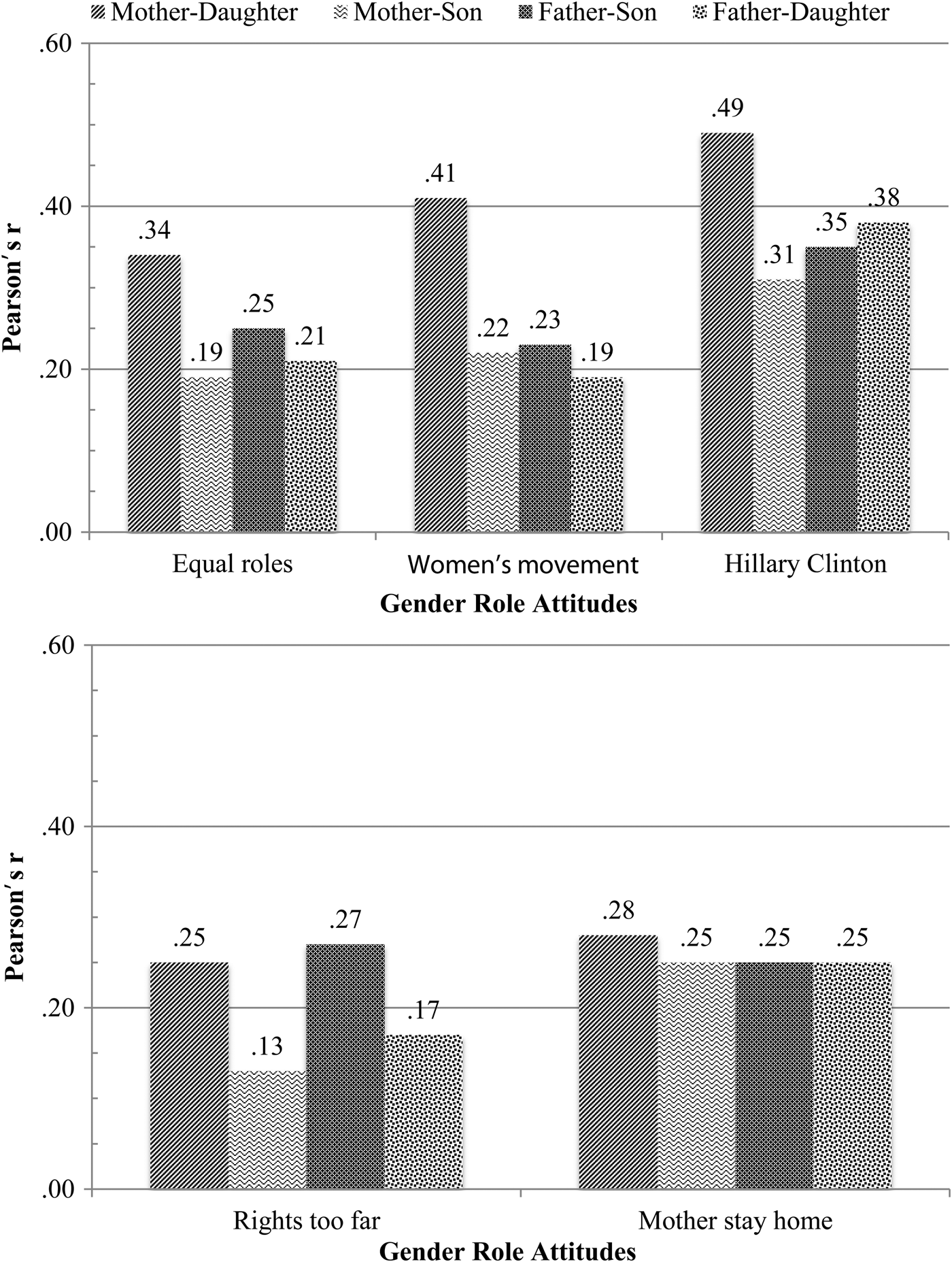
In order to uncover the internal patterns of gender role attitude transmission within the family, we begin by comparing attitude congruence between the four parent-offspring dyads—mother-daughter, mother-son, father-son, and father-daughter. Because of the general linear relationship between the attitudes of parents and their offspring, we use Pearson's product moment correlation coefficients to indicate the relative strength and consistency of similarities between parents and their offspring. Figure 1 contains these basic relationships for the five indicators of gender role attitudes.Footnote 5
Parent-offspring gender role attitude congruence.

One general picture that emerges from these bivariate relationships is the reasonably strong initial support for intergenerational transmission regardless of the attitudinal indicator and the particular sex combination. All of the 20 pair-wise correlations shown are statistically significant at conventional levels, all but four at p < .001 or better.Footnote 6 These relationships compare favorably with those reported, usually not distinguished by sex pairings, for a range of other issues, save partisanship (e.g., Jennings, Stoker, and Bowers Reference Jennings, Stoker and Bowers2009; Tedin Reference Tedin1974). At the same time, pair agreement ranges considerably, reaching its highest average peak across the four sex combinations on the partisan-infested ratings of Hillary Clinton. Overall, however, the findings supply presumptive support for the role that parents play in helping shape the gender role attitudes of their children.
Turning now to an assessment of the three models outlined above, we see that intergenerational attitude transmission varies by sex composition and attitude measure. In terms of sex composition, three general patterns emerge. First, the same-sex/cross-sex dyadic comparisons differ for mothers and fathers. Although the difference in the correlations is not always statistically significant, mother-daughter agreement always outruns mother-son agreement, thereby upholding the same-sex model.Footnote 7 The contrasts are especially noticeable with respect to evaluations of the women's movement and opinions about whether equal rights for all are being pushed too far, where the mother-daughter correlations are about twice that of the mother-son correlations.
The same-sex pattern proves to be less common and is generally much weaker when it does occur among the father-led pairs. None of the differences between father-son and father-daughter correlations are statistically significant. Indeed, the father-daughter correlation very slightly exceeds or is tied with that of the father-son correlation on two of the five measures. On the surface, then, fathers appear to be equally effective (or ineffective) socialization agents regardless of offspring sex.
A second generalization is that the magnitude of similarities among female same-sex dyads is consistently greater than that of male same-sex dyads, the edge running from the minute (“mothers stay home”) to the quite substantial (e.g., the women's movement). Taking the latter measure as an example, approximately 17% of the variance in the daughter's score is accounted for by her mother's score, as compared with a figure of 5% for the father-son dyad. So not only does the mother-daughter pairing lead the father-son pairing in its more consistent same-sex versus cross-sex association, but it also leads in terms of the strength of the differences.Footnote 8
A third pattern concerns cross-sex findings. Something of a standoff occurs here, thereby providing suggestive support for the equal roles model in the cross-sex situation. Differences between mother-son and father-daughter correlations are very slight, with neither mother nor father having much of an edge. If mothers had demonstrated more putative influence as in the case of same-sex dyads, some support would have been generated for the differential effects model—assuming that fathers would have been more influential in other domains. However, that turns out not to be the case. Rather, the parent equivalent model seems more applicable in this cross-sex configuration.
As for variations by attitudinal domain, two features merit comment. First, compared with the other measures, differences across the dyads are quite small for one of the issues—whether mothers of young children should stay home. Just why that occurs is not at all clear. The past immediacy and salience of the issue within the family circle may have simply tamped down any tendency for differentiation by sex pairings. This measure, as phrased, is also the least patently political one in nature. In any event, findings based on this measure, as compared with the other four, point more toward the equivalent roles model of parental transmission.
A second feature regarding particular attitudes is that, relative to other dyads, female same-sex congruence is particularly strong on measures stressing gender equality, as in the equal roles, women's movement, and rights-too-far measures. With respect to evaluations of the women's movement, for example, mother-daughter congruence is significantly greater than both mother-son and father-son congruence (p < .05).Footnote 9 In terms of traditional family values and practices, such as support for a clear sex division in childcare responsibilities, agreement between mothers and daughters is weaker and less distinguishable from other pairings. Mothers seem to be more successful at reproducing gender attitudes in their daughters where the subject or issue in question has manifest group-based interests that play out in the political sphere.
Fathers and sons come closest to that image, relative to mothers and daughters, with respect to the notion that the country has gone too far in pushing equal rights for everyone. Males of both generations expressed considerably less support for that policy at the aggregate level than did their counterpart females. The antipathy toward that policy may be reflected to some extent in this pairwise correlation. Cross-tabulations indicate that, on average, fathers are passing along a more resistant posture to their sons while mothers are passing along a more supportive one to their daughters.
VARIATIONS IN CONCORDANCE: THE IMPORTANCE OF CONSISTENCY
Working with parent and child combinations involving only one parent, we have established that parent-child congruence, while ranging considerably in size, is always positive and statistically significant, even with these fairly small analytic Ns. We have also seen the prominence of this congruence in the same-sex combination of mothers and daughters. Interpreting these findings was predicated on the basis of social learning theory, wherein processes of modeling, observational learning, and cue-taking act to foster the passing on of gender role values from parent to child. Both theory and prior research suggest that within-family factors will influence the degree to which the transmission is successful. One such factor is the consistency of parental cue giving. Past research has demonstrated the powerful effect of such consistency across time and across both parents (Jennings, Stoker, and Bowers Reference Jennings, Stoker and Bowers2009; Rico and Jennings Reference Rico and Jennings2012; Zuckerman, Dasovic, and Fitzgerald Reference Zuckerman, Dasovic and Fitzgerald2007, chapters 5–6).
Although we lack longitudinal data for both parents, we can employ the degree to which both parents have similar attitudes as the indicator of consistent cue giving. Children receiving a double dosage from agreeing parents should more often resemble a given parent out of a parental pair than when relying only on that one parent's attitude. By the same token, the impact of parents with a similarly disposed partner should ordinarily exceed that of parents who disagree with each other. Using the triads formed in 1965 by Generation 2 members (in their roles as offspring rather than parents) and their own mothers and fathers, Jennings and Niemi (Reference Jennings and Niemi1974, chapter 6) found strong tendencies of these sorts across a wide variety of measures. Agreement with homogeneous parents usually exceed those based on only one parent as well as those based on heterogeneous instances where mother and father disagreed.
We employ a similar analytic strategy for the gender role variables, none of which were available for the earlier Jennings and Niemi study. Parental pairs were allocated on each variable into a homogeneous or heterogeneous category.Footnote 10 Homogeneity for the three measures not employing thermometer scores consists of cases falling along the main diagonal when cross-tabulating the mother and father scores. The range was extended for the two 0–100 thermometer scores to include ratings on the diagonal plus or minus 10 degrees.Footnote 11
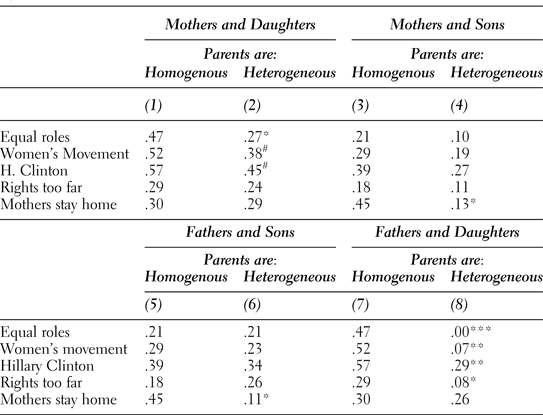
Table 1 contains the comparisons between the homogeneous and heterogeneous conditions, divided between the mother-child combinations in the top portion and the father-child combinations in the bottom. Because the homogeneous parents are in agreement by definition, the correlations between daughters or sons and their pa8rents will be the same for both the mother and the father dyads. Columns 1 and 7 contain these duplicate entries, as do columns 3 and 5, in order to facilitate comparisons.
Parent-offspring congruence by sex combinations and parental agreement level
Note: Entries are product moment correlation coefficients. All coefficients in the same-sex dyads are significant at the .05 level save “mothers stay home” and also at the .05 level for heterogeneous father-son dyads except “mothers stay home.” In the mother-son dyads that level holds for the women's movement and Clinton; in the father-daughter dyads, for Hillary Clinton and “mothers stay home.” Asterisks indicate the difference between homogeneous and heterogeneous coefficients in the side-by-side columns is significant based on a t-test for the interaction between parent attitude and homogeneous condition. Ns necessarily vary across the attitudes and combinations and range from a high of 222 for a homogeneous combination to 74 for a heterogeneous pairing. #p < .10, *p < .05, **p < .01, ***p < .001.
We begin by assessing the overall consequences of having agreeing versus nonagreeing parents. This is accomplished by comparing the two adjacent columns under each subhead in Table 1 (e.g., 1 and 2). If homogeneity makes a difference, the coefficients in the first column in the pairings should exceed that in the second column. That is universally so for all comparisons save the tied correlations on the equal roles measure in the father-son dyads. Barring this one exception out of 20 possibilities, the results speak loudly to the importance of consistency in the developing child's home environment and, by extension, offer strong support for social learning processes. While the overall pattern has the right shape, it should be acknowledged that the strict criterion of statistical significance is met for the most part only for the dyads including daughters.
Table 1 also demonstrates strong support for same-sex modeling when parents disagree (columns 2 and 4, 6 and 8). Mother-daughter agreement always exceeds that for mother-son, and a parallel pattern appears for fathers and sons except for the moms-stay-home item. Same-sex concordance also tends to run higher in the homogeneous condition with respect to mother-led pairs (columns 1 and 3). This is not the case for dyads involving fathers (columns 5 and 7). Indeed, agreement with their sons is actually about the same or slightly higher when fathers find themselves disagreeing with their wives, and only with respect to the issue of “mothers stay home” does concordance between fathers and sons exceed that for fathers and daughters in the heterogeneous setting.
Who gains or loses more by having an agreeing spouse? For all except the father-daughter dyads, the increments achieved by moving from the heterogeneous to the homogeneous condition are fairly similar, the increase in the coefficients ranging on average from around .10 to .15. The father-daughter dyad pattern constitutes a striking contrast. For all but the mothers-stay-home measure, the difference between the two conditions (column 7 minus column 8) is far higher than that found for the other three combinations. So marked are these differences that the average across the five measures stands at approximately .31, at least twice that for any of the other three dyads. Fathers with a disagreeing spouse have greatly diminished prospects of seeing their own views reproduced in their daughters.
Paradoxically, then, fathers benefit more than do mothers from like-minded partners in the dyads that include daughters (column 7 minus column 8 vs. column 3 minus column 4). However, the reason for this advantage rests in the far larger agreement that mothers enjoy with their daughters in the heterogeneous condition (column 2 vs. column 8). Mothers are the clear “winners” in this contest. Consequently, fathers profit much more from an agreeing partner than do mothers because their heterogeneous “base” is so much lower.
Dyads involving sons exhibit a murkier pattern. First, the differences between the mother- and father-headed dyads are much smaller than is true for the parallel daughter-based dyads. Second, whatever difference exists sometimes favors mothers and sometimes fathers. Based on these results, it seems likely that reports according more impact to mothers, and not controlling for offspring sex, could be driven by the larger mother-daughter similarities.
In sum, these findings provide strong support for a social learning interpretation of parent-child correspondence on gender role attitudes. The findings also lend support to both the same-sex and differentiated models of parental influence. When parents disagree, children do tend to emulate their same-sex parent. However, that pattern proves stronger among mothers and daughters than fathers and sons, and in the cross-sex combination mothers fare somewhat better with their sons than fathers do with their daughters. We discuss the likely reasons for mother dominance and the implications thereof in the Conclusion.Footnote 12
TAKING MULTIPLE FACTORS INTO ACCOUNT
Our results thus far provide at least moderate support for the passing on of gender role attitudes, with the majority of findings pointing toward the prominence of same-sex influence flows. Partitioning the parent-child pairs according to levels of parental agreement revealed a circumstance under which transmission is enhanced. Further tests of the transmission hypothesis require a multivariate approach. In the first place, we need to take into account the attitudes of both parents in a multiple regression analysis. Doing so will not only provide another angle regarding the relative influence of each parent, but will also provide additional information about the prevalence of same-sex versus opposite-sex concordance.
A multivariate analysis must also take into account possible influences other than parental attitudes. As noted at the outset, parent-child concordance could also arise through other mechanisms. Parents may serve as instruments for the acquisition of gender role attitudes via processes associated with status inheritance. Parents provide their children with differential exposures and opportunities that may in turn be related to political gender role attitudes, especially via social stratification and residential location. Parent-child concordance may also stem from other influences that the two lineage generations simultaneously share in common (e.g., Campbell Reference Campbell2006; Glass, Bengtson, and Dunham Reference Glass, Bengtson and Dunham1986; Rico and Jennings Reference Rico and Jennings2012; Vollebergh, Iedema, and Raaijmakers Reference Vollebergh, Iedema and Raaijmakers2001). These characteristics may undercut the supposed passing on of attitudes from parent to child. They may also provide explanatory power over and beyond that provided by parental attitudes. In order to test for these possibilities, we have estimated regression models for each attitude that include not only the same attitude for mothers and fathers as predictors, but seven control variables, as follows.
Family Socioeconomic Status
Education tends to be positively related to more liberal gender role attitudes (Kane Reference Kane1998; Thornton, Alwin, and Camburn Reference Thornton, Alwin and Camburn1983), an inclination echoed among the parents in the family units being analyzed here. Children growing up with better-educated parents are also more likely to be exposed to more liberal views in their nonhome environment. Consequently, we include educational attainment for both the mother and father, divided into four categories—high school only, some college, college degree, and beyond college. Family income also bears a positive relationship to more liberal gender role views among the parents although the relationship is not always statistically significant. Annual income was recorded in terms of 23 categories, ranging from less than $2,000 to $150,000 and over.
Religious Beliefs
A recurring finding in the literature reveals a negative relationship between gender egalitarianism and fundamentalist religious values and beliefs (Bolzendahl and Myers Reference Bolzendahl and Myers2004; Peek, Lowe, and Williams Reference Peek, Lowe and Williams1991). Commonly used indicators of religiosity, such as church attendance and the self-described importance of religion in one's life, do not necessarily capture religious beliefs as distinct from practices. Consequently, we employ responses to a four-item question about belief in the inerrancy of the Bible, which can be seen as a measure of religious fundamentalism.Footnote 13 In order to capture a composite picture of the family fundamentalist environment, we combined the scores of mothers and fathers (1–4) and divided by two.
Sociopolitical Milieu
The growing child is obviously exposed to a range of influences outside the home that can affect gender role attitudes. Ideally, we would have explicit and proximate indicators of gender role opinion climates in order to assess their likely contributions. One state-level indicator is available in the form of pooled estimates of state level gender role attitudes (labeled feminism) covering the 1974–1996 period (Arceneaux Reference Arceneaux2001). This measure is based on combining answers to two questions contained in the General Social Survey (GSS): (1) “Women should take care of running their homes and leave running the country to men,” and (2) “Most men are better suited emotionally for politics than are women.” We use the parental state scores even for older offspring who were not currently living in the same state on the grounds that residence during the formative years constitutes the critical period.
A second climate indicator is more proximate but less manifestly political. Just as education at the individual level is positively related to more liberal gender role attitudes, we should expect it to function similarly at the aggregate level. In order to capture that environmental indicator, we include the percentage of adults with a college degree or beyond living in the zip code areas occupied by the families under study here.Footnote 14
Family Division of Labor
Observing how domestic chores are allocated between their mothers and fathers could conceivably influence children's attitudes about gender roles, with the expectation being that more equal sharing of roles would lead to more liberal views by their offspring. The parents were asked a series of questions beginning with, “Who would you say spends the most time doing the household chores for your home and family—you or [your husband/wife/person you live with]?” Despite the explicit cues of oneself or one's spouse as the biggest contributor, some 18% of the parents volunteered an answer of “same” or “both.” Such insistence suggests a determined sense of egalitarianism within the household. Correspondingly, we created a dummy variable where 0 references nonequal sharing and 1 references equal divisions.
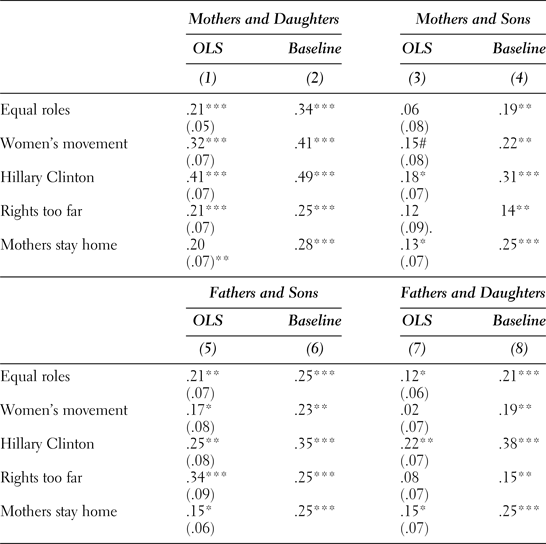
We estimated models by regressing the daughter's (son's) attitude against the mother's attitude and the father's attitude plus the seven predictors just described.Footnote 15 Before looking at the results, it should be noted that indicators of family socioeconomic status, residential location, religiosity, and domestic work sharing proved to be relatively weak predictors of offspring attitudes at the bivariate level. Given those results, we should expect to find continued support for the transmission hypothesis and, arguably, further support for same-sex predominance in the multivariate models. Table 2 presents the findings, wherein other predictors have been held constant. Columns 1 and 3 depict the regression coefficients involving mothers and their daughters and sons, respectively, while columns 5 and 7 do likewise for fathers and their offspring.Footnote 16 For comparison purposes, the even-numbered columns show the baseline, bivariate pairwise relationship for each attitudinal measure.
Impact of parent attitudes on offspring attitudes, controlling for other factors
Note: Entries are unstandardized regression coefficients, with standard errors in parentheses. Each estimate includes the father and mother attitude corresponding to the offspring's attitude as well as mother's education, father's education, family income, state feminism score, zip code, percentage with graduate degree or higher, parental report of shared work at home, and parental belief in Bible's inerrancy. #p < .10, *p < .05, **p < .01, ***p < .001
A scanning of the table reveals strong confirmation of parental influence in the same-sex combinations. Not surprisingly—especially in light of the inclusion of each parent's attitude in the estimates—the seeming impact of a mother or father is attenuated from the baseline, bivariate associations. Nevertheless, all of the significant same-sex relationships remain in place after controlling for other factors, most of them well beyond the .05 level. The coefficients for the same-sex dyads are also uniformly higher than those for the cross-sex dyads, although some of the differences are small. By the same token, several of the cross-sex relationships do not attain statistical significance, and only one (Hillary Clinton in the father-daughter pairing) reaches the .01 level. Beyond these specific points, the findings demonstrate that parent-child congruity on gender role attitudes is not simply an artifact of status inheritance and circumstances shared in common by parents and their offspring. Children appear to be taking cues from their parents, especially those of the same sex.
As we observed earlier, and as evidenced in a comparison of columns 1 and 5, mother-daughter concordance runs substantially higher than that for fathers and sons for the three attitude objects most explicitly tied to gender egalitarianism in the political sphere—equal roles, women's movement, and Hillary Clinton—and marginally higher for the other measure with a specific gendered referent—the moms-should-stay-home position. Those margins still prevail in the multivariate condition for all but the equal roles measure. The inclusion, in particular, of the father's attitude and parental religious fundamentalism as predictors of daughter's equal roles score reduces mother-daughter similarity, whereas the father-son dyad is much less affected by the addition of other predictors. At the same time, the similarity between fathers and sons on the “rights-too-far” measure has actually increased with other factors held constant, thereby opening up a considerable gap over the mother-daughter dyad.
The cross-sex comparisons yield something of a standoff in the putative influence of fathers and mothers. Differences in the coefficients tend to be small and, where more substantial, do not consistently favor one parent over the other. Importantly, the least difference in the same-sex and opposite-sex relationships occurs on the question of mother's role in caring for the young, the most “private” of the five attitudes at hand. In light of these same-sex and cross-sex findings in the multivariate world, our earlier generalizing about the stronger transmission flows from mothers to daughters remains intact but with a slight modification.
WHAT ABOUT OTHER ATTITUDES?
The question arises as to whether or not our general findings are specific to the domain of gender role attitudes. We argued earlier that sex categorization and the substantive content of gender attitudes would bolster same-sex attitudinal similarity within the family. However, perhaps the pronounced same-sex pattern occurs in other substantive domains as well. It is not unreasonable to suspect that, in general, offspring are more likely to model the same-sex rather than opposite-sex parent. We have little to guide us from past political socialization research due either to the absence of both mother and father in the data sets or, where present, a preoccupation with partisanship measures (e.g., Coffé and Voorpostel Reference Coffé and Voorpostel2010; Zuckerman, Dasovic, and Fitzgerald Reference Zuckerman, Dasovic and Fitzgerald2007, chapter 5).
Fortunately, the data set contains attitudinal questions tapping into a number of other substantive areas. In order to minimize possible methodological artifacts, we selected questions that matched the formats of the questions used in the foregoing analysis. Doing so meant including measures involving self-placements on the 1–7 issue scales, assessments based on the feeling thermometer, and responses based on five-item Likert scales and simple agree/disagree formats.Footnote 17 This produced 13 measures for comparison. In what follows, the comparisons are based on bivariate analysis, but multivariate work yields very similar patterns.
One way to determine if our findings apply especially to gender role attitudes is to compare the average of the same-sex correlations on the five gender role measures with the average of the correlations based on the 13 other measures. Considering first the mother-daughter dyads, the average correlation for the gender role attitudes is .35 compared with .21 for the other attitudes, a substantial gap that strongly supports the claim of differentiation regarding gender role transmission. The father-son comparison is in the same direction but yields a decidedly smaller gap (.27 vs. .25), so much so that it would be difficult to argue for the transmission distinctiveness of gender role attitudes among fathers and sons, thereby augmenting our claim about the special aspect of mother-daughter correspondence.
A second approach is to compare the same-sex and cross-sex differences for the gender role and nongender-specific measures. Again working with averages and ignoring statistical significance considerations, we find that the mother-daughter dyadic agreement exceeds that of mother-son agreement on only 5 of the 13 measures whereas such agreement always leads mother-son agreement on the gender role measures—testifying again to the distinctive nature of the gender roles domain for mother-daughter pairs. Interestingly enough, the picture differs somewhat for the father-led dyads. Father-son exceeds father-daughter agreement in 10 of the 13 instances (though these differences are often trivial) but only in 3 of the 5 gender role measures. Fathers' somewhat weaker influence over sons on gender role matters (relative to mothers over daughters) receives a modest offsetting “compensation” in the form of more influence in the nongender roles domain.
One final comparison is in order. As is well known, party identification is perhaps the most successfully transmitted political orientation in the United States, and the parent-child concordance stands as a benchmark of sorts. In contrast to the results reported on here for gender role measures, scant difference exists across the four dyads with respect to party identification, as these correlations demonstrate: mother-daughter (.50), mother-son (.47), father-son (.46), father-daughter (.45). Party identification, however, has unique properties, including high mother-father similarity. On the other hand, the substantive quality of the gender role measures implies some properties uniquely associated with sex status.
All in all, then, we are on reasonably firm ground in emphasizing the distinctiveness of same-sex agreement patterns when it comes to gender role attitudes. That is clearly the case with respect to mothers and their daughters. The wrinkle with fathers and their sons is that their congruity on gender role attitudes is somewhat less robust than that for mothers and their daughters and that their agreement tendencies carry over to nongender-specific matters. A likely reason for these differences rests in the heightened salience of gender role issues for women. As argued earlier, as the party being the focus of dispute and possible change, the domain of gender roles seems far more likely to loom large in the mother-daughter nexus.
CONCLUSION
Working in the tradition of political socialization via social learning processes, we have used national-level parent-child data to assess the transmission fidelity of gender role attitudes. Detailed attention was paid to the four combinations based upon parental and offspring sex. We found strong but variable support for the transmission model across five attitudinal indicators and the four parent-child combinations. Consistency of parental cue giving enhanced parent-child concordance, most decidedly so in the case of fathers and their daughters. In the multivariate analysis, parental attitudes overwhelmed other predictors of gender role attitudes. Of the three models posed at the outset, the one based on same-sex congruence proved to be the most dominant due—in great part, we think—to the substantive content of gender role attitudes and its connection with oppositional sex categories. Comparisons with parent-child correspondence based on attitudes not related to gender roles underscored the uniqueness of our findings. Further analysis (not shown) revealed little difference in pair correspondence on gender role attitudes according to offspring age, in contrast to the customary finding in the literature, and thereby strengthening our claims about the special nature of gender role socialization within the family circle.
This same-sex dominance has implications for effecting change and continuity in gender role attitudes. Regardless of whether the aim leans toward the more egalitarian or the more individualistic side of the attitudinal continuum, the influence pathway goes more through the same-sex than opposite-sex parent-child pairings. That being so, advocates of particular positions—including parents themselves—might want to target or emphasize the special connection between parents and children of the same sex as a way of maximizing their influence. Conversely, knowing that the passing on of gender role attitudes occurs less successfully among the cross-sex combinations, special efforts might be made to overcome this seemingly less “natural” outcome because the more “natural” one will take care of itself. Significantly, the same-sex pathway was least prominent in our analysis on the topic most common in everyday living but least visible on the national political agenda—the role of mothers in caring for the young. Ambivalence about this issue conceivably creates an opportunity for parents to exert more influence over their opposite-sex offspring.
Although the same-sex pattern prevailed in our analysis, both mothers and fathers influence the gender role attitudes of their children regardless of sex, as revealed most clearly in the multivariate analysis. Still, the mother-daughter similarity was distinctive, especially with respect to evaluations of the women's movement and of Hillary Clinton, two prime political signifiers of egalitarian gender-role attitudes during the time period being covered. We do not have indicators in hand from this survey, but the likely reasons for the mother-daughter singularity rest in the stronger emotional bonds and more frequent interaction between mothers and daughters. We know, for example, that the mothers in the sample felt much closer to their own mothers than to their fathers when they were in high school (Jennings and Niemi Reference Jennings and Niemi1974, chapter 6). The same seems likely to be true concerning the bonds between these mothers and their own daughters. Daughters also talk relatively more with their mothers than boys do with their fathers (Jennings Reference Jennings1983). Changes in family structures and other societal trends may have altered these patterns in the past couple of decades, but they seem unlikely to have disappeared. In any event, the combination of somewhat more egalitarian attitudes (see note 5) among the mothers coupled with the generally higher rate of mother-daughter transmission has apparently helped to create and sustain a gender gap in the younger generation (Jennings Reference Jennings2006).
Although we have found moderate to strong support for the role of parents in shaping the gender-role attitudes of their offspring—especially those of the same sex—other factors and variations are clearly at work but not taken into account here. Forces emanating from the educational, social, and media worlds inhabited by the developing child undoubtedly play into forming these attitudes. These forces are imperfectly captured by parental attitudes and by the various controls used in the multivariate analysis. Nor have we have had available such characteristics as parenting styles, affective and power relationship within the family circle, and offspring perceptions of parental attitudes that may condition the social learning process. Furthermore, we have been analyzing (mainly white) two-parent families—the great majority of whom are the biological parents of these sons and daughters—at a time when single-parent and blended families are becoming increasingly common. Incorporating these considerations into future research will further our understanding of the family's role in helping form gender-role orientations.
Finally, determining just how parents contribute to the predominance of same-sex congruity cannot be easily discerned with the type of survey data we have employed. Some perspective on the underlying processes can be gleaned from more intensive investigations. Illustratively, Jenkins (Reference Jenkins2013) studied two generations of mothers and daughters who had attended the same university, one during the women's movement and the other one well afterward. Reports from each part of the dyads provide clues as to the manner by which mothers helped shape their daughters' views regarding the women's movement and gender roles in private and public life. Although confined to college graduates and to women, studies of this kind suggest just how parents contribute via words and deeds to the same-sex patterning of gender role attitudes.
Appendix. Parent-offspring nongender role attitude congruence