On 18 January 1919, the French president of the Republic, Raymond Poincaré, officially opened the Paris Peace Conference, the self-proclaimed aim of which was to rearrange the post-war political landscape according to the Wilsonian principles of national self-determination and open diplomacy. In his opening address, Poincaré spoke of the ‘sufferings of war’, the ‘enormous sacrifices’ of the Allies, and the ‘crimes’ of the Central Powers as well as their ‘outrages’ against ‘humanity’ and their ‘mad arrogance’ and ‘shameful bargains’.Footnote 1 He ended by contrasting the Allied ‘idea of justice’ with the Central Powers' ‘idea of sovereign force’. Caught between these two opposing camps were the ‘captive nationalities’, which ‘from the depths of their age-long jails cried out to us for help’. To accomplish the ‘formidable task’ of drawing the borders of these areas, Poincaré reminded his listeners that they should ‘respect the right of nations, small and great, to dispose of themselves, and to reconcile it with the right, equally sacred, of ethnical and religious minorities'. In doing so, the statesmen were to be aided by ‘science and history, your two advisers’. With this final remark, Poincaré was referring to the academic experts who accompanied the politicians and diplomats to Paris; they are a new and still largely unexplored force in the international politics of the early twentieth century.
Poincaré's emotive language was neither an accident nor simply a reflection of diplomatic conventions. It was the direct consequence of a war in which governments had mobilized their populations on a scale that was altogether unprecedented. By 1917, the immense strain brought on by the war had given rise to powerful peace movements that demanded a stop to the carnage. Moreover, the revolutionary upheavals in Russia not only brought about the gradual corrosion of an ally, but forced Britain, France, and the United States to face a powerful ideological challenge. Soviet demands for a ‘peace without annexation’ and ‘national self-determination’ forced the AlliesFootnote 2 to search for a strong counter-claim that would not only be able to sustain their war effort but also win them a more extensive moral leadership in the war.Footnote 3 In his Caxton Hall speech on 5 January 1918, Lloyd George took the lead. The British prime minister specified that ‘no annexations’, ‘no indemnities’, and ‘national self-determination’ were to be the ‘general principles’ upon which the Allied peace terms would be based.Footnote 4 Three days later, American President Woodrow Wilson declared his famous Fourteen Points programme, which would become the foundation of the peace negotiations once the war ended. It soon became apparent, however, that national interests, concerns of international stability, and the complexities on the ground conflicted with the promise to remodel the post-war political landscape solely according to national aspirations. The way out, or so the Allied administrations hoped, was to engage in a new, scientific peace planning process.
The task of applying ‘Wilsonianism’ to the fluid realities of post-war Europe – and potentially to non-European regions as well – was thus delegated to a new species of actors in the formulation of international politics: i.e. the professional academics who were employed as ‘experts’. At the close of the war, France, Britain, and the United States had each assembled one central body of specialists that primarily gathered together historians, geographers, economists, and jurists. These ad hoc organizations collected material, drew up statistics and maps, and condensed their results into reports intended to guide the decision-makers at the upcoming peace conference. All three groups – the French comité d’études, the British Political Intelligence Department (PID), and the American Inquiry – were to abide by several limiting parameters, the first of which was that the territorial borders were to be altered or drawn to respect the wishes of the local population. They were also required to base their plans on the assumption that the future League of Nations would regulate international relations and conflicts. According to the new principles, peaceful arbitration was to replace war as a legitimate means to change political borders and resolve international conflicts.
This article examines Allied peace preparations between 1917 and 1919 from the perspective of experts. Rather than focusing on one group only, it investigates the connections between the British, French, and American expert organizations. As will be demonstrated, the contact between and mutual perceptions of the three bodies of specialists constitute an important albeit largely neglected aspect of the Allied peace planning process.
By investigating the role of foreign policy experts in the latter stages of the First World War, the article addresses two issues of a more general historical and contemporary relevance: the use of expertise in politics and the challenges of transnational policymaking. Regarding the former, the example of Allied peace planning shows that the impact experts have on decisions depends not simply on their proximity to political power. To be effective, expertise requires both a reliable access to decision-makers and a certain freedom to develop alternative options rather than being forced to provide a single solution to complex problems.Footnote 5 With regard to transnational policy-making, the article demonstrates that all three expert groups perceived the mutual exchange of materials and views and notably the competition between each other as central factors in their peace preparations. The ensuing efforts of experts and politicians to co-ordinate Allied peace planning testify to the increasing importance that transnational policy-making assumed in the early twentieth century. At the same time, the article shows that persisting national suspicion thwarted these transnational efforts to harmonize Allied peace planning.
As this article will argue, the lack of co-ordination between the expert teams prevented inter-Allied debate on the precise meaning of national self-determination and on common policy goals.Footnote 6 This shortcoming would constitute a heavy burden for the Paris Peace Conference and the early interwar period. It not only created tensions during the peace negotiations, but, more importantly, it also undermined the strength of the Western powers' alliance and their moral and political commitment to a post-war order wherein the Wilsonian ideals appeared to have been betrayed by national egoism.Footnote 7
Following a short review of the recent historical literature on experts and expertise, the article proceeds to an in-depth examination of the relationships between the three expert groups. It then outlines the experts' conceptions of national self-determination just before they began their work at the Paris Peace Conference. Before concluding the argument, a final section briefly surveys the impact that the incorporation into politics had on the experts and the academic fields they represented.
I
Following earlier discussions in the social sciences,Footnote 8 historians have somewhat belatedly ventured into the field of expertise. The first major contribution to follow the few isolated studies of the 1950s and 1960s was a collection of articles published by Roy MacLeod in 1988.Footnote 9 More recently, Eric H. Ash has noted that specialized advice emerged concurrently with the modern state. While politicians needed experts to enhance and legitimize their control over increasingly large and complex realms, advisers were able to acquire political influence as well as official recognition of their expertise.Footnote 10 Other authors have emphasized that the omnipresent characteristic of expertise in the political sphere today is the product of rapid processes of social and professional differentiation that have characterized the late nineteenth century.Footnote 11
In general, the historical perspective has touched on two crucial points that most of the social science literature has ignored. First, expertise is a variable phenomenon. Different historical periods and regions have different ‘expert cultures’Footnote 12 or ‘figurations’Footnote 13 of expert advisers. Secondly, expertise is a hybrid form of applied knowledge that is located in the space that resides between science and politics.Footnote 14 Veronika Lipphardt and Kiran Patel have taken the idea of a socially and politically embedded science to the point where knowledge, public debate, and political decision-making constitute epistemic fields that revolve around specific issues. In their case-study, this concerns the issue of biological human diversity.Footnote 15
For all that, the French, British, and American expert groups that engaged in peace planning activities from the latter stages of the First World War have been the subject of one single monograph each.Footnote 16 Beyond these broader surveys, there are just a few articles and book chapters that address more specific aspects of the three groups.Footnote 17 Remarkably, none of these studies has attempted to compare the groups or examine their relationships more thoroughly. Even when authors have been confronted with such connections and mutual perceptions, they have portrayed these exclusively from the perspective of ‘their’ expert group. This dominance of national perspectives proves to be all the more remarkable given that the peace deliberations at Paris were an international affair par excellence. Moreover, upon closer inspection of the preceding peace planning phase, it becomes evident that even at this early stage, the international dimension played an essential role in British, American, and French preparations for peace.
II
When the Allied governments in 1918 began increasingly to draw on the legitimatory power of universal principles to sustain their massive war efforts, scientific peace planning was commonly seen to be the underlying means with which these principles were to be applied to the post-war order. Aside from this common function, the simultaneous appearance of experts in the three countries was also an expression of the expansion and professionalization of state administrations during the war. The radical changes within the British Foreign Office are depicted vividly in a memorandum circulated by Robert Cecil. At the time the war broke out, the memo noted, ‘the clerical staff of the Foreign Office numbered about 130’. By the spring of 1918, the figure had increased to over 500. The fact that the size of the Foreign Office as a whole had ‘more than quintupled’ within a few years meant that offices were hopelessly overcrowded without, however, resolving the problem of understaffing: ‘The number of papers received in the Foreign Office in 1913 amounted to 58,790, while in 1917 it reached the total of 246,158.’Footnote 18 Another important factor for the sudden prominence of expertise in Allied foreign policy was the shared faith in scientific solutions.Footnote 19 This belief also pervaded the self-perception of the experts themselves, as may be exemplified by a passage written by Inquiry member Charles Seymour in his edited volume of the ‘Intimate Papers of Colonel House’. According to Seymour, the Inquiry ‘was always master of the facts which had been collected, and preserved an invariable objectivity in its analysis’.Footnote 20
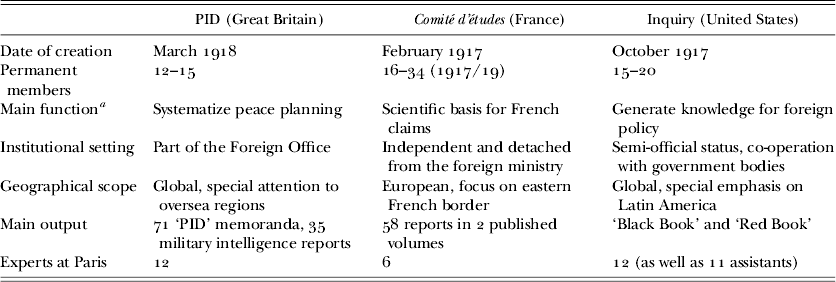
The pressure to legitimate their war effort, the expansion of state power, and the belief in science were common to all three Allied powers. These factors provided the impetus for the respective governments to establish bodies of experts that would flesh out the positions for their national delegations at the peace conference. Table 1 compares the main characteristics of the British, French, and American expert groups. The similarities between them are readily apparent. All three were created ex novo towards the end of the war and were attached more or less formally to the respective Foreign Office, with which they soon entered in some form of competition. The efforts of the experts were kept in relative secrecy by their governments for fear that news about peace preparations might lower the will of the general public to continue fighting or for fear of giving away war aims.Footnote 21 Moreover, all the groups focused their work on the collection, analysis, and presentation of prodigious amounts of data, and all of them manifested the tendency over time to shift their analytical angle from history to geography and map-making.Footnote 22 They each perceived that their main role was to furnish data to the political decision-makers, even if there were tendencies in all three groups to include recommendations in the reports and later at the Paris convention actively to engage in the decision-making processes. The members of the expert groups were for the most part extracted from academia. Heading the new organizations were intellectuals or academics with political experience including such figures as Ernest Lavisse and Charles Benoist in France,Footnote 23 or Walter Lippmann and Sidney Mezes in the case of the American Inquiry.Footnote 24 The exception to the rule was the head of the British PID, William Tyrrell, who was a career diplomat.Footnote 25 Lastly, all three expert groups were temporal creations of the war.Footnote 26
Comparison of the Political Intelligence Department (PID), the comité d’études, and the Inquiry

a For reasons of space, the ‘main function’ of the three groups within the foreign policy of their respective governments cannot be further discussed here. For the comité d’études, see Heffernan, ‘French national space’, pp. 34–6; for the Inquiry, see Smith, American empire, p. 119; for the PID see Goldstein, Winning the peace, pp. 57–8.
A crucial difference between the groups is their position within the state structure. While the PID, insofar as it was created from several ministerial bodies, was fully embedded in the British Foreign Office, the comité d’études was detached from the French foreign ministry both in terms of its location (at the Sorbonne and later at the École normale supérieure) and its funding. Consequently, its members tried to exert their influence by gaining the support of individual politicians, mainly the president of the Republic, Raymond Poincaré, and Clemenceau's confidant, André Tardieu, as well as the latter's secretary, Louis Aubert.Footnote 27 Inquiry members also sought to establish personal links with politicians. Depending on the constellation, these links were made with Colonel House, Secretary of State Lansing, and even Woodrow Wilson himself. Given the existing but tense relationship between the Inquiry and the US State Department, the American expert group may be placed in an intermediary position in terms of institutional embeddedness.
Another significant difference, which hints at each group's national agenda, resides in the specific regional foci upon which the expert teams directed their attention. The European continent constituted the core of the work of all three groups, particularly its central, eastern, and south-eastern parts. Yet the British experts paid greater attention to non-European issues, while the comité d’études poured most of its energies towards the Franco-German border and the Inquiry placed a special emphasis on Latin America.Footnote 28 The output of the groups also differed. Although it published its reports, the comité d’études did not condense its material into a concise form that would be useful to the negotiators at the peace conference. The British and American experts, in contrast, reduced their lengthy reports and compiled their data into short memoranda and converted it into visual representations on maps. Furthermore, the latter two expert groups successfully asserted their intention to participate themselves in the peace negotiations, consciously emphasizing the need to ‘train’ their academic members for this task. Lippmann's report on the work of the Inquiry in May 1918 stated that the Inquiry was to be seen as an ‘active organization, and not simply as a group of scholars producing voluminous reports which can be printed and used in their absence’.Footnote 29 The comité d’études, in contrast, was consulted but generally passed over by Tardieu in the comité consultatif de la delegation française.Footnote 30
The exchange of ideas and material between the groups was an important factor in the peace planning process and had a significant impact on the work of the experts. The British and Americans, for their part, first established contact in the summer of 1917, when Colonel House exchanged views with the head of the British Intelligence Mission to the United States, Sir William Wiseman.Footnote 31 After House had returned from a visit to London in November 1917, the two governments agreed to engage in a full exchange of material for the peace planning effort.Footnote 32 This diplomatic initiative trickled down to the level of the experts; it did not lead, however, to the comprehensive exchange envisaged in the diplomatic initiative, but rather to a partial exchange of views, techniques, and materials. By the end of February 1918, the nascent PID received a letter from Sir William Wiseman that reported on the activities of the Inquiry and asked for the state of peace preparations in Great Britain.Footnote 33 The British Foreign Secretary Arthur Balfour had already noted ‘that there should be a full interchange of material’ but waited for the opinion of the experts. George Prothero, head of the historical section of the British Foreign Office, discussed the matter with Tyrrell and the librarian Alwyn Parker. The three compiled a report on the PID's activities, sent it to Balfour, and let the Foreign Office decide whether and in which form it should be sent to Colonel House. Later in March 1918, the three experts drew up ‘a partial list of the books in course of preparation in the Historical Section’, which was then sent to House. Significantly, the list omitted a number of geo-strategically contentious titles.Footnote 34
Personal meetings between the British and American experts soon followed. On 24 April 1918, Inquiry member Douglas Johnson, who was on mission to Europe between March and October 1918, visited Prothero in his office in London. Prothero gave him copies of the ‘General Plan’ and the ‘Instructions to Historical Writers’.Footnote 35 Two days later, Johnson called again and this time presented his British colleagues ‘copies of various maps – a sort of kindergarten picture-maps, intended (we were told) for the rapid instruction of the President’.Footnote 36 In his own report of this meeting, Johnson noted that Prothero and Parker were ‘greatly interested in our block diagrams’.Footnote 37 Prothero handed Johnson a copy of the report on Spitsbergen, the only report that was ready in draft form at this point. Despite the limited importance of the issue, Prothero omitted the section on ‘General Observations’, which included the conclusions and recommendations of the PID. Even after Prothero and a few others had met Wiseman in May 1918 and decided to send three copies of each Peace Book to Colonel House, they considered to omit the ‘General Observations’ sections of each. In the end, the complications that resulted from editing new versions rendered this approach not only impractical but virtually impossible, and therefore full copies were, from thereon in, sent to the United States. This uneasy exchange of the historical section's ‘Peace Books’ with the American Inquiry continued right up to the first months of the Paris Peace Conference.Footnote 38
Contact with the French and British experts exposed the Inquiry to new sources of valuable data and intelligence reports that their own State Department and libraries could not provide. Furthermore, to engage in such exchanges was a means with which the Inquiry could learn from the experiences of the others and compare its own efforts to their work. On 3 June 1918, House informed Mezes that ‘[s]ince the English are so free with their information I think it would be well for us to be equally so’.Footnote 39 Mezes replied two weeks later that the incoming reports by Johnson on the ‘conclusions’ of the comité d’études were ‘of course a source of strength as a check on our own investigation’. Johnson's reports indicated the ‘extremely interesting’ finding that the French had employed a method similar to that used by the Inquiry by ‘[p]lotting its statistical material by small administrative districts’. Although there was no need to be ‘afraid to put [the Inquiry's work, VP] beside the results of the British and French Inquiries’, ‘a vast additional amount of work’ still remained to be done.Footnote 40 In a similar vein, Lippmann informed House that ‘Johnson's report on the British Inquiry was very helpful’.Footnote 41 It showed that both expert groups were ‘working along almost exactly parallel lines’ in terms of ‘subject matter’. The primary difference was in method: while the historical section of the British Foreign Office was preparing 150 Peace Books, the Inquiry was training its members to come up with concise recommendations on short notice:
This method seems to us superior to the British, but even if it weren't it would be necessary for us to adopt it, because the British will go with a large group of men who know their subjects and have known them for many years, while we have had practically to create a training school.Footnote 42
Since hardly any American specialists on the Balkans, Turkey, or Africa existed, the Inquiry would have ‘to make up by organization and training for what the British have from long experience’. The advantage of the Inquiry, Lippmann concluded, might be the ‘fresh minds’, the moment that within the PID ‘each expert seems to have some pet nationality of his own’. As it turned out, however, it was the Inquiry that brought ‘pet nationalities’ with it to Paris, given the fact that it not only relied heavily on second-hand sources, but that it also employed ‘experts’ that either had a personal link to the problem area but had no professional qualifications or had a professional qualification that was not particularly related to the problem area.Footnote 43
As in the American-British case, connections between the Inquiry and the comité d’études were first established at the diplomatic level. Shortly after the United States entered the war in April 1917, André Tardieu was nominated director of the new Haut Commissariat for Franco-American war co-operation.Footnote 44 On 15 July, Tardieu's secretary, Louis Aubert, asked Ernest Lavisse to send draft reports regarding the French borders to Washington since the French case was almost unknown to the Americans.Footnote 45 Personal and professional relations simultaneously paved the way for the exchange between the two groups. Most important was Isaiah Bowman's friendship with his French colleague Emmanuel de Martonne. The two men had known each other since the transcontinental geographical excursion organized by the American Geographical Society in 1912 and had remained in contact on professional and personal matters.Footnote 46 When de Martonne visited the Inquiry in October and November 1918, Bowman was his main contact person and source of information,Footnote 47 and Bowman indicated de Martonne as his local contact in Paris when he boarded the USS Washington to sail for Europe in early December 1918.Footnote 48 Bowman was not, however, the only one to have European contacts. Douglas Johnson, too, had a network of acquaintances in France and Great Britain that proved to be particularly useful for his mission to the two countries.Footnote 49
The Inquiry learned about the comité's existence in March 1918, when James T. Shotwell submitted a ‘Preliminary Report on European Specialists’.Footnote 50 In this report, Shotwell mentioned as source a ‘Professor X’, who had alluded to a committee including Lavisse, Pfister, Gallois, de Martonne, and the Général Bourgeois that was involved in peace preparations together with three other committees. The information was still rudimentary. Not giving any further details of the group's work, ‘Professor X’ supposed that ‘this committee has finished its work and is dissolved’.
More detailed information soon came in with Douglas Johnson's reports. Johnson met most of the members of the comité d’études during his mission to Europe in the spring and summer of 1918. Probably in late March 1918, Johnson sent his first report on French preparations for peace.Footnote 51 He mentioned a ‘Secret Committee started by M. Briand’ in which Lavisse, Benoist, and Vidal de la Blache were the chief members. Johnson reported that Lavisse had shown him the index to the planned volume regarding the eastern borders of France and had just received permission from Jules Cambon, secretary-general of the French foreign ministry, to forward it to the Inquiry. The next report, written shortly after the first, was more precise. Johnson correctly dated the creation of the comité d’études at February 1917 and described its working method of holding weekly meetings, where reports were assigned and discussed. He noted in particular that diverging opinions were not rejected by majority votes but included in a final section of the report. Johnson emphasized that ‘[n]o direction and no orders have been received from the Government. It is understood that the work of the committee does not in any way bind the Government.’ He then listed the 16 founding members.Footnote 52
It was Johnson's third report in August 1918 that gave the first detailed description of the work of the comité and its members.Footnote 53 Johnson dedicated a number of pages to individual sketches in which he noted political affiliations and the role that the person held within the expert group. Benoist, for instance, was described as the ‘agent de liaison’ between the comité and the political scene, but could not be ‘regarded as one of the strong men of the Comité intellectually’. De Martonne, the ‘best known French geographer’, was described as ‘rather advanced in political beliefs’ and engaged in French war propaganda outside of his work for the comité. Alphonse Aulard was a ‘radical socialist’ with a ‘pacifist’ attitude, which ‘makes all the more important his article on the persistance [sic] of the French spirit in Sarrelouis’. Apparently, Johnson tried to assess how trustworthy the assessments of the French experts were. In a way, this was a counter-strategy to the French intention to use the exchange with the Inquiry to convince the American experts of the French point of view.Footnote 54
The exchange of reports was carried out primarily through the personal connections that existed between Bowman and de Martonne, but still had to be approved at the political level. Thus, on 2 December 1917, Jules Cambon gave Lavisse permission to send reports to the Inquiry,Footnote 55 and shortly after this the first drafts of reports on the Franco-German border were inserted into the files of the American experts. Lowczyk mentions that five copies of the first volume of the comité as well as twenty-four single reports had been sent.Footnote 56 With the exception of de Martonne's report on Transylvania, four of five reports that can still be found in the files of the Inquiry address the Franco-German border issue.Footnote 57 This indicates that, in contrast to the American–British case, the exchange between the French and the American experts was not truly an attempt to harmonize their peace planning efforts. Rather, it was driven by the French urge to strengthen their position in the negotiations by recalibrating and potentially modifying their claims and arguments in the light of Wilsonian self-determination. It was in this transnational respect that the French expert group resulted in having the strongest impact on the peace negotiations.
The influence that the arguments of the comité had on the Inquiry is particularly apparent when the PID's attitude towards the eastern border of France is taken into consideration. While the Inquiry endorsed French claims not only to Alsace-Lorraine but also to the Saar region, the British experts only tacitly agreed to the former and were rather hostile to the latter.Footnote 58 This sceptical view was of course related to British concerns with regard to stability on the European continent, but it was probably also the result of the almost total lack of contact between the PID and the comité d’études.Footnote 59
The most vivid account of this mutual ignorance is given in a report by Douglas Johnson. Johnson travelled back and forth between France and England in the spring and summer of 1918 and ‘found that the British representatives were entirely ignorant of the work being done at Paris’.Footnote 60 Several of the British experts were convinced that the French were not engaged in any peace preparations at all, and others informed Johnson about a certain Hugues Le RouxFootnote 61 who had visited them on the pretence that he had been sent by the French government. Le Roux had then secured ‘all the data he could about British preparations’ without, however, reciprocating the courtesy. Back in Paris, Johnson was told by members of the comité that they had never heard of Le Roux and were generally ignorant of British preparations. Despite or perhaps due to a common feeling of distrust, British and French experts were both interested in knowing what the other side was working on, but when asked, Johnson declined their request that he act as a mediator. Evidently, he perceived the Inquiry, which was in contact with both the PID and the comité, to be in an advantageous position.
This strategic advantage that the Inquiry held did not, however, prevent Johnson from proposing a ‘central committee’, which was to be composed of two or three representatives of each of the expert groups and which would take on the task of preparing a common Allied position for the peace conference and removing ‘the suspicion and distrust’ that existed between the groups. The central expert committee never materialized, however, and this might have had something to do with the still precarious and indefinite position that was filled by the experts in the field of foreign policy-making. The obvious objection to the creation of such a committee was that it would venture into preliminary peace-making activities without official or democratic legitimation. Johnson anticipated this contention by suggesting that the role of the committee ought to be limited to that of ‘a body of students seeking to discover facts’ without, however, the power to make decisions. There is no trace in the archives to suggest that the idea was seriously discussed. Probably, the presence of national suspicions and a tacit objection on the part of the governments and their foreign ministries to extend further the political power of the experts put such ambitious plans on permanent hold.Footnote 62
Nevertheless, there were some attempts to create contacts between the British and French experts. Lowczyk mentions that already on 23 April 1917, a British officer sent the comité d’études a general request for the exchange of material. It was decided to pass the demand on to the Quai d'Orsay, where however the request was pursued no further;Footnote 63 in fact, the French experts never obtained permission to send reports to their British colleagues.Footnote 64 Another possible channel of continued communication may have been the personal relationships between experts. As his personal papers show, George W. Prothero was in sporadic contact with Émile Bourgeois; their correspondence, however, never touched upon topics of peace planning.Footnote 65 Another personal link existed between Emmanuel de Martonne and the Scottish geographer Alan Grant Ogilvie.Footnote 66 The two men had met in 1912 on the aforementioned transcontinental geographical excursion. Although he was not a member of the PID, Ogilvie was involved in British peace planning efforts and also participated in the peace conference as a geographical expert. That contacts between Ogilvie, de Martonne, and Bowman persisted may be demonstrated by the fact that all three had lunch together in Paris on 16 March 1919.Footnote 67
However, the personal contacts between Prothero and Émile Bourgeois and de Martonne and Ogilvie did not prove strong enough to ensure even an informal exchange between the comité d’études and the PID. A major problem was that these links did not connect key members of the expert groups on both sides. What is more, there are no traces of any personal contact between the main British and French experts, even at the Paris Peace Conference. While the reminiscences and diaries of James Headlam-Morley, Harold Nicolson, and Isaiah Bowman give a detailed picture of the intense co-operation between the British and the American experts in Paris, they have nothing to say about meetings between the British and the French advisers,Footnote 68 nor do the Souvenirs of the French expert Charles Benoist contain any mention regarding exchanges with the British or American experts during the peace conference.Footnote 69 Significantly, even Bowman's regular meetings with de Martonne did not lead to any co-operation or informal information gathering with the British PID members.Footnote 70
How may this almost total absence of Franco-British co-operation be explained? The aforementioned reports by Douglas Johnson suggest that national suspicion had effectively obstructed the exchange between the British and French experts. Both groups intended to keep their war aims and peace planning secret from the other.Footnote 71 Moreover, and contrary to the British-American and Franco-American contacts, there was no vested interest for Franco-British co-operation that could have overcome this difficulty. While the French could reasonably hope to exert significant influence on the emerging American foreign policy, they must have been much less certain about such chances with the British. Despite the apparent interest in co-operation and exchange, neither group expected to gain much from comparing methods or structures of expertise in their peace planning efforts. Since strong professional and personal links between the main specialists on both sides did not exist, the French and the British expert groups eventually entered the peace conference largely ignorant of each other's preparations.
III
National self-determination as the publicly announced foundation upon which Allied peace planning was to be built was not a lofty theory that suddenly clashed with reality at the Paris Peace Conference. Already as early as 1918, it had assumed the role of an umbrella term that adapted the political ideas of democracy and self-government to the myriad nationalist claims that were being made in Central and Eastern Europe.Footnote 72 Likewise, neither the peace planning efforts nor the actual peace negotiations can be reduced to a simple contrast between concerns of national self-determination on the one hand and strategic aims on the other.Footnote 73 First, there was not a dichotomy between just two factors but rather a range of factors that went into determining the course of territorial borders; geographical concerns came into play as well as strategic, historical, and economic considerations. Moreover, the dimension of ‘national self-determination’ itself was built on a variety of factors including ethnicity (language, religion, culture, habits, or even physical attributes at times), political will, historical achievements and territorial attachments, the degree of ‘civilization’, or the assumed capacity of self-government.
Apart from its internal ambivalence and its competition with other factors in the peace planning process, national self-determination yielded limited results in areas where ‘nationality’ as such was a new or unknown concept.Footnote 74 Were one to look beyond the surface presented by the conflict between self-determination and strategic interests, more general criteria could be seen to direct the processes by which the different factors were weighed. Whether and to what extent rivers and mountain ranges, transport routes and natural resources, the defensibility of a certain line, or allusions to the ‘nationality’ of the local populations took the upper hand depended on criteria that remained largely in the background. For all three expert groups and their delegations, these were mainly concerns of national security, stability, and the establishment of lasting peace in Europe.
Consequently, depending on the region under scrutiny, and in view of the more general and usually tacit criteria that were used in the peace talks, the experts made use of the concept of national self-determination as a token of variable meaning to be mentioned if and when it best suited their purposes; when the concept was used, the tactic was to apply only those partial versions or interpretations of it – be it cultural, political, or ethnic – that would enable the experts to argue their point better. Applying Wilsonianism was therefore not only about comparing language statistics and regional election results; it was also about determining the version of national self-determination that was to be used for each given situation and its relative importance and function within a more complex set of factors.Footnote 75 In this sense, the experts of the comité d’études sought to blend Wilsonian ideas of popular self-rule with historical, economic, and strategic arguments within the context of an overarching plan for French security from a future German attack.Footnote 76 The general criterion applied by the British PID was not so much self-determination as was the attainment of the renewed balance of power and stability in Europe. In the case of the Inquiry, the source of the so-called American disinterestedness seems to have in fact stemmed from the fundamental confusion surrounding how self-determination was to be defined and positioned within American peace planning strategies – was it to be a guiding principle or only a factor or variable to be included in the actual activities of peace planning? Neil Smith has convincingly argued that the geostrategic force that Wilsonianism represented resided in the attempt to place international relations on the same footing as a global market economy. This ‘open door’ policy was to rest on the pillars of sufficiently homogeneous and therefore, it was believed, stable nation-states. For the US delegation, then, national self-determination provided the means by which capitalist economies could peacefully spread at the global level by creating a stable political landscape of nation-states.Footnote 77
Unlike their British and French colleagues, however, most Inquiry members did not consciously pursue the ‘real’ geostrategic interests that Smith has retrospectively ascribed to them. Instead, particularly while under the leadership of Isaiah Bowman, the American experts had a tendency to lose sight of the larger political context as they focused on the collection and digestion of data. Consequently, the process of attributing weight to the different factors used in drawing borders took on a relatively arbitrary character. Not only did it quickly become clear to the experts that national self-determination could not be taken as the sole guiding principle; they also struggled to come to terms with the concept itself. At a ‘General Conference’ held by the Inquiry on 2 August 1918, Charles Haskins expressed this confusion when asking what the term ‘race’ actually meant and whether it included language. Bowman replied that ‘race’ should be used ‘only in its ethnological meaning’.Footnote 78 Thereupon, the conference adopted a formulation for ‘boundaries’ that included ‘linguistic, religious, racial, historical, strategic, etc.’ factors. Jeremy Crampton has gathered from this discussion that ‘“race” was considered in its socio-cultural aspects, and not its hereditary ones’.Footnote 79 Yet, upon a close examination of the minutes, it is not possible to reach these conclusions in such a straightforward manner. To exclude language and religion from the definition of ‘race’ in order to come up with an ‘ethnological meaning’ seems, instead, to suggest that there is a hereditary understanding of the term after all.
It is telling that there was the need for such a discussion on the definition of national self-determination and ‘race’ as one of its potential components. It indicates that the precise meaning and role that national self-determination played in peace planning was far from clear. All three groups, in sum, met the challenge of applying Wilsonian ideas to political realities by using national self-determination in a highly flexible manner, adopting it to local circumstances, strategic interests, and more general political aims.
IV
Incorporation into politics had quite diverse effects on the different groups of experts at the Paris Peace Conference. Worst off in this respect were the members of the comité d’études. As Lowczyk has shown, the degree to which its participants got entangled in the French wartime propaganda discredited the academic value of their work. Because it served such political ends, the comité's geographical expertise increasingly resembled German notions of geopolitics, which were deemed by the French academia at the time to be scientifically unsound.Footnote 80 The academic value of the group's work was therefore quickly forgotten, as was its failure to shape the positions of the French delegation at the Paris Peace Conference. In contrast to the British PID and the American Inquiry, there are hardly any memoirs produced by former members.Footnote 81 In addition, since most of the sources of the comité have been lost or scattered across multiple archives, its history has been largely forgotten by French historiography until the mid-1990s.Footnote 82
The Inquiry, by contrast, is the element that triggered the professionalization of American foreign policy and contributed to the development of the fields of historical, geographic, economic, and sociological studies of European and other global regions.Footnote 83 Former members of the group used the maps that had been produced in their academic teaching in the years immediately following the peace conference.Footnote 84 As might be expected, the manifold personal memoirs were largely apologetic for the peace settlements and praised the role of the Inquiry as a disinterested body of experts that had a direct link to President Wilson.Footnote 85 Criticism revolved around the failure to ratify the Versailles Treaty in the American Senate and US abstention from the League of Nations. Clearly, their experiences in Paris had propelled the experts towards advocating for an active American involvement in international affairs. Accordingly, the Inquiry's ‘Chief Territorial Specialist’, Isaiah Bowman, left the Paris Peace Conference as a ‘political animal’.Footnote 86
The orderly institutional integration of the British experts into the Foreign Office was a clue to the political influence that they acquired. Britain saw the closest integration between academic and political characters, creating ‘true’ expert figures such as Harold Nicolson and James Headlam-Morley, who built their careers in the intermittent space between science and foreign diplomacy. As was the case with the Inquiry, the establishment and work of the PID created a strong impetus for the reform and professionalization of the Foreign Office.
Perhaps it was this close political and diplomatic incorporation of the British experts that caused their later cynicism towards the Paris peace settlements. Like their American and (to a lesser extent) their French colleagues, the British experts at the Paris Peace Conference exerted their influence primarily as delegates in the numerous territorial commissions.Footnote 87 The commissions were expected to produce binding, unanimous recommendations and thus became politically charged. Representing their national delegations, the experts faced traditional diplomatic bargaining rather than academic debate on where best to draw borders. For instance, in the territorial commission on Romanian and Yugoslav borders, the chief British delegate, Sir Eyre Crowe, made it clear that in cases of doubt, the diplomats and experts assembled in the commission ‘should naturally favour their ally’, even if this principle ‘should not be pushed too far, because their real duty is to establish a situation that leads to permanent peace’.Footnote 88 Not surprisingly, the ensuing negotiations were dominated by sophisticated arguments concerning census data, historical allegiances of the populations, railway tracks, and geographical particularities that for the most part served strategic designs rather than local needs. Outside the commissions, the experts were rarely able to make their advice heard by directly counselling the political decision-makers – especially when this advice ran counter to political directives. Consequently, the accounts written by Keynes, Nicolson, and Headlam-Morley all express the frustration of idealistic young diplomats and academics learning that the political arena can be informed and even shaped by expertise, but that it ultimately operates according to a different logic than science.Footnote 89
V
The young diplomat and writer William C. Bullitt, who at the time served as a liaison officer between the American expert group and the State Department,Footnote 90 noted a growing discontentment among the twelve Inquiry members who accompanied the American peace delegation on its way across the Atlantic in early December 1918. Worried about the experts' increasing cynicism, Bullitt informed Wilson that his experts felt ‘left out of the game’.Footnote 91 Wilson was surprised, stating that it ‘simply had not occurred to him’ that his advisers needed more specific political guidelines.Footnote 92 The next day, the president outlined his general vision of the post-war order to the Inquiry members. Speaking for over an hour, Wilson concluded his talk with the memorable phrase ‘Tell me what is right and I'll fight for it.’Footnote 93 Even though the Inquiry members expressed their satisfaction with the meeting, their notes show that Wilson did not further specify what his idea of ‘justice’ and ‘right’ decisions actually was.Footnote 94 In particular, the American president remained vague in his conception of national self-determination, a point that his secretary of state, Robert Lansing, did not grow tired of mentioning.Footnote 95 Although the American experts, just like their French and British colleagues, were inspired by Wilson's words, and although several of them later exerted a significant influence on the peace negotiations, they were largely left on their own in the practical endeavour to match ‘Wilsonianism’ to the political map of Europe.
As this article has argued, the existing war-time contacts between the three expert groups were ultimately insufficient to allow for an inter-Allied debate on common policy goals and the clarification of how to apply national self-determination as a practical political concept. Mutual perceptions and exchanges between the expert groups resulted in significant processes of learning, comparison, and political persuasion, particularly for the American experts. The Inquiry not only incorporated techniques of producing maps, drafting reports, and administrative organization from the PID and the comité d’études; the American experts were also strongly influenced in their position on the Franco-German border by their French colleagues. All three groups, furthermore, were eager to win the ‘race’ for merging their government's national interests with self-determination in the most persuasive fashion, thereby gaining an advantage for the upcoming peace negotiations. There were thus indeed tendencies towards a transnational debate on border-drawing, but they were inextricably intertwined with and limited by national suspicion.
As a result, the role that national self-determination ought to play in Allied peace planning remained unclear, both as a concept for boundary drawing as well as in terms of its relative importance regarding other economic, military, geographical, and political factors. The experts bridged the divide between the new principle on the one hand and the competing considerations of policy and the intractable local realities on the other with an empirical and pragmatic approach. In their recommendations, they made use of different facets of national self-determination and positioned it differently within the argumentative web of factors and claims according to the situation at hand. More or less consciously, they balanced these factors against more general political goals such as military security, the balance of power, or economic stability.
When arriving at the Paris Peace Conference, the experts did not have a distinct status that would set them apart from diplomats and technical staff. Mostly, the members of the Inquiry, the comité d’études, and the PID served as delegates to the numerous territorial commissions and as advisers of diplomats and politicians. As a rule, they were expected to provide a single solution to complex problems in which they attempted to apply some form of national self-determination but usually had to observe strategic directives as well.
One might therefore argue that a more extensive co-ordination of Allied peace planning and a more effective use of expertise at the peace conference would have allowed for a more coherent and transparent application of national self-determination. The Paris peace settlements, including the Versailles Treaty, could thus have assumed a more consistent or at least plausible character, creating fewer grievances.
Instead, the continuing confusion over the role of national self-determination placed a heavy burden on the negotiations at the Paris Peace Conference and the early interwar period. While the approach of the experts and the decision-makers was rather pragmatic, national self-determination became the single term of reference for national aspirations, desires of minorities, and all kinds of geostrategic designs. In their appealing vagueness, Wilsonian ideas raised high hopes and mobilized global energies without providing the conceptual and practical means with which to direct and channel them. The interplay of British, American, and French expertise was not the way out of this new dilemma, which had arisen in international politics, but rather its first detailed exploration.