INTRODUCTION
During excavations at Vindolanda, a Roman military site south of Hadrian's Wall in northern England, human skeletal remains were recovered from the fill layers within a system of ditches dating to the late first or early second century a.d. (Phase 1 in the North Field). Disarticulated bones were found deposited along the length of the ditch for roughly 15 m, situated in differing sediment levels. This depositional context is unusual for human burial in Roman archaeology, though not without precedent.Footnote 1 Human remains discovered at archaeological sites, whether in traditional burial grounds or as isolated deposits, provide a valuable source of information about the past. Osteology can directly engage with biocultural data to elucidate questions about past societiesFootnote 2 and Roman archaeology in particular can benefit from such an approach as it has the great potential to combine evidence from texts, art and material culture along with the skeletal remains to create a more holistic understanding of Roman society and death. Cremation and inhumation burials in Roman Britain were the normative style of disposal of the dead in the province, but new finds and new interpretations challenge this impression.Footnote 3 This study will integrate principles from archaeology, forensic taphonomy and history as a means of interpreting the North Field skeleton and its depositional context in light of the growing body of literature regarding alternative funerary practices in Roman Britain.
ARCHAEOLOGICAL LANDSCAPE AND CONTEXTS OF SKELETAL FINDS
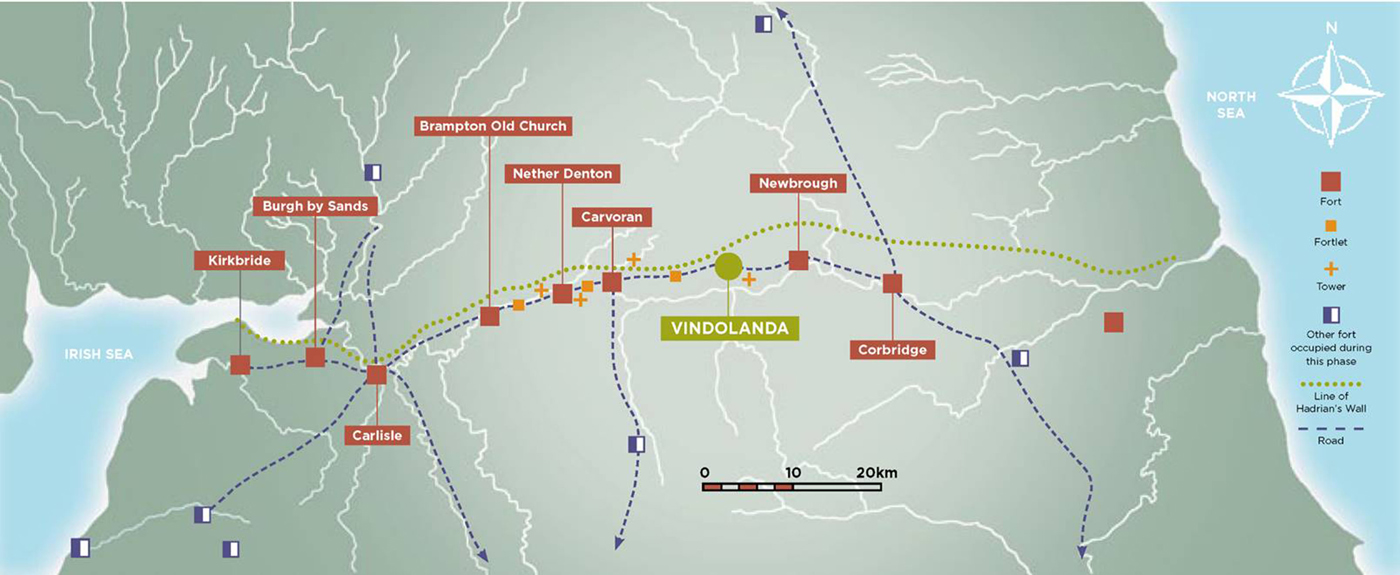
Vindolanda was a military fort and settlement in the province of Britannia near Hadrian's Wall in England, occupied from c. a.d. 85 through to the sub-Roman period in the fifth to sixth centuries (fig. 1).Footnote 4 The fort was an important central point in the defence of the early frontier and remained a key component of the frontier system throughout the construction and use of Hadrian's Wall.Footnote 5 The human remains under discussion were found during excavations in the field to the north of the Stanegate Road (hereafter the North Field), within an early ditch system dating to the first half of the second century a.d.Footnote 6 Vindolanda was an active settlement with four different phases of military forts occupying the main settlement area in quick succession between a.d. 85 and 120. Each fort had a series of defensive ditches to provide protection and demarcation of the military context. The stratigraphic sequence and dating of the main Vindolanda site is well understood, with successive forts in the same location constructed on different alignments using slightly different techniques, each one sealing the archaeological contexts of the earlier occupation periods beneath.Footnote 7
The disposition of forts on the northern frontier in the late first century a.d. in northern Britain. The location of Hadrian's Wall, constructed in the a.d. 120s, is marked by a green dotted line. (© Andrew Birley/The Vindolanda Trust)

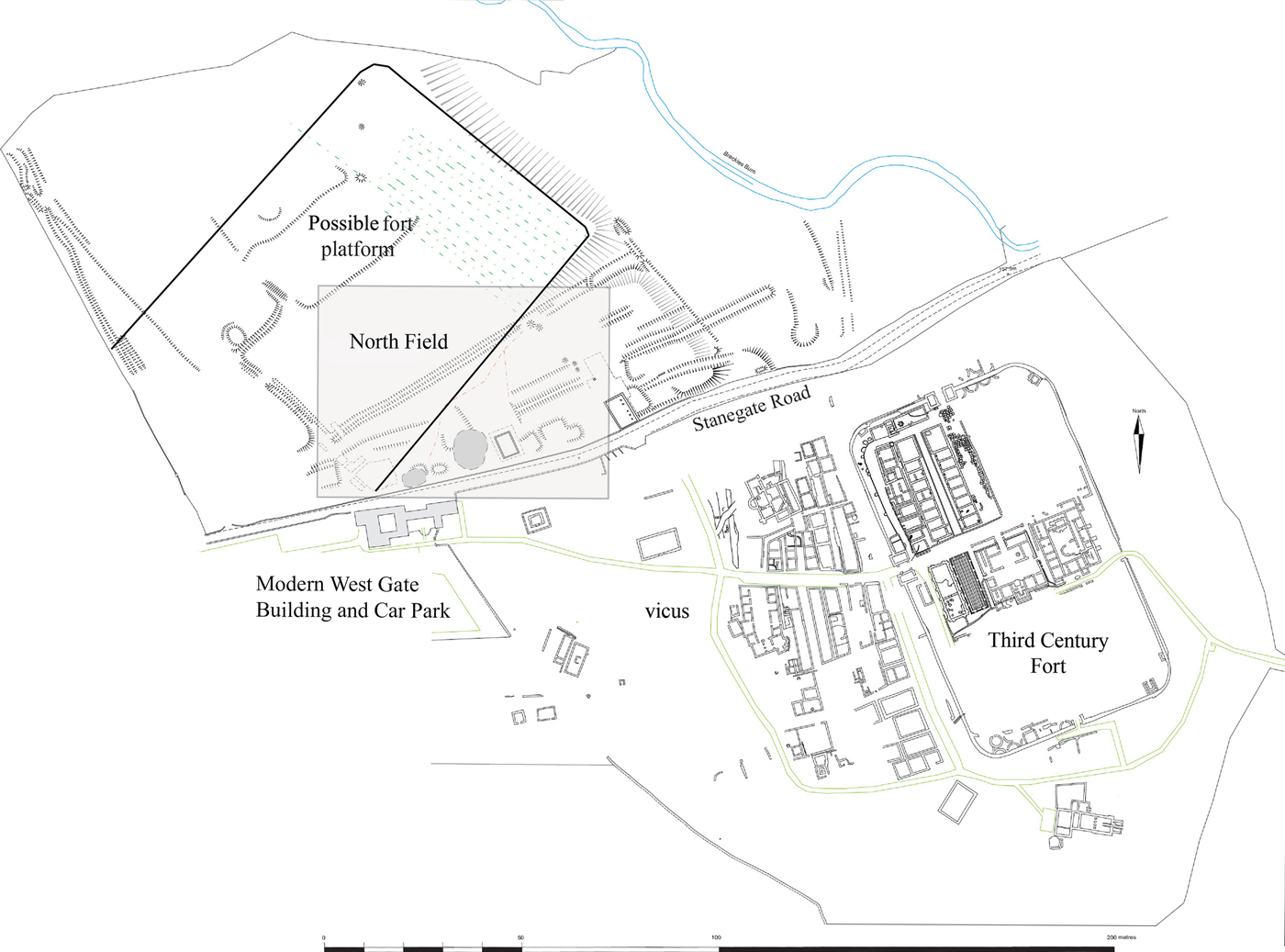
The North Field Project began in 2009 and excavations were completed during the 2017 field season, exploring roughly 5 per cent of the field down to natural boulder clay.Footnote 8 The entire field underwent geophysical (magnetometer and resistivity) survey in 2001, and in 2016 a GPR survey was conducted specifically targeting the depth at which the early ditch system had been found.Footnote 9 The results of both excavation and geophysical investigation suggest that the majority of activity took place in the southern half of the field nearer to the main fort and extramural settlement on the south side of the modern Stanegate Road (fig. 2). The archaeological phases in the North Field represent three broad periods of activity: stone structures associated with third-century a.d. occupation outside the fort; an industrial site with a kiln and associated features such as wells and pits dating to the later second century; and a series of ditches and a single structure dating to occupation sometime between a.d. 85 and 140.Footnote 10 The skeletal remains under discussion here were recovered from the earliest phase of activity detected in the field during these excavations (North Field Phase 1), which was a shallow defensive system containing three ditches in total dating to the first half of the second century. The ditch system indicates that a fort or temporary military accommodation such as a construction camp may have been located in the North Field, on the north side of the ditch system, but the exact nature of that occupation remains unclear.Footnote 11 There is no evidence that the associated occupation was to the south of the ditches discovered. Extensive work has been carried out in that area both in the North Field and on the main site south of the Stanegate and no remains that appear associated with these early Phase 1 ditches were found in the areas investigated down to the natural boulder clay.Footnote 12
The North Field at Vindolanda to the north-west of the known fort settlement of the second and third centuries a.d. The shaded box shows the area of the North Field excavations (see fig. 3 for detail). (© Andrew Birley/The Vindolanda Trust)

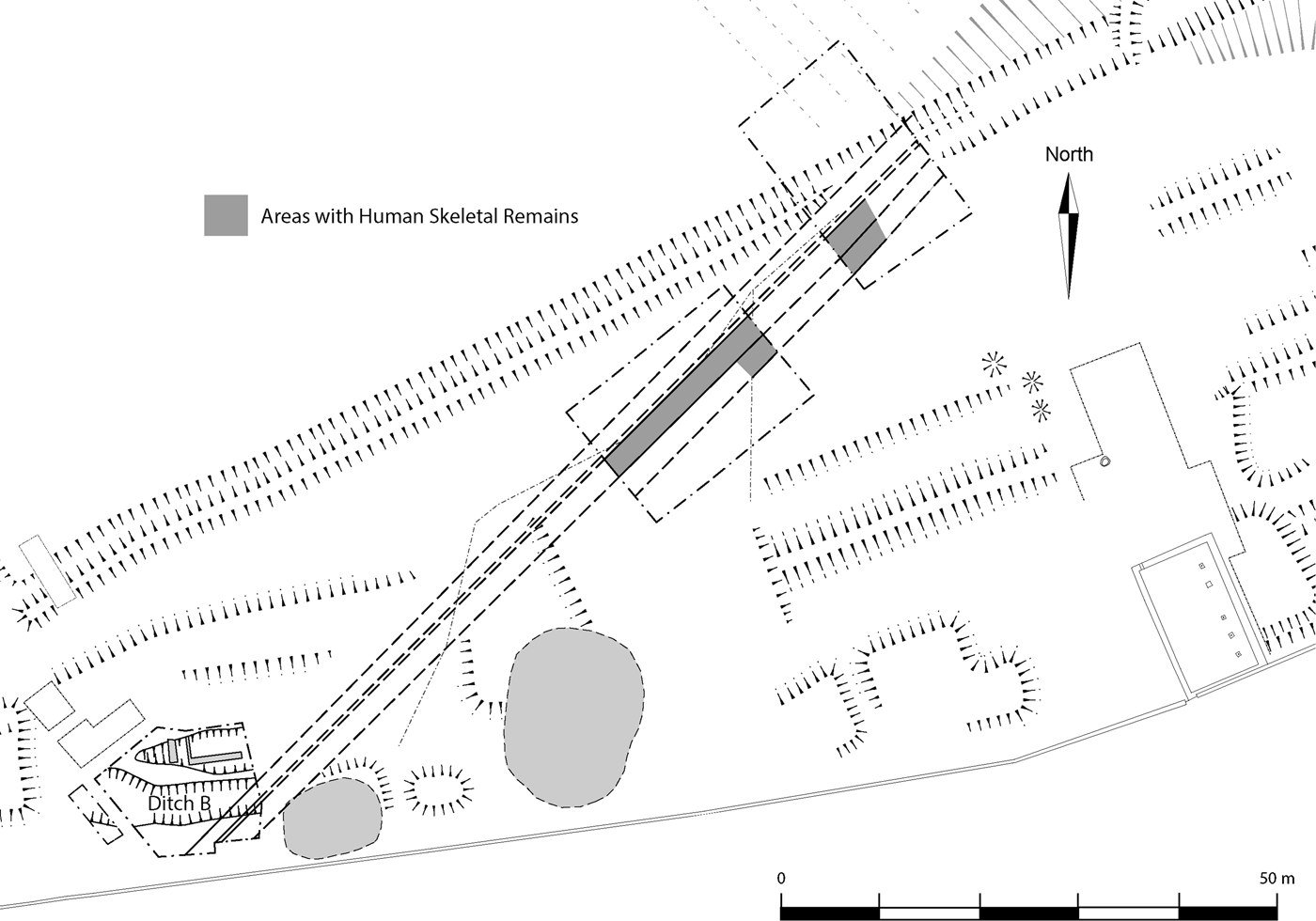
The defensive system itself is somewhat different from others at Vindolanda. It has three parallel ditches in total (fig. 3) with shallow baulks between them and steep cuts on both sides of the whole system, especially on the south side (fig. 4). The defensive system does not appear to be a recut of an earlier ditch, but rather, it is the primary feature in this part of the field, cut into the boulder clay. The shallowness of the ditches, less than 1 m in some places, suggests ephemeral and weak defence or even simple demarcation; however, the steep cuts on both sides of the system as a whole and the total of three ditches indicate somewhat more robust defence. Looking north of the ditches to what they may have defended, test trenches spaced across the area did not reveal any stone or timber structures. This combination of evidence indicates that the ditches may have protected a temporary settlement, perhaps one that was occupied for a period of only months, either to house a temporary vexillation from another unit or a construction camp for a unit building a permanent fort on the main site.
Plan showing the course of the early Phase 1 ditches in the North Field. For detail of the shaded areas where skeletal evidence was discovered, see fig. 7. (© Alexander Meyer/The Vindolanda Trust)

Section drawing of the early Phase 1 ditch profile showing the location of the find contexts in 2012. Western trench edge, section faces east. (© Alexander Meyer/The Vindolanda Trust)

This conclusion might be further supported by the general lack of domestic debris in the early Phase 1 ditch system. Enough pottery was recovered from within the ditch fills to provide a dateable assemblage, but otherwise there was little occupation debris discarded along the three ditches. This lack of domestic material stands in contrast to the abundance of debris recovered from the large fort ditches on the main Vindolanda site to the south.Footnote 13 In addition, the ditch fill in the North Field was predominantly fine silt, which in combination with the lack of discarded artefacts, suggests that the ditches were filled through natural processes without a great deal of human activity. These details might indicate short-term occupation and a lack of lengthy discard practices in the North Field in this early occupation phase at Vindolanda. The presence of human skeletal remains within the fill of this potentially short-lived ditch system, especially in an area of the site that may have been abandoned for some time after this early occupation period in favour of the primary forts to the south, raises questions about their deposition and subsequent taphonomic history.
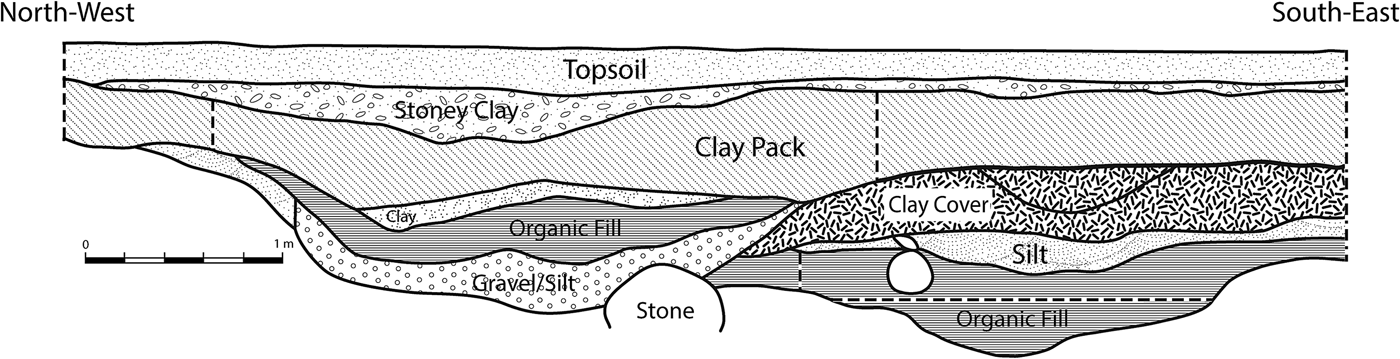
The sequence and dating of the features in the North Field were clear, especially in the 2010 excavations on the west end of the North Field. The date of the earliest ditch system in Phase 1 was determined by finds from within the ditch fills from three trenches in different parts of the North Field and by the stratigraphic sequence of features that overlay the defensive system.Footnote 14 A comparative analysis of the ceramics from the ditch fills with the assemblages from the main site at Vindolanda, and consideration of the coin evidence from nearby features, suggests that this early ditch system was filled sometime between c. a.d. 90 and 140.Footnote 15 This date is supported by specific ceramic evidence such as the occurrence of carinated bowl fragments, roughcast ware and grey rustic ware that are typical of pre-Hadrianic assemblages at Vindolanda and suggest a date in the first quarter of the second century.Footnote 16 A few contexts in the upper levels of ditch fill carry a slightly later date of a.d. 140 based on a small assemblage of ceramics, but most of the Phase 1 ditch system appears to have been filled around a.d. 120. There were no coins in the early ditch fill, but those in the features that lie above date to after a.d. 119. The sequence may be refined a bit further by the superimposition of layers and features. A second, larger ditch (Ditch system B, Phase 2) investigated in 2010, much deeper and wider than its predecessor, cut through the earlier Phase 1 ditches (fig. 3 for location; fig. 5 for section drawing). Ditch system B was on a different alignment and most of its lower fill levels were dated to the late first or early second century by ceramic evidence and a somewhat worn coin of Trajan minted between a.d. 98 and 103.Footnote 17 The early Phase 1 ditch system must date before Ditch system B, which cut through it. Filling of the Phase 1 ditch, however, may have taken place a short time before Ditch system B was cut and filled, since both features produced fills with similar broad dates in the late first century and the first quarter of the second century.
Section drawing showing Ditch system B on the left (north) cutting into one of the early Phase 1 ditches on the right (south/south-east). The section is on the eastern trench edge excavated in 2010, west-facing profile. (© Alexander Meyer/The Vindolanda Trust)

A more precise end-date for the filling of Ditch system B is offered by a stone building that was constructed over and subsided into the northern ditch of this defensive system (see fig. 3 for location). The floor surfaces of the structure produced an unusually high number of discarded ceramics dating to the first half of the second century,Footnote 18 including two mortarium stamps of Felicioles, a potter active between c. a.d. 110 and 140.Footnote 19 The small amount of black burnished ware from the floor and construction levels, which appears not to have been introduced to the area until sometime in the 120s or slightly later, may suggest a date for the construction of the building in the 120s, before the ceramic type was ubiquitous at Vindolanda.Footnote 20 Two somewhat worn coins from fills associated with the floor and the foundations of the building were Hadrianic, one dating to a.d. 119–25.Footnote 21 The evidence as it stands currently suggests that a date of a.d. 125–35 is reasonable for the construction and initial use of this building. Clay pack and fills over the whole area of Ditch system B were dated to the middle of the second century, c. a.d. 150 or 160.
In sum, we must account for these three features — the Phase 1 ditch, the Phase 2 Ditch system B and the building constructed over it — in the period between c. a.d. 90 and c. a.d. 140. Based on the evidence discussed above, Ditch B and the earlier Phase 1 ditch system should date to before c. a.d. 125, although exactly when they were cut and filled within this time period cannot be refined much further with current data. Altogether the stratigraphic sequence and associated finds seem to suggest that these three features were cut, filled and constructed in a relatively short period of time at the end of the first century and in the first half of the second century. It does not appear that the ceramic assemblage will provide any further refinement to that date, nor will scientific dating such as AMS radiocarbon dating applied to the bones found in the early defensive feature.
The human skeletal remains were found within the fill of the Phase 1 ditch system. There is no evidence in the excavated area of the North Field for the presence of burials.Footnote 22 Perceived normative conventions of Roman burial dictate that interment took place away from settlement areas, usually beside roadways. It might seem that the North Field could be a possible location of Roman burials considering its position near the Stanegate. However, the large areas that have now been excavated in the North Field, predominantly lying along the roadside, have not yielded any other human remains or indications of cremation practices nearby. Since the early ditch fills that contained the skeletal remains were part of the primary activity in the North Field so far detected, it is quite unlikely that an earlier burial was disturbed during ditch-digging. Despite the extensive excavation at Vindolanda there is no evidence of pre-Roman activity in the immediate area under or surrounding the Roman military occupation of the site. The taphonomic processes, discussed in detail below, also do not appear to suggest secondary deposition, though this possibility cannot be entirely ruled out. It is thought that the Roman period cemeteries were located to the west of the main fort and extramural settlement, along the road that ran out of the fort and met up with the Stanegate further to the west.Footnote 23 This road is located much further south of the modern Stanegate (see fig. 2 for location within site) and the North Field features under discussion. Additionally, cremation was the more common burial practice in military settlements across the Empire at this time.Footnote 24
A skeleton, even one deliberately buried, is a dynamic entity and the interpretation of the remaining elements is governed by the local ground conditions.Footnote 25 An understanding of the depositional context is therefore important. The North Field has a sloping landscape with a slight downhill gradient from north-west to south-east.Footnote 26 All Roman ditches and watercourses in the North Field follow the natural movement of water to the east. The Phase 1 ditch system lay on an orientation from south-west to north-east.Footnote 27 The flow of water, silt and other material in the ditches, therefore, would have moved in an easterly direction towards a sharp drop in the landscape just before reaching the Chinley Burn, which demarcates the North Field area on the east side (see fig. 2). The excavations have explored roughly 32 m of this defensive system in total, in three different archaeological trenches on the south-western, central and eastern areas of the Phase 1 ditch (see fig. 3). The lowest point of the two parallel ditches in the north-eastern sections of the ditch system where the human remains were recovered lay c. 1.65–1.75 m below ground level (see fig. 3 for location). In table 1 below we distinguish between a northern and southern ditch, both excavated over two seasons in 2012 and 2014. The whole ditch system is generally shallower in the western area of the field, suggesting that the original ground level in antiquity had a sharper drop to the east. There was no disturbance detected in the stratigraphy in the areas where the skeletal remains were recovered that could suggest material had entered the sealed ditch contexts at a later date.

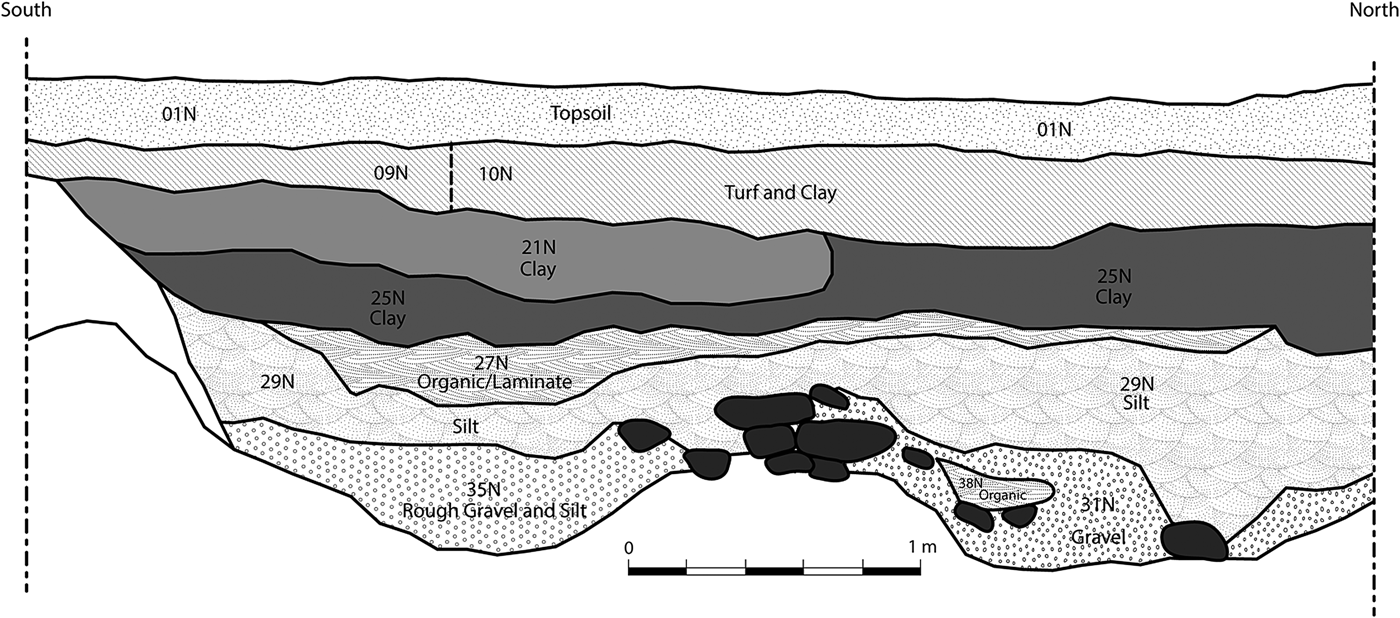
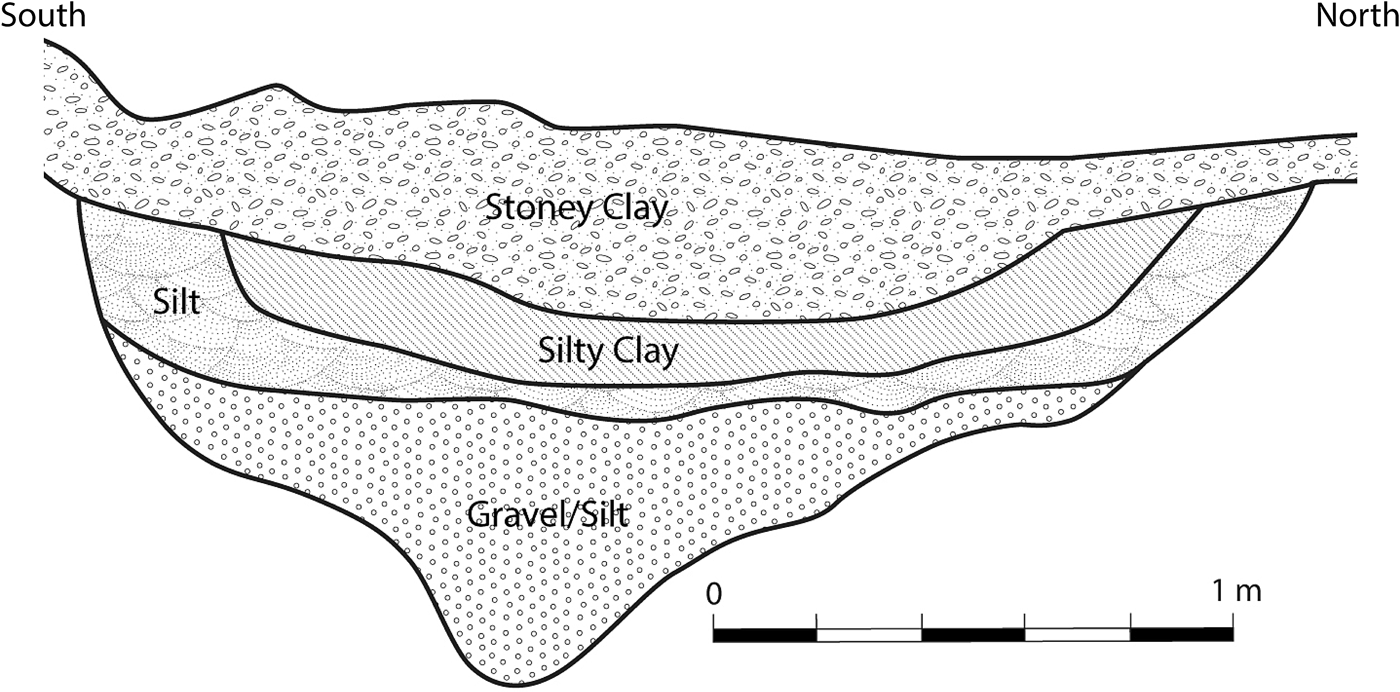
The composition of these stratigraphic layers was heterogeneous, the result of divergent formation processes, causing varied preservation depending on the location within the ditch system and the material of the object entering the fill. Silt was allowed to build up in the early ditches, especially in the area where the skeletal remains lay, with thin bands of organic material above the silt layers found in some sections of the ditches, but not all. The thickest deposit of organic fill (up to c. 60 cm in places) was found in the westernmost trench, which did not produce human remains. Since the ditches would easily fill with water at a natural low point in the field, especially on the eastern side, there would often have been significant amounts of running water in the ditches. Soil was carried along the course of the ditch and accumulated where water movement slowed and in places of congestion including flat sections. This silting process could happen quite rapidly in certain situations, such as during heavy rainstorms, when we estimate that the bottom of the ditch could be filled with c. 25 cm of silt in a matter of days or weeks. During the recent excavation season a fully excavated Roman ditch filled with c. 10 cm of silt overnight. The layers of silt found in the early ditch were very soft and permeable, allowing material deposited into the ditch to sink and settle into the levels below, depending on the size and weight of an object (fig. 6).
Profile of the early Phase 1 ditch from the centre of the 2014 trench, section faces east. (© Alexander Meyer/The Vindolanda Trust)

The formation processes of the ditch fills, including the human remains, can therefore be understood. At the very bottom of the individual ditches a layer of wet, gravelly silt accumulated to a depth of c. 30 cm. Pebbles and heavy material within the ditch fell through the softer silt and accumulated at the bottom (e.g. context V12-35N on fig. 4), while the fine, sandy, wet silt sits in a higher layer above to a depth of c. 25 cm (e.g. context V12-29N). Above this silt was a layer of organic accumulation or silt mixed with organic deposits (e.g. context V12-27N). These layers of fine silt and mixed organic material included a small number of artefacts that had not sunk into the silt, such as leather, ceramics and butchered animal remains. A large, heavy object falling into the ditch would most likely have sunk into the sediments, possibly resting on the ditch bottom. Parts of the object still exposed would have been covered subsequently by several different stratigraphic layers that formed around the object as the ditch accumulated sediments from natural movement of water and material.
The exact rate of silt accumulation cannot be calculated with certainty because it is dependent upon unknown factors such as rainfall and water movement. However, based on observation of excavation ditches during recent seasons, an object within a ditch could have been partially or completely covered swiftly. There is an indication that the silt layers in the Phase 1 ditch built up rather quickly. The silt accumulation contained few artefacts that are the typical by-product of human activity. If the ditch lay open for an extended period of time and silted up slowly, one would expect a certain amount of detritus from human occupation to have entered the fill, as is found in other ditch contexts at Vindolanda.Footnote 28 In the stretch of the Phase 1 ditch where the human remains were found, the silt layer was subsequently covered rapidly with other debris forming a different stratigraphic layer. In some areas of the early Phase 1 ditches in the North Field a thin layer of organic earth and artefacts from human discard collected over the silt. Therefore, the silt could have accumulated in a short period of time, especially in stormy periods, and anything lying in the ditch would have been quickly covered by silt and obscured by subsequent deposition.
Defensive ditches were a standard component of almost every military site in the Roman world,Footnote 29 and are also a feature of small fortlets and temporary camps to varying degrees. They served as the defensive element outside the fort walls and were critical to the basic security of a military garrison. Whilst in use, ditches were cleaned out fairly regularly, clearing the area of silt and debris.Footnote 30 Once a ditch ceased to be maintained, usually towards the end of occupation by a particular garrison, it was allowed to fill with silt from natural movement of water and soil, as well as with discarded material,Footnote 31 resulting in stratigraphic layers that reflect both natural and human activities. Human debris usually includes animal bones, household refuse and other by-products of light industry and production. The presence of human remains is unusual, but not unique in Roman forts, with possible war trophy skulls having been found in defensive boundary fort ditches at Vindolanda and elsewhere.Footnote 32
FORENSIC TAPHONOMY
When human bones are found in an archaeological context, particularly when not in a standard grave cut, it is important to recognise the circumstances by which the remains arrived in the state and situation in which they were discovered.Footnote 33 The analysis of a skeleton or partial skeleton should consider fully the taphonomic history of the body and the many dynamic formation processes that have combined to create the context in which the bones are found.Footnote 34 No one suite of taphonomic characteristics will be found on all excavated skeletal remains since the circumstances of burial or deposition vary so widely in context and duration.Footnote 35 In a deliberate grave cut the body is within an enclosed space and movement of the bodily articulations is limited by the boundaries of the empty volume of the cadaver. This volume is created by the infilling of the decomposed space of the body with the surrounding sediment. In such an enclosed space separating joints are unlikely to be disturbed from their original resting place as the pressure exerted from the surrounding sediment and lack of large scavenging animals keep the body largely in articulation.Footnote 36 In contrast, bodies that are left unburied or submerged in shallow water are rarely recovered intact and in anatomical position. Due to the decomposition of the connective and soft tissues the skeletal remains will eventually become disarticulated and are likely to be found dispersed from their original location of deposition.Footnote 37 Archaeological and palaeontological studies of water-transported remains relate the transport and hydrodynamic sorting potentials of different skeletal elements to differences in size, density and shapeFootnote 38 and each body of water will have a unique set of taphonomic circumstances.Footnote 39 As very little information regarding the impact of specific aquatic environments is availableFootnote 40 and much of forensic taphonomic research pertains to bodies dispersing in rivers, the interpretation of remains in this context should be considered with some caution. To answer the question of the ultimate origin of any single set of remains, the accompanying depositional contextual information is crucial.
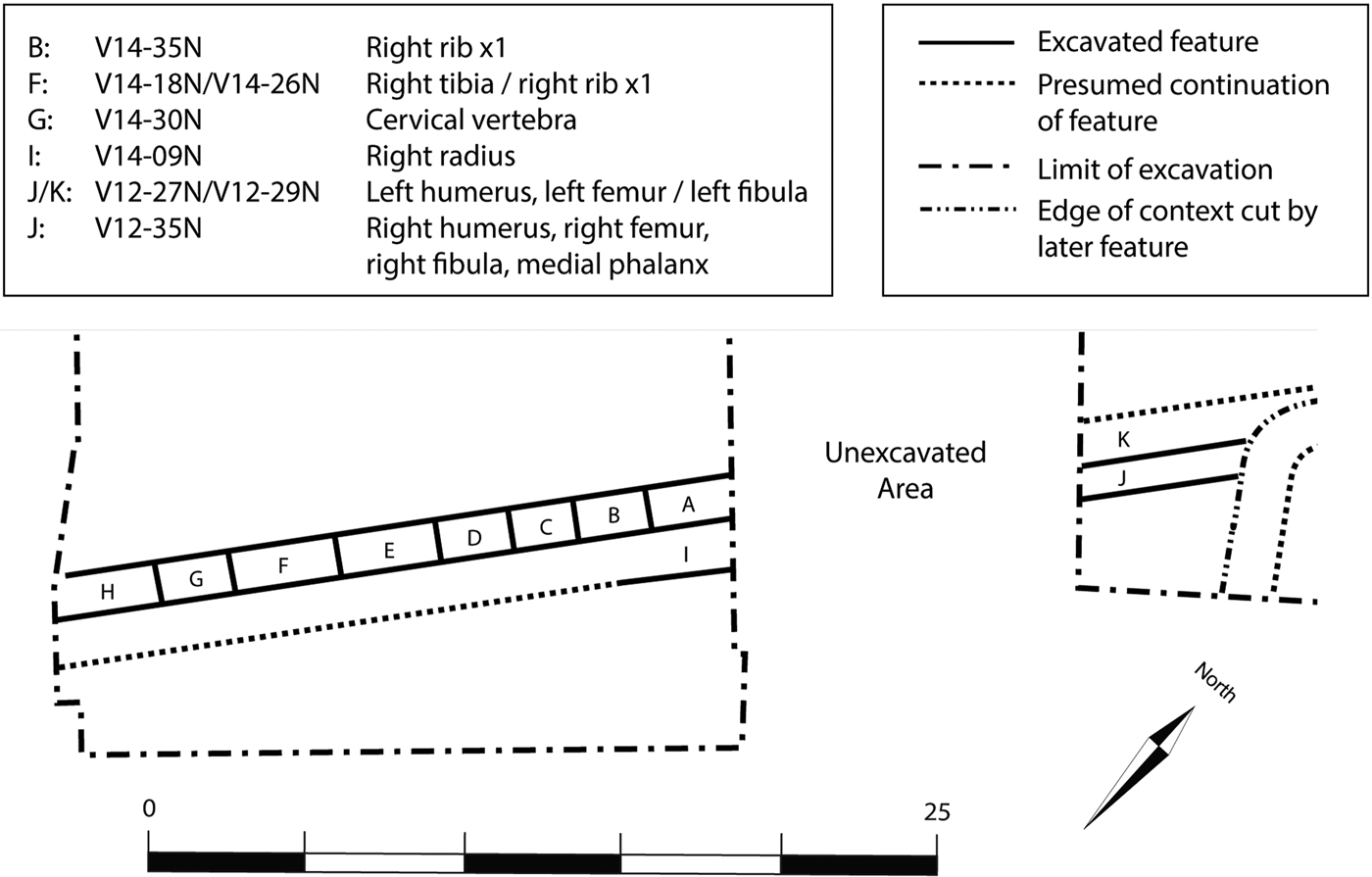
In unburied bodies disarticulation is thought to occur in a cephalic-caudal direction with the cranium separating first followed by the limbs.Footnote 41 The processes of decomposition, disarticulation and skeletonisation vary greatly in accordance with where the body is deposited; for example a body exposed to the open air will become skeletonised much faster than one in an enclosed environment.Footnote 42 The type of anatomical joint is important in the pattern of disarticulationFootnote 43 and in an aquatic environment water activity will affect more flexible joints more quickly than less flexible ones.Footnote 44 A general disarticulation sequence for bodies in moving water has been observed,Footnote 45 with the bones of the hands, wrists, feet and ankles separating first, along with the mandible and cranium. The bones of the lower legs and arms are thought to be the last elements to disarticulate. Controlled experimental observations of disarticulation patterns have demonstrated that various factors can greatly influence the bone displacement pattern of a human skeleton,Footnote 46 including the depositional environment and positioning of the body as well as the presence or absence of clothing and ante-mortem trauma. Once disarticulated or part-disarticulated, the individual skeletal elements will then be transported along the available space at different speeds. The effect of this differential transportation is that body parts can be spread over a wide area, or along the length of a ditch, and will follow different taphonomic routes as a result. fig. 7 illustrates the horizontal separation of the ditch contexts and the dispersal of the individual skeletal elements along these contexts. The more complete long bones were mainly found together further downstream, with the axial skeleton and the smaller fragments of tibia and radius upstream. No cranium has yet been found, but if present at deposition it would possibly be found further downstream in the unexcavated section of the ditch due to the flow properties of its more rounded shape.
Plan of the ditches excavated in 2012–14 with separation of contexts. Human skeletal remains found in squares B, F, G, I, J and K. This area corresponds to the shaded sections of ditch in fig. 3. (© Alexander Meyer/The Vindolanda Trust)

OSTEOLOGICAL ANALYSIS
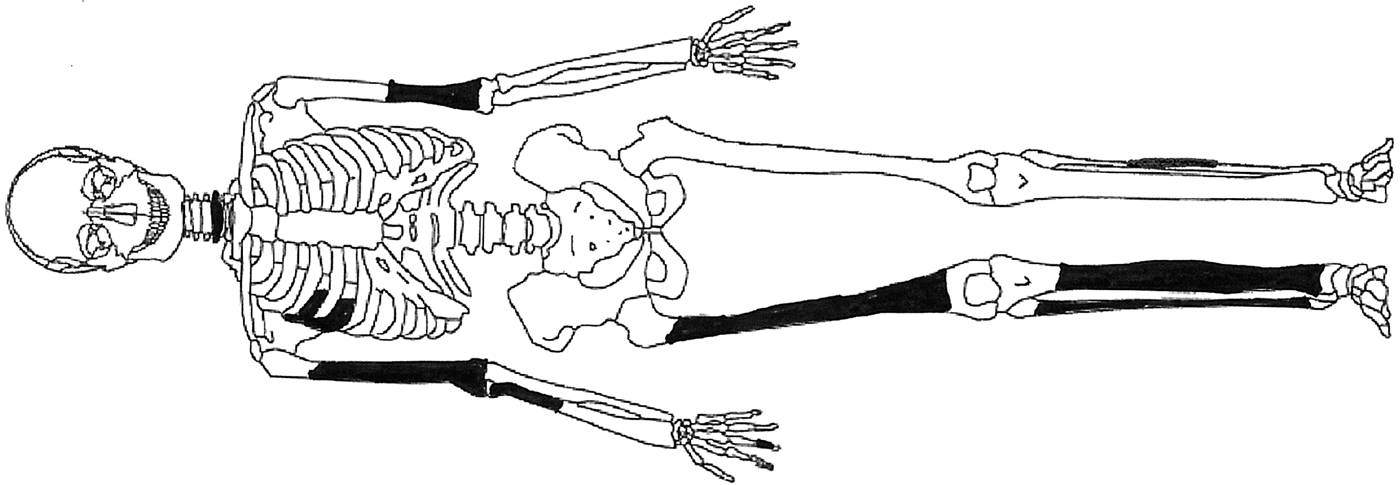
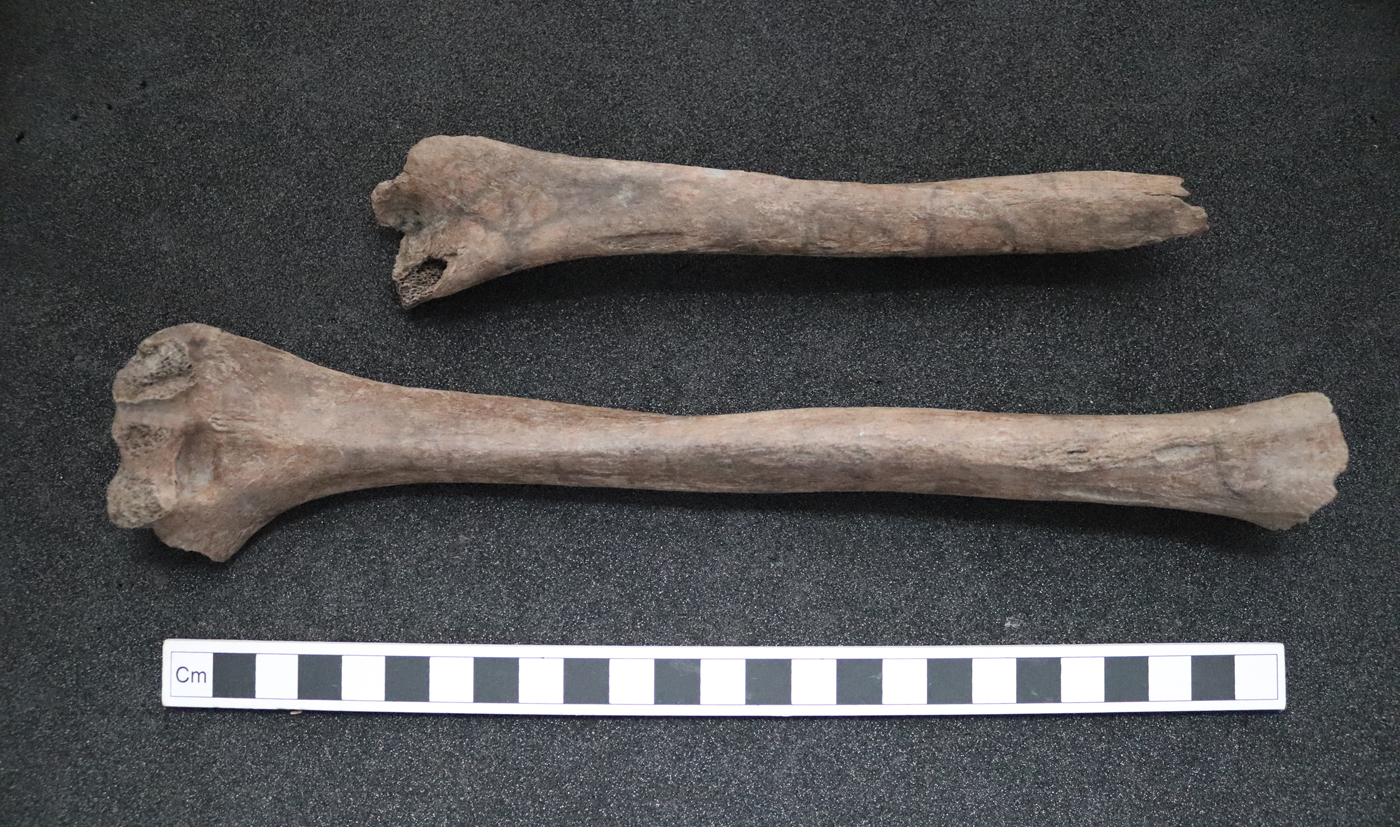
Skeletal elements from both the appendicular and axial skeleton are represented (figs 8–11), though no cranial bones have been found at this time. table 1 describes the skeletal elements present, their state of preservation and the ditch context in which they were found. The minimum number of individuals represented is one and the maximum twelve. There is no replication of any of the sided skeletal elements and the similarity in size of the antimeres,Footnote 47 where present, makes an interpretation of the bones coming from one individual the most likely explanation.
Skeletal elements represented, siding and level of preservation. (© Trudi Buck/The Vindolanda Trust)

Diaphysis of the right femur from the North Field skeleton. (© Trudi Buck/The Vindolanda Trust)

Diaphysis of the right tibia from the North Field skeleton. (© Trudi Buck/The Vindolanda Trust)

Right and left partial humeri from the North Field skeleton. (© Trudi Buck/The Vindolanda Trust)

The human skeletal elements were found dispersed along the fill of the ditch over a distance of approximately 15 m (see table 1 and fig. 7). Following disarticulation, the human bones showed patterns of fragmentation similar to the non-human animal bones found in the ditch system, due to the in-situ destruction caused by processes such as chemical dissolution and physical breakage during movement.Footnote 48 Of the long bones only the right humerus has an intact distal epiphysis, which was fully fused, indicating that the individual was an adult. Sex was determined by analysis of nuclear DNA taken from the right femur, indicating that the skeleton was male (see Supplementary Material). Only the femur was viable for DNA sampling and a moderate to high level of degradation of DNA was found. It was therefore not possible to test using DNA whether all bones came from the same individual.
Individual bones were examined for evidence of trauma and taphonomic changes, including colour change, breakage patterns, carnivore activity and abrasion.Footnote 49 table 1 gives the find context, position and description of the sediment for the individual skeletal elements. All recovered bones were incomplete but there was no indication of damage from animal activity, for example by rodent or carnivore gnawing,Footnote 50 nor was there any evidence of trauma or cut marks that would indicate human-induced post-mortem bone modifications.Footnote 51 The colour of the bones ranges from light to dark brown. Each skeletal element was subject to differential preservation, depending on the specific find location (see table 1) and post-mortem environment. None of the bones shows modification or weathering such as cracking or flaking along the diaphysis that would indicate that the skeleton had been exposed to the air for an extended period of time.Footnote 52
Two indicators of primary significance for these human remains are the preservation of the individual skeletal elements and the differential deposition of the remains through the length of the ditch. These suggest a scenario whereby an articulated body was disposed of in a waterlogged ditch and likely left unburied at, or shortly after, the time of death. The scatter pattern and differential preservation of the bones do not follow the expected pattern for a primary deposit in an enclosed space such as a deliberate grave.Footnote 53 It cannot be ruled out, especially since the cranium has not yet been located, that the skeleton represents a secondary deposit after the original burial had occurred and the body had undergone decomposition and disarticulation.Footnote 54 However, the presence of smaller skeletal elements including ribs, a vertebra and a phalange makes a secondary deposition less likely as these less robust bones are especially vulnerable to post-mortem events and are also less likely to be represented in assemblages deliberately curated, for example after exposure, as they are more easily overlooked or displaced.Footnote 55 It is also unlikely that the body was in the open air for an extended period of time as there is no evidence of animal scavenging on the bones as would be expected on a body subject to sub-aerial exposure,Footnote 56 though the use of negative evidence should be treated with caution here. A lack of rodent or canid modification can indicate the deposition of remains following only a relatively brief period of exposure or none at all,Footnote 57 though consideration is given to the fact that only part of the skeleton has been recovered. The skeleton is likely to have been disarticulated and the individual elements transported by water movement following heavy rains and the downhill gradient of the ditch. Decay of tissues occurs differently in flowing water than in standing bodies of water due to different biota and the buffeting of tissues as the body impacts against the ditch bottom during transport.Footnote 58 The interpretation of isolated, water-transported human bones such as these can be challenging due to the long distances that they can move from their original depositional context in addition to the effects of various diagenetic alterations from the substrate in which they are buried.Footnote 59
DISCUSSION AND CONCLUSIONS
Isolated human remains from Roman archaeological sites have been excavated previously but are often given less precedence in analysis in favour of more traditional burials in cemeteries or mausolea.Footnote 60 This discussion analyses the human remains recovered from the Phase 1 ditch in the North Field by placing them into the larger cultural, environmental and taphonomic context and adds to the growing body of literature on alternative burial practices in the Romano-British archaeological record.Footnote 61 Using the principles of forensic taphonomy, our working hypothesis is that the spatial distribution of the skeleton along the length of the defensive ditch, in addition to the absence of post-mortem modification, suggests that the partial skeleton was the result of a primary deposition with no deliberate burial. Soft tissue decomposition of the body occurred in a waterlogged environment, leaving disarticulated body parts spread along the ditch.
If this interpretation of the primary deposition of the corpse is correct then we have to question how this fits in with what are considered normal burial practices in the early Roman Empire and what this means for the further interpretation of the context of death and disposal. Whilst burial in Roman Britain followed a variety of rites derived from across the Empire, the general perceived theme is one of respect and care of the corpse, by burial in a shroud or coffin or by cremation and by provision of grave goods for the afterlife.Footnote 62 Body disposal methods that have been described as deviantFootnote 63 are increasingly being excavated from the Roman period, including decapitation burials such as at Driffield Terrace in York and burials located in unpopular or rarely visited areas of the cemetery in the Upper Walbrook valley.Footnote 64 The term ‘deviant’ has been used to refer to individuals who seem, by right of their burial treatment, to have been shunned or excluded outright from society.Footnote 65 These ‘deviant’ burials consist of atypical manipulation of the corpse or skeleton but are usually still located within cemetery contexts. Aspöck demonstrated that a single society can use a variety of burial practices that can all be considered normative.Footnote 66
Alternatively, the North Field skeleton may be part of what have been referred to as ‘the invisible dead’,Footnote 67 that is the products of funerary practices that leave little or no archaeological traces. Disarticulated skeletons and partial skeletons are often found in Roman excavations, with bodies deposited in wells, as at Verulamium and at Queen Street, London,Footnote 68 and isolated cranial and post-cranial remains found in, amongst other places, ditches and rivers.Footnote 69 Large numbers of crania and some post-cranial elements have been found in the Walbrook stream and its tributaries in London with differing interpretations having been put forward for these remains, including suicide, violent death, victims of the Boudiccan revolt, fluvial erosion from cemeteries and deliberate ritual deposition in watery contexts.Footnote 70 Excavations at the site of Moor House, City of London, have also uncovered numerous disarticulated human remains in ditch fills.Footnote 71 It is thought that at least some of these remains were deliberately deposited in the ditches as part of an excarnation ritual as some of the long bones displayed cut marks associated with defleshing.Footnote 72 It is unlikely that the Moor House remains, as those of the North Field skeleton, were the result of fluvial erosion from a grave as no in-situ inhumation burials were found in the area.
Disarticulated remains are important for interpreting attitudes to the dead in the Roman period.Footnote 73 The recorded remains of formal burials, whether ‘deviant’ or ‘normative’, may only be a small fraction of the overall population of Roman Britain, particularly in rural areas.Footnote 74 The disarticulated remains found on a variety of Roman sites may represent the ‘invisible dead’Footnote 75 and reflect alternative funerary practices to those found within the more visible cemetery contexts. Of 70 rural settlement sites in south-east England where disarticulated remains were excavated, 19 contained no evidence for formal burial.Footnote 76 These remains may be evidence for alternative funerary traditions, including exposure and excarnation, and may even be the normative rite in some rural areas. It has been proposed that these alternative practices are a continuation of traditional Iron Age funerary rites that left little evidence in the archaeological record,Footnote 77 including the deposition of bodies in or near sources of water such as wells, ditches and rivers.Footnote 78 Harding argues that the fragmentation and dispersal of the dead during the Iron Age is a standard form of disposal that may reflect long-standing traditions continuing from the Bronze Age and surviving beyond the Roman occupation.Footnote 79 For example, skeletal remains covered with a layer of natural silt were excavated from pits on Danebury hillfort.Footnote 80 The layer of silt suggests that the pits had been left open whilst the bodies decomposed. Many remains without a burial context date to the late Iron Age and early Roman period.Footnote 81 Other disarticulated human remains are known from early Roman Britain, such as the isolated vertebrae from a ditch at Jubilee Villa, Oxon.,Footnote 82 and a disarticulated skeleton from a ditch in Hockwold-cum-Wilton, Norfolk.Footnote 83
It is outside the scope of the present study to speculate exactly what happened to this man but a taphonomic analysis of the skeleton suggests that the body was not formally buried; rather it was covered over by the natural fill of the ditch and left to decompose.Footnote 84 The early date of the North Field ditch system could potentially suggest a victim of war, sacrifice or violence. Hope describes how in times of war normal burial practices could be supplanted by practical solutions and war dead would be buried in mass graves.Footnote 85 The presence of a single individual makes this scenario unlikely, though this interpretation could be revised should further human remains be found in this location. Hope also suggests that at certain times a symbolic covering of the body by only a couple of handfuls of earth would satisfy the ritual requirement.Footnote 86 Ritual deposition in a liminal place such as a boundary ditch is another possible interpretation. Some bog bodies from across the Empire have been interpreted as evidence of sacrifice,Footnote 87 though there is no specific evidence at Vindolanda to support this scenario.
The increasing numbers of deviant or alternative body disposals recognised in Roman Britain, such as the child skeleton found beneath the floor of a barrack building at Vindolanda,Footnote 88 decapitation burials in YorkFootnote 89 and the crania and post-crania from the Walbrook streams,Footnote 90 highlight the need for expanding analytical approaches to burial in Roman Britain.Footnote 91 Even individual skeletons and burials can fill in gaps in our knowledge of Roman burial and challenge the existing status quo. Archaeologically visible burials, whether inhumation or cremation, may not fully represent funerary practice in the province.Footnote 92 An increased reporting and awareness of these alternative or invisible funerary processes can enhance our understanding of Romano-British society. This discovery adds to the growing body of literature regarding alternative funerary practice in the Empire, highlighting that the concept of burial and disposal of the dead is more complex than ancient historical sources suggest.
SUPPLEMENTARY MATERIAL
For Supplementary Material for this article please visit https://doi.org/10.1017/S0068113X1900014X.
ACKNOWLEDGEMENTS
The authors would like to thank Robin Birley, Dr Andrew Birley and the Vindolanda Trust for the permission and support to conduct the field research presented here. Special thanks to the excavation team for their hard work and the conservation team for the post-excavation efforts. Significant funding to conduct the field research in the North Field at Vindolanda was provided by the Social Science and Humanities Research Council, Canada, and The University of Western Ontario Academic Development Fund. The external funding bodies had no role in study design, collection, analysis or interpretation of data, and had no influence on the written report or choice of publication.