Introduction
Thrips are direct and indirect pests of both agricultural and horticultural crops. As vectors of tospoviruses, they transmit some of the most important diseases worldwide (Ullman et al., Reference Ullman, Meideros, Campbell, Whitfield, Sherwood and German2002). Out of 5500 described species of thrips, only 11 species are reported to be vectors of tospovirues globally (Mound, Reference Mound2005). In India, watermelon bud necrosis virus (WBNV) and Iris yellow spot virus (IYSV) are transmitted by T. palmi and T. tabaci, respectively (Singh & Krishna Reddy, Reference Singh and Krishna Reddy1996; Ravi et al., Reference Ravi, Kitkaru and Winter2006). A peculiarity with thrips transmitted tospoviruses is that only the nymphs can acquire the virus while the adults can transmit (Whitfield et al., Reference Whitfield, Ullman and German2005). Morphological identification of thrips, both in adult and nymphal stages, is limited by the high degree of similarity of various developmental stages of thrips (Brunner et al., Reference Brunner, Flemming and Frey2002), polymorphism (Murai & Toda, Reference Murai and Toda2001) and also by the paucity of trained manpower, etc. On the other hand, molecular identification is not limited by polymorphism, sex and stage of development of the target species and development of suitable markers will all help a non-specialist to identify a given species. In addition to the above, molecular studies could also elucidate prevalence of biotypes and biotype associated strain variations in tospoviruses, if any. For species identification and molecular diversity studies, researchers have employed various molecular markers and methods, viz.: period (Barr et al., Reference Barr, Gui and McPheron2005), cytochrome b, 16S rRNA, 18S rRNA, 28S rRNA, 5.8S rRNA (Rokas et al., Reference Rokas, Nylander, Ronquist and Stone2002; Kjer, Reference Kjer2004), microsatellites (Kim & Sappington, Reference Kim and Sappington2005), real time PCR (Kox et al., Reference Kox, Vanden Beld, Zijlstra and Vierbergen2005), polymerase chain reaction – restriction fragment polymorphism (Toda & Komazaki, Reference Toda and Komazaki2002), random polymorphic DNA (Bayar et al., Reference Bayar, Torjek, Kiss, Gyulai and Heszky2001; Gyulai et al., Reference Gyulai, Bayar, Torjek, Kiss, Kiss, Szabo and Heszky2001), internal transcribed spacers (Moritz et al., Reference Moritz, Paulsen, Delker, Picl and Kumm2001; Toda & Komazaki, Reference Toda and Komazaki2002), mitochondrial cytochrome oxidase (mtCOI) (Brunner et al., Reference Brunner, Flemming and Frey2002; Frey & Frey, Reference Frey and Frey2004), etc., in a number of organisms. Since mtCOI shows reliable inter-specific variation as compared to other markers (Savolainen et al., Reference Savolainen, Cowan, Vogler, Roderick and Lane2005), primers specific to mtCOI were employed in this study to find out the molecular differences between the two important thrips vectors, viz. T. tabaci and T. palmi. This investigation was also carried out to identify species-specific markers for the above species and to carry out phylogenetic analysis.
Materials and methods
Stock culture and morphological identification
The thrips species, viz. T. tabaci and T. palmi, were collected on onion (Allium cepa cv. Arka Niketan) and watermelon (Citrullus lanatus var. lanatus cv. Arka Manik), respectively, at the experimental farm of the Indian Institute of Horticultural Research (IIHR), Bangalore, India. Pure cultures of both species were maintained on French bean pods (Phaseolus vulgaris cv. Arka Komal) in plastic containers (10×10 cm) at room temperature (30–32°C) and RH 70–90%. Morphological identification of T. tabaci and T. palmi was carried out prior to molecular studies (Bhatti, Reference Bhatti1980).
DNA isolation and polymerase chain reaction
A single adult female of T. tabaci and T. palmi from the stock culture was used for the extraction of DNA. Individual thrips were taken in 0.5 ml PCR tubes containing 10 μl of molecular biology grade water (DNAase-free and RNAase-free) (Eppendorf, Germany) and ground thoroughly using sterile plastic micro pestle. The homogenate was incubated in boiling water for 5 min, stored at −20°C for 10 min and centrifuged at 8000 g for 5 min at 4°C. Five micro liters of the supernatant were used as template for PCR.
PCR was carried out in a thermal cycler (Primus 96; MWG Biotech, Germany) with the following cycles: 94°C for 3 min as initial denaturation followed by 40 cycles of 94°C for 30 s, 53°C for 45 s, 72°C for 1 min and 72°C for 20 min as final extension. Primers specific to mtCOI, viz. mtD7.2F – 5′ATT AGG AGC HCC HGA YAT AGC ATT-3′ and mtD9.2R – 5′GAG GCA AGA TTA AAA TAT AAA CTT CTG-3′, resulting in the amplification of an approximately 500 bp fragment (Brunner et al., Reference Brunner, Flemming and Frey2002), were used in the present study. PCR was performed in a 25 μl total reaction volume containing 20 Pico moles of each primer, 10 mM Tris-HCl (pH8.3), 50 mM KCl, 2.5 mM MgCl2, 0.25 mM of each dNTP and 0.5 U of Taq polymerase (Fermentas GmBH, Germany). The amplified products were resolved in 1.5% agarose gel, stained with ethidium bromide (10 μg ml−1) and visualized in a gel documentation system (UVP, UK). For the species-specific primers mentioned in table 1, PCR mix and PCR cycle parameters were the same as above except for annealing temperature, which was 60°C for 35 s and 55°C for 35 s for T. tabaci and T. palmi, respectively.
Species-specific markers identified for T. tabaci and T. palmi.

Molecular cloning and sequencing
The PCR amplified fragments were eluted using Perfect prep® according to the manufacturer's protocol (Eppendorf, Germany) and ligated into the general purpose-cloning vector, InsT/Aclone (Fermentas GmBH, Germany) according to the manufacturer's protocol. Five micro liters of the ligated vector was cloned into 200 μl of competent Escherichia coli (DH5α) cells by heat treatment at 42°C for 45 s and the whole content was transferred into a tube containing 800 μl of SOC (tryptone-2% w/v, yeast extract-0.5% w/v, NaCl-8.6 mM, KCl-2.5 mM, MgSO4-2.0 mM, Glucose-20 mM in 1000 ml water, pH7.0) and rotated at 150 rpm, 37°C for 1 h; 200 μl of the above culture was spread on Luria Bertani agar (LBA) (tryptone-10 g, yeast extract-5 g, NaCl-5 g, agar-15 g in 1000 ml of water, pH 7.0) containing ampicillin (100 g ml−1), IPTG (4 μg ml−1) and X-gal (40 μg ml−1) and were incubated at 37°C for 16 h. Blue/white selection was carried out and all the white colonies (colonies harbouring the insert) were maintained on LBA containing ampicillin (100 μg ml−1), incubated at 37°C overnight and stored at 4°C until further use.
Plasmids were prepared from the overnight culture of the positive colonies cultured in LB broth (enzymatic casein-10 g, yeast extract-5 g, NaCl-5 g in 1000 water, pH 7.0) using modified alkali lysis method (Birnboim & Dolly, Reference Birnboim and Dolly1979). Plasmids were resolved in 1.0% agarose gel, stained with ethidium bromide (10 μg ml−1) and visualized in a gel documentation system. Clones that had 2.3 kb as compared to control plasmid (1.8 kb) were selected for sequencing. For the purpose of sequencing, plasmids were isolated using plasmid kit mini (Qiagen, Germany) according to manufacturer's protocol, from overnight cultures of the five randomly selected clones multiplied in LB broth. Sequencing was carried out in an automated sequencer (ABI Prism 310; Applied Biosystems, USA) using M13 universal primers both in forward and reverse directions. Homology search was carried out using BLAST (http://www.ncbi.nlm.nih.gov), and the differences in mtCOI sequences of T. tabaci and T. palmi were determined using the sequence alignment editor ‘Bioedit’. Sequences for T. tabaci and T. palmi were deposited with the NCBI database, and the accession numbers were DQ228494 and DQ228495, respectively. For the development of species-specific markers for T. tabaci and T. palmi, nine sets of forward and reverse primers were synthesized based on the variable regions in the aligned sequences of DQ228494 and DQ228495. The primers thus designed were tested both on identified T. tabaci and T. palmi (five specimens each of T. tabaci and T. palmi) and five each of unidentified test specimens collected from onion and watermelon. The PCR amplified fragments resulting from species-specific markers for T. tabaci and T. palmi were further cloned, sequenced and analyzed as above. The sequences for T. tabaci and T. palmi obtained in this study were compared with other NCBI accessions for the above two species for the mtCOI gene, and a cladogram was developed using ‘Treeview’ (Page, Reference Page1996).
Results and discussion
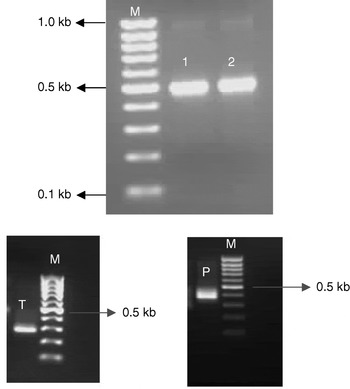
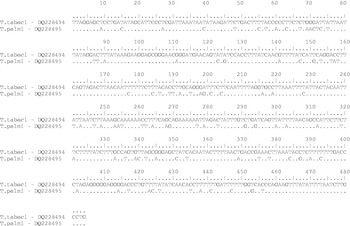
A single fragment of approximately 500 bp was amplified for both T. tabaci and T. palmi (fig. 1), and the total nucleotide length obtained was 484 in both cases. A comparison of the replicate sequences for both T. tabaci and T. palmi showed no mismatch, indicating there was no sequencing error. A similarity search using BLAST for sequences DQ228494 for T. tabaci and DQ228495 for T. palmi showed a maximum similarity for the respective species. Pair-wise alignment of DQ228494 and DQ228495 showed that there were variations in 91 nucleotides out of the total 484, amounting to a 20% difference between the species (fig. 2). Out of nine primer sets identified each for T. tabaci and T. palmi, one primer set, viz. 2 RA f & 5 RA r and 1 RA f & 5 RA r, could successfully identify T. tabaci and T. palmi, respectively (table 1, fig. 3). These species-specific markers amplified an expected fragment size of 298 bp and 390 bp for T. tabaci and T. palmi, respectively. BLAST search of the above sequences obtained using species-specific markers showed a maximum hit for the respective species. Similarly, same size bands were obtained from test thrips specimens collected from onion and watermelon. The sequences from the test specimens also showed a maximum hit for respective species (data not shown). Since the primers developed by Brunner et al. (Reference Brunner, Flemming and Frey2002) resulted in the amplification of same size bands (500 bp) both for T. tabaci and T. palmi, species identification was not possible without sequencing. On the other hand, the species-specific markers identified in this study resulted in differential amplification for T. tabaci (298 bp) and T. palmi (390 bp). Similarly, Kox et al. (Reference Kox, Vanden Beld, Zijlstra and Vierbergen2005) identified a successful species-specific marker within mtCOI sequences for T. palmi and identified the same using real-time PCR.
Consensus sequence of 484 bp from the mitochondrial cytochrome oxidase I (mtCOI) gene for the Bangalore strain of T. tabaci and T. palmi. Dots indicate nucleotides identical throughout the species compared.

Validation of species-specific markers for T. tabaci and T. palmi (M, 100 bp marker; 1, T. tabaci; 2, T. palmi; T, T. tabaci; P, T. palmi).

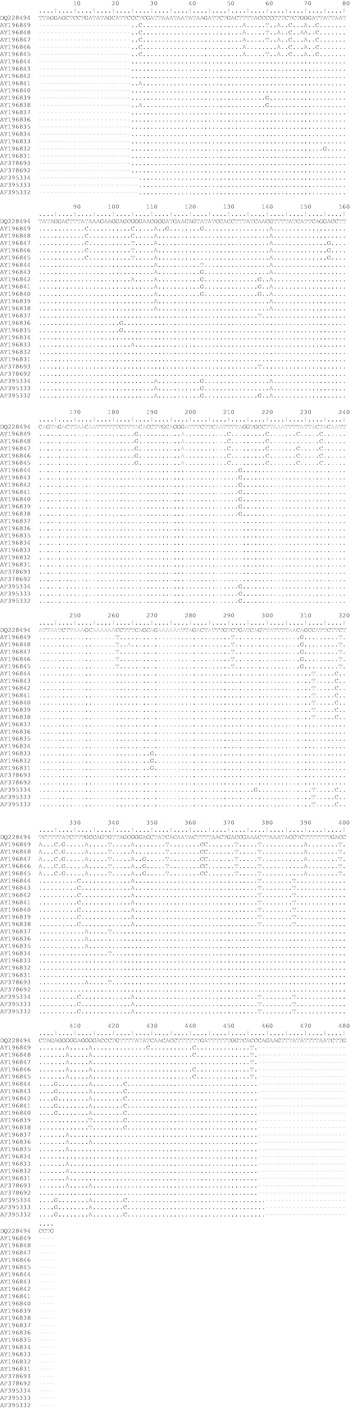
Consensus sequence of 484 bp from the mitochondrial cytochrome oxidase I (mtCOI) gene for T. tabaci (DQ228494) with other T. tabaci accessions (amplified with mtCOI specific primers). Dots indicate nucleotides identical throughout the species compared.

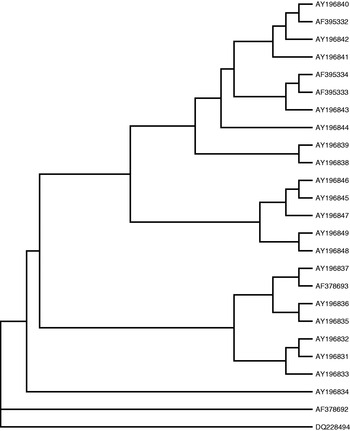
However, applicability of these primers on other populations of T. tabaci and T. palmi within and outside India depend on the variation in the nucleotide sequences both in forward (140–158 and 48–75 for T. tabaci and T. palmi, respectively) and reverse primer binding regions (414–438 for T. tabaci and T. palmi). Comparison of forward primer binding regions for T. tabaci (DQ228494) with other 24 accessions showed that there were variations at the 141st position, where 15 accessions had A instead of G; and at the 146th position, where three accessions had G instead of A. Similarly, in the reverse primer binding region at the 414th position, 15 accessions had A and two accessions had T instead of G, at the 423rd position ten accessions had C instead of T, and at the 429th position only one accession had C instead of T with reference to DQ228494. Overall, 2–11% variations were observed in DQ228494 out of the total length of 484 nucleotides compared for the 24 NCBI accessions (fig. 3). The cladogram for all 25 accessions for T. tabaci, including DQ228494, showed that there were two major clades: DQ228494 and another accession from Europe, AF378692, grouped in one clade with 98% similarity; and the rest of the accessions formed into the other major clade (fig. 4).
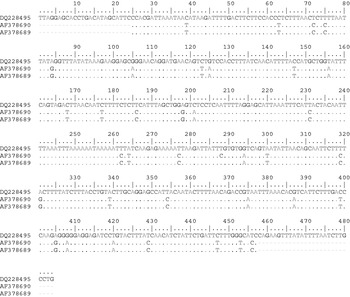
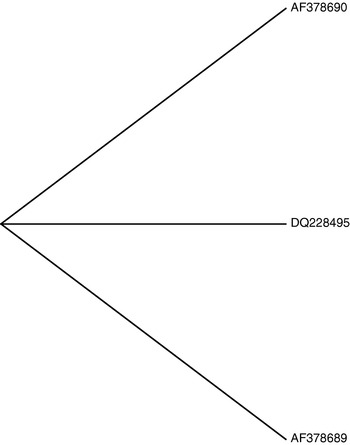
A comparison of the forward primer binding region for T. palmi (DQ228495) with two other NCBI accessions showed that there were variations at three positions; viz., at the 63rd position two accessions had T instead of C, and at the 72nd and 75th positions the two accessions had C instead of T. Similarly, in the reverse primer binding region, variations were found at the 420th position, where the two accessions compared had A instead of T, and at the 429th position, where the two accessions had C instead of T. As observed with DQ228494, T. palmi (DQ228495) had an overall variation of 8% with reference to the two other NCBI accessions (fig. 5). Similarly, the cladogram for all three accessions for T. palmi, including DQ228495, showed that all three accessions formed different clades (Fig. 6). Thus, T. tabaci and T. palmi collected on onion and watermelon at Bangalore, India are phylogenetically different, as compared to the other populations. Brunner et al. (Reference Brunner, Chatzivassilious, Katis and Frey2004) showed that T. tabaci collected from different host plants had different transmission efficiencies; and, therefore, it is important to ascertain how likely these genetic differences would be to affect the transmission efficiency of these two important vectors in the spread of Iris yellow spot and watermelon bud necrosis by T. tabaci and T. palmi, respectively, in the field.
Development of the degenerate primers would be a valuable tool in identifying the other populations of T. tabaci and T. palmi. Other criteria to be taken into consideration while developing a species-specific marker for thrips species are intra- and inter-specific variations (Bayar et al., Reference Bayar, Torjek, Kiss, Gyulai and Heszky2002; Brunner et al., Reference Brunner, Chatzivassilious, Katis and Frey2004; Frey & Frey, Reference Frey and Frey2004). Development of a species-specific marker also is advantageous where polymorphism is a problem, e.g. correct identification of T. tabaci is hampered by the colour and size variations observed according to the prevailing temperature (Murai & Toda, Reference Murai and Toda2001). The species-specific primers that have been identified in this study will enable a non-specialist to identify the target species at any developmental stage.
Rectangular cladogram for the 25 T. tabaci accessions in NCBI for 484 bp from the mitochondrial cytochrome oxidase I (mtCOI) gene.

Consensus sequence of 484 bp from the mitochondrial cytochrome oxidase I (mtCOI) gene for T. palmi (DQ228495) with other T. palmi accessions (amplified with mtCOI specific primers). Dots indicate nucleotides identical throughout the species compared.

A slanted cladogram for the three T. palmi NCBI accessions for 484 bp from the mitochondrial cytochrome oxidase I (mtCOI) gene.

In addition to identifying the genetic differences (as stated above) among different populations of T. tabaci and T. palmi, it is important in understanding the epidemiology of the tospovirus diseases in the field. Additionally, the study of molecular differences of differing populations of T. tabaci and T. palmi would shed light on the occurrence of biotypes, as observed in T. tabaci by Brunner et al. (Reference Brunner, Chatzivassilious, Katis and Frey2004).
Acknowledgements
The authors are grateful to the Director, Indian Institute of Horticultural Research, Bangalore 560089 for the facilities.