INTRODUCTION
Two of the most dramatic changes of the last century have been the rapid growth of the global human population and the concurrent increase in urbanization (United Nations 2012). In 2006, more than 50% of the global population was living in big cities (>100 000 inhabitants) (Carreiro et al. Reference Carreiro, Song and Wu2008), and nearly two-thirds of the 9 billion people projected to live on Earth by 2050 will reside in cities (United Nations 2012). Most of this growth will take place in developing countries, where urbanization is poorly planned and often results in environmental problems, including loss of property and lives to landslides and flooding, drinking water shortages and poor water quality, soil contamination, air pollution and loss of landscape aesthetic values (MEA 2005). In ageing urban landscapes, where urbanization began centuries ago and some of the abovementioned problems are already part of the routine of city inhabitants, ecological restoration offers an opportunity to mitigate some of these problems and improve human wellbeing.
However, implementing restoration projects in urban landscapes is complex. The proximity to large human populations requires consideration of social as well as environmental issues (Aronson et al. Reference Aronson, Blignaut, Milton, Le, Maitre, Esler, Limouzin, Fontaine, de Wit, Mugido, Prinsloo, van der Elst and Lederer2010; Brancalion et al. Reference Brancalion, Cardozo, Camatta, Aronson and Rodrigues2013), both in project planning and in the use of species and forest space. Ignoring these issues creates a risk of retaliatory measures that could compromise a project, as has occurred in some protected areas (Jim & Xu Reference Jim and Xu2002; Aswani & Weiant Reference Aswani and Weiant2004). Retaliation can emerge from differences in the preferences of local communities, environmentalists and government agents. For example, ecologists may decide to plant only native species, while the local population may prefer exotic fruiting trees for consumption or commercial use (Ball et al. Reference Ball, Gouzerh and Brancalion2014). Native animals, such as bees, snakes and bats, may support ecological processes and interactions, but may be perceived by communities as threats (e.g. L. J. Reid, unpublished data 2015). Thus, a challenge in ecological restoration is to facilitate partnerships that integrate relevant stakeholders and identify mutually beneficial community-based projects.
Social, economic and cultural issues have been poorly studied in restoration projects and represent a major issue for the advance of ecological restoration (Bendor et al. Reference Bendor, Lester, Livengood, Davis and Yonavjak2015; Murcia et al. Reference Murcia, Guariguata, Montes, Escobar, Moreno and Ram2016). One review of ecological restoration found that only 3% of the studies explored the perceptions of stakeholders of restoration projects (Aronson et al. Reference Aronson, Blignaut, Milton, Le, Maitre, Esler, Limouzin, Fontaine, de Wit, Mugido, Prinsloo, van der Elst and Lederer2010). New research works have finally shed some light on this issue (Brancalion et al. Reference Brancalion, Cardozo, Camatta, Aronson and Rodrigues2013), but it still insufficient. In order to explore the interaction of ecological and social components of restoration in urban settings, we conducted a socio-ecological assessment of a community-based restoration project in the city of Rio de Janeiro (Brazil) that restored Atlantic Forest vegetation in close proximity to a low-income local community. We compared the ecological parameters of the restored forest against those of a reference forest, which represents a passively restored forest site with similar topography and land use history. We also conducted a survey of perceptions of the restoration project and its potential for delivering ecosystem services to the local community. Data from the socio-ecological assessment were used to evaluate interactions between the local community and the restored forest and to identify trade-offs and potential synergies that would maximize restoration outcomes, improving the chances that local populations will accept and maintain ecologically beneficial restoration projects.
METHODS
Study site
This study was carried out in Serra de Inhoaíba, a small mountain range in a highly urbanized zone of Rio de Janeiro city, south-eastern Brazil (22°55’18.52” S and 43°34’35.06” W) (Fig. S1; available online). The local climate is tropical humid (Köppen classification), with average annual rainfall of 1187 mm, a small water deficit between July and October (Togashi et al. Reference Togashi, Montezuma and Leite2012) and an annual average temperature of 26°C (Oliveira et al. Reference Oliveira, Maia, Penha and Cunha1980). Vegetation in the Inhoaíba range is lowland Atlantic Forest (Oliveira-Filho Reference Oliveira-Filho2006) with a history of intensive land use for crops and pasture, followed by land abandonment in marginal areas. This has produced a mosaic of pastures and forests in different stages of secondary succession. Forest areas are concentrated on south-facing slopes, while pastures dominate slopes directed towards the north. Past and current agricultural land uses include production of sugar cane, orange, lemon and banana for markets in Rio de Janeiro city, while forests supply firewood to local communities (Galvão Reference Galvão1957; Engemann Reference Engemann and Oliveira2005; Oliveira & Guedes-Bruni Reference Oliveira and Guedes-Bruni2009; IBGE 2014). Rapid urban expansion, mainly in the last 70 years, has led to the occupation of most surrounding flatlands and some less steep slopes.
The restoration plantation is part of the Reforestation Effort programme under the supervision of technicians from the Rio de Janeiro city government. This programme employs more than 800 people from low-income communities to implement and maintain restoration plantations in deforested areas close to their homes. The programme objective is to control urban sprawl, reduce landslides and fires and conserve water resources by planting both exotic and native tree species. More than 5 million seedlings have been planted and 2000 ha restored by the programme in 140 different locations in Rio de Janeiro. Although the programme does not aim to recover native forest structure in restoration sites, the relatively high richness levels of native tree species used in plantations (usually over 50 species) indicates concern about the future composition of restored forests.
We studied a 55-ha Reforestation Effort site, established in 1992 on a south-facing slope previously covered by exotic grasses and scattered trees. Past land use included cane sugar and charcoal production in the 17th century (Oliveira & Guedes-Bruni Reference Oliveira and Guedes-Bruni2009), citrus production in the 20th century (Galvão Reference Galvão1957) and, recently, small-scale opencast granite quarrying. In 1992, a total of 158 400 seedlings, belonging to 70 native and six exotic species, were planted; 75% of these species were early and 25% were late successional. Nearly 60% were animal dispersed (Table S1). The site is in the Campo Grande zone, which has an estimated 328 370 inhabitants (IBGE 2010a) and is undergoing a rapid and disorderly process of urban expansion. We selected people from the neighbourhood nearest to the restored area as the study group. The community is poor, with 1297 inhabitants (IBGE 2010a) and monthly per capita income ranging from R$510.01 to R$794.66 (US$136 to US$211 at 10 December 2015; IBGE 2010b).
Data collection
Vegetation assessment
A vegetation assessment was carried out in the restored area and in a secondary forest area 3 km away, which is part of a 767-ha forest fragment. The secondary forest area is located on private property and has a similar topographic position within the Inhoaíba range. This area was subjected to selective logging in the past, and had undergone secondary succession for at least 43 years by the time vegetation sampling was conducted. We included this remnant in our study in order to represent a reference ecosystem and comparison for the vegetation diversity and structure of the restoration site. Although it is not a well-conserved, undisturbed remnant – which is absent in this study region – we considered that this large remnant is a suitable benchmark given the ecological conditions to which the vegetation undergoing restoration has been submitted.
Vegetation structure and diversity were assessed in thirty 10 × 10 m plots, each at least 50 m from other plots and randomly distributed in both study areas (hereafter restoration plantation and reference forest). We sampled individuals belonging to three different size classes: (a) canopy trees with a diameter at breast height (dbh) ≥5.0 cm; (b) small trees with a diameter at ground height (dgh) ≥1 cm and dbh <5 cm; and (c) seedlings of woody species with a height ≥10 and ≤30 cm. For small trees and seedlings, one 5 × 5 m plot and three 2 × 1 m plots, respectively, were nested within each 10 × 10 m plot. Individuals were identified to species level when possible and their height and dbh or dgh measured to calculate basal area. Species were classified by successional status (early/late successional) according to the criteria of Swaine and Whitmore (Reference Swaine and Whitmore1988). Dispersal modes were classified as animal and abiotic dispersed following Van der Pijl (Reference Van der Pijl1982). We visually assessed in each 10 × 10m plot the percentage of ground cover by exotic grasses in five cover classes: 0–5%, 5–25%, 25–50%, 50–75% and 75–100%. Degraded sites in the region are dominated by invasive African fodder grasses, such as Panicum maximum and Urochloa decumberns, which limit the establishment of planted tree seedlings. These invasive grasses are suppressed by understory shading as regrowth occurs, so exotic grass cover is used as an indicator of forest structure and the creation of favourable conditions for understory recolonization by native species.
Popular perceptions
A semi-structured questionnaire with both dichotomous and open-ended questions was used for community interviews (Alexiades & Sheldon Reference Alexiades and Sheldon1996). Quantitative and qualitative variables were used to explore the respondents' perceptions of ecosystem services, as well as the advantages and disadvantages of the restoration project for their livelihoods. The questionnaire was completed by 67 individuals (31 men and 36 women), representing c. 5% of the inhabitants of the neighbourhood. This sample size may not fully represent the perceptions of these inhabitants about the restoration project, but we preferred to reduce our potential sample size by targeting individuals with some connection to the plantation. Interviews were limited to people who had been living close to the border with the new forest for more than 20 years – the approximate age of the planting. This biased our sample towards elderly individuals (mean age of respondents of c. 50 years). We tried to interview the same number of men and women, but recruitment was limited by availability of community members during survey visits. The survey included questions on personal characteristics, relationships with the Reforestation Effort programme and perceptions of ecosystem services (Fig. S2). The interviews were conducted by A. E. Muler, accompanied by one of the community members, with A. E. Muler leading the interview and recording responses. Respondents answered survey questions and spoke freely about topics asked by A. E. Muler.
Data analyses
The study sites were compared according to the basal areas of canopy individuals and small trees, ground cover by exotic grasses and, for all three size classes, the density of individuals, species richness and abundance of individuals according to successional groups and dispersal syndromes. Mean seedling variable values were the mean of the three 2 × 1 m subplots inside each 10 × 10 m plot. Differences were analysed using Mann–Whitney tests (Crawley Reference Crawley2005). All analyses were performed using R software (R Core Development Team Reference Team2011). Species richness of each size class was analysed for each area by means of rarefaction curves using the software Estimate S9.1.0 (Colwell Reference Colwell2005). Descriptive analyses were used for the social evaluations.
RESULTS
Vegetation structure and composition
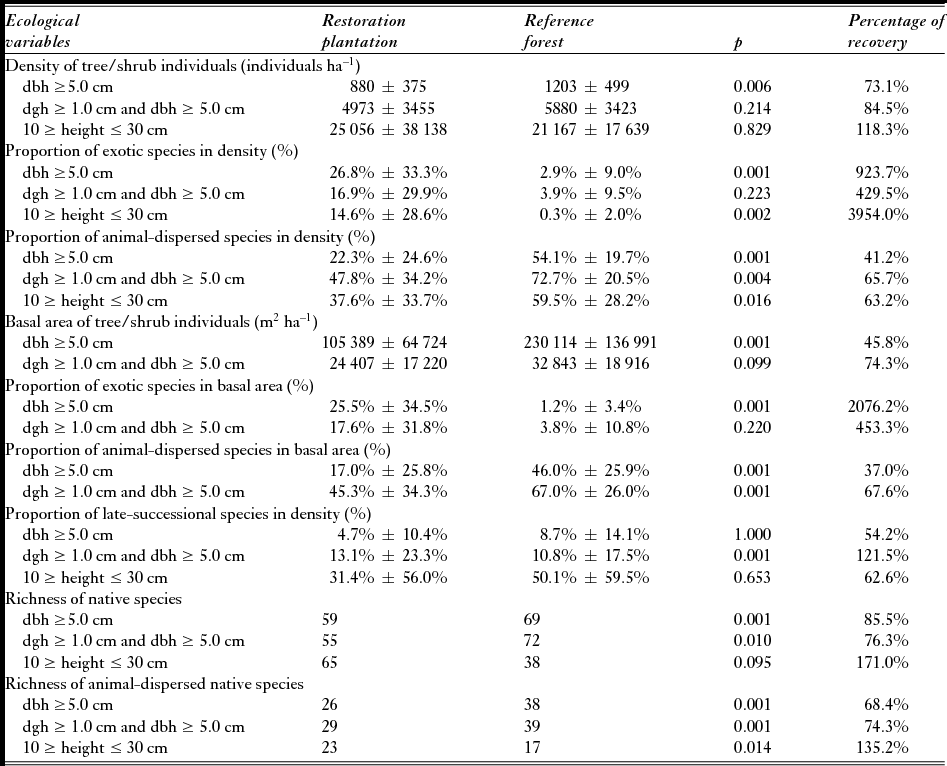
The restoration plantation showed lower basal area (p = 0.001) and density (p = 0.006) of canopy trees (dbh ≥5.0 cm) than the reference forest, but no difference was found for basal area of small trees (dgh ≥ 1.0 cm and dbh ≥ 5.0 cm) and density of small trees and seedlings (10 ≥ height ≤ 30 cm; Table 1). Exotic species were relevant components of forest structure, accounting for approximately 25% of the basal area and density of canopy trees and small trees. The proportion of the basal area and density of individuals belonging to exotic species declined from c. 25% for canopy trees to c. 17% for small trees (Table 1). The proportion of late-successional species only differed between restored and reference forest for sapling trees, with a higher proportion in the restoration forest (Table 1). The proportion of individuals and the basal area of animal-dispersed species were higher for all size classes in the reference forest, but under-representation of animal-dispersed species declined from canopy trees to small trees (Table 1). The restoration plantation showed greater cover of exotic grasses in the understory (70% of the plots with 50% or more grass cover; p = 0.001; w = 843.5), while most reference forest plots either lacked or showed a low proportion of grasses (0–25% grass cover).
Comparison of vegetation attributes between an urban plantation forest and a reference forest in Rio de Janeiro city, Brazil. Data on the three size classes: trees with diameter at breast height ≥5.0 cm; woody species individuals with diameter at ground height ≥1 cm and diameter at breast height <5 cm; and woody species individuals with height ≥10 and ≤30 cm. dbh = diameter at breast height; dgh = diameter at ground height.

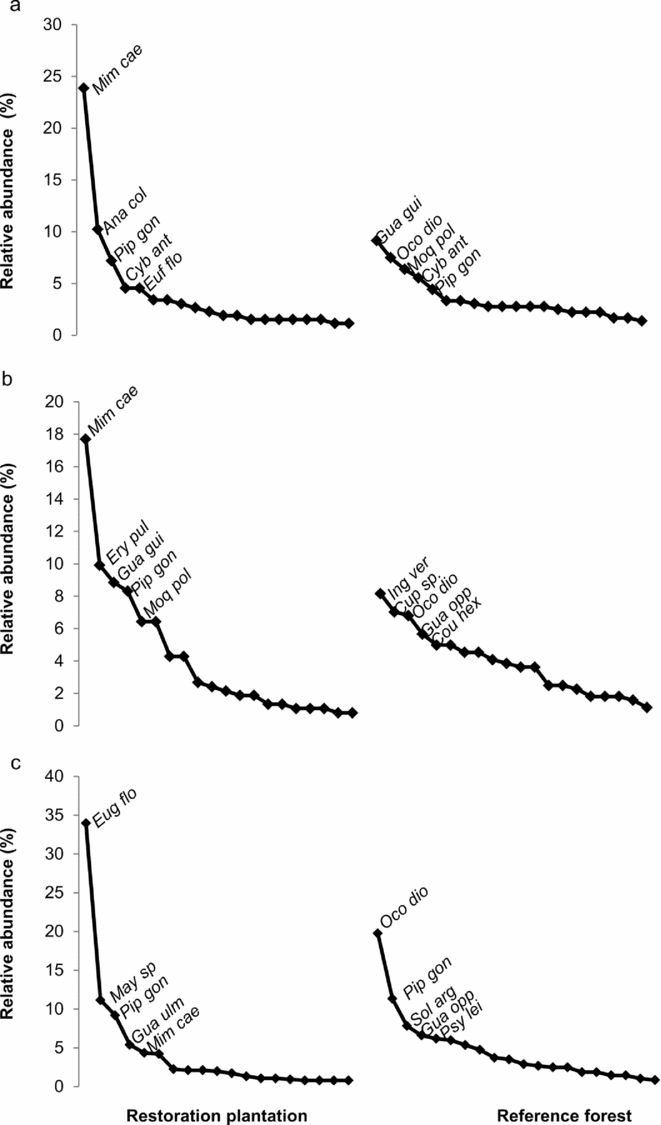
Although statistically different (p < 0.0001), the restoration plantation recovered approximately 85% of the rarefied species richness of the reference forest (69 species) for the group of canopy trees, but declined to 76% for small trees (Table 1). However, the restoration plantation showed a marginally higher (p = 0.095) rarefied species richness of seedlings than the reference forest. The composition of restoration and reference forest communities was also remarkably different (Sorensen index of 0.279 and 0.269 for canopy trees and small trees, respectively; Table S2). With the exception of Piptadenia gonoacantha, restoration and reference forests did not share dominant species in the three size classes (Fig. 1). The restoration plantation showed greater floristic dominance than the natural forest, mainly due to the very high density of the exotic legume Mimosa caesalpiniifolia in the size class of canopy trees and small trees, which accounted for almost 25% of individuals and represented 16% of the total basal area for canopy trees. However, the density of this shade-intolerant species ranked fifth in the seedling class, in which the native animal-dispersed tree Eugenia florida (Myrtaceae) had the highest density, followed by three other native trees. In addition to the dominant M. caesalpiniifolia, six exotic species were sampled in the planting, of which two were introduced (Albizia saman and Triplaris gardneriana) and the others were not planted (Albizia lebbeck, Caesalpinia tinctoria, Mangifera indica and Murraya paniculata). In the reference forest, M. caesalpiniifolia and Coffea arabica were recorded as exotic species, with both at very low densities. The restoration plantation showed increasing colonization of native species from the surrounding landscape, as 66% of the individuals of canopy trees, 68% of small trees and 82% of seedlings belonged to species that were not used at planting.
Dominance–diversity curves of species for the three size classes: (a) trees with diameter at breast height ≥5.0 cm; (b) woody species individuals with diameter at ground height ≥1 cm and diameter at breast height <5 cm; and (c) woody species individuals with height ≥10 and ≤30 cm, between the restoration plantation and reference forest in Serra de Inhoaíba, Rio de Janeiro.
Ana col = Anadenanthera colubrina; Cyb ant = Cybistax antisyphilitica; Cou hex = Coutarea hexandra; Cup sp. = Cupania species; Ery pul = Erythroxylum pulchrum; Eug flo = Eugenia florida; Gua gui = Guarea guidonia; Gua opp = Guapira opposita; Gua ulm = Guazuma ulmifolia; Ing ver = Inga vera; May sp. = Maytenus species; Mim cae = Mimosa caesalpiniifolia; Moq pol = Moquiniastrum polymorphum; Oco dio = Ocotea diospyrifolia; Pip gon = Piptadenia gonoacantha; Psy lei = Psychotria leiocarpa; Sol arg = Solanum argenteum.

Social perceptions
Most respondents had lived in the local community for over 30 years and the mean age of participants was 50 years. All reported low levels of education; 42% of men and 33% of women had completed high school. Men had a range of occupations, and approximately 45% of women were housewives. Almost all respondents (98.5%) were aware of the existence of the Reforestation Effort project. In general, they viewed the project favourably, along with restoration in other degraded areas in the neighbourhood. Reported participation in the reforestation project was low – 84% of men and 97% of women were not involved in any project activities, and most men (68%) and women (81%) reported little or no community participation in project design (e.g. selection of plant species). They reported that only a few community members were employed in project implementation, but community members were not part of the project design prior to planting.
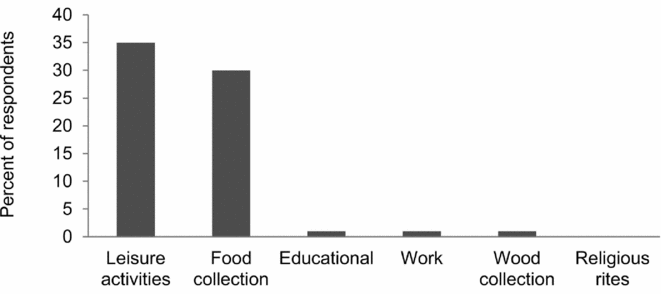
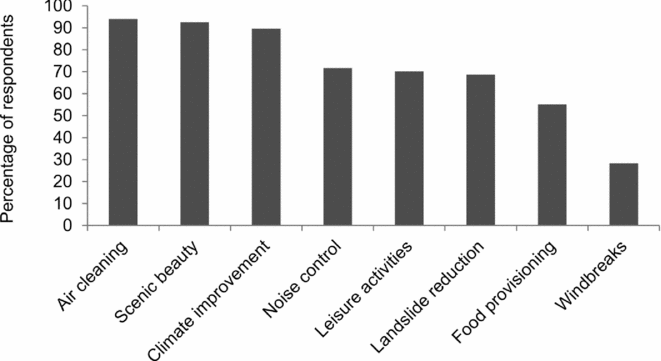
Approximately 70% of men and 55% of women reported some type of use of the restored forest, mainly gathering fruits and leisure activities (Fig. 2). Additionally, 52% of men and 39% of women reported harvesting medicinal plants in the forest. All residents acknowledged an improvement of ecosystem services provisioning following the implementation of the restoration project. Many different services were recognized as direct consequences of the restoration project (Fig. 3), with the most recognized being air cleaning, scenic beauty and climate improvement (open question). Some respondents also attributed higher availability of employment in the region to the jobs generated by the Reforestation Effort.
Type of restoration plantation use by the local community in Serra de Inhoaíba, Rio de Janeiro, Brazil.

Community perception of ecosystem services generated by restoration plantation in Serra de Inhoaíba, Rio de Janeiro, Brazil.

In spite of the awareness of the importance of the restoration project for their wellbeing, the local population stated preferences for different species in another restoration plantation: the majority of residents preferred native and exotic fruiting species (60%), compared to those preferring a mix of species (27%), only native species (9%) and ornamental species (4%) to be used in future restoration projects in the neighbourhood. In free conversations, residents also reported that they cut thorny species to facilitate movement within the forest and reduce injury risk.
DISCUSSION
The restoration project showed positive ecological and social outcomes. In spite of the high density of exotic tree species, the restoration plantation showed a similar vegetation size structure for small trees and seedlings and similar richness levels for seedlings. Although overall species composition similarity was low between restored and reference forests, the proportion of late-successional, native and spontaneously regenerating species and individuals was similar between the forest sites for the seedling communities. This suggests that the human legacy in restoration declines over time as non-planted species disperse from neighbouring remnants and establish in replanted understory (Suganuma & Durigan Reference Suganuma and Durigan2015).
However, a much lower proportion of animal-dispersed species was observed across all size classes in the restoration plantation. The high abundance of abiotic-dispersed trees in the restoration plantation may have prevented the arrival of animal-dispersed species from neighbouring remnants, as indicated by other research in Atlantic Forest restoration sites that found enhanced spontaneous regeneration of animal-dispersed seedlings beneath canopies of species of the same dispersal syndrome (Sansevero et al. Reference Sansevero, Prieto, de Moraes and Rodrigues2011; Viani et al. Reference Viani, Vidas, Pardi, Castro, Gusson and Brancalion2015). The divergent functional profile observed in our sites may be a direct consequence of the low attractiveness of the restoration plantation for vertebrate frugivores or of differential successional development. These results reinforce previous observations on the effectiveness of the functional composition trajectory for assessing restoration success (Brancalion & Holl Reference Brancalion and Holl2016).
The structure of the restoration plantation was heavily influenced by the use of abiotic-dispersed, early-successional species, such as M. caesalpiniifolia, Anadenanthera colubrina and P. gonoacantha. These species contributed a relatively high basal area to the restoration plantation. In restoration plantings in south-eastern Brazil, tree basal area recovers after only 25 years (Suganuma & Durigan Reference Suganuma and Durigan2015), highlighting the role of fast-growing planted species in modifying the environmental conditions of degraded areas. In particular, the exotic M. caesalpiniifolia, which is native to Brazil's north-east (Dutra & Morim Reference Dutra and Morim2011), was the dominant overstory species and played a key role in establishing forest structure in the degraded area. Rapid biomass recovery is not unique to restoration plantations; it recovers faster than species diversity in tropical forest succession (Martin et al. Reference Martin, Newton, Bullock, Martin, Newton and Bullock2014), especially in the humid tropics, and may contribute to mitigating climate change (Poorter et al. Reference Poorter, Bongers, Aide, Zambrano, Balvanera, Becknell, Boukili, Brancalion, Broadbent, Chazdon, Craven, Almeida-cortez, Cabral, Jong, Denslow, Dent, Dewalt, Hernandez-stefanoni, Jakovac and Junqueira2016).
The initial use of exotic pioneer species in restoration is justified by possible facilitation effects (Padilla & Pugnaire Reference Padilla and Pugnaire2006; Podadera et al. Reference Podadera, Engel, Parrotta, Machado, Sato and Durigan2015), especially if these coincide with livelihood benefits, such as food production or cultural functions (Ewel & Putz Reference Ewel and Putz2004; Lamb et al. Reference Lamb, Erskine and Parrotta2005; Brancalion et al. Reference Brancalion, Cardozo, Camatta, Aronson and Rodrigues2013) or ecological benefits (Catterall Reference Catterall2016). However, once canopy development has suppressed invasive grasses, facilitation benefits may decrease (Podadera et al. Reference Podadera, Engel, Parrotta, Machado, Sato and Durigan2015) and competition may prevail (Lortie & Callaway Reference Lortie and Callaway2006). In this case, thinning M. caesalpiniifolia trees could increase resource availability for spontaneously regenerating native species and so could accelerate succession while providing firewood to the local population.
However, it does not seem that exotic species are hampering the site's ecological trajectory. The increasing proportion of un-planted, late-successional native trees in the smaller size classes suggests that some exotic pioneer trees may act as ‘framework’ species in restoration (Blakesley et al. Reference Blakesley, Hardwick and Elliott2016), rather than invasive species, but more studies are needed in order to better understand which exotic species offer socio-economic benefits without invasive potential.
The local community had established a relationship with the restoration site through the use of forest space (leisure activities) and forest species (medicinal and food species). However, community engagement in the project was – and remains – low, suggesting that alterations to project planning early in the restoration process may be worthwhile in order to reduce perceived conflict with restoration and the risk of detrimental human influence on the forest (Ball et al. Reference Ball, Gouzerh and Brancalion2014). One way to improve the synergies between social and ecological outcomes of restoration is to incorporate community preferences in species selection for tree plantings.
Survey respondents preferred native and exotic fruit species that provide potential use values, while government technicians preferred native species. This supports previous suggestions that restoration projects that include economically valuable and culturally important species (Lamb et al. Reference Lamb, Erskine and Parrotta2005) or agro-successional crops (Vieira et al. Reference Vieira, Holl and Peneireiro2009) might be more attractive to the general population and create more demand for restoration (Brancalion et al. Reference Brancalion, Cardozo, Camatta, Aronson and Rodrigues2013). Since we did not find evidence of a negative impact of the use of abiotic-dispersed exotic trees in the restoration planting, and the local population demonstrated a clear preference for fruiting trees for local consumption, future restoration projects could benefit from the inclusion of animal-dispersed, exotic, fruit-bearing trees.
A possible strategy to operationalize this approach is the inclusion of a belt of medicinal and fruit species (native and exotic) surrounding the restoration planting. The higher light availability in forest borders would increase production of fruits and biomass of medicinal plants, facilitate access to useful plants and reinforce the protection of the core zones of the restoration site against fires and other human disturbances from surrounding urbanized areas. This approach would benefit residents and be an incentive to engage in management, prevent intrusion or land clearing and create social norms for forest use that support enforcement of environmental laws. However, the risk of biological invasions in restoration is great (Simberloff et al. Reference Simberloff, Alexander, Allendorf, Aronson, Antunes, Bacher, Bardgett, Bertolino, Bishop, Blackburn, Blakeslee, Blumenthal and Bortolus2011), and careful selection of species is needed in order to prevent detrimental ecological effects.
Limited community involvement prevented full incorporation of local values and priorities, like the preferential use of fruiting trees. This may contribute to the willingness of community members to modify the forest, including removal of undesirable species, without consent of project managers and planting of useful species. There is a body of literature suggesting that people are more likely to meet and engage in long-term conservation strategies when their expertise and opinions are incorporated into decision-making processes (Mascia Reference Mascia2003; Pretty & Smith Reference Pretty and Smith2004; Fu et al. Reference Fu, Wang, Lu, Liu, Ma, Chen and Liu2004; Gelcich et al. Reference Gelcich, Edwards-Jones and Kaiser2005). Many use and non-use values were reported for the studied restoration project, but we hypothesize that both social and ecological outcomes could have been higher if the local community had a greater participation on restoration planning. Community engagement can further facilitate the implementation of new restoration projects (Daily & Matson Reference Daily and Matson2008; Redford & Adams Reference Redford and Adams2009), which are urgently needed in the Atlantic Forest (Melo et al. Reference Melo, Arroyo-Rodríguez, Fahrig, Martínez-Ramos and Tabarelli2013).
There is a challenge in integrating ecological and social interests in restoration projects. Our case study, which assessed only one restoration programme using a single plantation and a single reference site, is not sufficient for generalizations about urban restoration. However, it is helpful to illustrate the strengths of this restoration project and the potential benefits of more comprehensive socio-ecological approaches. Our findings suggest that, although restoration has the potential to effectively recover high-diversity tropical forests in urban regions, the resilience of the forest restoration here is linked to the tolerance of the community to its presence, a trait that may not exist in other locations or persist in the study area. To address this issue, participatory diagnoses with local communities are needed in order to incorporate local needs, difficulties and economic activities during project development. In some areas, this may require greater efforts to link biodiversity conservation with food production and other benefits. Managers may need to adopt mixed models, possibly with the well-managed use of exotic species, especially in urban areas. Considering these needs is key to successful urban restoration.
CONCLUSIONS
There was rapid ecological gain in the restoration plantation through fast-growing pioneer exotic trees that act as a restoration ‘framework’, rather than invasive species. The human legacy appears to decline over time, as un-planted, late-successional native trees become established in the understory. It may be possible to facilitate this decline in human impacts and disturbances by including belts of medicinal and fruit species (native and exotic) around the restoration planting in order to accommodate local needs. This, along with a willingness to meet and engage with communities, could support long-term conservation strategies that use the expertise and opinions of neighbouring communities.
ACKNOWLEDGEMENTS
We are grateful to Rio de Janeiro city government and Reforestation Effort members; Alexandre Christo (in memoriam) for help in questionnaire design; and Alexandre Jaloto for help in data analyses. AEM thanks the Coordination for the Improvement of Higher-Level-or-Education-Personnel (CAPES). PHSB thanks the National Council for Scientific and Technological Development (CNPq, grant #304817/2015-5).
FINANCIAL SUPPORT
This study was financially supported by the Rio de Janeiro State Research Foundation (FAPERJ; E-26/110.793/2013). The authors received research grants and fellowships from the Coordination for the Improvement of Higher-Level-or-Education-Personnel (CAPES). PHSB thanks the National Council for Scientific and Technological Development of Brazil (CNPq) for a productivity grant (#304817/2015-5).
Supplementary material
To view supplementary material for this article, please visit https://doi.org/10.1017/S0376892917000388