


Introduction
Current cognitive models posit that negative self-imagery plays a key role in developing and maintaining social anxiety disorder (SAD; Clark and Wells, Reference Clark, Wells and Heimberg1995; Hofmann, Reference Hofmann2007; Rapee and Heimberg, Reference Rapee and Heimberg1997). It is proposed that individuals with SAD who enter feared social situations shift their attention to monitoring themselves in detail, noting internal sensations and signs of anxiety and generating negative self-images. A self-image formed in this way not only increases social anxiety but also adversely affects social performance. Consistent with cognitive theories, it has been found that individuals with SAD report experiencing negative self-images in threatening social situations (Hackmann et al., Reference Hackmann, Surawy and Clark1998).
To show that negative self-images play a causal role in social phobia, studies manipulating self-images experimentally have been conducted. These experimental studies have generally demonstrated the detrimental effects of negative self-image in highly socially anxious and non-anxious participants. Holding a negative self-image in mind during social situations led to increased anxiety, self-focused attention, safety behaviours, negative inferential bias and over-estimation of the visibility of their anxiety symptoms when compared with holding a control (relaxed or less negative) self-image in mind (Hirsch et al., Reference Hirsch, Clark, Mathews and Williams2003a,Reference Hirsch, Mathews, Clark, Williams and Morrisonb, Reference Hirsch, Meynen and Clark2004; Makkar and Grisham, Reference Makkar and Grisham2011). Thus the research has provided some evidence of the detrimental effects of negative self-images, suggesting that negative self-images might have a causal role in maintaining SAD.
Research to date has predominantly focused on the detrimental effects of negative self-images, while the potential benefits of positive self-images have been relatively neglected. Some studies included a positive self-image condition to compare the negative and positive self-image induction. Stopa and Jenkins (Reference Stopa and Jenkins2007) showed that the positive self-imagery group was less anxious, made better predictions of their performance, rated their actual performance better, and retrieved positive memories faster when compared with the negative self-imagery group. Similarly, Vassilopoulos (Reference Vassilopoulos2005) reported that socially anxious participants in the negative imagery condition perceived more bodily sensations and rated specific aspects of their performance unfavourably when compared with those in the positive imagery group. When individuals with low public-speaking anxiety were induced to hold a positive self-image in mind, they experienced less anxiety during speech tasks and reported fewer negative thoughts when compared with those in the negative self-image condition (Hirsch et al., Reference Hirsch, Mathews, Clark, Williams and Morrison2003b). Participants who were induced to have a positive self-image reported higher self-esteem in the context of social exclusion experiences than those induced to have a negative self-image in both high and low socially anxious participants (Hulme et al., Reference Hulme, Hirsch and Stopa2012).
Although these studies have provided initial evidence of the beneficial effects of positive self-images, they are limited because they did not assess the pre-induction states and examine the differences in the post-induction states between groups. As they did not obtain baseline (pre-induction) data of the positive and negative image group, their experimental designs did not elucidate clearly whether the observed differences resulted from the influence of positive self-image, negative self-image, or a combination of both. In addition to these limitations, previous studies were conducted mostly with university students with high social anxiety, not with a clinical sample diagnosed with SAD. Therefore, the present study examined the effects of negative versus positive self-images on SAD in a clinical sample, and the methodological limitations of previous studies were addressed by obtaining baseline data before inducing the positive or negative self-image and then comparing the pre- and post-induction states.
We also wanted to extend previous studies by investigating the effects of negative versus positive self-images on the judgement bias and emotion regulation (ER) strategies, as this had not yet been studied. Judgement bias refers to a tendency to over-estimate the likelihood and cost of future negative social evaluation (Blanchette and Richards, Reference Blanchette and Richards2010; Foa et al., Reference Foa, Franklin, Perry and Herbert1996). While interpretation bias occurs when resolving the ambiguity in a social situation that is immediately present, judgement bias involves estimating the likelihood of future events (Blanchette and Richards, Reference Blanchette and Richards2010). However, interpretation and judgement overlap and, in early research on interpretation bias using ambiguous social vignettes, judgement tasks were also included. We chose to focus on the judgement bias as anxiety is closely related to how people estimate the likelihood of future negative and threatening events. Judgement bias has been reported to be characteristic of SAD and one of the key mechanisms of changes in cognitive behavioural therapy (CBT) for SAD (Foa et al., Reference Foa, Franklin, Perry and Herbert1996; Hofmann, Reference Hofmann2004; Rapee et al., Reference Rapee, Gaston and Abbott2009). We hypothesized that when participants are induced to hold a negative self-image in mind, they would estimate higher social cost (judgement bias) and associated distress than pre-induction and compared with the positive self-image group. As self-representations that take the form of images, negative self-images may carry negative meanings about the self such as ‘I am weird’ or ‘I am unacceptable’ and thus lead to over-estimation of social cost of negative social events and associated distress, while positive self-images would carry benign meanings about the self and thus protect individuals from putting too much weight on one negative event.
In addition to examining the effects of self-image on judgement bias, we sought to further investigate its effects on ER, the process of controlling and deciding when and how to experience and express emotions (Gross, Reference Gross1998). Given the emerging research on emotion dysregulation in SAD (Hoffmann, Reference Hofmann2007), understanding the effects of self-image on ER appears to be important. Individuals with SAD anticipate excessive anxiety and distress in social situations, and when they experience negative emotions, they tend to suppress or avoid them (Spokas et al., Reference Spokas, Luterek and Heimberg2009; Turk et al., Reference Turk, Heimberg, Luterek, Mennin and Fresco2005). Use of maladaptive ER strategies has been assumed to play a crucial role in increasing and maintaining social anxiety and negative emotions (Spokas et al., Reference Spokas, Luterek and Heimberg2009; Turk et al., Reference Turk, Heimberg, Luterek, Mennin and Fresco2005). When individuals with SAD hold a negative self-image in mind, they may be fearful of negative emotional experiences and expression because they think that such expression increases the likelihood of negative evaluations from others and, as they feel more threatened, they are more likely to use maladaptive ER strategies such as emotional suppression and avoidance. In contrast, when they hold a positive self-image in mind, they are less likely to think that negative emotional experiences will bring negative social consequences, and thus they use more adaptive ER strategies such as problem-solving and cognitive reappraisal. Therefore, it was hypothesized that when participants are induced to hold a negative self-image in mind they would use less adaptive ER strategies than pre-induction and compared with the positive self-image group. In contrast, when they are induced to have a positive self-image, they would use more adaptive ER strategies than pre-induction and compared with the negative self-image group.
The main aim of the present study was to examine the effects of positive and negative self-images on social anxiety, judgement bias and ER by inducing a negative or positive self-image and comparing the participants’ pre- and post-inducement states (within-group comparison). We also examined the effects on anxiety, judgement bias and use of adaptive ER strategies between the positive and negative self-image groups to replicate and expand the findings of previous research (between-group comparison).
Method
Participants
We recruited participants through advertisements on several university websites and online social anxiety communities. We screened a total of 91 potential participants using the Social Avoidance and Distress scale (SADS; Lee and Choi, Reference Lee and Choi1997; Watson and Friend, Reference Watson and Friend1969) and the Brief Fear of Negative Evaluation scale (BFNE; Leary, Reference Leary1983, Lee and Choi, Reference Lee and Choi1997). The SADS and BFNE cut-off points for SAD were 93 and 42, respectively (Lee and Choi, Reference Lee and Choi1997), and so we contacted 81 individuals who scored higher than the cut-off points on both scales. These 81 participants were assessed with the Structured Clinical Interview for DSM-IV Axis I Disorders (SCID-I; First, Spitzer, Gibbon, and Williams, Reference First, Spitzer, Gibbon and Williams2002), using the mood episodes, mood disorders and anxiety disorders sections. The SCID was administered by master's level research assistants who were trained and supervised by a licensed clinical psychologist. Inclusion criteria were: (a) Diagnostic and Statistical Manual of Mental Disorders (DSM-IV; American Psychiatric Association, 1994) SAD diagnosis (19 participants were excluded), (b) no psychotic illness, (c) no organic brain injury or substance use disorder during the previous 3 months, (d) no mood disorders (13 participants were excluded), (e) no other anxiety disorders (two participants were excluded), and (f) no current psychiatric medication. We excluded 34 participants who did not meet the criteria, and five participants dropped out before the first session of the experiment.
A total of 42Footnote 2 individuals met the inclusion criteria, and we randomly assigned them to either the negative (n = 21) or the positive (n = 21) self-image groups. The positive self-image group comprised six men and 15 women with a mean age of 22 years (SD = 2.79). The mean number of years of education in the positive self-image group was 14.48 (SD = 1.40). The negative self-image group was composed of four men and 17 women with a mean age of 22.38 years (SD = 2.77). The mean number of years of education in the negative self-image group was 14.95 (SD = 1.20). Participants received about 10 US dollars for participation in this experiment. Participants gave written, informed consent, and we received approval for the study from the university institutional review board.
Measures
The SADS (Watson and Friend, Reference Watson and Friend1969) is a self-report scale that measures social anxiety and distress in various social situations and the degree of avoidance of potentially distressing social situations. The original scale consisted of 28 true/false statements, but the Korean version, the K-SADS, was changed to use a 5-point Likert rating scale ranging from 1 (strongly disagree) to 5 (strongly agree), with a higher score indicating greater anxiety (Lee and Choi, Reference Lee and Choi1997). The scale has good internal consistency, α = .92 (Lee and Choi, Reference Lee and Choi1997).
The BFNE (Leary, Reference Leary1983) assesses fear of negative evaluation from others, which is one of the core cognitive characteristics of social phobia. The original scale consisted of 30 true/false statements (Watson and Friend, Reference Watson and Friend1969), but the short form version of the BFNE (Leary, Reference Leary1983) consists of 12 items rated on a scale of 1 (strongly disagree) to 5 (strongly agree). The possible scores on the BFNE range from 12 to 60, with a higher score indicating greater fear of negative evaluation. The Korean version of the BFNE (K-FNE) has been demonstrated to have high internal consistency (α = .90; Lee and Choi, Reference Lee and Choi1997).
The Beck Depression Inventory-II (BDI; Beck et al., Reference Beck, Steer and Brown1996) is a 21-item scale that measures the severity of depression. Items are rated from 0 to 3, and scores range from 0 to 63. The Korean version of the BDI is also a well-established scale with established reliability and validity. The Korean version of the BDI was reported to have high internal consistency (α = 0.78; Lee and Song, Reference Lee and Song1991).
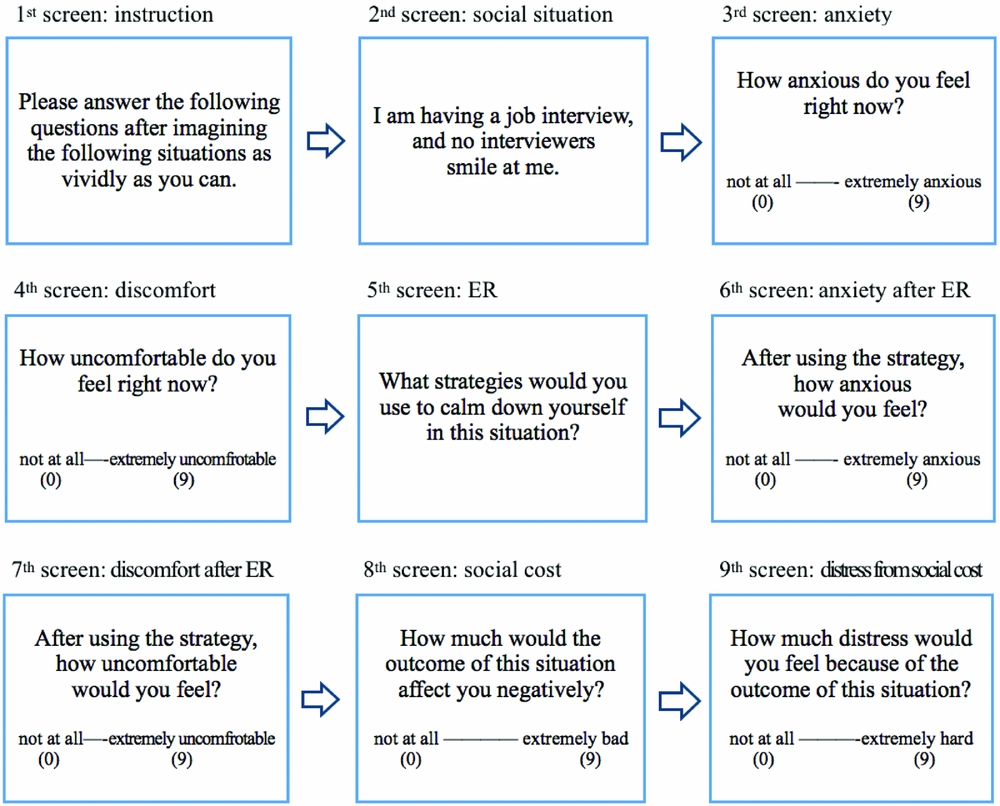
The Reactivity and Regulation Situation Task (RRST; Carthy et al., Reference Carthy, Horesh, Apter and Gross2010) is a computerized task to assess emotional reactivity and ER in children using ambiguous everyday situations with potentially threatening meanings. We modified this task into an adult version to assess anxiety, ER strategies and judgement bias in threatening social performance and interaction situations. The modified RRST consisted of nine screens per social situation. A different set of 10 social situations was presented at the pre- and post-induction RRST. The questions presented on the nine screens are given in Fig. 1. We used a 10-point Likert scale (0 = not at all, 9 = extremely) to measure anxiety, discomfort, social cost, distress from social cost, anxiety and discomfort after using ER. An open-ended question was used to assess ER strategies. The sequence of the nine screens was fixed, as presented in Fig. 1, and the 10 social situations were presented in the same order to all participants at the pre- and post-induction RRST. We conducted a preliminary test with 20 healthy people to confirm that the two different sets of social situations of the RRST elicited a similar level of anxiety and discomfort. The results showed no significant differences (anxiety: t (38) = –1.40, not significant; discomfort: t (38) =.74, not significant) between the two sets used pre- and post-induction.
An example of the RRST

Procedure
We met the participants twice with a 1-week interval in between (the first visit lasted 20 min, and the second lasted 40 min). Before the RRST main task was administered to the participants, we administered two practice trials to allow them to become familiar with the RRST. At the first visit, the main goal of administering the RRST was to assess the participants’ baseline anxiety and discomfort, judgement bias and ER strategies. On the second visit, we administered the RRST after we induced a negative or positive self-image in the participants.
Self-imagery induction method
We induced a specific self-image using the script used in Yoon (Reference Yoon2013), which was modified from Hirsch et al. (Reference Hirsch, Meynen and Clark2004) and Stopa and Jenkins (Reference Stopa and Jenkins2007), to help participants to relive each experience to its fullest. After we induced either a positive or a negative self-image, we measured the level of concentration on the self-imagery inducement task and image visibility on a 100-point Likert scale. The average concentration level was 71 and the visibility level was 72. We asked participants to maintain their induced self-images until the end of the RRST experiment. The instruction for inducing negative (positive) self-imagery was as follows:
‘Recall an incident where you thought of yourself as being at your worst (best). If you recall the incident, please explain in detail (if the participant speaks of a certain incident). What kind of images do you see from that memory? What do you hear? Do you smell or taste anything? How does your body feel? What kind of emotion do you feel from that image? What do you think makes you feel that way? What does your memory symbolize? Does this memory give any message to you about yourself?’
Emotion regulation strategy categorization method
Based on Gross (Reference Gross1998), we considered problem-solving, concentration, acceptance, reappraisal and relaxation to be adaptive ER strategies, and avoidance, diversion, rumination and suppressing emotions to be maladaptive strategies. Each participant's strategies (mean = 1.95, SD = 0.42) were classified by two graduate students, who majored in clinical psychology, and who had no knowledge of the study design and hypotheses. The inter-rater reliability was 0.95, which was excellent according to Nunnally (Reference Nunnally1978). We obtained the ratio of adaptive ER strategies by dividing the frequencies of adaptive ER strategies by the total number of strategies reported.
Results
Sample characteristics on normality
To confirm the normality of our sample data, a Shapiro–Wilk's test (Razali and Wah, Reference Razali and Wah2011; Shapiro and Wilk, Reference Shapiro and Wilk1965), a visual inspection of their histograms, normal Q–Q plots, and box plots were conducted. The results showed that all the scores (anxiety, discomfort, social cost, distress from social cost, adaptive ER, anxiety and discomfort after ER) were approximately normally distributed for both positive and negative image groups.
Demographic data analysis
There were no significant differences between the two groups in terms of gender [χ2 (1) = 0.53, p > .05], age [t (40) = 0.44, p > .05] or duration of education [t (40) = 1.18, p > .05].
Baseline comparison between the two groups
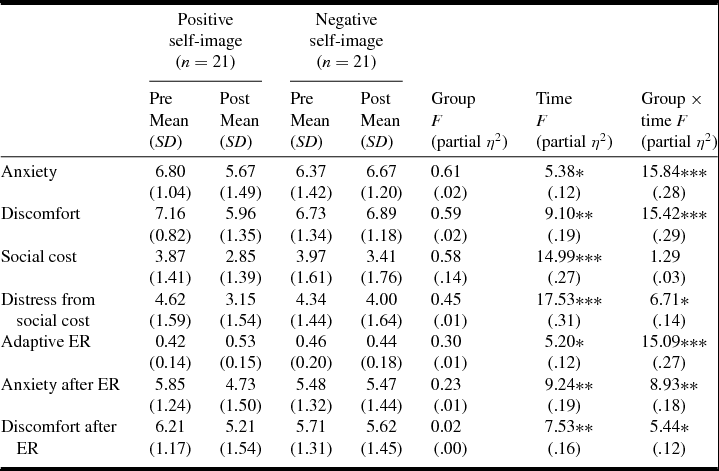
To examine the baseline differences between the positive and negative self-image groups, we conducted independent t-tests on their pre-experiment SADS, BFNE and BDI scores and found no significant differences: SADS, t (40) = –0.24, p > .05; BFNE, t (40) = –0.46, p > .05; and BDI, t (40) = 0.26, p > .05. Independent t-tests on the pre-induction scores showed that there were no significant differences in terms of anxiety, t (40) = –1.14, p > .05; discomfort, t (40) = –1.25, p > .05; judgement bias and associated distress, t (40) = 0.26, p > .05; t (40) = –0.04, p > .05; ER strategies, t (40) = 0.54, p > .05, t (40) = –1.25, p > .05; anxiety after ER, t (40) = –0.94, p > .05; and discomfort after ER, t (40) = 0.19, p > .05 (Table 1).
Anxiety and discomfort ratings, judgement bias and ER before and after induction of self-image

ER, emotion regulation. *p < .05, **p < .01, ***p < .001.
Effects of inducing self-image on anxiety and discomfort within and between groups
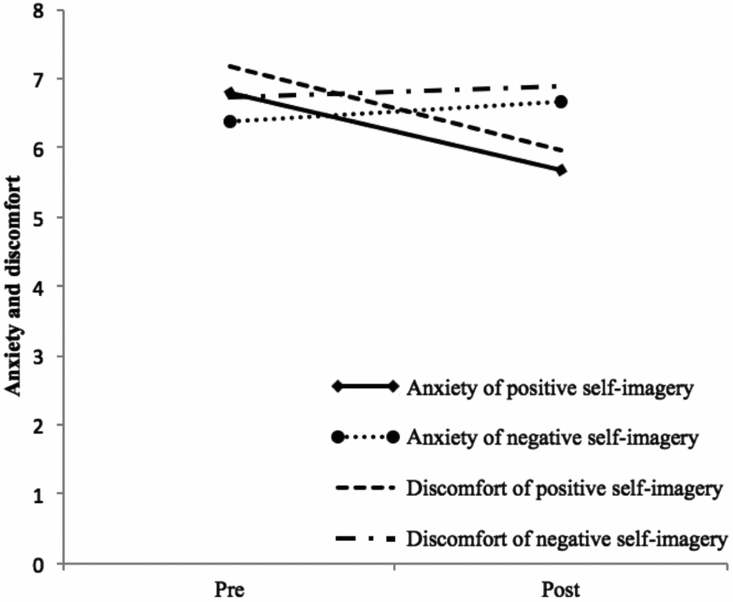
A 2×2 repeated-measure ANOVA showed significant main effects of time on anxiety [F (1,40) = 5.38, p < .05, partial η2 = .12] and discomfort [F (1,40) = 9.10, p < .01, partial η2 = .19], and interaction effects of group by time on anxiety [F (1,40) = 15.84, p < .001, partial η2 = .28; Fig. 2], and discomfort [F (1,40) = 15.42, p < .001, partial η2 = .29; Fig. 3]. No main effects of group on anxiety were shown [F (1,40) = .61, p > .05] or discomfort [F (1,40) = .59, p > .05]. We also used paired t-tests to explore the interactions, and there were significant differences between the pre- and post-induction on anxiety [t (20) = 3.64, p < .01, d = 0.90] and discomfort [t (20) = 3.81, p < .01, d = 1.10] in the positive self-image group (Figs 2 and 3). In contrast, there were no significant differences between the pre- and post-induction on anxiety [t (20) = –1.66, p > .05, d = –0.23] and discomfort [t (20) = –1.11, p > .05, d = –0.13] in the negative self-image group. That is, the positive self-image group showed less anxiety and discomfort after a positive self-image was induced, but the negative self-image group showed no differences between before and after induction.
The interaction effect of group by time on anxiety and discomfort

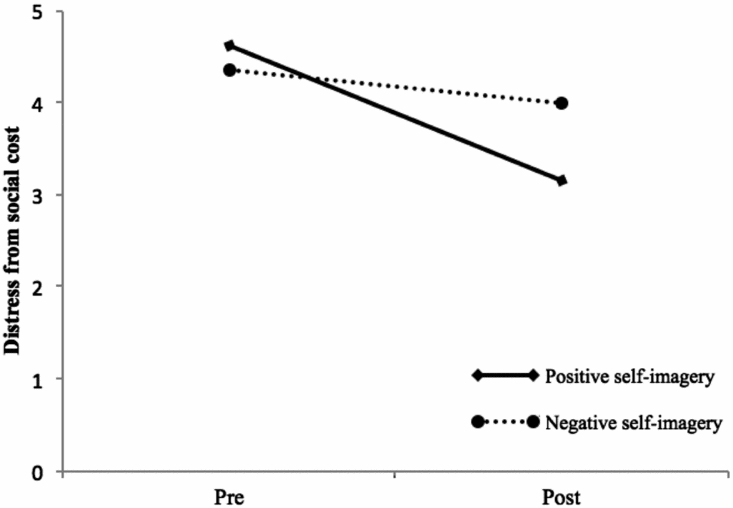
The interaction effect of group by time on distress from social cost

Effects of inducing self-image on judgement bias within and between groups
The 2×2 repeated measures ANOVAs showed that there were no significant main effects of group on the judgement bias of social cost [F (1,40) = .58, p > .05] or on the distress from social cost [F (1,40) = .45, p > .05]. However, there was a significant main effect of time on the judgement bias of social cost [F (1,40) = 14.99, p < .001, partial η2 = .27] and on the distress associated with social cost [F (1,40) = 17.53, p < .001, partial η 2 = .31]. There was a significant interaction effect of group by time on the distress from social cost [F (1,40) = 6.71, p < .05, partial η2 = .14; Fig. 4], but not on the judgement bias of social cost [F (1,40) = 1.29, p > .05]. Paired t-tests revealed that participants in the positive self-image group experienced significantly less distress related to the social cost after imagining the positive self-image [t (20) = 4.86, p < .001, d = 0.75], but those in the negative self-image group showed no significant difference after imagining the negative self-image [t (20) = 1.11, p > .05, d = 0.34].
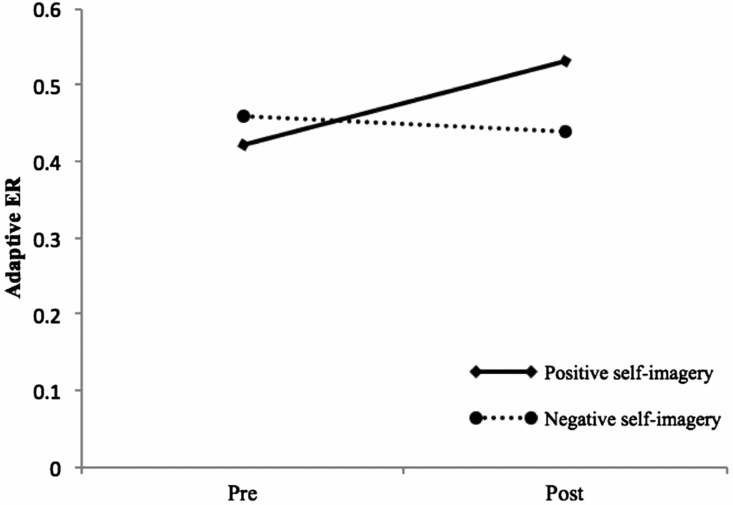
The interaction effect of group by time on adaptive ER strategies

Effects of inducing self-image on adaptive ER strategies within and between groups
The 2×2 repeated measures ANOVAs showed that there was no main effect of group [F (1,40) = .30, p > .05] on adaptive ER, but there was a main effect of time [F (1,40) = 5.20, p < .05, partial η2 = .12]. There was also a significant interaction effect of group by time [F (1,40) = 15.09, p < .001, partial η2 = .27]. Paired t-tests showed that participants in the positive self-image group used significantly more adaptive ER strategies after imagining a positive self-image [t (20) = –2.46, p < .05, d = –0.78; Fig. 5]. In contrast, those in the negative self-image group showed no difference in the use of adaptive ER strategies [t (20) = 1.18, p > 05, d = 0.11].
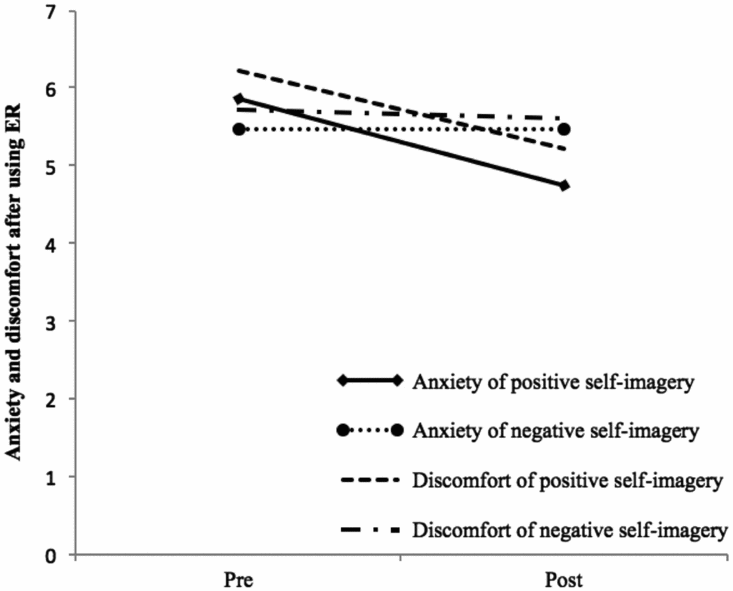
The interaction effect of group by time on anxiety and discomfort after using ER

We also conducted 2×2 repeated measures ANOVAs on anxiety and distress ratings reported after using ER strategies to examine the effect of using ER. The results showed that there were no main effects of group on anxiety [F (1,40) = .23, p > .05] and distress [F (1,40) = .02, p > .05]. However, there were main effects of time on anxiety [F (1,40) = 9.24, p < .01, partial η2 = .19] and discomfort [F (1,40) = 7.53, p < .01, partial η2 = .16]. There were also significant interaction effects of group by time on anxiety [F (1,40) = 8.93, p < .01, partial η2 = .18] and discomfort [F (1,40) = 5.44, p < .05, partial η2 = .12]. Paired t-tests showed that participants in the positive self-image group reported significantly less anxiety [t (20) = 3.43, p < .01, d = 0.83] and discomfort [t (20) = 2.90, p < .01, d = 0.75] after using ER strategies. In contrast, those in the negative self-image group showed no difference in anxiety [t (20) = 0.05, p > 05, d = 0.01] and discomfort [t (20) = 0.43, p > 05, d = 0.07] after using ER strategies.
Discussion
The purpose of this study was to investigate the effects of positive or negative self-images on anxiety and discomfort, judgement bias and use of ER strategies, using within- and between-group comparisons.
First, the between-group comparison indicated that individuals in the negative self-image group showed higher post-induction anxiety than those in the positive self-image group. This finding is consistent with that of previous studies in which individuals in negative self-image groups showed higher anxiety than those in neutral self-image groups (Hirsch et al., Reference Hirsch, Clark, Mathews and Williams2003a, Reference Hirsch, Meynen and Clark2004; Stopa and Jenkins, Reference Stopa and Jenkins2007). However, this finding does not clarify whether this higher anxiety came from the harmful effect of negative self-imagery or from the beneficial effect of positive self-imagery, or a combination of both.
Next, we analysed the difference in anxiety and discomfort between the pre- and post-induction of a negative or positive self-image. The within-group comparison indicated that there were significant decreases in social anxiety and discomfort in the positive self-image group but that there were no changes in the negative self-image group. The combination of these findings allowed us to determine the source of the observed differences between the positive and negative self-image groups. It demonstrated that there were less detrimental effects on social anxiety after we induced a negative self-image than the beneficial effects of a positive self-image. In the present study, there might have been a ceiling effect of the negative self-image in SAD individuals such that inducing a negative self-image could not worsen the negativity of participants’ self-image. In the majority of previous studies demonstrating detrimental effects of negative self-images, participants were not diagnosed with SAD but rather highly socially anxious individuals. In addition, the differences might have been caused by differences in the anxiety-provoking situations. In our study, we had participants imagine themselves in threatening analogue social situations and then estimated the anxiety and discomfort they might have experienced in those hypothetical situations. Although the mean anxiety and discomfort ratings of our participants ranged from 6.37 to 7.16 (on a 10-point Likert scale), the analogue situations could have been less threatening than the real-world social situations used in previous studies. The findings of the current study need to be replicated using real, rather than imagined, social situations.
In the present study, it was shown that holding a positive self-image in mind reduced anxiety, discomfort and the distress from negative consequences of adverse social events. Positive self-images could produce benign emotions that are lacking in SAD (Kashdan, Reference Kashdan2007), and mitigate the harmful effects of the negative emotions induced by social anxiety. The finding that a positive self-image did not change the judgement bias of estimated social cost itself, but the distress from social cost, also partly supports this explanation. It can be speculated that holding a positive self-image in mind may first generate benign emotions and reduce the distress and later counteract the biased negative attention and cognition. According to Hulme et al. (Reference Hulme, Hirsch and Stopa2012), self-images represent the working self in a Self-Memory System (Conway and Pleydell-Pearce, Reference Conway and Pleydell-Pearce2000) which regulates retrieval of self-relevant information in particular situations. It was proposed that a positive self-image increases the accessibility of a more positive working self that promotes positive self-esteem and initiates healthy positive self-bias. Future studies should elucidate the mechanism of how positive self-images generate beneficial effects in SAD.
To our knowledge, this is the first study to investigate the effects of positive versus negative self-images on ER. It was shown that a positive self-image significantly increased the use of adaptive ER strategies but that a negative self-image had no impact on the use of adaptive ER strategies. It is also important to note that participants induced to have a positive self-image not only used more adaptive ER strategies but also experienced less anxiety and discomfort after using those strategies than those with a negative self-image. This means that use of adaptive ER strategies produced the benefit of reducing anxiety and discomfort for participants holding a positive self-image in mind. Holding a positive self-image in mind could have elicited positive self-view or self-esteem, which gives the individual a sense of efficacy in threatening social situations and facilitates the use of adaptive ER strategies. It is also probable that holding a positive self-image in mind may have generated a benign emotion, which could facilitate approach modality, counteract chronic reliance on avoidance coping, and promote the use of the adaptive ER strategies.
The limitations and suggestions for future studies are as follows. First, we measured anxiety, judgement bias and ER strategies in analogue social situations. Therefore, the findings of the current study should be replicated using a methodology that assesses these variables in real-world social situations. Second, although the inclusion of within-group comparison of pre- and post-induction is an improvement on prior studies, there is reason to be cautious about the beneficial effects of the positive self-image until comparison with a neutral condition is performed. As the RRST was administered twice, 1 week apart, there is also a possibility that the beneficial effects of a positive self-image might come from habituation. However, we used the same procedure in the negative self-image group and compared between the two groups. We also tried to minimize the habituation effect to use the two different sets of social situations before and after the induction. Replications and extensions should incorporate a neutral self-image group and address the issue of the habituation effect. Third, we did not include a non-imagery condition (e.g. verbal instruction), which does not permit definite conclusions as to whether the beneficial effect of positive self-images is the effect of the positivity of self-image itself or not. Fourth, we did not include a non-clinical control group, so we could not confirm whether our findings were unique traits of SAD or not. Future studies should investigate the effects of positive and negative self-image by comparing a healthy control group with a disordered group. Lastly, we recruited the study participants from a community with an age range of 19–29 years, making it difficult to generalize the study's findings to a broader patient sample.
Despite these limitations, the present study demonstrated the beneficial effects of positive self-images on anxiety and discomfort, and use of adaptive ER strategies. The findings suggest that construction of a positive self-image can be a potentially valuable strategy in the treatment of SAD. Goldin et al. (Reference Goldin, Jazaieri, Ziv, Kraemer, Heimberg and Gross2013) found that CBT reduced negative self-views and increased positive self-views, and that more positive but not fewer negative self-views mediated the effects of CBT on social anxiety symptoms. Interventions targeting positive self-imagery and increasing the positivity that lacks in SAD can be a fruitful road to enhance the efficacy of the treatment for SAD (Ng et al., Reference Ng, Abbott and Hunt2014).
Conclusions
The results of this study highlight the beneficial effects of positive self-images on social anxiety and ER. Our findings support that enhancing positive self-images could be promising as part of interventions to treat SAD.
Acknowledgements
The authors gratefully acknowledge graduate students and staff at Korea University Social Phobia Counselling Center for assistance with data collection.
Ethical statement: Ethical approval for the study was obtained from Korea University ethics committee.
Conflicts of interest: Hannah Lee, Jung-Kwang Ahn and Jung-Hye Kwon have no conflicts of interest with regard to this publication.
Financial support: This research received no specific grant from any funding agency, commercial or not-for-profit sectors.



Comments
No Comments have been published for this article.