1. Introduction
International relations literature has been looking at audience cost. Fearon (Reference Fearon1994) first presented the audience cost model, arguing that leaders or governments will pay a domestic political price if they do not follow through on their threats or commitments in international bargaining. A large body of research has addressed whether audience costs exist and how, assuming they exist, they affect conflict behavior and outcomes.
The empirical findings are inconclusive, however. On the one hand, statistical tests partially confirm the existence of audience costs, operationalized using a democracy index. The results show, for example, that democratic leaders are less likely to back down than are non-democratic leaders (Partell and Palmer, Reference Partell and Palmer1999). On the other hand, process-tracing case studies find that ‘domestic audience costs mechanisms rarely play a significant role’ (Snyder and Borghard, Reference Snyder and Borghard2011: 437).Footnote 1 This leads to a puzzle: Why does this empirical gap exist?
One answer could be that audience costs are hard to observe directly. Since office-seeking leaders are likely to avoid choices that will incur high domestic political costs, any tests, whether quantitative or qualitative, that fail to take the selection effect into account will fall short of finding clear evidence to support or falsify the audience cost argument. To overcome these problems, Kurizaki and Whang (Reference Kurizaki and Whang2015) use a structural statistical model and successfully find observational evidence of audience costs. Survey experiments are also effective in measuring audience costs while avoiding the selection effect (Tomz, Reference Tomz2007; Trager and Vavreck, Reference Trager and Vavreck2011; Levendusky and Horowitz, Reference Levendusky and Horowitz2012).
A second answer, proposed herein, can be found in the time-inconsistency problem of audience costs caused by election timing and public attentiveness. Electoral punishment is central to the audience cost model. However, voters do not always have the opportunity to replace leaders even if they blunder in international bargaining because national elections typically come only once or twice every several years.Footnote 2 In addition, voters may become less willing to punish such leaders, since voters are more likely to disregard or even forget a leader's foreign policy missteps the further back in time they occurred (Achen and Bartels, Reference Achen and Bartels2004; Zaller, Reference Zaller1992). This ‘past discounting’Footnote 3 in voters’ decision-making can be exacerbated by the public's inattentiveness and lack of information when it comes to foreign affairs (Holsti, Reference Holsti2004). Thus, the current paper argues that democratic leaders have an incentive to choose strategically, with the electoral calendar in mind, when selecting a form of conflict behavior. Lacking this electoral perspective of the audience costs mechanism, existing studies might have looked for audience costs in ‘the wrong places’,Footnote 4 and found inconsistent evidence in measuring the existence of audience costs.
To test this argument, the authors conduct a natural experimentFootnote 5 featuring territorial disputes between Russia and the two Baltic republics: Estonia and Latvia. Despite the commonalities in the disputes, political systems, and socioeconomic backgrounds of the two Baltic states, their governments showed a contrast in retrenchment decisions with regard to their territorial claims against Russia. The current analysis shows that only the temporal gap in their electoral timing can explain this variation, for two reasons. First, the highest audience costs are difficult to observe directly. Leaders strategically avoid actions that will incur large audience costs, and therefore the magnitude of observable audience costs is lower than it might be (Schultz, Reference Schultz2001b; Kurizaki and Whang, Reference Kurizaki and Whang2015). This logic of selection justifies our approach of looking for, albeit indirectly, audience costs by focusing on a ‘backing down’ decision by leaders. Second, in contrast to survey experiments of audience costs (Tomz, Reference Tomz2007; Trager and Vavreck, Reference Trager and Vavreck2011; Levendusky and Horowitz, Reference Levendusky and Horowitz2012), our natural experiment is implemented in a real-world setting. Hence, we can overcome the problem of external validity inherent in experimental research design.
In the following sections, this article first briefly reviews recent studies that try to surmount the empirical gap in the literature on audience costs, to clarify why an examination of the relationship between elections and audience costs is needed. After discussing how voters make their electoral decisions by drawing on the literature on public opinion and voting behavior, this paper derives the implications for the audience cost mechanism. The following sections present the case study using a natural experimental approach. It concludes by summarizing the findings, with a discussion of the implications for scholars on audience costs and democratization.
2. Audience costs: on their existence and variety
The literature on audience costs has flowered both theoretically and empirically for two decades. Fearon (Reference Fearon1994) first formalized audience costs, using an international crisis bargaining model. These costs stem from political sanctions imposed on state leaders by their domestic audiences. Fearon argues that citizens will punish leaders who have taken unsuccessful foreign policy decisions that damage the national honor. On the basis of this logic, Guisinger and Smith (Reference Guisinger and Smith2002) point to the state's credibility in the international arena as a different concern of voters. Smith (Reference Smith1998) provides other microfoundations of the domestic punishment by predicting that voters will consider as incompetent any leader who backs down in international bargaining.
The audience cost theory provides one of the best explanations for war and peace in a logically consistent manner. State leaders can rationally opt for war when audience costs are larger than the costs of war. In that sense, audience cost models are a domestic explanation for war. At the same time, audience costs can contribute to peaceful conflict resolution by working as a credible signaling to overcome uncertainty that would cause war. Leaders of states with higher audience costs can efficiently communicate their intentions and resolve for war.
These attributes of audience costs may not be common across all regimes, however. Fearon (Reference Fearon1994) clearly suggests ‘variations in audience costs across regime types’ (p. 579) by hypothesizing that ‘democratic leaders on average have an easier time generating audience costs’ (p. 582). Fearon assumes that while both democratic and non-democratic leaders are constrained by audience costs in foreign policy decision making, democratic political institutions, especially elections, give citizens more power to sanction their leaders than autocracies do. Schultz (1998, Reference Schultz2001a) argues that the electoral competition between an incumbent party and opposition parties reinforces political accountability in democracies, which underlies Fearon's assumption.
A large number of empirical studies have tested and supported the hypothesis that audience costs are larger in democracies than in non-democracies. Statistical tests have found that democratic challengers are less likely to be reciprocated by their targets in interstate disputes than are non-democratic challengers (e.g., Eyerman and Hart, Reference Eyerman and Hart1996; Schulz, Reference Schultz1999, Reference Schultz2001a; Partel and Palmer, Reference Partell and Palmer1999; Gelpi and Griesdorf, Reference Gelpi and Griesdorf2001). This ‘democratic advantage’ has been interpreted as meaning that democratic leaders can generate higher audience costs than can non-democracies and can credibly signal that they are strongly resolved on war so that their targets are forced to take conciliatory actions in order to avoid the costs of fighting.
While these statistical works support, albeit indirectly, the plausible variations in audience costs, they do not question the existence of audience costs. By contrast, there are two types of study that look for the existence of audience costs more directly. First, there is the innovative form of structural estimation used by Kurizaki and Whang (Reference Kurizaki and Whang2015) to tackle the severe problems of partial observability and strategic selection in measuring audience costs. The results confirm the existence of audience costs and that the size of audience costs varies with the level of democracy. Second, survey experiments have been used to test the audience cost theory. Tomz (Reference Tomz2007) compares the effect of two actions of a president in an international crisis – staying out and bluffing – on her approval rating by use of split samples embedded in public opinion surveys. The results show that bluffing, that is, yielding after making threats, is less popular than staying out. Tomz concludes that the experiment demonstrates the existence of audience costs. Following Tomz's approach, Levendusky and Horowitz (Reference Levendusky and Horowitz2012) use survey experiments and find that leaders’ justifications for backing down can mitigate the domestic sanction. This result suggests that variations in audience costs may exist even within democratic states.
Recent process-tracing case studies call audience cost theory into question, however (Snyder and Borghard, Reference Snyder and Borghard2011; Trachtenberg, Reference Trachtenberg2012). Exploiting the advantage of most-likely case design, they offer many historical anecdotes in which the audience cost mechanisms did not work. Snyder and Borghard (Reference Snyder and Borghard2011), for example, show that in the Suez crisis, the democratic leaders of Britain and French backed down from their threats against Egypt but were not punished by their citizens. After the crisis, the ruling party in Britain won the next general election with even more seats than before. Another instance that is puzzling from an audience cost perspective for them is the Iran hostage crisis. President Jimmy Carter of the United States, where audience costs may be much higher than in other states, did back down and was defeated by Ronald Reagan in the presidential election soon after the crisis
Such anecdotal evidence does not falsify so much as support audience cost theory because these case studies do find lower audience costs, which may only be observable because of strategic selection bias. Process tracing case studies do, however, suggest two important gaps in the literature on audience costs. The first one is the gap between the theory and the empirics. While any theory of social science has probabilistic nature, it is desirable to specify the conditions under which a theory works. The second gap concerns the inconsistency among empirical studies. While the significance of audience costs is generally observed in statistical studies using large data sets, it is not found in case studies examining particular events. These gaps lead us to a question: When and why does the audience cost mechanism work? The next section answers this question by focusing on the electoral calendar in democratic states.
3. Elections, voters, and audience costs
Competitive elections are central to democratic politics. A long tradition in democratic theory prescribes elections as the mechanism of political accountability. Repeated elections allow citizens to influence political decision-making by choosing and replacing their leaders, and in turn incentivize governments to give consideration to public opinion (Manin, Reference Manin1997). Such electoral accountability plays a critical role in audience cost theory. With regard to national elections, Fearon (Reference Fearon1994) states that ‘foreign policy is made by an agent on behalf of principals (voters) who have the power to sanction the agent electorally or through the workings of public opinion’ (p. 581).Footnote 6 Based on this sanctioning mechanism, Fearon (Reference Fearon1994) argues that state leaders would pay domestic political costs if they could make foreign threats and then back down.Footnote 7
However, there are several reasons to suspect that the audience cost mechanism can work at any time. First, national elections, albeit regularized in democracies, are usually held just once or twice every several years, whether in a presidential system or in a parliamentary system. This deprives voters of the opportunities to punish leaders who made a foreign policy misstep in a timely fashion. Although voters can disapprove (or approve) of leaders in public opinion surveys conducted usually between elections by various media institutions or think tanks, ‘[t]he only really effective weapon of popular control in a democratic regime is the capacity of the electorate to throw a party from power’ (Key, Reference Key1966: 66–7)’. Moreover, leaders have no principle obligation, and occasionally even no incentive, to meet public demands except at election times.
Second, it is unnatural to assume that voters are always so attentive to politics that they intend to gather and remember as much political information as possible. Indeed, a large number of studies have demonstrated the inattentiveness of voters with regard to politics, especially as pertaining to foreign affairs (Delli Carpini and Keeter, Reference Carpini, Michael and Keeter1996; Holsti, Reference Holsti2004). Furthermore, voters may also be myopic in the sense that they disregard and even forget leaders’ foreign policy failures that took place in the distant past. Zaller (Reference Zaller1992), one of the most important studies on public opinion, argues that citizens base their political evaluations or preferences on ‘the considerations that are immediately salient or accessible to them’, and frequently modify their attitudes on political issues, depending on the events on ‘the top of the head’. They often forget details of past events (Achen and Bartels, Reference Achen and Bartels2004) and ‘focus on recent rather than cumulative incumbent performance’ (Huber et al., Reference Huber, Hill and Lenz2012: 720).Footnote 8 In a classic work on diplomacy, Nicolson (Reference Nicolson1969) lamented that ‘the ordinary elector is not merely ignorant, lazy and forgetful regarding the international commitments for which he has himself assumed responsibility, but he does not apply to the general theory of foreign affairs that thought and intelligence which he devotes to domestic matters. He is unwilling to make an effort of comprehension or to try to understand the simplest elements of the problem’ (p. 48). Nevertheless, these findings do not necessarily mean that voters are irrational. Rather, some argue that the voters’ ‘laziness’ is informationally efficient in terms of cost-savings. Given that it is too costly for voters to sequentially update their political attitudes by remembering and valuing whatever they see and hear about politics in everyday life, voters tend to maximize their benefits by intensively collecting political information necessary for casting a ballot shortly before elections (Nakamura, Reference Nakamura2014). This argument is consistent with the finding that the voters’ levels of political knowledge become highest in election years and lowest during mid-term of an electoral cycle (Anderson et al., Reference Anderson, Tilley and Heath2005).
Taken together, this paper argues that the dynamic nature of the voters' ways of preference formation and political evaluation give rise to the time-inconsistency problem of audience costs.Footnote 9 If voters care more about immediate events discounting the past, and have no way other than elections to punish leaders, the audience cost mechanism may turn out to work well only at election times. This is not to say that audience costs do not exist during other periods, but that such costs are not salient then. For instance, in between elections, even if state leaders made foreign policy missteps that voters were eager to punish, voters may not do so at the ballot box in reality, since they may forget and disregard the failures by the time of the upcoming elections. Knowing this, democratic leaders will take into account the electoral calendar when making some foreign policy decisions. They will seek to implement policies for which citizens will reward them late in the election cycle and carry out foreign policies that will invoke voters’ punishment or high audience costs earlier. In other words, as elections approach, leaders will avoid actions unfavorable from the perspective of voters. On the other hand, when such actions are necessary for the national interest, leaders will choose a time far from elections to minimize the audience costs.Footnote 10 The strategy will pay off more if the time lag between foreign policy blunders and the upcoming election is sufficient for leaders to restore their reputation by other successful domestic or foreign policies, or to justify their past decisions (Levendusky and Horowitz, Reference Levendusky and Horowitz2012).
4. Estonia and Latvia in comparison as a natural experiment
As the theoretical section argues, it is very difficult to identify definitively concrete behaviors by governments that involve audience costs: ‘That a leader would clearly document his or her plans to use a public pronouncement to create audience costs is unlikely’ (Gartzke and Lupu, Reference Gartzke and Lupu2012: 397). However, carefully designed comparative analysis can highlight the hidden causal effects of audience costs in an indirect manner, by investigating cases that show differences in election timing and whether to ‘back down’ but commonalities on the other important points. A comparison in a natural experimental circumstance might work out. This research achieves this goal by examining the Baltic nations of Estonia and Latvia, focusing on their territorial disputes with Russia and the variation in respective governments’ decisions to back down. Although these two democratic republics have highly similar political and economic structures, and territorial dispute problems with the Russian Federation, their decisions at the final stage of negotiation differed. The Estonian government clearly abandoned their claim, while their Latvian counterpart did not. This case therefore provides suitable conditions within which to evaluate how electoral timing correlates with unpopular government diplomatic decisions.
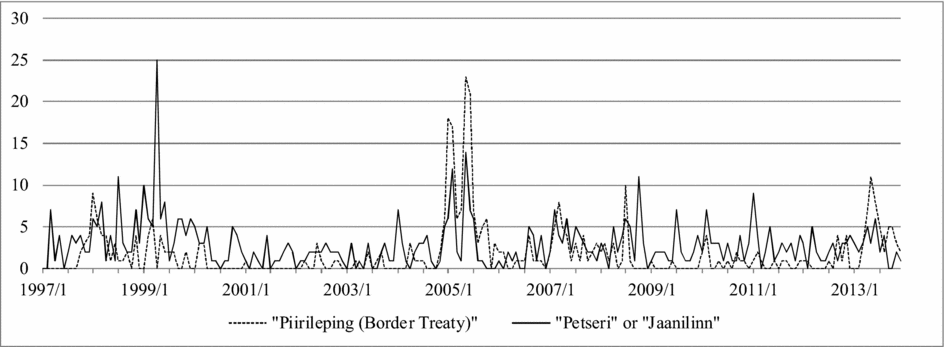
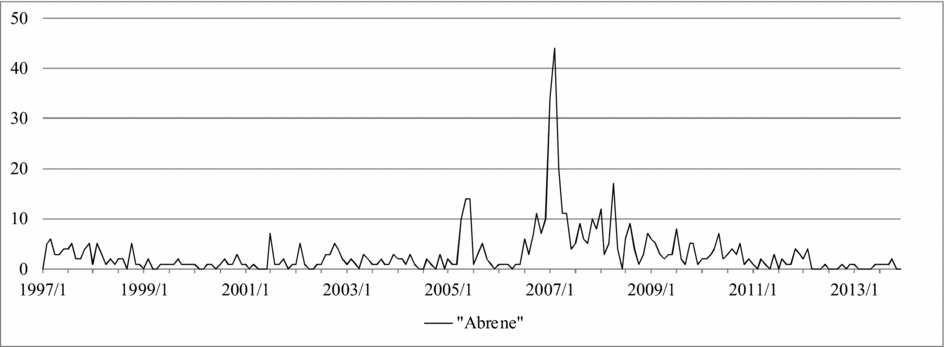
Needless to say, a territorial dispute is one of the most significant foreign policy issues, and most people do not react favorably to the renunciation of a territorial claim, as not only a strategic loss but also as an emotional reaction. This was the case for both Estonia and Latvia. Figures 1 and 2 show media coverage of border treaty issues in terms of number of articles in major local newspapers (Õhtuleht in Estonia and Diena in Latvia). They show that border treaty issues attracted public attention in both countries when their governments signed the treaties (2005 in Estonia and 2007 in Latvia). The figures also suggest fluctuations in audience interest in the issue as well.
The frequency of articles concerning the border issue in Estonia (monthly)

The frequency of articles concerning the border issue in Latvia (monthly)
Comparative study of these countries is an ideal way to examine the importance of electoral timing for government decisions to give up their diplomatic claims. The major aim of this section is not to trace politicians’ decision-making processes or to examine their inward intentions in light of the electoral calendar. Rather, the kernel of this section is to confirm the relative causal effect of electoral timing on governmental diplomatic decisions by connecting government behavior and electoral timing through in-depth studies. The following sub-sections outline the background to these border issues, the similarities between the two Baltic nations, and the concrete political processes involved when the governments made decisions on border issues.
4.1 Contextual backgrounds of the territorial disputes
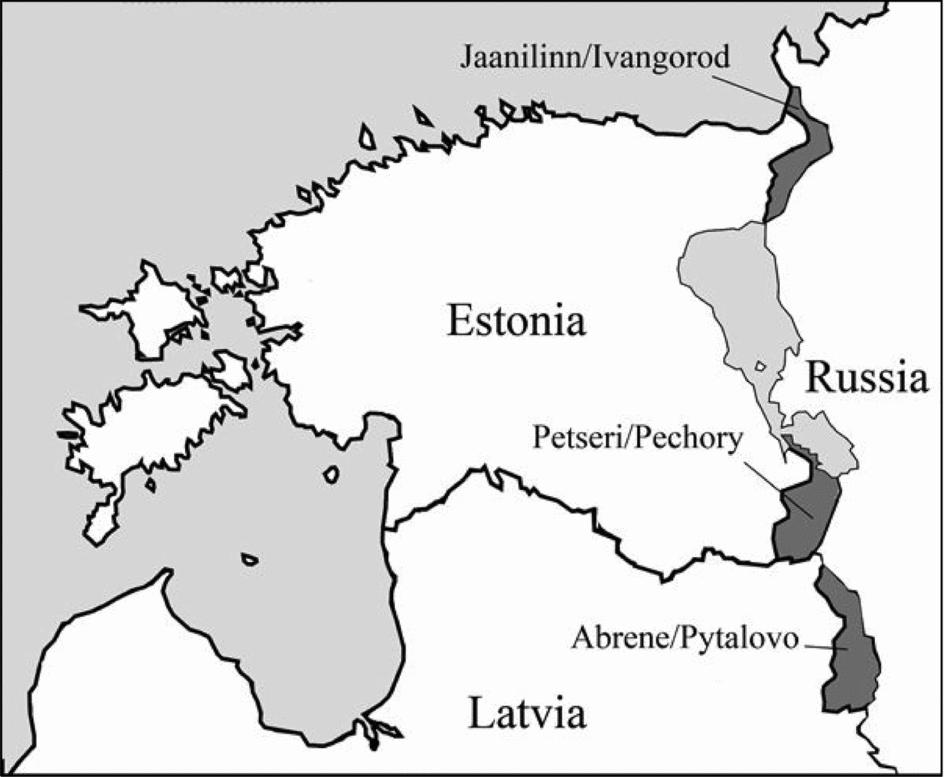
After the restoration of independence from the Soviet Union in the early 1990s, the governments of Estonia and Latvia had territorial/border disputes with the Russian Federation (Figure 3). The disputed territories between Estonia and the Russian Federation were Jaanilinn and Petseri (in Russian, Ivangorod and Pechery, respectively), and that between Latvia and the Russian Federation was Abrene (Pytalovo in Russian). All territories were under the effective control of the Russian Federation after the collapse of the Soviet Union.
The borders of Russia, Latvia, and Estonia, with disputed areas marked
The territories of Jaanilinn/Ivangorod and Petseri/Pechery were historically controlled by many great powers of Europe (the Teutonic Order, the Swedish empire, the Polish–Lithuanian commonwealth, and Russian dynasties), but a direct reason for contemporary territorial disputes over these areas can be found in early twentieth century history. After territorial tug-of-wars in the Middle Ages, Russian empires owned these lands for long time, since the eighteenth century. However, these territories were eventually captured by an independent Estonia from Russia on the basis of the Tartu Treaty (1920), after the Estonia–Soviet war. Similarly, Abrene/Pytalovo was captured by Latvia on the basis of the Riga Treaty (1920), after the Latvia–Soviet war. However, after these two Baltic republics (and Lithuania) were annexed to the Soviet Union in 1940, these territories were conceded and returned to the Russian Soviet Federative Socialist Republic (RSFSR). At that time, these border issues were not hugely problematic because it was just a matter of moving internal boundaries (East et al., Reference East, Jagger, Postgate and Thomas2007). Estonia and Latvia began to claim these territories back after the restoration of their independence from the Soviet Union. Because both republics regard their annexation by the Soviet Union in 1940 under the Molotov–Ribbentrop secret pact as illegal, the ceding of the territories to Russia was null and void ab initio. Hence, these territorial disputes involve not just technical issues but are also significant from the perspective of identity and memory politics, which tend to arouse nationalistic sentiments (Mole, Reference Mole2012).
Despite these nationalistic sentiments, both republics had to deal with their respective problems in a pragmatic manner in order to advance their accession to the European Union and NATO, and to fix the future border between the EU/NATO and Russia. Both Baltic republics and Russia began to draw up a draft version for the border treaties in the 1990s. Russia also signaled its willingness to sign the border treaties after Estonia and Latvia joined the EU and NATO (ibid: 137). Both governments eventually signed the border treaties with Russia in the first decade of the twenty-first century, and both the Estonian and Latvian governments have abandoned their claims to their old territories. The EU–Russia summit in May 2005 was a good diplomatic occasion to sign border treaties. However, the two governments reacted to this occasion in different ways. The principal problem for the two republics’ governments concerned the timing of the upcoming general elections.
4.2 Comparative analysis
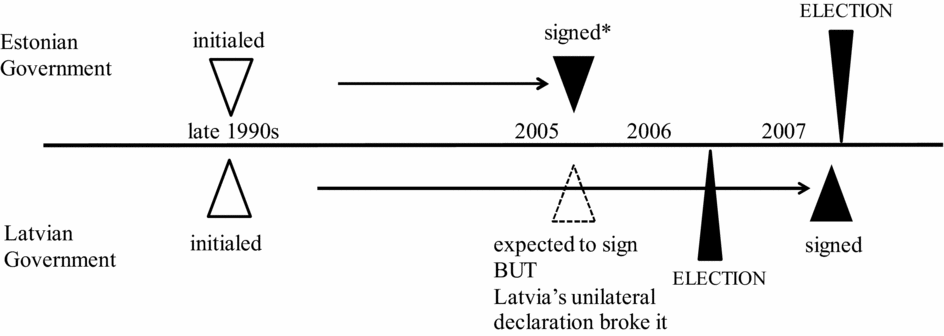
As noted above, there were differences between the two countries’ renunciation of their claims. Latvia and Estonia both initiated negotiations for a border treaty in 1997 and 1999 respectively, and, as seen below, both countries were expected to sign the border treaty with Russia in May 2005. While Estonia's government signed the agreement abandoning Jaanilinn/Ivangorod and Petseri/Pechery at that time,Footnote 11 the Latvian government broke off the agreement abandoning Abrene/Pytalovo with a unilateral declaration.Footnote 12 Both countries differed in terms of the diplomatic decisions made on this issue.
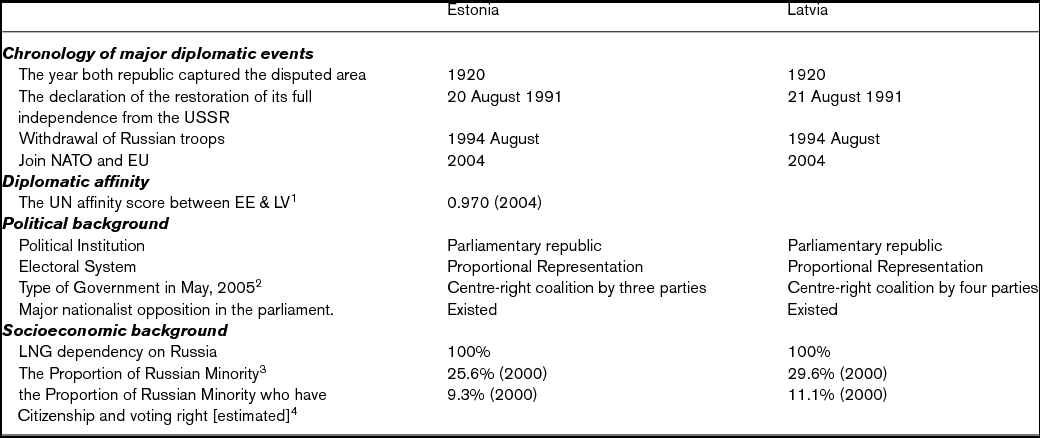
In terms of their characteristics, Estonia and Latvia share a great deal in common (Table 1). Hence, the different scenarios are a genuinely puzzling phenomenon. The variance is not insignificant, because the states have almost always acted in concert on important diplomatic issues, especially when confronting Russia. After the restoration of their independence, they (and Lithuania) formed the Baltic Council of Ministers in 1994, enhanced their reciprocal connections, and strengthened their co-operation. The co-operation and unity of the Baltic States as a single bloc ‘serve to undermine Russia's traditional policy of divide and rule towards these countries’ (Smith, Reference Smith2002: 171). They also established a unified BALTBAT peacekeeping battalion in 1994, the joint naval BALTRON squadron in 1998, and the joint airspace surveillance BALTNET operation in 1998. They even established a joint military academy in Estonia to educate high-ranking officers to protect the nations and their assets from their eastern neighbors’ invasions. Latvia and Estonia also saw the withdrawal of Russian troops at the same time, 1994, and later they both joined the EU and NATO in 2004. Moreover, they sent their troops concurrently to the former Yugoslavia for peacekeeping operations. The Strezhnev and Voeten (Reference Strezhnev and Voeten2013) UN affinity score between Estonia and Latvia in 2004 is surprisingly high (0.970), meaning that Estonia and Latvia acted in concert for 97% of the motions in the United Nations. Thus, the differences in decisions in the signing of their treaties can hardly be ignored. In the political evolution in the half decade since the restoration of independence, the differences in diplomatic the decisions between Latvia and Estonia had a great impact. Identifying the causes of these differences on a diplomatic issue may generate new insights into diplomatic decisions on territorial disputes.
Commonalities and similarities of Estonia and Latvia, concerning diplomatic negotiation with Russia
1 Based on Strezhnev and Voeten (Reference Strezhnev and Voeten2013)’s agree3un score.
2 Conrad and Golder (Reference Conrad and Golder2010). Estonia's three parties are; Reform Party, Centre Party, and People's Union. Latvia's four parties are; People's Party, First Party, Green and Farmers Union, and New Era.
3 Data deprived from Estonian and Latvian national census.
4 Authors’ estimation by the census data.
One cannot identify a cause for the differences in non-temporal factors. Latvia and Estonia are highly similar in their structural aspects. This means that some viable alternative explanations fail to account for the differences in the renunciation of their claims. First, both republics have adopted a parliamentary system of government, so that the prime ministers and cabinets were responsible for the diplomatic negotiations with Russia, which implies that there was no differences in the possibility of a veto over the signing of the border treaty. Next, the countries’ respective governments have all been center-right politically,Footnote 13 and all of them have been coalition governments, often including nationalist political parties (Conrad and Golder, Reference Conrad and Golder2010). In particular, alignments in coalition governments were similar before and after 2005, when the final negotiations on the territorial disputes between the two Baltic republics and Russia were held. Both countries’ coalition governments consisted of newly formed economically liberal parties (the Reform Party in Estonia, and the People's Union and New Era in Latvia), rural-based agrarian parties (the People's Union in Estonia, and the Green and Farmers Union in Latvia), and traditional centrist parties (the Centre Party in Estonia, and Latvia's Way in Latvia). Both governments also have latent internal political rivalry (cf. Reform Party versus Centre Party in Estonia; People's Party versus New Era in Latvia). Third, there have never been any pro-Russian governments featuring pro-Russian ethnic parties, even though many Russian-speaking minorities live within the territories of both countries. Finally, while both countries’ energy dependency on Russia was exceptionally high (100% of Liquefied Natural Gas), their economic ties with Russia are getting smaller. These factors mean that there is no significant difference between the republics’ bargaining strength with Russia.Footnote 14 Therefore, another viable explanatory factor must be sought to explain the differencesin their withdrawal of claims on the disputed territories.
The primary difference between Estonia and Latvia during this period concerned the timing of their upcoming national elections.Footnote 15 As the final negotiations approached in May 2005, the Estonian government faced a national election scheduled for March 2007 and its campaign period started in January 2007, while the Latvian government was preparing for one in October 2006, with its campaign period starting in January 2006.Footnote 16 As the current theoretical argument indicates, it is very difficult to identify clear evidence of actions suggesting the existence of audience costs or a causal mechanism determining politicians’ behavior based on such costs. However, from the circumstantial evidence, it is apparent that the timing of the general election was the only difference that might affect the different actions of the Estonian and Latvian governments. Figure 4 demonstrates the difference in timing of the national elections in Latvia and Estonia, and in their political actions relating to the negotiations of their respective border treaties with Russia. Given the differences in proximity of the forthcoming general elections, one can infer that these differences affected the Estonian and Latvian governments’ decisions on the border treaty negotiations of 2005. The Latvian government eventually signed the treaty with Russia one year after the national election, when the government did not have to fear a backlash from its electorate for abandoning a national territorial claim.
Diplomatic actions concerning border treaties with Russia shown alongside electoral schedules
4.3 Political processes and the final negotiations
Both governments and the Russian Federation were at the table to sign the border treaties in May 2005, but the two center-right coalition governments responded differently. The decision of the Estonian government to abandon its territorial claim was officially expressed in 2005, whereas the Latvian government expressed a unilateral announcement that tried to preserve its partial claim in 2005.
The Latvian government was at one point going to conclude the border treaty with the Russian Federation on 10 May 2005 (European Commission, 2006), before the Estonian government had expressed its willingness to abandon its territorial claim. However, on the eve of final negotiations with Russia, the Aigars Kalvītis government of Latvia unilaterally announced its decision not to withdraw its territorial claim on Abrene. While the two nations had been expected to sign the treaty on 10 May this unilateral action led to Russia refusing to sign the treaty (ibid.). The Kalvītis government announced that ‘this agreement is not related and does not diminish, does not deprive the state of Latvia and its citizens of the rights and legal claims provided by … the Peace Treaty between Latvia and Russia of August 11, 1920’ (Ministru Kabineta, Reference Ministru2005). Although Kalvītis (and his foreign minister, Atis Pabriks) justified this unilateral declaration by arguing that it was necessary to adjust technical and legal contradictions between the treaty and the Constitution (Satversme), the Kalvītis cabinet decided to withdraw its claim in 2007 without any constitutional reform. Their actions could therefore be construed as politically motivated.
Behind the scenes, the Kalvītis cabinet had changed its mind under pressure from the opposition. The start of the border negotiations was harshly criticized by the opposition right-wing For Fatherland and Freedom party, which had taken part in several governments in the past. At first, on 19 April Kalvītis rebuked the plans of the For Fatherland and Freedom party to include the area of Abrene in a future border treaty (The Baltic Times, 2005a). However, the opposition groups submitted a resolution plan that harshly criticized the Soviet occupation and demanded that the Russian Federation recognize that the peace treaty of 1920 was still in force (Latvijas Respublikas Saeima, Reference Saeima2005). This motion upset the government because it was submitted by MPs from not only the For Fatherland and Freedom party but also from the coalition partners, the New Era and Latvia First parties (ibid.), and the expectation was that it would be supported by another coalition partner, the Greens and Farmers Union (The Baltic Times, 2005b). For Kalvītis, Foreign Minister Pabriks, and their People's Party, signing the border treaty could have meant the collapse of the coalition or facing a barrage of criticism in the upcoming electoral campaign. Therefore, after the submission of the resolution, the government made its unilateral statement, effectively withdrawing the renunciation of its territorial claim on Abrene.
Latvia's Kalvītis cabinet was attempting to ‘demonstrate to the domestic audience that it belong[ed] to the “hawk” wing of politics’ (Rikveilis, Reference Rikveilis and Ozoliņa2008: 317 [Authors’ translation]) by taking unilateral action in 2005. In practice, public opinion in Latvia was not supportive of abandoning the territorial claim at that time. A survey in June 2005 found that slightly less than half of Latvian residents (49.5%) were prepared to accept abandoning the Abrene region (Margēviča, Reference Margēviča2005). It is reasonable to say, on observing the electoral campaign in 2006, that the Kalvītis cabinet's unilateral statement may have been (politically) rational within the context of electoral survival. Most of the political parties made reference to the Abrene question in the 2006 electoral campaign, and several major political parties (especially the New Era party, the main political rival of Kalvītis's People's Party) clearly opposed giving up the claim to Abrene (Zolče, Reference Zelče, Brikše and Zelče2007).Footnote 17 Thus, even though in the long term Latvia would have to abandon its claim to its former territory, the People's Party government had a strong incentive to maintain a strongly hawkish position on the Abrene issue to prevent its political rivals from having a reason to criticize the Kalvītis government and party before the election. In practice, once the result of the 2006 elections had restored the Kalvītis cabinet to power, the Latvian government immediately gave up the territorial claim in 2007. Of course, this divided parliament over the issue, and some political parties clearly opposed it (Archdeacon, Reference Archdeacon2007a, Reference Archdeacon2007b). The photo of a major protest by the nationalist All-for-Latvia! party received front-page coverage, and the Helsinki 86/National Force Union announced that it had ‘sentence[d] the Latvian president, prime minister and foreign minister to capital punishment for destroying the unity of the Latvian territory’ (Archdeacon, Reference Archdeacon2007c; BNS, 2007a). However, these protests did not last long, and no one raised this topic in the 2010 electoral campaign.
By contrast, the Estonian government officially announced that it did not intend to pursue its territorial claims on Jaanilinn and Petseri before it signed the border treaty with Russia in 2005. Prime Minister Andrus Ansip said in May 2005 that the government was ready to retreat on the border issue, and Foreign Minister Urmas Paet endorsed this statement (BNS, 2005a). With regard to political criticism, Prime Minister Ansip expressed his hope that ‘political parties won't use ratification of border treaty in parliament campaign’ for the upcoming elections (BNS, 2005b). These actions show that the government decided to back down on the border issue with a full understanding of the political risks – audience costs. Of course, opposition nationalist Fatherland and Res Publica Union, which had taken part in the previous governments, did not keep silent. This nationalist party clearly opposed this signification by the government in the parliament, because ‘[t]hey have to raise their ratings and their only chance is to create a wave of patriotism’ (Gryaznevich, Reference Gryaznevich2005).
The government, especially the PM's Reform Party, had enough time to prepare for the next elections and allow the electorate to forget about the unpopular decision of abandoning the territorial claim to Jaanilinn and Petseri. It was able to fabricate and raise another sentimental issue, also based on a historical dispute, as the main topic of the next general election. From 2006, one year before the election, Ansip's Reform Party and its coalition members promised to relocate a controversial bronze statue, which commemorated the Soviet soldiers who had fought Nazi Germany, from the center of Tallinn. For most of the Estonians, this statue symbolized the start of the occupation by Soviet Communists, and its relocation from the center of the capital meant liberation from the Soviet past and the victory of the Estonian nation. This strategy seemed to work. Although more than 7,000 people had signed a petition against the Estonia–Russia border treaty giving up the territorial claims (BNS, 2007b), the protests in Estonia did not continue for long. The debate in parliament continued after the government's signing of the treaty, but people forgot, ignored, or conceded that the border treaty had been signed.
Several specialists on Estonian politics have noted how the Estonian government used the statue relocation action as an electoral campaign issue to help win the 2007 elections (Smith, Reference Smith2008; Ehala, Reference Ehala2009). Ansip's Reform Party recorded an unprecedented victory in the March 2007 elections. Analysts’ accounts describe how the Estonian government avoided the negative impact of the withdrawal of the territorial claim by placing another nationalistic issue on the agenda and proving the government's nationalistic credentials on this newly fabricated issue. In addition, while the Estonian government had expressed its clear intent to withdraw the territorial claim, the border treaty had not been finally ratified because of a dispute in the Estonian parliament. This situation may also have contributed to diluting the presumably negative impact of the government's decision on the territorial issue in the minds of the electorate.
The decision to withdraw the territorial claims was an almost inescapable one for the two small republics facing a superpower. Latvia and Estonia had been expected to sign the border treaty with Russia in 2005, expressing their withdrawal of the territorial claims. Estonia government did this, while the Latvia government did not. The problem for the governments lay in deciding when to announce this undesirable decision. Estonia's Ansip government had enough time to counter any negative consequences and damage to its reputation among the electorate from signing the treaty and to fabricate another nationalistic issue on which it could present itself as hawkish. Thus, the Estonian government signed the border treaty as the occasion arose. Latvia's Kalvītis government had somehow to show its hawkish position to the electorate in the process of border negotiations in 2005; because it faced looming elections and its campaign several months later, the government could not back down. The Latvian government survived the election by taking an approach different to that of Estonia, but it signed the same treaty after the winning the elections.
5. Conclusion
Studies of international relations have sought to find clear evidence that audience costs exist and play a crucial role in conflict behavior, while, in the real world, state leaders have tried their best to avoid such costs. The latters’ efforts mean scholars encounter the major difficulties of strategic selection and partial observability of audience costs. Our strategy in this paper to tackle these difficulties is to demonstrate that audience costs exist in leaders’ strategic thinking and can affect their actual conflict behavior. Drawing on the literature on voting behavior, we began this study's theoretical arguments by assuming that voters are less informed about and inattentive to foreign affairs, and that they tend to overweigh recent events. These public limitations, coupled with the infrequency of national elections, give rise to time inconsistency in the audience cost mechanism. Knowing this, leaders decide on their conflict behavior with election timing in mind. In particular, it is expected that leaders, if they need to, will back down in international disputes during interelection periods in order to avoid audience costs. A natural experiment of territorial disputes between two Baltic nations and Russia supports our hypothesis.
This study has important implications for both scholars and policymakers. For scholars, our study draws out ‘the domestic nuances of the audience cost argument’ (Potter and Baum, Reference Potter and Baum2014: 179). Given the explosion of interest in democratic peace over the last decade, the literature on audience costs has focused on Fearon's (Reference Fearon1994) conjecture that audience costs are higher in democracies than in non-democracies. This dichotomy has been useful for understanding questions such as why democracies are more likely to win wars or get better deals in international crisis bargaining (Reiter and Stam, Reference Reiter and Stam2002), and why democracies are more reliable partners (Lipson, Reference Lipson2003). However, Weeks (Reference Weeks2008) neutralizes this democratic advantage by showing that some types of autocratic regime can generate enough audience costs to make their commitments credible. Moreover, even in democracies, the magnitude of audience costs or the extent to which the audience cost mechanism work can vary depending on the number of major political parties (Potter and Baum, Reference Potter and Baum2014), the presidents’ justification for backing down (Levendusky and Horowitz, Reference Levendusky and Horowitz2012), and the level of media freedom (Slantchev, Reference Slantchev2006). All these studies imply that studies of audience costs should move from the question of where those costs are high and significant in conflict behavior to the question of when they are such. Our findings of the relationship between election timing and audience costs can offer one possible answer and enhance the literature. A study on the effective signaling of electoral authoritarianism (Kinne and Marinov, Reference Kinne and Marinov2012) may show the theoretical leverage of our perspective on elections beyond the democracy–autocracy dichotomy.
This paper also offers some caveats to the policy of democratic promotion. Stimulated by the democratic peace thesis (e.g., Doyle, Reference Doyle1986; Russett, Reference Russett1993), policymakers such as President Clinton of the United States and Prime Minister Aso of Japan have pushed democratization across the world. There are no normative reasons to oppose them. Nevertheless, our findings imply that democratic elections can hinder peaceful conflict resolution significantly. While audience costs can facilitate communication between states, the efficiency of their signaling is based on risky actions such as military threats and troop mobilizations. Once such policies have been adopted, rational leaders with an office-seeking motive cannot help but stick to their course to avoid domestic political costs. Our study suggests that the more frequently national elections are held, the fewer opportunities to withdraw leaders have. A brief historical overview of a Japan–USSR territorial dispute strengthens our insight. In August 1955, the two states almost reached an agreement dividing their contested islands into two halves. Japanese voters supported a hawkish foreign minister who demanded all the islands, however, which prevented Prime Minister Hatoyama from conceding ground to the USSR. Hatoyama appears to have had an eye on the electoral calendar of Japan. He noted that, before the Upper House election in 1958, ‘In the negotiation with the Soviet Union, media coverage reporting the government's compromise plan disturbed diplomatic negotiations … With upcoming elections, these powers will become stronger’ (Hatoyama, Reference Hatoyama1957: 150–1).
It may be tempting to criticize our findings for their lack of falsifiability because they seem to see the unseeable. However, our research design for this natural experiment is tenable. The only difference between Estonia and Latvia's withdrawal in their disputes against Russia was the timing of the election. Other factors in the two nations, such as regime type, socioeconomic background, and foreign policy, were almost perfectly identical. While what this study identifies is not the existence of, but rather the effect of audience costs, this is a common way in international relations literature of overcoming the partial observability of audience costs of a strategic nature.
About the authors
Kiyotaka Yasui is a research associate at the Organization for Regional and Inter-regional Studies of Waseda University. His primary areas of research include the impact of domestic politics on international disputes, particularly the relationship between audience costs, elections, and public opinion. He is also a Ph.D. student at the Graduate School of Political Science of Waseda University, and previously worked as a research fellow at the Japan Society for the Promotion of Science.
Ryo Nakai is an assistant professor at the College of Law and Politics of Rikkyo University. He earned his doctoral degree from Waseda University. His research interests include party systems, elections, and ethnopolitics in newly democratized countries. One of the recent works, ‘The Influence of Party Competition on Minority Politics: A Comparison of Latvia and Estonia’, was published in the Journal on Ethnopolitics and Minority Issues in Europe. Previously, he worked as a research associate at Waseda University.