INTRODUCTION
German inflection has been viewed as a test case for the dual mechanism model of inflection. This model assumes a dual structure for inflectional systems: A rule-based mechanism for combining stem+affix generating regular forms, and storage of irregular forms in associative memory (Pinker, Reference Pinker1991; Marcus, Brinkmann, Clahsen, Wiese & Pinker, Reference Marcus, Brinkmann, Clahsen, Wiese and Pinker1995; Clahsen, Reference Clahsen1999; Clahsen, Lück & Hahne, Reference Clahsen, Lück and Hahne2007). Under this model the major claim is that errors occur as overgeneralizations which are not affected by the frequency of regular forms nor their similarity to other forms.
In English, regularity and frequency are confounded. As regular forms tend also to be the most frequent forms, overgeneralizations can be explained by frequency as well as regularity. In German, it is claimed, frequency and regularity in the inflection of noun plurals and past participles can be separated (Marcus et al., Reference Marcus, Brinkmann, Clahsen, Wiese and Pinker1995; Clahsen, Reference Clahsen1999). This would allow one to assess possible effects of frequency and regularity unambiguously. For German noun plural and past participle inflection the claim is that a dual structure of regular and irregular inflection is established early in children – indeed, it ‘seems to be intrinsic to children's as well as adults' language faculty' (Clahsen, Reference Clahsen1999: 1009). In order to substantiate or refute this claim empirical evidence from early acquisition is crucial. In this article I will focus on such evidence.
In the debate about a dual structure of German inflectional systems, noun plural acquisition has been a focus. It will therefore be addressed briefly before turning to past participles. German noun plurals are formed by the five suffixes -(e)n, -e, -er, -s and -ø. Three of these – -e, -er and -ø – can combine with vowel change (Umlaut), thus rendering eight different types of plural marking (Wurzel, Reference Wurzel1984; Heidolph, Flämig & Motsch, Reference Heidolph, Flämig and Motsch1984; Duden, Reference Duden1995; Köpcke, Reference Köpcke1988). There are regularities in the application of the different plural markers and these are based on the co-occurrence of gender and/or phonological patterns in word endings (Wurzel, Reference Wurzel1984; Duden, Reference Duden1995; Köpcke, Reference Köpcke1988). The large majority of German plural forms are captured by these regularities, but some have no discernable regularities (Duden, Reference Duden1995). Plurals with the suffixes -(e)n and -e are more frequent than any others in adult-to-adult speech (Baayen, Piepenbroek & von Rijn, Reference Baayen, Piepenbroek and von Rijn1993), in child-directed adult speech and in child speech (Szagun, Reference Szagun2001).
Under a dual mechanism approach, German noun plural inflections are classified as regular and irregular. The -s affix, which has a low frequency of around 4% (Baayen et al., Reference Baayen, Piepenbroek and von Rijn1993), is defined as the regular and default affix, because it is phonologically less restricted and occurs in a number of default conditions, such as unassimilated borrowings and acronyms (Marcus et al., Reference Marcus, Brinkmann, Clahsen, Wiese and Pinker1995; Clahsen, Reference Clahsen1999; Clahsen et al., Reference Clahsen, Lück and Hahne2007). All other plural forms are characterized as irregularFootnote 1 (Marcus et al., Reference Marcus, Brinkmann, Clahsen, Wiese and Pinker1995; Clahsen, Reference Clahsen1999). In support of this view, the prevalence of -s errors in the spontaneous speech of one child with typical development and nineteen children with SLI is cited (Clahsen, Rothweiler, Woest & Marcus, Reference Clahsen, Rothweiler, Woest and Marcus1992). Another line of evidence concerns children's preference for -s plurals in unusual sounding words. Experimental evidence from three- to eight-year-olds showed that these children tended to judge -s plurals on non-rhyming nonce words as more natural than -s plurals on rhyming nonce words (Bartke, Reference Bartke1998). This would be expected under a dual mechanism model which claims that -s affixation is not determined by analogy (Marcus et al., Reference Marcus, Brinkmann, Clahsen, Wiese and Pinker1995; Clahsen, Reference Clahsen1999).
Constructivist approaches to German plural inflections claim that the regular/irregular distinction is inappropriate for the German plural system (Szagun, Reference Szagun2001; Behrens, Reference Behrens, Do, Dominguez and Johanse2002). In accordance with descriptive grammars, German noun plurals are viewed as a system of multiple regularities which are deterministic or probabilistic in nature (Wurzel, Reference Wurzel1984; Duden, Reference Duden1995; Köpcke, Reference Köpcke1988). Two acquisition studies based on extensive longitudinal spontaneous speech data of twenty-three children altogether (Szagun, Reference Szagun2001; Behrens, Reference Behrens, Do, Dominguez and Johanse2002) showed that the children used all the different plural markers erroneously, with no preference for the -s error. Furthermore, erroneous affixation of the different plural suffixes often displayed a systematicity based on the regularities of German plural marking. With respect to the -s error, which is of special interest in the debate about the regular/irregular distinction, the data showed that it occurred in restricted phonological environments, such as after liquids, nasals and most frequently on nouns ending in -er in the singular, such as eimer (‘bucket’) (Szagun, Reference Szagun2001; Behrens, Reference Behrens, Do, Dominguez and Johanse2002). As final -er is pronounced [ʁ] in spoken German, it is possible that children analyze the -er ending as a full vowel and affix -s erroneously as an overgeneralization of the rule that words ending in unstressed vowels except schwa form the plural by -s affixation (Duden, Reference Duden1995). Erroneous affixation of -s would thus be based on analogy. Similar results for plural errors were obtained in an experimental elicitation study with Austrian children between 2 ; 6 and 6 ; 0 (S. Laaha, Ravid, Korecky-Kröll, G. Laaha & Dressler, Reference Laaha, Ravid, Korecky-Kröll, Laaha and Dressler2006). Such data constitute evidence against the dual mechanism model of German plural inflection. They show that several inflectional regularities are overgeneralized and that the erroneous affixation of -s is not arbitrary but based on analogy to existing patterns in the language.
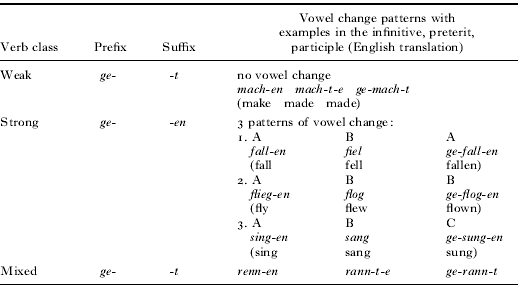
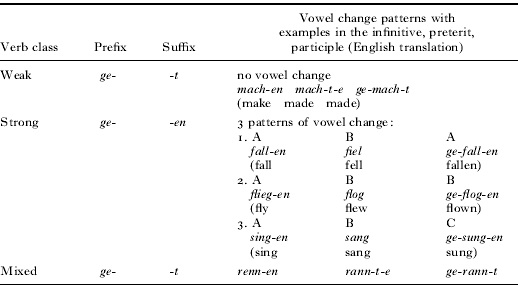
German participle formation is the other half of the test case for the dual mechanism system. Unlike the complexities of the German noun plural system, German participle formation is much closer to the dichotomy of English past tense formation. In German, past participle use is equivalent to the use of past tense in English, as reference to past events is made by the perfect tense which is formed with the auxiliaries haben (‘have’) or sein (‘be’)+past participle in spoken German. The formation of past participles involves the prefix ge-, the suffixes -t and -en, and vowel change (Ablaut). Three main classes of participle inflection may be distinguished (Heidolph et al., Reference Heidolph, Flämig and Motsch1984; Clahsen & Rothweiler, Reference Clahsen, Rothweiler, Booij and Van Marle1993; Duden, Reference Duden1995; Lindner, Reference Lindner, Fabri, Ortmann and Parodi1998): weak verbs, which take the suffix -t; strong verbs, which take the suffix -en and may involve vowel change in the stem; and mixed verbs which take the -t suffix and vowel change. There are approximately 160 base verbs with strong inflection and 13 mixed verbs (Clahsen & Rothweiler, Reference Clahsen, Rothweiler, Booij and Van Marle1993). For strong verbs, there are three types of vowel change patterns (Clahsen & Rothweiler, Reference Clahsen, Rothweiler, Booij and Van Marle1993; Lindner, Reference Lindner, Fabri, Ortmann and Parodi1998). The first pattern is ABA: the vowels of the present tense and past participle stem are the same, but the preterit has a different stem vowel, for example fallen, fiel, gefallen (English ‘fall, fell, fallen’). The second pattern is ABB: the preterit and past participle stem have the same vowel, for example fliegen, flog, geflogen (English ‘fly, flew, flown’). The third pattern is ABC: the present, preterit and past participle have a different vowel in each verb stem: singen, sang, gesungen (English ‘sing, sang, sung’). Prefixation is determined prosodically and syntactically. Participles with stress on the verb stem, or in separable verbs on the particle, take ge-. In separable verbs, ge- occurs before the verb stem, for example hin-ge-fall-en (English ‘fallen down’). A summary of this description is presented in Table 1.
German participle inflection
Under a dual mechanism approach to participle inflection, verb stem+-t affixation constitutes the regular pattern. Weak verbs with -t inflection are regular verbs. All other verbs are classified as irregular (Clahsen, Reference Clahsen, Booij and Van Marle1996). The dual mechanism approach then further specifies regular and irregular forms. Regular participles can be segmented into their constituent parts, the stem and the affix -t. In contrast, irregular participles are not segmented into their constituent parts, but are stored in memory as whole forms (Clahsen, Reference Clahsen, Booij and Van Marle1996; Penke, Reference Penke and Wunderlich2006).
There is agreement between descriptive linguistic and dual mechanism approaches concerning the status of weak verbs as regular. Differences concern whether strong and mixed verbs are grouped together as irregular and are viewed as rule-based (Heidolph et al., Reference Heidolph, Flämig and Motsch1984; Duden, Reference Duden1995; Lindner, Reference Lindner, Fabri, Ortmann and Parodi1998) or not (Clahsen, Reference Clahsen, Booij and Van Marle1996; Penke, Reference Penke and Wunderlich2006). In the present article I will avoid a classification as irregular. I shall refer to weak verbs as regular verbs, and to strong and mixed verbs.
With respect to the frequencies of different verb classes in German adult-to-adult speech, token frequency counts report a similar distribution of weak and strong verbs (Ruoff, Reference Ruoff1981; Baayen et al., Reference Baayen, Piepenbroek and von Rijn1993). This is different from English, where regular verbs outnumber irregulars (Marcus et al., Reference Marcus, Ullman, Pinker, Hollander, Rosen and Xu1992; Bybee, Reference Bybee1995). However, in terms of types, weak verbs clearly outnumber strong base verbs in German (Ruoff, Reference Ruoff1981; Bybee, Reference Bybee1995). It is unknown whether frequency distributions in child-directed speech correspond to those of adult-directed speech.
Most available studies on the acquisition of participles in young children agree that over-regularization with suffix -t is a frequent error, and few -en errors on regular verbs are observed (Mills, Reference Mills and Slobin1985; Clahsen & Rothweiler, Reference Clahsen, Rothweiler, Booij and Van Marle1993, Lindner, Reference Lindner, Fabri, Ortmann and Parodi1998; Elsen, Reference Elsen, Fabri, Ortmann and Parodi1998). In the most comprehensive account of participle acquisition, Clahsen & Rothweiler (Reference Clahsen, Rothweiler, Booij and Van Marle1993) analyzed the spontaneous speech of three typically developing children and nineteen children with SLI. Correct regular and irregular participles occurred at MLU <1·75. A variety of error types are classified: omission of prefix, omission of suffix, over-regularizations with -t suffix combined with participle verb stem, over-regularizations with -t suffix combined with stem vowel errors, and stem vowel errors alone. Omission of suffix was the most frequent error type. Omission of prefix and suffix decreased with increasing age. For over-regularization errors, however, a different pattern was observed. The data from one child indicated that these did not occur initially, then increased at around three years, and subsequently decreased again. This pattern is interpreted in terms of the U-shaped learning pattern described in the acquisition of English past tense inflection, indicating failure to retrieve a stored irregular form (Marcus, Pinker, Ullman, Hollander, Rosen & Xu, Reference Marcus, Ullman, Pinker, Hollander, Rosen and Xu1992). Clahsen & Rothweiler (Reference Clahsen, Rothweiler, Booij and Van Marle1993) conclude that children have acquired the regular/irregular distinction of participles with the occurrence of over-regularizations. They note, however, that the omission of suffixation on strong verbs is indicative of the analysis of strong verbs into their morphological components and suggests that the formation of regular and irregular participles is rule-based (Clahsen & Rothweiler, Reference Clahsen, Rothweiler, Booij and Van Marle1993). This view is abandoned subsequently in favor of the view that regular participles only are rule-based and irregular participles are stored in memory as whole forms (Clahsen, Reference Clahsen1999).
The learning pattern referred to as U-shaped has a particular significance under a dual mechanism approach (Marcus et al., Reference Marcus, Ullman, Pinker, Hollander, Rosen and Xu1992). In English past tense acquisition this is a pattern whereby children go through an initial extended period of several months during which they use regular and irregular forms correctly. Errors of over-regularization occur when children have acquired the rule for the formation of regular inflection. Under a dual mechanism model, retrieval of an irregular form blocks the rule for generating a regular form. Failure of blocking leads to the application of the rule to an irregular form, i.e. to over-regularization. When children have just learned an irregular form, their retrieval of the form may not be strong enough and fail occasionally, thus leading to over-regularization. As storage of irregular forms is consolidated, over-regularizations disappear. The U-shaped learning pattern is viewed as evidence for a dual mechanism model of inflection (Marcus et al., Reference Marcus, Ullman, Pinker, Hollander, Rosen and Xu1992). Crucial to this approach is that memory retrieval errors, and thus over-regularizations, are rare (Marcus et al., Reference Marcus, Ullman, Pinker, Hollander, Rosen and Xu1992). This was confirmed for the English past tense data analyzed by Marcus et al. (Reference Marcus, Ullman, Pinker, Hollander, Rosen and Xu1992) in which over-regularization occurred at a low rate, averaging 2·5% and remaining roughly constant between ages two and five. The average over-regularization rate for German participles presented in Clahsen & Rothweiler (Reference Clahsen, Rothweiler, Booij and Van Marle1993), however, is 9%, and thus considerably higher.
In the present study an analysis of early participle acquisition will be presented. A constructivist approach to inflectional learning is taken. It is assumed that in acquiring participle inflections children make use of distributional and structural information in the input. They generalize recurrent patterns, such as the co-occurrence of suffixation and prefixation, and the co-occurrence of vowel patterns and participle suffixes. One consistent pattern is the co-occurrence of prefix ge- with suffixes -t and -en on a verb stem. Another consistent pattern is the co-occurrence of the -t suffix with a stem containing a present tense vowel. This pattern has only thirteen exceptions of mixed participles with stem changes. It is defined as regular. Suffixation of -en, however, may or may not occur with vowel change in the stem. It is not very predictable when the -en suffix combines with a verb stem containing a present tense or participle stem vowel, although there are some ‘Ablaut’ sequences which are common to several verbs (Duden, Reference Duden1995). The acquisition of strong and mixed verb participles therefore has to rely largely on the memorization of individual items. This does not, however, preclude segmentation into morphological components. It is assumed here that participles of all classes are analyzed into their morphological components. This is because children acquire participles simultaneously with person inflection on verbs (Mills, Reference Mills and Slobin1985; Behrens, Reference Behrens1993; Lindner, Reference Lindner, Fabri, Ortmann and Parodi1998; Bittner, Reference Bittner, Bittner, Dressler and Kilani-Schoch2000; Szagun & Stumper, Reference Szagun and Stumper2007) and are already operating with the segmentation of verbs into stems and affixes.
Several predictions regarding children's errors follow from these assumptions: as segmentation into morphological components is assumed for participles of all classes, children's errors should involve all participle markers, not just over-regularization; children should produce participle errors right from the beginning, as part of their generalizations within the verb inflectional system; there should be no special status of over-regularization errors in the sense that its occurrence follows the U-shaped developmental path observed in the acquisition of the English past tense (Marcus et al., Reference Marcus, Ullman, Pinker, Hollander, Rosen and Xu1992). Frequency distributions of weak and strong participles in adult child-directed and in child speech will be compared to examine if they differ or not. A frequency effect is expected for error patterns in the sense that the most frequent elements of participle formation are most frequently involved in errors.
METHOD
Design and participants
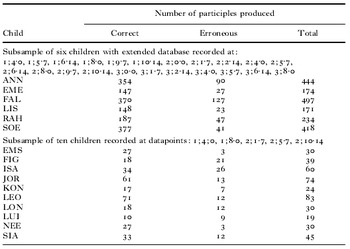
The data for the present analysis are from a large corpus of the spontaneous speech of twenty-two German-speaking children (Szagun, Reference Szagun2004; Szagun, Stumper, Sondag & Franik, Reference Szagun, Stumper, Sondag and Franik2007). The data are longitudinal. There are two subsamples. Six children, four girls and two boys, were recorded every 5–6 weeks between the ages of 1 ; 4 and 3 ; 8 with 22 speech samples per child. Sixteen children were recorded every 4½ months between the ages of 1 ; 4 and 2 ; 10, with 5 speech samples per child. For the present analysis ten children were selected out of the subsample of sixteen. The other six children produced too few participles to allow meaningful percentage calculations per verb class (see ‘Results’). An overview over the datapoints and children is given in Table 2 (see ‘Results’). For each subsample, two hours' spontaneous speech in a free-play situation were audio-recorded per datapoint. For the total sample, child-directed speech from a parent was part of the analysis. It was sampled at datapoints 1 ; 4, 1 ; 8, 2 ; 1 and 2 ; 5. The children had no diagnosed developmental delays and demonstrated age-appropriate object permanence knowledge at the start of data collection at age 1 ; 4 (Sarimski, Reference Sarimski1987). The children were growing up in monolingual environments and were resident in Oldenburg, northern Germany. They were recruited for the study from two daycare centers and pediatricians' practices in Oldenburg.
Data collection and transcription
Data collection took place in a playroom at the Department of Psychology at the University of Oldenburg. The child was recorded in a free-play situation with a parent. This was usually the mother. In two cases it was the father, who was also the main caregiver. An investigator was also present during most play sessions, but not always for the entire session. There was a set of toys such as cars and garage, dolls, doll's house, zoo animals, farm animals, forest animals, picture books, puzzles, medical kit, ambulance, fire-station. Digital auditory tape-recording was carried out, using portable Sony DAT-recorders and high-sensitive Sony or Aiwa microphones. At datapoints 1 ; 4, 1 ; 8, 2 ; 1 and 2 ; 5 video-recordings were also made.
Everything spoken by the child and the first 500 parental child-directed utterances at datapoints 1 ; 4, 1 ; 8, 2 ; 1 and 2 ; 5 were transcribed using CHILDES (MacWhinney, Reference MacWhinney2000). Investigator utterances and parental utterances which were not directed at the child were not transcribed verbatim and were not part of the analysis. An adaptation of rules for transcribing contracted speech and for coding morphosyntax was developed and used (for more details see Szagun, Reference Szagun2001; Reference Szagun2004; Szagun et al., Reference Szagun, Stumper, Sondag and Franik2007). Transcription was done from the DAT recordings and videos. Eight transcribers who were trained extensively on using CHAT notations and transcription rules performed the transcriptions. Reliability checks on transcription were calculated for 7·3% of the total transcripts for different pairs of transcribers. Percentage agreements were between 96% and 100%. Coding of morphosyntax was performed by three researchers. Participles were coded as part of the overall morphosyntactic coding. Reliability checks were done for 20% of the total transcripts for the overall morphosyntactic coding, which does not include error coding. Cohen's kappa was used as a measure of reliability. Kappas were 0·94 for coders 1 and 2, 0·98 for coders 1 and 3, and 0·96 for coders 2 and 3, indicating very good agreement between coders. CLAN programs were used for calculating frequencies of correct and erroneous participle forms.
Coding scheme for erroneous participle forms
Error patterns used all the marking components of the participle system:
(1) Omission of prefix: prefix ge- is omitted, either in initial or medial position. Examples: fund-en (correct ge-fund-en ‘found’), rein-setz-t (correct rein-ge-setz-t ‘seated in’). Omission of prefix occurred on weak and strong verbs. It occurred on its own and in combination with other errors.
(2) Omission of suffix: suffix -t or -en is omitted. This occurred on weak and strong verbs and with all three vowel patterns:
(a) on ABA verbs. Example: ge-fall (correct ge-fall-en ‘fallen’).
Here, and in the following patterns, ABB and ABC verbs are combined. The reason is that in child-directed speech the preterit is barely used. It is therefore reasonable to discard the preterit verb stem and consider only the present tense and past participle stems (Lindner, Reference Lindner, Fabri, Ortmann and Parodi1998). In the case of ABB/ABC verbs the following errors of suffix omission patterns occurred:
(b) The past participle verb stem is used, as in ge-fund (correct ge-fund-en ‘found’), or:
(c) The participle has the vowel of the present tense stem, as in weg-ge-flieg (correct weg-ge-flog-en ‘flown away’).
(d) Omission of suffix on weak verbs. Example: ge-mach (correct ge-mach-t ‘made’).
(3) Affixation of -t on strong verbs: -t is used as suffix instead of -en. The -t error occurred on all three types of strong verbs:
(a) Example for ABA verb: um-ge-fall-t (correct um-ge-fall-en ‘fallen over’).
In the case of ABB/ABC verbs:
(b) The past participle verb stem is combined with -t suffix, as in raus-ge-gang-t (correct raus-ge-gang-en ‘gone out’), or:
(c) The past participle has the vowel of the present tense stem and suffix -t, as in: ge-spring-t (correct ge-sprung-en ‘sprung’).
Categories (3a), (3b) and (3c) are defined as ‘over-regularization’. This follows the definition of over-regularization as the substitution of the suffix -t for the suffix -en irrespective of verb stem chosen (Lindner, Reference Lindner, Fabri, Ortmann and Parodi1998).
(4) Participle with present tense stem vowel+-en suffix on strong verbs: the correct suffix -en is used on a present tense stem. This marking occurred with ABB/ABC strong verbs. Example: ge-trink-en (correct ge-trunk-en ‘drunk’).
(5) Affixation of -en on weak verbs: -en is used as suffix instead of -t. Example: auf-ge-mach-en (correct auf-ge-mach-t ‘opened’).
(6) Participle with present tense stem+correct suffix -t on mixed verbs. Example: ge-denk-t (correct ge-dach-t ‘thought’).
(7) Other: errors which did not fit into the above categories. Examples: ge-fund-e (correct ge-fund-en ‘found’), ge-arbeit-est (correct ge-arbeit-et ‘worked’). Overgeneralization of vowels, in the sense of using a vowel different from present tense stem vowel on ABA or weak verbs (i.e. ge-foll-t instead of ge-fall-en ‘fallen’, ‘ge-moch-t’ instead of ‘ge-mach-t’) is a possible error pattern. However, it did not occur.
Two independent coders categorized errors according to the above scheme. All errors were categorized. As a measure of reliability Cohen's kappa was used. Kappas were calculated for suffix and prefix errors (categories 1, 2, 3 and 5). Kappa=0·97 were obtained for the sample of six children and for the sample of ten children. For the sample of six children, coder reliabilities were calculated for subdivisions of suffix omission errors (categories 2a, b, c, d) and subdivisions of -t affixation errors and vowel errors with -en affixation combined (categories 3a, b, c and 4). In the case of suffix omission, 100% agreement was observed, for -t suffixation and vowel errors+-en kappa was 0·96. Thus, there was very good agreement between coders. Out of the total errors, the category ‘other’ contained 4·2% in the sample of six children, and 3·9% in the sample of ten children. The proportion of ‘other’ errors out of the total of correct tokens plus ‘other’ errors was 0·8% in the sample of six children, and 1·7% in the sample of ten children.
RESULTS
Results are presented in three sections. First, frequency analyses of participle use in adult and child speech are presented. This is followed by error analysis in child speech, examining types and frequencies of errors. Finally, an analysis of error patterns over age and in relation to individual verbs is presented.
Descriptive analysis of frequencies per participle class and growth of participle classes
Type and token frequencies of participles in children's and adult child-directed speech were calculated per participle class. The data from six children with 22 speech samples were used. The data of the ten children recorded till 2 ; 10 were considered insufficient to represent participle use in the different verb classes (see Table 2), as only two of the speech samples for these children cover the period from the middle of the third year of life, when participles became more frequent. For adults, speech samples from all twenty-two mothers/fathers are the basis of the analysis. The aim was to use as large a dataset as possible to represent participle use in adult child-directed speech. Two thousand utterances per parent, i.e. a total of 44,000 utterances containing 1035 participles (mean=47, SD=12) were the sample of child-directed speech.
Datapoints per subsample, number of children per subsample, number of participles produced per child

In the present analysis only past participles, not the verbs in any inflected form, were counted. Counting lexemes would assume that all the different inflected forms of a verb have been fully connected in the child's system. Such an assumption would seem unjustified, especially for strong and mixed participles which, to some extent, rely on the memorization of individual items. The frequency counts include only correct participle forms. The reason is that incorrect forms are not classifiable with respect to participle class. It is not clear, for instance, whether a form such as gefallt or gefall constitutes a weak or a strong verb for a child.
When counting type frequencies the same base verb with different prefixes and particles were counted as different types. For example, the base verb fallen ‘fall’ and the prefixed verbs umfallen ‘fall over’ and runterfallen ‘fall down’ were counted as three types. This procedure was used by Clahsen & Rothweiler (Reference Clahsen, Rothweiler, Booij and Van Marle1993) and has been criticized by Bybee (Reference Bybee1995), who argues that it would inflate the number of strong verbs and lead to the larger relative distribution of strong verbs in German as compared to English. However, there are a number of reasons for counting prefixed verbs with the same base verb as different types. One is that the prefix often results in very different semantics, i.e. fangen ‘catch’ and anfangen ‘begin’. Furthermore, not only strong base verbs but also weak base verbs form prefixed verbs, i.e. the weak verb machen ‘make’ has the prefixed forms aufmachen ‘open’, wegmachen ‘get rid of’, anmachen ‘switch on’ and many more. It is hard to see how counting prefixed verbs separately would bias against weak verb type frequency. For present purposes, it is important to use the same procedure as Clahsen & Rothweiler (Reference Clahsen, Rothweiler, Booij and Van Marle1993) in order to make this analysis comparable to theirs.
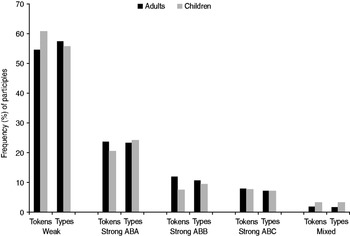
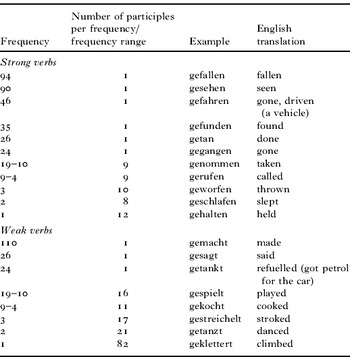
Figure 1 shows the mean percentages of token and type frequencies in the different participle classes for adults and children. The counts are based on the total of all participles over the different datapoints. In our data, individual verbs were used with differing frequencies. Two strong and one weak verb were used extremely frequently, another four strong and two weak verbs highly frequently. The lower frequencies and frequency ranges contained more weak than strong verbs (for more detail, see Appendix). In order not to obscure such detail of verb use, type as well as token frequencies are presented.
Mean percentage frequencies of tokens and types in the different participle classes for adults and children (adults: n=22, children: n=6).

As Figure 1 indicates, on the whole, type and token frequencies of participles in the different verb classes are similar for adults and children. Participles of weak verbs are the most frequent, followed by strong verb participles in the ABA, ABB and ABC classes, and mixed participles. From a theoretical viewpoint the relevant question is whether weak and strong participles differ in frequency or not. For this comparison all strong participle classes were collapsed and their frequency compared to the frequency of weak participles. For tokens proportional frequencies of weak participles were significantly higher than proportional frequencies of all strong participles together in adult and in child speech (Wilcoxon matched-pairs sign test, p=0·004 for adults, and p=0·028 for children). While children used around 6% more weak participles than adults, this difference between the proportions of weak participles in adult and child speech was not significant (Mann–Whitney U test, n.s.). Similarly, the proportions of strong participles in adult and in child speech did not differ significantly (Mann–Whitney U test, n.s.). For type frequencies, too, the percentage of weak participles was significantly larger than the percentage of all strong participles together in adult and in child speech (Wilcoxon, p<0·001 for adults, and p=0·043 for children). The difference between the proportion of weak participles in adult versus child speech was not significant (Mann–Whitney U test, n.s.), nor was the difference between the proportion of strong participles in adult versus child speech (Mann–Whitney U test, n.s.).
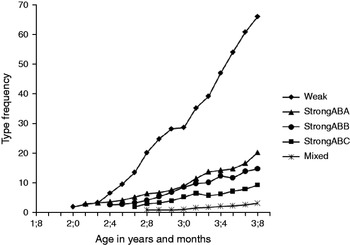
The next point concerns the growth of participle classes over time. Initially, participle use was sporadic. The first correct participle use occurred at 1 ; 6 in the speech sample of one child, and with a weak verb. Two more children used correct participles at 1 ; 10, with weak and strong verbs. From 2 ; 0, three or more children used correct weak and strong participles, and from 2 ; 1 participles of the mixed class occurred in different children's samples. Growth of participles in the different participle classes was very similar for the six individual children, and therefore means will be presented here. Figure 2 depicts the mean cumulative type frequencies of correct participles in the different participle classes over age. Numbers are absolute frequencies. Counts presented in Figure 2 start at a datapoint when three or more children used correct forms per participle class. This is 2 ; 0 for weak verbs, 2 ; 1 for strong ABA verbs, 2 ; 4 for strong ABB verbs, 2 ; 6·14 for strong ABC verbs, and 2 ; 8 for mixed verbs. Onset and growth of type frequencies in the different participle classes correspond to the frequencies of these classes in the language of adults and children (see Figure 1).
Mean cumulative type frequencies of correct participles in the different participle classes at the different age levels (n=6).

Growth curves were fitted to each child's cumulative type frequencies per participle class at the different age levels. For growth rates, too, the theoretically relevant comparison is between weak and strong participles. The linear growth rates for weak participles and all strong participle classes collapsed were compared. Weak participles had a significantly larger growth rate than all strong participles together (t(5)=2·62, p=0·047).
Types and frequencies of errors
Types of errors in child speech and their frequencies were analyzed. In a first analysis, the distribution of prefix and suffix errors was analyzed using the broad categories according to the scheme presented in the ‘Methods’ section, i.e. categories (1) prefix omission, (2) suffix omission, (3) affixation of -t on strong verbs, and (5) affixation of -en on weak verbs. For these analyses, errors were summed up over all the datapoints. Two analyses were performed. One used the data from the subsample of six children with 22 datapoints covering an age span from 1 ; 4 to 3 ; 8. The other used the data from the subsample of ten children with 5 datapoints covering an age span from 1 ; 4 to 2 ; 10·14 (see Table 2). Percentages of errors were calculated. In order to have a meaningful percentage score a minimum total of 10 (correct+erroneous participles) is required. This requirement was met per individual child, including calculations of error proportions out of the smaller total of strong verbs.
Proportions of errors were calculated determining totals of correct forms in accordance with the opportunity for a particular error type.
Category (1): proportion of prefix omission:

Category (2): proportion of suffix omission:
Category (3): proportion of -t affixation on strong verbs:
Category (5): proportion of -en affixation on weak verbs:




Each proportional score was multiplied by 100 to obtain percentages. Prefix errors occurred on their own or in combination with suffix and vowel errors. In the above calculations ‘number of prefix omissions’ refers to all prefix omissions. Out of these the percentage of error combinations consisting of suffix/vowel errors in combination with prefix omission was 19% in the sample of six children and 17% in the sample of ten children.
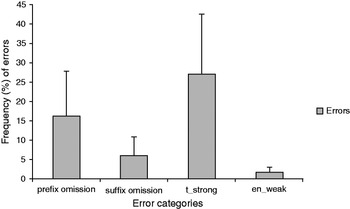
Figure 3 shows the mean percentage frequencies of the four broad error categories ‘prefix omission’, ‘suffix omission’, ‘-t suffix on strong verbs’, ‘en suffix on weak verbs’ for the sample of six children. Frequencies of error categories differed significantly (Friedman, χ2 (3, N=6)=13·4, p<0·001). Three planned pairwise comparisons were performed in order to test if frequencies of -t errors differ significantly from frequencies of -en errors and suffix and prefix omission. The procedure for multiple planned comparisons for Friedman non-parametric analysis of variance, which calculates critical values for multiple dependent comparisons, was used (Siegal & Castellan, Reference Siegal and Castellan1988; Dunnett, Reference Dunnett1964) setting α at 0·05. This rendered one significant difference. The -t error on strong verbs was significantly more frequent than the -en error on weak verbs (Friedman, multiple dependent comparisons, p<0·05). It was not significantly more frequent than suffix or prefix omission.
Mean relative frequencies (%) of suffix and prefix errors in the subsample of six children (data collapsed over age levels 1 ; 4–3 ; 8).

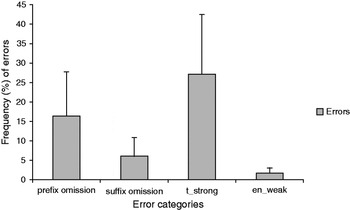
Mean percentage frequencies of the different error categories for the sample of ten children are shown in Figure 4. In this sample, frequencies of error categories also differed significantly (Friedman, χ2 (3, N=10)=10·1, p=0·017). Three planned pairwise comparisons showed that the -t error was significantly more frequent than the -en error (Friedman, multiple dependent comparisons, p<0·05). There were no significant differences between the frequencies of -t error and suffix omission and -t error and prefix omission. In order to give an impression of individual variation, standard error bars are displayed in Figures 3 and 4, although the test statistic is based on ranks, not means.
Mean relative frequencies (%) of suffix and prefix errors in the subsample of ten children (data collapsed over age levels 1 ; 4–2 ; 10).

In both samples, -t affixation on strong verbs, i.e. over-regularization, was significantly more frequent than -en suffix error on weak verbs. Over-regularization was thus the dominant suffix substitution error. However, in both samples also, it was not significantly more frequent than suffix or prefix omission. Figures 3 and 4 show that error rates for over-regularization and prefix omission are high, 10% each in the subsample of six children, and 27% and 16%, respectively, in the sample of ten children. Suffix omission is around 3% in the sample of six, and 6% in the sample of ten children, -en affixation around 1% in both samples. Summing up, the total error rate is 24% in the sample of six children and 40% in the sample of ten children. In order to test if the differences between the samples are due to the different children, the different number of datapoints or different age ranges covered, the proportion of errors per error category were compared in the two subsamples using only participles from the datapoints available for both samples: 1 ; 4·0, 1 ; 8·0, 2 ; 1·7, 2 ; 5·7, 2 ; 10·14 (see Table 2). This reduced the sample of six children to five, as EME did not produce enough participles over this age range. There were no differences on any error category between the two subsamples when the same early age range was covered (Mann Whitney U test, n.s.). Therefore, the higher error rates in the sample of ten children are not due to the different children or different number of datapoints, but to the early age range (see ‘Frequency of errors over age’ below).
In a second step, a more fine-grained analysis of error patterns looked at how suffix errors, vowel errors and their combinations were distributed over the different verb classes. This analysis uses the subdivisions of categories (2) and (3) and category (4) (see ‘Coding scheme for erroneous participle forms’). Present tense stem error on mixed verbs (category 6) was not analyzed further, as this error occurred only once. Only the data from the six children with an extended database are used, as data from the other children are insufficient for percentage calculations per fine error categories.
Proportional error scores were calculated as follows. For subcategories of suffix omission:
Category (2a): proportion of suffix omission on ABA participles
Category (2b): proportion of suffix omission on ABB/C participle stem
Category (2c): proportion of suffix omission+vowel errors on ABB/C participles
Category (2d): proportion of suffix omissions on weak participles
For errors of over-regularization:Category (3a): proportion of -t errors on ABA participles
Category (3b): proportion of -t errors on ABB/C participle stem
Category (3c): proportion of -t+vowel errors on ABB/C participles
Category (4): proportion of vowel errors+-en suffix on ABB/C participles








Each proportional score was multiplied by 100 to obtain percentages.
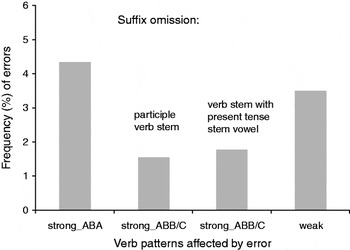
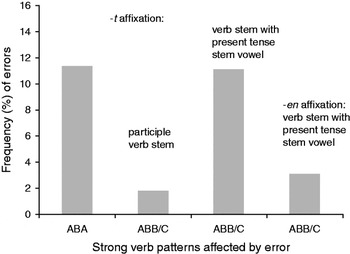
Figure 5 shows the mean percentage frequencies for each error category of suffix omission on the different verb types (categories 2a, b, c, d). From a theoretical viewpoint, fewer suffix omissions on strong participles would indicate that children operate with segmentation on strong verbs less frequently. The difference between frequencies of suffix omission on all strong verbs collapsed versus weak verbs was not significant (Wilcoxon, n.s.). Figure 6 shows the mean percentages for different types of over-regularization errors and for vowel errors alone (categories 3a, b, c and 4). In order to test if frequent elements of participle formation occur more often in children's errors, for ABB/C verbs frequencies of participles with present tense stem vowel (categories 3c+4) were compared to frequencies of participles with correct participle stem and suffix error (category 3b). Errors on ABB/C participles containing a present stem vowel were significantly more frequent than errors on ABB/C participles with correct participle stem vowel (Wilcoxon, p=0·028). Taken together with the result on suffix substitution errors, this result indicates that children have a preference for frequent elements of participle formation when they make substitution errors.
Mean relative frequencies (%) of suffix omission for different verb classes (data collapsed over age levels 1 ; 4–3 ; 8, n=6).

Mean relative frequencies (%) of -t affixation and vowel errors for different verb classes (data collapsed over age levels 1 ; 4–3 ; 8, n=6)

Frequency of errors over age
In this section, an analysis of the use of different error patterns over age will be presented. Only the three most frequent patterns, prefix omission, suffix omission and over-regularization contain sufficient data for this analysis. The data from the six children with extended database are sufficient to perform the analysis, but datapoints had to be grouped into age ranges for percentage calculations. Participles occurred for the first time at 1 ; 6 and continued to occur only sporadically at the early age levels. The first age range therefore covers more datapoints than the later ones: 1 ; 6·14–2·4.0. Thereafter, age ranges cover three datapoints each: 2 ; 5·7– 2 ; 8·0, 2 ; 9·7–3 ; 0·0, 3 ; 3·7–3 ; 4·0, and 3 ; 5·7–3 ; 8·0. Percentage scores for prefix omission, suffix omission and over-regularization errors were calculated in the way presented in the previous section (‘Types and frequencies of errors’). When calculating over-regularization errors, the first two age ranges had to be collapsed in order to have minimum totals of 10.
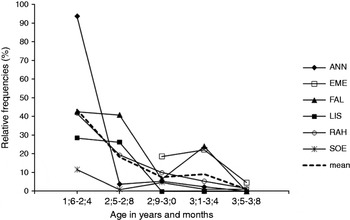
Because the large standard deviations in Figures 3 and 4 suggest substantial individual differences in error use, error trajectories will be presented per individual child and per group mean. Figure 7 shows the percentage of prefix omission errors over age. Mean rate of prefix errors ranged between 43% at the lowest and 1% at the highest age range. Prefix errors decreased significantly over age for a sample of five children over five age ranges (Page test for ordered alternatives for small samples (Siegal & Castellan, Reference Siegal and Castellan1988), L=265, p<0·001). For most children, prefix errors started at a high level, particularly for ANN. The decrease over the initial age ranges was steep. Over all age ranges it was not monotonic, but a larger increase occurred only for FAL. EME did not start using participles till age range 2 ; 9–3 ; 0.
Relative frequencies (%) of prefix omission errors for individual children and for the group mean at different ages (n=6).

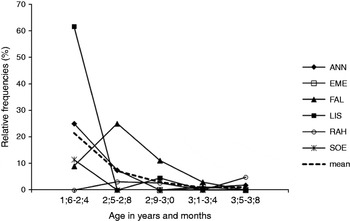
Figure 8 presents percentages of suffix omission errors per child and for the group mean. Mean rate of suffix omission errors ranged between 21% at the lowest and 1% at the highest age range. Suffix omission decreased significantly over age for a sample of five children over five age ranges (Page test, L=244·5, p<0·05). There were some marked individual differences. FAL's suffix omission errors increased after the initial level and then decreased again, and LIS started with an extremely high error level followed by a sharp drop.
Relative frequencies (%) of suffix omission errors for individual children and for the group mean at different ages (n=6).

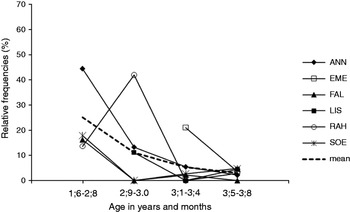
Figure 9 presents percentages of over-regularization errors per individual child and for the group mean. Mean rate of over-regularization ranged between 25% at the lowest and 3% at the highest age range. The decrease in over-regularization errors over age was significant for a sample of four children over four age ranges (Page test, L=112, p<0·05). For ANN, FAL and SOE errors started at a high level and then decreased with some minor fluctuations. RAH's error levels increased from the first to the second age range and then decreased again. For LIS there were insufficient data to calculate percentages for the first age range (see also Table 3).
Relative frequencies (%) of over-regularization errors for individual children and for the group mean at different ages (n=6).

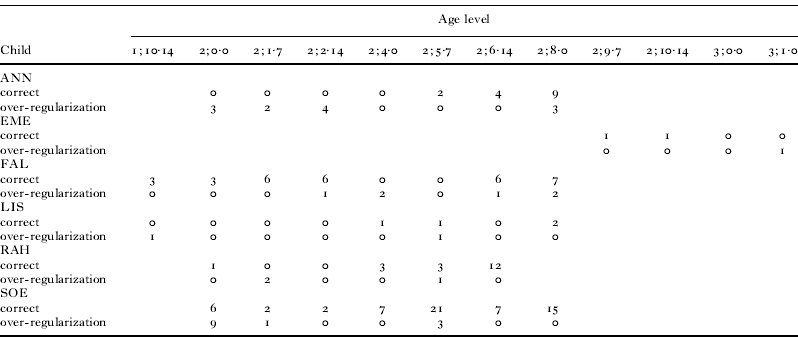
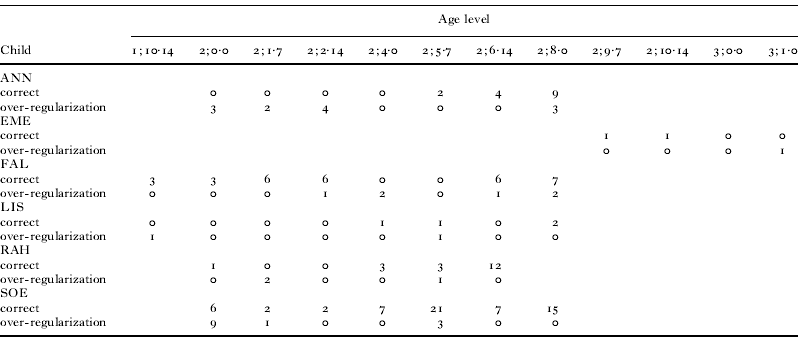
Errors of over-regularization are of particular theoretical relevance, as an initial extended error-free period is postulated by the dual mechanism model (Marcus et al., Reference Marcus, Ullman, Pinker, Hollander, Rosen and Xu1992). Collapsing many early datapoints, as had to be done here in order to obtain meaningful percentage scores, may hide this and a possible U-shaped trajectory. Therefore raw data with number of correct participles and number of over-regularizations are presented in Table 3 for each child from the datapoint of first occurrence to 2 ; 8, and 3 ; 1 for EME. The table shows that for one child, FAL, correct forms preceded errors for a period of three age levels. For ANN, the reverse is true: errors at three age levels preceded correct forms. SOE started with errors and correct forms simultaneously. The other three children produced participles too sporadically for the data to be conclusive. LIS started with one error, RAH with one correct form, followed by two errors. EME used one correct form per age level before the first error occurred. FAL's pattern may be interpreted as containing an extended period of correct use before errors set in, if three months qualify as an extended period.
Number of correct strong participles and over-regularization errors per child at initial age levels
Errors per verb
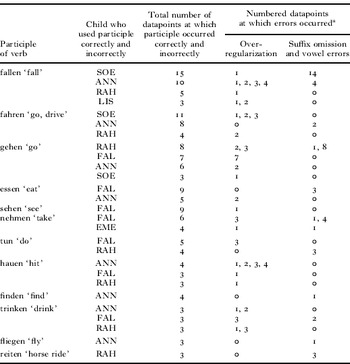
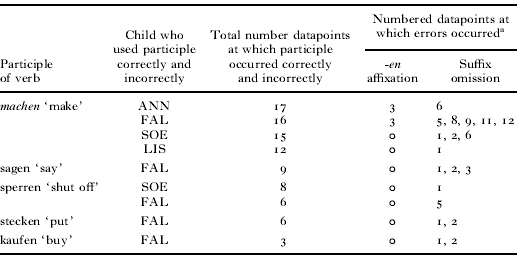
There could be a U-shaped trajectory when errors are looked at per individual verb and child. Table 4 presents a list of strong verbs with the total number of datapoints at which the verb's participle occurred correctly and incorrectly in an individual child's speech, and the datapoints at which errors occurred on the participle, separately for over-regularization and suffix omission and vowel errors. The minimum number of times a participle had to occur to be included in the list was at three separate datapoints. If an error occurred at least two datapoints after the participle's first correct use, the error was considered to occur at least with some time delay after correct use. Table 5 presents the equivalent for weak participles, -en errors and suffix errors. Numbering of the datapoints in Tables 4 and 5, columns 4 and 5, starts with 1 for the datapoint of a participle's first occurrence and is consecutive for each datapoint at which the participle is used.
Individual strong verbs used at three or more datapoints and their error patterns per child

a Numbering of datapoints starts with 1 for the datapoint of a participle's first occurrence and is consecutive for each datapoint at which the participle is used.
Individual weak verbs used at three or more datapoints and their error patterns per child
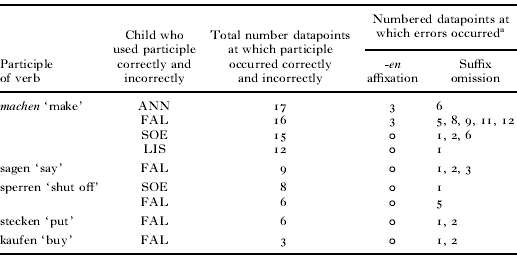
a Numbering of datapoints starts with 1 for the datapoint of a participle's first occurrence and is consecutive for each datapoint at which the participle is used.
The data in Table 4 show that for most strong verbs and for five of the six children, errors occurred right from the initial use of a particular participle. This concerns over-regularization and other errors. Only one child, FAL, committed over-regularization errors after he had used the participles correctly for at least two datapoints. This concerns four verbs: gehen ‘go’, nehmen ‘take’, tun ‘do’ and trinken ‘drink’ (see Table 4). But on another three verbs, sehen ‘see’, hauen ‘hit’ and essen ‘eat’, FAL made errors, including over-regularization, right from the beginning. Furthermore, three children, FAL, SOE and ANN, displayed the pattern of delayed error use for suffix and vowel errors for the verbs fallen ‘fall’ and essen ‘eat’. Table 5 indicates that for weak verbs, too, most children committed errors on most of the participles right from the beginning, but for the verb machen ‘make’ ANN and FAL committed the -en suffix error after two datapoints of correct use. Suffix omission occurred on machen ‘make’ and sperren ‘shut off’ after four datapoints of correct use for FAL and after five for ANN.
In the light of the data on over-regularization errors over age per child and per verb, it cannot be concluded that children generally go through a period of using strong participles correctly and then start with errors of over-regularization. Only one child did so for just over half the strong participles he over-regularized. What is more, on the occasions when error use occurred with a delay, it did so for suffix omission as well, and for -en and suffix omission errors on weak participles.
DISCUSSION
The results of the present study show that participles of weak verbs occurred significantly more frequently than participles of strong verbs. Within the class of strong verbs, participles with present tense stem vowel (ABA) were most frequent, followed by participles with vowel change in the stem (ABB and ABC). Mixed verbs were least frequent. This pattern was observed for types and tokens in children's speech and the child-directed speech of adults. In child speech, onset and growth of participles in the different classes over age mirrored these frequency patterns. The growth rate of weak participles was significantly larger than that of all strong participles taken together.
A qualitative error analysis showed that children used all elements of participle marking erroneously. Their errors consisted of prefix omission, suffix omission, -t suffixation on strong verbs, -en suffixation on weak verbs, and vowel errors. Affixation of -t on strong verbs, which constitutes over-regularization, was significantly more frequent than -en affixation on weak verbs but not more than suffix omission and prefix omission. An analysis of error occurrence per verb class showed that frequencies of suffix omission on weak and strong participles did not differ significantly. For ABB/C participles, errors which contained an incorrect present tense stem vowel were significantly more frequent than suffix errors on a participle stem with correct vowel. Thus, the most frequent elements of participle formation, -t affixation and present tense stem vowel were used most frequently in children's errors.
Analyzing the trajectories of the main error types over age showed that suffix omission, prefix omission and over-regularization were highly frequent at earlier age levels and then decreased significantly. Analysis of error patterns per verb showed that errors – including over-regularization – tended to occur from the participle's initial use. This was the case for strong and weak participles. There was some indication of delayed onset of over-regularization and other errors for some strong and some weak participles.
The present results show a frequency advantage of weak or regular over strong participles. This shows up in frequencies of adult and child speech and in growth rates of participle classes. Thus, contrary to the dual mechanism model's claim (Marcus et al., Reference Marcus, Brinkmann, Clahsen, Wiese and Pinker1995; Clahsen, Reference Clahsen, Booij and Van Marle1996; Reference Clahsen1999), frequency and regularity cannot be separated in German participle inflection: regular forms are also the most frequent ones. The dual mechanism model made its frequency claims based on data of adult-to-adult language (Ruoff, Reference Ruoff1981; Baayen et al., Reference Baayen, Piepenbroek and von Rijn1993) and counting verbs as lexemes. This may partly explain the difference from the present results, which are based on child-directed adult speech and on counting participles only. Within the context of child language acquisition the present choice of input database would seem preferable. Child-directed speech represents the input young children use most frequently for learning. Counting participles only does not assume that a verb's different inflected forms have been fully connected in a young child's system – an assumption which underlies lexeme counts but may be unjustified. The present finding of a frequency advantage for weak participles questions one of the central claims of the dual mechanism model when applied to German: the claim that frequency and regularity can be separated and that, therefore, any effects of regularity cannot be explained by frequency.
The finding that all elements of participle marking are used erroneously indicates that children segment participles of all verb classes into their morphological components. At the same time, error preferences show a dominance of errors of over-regularization, which confirms previous findings (Mills, Reference Mills and Slobin1985; Clahsen & Rothweiler, Reference Clahsen, Rothweiler, Booij and Van Marle1993; Elsen, Reference Elsen, Fabri, Ortmann and Parodi1998; Lindner, Reference Lindner, Fabri, Ortmann and Parodi1998). The dual mechanism model's claim regarding the frequency of over-regularization errors is confirmed (Marcus et al., Reference Marcus, Brinkmann, Clahsen, Wiese and Pinker1995; Clahsen, Reference Clahsen, Booij and Van Marle1996; Reference Clahsen1999; Clahsen, Hadler & Weyerts, Reference Clahsen, Hadler and Weyerts2004). However, the explanation for the phenomenon is not. Over-regularization can be explained by frequency. The regular pattern is also the most frequent one in the language. One constituent of the regular pattern, the identity of present tense and participle stem vowel, is also a constituent of participle formation in strong ABA verbs and therefore most frequent in participle formation. It occurs most frequently in errors on ABB/C verbs when vowel change in the participle stem is required. This is yet another confirmation for frequency effects on children's participle errors.
The dominance of over-regularization does not render the other error patterns meaningless. On the contrary, they are highly relevant for an account of how learning participle inflection may occur. Suffix omission on weak and strong verbs is evidence that participles of both verb classes are analyzed into morphological components. Furthermore, segmentation processes occur to the same extent for both verb classes. Evidence for segmentation and generalization processes are the error patterns on ABB/C strong verbs in which children combine either suffix omission or -t suffix with a participle stem, and the -en suffix with a present tense stem vowel (categories 2b, 3b and 4; see ‘Coding scheme for erroneous participle forms’ and Figures 5 and 6). In these error patterns children do not simply omit, but they combine elements of participle marking in unusual ways. In doing so, they provide evidence of (incorrect) generalizations of different participle patterns. A similar variety of errors was observed in the participle productions of one child studied by Elsen (Reference Elsen, Fabri, Ortmann and Parodi1998) and Lindner (Reference Lindner, Fabri, Ortmann and Parodi1998). Both authors conclude that strong participles are segmented into components and their regularities applied in erroneous generalizations (Elsen, Reference Elsen, Fabri, Ortmann and Parodi1998; Lindner, Reference Lindner, Fabri, Ortmann and Parodi1998). These error patterns and the affixation of -en on weak verbs (category 5, see ‘Coding scheme for erroneous participle forms’) occur with low frequency. However, their frequency well exceeds the 2·5% errors observed for over-regularization in English past tense acquisition (Marcus et al., Reference Marcus, Ullman, Pinker, Hollander, Rosen and Xu1992) and cannot be discounted as inconsequential. The low frequencies recorded here may also be a consequence of sampling methods. Low-frequency items are more likely to be missed, unless dense data sampling or diary methods are used (Elsen, Reference Elsen, Fabri, Ortmann and Parodi1998; Tomasello & Stahl, Reference Tomasello and Stahl2004). The application of either of these methods may reveal more low-frequency errors.
Omission of the prefix ge- on weak and strong verbs is observed to be a highly frequent error in all the available evidence on participle acquisition (Mills, Reference Mills and Slobin1985; Clahsen & Rothweiler, Reference Clahsen, Rothweiler, Booij and Van Marle1993; Elsen, Reference Elsen, Fabri, Ortmann and Parodi1998; Lindner, Reference Lindner, Fabri, Ortmann and Parodi1998) including the present study. While this error may be prosodically determined, as children tend to leave out unstressed elements (Slobin, Reference Slobin, Ferguson and Slobin1973), it is nevertheless further evidence that participles are segmented into their components. All the different error patterns observed here clearly contradict the view that participles of strong verbs are stored in memory as unanalyzed wholes (Clahsen, Reference Clahsen, Booij and Van Marle1996; Reference Clahsen1999).
Regarding the developmental trajectories of errors, the general tendency is that children produce different types of errors right from the beginning of strong and weak participle use. Elsen (Reference Elsen, Fabri, Ortmann and Parodi1998) reports a similar finding on the basis of a very detailed single case study. Errors, including those of over-regularization, do not only occur early but do so much more frequently. This shows up in the age-related error patterns for six children and in the very high error rates of ten other children whose errors are captured over the early age ranges up to 2 ; 10 only. The present data thus do not support the dual mechanism model's claim (Marcus et al., Reference Marcus, Ullman, Pinker, Hollander, Rosen and Xu1992; Clahsen et al., Reference Clahsen, Hadler and Weyerts2004) of an initial extended error-free period. However, there is some individual variation in error patterns which bears on the question of U-shaped development in over-regularization errors. RAH's over-regularizations increased from the first to the second age range, but her earliest use of strong participles was not free from over-regularizations (see Figure 9 and Table 3). The only evidence of delayed production of over-regularizations comes from FAL. He used only correct strong participles for an initial period of three months (see Table 3), and he used just over half his strong participles correctly for several months before he over-regularized them (see Table 4). However, the other five children produced over-regularizations on all their strong participles from the beginning (see Table 4), and ANN even produced over-regularized strong participles only during the initial three months (see Table 3). FAL's pattern was the exception. However, his deviations from an overall pattern of decreasing errors were not limited to over-regularizations. His suffix omission errors increased from the first to the second, and his prefix omissions from the third to the fourth age range (see Figures 8 and 7). He displayed delayed onset of -en error on one weak verb and of suffix omission on two weak and two strong verbs (see Table 4). The same was observed for ANN, and for SOE's suffix omissions on strong participles. Thus, there is no special status of over-regularization. The general tendency of early onset of errors together with its exceptions is observed for all errors.
The present results contradict some of the dual mechanism's assumptions regarding the acquisition of German participle inflection. Children's diverse errors bear evidence for the segmentation of weak and strong participles into morphological components. This contradicts the assumption that regular participles only are segmented into their component parts whereas strong participles are stored as whole forms (Clahsen, Reference Clahsen, Booij and Van Marle1996; Reference Clahsen1999; Penke Reference Penke and Wunderlich2006). Over-regularizations do not generally show U-shaped development. Furthermore, over-regularization and total error rates are much higher than the theory of occasional retrieval failure (Marcus et al., Reference Marcus, Ullman, Pinker, Hollander, Rosen and Xu1992; Reference Marcus, Brinkmann, Clahsen, Wiese and Pinker1995) would allow. The theory would have to explain why German-speaking children suffer from so much more memory failure. Finally, the dominance of over-regularization can be explained by frequency effects.
The findings confirm the predictions made within a constructivist approach to inflectional learning. Such an approach assumes that children construct inflectional patterns making use of structural and distributional information in the input, and it can explain the present findings. Children produce errors right from the beginning because they are acquiring participles within the wider framework of the verb inflectional system. When children begin to inflect participles, they are already operating with infinitives and person marking (Mills, Reference Mills and Slobin1985; Behrens, Reference Behrens1993; Bittner, Reference Bittner, Bittner, Dressler and Kilani-Schoch2000; Szagun & Stumper, Reference Szagun and Stumper2007), i.e. with a system of segmenting verbs into stems and affixes. This would allow errors using all the participle markers right from the beginning. The dominance of over-regularization is rooted in a distributional pattern of the language: the co-occurrence of prefix ge- with suffix -t on a verb stem is the most frequent and predictable pattern of participle inflection. The patterns combining prefix ge- with -en suffix on a verb stem with vowel change are considerably less predictable. While there are some ‘Ablaut’ sequences common to groups of verbs (Duden, Reference Duden1995), recurring patterns have low probability. The acquisition of such participles has to rely on a combination of applying similarities in vowel patterns with very low probabilities of occurrence and memorization of individual items. The process of practice and memorization of individual items it not viewed as contradictory to the process of learning regularities. Almost all psychological theories of learning and development incorporate processes of generalization as well as memorization of individual items. Participle inflection may be viewed as a dual system in the sense that there is one dominant regular pattern and minor other patterns, but such duality is the outcome of learning (Westermann, Reference Westermann, Gernsbacher and Derry1998) rather than ‘intrinsic’ (Clahsen, Reference Clahsen1999). It is constructed as a result of experience with the structural and distributional patterns of the input language.
One limitation of the present study is that most of the data analysis is based on the speech of a sample of six children. Where possible, this is backed up by data from another ten children. Important aspects, such as individual variation, which is indicated by the large standard deviations in the group analyses and indicated by the error trajectories of individual children, cannot be generalized because of the small sample size. Another limitation is the moderate amount of adult input data. Generalizations from the present results have to be viewed within the limitations of the samples they are based on. At present, analyses of German participle acquisition based on larger datasets are not available. Considerably less sampled speech has been used as the basis of widely accepted claims and generalizations about the early acquisition of German inflection (Marcus et al., Reference Marcus, Brinkmann, Clahsen, Wiese and Pinker1995; Clahsen, Reference Clahsen1999). It is highly desirable to carry out analyses of participle inflection on the basis of richer speech samples from more children. This will offer the opportunity to substantiate, modify or refute the present results and interpretations.
APPENDIX
Token frequencies or frequency rangesFootnote a for individual strong and weak participles and number of participlesFootnote b per frequency/frequency range – as used in the child-directed speech of twenty-two adults.

a Frequencies and frequency ranges are defined on the basis of the verbs' occurrences in the data.
b Base verbs are the basis of calculation, thus gefallen includes umgefallen, hingefallen and other simplex forms, and gemacht includes angemacht, ausgemacht and other simplex forms.