1. Introduction
Aristotle commences his Physics by observing that “the natural way to go about” an inquiry into the principles of a subject is “to start with what is more intelligible and clear to us” (Reference Waterfield1996, 184a).Footnote 1 And so I will proceed here. The subject into which we inquire is symmetry breaking. We are (or so I suppose) philosophers of science who—in spite of having witnessed the presidential address at the last PSA (Earman Reference Earman2004)—are not yet masters of the mysteries of Noether's two theorems, the constrained Hamiltonian formalism, or the Higgs mechanism. What is more intelligible and clear to us is (or so I suppose) the standard quantum formalism for spin
 $\frac{1}{2}$
systems (e.g., electrons) and small assemblages thereof—the formalism that frames most familiar expositions of the EPR argument, the Bell inequalities, and the measurement problem. Thus I aim here to start from this formalism and work toward an explication of symmetry breaking, with the aim of raising some recognizably foundational questions about it. The framework I develop is a simplification of one used to treat the phenomenon of ferromagnetism, and the recognizably foundational questions bear upon the notion of physical possibility naturally allied to a theory that countenances symmetry breaking.
2. Why Johnny's So Long
Iron is ferromagnetic: above 771° C an iron bar at equilibrium exhibits no net magnetization (paramagnetic phase); below 771° C, an iron bar at equilibrium exhibits spontaneous magnetization (ferromagnetic phase); at 771° C, both phases, ferromagnetic and paramagnetic, are possible for it. These examples illustrate phase structure, the availability, to certain systems in equilibrium at certain temperatures, of a variety of different phases. To accommodate phase structure, let us suppose, statistical physics must allow that, for certain systems at certain temperatures, a multiplicity of equilibrium states—and so a multiplicity of phases—are possible.
Phases are typically differentiated by appeal to an order parameter: the ferromagnetic phase, which requires the spins of most of the (outer shell) electrons in the iron to line up, is more highly ordered than the paramagnetic phase, in which the spins of constituent electrons, distributed every which way, tend to cancel one another out. That a conspiracy of electron spins underlies iron's ferromagnetism suggests that we might model a bulk ferromagnet in terms of its constituents, idealized as spin
 $\frac{1}{2}$
systems. Now the statistical physics of finite systems identifies equilibrium states with Gibbs states. And at finite temperatures, if the Gibbs state of a finite system exists, it is unique. So too then must be the phase available to a finite system in equilibrium at a finite temperature. The reason Johnny's so long at the ferromagnet is that to wrest a phase transition from a model of the underlying microphysics, we need to posit an infinite number of microconstituents.
In the thermodynamic limit of statistical mechanics, one lets the number of microconstituents one considers, and the volume they occupy, go to infinity, while keeping their energy density finite. Only in the thermodynamic limit can one introduce a notion of equilibrium that allows what the Gibbs notion of equilibrium for finite systems disallows: the multiplicity of equilibrium states at a finite temperature implicated in phase structure.Footnote 2
Iron's ferromagnetic phase is an instance of the subject into whose principles we inquire: broken symmetry. As a first approximation, let us say that symmetry breaking occurs when a physically significant state of a system—its ground state, or an equilibrium state—fails to be invariant under the system's dynamical symmetries, where these are understood (again, to first approximation) as transformations on the theory's state space under which the set of dynamically allowed histories is stable (Earman Reference Earman1989, Chapter 3, spells this out). Without delving into the detailed microdynamics of a ferromagnet, we can suppose those dynamics to be rotationally invariant: rotating each state in a dynamically possible history through a fixed angle yields a dynamically possible history. Ferromagnetic states break this symmetry—spontaneously magnetized, an iron bar has a polarization lying in a particular direction; neither this direction nor the state of the iron bar are invariant under arbitrary rotations.
If the set of equilibrium states for a given system at a given temperature contains only one member, that member must be invariant under (i.e., cannot break) dynamical symmetries.Footnote 3 Because the equilibrium state of a finite system at a finite temperature is unique, short of the thermodynamic limit, there is no symmetry breaking by equilibrium states. This is another reason Johnny's so long at the ferromagnet.
3. Electrons to Ferromagnets
In this section I set off from what is most familiar to us—a single spin
 $\frac{1}{2}$
system—and develop a characterization of symmetry breaking in terms of the availability of unitarily inequivalent representations of the physics of an infinite collection of such systems.
3.1. A Single Spin
 $\frac{1}{2}$
System

To construct a quantum theory of a single spin system, one finds a trio of observables
 $\{ \sigma _{x},\:\sigma _{y},\:\sigma _{z}\} $
manifesting the algebraic structure encapsulated by the Canonical Anticommutation Relations (CARs), that is,Footnote 4


The usual way to realize the quantum theory of a single spin system is to find self-adjoint operators
 $\{ \hat{\sigma }_{x},\:\hat{\sigma }_{y},\:\hat{\sigma }_{z}\} $
acting on a Hilbert space
 $\mathstrut{\cal H} $
and satisfying (1) and (2). The observables pertaining to the system correspond to elements of
 $\mathstrut{\frak B} _{sa}(\mathstrut{\cal H}) $
the self-adjoint subset of the set of bounded operators on
 $\mathstrut{\cal H} $
. (Remark, for future reference, that
 $\mathstrut{\frak B} (\mathstrut{\cal H}) $
can be obtained from the Pauli spins by forming polynomials of
 $\{ \hat{\sigma }_{x},\:\hat{\sigma }_{y},\:\hat{\sigma }_{z}\} $
, then closing the resulting set in
 $\mathstrut{\cal H} $
's weak operator topology,Footnote 5 and that closing a set of bounded operators in the weak topology is a recipe for building a von Neumann algebra.) A state of the system is a functional
 $\rho \thinspace{:}\thinspace \mathstrut{\frak B} (\mathstrut{\cal H}) \rightarrow \mathstrut{\Bbb R} $
that assigns every system observable an expectation value, subject to prima facie reasonable constraints, for example, linearity, normalization, and countable additivity. According to Gleason's theorem, in Hilbert spaces of dimension greater than 2 (which are the sorts of Hilbert spaces we'll be dealing with, once we consider more than one spin system), possible states on
 $\mathstrut{\frak B} (\mathstrut{\cal H}) $
stand in one-to-one correspondence to density operators
 $\hat{\rho }$
on
 $\mathstrut{\cal H} $
, where
 $Tr(\hat{A}\hat{\rho }) $
gives the expectation value
 $< \hat{A}> $
of an observable
 $\hat{A}$
in a state
 $\hat{\rho }$
.
Suppose you and I each construct a Hilbert space quantum theory of a single spin system. Mine features the usual operators
 $\{ \hat{\sigma }_{x},\:\hat{\sigma }_{y},\:\hat{\sigma }_{z}\} $
satisfying the CARs and acting on a vector space spanned by eigenvectors
 $\vert +> $
and
 $\vert -> $
of
 $\hat{\sigma }_{z}$
(see Sewell Reference Sewell2003, §2.2.1 for details). You are contrary: you find operators
 $\{ \hat{\sigma }_{a},\:\hat{\sigma }_{b},\:\hat{\sigma }_{c}\} $
satisfying the Pauli relations and acting on a vector space spanned by eigenvectors
 $\vert \uparrow > $
and
 $\vert \downarrow > $
of your
 $\hat{\sigma }_{c}$
operator. No one would be tempted to suppose that you and I have found different quantum theories of a single spin
 $\frac{1}{2}$
system. Still, it's worth elaborating the concept of sameness of quantum theory that enables us to resist the temptation.
Start with the idea that physical theory theories are in the business of delineating what's possible for systems to which they apply. Add the idea—I'll call it the Hilbert space account—that a possibility for a quantum system is given by an expectation value assignment to the full set of observables pertaining to it, which set is given in turn by
 $\mathstrut{\frak B} _{sa}(\mathstrut{\cal H}) $
for some fixed Hilbert space
 $\mathstrut{\cal H} $
. Provided
 $\mathrm{dim}\,(\mathstrut{\cal H}) > 2$
, then, possibilities for the system correspond to density matrices on
 $\mathstrut{\cal H} $
. Finally, adopt as a criterion for the equivalence of theories the coincidence of the possibilities they recognize. Then two quantum theories are physically equivalent iff they're unitarily equivalent: A Hilbert space
 $\mathstrut{\cal H} $
, and a collection of operators
 $\{ \hat{O}_{i}\} $
is unitarily equivalent to
 $(\mathstrut{\cal H} ^{\prime },\:\{ \hat{O}^{\prime }_{i}\}) $
if and only if there exists a one-to-one, linear, norm-preserving transformation (“unitary map”)
 $U\thinspace{:}\thinspace \mathstrut{\cal H} \rightarrow \mathstrut{\cal H} ^{\prime }$
such that
 $U^{-1}\hat{O}^{\prime }_{i}U=\hat{O}_{i}$
for all values of i. U sets up the desired coincidence: for each expectation value assignment essayed by the first theory (via
 $Tr(\hat{A}\hat{\rho }) $
for all
 $\hat{A}\in \mathstrut{\frak B} (\mathstrut{\cal H}) $
), it identifies an identical expectation value assignment essayed by the second (
 $Tr(\hat{A}^{\prime }\hat{\rho }^{\prime }) $
, where
 $\hat{X}^{\prime }=U\hat{X}U^{-1}$
). Wigner (Reference Wigner1959) showed that, under rather general circumstances, the quantization of finitely many spin
 $\frac{1}{2}$
systems is unique up to unitary equivalence. Thus you and I can be confident that, notational variances notwithstanding, our quantizations give the same theory.
The polarization of a system is a vector whose magnitude (
 $\in [ 0,\: 1] $
) gives the strength and whose orientation gives the direction of the system's magnetization. On a single electron, it is represented by an observable
 $\hat{m}$
whose three components correspond to three orthogonal components of quantum spin. For example, in
 $\vert +> $
,
 $< \hat{m}> =+1$
along the z axis. One upshot of the unitary equivalence of our quantizations is, where U is the map establishing that equivalence,
 $\vert +^{\prime }> =U\vert +> $
is a state in your theory and
 $\hat{m}^{\prime }=U\hat{m}U^{-1}$
is an observable in your theory such that
 $< +^{\prime }\vert \hat{m}^{\prime }\vert +^{\prime }> =+1$
along the z axis.
3.2. Finite One-Dimensional Spin Chain
Now suppose that we have a finite number of electrons, arranged in a one-dimensional lattice. To find a quantum theory for this composite system, we must equip each location k with a Pauli spin
 $\sigma ^{k}=(\sigma ^{k}_{x},\:\sigma ^{k}_{y},\:\sigma ^{k}_{z}) $
satisfying the CARs, expanded to include the requirement that spin observables for different systems commute:

One way—according to Wigner's theorem, up to unitary equivalence, the only way—to build a quantum theory fitting these specifications is to use a vector space
 $\mathstrut{\cal H} $
spanned by a basis consisting of sequences
 $s_{k}$
, where k ranges from
 $-n$
to n, and each
 $s_{k}$
takes one of the values
 $\pm 1$
. (Note that there are finitely many distinct such sequences—finitely many ways to map a set of finite cardinality into the set {+1, −1}.) Operators
 $\hat{\sigma }^{m}_{z}$
are introduced in such a way that sequences
 $s_{k}$
whose mth entry is
 $\pm 1$
correspond to eigenvectors associated with the eigenvalue
 $\pm 1$
. Operators
 $\hat{\sigma }^{k}_{y},\:\hat{\sigma }^{k}_{z}$
conspiring with these to satisfy the CARs (3) are introduced by analogy to their single electron counterparts (see Sewell Reference Sewell2003, §2.3 for details).
In the basis sequence
 $s_{k}$
, the polarization observable
 $\hat{m}$
(which belongs to
 $\mathstrut{\frak B} (\mathstrut{\cal H}) $
in virtue of its components
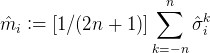 $\hat{m}_{i}\mathrel{\mathop:}= [ 1/ (2n+1) ] \sum_{k=-n}^{n}\hat{\sigma }^{k}_{i}$
being polynomials of Pauli spins) takes an expectation value of magnitude
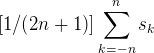 $[ 1/ (2n+1) ] \sum_{k=-n}^{n}s_{k}$
directed along the z axis. (The polarization of arbitrary states is more complicated; fortunately we needn't go into it.) For “balanced” basis sequences containing an equal number of +1s and −1s, the magnetic moments of the constituent electrons cancel out, and the polarization is 0. For “unbalanced” sequences, the polarization points up or down, depending on whether +1 or −1 predominates. The polarization attains extreme values (of
 $\pm 1$
) for those sequences every term of which is the same. As n grows, the fraction of states in the basis that attain extreme values of polarization shrinks—eo ipso, the measure of extremely polarized states in the state space shrinks as well. One might suspect that, as
 $n\rightarrow \infty $
, the measure of extremely polarized, adamantly symmetry-breaking states in the basis set approaches 0. The next sections reveal that this expectation—along with the Hilbert space account of the content of quantum theories—is upset in the thermodynamic limit.
3.3. Infinite One-Dimensional Chain
Now our system is a doubly infinite chain of electrons, labeled by the positive and negative integers
 $\mathstrut{\Bbb Z} =\{ \ldots \:,\: -2,\: -1,\: 0,\: 1,\: 2,\:\ldots \} $
. Once again, to construct a quantum theory of this system is to associate with each electron k a
 $\sigma ^{k}=(\sigma ^{k}_{x},\:\sigma ^{k}_{y},\:\sigma ^{k}_{z}) $
satisfying the CARs (3). If on the model of the finite spin chain, we attempt to construct our Hilbert space from a basis consisting of all possible maps from
 $\mathstrut{\Bbb Z} $
to
 $\{ \pm 1\} $
, we run into the difficulty that the set of such maps is nondenumerable, and the Hilbert space nonseparable, which runs counter to the entrenched tradition of using separable Hilbert spaces for physics. One way to obtain a separable Hilbert space is to start with the sequence
 $s_{k}=+1$
for
 $k\in \mathstrut{\Bbb Z} $
and add all sequences obtainable from this one by finitely many local modifications. The resulting basis consists of all sequences for which all but a finite number of sites
 $s_{k}$
take the value +1. Now we can continue to follow the model of the finite spin chain to introduce operators
 $\sigma ^{+}_{k}$
satisfying the CARs (Sewell Reference Sewell2003, §2.3 has details). I will call this quantization
 $(\mathstrut{\cal H} ^{+},\: S^{+}) $
.
Consider how the polarization observable
 $\hat{m}^{+}$
behaves on
 $(\mathstrut{\cal H} ^{+},\: S^{+}) $
. (
 $\mathstrut{\frak B} (\mathstrut{\cal H} ^{+}) $
harbors such an observable because the sequence
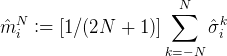 $\hat{m}^{N}_{i}\mathrel{\mathop:}= [ 1/ (2N+1) ] \sum_{k=-N}^{N}\hat{\sigma }^{k}_{i}$
has a limit as
 $N\rightarrow \infty $
in
 $\mathstrut{\cal H} ^{+}$
's weak topology. We can imagine realizations of the CARs, modeled on
 $(\mathstrut{\cal H} ^{+},\: S^{+}) $
, for which this is not so: for example, a representation whose “ground state” is given by
 $s_{0}=+1,\: s_{\pm k}=-1$
for
 $2^{n}\leq k\leq 2^{n+1}-1$
and n even, and
 $s_{\pm k}=-1$
for
 $2^{n}\leq k\leq 2^{n+1}-1$
and n odd.) For every state in the basis,
 $< \hat{m}^{+}> $
will be oriented along the z axis and take the value
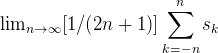 $\mathrm{\lim}_{n\rightarrow \infty }[ 1/ (2n+1) ] \sum_{k=-n}^{n}s_{k}$
, which is 1, because for each basis element, all but a finite number of the
 $s_{k}$
s take the value +1. Every state representable on
 $S^{+}$
will inherit this feature from the basis vectors in terms of which it is expressed: every state in the representation will have unit polarization in the positive z direction, in bold defiance of the (posited) rotational symmetry of system's dynamics! Instead of being rare, symmetry-breaking states are pandemic. But they all break symmetry in the same way: where (oh where) have states with other polarizations gone?
The answer is that they've gone to other representations of the physics of infinite spin chains. Consider, for instance, a representation set in a Hilbert space whose basis elements correspond to the sequence
 $s_{k}=-1$
for
 $k\in \mathstrut{\Bbb Z} $
, along with all sequences obtainable from this one by finitely many local modifications. The basis consists, then, of sequences for which all but a finite number of sites
 $s_{k}$
take the value −1. Operators
 $\sigma ^{-}_{k}$
satisfying the CARs are introduced in such a way that the nth entry in the basis sequence
 $s_{k}$
gives the expectation value of
 $\hat{\sigma }^{n}_{z}$
(Sewell Reference Sewell2003, §2.3 has details). Call this representation
 $(\mathstrut{\cal H} ^{-},\: S^{-}) $
. Because in every basis element of
 $S^{-}$
all but a finite number of the
 $s_{k}$
s take the value −1, on every state in
 $S^{-}$
,
 $< \hat{m}^{-}> $
will be given by a unit vector in the negative z direction. That is, every state in
 $S^{-}$
has unit polarization the negative z direction, boldly breaking the (posited) rotational symmetry of the dynamics.
These states count as symmetry breaking (in our rough and ready sense) only if they are physically significant. Here's a dynamical story which reveals them to be so. In the Heisenberg model of ferromagnetism, neighboring spins in the chain are supposed to interact via the Hamiltonian

where J is a positive real number. This Hamiltonian, which is invariant under rotations of the Pauli spins
 $\sigma ^{k}$
, aims to recover ferromagnetism by rendering states of the system in which spins are aligned energetically favorable.Footnote 6 In
 $(\mathstrut{\cal H} ^{+},\: S^{+}) $
, for instance,
 $< \hat{H}^{+}> $
is minimized in the translationally invariant state
 $\vert \Omega ^{+}> $
corresponding to the sequence
 $s_{k}=+1$
for all k. That is to say, the symmetry-breaking state
 $\vert \Omega ^{+}> $
is theground state of the Hamiltonian and for that reason physically significant. Mutatis mutandis, the symmetry-breaking translationally invariant state
 $\vert \Omega ^{-}> $
corresponding to the sequence
 $s_{k}=-1$
for all k is the ground state of
 $\hat{H}^{-}$
in
 $(\mathstrut{\cal H} ^{-},\: S^{-}) $
. Indeed, the one-dimensional Heisenberg ferromagnet with 0 external magnetization admits a continuum of translationally invariant ground states. Each is a product state with all spins parallel; each can be derived from any other by a suitable rotation.
Of course, the same can be said of the finite spin chain with Hamiltonian (4). Each product state of the finite chain with all spins parallel will be a translationally invariant ground state of the Hamiltonian. There are continuously many such states; each breaks the rotational symmetry of dynamics governed by that Hamiltonian; each can be derived from any other by a suitable rotation. But all these states live in the same Hilbert space, wherein rotation is implemented by a unitary (i.e., probability-conserving) operator. So the action of the symmetry does not change the space of possibilities or the probability structure the theory allots the finite spin chain. That symmetries needn't so act on the Hilbert space representations of the physics of infinite systems is crucial to the explication of broken symmetry.
3.4. Broken Symmetry
With the foregoing example in hand, we are ready to explicate broken symmetry. Begin by noticing that we have outrun the resources of the Hilbert space account. Wigner's theorem does not guarantee that all quantizations of infinite spin chains are unitarily equivalent. And indeed
 $(\mathstrut{\cal H} ^{-},\: S^{-}) $
and
 $(\mathstrut{\cal H} ^{+},\: S^{+}) $
are not. Following Sewell Reference Sewell2003 (§2.3.3), suppose, for contradiction, that they were. Then there would be a unitary
 $U\thinspace{:}\thinspace \mathstrut{\cal H} ^{+}\rightarrow \mathstrut{\cal H} ^{-}$
such that
 $U\hat{\sigma }^{+}_{n}U^{-1}=\hat{\sigma }^{-}_{n}$
for all n. Where
 $\hat{m}^{\pm }_{N}\mathrel{\mathop:}= [ 1/ (2N+1) ] \sum_{n=-N}^{N}\hat{\sigma }^{\pm }_{n}$
, this implies that
 $\hat{m}^{-}_{N}=U\hat{m}^{+}_{N}U^{-1}$
. For
 $\vert \psi ^{+}> $
and
 $\vert \psi ^{-}> $
, unit vectors in
 $\mathstrut{\cal H} ^{+}$
and
 $\mathstrut{\cal H} ^{-}$
related by
 $\vert \psi ^{-}> =U\vert \psi ^{+}> $
, it follows that

But in the limit
 $N\rightarrow \infty $
, (5) breaks down: the right-hand side (which gives the expectation value the state
 $\vert \psi ^{-}> $
assigns the polarization observable
 $\hat{m}^{-}$
) and the left-hand side (which gives the expectation value the state
 $\vert \psi ^{+}> $
assigns the polarization observable
 $\hat{m}^{+}$
) go to +1 and −1, respectively. The expectation values
 $\vert \psi ^{+}> $
assigns observables in
 $\mathstrut{\frak B} (\mathstrut{\cal H} ^{+}) $
do not replicate the expectation values
 $\vert \psi ^{-}> $
assigns the images of those observables (in
 $\mathstrut{\frak B} (\mathstrut{\cal H} ^{-}) $
) under the map
 $U$
. The quantizations
 $(\mathstrut{\cal H} ^{-},\: S^{-}) $
and
 $(\mathstrut{\cal H} ^{+},\: S^{+}) $
are not unitarily equivalent.
According to the Hilbert space approach to quantum theories,
 $(\mathstrut{\cal H} ^{-},\: S^{-}) $
and
 $(\mathstrut{\cal H} ^{+},\: S^{+}) $
constitute distinct and rival theories of the infinite spin chain: the set of worlds possible according to the first theory includes none where the polarization is directed in the positive z direction; the set of worlds possible according to the second theory includes only worlds where the polarization is so-directed. Supposing both sorts of polarization are possible, neither
 $(\mathstrut{\cal H} ^{-},\: S^{-}) $
nor
 $(\mathstrut{\cal H} ^{+},\: S^{+}) $
, on the Hilbert space account, can give the theory of the infinite spin chain. Once we stray outside the scope of Wigner's theorem (or its analog for canonical commutation relations, the Stone–von Neumann theorem), we confront the problem of how to circumscribe the set of states possible according to a quantum theory so that it is large enough to accommodate physically significant states residing in unitarily inequivalent quantizations. Identifying possibilities with density matrices acting on a fixed Hilbert space
 $\mathstrut{\cal H} $
and observables with elements of
 $\mathstrut{\frak B} _{sa}(\mathstrut{\cal H}) $
will no longer cut it. Other options that might are discussed in Section 4.
The algebraic approach to quantum theories frames these other options, as well as our official account of broken symmetry. To get into the algebraic approach, notice how much
 $(\mathstrut{\cal H} ^{-},\: S^{-}) $
and
 $(\mathstrut{\cal H} ^{+},\: S^{+}) $
, their unitary inequivalence notwithstanding, have in common. Each of them has a set of operators satisfying the CARs (3). We can think of such a set as a basis for a linear vector space over the complex numbers (i.e., an arbitrary element of this vector space corresponds to a linear combination of operators in this set). This vector space becomes an algebra when equipped with the product structure supplied by (3). It becomes, in fact, a
 $*$
-algebra, owing to the availability of a Hilbert space adjoint operation. A
 $C^{*}$
-algebra is a
 $*$
-algebra equipped with a norm exhibiting certain propertiesFootnote 7 and is complete in the topology induced by that norm. The Hilbert space operator normFootnote 8 turns the
 $*$
-algebra we've constructed from the Pauli operators into a
 $C^{*}$
-algebra called the CAR algebra. This algebra is independent of which set of Pauli operators—
 $(\mathstrut{\cal H} ^{-},\: S^{-}) $
's or
 $(\mathstrut{\cal H} ^{+},\: S^{+}) $
's or some other representation's—we used to construct it: any
 $C^{*}$
-algebra obtained by following the recipe discussed above will be
 $*$
-isomorphic to any other. The CAR algebra is thus the abstract algebraic structure common to every Hilbert space realization of the CARs.
The algebraic approach identifies observables pertaining to a system, not with bounded self-adjoint operators acting on some concrete Hilbert space, but with the self-adjoint part of an abstract
 $C^{*}$
-algebra
 $\mathstrut{\frak A} $
. Quantum states are defined directly in terms of
 $\mathstrut{\frak A} $
: a state ω is a linear map
 $\omega \thinspace{:}\thinspace \mathstrut{\frak A} \rightarrow \mathstrut{\Bbb C} $
that is normed and positive, so that
 $\omega (A) $
can be understood as the expectation value of an observable
 $A\in \mathstrut{\frak A} $
. To make contact between this standpoint and the symmetry-breaking ground states
 $\vert \Omega ^{-}> $
and
 $\vert \Omega ^{+}> $
, a few more definitions are needed.
Abstract
 $C^{*}$
-algebras admit Hilbert space representations. A representation of a
 $C^{*}$
-algebra
 $\mathstrut{\frak A} $
is a
 $*$
-morphism (that is, a map preserving algebraic structure)
 $\pi \thinspace{:}\thinspace \mathstrut{\frak A} \rightarrow \mathstrut{\frak B} (\mathstrut{\cal H}) $
from the abstract algebra into the concrete algebra of bounded linear operators on a Hilbert space
 $\mathstrut{\cal H} $
. Any density matrix ρ on
 $\mathstrut{\cal H} $
generates a state ω on the algebra
 $\mathstrut{\frak A} $
via
 $\omega (A) =Tr(\rho \pi (A)) $
for all
 $A\in \mathstrut{\frak A} $
. There is also a sense in which an abstract algebraic state generates a concrete Hilbert space representation. According to the Gel'fand-Naimark-Segal (GNS) theorem, given a state ω on a
 $C^{*}$
-algebra
 $\mathstrut{\frak A} $
, there is a Hilbert space representation
 $(\pi _{\omega },\: H_{\omega }) $
of
 $\mathstrut{\frak A} $
in which ω is realized as vector
 $\vert \Omega _{\omega }\rangle $
in the sense that
 $\omega (A) =\langle \Omega _{\omega }\vert \pi _{\omega }(A) \vert \Omega _{\omega }\rangle $
for all
 $A\in \mathstrut{\frak A} $
. What's more,
 $\{ \pi _{\omega }(A) \vert \Omega _{\omega }\rangle \} $
is dense in
 $H_{\omega }$
; that is,
 $\vert \Omega _{\omega }\rangle $
is cyclic. The GNS representation
 $(\pi _{\omega },\: H_{\omega },\:\vert \Omega _{\omega }\rangle) $
is, up to unitary equivalence, the unique representation in which ω is realized as a cyclic vector.Footnote 9
Confining attention to pure algebraic states, such as the symmetry-breaking ground states
 $\omega ^{+}$
and
 $\omega ^{-}$
, the unitary equivalence of their GNS representations means that any state expressible as a density matrix on one is so expressible on the other. When pure algebraic states give rise to unitarily inequivalent GNS representations, no state expressible as a density matrix on one is so expressible on the other.
Now,
 $(\mathstrut{\cal H} ^{-},\: S^{-}) $
and
 $(\mathstrut{\cal H} ^{+},\: S^{+}) $
both carry representations of the CAR algebra, so the symmetry-breaking ground states
 $\vert \Omega ^{+}> $
and
 $\vert \Omega ^{-}> $
correspond to states
 $\omega ^{+}$
and
 $\omega ^{-}$
on that algebra. Because
 $\vert \Omega ^{-}> $
and
 $\vert \Omega ^{+}> $
are cyclic (Bratteli and Robinson Reference Bratteli and Robinson1996, 348–349),
 $(\mathstrut{\cal H} ^{-},\: S^{-},\:\vert \Omega ^{-}>) $
and
 $(\mathstrut{\cal H} ^{+},\: S^{+},\:\vert \Omega ^{+}>) $
are (unitarily equivalent) to the GNS representation of
 $\omega ^{+}$
and
 $\omega ^{-}$
, respectively. Because (as was argued at the outset of this section) the former representations are unitarily inequivalent, so are the latter. Hence, because
 $\omega ^{+}$
and
 $\omega ^{-}$
are pure, no state expressible as density matrix on one representation is expressible as a density matrix on the other, and vice versa.
To see how this unitary inequivalence manifests broken symmetry, we need a way to identify a system's dynamical symmetries. In the algebraic approach, a one-parameter family of automorphisms
 $\alpha _{t}\thinspace{:}\thinspace \mathstrut{\frak A} \rightarrow \mathstrut{\frak A} $
encodes the dynamics of the system whose observable algebra is given by
 $\mathstrut{\frak A} $
. That is
 $\alpha _{t}(A) $
represents the evolution of an observable
 $A\in \mathstrut{\frak A} $
, through a time t. Call the pair
 $(\mathstrut{\frak A},\:\alpha _{t}) $
a
 $C^{*}$
dynamical system. In the case of quantum field theories, that is, theories obtained as quantizations of classical field theories, dynamical automorphisms
 $\alpha _{t}$
can be induced by the dynamics of the classical theory. In overtly quantum models, such as models of ferromagnetism in terms of spin systems, they can arise by taking infinite volume limits of dynamics explicitly defined for finite volumes. Let us not worry, for now, where these dynamical automorphisms come from. The current point is that they can be used to identify dynamical symmetries: where
 $(\mathstrut{\frak A},\:\alpha _{t}) $
is a
 $C^{*}$
dynamical system and θ is an automorphism of
 $\mathstrut{\frak A} $
. θ is a dynamical symmetry of
 $(\mathstrut{\frak A},\:\alpha _{t}) $
if and only if
 $[ \theta,\:\alpha _{t}] =0.$
In the case that we have an antecedent grip on the set of states possible for the system, this definition can be shown to coincide with our earlier one.Footnote 10 If we've lost our grip, we can still use this definition to talk about symmetry breaking.
In ordinary quantum mechanics, symmetries (as well as dynamics) are implemented by unitary operators. The observable algebras encountered there are of the form
 $\mathstrut{\frak B} (\mathstrut{\cal H}) $
for some
 $\mathstrut{\cal H} $
, and any automorphism θ of such an algebra is implemented by a unitary element
 $U\in \mathstrut{\frak B} (\mathstrut{\cal H}) $
(that is,
 $\theta (A) =UAU^{-1}$
for all
 $A\in \mathstrut{\frak B} (\mathstrut{\cal H}) $
). For systems with infinitely many degrees of freedom, like our infinite spin chains, it is no longer guaranteed that automorphisms of the abstract algebra will be implemented by unitary operators on representations of that algebra. That is, for an automorphism θ and a representation π :
 $\mathstrut{\frak A} \rightarrow \mathstrut{\frak B} (\mathstrut{\cal H}) $
, it needn't be the case that
 $\pi (\theta (A)) =\hat{U}\pi (A) \hat{U}^{-1}$
for some
 $\hat{U}$
on
 $\mathstrut{\cal H} $
and all
 $A\in \mathstrut{\frak A} $
.
Now we can define states of broken symmetry: A state ω breaks a dynamical symmetry θ iff θ is not unitarily implementable on ω's GNS representation. Unlike rotations acting on ground states of the finite spin chain, dynamical symmetries do not conserve transition probabilities in the GNS representations of states that break them.
An equivalent characterization of unitary implementability is this: θ is unitarily implementable in ω's GNS representation iff that GNS representation is unitarily equivalent to the GNS representation determined by
 $\omega \circ \theta $
. (Here,
 $\omega \circ \theta $
is defined as follows:
 $\omega \circ \theta (A) \mathrel{\mathop:}= \omega (\theta (A)) $
for all
 $A\in \mathstrut{\frak A} $
.) Thus: A dynamical symmetry θ is broken in a state ω just in case the GNS representations of ω and
 $\omega \circ \theta $
are unitarily inequivalent.
To see this definition in action, consider the spin reversal symmetry of the Heisenberg dynamics. The automorphism implementing this symmetry acts as follows on the CAR algebra:

Hence,
 $\omega ^{-}=\omega ^{+}\circ \theta $
and
 $\omega ^{+}=\omega ^{-}\circ \theta $
. We've already seen that the GNS representations
 $(\mathstrut{\cal H} ^{-},\: S^{-},\:\vert \Omega ^{-}>) $
and
 $(\mathstrut{\cal H} ^{+},\: S^{+},\:\vert \Omega ^{+}>) $
fail to be unitarily equivalent. This establishes that the spin reversal symmetry is broken in the states
 $\omega ^{-}$
and
 $\omega ^{+}$
.
The definition of symmetry breaking makes it plain that none is to be had on the Hilbert space approach to quantum theories. If ω is a physically significant (ground or equilibrium) state and θ is a dynamical symmetry, then
 $\omega \circ \theta $
had better be a physically significant state as well. But if ω breaks the symmetry θ, ω and
 $\omega \circ \theta $
give rise (via the GNS representation) to unitarily inequivalent Hilbert space theories. In neither state's GNS representation do both states appear as density operators. And in no representation of the form
 $\mathstrut{\frak B} (\mathstrut{\cal H}) $
for some fixed
 $\mathstrut{\cal H} $
do both states so appear. On the Hilbert space account, it can't be that ω and
 $\omega \circ \theta $
are both possible states of the system. But we just got through saying they had better be. The next section reviews some alternatives to the Hilbert space account.
4. Broken Symmetry and Physical Possibility
The obvious alternative is the algebraic approach. Identify observables pertaining to our infinite spin chain with the self-adjoint elements of the abstract CAR algebra
 $\mathstrut{\frak A} $
. States are states (in the algebraic sense) on
 $\mathstrut{\frak A} $
. Thus the set of possibilities for the infinite spin chain encompasses symmetry-breaking states
 $\omega ^{+}$
and
 $\omega ^{-}$
. Dynamics take the form of automorphism groups
 $\alpha _{t}$
on
 $\mathstrut{\frak A} $
. Dynamical symmetries needn't be unitarily implementable in every representation of
 $\mathstrut{\frak A} $
. The expanded sense of what's possible for a quantum system afforded by the algebraic approach leaves ample opportunity for symmetry breaking.
But physical models exist for which the notion of physical possibility articulated by the algebraic approach seems altogether too inclusive. To see this, let us reopen the question of where the dynamical automorphism group
 $\alpha _{t}$
on the CAR algebra comes from. In the sorts of models we've been discussing, dynamics are supplied locally, by specifying a Hamiltonian for a finite region V; for example, for the Heisenberg model

where
 $< i,\: j> \in V$
denotes summation over nearest neighbors in V. Let
 $\mathstrut{\frak A} _{V}$
denote the CAR algebra generated by subjecting spins at lattice sites in V to the CARs. When V (and so the number of lattice sites contained in V) is finite, Wigner's theorem assures us that the representation of
 $\mathstrut{\frak A} _{V}$
is unique up to unitary equivalence.
 $\mathstrut{\frak A} _{V}$
's dynamical automorphisms are given by the unitary group
 $\alpha ^{V}_{t}(A) \mathrel{\mathop:}= \mathrm{exp}\,(-iH_{V}t) A\mathrm{exp}\,(-iH_{V}t) $
.
Should
 $\mathrm{\lim}_{V\rightarrow \infty }\alpha ^{V}_{t}$
converge in the norm topology, it will define an automorphism group
 $\alpha _{t}$
on the overall CAR algebra
 $\mathstrut{\frak A} $
. In this case,
 $(\mathstrut{\frak A},\:\alpha _{t}) $
will constitute a
 $C^{*}$
dynamical system. Norm convergence is known to obtain for models, like the Heisenberg model, that posit short-range interactions (Streater Reference Streater1967) or even long-range interactions that fade fast enough as the distance between lattice sites grows (Robinson Reference Robinson1968). But many interesting physical models—for instance, the Bardeen-Cooper-Schrieffer model of superconductivity—posit long-range interactions that spoil the norm convergence of
 $\alpha ^{V}_{t}$
and leave the overall algebra
 $\mathstrut{\frak A} $
without a generally defined dynamics.
In these cases, all dynamical hope is not lost. For even if
 $\mathrm{\lim}_{V\rightarrow \infty }\alpha ^{V}_{t}$
fails to converge in the norm topology, there may be states ω such that
 $\pi _{\omega }(\alpha ^{V}_{t}) $
converges in the weak topology of their GNS representation's Hilbert space. In this case, even though no dynamics for the abstract algebra
 $\mathstrut{\frak A} $
exists, dynamics are available on a state-by-state basis, in the form of an automorphism of the concrete von Neumann (aka “
 $W^{*}$
”) algebra associated with a particular representation. Following Sewell, I will call dynamics obtainable on these terms “
 $W^{*}$
dynamics.”
Some noteworthy features of the sort of
 $W^{*}$
dynamics that have been studied (cf. Morchio and Strocchi Reference Morchio and Strocchi1985; Strocchi Reference Strocchi1988) include: when
 $\pi _{\omega }(\alpha ^{V}_{t}) $
converges in
 $\mathstrut{\cal H} _{\omega }$
's weak topology to an automorphism
 $A^{\omega }_{t}$
acting on elements of
 $\mathstrut{\frak B} (\mathstrut{\cal H} _{\omega }) $
,
 $A^{\omega }_{t}$
shares the dynamical symmetries (which typically continue to be implementable by automorphisms of
 $\mathstrut{\frak A} $
, even when the overall dynamics aren't) of the
 $\alpha ^{V}_{t}$
. Thus
 $W^{*}$
dynamics maintains the feature in which we're interested and maintains it in a way that enables the application of our definition of symmetry breaking. What's more, the set of states on
 $\mathstrut{\frak A} $
whose GNS representations sustain
 $W^{*}$
dynamics is stable under the action of symmetries of the finite-volume dynamics and contains states of physical interest, such as equilibrium and symmetry-breaking ones.
The Emch and Knops (Reference Emch and Knops1970) model of the infinite spin chain provides a salient example of
 $W^{*}$
dynamics. The model assumes infinitely long range interactions and adopts a mean field approximation—roughly speaking, it replaces J in the Hamiltonian (7) with the operator average
 $\mathbf{m}^{V}$
of spins in V.
 $\mathbf{m}^{V}$
is defined on the model of the polarization observable
 $\mathbf{m}_{N}$
, summing and averaging over spins in V. That the existence of a global polarization observable is a representation-dependent matter leads us to expect that in the limit as
 $V\rightarrow \infty $
, the availability of
 $\mathbf{m}^{V}$
, and so the Emch-Knop dynamics, is representation-dependent as well. That the global polarization takes different values in different representations leads us to expect that the Emch-Knop dynamics needn't take the same form everywhere they're well defined. These expectations are upheld: although
 $\alpha ^{V}_{t}$
lacks a limit in the norm topology as
 $V\rightarrow \infty $
,
 $\pi _{\omega }(\alpha ^{V}_{t}) $
does converge in the weak topology of the GNS representations of physically significant states, such as extremal KMS states, which answer to pure equilibrium phases and in this case break the translation-invariance symmetry of the Emch-Knop dynamics. In the GNS representation of each extremal KMS state, the
 $W^{*}$
dynamical automorphism is implemented unitarily and “lifts” to a
 $C^{*}$
automorphism of the CAR algebra
 $\mathstrut{\frak A} $
. Because the
 $W^{*}$
dynamics depend on
 $\mathbf{m}$
, which takes a different (and dispersion-free) value in different extremal KMS states, these
 $C^{*}$
automorphisms vary depending on the GNS representation they were lifted from. In the presence of
 $W^{*}$
dynamics, then, symmetry breaking takes on a dynamic dimension. It's not that symmetries are broken dynamically, but that their breaking is expressed dynamically, by the dynamics assuming different forms for different symmetry-breaking states.
In the presence of
 $W^{*}$
dynamics, the idea that the possibilities for a physical system correspond to states on an abstract algebra loses some of its appeal. Placing every algebraic state on a modal par, the idea is more democratic than the physics, which distinguishes invidiously between algebraic states on the basis of their capacity to sustain dynamics. Supposing that genuine physical possibilities are those that admit of time development, algebraic states incapable of sustaining dynamics are on that account less genuinely physical than those that are capable. The capable ones incidentally have further claims to physical significance; for instance, they're equilibrium states. In the presence of
 $W^{*}$
dynamics, there's a sense in which some states are more possible than others. Which states those are depend on contingent features of local dynamics. Our account of what's possible for a quantum system should be revised to accommodate these facts.