Looking backward today on these endless disputes between our government and the belligerents over neutral rights, it seems hard to understand how we could have attached so much importance to them. They irritated both belligerents and burdened our relations with them, and I find it hard to believe they involved our national honor.
Why did the United States intervene in World War I? The immediate impetus behind the decision to declare war is clear enough, but its deeper roots are more puzzling. In defiance of American threats, Germany launched a campaign of unrestricted submarine warfare in February 1917. President Woodrow Wilson was not eager for war but both contemporary observers and subsequent historians generally agree that failure to carry out his earlier threats would have caused an unacceptable loss of prestige and credibility. On the other hand, as Kennan's comments suggest, the reasons Wilson made the threats that led to war in 1917 are far less obvious. The risk of war was apparent at the time. As early as mid-1915, many observers, including Wilson's secretary of state, William Jennings Bryan, worried that the president's response to the German submarine campaign could eventually lead to intervention. The submarine threat to American lives does not offer a very convincing explanation on its own. German submarine activity had cost only 236 American lives by April 1917, all but fourteen embarked on ships flying the flags of belligerent states.2
Grattan 1929, 163.
Debate among historians about American intervention has focused on filling this explanatory gap. Some have stressed broader strategic considerations, particularly the need to prevent Germany from dominating the European continent or eroding British control of the seas.3
Others have argued that Wilson's policies arose from his ideological commitments to democracy and international law.4 Still others have focused on the psychology of Wilson and his closest advisers to explain his choices.5One potential explanation is almost universally dismissed by contemporary historians of U.S. foreign relations: that the war-induced boom in exports to the Allies prompted the Wilson administration to take a strong stand against German submarine warfare, ultimately leading to intervention. This explanation was widely accepted during the interwar period and provided the intellectual justification for the neutrality legislation of the 1930s. Largely for this reason, it became deeply unfashionable after Pearl Harbor. Today, the “revisionist” historians who advanced this line of argument during the 1920s and 1930s, when they are remembered at all, tend to be lumped together with the isolationist politicians who resisted American intervention in World War II. This article will make a case for reconsidering their argument about the influence of economic interests on American involvement in the war. The economic explanation offered by most academic revisionists was subtler and more convincing than the conspiracy theories about influential “merchants of death” that publicists and politicians promoted during the interwar period. It also bears directly on recent scholarly debates about the effect of trade on international conflict. An analysis of data on the wartime export boom and congressional voting on war-related measures offers substantial evidence that economic factors influenced political actors' positions on the war.
This article proceeds in four sections. The first reviews the revisionist argument and its relationship to current scholarship on trade and conflict. The second evaluates the plausibility of the revisionists' claims by examining data on the aggregate economic impact of the war on the United States before intervention. The third section tests the influence of economic considerations on the positions of political actors more rigorously using congressional roll-call votes on war-related measures. A final section summarizes and concludes.
Trade, Conflict, and American Intervention in World War I
The revisionists' theoretical claims are important not only for understanding American intervention in World War I, but also for what they suggest about recent research concerning the impact of trade on interstate conflict. Most of this work concludes that trade increases cooperation and reduces the probability of militarized conflict between trading partners.6
As Oneal and Russett state, “militarized disputes are most likely when states are unhampered by important external economic relations and when their importance is declining.”7Oneal and Russett 1997, 288.
As Mansfield and Pollins point out in their review of this literature, the principal theoretical mechanism proposed to account for this relationship concerns the opportunity cost of trade-disrupting conflict.8
Mansfield and Pollins 2003, 3.
Polachek 1980, 56.
Support for the liberal argument about trade and conflict is broad but not universal. Some critics reject entirely the claim that conflict is less likely between trading partners.10
However, most question the causal logic of the liberal argument about the opportunity costs of conflict without necessarily rejecting the empirical association between trade and peace. Simmons points out that the opportunity-cost argument assumes that traders influence state decisions, a condition that will not hold in every case.11Simmons 2003.
The theoretical argument of the interwar revisionists differs from most contemporary critiques of liberal claims about trade and conflict in that it rejects neither their empirical claims about peaceful relations among trading partners nor the causal logic of the opportunity-cost argument. Instead, it focuses on the effect of commercial relationships on the behavior of third states. As Levy has pointed out, relatively little attention has been paid to this issue in the contemporary literature.14
Levy 2003, 139.
Gallagher and Robinson 1953.
Tilly 1985.
Although academic revisionists of the interwar period came to different conclusions about the impact of trade on conflict, the logic of their argument about the U.S. role in World War I closely resembles the contemporary liberal opportunity-cost argument. Unfortunately, these historians have often been lumped together with those who contended that arms manufacturers and the bankers who financed them brought about U.S. intervention to reap the benefits of wartime military spending and the munitions trade, as well as to facilitate repayment of their loans to Allied governments. Writers such as Engelbrecht and Hanighen, authors of the memorably titled Merchants of Death, helped to publicize this line of argument.17
Engelbrecht and Hanighen 1935.
Buehrig 1955, 95.
Most academic revisionists rejected this line of argument.19
The most important exception to this generalization is Harry Elmer Barnes, who wrote a preface to Merchants of Death. Although Barnes was more careful than many who adopted this line of argument, the chapter of his 1926 book devoted to American intervention emphasizes the role of business interests and pro-British politicians in American intervention. Barnes's stress on lobbying and the discretion available to the Wilson administration more closely resembles the merchants of death hypothesis than the argument of most other academic revisionists.
Beard 1936.
Grattan 1929, 132.
Beard 1936, 21.
For the revisionists, the opportunity cost of lost trade greatly influenced the Wilson administration's foreign policy choices, ultimately involving the United States on the Allied side in spite of President Wilson's efforts to remain neutral. The revisionists pointed out that the value of trade with the Allied powers undercut the credibility of the administration's efforts to enforce American neutral rights against British violations. The British navy effectively prevented the export even of noncontraband items to Germany and its allies. Although the administration protested British actions, it shrank from threatening the munitions embargo that some members of Congress demanded.24
Coogan argues persuasively that because the United States failed to enforce its rights equally against all the belligerent powers, it was not really “neutral” in terms of the legal definition prevailing at the time; see Coogan 1981 and 1994. Although Coogan stops short of attributing the U.S. position to the value of trade with the Allies, he points out that “non-belligerent non-neutrality provide a tremendous boon for American political and economic interests”; Coogan 1994, 81.
At the same time, the value of wartime trade prompted the administration to take a hard line on German submarine warfare. Because the British blockade of Germany permitted little trade between the United States and Germany during the war, there was no economic stake to inhibit American action against German violations of neutral rights. The administration ultimately settled on a strategy of threatening American intervention to persuade the Germans to accept rules of engagement that would not undermine American trade. This approach carried an obvious risk of war, but it was largely successful until January 1917, when the Germans elected to gamble that they could do more damage to the Allies through unrestricted submarine warfare than they would suffer through American belligerency. As Birdsall summarized the American path to war, “the administration yielded to pressures no administration is likely to withstand. The alternative policy of strict adherence to its earlier standards of neutrality meant economic depression on a national scale.”25
Birdsall 1939, 225.
This line of argument tended to undercut efforts to blame the Wilson administration for involving the United States in the war. During the interwar period, some proponents of neutrality blamed the administration's pro-Allied sympathies for the decision to intervene.26
See, for example, Borchard and Lage 1940, 34–37, 57, 82.
Beard 1936, 22–23.
See, for example, Link 1965, 291–97, 391–400.
See, for example, May 1959, 416–18.
Because the administration had so little real policy discretion, lobbying and agitation by bankers and munitions makers is also superfluous in the academic revisionist account. Contact between the Wilson administration and economic actors with important stakes in the war undeniably took place, but it had little causal importance. The House of Morgan was intimately involved in the British effort to obtain a wide range of exports from the United States. From January 1915 through the American entry into the war, the Morgan Bank arranged financing and acted as the primary purchasing agent for the British government, and eventually its allies as well.30
Burk 1985, 6.
Beard 1936, 97.
Trade with Allies played an indispensable role in the revisionist explanation for American intervention, but revisionists did not focus exclusively on this consideration. Their differences from other historians writing at the same time come across more starkly in later historiographical essays than in the actual narrative histories. For example, revisionists such as Birdsall pointed out the importance of strategic interaction between German and American decision making in the run-up to the war, something contemporary critics of the revisionists, such as Charles Seymour, emphasized.32
Birdsall 1939, 218.
Such an embargo would have blighted the prosperity not merely of munitions makers and bankers, but all of our industries, small and large, thrown back our laboring classes into unemployment, and ruined the farmers. There would have been so many protests to Congress from the various sections of the country that the maintenance of such restrictions is inconceivable.33
Seymour 1964, 172.
Assessing the Revisionist Argument
However interesting the theoretical implications of the revisionist argument, the historiography of U.S. intervention in World War I offers little support for it. The claim that American trade with the Allied powers pulled the country into World War I was widely dismissed after World War II. The fate of the revisionist argument is almost certainly linked to the highly visible political stand that prominent revisionists like Charles Beard took against American entry into World War II.34
Cohen 1967.
Ibid., 240. Examples of historians' dismissals of the revisionist argument include Cooper 1969, 7; as well as Stromberg 1977, 441, who quips that “[o]nce the essential accessory of the well-equipped mind, the ‘economic interpretation’ has become as antiquated as monophonic recording”; and Bemis 1947, 55, who blames the revisionists for the American failure to respond to the Nazi threat in the 1930s.
Although the incorrectness of the revisionist position is conventional wisdom, specific efforts to debunk their central arguments are difficult to find. One problem is that the revisionists' most important claims concerned the size of the economic stake and the tendency of major political actors to support the economic interests of their constituents rather than the motives and actions of particular individuals. These claims are not easy to test using the documentary record of American decision making. To be sure, there is archival evidence indicating that the Wilson administration was aware of the economic pressures that the revisionists emphasized. However, the principal testable implications of their argument concerned the volume of trade, and thus the political consequences of ignoring it, as well as the tendency of major political actors to take positions that support the economic interests of their constituents. These general patterns are easier to test through statistical analysis than by searching the archival record. The remainder of this section will examine the dimensions of the export boom, and whether or not political leaders' positions on neutrality and intervention reflected their constituents' interests in it.
The Export Boom and American Decision Making
A first step in assessing the revisionist argument is to examine the impact of the wartime export boom on the American economy. Neither the revisionists of the 1930s nor any of their critics presented much more than a few aggregate trade statistics. These sufficed to show that American exports to the Allies increased substantially during the war but did not put this increase in the perspective of historical trading patterns or the size of the U.S. economy. Was the export boom really large enough to have had the political effects the revisionists claimed?
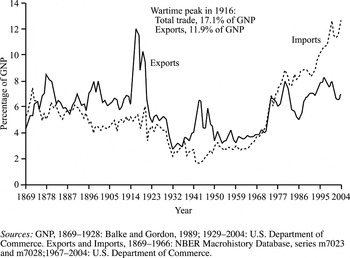
Figure 1 shows the export and import share of U.S. gross national product (GNP) from 1869 through 2004. The export boom associated with World War I is easy to locate. It is enormous in relation to the economy as a whole. Merchandise exports constituted nearly 12 percent of gross national product in 1916, roughly double their share in 1914, and more than in any other year for which data are available. This generalization includes even the globalization of the past thirty years, although the United States currently brings in substantially more imports, as well as maintaining an extensive trade in services, something for which no early-twentieth-century data are available. The export boom was also associated with the longest economic expansion since the Civil War, lasting forty-four months from December 1914 to August 1918.37
National Bureau of Economic Research 2006.

Trade and the American economy, 1869–2004
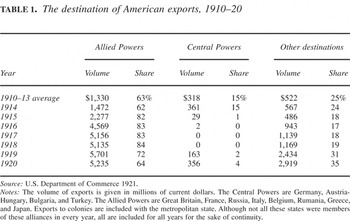
The great majority of these exports went to the Allies, especially Britain. As Table 1 indicates, the share of American exports going to the Allies rose from 63 percent before the war to more than 80 percent during the war. By November 1916, 40 percent of British military expenditures were taking place in the United States.38
Burk 1984, 5.
The destination of American exports, 1910–20

There is ample documentary evidence that President Wilson was aware of the economic stakes. The most detailed historical account of American decision making, Arthur S. Link's multivolume biography of Woodrow Wilson, argues that the principal American foreign policy goal once the war had begun was “to win the largest possible freedom of trade with all belligerents for American citizens, within the bounds of neutrality.”39
Link 1960, 105.
Ibid., 82–83.
Evidence on the regional impact of the export boom, which I consider in detail in the next section, indicates that failure to protect wartime exports would have endangered Wilson's chance for reelection in 1916. Wilson had won the 1912 election mainly because the Republican vote had been split between incumbent President William Howard Taft and Theodore Roosevelt, a former Republican president running as a third-party candidate. Wilson's electoral fortunes were secure only in the solidly Democratic South, which benefited less from the export boom than any other region of the country. Southern support was not sufficient for reelection. Wilson could not afford to ignore the interests of states that benefited from the export boom. These benefits were greatest in the heavily populated northeastern and Great Lakes states, which made up 237 of the 266 electoral votes required to win the election. Wilson's 1912 vote total was lower than the combination of Taft and Roosevelt in every one of these states, so remaining competitive promised to be difficult. The economic impact of failing to protect these states' considerable interest in exports to the Allies would have made this task even harder. Because of the success of his diplomacy through the November 1916 election, Wilson was able to run as the candidate who “kept us out of war” while maintaining the booming American trade with the Allies. The president still had only limited success in the Northeast, but he managed to win in Ohio and New Hampshire. This result was crucial to the outcome of the election. Even though Wilson dominated the electoral vote in the rest of the country, Republican Charles Evans Hughes would have been elected president in 1916 if he had carried Ohio.
Export income did not alter Wilson's preference for neutrality and a prompt, negotiated end to the war. Wilson complained in late 1916 that the war had “checked and diverted” industries in neutral countries, and that “their energies are drawn off into temporary and novel channels.”42
Link 1965, 197.

The export boom and the submarine campaign
American policy was most resolutely neutral during the early months of the war, when American trade was generally disrupted. Wilson urged Americans to be “neutral in thought as well as in action” and argued that the war was “one with which we have nothing to do, whose causes cannot touch us.”43
At the suggestion of his secretary of state, William Jennings Bryan, Wilson also officially discouraged lending to belligerent states.44Link 1960, 62–64.
Ibid., 105–14, 682–93; and Devlin 1975, 156–72.
Link 1960, 115–16.
Ibid., 130–31.
As American exports to the Allies grew through 1915, American policy changed in much the way contemporary liberal theory and the revisionist argument suggest. Conflict with the Allies declined, and the United States adopted policies more favorable to them. In October 1914, the Wilson administration modified its policy on lending to the belligerents, permitting bank credits, though not publicly issued bonds.48
In the summer of 1915, the Wilson administration further loosened its lending restrictions, permitting a $500 million bond issue by Britain and France.49 In both cases, the requirements of financing American exports to the Allied powers prompted the administration to reconsider its policy. The United States continued to protest the British blockade, but these objections had little practical effect.50 Moreover, the implied threat of a munitions embargo became less credible as American exports to the Allies grew. The British Committee of Imperial Defence noted this added leverage when it finally placed cotton on the contraband list in August 1915: “It might be pointed out that if the Americans refuse to supply us with munitions they will not only continue to lose their trade with Germany, but they will also lose the advantage they gain from supplying the Allies with munitions.”51Quoted in Link 1960, 602.
Although their dependence on American financing began to worry them in late 1916, the statistics in Table 1 suggest that British confidence in American forbearance was well founded.52
Link 1965, 175–84.
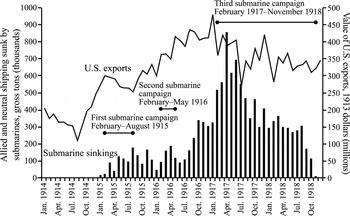
At the same time, trade with the Allies brought the United States into conflict with Germany. It quickly became clear that the Allies intended to purchase large quantities of war materiel in the United States, and that the British could effectively prevent the Central Powers from doing the same. In February 1915, the Germans declared the area around the British Isles to be a war zone in which Allied shipping would be subject to submarine attacks. As Figure 2 indicates, this submarine campaign was not terribly effective against commerce but took a heavy toll in civilian life. The majority of Americans killed by German submarines died during this period, most when the British passenger liner Lusitania was sunk on 7 May 1915. In spite of this fact, the official American response was relatively cautious. President Wilson stated that he would hold the Germans to “strict accountability” for violations of American neutral rights, and sent several protest notes concerning the Lusitania. He did not explicitly threaten to break diplomatic relations.53
Devlin 1975, 284–86.
In February 1916, the German navy launched an “intensified” effort intended to sink armed merchant vessels without warning.55
Hardach 1977, 41.
The third and final submarine campaign began with the resumption of unrestricted submarine warfare on 1 February 1917 and extended through the end of the war. As Figure 2 indicates, it was preceded by a period of several months during which the German navy intensified its campaign within the cruiser rules, with substantial results.57
Hardach 1977, 41–42.
Ibid., 41–43.
In sum, the path to American intervention was a complicated one, but its central developments fit the logic of the revisionist argument in light of the development of the export boom. As the war progressed, the opportunity cost of lost trade with the Allies greatly increased, while the opportunity cost of lost trade with the Central Powers declined. The United States drew closer to the Allied powers as the value of trade increased. The American response to the German submarine campaigns also escalated with the value of trade. Wilson genuinely wanted to avoid American intervention, but the need to protect American trade prompted him to take risks that led ultimately to that outcome.
The Export Boom and the Politics of American Neutrality
Establishing the size of the export boom and its relationship to key decisions helps establish the plausibility of the revisionists' argument, but their most important claims concerned the effects of their constituents' economic interests on the positions taken by major political actors. Did the benefits of wartime trade really influence political leaders' views of the war, as the revisionists argued?
Wilson was clearly the key decision maker, but discerning the most important influences on his choices is extremely difficult. Wilson's many public and private utterances about the war have been used to support claims that his thinking was driven by many different considerations. In the short space available here, another effort to parse Wilson's statements and actions is unlikely advance this debate. Instead, I will test the revisionist claim that politicians responded to their constituents' interests in wartime exports by examining congressional voting. Members of Congress confronted the same international events that Wilson did, but not all of them reached the same conclusions about the appropriate response. The revisionist argument implies that their differences over policy should reflect their constituents' stake in wartime trade. Their views are not as important as Wilson's, but they offer an opportunity for a more rigorous test of the revisionists' general argument about preference formation.
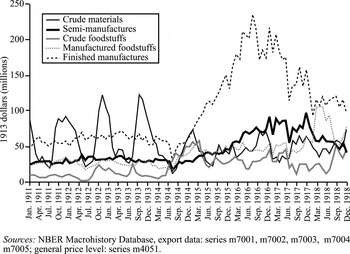
The first step in developing such a test is to disaggregate the impact of the export boom. If the export boom had affected entire American economy in the same way, economic interests could not be used to explain differences over the war. As Figure 3 indicates, however, wartime trade varied across different sectors of the economy. The biggest beneficiaries were exporters of finished manufactures. Exports of crude foodstuffs, primarily meat and wheat, increased sharply during the first year of the war, particularly in proportion to their prewar volume. However, they were soon overtaken by finished manufactures. Once the general belief that the war would be short was dispelled, the Allies, especially Britain, began to mobilize their industries for war and to call on those in the United States. While exports of crude and manufactured foodstuffs and semi-manufactures all increased substantially during the war, finished manufactures constituted the bulk of wartime exports. Exports of raw materials, especially cotton, were seriously disrupted, and consistently failed to reach their regular prewar seasonal peak, clearly visible in the prewar portion of Figure 3.

Monthly U.S. exports by class, 1911–18
The case of cotton illustrates the fact that the war generated losers as well as winners in the American economy. Raw cotton had accounted for roughly 25 percent of the value of U.S. exports in the five years before the beginning of the war. After the war began, the Allies concentrated on procuring war-related goods, and restricted the shipping capacity available for other things.61
Hardach 1977, 48–51.
Fowler 2000.
Lipsey 1963, 251, 256, 261.
Bensel 1984, 120.
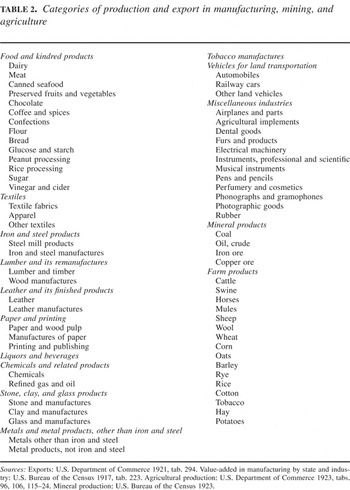
The regional concentration of major economic activities such as the growing of cotton makes it possible to estimate roughly the value of the export boom to each state. In order to facilitate this estimate, annual exports listed in the 1920 Statistical Abstract of the United States were divided into the sixty-nine categories listed in Table 2. These categories were chosen to correspond as closely as possible with the industrial sectors, mineral products, and agricultural commodities for which state-level production data are available in prewar economic censuses. A portion of the annual value of exports in each of these categories was allocated to each state based on its share of production in that category. After summing the total value of each state's share of all export categories, per capita shares of the export income were calculated using data on total population from the 1910 census.
Categories of production and export in manufacturing, mining, and agriculture

Although these estimates correspond to contemporary impressions of the impact of the export boom on different parts of the nation, they are far from perfect. In the early twentieth century, economic censuses did not provide production figures for every industry in every state. For confidentiality reasons, the censuses also did not report data in cases where a particular sector had only a few establishments in a given state. Prewar production and population data do not reflect changes in states' populations and output of traded goods during the war. These and other sources of measurement error mean that the estimates of per capita export income used here should be treated with caution. At the same time, the shortcomings of the data do not render the patterns they suggest meaningless. Indeed, because measurement error makes the discovery of such patterns more difficult, those that do emerge from these data are likely to have been very strong in reality.
Per capita export income does not necessarily reflect each state's commercial stake in the war because not all American exports went to Europe. Export income from trade with the Allies would provide a better indicator of the economic stake in the war. Unfortunately, data on the destination of particular export commodities for this period are not readily available. In their absence, the change in export income compared to prewar levels provides a reasonable indicator of the stake each state had in trade with the Allies. Although U.S. exports to other areas of the world expanded during the war, Europe received an unusually large share of American exports during the 1915–17 period. Gains in export income during this period are thus more closely related to each state's stake in war-related trade than is their level of export income.
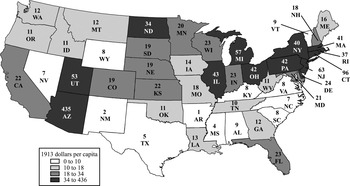
Figure 4 shows the state-to-state differences in export income. (The fact that per capita GNP in 1913 was roughly $400 helps in assessing the magnitude of the numbers in the map.) Several patterns deserve comment. Manufacturing was highly concentrated in the Northeast during the early twentieth century. Not surprisingly, this part of the county gained the most from the wartime export boom, which was dominated by finished manufactures. Although exports of wheat rose dramatically during the war, the wheat-producing states in the Great Plains did not benefit as much as manufacturing states in the Northeast did. The cotton-exporting South, which had the highest per capita export income before the war, gained least of all. Finally, the largest per capita beneficiary of the export boom was Arizona. The fourth least populous state in 1910 was responsible for roughly half the copper ore and a third of the refined copper produced in the United States. Vast quantities of the metal were exported during the war. In fact, it accounted for a little more than 4 percent of all U.S. exports in 1916.

Change in real annual export income, 1910–13 to 1916
The regional differences in export income roughly correspond to common understandings of regional tendencies in public support and opposition to the war. Public figures from the Northeast generally favored a hard line on German submarine warfare. Those from the South and West more often opposed such measures, stressing the dangers of entanglement. Cooper pays particularly close attention to these regional differences, although he attributes them primarily to ideology and regional differences in the national origin of the population.65
Cooper 1969.
Export Income and Support for War-Related Measures in Congress
Compared to more recent conflicts, the number of roll-call votes related to World War I was small. Congressional sessions were much shorter during the early twentieth century. Congress adjourned before the November 1914 election and met for only a short lame-duck session before the new Congress convened in December 1915. As a result, Congress did not deal with many war-related issues, especially during the first eighteen months of the conflict. Many important questions, such as the widely discussed embargo on arms sales to belligerents, never came to a vote.
Three sets of votes related to the Wilson administration's hard line on German submarine warfare will be considered here. The first, from March 1916, concerns the administration's insistence on American rights to travel on belligerent ships. The second concerns the administration's February 1917 plan to arm American merchant vessels. The third is the resolution to declare war on Germany in April 1917. The purpose of the analysis is to test the revisionist argument about the effect of export income on foreign policy preferences rather than to demonstrate the historical importance of these particular votes. Whatever their role in the policymaking process, these votes are among the few available windows onto the preference-formation process during this historical period. In the absence of public opinion polls and other relevant sources of data, they are especially important.
In testing hypotheses about the effect of economic interests on congressional support for intervention, several alternative explanations must also be considered. One of the most commonly discussed reasons for differences over war-related measures are the ethnic or national loyalties of Americans to various belligerent states. During the war, Theodore Roosevelt famously questioned the loyalty of “hyphenated Americans” who allegedly put the interests of their native or ancestral country ahead of the United States. Wilson made similar comments both before and after the United States entered the war. Subsequent historians have frequently used ethnic and national loyalties to explain opposition to measures that led to intervention in the war.66
Although it is tempting to dismiss Roosevelt's and Wilson's comments about immigrants as reflections of the two men's well-known racist attitudes, there is reason to take seriously the possibility that ethnic and national loyalties might have influenced opinions about the war. In 1910, 14.7 percent of the population had been born outside the United States, the vast majority in European countries that were involved in the war. Roughly 6.0 percent of the total population had been born in the Allied states, and 6.0 percent in the Central Powers or Ireland. Although no statistics on ancestry are available, it is certainly plausible that those born in belligerent states, as well as some of their descendents, felt some loyalty to one side or the other during the war. Naturalization was also substantially easier before the immigration restrictions of the 1920s—in some states, noncitizens were even allowed to vote—so the foreign-born population was arguably more politically salient during World War I than it is today. Events during the war also point to the plausibility of this argument. For example, politicians from states with large Irish populations were especially outspoken after the British executed several leaders of the Easter Rising in 1916, ignoring a Senate resolution urging clemency.67
Devlin 1975, 502–3.
The reason the national-origins hypothesis must be considered when testing the influence of economic interests is that the same features of the economy that led some states to benefit more or less from the export boom also shaped patterns of European immigration to the United States. For this reason, if the national-origins hypothesis is correct, it is a potentially confounding influence. For example, in five states, all clustered in the industrialized Northeast, more than 3 percent of the total population had been born in Ireland: Connecticut (5.2 percent), Massachusetts (6.6 percent), New Hampshire (5.5 percent), New York (3.3 percent), and New Jersey (4.0 percent). If politicians in these states responded to Irish-American hostility to Britain by tempering their support for war-related measures in Congress, their voting records might differ from those of politicians from states that enjoyed similar benefits from the export boom but contained fewer voters of Irish origin, such as Ohio (0.8 percent). Failing to account for these differences could produce a specification error in the models of congressional voting.
For similar reasons, a model of congressional voting must include party affiliation in order to estimate the effect of export income. The two major parties had distinctive regional bases, and each reflected the prevailing economic interests in those areas. The Democrats, based in the South, tended to favor more liberal trade policies, particularly toward industrialized countries that imported agricultural commodities. The Republicans, strongest in the industrial Northeast, preferred protection against manufactured imports.68
Although generalizations about the regional bases of the two parties admitted some exceptions, particularly the northeastern cities the Democrats controlled, they suggest that economic structure produced a relationship between party and export income similar to the one linking immigrant population and export income.The Gore and McLemore Resolutions, March 1916
The first major congressional challenge to the administration's diplomacy came in early 1916. The administration had successfully used diplomatic pressure coupled with public plans for greater military preparedness to persuade the Germans to curtail their first submarine campaign in August 1915. Despite its apparent success, some members of Congress argued that the administration's approach carried an unacceptably high risk of war.69
Cooper 1969, 92–95.
Link 1964, 167–94.
Because these votes relate directly to the risks of the administration's strategy for protecting American trade, they are good test cases for the influence of economic interests. The revisionist argument suggests that members of Congress from states that drew greater benefits from the export boom should be more willing to accept the risks inherent in the administration's strategy for protecting it. These members should vote in favor of tabling the two resolutions. Theoretical expectations concerning the other variables are equally clear. Democrats should be more likely to vote for tabling these measures in order to support the president. Members from states with relatively large populations born in Allied countries should also vote to table these resolutions. Those from states that had relatively large immigrant populations predisposed to favor the Central Powers should be more likely to vote against the motion to table.
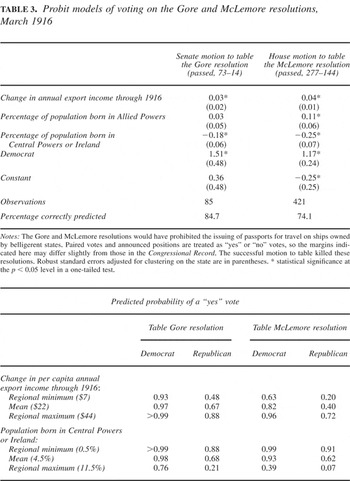
Table 3 presents the results of probit models of the votes to table the Gore resolution in the Senate and the McLemore resolution in the House. The results support both revisionist and national-origins arguments. Because of the larger number of observations, results are somewhat clearer for the House of Representatives than for the Senate. President Wilson's appeal to members of his party in the House was generally successful, although 34 of the 217 Democrats present nevertheless voted against tabling the measure. These members were more likely to be from states that had made relatively small gains from wartime trade. The predicted probabilities below the table show this result more intuitively than do the probit coefficients. For example, holding other variables at their mean value, a Democrat from the cotton-producing region that had the smallest stake in wartime trade had a 0.63 probability of voting to table the resolutions. A member from an average New England or Middle Atlantic state, whose constituents were receiving much greater shares of export income, had a 0.98 probability of casting such a vote. Among Republicans, who were much more evenly divided, the model suggests that gains from wartime trade could be decisive. There were no Republican members of Congress from the southern states with the smallest stakes in the war, but a member from an average state had a 0.39 probability of voting to table the McLemore resolution. By contrast, a typical New England or Middle Atlantic member had a 0.72 probability of casting this vote.
Probit models of voting on the Gore and McLemore resolutions, March 1916

The patterns in Senate voting on the Gore resolution were generally similar to those observed in the House, although the effect of party was somewhat larger. As the predicted probabilities below the table suggest, Democrats responded overwhelmingly to Wilson's call for support. All but two voted to table the Gore resolution, including even Thomas Gore himself! As in the House, Republicans were more evenly split, and the effect of their states' stake in the war was somewhat larger.
The national origin of a state's population also influenced how its representatives voted on the Gore and McLemore resolutions. Because populations from Ireland and the Central Powers had the largest effects, they will be used for illustrative purposes here. Immigration from the Allied states also influenced the way their representatives voted, however. Holding other variables at their mean value, members of both parties were likely to vote against the motion to table if they came from states with a relatively large population born in the Central Powers or Ireland. Although the political effects of immigrant populations are substantial, the magnitude suggested by the predicted probabilities in Table 3 is somewhat misleading. Very large immigrant populations were observed only in states with very large manufacturing sectors that also had relatively large stakes in wartime trade. (The reverse was not true, since manufacturing states such as Michigan and Ohio had immigrant populations near the national average.) Moreover, the fact that immigrants from all the belligerents were concentrated in the same areas of the United States meant that their political effects partially offset one another.
The Armed Ship Bill, February 1917
The next set of votes concerns the Wilson administration's plan to place naval guns on American merchant vessels so that they could defend themselves against attacks by German submarines. The Germans announced that they would resume unrestricted submarine warfare on 1 February 1917, in defiance of Wilson's ultimatum. Wilson promptly severed diplomatic relations, but he did not ask for an immediate declaration of war. Instead, he considered ways of defending American shipping without actually entering the war, hoping the Germans would reconsider the submarine campaign as they had in 1915 and 1916.71
American shippers requested naval protection, or at least defensive weapons for firing at submarines on the surface.72The provision of these weapons was not as futile as it would be against modern submarines. The U-boats of World War I carried only a few torpedoes and could not remain submerged for long periods of time. Whenever possible, U-boat commanders preferred to engage merchant ships on the surface with their guns. Because U-boats were relatively small and unarmored, they were highly vulnerable to naval gunfire when they surfaced.
May 1959, 422–23.
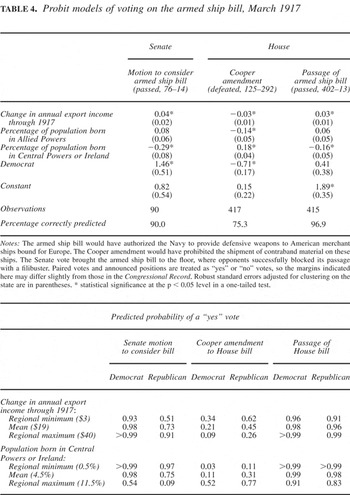
The armed ship bill provides a more difficult test of the revisionist argument about the political environment than do the Gore and McLemore resolutions. If inflammatory events erase economically motivated differences over security issues, failure to reject the null hypothesis with respect to export income should be very likely in this case. The House vote in support of the bill on 1 March was overwhelming, 402–13. Opposition to intervention did not disappear, however. Representative Henry Allen Cooper (R-Wisc.) offered an amendment that would have prohibited the shipment of contraband material on armed ships. It was defeated more narrowly, 125–292. In the Senate, opponents of the armed ship bill were unable to block it from being brought to the floor on a 76–14 vote but managed to filibuster the measure until the congressional session expired on 3 March. Although the Senate never acted, Wilson moved to arm the merchant ships without congressional authorization. Denied his show of national unity, Wilson reacted bitterly that “[a] little group of willful men, representing no opinion but their own, have rendered the great government of the United States helpless and contemptible.”74
Table 4 presents the results of probit models of the three votes mentioned in the last paragraph. The revisionist argument suggests that export income should be associated with a “yes” vote on the motions to consider the bill in the Senate and to pass it in the House. It should also be associated with a “no” vote on the Cooper amendment to prohibit the transport of contraband material on armed ships. The results support these expectations. They also bolster the argument that the national origin of the U.S. population was a major influence on congressional voting. The models generate less decisive results in the case of the very lopsided votes to consider the armed ship bill in the Senate and to pass it in the House. As the amount of variation in the dependent variable declines, it becomes more difficult to discern any association with any of the independent variables, especially with relatively few observations. Nevertheless, there is still a statistically significant relationship between export income and support for the bill in both the House and Senate. As the predicted probabilities suggest, the effects are smaller than in the case of the Gore and McLemore resolutions.
Probit models of voting on the armed ship bill, March 1917

In the case of the Cooper amendment, the vote with the greatest proportion of members on the losing side, the results closely resemble those concerning the Gore and McLemore resolutions. Democrats tended to vote against the amendment unless they came from a state that had a relatively large population with national loyalties opposed to the Allied cause. Lacking the motive of loyalty to the president, Republicans supported the amendment if their state received less-than-average benefits from the export boom, or had a high proportion of its population born in the Central Powers or Ireland.
The Declaration of War, April 1917
The final set of votes concerns the resolution to declare war on Germany, carrying out the administration's threat to take action if the Germans resumed unrestricted submarine warfare. When it became obvious that the Germans would not back down, Wilson called the new Congress elected in November 1916 into session early—it would not normally have convened until December 1917—and asked for a declaration of war on 2 April. The Senate approved the resolution two days later, 82–6. The House on 5 April did the same, 373–50.
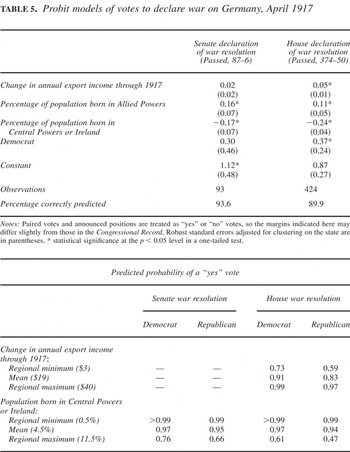
The heated political atmosphere surrounding the declaration of war provides a still tougher test of the influence of export income. The revisionist position suggests that export income should be associated with support for the war resolution. One of the two probit models in Table 5 supports this hypothesis. Export income was not a statistically significant predictor of the lopsided Senate vote, although the national origin of senators' home state population was. In the House, however, both were statistically significantly related to the probability of supporting the war resolution. As in the other votes examined so far, the effects of both wartime trade and the national origins of their states' population were larger on Republicans than on Democrats, who were constrained by party loyalty.
Probit models of votes to declare war on Germany, April 1917

Overall, congressional voting on these war-related measures provides strong evidence for the revisionist claim that export income played an important role in shaping support and opposition to intervention. In spite of the imperfections in the operational indicators used here, there is evidence that export income had a statistically significant and substantively important effect on a range of votes concerning the Wilson administration's foreign policy. At the same time, the results indicate that economic interests were not the only consideration that mattered. The national origins of the population in different regions of the country also strongly influenced congressional voting. Loyalty to Wilson also influenced Democrats in key instances, such as the votes on the Gore and McLemore resolutions.
Conclusions
The evidence reviewed in this article suggests that the revisionist claim that the export boom associated with the war influenced the American decision to intervene deserves to be reconsidered. First, given its size relative to the U.S. economy, the export boom, like an elephant in the room, would have been difficult for any politician to ignore. Some important accounts of U.S. entry into the war miss this point. Dismissing economic concerns in Wilson's March 1917 deliberations over a possible declaration of war, May writes that “[t]here was no longer a compelling economic reason for resisting the German blockade. America had become so prosperous that she could afford to lose part of her trade with the Allies.”75
May 1959, 426. May follows this comment by noting that “[t]he unrestricted submarine campaign had seemed thus far to be relatively ineffective.” As the evidence presented in Figure 2 indicates, this assertion is incorrect.
Second, the U.S. response to the German submarine threat paralleled the size of the export boom and the German success in destroying shipping. In the spring of 1915, when the export boom was just beginning and German efforts to block this trade were largely ineffective, the American response was relatively low key, in spite of the sinking of the Lusitania. In 1916, when both exports and the German submarine threat to them were much greater, so was the U.S. response. Wilson threatened to sever diplomatic relations with Germany if submarine warfare were not restricted. This threat led to war when the Germans resumed their submarine campaign in 1917.
Third, there is evidence that export income influenced politicians' preferences about the response to German submarine warfare, as revisionists argued. Differences in export income across the forty-eight states strongly influenced the way members of Congress voted on war-related measures. Members of Congress did not determine policy, but their views on Wilson's decisions provide a valuable window onto the considerations that influenced American political leaders' views on the war. Export income was not the only factor that shaped congressional voting, but its effects were substantial.
While the revisionist argument should be reconsidered, other explanations for the decision to intervene remain plausible. Indeed, the roll-call analysis might provide the basis for a stronger argument about the role of ethnic politics in the decision. Ultimately, evidence supporting the revisionist claim must be weighed against that supporting alternative accounts. Before such a comparison can be undertaken, however, the alternative arguments must be specified in a clear and falsifiable way. Just as the revisionist claim about the role of economic interests implied testable generalizations about the size of the export boom, and the political effects of differences in income from it, so generalizations from other arguments should be set out and tested against empirical evidence.
Many explanations for U.S. entry into World War I imply few such testable generalizations. For example, accounts stressing security interests often define these considerations in vague terms, encompassing not only observable conditions, such as the military strength of rival states, but also considerations of national prestige, ideological goals for world order, and the like.76
Examples include May 1959; and Smith 1965. For a review of recent works making this type of argument, see Kennedy 2001.
Notable examples include Devlin 1975; and George and George 1964. Even Sigmund Freud himself was involved in a psychological study of Wilson; see Freud and Bullitt 1967.
The revisionist argument about U.S. intervention in World War I has several important implications for current research about trade and conflict. There is evidence that the opportunity cost of lost trade influenced policymakers, much as liberals have claimed. Among trading partners, this opportunity cost reduced conflict. The enormous volume of wartime American exports to the Allies inhibited both sides from adopting some policies that might have disrupted trade. The British government sought to mitigate the impact of their blockade of Germany by permitting continuing cotton exports during the first year of the war, as well as by purchasing enough of the affected commodities to prevent their prices from falling steeply. For its part, the Wilson administration refrained from serious action against British violations of American neutral rights and altered its policy on belligerent lending in ways that benefited the Allies. Anglo-American relations were certainly not conflict free during the period of American neutrality, but things might have been much worse had not both sides been so concerned about maintaining the flow of exports.
On the other hand, this case does not support more universalistic liberal claims about the conflict-reducing effects of trade. Even as it reduces conflict between trading partners, international commerce may make conflict with third parties more likely. For the revisionists of the 1930s, this was the most important lesson of American intervention in World War I. The military value of American exports to the Allies antagonized the Central Powers. The submarine campaign was the most obvious German effort to limit this trade, but German agents also engaged in some less important but still provocative acts of spying and sabotage before the United States entered the war.78
But for American trade with the Allies, the Germans would have had no motive to take these actions.From the standpoint of the contemporary literature on interdependence and conflict, a more important mechanism through which trade led to hostility with third parties in this case concerns the effect of the opportunity cost of lost trade on American decision making. Just as it provides reasons to avoid militarized conflicts with trading partners, so this opportunity cost also furnishes a motive for diplomatic and military action against third-party threats. The value of the trade with the Allies created political pressures for the Wilson administration to act against the German submarine campaign. As the trade became more economically important, the Wilson administration made increasingly grave diplomatic threats for this purpose. Carrying out these threats brought the United States into the war.
How important are these mechanisms through which a commercial relationship may promote conflict with third parties? The revisionist argument was developed to explain an unusual case, involving major powers and a protracted global war. Assessing the generality of the causal mechanisms they identified will require further research, but a few observations are possible at this point. First, the threat or use of military force to defend trade is not an option available to every state. The political pressures on the Wilson administration to take action against the German submarine campaign presumed that the United States had the capacity to act against the Germans. The war affected less powerful neutrals in much the same way it affected the United States, but these states did not react as the United States did. On the other hand, the threat to trade need not come from another powerful state or be part of a major military conflict. Nonstate actors within a trading partner might also jeopardize an important market, or the supply of a vital good. These actors could threaten trade through peaceful political processes as well as through violence. Military responses to these kinds of threats may be uncommon. As American intervention in World War I suggests, they may nevertheless be important.