INTRODUCTION
A network is not just an idea. Rather, it is an extraordinary representation of the reality that surrounds us; the world is a network. The world wide web, the means by which every day billions of people are linked and operate, is a network; so are the ecosystem food chains, our cellular and neuronal systems, the connection system that regulates the interaction between RNA and mitochondria, proteins and molecules. The system of social relations in which we are embedded is also a network that determines the success of individuals and enterprises.
Seventy years of research on social networks, from the Gestalt psychology and the seminal work of Jacob Moreno (Reference Moreno1934) and through the first research conducted inside Harvard University and the University of Manchester, have yielded exceptional results: The development of network theory in the realms of social and economic research. Example theories include the theory of six degrees of separation by Milgram (Reference Milgram1967) and theories of the strength of weak ties and embeddedness by Granovetter (Reference Granovetter1973, Reference Granovetter1985, respectively), as well as the contributions of Freeman (Reference Freeman1979) regarding measures of centrality in social networks. More recently, important contributions to the Network Theory of Organizations have come from Brass (Reference Brass1984), Burt (Reference Burt1992) and Krackhardt (Reference Krackhardt1992, Reference Krackhardt1999).
Thanks to these discoveries, the topic of informal organizational networks has again aroused enormous interest in both scholars and practitioners, although it had been extensively investigated by the school of human relations as early as the 1950s. The informal organization is a ‘network of relationships that employees form across functions and divisions to accomplish tasks fast’ (Krackhardt & Hanson, Reference Krackhardt and Hanson1993: 104). This system of relationships creates an informal network organization (Allen, James, & Gamlen, Reference Allen, James and Gamlen2007; Rank, Reference Rank2008; De Toni & Nonino, Reference De Toni and Nonino2010) not explicitly designed as the organizational chart, but emergent and ‘lived’ by employees in almost all organizations. And ‘over time this leads to the emergence of informal hierarchy even across organizational levels’ (Diefenbach & Sillince, Reference Diefenbach and Sillince2011: 1521).
The scientific production on the subject of informal organization and on the informal networks is founded on the key concept of social capital (Bordieau, Reference Bordieau1986; Coleman, Reference Coleman1988; Putnam, Reference Putnam1993). Social capital has been defined by Nahapiet and Ghoshal as ‘the sum of actual and potential resources embedded within, available through and derived from the network of relationships possessed by an individual or social unit’ (1998: 243); however, there also exists the organizational social capital, ‘a resource reflecting the character of social relations within the firm. […] realized through members’ levels of collective goal orientation and shared trust, which create value by facilitating successful collective action’ (Leana & Van Buren, Reference Leana and Van Buren1999: 538) and enhancing the firm's capabilities through a better creating and knowledge sharing (Nahapiet & Ghoshal, Reference Nahapiet and Ghoshal1998; Zahra, Reference Zahra2010). For a long time, the literature on social capital has demonstrated through the use of social network analysis (SNA) how individuals and groups with particular positions within informal networks obtain advantages in terms of power and leadership (Borgatti & Foster, Reference Borgatti and Foster2003). Nevertheless, there has been little research focused on how intra-organizational social capital can be represented and measured in terms of a set of resources coming from different types of informal relationships. A fundamental research of Tsai and Ghoshal (Reference Tsai and Ghoshal1998) on relationships among the business units links the structural, relational, and cognitive dimensions of social capital and ‘represents an attempt to move from a conceptual view of intra-firm social capital to a more concrete definition of the construct’ (p. 474). But network theorists argue that an understanding of social capital requires a finer-grained analysis of the specific quality of network ties (Adler & Kwon, Reference Adler and Kwon2002). More convincing results can be obtained if research focuses on the specific network mechanism responsible for social capital (Burt, Reference Burt2000) integrating the range of resources provided by the structure of relations ‘belonging intrinsically to one dimension of social structure rather than another; capital, in all its forms, is a relation, not a thing’ (Adler & Kwon, Reference Adler and Kwon2002: 27).
So the first objective of the present research has been to identify the informal organizational network sources of competitive advantage for individuals and groups and sources of organizational social capital. Consequently, the first research question has been formalized as follows:
How many informal networks are source of intra-organizational social capital?
The second research objective has been to develop a model for representing and measuring the intra-organizational social capital emerging from informal networks and to clarify the causal relation between the networks, responding to the following question:
What are the causal relationships between the informal networks sources of intra-organizational social capital?
During the bibliographic research, I performed an in-depth analysis of the contributions available in the literature by considering three different but complementary classes of studies: Research on social capital, on organizational theory focusing on the concept of informal organization and, finally, on the structural, relational and cognitive analysis of intra-organizational networks, as was most closely related to the subject matter at hand. The analysis of the literature allowed me to identify the characteristics of 10 informal organizational network sources of intra-organizational social capital and to design a theoretical model based on three different conceptual perspectives of social capital: The structural, the relational and the cognitive. To empirically investigate and measure social capital as a system of informal relations and to test the model, I conducted a survey within five divisions of a knowledge-intensive company. The causal relationships between the network dimensions of intra-organizational social capital were identified via a correlation analysis named Quadratic Assignment Procedures (QAPs), and the causal relationships between the three dimensions of capital were tested using the statistical technique called Multiple Regression QAP. This paper will end by discussing the results of the statistical analysis, providing answers to research questions and suggesting future research directions.
Social capital as outcome of informal relations
The first definition of social capital is commonly attributed to Hanifan: ‘those tangible substances [that] count for most in the daily lives of people: Namely good will, fellowship, sympathy, and social intercourse among the individuals and families who make up a social unit … If [an individual comes] into contact with his neighbor, and they with other neighbors, there will be an accumulation of social capital, which may immediately satisfy his social needs and which may bear a social potentiality sufficient to the substantial improvement of living conditions in the whole community’ (Hanifan, Reference Hanifan1916: 130).
Other definitions, perhaps the most celebrated, emphasize the link between the network of interpersonal relationships and social capital. Putnam refers to an idea by Jane Jacobs (Reference Jacobs1961), who defines social capital as the set of ‘features of social organization such as networks, norms, and social trust that facilitate coordination and cooperation for mutual benefit’ (Putnam, Reference Putnam1995: 67), while Bordieau considers it ‘the aggregate of the actual or potential resources which are linked to possession of a durable network of more or less institutionalized relationships of mutual acquaintance or recognition’ (Reference Bordieau1986: 248).
Moreover, social capital is ‘embodied in the relations among persons’ (Coleman, Reference Coleman1990: 304) and ‘is not a single entity but a variety of different entities, with two elements in common: They all consist of some aspect of social structure, and they facilitate certain actions of actors – whether persons or corporate actors – within structure’ (Coleman, Reference Coleman1988: 98).
‘The network of relationships is the product of investment strategies, individual or collective, consciously or unconsciously aimed at establishing or reproducing social relationship, which are directly usable in the short or long term’ (Bordieau, Reference Bordieau1986: 249). Social capital is the accumulated value of relationships and contacts, a network of ties with a cost (in terms of time invested) associated with their creation and their maintenance. The accumulation of social capital requires a ‘strategy’ for maximizing opportunities with correct investment and without network decay. As a matter of fact, ‘social organization constitutes social capital, facilitating the achievement of goals that could not be achieved in its absence or could be achieved only at a higher cost’ (Coleman, Reference Coleman1990: 304).
Social capital and informal organizational networks
Fukuyama points out the informal nature of social capital, defining it as ‘the ability of people to work together for common purposes in groups and organizations’ (Fukuyama, Reference Fukuyama1995: 10) thanks to an ‘informal norm that promotes cooperation between two or more individuals’ (Fukuyama, Reference Fukuyama2001: 7). As a matter of fact ‘the emergence not only of informal networks, but of informal hierarchical structures and processes – even when politically motivated – is perceived as legitimate and as a normal part of the work and activities of professionals’ (Diefenbach & Sillince, Reference Diefenbach and Sillince2011: 1523).
SNA has been used extensively to measure access to social capital (Lin, Fu, & Hsung, Reference Lin, Fu and Hsung2001). SNA scholars define social capital in reference to the embeddedness theory (Granovetter, Reference Granovetter1985): Any individual/group/organization is embedded in a social network of relationships, and the structure and position of actors in their social network provide real competitive advantage (or disadvantage) with regard to identifying, collecting and interpreting important information (Granovetter, Reference Granovetter1973; Burt, Reference Burt2001). This information can be used to develop new skills and to apply these skills to improve and radically innovate on operating procedures, products and services (Tsai & Ghoshal, Reference Tsai and Ghoshal1998) and increasing organizational performance (Cohen & Prusak, Reference Cohen and Prusak2001).
From this perspective, social capital can be seen as the set of ‘resources embedded in a social structure that are accessed and/or mobilized in purposive action’ (Lin, Reference Lin2001: 20) or better ‘friends, colleagues, and more general contacts through whom you receive opportunities to use your financial and human capital’ (Burt, Reference Burt1992: 9).
As previously mentioned, social capital is certainly a characteristic of individuals but also of organizations. It is the complex network of formal and informal (personal and values-sharing) working relationships within organizations. Organizational (corporate) social capital can be defined as the system of social relationships embedded in work-related organizational roles (employee, team member, manager, entrepreneur) and in networks of personal relationships; it refers therefore to ‘the set of resources, tangible or virtual, that accrue to a corporate player through the player's social relationships, facilitating the attainment of goals’ (Leenders & Gabbay, Reference Leenders and Gabbay1999: 3).
The value of organizational social capital
Social capital is crucial for both entrepreneurs and managers who are responsible for managing businesses effectively and efficiently. As reported in the reviews by Adler and Kwon (Reference Adler and Kwon2002) and Borgatti and Foster (Reference Borgatti and Foster2003), the literature has amply demonstrated the importance of social capital in management; in fact, the social capital owned by an individual allows the development of his/her human capital (Bordieau, Reference Bordieau1986), positively influences his/her success in an enterprise in terms of targets accomplished, rapid growth along a career path and finding new jobs, as well as entrepreneurial success and the creation of new start-ups. At the company level, it has been demonstrated that a high level of intra-organizational social capital fosters knowledge creation and exchange and efficient teamwork while reducing dismissals (Nahapiet & Ghoshal, Reference Nahapiet and Ghoshal1998), but also knowledge transfer (De Toni, Nonino, & Pivetta, Reference De Toni, Nonino and Pivetta2011; Maurer, Bartsch, & Ebers, Reference Maurer, Bartsch and Ebers2011), innovation performance (Kijkuit & van den Ende, Reference Kijkuit and van den Ende2010; Battistella & Nonino, Reference Battistella and Nonino2012) and growth (Prashantham & Dhanaraj, Reference Prashantham and Dhanaraj2010). At the inter-organizational level, social capital strengthens relationships with suppliers and customers and knowledge exchange among firms (Nonino & Panizzolo, Reference Nonino and Panizzolo2007; Wu, Reference Wu2008; Biotto, De Toni, & Nonino, Reference Biotto, De Toni and Nonino2012).
As has been pointed out by Burt (Reference Burt2000), most authors agree that social capital is a metaphor in which the social structure is a kind of capital that can create competitive advantage for companies and individuals; in fact, organizations benefit from social capital through the following means:
• Better knowledge-sharing due to established trust in relationships, common frames of reference, and shared goals.
• Lower transaction costs due to a high level of trust and a cooperative spirit (both within the organization and between the organization and its customers and partners).
• Low turnover rates, reducing severance costs and hiring and training expenses, avoiding discontinuities associated with frequent personnel changes, and maintaining valuable organizational knowledge.
• Greater coherence of action due to organizational stability and shared understanding (Cohen & Prusak, Reference Cohen and Prusak2001: 10).
The investments made (in social capital) to increase collaboration and cooperation are the conditio sine qua non for talented people to express themselves; people remain within organizations because of loyalty to their colleagues and not because of loyalty to the company: They are loyal to groups, and therefore, it is necessary to make groups stronger. ‘If there's a high level of trust in the organization, you're more likely to retain talented people because they feel more comfortable taking chances, which is how talent manages itself’ (Larry Prusak in Donahue, Reference Donahue2001: 6). The effect of social capital is better management of talented people; a survey conducted with a sample of 13,000 managers showed that 80% of them find that they have worked for a boss who felt inadequate at least once in their life and that this situation has created in them a desire to leave the company, reducing their desire to learn and develop the business (Michaels, Handfield-Jones, & Axelrod, Reference Michaels, Handfield-Jones and Axelrod2001). Social capital can thus be seen as the glue that builds and holds together communities (Cohen & Prusak, Reference Cohen and Prusak2001). However, there is also a ‘dark side’ to social capital when the glue is so strong that it becomes a constraint, and that ‘ … might also limit [his] ability to change the composition of this network as required by [his] tasks’ (Gargiulo & Benassi, Reference Gargiulo and Benassi1999: 299).
THE THREE DIMENSIONS OF SOCIAL CAPITAL
Social capital is a property of relationships. If an actor is no longer present in the network, his/her relational system and his/her social capital dissolve. Social capital is also ‘at the heart of SNA’ (Brass & Krackhardt, Reference Brass and Krackhardt1999: 180).
Generally, it is possible to distinguish three types of social capital using a network perspective:
1. Bonding, which considers the ties between people in similar conditions, such as family members, friends and neighbors.
2. Bridging, which considers the ties between distant people.
3. Linking, which considers the ties between very dissimilar persons outside the community analyzed to enable them to tap into resources not available within the community.
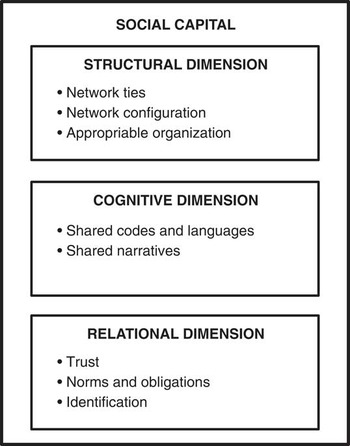
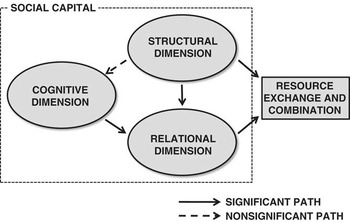
The more convincing model of organizational social capital is certainly that proposed by Nahapiet and Ghoshal, contemporary authors most cited in relation to the topic of social capital in management due to their famous article ‘Social Capital, Intellectual Capital and the Organizational Advantage’, which appeared in the Academy of Management Review in 1998. The two scholars, in addition to ascribing the centrality of social relationships in their definition (cited in first section), identify three dimensions/perspectives that highlight the network characteristics of social capital (Figure 1):
The three dimensions of social capital (source: Adapted from Nahapiet & Ghoshal, Reference Nahapiet and Ghoshal1998)

1. The structural dimension, the network of weak and strong relationships, that is individuals we know and can achieve;
2. The relational dimension, the network of ‘personal’ relationships – that is, individuals we consider friends and trust;
3. The cognitive dimension, the network of shared values, norms and language – in other words, the organizational culture.
Consistent with the three dimensions of social capital outlined by Nahapiet and Ghoshal (Reference Nahapiet and Ghoshal1998), it is possible to recognize three different perspectives and consequently three approaches to the study of organizational networks:
• The structural/positional approach that postulates that the behavior of actors depends largely on the structure of social relations or how an actor is connected to another;
• The relational approach linked to the multiplexity and dynamism of dyadic relations; it recognizes that such ties are governed by explicit transactions shaped by contracts, formal and informal arrangements and legal obligations;
• The cultural approach, which postulates that cultural artifacts as knowledge, technology, norms and institutional rules (the dynamic system of beliefs and attitudes) can actively determine interactions, choices and human decisions and then influence the structure of the network.
The three perspectives provide very different perspectives on social networks and very different orientations toward the object of analysis.
The structural perspective is very ‘aseptic’ and oriented toward the study of the position of actors in the network. When in the structural approach questions arise concerning the nature of relationships, often assumptions are made regarding the non-significance of the attributes of actors (human capital) and it is assumed that the type of relationship is given by the position of the actor within the structure of the network rather than being determined based on his behavior.
The relational approach studies the dyadic relationships more thoroughly, recognizing that the multidimensionality (multiplexity) and dynamism of interactions and information exchanges are linked not to an undifferentiated flow of information but instead to the strategic and interested intent of the actors.
The cultural approach argues that actors exist both as themselves (with their human capital) and as participants in the social network in which they are embedded by force. In summary, if the structural approach uses key attributes of the individuals in relation to their position in the network, the relational perspective is extremely focused on the individual, while the cultural perspective is focused on the individual but in relation to the group.
A MODEL OF INTRA-ORGANIZATIONAL SOCIAL CAPITAL BASED ON INFORMAL NETWORKS
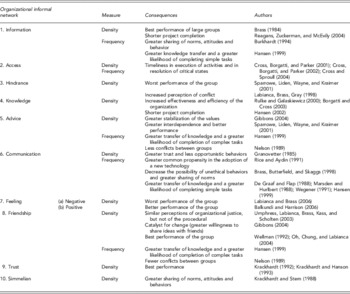
The literature review has been carried out with the aim of identifying the contributions that show how the existence and intensity (frequency) and high distribution (density) of social ties within an organization positively or negatively impact the performance of individuals and groups (Table 1).
The 10 informal organizational networks

In particular, the literature search has permitted the identification of 10 informal organizational networks:
1. Information network: The network of working information exchange;
2. Access network: The network of accessibility to knowledge; it represents the availability of knowledge within the organization;
3. Hindrance network: The network of negative working relationships within the organizational boundaries;
4. Knowledge network: The network of perception of knowledge distribution within an organization;
5. Advice network: The network of advice relations that allow the resolution of labor problems;
6. Communication network: The network of informal non-working communication exchange;
7. Feeling network: The network of perceptions of similarity/distance within the organization;
8. Friendship network: The network of friendships within the organization;
9. Trust network: The network of mutual trust within organization;
10. Simmelian network: The network of Simmel triads (relationships of trust and friendship) within the organization.
The importance of the first nine networks is easily understandable, but the Simmelian network, which has been selected to measure the cognitive dimension of social capital, needs particular investigation.
Going beyond the traditional distinction between strong and weak ties, Simmel (Reference Simmel1955) analyzes the special nature of ties holding together a triad of dyadic relationships (called after him the ‘Simmelian triad’ or ‘Simmelian ties’) or a triad of actors (the minimum group) with a reciprocal relationship with each other; the ties form a triangle closed on each side. Simmel shows the stability and continuity of these relations over time and, specifically, that the individuals belonging to the same triad have similar perceptions of the structure of the informal relationships network. Moreover, Krackhardt and Stern (Reference Krackhardt and Stern1988) suggest that membership in a triad of trust and friendship ties has a strong influence on the actors in the group analyzed, naturally aligning their behavior and thinking. More recently Tortoriello and Krackhardt (Reference Tortoriello and Krackhardt2010) focused on the positive role of Simmelian ties in the generation of innovation.
Because the ultimate aim of the research was the development of a model for representing and measuring the intra-organizational social capital built from informal organizational networks, the idea was to organize the 10 networks in a framework based on the three perspectives on social capital previously exposed.
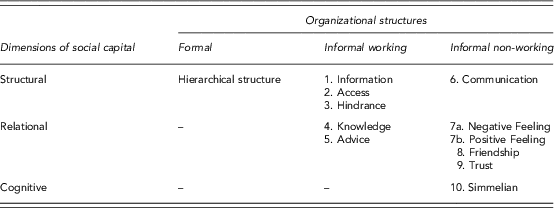
Moreover, as highlighted by Nelson (Reference Nelson2001) and Diefenbach and Sillince (Reference Diefenbach and Sillince2011), there is an emergence of informal hierarchy in addition to the formal structure (represented by the hierarchical structure – organizational chart). So I subdivided the informal organizational networks in two different emergent ‘informal organizational structures’: One strictly related to working activities (informal working structure) and one more personal or non-working (the informal non-working structure) (see Table 2).
Theoretical classification of informal networks based on the three dimensions of social capital and organizational structures

Tsai and Ghoshal (Reference Tsai and Ghoshal1998) empirically demonstrated the causal relationships that exist between the three dimensions: Within the groups, both the structural dimension and the cognitive one create the relational system between individuals. Moreover they demonstrate that structural and relational dimensions are source of resource exchange/combination and value creation. It is important to stress that despite the initial assumption of causality between structural and cognitive dimension, the authors found no significant correlation (Figure 2).
Relationship between dimensions of social capital and the impact on resource exchange and combination (source: Tsai & Ghoshal, Reference Tsai and Ghoshal1998)

The model illustrated in Figure 2 is the same theoretical model used in my research. The goal was to find the same cause–effect relationships for the three dimensions of social capital demonstrated by Tsai and Ghoshal but this time defined in terms of informal organizational relations as organized in the framework in Table 2.
METHODS
The fundamental methodology at the base of my research has been the SNA, which provides a large number of analytical approaches and measures for understanding data on social relations. The data allow the analysis of concepts related to structures, transactions and social connections (Tichy, Tushman, & Fombrun, Reference Tichy, Tushman and Fombrun1979); in fact, ‘the basic “building block” of SNA is the relationship’ (Brass & Labianca, Reference Brass and Labianca1999: 326).
To test my model for the measurement of intra-organizational social capital, I conducted a survey within five divisions of a knowledge-intensive company. Then I performed a regression analysis on informal network data to test the hypotheses of causal links between dimensions of social capital represented through informal organizational networks using the statistical techniques QAP and Multiple Regression Quadratic Assignment Procedure (MRQAP).
Sample
I tested my hypotheses on a sample of informal relationships of knowledge workers belonging to a company working in the information technology services sector. This site seemed me particularly appropriate because communication, collaboration based on reciprocal trust and on awareness of colleagues’ skills and knowledge sharing are fundamental drivers in the knowledge-intensive companies. The units of analysis were the relationships and the informal organizational relations system of all 212 employees belonging to five business divisions. The number of women was 72 (33.96%) while the number of men was 140 (66.04%). The number of managers was 23 (10.84%): five women (2.35%) and 18 men (8.49%). The average job experience within the company was 44.12 months.
Collection method
SNA generally requires the use of one of three data collection techniques: Participant observation, interviews or questionnaires. For the data collection related to the relationships between the actors, I chose questionnaires.
I administered a questionnaire to all 212 members of the five divisions of the knowledge-intensive company. The large number of actors and business characteristics convinced me to design an electronic questionnaire in Microsoft Excel®; of course, when one is dealing with IT solutions, all of the companies’ employees feel comfortable using PCs. The electronic format also facilitated the questionnaire compilation and subsequent data storage in the adjacency matrices.
The questionnaire could not be anonymous to the researcher, who needed to know the names of the actors to organize the data in the adjacency matrix; this creates concern with some questions regarding the reliability of the responses: As a matter of fact the questions could be judged ‘delicate’ because they have to do with personal issues, such as friendship and feeling, and concern aspects related to trust (or distrust) of colleagues. To increase the reliability of the responses and make people aware that the research would analyze only aggregate data, while ensuring the anonymity of the respondents, I sent all employees an introduction letter in which I guaranteed an ethical approach to the research that would comply with privacy laws. Moreover, this assurance was reaffirmed through a video in which the researchers appeared personally. The video released to all members also contained some information about the research objectives, the structure of the questionnaire and how to compile it; the same information was contained within the questionnaire. At that stage, the cooperation of the management was essential to emphasize the importance of the analysis and the seriousness of the researchers.
Regarding the data collection process, we should note that the Excel® questionnaires in electronic form were sent via e-mail with the video to all members of the organization (212 people) and that the responses were collected within 15 days. The percentage of respondents was 89.62%.
Dependent and independent variables
I analyzed informal organizational networks identified in the literature using the associated adjacency matrix (i.e., an actor-by-actor square matrix whose size was equal to the number of employees and mathematically represented social relationships) as the independent and dependent variables.
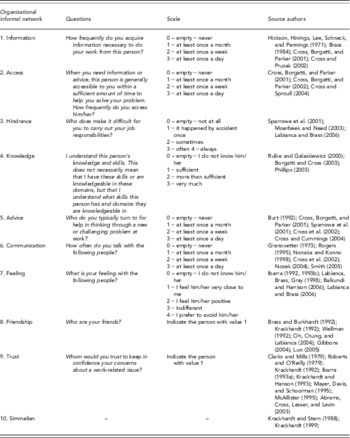
For nine of the 10 informal organizational networks inside the proposed model, I formulated a question found in the literature and adopted and validated in previous research (see Appendix A1). So the electronic questionnaire was divided into nine questions (Appendix A1) that allowed me to highlight both the nature and to measure the ‘strength’ of informal relationships. I used data outlining the direction and intensity of the relationship: The weight of a relationship has been associated both with the level of skill perceived by individuals, such as in the knowledge network, and with the frequency with which the relationship occurred; I assumed that a relationship between two actors who exchange information daily is stronger than that of two other actors who come into contact only weekly or monthly. Appendix A1 presents details of the scales and sources.
Construction of adjacency matrices
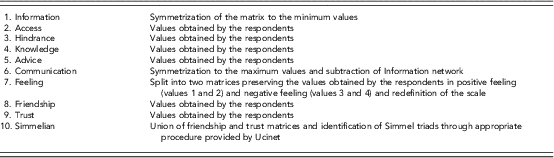
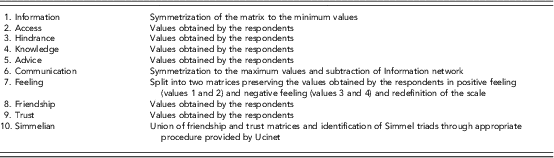
On the basis of responses to questionnaires received, for each question I constructed an adjacency matrix; each matrix thus obtained was earmarked for one of the 10 informal networks (11 considering the division between positive and negative feeling). Appendix A2 shows the procedure for constructing the adjacency matrix. The organization of the data in an adjacency matrix has allowed their importation and subsequent analysis using the program Ucinet 6® (Borgatti, Everett, & Freeman, Reference Borgatti, Everett and Freeman2002).
Analysis
The objective of correlation analysis of the 11-adjacency matrix representing 10 informal organizational networks has been to understand of whether the existence of a relationship between two actors is somehow linked to the existence of another type of relation. However, ‘one of the most serious problems of the statistical analysis of networks is that the unit of analysis is the dyad and dyads, as has been reasonably argued, cannot be considered independent of one another’ (Krackhardt, Reference Krackhardt1988: 360).
One must consider, for example, an adjacency matrix that refers to the social relations system of friendship. The network data do not represent independent observations but instead feature a certain degree of dependence in relation to the row or column to which they belongFootnote 1. The critical state in the correlation analysis resulting from the non-independence of observations is called structural autocorrelation. Therefore, one of the main difficulties that researchers face when analyzing the network data is the need to use statistical techniques different from those for independent data; these may, in fact, be inappropriate for performing correlation analysis and regressions on relational data (Kilduff & Tsai, Reference Kilduff and Tsai2003). In testing hypotheses about the relational matrices, it is not possible, in fact, to apply the rules of classical statistical regression because the observations are not independent.
A non-parametric answer to the problem of testing the null hypothesis that two network variables are correlated is the QAPFootnote 2. The QAP technique allows nonparametric inference in the analysis of social networks. In fact, it refers to a family of tests of inference in which the null hypothesis is that the association between two networks is zero, even in the case of a permutated distribution (Hubert, Reference Hubert1987); in other words, we make sure that there is not a similar pattern between elements of different variables (Dekker, Krackhardt, & Snijders, Reference Dekker, Krackhardt and Snijders2003).
The most consolidated methodology for the testing of hypotheses concerning the presence/absence of a particular social relationship based on particular conditions widely used in network analysis is the MRQAP. This regression technique allows the analysis of relational data for social networks that are systematically interdependent by definition. The technique of randomized permutation MRQAP (Edgington, Reference Edgington1969) allows one to obtain reliable estimates, exceeding the criticality of dependence between observations by analyzing the dyadic-level data even though the autocorrelations between the rows and columns of the matrices for the dyadic data are different (Krackhardt, Reference Krackhardt1988).
The process of MRQAP occurs through a non-parametric statistical algorithm that realizes the regression of the dependent matrix in relation to one or more independent matrices, proceeding through two distinct phases (Kilduff & Krackhardt, Reference Kilduff and Krackhardt1994):
1. In the first phase, standard multiple regression is conducted, comparing the cells of the dependent matrix with the corresponding cells of the independent matrix;
2. In the second phase, the rows and columns of the dependent matrix are randomly permutated and the regression model recalculated.
The permutation process for the regression is repeated many times to estimate the standard error and calculate the p-value for the statistic while keeping the R 2 values and all coefficients calculated at each change. The larger the number of permutations, the better is the estimate of the standard error and significance.
QAP and MRQAP statistical techniques allow the verification of statistical assumptions regarding the link between adjacency matrices, overcoming the problem of structural autocorrelation (Krackhardt, Reference Krackhardt1987) and taking into account the spurious correlations due to multicollinearity (Dekker, Krackhardt, & Snijders, Reference Dekker, Krackhardt and Snijders2003). Therefore, they have been widely used in the study of social networks (e.g., Krackhardt & Kilduff, Reference Krackhardt and Kilduff1990; Kilduff, Reference Kilduff1992; Burkhardt, Reference Burkhardt1994; Labianca, Brass, & Gray, Reference Labianca, Brass and Gray1998; Hinds, Carley, Krackhardt, & Wholey, Reference Hinds, Carley, Krackhardt and Wholey2000; Shah, Reference Shah2000; Labianca et al., Reference Labianca, Fairbank, Thomas, Gioia and Umphress2001; Tsai, Reference Tsai2002; Borgatti & Cross, Reference Borgatti and Cross2003; Moody & White, Reference Moody and White2003; Ho & Levesque, Reference Ho and Levesque2005; Grandori & Soda, Reference Grandori and Soda2006). Tsai and Ghoshal (Reference Tsai and Ghoshal1998) have used the MRQAP to test the same model I used in my research (Figure 1) using a sample of 15 business units of a multinational in the electronics sector.
Analysis of results
The QAP correlation analysis was carried out with the intention of highlighting the relationships between the 10 informal organizational networks. In particular, it was considered important to understand when a particular social relationship, such as trust, would predict the simultaneous existence of another type of relationship, such as friendship. Furthermore, to validate my classification framework rediscovering the same causal model as employed by Tsai and Ghoshal, I used the statistical technique of Multiple Regression Quadratic Assignment.
To perform the QAP and MRQAP statistical analysis, I used the Ucinet 6® software for network analysis, which includes a highly advanced version of the statistical model MRQAPFootnote 3; in fact, the most accurate model is the double semi-partialling method (Dekker, Krackhardt, & Snijders, Reference Dekker, Krackhardt and Snijders2007) that I used to test the hypotheses. The number of permutations set as a default in Ucinet is 5,000, but I selected 10,000 permutations to obtain a more accurate estimate. Indeed, the greater the number of permutations, the better the estimate of the standard error and significance (Borgatti, Everett, & Freeman, Reference Borgatti, Everett and Freeman2002).
Empirical evidence from the QAP analysis: The links between the different network dimensions of intra-organizational social capital
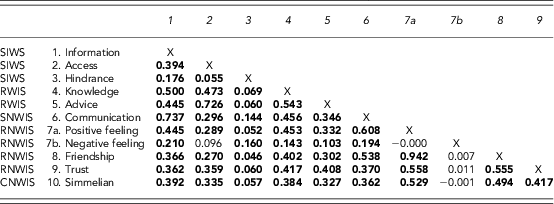
Table 3 summarizes the results in terms of Pearson's correlation coefficients (p) of QAP correlation analysis between the 10 informal organizational networks as they were articulated within the Holding Group at the time of data collection; all highly significant relationships (p < .001) are highlighted.
Results of QAP correlation analysis of the informal organizational networks (in bold highly significant correlations)
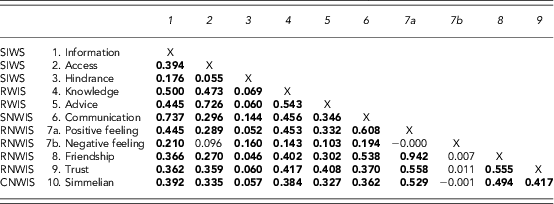
CNWIS = cognitive–non-working informal structure; QAP = Quadratic Assignment Procedure; RNWIS = relational–informal working structure; RWIS = relational–informal working structure; SNWIS = structural–non-working informal structure; SWIS = structural–informal working structure.
The analysis of the results suggests that almost all networks are highly correlated to each other, except for the network of feeling (dislike/perceived distance), which is not correlated (as one could easily expect) to the ties of perception of similarity, friendship and belonging to the triads of Simmel.
I found the highest correlations (shown in Table 3) within the same dimensions of social capital. Regarding the structural dimension, the relationships of informal communication are strongly correlated (p = .737) with working relations; it seems, in fact, that informal communications originate with colleagues with whom people actively collaborates in their working activities. Concerning the relational dimension, there is a high correlation between advice and accessibility (p = .726) and friendship and positive feeling (p = .942). If the first result is explainable by the consideration that a person who provides help in the workplace demonstrates accessibility, the second is obvious: People whom we feel are closer to us are mostly our friends or individuals we consider such.
Empirical evidence from MRQAP analysis: Causality between the different dimensions of social capital
As I previously stated, to be sure of the correctness of my classification framework for the 10 informal organizational networks within the three dimensions of social capital identified by Nahapiet and Ghoshal (Reference Nahapiet and Ghoshal1998), I deemed it appropriate to empirically verify that the same causal relationships analyzed later by Tsai and Ghoshal (Reference Tsai and Ghoshal1998) occur among the three groups of networks. The two authors have shown that within the groups, structural and cognitive dimensions create the relational structure built up between individuals, but they have not found a causal link between the two dimensions.
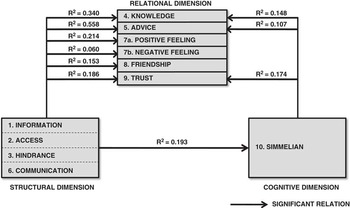
Figure 3 summarizes the significant relationships identified and the proportion of variance explained (R 2) calculated using data on the entire span of informal organizational networks of the five divisions.
Causal relationships between dimensions of social capital

The statistical analysis, performed using the three networks belonging to the structural dimension as the independent variables and the networks of relational and cognitive dimensions as the dependent variables, has validated the network model of social capital.
Table 4 shows, in fact, that there is a cause–effect relation between the three sub-dimensions of the structural dimension, as it has been defined by us, and the six sub-dimension of the relational dimension, with the exception of the hindrance relations.
MRQAP regression analysis of the impact of the structural dimension on the relational and cognitive dimensions (significant correlations in bold)

MRQAP = Multiple Regression Quadratic Assignment Procedure.
***p < .001, **p < .01, *p < .05.
As regards the proportion of variance explained (R 2) of the relational dimension described by the structural model, we can note high values with regard to ascribed knowledge (R 2 = 0.340), advice (R 2 = 0.558) and perceptions of similarity (R 2 = 0.214). The three sub-dimensions also predict the development of the cognitive dimension, as measured by the triads of Simmel (R 2 = 0.193).
Finally, to complete the model by Tsai and Ghoshal, a further MRQAP regression analysis was performed using three networks belonging to the structural dimension as dependent variables and the network of triads of Simmel as the independent variable (Table 5).
MRQAP regression analysis of the impact of the cognitive dimension on the relational dimension (significant correlations in bold)

MRQAP = Multiple Regression Quadratic Assignment Procedure.
***p < .001, **p < .01, *p < .05.
This dimension predicts the tendency to form relationships of ascribed knowledge and problem-solving ability but, above all, trust in one's own colleagues.
DISCUSSION AND CONCLUSION
The results of the research allow me to identify some considerations that may have important implications, both academic and managerial.
Research implications
The research implications are illustrated through the answers to the questions that guided this study. The first answer comes from the results of literature review, that is the identification of informal networks sources of intra-organizational social capital, and from the subsequent validation of the model hypothesized. From an academic standpoint, it is important to highlight how the statistical analysis has demonstrated the validity of the network measurement model of intra-organizational social capital proposed; in fact, I have confirmed all of the cause–effect relationships between the three dimensions of social capital defined in terms of informal relations and in line with the model by Tsai and Ghoshal (second answer). Even the cognitive dimension, which I have identified as the network of Simmelian triads built with relationships of trust and friendship, is influenced by the networks belonging to the structural dimension; this result, predicted by the authors who inspired me but not proved at that time, represents an innovation on the literature on the subject. Moreover, the strong correlation among some informal organizational networks has enabled me to organize them in a two-dimensional framework (Table 2) that, in addition to the three dimensions of social capital, identifies three different organizational areas: The formal structure (represented by the hierarchical structure), the informal working structure and the informal non-working structure.
The networks do not have a random topology and are not static objects: Their transformation, growth, evolution and dissolution follow precise rules, probably laws that permit talking about network theory (Barabási, Reference Barabási2002). Companies also have their own internal networks, informal social relations and their social capital, intra-organizational social capital. However, the informal organizational networks are subjected to constant changes over time due to both exogenous factors, such as the entry of new employees in the working context, and endogenous factors like the need for employee mobility within the company. Due to continuous perturbations, informal organizational networks change, reconfigure themselves and adapt, reaching new values of social capital.
As I have shown, the structural dimension, strongly influenced by the formal organization structure (the organization chart), by the spatial arrangement of individuals belonging to the organization and by time and information and communication technology at their disposal to communicate with colleagues, influences in its turn the cognitive and relational dimensions for individuals. In fact, it is not a surprise that the informal communication flow is created among colleagues who actively work together; however, within this particular dimension, it is above all the accessibility of individuals that predicts the emergence of informal relations, the real source of intra-organizational social capital. In contrast, hindrance relations, as it is plausible to expect, negatively affect the establishment of relations of problem-solving ability attributed to colleagues and the perception of similarity and friendship.
Working relationships create the opportunity to acknowledge others’ competence and problem-solving ability and to perceive similarities of character, but this opportunity is greatly heightened by the accessibility of colleagues and reduced by obstacles that they may consciously or unconsciously create. Moreover, continuous working collaboration and the propensity of colleagues to make themselves available also create a shared organizational culture in terms of language, norms and values.
Managerial implications
From a managerial standpoint, it must be stressed that the best results in terms of organizational social capital development are achieved when companies design their organizational structure and system of tasks to convey the natural creation of an informal relations structure wherein there is mutual accessibility between employees. This can be done, for example, by rewarding individuals who make themselves available to their colleagues in order to develop a ‘culture of cooperation’ based on the increase in informal organizational relations. Even the implementation and use of information and communication technology tools can be an opportunity to increase the accessibility of individuals and facilitate cooperation across functions and business units.
What is also vital is the protection of the ‘key player’ who maintains the organizational structure stable and nurtures the development of the structural dimension (and therefore the relational and cognitive dimensions) of intra-organizational social capital. A turnover that is not well planned, without an assessment of informal relationships through tools such as SNA, is a source of great uncertainty; it represents a real risk for a company (many times caused by unforeseen events) but one that would be important to consider with full knowledge of the real impact on organizational social capital. If, for example, the effect of replacing an experienced employee with a new employee with greater skills is theoretically to increase the knowledge and capacity of the firm, this does not mean that the change will translate in practice into greater effectiveness and efficiency. In fact, the company might lose along with its senior staff member, his/her whole network of informal and personal relationships (structural, relational and cognitive), resulting in an overall decrease in intra-organizational social capital; these relationships had helped him/her not only to quickly reach his/her own goals but also to advance those of other colleagues. However, it is possible that the newcomer, by reconfiguring the organizational informal networks at a certain time and making himself/herself more accessible, would make the organization achieve greater effectiveness and efficiency in the execution of one or more tasks.
Another possible effect of turnover is a decrease in the cognitive dimension of organizational social capital, which refers to value-sharing and affects the collective targets and shared beliefs of organization members. Thus, turnover or employee transfers within the organizational structure create a disruption in social networks, and their effect on employee performance and organizational units are unclear.
A future direction for research might be not only to identify the ‘key actors’ within the company to clarify who should be promoted or moved within companies’ walls to improve organizational social capital but also to identify how turnover and recruitment should be managed to achieve business objectives without altering organizational social capital adversely and irreparably. Thus, it will be necessary to identify which informal dimensions (i.e., which type of relations) impact business performance and especially how the system of informal networks should be structured to ensure organizational stability and the flexibility indispensable for companies facing today's competitive environment.
Limitations and opportunities for future research
The main limitation of my research is that the empirical analysis is carried out on a limited number of employees owing to the same holding company and business (information technology services). Although the sample size was significant in terms of the number of individuals and relationships and encompassed five business divisions, its dimension cannot justify the broad generalization of the results. Nevertheless, in my opinion this research can be considered a theory-building study and my future efforts will be oriented toward obtaining an extension of the sample to increase the generalizability of the results. In the future, I will also want to clarify what dimension of intra-organizational social capital or informal organizational area (working or not) more substantially impacts business performance and is effective in the achievement of working objectives both at the individual level and at the group level.
Appendixes
Measurement of constructs (questions used for the identification of the 10 informal organizational networks)

Procedure for the construction of the adjacency matrixes