Introduction
A linear carbon chain composed of both sp 2 and sp bonding is expected to be a potential candidate for further enriching the characteristics and functions of carbon nanotube (CNT) that contributed to various applications such as gas storage, sensors, and catalysis[ Reference Yan, Miao, Yang, Xiao, Yang, Liu and Yang 1 ] by inserting it inner the tube hollow. Considering the degeneracy of π orbitals of each carbon atom, two forms of carbon chains have been hypothesized.[ Reference Fan, Liu, Lin, Shen and Kuo 2 ] One of the forms, cumulene (= C = C = C = C =), is connected with the equidistant carbon atoms, while the other form, polyyne (−C ≡ C ≡ C≡ C−), with the alternating single and triple bonds.[ Reference Andrade, Vasconcelos, Gouvea, Archanjo, Achete, Kim, Endo, Fantini, Dresselhaus and Souza Filho 3 ] Such carbon chains possess average conjugation length of about 8–12 carbon atoms, which could stably exist inner the CNT, showing that these long C chains were entirely protected by outside CNT,[ Reference Zhao, Ando, Liu, Jinno and Suzuki 4 ] and once the carbon chain includes more than 20 atoms, they become energetically unstable.[ Reference Scuderi, Scalese, Bagiante, Compagnini, D'Urso and Privitera 5 ]
On the other hand, high-resolution transmission electron microscopy observations and Raman scattering studies indicate that the most stable structure of CNT with carbon chain inserted into its innermost tube is the one with 0.7 nm in diameter.[ Reference Andrade, Vasconcelos, Gouvea, Archanjo, Achete, Kim, Endo, Fantini, Dresselhaus and Souza Filho 3 ] This very small tube diameter provides the limited space for remaining carbon atoms to arrange themselves to form a chain, resulting in the expected van der Waals spacing between C chains and the innermost tube, 0.34 nm.[ Reference Shi, Rohringer, Suenaga, Niimi, Kotakoski, Meyer, Peterlik, Wanko, Cahangirov and Rubio 6 ]
To systemically illustrate the inserting effect of carbon chain for CNTs, this paper gives a theoretical investigation on the structures and electronic behavior of two kinds of chains inserted CNTs. We chose (9, 0) and (5, 5) CNTs as our representative samples because the stable geometry for carbon chain requires a diameter of the tube to be 0.7 nm that similar to what we selected ones according to the previous report.[ Reference Fan, Liu, Lin, Shen and Kuo 2 , Reference Sheng, Jin, Yu, An, Ando and Zhao 7 ] The results infer that the insertion of carbon chains may improve the conductivity of metallic single-walled carbon nanotubes (SWNTs), which would be meaningful for exploiting potential application of this novel material.
Computational details
In the present study, we implemented the density functional theory (DFT) method to investigate the geometric configurations and electronic behavior of polyyne and cumulene, two categories of the carbon chain, inserted (9, 0) and (5, 5) SWCNTs. The whole calculations were implemented in the Dmol3 package. The generalized gradient approximation was employed as described by Perdew, Burke, and Ernzerhof to treat the exchange and correlation.[ Reference Zhang, Cui, Zhang and Tang 8 , Reference Dahan and Toroker 9 ] The periodic boundary condition for (9, 0) and (5, 5) SWCNTs are respectively adopted as 20 × 20 × 12.8 Å3 and 20 × 20 × 12.3 Å3, which both present lowest energy for related structures, to preserve the interaction between adjacent units.[ Reference Horastani, Javad Hashemifar, Masoud Sayedi and Hossein Sheikhi 10 , Reference Zhang, Dai, Wei and Wu 11 ] The space orbital cut-off radius was set to 0.45 nm,[ Reference Bastos and Camps 12 ] whereas the Brillouin zone k-point sampling was performed in 1 × 1 × 9 Monkhorst-Pack mesh that presents good approximation for SWCNTs.[ Reference Zhang, Cui, Dong, Chen and Tang 13 ] The energy tolerance accuracy, maximum force, and displacement were set as 10−5 Ha, 2 × 10⁻³ Ha/Å, and 5 × 10⁻³ Å, respectively.[ Reference Wang, Zhang, Zhang and Liu 14 ] The core treatment was defined as DFT semi-core pseudopots to manage the interaction between the nucleus and valence electron.[ Reference Zhang, Dai, Chen and Tang 15 ]
Results and discussion
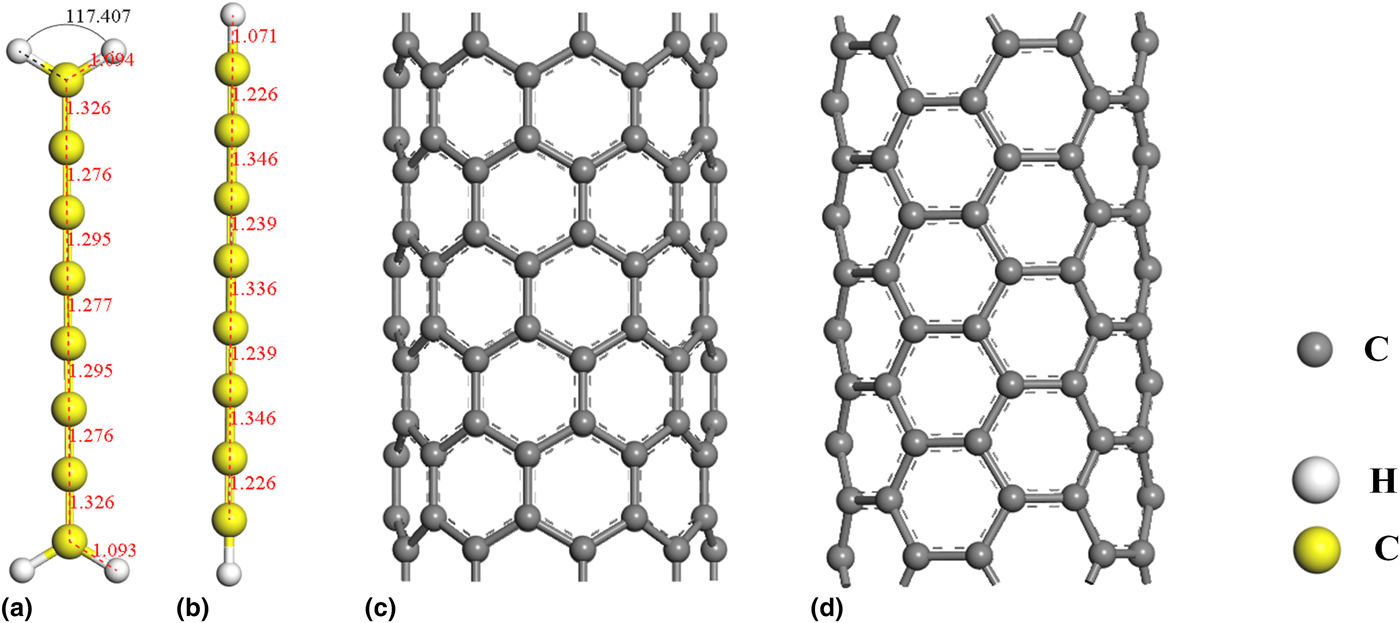
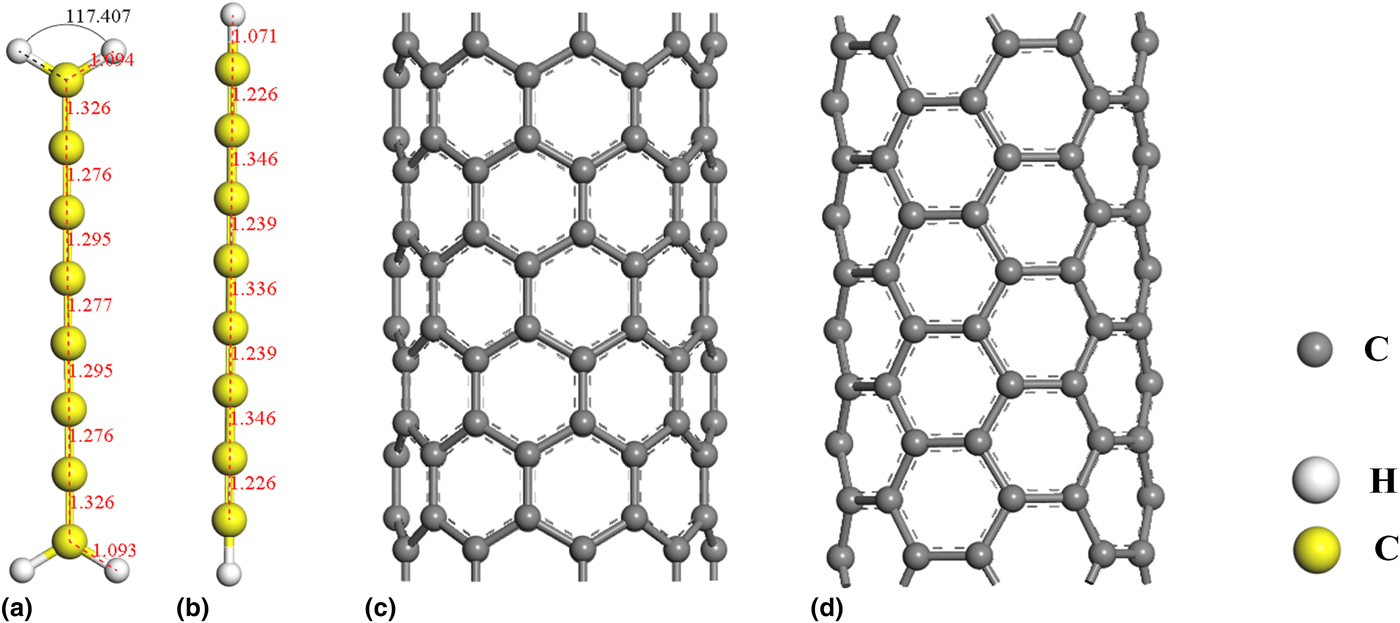
The geometric structure of carbon chains with eight C atoms and representative CNTs are shown in Fig. 1. It can be seen from Fig. 1(a) where the geometry of cumulene is depicted that the lengths of interconnected carbon atoms through absolute double bond are in good symmetry from both ends. Two H atoms connected with the terminal C atom with an angle of 117.407°. In Fig. 1(b), alternating C–C bond and C≡C bond with two H atoms in both end comprehend the polyyne, which has similar symmetric manner with that of cumulene in terms of bond lengths. Moreover, the (9, 0) and (5, 5) CNTs after geometric optimization are described in Figs. 1(c) and 1(d), respectively.
Geometric models of carbon chain and CNTs. (a) cumulene; (b) polyyne; (c) (9, 0) CNT; (d) (5, 5) CNT.
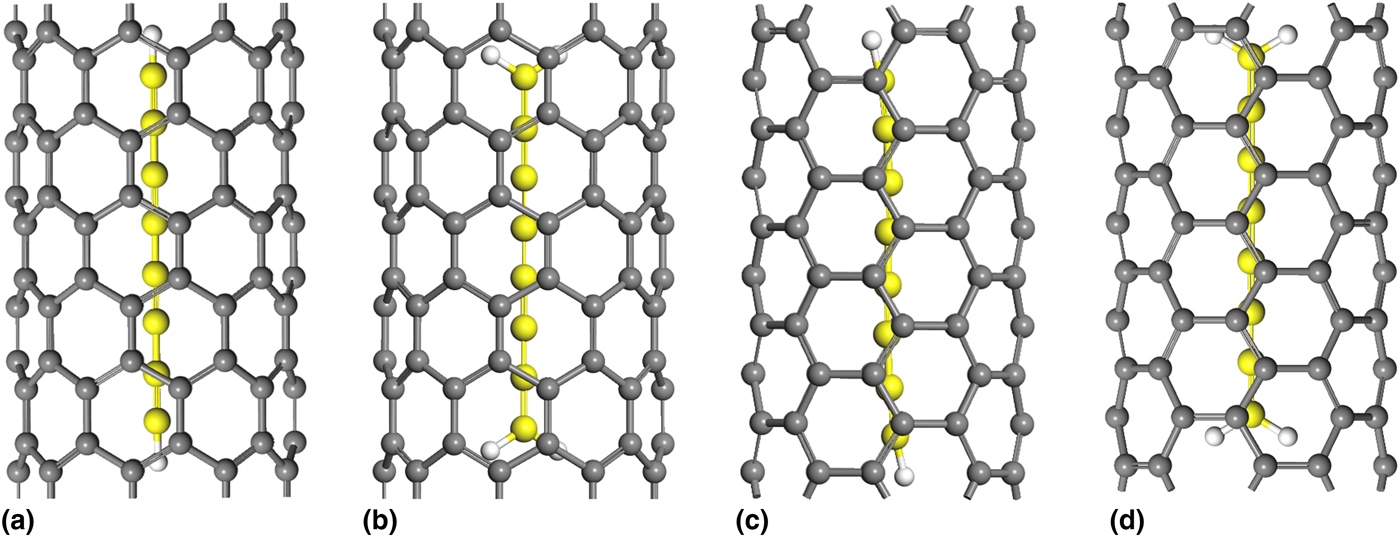
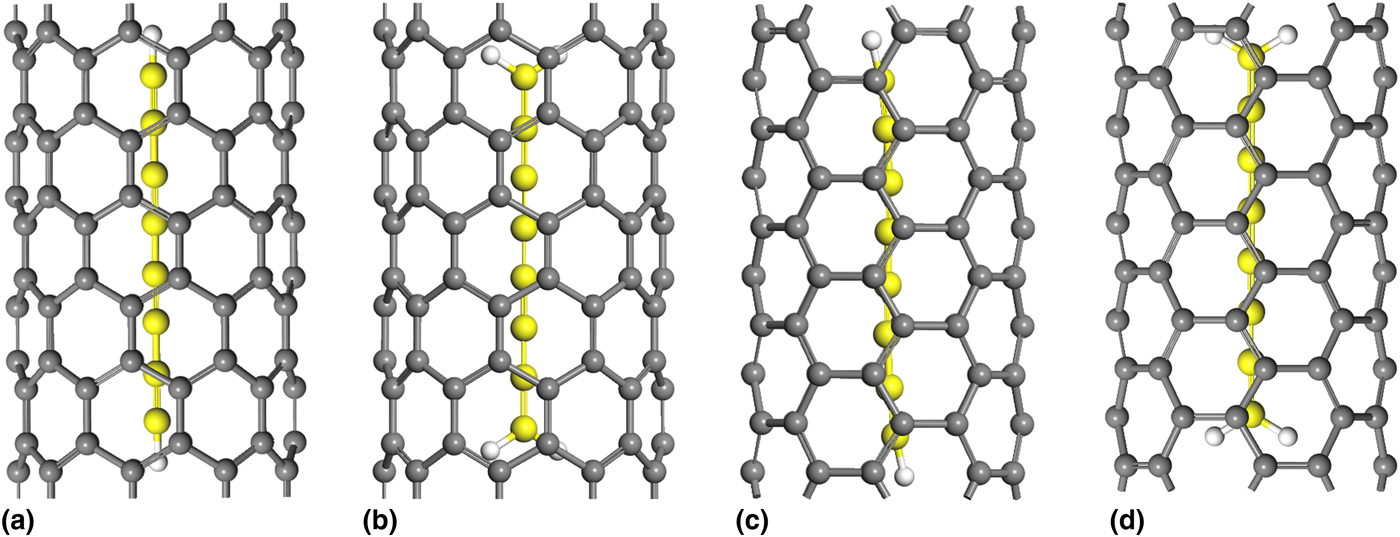
The geometrically optimized structures for chain inserted CNTs are shown in Fig. 2. We can find that the geometries of carbon chains and CNTs does not witness a significant modification after optimization except for polyyne-(5, 5) CNT system in which the ending H of the carbon chain experiences an excursion from origin site, which may attribute to the strong binding force between the polyyne and (5, 5) CNT. On the other hand, the C–C bond lengths of the CNTs have little change, while in the carbon chains, it is tuned by the structure of CNTs. For example, the average bond length of C–C bond in isolated carbon chain is measured to be 1.343 Å, whereas shortened to 1.333 Å in the case of (9, 0) CNT and 1.336 Å in (5, 5) CNT system, respectively. This can be attributed to the interaction between the CNT support and chain insertion.
Geometric structures of polyyne and cumulene inserted CNTs. (a) polyyne-(9, 0) CNT; (b) cumulene-(9, 0) CNT; (c) polyyne-(5, 5) CNT; (d) cumulene-(5, 5) CNT.
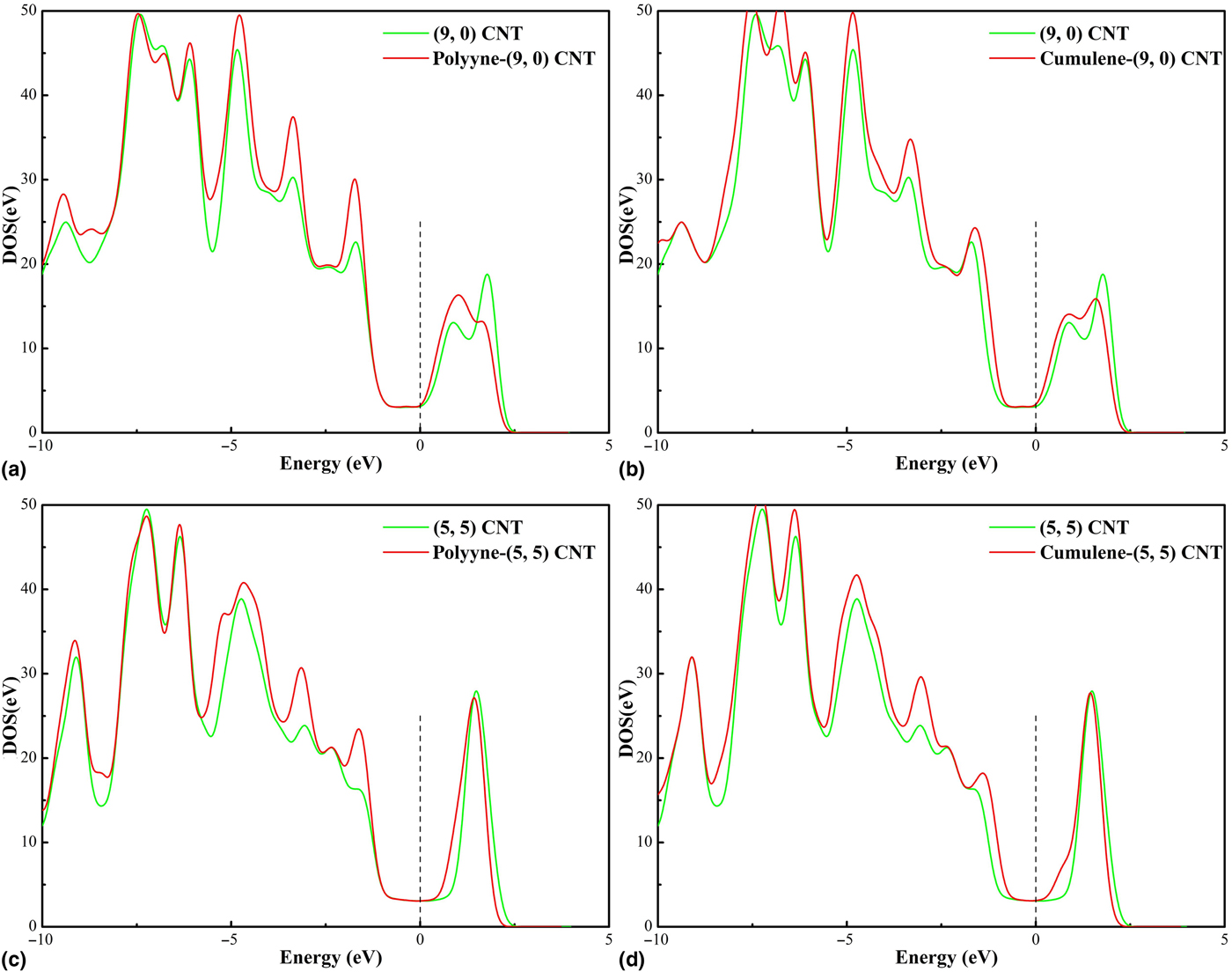
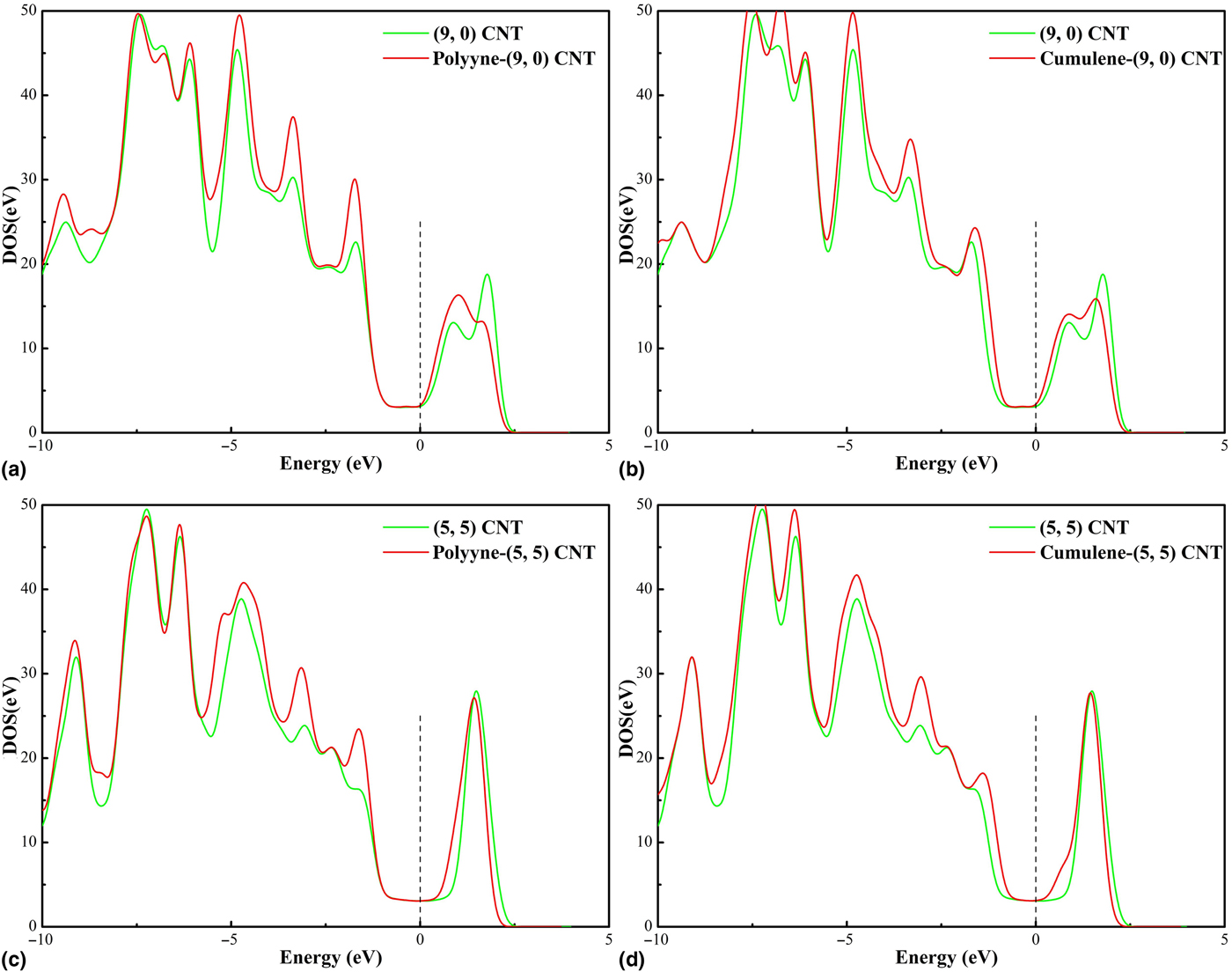
The density-of-state (DOS) distributions are depicted in Fig. 3 to provide a detailed information and comparison upon the electronic behavior of carbon-chain insertion into CNTs.[ Reference Penza, Rossi, Alvisi, Cassano, Signore, Serra and Giorgi 16 , Reference Rad 17 ] One can find that with respect to polyyne insertion into representative CNTs, the lowest unoccupied molecular orbital (LUMO) shows slightly shift toward lower region while highest occupied molecular orbital (HOMO) basically unchanged, which could lead to the narrowed E g to some extent. Likely, when cumulene inserts into two kinds of CNTs, not only HOMO witnesses a shift toward a higher region, but also the LUMO changes to a lower region despite the kind of CNT, resulting in the remarkably narrowed gap near the Fermi level. Such results provide us with two conclusions: (a) cumulene insertion would exert larger effect on CNTs upon electronic behaviors compared with polyyne; (b) comparison between these systems could be beneficial to qualitatively understand conductivity change in chain inserted CNTs against pure CNT system, shedding lights on the change mechanism of conductivity in CNTs caused by insertion of chains. That is to say, the inserted carbon chain can modify the electronic structure of CNTs by increasing the DOSs at Fermi energy.
Comparison of DOS distributions for varying systems. The dash lines represent Fermi level. (a) DOS for (9, 0) CNT and polyyne-(9, 0) CNT; (b) DOS for (9, 0) CNT and cumulene-(9, 0) CNT; (c) DOS for (5, 5) CNT and polyyne-(5, 5) CNT; (d) DOS for (5, 5) CNT and cumulene-(5, 5) CNT.
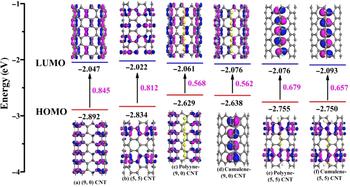
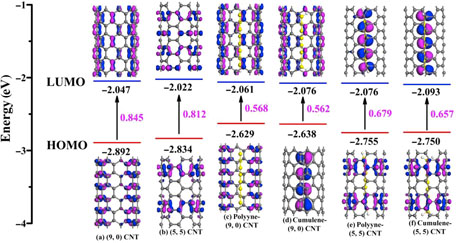
To illuminate the conductivity change of CNTs responding to chain insertion, the frontier molecular orbital theory would be essential and helpful, as the distributions of HOMO and LUMO associated with their related energy could be obtained.[ Reference Istadeh, Kalantarinejad, Aghaei and Soleymani Yazdi 18 , Reference Li, Hodak, Lu and Bernholc 19 ] In that regard, the energy gap (E g) between the LUMO and HOMO would be calculated as well, which has been widely accepted as a workable and effective indicator to the electrical conductivity of bulk materials.[ Reference Penza, Rossi, Alvisi, Suriano and Serra 20 , Reference Li, Wang and Cao 21 ] Referring to the previous report, lower E g means higher electrical conductivity and in contrast, higher E g corresponds to the lower electrical conductivity.[ Reference Rad and Abedini 22 , Reference Moradi, Sebt, Karimi-Maleh, Sadeghi, Karimi, Bahari and Arabi 23 ] Figure 4 presents the distributions of HOMO and LUMO and their energies in parallel with related energy gaps (E g). In the pure (9, 0) and (5, 5) CNTs systems, the HOMO and LUMO distribute uniformly with related E g of 0.845 and 0.812 eV, respectively. For the insertion of the carbon chain, there display different degrees of transformation toward HOMO and LUMO distributions, which therefore leads to the change of their energies. We can find that both for the (9, 0) and (5, 5) CNTs, cumulene insertion exerts a greater effect on the conductivity change for the system than that of polyyne, with lower E g indicating higher conductivity. This is in agreement with what we mentioned above that cumulene insertion would exert a larger effect on CNTs upon electronic behaviors compared with polyyne. In addition, chain insertions could exert much more effect on (9, 0) CNT with respect to system conductivity change than that of (5, 5) CNT, given the pronounced decreased of E g in (9, 0) CNT configurations.
HOMO and LUMO distributions and related energies of various systems (a) HOMO and LUMO distributions for (9, 0) CNT; (b) HOMO and LUMO distributions for (5, 5) CNT; (c) HOMO and LUMO distributions for polyyne-(9, 0) CNT; (d) HOMO and LUMO distributions for cumulene-(9, 0) CNT; (e) HOMO and LUMO distributions for polyyne-(5, 5) CNT; (f) HOMO and LUMO distributions for cumulene-(5, 5) CNT.

Conclusions
In this work, we performed DFT calculation and studied the electronic behaviors of CNTs caused by insertion of two kinds of the carbon chain. The results show that,
-
(1) The insertion of cumulene and polyyne can affect the electron distribution of two kinds of nanotubes, giving rise to conductivity change to some degree.
-
(2) Cumulene insertion would exert a larger effect on CNTs upon electronic behaviors compared with polyyne, leading to a larger decrease in system electrical conductivity.
-
(3) Chain insertion would cause more influences on (9, 0) CNT in terms of conductivity change than that of (5, 5) CNT.
Our calculations would be meaningful to indicate possible application for chain inserted CNTs, providing theoretical fundamentals for insertion mechanism towards CNT.
Acknowledgment
This study was supported by the Natural Science Foundation of China (grant no. 51674055).
Contributions and competing interests
H. C. performed this work and wrote this manuscript, G. Q. guided this work, while Q. L. and J. W. modified writing in order to improve its quality. All authors have no interest conflict about its submission.