Australian universities offer teacher training in Indigenous education through core, elective, and embedded units in an attempt to respond to the expectations outlined in the varying policies that interpret graduate teacher knowledge. Interpretations of the policy discourses and impact of the variability among communities and students can be understood through recent debates in education best practice for teaching Indigenous students. The debate referred to as the ‘education wars’ includes Noel Pearson's assertion of the Direct Instruction Method, while Chris Sarra emphasises a focus on ‘high expectations relationships’ (as cited in McMullen, Reference McMullen2012). The variability in the debate highlights the contestations involved in teacher knowledge about learning models, even beyond the policy context.
Anderson (Reference Anderson2012) further highlights that school curriculum and teaching methods are the basis of an urgent reform in remote community schools, and envisages teachers with university degrees and 5 years of experience will make a difference to outcomes for Indigenous students and approaches within the classroom. Conversely, the teaching population in remote communities often comprises new or recent graduates (as cited in Jorgensen, Grootenboer, Niesche, & Lerman, Reference Jorgensen, Grootenboer, Niesche and Lerman2010, p. 61) and the prospect of working in Indigenous education settings as a whole are viewed by some in the teaching profession as low status (see Malin, Reference Malin, Cowlishaw and Morris1997, on teacher attitudes). The outcomes communicated during teacher training have largely been left untended in recent debates about policy and practice in Indigenous education, despite the assumption of graduate teachers’ ability to:
Demonstrate broad knowledge and understanding of the impact of culture, cultural identity and linguistic background on the education of students from Aboriginal and Torres Strait Islander backgrounds, and;
Demonstrate broad knowledge of, understanding of and respect for Aboriginal and Torres Strait Islander histories, cultures and languages. (Australian Institute for Teaching and School Leadership, 2012)
This article describes how five pre-service teachers at similar stages of completion in their course responded to case studies on Indigenous education in the final assessment of a core unit of study on Indigenous education topics such as government policies, developing relationships, and teacher attitudes. It also discusses the implications of prior content knowledge of education and prior metacognitive knowledge of university study on the assignment submissions (Dochy, de Rijdt, & Dyck, Reference Dochy, de Rijdt and Dyck2002, p. 270; Dochy, Segers, & Buehl, Reference Dochy, Segers and Buehl1999), and the relationship with course outcomes and preparing teachers according to the Australian Professional Standards for Teachers (AITSL, 2012).
Terminology
This article uses the term ‘Indigenous’ to signify that pre-service teachers in the study site engage in both Aboriginal and Torres Strait Islander education, and thus the use of the word aims to represent the diversity of First Nation cultures within the Australian context. The term ‘education’ posits perspectives on teaching and learning, as well as the range of perspectives and knowledge explored in the unit being attributed to perspectives in education. As such, ‘Indigenous education’ refers to a unit of study that is situated in the graduate teacher development of professional practice, knowledge and engagement (AITSL, 2012) in teaching and learning in Aboriginal and Torres Strait Islander education.
Indigenous Education
The importance of teacher training in Indigenous education was initiated at a federal level following the 1967 referendum, resulting in Commonwealth influence over Aboriginal and Torres Strait Islander affairs, and consequently highlighting the disparity of educational outcomes for Indigenous students (Beresford, Reference Beresford, Beresford, Partington and Gower2003, p. 112; Malin & Maidment, Reference Malin and Maidment2003, p. 87). Despite continual policies and reports about the inclusion of Indigenous education and consideration of students’ needs in national structures (Malin & Maidment, Reference Malin and Maidment2003, p. 89), it was not until the late 1990s that explicit units were considered as core within the context of pre-service teacher training (Craven, Halse, Marsh, Mooney, & Wilson-Miller, Reference Craven, Halse, Marsh, Mooney and Wilson-Miller2005a, p. 16). Amid recommendations by the Australian Education Council in 1989 and the Australian Council of Deans in 2001 for requisite units, institutions still embed Indigenous education across other areas (Craven et al., Reference Craven, Halse, Marsh, Mooney and Wilson-Miller2005a), such as inclusion or diversity. Evidenced by the fewer than 50% of universities in 2002 that had compulsory subjects for Indigenous education (Craven, Halse, Marsh, Mooney, & Wilson-Miller, Reference Craven, Halse, Marsh, Mooney and Wilson-Miller2005b, p. 2), the area remains as a low status priority within teacher training and knowledge. Teacher preparation through units in Indigenous education leads to subsequent causal translations into classroom practice (Harrison & Greenfield, Reference Harrison and Greenfield2011); however, analysis of outcomes after engaging in core units has been limited.
Accreditation of teacher education courses is dependent on a graduate's aptitude in the ‘core knowledge . . . skills and general capabilities important for all Australian students’ (Australian Curriculum Assessment and Reporting Authority [ACARA], 2012a) as attested within the Australian Professional Standards for Teachers (AITSL, 2012). Significantly, Aboriginal and Torres Strait Islander perspectives must be included across all key learning areas (KLAs) beyond those that pertain specifically to Indigenous Studies, and all teachers must appreciate and respond to the needs of Indigenous students. The quality of content and instruction within explicit units correlates with positive and active positions in Indigenous education (Craven et al., Reference Craven, Halse, Marsh, Mooney and Wilson-Miller2005a); however, the approaches and processes by which these principles can be developed are varied.
Pre-Service Teachers and Indigenous Education
Teachers are a significant factor in learner achievement and engagement (Hattie, Reference Hattie2002), and a critical determinant to attendance and outcomes for Indigenous students (Hughes & Hughes, Reference Hughes and Hughes2011). Most neophyte and veteran teachers in Australia come from Anglo-Saxon, middle-class and metropolitan upbringings with limited dealings with people from other cultural and social backgrounds (Allard & Santoro, Reference Allard and Santoro2004), which affects their position towards Indigenous education. Often, a teacher's knowledge base about students, issues, communities and contexts is drawn from unquestioned personal assumptions and experiences acquired through childhood and schooling years (Leonard, Reference Leonard2002) that has detrimental implications for students (Malin, Reference Malin, Cowlishaw and Morris1997).
Content comprehension or ‘knowledge acquaintance’ (Shulman, Reference Shulman1987, p. 7) is based on a teachers’ choice; so, too, is Indigenous education transposed in the classroom dependent on the knowledge of the educator (Harrison & Greenfield, Reference Harrison and Greenfield2011, p. 66). As such, teachers are mandated to become informed of the historical, social, political and environmental circumstances affecting Indigenous students (AITSL, 2012; Price, Reference Price2012), as well as to become familiar with the implications associated with embedding perspectives across the curriculum (ACARA, 2012a; AITSL, 2012; Harrison & Greenfield, Reference Harrison and Greenfield2011). An understanding of the states in which Indigenous education operates necessitates core units that challenge held assumptions and develop pre-service teachers’ content knowledge.
Neophyte teachers are consistently cited as being ill equipped to operate in contexts affiliated with Indigenous education (Jorgensen, Grootenboer, Niesche, & Lerman, Reference Jorgensen, Grootenboer, Niesche and Lerman2010), resulting from a ‘missing paradigm’ (Shulman, Reference Shulman1986, p. 6) due to units that have focused on pedagogy for Indigenous students that is devoid of content knowledge regarding perspectives and issues. A ‘chasm of the intellect’ (Pascoe, Reference Pascoe, Purdie, Milgate and Bell2012, p. 5) regarding histories, peoples and knowledges has ensued, with a subsequent disparity between the self-competency and affective attributes (Craven et al., Reference Craven, Halse, Marsh, Mooney and Wilson-Miller2005a, p. 8) that are required for sustainable engagement in Indigenous education. Self-competency develops from cultural competency, where those in professional positions such as health workers and educators develop their practice by reflecting on their own backgrounds and professions in the choices they make, consistent with Indigenous expectations (Ranzijn, McConnochie, & Nolan, Reference Ranzijn, McConnochie and Nolan2010). The affective attribute that stems from educators enjoying teaching Indigenous Studies and Indigenous students is that ‘they are more likely to be committed to this area’ (Craven et al., Reference Craven, Halse, Marsh, Mooney and Wilson-Miller2005a, p. 8). Although the affective attribute is noted as a predicator for longitudinal commitment to Indigenous education, a reliance on unchallenged personal views results in deficit and ‘blame’ ideologies (McConaghy, Reference McConaghy2000) that infer Indigenous students’ identities as being the reason for a failure to achieve equitable educational outcomes, in turn refuting cultural competency.
Prior Knowledge
Unit outcomes are used as key indicators of content within units taught at universities, and are similarly used to determine course accreditation. Pre-service teachers progress through their course at different rates, and Indigenous education features at varying times across different institutions (Craven, Halse, Marsh, Mooney, & Wilson-Miller, Reference Craven, Halse, Marsh, Mooney and Wilson-Miller2005c). The early positioning of Indigenous education units in courses indicates the ‘tell me how to do it’ phase of education (DiAngelo & Sensoy, Reference DiAngelo and Sensoy2010) where training teachers are grappling with the strategies, principles, approaches and essential identities of becoming a teacher (Brtizman, Reference Brtizman2003). As such, training teachers may be looking for solutions to perceived problems in Indigenous education. Alluding to a set of pedagogies or knowledges in Indigenous education training is synonymous with ‘formulas for domination’ (Foucault, Reference Foucault1977) within the classroom.
Achieving unit outcomes and understanding unit content and preceding study within a specific area has been used as a predictor within fields other than education (Hailikari, Nevgi, & Komulainen, Reference Hailikari, Nevgi and Komulainen2008; Thompson & Zamboanga, Reference Thompson and Zamboanga2004). As with other professional fields, a prior knowledge base in education and in higher education study develops skills in grappling with the academic and at times, confronting nature of higher education. Prior knowledge in the field of education and the workings of higher education allows training teachers to think critically about the contexts of Indigenous education beyond the self, as they are already versed in the foundations of education.
Methodology
The purpose of this study was to describe how pre-service teachers responded to Indigenous education through the use of an embedded assessment case-study methodology, which was exemplified in the final assessment item. The study took place in a core Indigenous education unit, facilitated by an education faculty, with the purpose of embedding an Indigenous understanding into educators’ methodology. This differs from Indigenous Studies units, which are most often taught through Higher Education Indigenous Centres with the purpose of learning about Indigenous issues and perspectives.
The unit's intention was to prepare teachers by teaching them about their responsibility to facilitate Indigenous education for all students. There were introductions to Indigenous Studies through readings and guest lectures; however, the majority of the unit focused specifically on teacher choices in curriculum, pedagogy and practice. The unit explored the idea that context and perspective matters in schooling, and how school and education looks different from different standpoints. The focus on context within the unit was imperative as what is valid in one context is not necessarily transferable to other contexts, nor to other professionals (Tuhiwai Smith, Reference Tuhiwai Smith1999, p. 85). The use of resources that represent Indigenous issues, perspectives and peoples, such as books, the internet and human resources, were examined in the context of the curriculum, and laid the basis for the first assessment item.
There is a link between realistic assessment and achieving learning outcomes (Dochy, Segers, & Buehl, Reference Dochy, Segers and Buehl1999); however, assessments in teacher education are often separated from learning experiences in real teacher practice. Consequently, the expression of understanding and learning through assessment is based on personal and assumptive perceptions rather than informed perspective and conjecture, due to the separation of theory and practice in instruction approaches (Hammerness, Darling-Hammond, & Shulman, Reference Hammerness, Darling-Hammond and Shulman2001; Price, Reference Price2012). In this way, the basis of the first assessment task emanated from the use of teaching resources to supplement practice. The aim was for students to challenge resources and their often-stereotyped representation of Aboriginal and Torres Strait Islander peoples, cultures and histories in the classroom. The second assessment task similarly focused on embedding resources in the creation of a curriculum resource such as a sequence of lesson plans, assessment task or small unit of work, in a way that reflects an understanding of embedding Indigenous education across the curriculum.
The final assignment was a case study analysis of Indigenous education situations related to topics such as government policies, developing relationships, and teacher attitudes, that was embedded across the total seven tutorials and two seminars. Case-study methodology has been highlighted as a tool by which pre-service teachers are able to engage in critical reflection rather than personal assumptions and experiences (Hammerness et al., Reference Hammerness, Darling-Hammond and Shulman2001), and formed the basis for the design of the culminating assessment task for the unit in this study. Zeichner and Liston (Reference Zeichner and Liston1996) similarly highlight the need for pre-service teachers to reflect critically on the institutional, political and cultural attributes of schooling (p. 53) and the associated implications of actions and knowledge through having control over processes and work (Zeichner & Liston, Reference Zeichner and Liston1987, p. 26).
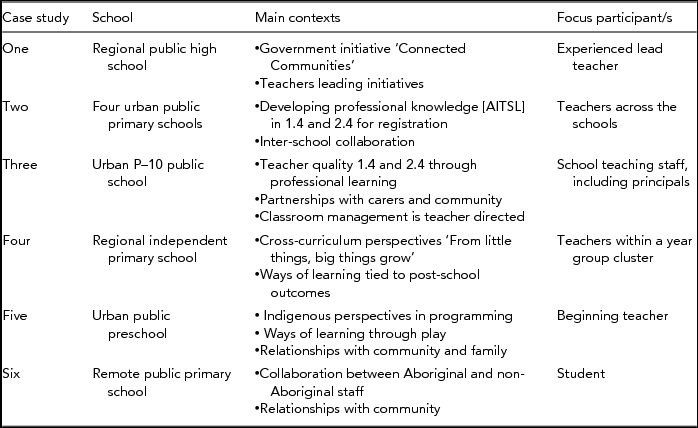
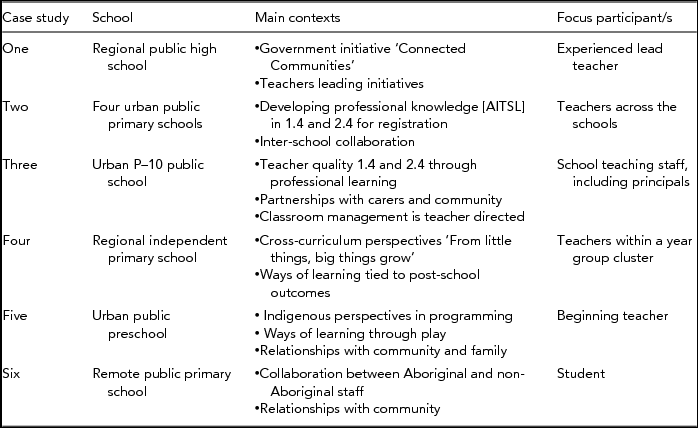
In the first tutorial for the teaching period, students were presented with six cases from which to choose as a lens for unit content and the major case-study task. Each case contained information about a context drawn from school sites and profiles published on the My School website (ACARA, 2012b) from Australia's annual National Assessment Program in Literacy and Numeracy (NAPLAN; ACARA, 2012c), and as such was based on realistic contexts, as shown in Table 1. The participants and contexts presented in the cases were developed based on the lecturer's own professional experience across a range of remote, regional and urban contexts.
Content Analysis of the Case Studies
Each week during tutorials, students were allocated times to work with others on their case study through critically reflecting a series of questions that responded to the reading, lecture and online materials. In this way, the assessment was embedded into the pedagogical approach of the unit delivery, amalgamating learning outcomes and affiliated teacher action (Campbell & Groundwater-Smith, Reference Campbell and Groundwater-Smith2010). The content of the cases were written to encourage students to engage in multiple perspectives and make connections to theory while addressing the particulars of the situation (Hammerness et al., Reference Hammerness, Darling-Hammond and Shulman2001). The criteria for assessment was thus:
1. the extent to which the response considers Indigenous and non-Indigenous perspectives in education;
2. critical analysis of the case through the realistic educational context and integration of the unit's topics; and
3. the use of relevant and extensive evidence to support ideas.
Context is significant for professionals to understand when engaged in Indigenous education (Tuhiwai Smith, Reference Tuhiwai Smith1999), so the cases aimed to encourage students in addressing the knowledge base of the profession rather than talking from a personal perspective (Hammerness et al., Reference Hammerness, Darling-Hammond and Shulman2001, p. 23). Each case was positioned in the present, not in the past or a utopian future (Dewey, Reference Dewey1938), and it was outlined in the criteria that the responses should likewise reflect this standpoint (criterion 2). Differences between cases allowed for larger group discussions to highlight that education is not handing over a skill set or the construction of external powers (Dewey, Reference Dewey1916, p. 112), and the absence of ‘problems’ evidenced the inability for ‘solutions’ and aimed to encourage thinking beyond the deficit ideologies commonly defaulted to in Indigenous education (criterion 1).
After engaging in scaffolding questions structured around the focal topics of cultural safety, history and perspectives, policy and pedagogy, and relationships, students were asked to write an analysis on one of the cases, drawing on the range of evidences presented in the unit. The aim of the assessment was to meaningfully address the learning outcomes, namely, reflection on Indigenous students’ needs and the application of Indigenous perspectives to Western education. In the analysis, students were required to situate the breadth of the topics from the unit in relation to the dimensions of the case study, with support from interviews, theory, literature, case studies and reflections to demonstrate careful deliberation of the interpretations and implications present in the context. As Indigenous education is not only demonstrated within specialised content descriptors or solely for Indigenous students (ACARA, 2012a; AITSL, 2012), four of the six cases mentioned Indigenous perspectives and contested areas such as policy (66.67%), and only one of the cases (16.67%) disclosed the number of identified students within the setting.
Pre-service teachers wrote one case study each over the semester. A total of 103 case study analyses from 103 pre-service teachers were submitted at the end of a 4-week intensive core Indigenous education unit, of which 5 were collected and analysed. The data was examined for: (a) levels of reflective language and thinking (criterion 1), and (b) degree of orientation towards discourses in Indigenous education (criteria 2 and 3).
Data Collection
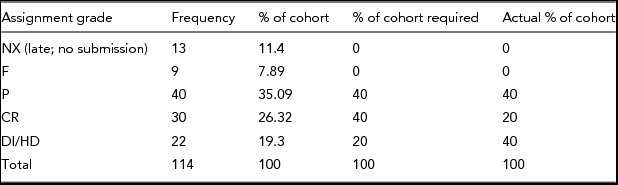
Two months after the finalisation of unit grades, two emails were sent to all students who were actively enrolled in the unit (Pass–High Distinction grades) at the time of the final assessment, outlining the scope and implications of the project. Course enrolment, grade in the final assignment and completion rate for the population (n = 101) is displayed in Table 2. As Table 2 shows, Fail (F and NX) submissions comprised 19% of the assessments; Pass (P) submissions made up 35%, Credit (CR) consisted of 26%, and Distinction (DI)/High-Distinction (HD) were 19% of total submissions.
Spread of Grades and Sample According to Student Population
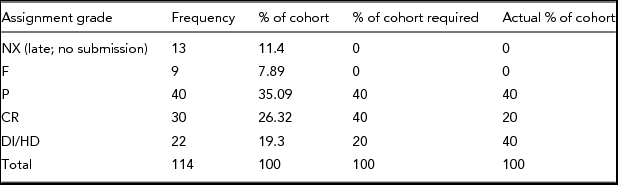
Note: F = Fail, P = Pass, CR = Credit, DI/HD = Distinction/High Distinction.
Five participants (two P, two CR and one DI/HD) were sought, based on the total number of assignment grades in order to reflect the spread, as shown in Table 2. F and NX assignments were not included due to the possibility of appeal. A total of nine students replied to the request for participants. It was planned that in order to avoid bias in the selection of participants, the first applicable students from the sought ratio (two P, two CR and one D/HD) would be sent consent forms. However, lack of returned consent from CR graded students resulted in overall recruitment of two Pass [P], one Credit [CR] and two Distinction/High Distinction [DI/HD] participants. As the project was investigating examination of Indigenous education and the position of core units in course structures, accepting a DI/HD instead of a CR offered further insight into the differences across rates of course completion.
Participants
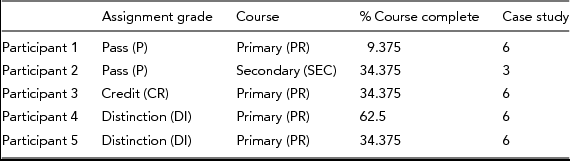
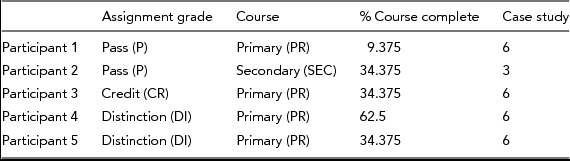
Table 3 shows the five participants involved in the study. The participants were largely at similar stages in course completion, with one each of the P, CR and DI/HD participants (three in total) a third of the way through their course before enrolling in the unit. Most participants were enrolled in a Primary (PR) course, with only one enrolled in a Secondary (SEC) course. As a result of the course enrolment, four participants examined case study 6, which was situated in a primary school, whereas only one examined case study 3, which was situated in a Prep to Year 10 school setting. Demographic features of the participants were not collected to protect their anonymity.
Description of Participants in the Study
The unit was ranked as suitable for an undergraduate first year level; however, students in undergraduate teacher education courses were advised to take the unit at different stages, through the dissemination of course structure guidance:
• second semester or intensive middle term in the third year primary and early childhood courses;
• second semester of the second year for secondary education courses; and
• second semester of the second year for the 2-year graduate entry course.
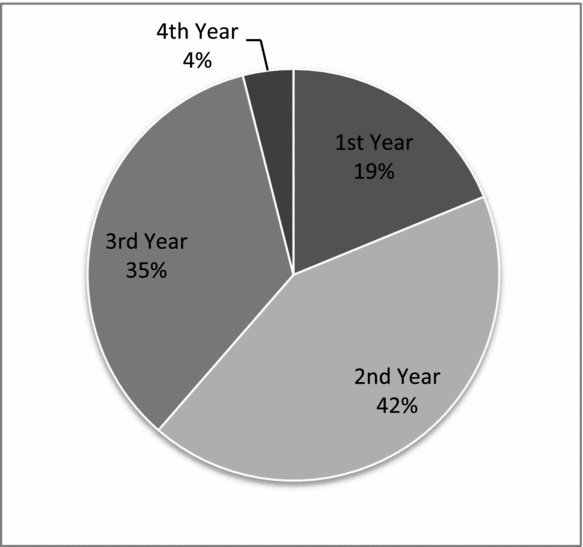
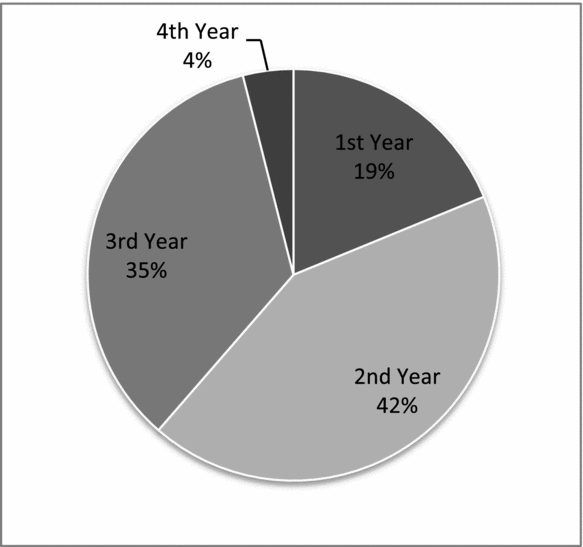
Figure 1 shows the spread of all enrolments in the unit across the year levels. The majority of students (81%) were in their second, third or fourth year of study; however, 19% of enrolled students were in their first year. The five participants in the study came from different year levels, with one student in first year, and four in the second year of study in their degree.
Enrolled year level of students (n = 101).
Findings and Discussion
The main themes in the qualitative data are presented in coding order, reflective of the prevalent categories represented in the five responses. The data was analysed for reflection and orientation to discourses, as outlined in the methodology. As the investigator was also the lecturer, reflexivity was vital in attempting to discern authentic representations of participant meaning and as such is discussed where relevant in the following sections. In the conclusion, the article will draw on the findings to highlight possible implications for teacher education and professional learning.
Teacher Knowledge
In relation to the theoretical framework of cultural competency (Ranzijn et al., Reference Ranzijn, McConnochie and Nolan2010), pre-service teachers in the CR and DI/HD gradings identified that it was the teacher's prerogative to develop a knowledge base about the historical, cultural and social contexts of Indigenous education, with a strong theme being responsibility. Participants discussed teacher knowledge about historical events and implications across all three of the grade categories, although it was notably the focus of the response for pre-service teachers in the P and CR gradings. Core units in Indigenous education offer learning about a range of substantive knowledges such as historical events and policies affecting both early and contemporary Indigenous and non-Indigenous identities and relations (Craven et al., Reference Craven, Halse, Marsh, Mooney and Wilson-Miller2005a). Although histories was a focus topic for only one week in the unit, P/CR participants focus may indicate student inability to critically consider the knowledge presented at these gradings. Initially, it was thought that the connection was a reflection of deficit discourse; however, participants highlighted the prevalent etic theme of educational implications as being associated with histories across the CR-DI/HD grade categories, with P-grade responses typically situating histories as being separate from the context of the case. Affective notions were found in the P and CR responses, ranging from apologetic to uncertainty about the implications of historical events and policies:
CR-Grade Participant: For some members of the community, current policies such as the Northern Territory National Emergency Response and the Stronger Futures legislation may have further implications, and possibly return the feeling of being dictated to and being told how to live their lives.
Craven et al.'s (Reference Craven, Halse, Marsh, Mooney and Wilson-Miller2005a) findings emphasise the need for core units to go beyond the teaching of substantive knowledges, instead extending into pedagogy and curriculum comprehension (p. 83); however, participants in the P- and CR-grade ranges may have focused on this knowledge in the response perhaps due to the unit being the first learning about histories (Craven et al., Reference Craven, Halse, Marsh, Mooney and Wilson-Miller2005a, p. 81). Hollingsworth (as cited in Miller, Dunn, & Currell, Reference Miller, Dunn, Currell, Phillips and Lampert2005) suggests that ‘. . . a large number of non-Indigenous students are appalled at what was done and said, and who feel very guilty. . .’ (p. 64), and as such may represent understandings through such lenses. Pre-service teachers who studied a core Indigenous education unit have highlighted that they, too, had experiences of personal responsibility for past injustices and subsequent feelings of shame, disbelief, confusion and anger when learning about histories (Miller et al., Reference Miller, Dunn, Currell, Phillips and Lampert2005).
Being faced with constructions of self through knowledge about histories is confronting for pre-service teachers and can be linked to prior content knowledge in incidents such as histories that are contained in core units. Moreover, a prior metacognitive knowledge is assumed through engaging in critical thinking, as an imperative lens when discerning histories as idiosyncratic reflections ‘. . . can be counterproductive in terms of both understanding our history and, more importantly, in engaging in the present to combat racism’ (Hollingsworth, as cited in Miller et al., Reference Miller, Dunn, Currell, Phillips and Lampert2005, p. 64). Although the assumption about prior content knowledge would apply to all pre-service teachers undertaking a core unit, prior metacognitive knowledge in regards to discerning literature and ideas is developed through prolonged academic engagement. Applying new knowledge skills in addition to debunking previously unchallenged and accepted content knowledge may have implications for understanding faculties within Indigenous education units.
Indigenous Perspectives
All participants discussed the understanding of how to include Indigenous perspectives as being an integral component to teacher knowledge, with a predominant recurring theme being learning. The terminology of ‘pedagogy’ and ‘ways of learning’ in relation to the 8 Aboriginal Ways of Learning pedagogical framework (Yunkaporta & Kirby, Reference Yunkaporta and Kirby2012) were used interchangeably through all gradings, suggesting that there are a range of interpretations of ways to include perspectives through practice. Interestingly, students from the P/CR gradings separated perspectives as being for Indigenous students, whereas DI/HD gradings suggested that the practice of including perspectives is for all students and inherently part of a teacher's role and responsibility:
DI/HD Grade Participant: Any teacher can incorporate Aboriginal perspectives using this framework that responds holistically to land, people, culture, language, spirit and nature . . .
P Grade Participant: . . . this framework allows Indigenous students to use kinesthetic learning to develop skills and indirectly learn through different perspectives.
Indigenous education is for all students and teachers, and including perspectives benefits not only Indigenous students, but all students in the classroom (Yunkaporta & Kirby, Reference Yunkaporta and Kirby2012). Despite the prior assessment item being about the use of planning and resources as avenues for including perspectives, only the P and DI/HD participant responses mentioned these practices in the analysis of the context. In order for the inclusion of Indigenous learning and teaching, processes need to come from a non-dominant standpoint (Nakata, Reference Nakata2007; Taffe, Reference Taffe1995, p. 12) and need to consider all practices and expectations within the classroom that affect learning. Initially, it was thought that the absence of planning and resources in as prominent a position in perspectives as pedagogies may have resulted from the previous two assessment tasks being about practices specifically; however, the literature indicates it may be an indication of the separation of curriculum and content knowledge (Shulman, Reference Shulman1986, p. 6). Resources are referred to by participants as being synonymous with school attributes such as gardens, and a P participant was the only one to discuss the use of resources in the classroom through the use of an Aboriginal languages map.
Stereotyping is defined as a subsidiary of pedagogy (Craven, Reference Craven1996, p. 213) due to its significance in the representation of Indigenous perspectives in the classroom. Student and school achievement was discussed by CR and DI/HD participants, with a strong emic theme of a culture of stereotyping due to recent and current government policies. Participants indicated, however, that teachers and parents are central to challenging and refuting commonly held stereotypes through policies such as the Northern Territory Emergency Response/Stronger Futures and Close the Gap:
CR Grade Participant: In Rachel's situation her parents have set the benchmark in their family. Stereotyping is a contributor to the gap in education and Rachel's parents have stepped away from the stereotype, and shown her that she can achieve what she wants out of life.
A teacher knowledge based on race, racism and misconception has dire consequences for the success of teaching strategies and student learning and engagement (Craven, Reference Craven1996, p. 213). The acknowledgement of achievement across all gradings refutes deficit ideologies regarding the ability of students and schools to achieve equitable outcomes in Indigenous education. However, the degrees to which these achievements are engaged with differ. As discussed earlier, the P and CR gradings had a strong focus on histories; however, the DI/HD gradings had a strong focus on unpacking the achievements of the schools and students.
Developing Relationships
The DI participants further expressed that working with communities and students was part of culturally competent practice and foundational to meeting the needs of students within the given context. This is reflective of the Ramsden (Reference Ramsden2002) cultural safety principles that underpinned unit theory in relation to the Negotiation and Equal Partnership Model, whereby relationships between local community and service providers, such as schools, are critical to developing cultural safety for students (p. 99). A recurrent emic theme arising from the analysis of responses in relation to developing relationships with community was collaboration, highlighting that cultivating a ‘cultural identity’ or ‘cultural understanding’ within schools is dependent on the quality of relationships and partnerships:
P Grade Participant: This collaboration creates the cultural understanding needed to help ‘close the gap’ between Indigenous and non-Indigenous Education. This can be established further through the development of partnerships and relationships with parents and the community members . . .
DI/HD Grade Participant: However, in order for teachers to maintain these relationships and community links they need to ensure that an equal power balance is developed between them and the Elder, parent or other Indigenous community member . . .
Harrison and Greenfield (Reference Harrison and Greenfield2011) assert that interactions between teachers and community through relationships and partnerships are integral to the inclusion of perspectives in all classrooms within a school as ‘learning is local’ (p. 74), and so needs to be situated within the surrounding environment. Ways of forming partnerships in the context of the case were discussed by all participants, from formal agreements to informal gatherings, and a strong focus across all the gradings was the reciprocity of success in Indigenous education, based on meaningful community involvement. It was also highlighted that although there are varying reasons for relationships, such as student mobility, educational success and the values associated with learning, it is ultimately the teacher's role to develop and build these relationships with an understanding of the implications of the context:
DI/HD Grade Participant: To be successful within the school community, the teachers will have had to develop a strong community presence, which involves formal and informal partnerships with both the school families but the wider community.
Communication of place in regards to naming of people and country was evident in the CR and DI/HD gradings, with connections between the languages and people discussed in relation to implications with communication and local histories. Teacher engagement with community is not only in what they do, but how they engage in discourse that results in stereotyped, stagnate, exotic and simplistic understandings (Harrison & Greenfield, Reference Harrison and Greenfield2011). As such, it is vital for teachers to know who the people are in the area they are teaching, so as to know the right people to speak to in regards to that community and to disband commonly held stereotypes.
Conclusion
This study shows that it is important for tertiary institutions to offer core units in Indigenous education as for many students it is the first time they are not only exposed to substantive knowledges, but are also challenged to reflect critically on the creation of knowledges about Indigenous issues and peoples. In order for pre-service teachers to make the shift from affective to reflective, the perspectives, issues and deliberations contained in units should be situated within diverse and specific contexts to allow for ongoing acknowledgement of the range of experiences and contestations that exist in Indigenous education beyond a formula of ‘what works’.
There are distinct differences between levels of achievement that need to be carefully considered when deeming a graduate ready to teach according the Australian Standards (AITSL, 2012). Pre-service teachers seem to understand the implications of context when forming relationships and partnerships with students, families and communities; however, the acknowledgement of diversity in Indigenous Australia through referring to place is only demonstrated through those who have engaged longitudinally in further study. Pre-service teacher reflections on how to include Indigenous education in teacher practice seem to be limited to entities of pedagogy, making the argument for the inclusion of a specific practicum placement that focuses on Indigenous education.
Ultimately, it seems to be up to individual institutions as to how they situate Indigenous education within course structures, but there may be vulnerabilities towards deficit and sympathetic understandings associated with engaging in Indigenous education too early in a pre-service teacher's training. Limited time to complete the study resulted in a smaller sample size, limiting generalisability. As such, further study would be useful by way of longitudinal investigation with a larger sample, as well as through an analysis of approaches across the range of tertiary institutions that offer core units. Interviews and focus groups with participants may also offer a deeper snapshot regarding this area of study.
Core units are undoubtedly integral to developing graduate knowledge and understanding; however, the methods by which universities engage students in learning, assessment and practice regarding Indigenous education needs to be considered carefully in order to redress both the lack of substantive knowledge upon entrance to a unit, and the absence of real practice in relation to the inclusion of perspectives as well as engagement with a community.
Acknowledgments
I would like to thank my research supervisor, Dr Misty Kirby, for her guidance.
About the Author
Raegina Taylor has been involved in working with Aboriginal and Torres Strait Islander communities since 2002 in a variety of roles. She spent 3 years working with communities in urban regions as a student teacher and early career teacher, and over 2 years working in remote communities as a teacher, curriculum developer and staff mentor. Raegina has worked as a lecturer in coordinating a core unit in Indigenous education for undergraduate pre-service teachers. Her current research interests are the responses from both higher education and school constituents to policies regarding Indigenous education, as well as the broader contexts and experiences in education as they relate to Indigenous education.