Imagine that you are pickpocketed by a child. How would you react? What would your responses be if the child started to cry and expressed negative emotions? Do you think your responses would depend on the child’s sex? This study addressed these questions by examining the role of the child’s sex, emotions, and crying, after being caught committing a moral transgression, over adults’ forgiveness, trust, and disciplinary behaviors.
Moral transgression is a violation of a moral standard, which typically triggers negative emotions in targets, such as discomfort, anger, and sadness (Dys & Malti, Reference Dys and Malti2016). One of the factors that tend to contribute to the way individuals respond in these types of situations is the offender’s reaction. Verbal accounts, such as apologies or excuses, may increase the targets’ willingness to forgive and reconcile with the transgressor, although nonverbal cues such as signaling regret, vulnerability, or powerlessness also seem to affect the targets’ responses (e.g., McCullough, Reference McCullough2001). The interpretation of a moral transgression also depends on the transgressor’s and on the targets’ age (Dys & Malti, Reference Dys and Malti2016). Although these judgments tend to change throughout the life span, it is not clear how adults perceive and react to children’s moral transgressions. Mitigating information, including powerless emotions expressed by an offender-child, tend to decrease caregivers’ negative feelings and reduce power assertion behaviors (Irwin, Skowronski, Crouch, Milner, & Zengel, Reference Irwin, Skowronski, Crouch, Milner and Zengel2014). Thus, this study will focus on the powerless emotions of shame, sadness, and fear, which tend to function as help-seeking behaviors (van Kleef, Reference van Kleef2016). However, as suggested by appraisal theories, each of these specific emotions may communicate different meanings in the context of a moral transgression and affect how individuals perceive the offenders’ character and intentions. Specifically, shame signals self-criticism, self-disappointment, and regret (Eisenberg, Reference Eisenberg2000). In contrast, fear and sadness do not necessarily signal regret. Fear is often expressed when events are outside of one’s control and the person is afraid of a punishment retribution, while sadness may signal individual’s loss of a desired goal and it may also be displayed intentionally to elicit forgiveness from the target (van Kleef, Reference van Kleef2016).
What if the child cries after being caught committing a moral transgression? Crying behavior is a complex biological response that expresses vulnerability (Hendriks & Vingerhoets, Reference Hendriks and Vingerhoets2006; Jellesma & Vingerhoets, Reference Jellesma and Vingerhoets2012). Crying evolved to improve and re-establish the contact between mother and infant, attract parental attention in moments of distress, and subsequently increase caregiving behaviors (Newman, Reference Newman2007). When expressed by children, crying can be used to catch the adult’s attention, to foster empathy and social support (Jellesma & Vingerhoets, Reference Jellesma and Vingerhoets2012). Thus, people seem to feel inclined to support a crying person (Hendriks & Vingerhoets, Reference Hendriks and Vingerhoets2006). Crying may also influence person perception: Individuals who cry tend to be perceived as warmer (e.g., Zickfeld, van de Ven, Schubert, & Vingerhoets, Reference Zickfeld, van de Ven, Schubert and Vingerhoets2018), but also less emotionally stable (Hendriks & Vingerhoets, Reference Hendriks and Vingerhoets2006). Crying may amplify perceived emotions, such as sadness (Balsters, Krahmer, Swerts, & Vingerhoets, Reference Balsters, Krahmer, Swerts and Vingerhoets2013; Hendriks & Vingerhoets, Reference Hendriks and Vingerhoets2006). Indeed, previous research demonstrates that fearful, angry, and neutral faces, in the presence of tears, are understood as less aggressive (Balsters et al., Reference Balsters, Krahmer, Swerts and Vingerhoets2013; Hendriks & Vingerhoets, Reference Hendriks and Vingerhoets2006; Provine, Krosnowski, & Brocato, Reference Provine, Krosnowski and Brocato2009). Crying may be perceived as a discharge of emotional tension when someone is unable to control their affect or has coping difficulties (Miceli & Castelfranchi, Reference Miceli and Castelfranchi2003). As a result, crying combined with negative emotions may lead adults to perceive the child-offender as more emotionally distressed than in the absence of crying, thus amplifying the offender’s needs and feelings. However, adults’ responses to children’s crying after being caught committing a moral wrongdoing are still unclear, especially regarding their emotional and behavioral responses, including willingness to trust and forgive the child.
Forgiveness is a form of conflict resolution that consists of an uncoerced willingness to give up resentment when a person is the target of a noxious, harmful, immoral or unjust behavior, which typically occurs after letting go of negative emotions, and avoidant or revenge motivations towards the offender, by replacing them with positive motivations (Enright, Freedman, & Rique, Reference Enright, Freedman, Rique, Enright and North1998; McCullough, Reference McCullough2001). As a result, forgiveness may be a mechanism to preserve social relationships, restore social harmony (Girard & Mullet, Reference Girard and Mullet1997), as well as a coping strategy to avoid negative feelings and thoughts (McCullough, Reference McCullough2001).
In the literature on moral development, the most studied disciplinary practices include overreactivity/power assertion (e.g., overt punishment), warmth/love withdrawal (e.g., ignoring the child), induction (i.e., reasoning and adherence to moral standards), and laxness (e.g., permissiveness) (Barnett, Quackenbush, & Sinisi, Reference Barnett, Quackenbush and Sinisi1996). Inductive practices can have positive consequences for the child’s moral development (Hoffman, Reference Hoffman2000). Although these practices are judged more favorably than overreactivity, warmth withdrawal, or laxness, the evaluation of each of these disciplinary actions depends on factors such as the sex of the child-offender and the sex of the adult-target. Induction is also considered more effective in reducing the likelihood of the child-transgressor’s misbehavior towards girls than boys, whereas punitive practices are considered as more effective for boys than for girls (Barnett et al., Reference Barnett, Quackenbush and Sinisi1996). Women also favor inductive practices when compared to men, whereas men tend to evaluate power assertion and warmth withdrawal more favorably than women (Barnett et al., Reference Barnett, Quackenbush and Sinisi1996). For example, women devote more time to childcare and display more nurture behaviors than males in most human societies and many mammal species (Royle, Smiseth, & Kölliker, Reference Royle, Smiseth and Kölliker2012). Mothers are also more supportive to the negative emotional displays of their child, compared to fathers who tend to use more punitive behaviors (Eisenberg, Fabes, Schaller, Carlo, & Miller, Reference Eisenberg, Fabes, Schaller, Carlo and Miller1991). Overall, literature indicates that women have stronger caretaking motivations towards crying infants compared to men, who instead may decrease caretaking motivations and respond more aggressively to crying infants under stressful circumstances (Probst et al., Reference Probst, Meng-Hentschel, Golle, Stucki, Akyildiz-Kunz and Lobmaier2017). Also important are the sex-specific stereotypes on emotions: Powerless emotions (e.g., sadness, fear, shame) and crying are perceived as “feminine”, whereas powerful emotions (e.g., anger, contempt) are categorized as “masculine” (Miceli & Castelfranchi, Reference Miceli and Castelfranchi2003). These stereotypes may influence how adults react to children’s expressions. Thus, sex differences seem to influence a participant’s responses but depend on the children’s emotional responses.
Few studies have been conducted to understand how emotions and crying expressed by a child-offender influence adults’ response. These non-verbal cues play an important role in interpersonal communication and may be relevant predictors of adults’ reactions towards a morally offending child. However, little is known about whether a child crying while displaying emotions can influence an adult’s responses. Moreover, to our knowledge no research addressed these questions when the transgressor is a child who is not an acquaintance of the adult. Thus, the goal of this study was to examine the influence of a child expressing powerless emotions and crying when caught committing a moral transgression on the adult’s estimates of anticipated emotional responses, willingness to trust and to forgive the child, estimation of recidivism of the child’s misbehavior, and on anticipated disciplinary actions towards the child-offender. To address these questions a hypothetical scenario was developed in which the child’s sex, emotions (sadness, fear, shame or no emotion) and crying behavior (crying vs. not crying) were manipulated. Additionally, the adult participant’s sex was examined.
We hypothesized that participants would respond positively (i.e. lower anticipation of negative emotions, more willingness to trust and to forgive the child, and to use inductive behaviors, and lower estimation of recidivism, warmth removal and overreactivity): (a) More in the conditions where the child cried than in the non-crying conditions; (b) more when the child expressed emotions than in the absence of emotions; and (c) more when the child cried and expressed emotions than in all of the other non-crying conditions.
Given the typical higher report of affiliative and caring responses towards children in women than men (Probst et al., Reference Probst, Meng-Hentschel, Golle, Stucki, Akyildiz-Kunz and Lobmaier2017; Royle et al., Reference Royle, Smiseth and Kölliker2012), we expected that women would report more willingness to trust and to forgive the child and would estimate lower misbehavior recidivism than men. We also expected women to report more use of inductive behaviors than males, whereas men would anticipate more overreactivity and warmth removal practices than women (Barnett et al., Reference Barnett, Quackenbush and Sinisi1996). Finally, we expected higher anticipation of using inductive behaviors when the child was a girl than a boy, and more use of overreactivity practices towards boys than girls. Although the expressions of fear, sadness, shame, and crying are stereotypically viewed as more “feminine” (Bekker & Vingerhoets, Reference Bekker, Vingerhoets, Vingerhoets and Cornelius2001), no predictions were made given the lack of evidence addressing these questions. The interaction between crying and the sex of the respondent is difficult to predict, given the inconsistency in previous findings. A recent study with infants suggests that crying may increase negative behaviors in men (Probst et al., Reference Probst, Meng-Hentschel, Golle, Stucki, Akyildiz-Kunz and Lobmaier2017), while other studies among adults have not found sex differences in response to crying (Hendriks & Vingerhoets, Reference Hendriks and Vingerhoets2006).
Method
Participants
A sample of 847 participants was recruited, but five respondents were excluded due to incompleteness and errors. The final sample consisted of 842 participants (432 women; 410 men), between 18 and 35 years of age (M = 23.42; SD = 4.74), the majority were Portuguese (96.8%), college students (50.7%), single (85.7%) and stated not having children (90.2%). However, most have experienced taking care of a child (75.4%).
Procedure and Measures
The project was approved by the Ethical Committee of ISCTE-Instituto Universitário de Lisboa (ref. 09/2016). To recruit participants, a snowball sampling procedure was used. Participation was voluntary, and no incentives were offered. The anonymity and confidentiality of the individual data was assured. After signing the informed consent, participants provided information on their sociodemographic characteristics (age, sex, marital status, nationality, and academic background) and relationship with children.
Participants were randomly assigned to different experimental conditions in which the content of a vignette, adapted from the Irwin et al. (Reference Irwin, Skowronski, Crouch, Milner and Zengel2014) study, was used to measure anticipated responses to a moral transgression committed by a child. Participants were asked to envision a situation in which a child had committed a moral transgression towards them, while the child’s sex (girl vs. boy), subsequent emotions (sadness, fear, shame, no emotion) and crying behavior (crying vs. not crying) were manipulated. The following is an example of the vignette in the neutral condition (i.e., no emotion and no crying behavior). The brackets include the other conditions:
A 10-year-old girl [boy] took your wallet with money inside, without you having noticed and without your permission. Later, you find your wallet in the girl’s [boy’s] backpack with no money. When realizing that you found your wallet, the girl [boy] [vs. expressed fear vs. sadness vs. shame] looked at you [vs. and started to cry].
This corresponded to a between-subjects factorial design with a 2 (Child Sex) x 2 (Crying) x 4 (Emotions). Thus, 16 surveys included all possible combinations of the manipulated variables. Each version was completed by 50 to 59 participants: 25 to 28 by men and 25 to 34 by women.
After reading the vignette, all participants were asked to indicate how they would feel in that moment. Anticipated emotions of the participants’ anger (4 items: Angry, irritated, furious, annoyed; α = .88), sadness (5 items: Sad, hurt, disappointed, sorrow, disconsolate; α = .83) and discomfort (3 items: Discomfort, unease, tense; α = .78) were collected, and additional filler items of emotions were included (e.g., ashamed, bored, scared). Responses were given on a 5-point scale, ranging from 1 (not at all) to 5 (extremely).
Participants then rated their anticipated willingness to forgive the child by responding to two single items, one that assessed their immediate response to the transgressor (“how likely are you to forgive this child after the event?”), and another for delayed forgiveness, by asking the likelihood of forgiving the child a week after. Both items were responded to on a 5-point scale, ranging from 1 (definitely not forgive) to 5 (definitely forgive). In addition, two single items were used to measure: (a) Participant’s anticipated trust in the child (“how likely are you to trust this child again?”) ranging from 1 (definitely not trust)” to 5 (definitely trust); and (b) participant’s estimates of recidivism of the child’s behavior (“how likely do you think this child will commit a similar act in the future?)”, from 1 (very unlikely) to 5 (extremely likely). Single-item scales are frequently used to measure responses to these variables in research using hypothetical scenarios (e.g., Berry, Worthington, Parrott, O’Conner, & Wade, Reference Berry, Worthington, Parrott, O’Conner and Wade2001).
Disciplinary responses were measured by using items adapted from Scarnier, Schmader, and Lickel (Reference Scarnier, Schmader and Lickel2009) study, which included warmth removal and induction dimensions (from the Parenting Styles and Dimensions Questionnaire; Robinson, Mandleco, Olsen, & Hart, Reference Robinson, Mandleco, Olsen and Hart1995), and overreactivity and laxness (from the Parenting Scale; Arnold, O’Leary, Wolff, & Acker, Reference Arnold, O’Leary, Wolff and Acker1993). These measures were originally developed to assess parental disciplinary practices, but some studies have used adaptations targeting other adults (Arnold, McWilliams, & Arnold, Reference Arnold, McWilliams and Arnold1998). Following the Scarnier et al. (Reference Scarnier, Schmader and Lickel2009) adaptations and also taking into account the original scales, we asked participants to indicate how they would behave following the event. Inductive behaviors, corresponding to the use of reasoning about the adherence to moral standards and the consequences of maladaptive behavior, were measured with 5 items (α = .76; e.g., “I would give the child reasons why rules should be obeyed”; “I would explain the consequences of the child’s behavior”). Overreactivity, corresponding to punishment-power assertion behaviors, involving a variety of aggressive and anger-impulsive acts, were assessed with 10 items (α = .79; e.g., “I would insult the child, say mean things, or call the child names”; “I would be so frustrated or angry that the child would be able to see that I was upset”). Warmth removal (also often labeled as love withdrawal) practices, is considered an alternative punitive disciplinary practice and has been defined as “a temporarily withholding expressions of love and nurturance from the child” (Larzelere & Kuhn, Reference Larzelere and Kuhn2005, p. 26), and according to Scarnier et al. (Reference Scarnier, Schmader and Lickel2009) may convey an avoidant strategy to discipline. It was measured using 5 items (α = .71; e.g., “I would be less responsive to the child’s feelings immediately after the event”; “I would not comfort the child and show understanding for his/her feelings immediately after the event”). Finally, laxness, considered a permissive and inconsistent educational practice, was measured with 4 items (α = .55; e.g., “I would let the child do whatever he/she wants later that day”; “I would say the child can’t do something that day, but then let the child do it anyway”), but given the low reliability, this last dimension was excluded. All ratings were made on the basis of how likely participants estimated displaying the behaviors towards the child on a scale ranging from 1 (very unlikely) to 5 (extremely likely). Mean scores were calculated. High scores indicate a participant’s anticipation of using overreactive, warmth removal, or inductive behaviors following the child’s misbehavior.
Participants were then asked to recall the scenario and to indicate the child’s sex with a dichotomous option (boy/girl). Child’s age, emotions and behavioral reactions were asked using an open answer format, not to provide cues regarding the possible responses of all conditions to participants, but instead to verify if the information could be recalled after all the measurements. At the end, participants were debriefed and thanked.
Results
Recall of the Child’s Characteristics
Most participants correctly recalled the child’s sex (92.6%) and age (81.4%). Participants who did not recall the child’s age (n = 122) indicated the child as being between 2 and 15 years of age (M = 7.88; SD = 2.38). The crying behavior manipulation was recalled by 89.3% of participants (93.6% in crying and 84.7% in the non-crying conditions). Most participants in the emotion conditions recalled a child expressing an emotion (76.9% in the sad, 76.5% in the fear, and 73.8% in the shame condition), while the majority of those who read the vignette in which the emotion was omitted did not report any emotion (75.6%). However, the accuracy level on the type of emotion recalled was lower: 65.9% correctly recalled sadness, 56.3% recalled fear, and 54.3% recalled shame in the emotion-target condition, indicating that the precise emotion was difficult to process, although the perceived emotional valence was negative. Because the rates of recall accuracy cannot be a check of whether the information was properly manipulated (O’Keefe, Reference O’Keefe2003), participants were not excluded based on their emotional recall accuracy.
Descriptive Statistics and Correlational Data
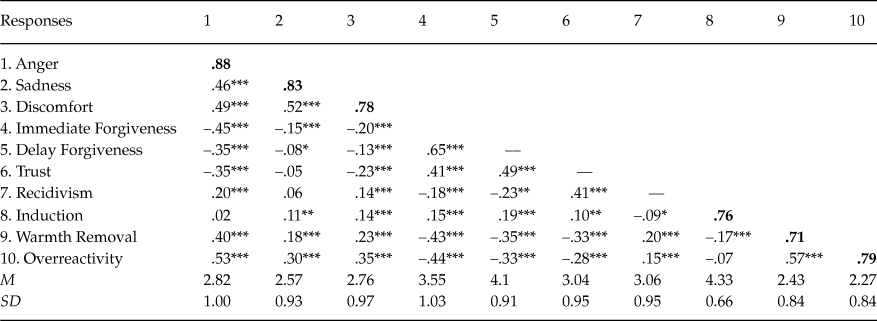
Table 1 shows all the Pearson correlations among our dependent variables. Positive linear correlations were found among the anticipated negative emotions (anger, discomfort, and sadness). All of these emotions were also positively related to the anticipation of overreacting and warmth removal towards the child immediately after the event. Anger and discomfort, but not sadness, were also related to estimates of future encounters with the child, including to lower levels of trust and higher estimates of misbehavior recidivism. In contrast, both sadness and discomfort were positively correlated to the use of inductive behavior, but the values were very low, rs < .14. Regarding the intercorrelations among the disciplinary practices, we found that high warmth removal was associated to high overreactivity and low use of inductive behaviors. High overreactivity and high warmth removal were also related to high estimates of the child’s recidivism, and with low levels of trust. In contrast, the anticipation of using inductive practices was negatively related to recidivism and positively with trust.
Person Correlations, Cronbach’s α, Means, and Standard Deviations of the Main Variables

Note: N between 838 (for discomfort) and 842 (for forgiveness, warmth removal, and overreactivity). Bold along the diagonal indicates reliability of the measures.
* p < .05. **p < .01. ***p < .001. All p values are two-tailed.
Finally, higher estimates of willingness to forgive the child (immediately and delayed) were related to reports of low levels of negative emotions (discomfort, sadness, and anger), to lower use of overreactivity and of warmth removal, to high inductive behavior, to lower estimates of recidivism, and to higher trust. Although these two estimates of forgiveness were statistically correlated with all the dependent variables, we will analyze them separately, since participants were asked to estimate their likelihood of forgiving the child at two different phases (immediately and after a week). Thus, we compared the correlations between these two forgiveness measures with the dependent variables that were either more focused on immediate responses (i.e., on emotions and disciplinary actions) or on prospective anticipations about potentially future encounters with the child (i.e., estimates of future recidivism and trust). These comparisons were made by computing the Fisher z transformations, taking into account the values of the correlations from the same sample, as suggested by Eid, Gollwitzer, and Schmitt (Reference Eid, Gollwitzer and Schmitt2011). We found that the negative correlations between immediate forgiveness and the participant’s emotions were statistically higher than the negative correlations between delayed forgiveness and these same negative emotions (all z > 2.47, ps <. 01). In a similar vein, the negative correlations between immediate forgiveness and overreactivity and warmth removal were statistically higher than the associations between delayed forgiveness and these two disciplinary acts (both z > 3.01, ps <.01). In contrast, estimates of recidivism and trust in future events were more strongly correlated with delayed forgiveness than with immediate forgiveness (both z > 1.81, ps < .05). The exception was the comparison between the positive correlations between both estimates of forgiveness and inductive practices, since they were not statistically significant (z = 1.64, p = .10).
Hypotheses Testing
The dependent variables were analyzed using a 2 (Child Sex) × 4 (Child Emotion) × 2 (Child Crying) × 2 (Participant Sex) between-subjects design. To test the effects of these four independent variables on the outcomes, Multivariate Analysis of Variance (MANOVAs) or single Analysis of Variance (ANOVAs) were conducted, depending on whether the measurements were conceptually related and statistically intercorrelated.
For the three anticipated emotions, the MANOVA yielded a significant multivariate main effect for participant sex, F(3, 804) = 4.81, p =.003,  ${\rm{\eta }}_p^2$ =.018. Subsequent univariate tests suggested that across emotions, sex differences were only found for discomfort, F(1, 806) = 7.56, p = .006,
 ${\rm{\eta }}_p^2$ = .009, 95% CI [0.05, 0.32], indicating that women (M = 2.84; SE = 0.05) anticipated more discomfort than men (M = 2.66; SE = 0.05). The interaction between the child’s sex and crying also yielded a significant multivariate result, F(3, 808) = 3.66, p = .012,
 ${\rm{\eta }}_p^2$ = .013. Separate analyses for the simple effects of crying as a function of the child’s sex resulted in significant differences when the child was a boy for both anger, F(1, 806) = 10.91, p = .001,
 ${\rm{\eta }}_p^2$ = .013, 95% CI [0.13, 0.51], and discomfort, F(1, 806) = 8.09, p = .005,
 ${\rm{\eta }}_p^2$ = .010, 95% CI [0.08, 0.46], but statistical differences were not found when the child was a girl, ps > .05. Participants in the boy-crying conditions anticipated less anger (M = 2.68; SE = 0.07 vs. M = 3.00; SE= 0.07) and less discomfort (M = 2.61; SE= 0.07 vs. M = 2.81; SE= 0.07) than those in the non-crying conditions.
The responses to both estimates of forgiveness (immediately and delayed) were analyzed by running two separate ANOVAs. This choice was also related to the fact that participants responded differently to both estimates, being more willing to forgive the child a week later (M = 4.10; SD = 0.91) than immediately (M = 3.55; SD = 1.03), t (841) = 19.47, p < .001. The ANOVAs yielded different results for the effects of crying. For immediate forgiveness there was only the main effect of the participant’s sex, F(1, 810) = 6.41, p = .012,  ${\rm{\eta }}_p^2$ = .008, 95% CI [0.04, 0.32], indicating that women (M = 3.64; SE = 0.05) reported higher intentions to forgive the child than men (M = 3.46; SE = 0.05). However, for delayed forgiveness, besides the participant’s sex main effect, F(1, 810) = 10.49, p = .001,
 ${\rm{\eta }}_p^2$ = .013, 95% CI [0.08, 0.33], with women reporting more willingness to forgive the child a week later than men (M women = 4.20, SE women = 0.04 vs. M men = 3.99, SE men = 0.05), there was also an effect of crying, F(1, 810) = 4.25, p = .040,
 ${\rm{\eta }}_p^2$ = .005, 95% CI [0.01, 0.25], i.e. participants in the crying condition reported more willingness to forgive (M = 4.16; SE = 0.04) than participants in the non-crying condition (M = 4.03; SE = 0.05). Additional planned contrasts comparing the conditions in which crying and emotions were present with the non-crying conditions have not supported the hypothesis that adding emotions to crying would augment the participant’s forgiveness.
For trust, the ANOVA yielded main effects for crying, F(1, 809) = 4.98, p = .026,  ${\rm{\eta }}_p^2$ = .006, 95% CI [0.02, 0.28], and for the child’s sex, F(1, 809) = 4.35, p = .037,
 ${\rm{\eta }}_p^2$ = .01, 95% CI [0.01, 0.27]. Participants in the crying condition reported significantly stronger levels of trust (M = 3.11; SE = 0.05) than did participants in the non-crying condition (M = 2.97; SE = 0.05). Participants also reported higher trust when the child was a girl (M = 3.11; SE = 0.05) than a boy (M = 2.97; SE = 0.05). Additionally, there was a significant three-way interaction between crying, emotion and the participant’s sex, F(3, 809) = 3.07, p = .027,
 ${\rm{\eta }}_p^2$ = .011. Although both sexes generally expected to trust the child more in the crying conditions than in the non-crying conditions, women reported a higher trust than men (M = 3.01; SE = 0.13 vs. M = 2.69; SE = 0.14), specifically in the condition where the child expressed shame but had not cried, F(1, 809) = 4.55, p = .033,
 ${\rm{\eta }}_p^2$ = .01, 95% CI [0.03, 0.796]. Planned contrast comparing crying associated with emotions conditions versus the non-crying conditions also yielded a statistically significant effect, t(825) = 2.02, p = .043, d = 0.14, indicating that crying associated with negative emotional expressions increased the participant’s intention to forgive the child.
The ANOVA on estimates of recidivism yielded only a significant effect of crying, F(1, 808) = 5.75, p = .017,  ${\rm{\eta }}_p^2$ = .007, 95% CI [0.03, 0.29]. Participants in the crying conditions reported a lower likelihood of the child committing a similar act in the future than participants in the non-crying conditions (M = 2.99; SE = 0.05 vs. M = 3.15; SE = 0.05).
For disciplinary behaviors, participants reported that they would be most likely to use inductive behaviors (M = 4.33; SD = 0.66), followed by warmth removal (M = 2.43; SD = .83), and overreactivity (M = 2.27; SD = 0.63). To test the effects of the independent variables on the three anticipated behavioral responses, a MANOVA was used. Results only yielded a main effect of the participant’s sex, F(3, 807) = 13.27, p < .001,  ${\rm{\eta }}_p^2$ = .047. Follow-up analyses indicated significant results consistent with the hypotheses, by showing that men, compared to women, reported a greater likelihood to overreact (M men = 2.35; SE men = 0.03 vs. M women = 2.19; SE women = 0.03), F(1, 809) = 12.42, p < .001,
 ${\rm{\eta }}_p^2$ = .016, 95% CI [0.07, 0.24], and removing warmth (M men = 2.53; SE men = 0.04 vs. M women = 2.33; SE women = 0.04), F(1, 809) = 12.37, p < .001,
 ${\rm{\eta }}_p^2$ = .015, 95% CI [0.09, 0.31]; and a lesser likelihood to using inductive behaviors (M women = 4.44; SE women = 0.04 vs. M men = 4.21; SE men = 0.03), F(1, 809) = 27.28, p < .001,
 ${\rm{\eta }}_p^2$ = .033, 95% CI [0.15, 0.32].
Discussion
Emotions and crying are relevant cues for interpersonal relations. They tend to influence person perception, emotion recognition, and evoke in respondents a range of emotional and behavioral responses. This study examined whether the emotions and crying behavior from a child, displayed after committing a moral transgression, would influence adults’ emotions, willingness to forgive and to trust the child, estimation of recidivism of the child’s misbehavior, and disciplinary practices. Sex differences were analyzed by also manipulating the child’s sex and by taking into account the participant’s sex.
We found that participants estimated a lower likelihood of the child committing a similar act in the future. They also reported higher intentions to forgive the child a week after the event in the conditions where the child cried than in the non-crying conditions. In addition, participants expressed higher intentions to trust a crying child that expressed a powerless emotion, than a non-crying child. All these three dependent variables relate to prospective anticipations about potentially future encounters with the child, but do not refer to the responses that participants would give immediately after the event. Interestingly, the willingness to immediately forgive the child and the anticipated disciplinary actions that participants would use after the event were not affected by crying or by the emotional cues. These results indicate that the specific cues related to the child’s crying are more likely to bias estimates of future events than immediate forgiveness and disciplinary acts following a moral transgression committed by a child. In contrast, participant gender was related to estimates of the participant’s immediate responses, such as emotions, disciplinary actions, and forgiveness. Thus, our findings suggest that participants relied on different aspects of the available information to make estimates about their responses. On one hand, for immediate responses to the event, participants seemed to rely more on judgments about the morality of the child’s misconduct, which were influenced by gender-related values and disciplinary practices. More specifically, women reported higher use of inductive behaviors, being less prone to overreact and less likely to remove warmth from the child-offender than men. These responses are consistent with previous studies indicating women’s tendency to report stronger affiliative responses towards children (Probst et al., Reference Probst, Meng-Hentschel, Golle, Stucki, Akyildiz-Kunz and Lobmaier2017; Royle et al., Reference Royle, Smiseth and Kölliker2012), and to evaluate more favorably inductive behaviors, and less favorably power assertion and warmth removal than males (Barnett et al., Reference Barnett, Quackenbush and Sinisi1996). In addition, women anticipated feeling more discomfort with the hypothetical situation than men did, and reported higher intentions to forgive the child, both immediately and a week apart from the event. On the other hand, in response to future events, participants seemed to also rely on information about how the child reacted after being caught committing the wrongdoing, and more particularly rely on the crying cue that the child expressed. The act of crying provoked high trust and high forgiveness from participants as well as increased the participants’ anticipation of lower likelihood of recidivism; probably because crying may have been perceived as a sign of regret. These results are consistent with theoretical and functional approaches about the communicative functions of crying; specifically, that crying behavior may express regret and also vulnerability (Hendriks, Croon, & Vingerhoets, Reference Hendriks, Croon and Vingerhoets2008; Hendriks & Vingerhoets, Reference Hendriks and Vingerhoets2006; Jellesma & Vingerhoets, Reference Jellesma and Vingerhoets2012).
Despite the role of participants’ gender on disciplinary acts, participants generally reported more willingness to use inductive behaviors than warmth removal and overreactivity, which suggests a general concern to adopt positive practices towards the child-offender. Literature has shown that induction practices are perceived as more acceptable than power assertion and withdrawal responses (Barnett et al., Reference Barnett, Quackenbush and Sinisi1996), and to have a positive impact on children’s moral development (Hoffman, Reference Hoffman2000). Consistent with this perspective, we also found that the anticipation of using inductive practices was associated with higher willingness to forgive and to trust the child, whereas overreactivity, warmth removal, and estimates of recidivism had the opposite association.
In contrast to our initial predictions, the potentiated effect of child’s emotions associated with crying was not observed for participant’s willingness to forgive the child, estimation of recidivism of the child’s misbehavior, and disciplinary practices. Moreover, the hypotheses predicting an effect of the child’s emotions, regardless of crying behavior, were not confirmed in any of the outcomes. The absence of effects of the child’s emotions may be related to the powerless and affiliate characteristics of the emotions that were manipulated. Future research should investigate whether a different pattern of results would occur if the child expresses dominant emotions instead. Thus, crying seemed to play a more central role in communicating how the child was feeling, and whether the child would be less likely to commit similar transgressions in the future, than knowing that the child expressed a specific emotion such as fear, sadness or shame. This stronger reliance on crying than on emotions is consistent with Hendriks and Vingerhoets (Reference Hendriks and Vingerhoets2006) findings, in which they reported a stronger impact of crying faces compared to emotional expressions on person perception, emotional contagion, and emotional support. Also relevant in our study, and in comparison to naming the type of emotion that the child had felt, the accuracy levels in recalling crying behavior were very high. This difficulty of participants in reporting the child’s emotion might explain the findings that none of the emotions presented an advantage in reports of forgiveness, recidivism, and disciplinary actions. For estimates of trust there was however, a significant three-way interaction between participant’s sex, crying, and emotion. Specifically, the interaction indicated that women estimated higher levels of trust than men, but only in the shame condition in which the child was not crying. This result indicates that what might have induced more trust in women was the expression of the child’s shame, which is often interpreted as signaling self-disappointment and regret (Eisenberg, Reference Eisenberg2000), and potentially function more as an appeasement strategy than fear or sad expressions. However, additional research seems warranted because of the low retrieval rates for shame and the lack of studies testing the role of this emotion expressed by an offender-child.
The hypotheses that predicted higher anticipation of using inductive behaviors towards girls and using overreactivity practices towards boys were not supported. However, we found significant effects of the child’s sex on participant’s trust, indicating higher levels of trust for girls than for boys. This result is in line with research findings indicating that boys tend to be perceived as more problematic than girls (Kokkinos, Panayiotou, & Davazoglou, Reference Kokkinos, Panayiotou and Davazoglou2005). Therefore, it is possible that participants expressed more willingness to trust an offender girl than a boy due to these different gender expectations.
Participants also anticipated less anger and less discomfort when the child was a crying boy than a non-crying boy; whereas crying did not seem to affect participants’ emotions when the child was a girl. Thus, it seems that crying influenced the participants’ feelings towards boys, but not towards girls. Given that crying tends to be perceived as a cue of powerlessness, which is less typically expressed in men/boys than women/girls (Bekker & Vingerhoets, Reference Bekker, Vingerhoets, Vingerhoets and Cornelius2001), its manifestation in boys might have contributed to the lower discomfort and lower anticipation of anger with the situation; whereas in girls, crying might have been perceived as more common, thereby not influencing participants’ emotional responses.
Several limitations of this study also need to be discussed. First, only one vignette was used. Thus, the inferences from this study can only be applied to situations similar to the present hypothetical scenario. However, the use of a single scenario allowed the control of several child characteristics such as the child’s sex and their expressions. Factors, such as the familiarity with the child and the moral rule violation were kept constant, since these factors may affect the interpretation of a moral transgression and subsequent responses (Dys & Malti, Reference Dys and Malti2016). We also kept constant the age of the child by providing information in the vignette that the child was 10 years of age. Although most participants correctly recalled the child’s age, other participants have reported different ages, which varied between 2 (early childhood) and 15 years old (adolescence). These distinct interpretations of the child’s age might have affected the participants’ perception of the moral transgression of the child, as it is possible, for example, that older children might be perceived as being more accountable for their actions than younger children.
Future research also needs to take into account the judgments that adults make about the child’s act of crying and the emotions expressed. Judgments related to the child’s sincerity, perceived manipulative intentions, or even the level of child’s regret might hold relevant roles in accounting for the adult’s responses, including in explaining why children’s crying was more effective in predicting the lower estimates of recidivism, trust, and delayed forgiveness. Zeifman and Brown (Reference Zeifman and Brown2011) have found, for example, that the level of sincerity of tears expressed in children’s faces was lower than those perceived in adults, suggesting that children may also use crying and negative emotions as manipulative strategies to achieve their desired goals.
Furthermore, the scenario has not provided any information regarding the respondent’s proximity with the child. Responses might have been different if the respondent was an acquainted or a family member of the child. Due to in-group favoritism (Tajfel, Reference Tajfel1982) and to the “black sheep effect” (Marques, Yzerbyt, & Leyens Reference Marques, Yzerbyt and Leyens1988), both well documented, individuals tend to make more extreme judgments about in-group members (both likeable and unlikeable judgments) then about out-group members, and also tend to react more negatively towards deviant in-group than out-group members. Thus, different results are expected to occur based on the proximity of the participant with the child. Future studies should investigate whether these effects apply to situations similar to the one investigated in the present study. More precisely, would adults express more extreme responses towards an acquainted child who committed a moral transgression (e.g., high negative emotions, low forgiveness immediately after the event but probably high delayed forgiveness, and more use of both positive and negative disciplinary practices) then towards an unfamiliar child?
The type of disciplinary practices the respondent received during childhood and adolescence may also be relevant, since these practices seem to be transmitted across generations (Simons, Beaman, Conger, & Chao, Reference Simons, Beaman, Conger and Chao1992). Thus, also relevant would be to consider the participants’ own history of committing similar transgressions as a child, since it may affect the perceived severity of the transgression and subsequent responses (Leenders & Brugman, Reference Leenders and Brugman2005).
Because of the low rates in recalling the child’s type of emotions, it is also not clear if respondents were less conscious of the manipulation, or simply less able to designate them. The use of multiple-choice options in which the respondents would select the type of emotion they remembered might increase the recall accuracy rates. However, the open format has given high levels of recall accuracy for crying suggesting that the selected emotions were less relevant than crying to influence adult’s responses. In future studies it would be interesting to investigate whether expressions of these powerless emotions lead to different responses in comparison to expressions of powerful emotions (e.g., anger; schadenfreude). The use of photographs or videos of crying children and their facial expressions could also be an indirect way to further address our questions.
Another limitation concerns our focus on the evaluation of the participant’s reporting of negative emotions. Future studies should also consider the role of positive emotions (e.g., pity, compassion, sympathy, mercy, benevolence) to understand how participants respond to a moral transgression committed by a child, as they can be also triggered by powerless emotions and by the crying cue of the offender. These positive emotions are relevant in many interpersonal relations, and recently addressed in studies on forgiveness and reconciliation (e.g., Zhang, Ting-Toomey, Oetzel, & Zhang, Reference Zhang, Ting-Toomey, Oetzel and Zhang2015). In addition, many of our dependent measures might have also been overestimated due to social desirability, although as suggested by the theory of planned behavior (Ajzen, & Fishbein, Reference Ajzen and Fishbein1980), subjective reports indicative of participants’ attitudes and social norms can be important predictors of actual behavior. Nevertheless, as a complement to the self-reported data it could be relevant to include objective measures of emotions and behavioral tendencies. For example, participants’ facial expressions could be recorded as a complement to assess the intensity and the valence of the emotions experienced. Facial cues are relevant in social interactions and tend to be related to behavioral tendencies (e.g., approach, avoidance). Other responses less susceptible to social demands could also include the assessment of physiological responses, such as skin conductance to understand the intensity of emotions, while the use of facial electromyography could be important to capture the activation of particular facial muscles that are related to specific emotions (Cacioppo, Tassinary, & Berntson, Reference Cacioppo, Tassinary and Berntson2007).
Another limitation of our study includes the use of a convenient and homogeneous sample of respondents (within a specific age range, the majority enrolled in higher education, being single) which limits the generalization of the results. Although several adaptive functions of emotions and crying have already been discussed (e.g., Vingerhoets & Scheirs, Reference Vingerhoets, Scheirs and Fisher2000), it remains unclear what their role is in different contexts (e.g., school), with different samples (e.g., professors, family members, peers), and in distinct age groups (e.g., infants, adolescents, elderly). To increase the generalizability of the findings, additional studies will be required taking into account these distinct personal backgrounds and contexts.
Overall, our results offer some support for theories that consider crying a communicative signal with adaptive functions for children, by suggesting that crying may mobilize adults’ appeasement responses in future interpersonal events with an offender-child. More specifically, crying reduces adults’ estimates of a child repeating the moral transgression behavior and increases their trust and willingness to forgive the child. In addition, the study corroborated previous findings on gender differences in disciplinary practices. Previous studies have reported how parental disciplinary practices can affect children’s psychosocial development (e.g., Goldberg, Kashy, & Smith, Reference Goldberg, Kashy and Smith2012). Our results extend these prior studies, showing that findings on parental disciplinary practices also apply to other potential educational agents. Overall, this study contributed to a better understanding of the implications of crying on a child-adult relation after a child’s moral transgression, and sheds light on the importance of gender dynamics (child-transgressors and adult-targets) in the forgiveness process.