INTRODUCTION
Biological invasion, i.e. the process of human-mediated geographic range expansion of a species (Williamson, Reference Williamson1996; Lockwood et al., Reference Lockwood, Hoopes and Marchetti2013), is considered a major threat to marine biodiversity and ecosystem functioning, and a cause for serious economic and social damage (Molnar et al., Reference Molnar, Gamboa, Revenga and Spalding2008; Costello et al., Reference Costello, Coll, Danovaro, Halpin, Ojaveer and Miloslavich2010). The phenomenon of biological invasion is especially pronounced in the Mediterranean, where, in a total of approximately 17,000 marine species (Coll et al., Reference Coll, Piroddi, Steenbeek, Kaschner, Ben Rais Lasram, Aguzzi, Ballesteros, Bianchi, Corbera, Dailianis, Danovaro, Estrada, Froglia, Galil, Gasol, Gertwagen, Gil, Guilhaumon, Kesner-Reyes, Kitsos, Koukouras, Lampadariou, Laxamana, López-Fé de la Cuadra, Lotze, Martin, Mouillot, Oro, Raicevich, Rius-Barile, Saiz-Salinas, San Vicente, Somot, Templado, Turon, Vafidis, Villanueva and Voultsiadou2010), there are currently 986 alien species, 134 of which are invasive (Zenetos et al., Reference Zenetos, Gofas, Morri, Rosso, Violanti, Raso, Çinar, Almogi-Labin, Ates and Azzurro2012). Accordingly, biological invasion is considered of particular importance to current EU policies relevant to biodiversity and the marine environment, and this is exemplified in documents such as the Marine Strategy Framework Directive (MSFD) (EU, 2008a), the European Commission's Communications on ‘A European Strategy for Marine and Maritime Research’ (EU, 2008b) and ‘The EU Biodiversity Strategy to 2020' (EU, 2011). Additionally, invasive alien species have been the focus of the recent European Commission Proposal for a Regulation ‘On the Prevention and Management of the Introduction and Spread of Invasive Alien Species’ (EU, 2013).
The major pathways of introduction (Hulme et al., Reference Hulme, Bacher, Kenis, Klotz, Kühn, Minchin, Nentwig, Olenin, Panov, Pergl, Pyšek, Roques, Sol, Solarz and Vilà2008) of alien species to the Mediterranean are the active dispersal of species occurring in the Red Sea via the human-made ‘corridor’ of the Suez Canal (‘Lessepsian migration’), and their unintentional transportation by shipping activities, i.e. via hull biofouling and ballast waters (Zenetos et al., Reference Zenetos, Gofas, Morri, Rosso, Violanti, Raso, Çinar, Almogi-Labin, Ates and Azzurro2012; Nunes et al., Reference Nunes, Katsanevakis, Zenetos and Cardoso2014). Lessepsian migration (Por, Reference Por1971) has been taking place in the Mediterranean incessantly since the opening of the Suez Canal in 1869 and has accelerated in recent years (Raitsos et al., Reference Raitsos, Beaugrand, Georgopoulos, Zenetos, Pancucci-Papadopoulou, Theocharis and Papathanassiou2010). The eastern Mediterranean currently hosts a total of 775 alien species, mainly of Indo-Pacific origin (Zenetos et al., Reference Zenetos, Gofas, Morri, Rosso, Violanti, Raso, Çinar, Almogi-Labin, Ates and Azzurro2012). Many of these species have entered the Aegean Sea, with the Dodecanese islands being the main entrance point (Pancucci-Papadopoulou et al., Reference Pancucci-Papadopoulou, Raitsos and Corsini-Foka2012). The European Alien Species Information Network database (EASIN) presently contains records for 201 alien marine species in the Aegean Sea (Katsanevakis et al., Reference Katsanevakis, Bogucarskis, Gatto, Vandekerkhove, Deriu and Cardoso2012; EASIN, 2014), while the corresponding records in the Marine Mediterranean Invasive Alien Species Database (MAMIAS) online database are 289 (MAMIAS, 2014). Most of the alien species in the Aegean Sea are benthic invertebrates, followed by fish and macroalgae, mainly of Indo-Pacific origin (Zenetos et al., Reference Zenetos, Katsanevakis, Poursanidis, Crocetta, Damalas, Apostolopoulos, Gravili, Vardala-Theodorou and Malaquias2011). The presence of the thermophilic Lessepsian migrants is very important in the south Aegean Sea (Zenetos et al., Reference Zenetos, Pancucci-Papadopoulou, Zogaris, Papastergiadou, Vardakas, Aligizaki and Economou2009b), which is filled with warm, highly saline water from the Levantine basin (Theocharis et al., Reference Theocharis, Balopoulos, Kioroglou, Kontoyiannis and Iona1999). However, it is often held (e.g. Pancucci-Papadopoulou et al., Reference Pancucci-Papadopoulou, Zenetos, Corsini-Foka and Politou2005; Zenetos et al., Reference Zenetos, Çinar, Pancucci-Papadopoulou, Harmelin, Furnari, Andaloro, Bellou, Streftaris and Zibrowius2005a; Katsanevakis et al., Reference Katsanevakis, Zenetos, Poursanidis, Nunes, Deriu, Bogucarskis and Cardoso2013) that the occurrence of Lessepsian migrants is generally negligible in the north Aegean Sea, where the waters are colder (Zervakis & Georgopoulos, Reference Zervakis and Georgopoulos2002), a few recently published exceptions notwithstanding (e.g. Karachle et al., Reference Karachle, Triantaphyllidis and Stergiou2004; Zenetos et al., Reference Zenetos, Koutsoubas and Vardala-Theodorou2005b; Manousis et al., Reference Manousis, Mpardakis, Paraskevopoulos and Galinou-Mitsoudi2010; Yaglioglu et al., Reference Yaglioglu, Turan, Erguden and Gurlek2011; Çinar and Dagli, Reference Çinar and Dagli2012; Manousis & Galinou-Mitsoudi, Reference Manousis and Galinou-Mitsoudi2014). On the other hand, the alien species whose pathway of introduction is shipping activities have invaded locations throughout the Aegean Sea, with major gulfs with dense marine traffic (e.g. Saronikos, Thermaikos) being hotspots for these species (Katsanevakis et al., Reference Katsanevakis, Zenetos, Poursanidis, Nunes, Deriu, Bogucarskis and Cardoso2013).
The abundance and state characterization of non-indigenous species, especially the invasive ones, will be used as criteria for determining the environmental status relevant to the ‘non-indigenous species’ descriptor of Annex I to the MSFD (EU, 2010). Given the fact that new alien species are introduced every year in the Mediterranean and the Aegean Sea, and that the distribution of many of the introduced species is expanding, continuous collection of data on the geographical distribution of alien species, and the pathways of their introduction, are deemed essential prior tasks for the assessment and management of biological invasions and the environmental quality of marine waters at large (Meliane & Hewitt, Reference Meliane and Hewitt2005; Zenetos et al., Reference Zenetos, Gofas, Morri, Rosso, Violanti, Raso, Çinar, Almogi-Labin, Ates and Azzurro2012; Katsanevakis et al., Reference Katsanevakis, Zenetos, Poursanidis, Nunes, Deriu, Bogucarskis and Cardoso2013).
This paper aims to contribute to our knowledge of the current patterns of distribution and pathways of introduction of alien marine species in the north-eastern Aegean Sea.
MATERIALS AND METHODS
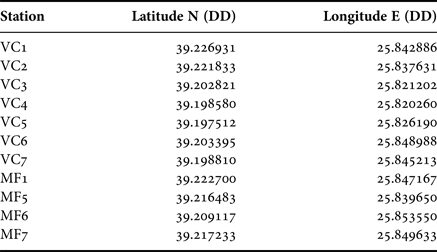
A survey of the benthic biodiversity (megafauna, macrofauna and macrophytic flora) of the upper sublittoral zone of Sigri Bay (Lesvos Island, north-eastern Aegean Sea) was conducted in 2013 (Figure 1). The marine environment in the Sigri Bay is considered to be relatively undisturbed, the most important pressure being artisanal fisheries. One of the principal aims of the survey was to check for the presence of alien marine species. The sampling of soft substrate macrofauna was carried out in June, with a Van Veen sediment grab (0.1 m2 sampling surface), at seven sampling stations (two replicate samples per sampling station). The laboratory analysis of the macrofauna was carried out according to Eleftheriou & McIntyre (Reference Eleftheriou and McIntyre2005). A visual census (Harmelin-Vivien & Harmelin, Reference Harmelin-Vivien and Harmelin1975; Harmelin et al., Reference Harmelin-Vivien, Harmelin, Chauvet, Duval, Galzin, Leieune, Barnabb, Blanc, Chevalier, Duclerc and Lassere1985) and an underwater photographic survey of the megafauna and macrophytic flora on hard substrate and in Posidonia oceanica (Linnaeus) Delile meadows was carried out by scuba diving in September, at eight sampling stations at a depth of ca. 15 m (three transects of 25 × 5 m2 per habitat and per sampling station). The geographical coordinates of all sampling stations are given in Table A1 in the appendix. Accepted species names and authorities were checked using a web service provided by the World Register of Marine Species (WoRMS) online database (WoRMS Editorial Board, 2014). Species distribution-related data (range in the Mediterranean, extent of occurrence and area of occupancy in the Aegean Sea) were assessed using the mapping web service provided by the European Alien Species Information Network (EASIN) online database (Katsanevakis et al., Reference Katsanevakis, Bogucarskis, Gatto, Vandekerkhove, Deriu and Cardoso2012; EASIN, 2014). The ranges of the species in the Mediterranean are given in terms of the marine ecoregions where the species have been recorded, according to the scheme of Spalding et al. (Reference Spalding, Fox, Allen, Davidson, Ferdaña, Finlayson, Halpern, Jorge, Lombana, Lourie, Martin, McManus, Molnar, Recchia and Robertson2007). The area of occupancy was assessed in relative terms, using the 10 × 10 km2 grid option of the EASIN mapping web service. The species impact was also retrieved from the EASIN online database (EASIN, 2014). The information given in this paper regarding the beogeographical origin of the species and whether they are established or invasive in the eastern Mediterranean follows Zenetos et al. (Reference Zenetos, Gofas, Verlaque, Çinar, Garcia Raso, Bianchi, Morri, Azzurro, Bilecenoglu and Froglia2010). We considered as ‘established’ in the study area those species that have self-maintaining populations, as evidenced by a minimum of two (three for fishes) records from different localities in the study area (sensu Zenetos et al., Reference Zenetos, Çinar, Pancucci-Papadopoulou, Harmelin, Furnari, Andaloro, Bellou, Streftaris and Zibrowius2005a; Katsanevakis & Tsiamis, Reference Katsanevakis and Tsiamis2009).
Map of the study area, showing the sampling stations. The blue dots indicate the visual census sampling stations, the orange dots indicate the macrofauna sampling stations.

RESULTS AND DISCUSSION
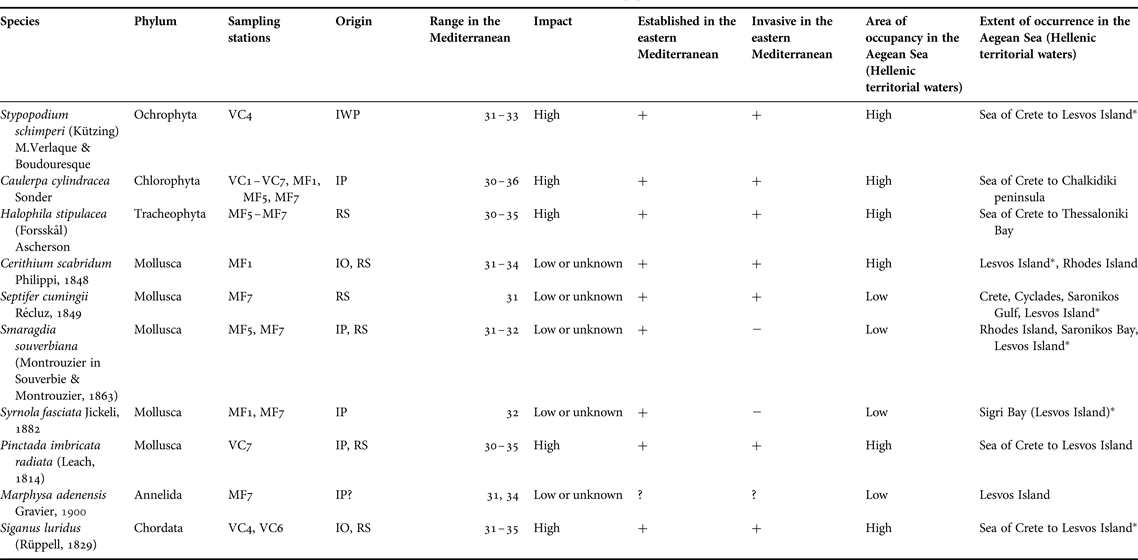
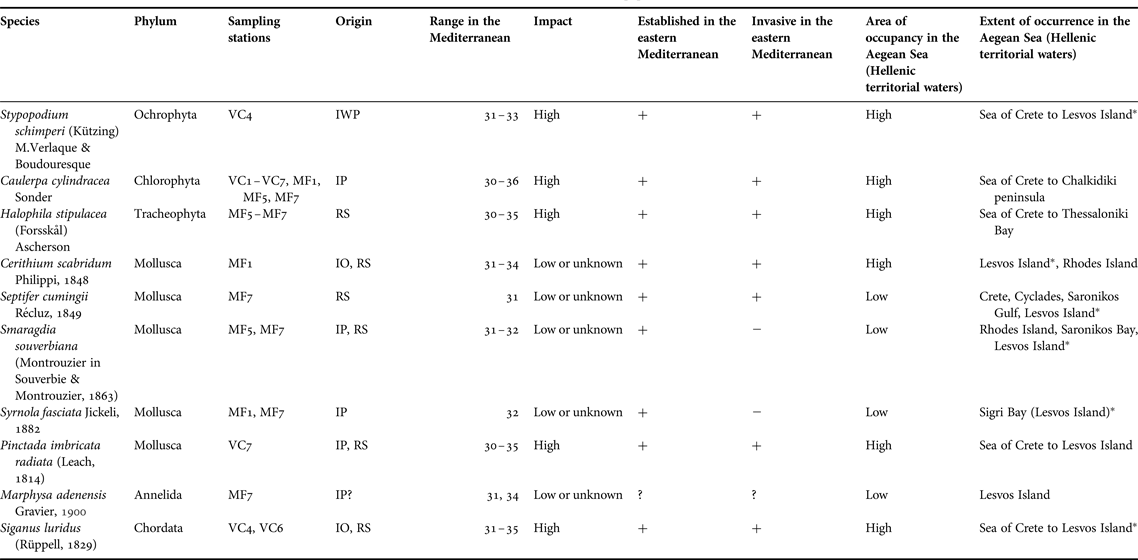
Ten alien marine species were recorded in the study area (Table 1): the gastropods Cerithium scabridum, Smaragdia souverbiana and Syrnola fasciata, the bivalves Septifer cumingii and Pinctada imbricata radiata, the polychaete worm Marphysa adenensis, the bony fish Siganus luridus, the macroalgae Caulerpa cylindracea and Stypopodium schimperi and the angiosperm Halophila stipulacea. The record of the mollusc Syrnola fasciata is the first from Hellenic territorial waters. The records of the molluscs Septifer cumingii, Syrnola fasciata and Smaragdia souverbiana, the bony fish Siganus luridus and the brown alga Stypopodium schimperi constitute evidence for a further northwards extension of their geographic ranges in the Aegean Sea. The record of Cerithium scabridum is the first in Lesvos Island and partially fills the gap in the distribution of the species in the eastern Aegean Sea. The polychaete M. adenensis, which was also found in Sigri Bay, has recently been reported for the first time from the Mediterranean as a cryptogenic species (Katsiaras et al., Reference Katsiaras, Simboura and Koutsoubas2014). All of the recorded species were rare, with the exception of Caulerpa cylindracea, which was observed on a variety of substrates across the study area.
List of the alien species recorded in the study area and their invasion ecology-related attributes. Data are compiled from the scientific literature and on-line databases (cf. Materials and Methods), except *, which is new information in this paper.
Caulerpa cylindracea
Synonym: Caulerpa racemosa var. cylindracea (Sonder) Verlaque, Huisman & Boudouresque
The green alga Caulerpa cylindracea, endemic to south-west Australia (Verlaque et al., Reference Verlaque, Durand, Huisman, Boudouresque and Le Parco2003), was introduced in the Mediterranean via the Suez Canal. It is presently one of the best-known and most important invasive alien species in the Hellenic seas and the Mediterranean in general (Streftaris & Zenetos, Reference Streftaris and Zenetos2006; Tsiamis et al., Reference Tsiamis, Montesanto, Panayotidis, Katsaros and Verlaque2010), its distribution reaching currently as far as the Canary Islands (Verlaque et al., Reference Verlaque, Afonso-Carrillo, Gil-Rodriguez, Durand, Boudouresque and Le Parco2004). The broad distribution of C. cylindracea in a wide spectrum of habitats across the Mediterranean is based on its especially effective vegetative and sexual reproduction, as well as secondary dispersal mechanisms, i.e. shipping (Klein & Verlaque, Reference Klein and Verlaque2008). In many cases, C. cylindracea has drastically changed the structure and functioning of the local ecosystems, causing a decline in macroalgal diversity and alteration in the composition of macrofauna, as well as a modification of the structure and properties of the substrate (Piazzi et al., Reference Piazzi, Meinesz, Verlaque, Akçali, Antolić, Argyrou, Balata, Ballesteros, Calvo, Cinelli, Cirik, Cossu, D'Archino, Djellouli, Javel, Lanfranco, Mifsud, Pala, Panayotidis, Peirano, Pergent, Petrocelli, Ruitton, Ž uljević and Ceccherelli2005; Klein & Verlaque, Reference Klein and Verlaque2008).
In the area of Sigri Bay, C. cylindracea was found at all of the visual census stations and at the macrofauna sampling stations MF1, MF5 and MF7, in the northern part of the bay (Figure 1). We consider it as established in the study area. The alga was observed to grow on hard and soft substrates and along the edges of the mattes of Posidonia oceanica (Figure 2A, B). It is known that C. cylindracea has the ability to grow at the edges of P. oceanica meadows and this growth is likely to have a negative impact on P. oceanica leaves in the proximity of the alga, while growth inside the seagrass meadow has been found to be dependent on the seagrass shoot density (Ceccherelli et al., Reference Ceccherelli, Piazzi and Cinelli2000; Katsanevakis et al., Reference Katsanevakis, Issaris, Poursanidis and Thessalou-Legaki2010). This species has been recorded at Lesvos Island also by Tsiamis et al. (Reference Tsiamis, Montesanto, Panayotidis, Katsaros and Verlaque2010).
Photographs of the alien species recorded in the study area: (A) Caulerpa cylindracea growing on the edge of a Posidonia oceanica matte; (B) Caulerpa cylindracea growing among photophilic algae (e.g. Padina pavonica (Linnaeus) Thivy); (C) a Stypopodium schimperi stand; (D) Septifer cumingii; (E, F) Smaragdia souverbiana; (G) Cerithium scabridum; (H) Syrnola fasciata. Scale bar: 1 mm.
Stypopodium schimperi
Stypopodium schimperi is a brown alga which was introduced in the Mediterranean via the Suez Canal and is considered as one of the tropical species that is becoming dominant in the eastern Mediterranean (Bianchi, Reference Bianchi2007). It has been recorded in both the south and the north Aegean Sea (Tsiamis et al., Reference Tsiamis, Montesanto, Panayotidis, Katsaros and Verlaque2010, Reference Tsiamis, Panayotidis, Economou-Amilli and Katsaros2013) and it grows on rocky bottoms, in shallow waters up to several meters deep (Verlaque & Boudouresque, Reference Verlaque and Boudouresque1991). It is considered among the worst invasive species in the Mediterranean because of its impact on biodiversity and ecosystem functioning (Streftaris & Zenetos, Reference Streftaris and Zenetos2006). Although its invasive behaviour is well known along the Levantine coasts, such behaviour had not been observed in Greece until extremely high abundances and dominance of this species were observed in Rhodes Island in 2009 (Tsiamis et al., Reference Tsiamis, Montesanto, Panayotidis, Katsaros and Verlaque2010). Its effectiveness as an invasive species may be attributed to its perennial life cycle, its possession of defence metabolites and its avoidance by grazers (Boudouresque & Verlaque, Reference Boudouresque and Verlaque2002).
In the area of Sigri Bay, S. schimperi patches were observed on rocky substrate at the visual census station VC4, at the south of Kavalouros islet (Figures 1 & 2C). We do not have enough data to assess its establishment status in the study area. To our knowledge, this is presently the northernmost published record of this species in the Aegean Sea, the immediately preceding one having been at Chios Island (Katsanevakis & Tsiamis, Reference Katsanevakis and Tsiamis2009).
Halophila stipulacea
The marine angiosperm Halophila stipulacea is a Lessepsian migrant that is established and invasive in the eastern Mediterranean (Zenetos et al., Reference Zenetos, Gofas, Verlaque, Çinar, Garcia Raso, Bianchi, Morri, Azzurro, Bilecenoglu and Froglia2010) and in the Hellenic seas, although it is absent from the far north Aegean Sea, probably because of the lower seawater temperature therein (Tsiamis et al., Reference Tsiamis, Montesanto, Panayotidis, Katsaros and Verlaque2010). It is found on sandy bottoms at various depths, usually along with the native seagrass Cymodocea nodosa (Ucria) Ascherson and, occasionally, it can be abundant (Tsiamis et al., Reference Tsiamis, Panayotidis, Economou-Amilli and Katsaros2013). It is considered to be harmful to biodiversity (Streftaris & Zenetos, Reference Streftaris and Zenetos2006) because there are indications of invasive behaviour on sandy bottoms due to its high abundance. However, no displacement of native species due to H. stipulacea has been reported in the Mediterranean Sea yet (Tsiamis et al., Reference Tsiamis, Panayotidis, Economou-Amilli and Katsaros2013).
In the area of Sigri Bay, H. stipulacea was found on soft substrate, at the macrofauna sampling stations MF5, MF6 and MF7, in the northern part of the bay (Figure 1). We consider it as established in the study area. The northernmost published records in the Aegean Sea have been at the Pagasitikos Gulf and Sporades Islands (Tsiamis et al., Reference Tsiamis, Montesanto, Panayotidis, Katsaros and Verlaque2010). To our knowledge, this is presently the northernmost published record of this species in the eastern Aegean Sea, the immediately preceding ones having been at Dikili, on the Turkish coast of the Aegean Sea (Akçli & Cirik, Reference Akçali and Cirik2007) and at Chios Island (Katsanevakis & Tsiamis, Reference Katsanevakis and Tsiamis2009).
Septifer cumingii
Synonym: Septifer forskali Dunker, 1855
The bivalve Septifer cumingii was introduced in the Mediterranean via the Suez Canal and is currently established and invasive in the eastern Mediterranean (Zenetos et al., Reference Zenetos, Gofas, Morri, Rosso, Violanti, Raso, Çinar, Almogi-Labin, Ates and Azzurro2012). A suspension feeder, epifaunal and actively mobile, it attaches with byssus on hard substrata in shallow waters (Zenetos et al., 2003). A rare species, it was found on the Levantine coast of Turkey (Bakir et al., Reference Bakir, Öztürk, Doğan and Önen2012) and only recently in the southern Aegean (Zenetos et al., Reference Zenetos, Katsanevakis, Poursanidis, Crocetta, Damalas, Apostolopoulos, Gravili, Vardala-Theodorou and Malaquias2011) and Saronikos Bay (Zenetos et al., Reference Zenetos, Koutsogiannopoulos, Ovalis and Poursanidis2013).
In the area of Sigri Bay, S. cumingii was found in soft substrate samples at the macrofauna sampling station MF7 (one specimen), in the northern part of the bay (Figures 1 & 2D). We do not have enough data to assess its establishment status in the study area. To our knowledge, this is presently the northernmost published record of this species in the Aegean Sea, the immediately preceding ones having been at the island of Astypalaia in the Dodecanese (Zenetos et al., Reference Zenetos, Katsanevakis, Poursanidis, Crocetta, Damalas, Apostolopoulos, Gravili, Vardala-Theodorou and Malaquias2011) and Saronikos Bay (Zenetos et al., Reference Zenetos, Koutsogiannopoulos, Ovalis and Poursanidis2013).
Smaragdia souverbiana
Smaragdia souverbiana is a gastropod species that is widely distributed in the Indo-West Pacific (Dekker, Reference Dekker2000). Its first published record in the Mediterranean was from the Levantine coast of Turkey (Buzzurro & Greppi, Reference Buzzurro and Greppi1994), although a single shell of Smaragdia souverbiana was found in the intestine of the Erythrean alien fish Callionymus filamentosus Valenciennes, 1837, which had been caught in Haifa Bay in 1987 (Rothman & Mienis, Reference Rothman and Mienis2011). Smaragdia souverbiana is a seagrass-associated gastropod species (Dekker, Reference Dekker2000; Rossini et al., Reference Rossini, Rueda and Tibbetts2014) that was found to directly consume tissues of the seagrass species Halophila ovalis (R. Brown) J.D. Hooker, Zostera capricorni Ascherson and Cymodocea serrulata (R. Brown) Ascherson & Magnus in eastern Australia (Rossini et al., Reference Rossini, Rueda and Tibbetts2014). Another neritid species that is also directly feeding on seagrasses is Smaragdia viridis (Linnaeus, 1758), the only native marine species of the family Neritidae from European coasts (Rueda & Salas, Reference Rueda and Salas2007). Smaragdia viridis was found to feed on Zostera marina Linnaeus and Cymodocea nodosa (Ucria) Ascherson in the western Mediterranean (Rueda & Salas, Reference Rueda and Salas2007). Smaragdia viridis is the only known native species of marine gastropods that has been shown to belong to the trophic group of seagrass-consuming animals in the Mediterranean (Rueda & Salas, Reference Rueda and Salas2007). However, it remains to be demonstrated whether the alien in the Mediterranean Smaragdia souverbiana is also directly feeding on seagrasses.
In the area of Sigri Bay, Smaragdia souverbiana was found in soft substrate samples, at the macrofauna sampling stations MF5 (two specimens) and MF7 (one specimen), in the northern part of the bay (Figures 1 & 2E, F). We consider it as established in the study area. To our knowledge, this is presently the northernmost published record of this species in the Aegean Sea, the immediately preceding ones having been at Rhodes Island (Buzzurro & Greppi, Reference Buzzurro and Greppi1994) and in the Korinthiakos Gulf (Zenetos et al., Reference Zenetos, Koutsogiannopoulos, Ovalis and Poursanidis2013). We also recorded Smaragdia viridis in the area of Sigri Bay, in soft substrate samples, at the macrofauna sampling stations MF1 (18 specimens), MF2 (2), MF5 (2) and MF7 (6).
Cerithium scabridum
The gastropod Cerithium scabridum is a Lessepsian migrant that is considered established and invasive in the eastern Mediterranean (Zenetos et al., Reference Zenetos, Gofas, Verlaque, Çinar, Garcia Raso, Bianchi, Morri, Azzurro, Bilecenoglu and Froglia2010). It is found in shallow waters, on a variety of substrates that include sandy mud, with Cymodocea nodosa or Zostera noltei Hornemann (Zenetos et al., Reference Zenetos, Gofas, Russo and Templado2004). Its considerable success as an invasive species may be attributed to its ability for long-distance dispersal via a long-lived pelagic larval stage, high fecundity and a wide ecological niche (Lavie & Nevo, Reference Lavie and Nevo1986).
In the area of Sigri Bay, Cerithium scabridum was found in soft substrate samples at the macrofauna sampling station MF1 (three specimens), in the northern part of the bay (Figures 1 & 2G). We do not have enough data to assess its establishment status in the study area. Its known distribution in the Aegean Sea consists of Imvros (Albayrak, Reference Albayrak2001) and Rhodes (Zenetos et al., Reference Zenetos, Ovalis and Kalogirou2009a) islands. This new record in Lesvos Island, at an intermediate latitude along the eastern Aegean, further closes the gap in its distribution in the eastern Mediterranean Sea.
Syrnola fasciata
Syrnola fasciata is a marine gastropod species of the family Pyramidellidae. It is of Indo-Pacific origin, it was introduced in the Mediterranean via the Suez Canal and is currently established in the eastern Mediterranean (Zenetos et al., Reference Zenetos, Gofas, Verlaque, Çinar, Garcia Raso, Bianchi, Morri, Azzurro, Bilecenoglu and Froglia2010). Syrnola fasciata was recorded for the first time in the Mediterranean off the Israeli coast in 1958 (Van Aartsen et al., Reference van Aartsen, Barash and Carrozza1989), and since then its distribution has spread along the Turkish coasts up to the south Aegean Sea (Öztürk & Can, Reference Öztürk and Can2006). Pyramidellids are ectoparasites, mainly of polychaetes and molluscs (Robertson & Mau-Lastovicka, Reference Robertson and Mau-Lastovicka1979).
In the area of Sigri Bay, S. fasciata was found in soft substrate samples, at the macrofauna sampling stations MF1 (two specimens) and MF7 (three specimens), in the northern part of the bay (Figures 1 & 2H). We consider it as established in the study area. To our knowledge, this is presently the only published record of this species in Hellenic territorial waters, although it was found off the Turkish coast of the south Aegean Sea (Öztürk & Can, Reference Öztürk and Can2006).
Pinctada imbricata radiata
Synonym: Pinctada radiata (Leach, 1814)
The pearl oyster Pinctada imbricata radiata was introduced in the Mediterranean via the Suez Canal and is currently established and invasive in the eastern Mediterranean (Zenetos et al., Reference Zenetos, Gofas, Verlaque, Çinar, Garcia Raso, Bianchi, Morri, Azzurro, Bilecenoglu and Froglia2010). It was found in Rhodes Island (Zenetos et al., Reference Zenetos, Koutsoubas and Vardala-Theodorou2005b), in the Cyclades and in Crete (Zenetos et al., Reference Zenetos, Vassilopoulou, Salomidi and Poursanidis2008). It also has established populations in sites where it was originally imported for aquaculture, such as Lesvos Island (Serbetis, Reference Serbetis1963; Zenetos et al., Reference Zenetos, Koutsoubas and Vardala-Theodorou2005b). An epifaunal suspension feeder, it lives attached by its byssus to hard substrata (Zenetos et al., 2003). Its tolerance to chemical contamination has enhanced its expansion in enclosed polluted ecosystems (Zenetos et al., Reference Zenetos, Vassilopoulou, Salomidi and Poursanidis2008) and this species is used as a heavy metal bioindicator (e.g. Al-Madfa et al., Reference Al-Madfa, Abdel-Moati and Al-Gimaly1998).
In the area of Sigri Bay, P. imbricata radiata was found on hard substrates at the visual census station VC7, near Skordonisi islet (Figure 1). Although it is known to be established in Lesvos Island (Zenetos et al., Reference Zenetos, Koutsoubas and Vardala-Theodorou2005b), we do not have enough data to assess its establishment status in the study area.
Marphysa adenensis
The polychaete Marphysa adenensis that we found in Sigri Bay has recently been reported for the first time from the Mediterranean as a cryptogenic species (Katsiaras et al., Reference Katsiaras, Simboura and Koutsoubas2014). It has been known to occur mainly in Indian Ocean locations, e.g. in Madagaskar (Day, Reference Day1962) and in the Gulf of Aden (Gravier, Reference Gravier1900).
In the area of Sigri Bay, M. adenensis was found in soft substrate samples, at the macrofauna sampling station MF7 (one specimen), in the northern part of the bay. We do not have enough data to assess its establishment status in the study area.
Siganus luridus
Siganus luridus is a Lessepsian migrant herbivorous fish species. Along with Siganus rivulatus Forsskål & Niebuhr, 1775, they effectively compete for food and habitat resources with the two native herbivorous fish of the Mediterranean, Sarpa salpa (Linnaeus, 1758) and Sparisoma cretense (Linnaeus, 1758), and in many cases became the dominant herbivorous fish along the coasts of the eastern Mediterranean (Bariche et al., Reference Bariche, Letourneur and Harmelin-Vivien2004; Golani, Reference Golani, Golani and Appelbaum-Golani2010). It is believed that the Siganus species pose a potential threat to the benthic biodiversity of the Mediterranean (Galil, Reference Galil2007; Dimitriadis et al., Reference Dimitriadis, Sini, Gerovasileiou, Fournari-Kostandinisou, Sourbes, Poursanidis and Koutsoubas2013), especially to the hard-bottom habitats that are dominated by Cystoseira C. Agardh (Sala et al., Reference Sala, Kizilkaya, Yildirim and Ballesteros2011).
In Sigri Bay, Siganus luridus was found on hard substrate and on Posidonia oceanica meadows at the visual census stations VC4, south of the Kavalouros islet (three individuals, 20 cm in length) and VC6, near the Plaka headland (one individual, 15 cm in length). The Siganus luridus individuals were observed to intermingle with Sarpa salpa individuals. We do not have enough data to assess its establishment status in the study area. To our knowledge, this is presently the northernmost published record of this species in the Aegean Sea, the immediately preceding ones having been at Chios Island (Katsanevakis & Tsiamis, Reference Katsanevakis and Tsiamis2009), in the gulf of Smyrna (Kara & Akyol, Reference Kara and Akyol2011) and at the Cyclades Islands (Giakoumi, Reference Giakoumi2014).
Half of the alien species found in Sigri Bay were molluscs. This is not surprising though, since molluscs are the most diverse group of marine alien species in the Mediterranean (Zenetos et al., Reference Zenetos, Gofas, Morri, Rosso, Violanti, Raso, Çinar, Almogi-Labin, Ates and Azzurro2012) and also in the Aegean Sea (Zenetos et al., Reference Zenetos, Katsanevakis, Poursanidis, Crocetta, Damalas, Apostolopoulos, Gravili, Vardala-Theodorou and Malaquias2011). All of the alien species recorded in the area of Sigri Bay are of Indo-Pacific origin, presumably introduced to the Mediterranean via the Suez Canal. Stypopodium schimperi, Caulerpa cylindracea, Halophila stipulacea, Pinctada imbricata radiata and Siganus luridus are widely distributed in the eastern Mediterranean. Whereas, there is only a small number of scattered records in the eastern Mediterranean for Cerithium scabridum, Septifer cumingii, Smaragdia souverbiana, Syrnola fasciata and Marphysa adenensis, and these species are considered to be ‘suspected’ Lessepsian migrants, or species that were possibly transported by shipping activities.
It is known that low advection contributes to the retention of both larvae and suspended, fine sediments in sheltered habitats such as embayments, and increased larval retention can contribute to an increased establishment of non-native species (Byers & Pringle, Reference Byers and Pringle2006). Accordingly, compared to open coasts, a much higher number and proportion of alien species are found in embayments where soft-bottom habitats predominate (Byers & Grabowski, Reference Byers, Grabowski, Bertness, Bruno, Silliman and Stachowicz2014). These processes seem to control the distribution of macrobenthic alien species in the study area; almost all of the alien macrobenthic species (with the exception of Pinctada imbricata radiata, a species associated with hard substrates), as well as H. stipulacea, were recorded only in the sheltered northern part of Sigri Bay and none along the exposed western coast of Nisiopi Island.
The importance of shipping as a pathway for the introduction of alien species in the area of Sigri Bay is unknown. Today, Sigri is a minor port that is used mainly by fishing and military vessels. However, it is also sporadically used by passenger ships and yachts. As such, we speculate that shipping activities may mediate in the introduction of biofouling alien species. Indeed, Pinctada imbricata radiata and Septifer cumingii, which we found in Sigri Bay, are two biofouling species known to foul artificial surfaces (e.g. Özbek et al., Reference Özbek, Özkaya, Öztürk and Golani2014). There is a plan for upgrading the port facilities in the near future, and the importance of shipping as a pathway of introduction for alien species in the area may also become enhanced.
Within the limited extent of the study area, we recorded ten alien marine species that are Lessepsian or ‘suspected’ Lessepsian migrants. This result seems to contradict the convention that the presence of Lessepsian migrants in the north Aegean Sea is generally negligible (e.g. Pancucci-Papadopoulou et al., Reference Pancucci-Papadopoulou, Zenetos, Corsini-Foka and Politou2005; Zenetos et al., Reference Zenetos, Koutsoubas and Vardala-Theodorou2005b; Katsanevakis et al., Reference Katsanevakis, Zenetos, Poursanidis, Nunes, Deriu, Bogucarskis and Cardoso2013) and indicates that the northwards expansion of the distributions of alien marine species in the Aegean Sea is presently an ongoing phenomenon.
ACKNOWLEDGEMENTS
The authors would like to thank Elena Akritopoulou, Andreas Alifragkis, Zinovia Erga, Christos Katsoupis, Zoi Thanopoulou and Hector Yiourgis for their keen participation in the fieldwork. Thanks are also due to Stuart Cochrane for the language editing of the manuscript. This research was funded by the Museum of Natural History of the Petrified Forest of Lesvos in the framework of the research project ‘Survey of the benthic fauna and flora of Nisiopi Island’.
Appendix
Geographic coordinates in decimal degrees of the sampling stations.