I. THE NON-COGNITIVIST INTERPRETATION
One might initially be tempted to think that a reconstruction of Mill's metaethics should look primarily to his Utilitarianism. But Alan Ryan compellingly argues that Utilitarianism should be read in light of several key passages from some of Mill's other works, especially A System of Logic.Footnote 1 Ryan has in mind passages such as this one from the final chapter of System:
It is customary . . . to include under the term moral knowledge, and even (though improperly) under that of moral science, an inquiry the results of which do not express themselves in the indicative, but in the imperative mood, or in periphrases equivalent to it; what is called the knowledge of duties; practical ethics, or morality.
Now, the imperative mood is the characteristic of art, as distinguished from science. Whatever speaks in rules, or precepts, not in assertions respecting matters of fact, is art; and ethics, or morality, is properly a portion of the art corresponding to the sciences of human nature and society.Footnote 2
On a plain reading of this text, Mill is endorsing metaethical non-cognitivism, the view that moral utterances are not apt for truth.Footnote 3 More specifically, his view appears to be a version of prescriptivism, the form of non-cognitivism most prominently defended by R. M. Hare.Footnote 4 Mill even goes so far as to claim that ostensibly indicative moral utterances are actually ‘periphrases’ of imperatival ones. This analysis of moral language is driven in large part by Mill's distinction between art and science.
Mill is emphatic that morality is an art rather than a science and spends much of the remainder of System’s final chapter elucidating this distinction. ‘The art’, he says, ‘proposes to itself an end to be attained, defines the end, and hands it over to the science.’Footnote 5 Art is the supplier of ‘the original major premise, which asserts that the attainment of the given end is desirable’.Footnote 6 By contrast, the role of science is to establish the most expedient path to the end supplied by art. ‘But though the reasonings which connect the end or purpose of every art with its means belong to the domain of Science,’ Mill continues, ‘the definition of the end itself belongs exclusively to Art, and forms its peculiar province.’Footnote 7 Art answers the question of what end(s) to obtain. Science answers the question of which means will be most expedient in obtaining the end(s).Footnote 8
After introducing the art–science distinction, Mill appears to reaffirm a non-cognitivist analysis of moral utterances. He writes:
These are not propositions of science. Propositions of science assert a matter of fact: an existence, a co-existence, a succession, or a resemblance. The propositions now spoken of do not assert that any thing is, but enjoin or recommend that something should be. They are a class by themselves. A proposition of which the predicate is expressed by the words ought or should be, is generically different from one which is expressed by is, or will be.Footnote 9
Mill also echoes this view in other works. In ‘On the Definition of Political Economy’, for example, he discusses the art–science distinction as it relates to mental facts about human beings:
[M]orality itself is not a science, but an art; not truths, but rules. The truths on which the rules are founded are drawn (as is the case in all arts) from a variety of sciences; but the principle of them, and those which are most nearly peculiar to this particular art, belong to a branch of the science of the mind.Footnote 10
This passage is of interest not only because it contains a statement of Mill's apparent prescriptivist commitments, but also because in it Mill speaks of ‘[t]he truths on which the rules are founded’. This is an early clue that Mill takes a particular relation to obtain between facts about the human mind and the moral prescriptions that are in force for human agents – that is, the moral prescriptions that have genuine normative authority over us.
This commitment on Mill's part is key to my interpretation of his view. The relevant mental facts are what bridge the gap between Mill's formal claims about moral language and his arguments in favour of utilitarianism. In the sections that follow, I sketch how these various elements of his thinking can be brought together. My aim is not to provide an exhaustive specification or defence of all aspects of the prescriptivist interpretation of Mill, but instead to show how it can deal with extant objections and how it fits with various features of his overall moral outlook. My main claims are as follows.
First, Mill is indeed a metaethical prescriptivist. I develop this claim in section II through engagement with various objections that Christopher Macleod poses to the prescriptivist interpretation. I argue that Mill has a coherent distinction between art and science and that this is what allows him to formulate his prescriptivism in a clear way.
Second, Mill's test of the competent judges in Utilitarianism II is consistent with – and indeed, might well serve an important function in – his prescriptivist metaethical view. I develop this claim in section III in response to David Brink's realist reading of Mill, which appeals to the argumentative role played by the competent judges passage. My alternative reading of the role of the competent judges emerges as a way of making sense of textual data that create difficulties for Brink's interpretation. My reading hinges on the following fact. While Mill understands some ostensibly indicative uses of moral language as amounting to disguised imperatives, he need not understand all uses of moral language in this way. Some apparent instances of moral language (including statements about desirability) in Mill's work are genuinely indicative but not genuinely moral. Mill's non-cognitivism extends naturally to all claims about rightness because they pertain straightforwardly to action, and so ‘enjoin or recommend that something should be’.Footnote 11 But there is room in his view for – and indeed, certain features of his view require that he hold – a more complicated view of goodness and concomitant axiological concepts. Some utterances invoking such concepts plausibly turn out to be disguised imperatives, while others turn out to be genuinely indicative but non-moral in their content.
My third main claim is about the notion of desirability in Mill's framework. On Mill's view, I argue, the disposition to utter or endorse a given prescription is undergirded by mental states – specifically, desires – that motivate. For this reason, we can infer facts about a speaker's psychology from the fact of her uttering an imperative.Footnote 12 The subject matter of the judgments of the competent judges, I claim, are such psychological facts. This allows Mill to make inferences from facts about an agent's motivation to her imperatival commitments.
Why is this significant? For Mill, morality's status as an art means that it is a system of ends – specifically, the ends of conduct. To be an end of conduct in this sense means to be the thing prescribed to be done, promoted, avoided, or curtailed in a prescription. Such ends of conduct are for Mill none other than those fixed by human beings via their desires. To establish something as an end of morality, then, requires showing that it is in fact capable of being desired by (and hence is motivating to) human beings for its own sake, and to establish something as the sole end of morality requires showing it to be the sole thing capable of being so desired by human beings. On Mill's view, what fits the bill here is none other than happiness.
For reasons that fall out of my critical engagement in section IV with Nicholas Drake's interpretation of Mill, however, this does not get Mill all the way to a vindication of utilitarianism. In order to truly establish the principle of utility ‘as the directive rule of human conduct’,Footnote 13 Mill needs an account of why we have reasons to promote the happiness of others rather than just our own. My suggestions about the resources that Mill has for accomplishing this task bring into greater focus the question of how ultimately to categorize Mill's metaethical position, the issue with which I conclude.
II. MACLEOD'S OBJECTIONS
In a recent paper, Christopher Macleod attempts to cast doubt on Ryan's interpretation of Mill's metaethics.Footnote 14 Macleod makes four principal objections to the non-cognitivist interpretation. I now consider these in turn.
Objection 1: The purported hollowness of the art–science distinction
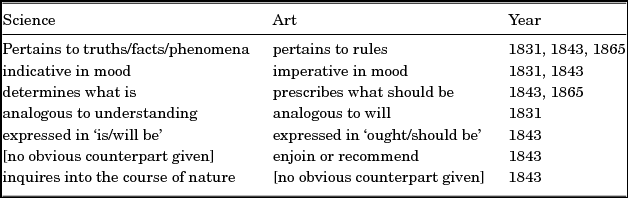
Macleod's first objection is that Mill's distinction between art and science is ‘fairly hollow’, since ‘once padding is removed from Mill's writing on the distinction, we are left with relatively little’.Footnote 15 In order to get clear on what Macleod has in mind, I reproduce above his helpful table of Mill's formulations of the distinction in various of his writings.
Mill's many definitions of the terms ‘art’ and ‘science’

Source: Macleod, ‘Was Mill a Noncognitivist?’, p. 212.
Macleod claims that we could well view each of these construals of art as distinct because, for example, ‘being enjoined or recommended is not the same thing as being prescribed’ and ‘rules do not stand to facts as the will stands to understanding in anything but a very loose sense’.Footnote 16 Rendering these construals coextensive would on Macleod's view require ‘much effort and interpolation’, and taking them to be equivalent is simply implausible.Footnote 17 Mill's art–science distinction, Macleod concludes, displays a ‘lack of rigor’.Footnote 18
However, this denial of the systematicity of Mill's distinction can be resisted. While it is true that Mill's various construals of art and science are not always equivalent, this is consistent with their contributing to a single overall conception of art and a single overall conception of science. This would be so as long as some construals are subsumed by others in virtue of stating necessary conditions rather than sufficient ones. It might be, for example, that all utterances pertaining to truths, facts, and phenomena in Mill's sense are indicative in mood, but also that not all statements in the indicative mood pertain to truths, facts, and phenomena. To take a standard case, one might maintain that claims about the properties of fictional characters are always indicative in mood and yet do not pertain to truths, facts, or phenomena in the ordinary sense. In this case, the two relevant characterizations of science would each be accurate and would each contribute to an overall understanding of a certain conception of science despite failing to be equivalent. ‘Pertaining to truth, facts, and phenomena’ would subsume ‘presentation in the indicative mood’ in so far as the latter is a necessary, but not a sufficient, condition for the former (and hence a necessary but not sufficient condition for science in Mill's sense). To take another example, one might hold that enjoining or recommending is not equivalent to prescribing, while also holding that prescribing has enjoining or recommending as a necessary but not sufficient condition.
So it might be that each of Mill's characterizations of art and science contributes to an overall distinction between truth-apt, descriptive statements on the one hand and non-truth-apt, prescriptive moral utterances on the other, despite these characterizations failing to be equivalent in all cases. Mill's alleged lack of rigour could also be explained in a number of other ways that do not render the overall art–science distinction hollow. One plausible option is that Mill is attempting to articulate a distinction that would have been rather unfamiliar to his contemporaries. It would thus be unsurprising that he struggles to find the right terminology with which to do so, hazarding various ways of capturing what he means.
Indeed, Mill himself writes in his letter to Edward Lytton Bulwer that while he is attempting to capture something ordinary or commonsensical about morality, he is expressing it ‘in new language’.Footnote 19 Macleod argues that this letter is evidence against a non-cognitivist reading, since it suggests that ‘Mill simply did not see his comments as philosophically innovative’.Footnote 20 But we can plausibly read Mill as instead meaning the following. While he is not taking issue with common-sense morality at the level of substantive first-order principles, his distinction captures a certain linguistic or structural dimension of first-order moral claims in general that was not well recognized by his contemporaries. The question turns on which ordinary views Mill takes himself to be capturing and how he takes himself to be capturing them despite doing so in new language, and this is not at all clear from Mill's letter. So the meaning of the relevant passage in the letter is inextricably tied to Mill's substantive claims about moral language. We must interpret the letter in light of what Mill says elsewhere rather than the other way around.
Objection 2: Non-ontological normative realism as an alternative
In any case, Macleod's analysis leads him to conclude that we need not attribute metaethical non-cognitivism to Mill. Macleod maintains that there is at least enough ambiguity in Mill's remarks about morality's status as art to leave open a second interpretative option. Far from being a non-cognitivist, Macleod argues, Mill might instead hold that ‘the alternative to factive statements about the world are truth-apt statements that are not about the way the world is’.Footnote 21 Macleod continues: ‘All we properly gather from his definition [of art] . . . is that noncognitivism and a cognitivism taking in truths that are not about the way the world is are the only options open to Mill.’Footnote 22 Macleod here agrees that Mill's construal of the distinction between art and science rules out a cognitivist interpretation on which moral truths are truths about the way the world is. But he maintains that this alone does not force us to a non-cognitivist interpretation of Mill. Instead, Mill ‘can merely hold that moral truths are made true in some other way’.Footnote 23
Absent any statement from Mill as to how else they might be made true, however, this interpretation is difficult to ground in the text.Footnote 24 Mill's appeal to imperatives and prescriptions in the course of making his distinction tells in favour of the non-cognitivist interpretation. His emphasis on the radical difference in the grammatical form of the verdicts of science and the verdicts of art is problematic for Macleod's cognitivist reading. Were Mill attempting to make a distinction between a natural world of scientific truths on the one hand and a non-worldly domain of normative truths on the other, the grammatical form of the two sets of truths simply would not be relevant.
In fairness to Macleod, he does in a separate paper make some further suggestions as to how his alternative cognitivist interpretation might go.Footnote 25 Drawing upon certain of Mill's remarks about the reliability of memory and the reliability of induction, Macleod argues that Mill affirms truths about epistemic reasons and draws a parallel with Mill's remarks about the desirability of pleasure. Even supposing that we grant this picture of Mill's theory of epistemic reasons, however, we would still face the interpretative task of squaring reasons-talk with Mill's remarks about the art of morality. As we shall continue to see, this is no easy task. Mill's explicit remarks on the foundations of morality resist such an analysis.
There is also an additional text to consider, one that casts further doubt on any cognitivist interpretation. Mill employs the art–science distinction not only in the works countenanced by Macleod, but also in a posthumously published essay entitled ‘Nature’ penned at some point between 1850 and 1858.Footnote 26 This essay contains what is perhaps Mill's clearest statement of how art and science relate to issues of basic ontology. Mill first endorses a conception of Nature as ‘the aggregate of all the powers and properties of all things’.Footnote 27 He next considers and rejects a second conception of Nature as ‘what takes place without the agency, or without the voluntary and intentional agency, of man’.Footnote 28 His reason for rejecting this conception is that ‘Art is as much Nature as anything else . . . Art has no independent powers of its own: Art is but the employment of the powers of Nature for an end.’Footnote 29 Mill reiterates the art–science distinction a few pages laterFootnote 30 and then rejects a third conception of Nature on which it serves as a normative ideal. These passages constitute some measure of additional evidence against Macleod's suggested interpretation of Mill. The mention of properties in the first conception of Nature – the conception that Mill endorses – is a serious problem for Macleod's reading. If Nature is here read as ‘the world in toto’ (a construal suggested by MacleodFootnote 31) and so encompasses all properties, there are (in Mill's ontology) no properties left for a non-worldly moral domain to ground, and hence no distinctively moral predicates to use in truth-apt moral sentences.
Now, one could point out that the passage explicitly commits Mill to the idea that Nature ‘refer[s] only to what is’ and that this might be consistent with (or even supportive of) a non-worldly domain of normative truths that concerns what we ought to do. But Mill makes clear in rejecting the second conception of Nature that there is nothing ontologically distinctive about art in his sense. Plausibly, non-worldliness is an ontologically distinctive feature of a domain even if non-worldliness consists merely in truth-aptness without a corresponding class of facts in the usual sense. The distinctiveness of the domain would in that case consist not in its requiring too robust an ontology, but rather in its requiring no substantive ontology at all. Art's being ‘as much Nature as anything else’ seems to rule this out.
Objection 3: Non-cognitivism's revisionary status
Macleod's third objection is that the revisionary status of non-cognitivism renders the burden of proof on a non-cognitivist interpretation of Mill especially high. The thought goes something like this. Cognitivism is our default metaethical view, while non-cognitivism is a view that we typically arrive at only in response to certain philosophical problems.Footnote 32 Combined with the fact that Mill took himself to be capturing ordinary views about morality, any non-cognitivist interpretation faces a significant hurdle. I have already responded to the idea that Mill's taking himself to be capturing ordinary ways of thinking about morality amounts to evidence for a cognitivist interpretation. I claimed that it does not, since Mill does not specify in the relevant passage which ordinary ways of thinking he has in mind. Divorced from that point, this objection's traction is diminished. A view's revisionary status is in itself no reason to exclude it from consideration as an interpretative possibility, especially in the present case. After all, Mill was arguably both one of the most innovative philosophers of his time and a skilled logician. These facts suggest that Mill was especially well positioned to identify non-cognitivism as a live metaethical option. So as long as Mill's attempting to capture some commonsensical feature of morality is consistent with his being a non-cognitivist, the fact that non-cognitivism has some other revisionary features need not trouble us.
Objection 4: Mill's appeal to cognitivist notions
Macleod's final objection is that Mill's use of ostensibly cognitivist notions such as truth, evidence, and the like tell against a non-cognitivist reading.Footnote 33 Macleod cites as his primary example a qualification that Mill adds immediately after the passage from System cited in my footnote 9. ‘It is true,’ Mill tells us, ‘that in the largest sense of the words, even these propositions assert something as a matter of fact.’Footnote 34 This passage, Macleod writes, ‘should shake any non-cognitivist reading predicated on Mill's few apparent implications that art does not pertain to truth’.Footnote 35 As Drake points out, however, Mill offers a clarification in the next sentence of the passage.Footnote 36 Mill there writes that ‘The fact affirmed in them is, that the conduct recommended excites in the speaker's mind the feeling of approbation.’Footnote 37
In light of Mill's clarification, we should not count this particular passage as evidence against a non-cognitivist interpretation. It makes a claim that any plausible non-cognitivist interpretation should accommodate, consisting as it does in the observation that the fact of an imperative's being uttered tells us something about the speaker's attitudes. Specifically, it tells us that in so far as the speaker is being genuine, she approves of what she is exhorting the listener to do.Footnote 38 Since Mill clarifies his talk of assertion here as being only ‘in the largest sense’, we have reason to doubt that he is describing something straightforwardly cognitivist. We can read Mill as claiming that imperatival utterances tacitly affirm the underlying facts about the speaker's motivation that explain them. While we might not ultimately think this claim to be quite correct, the main takeaway for my interpretative purposes is that Mill's non-cognitivist position makes use of the descriptive facts that underlie moral utterances, reliant as those utterances are (explanatorily) on facts about human motivation. I will in the next section provide further evidence in support of this idea, focusing on the competent judges passage in Utilitarianism as my primary example.
III. BRINK AND THE COMPETENT JUDGES
David Brink argues for a realist reading of Mill on different grounds.Footnote 39 Brink's analysis appeals centrally to the well-known competent judges passage in Mill's Utilitarianism. In this section, I sketch an alternative interpretation of what the competent judges are up to. On my interpretation, Mill's careful attention to human mental capacities is due not to any realist, perfectionist tendency, but rather to a keen awareness of the psychological complexity of human beings that any sophisticated version of moral anti-realism ought to include.
In the competent judges passage, Mill provides a test for determining which of two pleasures is qualitatively superior to the other. The core text of the passage goes as follows:
If I am asked, what I mean by difference of quality in pleasures, or what makes one pleasure more valuable than another, merely as a pleasure, except its being greater in amount, there is but one possible answer. Of two pleasures, if there be one to which all or almost all who have experience of both give a decided preference, irrespective of any feelings of moral obligation to prefer it, that is the more desirable pleasure. If one of the two is, by those who are competently acquainted with both, placed so far above the other that they prefer it, even though knowing it to be attended with a greater amount of discontent, and would not resign it for any quantity of the other pleasure which their nature is capable of, we are justified in ascribing to the preferred enjoyment a superiority in quality so far outweighing quantity as to render it, in comparison, of small account.Footnote 40
Brink gives the test of the competent judges a place of prominence in his interpretation of Mill, arguing that ‘the preferences of the competent judges should be understood as evidence of the greater value of the object of their preferences, rather than as constituting the object of their preference as more valuable’.Footnote 41 This evidential interpretation takes Mill to be a moral realist, construing the verdicts of the judges as correct assessments of the objective (in the sense of mind-independent) truth of the matter regarding the comparative value of different pleasures. Brink also raises but rejects what he calls the constitutive interpretation. On this interpretation, the verdicts of the judges are what make it the case that one pleasure is more valuable than another, thus resulting in an interpretation of Mill on which he is a metaethical subjectivist – a cognitivist form of anti-realism on which moral truths are mind-dependent.
Brink's main argument for the evidential, realist reading involves Mill's appeal to the concept of dignity. Following T. H. Green, Brink points us to the following passage, in which Mill claims that competent judges choose higher pleasures over lower ones out of ‘a sense of dignity’:
We may give what explanation we please of this unwillingness [on the part of a competent judge ever to sink into what he feels to be a lower grade of existence] . . . but its most appropriate appellation is a sense of dignity, which all human beings possess in one form or other, and in some, though by no means in exact, proportion to their higher faculties . . .Footnote 42
The interpretative conclusions that Brink draws on the basis of this passage, however, outrun what Mill says. Brink writes:
In claiming that it is the dignity of a life in which the higher capacities are exercised and the competent judge's sense of her own dignity that explains her preference for those activities, Mill implies that her preferences reflect judgments about the value that these activities have independently of their being the object of desire or the source of pleasure. We take pleasure in these activities because we recognize their value.Footnote 43
It is not at all obvious that having a sense of dignity as Mill understands it commits one to ascribing mind-independent value to the objects of one's preferences. Brink leaves out the crucial final clause of the quoted sentence, which contains Mill's own statement of why a sense of dignity affects the preferences of competent judges in this way. Mill finishes the sentence by claiming that a sense of dignity ‘is so essential a part of the happiness of those in whom it is strong that nothing which conflicts with it could be, otherwise than momentarily, an object of desire to them’.Footnote 44 Mill's explanation here can be put in strictly psychological terms: oftentimes, desiring a certain pleasure is incompatible with our self-conception, in the sense of either failing to engage us at all or by being incompatible with the kind of people we desire to be in such a way as to cause us to eschew the desire for the relevant pleasure. Surely one does not need to be a moral realist in order to believe that.
In the course of his analysis, Brink is keen to draw attention to the ‘judicial analogy’ that is at work in Mill's explication of his view.Footnote 45 Mill's particular choice of metaphor here is certainly no accident. The notion of a judge calls to mind an arbiter of facts who applies to those facts a standard not just of her own making in order to make her judgment. This is how Mill himself uses the metaphor of a judge in a passage of A System of Logic where his express purpose in using it is as a contrast to what he thinks a person engaged in making moral claims does.Footnote 46 Mill's use of the judge metaphor there is apparently in service of explaining his conception of science. The idea seems to be that our discovering truths about the world is relevantly like a judiciary's making a finding of fact. Mill's metaphor for a practitioner of art, by contrast, is the legislator, who puts in place (of her own authority) rules and precepts.
This cuts against both the evidential and constitutive interpretations as Brink characterizes them. The evidential interpretation implies that morality is a science rather than an art, a view that Mill explicitly disavows both leading up to and after the publication of Utilitarianism. If the preferences of the judges are evidence as to the way things are morally, then there are truths about the way things are morally, and morality is a science rather than an art. But Mill affirms the opposite. The constitutive interpretation fares no better, since it is on that interpretation inexplicable why Mill describes the subject of his procedure as judges rather than as legislators. If the judges’ opinions are constitutive of the moral superiority of one pleasure to another, then they are not judges in Mill's sense at all, but legislators.
A defender of the evidential interpretation might reply that it is possible that Mill changed his view sometime during the twenty years that separate the first edition of System and Utilitarianism, initially viewing practitioners of the art of morality as akin to legislators but later coming to view them as akin to judges. There is significant reason to doubt this hypothesis, however. Mill himself served as the editor of some editions of System, including the 1865 edition published four years after Utilitarianism. His discussion of the art–science distinction in this later edition of System includes a footnote directing the reader desirous of a defence of the principle of utility to ‘the little volume entitled Utilitarianism’.Footnote 47 Yet he does not amend System to reflect any shift in his thinking on the distinction between art and science, nor to reflect any shift in his thinking regarding morality's status as an art. If Mill had indeed changed his view in the intervening years, these omissions on his part would suggest carelessness.
Fortunately, Brink's two interpretative options are not exhaustive. There is a third one: Mill's judges are indeed playing the role of judge as he earlier describes it, but their judgments do not have moral content. On this psychological interpretation of the project in which the competent judges are engaged, they are indeed making judgments about the way that things are, but not about the way that things are morally. Instead, their judgments are of psychological facts about themselves – purely descriptive facts that do not themselves have any moral content. Allow me to explain.
As Brink himself points out, Mill draws a parallel between judgments of quality and judgments of quantity with regard to pleasures. Since quantitative judgments are a descriptive, factive matter, Brink reasons, Mill must believe something similar about judgments of the comparative quality of pleasures.Footnote 48 But in the context of Brink's argument, this shows too much. Quantitative judgments are indeed descriptive, factual matters, and they do not themselves have any moral content. If Mill really does regard qualitative judgments as deeply analogous to quantitative ones, it seems to follow that they do not have moral content either.
Surprising as this interpretation may seem at first, various surrounding passages appear to support it:
On a question which is the best worth having of two pleasures, or which of two modes of existence is the most grateful to the feelings . . . the judgment of those who are qualified by knowledge of both, or, if they differ, that of the majority among them, must be admitted as final.Footnote 49
If the ‘or’ here indicates that Mill regards the two clauses connected by it as equivalent, we have reason to read Mill's talk of ‘best worth having’ and related notions (e.g. ‘superiority in quality’Footnote 50 and ‘the more desirable pleasure’Footnote 51) as non-moral descriptive notions that convey the effects of a pleasure on its subject (e.g. ‘grateful to the feelings’). Soon after this passage, Mill asks (rhetorically), ‘What means are there of determining which is the acutest of two pains, or the intensest of two pleasurable sensations, except the general suffrage of those who are familiar with both?’Footnote 52 This tells in favour of the equivalence, since ‘acutest’ and ‘intensest’ lend themselves most straightforwardly to a non-moral construal on which they convey nothing more than the magnitude of our feelings. While they have no moral content themselves, the relevance of such truths to the art of morality is that they ground commitments to moral imperatives.
Mill's preliminary remarks on the proof of the principle of utility in Utilitarianism IV also supports this reading. He (in)famously writes:
The only proof capable of being given that an object is visible, is that people actually see it. The only proof that a sound is audible, is that people hear it: and so of the other sources of our experience. In like manner, I apprehend, the sole evidence it is possible to procure that anything is desirable, is that people actually desire it.Footnote 53
The parallelism in this passage suggests that the last sentence should read ‘capable of being desired’ rather than ‘desirable’.Footnote 54 We are again faced with an interpretative situation in which one option would impute Mill with carelessness, and we should once again resist the temptation. We should instead take the parallelism seriously, at least to this extent: Mill understands ‘desirable’ as a purely descriptive notion rather than as a moral one. This becomes more plausible against the backdrop of Mill's beliefs that System would be among his most prominent works in the long run and that System provided a methodological way forward for moral philosophy.Footnote 55 These beliefs may well have led Mill to expect that many readers of Utilitarianism would be antecedently familiar with the ideas of System, which would make his non-standard employment of the idea of desirability less jarring.
Still, one might worry that this interpretative claim places too much weight on a passage that Mill did not take to be crucial to the proof, where Mill's not taking it to be crucial is evidenced by certain remarks in his correspondence with Theodor Gomperz.Footnote 56 Writing to Mill, Gomperz refers to the parallel with sensory modalities as a ‘stumbling block . . . which when pointed out to you by me . . . you said you would remove’.Footnote 57 In his reply, however, Mill seems to disavow this characterization of the matter. Mill imputes Gomperz with having previously maintained that the parallel is ‘apparently though not really fallacious’.Footnote 58 Mill admits the need for ‘further explanation & development’ of the parallel,Footnote 59 but this supports the claim that he thought its inclusion vital. So too does the fact that he never did actually remove it.
The idea that desirability is a descriptive, psychological notion for Mill can be given additional support by answering the question of what role the competent judges play in Mill's overall argument for utilitarianism. Recall Mill's statement from ‘On the Definition of Political Economy’, quoted above in section I, about ‘the truths on which the [moral] rules are founded’, where these truths ‘belong to a branch of the science of the mind’.Footnote 60 Brink treats Mill's careful attention to humans’ sophisticated psychological capacities as a perfectionist (and therefore realist) tendency. But sophisticated non-cognitivists have just as much reason as perfectionists to pay such attention. A non-moral descriptive account of the effects of a given pleasure on its subject is crucial to the prescriptivist metaethical view that Mill seems to endorse. The more desirable of two pleasures is the more potent object of desire, that is, the more motivating pleasure. By understanding which pleasures are more or less motivating than others, the proponent of prescriptivism can infer which prescriptions competent moral agents endorse or are disposed to express.Footnote 61 The ability to make justified claims of this sort is part and parcel of the prescriptivist picture of morality, since this reveals which moral norms are in force in a given situation. Mill's test of the competent judges can therefore be seen as a crucial link between his prescriptivist analysis of moral language and the conclusions he arrives at in Utilitarianism IV.
This interpretion makes sense of what would otherwise be inexplicable features of Mill's proof. The conclusion of Mill's initial argument in Utilitarianism IV is this: ‘Happiness has made out its title as one of the ends of conduct, and consequently as one of the criteria of morality.’Footnote 62 Much of the remainder of Utilitarianism IV is spent arguing that it is the only such end and thus the only criterion of morality. Having presented various forms of evidence to the effect that it is the only such end, Mill concludes that: ‘happiness is the sole end of human action, and the promotion of it the test by which to judge of all human conduct; from whence it necessarily follows that it must be the criterion of morality, since a part is included in the whole’.Footnote 63 The structure of Mill's argument suggests that he takes his primary dialectical task in Utilitarianism IV to be to establish the purely descriptive claim that happiness is the sole end of human action. On his view, it follows from this as a matter of conceptual or logical truth that happiness is the ultimate standard of morality. He gives no clear argument in Utilitarianism as to why this follows. But his claims in System and the other writings in which he makes the art–science distinction supply a clear rationale. According to what I shall call Mill's conative principle, the disposition to endorse or express particular imperatives is fixed by descriptive facts about what ends the agent in question desires. Mill thinks that if it is true as a matter of fact that all agents set the same ultimate end, that of their own happiness, it follows that there is a universal class of imperatives to which all human beings are committed.
Mill next reiterates the epistemological foundation upon which judgments about human motivation rest, claiming that the question of whether human beings desire only happiness is ‘a question of fact and experience, dependent, like all similar questions, upon evidence. It can only be determined by practiced self-consciousness and self-observation, assisted by observation of others.’Footnote 64 Mill rests the question of whether happiness really is the sole end of human action on the standard sources of evidence that we have for questions about human motivation: introspective reflection on our own mental states and inferences from our observations of our own behaviour and the behaviour of others. On the strength of these evidentiary sources, Mill explicitly links happiness with desire:
I believe that these sources of evidence, impartially consulted, will declare that desiring a thing and finding it pleasant, aversion to it and thinking of it as painful, are phenomena entirely inseparable, or rather two parts of the same phenomenon; in strictness of language, two different modes of naming the same psychological fact.Footnote 65
With this move, Mill asserts a very strong connection between happiness and desire, and hence also with motivation, which together with his conative principle in turn lays the groundwork for a sophisticated non-cognitivist analysis of moral language and practice.
It is worth briefly noting that the non-cognitivist interpretation does not stand or fall with the foregoing interpretative suggestions about Mill's notion of desirability. One could maintain that Mill is an axiological realist – a realist about the good – while denying that he is a deontic realist – a realist about moral normativity or the right.Footnote 66 Such an interpretation would need to square its attribution of axiological realism with Mill's insistence that questions of ends are the province of art rather than of science. A further difficulty that would need to be dealt with is classical utilitarianism's affirmation of an especially close relationship between the axiological and the deontic. Nonetheless, this interpretative possibility is certainly worthy of further development and discussion. Though I regrettably cannot take up that task here, my remarks in the next section are compatible with the truth of this alternative interpretation.
IV. MILLIAN CONSTRUCTIVISM?
Before concluding, we should briefly consider how my interpretation of Mill's metaethics differs from Drake's Humean constructivist interpretation. This will also serve to raise the further issue of how ultimately to classify Mill's view given my reading.
Humean constructivism is a version of metaethical anti-realism. It affirms that there is genuine normativity but says that normativity is thoroughly mind-dependent. This much is in keeping with what I have argued. But at the heart of Humean constructivism is a further doctrine to which Mill could not have consistently subscribed: the doctrine of the radical contingency of the content of practical reason. Drake writes:
Although under Humean constructivism the practical point of view is contingently given, Mill's hedonic psychological claim, if true, represents a characteristic of people in general – a robust species-wide regularity – which entails utilitarian practical reasons for practically all people, particularly under Mill's social-instinct and Hobbesian arguments . . . in which all people have an interest in promoting a society which treats interests equally. Mill's hedonic psychological claim is an empirical claim that may be true or false; it is not possible to discuss that here.Footnote 67
Mill does not regard psychological hedonism as ‘contingently given’ in the way that Humean constructivism requires. According to Humean constructivism, people might have intrinsically desired something other than pleasure. Mill cannot assent to this claim without giving up his particular way of arguing for the hedonic psychological claim. If desiring and thinking pleasant really are ‘two different modes of naming the same psychological fact’,Footnote 68 they cannot come apart in this way. Mill confirms as much when he says ‘that to desire anything, except in proportion as the idea of it is pleasant, is a physical and metaphysical impossibility’.Footnote 69 Though Mill does suggest that we come to know the equivalence empirically, he nonetheless seems committed to regarding it as something which in a very strong sense could not be otherwise – a ‘metaphysical impossibility’.
If this is so, Mill cannot be a thoroughgoing Humean constructivist about all practical normativity. But he might still be a Humean constructivist about moral normativity in particular, since his view has not yet been shown to entail non-contingent other-regarding reasons that would rule out, say, egoism as a consistent practical principle.Footnote 70 I now examine two aspects of Mill's view that do in fact rule out egoism and other non-utilitarian practical principles.
One way to make sense of the step in Mill's proof that moves from individual happiness to general happiness is to say that he believes, like R. M. Hare, that to endorse a given prescription in one's own case often brings with it quite demanding general commitments.Footnote 71 This is suggested by a passage of System in which Mill insists on the need for a first practical principle that is universal, general, and justifies all other subsidiary practical principles – both moral and non-moral.Footnote 72 If there were multiple ‘ultimate principles of conduct’, Mill thinks, we would require an ‘umpire between them’ to resolve their competing claims.Footnote 73 Egoism generates competing claims of this kind by rendering each person's happiness the ground of a principle of conduct, but it lacks such an umpire for deciding between them. So too, Mill seems committed to maintaining, do all other non-utilitarian practical principles. A single first practical principle is required for determinate and decisive verdicts on the status of courses of conduct. If only the principle of utility can do the job here, then everyone who properly justifies their conduct (even in matters of mere prudence) must eventually appeal to it, and to do this is to take on the far-reaching commitments that the principle involves.
Mill also seems to rule out egoism by implicitly employing the distinction between motivating and normative reasons.Footnote 74 Something very much like this distinction figures in various aspects of Mill's overall argument in Utilitarianism. This is seen most clearly in his denial of the requirement that ‘that the sole motive of all we do shall be a feeling of duty’.Footnote 75 Mill allows that a person's motivating reason for action – that is, the explanation of why she in fact performs the action – can be different from her normative reason for action – that is, what justifies the action. A person who acts in mere conformity with the principle of utility acts in accordance with the normative reason that the principle enshrines, but her motivating reason might well be something else – Millian ‘external sanctions’, for example.Footnote 76 Mill seems on this basis entitled to the distinction between motivating and normative reasons. His view therefore allows, against the claims of egoism, that people have normative reasons to act in accordance with the principle of utility even when they lack a motivating reason to do so.
On my interpretation of Mill, it is an individual's desires that explain what moral prescriptions are in force for her. This makes it pressing to ask how considerations of general utility can give a normative reason to someone who is not motivated by those considerations. My answer is that Utilitarianism II contains an implicit theory of how this can be so. There, Mill engages with the objection to his view that some people in fact choose lower pleasures over higher ones. Mill replies to the objection by claiming that such people have become incapable of experiencing the relevant higher pleasures.Footnote 77 Having become incapable of these pleasures, they are no longer in a position to judge reliably or experience their motivating effects. Yet Mill does not withdraw the claim that it is ‘better to be Socrates dissatisfied than a fool satisfied’,Footnote 78 and this claim entails that one who prefers lower pleasures has a normative reason to regain a capacity for experiencing the higher pleasures, despite lacking a motivating reason to do so. The prescriptions in force for a person, and so the normative reasons that she has, are sometimes explained by the motivations that she would have if epistemically well positioned, that is, were she a competent judge with respect to the relevant pleasure.
It seems to me that Mill's commitments entail an analogous principle for moral reasons. For the prospective utility of some person or group of persons S1 to give S2 a normative reason, it need not be the case that S2 actually is motivated by S1’s prospective utility. It need only be the case that S2 would be so motivated if S2 were a competent judge with regard to the relevant prospective utility. What component of Mill's view shows that S2 would indeed be so motivated? That S2 would be so motivated follows from Mill's equivalence between thinking pleasant and desiring. For S2 to be a competent judge with respect to the prospective pleasure of S1 would involve at the very least a kind of empathic perspective-taking that consists in she herself imagining (or even actually experiencing) the relevant pleasure. S2 would thereby be thinking pleasant the relevant experience of S1.Footnote 79 From this it follows that S2 would be desiring it, and to desire it is to be motivated by it in the way that undergirds an imperatival commitment to its pursuit.Footnote 80 While Mill does not explicitly develop this line of thinking, it follows naturally from claims he does explicitly endorse. Something like this may well be what led him to think it unproblematic to infer a commitment to the general happiness from a commitment to one's own individual happiness.
Drake supports his Humean constructivist reading by appealing to Mill's remark that the principle of utility is not subject to ‘proof in the ordinary and popular meaning of the term’.Footnote 81 Drake acknowledges Mill's qualification to this remark. Mill writes that ‘Considerations may be presented capable of determining the intellect either to give or withhold its assent to the doctrine.’Footnote 82 Drake claims that such ‘“assent” cannot be epistemological, in the sense of believing the principle of utility to be a fact, as Mill holds morality to be not a factual matter’.Footnote 83 Drake claims that since the assent is not epistemological, it must instead be practical assent of the sort that is the hallmark of Humean constructivism. But it seems to me that we have good reason to take Mill's talk of assent as epistemological, for he speaks of its effect on the intellect. My reading shows how to square Mill's making an epistemological point here with his denial of moral facts: my non-cognitivist Mill would have us infer which prescriptions are in force for an agent from descriptive facts about her. Mill is engaged in the epistemological enterprise of moral justification; he simply has a different conception of how such justification properly operates due to his non-cognitivist commitments.
I turn now to the question of how to classify the resulting view. If the principal point of contention between Humean constructivists and Mill is the contingency of the content of practical reason, does it follow from what I have said that Mill is a Kantian constructivist? After all, this is precisely what is supposed to distinguish Humean constructivism from Kantian constructivism.Footnote 84 Though both views affirm the mind-dependence of normativity, constructivists of the Humean variety affirm the contingency of the content of practical reason, while those of the Kantian variety deny it. The question is especially pressing if we affirm Drake's understanding of constructivism, according to which it is neutral between cognitivism and non-cognitivism. We might otherwise have distinguished Mill from Kantian constructivists on the basis of Mill's non-cognitivism, which Kantian constructivists do not typically share. But if we accept Drake's characterization of constructivism, this strategy is not available to us.
This raises deep issues about the nature of metaethical constructivism that I cannot take up in full here. But we can say the following. It is true that Mill agrees with Kantian constructivists that some of the content of practical reason is necessary (and so universal), rather than its being contingent (and so in principle non-universal). But we should not take agreement on that issue as the litmus test for full-fledged Kantian constructivism. What makes Kantian constructivism distinctively Kantian is not merely that it makes this claim, but instead the kinds of considerations that it brings to bear in arguing for the claim.
Kant and Mill are not the only well-known historical thinkers to combine a mind-dependent conception of the normative with a claim to the necessity (and so universality) of its dictates for all agents. In recent work on Benedict de Spinoza, I claim that he too affirms just this combination of views.Footnote 85 But Spinoza's strident commitment to arch-rationalist metaphysical inquiry is as anti-Kantian a doctrine as there ever was, and it figures centrally in his argument for the universality of morality's dictates. Where Kant appeals to the constitutive structure of the rational will, Spinoza appeals to the metaphysics of individuation and personal identity. The starting points and resulting argumentative strategies of these two thinkers are so radically different that calling both of their views ‘Kantian constructivism’ (or ‘Spinozistic constructivism’ if we are inclined to give precedence to the earlier figure) is an unhelpful way of carving up the conceptual terrain.
It instead makes good sense to opt for a classificatory scheme according to which distinctive argumentative routes to the universality claim each receive their own particular designation. If constructivism can be construed broadly enough to include some non-cognitivist views, as Drake maintains, then Mill's view as I have interpreted it merits its own designation. Mill's view does not appeal to anything like the rational will as Kant understands it. Mill does appeal to what can be broadly characterized as features of the structure of practical reason via his prescriptivism about moral language, his conative principle, and his claim of metaphysical equivalence between desiring and thinking pleasant. But these and various of Mill's other claims yield an altogether different view of the structure of practical reason than the one that Kant and his followers endorse. This suggests that we should classify Mill's position differently: as Millian constructivism.Footnote 86