


INTRODUCTION
Current reports suggest that world population is going to reach 9 billion by 2050 (United Nations 2009) and that the world's current staple crops (maize, rice, wheat and potato) may not be able to meet demand for food (Baye et al., Reference Baye, Kebede and Belete2001). The challenge has sparked recent interest in the possible use and re-introduction of neglected and underutilised species (NUS) (Mabhaudhi, Reference Mabhaudhi2009). Azam-Ali (Reference Azam-Ali2010) defined NUS as crops that were previously not classified as major crops, have been under researched and currently occupy low levels of utilisation, and are mainly confined to small-scale farmers. Unlike most staple crops, most NUS are believed to be adapted to a range of ecological niches (Padulosi, Reference Padulosi1998), which are often marginal and harsh, thus offering sustainable food production (Idowu, Reference Idowu2009). Such crops include taro (Colocasia esculenta (L.) Schott), locally known as amadumbe in South Africa.
Taro is one of the oldest domesticated crops, with a history of cultivation in the Indo–Pacific dating back to more than 10 000 years (Cable, Reference Cable and Chandra1984; Haudricourt and Hédin, Reference Haudricourt and Hédin1987 cited in Lebot, Reference Lebot2009; Plucknett, Reference Plucknett and Simmonds1984; Rao et al., Reference Rao, Hunter, Eyzaguirre and Matthews2010). It has two botanical varieties: C. esculenta var. esculenta (dasheen), and C. esculenta var. antiquorum (eddoe). The two varieties are distinguished by the shape and size of their main corms and cormels. Dasheen genotypes produce a large main corm and few, small side cormels – the edible part of which is the large central corm. Eddoe genotypes have a relatively smaller central corm (compared with the dasheen) and numerous well-developed side cormels which are edible (Lebot, Reference Lebot2009). In South Africa, the central corm is usually kept and used to propagate the next crop. In other cases, and especially for the dasheen type, taro is usually propagated from suckers, called huli (Lebot, Reference Lebot2009). Taro is generally consumed as a subsistence crop and currently occupies low levels of utilisation hence its classification as a NUS.
In South Africa, taro is a NUS cultivated by subsistence farmers using landraces. Its production remains confined to mostly rural coastal areas of KwaZulu-Natal and the Eastern Cape provinces (Shange, Reference Shange2004). Over the last decade, semi-commercialisation of taro by subsistence farmers (Agergaad and Birch-Thomsen, Reference Agergaard and Birch-Thomsen2006; Modi, Reference Modi2003) has contributed to an increase in taro production. As such, there is growing interest to promote it among small-scale farmers in other parts of the country, which may be drier than the coastal areas. Lack of scientific information describing effects of drought on growth, development and yield of diverse taro landraces remains a bottleneck to its successful expansion.
There has been limited research on drought tolerance of this crop. Snyder and Lugo (Reference Snyder, Lugo and Sing1980) reported that drought tolerance existed in some wild relatives of taro, suggesting it was possible to develop drought tolerant hybrids. Sivan (Reference Sivan1995) evaluated effects of drought on growth of two taro varieties (dasheen and eddoe) and tannia and observed that stomatal conductance (SC) declined under water stress relative to the well-watered treatment. In addition, water stress was shown to reduce leaf number and leaf area of both cultivars. In India, Sahoo et al. (Reference Sahoo, Madhumita and Mukherjee2006), using taro hybrids, reported significant variations for taro growth parameters such as height, leaf number and leaf area, leaf relative water content, chlorophyll stability index and injury by desiccation in response to osmotic stress. They concluded that development of drought tolerant varieties of taro was a possibility after observing tolerance to osmotic stress with negligible yield reduction in the taro hybrid.
South Africa's research efforts on taro have primarily focussed on propagule quality and storage (Modi, Reference Modi2007; Shange, Reference Shange2004), with limited research on growth, yield quality and nutrition (Mare, Reference Mare2006, Reference Mare2010; Mare and Modi, Reference Mare and Modi2012; McEwan, Reference McEwan2008; Modi, Reference Modi2007). There has been no research describing taro's drought tolerance and there are currently no improved varieties of taro, hence local subsistence farmers still use landraces. Availability of information describing drought tolerance in these landraces could lead to development of drought tolerant varieties. It is hypothesised that local taro landraces may have developed drought tolerance over centuries of farmer and natural selection. Therefore, this study is aimed to evaluate the growth responses to water stress and mechanisms of drought tolerance of local taro landraces.
MATERIALS AND METHODS
Planting material
Three landraces of taro (Amadumbe) were collected from two locations in KwaZulu-Natal (KZN); one from KwaNgwanase (KW) (27°1′S; 32°44′E) in northern KZN, and two from Umbumbulu (UM and Dumbe Lomfula (DL): 29°36′S; 30°25′E) in the midlands of KZN, in April, 2010. The KW and DL landraces were classified as dasheen types characterised by a large central corm and no side cormels (Mabhaudhi and Modi, Reference Mabhaudhi and Modi2013). The DL landrace was obtained from the wild where it was growing in shallow streams. The KW landrace was semi-domesticated and cultivated on stream-banks. The UM landrace is an upland landrace and is an eddoe type landrace characterised by a central corm and numerous side cormels which are the edible parts (Lebot, Reference Lebot2009). In order to eliminate propagule size effects, planting material was initially selected for uniform plant size (Singh et al., Reference Singh, Matthews, Griffin, Ritchie, Hunt and Goenaga1998). Propagules were then treated with a bactericide and fungicide (Sporekill®) to prevent rotting during sprouting. Thereafter, propagules were sprouted in vermiculite (30 °C, 90% RH) for 21 days before being planted out in the field. KW was propagated using head-setts, UM and DL using sprouted corms and cuttings, respectively.
Description of experimental sites
Field trials were conducted at the University of KwaZulu-Natal's Ukulinga Research Farm, Pietermaritzburg (29 °37′S; 30 °16′E) during the summer planting seasons of 2010/11 and 2011/12. Ukulinga represents a semi-arid environment and is characterised by clay-loam soils (USDA taxonomic system). Weather parameters were monitored by an automatic weather station (ARC – Institute for Soil, Climate and Water) situated within a 100 m radius of the trials.
Experimental designs
A factorial experiment with a split-plot layout arranged in a completely randomised block design was used. Irrigation (full irrigation (FI) versus rainfed (RF)) was the main factor, while landrace type (DL, KW and UM) was the sub-factor. FI involved watering the crops to 100% of crop water requirement (Allen et al., Reference Allen, Pereira, Raes and Smith1998). Irrigation scheduling for the FI treatment was based on reference evapotranspiration (ETo) and a crop factor (Kc) (Mabhaudhi et al., Reference Mabhaudhi, Modi and Beletse2013a) and was applied twice weekly using sprinklers on 1 m high risers. During the 2010/11 growing season, 912 mm of rainfall were received compared to 622 mm received during 2011/12 growing season. Supplementary irrigation amounted to 879 mm and 740 mm during 2010/11 and 2011/12 growing seasons, respectively. Less supplementary irrigation was applied during 2011/12 growing season because the taro crop was harvested earlier than in the preceding season. The sub-factor (landrace type) was replicated three times. The trials were planted on an area of 499.8 m2. Main plots measured 207.4 m2 each, with 15 m spacing between them to prevent water from sprinklers in the FI treatment from reaching RF plots – sprinklers had a maximum range of 6 m radius. The sub-plot size was 17 m2 with an inter-plot spacing of 1 m, and plant spacing of 1 × 0.5 m, translating to 44 plants per plot. In order to allow for maximum possible crop stand, the RF treatment was established under FI until plants had reached 90% emergence. Thereafter, irrigation was withheld from the RF treatment.
Agronomic practices
Prior to commencement of trials, soil samples were taken for soil fertility and textural analysis. Results of soil texture analysis were used to define soil physical parameters of field capacity, permanent wilting point and saturation (K sat) using the Soil Water Characteristics Hydraulic Properties Calculator (http://hydrolab.arsusda.gov/soilwater/Index.htm). Land preparation involved disking and rotovating the fields to achieve a fine seedbed. Fertiliser was applied using an organic fertiliser, Gromor®, at a rate of 5 330 kg ha−1 (Mare, Reference Mare2010). Since taro takes long to mature, fertiliser application was split into two: half at planting and the remainder 20 weeks after planting, to ensure nutrient availability throughout the trials. Weeding and ridging were done by hand-hoeing.
Data collection
The experimental designs and data collection were specifically designed to collect empirical data and observations for taro, which could later be used to model taro using AquaCrop (Steduto et al. Reference Steduto, Hsiao, Raes and Fereres2009). Data collection included emergence until at least 90% of the plants had emerged. Canopy characteristics (plant height, leaf number and leaf area index (LAI)) were determined starting from when the plants had reached 90% emergence. Plant height was measured from the bottom of the plant up to the base of the 2nd youngest fully unfolded leaf. Leaf number was counted only for fully unfolded leaves with at least 50% green leaf area. LAI was measured using the LAI2200 Canopy Analyser (LI-COR, Inc. USA & Canada). During the 2010/11 season, only the KW and UM landraces were measured since the crop stand in the DL landrace was too low to allow good measurements to be taken. SC was determined using a steady state leaf porometer (Model SC-1, Decagon Devices, USA). During 2011/12 planting season, leaf CCI was determined using a chlorophyll content meter (CCM-200 PLUS, Opti-Sciences, USA). SC and CCI were measured from the abaxial and adaxial leaf surfaces, respectively, of the 2nd youngest fully unfolded leaf for the entire duration of the trial. Stomata are generally evenly distributed in taro leaves and have been found to be consistently higher on the abaxial than adaxial surface. SC measurements were taken at the middle of the leaf, about 2–3 cm from the leaf margin, halfway along the lamina as described for by Sivan (Reference Sivan1995). SC was measured at the onset of the rapid vegetative stage (4 months after planting). Measurements of SC and CCI were taken during midday between (1200–1400 h) and during the periods in-between irrigation events when the soil was drying. Soil water content (SWC) was monitored weekly using a PR2/6 profile probe connected to a handheld HH2-moisture meter (Delta-T Devices, UK). The vegetative growth index (VGI) was measured in field trials as described by Lebot (Reference Lebot2009) with minor modifications (Equation 1):
 \begin{equation}
{\rm VGI} = \left[ {\left( {\left( {{\rm leaf}\;{\rm width} \times {\rm leaf}\;{\rm length}} \right) ^{*} {\rm leaf}\;{\rm number}} \right) ^{*} {\rm H/100}} \right] - ({\rm suckers} + {\rm stolons})^2\end{equation}
where VGI = vegetative growth index
 \begin{equation*}
H = {\rm plant}\;{\rm height}{\rm .}
\end{equation*}
Statistical analyses
Data collected from all trials were analysed using analysis of variance with GenStat® (Version 14, VSN International, UK). Thereafter, least significant differences (LSD) were used to separate means at the 5% level of significance.
RESULTS
Weather data
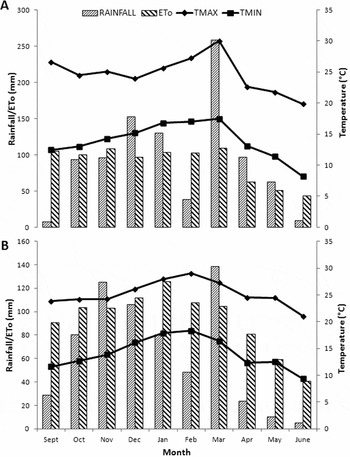
During the first season (2010/11), the average temperature was 19.5 °C, with measured total rainfall of 939.2 mm against a calculated reference evapotranspiration (ETo) of 878.1 mm. As such, rainfall received during this period was greater (by 61.1 mm) than ETo. Most of the rainfall was received during the vegetative periods (Dec–March) and either exceeded or matched ETo (Figure 1). Total rainfall (647.2 mm) received in 2011/12 was less than that received in the 2010/11 season. Furthermore, total rainfall received was less (280.6 mm) than ETo, suggesting that the crop may have suffered evaporative demand stress during the 2011/12 season. Lastly, rainfall distribution showed that rainfall during the whole growing season was lower than ETo, except for March and November (Figure 1).
Maximum (T max) and minimum (T min) temperatures, rainfall and reference evapotranspiration (ETo) recorded at Ukulinga (Sept – June) during A. 2010/11 and B. 2011/12 planting seasons. Note the difference in rainfall and ETo recorded during 2011/12.

Crop establishment
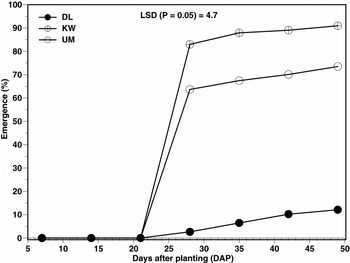
Results reported only refer to differences between landraces for both planting seasons. This is because all plants were established under FI. Results of emergence showed highly significant differences (P < 0.001) among landraces, with KW emerging faster compared to the UM and KW landraces. The DL landrace showed the lowest emergence, failing to reach 25% emergence throughout the season. Overall, taro landraces emerged slowly, reaching 90% establishment at about 49 DAP, on average (Figure 2).
Emergence of taro landraces Dumbe Lomfula (DL), KwaNgwanase (KW) & Umbumbulu (UM)) based on mean values for both seasons. Note that DL was slow to emerge.

Stomatal conductance and chlorophyll content index
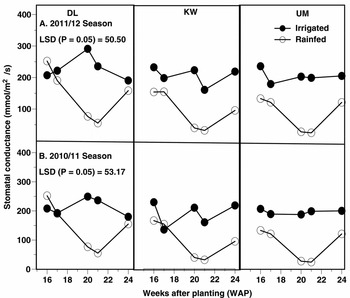
Across both seasons, results showed highly significant differences (P < 0.001) between irrigation treatments and landraces (Figure 3). During the 2010/11 season, there was a significant interaction (P < 0.05) between irrigation treatments while in the subsequent season (2011/12), the interaction was not significant. SC was lower under RF, after 17 weeks, compared with irrigated conditions: it was almost twice as high under irrigated relative to RF conditions (Figure 3). On average, for both irrigation treatments, the DL landrace had higher SC than the UM landrace. Under RF conditions, based on mean values for both seasons, SC for DL, KW and UM was 34%, 52% and 58% lower, respectively, compared with irrigated conditions. Under RF conditions, the UM landrace was shown to have the lowest SC compared to the DL and KW landraces, suggesting a greater degree of stomatal control in the UM landrace.
Stomatal conductance of taro landraces (Dumbe Lomfula (DL), KwaNgwanase (KW) and Umbumbulu (UM)) grown under irrigated and rainfed conditions at Ukulinga during (b) 2010/11 and (a) 2011/12 planting seasons.

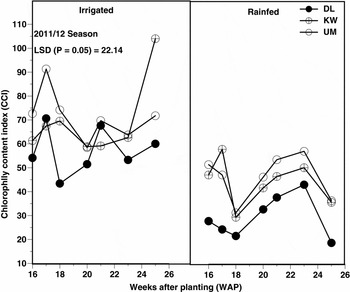
CCI was shown to be significantly (P < 0.001) lower under RF relative to irrigated conditions (Figure 4). Based on mean values, CCI was about 40% lower under RF compared with irrigated conditions. Landraces were shown to differ significantly (P < 0.001) with respect to CCI. Results of CCI showed that DL had the greatest decrease (49%) while KW and UM had similar decreases (36%) under RF relative to irrigated conditions. This meant that, even though the UM landrace had lower CCI under RF conditions; it retained a higher CCI under RF (stress) conditions than the DL and KW landraces.
Chlorophyll content index (CCI) of taro landraces (Dumbe Lomfula (DL), KwaNgwanase (KW) and Umbumbulu (UM)) grown under (a) irrigated and (b) rainfed conditions at Ukulinga during the 2011/12 planting season.

Crop growth
Results collected from both seasons (2010/11 and 2011/12) showed that measured growth parameters of plant height, leaf number and LAI were negatively affected by limited water availability under RF conditions. Plant height results for both seasons recorded highly significant differences (P < 0.001) between irrigation treatments, landraces and their interaction. During 2010/11, plant height of KW, UM and DL was respectively 42, 32 and 29% lower under RF relative to irrigated conditions. While for the subsequent season (2011/12), plant height of UM, KW and DL was respectively 33, 31 and 26% lower under RF relative to irrigated conditions. The UM and KW landraces were more inclined to attain a lower maximum plant height under water limited conditions.
Leaf number, for both seasons, showed highly significant differences (P < 0.001) between irrigation treatments and landraces. During the 2011/12 planting season there was a highly significant (P < 0.001) interaction between irrigation treatments and landraces. The observed trend of results, across both seasons, showed that, on average, DL and KW landraces had a higher leaf number than the UM landrace. On average, for both seasons, leaf number of DL, KW and UM landraces was lower by 29, 36 and 28%, respectively, under RF relative to irrigated conditions.
Results of LAI measured during 2010/11 showed that LAI was significantly (P < 0.001) lower (70%) under RF compared with irrigated conditions; the greatest reductions in LAI were observed in the KW landrace. Overall, the UM landrace was shown to have significantly (P < 0.001) higher LAI than the KW landrace. In the subsequent season (2011/12), results of LAI were consistent with those observed during the 2010/11 season. Based on mean values for irrigation treatments, LAI was significantly (P < 0.001) lower (66%) under RF compared to irrigated conditions. There were no significant differences between the landraces. However, the KW and UM landraces had higher LAI than the DL landrace under both irrigated and RF conditions. This was despite the fact that DL had larger-sized leaves (data not shown) than UM and KW. The KW landrace had the greatest reductions in LAI under RF conditions compared with the UM landrace. This was consistent with decreased plant height and leaf number. Although the UM landrace showed a decreased plant height and leaf number, its reductions in leaf number were minimal; hence, it had better LAI under RF conditions.
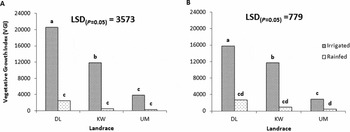
The VGI was shown to be significantly (P < 0.001) lower under RF compared with irrigated conditions (Figure 5). The VGI varied significantly (P < 0.001) between treatments and landraces with the interaction between the former and latter also being highly significant (P < 0.001) (Figure 5). Under RF conditions, VGI was 91% and 87% lower during the 2010/11 and 2011/12 planting seasons, respectively, relative to irrigated conditions. Decreases in VGI were highest in the KW and UM landraces (94% and 89%), respectively, compared with the DL landrace (86%). Reduction in VGI under RF conditions was consistent with results of reduced plant height, leaf number and LAI compared with irrigated conditions.
Vegetative growth index (VGI) of taro landraces (Dumbe Lomfula (DL), KwaNgwanase (KW) and Umbumbulu (UM)) grown under irrigated and rainfed conditions at Ukulinga during A. 2010/11 and B. 2011/12 planting seasons.

Crop phenology and yield
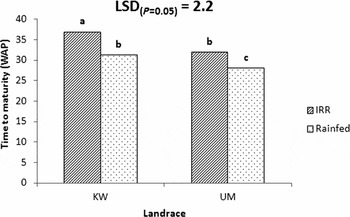
Only the KW and UM landraces were evaluated for time to harvest maturity because the DL landrace, a perennial, was not exhibiting any signs of harvest maturity. Time to harvest maturity was significantly lower under RF (30 WAP) relative to irrigated (32 WAP) conditions. The UM landrace matured earlier under both irrigated and RF conditions than the KW landrace (Figure 6).
Time to maturity, in weeks after planting, of taro landraces (KwaNgwanase (KW) and Umbumbulu (UM)) grown under irrigated (IRR) and rainfed conditions at Ukulinga during 2010/11 planting season. Note that DL is not included in this graph.

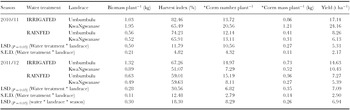
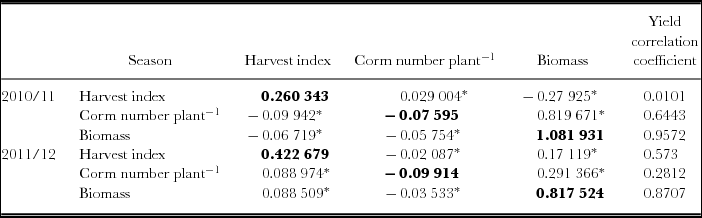
With the exception of corm number, the interactions between water treatments, landraces and seasons (G × T × Y) was shown to be not significant (P > 0.05). Therefore, results of yield and its components are reported on a seasonal basis. The DL landrace failed to form yield across either season and therefore results of yield only show the KW and UM landraces (Tables 1 and 2). This was because the DL landrace is a non-domesticated perennial crop which normally grows in shallow rivers. As such our attempt to take it out of its natural habitat was unsuccessful. Due to differences in weather parameters between the two seasons, results presented here do not show the interaction between seasons. During the 2010/11 planting season, biomass, HI, corm number and corm mass were all lower under RF compared to irrigated conditions (Table 1). Results of biomass, corm mass and yield all showed highly significant differences (P < 0.001) between irrigation treatments. Overall, yield (t ha−1) was, on average, 65% lower under RF compared to irrigated conditions. The KW landrace had higher yield under irrigated conditions than the UM landrace, only in 2010/11. This was consistent with the longer crop duration (Figure 6). The opposite was true under RF conditions; yield of the KW landrace was 75% lower compared with 52% in the UM landrace. The pattern of lower yield between the two landraces was consistent with trends in VGI; vegetative growth of the UM landraces was less affected by limited water availability under RF conditions (Figure 6). As such, lowering of final yield was mainly related to lower biomass per plant (Table 2). Correlation and path analysis of yield and yield determinants confirmed that biomass was highly correlated with yield (r = 0.9572) and that biomass had the greatest direct contribution to yield (1.081931) (Table 2).
Yield and yield components (biomass, harvest index, corm number and corm mass) of two taro landraces (KwaNgwanase (KW) and Umbumbulu (UM)) grown under irrigated and rainfed conditions during 2010/11 and 2011/12 summer seasons.

Numbers in the same column not sharing the same letter differ significantly at LSD (P = 0.05). *The word ‘corm’ is used to represent both the main corm plus the side cormels.
Correlation matrix and path coefficients showing direct and indirect contributions of biomass, harvest index and corm number per plant to yield for both KwaNgwanase (KW) and Umbumbulu (UM) landraces during 2010/11 and 2011/12 planting seasons.
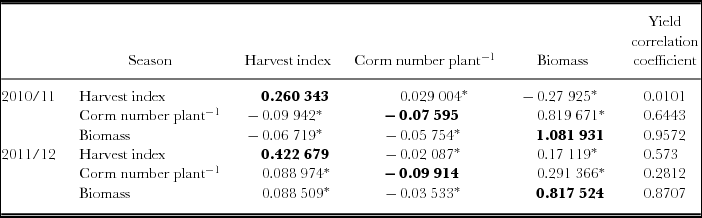
Values in bold represent the direct contribution; *represents the indirect contribution.
During the subsequent season (2011/12), the trend was similar, with respect to differences between water treatments (Table 1). Yield components and final yield were lower under RF than irrigated conditions (Table 1). Contrary to results from the first season, the UM landrace had higher biomass and yield than the KW landrace under both irrigated and RF conditions during the second season. Secondly, based on percentage yield decline under RF conditions, the UM landrace performed better than the KW landrace under RF conditions (Table 1). Correlation and path analysis of yield and yield determinants for the second season were consistent with results of the first season (Table 2). Biomass was highly correlated to final yield (r = 0.8707) and contributed highly (0.817 524) towards final yield. The contribution of HI to final yield was minimal while corm number had the least contribution (Table 2). Corm number generally was not much lower under RF relative to irrigated conditions. This suggested that while corm number may be relatively consistent, individual corm size and mass decreased in response to limited water availability. Since biomass was shown to contribute most to yield, the UM landrace may be more suited to RF production due to a higher biomass (and consequently yield) under RF relative to irrigated conditions (Table 1).
DISCUSSION
Taro landraces were slow to emerge, taking at least 49 days after planting to emerge. Results observed in this study concurred with other studies on the same landraces conducted under rain shelter and controlled environments (Mabhaudhi et al., Reference Mabhaudhi, Modi and Beletse2013a, Reference Mabhaudhi, Modi and Beletseb). Mare (Reference Mare2010) reported even longer establishment periods (≈ 70 days after planting) for several eddoe type landraces. Time taken to emerge may be reflective of different propagules used for each of the three landraces. KW was propagated using head-setts, UM and DL using sprouted corms and cuttings, respectively. This may have resulted in propagule type and size effects (Lebot, Reference Lebot2009; Singh et al., Reference Singh, Matthews, Griffin, Ritchie, Hunt and Goenaga1998); thus explaining differences observed between landraces.
Our findings showed that SC was lower under RF than irrigated conditions. Sivan (Reference Sivan1995) reported similar findings of lower SC under water stress in two dasheen and eddoe taro varieties. Stomatal closure is a drought avoidance mechanism (Levitt, Reference Levitt1972; Turner, Reference Turner1986) which allows for the crop to minimise transpirational water losses (Chaves et al., Reference Chaves, Maroco and Pereira2003). It is widely accepted as the major limitation to photosynthesis and biomass production under drought stress (Chaves et al., Reference Chaves, Pereira, Maroco, Rodrigues, Ricardo, Osorio, Carvalho, Faria and Pinheiro2002, Reference Chaves, Maroco and Pereira2003). Based on our results, stomatal regulation may play a role in stress acclimation of taro landraces to water stress, specifically the UM landrace.
Under limited water availability, lowering chlorophyll content is a strategy employed by plants to help get rid of excess radiation energy. In this study, CCI was lower under RF relative to irrigated conditions, in line with lower SC. According to Havaux and Tardy (Reference Havaux and Tardy1999), under stress, lowering CCI down-regulates photosynthesis in response to decreased intracellular CO2 availability resulting from stomatal closure. Therefore, results observed implied energy dissipation mechanism in taro landraces. Our findings also agree with Sahoo et al. (Reference Sahoo, Madhumita and Mukherjee2006) who reported lower chlorophyll stability index in a taro hybrid subjected to water stress. This response was clear in the UM landrace, suggesting the UM landrace was able to down-regulate its photosynthesis in line with decreasing CO2 availability.
Plants also cope with limited water availability through reduction in plant size and surface area available for transpiration (Mitchell et al., Reference Mitchell, Siamhan, Wamala, Risimeri, Chinyamakobvu, Henderson and Fukai1998) as a drought avoidance strategy (Levitt, Reference Levitt1972; Turner, Reference Turner1986). Our observed findings were consistent with findings by Sahoo et al. (Reference Sahoo, Madhumita and Mukherjee2006) that water stress decreased plant height, leaf number and leaf area of a taro hybrid. According to Lebot (Reference Lebot2009), VGI is a unique taro specific index in that it considers all aspects of taro morphology – leaf number and area, plant height as well as suckers and stolons. It has been reported to be often positively correlated to corm yield (Lebot, Reference Lebot2009). Under RF conditions, reduction in VGI was due to failure by landraces to form suckers, coupled with lower plant height, leaf number and leaf area under RF conditions. The UM landrace showed moderate decreases in vegetative components under stress suggesting that it was able to strike a balance between minimising water losses through transpiration while allowing for biomass production to continue. This was consistent with UM's degree of stomatal control and accompanying lowering of CCI.
Plants that escape drought generally exhibit a degree of phenological plasticity by completing their life cycle before water stress becomes terminal. In this regard, taro landraces, especially the UM landrace, showed a degree of phenological plasticity under RF conditions. The UM landrace matured earlier under RF relative to irrigated conditions. This was consistent with decreased vegetative growth under RF conditions. RF conditions resulted in enhanced leaf shedding (reduced leaf number) which resulted in shortened crop duration. Blum (Reference Blum2005) associated drought avoidance with reduced season duration due to reduced leaf number. While reduction in leaf number is a drought avoidance mechanism, phenological plasticity is an escape mechanism. This agrees with Ludlow (Reference Ludlow, Kreeb, Richter and Hinckley1989) who suggested that drought tolerance strategies do not necessarily work in isolation.
Yield components and final yield were all lower under RF conditions relative to irrigated conditions. This concurs with Blum (Reference Blum2005) who noted that drought responses that favoured avoidance and escape were often to the detriment of yield due to reduced crop duration and biomass production. In this study, growing taro under RF conditions resulted in yield losses of at least 50%, in the KW and UM. According to Farooq et al. (Reference Farooq, Wahid, Kobayashi, Fujita and Basra2009), many yield-determining plant processes are affected by water stress. Findings of the current study showed that the greatest contributor to yield attainment was biomass. However, biomass production was affected by reduced SC and chlorophyll content, reduced vegetative growth and crop duration under RF conditions. The fact that the three way interaction between water treatments, landraces and seasons was only significant for corm number highlights that this parameter is unstable and therefore may not be suitable as a selection criteria. This was also confirmed by results of path analyses which indicated that corm number had the least contribution to yield.
CONCLUSIONS
This study showed that taro landraces were susceptible to drought stress under RF conditions. Attempts to domesticate the DL landrace out of its native habitat were unsuccessful as the crop failed to produce yield. The study managed to index drought strategies in taro landraces. These involved a combination of drought avoidance and escape mechanisms. Drought avoidance was achieved through stomatal regulation, energy dissipation and reduced canopy size. Drought escape was demonstrated through phenological plasticity such that under water limited conditions, taro matured earlier. The KW landrace is more suited to irrigated conditions and therefore should be cultivated where supplementary irrigation is available. The UM landrace showed greater adaptability to limited water availability under RF conditions. As such, the UM landrace may be suited for RF production given that management practices that favour biomass accumulation are practised. Future studies should focus on issues related to nutritional water productivity of taro as a possible food security crop. Such studies will also consider the cost-benefit analyses of producing taro under irrigation as opposed to the current scenario whereby it is produced under RF conditions. Such information would prove useful to advising subsistence farmers with access to irrigation schemes.
Acknowledgements. The Water Research Commission of South Africa is acknowledged for initiating, funding, directing and managing this research through WRC Project No. K5/1771//4 ‘Water-Use of Drought Tolerant Crops’ (WRC, 2009).