INTRODUCTION
Many parasites require blood-sucking vectors to be transmitted between vertebrate hosts. Factors including host abundance and immunocompetence may affect the epizootiology of vector-borne diseases, but vector abundance plays a prominent role in determining the exposure of a potential host to infections (Atkinson and Van Riper, Reference Atkinson, van Riper, Loye and Zuk1991; Martínez-Abraín et al. Reference Martínez-Abrain, Esparza and Oro2004). Positive associations between pathogen infection and the abundance of vectors have been reported in different animal models including reptilians (Reardon and Norbury, Reference Reardon and Norbury2004), mammals (Smith et al. Reference Smith, Telfer, Burthe, Bennett and Begon2005) and birds (Sol et al. Reference Sol, Jovani and Torres2000; Griffing et al. Reference Griffing, Kilpatrick, Clark and Marra2007). However, in spite of its importance in the understanding of the dynamics of diseases in avian populations, the direct relationship between the risk of infection by blood parasites and avian exposure to vectors has been rarely tested in the wild (Sol et al. Reference Sol, Jovani and Torres2000).
Most evidence supporting an association between the abundance of vectors and blood parasite transmission to birds is indirect. For instance, the absence of suitable vectors might explain the low incidence of blood parasites in species living in marine/saline habitats (Super and van Riper, Reference Super and van Riper1995; Figuerola, Reference Figuerola1999; Mendes et al. Reference Mendes, Piersma, Lecoq, Spaans and Ricklefs2005). Also, environmental characteristics around the nests, which may affect the abundance of vectors, seem to determine blood parasite prevalence in avian populations (Sánchez et al. Reference Sánchez, Cuervo and Moreno2007; Wood et al. Reference Wood, Cosgrove, Wilkin, Knowles, Day and Sheldon2007; Ortego and Cordero, Reference Ortego and Cordero2010).
Nestlings from many species are constrained to the nest during the first developmental stages. Therefore, they have limited abilities to avoid ectoparasites once these have reached the nest, thus potentially increasing their exposure to pathogens (Merino, Reference Merino2010). In addition to nest-dwelling parasites, a diversity of blood-sucking flying insects including mosquitoes, biting midges and black flies, bite on nestlings (Tomás et al. Reference Tomás, Merino, Martínez-de la Puente, Moreno, Morales and Lobato2008a; Votýpka et al. Reference Votýpka, Synek and Svobodová2009). Attacks by blood-sucking flying insects may produce direct tissue damage, anaemia and immunological reactions against toxins and/or allergens contained in insect saliva (Hunter et al. Reference Hunter, Rohner and Currie1997; Lehane, Reference Lehane2005). Moreover, they play a role as vectors of different blood parasites, potentially increasing the incidence of chronic diseases (Valkiūnas, Reference Valkiūnas2005). The combined effect of both biting and infections by pathogens may impose important physiological costs on nestlings, reducing their general condition (Tomás et al. Reference Tomás, Merino, Martínez-de la Puente, Moreno, Morales and Lobato2008b; Martínez-de la Puente et al. Reference Martínez-de la Puente, Merino, Lobato, Rivero-de Aguilar, del Cerro, Ruiz-de-Castañeda and Moreno2010) and survival probability (Hunter et al. Reference Hunter, Rohner and Currie1997). Moreover, ectoparasite attacks during the nestling phase may induce long-term costs in survivors (Fitze et al. Reference Fitze, Clobert and Richner2004).
In contrast to the well-studied effects of nest-dwelling parasites on nestling fitness (Lehmann, Reference Lehmann1993), there is scarce information about the effects of blood-sucking flying insects on nestling health status. Furthermore, the detection of infections by blood parasites in nestlings has an additional difficulty because, in some cases, pre-patent periods of infection are longer than or close to the period of nestling presence in the nest. Therefore, blood parasites are not always detectable in peripheral blood before nestlings leave the nest (Atkinson and Van Riper, Reference Atkinson, van Riper, Loye and Zuk1991). However, some parasite genera, for example Leucocytozoon and Trypanosoma, are commonly found infecting nestlings (Fargallo and Merino, Reference Fargallo and Merino2004; Arriero et al. Reference Arriero, Moreno, Merino and Martínez2008; Ortego and Cordero, Reference Ortego and Cordero2010). These parasite genera have pre-patent periods of about 5 days (Fallis and Bennett, Reference Fallis and Bennett1961; Molyneux, Reference Molyneux1973; but see Baker, Reference Baker1956), which are shorter than those of other blood parasites (i.e. Haemoproteus and Plasmodium) commonly found infecting adults but rarely nestlings (Cosgrove et al. Reference Cosgrove, Knowles, Day and Sheldon2006).
Here, we experimentally modified the number of blood-sucking flying insects in blue tit, Cyanistes caeruleus, nests using an insect repellent. We studied the association between prevalence of infection by Trypanosoma and Leucocytozoon in nestlings and the abundance of blood-sucking flying insects in their nests. Trypanosoma and Leucocytozoon are the only blood parasites found infecting blue tit nestlings in this population (Fargallo and Merino, Reference Fargallo and Merino2004). These parasite genera are transmitted by both biting midges (Ceratopogonidae: Culicoides) and black flies (Simuliidae) (Bennett, Reference Bennett1961; Miltgen and Landau, Reference Miltgen and Landau1982; Morn et al. Reference Morn, Matsui, Iijima and Fujinaga1984; Votýpka and Svobodová, Reference Votýpka and Svobodová2004; Valkiūnas, Reference Valkiūnas2005), the only blood-sucking flying insects found in blue tit nests in the studied population (Tomás et al. Reference Tomás, Merino, Martínez-de la Puente, Moreno, Morales and Lobato2008a). In addition, we studied the combined effect of the insect repellent treatment and blood parasite infection on nestling condition and phytohaemagglutinin (PHA) skin response, the last being a widely accepted indicator of avian immune status (Lochmiller et al. Reference Lochmiller, Vestey and Boren1993; Hõrak et al. Reference Hõrak, Tegelmann, Ots and Møller1999; Martin et al. Reference Martin, Han, Lewittes, Kuhlman, Klasing and Wikelski2006) that does not produce any risk for the bird's health (see Merino et al. Reference Merino, Martínez, Møller, Sanabria, de Lope, Pérez and Rodríguez-Caabeiro1999).
MATERIALS AND METHODS
During the spring of 2009, we studied a blue tit population breeding in nest-boxes in a Pyrenean oak Quercus pyrenaica (Willd.) forest in central Spain (40°53′74N, 4°01′W, 1200 m above sea level). All nest-boxes were emptied prior to bird occupation. Nests were periodically inspected to determine reproductive stages of birds.
Treatments
When nestlings were 3 days old, nests were assigned either to the insect repellent or to the control groups. Nests assigned to each treatment (control or insect repellent) were initially paired according to the number of nestlings and hatching date. Fumigation with the insect repellent was carried out when nestlings were 3, 7, 10 and 12 days old using the repellent ‘Dixie Repellent Culicoides’ (Química de Munguía S.A. – Quimunsa, Spain) containing water, 96° alcohol (35%), citronella (3%) and ethyl butylacetylaminopropionate (20%). The same methodology was employed in control nests using water instead of the repellent ‘Dixie Repellent Culicoides’. Although the repellent is ready to use directly on the skin of animals, nestlings were extracted from nests prior to repellent application and immediately put back in their nest to avoid any potential detrimental effect on them. The same procedure was used in control nests. This repellent reduces the number of blood-sucking flying insects in nests without apparent negative effects on nestlings (Martínez-de la Puente et al. Reference Martínez-de la Puente, Merino, Lobato, Rivero-de Aguilar, del Cerro and Ruiz-de-Castañeda2009a).
When nestlings were 13 days old, they were ringed, weighed with an electronic balance to the nearest 0·1 g and their tarsus length measured with a dial calliper to the nearest 0·01 mm. Subsequently, a drop of blood was taken from the brachial vein of each nestling and stored in an FTA card (Whatman, UK) for molecular identification of blood parasites.
Measure of PHA response
Nestlings were ringed at the age of 12 days. After that, a point on the wing web (patagium) of the right wing of each nestling was marked with permanent ink. Three measures were taken at that point with a digital ‘spessimeter’ with constant pressure (Mitutoyo Digimatic Thickness Gauge 547-313, Tokyo, Japan) to the nearest 0·01 mm and the mean value calculated. Immediately after this measure was taken, nestlings were injected with 0·2 mg of PHA dissolved in 0·04 mL of PBS in the right wing web point. After 24 h, the web thickness was measured at the wing point following the procedure described above. Such measurements are highly repeatable (Saino et al. Reference Saino, Calza and Møller1997; González et al. Reference González, Sorci, Moller, Ninni, Haussy and de Lope1999; Moreno et al. Reference Moreno, Sanz and Arriero1999). The swelling response to PHA (wing web index) was calculated as the difference between pre- and post-injection measurements on the right wing web point (Smits et al. Reference Smits, Bortolotti and Tella1999). The response to PHA could not be measured in 9 nestlings from different broods.
Molecular identification of blood parasite infections
DNA was extracted from FTA cards following the protocol described by Martínez et al. (Reference Martínez, Martínez-de la Puente, Herrero, del Cerro, Lobato, Rivero-de Aguilar, Vásquez and Merino2009). Due to the low Leucocytozoon and Trypanosoma prevalence previously found in nestlings by microscopic methods in other field seasons, the molecular detection was carried out using qPCR in order to enhance the sensitivity. Two pairs of primers were designed and their specificities were checked by sequencing the amplicons obtained from different control samples.
Polymerase chain reactions used 20 μL reaction volumes containing 20 ng template DNA, 0·12 μ m of each primer, and 10 μL of Power SYBR® Green PCR Master Mix (Applied Biosystems, Foster City, CA, USA). Primers Try-F (5′-GGAGAGGGAGCCTGAGAAATA-3′) and Try-R (5′-ATGCACTAGGCACCGTCG-3′) were designed to detect a fragment (122 bp) of the 18S rRNA gene from Trypanosoma, and primers qLeuF1 (3′-CCTTTATCATGGTATAGTGGT-5′) and qLeuR1 (5′-GCTAAAGCTACAAATGGG-5′) were designed to detect a fragment (233 bp) of the cytochrome B from Leucocytozoon. The reactions were cycled under the following conditions using the 7500 Fast Real-Time PCR System (Applied Biosystems): 50 °C for 2 min, 95 °C for 10 min, 40 cycles at 95 °C for 15 s, 56 °C for 30 s, and 60 °C for 30 s. PCR products were detected monitoring the dissociation curve obtained. At least 1 positive control and 1 negative control were included per plate. DNA isolation of blood parasites failed for 5 broods (2 control and 3 insect repellent treatment broods) and 7 nestlings from different broods.
Insect collection and quantification
During the period between days 7 and 13 of nestling age, we captured blood-sucking flying insects using the method described and tested by Tomás et al. (Reference Tomás, Merino, Martínez-de la Puente, Moreno, Morales and Lobato2008a). In brief, the method consisted of placing inside and close to the roof of each nest-box a plastic Petri dish (8·5 cm diameter; 56·7 cm2) with a thinly spread layer of commercially available body gel–oil in which insects get trapped. On day 10, Petri dishes located on day 7 were replaced by new ones and maintained during another 3 days. We quantified the number of blood-sucking flying insects, both biting midges and black flies, per nest using an Olympus SZH stereomicroscope (×10 to ×64 magnification). The total number of blood-sucking flying insects in Petri dishes from each nest captured during the 6- day period was used in subsequent analyses. On day 20 or 21 after hatching, depending on when all nestlings had already fledged, nests were removed and nest material was teased apart over a white piece of paper to count the number of pupae of blowflies. Blowfly larvae of the dipteran Protocalliphora are commonly found in cavity nesters in the studied area (Moreno et al. Reference Moreno, Merino, Lobato, Ruiz-De-Castañeda, Martínez-de la Puente, del Cerro and Rivero-de Aguilar2009). However, because all flies could not be identified at the genus level, we cannot completely rule out the potential presence of a few Calliphora flies in the samples. The total number of blood-sucking flying insects and the number of pupae of blowflies were log10 (x+1) transformed to normalize their distribution. The number of blowflies was not quantified in one nest because a predator removed most of the nest material prior to nest collection.
Statistical analysis
Statistical analyses were conducted using Statistica (version 7.0, StatSoft, Inc. 2001), JMP and the GENMOD procedure in SAS 9.2 software (SAS Institute, Cary, NC, USA). Nestlings from 23 control and 20 fumigated nests were followed from the beginning of experimental treatment to fledging, although sample size varied between analyses because of the reasons described above. The GENMOD procedure was used to test for the effect of the fumigation treatment and the number of blood-sucking flying insects on the number of nestlings infected by each blood parasite (Trypanosoma and Leucocytozoon) with respect to uninfected nestlings in blue tit broods. To test for variables affecting the nestling immune system, we initially included in the model the PHA response of each nestling as dependent variable, the insect repellent treatment, the presence/absence of Trypanosoma and the presence/absence of Leucocytozoon as factors, nest as a random factor and the number of blowflies and nestling body mass as continuous variables. The same procedure was used to test for the effect of the insect repellent treatment, the presence/absence of Trypanosoma and the presence/absence of Leucocytozoon, the number of blowflies and tarsus length on nestling body mass. Non-significant variables were removed from the final model using a backward stepwise procedure. The abundance of blowflies was included in the analyses in order to control for the potential negative effect of these parasites on nestling condition and PHA response (Hurtrez-Boussès et al. Reference Hurtrez-Boussès, Perret, Renaud and Blondel1997; Puchala, Reference Puchala2004).
RESULTS
At the beginning of the experiment, there were no significant differences in hatching date (F 1,41 = 0·92, P = 0·34) and brood size (F 1,41 = 0·23, P = 0·63) between nests subsequently assigned to fumigated and control groups. The number of blood-sucking flying insects was lower in insect repellent nests than in control nests after fumigation (fumigated nests: 9·05±15·76, range: 0–62, control nests: 71·48±120·60, range: 4–558; F 1,41 = 24·08, P<0·001); however, these insects were still present in most fumigated nests (14 of 20; 70%). The number of blowflies did not differ significantly between fumigated and control nests after fumigation (fumigated nests: 12·15±11·82, range: 0–35, control nests: 17·55±18·02, range: 0–62; F 1,40 = 0·72, P = 0·40).
Blood-sucking flying insects and blood parasite infections
A total of 278 nestlings from 38 broods (21 controls and 17 fumigated nests) were screened for blood parasite infections. The number of nestlings infected per brood ranged between 0 and 3. Trypanosoma infections were found in 6 nestlings from 2 fumigated and 4 control broods. Leucocytozoon infections were found in 11 nestlings from 1 fumigated and 6 control broods. We did not find any co-infected nestling. Because most nests were visited by blood-sucking flying insects, together with the fact that blood parasite prevalence could not be quantified for 3 insect repellent nests without biting flies, we conducted our analyses considering the number of blood-sucking flying insects together with the insect repellent treatment as the variable potentially explaining blood parasite prevalence. Using this approach, Trypanosoma infections were significantly and positively associated with the number of blood-sucking flying insects in the nest (treatment: F 1,36 = 0·21, P = 0·64; blood-sucking flying insects: F 1,36 = 4·22, P = 0·04). This was not the case for infections by Leucocytozoon (treatment: F 1,36 = 0·36, P = 0·55; blood-sucking flying insects: F 1,36 = 0·53, P = 0·46).
Effects on nestling body mass and health status
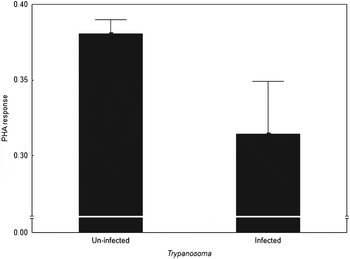
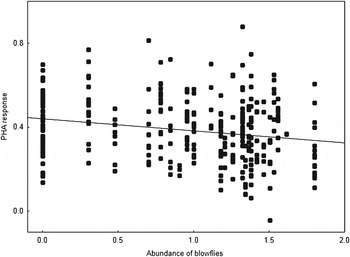
Nestling body mass was not significantly affected by any of the independent variables included in the model with the exception of tarsus length (data not shown). However, the PHA response was negatively associated with infections by Trypanosoma (Fig. 1, F 1,223 = 4·79, P = 0·03) and the number of blowflies (Fig. 2, F 1,223 = 4·67, P = 0·03) and positively with nestling body mass (F 1,223 = 5·24, P = 0·02). The insect repellent treatment and infections by Leucocytozoon were not retained by the final model.
Nestling PHA response (mm) with respect to Trypanosoma infection status. Bars denote standard error.

Relationship between nestling PHA response (mm) and the number of blowflies (log10x+1) in the nest. Regression line is shown.

DISCUSSION
Parasite prevalence in nestlings
The prevalence of blood parasites infecting blue tit nestlings has previously been reported (Fargallo and Merino, Reference Fargallo and Merino2004; Cosgrove, Reference Cosgrove, Knowles, Day and Sheldon2006; Arriero et al. Reference Arriero, Moreno, Merino and Martínez2008). Here, we found 29% of broods infected by Trypanosoma and/or Leucocytozoon parasites. A previous study in central Spain, by Arriero et al. (Reference Arriero, Moreno, Merino and Martínez2008), found 16% and 13% of broods infected by Leucocytozoon in 2 consecutive years while only 1 nestling was found infected by Trypanosoma. Curiously, Fargallo and Merino (Reference Fargallo and Merino2004) found nestlings infected by Trypanosoma and Leucocytozoon in 80% and 100% of nests respectively, in the same blue tit population studied here. Discrepancies between studies could be due either to inter-annual differences in vector abundance in the area (Tomás et al. Reference Tomás, Merino, Martínez-de la Puente, Moreno, Morales and Lobato2008a), to differences in the immunological and/or nutritional state of nestlings (see Merino et al. Reference Merino, Potti and Moreno1996, Reference Merino, Møller and de Lope2000a), but also to the fact that Fargallo and Merino (Reference Fargallo and Merino2004) sampled nestlings 2 days older than those in this study. The probability of detecting parasites in the peripheral blood of nestlings may increase with nestling age because the time available for parasite transmission and development increases. Therefore, it is possible that we underestimated the prevalence of blood parasite infections in nestlings sampled at 13 days old. Nevertheless, the potential effect of undetected infections should render our results conservative because infected individuals would have been considered as uninfected.
Blood parasite prevalence and blood-sucking flying insects
The insect repellent treatment effectively reduced the number of blood-sucking flying insects in nests. Unexpectedly, this treatment did not reduce the prevalence of infection by blood parasites in nestlings. However, because the treatment did not completely eliminate blood-sucking flying insects from nests in most of the fumigated nests, nestlings were still exposed to blood parasite infections. In support of this possibility, the number of blood-sucking flying insects determined their infection status by Trypanosoma. The alternative, that more parasitized nestlings attracted more blood-sucking flying insects to their nest, is not supported by previous studies, in which low parasitized birds attracted more vectors than more parasitized ones (Tomás et al. Reference Tomás, Merino, Martínez-de la Puente, Moreno, Morales and Lobato2008b; Martínez-de la Puente et al. Reference Martínez-de la Puente, Merino, Tomás, Moreno, Morales, Lobato, Talavera and Sarto i Monteys2009b; Lalubin et al. Reference Lalubin, Bize, van Rooyen, Christe and Glaizot2012). Sol et al. (Reference Sol, Jovani and Torres2000) found good evidence supporting a role for vector abundance in determining the prevalence of infection by blood parasites in birds. These authors found that vector abundance correlated with the prevalence of infection by Haemoproteus and that the scarcity of vectors, and not other measured host traits, was the reason explaining the low prevalence of Haemoproteus (Sol et al. Reference Sol, Jovani and Torres2000). Our study on a different host–vector–blood parasite system agrees with their finding: the more vectors that visited the nest, the more likely nestlings were to be infected by blood parasites. Thus, factors affecting the number of blood-sucking flying insects in bird nests including brood size, nest temperature and weather conditions (Tomás et al. Reference Tomás, Merino, Martínez-de la Puente, Moreno, Morales and Lobato2008b; Martínez-de la Puente et al. Reference Martínez-de la Puente, Merino, Lobato, Rivero-de Aguilar, del Cerro, Ruiz-de-Castañeda and Moreno2010) could be important determinants of the prevalence of infection by blood parasites in nestlings (see Fargallo and Merino, Reference Fargallo and Merino2004).
Parasites and PHA response
Negative associations were found between Trypanosoma and blowfly infections and the PHA response in nestlings. Studies on captive house sparrows Passer domesticus reported that birds infected by blood parasites mounted a lower PHA response than uninfected birds (Navarro et al. Reference Navarro, Marzal, de Lope and Møller2003) and higher PHA responses were associated with a higher rate of recovery from parasite infections (González et al. Reference González, Sorci, Moller, Ninni, Haussy and de Lope1999).
Because the relationships reported here between PHA response and parasite infections are not based on an experiment, we cannot identify the causality of these associations. First, it is possible that the lower PHA response found in infected nestlings is the consequence of parasite infections. The costs of infections may be multiple and diverse according to the parasite species involved. The costs may include metabolic changes affecting the allocation of resources that could otherwise be used for self-maintenance (Møller, Reference Møller, Clayton and Moore1997; Merino et al. Reference Merino, Moreno, Sanz and Arriero2000b). Moreover, parasites are a source of physiological stress (Merino et al. Reference Merino, Martínez, Barbosa, Møller, de Lope, Pérez and Rodríguez-Caabeiro1998; Arriero et al. Reference Arriero, Moreno, Merino and Martínez2008; Martínez-de la Puente et al. Reference Martínez-de la Puente, Merino, Tomás, Moreno, Morales, Lobato and Martínez2011) and stress or the physiological responses to reduce the costs induced by stressful situations are immunosuppressant (Merino et al. Reference Merino, Martínez, Møller, Barbosa, de Lope and Rodríguez-Caabeiro2001; Saino et al. Reference Saino, Suffritti, Martinelli, Rubolini and Møller2003). Alternatively, a lower PHA response could indicate a nestling's susceptibility to infections. Nestlings may largely depend on their parents to mount an effective immunological response once parasites or their vectors reached the nests (Merino, Reference Merino2010). Nutrition status plays a major role on the immune system of the nestling as supported by the positive association between the intensity of the PHA response and nestling condition (Saino et al. Reference Saino, Calza and Møller1997; Navarro et al. Reference Navarro, Marzal, de Lope and Møller2003; this study) or food provisioning or availability (Lochmiller et al. Reference Lochmiller, Vestey and Boren1993; Saino et al. Reference Saino, Calza and Møller1997; Hoi-Leitner et al. Reference Hoi-Leitner, Romero-Pujante, Hoi and Pavlova2001). Thus, a reduction in parental effort could reduce nestling condition and increase their susceptibility to infections (Merino et al. Reference Merino, Potti and Moreno1996). Under this assumption the relationship between the PHA response and parasite infections could be mediated by nestling condition. However, it was found that the associations between PHA response and parasite infections remained significant after controlling statistically for nestling body mass. Nevertheless, the scarcity of specific nutrients in nestling diet, such as protein content, could induce immunosuppression, thus increasing nestling exposure to parasites without detectable effects on body condition (Saino et al. Reference Saino, Calza and Møller1997).
Finally, we did not find any significant effect of the insect repellent treatment on nestling body mass or PHA response after controlling for the effect of blood parasite infections. This suggests that blood parasites transmitted by blood-sucking flying insects, but not insect attacks, are mainly responsible for the detrimental effects on nestlings.
In conclusion, we found support for the fact that (i) the number of blood-sucking flying insects increases nestling exposure to blood-parasite infections and (ii) parasite infections adversely affect the nestling PHA response.
ACKNOWLEDGEMENTS
We thank Javier Donés (Director of Montes de Valsaín) for permission to work in the study area. The Junta de Castilla y León authorized the ringing and handling of birds. This study is a contribution to the research developed at the ‘El Ventorrillo’ field station. We thank J. Figuerola and L. Gangoso for their help with statistical analyses and two anonymous reviewers for helpful comments.
FINANCIAL SUPPORT
This study was funded by project CGL2009-09439. Josué Martínez-de la Puente is supported by a contract from the programme Junta para la Ampliación de Estudios (CSIC) co-financed by Fondo Social Europeo.