


Introduction
Bovine respiratory disease (BRD) is a common disease concern in dairy cattle. According to the US National Animal Health Monitoring Surveys (NAHMS), BRD is the second most commonly recorded health issue in preweaned dairy calves with an incidence of 18% (second only to diarrheal disease) and the most commonly recorded health issue in weaned calves at 11.2%. In adult dairy cows, the recorded incidence is much lower at <3% incidence. However, it is highly likely that the true incidence is higher in all categories of dairy animals as dairies often fail to accurately detect and/or record clinical diseases.
The impact of BRD is highly variable, depending on the accuracy and completeness of detection, effectiveness of treatment, and on-farm culling practices. Consequences may manifest themselves immediately or later in life and include decreased rate of gain, delayed age at first service, delayed age at first calving, a higher culling risk either as heifers or as cows, and in some cases, depending at least in part on heifer culling practices, lower future milk production (Waltner-Toews et al., Reference Waltner-Toews, Martin and Meek1986; Virtala et al., Reference Virtala, Mechor, Gröhn and Erb1996; Ames, Reference Ames1997; Donovan et al., Reference Donovan, Dohoo, Montgomery and Bennett1998; Bach, Reference Bach2011; Stanton et al., Reference Stanton, Kelton, Leblanc, Wormuth and Leslie2012; Schaffer et al., Reference Schaffer, Larson, Cernicchiaro, Hanzlicek, Bartle and Thomson2016; Closs and Dechow, Reference Closs and Dechow2017; Cramer and Ollivett, Reference Cramer and Ollivett2019; Steckler and Boermann, Reference Steckler and Boermann2019). However, there are few published estimates of the cost of BRD in dairy animals and these figures likely underestimate the complete impact, in part due to the inconsistencies in disease recording that result in low, biased cost assessments and incomplete characterization of the impact of BRD on growth and culling. Published cost estimates vary from $29 to $50, after accounting for inflation from the time of publication until 2020 (Kaneene and Hurd, Reference Kaneene and Hurd1990; van der Fels-Klerx et al., Reference Van Der Fels-Klerx, Sorensen, Jalvingh and Huirne2001; Dubrovsky et al., Reference Dubrovsky, Van Eenennaam, Aly, Karle, Rossitto, Overton, Lehenbauer and Fadel2020).
Nevertheless, economic conditions in today's dairy climate are vastly different from those represented by previously published estimates. First, there is currently a large surplus of dairy heifer inventory relative to demand. This excess inventory, coupled with reduced demand due to weak milk prices, has resulted in heifer values along the entire replacement timeline that are significantly lower than the cost of raising, based on comparisons between projected cost estimates by the author and heifer auction market values. Second, a surplus on the farm of replacement heifers today has contributed to economic strain for many producers; consequently, there is more voluntary or selective culling of heifers prior to calving. Generally, producers try to identify cull candidates early in life to reduce the total investment costs and minimize economic losses. While many factors combine to determine the most appropriate heifers for removal from the herd and entry into the beef chain, a history of BRD or other disease and/or a lower rate of gain are two important factors for consideration in addition to genetic potential. Finally, because many if not most of the more severely affected heifers are removed prior to calving in this scenario, measuring the carry-over impact of heifer disease is much more difficult due to the culling bias. The goal of this project was to estimate the cost of BRD in heifers from birth through 4 months of age by evaluating the impact of BRD on treatment costs, mortality costs, culling costs, rate of gain, and future value on the cost of raising heifers with and without an incident case of BRD in early life.
Commercial dairy disease data
To establish the pattern of BRD in dairy replacement heifers, a convenience sample of 23 dairy herds from across the USA was compiled from on-farm dairy records. Herds ranged from 448 to 6856 cows, milking and dry, with a median herd size of 1600. Holstein was the predominant breed (90%) with the remainder being Jersey or Crossbreds. To be included in this data set, all herds had to record BRD in their replacement heifers on a monthly basis and use Dairy Comp 305 (Valley Agricultural Software Inc., Tulare, CA, USA) as their on-farm record system. There was no minimum or maximum threshold to be included other than simply having monthly BRD information recorded consistently. Dairy heifer data for 104,100 dairy replacement heifers born between 1 January 2016 and 31 December 2017 were collected in early 2019. Preliminary screening of the records for heifers born only in 2016 showed that the risk of initial cases of BRD past 120 days of age was <1%. Consequently, data from both years of birth were used allowing for follow-up through at least one full year. The dates for the first, second, third, and fourth recorded BRD cases were collected along with the birth dates, removal dates, and removal codes (sold versus died).
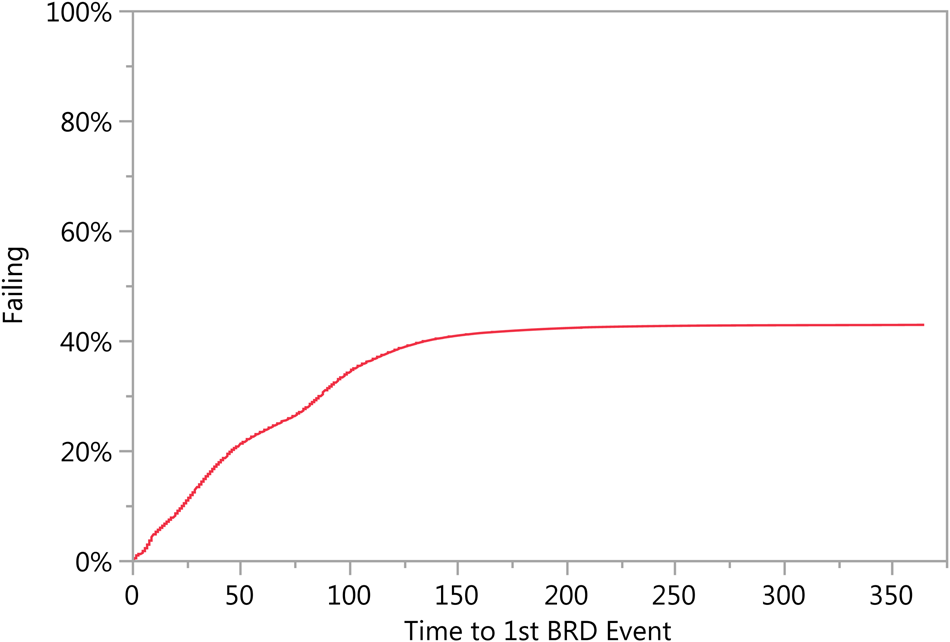
After examination of the timing of occurrence for the first BRD event using a survival plot, the first 4 months was chosen as the primary time at risk for study and cost estimation (Fig. 1). In this data set, there was a high risk of BRD through the first 4 months and then the risk of new cases diminished greatly such that very few new cases were recorded between months 5 through 12 of age. Table 1 shows the BRD incidence stratified by age category and incident versus total BRD risk.
Time to first recorded BRD event (days) for all heifers in the 23-herd dairy heifer data set, censoring at 365 days of age.

Incidence of BRD by 30-day increments over the first 120 days of life

a Initial case incidence = number of first time BRD cases/number of heifers born.
b Total BRD risk = number of new and repeat cases/number of heifers born.
Economic model construction and results
To estimate the cost of BRD occurring within the first 120 days of age in dairy replacement heifers, an existing economic model for estimating the cost of heifer raising from birth through first calving was modified and used (Overton and Dhuyvetter, Reference Overton, Dhuyvetter and Beede2017). Updates were made to better account for variations in labor efficiency differences across farms of varying size, to improve the cost estimation of housing using confinement versus more extensive systems, and to reflect current economic conditions. The original model was created to compare a traditional (conventional) method of raising heifers which achieved an average daily gain of 0.72 kg day−1 to a more intensive approach (improved nutritional management to achieve a higher rate of lean tissue gain (0.86 kg d−1 of average daily gain) by favoring a higher metabolizable protein-allowable gain than metabolizable energy-allowable gain as predicted via the ration balancing software). To model the effects of BRD, two additional submodels for growth were created to follow heifers from birth through calving. The first group, BRD, represented heifers that experience one or more cases of respiratory disease within the first 120 days of age. The comparison group, No-BRD, represented heifers that do not experience respiratory disease within the first 120 days of age.
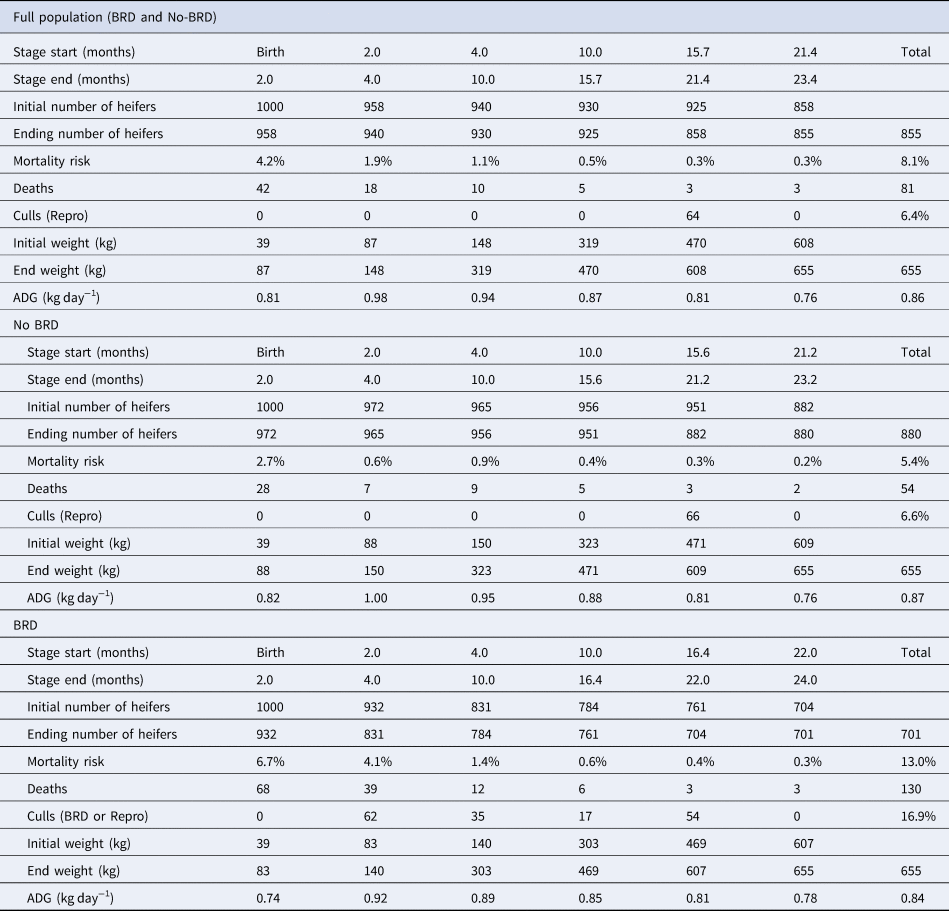
The estimated impact of BRD on the baseline growth curve was adapted from published work (Donovan et al., Reference Donovan, Dohoo, Montgomery and Bennett1998; Stanton et al., Reference Stanton, Kelton, Leblanc, Wormuth and Leslie2012; Cramer and Ollivett, Reference Cramer and Ollivett2019; Steckler and Boermann, Reference Steckler and Boermann2019). No published study described the precise differences in growth between BRD and No-BRD heifers across all stages as modeled in this project; thus, portions of each study are used to create a blended representative growth curve. Starting with the original intensive growth curve that contained both BRD and No-BRD heifers, growth differences were estimated from the published literature for each stage between the two disease classes. However, to subtract the anticipated impact of BRD from the original population growth curve that reflected animals with and without respiratory disease without adjusting the No-BRD heifers upwards would be incorrect. Thus, 20% of the predicted difference in growth attributable to BRD was added to the original growth curve for the No-BRD heifers and the estimated impact of BRD was then subtracted from this new curve to create the slower growth curve for the BRD heifers. As expected, the largest differences in growth were prior to 4 months of age, with diminishing impacts up through the prepartum period as shown in Table 2. The diminishing impacts on the average growth rate at the population level are assumed to be the result of culling, and thus the removal of the more severely affected heifers, and a small amount of compensatory growth that is associated with improvement in health in those heifers that remain in the herd.
Growth stages within the heifer-raising model and the corresponding daily gains, mortality risk, and culls, both BRD-related and those resulting from reproductive failure

Values were rounded for reporting; thus, some values may appear to be slightly different than expected.
All housing, nutrition, and reproductive management options are identical between the two modeled scenarios and mimic a large (>1000 cows) dairy (from a labor efficiency perspective) using confined, indoor housing. Assumptions within the model include a newborn heifer calf value of $100, labor at $15 h−1, current feed ingredient prices representative of the Midwest region of the USA, and a capital cost of 6%. Housing is by individual calf hutch until weaning, followed by small indoor group pens and then movement into large indoor group pens. The nutrition program starts with a 28:18 milk replacer and 22% calf starter, followed by a 20% grower grain with alfalfa hay, then proceeding on to a TMR (total mixed rations)-based feeding program designed to meet the metabolizable protein and energy needs to support daily gain as shown in Table 2. Reproductive management begins when heifers reach the targeted breeding size of 400 kg (based upon 57% of 702 kg expected mature weight) and 130 cm in withers height. Breeding is modeled as an estrus detection-based program where the average insemination risk is 68% and held constant across the six 21-day cycles of breeding eligibility. The conception risk starts at 58% and declines to 47% by cycle 6 with a resulting weighted average conception risk of 56% overall.
Throughout this paper, cumulative and total disease risks are mentioned. By definition, cumulative risk is calculated as the number of new or incident cases divided by the total number of animals at risk. Total risk refers to the total cases, incident and repeat, that occur throughout the heifer raising period. Cumulative mortality risks, age-specific mortality risks, case-fatality risks, and non-mortality culling information were collected from a number of sources and adapted into the model (Sivula et al., Reference Sivula, Ames, Marsh and Werdin1996; Virtala et al., Reference Virtala, Mechor, Gröhn and Erb1996; Stanton et al., Reference Stanton, Kelton, Leblanc, Wormuth and Leslie2012; Schaffer et al., Reference Schaffer, Larson, Cernicchiaro, Hanzlicek, Bartle and Thomson2016; Closs and Dechow, Reference Closs and Dechow2017). Published estimates for BRD-attributable mortality risk vary by study and by age. Preweaing, 24% of all deaths were attributed to BRD, but postweaning, the risk rose to 59% (USDA, 2018). Canadian researchers attributed 47% of all heifer deaths to BRD (Stanton et al., Reference Stanton, Kelton, Leblanc, Wormuth and Leslie2012). Case-fatality risks reported vary widely from a low of 2.2% to a high of 20.4%, with much of the variation likely due to large differences in the ‘apparent’ incidence recorded (Sivula et al., Reference Sivula, Ames, Marsh and Werdin1996; Virtala et al., Reference Virtala, Mechor, Gröhn and Erb1996; Schaffer et al., Reference Schaffer, Larson, Cernicchiaro, Hanzlicek, Bartle and Thomson2016). Total culling risk, including mortality and non-mortality reasons, ranged from 1.6 to 5.0 times higher for heifers with recorded BRD as compared to those without BRD (Stanton et al., Reference Stanton, Kelton, Leblanc, Wormuth and Leslie2012; Schaffer et al., Reference Schaffer, Larson, Cernicchiaro, Hanzlicek, Bartle and Thomson2016; Closs and Dechow, Reference Closs and Dechow2017).
In order to construct the two model paths of BRD or no-BRD, stage-specific mortality risks for a complete population (ALL) that included heifers with and without BRD were created (Table 2). A 4.2% preweaning mortality risk and 8.1% cumulative mortality risk from livebirth to calving were input for the ALL population and the only additional culling modeled for this group was that due to reproductive failure, where 65 heifers (6.5%) were sold. From this ALL scenario, changes were made to account for the presence or absence of BRD. Then, all predicted BRD-related mortality risks and treatment costs were removed to reflect only the effect and cost of BRD-related health costs (BRD scenario). However, the differences in risk were not simply subtracted from the ALL population estimates. Rather, the No-BRD population was assumed to have decreased mortality risks across the full raising period, and the BRD model was adjusted such that the final, joined population (ALL) reflected the same mortality risk as before. An assumed cumulative incidence of 36.6% BRD was used, with 61.9% of incident cases occurring by 60 days of age, but for simulation and presentation purposes, equal populations of 1000 heifers each were modeled for BRD or No-BRD. A BRD case fatality risk of 8.0% of incident cases was assumed. Working backwards from the total mortality expected in the ALL population, the total number of dead heifers attributable to BRD was calculated. Then, the remaining number of deaths not attributable to BRD was determined and was distributed proportionately over both the BRD and No-BRD heifers by stage based upon the 36.6% incidence assumed. Adding the BRD-attributable risk to the underlying baseline risk resulted in the final mortality risk in the BRD population. As a result of this approach, 41% of total deaths in the BRD population were attributable to BRD and both the case fatality risk and this attributable death risk are consistent with the previously cited published work (Sivula et al., Reference Sivula, Ames, Marsh and Werdin1996; Virtala et al., Reference Virtala, Mechor, Gröhn and Erb1996; Stanton et al., Reference Stanton, Kelton, Leblanc, Wormuth and Leslie2012; Schaffer et al., Reference Schaffer, Larson, Cernicchiaro, Hanzlicek, Bartle and Thomson2016; USDA, 2018). Approximately 80% of the BRD-attributable deaths were assumed to occur within the stage where BRD occurred, with the remainder carrying over into subsequent raising stages. The cumulative mortality risk for the BRD heifers was 13.0 versus 5.4% in the No-BRD population, resulting in a relative risk for mortality due to BRD of 2.4, which is in agreement with published literature.
Table 2 shows the inventory, mortality risk, culling risk, and growth (weight) for both BRD and No-BRD heifers across the full raising period. Throughout each table, rounding was used, resulting in slight differences between what is shown numerically, and the actual values used within the models. Though the cumulative incidence of BRD modeled was 36.6%, the total incidence for initial and repeat cases was 62.2%. Consequently, an average of 1.7 treatments per incident case was estimated by dividing the total recorded incidence by the cumulative incidence. Age-specific weight-based treatments using an approved extended therapy macrolide (a single extended dose per treatment protocol) and a non-steroidal anti-inflammatory drug (a single dose per treatment) were built into the model using current pricing from an online veterinary distributor. For example, the on-farm treatment protocol for an 84 kg heifer, including labor and drug costs but no veterinary involvement, totaled $15.82.
To estimate the higher non-mortality, non-reproductive culling risk for BRD heifers, an assumption was made that 10% of incident cases were culled into the beef market, due to poor growth performance, and these culls were removed 14 days after entry into the subsequent raising stage. Additionally, 10% of the repeat treatments that carried over into stage four were also removed. Because the focus of the current work was on the cost of BRD occurring within the first 120 days of life, no additional culling attributable to BRD was modeled past 11 months of age. While BRD may occur later in life, it is usually at a much lower risk and its impact was not the focus of this model. Breeding commenced once heifers reached 57% of mature weight. Because the BRD heifers grow at a slow pace, there is a delay to first service and an older average age at first calving (24.0 months versus 23.2) despite identical reproductive efficiency assumed across the two groups. Due to the earlier culling pressure prior to breeding, the BRD group has fewer culls attributable to reproductive failure despite identical assumed reproductive performance once in the breeding group. In the No-BRD group, 6.6% of total heifers that entered the raising program were culled due to reproductive failure as compared to 5.4% of the BRD group. The total non-mortality culling risk was 2.6 times higher (16.9 versus 6.6%) in the BRD group and this agrees with previously cited references. Altogether, the total removal risk was 2.5 times higher for the BRD heifers at 29.9 versus 12.0%, assuming no additional selective culling based on genetics.
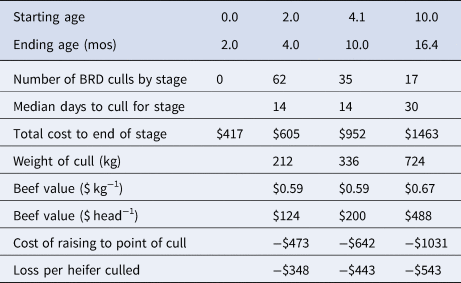
Culling heifers at any stage of the replacement program results in financial losses due to the mismatch between costs incurred by raising relative to the revenue received when culled, under current market conditions. Culling heifers to the beef market due to BRD results in even greater losses due to the lower quality of the heifers and/or poor growth performance. For example, the loss incurred by culling a heifer at 2.5 months is $348, assuming a modeled market value of $1.29 kg−1, a body weight at culling of 962 kg, and an estimated cost of raising up to this time of $473 that includes the initial calf value, feed, housing, and other management inputs (see Table 3). Delaying the culling decision results in greater losses due to the widening gap between investment cost and expected returns as cull beef animals. The market values received for each stage represent the average values/unit of body weight obtained from online market news reports from public auction houses located in California (escalonlivestockmarket.com), Pennsylvania (ams.usda.gov), Missouri (producerslivestock.com), and Idaho (ams.usda.gov) that reported values for Holstein heifers across a range of body weights. Market values for heifers culled prior to breeding were discounted 25% from reported market values to account for lower potential value associated with their health status. Table 3 shows the details by stage for heifers within the BRD scenario and their losses when culled. The losses per head culled were −$348, −$443, and −$543 for heifers culled due to BRD at 2.5, 4.5, and 11 months of age, respectively.
Cost of raising heifers within the BRD population by stage from birth through 16 months of age and the associated losses incurred as a result of culling at either 2.5, 4.5, or 11 months of age

Finally, there is the issue of first lactation performance impacts due to potential carry-over effects attributable to BRD that occurs in the young heifers. While there is no doubt that experiencing BRD is bad, the ability to measure the carry-over effects is difficult for several reasons. First, as modeled in this project, there is usually additional culling of the most severely affected animals; consequently, only heifers that have recovered more completely have the opportunity to calve, thus diminishing any measurable differences. Second, disease definition, detection intensity, and accuracy of diagnostic efforts vary greatly across herds. There is likely some misclassification bias resulting in BRD-affected animals calving without the condition being identified and recorded. As a result, the ability to quantify a statistically significant effect of BRD on milk production or the subsequent culling risk in first lactation is diminished. Schaffer et al. reported that heifers born on a single farm with BRD were 28% more likely to be culled in first lactation and they produced 233 kg less 305-day mature equivalent milk (Schaffer et al., Reference Schaffer, Larson, Cernicchiaro, Hanzlicek, Bartle and Thomson2016). Previous work by the author yielded very herd-specific results with some herds demonstrating similar losses, but others have no detectable effect of previous BRD. For the purposes of this project, no differences in first lactation culling risk were predicted due to the culling of the worst affected heifers prior to calving for the first time. Meta-regression work by Soberon and Van Amburgh showed a positive relationship between preweaning ADG and first lactation milk, where milk yield = −106 kg + 1551.4 kg × ADG (Soberon and Van Amburgh, Reference Soberon and Van Amburgh2013). Using this approach, despite the culling pressure previously modeled, surviving BRD heifers are predicted to produce 123 kg less milk based on the lower average rate of gain preweaning as compared to the No-BRD heifers. Assuming 2.33 kg of marginal milk per marginal kg of dry matter consumed, a feed price of $0.25 kg−1 dry matter and a milk value of $0.40 kg−1, and 25% culling risk in first lactation, the net present value of the marginal milk that is not produced in the first lactation is $30.
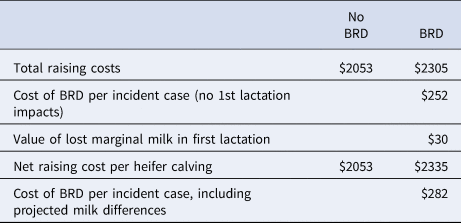
Table 4 shows the overall net economic impact of BRD. The total raising cost for heifers in the No-BRD group was $2053 per heifer that calves. In the BRD group, the total raising cost is $2305 per heifer that calves, yielding a net difference of $252. This additional expense is the estimated cost per incident case of BRD that occurs within the first 120 days of age, assuming no carry-over effects into first lactation. If the economic value of the reduction in predicted milk due to BRD-related impacts on early heifer growth is considered as modeled, the net cost per incident case of BRD rises to $282. These cost estimates for BRD are significantly higher than other previously reported values, even accounting for inflation adjustment. One big difference is in the approach taken with culling. Current market conditions reflect a very large loss when heifers are culled for the beef market. Other models have assumed a much lower additional culling risk attributable to BRD relative to the approach taken here. However, if additional non-mortality culling is eliminated from the BRD group, the cost differences due to mortality, slower rate of gain, and additional treatment costs are still $125 (no milk consideration) and $155 (accounting for lower milk production in the first lactation). However, if no heifers were selectively culled prior to first calving, the impact of BRD on productivity in the first lactation would be significantly higher than modeled here and there would be additional culling losses in the first lactation that were not evaluated in this model.
Total Holstein heifer raising costs, from birth to calving including calf value, mortality, culling, and opportunity costs and the resulting cost of BRD

Conclusion
Heifer BRD occurring in the first 120 days of age was found to be very costly with anticipated differences in raising cost between animals with BRD and those without resulting in a cost per incident case of $252 or $282, depending upon whether anticipated future milk production differences were considered or not. Current market conditions as reflected in this model have contributed to a higher cost estimate than previously published, driven in part by the losses associated with selective culling of a subset of heifers that experienced BRD. However, the impact on a herd's ability to selectively cull based upon genetics, resulting in even more valuable heifers at calving if BRD were eliminated or greatly reduced, was not considered. Individual herd costs will vary but may be significantly higher, depending upon the initial value of the calf entering the raising program, level of BRD, the culling practices associated with BRD, the accuracy and promptness of diagnosis and treatment, and any potential carry-over effects into the first lactation.