

Developmental dyslexia is a failure to acquire word recognition skills that affects around 5% of the population despite adequate intelligence, education, and social background (Lyon, Reference Lyon1995; Snowling, Reference Snowling2000; Stanovich, Reference Stanovich1982; Vellutino, Reference Vellutino1979). A leading hypothesis to explain the difficulties of the dyslexics (DYS) with word recognition is that it results from a deficient representation and use of phonological information (Goswami & Bryant, Reference Goswami and Bryant1990; Griffith & Snowling, Reference Griffith and Snowling2002; Rack, Snowling, & Olson, Reference Rack, Snowling and Olson1992; Sprenger-Charolles, Colé, & Serniclaes, Reference Sprenger-Charolles, Colé and Serniclaes2006; Ziegler & Goswami, Reference Ziegler and Goswami2005), which interferes with the ability to establish grapheme–phoneme correspondences. These deficient phonological skills delay the development of orthographic knowledge (Hultquist, Reference Hultquist1997) and the ability to process orthographic information (Marinus & De Jong, Reference Marinus and De Jong2010), preventing the DYS from developing rapid and automatic word recognition skills (Share, Reference Share1995).
Although these phonological processing difficulties persist into adulthood (Bruck, Reference Bruck1990, Reference Bruck1992; Felton, Naylor, & Wood, Reference Felton, Naylor and Wood1990), the DYS make progress in learning to read (Deacon, Parrila, & Kirby, Reference Deacon, Parrila and Kirby2006; Pennington, Van Orden, Smith, Green, & Haith, Reference Pennington, Van Orden, Smith, Green and Haith1990) and some succeed at university. However, very little is known about the mechanism by which the DYS learn to read. As a substitute for their inefficient decoding abilities, Stanovich (Reference Stanovich1980) has proposed that they use their adequate semantic knowledge to recognize words in a top-down process (for a similar proposition, see Hulme & Snowling, Reference Hulme and Snowling1992). The DYS have also been assumed to process complex orthographic patterns more easily than do spelling-age controls (Lefly & Pennington, Reference Lefly and Pennington1991; Pennington et al., Reference Pennington, McCabe, Smith, Lefly, Bookman and Kimberling1986) and to develop superior awareness of the orthographic structure of words compared to typically developing readers (Siegel, Share, & Geva, Reference Siegel, Share and Geva1995).
In a pioneering work, Elbro and Arnbak (Reference Elbro and Arnbak1996) have suggested that dyslexic readers are particularly prone to rely on morphemes, the smallest units of meaning in words, during visual word recognition. There are at least two reasons why the processing of written morphology could be particularly appropriate for dyslexic readers. First, morphemes are larger units than graphemes. Thus, their processing does not require the activation of fine-grained phonological representations, which are underspecified in DYS (e.g., Ziegler & Goswami, Reference Ziegler and Goswami2005). Second, a large proportion of the new words encountered in print are morphologically complex (Nagy & Anderson, Reference Nagy and Anderson1984), and these complex words are generally very long and unfrequent, thereby unlikely to be represented in the lexicon. Because dyslexic readers have difficulties in reading long words (Martens & de Jong, Reference Martens and de Jong2006) and new words (Rack et al., Reference Rack, Snowling and Olson1992), the possibility to decompose morphologically complex words into morpheme-size units may facilitate word recognition.
In spite of these arguments, only a few studies have investigated the issue of morphological processing during visual word recognition in dyslexic readers. The present study is designed to examine whether children with developmental dyslexia rely on morphemes during visual word recognition and on which properties of morphemes they rely to do so.
MORPHOLOGY, WORD RECOGNITION, AND DEVELOPMENTAL DYSLEXIA
Over the last decade, an increasing body of research has demonstrated that developing readers rely on morphemes during the processing of morphologically complex words and pseudowords (in English: Carlisle & Stone, Reference Carlisle, Stone, Assink and Sandra2003, Reference Carlisle and Stone2005; in French: Colé, Bouton, Leuwers, Casalis, & Sprenger-Charolles, Reference Colé, Bouton, Leuwers, Casalis and Sprenger-Charolles2012; Quémart, Casalis, & Duncan, Reference Quémart, Casalis and Duncan2012; in Italian: Burani, Marcolini, & Stella, Reference Burani, Marcolini and Stella2002) as early as in second grade.
However, there is little agreement as to whether the ability to process written morphology can develop in spite of decoding difficulties. Some authors have argued that the processing of small-size units such as graphemes is required to process large-size units such as rhymes (Duncan, Seymour, & Hill, Reference Duncan, Seymour and Hill1997, Reference Duncan, Seymour and Hill2000), suggesting that the processing of written morphemes should not be possible when the application of grapheme–phoneme correspondences is impaired. Nevertheless, the psycholinguistic grain-size theory considers that reading development does not necessarily involve a small-to-large unit progression and that grain-size units depend on orthographic consistency as well as on the availability of spoken units in a given language (Ziegler & Goswami, Reference Ziegler and Goswami2005). In line with this argument, Hatcher and Snowling (Reference Hatcher, Snowling, Reid and Wearmouth2002) suggest that the establishment of relationships between orthography and phonology occurs at a coarse-grained level in DYS, that is, at a multiletter level or at a morphemic level.
Studies investigating the ability of readers with dyslexia to make use of morphemes during visual word recognition have revealed inconsistent results. Children with dyslexia benefit from the presence of morphemes when reading aloud Italian complex words (e.g., cassiere, “cashier”) and pseudowords (e.g., donnista, “womanist”; Burani, Marcolini, De Luca, & Zoccolotti, Reference Burani, Marcolini, De Luca and Zoccolotti2008; Traficante, Marcolini, Luci, Zoccolotti, & Burani, Reference Traficante, Marcolini, Luci, Zoccolotti and Burani2011). In Danish, they are more efficient when they can move a text window morpheme-by-morpheme than syllable-by-syllable, contrary to their reading-age matched peers (Elbro & Arnbak, Reference Elbro and Arnbak1996). Significant priming effects in a lexical decision task have also been evidenced by Leikin and Zur Hagit (Reference Leikin and Zur Hagit2006) in Hebrew-speaking adults with dyslexia. By contrast, Deacon et al. (Reference Deacon, Parrila and Kirby2006) found that, contrary to their age matched peers, high-functioning English-speaking adult DYS were not influenced by the morphological complexity of words when performing a lexical decision task. A lack of sensitivity to the morphological structure of words has also been reported by Schiff and Raveh (Reference Schiff and Raveh2007) in a primed word fragment completion task in adult Hebrew readers with dyslexia (for similar results in a primed visual lexical decision task, see also Raveh & Schiff, Reference Raveh and Schiff2008).
These inconsistencies might result from methodological differences between studies with respect to the tasks used and the control groups selected for comparison. The DYS’ reliance on derivational morphemes in a naming task indicates that they have established connections between orthography and phonology at grain sizes larger than single letters, which might supplement inefficient grapheme–phoneme decoding. By contrast, the lexical decision task sheds light on how the lexical system encodes morphological information and how it recognizes morphologically complex words. In addition, given the absence of a reading-age matched control group in many experiments, one cannot exclude that the different patterns of results observed in DYS may be the consequence of their general reading delay rather than a specific deficit in morphological processing. Thus, the lack of convergence between the studies conducted so far demonstrates the need to further investigate the processing of written morphology in DYS.
NATURE OF MORPHOLOGICAL PROCESSING
Because morphemes encode both form and meaning information, the present paper also seeks to clarify the influence of each of these properties in the DYS’ processing of written morphology. Both hypotheses (form-driven and meaning-driven processing) have been proposed. According to Burani et al. (Reference Burani, Marcolini, De Luca and Zoccolotti2008, see also Marcolini, Traficante, Zoccolotti, & Burani, Reference Marcolini, Traficante, Zoccolotti and Burani2011; Traficante et al., Reference Traficante, Marcolini, Luci, Zoccolotti and Burani2011), children with dyslexia are better able to grasp morphemic than graphemic units when reading long and unfrequent words, because morphemes are larger units than graphemes and easily catchable. This form-driven hypothesis assumes that the processing of written morphology does not necessarily require the activation of semantic knowledge when reading aloud. In contrast, Elbro and Arnbak (Reference Elbro and Arnbak1996, see also Casalis, Colé, & Sopo, Reference Casalis, Colé and Sopo2004, for a similar proposition) consider that the DYS’ activation of morphemes’ meaning is central in morphological decomposition when reading aloud. In line with this meaning-driven hypothesis are the more accurate reading scores of the DYS when morphologically complex words are semantically transparent (e.g., sunburn) than when they are opaque (e.g., window; Elbro & Arnbak, Reference Elbro and Arnbak1996).
The form-based and meaning-based hypotheses of morphological decomposition have never been directly compared in dyslexic readers. The priming paradigm associated to a lexical decision task has been successfully used to investigate this issue in adult skilled readers (in English: Feldman, Soltano, Pastizzo, & Francis, Reference Feldman, Soltano, Pastizzo and Francis2004; Marslen-Wilson, Tyler, Waksler, & Older, Reference Marslen-Wilson, Tyler, Waksler and Older1994; Rastle, Davis, Marslen-Wilson, & Tyler, Reference Rastle, Davis, Marslen-Wilson and Tyler2000; in French: Giraudo & Grainger, Reference Giraudo and Grainger2000; Longtin, Segui, & Hallé, Reference Longtin, Segui and Hallé2003; see Rastle & Davis, Reference Rastle and Davis2008, for a review) and in typically developing readers (Casalis, Dusautoir, Colé, & Ducrot, Reference Casalis, Dusautoir, Colé and Ducrot2009; Quémart, Casalis, & Colé, Reference Quémart, Casalis and Colé2011). In particular, the manipulation of the semantic overlap between morphologically related prime–target pairs, as well as the manipulation of prime duration, has made it possible to examine the influence of form and meaning in the processing of written morphology.
In adult skilled readers, when the prime is presented so fast that it cannot be explicitly perceived (i.e., masked priming), priming effects have been observed when prime–target pairs share a morphological relationship (e.g., cleaner–clean) and a pseudoderivation relationship (i.e., morphological relationship with no semantic overlap, e.g., corner–corn). This result is taken as evidence that the processing system is not influenced by the semantic properties of morphemes at the earliest steps of word recognition (in English: Marslen-Wilson, Bozic, & Randall, Reference Marslen-Wilson, Bozic and Randall2008; Rastle, Davis, & New, Reference Rastle, Davis and New2004; in French: Longtin & Meunier, Reference Longtin and Meunier2005; Longtin et al., Reference Longtin, Segui and Hallé2003). However, when the prime is presented for more than 200 ms, priming effects are not observed in the pseudoderivation condition anymore (Marslen-Wilson et al., Reference Marslen-Wilson, Bozic and Randall2008; Longtin et al., Reference Longtin, Segui and Hallé2003; Meunier & Longtin, Reference Meunier and Longtin2007), indicating that the activation of the semantic properties of morphemes is essential to observe morphological decomposition later in the time course of visual word recognition.
Similar results have been observed in typically developing readers, except that the influence of the semantic properties of morphemes was perceptible later in the time course of word recognition than in adults. In a study using three different prime durations, Quémart et al. (Reference Quémart, Casalis and Colé2011) found that third- to seventh-grade children benefit from a prime that shares a morphological relationship (i.e., tablette–TABLE; “little table–table”) and a pseudoderivation relationship (i.e., baguette–BAGUE) when the prime is presented for 60 ms and 250 ms. However, with a prime duration of 800 ms, priming effects were not significant in the pseudoderivation condition anymore, indicating that form overlap is not sufficient to process morphologically complex words through their components at this prime duration.Footnote 1 Instead, the significant priming effects observed in both the morphological and the semantic conditions were taken as evidence that developing readers are mainly influenced by the semantic overlap between primes and targets when recognizing words at this 800 ms prime duration.
These patterns of priming have led to the conclusion that morphological decomposition is initially driven by the form properties of morphemes (morphoortho-graphic processing) and then driven by the semantic properties of morphemes (morphosemantic processing). This double mechanism, the form-then-meaning account, assumes that morpho-orthographic processing is a sine qua non to morphological decomposition and that the activation of the semantic properties of morphemes occurs only when words have been decomposed into smaller components on the basis of their form properties.
Nevertheless, the necessity to decompose morphologically complex words into smaller orthographic units prior to the activation of morphemes’ meaning has been put into question fairly recently (Diependaele, Duñabeitia, Morris, & Keuleers, Reference Diependaele, Duñabeitia, Morris and Keuleers2011; Diependaele, Sandra, & Grainger, Reference Diependaele, Sandra and Grainger2005, Reference Diependaele, Sandra and Grainger2009; Feldman, O'Connor, & Moscoso del Prado Martin, Reference Feldman, O'Connor and Moscoso del Prado Martin2009; but see Davis & Rastle, Reference Davis and Rastle2010, for an alternative view). The authors suggest that the semantic properties of morphemes influence morphological decomposition very early in the time course of word recognition. Their assumption is based on a systematic review of the adult literature on morphological masked priming as well as on empirical data, whereby the amount of priming is larger when prime–target pairs share a morphological relationship that is semantically transparent (i.e., related in meaning) than when the relationship is semantically opaque (i.e., unrelated in meaning). To explain these results, Diependaele et al. (Reference Diependaele, Sandra and Grainger2009) have proposed a hybrid model of morphological processing, according to which morpho-orthographic and morphosemantic representations are activated in parallel during word recognition. The morpho-orthographic and morphosemantic levels are interconnected via feedback connections and resonate with each other when the words that are presented to the system activate the two processing levels. These feedback connections explain why larger amounts of priming have been observed when the morphological relationship is semantically transparent than when it is opaque.
The existence of form-driven and meaning-driven hypotheses of morphological processing when reading aloud in the dyslexic literature, as well as the lack of consensus regarding the triggering factors of morphological decomposition in the adult literature, prompted the need to address whether and how children with developmental dyslexia rely on morphemes during visual word recognition.
THE PRESENT STUDY
The existing work thus leaves two important questions open regarding the processing of derivational morphology in children with developmental dyslexia.
1. Do children with dyslexia activate morphological information during visual word recognition?
2. What is the influence of morphemes’ meaning and form properties in this processing?
In this paper, we attempt to address these questions through the study of the influence of semantic information (Experiment 1) and form information (Experiment 2) on French DYS’ morphological decomposition. Morphologically related pairs of words were included in a visual masked priming paradigm, which consists in presenting the primes so fast that they cannot be explicitly perceived. Thus, contrary to the unmasked priming paradigm, which makes it possible to activate strategies in the recognition process, the masked priming paradigm is a powerful tool for investigating rapid and automatic word recognition and for exploring a process that is not under strategic control (Forster, Reference Forster1998).
Although online priming studies have already been conducted in adults with dyslexia (Leikin & Zur Hagit, Reference Leikin and Zur Hagit2006; Raveh & Schiff, Reference Raveh and Schiff2008; Schiff & Raveh, Reference Schiff and Raveh2007), such studies have never been carried out in dyslexic children. The priming paradigm has nonetheless already been exploited in the “garden variety” of poor readers. Significant phonological (Betjemann & Keenan, Reference Betjemann and Keenan2008) and semantic (Assink, Van Bergen, Van Teeseling, & Knuijt, Reference Assink, Van Bergen, Van Teeseling and Knuijt2004; Simpson, Lorsbach, & Whitehouse, Reference Simpson, Lorsbach and Whitehouse1983) unmasked priming effects have been reported in this population, as well as phonological and orthographic masked priming effects (Booth, Perfetti, & MacWhinney, Reference Booth, Perfetti and MacWhinney1999). In the latter study, Booth et al. have shown that poor readers are slower in activating orthographic and phonological information than are good readers, but pseudohomophone priming effects (e.g., kyte–KITE) and orthographic priming effects (e.g., kute–KITE) were already reliable when primes where presented for 60 ms. Following Booth et al. (Reference Booth, Perfetti and MacWhinney1999), we decided to use a 60 ms prime duration in the two experiments presented below.
In order to examine the influence of primes on target processing, we asked the participants to perform a lexical decision task on the targets. This task is more appropriate than the naming task for the purpose of this study because we sought to investigate whether dyslexic children activate morphological representations during visual word recognition. In addition, lexical decision times are influenced to a greater extent by morphological and semantic information than by word naming times (Baayen, Feldman, & Schreuder, Reference Baayen, Feldman and Schreuder2006).
In each experiment, we compared patterns of priming observed in DYS to patterns of priming of children matched for reading level (RL) and of children matched for chronological age (CA). We included a group of adult skilled readers in Experiment 2 only, because the effect of semantic transparency on French adult skilled readers’ morphological processing has been demonstrated in several studies (see, e.g., Longtin et al., Reference Longtin, Segui and Hallé2003).
EXPERIMENT 1: INFLUENCE OF THE SEMANTIC PROPERTIES OF MORPHEMES
Experiment 1 was specifically designed to examine whether dyslexic children rely on morphemes during visual word recognition and, if so, whether this reliance is driven by the semantic properties of morphemes. To do so, we selected prime–target pairs that could share four relationships: morphological (e.g., tablette–TABLE, “little table–TABLE”), pseudoderivation (i.e., morphological without semantic overlap, e.g., baguette–BAGUE, “French stick–ring”), orthographic control (i.e., orthographic overlap with no morphological relationship, abricot–ABRI, “apricot–shelter”), and semantic control (e.g., tulipe–FLEUR, “tulip–FLOWER”).
If children with dyslexia process the morphological structure of words during their recognition, they should benefit from morphological priming, and we expect to observe different priming effects in the orthographic control and the semantic control conditions. With respect to the nature of this processing, two assumptions can be formulated on the basis of naming patterns observed in previous studies. If morphemes’ meaning is not involved in morphological processing in dyslexic readers, as suggested by the form-driven hypothesis, then we should observe significant priming effects in the morphological and pseudoderivation conditions. However, if dyslexic readers rely on the semantic properties of morphemes to process derivational morphology, as proposed by the meaning-driven hypothesis, we expect significant priming effects in the morphological condition only. Finally, we did not expect significant priming effects in the semantic control condition in both groups, because semantic priming typically characterizes later stages of visual word recognition (Bonnotte & Casalis, Reference Bonnotte and Casalis2010; Nievas & Justicia, Reference Nievas and Justicia2004).
Method
Participants
The DYS (n = 16, 7 boys, 9 girls, mean age = 13 years, 6 months [13;6]), the RL control participants (n = 16, 9 boys, 7 girls, mean age = 9;8), and the CA control participants (n = 16, 8 boys and 8 girls, mean age = 13;1) were recruited while they were involved in a larger experiment on morphological processing in good and poor readers in regular schools in the area of Lille (Northern France) and in a specialized school for children with dyslexia in the area of Arras (Pas de Calais, France).
All the dyslexic participants were impaired in both pseudoword and irregular word reading, and they were therefore classified as having a mixed profile of dyslexia by a multidisciplinary team including a speech therapist and an education psychologist. Their nonverbal IQ was within normal range, and they all had at least 24 months reading delay.
None of the control participant reported language impairments, hearing impairments, or neurological disorders, and all the participants had French as their first language.
Background measures
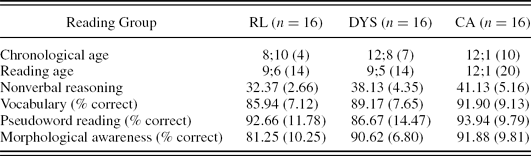
The children completed a battery of five tasks in order to provide a more complete picture of the cognitive and metalinguistic skills of both groups of participants. The complete battery was administered in one session between the two lists of the experimental task. The tasks were administered individually to participants in a quiet room in their schools, and they were administered in the same order to all participants. The mean scores for each of the measures for each group are given in Table 1.
Mean background measures (standard deviations) according to the group in Experiment 1

Note: RL, reading level matched children; DYS, dyslexic children; CA, chronological age matched children. Chronological and reading age are in years;months; nonverbal reasoning (max = 36 in RL, max = 60 in DYS and in CA) is raw scores.
READING SKILLS
Word reading ability was assessed with the Alouette French reading test (Lefavrais, Reference Lefavrais1967), which was administered individually. This test is the most commonly used reading test in France. It consists in reading a text of 265 words aloud as quickly and accurately as possible. The final score provides a reading age taking into account both speed (how many words are read during 3 min) and accuracy. This reading age enables us to ensure that the DYS’ reading age is at least 18 months behind their CA. Although the reliability of this test has not been directly assessed, it compares favorably with other reading tests in terms of sensitivity, specificity, and efficiency (Bertrand, Fluss, Billard, & Ziegler, Reference Bertrand, Fluss, Billard and Ziegler2010).
NONVERBAL REASONING
Nonverbal reasoning was assessed by Raven's Coloured Progressive Matrices (Raven, Court, & Raven, Reference Raven, Court and Raven1995) in children under the age of 12, and Raven's Standard Progressive Matrices (Raven, Raven, & Court, Reference Raven, Raven and Court1998) in children older than 12. The score provided is the raw score (number of correct responsesFootnote 2). The reliabilities of the Raven Coloured and Standard Progressive Matrices are .90 and .88, respectively.
RECEPTIVE VOCABULARY
Receptive vocabulary of the participants was measured with the French version of the Peabody Picture Vocabulary Test, the Echelle de Vocabulaire en Images Peabody (Dunn, Theriault-Whalen & Dunn, Reference Dunn, Theriault-Whalen and Dunn1993). This test consists of 170 words of increasing difficulty. For each word, children need to choose the corresponding image from four alternatives. Because of time constraints, a shorter version of the test has been administered. For each child, we selected a subset of images depending on their CA. This subset included images ranging from 2 years below up to 2 years above their CA. For example, 8-year-old children completed the test comprising items for 6-year-olds and 10-year-olds. The score was the percentage of correct answers within a given age range. The reliability of the Echelle de Vocabulaire en Images Peabody test is .80.
PHONOLOGICAL DECODING
We assessed the phonological decoding skills of the participants by means of a pseudoword reading task. It consisted in reading a set of 12 short pseudowords (mean number of letters = 4.67; SD = 0.49) and 20 long pseudowords (mean number of letters = 8.95; SD = 0.51) as fast and accurately as possible. The pseudowords were created by substituting one or two letters from an existing word. This task is a good indicator of phonological skills and is particularly deficient in readers with dyslexia (Rack et al., Reference Rack, Snowling and Olson1992). Interitem reliability was .82.
MORPHOLOGICAL AWARENESS
Finally, as a control measure, we assessed morphological awareness through a sentence completion task, adapted from Carlisle (Reference Carlisle1988). The participants were orally provided with a sentence and had to add the appropriate derivational suffix at the end of a base word to complete the sentence correctly (e.g., Une petite fille est une ____ [fillette]). The whole task consisted of 10 sentences, each with one target word. Half of the derivations involved no phonological change (e.g., fille/fillette), and half of the derivations involved a phonological change (e.g., forêt/forestier). The mean spoken frequency of the base was 90.14 and the mean spoken frequency of the whole word was 4.08, as indicated by the French Lexical database Lexique (New, Brysbaert, Veronis, & Pallier, Reference New, Brysbaert, Veronis and Pallier2007).Footnote 3 Participants performed two practice trials prior to receiving the 10 test trials. Interitem reliability was .92.
The DYS were matched to the group of RL children (n = 16, 9 boys, 7 girls) in terms of reading age (t < 1) and to the group of CA children (n = 16, 8 boys, 8 girls) in terms of receptive vocabulary (t < 1) and nonverbal reasoning, t (30) = 1.77, ns. However, because of recruitment constraints, DYS were slightly older than the CA children, t (30) = 2.08, p = .046.
Reading accuracy in the pseudoword reading task depended on the group, F (2, 91) = 3.18, p = .046. Paired-sample t tests indicate that the DYS were less accurate than the RL children, t (62) = 1.82, p = .037, and the CA children, t (60) = 2.30, p = .025, when reading pseudowords. Regarding morphological awareness, there was a significant effect of the group on the percentage of correct derivations, F (2, 45) = 6.54, p = .003. The DYS were more accurate than the RL matched children when completing sentences with the correct derived form, t (30) = 3.05, p = .004, and their performance was not different from the CA matched children (t < 1).
Stimuli and design
Four experimental conditions were created, including 16 prime–target pairs in each condition. The conditions were the following:
1. Morphological (e.g., tablette–TABLE, “little table–TABLE”): Prime–target pairs were morphologically related, and the morphological status of the primes was determined using the “Brio” French dictionary (Rey-Debove, Reference Rey-Debove2004), which analyzes the lexical morphology of French. An equivalent in English could be cleaner–CLEAN.
2. Pseudoderivation (e.g., baguette–BAGUE, “French stick–RING”): The primes could be parsed into existing morphemes (“bague” and “–ette”) but were semantically unrelated to the target. An equivalent in English could be corner–CORN.
3. Orthographic control (e.g., abricot–ABRI, “apricot–SHELTER”): The primes were orthographically related to the target, because their beginning word included the target, but they could not be parsed into existing morphemes (i.e., “cot” is not a suffix ending in French). An equivalent in English could be brothel–BROTH.
4. Semantic control (e.g., tulipe–FLEUR; “tulip–FLOWER”): Primes-target pairs were semantically but not morphologically or orthographically related.
The semantic relatedness between morphological and pseudoderivation pairs was evaluated by 112 undergraduate students from the University of Lille (Northern France) on a scale ranging from 1 (surely unrelated) to 4 (surely related). Prime–target pairs in the morphological condition had a mean rate of at least 3.50 out of 4 (M = 3.86, SD = 0.12), while in the pseudoderivation condition the prime–target pairs had a mean rate of 1.50 out of 4 (M = 1.24, SD = 0.07). In addition, the semantic relatedness between primes and targets was not different in the morphological (M = 0.33) and the semantic (M = 0.26) conditions, t (30) = 1.11, p = .273, as determined by latent semantic analysis (Landauer & Dumais, Reference Landauer and Dumais1997).
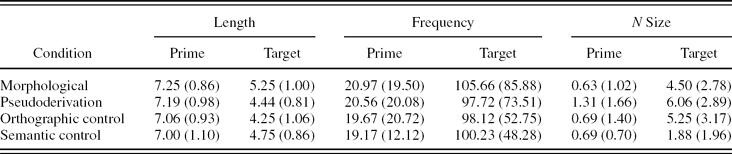
The distributional characteristics of selected items were provided by the French lexical database Manulex-infra (Peereman, Lété, & Sprenger-Charolles, Reference Peereman, Lété and Sprenger-Charolles2007) and are summarized in Table 2. Primes were matched for print frequency, length, and neighborhood size (Fs < 1.11). Targets were matched for print frequency (F < 1) but could not be perfectly matched for length, F (3, 60) = 3.47, p = .02, as morphologically related targets were longer than orthographically related targets (5.25 vs. 4.25 letters, p = .02). Because of constraints on item selection, we could not fully match the targets in neighborhood size, F (3, 60) = 7.02, p < .001. Targets from the semantic condition (mean N size = 1.88) had fewer orthographic neighbors than targets in the morphological (mean N size = 4.50), the pseudoderived (mean N size = 6.06), and the orthographic control (mean N size = 5.25) conditions. Finally, the orthographic overlap between primes and targets tended to be higher in the morphological and the pseudoderivation conditions than in the orthographic control condition. A complete list of the stimuli is presented in Appendix A.
Stimulus properties across test conditions of Experiment 1
Note: N size corresponds to the mean number of orthographic neighbors. Lexical frequency is given by the French database “Manulex Infra” (Peereman et al., Reference Peereman, Lété and Sprenger-Charolles2007) and was calculated from a corpus of 42,422 words.
Each of the 64 targets was associated with an unrelated prime, which served as a baseline to assess priming effects. These 64 prime–target pairs shared no morphological, semantic, or orthographic relationship.
An additional set of 16 unrelated prime–target pairs was included as fillers in the experiment, in order to reduce the proportion of related prime–target pairs to 44%, leading to a total of 144 prime–word target pairs.
For the purpose of the lexical decision task, 144 prime–target pairs with pseudowords as targets and words as primes were included in the experiment. Pseudowords consisted of legal orthographic and phonological sequences created by changing one or two letters of an existing word. In analogy to the word condition, 64 pseudoword targets were preceded by an orthographically related word and 80 were preceded by an orthographically unrelated word. In addition, half of these primes were derived or pseudoderived words and half were not.
The 288 prime–target pairs were divided into two lists of 144 items, with 72 word targets and 72 pseudoword targets in each list. Among the 72 target words from each list, 32 were associated with a related prime (8 from each of the 4 conditions) and 32 were associated with an unrelated prime. A target word preceded by a related prime in one list was preceded by an unrelated prime in the other list.
Procedure and apparatus
The presentation of the stimuli and recording of response times were controlled using the E-Prime software package version 1.0 (Schneider, Eschmann, & Zuccolotto, Reference Schneider, Eschmann and Zuccolotto2002) running on a Dell Latitude 131L laptop computer. The items were displayed in 25-point Courier New font and appeared on the screen as black characters on a white background. Each trial consisted of the following sequence of four stimuli: a fixation cross (which also served as intertrial interval) was displayed on the middle of the screen for 1000 ms; a forward mask consisting of a row of eight hash marks was presented for 800 ms; the prime stimulus in lowercase letters was presented for 60 ms; and then the target stimulus was presented in uppercase letters. The target remained on the screen until the participants responded, and for a maximum of 5000 ms. Reaction times were measured from target onset until the participants' response.
Child participants were tested in a dedicated room at their school building during regularly scheduled school hours. They were instructed to respond as rapidly and as accurately as possible whether the target was a real word or not, and had to respond by pressing the p (“yes” answer for right-handed childrenFootnote 4) or q (“no” answer for right-handed children) keys on a computer keyboard. The presence of a prime was not mentioned. Each participant completed 10 practice trials, representative of the experimental stimuli, and then completed the two experimental lists without feedback.
We used a within-participants design, in order to eliminate interindividual differences. Therefore, each participant completed the two experimental lists, but the background tests were completed between the two experimental lists in order to minimize repetition effects. In addition, to ensure that target repetition did not influence priming effects, we entered the order of list presentation into the statistical analysis. The order of presentation of the items within the two lists was randomized, and the order of presentation of each list was counterbalanced.
Results
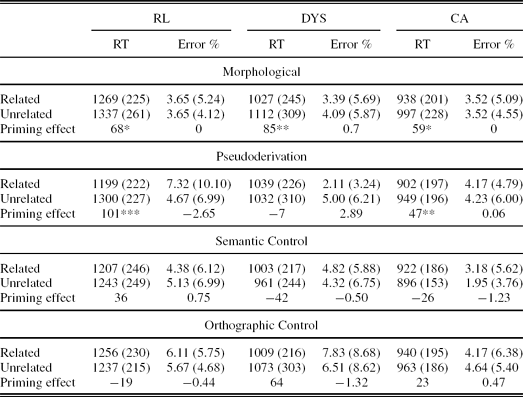
Table 3 shows the mean error percentages and mean reaction times (RTs) for correct responses in each group. A 3 (group: DYS vs. RL vs. CA) × 4 (condition: Morphological vs. Pseudoderivation vs. Semantic vs. Orthographic) × 2 (priming: Related vs. Unrelated) × 2 (order of list presentation: 1 vs. 2) repeated-measures analysis of variance was computed using log-transformed RTs as dependant variable. RTs faster than 500 ms (0.24 % of the data) and slower than 3500 ms (2.30% of the data) were considered as outliers and removed from data analysis. Two targets were also excluded from data analysis because error rates were beyond 2 standard deviations of the mean (“mou”: 19.19%; “char”: 15.07%Footnote 5).
Experiment 1 Mean (standard deviation) RTs (ms) and error percentages of the three groups according to the condition and the priming relationship
Note: RTs, reaction times; RL, reading level matched children; DYS, dyslexic children; CA, chronological age matched children.
*p < .05. **p < .01. ***p < .001.
The analysis of variance indicated a main effect of group, F (2, 45) = 10.69, p < .001, η2p = 0.32. Post hoc comparisons showed that the RL children were slower than the DYS and the CA controls, but reaction times were not different between the DYS and the CA controls. The main effect of priming was also significant, F (1, 45) = 6.91, p = .012, η2p = 0.13, indicating that RTs were faster when targets were preceded by related rather than unrelated primes. This priming effect interacted with the group, F (2, 45) = 3.73, p = .03, η2p = 0.14, showing that the amount of priming differed across the three groups. The main effect of the order of list presentation was significant, F (1, 45) = 59.34, p < .001, η2p = 0.57, because RTs were faster in the second testing session than in the first, but the three-way interaction between order of list presentation, condition, and priming did not achieve significance (F < 1) and will not be discussed further. Finally, the three-way interaction among group, priming, and condition was not significant, F (6, 135) = 1.05, p = .39, η2p = 0.04. The significant interaction between group and priming led us to perform planned comparisons on this interaction in each group.
The DYS showed significant priming effects in the morphological condition, F (1, 15) = 8.90, p = .009, η2p = 0.37 but not in any of the three other conditions, pseudoderivation: F < 1; orthographic control: F (1, 15) = 2.65, p = .12, η2p = 0.12; and semantic control: F (1, 15) = 2.00, p = .18, η2p = 0.12. By contrast, the RL and CA control groups showed priming effects in the morphological, F (1, 15) = 5.94, p = .028, η2p = 0.28 in RL, F (1, 15) = 5.15, p = .038, η2p = 0.26 in CA, and in the pseudoderivation, F (1, 15) = 18.37, p < .001, η2p = 0.55 in RL, F (1, 15) = 8.90, p = .009, η2p = 0.35 in CA, conditions. No significant priming effects were observed in these groups for the orthographic control, F(1, 15) = 1.36, p = .26, η2p = 0.08 in RL, F < 1 in CA, and the semantic control (F S < 1 in RL and in CA) conditions.
Discussion
Experiment 1 was conducted in order to answer two questions related to morphological processing in dyslexic readers. The first question was whether dyslexic children rely on morphemes during visual word recognition. Results show significant morphological priming effects in the dyslexic group of participants, as well as in the two control groups. However, priming effects were not significant in the orthographic control and the semantic control conditions. These patterns of priming indicate that children with dyslexia benefit from the presence of a morphologically related prime to process a target and that this processing can be distinguished from priming attributable to form or meaning overlap alone. This result reinforces the hypothesis according to which the DYS are able to process morphemic units in spite of their decoding difficulties, as already proposed by Elbro and Arnbak (Reference Elbro and Arnbak1996) and Burani et al. (Reference Burani, Marcolini, De Luca and Zoccolotti2008). The use of a masked priming procedure has also made it possible to evidentiate that the activation of morphological representations is rapid and automatic in dyslexic readers.
The second question was whether semantic overlap between morphologically related words is necessary for DYS to trigger morphological decomposition during visual word recognition. Our results indicate that the DYS and control groups are influenced differently by semantic properties of the combination of morphemes. Contrary to their matched peers, children with dyslexia do not exhibit significant priming effects when prime–target pairs share a pseudoderivation relationship. Thus, form overlap is not sufficient to process morphologically complex words into smaller components in dyslexic readers. Morphological representations of DYS appear to be specified at the morphosemantic level of representation rather than at the morpho-orthographic level, which confirms the hypothesis of semantically structured morphological representations in DYS already suggested by Elbro and Arnbak (Reference Elbro and Arnbak1996, see Casalis et al., Reference Casalis, Colé and Sopo2004, for a similar proposition).
A noteworthy aspect of the current results is that priming effects in dyslexic readers were significant in the morphological condition only. This finding supports the hypothesis that morphological decomposition is not necessarily only driven by the orthographic properties of morphemes at the earliest steps of word recognition and that the semantic properties of morphemes also have a role to play at this step of visual word recognition. Slightly larger priming effects in the morphological condition than in the pseudoderivation condition had already been evidenced in adult skilled readers (Diependaele et al., Reference Diependaele, Sandra and Grainger2005, Reference Diependaele, Sandra and Grainger2009, Reference Diependaele, Duñabeitia, Morris and Keuleers2011; Feldman et al., Reference Feldman, O'Connor and Moscoso del Prado Martin2009), but the hypothesis according to which the semantic overlap between morphologically related primes influences word recognition very early in the time course of word recognition has received only little support so far. Our results in the dyslexic population are in line with this hypothesis, in that they indicate that an early and efficient activation of the morphosemantic procedure can assist inefficient morpho-orthographic decomposition at the earliest steps of word recognition.
In summary, the processing of written morphology is more influenced by the semantic properties than by the form properties of morphemes in dyslexic readers. In order to further support this finding, we conducted a second experiment in which we manipulated the phonological and orthographic overlap between morphologically related primes and targets, while keeping semantic overlap constant.
EXPERIMENT 2: INFLUENCE OF THE FORM PROPERTIES OF MORPHEMES
Morphological derivation often implies slight form modification of the base word, which can be phonological (e.g., direct/direction) and/or orthographic (e.g., divide/division). These modifications do not appear to be a barrier to efficient morphological decomposition in adult skilled readers, because they benefit from masked priming even when the derivation involves a slight orthographic alteration of the base word (e.g., wranish–WARN; Beyersmann, Castles, & Coltheart, Reference Beyersmann, Castles and Coltheart2011; Duñabeitia, Perea, & Carreiras, Reference Duñabeitia, Perea and Carreiras2007; McCormick, Rastle, & Davis, Reference McCormick, Rastle and Davis2008).
However, developing readers in third and fifth grades have more difficulty in naming derived forms when they undergo phonological and orthographic modifications than when they do not (Carlisle, Reference Carlisle2000). In addition, 10-year-old children are more accurate when performing a primed fragment completion task when morphological overlap between primes and targets is orthographically transparent (e.g., messy–MESS) than when it is opaque (e.g., chosen–CHOOSE; Feldman, Rueckl, DiLiberto, Pastizzo, & Vellutino, Reference Feldman, Rueckl, DiLiberto, Pastizzo and Vellutino2002). Thus, morphological decomposition appears to be less flexible and more sensitive to form overlap between morphologically related words in developing readers than in skilled readers.
The probability to be penalized by form modifications of the base also depends on phonological skills. Poor readers have more difficulties naming words whose base word undergoes a phonological shift when a suffix is added (“shift words,” e.g., natural) than words that are phonologically transparent (“stable words,” e.g., cultural), and this effect is more pronounced in poor readers than in average readers (Carlisle, Stone, & Katz, Reference Carlisle, Stone and Katz2001). Nevertheless, using the same stimuli, Carlisle et al. (Reference Carlisle, Stone and Katz2001) found that poor readers’ latencies were less penalized by phonological shift in a lexical decision task, suggesting that the impact of phonological transparency depends, at least partially, on task demands.
In this study, we aimed at verifying to what extent a semantic overlap between morphologically related words is sufficient to trigger morphological decomposition in children with dyslexia. To this end, we manipulated the phonological and orthographic overlap between morphologically complex words and kept semantic overlap constant. If children with dyslexia activate rapidly and automatically the semantic properties of morphemes during visual word recognition, as already evidenced in Experiment 1, then we expect them to benefit from morphological priming independently of the phonological and orthographic modifications of the base word. Regarding the control groups, results from Experiment 1 indicate that morphological decomposition is triggered by the form properties of morphemes at the earliest steps of word recognition. As a consequence, we expect the RL and the CA children to be penalized by these form modifications of the base word and to exhibit morphological priming only when there is no modification of the base word. Finally, we expected the adults to exhibit priming effects in the three morphological conditions, given that morphological processing has been shown to be robust to form modifications in this population (Beyersmann et al., Reference Beyersmann, Castles and Coltheart2011; Duñabeitia et al., Reference Duñabeitia, Perea and Carreiras2007; McCormick et al., Reference McCormick, Rastle and Davis2008).
Method
Participants and background measures
A new pool of participants involved in the same large-scale study as in Experiment 1 participated in Experiment 2. Based on the background measures presented in Experiment 1, we constituted a group of DYS (n = 14, 5 boys, 9 girls), a group of RL matched children (n = 14, 7 boys, 7 girls), and a group of CA matched children (n = 14, 4 boys, 10 girls). As in Experiment 1, the inclusion in the DYS group was justified by their reading age and their scores in nonverbal reasoning and receptive vocabulary.
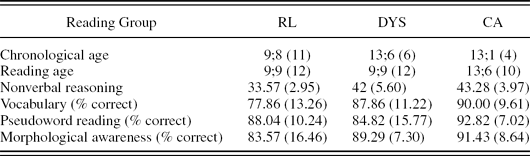
The mean scores of these background measures as well as the accuracy in pseudoword decoding and morphological awareness are provided in Table 4. The DYS were matched to RL controls in reading age (t < 1) and matched to CA controls in nonverbal reasoning and receptive vocabulary (ts < 1). However, because of recruitment constraints, DYS could not be perfectly matched to CA controls in terms of CA, t (26) = 2.47, p = .020.
Mean (standard deviation) background measures according to the group in Experiment 2
Note: RL, reading level matched children; DYS, dyslexic children; CA, chronological age matched children. Chronological and reading age are in years;months; nonverbal reasoning (max = 36 in RL, max = 60 in DYS and in CA) is raw scores.
Regarding pseudoword decoding, mean accuracy scores depended on the group, F (2, 79) = 3.19, p = .047. Accuracy was lower in the DYS than in the CA matched children, t (52) = 2.37, p = .011, but was not different in the DYS than in the RL matched children (t < 1). With respect to morphological awareness, correct sentence completion did not depend on the group, F (2, 39) = 1.74, p = .19. Finally, it is important to note that the DYS from Experiment 1 and from Experiment 2 were matched for reading age, pseudoword reading accuracy, and morphological awareness (all ts < 1).
Fifteen undergraduate students at the University of Lille also participated in the experiment in order to constitute a group of adult participants. All were native speakers of French and reported normal or corrected to normal vision. They had no history of learning disabilities and/or neurological impairments. No credit was given for their participation.
Materials
We selected four new sets of 16 prime–target pairs that were divided into four groups, including three morphological conditions and one orthographic control condition. These conditions are presented below.
MORPHOLOGICAL TRANSPARENT
A morphological transparent is, for example, nuageux–nuage, “cloudy–CLOUD.” The prime words were derived forms of the target, and the derivation did not involve any phonological or orthographic modification of the base word. Nevertheless, contrary to McCormick et al. (Reference McCormick, Rastle and Davis2008), we did not consider a missing e or shared e at the end of base words as an orthographic alteration, because most of the French words end with a silent e that is very often preserved (e.g., nuageux–nuage) or replaced by another vowel (e.g., policier–police) in the derived form. In English, cloudy–CLOUD would have been a good example of this condition.
MORPHOLOGICAL WITH PHONOLOGICAL SHIFT (P SHIFT) OF THE BASE
A morphological P shift is, for example, bergerie–BERGER, “sheepfold–sheep.” This condition consisted of morphologically related pairs of words whose base word had a phonological shift of the base when it appeared in the derived form. The phonological shift corresponded to the pronunciation of a silent letter for half of the items (e.g., dentiste–dent, “dentist–tooth”) or to the voicing of the vowel and consonant that constitute a nasal vowel at the end of the base for the other half of the items (e.g., moulinet–MOULIN, “reel–mill”). An equivalent of this condition in English could be direction–DIRECT.
MORPHOLOGICAL WITH PHONOLOGICAL AND ORTHOGRAPHIC SHIFT (PO SHIFT) OF THE BASE
Footnote 6 A morphological PO shift is, for example, soigneux–SOIN, “careful–CARE.” In this condition, primes were morphologically related to the target but the derivation involved both a phonological and an orthographic shift of the base word, for different reasons. First, primes and targets could be allomorphic forms of the same root (e.g., soigneux–soin, “careful–CARE”). Second, the derivation could require the addition of an additional letter between the base and the suffix (e.g., magicien–magie, “magician–MAGIC”). Third, the form modifications could be explained by the necessity to transform final letters of the base to respect the orthographic conventions of French language (e.g., banquette–banc, “seat– bench”). An equivalent of this condition in English could be division–DIVIDE.
As in Experiment 1, the morphological relationship between primes and targets was determined using the “Brio” French dictionary (Rey-Debove, Reference Rey-Debove2004).
ORTHOGRAPHIC CONTROL
This control condition (e.g., fourmi–FOUR; “ant–OVEN”) was equivalent to the one used in Experiment 1 but included a new set of prime–target pairs. An equivalent in English could be spinach–SPIN.
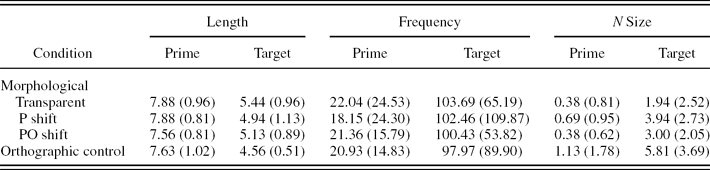
Primes were matched for frequency, length, and orthographic neighborhood (Fs < 1.18). Targets were matched for frequency (F < 1) but could not be matched perfectly in length, F (3, 60) = 2.35, p = .08, because the mean number of letters in the target words of the morphological transparent condition tended to be higher than in that of the orthographic control condition. In addition, the mean number of orthographic neighbors of the targets also depended on the condition, F (3, 60) = 3.61, p = .02. Targets from the orthographic control condition had on average more orthographic neighbors than did targets from the morphological transparent condition. Mean values for each of these variables are shown in Table 5.
Stimulus properties across test conditions of Experiment 2
Note: N size corresponds to the mean number of orthographic neighbors. Lexical frequency is given by the French database “Manulex Infra” (Peereman et al., Reference Peereman, Lété and Sprenger-Charolles2007) and has been calculated from a corpus of 42,422 words. P, phonological; PO, phonological and orthographic.
As in Experiment 1, each target was associated with an unrelated prime that was not morphologically, semantically, or orthographically related. Sixteen unrelated prime–target pairs were also included as fillers to dilute the proportion of related items encountered in the experiment. There were 144 pseudoword targets included in the experiment for the “no” responses of the lexical decision task. They were created the same way as in Experiment 1 and were preceded by a prime word that could be orthographically related (n = 64) or unrelated (n = 80).
The design of the experiment was the same as in Experiment 1: the total of 288 prime target-pairs (144 with words as targets and 144 with pseudowords as targets) was divided into two lists of 144 pairs of items, with equal number of words and pseudowords in each list. Each target word was preceded by a related prime in one list and by an unrelated prime in the other list.
A complete list of the stimuli included in each condition is presented in Appendix B.
Procedure and apparatus
The procedure and apparatus of Experiment 2 was exactly the same as that of Experiment 1.
Results
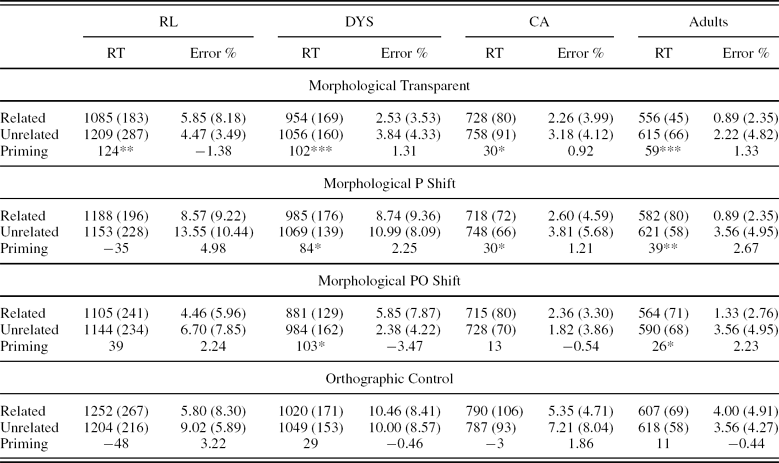
We used the same trimming procedure as in Experiment 1. RTs faster than 500 ms (0.81% of the data) and slower than 3500 ms (0.98% of the data) were removed from data analysis in the DYS and control children groups.Footnote 7 In all groups, four items were excluded from data analysis because of high error rates (“odeur”: 9.52%; “mare”: 19.05%, “ras”: 48.24%, “fier”: 23.17%Footnote 8). Error percentages and mean latencies for correct responses for each group are presented in Table 6.
Experiment 2 Mean (standard deviation) RTs (ms), priming effects (ms), and error percentages of the three groups of children and the adults according to the condition and the priming relationship
Note: RTs, reaction times; RL, reading level matched children; DYS, dyslexic children; CA, chronological age matched children; P, phonological; PO, phonological and orthographic.
*p < .05. **p < .01. *** p < .001.
Analyses of variance were carried out separately in the group of DYS and control children and in adults.
Results in DYS and control children
A 3 (group: DYS vs. RL vs. CA) × 4 (condition: morphological transparent vs. morphological P-shift vs. morphological PO-shift vs. orthographic control) × 2 (priming: related vs. unrelated) × 2 (order of list presentation: 1 vs. 2) repeated-measures analysis of variance was computed using log-transformed RTs as a dependent variable.
The analysis of variance showed a main effect of group, F (2, 39) = 37.70, η2p = 0.66, p < .001. Post hoc comparisons indicated that the RL children were slower than the DYS and that the DYS were slower than the CA controls. The main effect of priming was also significant, F (1, 39) = 25.60, η2p = 0.46, p < .001, because RTs were faster when targets were preceded by related primes than when preceded by unrelated primes. There was a significant interaction between group and priming, F (2, 39) = 5.70, η2p = 0.23, p = .006, indicating that the amount of priming differed across the three groups. The effect of order of list presentation was also significant, F (1, 39) = 39.9, p < .001, η2p = 0.51, because RTs were faster in the second session than in the first. However, the three-way interaction among order of list presentation, condition, and priming was not significant (F < 1) and will therefore not be discussed further. Finally, the three-way interaction among group, condition, and priming did not achieve significance, F (6, 117) = 1.4, p = .20, η2p = 0.07. Nevertheless, as the group by priming interaction was significant, we performed planned comparisons to test our specific hypotheses.
The DYS showed significant priming effects in the three morphological conditions, namely, transparent, F (1, 13) = 15.93, p = .001, η2p = 0.55; with P-shift, F (1, 13) = 6.49, p = .024, η2p = 0.33; and with PO-shift, F (1, 13) = 7.76, p = .015, η2p = 0.37. No significant priming effect was observed in the orthographic control condition, F (1, 13) = 1.56, p = .233, η2p = 0.11. In RL children, priming effects were significant in the morphological transparent condition, F (1, 13) = 11.79, p = .004, η2p = 0.48, but were not significant in the three other conditions: morphological P-shift, F < 1; morphological PO-shift, F (1, 13) = 1.82, p = .200, η2p = 0.12; orthographic control, F < 1. Finally, in CA children, priming effects were significant in the morphological transparent condition, F (1, 13) = 4.70, p = .049, η2p = 0.27, and in the morphological P-shift condition, F (1, 13) = 6.63, p = .023, η2p = 0.34. Priming effects in the morphological OP-shift condition and in the orthographic control condition did not achieve significance, Fs < 1.
Results in adults
A 4 (condition: morphological transparent vs. morphological P-shift vs. morphological PO-shift vs. orthographic control) × 2 (prime: related vs. unrelated) × 2 (order of list presentation: 1 vs. 2) repeated-measures analysis of variance was computed on log-transformed RTs.
There was a main effect of priming, F (1, 14) = 37.08, p < .001, η2p = 0.73, indicating that related targets were processed faster than unrelated targets. The interaction between condition and priming was also significant, F (3, 42) = 4.11, p = .012, η2p = 0.23, suggesting that priming effects depended on the condition. The main effect of the order of list presentation was significant, F (1, 14) = 14.99, p = .002, η2p = 0.52, because RTs were faster at the second presentation than at the first, but the critical three-way interaction among order of list presentation, priming, and condition was not significant (F < 1).
Planned comparisons indicated significant priming effects in the morphological transparent condition, F (1, 14) = 39.99, p < .001, η2p = 0.74; in the morphological P-shift condition, F (1, 14) = 10.17, p = .007, η2p = 0.42; and in the morphological PO-shift condition, F (1, 14) = 8.26, p = .012, η2p = 0.37. However, priming effects were not significant in the orthographic control condition, F (1, 14) = 1.97, p = .18, η2p = 0.12.
Discussion
The results of Experiment 2 clearly indicate that the dyslexic children benefit from priming in the three morphological conditions, independently of the phonological and orthographic shifts of the base word. Such results corroborate the finding of Experiment 1 that dyslexic readers rely on morphemes during visual word recognition and that the probability to process morphologically complex words through their components depends more on semantic overlap between morphologically related words than on form overlap.
A different pattern of priming emerged in the two control groups and in the DYS. In the RL group, morphological priming was significant only in the morphological transparent condition, indicating that morpho-orthographic decomposition evidenced in Experiment 1 requires phonological and orthographic overlap between morphologically related words. Turning to the CA group, priming effects were significant in the morphological transparent and the morphological with phonological shift conditions. This finding suggests that the CA children are not influenced by phonological alterations of the base, whereas orthographic alterations prevent them from decomposing morphologically complex words into smaller components. Thus, the only developmental difference between the RL and the CA children occurs in the morphological condition with phonological shift. This result can be accounted for by the fact that the connections between phonology and orthography are not sufficiently developed in RL children, preventing them from benefiting from the orthographic overlap between morphologically related words. Because developing readers mainly rely on form overlap to decide whether two words are morphologically related or not (Carlisle & Fleming, Reference Carlisle and Fleming2003), the lack of phonological overlap between the words included in the phonological shift condition might have prevented morphological decomposition.
Priming effects were significant in the three morphological conditions in adult skilled readers. This result suggests that their processing of written morphology is flexible to phonological and orthographic shifts of the base word, as already evidenced in English (Beyersmann et al., Reference Beyersmann, Castles and Coltheart2011; McCormick et al., Reference McCormick, Rastle and Davis2008) and in Spanish (Duñabeitia et al., Reference Duñabeitia, Perea and Carreiras2007). Adult models of morphological processing will be considered in the General Discussion.
GENERAL DISCUSSION
The present study investigated whether and how French dyslexic children rely on the morphological structure of words during their visual recognition. Following the studies of Elbro and Arnbak (Reference Elbro and Arnbak1996) and Burani et al. (Reference Burani, Marcolini, De Luca and Zoccolotti2008), we were specifically interested in testing the influence of form and meaning properties of morphemes in the DYS’ processing of morphologically complex words. To this end, we conducted two masked priming experiments in which we manipulated the semantic overlap (Experiment 1) and the form overlap (Experiment 2) between morphologically related pairs of words.
In this section, we summarize the main results in relation to the two aims of the study and we relate these findings to reading procedures in DYS. We also interpret our findings in light of the current models of morphological processing.
The significant morphological priming effects observed across the two experiments in dyslexic children indicate that they rely on derivational morphemes during visual word recognition. Although several studies indicate that French typically developing readers make use of the morphological structure of words during their recognition (Casalis et al., Reference Casalis, Dusautoir, Colé and Ducrot2009; Quémart et al., Reference Quémart, Casalis and Colé2011, Reference Quémart, Casalis and Duncan2012), we report that such processing is also at work in French DYS. A morphological facilitation when naming words and pseudowords had already been evidenced in the dyslexic population by Burani et al. (Reference Burani, Marcolini, De Luca and Zoccolotti2008), Traficante et al. (Reference Traficante, Marcolini, Luci, Zoccolotti and Burani2011), and Elbro and Arnbak (Reference Elbro and Arnbak1996), suggesting that in spite of their decoding difficulties, dyslexic readers are able to grasp larger units such as morphemes to decode words faster. The present study extends those results by indicating that morphological processing also characterizes visual word recognition. Such an automatic processing is remarkable in the sense that dyslexic readers are generally assumed to be very slow when processing linguistic information (Pennington, Reference Pennington2006). Nevertheless, adequate speed of processing of the primes emerges in these readers when tapping automatic and unconscious processes with the masked priming paradigm, which corroborates Bonifacci and Snow-ling (Reference Bonifacci and Snowling2008)'s finding that speed of information processing is normal in dyslexic children.
Turning to the nature of this processing, the patterns of priming observed in Experiment 1 and in Experiment 2 suggest that dyslexic readers are mainly influenced by the semantic properties of morphemes during the identification of morphologically complex words, whereas their reading-level and chronological-age matched peers are essentially influenced by the form properties of morphemes. Thus, the semantic interpretability of base and suffix combinations is the triggering factor of morphological decomposition in dyslexic readers. The important role of morphemes’ meaning in morphological processing confirms the hypothesis of Elbro and Arnbak (Reference Elbro and Arnbak1996) and Casalis et al. (Reference Casalis, Colé and Sopo2004) that dyslexic readers take advantage of their relatively preserved semantic skills to develop a morphosemantic level of representations. Adequate morphological awareness abilities observed in dyslexic children in Experiments 1 and 2 reinforce this hypothesis. Furthermore, the activation of this morphosemantic level of representation evidenced with a new task, the primed lexical decision task, fosters the semantic hypothesis by showing that this processing is not specific to the naming task. By contrast, priming effects observed in Experiment 2 in the two control groups strengthen Quémart et al. (Reference Quémart, Casalis and Colé2011)'s proposition that morphological processing is primarily form-driven in typically developing readers. Finally, results in adult skilled readers suggest that they are not penalized by slight orthographic or phonological shifts of the base word when decomposing morphologically complex words. A flexibility of morpho-orthographic processing has already been evidenced by several studies (Beyersmann et al., Reference Beyersmann, Castles and Coltheart2011; Duñabeitia et al., Reference Duñabeitia, Perea and Carreiras2007; McCormick et al., Reference McCormick, Rastle and Davis2008) but had never been reported in the French language. The difference in patterns of priming between chronological-age matched children and adult skilled readers in the morphological PO-shift condition point out that 13-year-old children are not yet as flexible as adults to process the orthographic properties of morphemes.
Integrating morphological processing to other reading strategies in dyslexic readers
The DYS’ higher reliance on semantic than form properties of morphemes is in line with the general idea that these readers are prone to implement a semantic reading strategy. As proposed in Stanovich's (Reference Stanovich1980) interactive–compensatory model, dyslexic readers may use their adequate semantic skills when recognizing words through a top-down process, as a substitute for their inefficient decoding abilities (see Hulme & Snowling, Reference Hulme and Snowling1992, for a similar account). Readers with low-quality lexical representations tend to use contextual information to bolster their word recognition by selecting the appropriate lexical entry as a function of the semantic context (Frith, Reference Frith and Frith1980), whereas good readers with high-quality representations retrieve lexical and semantic information using bottom-up information (Perfetti & Hart, Reference Perfetti, Hart and Corfien2001). Empirical evidence supporting a particular reliance on semantic information in readers with dyslexia has been provided across several studies, where they have been shown to make more use of context when decoding words compared with normal readers (Ben-Dror, Pollatsek, & Scarpati, Reference Ben-Dror, Pollatsek and Scarpati1991; Bruck, Reference Bruck1988; Nation & Snowling, Reference Nation and Snowling1998) and to mostly rely on the semantic pathway during word naming (Hennessey, Deadman, & Williams, Reference Hennessey, Deadman and Williams2011).
We do not advocate here that the DYS only benefit from the semantic overlap between morphologically related words during visual word recognition, especially because we did not observe priming effects in the semantic control condition. Morphemes are units of form and meaning, and young readers rely on the convergence between form and meaning when developing mental representations of morphemes (Schreuder & Baayen, Reference Schreuder, Baayen and Feldman1995). In addition, derived words that belong to the same morphological family typically share form characteristics. However, the activation of morpho-orthographic information is inefficient in DYS, and they quickly activate the semantic properties of morphemes to try to compensate for their difficulty in processing orthographic information.
An additional assumption is that the DYS’ processing of written morphology is coarse-grained, in that they do not appear to code letter position or identity within morphemes in a strict fashion. The hypothesis of a coarse-grained coding of spelling–sound correspondences in DYS has already been proposed by Hatcher and Snowling (Reference Hatcher, Snowling, Reid and Wearmouth2002; see Burani et al., Reference Burani, Marcolini, De Luca and Zoccolotti2008, for a similar proposition). Developmental dyslexia is characterized by difficulties in the development of phonemic representations that imply difficulties in the development of phonemic decoding. However, Hatcher and Snowling argue that children with dyslexia establish connections between orthography and phonology at a coarse-grained level, namely, between units larger than graphemes and phonemes. Results of this study extend this conceptualization by indicating that dyslexic readers are also able to rely on morpheme-size units during visual word recognition.
Theoretical implications
Morpho-orthographic versus morphosemantic processing
Two sets of hypotheses about the influence of form and meaning in the processing of written morphology have been formulated. According to the form-then-meaning account, morphological processing is a two-stage serial process, involving first the decomposition of morphologically complex words into morpho-orthographic units and second the activation of the semantic properties of morphemes (Rastle & Davis, Reference Rastle and Davis2008). This hypothesis is supported by significant masked priming effects in adult skilled readers when prime–target pairs share morphological or pseudoderivation relationships and by an absence of pseudoderivation priming when primes are fully visible. However, according to the hybrid model of morphological processing (Diependaele et al., Reference Diependaele, Sandra and Grainger2009), the two levels of morphological representations (morpho-orthographic and morphosemantic) are activated in parallel. Truly derived words can be recognized along both processing routes, because morphologically related words share both form and meaning properties. However, pseudoderived words are only able to activate the morpho-orthographic level, because the meaning of their components in not related to that of the whole word. Finally, the feedback connections between the morphosemantic and morpho-orthographic levels of representation explain the greater priming effects for morphologically related words than for pseudoderived words observed in adult skilled readers (Feldman et al., Reference Feldman, O'Connor and Moscoso del Prado Martin2009).
The present results fit nicely with the hybrid model of morphological processing. The significant morphological priming effects in absence of pseudoderivation priming show that the morphosemantic route is already involved in the recognition of morphologically complex words at the earliest steps of word recognition and that an automatic activation of form properties of morphemes is not mandatory to trigger morphological decomposition. Thus, the DYS’ specific sensitivity to the semantic properties of morphemes indicates that the activation of their morphosemantic level of representation supplies an inefficient activation of the morpho-orthographic level of processing in this population.
Such a conception of morphological processing in dyslexic readers is akin to the supralexical model of derivational morphology proposed by Giraudo and Grainger (Reference Giraudo and Grainger2000, Reference Giraudo and Grainger2001). In this model, morphological representations are located between whole-word representations forms and higher level semantic representations. When a morphologically complex word is presented to the cognitive system (e.g., departure), the whole word activates the representation of the corresponding morphemes (depart– and –ure) that send back activation to all whole-word representations that are compatible with those morphemes (e.g., depart, departing . . .) but not to those who are only orthographically related (e.g., department). Although this model of supralexical processing lacks a morpho-orthographic level of representation in order to explain morphological processing in typically developing readers and adult skilled readers, it enables us to understand how the system works when the morpho-orthographic processing level is deficient. In particular, it explains why priming occurs only when primes and targets are morphologically and semantically related, as evidenced in Experiment 1. In addition, because these supralexical representations are located at an abstract level in the architecture of the model, morphological processing is not influenced by surface phonological or orthographic modifications of the base word. Therefore, priming effects emerge even though primes and targets are not completely overlapping in DYS, as indicated by the significant priming effects in the three morphological conditions of Experiment 2.
Fine-grained versus coarse-grained processing of written morphology
Morphological processing is flexible to surface form modifications of the base in dyslexic readers but much less flexible in the two control groups. This difference can be accounted for by the dual-route approach to orthographic processing recently outlined by Grainger and Ziegler (Reference Grainger and Ziegler2011). In this model, word recognition is thought to be achieved via two routes, the fine-grained route and the coarse-grained route. The first processing route is involved in the precise coding of letter position in strings, whereas the second processing route enables readers to rapidly access semantic representations through a flexible orthographic processing system that does not encode letter position. With respect to morphological processing, the authors argue that morpho-orthographic decomposition occurs via the fine-grained route, becasue it requires a precise letter position coding in order to differentiate between morphemes that differ in only one letter (e.g., –age vs. –ale in French). By contrast, morphosemantic processing is supposed to be achieved along the coarse-grained coding route, which enables readers to access very rapidly morphological representations. The two types of constraints (fine-grained and coarse-grained) interact with each other in order to optimize the recognition of morphologically complex words. Nevertheless, Grainger and Ziegler (Reference Grainger and Ziegler2011) report significant masked transposed letter priming for derived words (e.g., signer–SING) but not for pseudoderived words (e.g., conrer–CORN). Because transposed-letter priming is possible only via the coarse-grained processing route, the lack of priming effect in the pseudoderivation condition shows that such words are not processed via the coarse-grained route.
Within this framework, the insensitivity of dyslexic readers to slight orthographic modifications of the base word points out the specific involvement of the coarse-grained route during their visual word recognition. Because this route is selectively involved in morphosemantic processing (Grainger & Ziegler, Reference Grainger and Ziegler2011), this finding also reinforces the idea that dyslexic readers activate only morphosemantic representations when processing written morphology. In addition, the DYS’ results are in accordance with the lexical tuning hypothesis (Castles, Davis, Cavalot, & Forster, Reference Castles, Davis, Cavalot and Forster2007) according to which orthographic representations become finely tuned as a function of the growing orthographic lexicon. Because the orthographic representations of the DYS are not sufficiently detailed, priming effects occur even when the orthographic matching between primes and targets is not perfect (see Marinus & De Jong, Reference Marinus and De Jong2010, for a similar explanation).
The lack of flexibility of the control groups’ word recognition system evidenced in Experiment 2 shows that their orthographic processing is principally achieved along the fine-grained route, which is supposed to be involved in morpho-orthographic decomposition (Grainger & Ziegler, Reference Grainger and Ziegler2011). This result is in accordance with the findings of Quémart et al. (Reference Quémart, Casalis and Colé2011) that morphological decomposition is essentially triggered by the form properties of morphemes in developing readers from Grade 3 to Grade 7. However, if the semantic properties of morphemes are activated later in the time course of word recognition, as evidenced by Quémart et al. (Reference Quémart, Casalis and Colé2011), then morphological processing should be more flexible with a longer prime duration than with a short prime duration. Additional studies are needed to explore this hypothesis.
Conclusion
The present study brings new evidence that dyslexic readers have developed representations for written morphology and indicates that they activate these representations rapidly and automatically during the recognition of morphologically complex words. These representations are located at the morphosemantic level, and their access occurs along a coarse-grained route of orthographic processing. By contrast, morphological representations of reading-level and age matched participants are located at the morpho-orthographic level and are accessed via a fine-grained processing system that is sensitive to form modifications. Finally, these results confirm that form and meaning make separate contribution to the processing of written morphology.
APPENDIX A
Target and prime words used in Experiment 1
APPENDIX B
Target and prime words used in Experiment 2
ACKNOWLEDGMENTS
This research was completed while the first author was a doctoral student at the University of Lille North of France. We would like to thank the children who participated in this study and the anonymous reviewers for their helpful comments on an earlier version of this paper. This work was supported by the French Ministry of Research and Technology (award to P.Q.) and by the French National Agency of Research (project “Lect Morpho” to S.C.).