Earthquakes are major geological disasters that cause enormous losses. Data from the US Geological Survey indicate that more than 8 earthquakes scoring higher than 7.0 on the Richter scale occurred worldwide in 2014. The human and economic impacts of earthquakes are increasingly important given continued population growth and urbanization in earthquake-prone areas.
Violent earthquakes generate large numbers of casualties in a short time, and short- and long-term rescue efforts greatly affect outcomes for the injured.Reference Reinhardt, Li and Gosney 1 Key to an effective rescue response is deploying the resources to the most appropriate places at the most appropriate times, yet little is known about when hospitals can expect to face the largest number of patients after a major earthquake and what types of injuries the hospital will need to treat for earthquakes of a given severity. The answers to these questions are critical for ensuring that hospitals serving earthquake victims are adequately prepared and allocate their resources most effectively.
At 2:28 PM on 12 May 2008, the Wenchuan earthquake devastated parts of Sichuan province in China, leading to 69,195 deaths and 18,392 missing. The China Earthquake Data Center reported that the magnitude (Ms) was 8.0 with a maximum intensity of XI on a scale of I-XII. Five years later, at 8:02 AM on 20 April 2013, the Lushan earthquake struck in a different part of Sichuan province; the Ms was 7.0 and the maximum intensity IX. Official statistics indicated at least 196 deaths, 11,470 injured, and 21 missing. During both earthquakes, West China Hospital of Sichuan University, the only national-level teaching hospital near both epicenters, was unaffected and served as the main medical center for earthquake-induced injuries.Reference Deng, Zheng and Shi 2
As a result, West China Hospital has accumulated significant data on earthquake injuries that may prove useful for improving emergency medical response in the hospital and in the field. Analysis of these data, for example, has already provided insights into the trauma characteristics and rescue management of patients in the Wenchuan and Lushan earthquakes.Reference Xie, Du and Xia 3 - Reference Yang, Liu and Liu 6 These previous studies provide a basis for injury epidemiology, antibiotic selection, and epidemic prevention in a single earthquake.
Particularly useful for designing rescue procedures would be to compare the injury epidemiology for different earthquakes.Reference Jiang, Xiang and Liu 7 Otani et al took a step in this direction in their comparison of the Wenchuan Earthquake and a 2011 earthquake in eastern Japan, but they did not focus on injuries and they did not analyze data in detail.Reference Otani, Ando and Atobe 8 Here the insights from West China Hospital may prove particularly valuable, since the same medical center provided the brunt of medical care to victims of 2 major earthquakes in the same region of China, allowing investigators to conduct comparisons unaffected by confounding due to institutional or geographic differences.
Therefore, we retrospectively compared the injury characteristics and hospitalization course of patients admitted to West China Hospital of Sichuan University in the Wenchuan and the Lushan earthquakes. We also explored the impact of seismic intensity on earthquake-induced injuries. Our findings may provide a reference for future rescue efforts.
Methods
Study Design and Data Collection
This hospital-based, retrospective, observational study was approved by the Institutional Review Board of West China Hospital of Sichuan University. All data used in the study came from existing medical records collected as part of routine procedures at the hospital, and no personal information was involved. Thus, informed consent from the participants was deemed unnecessary. Data were collected and updated through 5 August 2013.
Patients from earthquake-affected areas were transported to West China Hospital directly from the scene by helicopter or from field hospitals by ambulance. The following data were collected upon admission to our hospital: age, sex, admission and discharge dates, causes (types) of injury, diagnosis, number of operations, days in the intensive care unit (ICU), and clinical outcomes (recovery, deterioration, or death). Causes of injury were classified into 4 categories on the basis of previous studies of earthquake-related injuries and reports from the US Centers for Disease Control and PreventionReference LeMier, Cummings and West 9 : being struck accidentally by an object, falling, being buried, or other infrequent injury (eg, burns, cuts, motor vehicle crashes, delayed effects of injuries). Even though some patients may have suffered 2 or more types of injury, our analyses focused on only the principal injury. A substantial percentage (11.4%) of patients in the Wenchuan earthquake were struck nonfatally by objects, and their injuries were due primarily to having been buried for long periods; these patients were categorized as having injuries due to being buried.
We included in our data set only those operations performed in surgery wards of West China Hospital, and we did not include minor procedures typically performed without the need for anesthetists or professional nurses, such as plaster fixation, traction, paracentesis, stent implantation, and angiography.
Inclusion and Exclusion Criteria
Inpatients with physical trauma or psychological disorders were included. Patients were excluded if they were diagnosed primarily with minor injuries and were treated only in the emergency department without being admitted. During our analysis to correlate seismic intensity with injury type (see below), patients were excluded if we could not determine where their principal injury occurred.
Correlation of Injury Epidemiology With Seismic Intensity
We searched for possible relationships between seismic intensity and earthquake-related injuries by combining data from both earthquakes and correlating the location of each patient’s principal injury with seismic intensity distribution maps produced by the China Earthquake Administration (Wenchuan earthquake: www.csi.ac.cn/manage/html/4028861611c5c2ba0111c5c558b00001/_content/09_05/08/1241771246756.html, accessed 6 October 2013; Lushan earthquake: www.cea.gov.cn/publish/dizhenj/464/478/20130425153642550719811/index.html, accessed 6 October 2013). These maps quantitate the intensity of ground shaking and severity of structural damage by using a scale of I-XII. Seismic intensity normally decreases with increasing distance from the epicenter, except for certain locations where the intensity is not proportional to the distance. Additional information about both earthquakes, such as Richter magnitudes and casualties, came from the work of Xu et alReference Xu, Xu and Zhou 10 and the China Earthquake Networks Center.
Statistical Analysis
Continuous data showing a normal distribution were reported as means±standard deviations, whereas categorical data were reported as percentages. Data were analyzed, as appropriate, by using descriptive analysis, Student’s t-test, Pearson chi-square test, Fisher’s exact test, or the Kruskal-Wallis test. Statistical analyses were performed by using SPSS 17.0 (IBM, Chicago, IL), and figures showing descriptive analyses were created by using Graphpad Prism 5. A two-sided p value less than 0.05 was deemed statistically significant.
Results
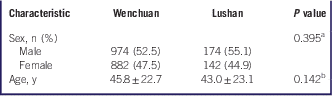
After the Wenchuan earthquake, 1856 patients were admitted to West China Hospital by 23 July 2008.Reference Xie, Du and Xia 3 Among these, 89 patients (4.8%) were transferred to the ICU because of organ failure and 33 patients (1.8%) died from various causes including severe craniocerebral injury, crush syndrome, infection, and multiple organ failure (MOF). After the Lushan earthquake, 316 trauma patients were admitted to our hospital, and 65 (20.6%) were treated in the ICU. By 5 August 2013, 279 patients (88.3%) had recovered, whereas the remaining 37 (11.7%) remained hospitalized either for rehabilitation therapy (n=27) or for intensive care (n=10). No fatalities were recorded through the end of follow-up on 5 August 2013. The average age and gender distribution of trauma patients were similar for both earthquakes (Table 1).
Demographic Characteristics of Patients Admitted to West China Hospital in the Wake of the Wenchuan and Lushan Earthquakes

a Based on Pearson chi-squared test.
b Based on independent-samples t-test.
Hospital Admissions
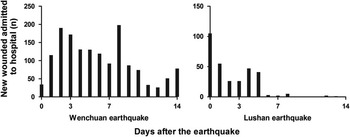
We first analyzed the distribution of admissions after each earthquake to determine when any peaks occurred (Figure 1). We did not observe any clear peak after the Wenchuan earthquake. On the same day as the earthquake, a small number of wounded individuals from areas outside the epicenter were admitted, and only 27.5% of patients were admitted during the subsequent 72-h “golden period” in earthquake medical rescue.Reference Jang, Lien and Tsai 11 Approximately 33% of total patients were admitted during the second week after the earthquake.Reference Xie, Du and Xia 3 After the Lushan earthquake, in contrast, we observed a clear peak in patient admissions: 160 patients (50.63%) were admitted to our hospital within the first 2 days of the disaster, and more than 95% were admitted within the first week.
Patient Admissions by Time. Admissions of new wounded to West China Hospital over time after the Wenchuan earthquake in 2008 and the Lushan earthquake in 2013 in Sichuan, China.

Surgical Interventions
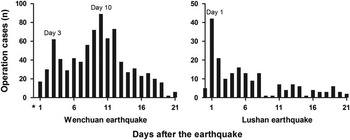
Next we analyzed the time frame over which earthquake victims underwent surgery after admission (Figure 2). Operations on Wenchuan patients were spread out over a longer period, with the peak occurring later than in Lushan.Reference Huang, Du and Zhou 12 More than 50% of operations on Lushan patients (129 of 211) were performed within the first week after the earthquake, compared to 32.3% of operations (259/801) in the Wenchuan disaster.
Surgical Operations by Time. Numbers of surgical operations performed during the emergency phase (3 weeks) after the Wenchuan and Lushan earthquakes. The asterisk indicates that data were not collected on the day of the Wenchuan earthquake.

Types of Injury
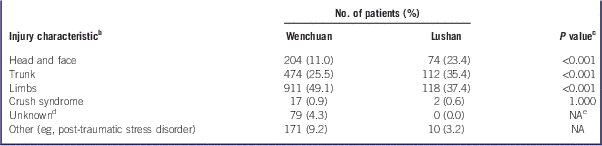
The distribution of types of injury differed between the 2 earthquakes (Tables 2 and 3). Whereas injuries due to being accidentally struck or buried were more common in the Wenchuan earthquake, injuries related to falling were more common in the Lushan earthquake. Injuries to the head, face, and trunk were more frequent among patients in the Lushan earthquake than among those in the Wenchuan earthquake, whereas injuries involving extremities were less frequent among Lushan patients. The frequency of crush syndrome was similarly low in both earthquakes.
Profile of Injury Types or Causes in Patients Admitted to West China Hospital After the Wenchuan and Lushan Earthquakes

a Patients with multiple injuries were classified only according to the clinically most important one.
b Based on Pearson chi-squared test.
Profile of Injury Types and Locations on the Body Among Patients Admitted to West China Hospital After the Wenchuan and Lushan EarthquakesFootnote a

a Patients with multiple injuries were classified only according to the clinically most important injury.
b Injuries involving the clavicle, scapula, bony pelvis, and hip were classified as trunk injuries.
c Based on Pearson chi-squared test or Fisher’s exact test.
d Due to missing data in medical records.
e NA, not analyzed.
Seismic Intensity and Injury Type
After we excluded patients for whom we could not clearly determine where the earthquake-related injury occurred, we were left with 416 patients (19.15%) for whom we explored possible relationships between type of injury and seismic intensity. Given the relatively small sample size, we grouped the data into 3 intensity categories: <VI, VI-VIII, and IX-XI. The distributions of injury types varied significantly with seismic intensity (Table 4). Higher intensity was associated with greater frequency of being unintentionally struck or buried, and with lower frequency of falling. The frequency of non-physical injury, defined as earthquake-induced psychological disorders or recurrence of underlying conditions, was higher for seismic intensities of VI-VIII than for other intensities. The distribution of injury locations on the body was similar for the 3 intensity categories, with orthopedic injuries the most frequent for all categories, including injuries of the spine, spinal cord, limbs, bony pelvis, scapula, and clavicle (Table 5). Injuries were also frequently sustained at other body locations, including on the chest, on the head, and on or near the surface of the skin.
Relationship Between Seismic Intensity and Type of Injury

a Other physical injuries included cuts, burns, motor vehicle crashes, and delayed effects of injuries.
b Non-physical injury refers to earthquake-induced psychological disorders or earthquake-induced reoccurrence of underlying conditions.
c Based on Kruskal-Wallis test.
Relationship Between Seismic Intensity and Location of Injury on the Body

a Most patients included in the analysis had injuries in multiple locations and were classified only by the location of the clinically most important injury.
b External injuries included all superficial injuries, such as skin injuries and burns.
c Non-physical injury refers to earthquake-induced psychological disorders or earthquake-induced reoccurrence of underlying conditions.
d Based on Kruskal-Wallis test.
Discussion
Southwest China has seen 6 major earthquakes in as many years—in Wenchuan, Yushu, Yiliang, Lushan, Dingxi, and Ludian—which suggests that the tectonic crust is actively moving.Reference Chen, Wang and Ran 13 , Reference Peng, Zhu and Yang 14 Understanding how particular factors in earthquakes can affect injury epidemiology may help to improve the emergency medical response after such devastating events. This requires carefully controlled comparisons of patient admissions and clinical outcomes in different earthquakes, which is sorely lacking in the literature.Reference Xie, Du and Xia 3 , Reference Yang, Liu and Liu 6 , Reference Bulut, Fedakar and Akkose 15 , Reference Sechriest, Wing and Walker 16 Here we capitalized on the unique experience of West China Hospital of Sichuan University as the provider of most emergency services in the wake of the Wenchuan and Lushan earthquakes. Although the medical center was the same and was equidistant from each epicenter, and although both earthquake zones lay along the Longmenshan FaultReference Zheng, Ge and Xie 17 and shared similar geology, demographics, and accessibility,Reference Whitman, Anagnos and Kircher 18 the numbers and distributions of patient admissions and injury types differed significantly between the earthquakes. Our analysis suggests that these differences may reflect primarily differences in seismic intensity.
The Wenchuan earthquake severely damaged transportation systems; as a result, most rescuers did not arrive at the epicenter until several days after the disaster and most trauma patients had to be transferred to our hospital after initial treatment in smaller medical facilities.Reference Xie, Du and Xia 3 Transportation systems were restored the same day that the Lushan earthquake occurred, allowing the injured to receive timely rescue services. These differences help to explain why casualties from the Wenchuan earthquake “poured” into our hospital continuously, whereas the number of admissions from the Lushan earthquake peaked on the day of the disaster. Similarly, the peak in the number of surgical operations occurred later in the Wenchuan earthquakeReference Huang, Du and Zhou 12 than in the Lushan disaster. We infer that greater seismic intensity is associated with a later peak in the number of patient admissions and surgical interventions. This implies that, at least for large medical facilities that act as regional emergency response centers, delaying the allocation of resources to ensure adequate supply for a later peak in admissions may be justified. Our findings also suggest that when earthquakes minimally affect transportation networks, medical staff should prepare for an immediate influx of patients.
In contrast to these differences between the Wenchuan and Lushan earthquakes, patients from both disasters presented most often with injuries due to being unintentionally struck or due to falling. Seismic intensity may help to determine the relative proportions of these injury types. Greater seismic intensity may be associated with greater structural damage to buildings as well as to more falling objects. Because both epicenters lie in mountainous regions, greater intensity is also expected to be associated with more secondary disasters, such as rockfall and debris flow. As a result, greater intensity should lead to higher proportions of patients being struck or buried. In less intense earthquakes like the one in Lushan, less structural damage and a higher proportion of indirect injuries, such as falls, are expected. Correlation between seismic intensity and type of injury (Tables 4 and 5) support these arguments, although these findings, which are based on less than 20% of our sample, should be verified in larger studies. Our study further suggests the need to pay attention to psychological disorders and the recurrence of underlying conditions in earthquake victims, especially after events of moderate seismic intensity.
Although similar numbers of patients were transferred to the ICU after both earthquakes, far more Wenchuan patients died or were admitted to the hospital with MOF. The similar number of admissions in both earthquakes likely reflects the fact that indications for ICU admission were broader after the Lushan disaster, in part because of the Wenchuan experience. The significantly greater trauma severity in many Wenchuan patients may reflect the greater proportion of injuries due to burial than due to falls. Most falling injuries occurred when patients fell from buildings or slipped or tripped near the ground. Most of these injuries occurred in the extremities and were not fatal. In contrast, patients who were struck or buried tended to have multiple injuries and to suffer one or more conditions associated with burial that increase mortality, including serious infection, myoglobinemia, malnutrition, and disturbance of the internal environment.Reference Sever and Vanholder 19 - Reference Wen, Shi and Li 21 On the other hand, severely injured patients might progress to MOF or death if they do not receive effective treatments in time.Reference Dewar, Moore and Moore 22 In the more violent Wenchuan earthquake, delay in receiving emergency treatments and transferring patients to medical establishments may have contributed to the higher rate of MOF and mortality.
Our results show that, regardless of the seismic intensity, a large proportion of earthquake-related injuries are orthopedic, highlighting the importance of orthopedic surgeons. In addition, the incidence of thoracic trauma and brain injuries seems to be higher in earthquakes than in other situations.Reference Xie, Du and Xia 3 , Reference Hu, Guo and Zhang 23 - Reference Rutland-Brown, Langlois and Thomas 27 This led us to ask whether brain and chest injuries occur more frequently in more destructive earthquakes. Surprisingly, we found a higher proportion of brain and chest injuries in the less violent Lushan earthquake. We speculate that this may have been because a greater proportion of Wenchuan patients with these injuries died before they could reach our hospital. Thoracic trauma and severe brain injury are associated with greater risk of rapid death,Reference Shorr, Crittenden and Indeck 28 , Reference Stevens and Sutter 29 and large areas affected by the Wenchuan disaster remained inaccessible or poorly accessible to rescue services for days or even weeks after the earthquake. We propose that medical centers, when preparing response plans for earthquakes where transportation networks are minimally affected, give priority not only to orthopedic surgery but also to thoracic surgery and neurosurgery.
Limitations
The insights from this study may be more relevant to large medical centers that act as the principal provider of emergency medical response near earthquake epicenters than to other types of medical institutions. Our analysis of the relationship between injury type and seismic intensity is limited because we did not know the accurate location of the earthquake injury for the majority of our patients. Nevertheless, the insights that we gained provide a basis for more detailed research.
Conclusions
Our comparison of patients admitted to our hospital in the wake of the Wenchuan and Lushan earthquakes in Sichuan led us to several conclusions. The more violent an earthquake is, the greater the delay from the event to the peak in numbers of patients admitted and surgical operations performed. Earthquakes of greater seismic intensity are associated with higher proportions of injuries due to being struck or buried and lower proportions of injuries due to falling. In earthquakes that minimally affect patient transport, medical centers should prepare for a large, immediate influx of admissions; they should also ensure the availability of adequate resources for not only orthopedic surgery but also thoracic surgery and neurosurgery. The prognosis of patients with thoracic trauma or brain injury may strongly depend on whether they can be transferred rapidly from the earthquake area to an appropriately equipped medical center.
Acknowledgments
We express our gratitude to all the doctors and nurses who were involved in rescue work in the 2 earthquakes.