Introduction
Psychological trauma and stress-related phenotypes have long been linked with accelerated aging. This link has repeatedly captured the imagination of literary writers (Hugo, Reference Hugo2012; Zannas, Reference Zannas2019b), has been observed in clinical settings (Bersani, Mellon, Reus, & Wolkowitz, Reference Bersani, Mellon, Reus and Wolkowitz2019), and has been supported by epidemiological studies (Felitti et al., Reference Felitti, Anda, Nordenberg, Williamson, Spitz, Edwards and Marks1998; Vaccarino et al., Reference Vaccarino, Goldberg, Rooks, Shah, Veledar, Faber and Bremner2013). Dissecting the underlying mechanisms is important and timely, given the high prevalence of trauma exposure and global aging of the human population (Breslau et al., Reference Breslau, Kessler, Chilcoat, Schultz, Davis and Andreski1998; U.S. Department of Health and Human Services, 2013). Among plausible mechanisms, epigenetics – the chemical changes that regulate genomic function without altering the genetic code – has emerged as a key link between stress exposure and health outcomes and as a molecular hallmark of the aging process (Cavalli & Heard, Reference Cavalli and Heard2019; Gassen, Chrousos, Binder, & Zannas, Reference Gassen, Chrousos, Binder and Zannas2016; Lopez-Otin, Blasco, Partridge, Serrano, & Kroemer, Reference Lopez-Otin, Blasco, Partridge, Serrano and Kroemer2013). In particular, a critical epigenetic modification is DNA methylation (DNAm) in the cytosine-guanine (CpG) context, which through array technology has become widely studied in humans (Yong, Hsu, & Chen, Reference Yong, Hsu and Chen2016; Zannas, Reference Zannas2019a).
DNAm patterns have been shown to change extensively with age (Fraga et al., Reference Fraga, Ballestar, Paz, Ropero, Setien, Ballestar and Esteller2005; Horvath & Raj, Reference Horvath and Raj2018), and composite (multi-CpG) methylomic markers (so-called ‘epigenetic aging’) that combine the DNAm status of multiple age-regulated CpG sites can predict not only chronological age (Hannum et al., Reference Hannum, Guinney, Zhao, Zhang, Hughes, Sadda and Zhang2013; Horvath, Reference Horvath2013) but also diverse health outcomes (Hillary et al., Reference Hillary, Stevenson, McCartney, Campbell, Walker, Howard and Marioni2020; Joyce et al., Reference Joyce, Gao, Zheng, Ma, Hwang, Liu and Lloyd-Jones2021; Levine et al., Reference Levine, Lu, Quach, Chen, Assimes, Bandinelli and Horvath2018; Lu et al., Reference Lu, Quach, Wilson, Reiner, Aviv, Raj and Horvath2019; McCrory et al., Reference McCrory, Fiorito, Hernandez, Polidoro, O'Halloran, Hever and Kenny2021; Zheng et al., Reference Zheng, Joyce, Colicino, Liu, Zhang, Dai and Hou2016) [reviewed in (Horvath & Raj, Reference Horvath and Raj2018; Palma-Gudiel, Fañanás, Horvath, & Zannas, Reference Palma-Gudiel, Fañanás, Horvath and Zannas2020)]. The early (first-generation) metrics by Horvath and Hannum et al. were derived by regression models aiming to predict chronological age, and the difference between DNAm-predicted and chronological age was proposed as a measure of an individual's biological aging (Hannum et al., Reference Hannum, Guinney, Zhao, Zhang, Hughes, Sadda and Zhang2013; Horvath, Reference Horvath2013). Subsequently developed (second-generation) metrics, such as the widely used PhenoAge and GrimAge, further aimed to predict healthspan and lifespan by including in their regression model clinical biomarkers and mortality endpoints (Levine et al., Reference Levine, Lu, Quach, Chen, Assimes, Bandinelli and Horvath2018; Lu et al., Reference Lu, Quach, Wilson, Reiner, Aviv, Raj and Horvath2019).
Leveraging these markers, we and others previously linked various types of stress and trauma exposure with advanced epigenetic age (Belsky et al., Reference Belsky, Caspi, Corcoran, Sugden, Poulton, Arseneault and Moffitt2022; Boks et al., Reference Boks, van Mierlo, Rutten, Radstake, De Witte, Geuze and Vermetten2015; Brody, Yu, Chen, Beach, & Miller, Reference Brody, Yu, Chen, Beach and Miller2016; Copeland, Shanahan, McGinnis, Aberg, & van den Oord, Reference Copeland, Shanahan, McGinnis, Aberg and van den Oord2022; Harvanek, Fogelman, Xu, & Sinha, Reference Harvanek, Fogelman, Xu and Sinha2021; Katrinli et al., Reference Katrinli, Stevens, Wani, Lori, Kilaru, van Rooij and Smith2020; Lim, Nzegwu, & Wright, Reference Lim, Nzegwu and Wright2022; Wolf et al., Reference Wolf, Maniates, Nugent, Maihofer, Armstrong, Ratanatharathorn and Logue2018; Zannas et al., Reference Zannas, Arloth, Carrillo-Roa, Iurato, Roh, Ressler and Mehta2015a). Moreover, published work to date has associated advanced epigenetic age with posttraumatic stress disorder (PTSD) (Katrinli et al., Reference Katrinli, Stevens, Wani, Lori, Kilaru, van Rooij and Smith2020; Kuan et al., Reference Kuan, Ren, Clouston, Yang, Jonas, Kotov and Luft2021; Mehta et al., Reference Mehta, Bruenig, Pierce, Sathyanarayanan, Stringfellow, Miller and Shakespeare-Finch2022; Na et al., Reference Na, Montalvo-Ortiz, Nagamatsu, Southwick, Krystal, Gelernter and Pietrzak2022; Wang et al., Reference Wang, Hui, Goldberg, Smith, Kaseer, Murrah and Sun2022; Wolf et al., Reference Wolf, Maniates, Nugent, Maihofer, Armstrong, Ratanatharathorn and Logue2018), though a lack of and even an opposite direction of association have been reported (Boks et al., Reference Boks, van Mierlo, Rutten, Radstake, De Witte, Geuze and Vermetten2015; Mehta et al., Reference Mehta, Bruenig, Lawford, Harvey, Carrillo-Roa, Morris and Voisey2018; Verhoeven et al., Reference Verhoeven, Yang, Wolkowitz, Bersani, Lindqvist, Mellon and Hammamieh2018). Among studies reporting positive associations, findings further vary depending on the timing of PTSD diagnosis: several cohorts have associated advanced epigenetic age with either lifetime or current PTSD (Katrinli et al., Reference Katrinli, Stevens, Wani, Lori, Kilaru, van Rooij and Smith2020; Kuan et al., Reference Kuan, Ren, Clouston, Yang, Jonas, Kotov and Luft2021; Mehta et al., Reference Mehta, Bruenig, Pierce, Sathyanarayanan, Stringfellow, Miller and Shakespeare-Finch2022; Na et al., Reference Na, Montalvo-Ortiz, Nagamatsu, Southwick, Krystal, Gelernter and Pietrzak2022; Wang et al., Reference Wang, Hui, Goldberg, Smith, Kaseer, Murrah and Sun2022), but a meta-analysis found this association to be significant for lifetime PTSD only (Wolf et al., Reference Wolf, Maniates, Nugent, Maihofer, Armstrong, Ratanatharathorn and Logue2018). Such variable findings suggest that epigenetic aging and PTSD risk are linked through a complex relationship, the direction of which remains unclear. Importantly, no studies to date have examined whether epigenetic aging measured at the time of trauma predicts the subsequent development of PTSD outcomes. This hypothesis is plausible, given that several hallmarks of aging, including chronic inflammation, metabolic dysregulation, stem cell dysfunction, and epigenetic alterations, are thought to play key roles in PTSD pathogenesis (Kao et al., Reference Kao, He, Zannas, Hahn, Kühne, Reichel and Turck2016; López-Otín, Blasco, Partridge, Serrano, & Kroemer, Reference López-Otín, Blasco, Partridge, Serrano and Kroemer2022; Mellon, Gautam, Hammamieh, Jett, & Wolkowitz, Reference Mellon, Gautam, Hammamieh, Jett and Wolkowitz2018; Seo et al., Reference Seo, Park, Park, Kim, Kim and Kim2019; Zannas, Provençal, & Binder, Reference Zannas, Provençal and Binder2015b). Moreover, there is a paucity of studies integrating epigenomic and phenotypic assessments with neuroimaging measures to uncover the neural substrates underlying posttraumatic outcomes associated with epigenetic aging.
To address these knowledge gaps, the present study leverages the AURORA (Advancing Understanding of RecOvery afteR traumA) cohort (McLean et al., Reference McLean, Ressler, Koenen, Neylan, Germine, Jovanovic and Kessler2020), a multi-ancestry cohort of women and men who presented to the emergency department (ED) after trauma. Participant assessments included blood collection at ED presentation, longitudinal PTSD symptoms during the 6 months following trauma exposure, and structural and functional neuroimaging 2 weeks after trauma. To capture the potentially different aspects and unique contributions of epigenetic aging markers, we here examine all four aforementioned, widely used epigenetic aging markers (HorvathAge, HannumAge, PhenoAge, and GrimAge) (Hannum et al., Reference Hannum, Guinney, Zhao, Zhang, Hughes, Sadda and Zhang2013; Horvath, Reference Horvath2013; Levine et al., Reference Levine, Lu, Quach, Chen, Assimes, Bandinelli and Horvath2018; Lu et al., Reference Lu, Quach, Wilson, Reiner, Aviv, Raj and Horvath2019). Given that prevention and treatment of psychiatric sequelae would greatly benefit from biomarkers available early after trauma exposure, we first examine if epigenetic aging at ED presentation predicts the development of PTSD outcomes during follow-up. We then assess structural and functional neural correlates of epigenetic aging that may be relevant for PTSD outcomes. In particular, our structural MRI analyses focus on the amygdala and the hippocampus, two brain regions with established roles in stress and trauma-related phenotypes (Del Casale et al., Reference Del Casale, Ferracuti, Barbetti, Bargagna, Zega, Iannuccelli and Pompili2022; Morey et al., Reference Morey, Gold, LaBar, Beall, Brown, Haswell and McCarthy2012), whereas functional MRI analyses explore alterations in network connectivity, which have been linked with PTSD outcomes (Korgaonkar et al., Reference Korgaonkar, Chakouch, Breukelaar, Erlinger, Felmingham, Forbes and Bryant2020; Sheynin et al., Reference Sheynin, Duval, King, Angstadt, Phan, Simon and Liberzon2020).
Methods
Study participants
All data for the present report are obtained from the AURORA (McLean et al., Reference McLean, Ressler, Koenen, Neylan, Germine, Jovanovic and Kessler2020), a large multi-ancestry cohort study (total n > 3000) that involves women and men presenting to the ED within 72 h after exposure to psychological trauma. Inclusion and exclusion criteria for AURORA participants were as follows. Patients aged 18–75 years who presented to the ED within 72 h of trauma exposure at participating ED sites were screened for study eligibility. Trauma exposures automatically qualifying for study enrollment were motor vehicle collision, physical assault, sexual assault, fall greater than 10 feet, or mass casualty incidents. Other trauma exposures also qualified if: (1) the individual responded to a screener question that they experienced the exposure as involving actual or threatened serious injury, sexual violence, or death, either by direct exposure, witnessing, or learning about it; and (2) the research assistant agreed that the exposure was a plausible qualifying event. Exclusion criteria included administration of general anesthesia, long bone fractures, laceration with significant hemorrhage, solid organ injury > American Association for the Surgery of Trauma Grade 1, not alert and oriented at the time of enrollment, not fluent in written or spoken English, visual or auditory impairment precluding completion of web-based neurocognitive evaluations and/or telephone follow-ups, self-inflicted or occupational injury, prisoners, individuals pregnant or breastfeeding, individuals reporting ongoing domestic violence, and individuals taking >20 mg morphine or equivalent per day. To be eligible for the study, patients also needed to have an iOS or Android-compatible smartphone with internet access and an email address that they check regularly.
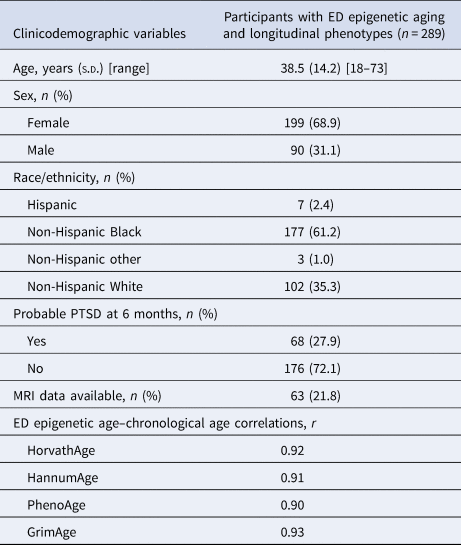
The present study is focused on a subset of AURORA participants (n = 289) in whom epigenetic assessments of ED blood samples were performed. A smaller subset of these individuals (n = 63) also underwent neuroimaging assessments 2 weeks after trauma. Clinicodemographic characteristics of included participants are presented in Table 1.
Participant demographic and clinical variables

MRI, magnetic resonance imaging; n, number; r, Pearson correlation coefficient; s.d., standard deviation.
PTSD at 6 months was defined using the PTSD Checklist for DSM-5 (PCL-5) and a previously established score threshold of ⩾31 (Blevins et al., Reference Blevins, Weathers, Davis, Witte and Domino2015; Bovin et al., Reference Bovin, Marx, Weathers, Gallagher, Rodriguez, Schnurr and Keane2016; Kessler et al., Reference Kessler, Ressler, House, Beaudoin, An, Stevens and McLean2021).
Phenotypic measures
Probable PTSD diagnosis at 6 months was defined using the PTSD Checklist for DSM-5 (PCL-5) – a 20-item self-report scale that uses a 0–4 response format asking how much the participant was ‘bothered by’ each PTSD symptom (0–4 scale) in the past 30 days – and a previously established PCL-5 score threshold of ⩾31 (Blevins, Weathers, Davis, Witte, & Domino, Reference Blevins, Weathers, Davis, Witte and Domino2015; Bovin et al., Reference Bovin, Marx, Weathers, Gallagher, Rodriguez, Schnurr and Keane2016; Kessler et al., Reference Kessler, Ressler, House, Beaudoin, An, Stevens and McLean2021). Distinct PTSD-related symptom trajectories (intrusive memories, hyperarousal, avoidance, nightmares, and sleep disturbance) were characterized using data from symptom assessments collected from AURORA participants at 10 timepoints during the 6 months after trauma exposure (McLean et al., Reference McLean, Ressler, Koenen, Neylan, Germine, Jovanovic and Kessler2020). Each of these symptoms is assessed through smartphone-based surveys using 2–3 items asking participants to rate the symptom severity or frequency (0–4 scale) experienced over the preceding days. For each symptom, latent trajectory classes were defined using growth mixture models. Given the smaller cohort subset with epigenetic data, statistical power was increased here by comparing the combined trajectories with low or moderate recovery symptoms v. those with moderate or high persistent symptoms over the follow-up duration. Further details are provided in online Supplementary Methods and in Beaudoin et al. (Reference Beaudoin, An, Basu, Ji, Liu, Kessler and McLean2023). PTSD symptoms at ED presentation and over the lifetime were assessed using the abbreviated (six-item) civilian version of PCL-5 (PCL-C), and the presence of significant PTSD symptoms at ED presentation was defined using a previously established score threshold of ⩾14 (Lang & Stein, Reference Lang and Stein2005). Childhood trauma history was assessed using a modified, 11-item survey derived from the short version of the childhood trauma questionnaire (CTQ) (Bernstein et al., Reference Bernstein, Stein, Newcomb, Walker, Pogge, Ahluvalia and Zule2003). The survey included two items each from the physical neglect, emotional neglect, emotional abuse, and physical abuse subtype and three items from the sexual abuse subtype, with each item asking the frequency (0–4 scale) of traumatic experience during the participant's childhood. Lifetime trauma burden was defined as the sum of all questionnaire items comprising the Life Events Checklist (LEC-5) (Gray, Litz, Hsu, & Lombardo, Reference Gray, Litz, Hsu and Lombardo2004; Weathers et al., Reference Weathers, Blake, Schnurr, Kaloupek, Marx and Keane2013). General mental and physical health at the time of ED presentation were derived using normative scores based on questions from the 12-item Short Form Health Survey (SF-12) (Ware, Kosinski, & Keller, Reference Ware, Kosinski and Keller1996). Quantity of daily tobacco and alcohol use at ED presentation was assessed using the PhenX toolkit (Hamilton et al., Reference Hamilton, Strader, Pratt, Maiese, Hendershot, Kwok and Haines2011).
DNA methylation
Blood samples were collected in the ED using DNA PAXgene tubes (Qiagen, Germantown MD, USA), frozen at −20°C at each collection study site, and then batch-shipped on dry ice to the NIMH repository (Piscataway, NJ, USA). DNA was isolated upon arrival to the repository using chemagen magnetic bead technology via Chemagic 360 instrumentation (PerkinElmer, Waltham, MA, USA). DNA concentration and purity were determined using UV/Vis on a Lunatic reader (Unchained Labs, Pleasanton, CA, USA). Bisulfite conversion of the isolated DNA was performed at the University of Minnesota Genomics Center, St. Paul, MN using EZ-96 DNA Methylation Kits (Zymo Research, Irvine, CA, USA) according to the manufacturer's instructions. DNAm was quantified using the Infinium Human MethylationEPIC BeadChip (Illumina Inc., San Diego, CA, USA). All steps were performed manually except for hybridization and staining steps, which were performed by a liquid handling robot (Tecan, Männedorf, Switzerland). To account for potential technical batch effects, DNA samples from different outcomes were randomized across beadchips. Quality control (QC) was performed using the CHAMP package in RStudio (Tian et al., Reference Tian, Morris, Webster, Yang, Beck, Feber and Teschendorff2017). ChAMP is an integrated analysis pipeline that filters low-quality probes and samples, adjusts for Infinium I and Infinium II probe design, and corrects for batch effects. Methylation data were cleaned by removing: (i) probes with low detection p > 0.1 or with beadcount <3 in at least 5% of samples; (ii) previously identified cross-reactive and polymorphic probes; (iii) probes containing SNPs that overlap with a CpG site, at single base extension sites, or when the CpG probe was located near short insertions or deletions; and (iv) probes located on the X and Y chromosomes. Data were then visually inspected by singular value decomposition and remaining batch effects were removed using ComBat (Johnson, Li, & Rabinovic, Reference Johnson, Li and Rabinovic2007; Leek, Johnson, Parker, Jaffe, & Storey, Reference Leek, Johnson, Parker, Jaffe and Storey2012). QC-processed DNAm data (β values) were used to calculate epigenetic aging with the online Horvath calculator, and downstream analyses focused on the four widely used first- and second-generation epigenetic aging markers: HorvathAge (Horvath, Reference Horvath2013), HannumAge (Hannum et al., Reference Hannum, Guinney, Zhao, Zhang, Hughes, Sadda and Zhang2013), PhenoAge (Levine et al., Reference Levine, Lu, Quach, Chen, Assimes, Bandinelli and Horvath2018), and GrimAge (Lu et al., Reference Lu, Quach, Wilson, Reiner, Aviv, Raj and Horvath2019). Since different immune cell types have distinct epigenetic profiles and their blood distribution can be influenced by stress (Adalsteinsson et al., Reference Adalsteinsson, Gudnason, Aspelund, Harris, Launer, Eiriksdottir and Gudnason2012; Beis et al., Reference Beis, von Känel, Heimgartner, Zuccarella-Hackl, Bürkle, Ehlert and Wirtz2018), array DNAm data and standard procedures were used to estimate blood cell proportions (CD8 + T cells, CD4 + T cells, B cells, natural killer cells, granulocytes, monocytes) (Houseman et al., Reference Houseman, Accomando, Koestler, Christensen, Marsit, Nelson and Kelsey2012) that were included as covariates to adjust for potential confounding in all regression models.
Genetic ancestry principal components
DNA samples were genotyped using the Infinium Global Screening Array-24 v1.0 (Illumina Inc.) at the Stanley Center/Broad Institute. Data were quality-controlled and principal component analysis (PCA) was implemented using the Plink1.9 program. We performed PCA jointly on our samples with samples from the 1000 Genomes Project (1000G) and extracted the top 10 principal components (PCs) (plink.eigenvec and plink.eigenval files were generated) of the variance-standardized relationship matrix. With the 1000G PCs, we trained a decision tree and used the rpart (Recursive Partitioning and Regression Trees) package in RStudio (Version 2022.02.3) to test AURORA PCs to predicate the genetic ancestry and the possible genetic ancestry probabilities.
Neuroimaging measures
T1-weighted structural MRI and resting-state functional MRI (rs-fMRI) data were collected across five sites with harmonized acquisition parameters at the 2-week follow-up timepoint (Harnett et al., Reference Harnett, van Rooij, Ely, Lebois, Murty, Jovanovic and Stevens2021). Data were preprocessed using FMRIPREP v1.2.2 (Esteban et al., Reference Esteban, Markiewicz, Blair, Moodie, Isik, Erramuzpe and Gorgolewski2019). Brain surfaces were reconstructed, and subcortical volumes were extracted using FreeSurfer v6.0.1 (Dale, Fischl, & Sereno, Reference Dale, Fischl and Sereno1999), in order to generate volumetric data for the hippocampus and the amygdala (left and right). Each hippocampus was subdivided into 21 subregions (Iglesias et al., Reference Iglesias, Augustinack, Nguyen, Player, Player, Wright and Van Leemput2015) and each amygdala into nine nuclei (Saygin et al., Reference Saygin, Kliemann, Iglesias, van der Kouwe, Boyd, Reuter and Augustinack2017). For each of these metrics and to minimize the number of comparisons, analyses examined the sum volume of both sides (left and right) as the variable of interest. The rs-fMRI data (TR = 2.36 s, 230 volumes, 9:05 min scan time) were processed using ICA-AROMA as part of the FMRIPREP pipeline, which has been shown to handle motion artifacts in a robust, data-driven fashion that performs equal to or better than standard scrubbing or censoring procedures (Pruim et al., Reference Pruim, Mennes, van Rooij, Llera, Buitelaar and Beckmann2015b; Pruim, Mennes, Buitelaar, & Beckmann, Reference Pruim, Mennes, Buitelaar and Beckmann2015a). The rs-fMRI data were further processed within the Analysis for Functional NeuroImages program 3dTproject to perform linear detrending, censoring of non-steady state volumes identified by FMRIPREP, bandpass filtering (0.01–0.1 Hz), and regression of white matter, corticospinal fluid, and global signal to account for potential physiological noise. Network connectivity was estimated by correlating the mean fMRI time-course from regions of interest (ROIs) in the Yeo 7-Network atlas (Yeo et al., Reference Yeo, Krienen, Sepulcre, Sabuncu, Lashkari, Hollinshead and Buckner2011). Independent Pearson correlation coefficients were calculated for each pair of ROIs to represent the strength of network-to-network functional connectivity. Pearson correlations were z-transformed prior to statistical analyses.
Statistical analysis
All statistical analyses were performed in R version 4.2.0. Logistic regression models tested ED epigenetic aging markers as the primary (four total) independent variables and 6-month probable PTSD diagnosis as the primary dependent variable of interest. These primary analyses were corrected for multiple testing with the conservative Bonferroni method (Bland & Altman, Reference Bland and Altman1995), leading to an adjusted α (p value threshold) of 0.05/4 = 0.0125. Secondary analyses evaluated associations between epigenetic aging and distinct PTSD-related symptom trajectories and between individual GrimAge CpG sites and PTSD outcomes. Other secondary analyses evaluated associations between epigenetic aging and amygdala and hippocampus volumes as well as resting-state functional connectivity. These analyses were corrected for multiple testing using the false discovery rate (FDR) method (Benjamini & Hochberg, Reference Benjamini and Hochberg1995). All models were adjusted for age, sex, self-reported race/ethnicity, educational level, marital status, and DNAm-estimated blood cell proportions. We further controlled all models involving MRI data for imaging site and models involving structural MRI for total intracranial volume. Additional sensitivity analyses adjusted for CTQ and lifetime trauma scores, PTSD symptoms at the time of ED presentation and over the lifetime, SF-12 mental and physical health scores, quantity of tobacco and alcohol use, income, body mass index (BMI), and the first three genetic ancestry (SNP-based) PCs.
Results
Cohort overview and clinicodemographic characteristics
The characteristics of participants (n = 289) are summarized in Table 1. Most participants were non-Hispanic Black women less than 40 years of age. As expected, all four epigenetic aging markers (HorvathAge, HannumAge, PhenoAge, and GrimAge) were strongly correlated with chronological age (all pairwise correlation p values < 2.2 × 10⁻¹⁶). Approximately one in four participants had probable PTSD 6 months after trauma. There were no significant differences in chronological age, sex, or race/ethnicity between participants with and without 6-month PTSD (all p values > 0.46).
Advanced GrimAge at the time of trauma predicts PTSD outcomes in the ensuing 6 months
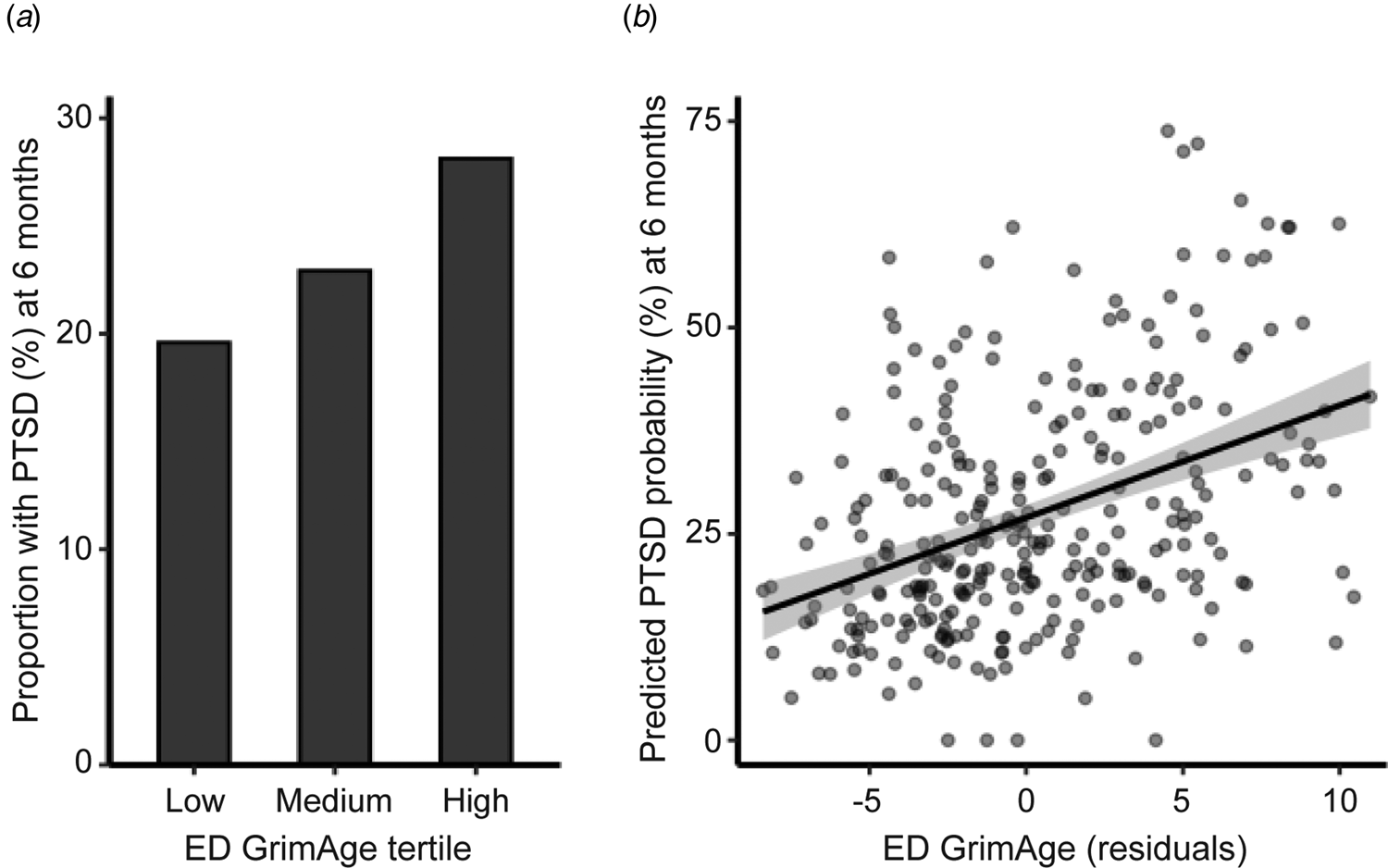
Primary analyses tested whether any of the four measures of epigenetic aging (HorvathAge, HannumAge, PhenoAge, and GrimAge) predicted 6-month PTSD outcome. After adjusting for age, sex, self-reported race/ethnicity, educational level, marital status, and DNAm-estimated blood cell proportions, and correcting for multiple comparisons (Bonferroni-adjusted α < 0.0125), only ED GrimAge significantly predicted 6-month probable PTSD diagnosis (n = 244, β = 0.11, s.e. = 0.04, z = 2.5, p = 0.0114). This effect remained significant after further stepwise adjustment for childhood and lifetime trauma burden, PTSD symptoms at the time of ED presentation and over the lifetime, general mental and physical health, quantity of tobacco and alcohol use, income, BMI, and genetic ancestry PCs (p values between 0.0092 and 0.0414). Moreover, a dose–response relationship between epigenetic aging and PTSD was observed, with individuals in the highest GrimAge tertile having 17% greater risk than those in the medium and 44% greater risk than individuals in the lowest tertile (Fig. 1a, b). Secondary analyses assessed whether ED GrimAge predicts distinct PTSD-related symptom trajectories: intrusive memories, hyperarousal, avoidance, nightmares, and sleep disturbance. As expected, pairwise positive correlations were observed for scores obtained for all five symptom categories at each of the 10 timepoints (all p values < 4.8 × 10⁻⁷). In adjusted analyses, advanced GrimAge significantly predicted worse trajectories of intrusive memories (n = 289, β = 0.10, s.e. = 0.04, z = 2.5, p = 0.0125) and nightmares (n = 289, β = 0.09, s.e. = 0.04, z = 2.1, p = 0.0319) during the 6 months after trauma, and these predictions did not change after further controlling for PTSD symptoms at ED presentation (p = 0.0177 for intrusive memories and 0.0405 for nightmares). In contrast, no significant findings were observed for hyperarousal, avoidance, and sleep (p values > 0.24). Taken together, these findings suggest that advanced epigenetic age is associated with heightened PTSD risk and, in particular, increased intrusive memories and nightmares in the aftermath of trauma.
Advanced GrimAge at emergency department (ED) presentation predicts increased risk for posttraumatic stress disorder (PTSD) 6 months later. (a) Proportion of participants with 6-month probable PTSD stratified by ED GrimAge tertile. (b) Graph depicting how ED GrimAge predicts the probability for 6-month PTSD diagnosis. Predicted probabilities have been adjusted for covariates (details in Methods section). Depicted GrimAge residuals are after adjusting for chronological age. Additional statistics are provided in Results.

GrimAge CpG sites and PTSD outcomes
The prediction of PTSD trajectories by the composite (multi-CpG) GrimAge marker also prompted us to examine whether it may be driven by specific CpG sites. To address this question, we separately tested if 6-month probable PTSD was associated with ED methylation levels at each of the 1030 CpGs that comprise GrimAge (Lu et al., Reference Lu, Quach, Wilson, Reiner, Aviv, Raj and Horvath2019). After adjusting for age, sex, self-reported race/ethnicity, educational level, marital status, and DNAm-estimated blood cell proportions, a total of 39 CpGs sites were found to predict PTSD at the nominal but not the FDR-adjusted level of statistical significance (online Supplementary Table S4). Among these 39 CpG sites, ED methylation at only two sites was also significantly associated with the GrimAge-predicted intrusive memories and nightmares symptom trajectories (cg06722193, cg02716826; online Supplementary Table S4). To rule out the possibility that associations merely reflect correlation strength of these CpGs with GrimAge in our data, we performed pairwise correlations of each GrimAge CpG with the composite GrimAge metric. When ranking correlations from smaller to larger p values, cg06722193 and cg02716826 were respectively ranked #286 and #53 among all GrimAge CpGs. The association with cg06722193 (shown in Fig. 2) is particularly interesting, given that this CpG is located within IRX6, a gene that is involved in neuronal development and is epigenetically regulated by stress exposure (Del Corvo et al., Reference Del Corvo, Bongiorni, Stefanon, Sgorlon, Valentini, Ajmone Marsan and Chillemi2020; Leung et al., Reference Leung, Kosyk, Welter, Dietrich, Archer and Zannas2022; Star et al., Reference Star, Zhu, Shi, Liu, Pashmforoush, Sauve and Chow2012). These findings provide limited evidence for genomic site-specific prediction of PTSD outcomes and rather support this prediction as an overall (i.e. emergent) property of the composite GrimAge marker.
Example of a GrimAge CpG, the methylation levels of which predict 6-month posttraumatic stress disorder (PTSD) and related symptom trajectories at the nominal level of statistical significance. Predicted probabilities have been adjusted for covariates (as described in Methods). Detailed statistics are provided in online Supplementary Table S4.

Advanced GrimAge is associated with brain alterations relevant for PTSD outcomes
To identify posttraumatic brain alterations associated with advanced epigenetic age (assessed via ED GrimAge), we leveraged structural and functional neuroimaging (MRI) data available in a smaller subset of individuals at the 2-week follow-up timepoint (n = 63; 40 women, 23 men; age mean, 35.1; age range = 18–67). Structural MRI analyses focused on the amygdala and the hippocampus, two brain regions with established roles in stress and trauma-related phenotypes (Del Casale et al., Reference Del Casale, Ferracuti, Barbetti, Bargagna, Zega, Iannuccelli and Pompili2022; Morey et al., Reference Morey, Gold, LaBar, Beall, Brown, Haswell and McCarthy2012). After adjusting for age, sex, self-reported race/ethnicity, educational level, marital status, DNAm-estimated blood cell proportions, imaging site, and total intracranial volume, advanced GrimAge was significantly associated with reduced whole amygdala volume (n = 62, β = −22.7, s.e. = 10.8, t = −2.1, p = 0.0413) but not hippocampal volume (p = 0.21). Secondary analyses examined if this association was driven by selected amygdala subregions (nine measures total). After covariate adjustment and FDR correction for multiple testing, advanced GrimAge was significantly associated with smaller volumes of the cortico-amygdaloid transition and the cortical and accessory basal nuclei (FDR-adjusted p values between 0.0013 and 0.0169; example shown in Fig. 3). We next explored associations between advanced GrimAge and resting-state functional network connectivity (21 measures total). After covariate adjustment and FDR correction, GrimAge was not significantly associated with any network connectivity measure (n = 63; all FDR-adjusted p values > 0.07).
Advanced GrimAge is associated with reduced amygdala subregion volumes. Example is shown for volume of the accessory basal nucleus of the amygdala. The brain image on the right depicts the accessory basal nucleus from a single subject. Depicted GrimAge residuals are after adjusting for chronological age and DNA methylation-estimated blood cell proportions. Additional statistics are provided in Results.

Discussion
Prior research has linked stress exposure and PTSD with advanced epigenetic age (Belsky et al., Reference Belsky, Caspi, Corcoran, Sugden, Poulton, Arseneault and Moffitt2022; Boks et al., Reference Boks, van Mierlo, Rutten, Radstake, De Witte, Geuze and Vermetten2015; Brody et al., Reference Brody, Yu, Chen, Beach and Miller2016; Copeland et al., Reference Copeland, Shanahan, McGinnis, Aberg and van den Oord2022; Harvanek et al., Reference Harvanek, Fogelman, Xu and Sinha2021; Katrinli et al., Reference Katrinli, Stevens, Wani, Lori, Kilaru, van Rooij and Smith2020; Kuan et al., Reference Kuan, Ren, Clouston, Yang, Jonas, Kotov and Luft2021; Lim et al., Reference Lim, Nzegwu and Wright2022; Mehta et al., Reference Mehta, Bruenig, Pierce, Sathyanarayanan, Stringfellow, Miller and Shakespeare-Finch2022; Na et al., Reference Na, Montalvo-Ortiz, Nagamatsu, Southwick, Krystal, Gelernter and Pietrzak2022; Wang et al., Reference Wang, Hui, Goldberg, Smith, Kaseer, Murrah and Sun2022; Wolf et al., Reference Wolf, Maniates, Nugent, Maihofer, Armstrong, Ratanatharathorn and Logue2018; Zannas et al., Reference Zannas, Arloth, Carrillo-Roa, Iurato, Roh, Ressler and Mehta2015a), but no studies have examined whether epigenetic aging measured at the time of trauma predicts subsequent development of PTSD outcomes. Leveraging the AURORA cohort (McLean et al., Reference McLean, Ressler, Koenen, Neylan, Germine, Jovanovic and Kessler2020), the present study showed that advanced epigenetic age (measured with GrimAge) at ED presentation predicts increased PTSD risk and worse intrusive memories and nightmares symptom trajectories in the ensuing 6 months. In a cohort subset with neuroimaging data 2 weeks after trauma, advanced ED epigenetic age was further associated with reduced whole amygdala and amygdala subregion volumes.
Recent work in the AURORA study has identified promising clinical predictors (Kessler et al., Reference Kessler, Ressler, House, Beaudoin, An, Stevens and McLean2021; Ziobrowski et al., Reference Ziobrowski, Kennedy, Ustun, House, Beaudoin, An and van Rooij2021), but personalized interventions would also benefit from molecular markers of risk for developing distinct posttraumatic outcomes (Howie, Rijal, & Ressler, Reference Howie, Rijal and Ressler2019; Linnstaedt, Zannas, McLean, Koenen, & Ressler, Reference Linnstaedt, Zannas, McLean, Koenen and Ressler2020; Smith et al., Reference Smith, Ratanatharathorn, Maihofer, Naviaux, Aiello, Amstadter and Nievergelt2020; Zannas et al., Reference Zannas, Provençal and Binder2015b). Epigenetic signatures have been proposed as prime candidate markers of posttraumatic vulnerability (Howie et al., Reference Howie, Rijal and Ressler2019; Linnstaedt et al., Reference Linnstaedt, Zannas, McLean, Koenen and Ressler2020; Smith et al., Reference Smith, Ratanatharathorn, Maihofer, Naviaux, Aiello, Amstadter and Nievergelt2020; Zannas et al., Reference Zannas, Provençal and Binder2015b), given the epigenome's role as a molecular interface between environment and health (Cavalli & Heard, Reference Cavalli and Heard2019; Gassen et al., Reference Gassen, Chrousos, Binder and Zannas2016). Our finding that GrimAge is a predictive marker of PTSD extends previous studies observing advanced GrimAge in individuals with current or lifetime PTSD (Katrinli et al., Reference Katrinli, Stevens, Wani, Lori, Kilaru, van Rooij and Smith2020; Na et al., Reference Na, Montalvo-Ortiz, Nagamatsu, Southwick, Krystal, Gelernter and Pietrzak2022; Wolf et al., Reference Wolf, Maniates, Nugent, Maihofer, Armstrong, Ratanatharathorn and Logue2018; Yang et al., Reference Yang, Wu, Verhoeven, Gautam, Reus, Kang and Wolkowitz2021). Moreover, our prospective observations build on previous longitudinal studies indicating that both trauma exposure and increased PTSD symptoms are associated with accelerated epigenetic aging over time (Belsky et al., Reference Belsky, Caspi, Corcoran, Sugden, Poulton, Arseneault and Moffitt2022; Mehta et al., Reference Mehta, Bruenig, Pierce, Sathyanarayanan, Stringfellow, Miller and Shakespeare-Finch2022; Sumner, Colich, Uddin, Armstrong, & McLaughlin, Reference Sumner, Colich, Uddin, Armstrong and McLaughlin2019; Wolf et al., Reference Wolf, Logue, Morrison, Wilcox, Stone, Schichman and Miller2019; Yang et al., Reference Yang, Wu, Verhoeven, Gautam, Reus, Kang and Wolkowitz2021). The unique ability of GrimAge to capture vulnerability in the immediate aftermath of trauma may stem from its development as a predictor of healthspan and lifespan, which likely makes it more amenable to environmental stressors as life advances. In contrast, we speculate that DNAm-based predictors of chronological age may undergo more tightly programmed epigenomic changes as a result of advancing age. Intriguingly, our longitudinal data spanning distinct symptom categories further show that GrimAge predicts worse trajectories only for intrusive memories and nightmares, thereby suggesting that advanced epigenetic age contributes to psychiatric risk through select PTSD symptoms that develop and persist longitudinally after trauma exposure.
Leveraging neuroimaging data available in a subset of study participants, we also found that GrimAge is associated with reduced volume of the whole amygdala and specific amygdala subregions, including the cortico-amygdaloid transition and the cortical and accessory basal nuclei. Reduced volume in the whole amygdala and in select amygdala subregions has been previously observed in PTSD (Morey et al., Reference Morey, Gold, LaBar, Beall, Brown, Haswell and McCarthy2012, Reference Morey, Clarke, Haswell, Phillips, Clausen, Mufford and LaBar2020). Work in animal models further shows that amygdala subregions can shrink in stress-exposed mice and further predispose to exacerbated behavioral sequelae after stress exposure (Golub et al., Reference Golub, Kaltwasser, Mauch, Herrmann, Schmidt, Holsboer and Wotjak2011; Yang et al., Reference Yang, Mozhui, Karlsson, Cameron, Williams and Holmes2008). Our findings thus suggest that advanced epigenetic age is associated with structural alterations in the amygdala and related increased vulnerability for PTSD development and persistence. This possibility is congruent with a prior study linking GrimAge with brain region-specific cortical atrophy (Katrinli et al., Reference Katrinli, Stevens, Wani, Lori, Kilaru, van Rooij and Smith2020). It is important to note that all neuroimaging measures in the present study were obtained 2 weeks after ED presentation. While this timepoint was in part selected due to challenges inherent to performing MRI at the time of trauma exposure, it also lies temporally between ED presentation and the 6-month follow-up. Thus, an intriguing hypothesis is that early structural brain alterations associated with advanced GrimAge could predispose to worse PTSD trajectories in the aftermath of trauma. However, the current study design limited our ability to test this hypothesis, given the lack of neuroimaging measures before trauma exposure that would be necessary to temporally disentangle the observed associations.
Additional limitations should be considered when interpreting the findings reported herein. Although our analyses adjusted for several potential confounders, the study's unique design and observational setting did not allow us to include a control (non-trauma) group that would disentangle the extent to which advanced GrimAge was a direct consequence of or already present before the traumatic event. However, given that blood samples were collected within hours of trauma exposure and neuroimaging was performed at the 2-week follow-up, it is likely that epigenetic patterns and brain alterations were already present prior to trauma. Moreover, the study design precluded us from testing whether PTSD symptoms accelerate epigenetic aging, which is a more commonly studied direction of association. Analyses were adjusted for key potential confounders, including childhood and lifetime trauma burden, ED and lifetime PTSD symptoms, and general mental and physical health, but the possibility that other undocumented confounders could in part account for the observed associations cannot be ruled out. As expected, all symptom scores showed significant positive pairwise correlations and thus do not represent independent signals; however, our findings suggest that advanced GrimAge is specifically associated with worse intrusive memories and nightmares symptom trajectories. Our sample size was modest, especially for analyses involving neuroimaging data. This limited our power for conclusively testing genomic site-specific predictions and precluded us from testing if brain alterations statistically mediate the prediction of PTSD outcomes by GrimAge. Epigenetic assessments were conducted in whole blood, and while our analyses adjusted for blood cell composition, the findings' mechanistic relevance remains to be dissected in brain tissues with direct phenotypic relevance, such as the amygdala. The presented findings will thus benefit by replication and further dissection in larger independent cohorts and postmortem datasets.
In sum, the findings presented here shed new light on the relation between biological aging and trauma-related phenotypes, suggesting that GrimAge measured immediately after trauma predicts subsequent PTSD trajectories and is associated with relevant brain alterations. Furthering these findings has the potential to enhance early prevention and treatment of posttraumatic psychiatric sequelae.
Supplementary material
The supplementary material for this article can be found at https://doi.org/10.1017/S0033291723000636
Acknowledgements
The investigators wish to thank the trauma survivors participating in the AURORA Study. Their time and effort during a challenging period of their lives make our efforts to improve recovery for future trauma survivors possible. This project was supported by NIMH under U01MH110925, the US Army MRMC, One Mind, and The Mayday Fund. This work was also supported by a NARSAD Young Investigator grant (#24135) and a Foundation of Hope for Research and Treatment of Mental Illness grant awarded to ASZ. Verily Life Sciences and Mindstrong Health provided some of the hardware and software used to perform study assessments. Bio-samples for this publication were processed by and obtained from the NIMH Repository & Genomics Resource, supported by cooperative agreement U24MH068457. Data and/or research tools used in the preparation of this manuscript were obtained from the National Institute of Mental Health (NIMH) Data Archive (NDA) under DOI: 10.15154/1528075. NDA is a collaborative informatics system created by the National Institutes of Health to provide a national resource to support and accelerate research in mental health. This manuscript reflects the views of the authors and may not reflect the opinions or views of any of the funders or of the Submitters submitting original data to NDA. The authors would like to thank Dr Ake T. Lu and Dr. Steve Horvath for providing the list of CpG sites that comprise the GrimAge marker.
Author contributions
Conceptualization, analyses, and manuscript draft: ASZ. Genomic data: SDL. Phenotypic data and statistical supervision: XA. Neuroimaging data: JSS, NGH, ARR, KIO. Critical editing and supervision: DRR, EBB, KCK, KJR, SAM. Funding: ASZ, KCK, KJR, SAM. Manuscript editing and approval: all authors.
Financial support
This project was supported by NIMH under U01MH110925, the US Army MRMC, One Mind, and The Mayday Fund. This work was also supported by a NARSAD Young Investigator grant (#24135) and a Foundation of Hope for Research and Treatment of Mental Illness grant awarded to ASZ. Bio-samples for this publication were processed by and obtained from the NIMH Repository & Genomics Resource, supported by cooperative agreement U24MH068457.
Conflict of interest
None.
Ethical standards
The authors assert that all procedures contributing to this work comply with the ethical standards of the relevant national and institutional committees on human experimentation and with the Helsinki Declaration of 1975, as revised in 2008.