


Lameness associated with hoof lesions is recognised as one of the most important health, welfare and productivity challenges affecting dairy cows worldwide (Whay and Shearer, Reference Whay and Shearer2017). From an animal welfare perspective, lameness represents a sign of pain that alters normal behaviour, including feeding, lying and social interactions (Galindo and Broom, Reference Galindo and Broom2002; Ito et al., Reference Ito, von Keyserlingk, LeBlanc and Weary2010; Norring et al., Reference Norring, Häggman, Simojoki, Tamminen, Winckler and Pastell2014). From a productivity perspective, lameness has been consistently associated with impaired reproductive performance, increased treatment and labour costs, reduced milk yield and an elevated risk of premature culling (Booth et al., Reference Booth, Warnick, Gröhn, Maizon, Guard and Janssen2004; Charfeddine and Pérez-Cabal, Reference Charfeddine and Pérez-Cabal2017; Dolecheck and Bewley, Reference Dolecheck and Bewley2018; Tsousis et al., Reference Tsousis, Boscos and Praxitelous2022; Mondini et al., Reference Mondini, Gislon, Zucali, Pavolini, Bava, Tamburini and Sandrucci2026). The majority of lameness cases in dairy cows arise from disorders of the claw and hoof (Fenster et al., Reference Fenster, Ruchti and Credille2023). These lesions are commonly categorised as non-infectious claw horn lesions, such as sole ulcer, sole haemorrhage and white line disease; and infectious lesions, including digital dermatitis (DD) and interdigital phlegmon (Bell et al., Reference Bell, Pedersen, Randall, Remnant, Wilson and Gross2024). Bovine claws can also be affected by various conformational abnormalities or deformities, of which the most relevant is ‘corkscrew claw’, a progressive and irreversible deformity of the claw capsule in dairy cows, characterised by spiral rotation of the claw, narrowing and elongation, deviation of the abaxial wall and a gradual shift of weight-bearing away from the sole (van Amstel, Reference van Amstel2017).
Lameness risk factors related to hoof lesions reflect complex interactions between animal-level susceptibility, environmental exposure and herd management practices, underscoring the importance of robust epidemiological investigation (Roche et al., Reference Roche, Renaud, Saraceni, Kelton and DeVries2024). Studies have described the prevalence and distribution of hoof lesions across different production systems and geographical regions, reporting substantial variation in lesion occurrence (Thomsen et al., Reference Thomsen, Shearer and Houe2023).
Retrospective analyses of hoof-trimming records have further contributed to understanding hoof lesion patterns, although methodological approaches and epidemiological definitions vary, with important implications for the definition and use of hoof-health traits in genetic analyses (ICAR, 2022). Across trimming-based epidemiological studies, substantial hoof lesion occurrence has been consistently reported at both the cow and farm levels, with considerable between-herd heterogeneity. At the cow level, reported prevalence typically ranges from approximately 30–50% under commercial conditions, with non-infectious claw horn lesions predominating, particularly white line disease, sole ulcer and sole haemorrhage (Solano et al., Reference Solano, Barkema, Mason, Pajor, LeBlanc and Orsel2016; Correa-Valencia et al., Reference Correa-Valencia, Castaño-aguilar, Shearer, Arango-Sabogal and Fecteau2019; Arango-Sabogal et al., Reference Arango-Sabogal, Desrochers, Lacroix, Christen and Dufour2020; Sadiq et al., Reference Sadiq, Ramanoon, Mossadeq, Mansor and Syed-Hussain2021). Infectious lesions such as DD show greater variability, with cow-level prevalence ranging from single-digit percentages to over 30% in endemically affected herds (Sadiq et al., Reference Sadiq, Ramanoon, Mansor, Syed-Hussain and Shaik Mossadeq2020; Kofler et al., Reference Kofler, Suntinger, Mayerhofer, Linke, Maurer, Hund, Fiedler, Duda and Egger-Danner2022). Lesions consistently show a non-uniform anatomical distribution, with a marked predilection for the hind feet, particularly the lateral claws (Solano et al., Reference Solano, Barkema, Mason, Pajor, LeBlanc and Orsel2016; Britten et al., Reference Britten, Blackie, Reader, Booth and Mahendran2025). At the farm level, prevalence estimates vary widely, with many studies reporting that 30–60% of herds have a substantial proportion of affected cows, reflecting differences in management, environment and trimming strategies (Solano et al., Reference Solano, Barkema, Mason, Pajor, LeBlanc and Orsel2016; Sadiq et al., Reference Sadiq, Ramanoon, Mansor, Syed-Hussain and Shaik Mossadeq2020; Kofler et al., Reference Kofler, Suntinger, Mayerhofer, Linke, Maurer, Hund, Fiedler, Duda and Egger-Danner2022).
Hoof-trimming strategies vary across dairy herds and may be implemented either preventively, through routine whole-herd trimming at scheduled intervals or therapeutically, by selectively trimming clinically lame or high-risk cows (Vidmar et al., Reference Vidmar, Hodnik and Starič2021). These differing approaches have important implications for the interpretation of hoof-trimming records, as the population of cows examined during each visit may vary substantially (Solano et al., Reference Solano, Barkema, Mason, Pajor, LeBlanc and Orsel2016). Despite a growing body of literature on hoof lesion epidemiology, published data from some geographical regions, including Southern Europe, remain limited (Zecconi et al., Reference Zecconi, Tarantino, Luzi and Redaelli2011; Thomsen et al., Reference Thomsen, Shearer and Houe2023). Retrospective observational analyses of such datasets offer a valuable opportunity to characterise hoof health patterns under commercial conditions, provided that prevalence measures are clearly specified and interpreted within their methodological context (Ishak et al., Reference Ishak, Guatteo, Lehebel, Brisseau, Drouet, Duvauchelle-waché and Relun2025).
The present study forms part of a broader, nationwide initiative aimed at the systematic collection, harmonisation and standardisation of claw health data in Italian dairy cows, in line with international recommendations for functional trait recording (ICAR, 2022). Within this framework, hoof-trimming records routinely generated under commercial conditions represent a robust and scalable source of phenotypic information, enabling the characterisation of lesion prevalence, anatomical distribution, between-farm heterogeneity across diverse production systems and geographic regions.
The objective of this retrospective observational pilot study was to quantify the prevalence of hoof lesions in Southern Italian dairy cows using hoof-trimming records collected across multiple trimming sessions between 2023 and 2025. Specifically, this study aimed to describe the occurrence of different hoof lesion types and their anatomical distribution by foot and claw, thereby contributing robust, region-specific epidemiological evidence to support improved lameness prevention and claw health management in Italian dairy herds.
Materials and methods
This study was conducted in accordance with the ‘Strengthening the Reporting of Observational Studies in Epidemiology’ (STROBE-Vet) guidelines (Sargeant et al., Reference Sargeant, O'connor, Dohoo, Erb, Cevallos, Egger, Ersbøll, Martin, Nielsen, Pearl, Pfeiffer, Sanchez, Torrence, Vigre, Waldner and Ward2016). Ethical approval was granted by the Ethics Review Committee of the School of Veterinary Medicine and Science, University of Nottingham, United Kingdom (clearance reference no. 4121240509) and from the Department of Veterinary Sciences, University of Messina, Italy (Ethical approval code no. 16/2026). All data on farm and animal identities were anonymised before release to the research team for analysis.
Data collection
Data were recorded using a dedicated hoof lesion management software for hoof-trimming records (DataTrim, FAMA Services S.R.L.S., Abbiategrasso, Italy) as part of the HappyFeet project, a national initiative established in collaboration with the Associazione Nazionale Allevatori della Razza Frisona, Bruna e Jersey Italiana – National Association of Breeders of Italian Holstein, Brown and Jersey Breeders. The project aims to standardise claw health recording by professional hoof trimmers across Italy, in line with the International Committee for Animal Recording (ICAR) Claw Health Atlas, to support farm-level reporting, epidemiological analyses and future national genetic evaluation (ICAR, 2022). The dataset was limited to routinely collected hoof-trimming records, and no supplementary information on farm management, housing, nutrition or environmental conditions was available.
All records were uploaded and collected by a single professional hoof trimmer over the study period from 2023 to 2025. Data were recorded directly during trimming procedures using dedicated hoof management software integrated with the trimming crush, allowing records to be exported electronically for subsequent analysis. The dataset included visit-level and cow-level identifiers (VisitID, FarmID, CowID), trimming date, foot and claw information (front/hind foot, medial/lateral claw), and lesion diagnoses were made by the same hoof trimmer during routine trimming procedures based on a modified ICAR classification (Egger-danner et al., Reference Egger-danner, Nielsen, Fiedler, Müller, Fjeldaas, Döpfer, Daniel, Bergsten, Cramer, Christen, Stock, Thomas, Holzhauer, Steiner, Clarke, Capion, Charfeddine, Pryce, Oakes, Burgstaller, Heringstad, Ødegård, Kofler, Egger and Cole2020).
Statistical analysis
All analyses, including data handling, descriptive analyses and mixed-effects regression modelling, were conducted using R version 4.3.1 (R Core Team, 2023). Prior to analysis, all records were cleaned and standardised using reproducible workflows. Lesion diagnosis fields were checked and cleaned to remove empty or invalid codes. A binary lesion indicator was created to distinguish records with at least one valid hoof lesion diagnosis from records with no recorded lesions, where a value of 1 indicated the presence of at least one valid lesion diagnosis code recorded during a trimming event and a value of 0 indicated trimming records without lesions. Where multiple lesion records were recorded for the same cow during a single trimming visit, records were aggregated using a unique cow identifier so that each cow contributed only once to visit-level summaries. Rows with missing, empty or invalid diagnosis codes were classified as non-lesion records.
Multiple lesions could be recorded for the same cow within a single trimming visit and were retained as separate lesions for descriptive analyses. The median interval between trimming visits was calculated at the farm level based on the difference in days between consecutive trimming dates. To account for substantial heterogeneity in the scale of hoof-trimming visits, trimming sessions were stratified into quartiles according to the number of unique cows trimmed per visit.
Prevalences
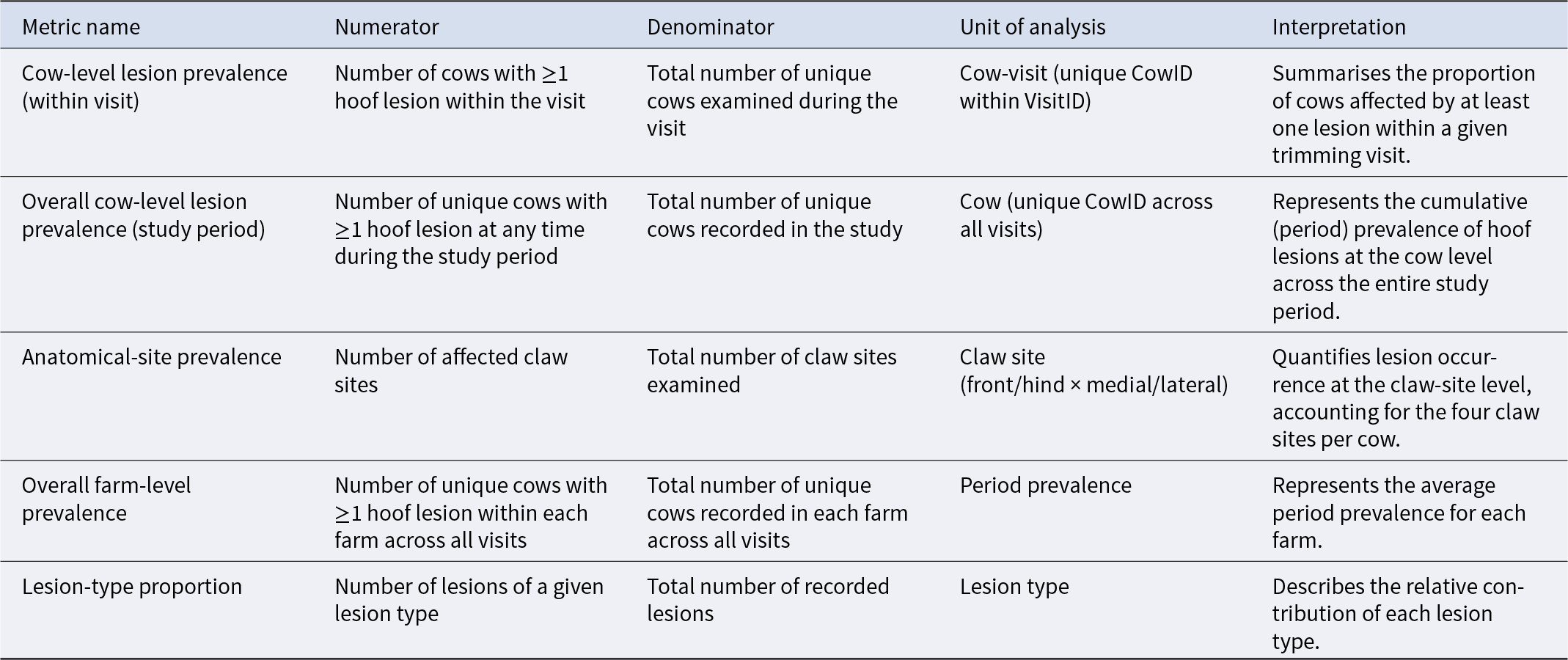
Hoof lesion prevalence was calculated at different hierarchical levels using clearly defined numerators and denominators. A cow was considered affected if at least one hoof lesion was recorded during a trimming event, regardless of lesion type or number. Prevalence was calculated at the cow and farm levels, with detailed definitions of each prevalence metric and corresponding denominators provided in Table 1. Quartile cut-points were derived from the empirical distribution of visit size, with Q1 representing the smallest visits and Q4 the largest. This stratification was applied to enable descriptive and comparative analyses of lesion prevalence across visits of differing size, while reducing the influence of extreme values and facilitating meaningful comparisons between small- and large-scale trimming sessions.
Units of analysis and denominators used in prevalence calculations

Table 1 Long description
The table defines how several hoof-lesion prevalence metrics are calculated by specifying the numerator, denominator, unit of analysis, and interpretation for each metric. Cow-level prevalence within a visit counts cows with at least one hoof lesion during a trimming visit out of all cows examined in that visit, using a cow-visit unit. Overall cow-level prevalence for the study period counts unique cows that had at least one lesion at any time during the study out of all unique cows in the study, using the cow as the unit. Anatomical-site prevalence counts affected claw sites out of all claw sites examined, treating each cow as contributing four sites based on front or hind and medial or lateral. Overall farm-level prevalence counts unique cows with at least one lesion within each farm across all visits out of all unique cows recorded for that farm across all visits, reflecting period prevalence at the farm level. Lesion-type proportion counts lesions of a specific type out of all recorded lesions to show each type’s relative contribution. Because the metrics use different units and denominators, values from different rows are not directly comparable without accounting for the level of measurement.
Note: This table summarises the unit of analysis and denominators used for the different prevalence metrics reported in the study.
Mixed-effects model for claw-level lesion risk
To evaluate differences in lesion occurrence between anatomical sites, a mixed-effects logistic regression model was fitted with claw-level lesion presence as a binary outcome (lesion present = 1, absent = 0). Anatomical site (front lateral, front medial, hind lateral, hind medial) was included as a fixed effect, with front lateral claws used as the reference category. Random intercepts for farm and cow were included to account for clustering of observations within farms and repeated measurements within cows across trimming visits. The model can be expressed as follows:
 \begin{equation*}{\text{logit}}\left( {P\left( {{Y_{ijk}} = 1} \right)} \right) = {\beta _0} + {\beta _1}{\text{FootCla}}{{\text{w}}_{ijk}} + {u_i} + {v_j},\end{equation*}
where  ${Y_{ijk}}$ is the lesion status of claw
 $k{\text{ }}$for cow
 $j{\text{ }}$on farm
 $i$,
 ${\beta _0}{\text{ }}$is the intercept,
 ${\beta _1}$represents the effect of anatomical site and
 ${u_i}{\text{ }}$and
 ${v_j}{\text{ }}$are random effects for farm and cow, respectively. Results were reported as odds ratios with 95% confidence intervals. Model fit was assessed using simulation-based residual diagnostics, which indicated no evidence of lack of fit, zero inflation or overdispersion.
Results
A total of 24,158 cow-trimming records from 94 dairy farms were analysed, corresponding to 246 trimming visits conducted between 2023 and 2025 and involving 13,782 unique cows, with some cows contributing multiple trimming events. The median number of unique cows trimmed per visit was 73.5 (3–494) cows. At the farm level, the median number of unique cows per farm was 110 (7–806) (Supplementary material, Fig. 1S).
Visit-size distribution
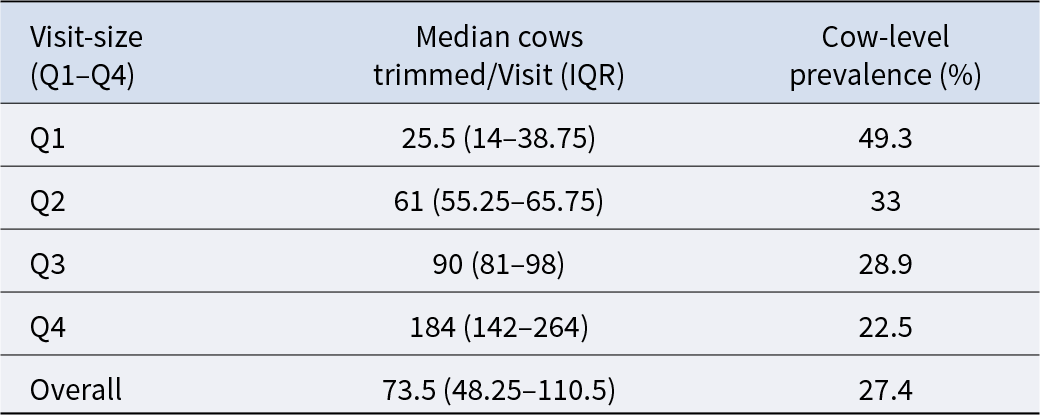
Overall, the median number of cows trimmed (Table 2) per visit was 73.5 (interquartile range [IQR]: 48.25–110.5). When stratified by visit-size quartiles, the median visit size increased progressively from 25.5 cows in Q1 (IQR: 14–38.75) to 61 cows in Q2 (IQR: 55.25–65.75) and 90 cows in Q3 (IQR: 81–98), before reaching 184 cows in Q4 (IQR: 142–264). The median interval between consecutive trimming visits (for farms with at least two trimming sessions in the dataset) was 216.5 days (range: 58–540 days).
Hoof lesion prevalence across visit-size quartiles (Q1–Q4) in dairy cows, with median number of cows trimmed per visit and corresponding cow-level prevalence estimates

Table 2 Long description
The table reports cow-level prevalence percentages across four visit-size quartiles, alongside the median number of cows trimmed per visit and the interquartile range. Prevalence is highest in Q1 at 49.3% with a median of 25.5 cows trimmed per visit (IQR 14 to 38.75). It decreases in Q2 to 33% with a median of 61 (IQR 55.25 to 65.75), and in Q3 to 28.9% with a median of 90 (IQR 81 to 98). The lowest prevalence is in Q4 at 22.5% with a median of 184 (IQR 142 to 264). Overall, the median visit size is 73.5 cows (IQR 48.25 to 110.5) and overall prevalence is 27.4%. Across quartiles, larger visit sizes are associated with lower prevalence, but the table does not indicate whether this pattern is causal or adjusted for other factors.
Cow-level prevalence
Overall cow-level prevalence, calculated as the proportion of cow-trimming events with ≥1 lesion, across all visits was 27.4% (Table 2). The distribution of cow-level prevalence varied across visits, with a median prevalence of 25.1% (IQR: 14.6–39.8%). The median cow-level prevalence was highest in the smallest visit-size category (Q1: 49.3%, IQR 38.2–63.7%) and declined progressively across increasing visit sizes to 33.0% (IQR: 24.5–44.1%) in Q2, 28.9% (IQR: 19.6–36.8%) in Q3 and 22.5% (IQR: 14.2–30.7%) in Q4 (Supplementary material, Fig. 2S).
Farm-level prevalence
Overall farm-level prevalence, calculated on a unique-cow basis within each farm, was 37.2% (Table 2), with a median farm-level prevalence of 34.6% (IQR: 22.1–48.9%). Farm-level prevalence estimates varied widely across herds and showed no clear linear association with herd size, with farms of comparable size distributed across all prevalence categories (Supplementary material, Fig. 3S). The distribution of herd-level prevalence was highly heterogeneous, driven by a small number of farms with particularly high prevalence values but a low number of cows (Supplementary material, Fig. 4S).
When stratified by visit-size quartiles, median farm-level prevalence was highest in Q1 (50.0%, IQR: 39.4–62.8%), decreased to 32.7% (IQR: 23.5–41.9%) in Q2 and 31.0% (IQR: 21.8–39.6%) in Q3 and increased slightly to 33.5% (IQR: 24.1–42.3%) in Q4. Substantial between-farm variability was evident within each visit-size stratum, although both median prevalence and dispersion were generally lower in larger trimming sessions (Supplementary material, Fig. 5S).
Lesion types
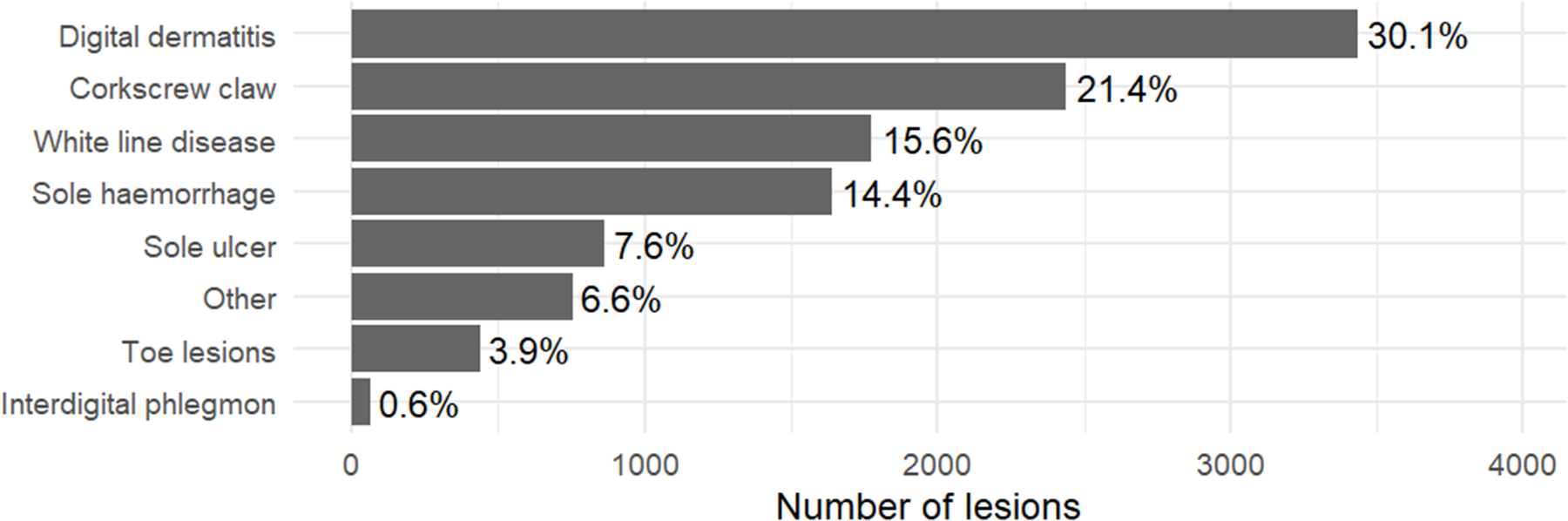
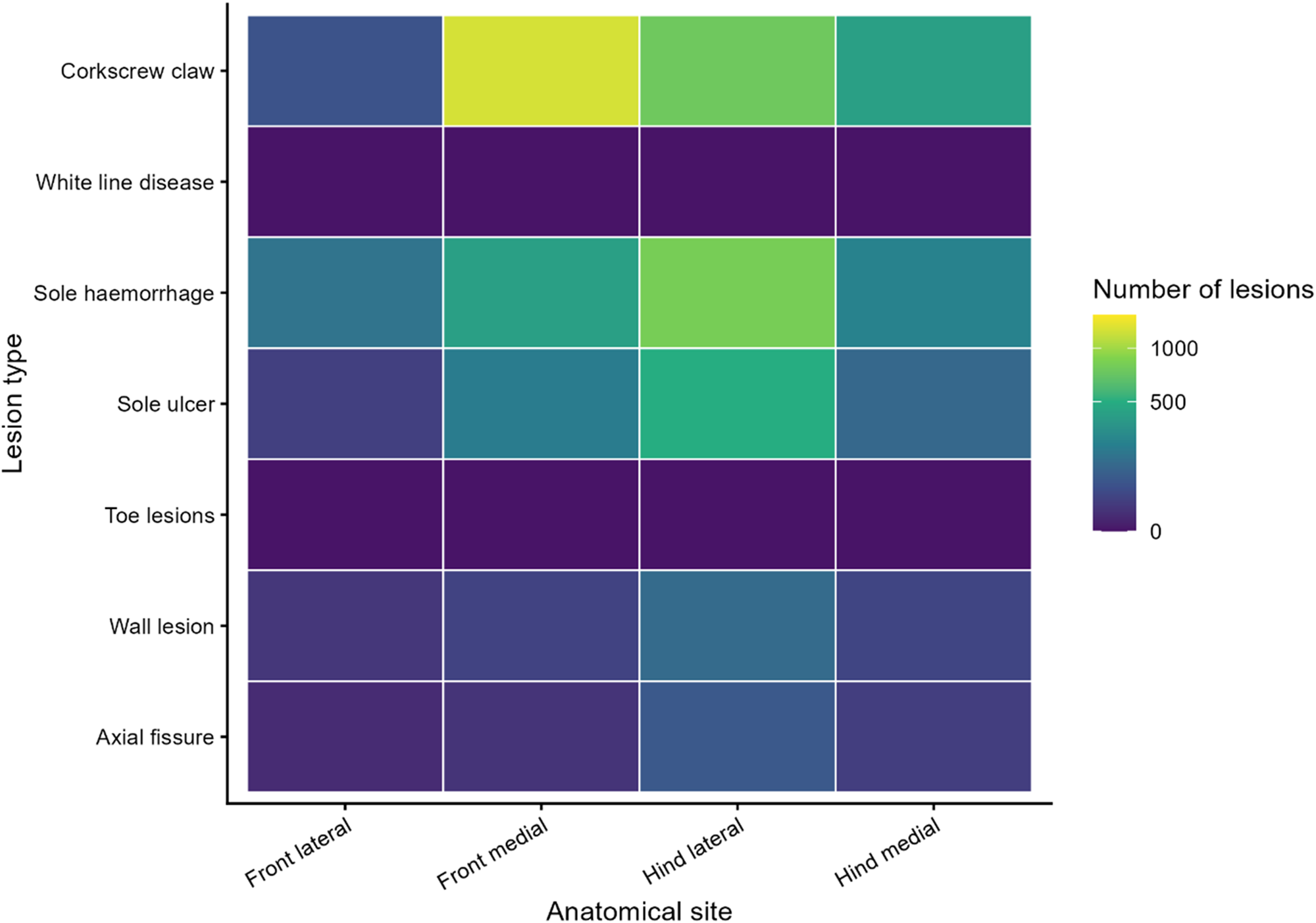
Overall, 11,408 hoof lesions were recorded. Out of this total, DD was the most frequently recorded lesion (30.1%), followed by corkscrew claw (21.4%), white line disease (15.6%) and sole haemorrhage (14.4%), as shown in Fig. 1. Less common lesion types were recorded at substantially lower frequencies. Across all lesions, 67.2% occurred in the hind feet and 32.8% in the front feet. When stratified by claw, lesions in the front feet were predominantly located in the medial claws, with 2,334 recorded observations, whereas lesions in the hind feet were concentrated in the lateral claws, with 3,747 recorded observations (Supplementary material, Fig. 6S). Lesion-type distribution varied markedly by anatomical site (Fig. 2). Corkscrew claw lesions were most frequently recorded on the front medial and hind medial claws, whereas white line disease showed a higher relative occurrence on the hind lateral and front lateral claws. Sole haemorrhage was more evenly distributed across sites but occurred slightly more often on lateral claws, particularly in the hind feet. Sole ulcers were predominantly associated with the hind claws, with a greater proportion affecting the lateral claw. In contrast, toe lesions, wall lesions and axial fissures occurred at lower frequencies overall and showed less pronounced site-specific clustering. Lesion prevalence at the individual cow level varied, with the maximum number of lesions recorded in a single cow during one trimming session being 10.
Distribution of the most prevalent hoof lesions by lesion type. Note: The bar chart shows the number and percentage of recorded hoof lesions by category.

Lesion-type distribution by anatomical site for some of the most common claw horn lesions. Note: Heatmap showing the number of lesions, ordered by most prevalence, within each anatomical site (front lateral, front medial, hind lateral, hind medial). Colours indicate the proportion of lesions occurring at each site, with lighter colours representing higher number of lesions.

Mixed-effects logistic regression identified clear differences in lesion risk between anatomical sites. Using the front lateral claw as the reference category, the odds of lesion occurrence were 5.9-fold higher in front medial claws, 16.9-fold higher in hind lateral claws and 2.5-fold higher in hind medial claws. The highest odds were observed in the hind lateral claw, which consistently showed the greatest lesion prevalence across descriptive and model-based analyses (Table 3).
Mixed-effects logistic regression results for claw-level lesion occurrence

Table 3 Long description
The table reports mixed-effects logistic regression results for the likelihood of a claw-level lesion by claw position, using the front lateral claw as the reference. Compared with the reference, the hind lateral claw shows the largest increase in odds, with an odds ratio of 16.93 and a 95 percent confidence interval from 14.97 to 19.14. The front medial claw also has higher odds, with an odds ratio of 5.85 and a 95 percent confidence interval from 5.17 to 6.62. The hind medial claw has a smaller but still elevated odds ratio of 2.53 with a 95 percent confidence interval from 2.23 to 2.89. All listed claw-position effects have p-values below 0.001, indicating strong evidence of differences from the reference. The intercept corresponds to a low baseline lesion probability for the reference category, with an odds ratio of 0.10 and a 95 percent confidence interval from 0.09 to 0.11. Results describe associations from the fitted model and do not by themselves establish causation.
Front lateral claw was used as the reference category.
ORs are presented with 95% confidence intervals (CI). P-values <0.001 were considered statistically significant.
Discussion
This retrospective observational pilot study provides region-specific epidemiological evidence on hoof lesion occurrence and anatomical distribution in Southern Italian dairy cows using routinely collected hoof-trimming records from 2023 to 2025. At the cow level, overall lesion prevalence across trimming visits was 27.4%, with substantial variability between visits, while at the farm level, prevalence averaged 37.2% and ranged widely from 14.7 to 97.6%, indicating pronounced heterogeneity both between farms and across trimming sessions. Lesions predominantly affected the hind feet, particularly the lateral claw, and DD, corkscrew claw and white line disease were the most frequently recorded lesion types.
Cow- and herd-level prevalences
At the cow level, overall hoof lesion prevalence in the present study was 27.4% across trimming visits, with marked variability between sessions. This estimate falls within the lower-to-moderate range of values reported in trimming- and clinically based studies conducted under commercial conditions, where cow-level prevalence commonly ranges from approximately 30–50%, depending on production system, study design and lesion definition (Solano et al., Reference Solano, Barkema, Mason, Pajor, LeBlanc and Orsel2016; Sadiq et al., Reference Sadiq, Ramanoon, Mossadeq, Mansor and Syed-Hussain2021; Thomsen et al., Reference Thomsen, Shearer and Houe2023). In dairy herds in Peninsular Malaysia, for example, an overall cow-level prevalence of 46.2% was reported, with sole ulcer, white line disease and sole haemorrhage being the most prevalent non-infectious lesions, while DD affected a smaller proportion of cows (Sadiq et al., Reference Sadiq, Ramanoon, Mossadeq, Mansor and Syed-Hussain2021). Similarly, trimming-based analyses in Alberta dairy herds indicated cow-level prevalence values of approximately 15% for DD, 6% for sole ulcers and 4% for white line disease (Solano et al., Reference Solano, Barkema, Mason, Pajor, LeBlanc and Orsel2016). Differences between studies likely reflect variation in housing systems, management practices, lesion definitions and, critically, the composition of trimming sessions. In the present study, the observed cow-level prevalence may therefore represent a combination of underlying lesion occurrence and the selective presentation of cows for trimming, particularly in visits that were primarily therapeutic rather than preventive.
Overall, the farm-level prevalence in the present study was 37.2%, ranging from 14.69% to 97.59%, highlighting pronounced inter-farm heterogeneity. Similar variability has been reported in other regions and is likely attributable to differences in housing design, flooring characteristics, hygiene, nutrition, herd size and hoof care management practices (Sadiq et al., Reference Sadiq, Ramanoon, Mossadeq, Mansor and Syed-Hussain2021; Browne et al., Reference Browne, Hudson, Crossley, Sugrue, Huxley and Conneely2022). In a large study of Alberta dairy herds, predominantly free-stall indoor-housed operations, hoof lesions were common at both the cow and herd levels, based on whole-herd trimming data. At the cow level, DD was the most prevalent lesion (≈15% of cows), followed by sole ulcers (≈6%) and white line disease (≈4%); at the herd level, almost all farms had at least one cow affected by DD and most herds also reported non-infectious claw horn lesions, with substantial variability in prevalence between farms (Solano et al., Reference Solano, Barkema, Mason, Pajor, LeBlanc and Orsel2016). In pasture-based and partly housed systems in Ireland, examination of lame cows showed that more than 95% of lame animals had at least one hoof lesion, with sole haemorrhage (77–80%), white line disease (72–73%) and overgrown claws (55–71%) being the most prevalent non-infectious conditions (Browne et al., Reference Browne, Hudson, Crossley, Sugrue, Huxley and Conneely2022). However, this wide range must also be interpreted in light of trimming practices, as in some herds, trimming sessions included only a small subset of cows, potentially restricted to animals presented as lame rather than the entire herd. Consequently, farm-level prevalence estimates derived from trimming records may reflect both underlying lesion prevalence and farm-specific trimming strategies.
Interpretation of herd-level prevalence should be approached cautiously because trimming session size and composition varied considerably between farms. Furthermore, complete herd population denominators were not consistently available, and some trimming sessions likely represented selected subsets of animals rather than the entire herd. Consequently, apparent differences in herd-level prevalence may partly reflect sampling variation and trimming practices rather than true between-herd differences. These findings emphasise the importance of herd-specific preventive approaches and cautious interpretation of trimming-based prevalence metrics, rather than reliance on uniform thresholds for claw health management.
Corkscrew claw
Interestingly, in the present study, corkscrew claw accounted for approximately 21% of all recorded lesions, making this condition the second most frequently identified hoof disorder after DD. The growing recognition of corkscrew claw has led to the development of standardised scoring systems to quantify severity and support epidemiological and risk-factor studies (Capion et al., Reference Capion, Rinken, Christensen, Dahl-pedersen and Bach2024). Once established, the condition tends to worsen over time and is frequently observed alongside other claw lesions and lameness, although a direct causal relationship with lameness is not always clear. This proportion of corkscrew claw is higher than that reported in several earlier trimming-based and cross-sectional studies, in which corkscrew claw was either less prevalent or not consistently distinguished as a separate diagnostic category (Solano et al., Reference Solano, Barkema, Mason, Pajor, LeBlanc and Orsel2016; Browne et al., Reference Browne, Hudson, Crossley, Sugrue, Huxley and Conneely2022). However, this finding aligns with more recent reports describing an increasing recognition of corkscrew claw and corkscrew claw syndrome, with prevalence estimates ranging from 10% to 15% in lame cows in pasture-based systems to 16% in heifers and over 30% in mature cows in affected herds (Cook et al., Reference Cook, Strebe and Karlen2019; Capion et al., Reference Capion, Rinken, Christensen, Dahl-pedersen and Bach2024). The relatively high frequency observed in the present dataset may therefore reflect both true epidemiological relevance and improved detection through systematic hoof-trimming records. Unlike other types of lesions, corkscrew claw represents a stable and routinely recordable claw conformation phenotype, making it particularly suitable for inclusion in future national genetic evaluation and breeding programmes (Häggman and Juga, Reference Häggman and Juga2013; Ødegård et al., Reference Ødegård, Svendsen and Heringstad2013). These findings underscore the importance of routinely recorded corkscrew claw data for future national-scale genetic analyses, as incorporation of this trait into breeding programmes could contribute to long-term improvements in claw health, enhanced animal welfare and sustained reductions in lameness prevalence under commercial dairy production conditions (Grandin, Reference Grandin2024).
Anatomical distribution
With regard to anatomical distribution, lesions were unevenly distributed across the claws, with more than two-thirds occurring in the hind feet and a strong predilection for the hind lateral claw. This pattern is consistent with previous epidemiological studies and reflects well-established biomechanical and environmental mechanisms, including greater weight-bearing, increased exposure to slurry and prolonged standing on hard surfaces (Solano et al., Reference Solano, Barkema, Mason, Pajor, LeBlanc and Orsel2016; Britten et al., Reference Britten, Blackie, Reader, Booth and Mahendran2025). The elevated odds of lesions in the hind lateral claw observed in the mixed-effects model further support these findings and are consistent with reports from large-scale trimming databases (Kofler et al., Reference Kofler, Suntinger, Mayerhofer, Linke, Maurer, Hund, Fiedler, Duda and Egger-Danner2022). The hind feet, particularly the lateral claw, are subjected to greater weight-bearing and shear forces during locomotion and standing, while horn overgrowth is more pronounced in the rear hooves due to altered wear patterns, increasing susceptibility to claw horn disruption (Sadiq et al., Reference Sadiq, Ramanoon, Mansor, Syed-Hussain and Shaik Mossadeq2020). Sustained high pressure in these regions predisposes cows to claw disorders such as sole haemorrhage and sole ulceration, underscoring the link between pressure distribution and hoof health (van der Tol et al., Reference van der Tol, Metz, Noordhuizen-stassen, Back, Braam and Weijs2002). Overall, the anatomical distribution observed in the present study supports the well-established susceptibility of the hind lateral claw, while also revealing lesion-specific patterns, notably the increased prevalence of corkscrew claw in the front medial claw. While classical corkscrew claw has been described predominantly as a deformity of the lateral hind claw (van Amstel, Reference van Amstel2017), more recent work has identified a distinct corkscrew claw syndrome affecting the medial claws of the front (and hind) feet, particularly in younger animals (Cook et al., Reference Cook, Strebe and Karlen2019; Capion et al., Reference Capion, Rinken, Christensen, Dahl-pedersen and Bach2024). These patterns may partly reflect inherited components as well as differences in biomechanical loading, with altered forelimb weight distribution during feeding and skeletal development hypothesised to contribute to medial front claw involvement (van Amstel, Reference van Amstel2017; Cook et al., Reference Cook, Strebe and Karlen2019), underscoring the importance of lesion-specific anatomical interpretation when comparing hoof-trimming data across studies.
Visit size and trimming strategy
In the present study, cow-level hoof lesion prevalence declined progressively with increasing trimming visit size, with substantially higher prevalence during smaller visits than during larger ones. To our knowledge, few studies have explicitly examined the effect of trimming visit size on observed hoof lesion prevalence. However, the inverse association observed here is consistent with a substantial body of literature demonstrating that trimming-based prevalence estimates are strongly influenced by trimming strategy. Studies based on selective examination of lame cows report very high lesion prevalence, reflecting case selection rather than underlying herd-level disease prevalence (Browne et al., Reference Browne, Hudson, Crossley, Sugrue, Huxley and Conneely2022). In contrast, whole-herd trimming and benchmarking studies report lower and more stable lesion estimates, with moderate cow-level prevalence in routine whole-herd trimming and annual incidence risks of approximately 30–33% in large benchmarking datasets (Solano et al., Reference Solano, Barkema, Mason, Pajor, LeBlanc and Orsel2016; Kofler et al., Reference Kofler, Suntinger, Mayerhofer, Linke, Maurer, Hund, Fiedler, Duda and Egger-Danner2022). Previous authors have emphasised that trimming-based lesion data must be interpreted in light of herd coverage and trimming context, as selective or therapeutic trimming inflates apparent prevalence (Arango-Sabogal et al., Reference Arango-Sabogal, Desrochers, Lacroix, Christen and Dufour2020; Thomsen et al., Reference Thomsen, Shearer and Houe2023). The visit-size stratification applied in the present study, therefore, provides a pragmatic approach to accounting for trimming strategy and enhances the interpretability of trimming-based prevalence estimates for surveillance and benchmarking purposes.
Methodological considerations in hoof lesion epidemiology
Direct comparison of lesion prevalence estimates across studies must be undertaken with caution due to substantial methodological heterogeneity in how prevalence is calculated and reported. In the present study, prevalence estimates were derived from trimming records and repeated cow-level observations, whereas cross-sectional surveys typically estimate cow-level prevalence at a single time point, often reporting values between 30% and 50% (Sadiq et al., Reference Sadiq, Ramanoon, Mansor, Syed-Hussain and Shaik Mossadeq2020). Retrospective trimming-based studies may further report lesion frequencies as proportions of recorded lesions rather than proportions of affected cows, limiting direct epidemiological comparability (Correa-Valencia et al., Reference Correa-Valencia, Castaño-aguilar, Shearer, Arango-Sabogal and Fecteau2019; Arango-Sabogal et al., Reference Arango-Sabogal, Desrochers, Lacroix, Christen and Dufour2020). Longitudinal benchmarking studies, in contrast, frequently report incidence risk rather than prevalence, further constraining direct comparisons (Kofler et al., Reference Kofler, Suntinger, Mayerhofer, Linke, Maurer, Hund, Fiedler, Duda and Egger-Danner2022).
Collectively, these methodological differences indicate that apparent discrepancies in reported hoof lesion prevalence across studies may reflect differences in epidemiological definitions and analytical frameworks rather than true variation in disease occurrence. Clear specification of denominators, units of analysis and study design is therefore essential for accurate interpretation and meaningful comparison of hoof health data across production systems and geographical regions. The findings highlight the importance of routinely collected hoof-trimming phenotypic data, which provide a robust and practical basis for characterising hoof lesion patterns at the cow and herd levels under commercial conditions, and offer valuable opportunities for future risk-factor and genetic analyses aimed at improving claw health and animal welfare in dairy cows. In particular, this initiative aligns with the ICAR guidelines, which identify routinely recorded hoof-trimming data as a cornerstone for epidemiological surveillance, benchmarking and the development of genetic evaluations for claw health at national and international levels (ICAR, 2022).
Study limitations
Firstly, lesion diagnoses were recorded by a single professional hoof trimmer during routine visits rather than by an observer under controlled conditions. Although this reflects real-world practice and enhances external validity, intra-observer variability in lesion recognition and coding cannot be excluded and may have contributed to measurement error.
Secondly, the analysis was based on retrospective hoof-trimming records, which may introduce selection bias, as in some trimming sessions, it is very likely that only observed lame cows were presented for the trimming session, representing only a part of the herd.
Thirdly, trimming frequency varied substantially between farms, with a median interval of approximately 7 months between visits. Differences in trimming schedules may have influenced lesion detection, as herds with more frequent trimming are likely to have a higher probability of lesion identification. Consequently, prevalence estimates derived from trimming records may reflect both underlying lesion prevalence and management practices related to hoof care. The repeated observations of the same cows across trimming sessions were retained in the analysis to characterise lesions over time. While this approach provides a comprehensive description of lesion occurrence, it differs from single-time-point prevalence estimates commonly reported in cross-sectional studies and may limit direct comparability with those studies.
In conclusion, this retrospective observational pilot study provides region-specific epidemiological evidence on hoof lesion occurrence in Southern Italian dairy cows within a nationally coordinated claw health framework based on routinely collected hoof-trimming records. Importantly, the high frequency of corkscrew claw observed in this study underscores the value of routinely recorded claw conformation data for future national-scale genetic analyses. Incorporation of corkscrew claw as one of the traits in breeding programmes could contribute to long-term improvements in claw health, enhanced animal welfare and sustained reductions in lameness prevalence under commercial dairy production conditions. Future nationally coordinated studies integrating multiple hoof trimmers would enable a more comprehensive evaluation of the determinants of hoof health at the national level.
Declaration of generative AI and AI-assisted technologies in the writing process
Artificial intelligence tools were used in a limited capacity during the preparation of this work. Grammarly (2026) was used for proofreading, including checking spelling, punctuation and clarity. ChatGPT (OpenAI, GPT-5.3, 2026) was used for limited technical support in debugging some R codes; it was not used to generate text, figures or conduct statistical analyses. All content, analyses and interpretations were independently developed, verified and approved by the authors, who take full responsibility for the integrity and accuracy of the work.
Supplementary material
The supplementary material for this article can be found at https://doi.org/10.1017/S0022029926102507.
Acknowledgements
The authors thank Davide Messina from the University of Nottingham for his assistance with this work. The authors acknowledge support from the University of Messina through the APC initiative.



 Open access

