




No CrossRef data available.
Article contents
- Abstract
- MEDIAN VOTER THEORY
- THE REPUBLICAN STRATEGY IN THE “NEW” SOUTHA more concise discussion of these issues appears in Fraga and Ramírez (2003–2004, pp. 79–80).
- THE DEMOCRATIC LEADERSHIP COUNCIL'S THIRD WAYThis discussion relies heavily on the excellent analysis of the Democratic Party by Baer (2000). See also Frymer (1999), especially pp. 112–119. This section builds considerably on Fraga and Ramírez (2003–2004, pp. 78–79).
- MEDIAN VOTER THEORY IN A MULTICULTURAL ELECTORATE: ELECTION 2000For a related discussion see Fraga and Ramírez (2003–2004, pp. 81–82).
- TESTING SYMBOLIC MAINSTREAMING
- Evaluating White Opinion: Views of the Parties and Latinos
- White Views of Latinos and African Americans: Did Bush Choose the “Right” Group?
- THE FUTURE OF RACE AND ETHNICITY IN NATIONAL PARTY POLITICS
- Footnotes
- References
PLAYING THE “LATINO CARD”: Race, Ethnicity, and National Party Politics
Published online by Cambridge University Press: 01 September 2004
Article contents
- Abstract
- MEDIAN VOTER THEORY
- THE REPUBLICAN STRATEGY IN THE “NEW” SOUTHA more concise discussion of these issues appears in Fraga and Ramírez (2003–2004, pp. 79–80).
- THE DEMOCRATIC LEADERSHIP COUNCIL'S THIRD WAYThis discussion relies heavily on the excellent analysis of the Democratic Party by Baer (2000). See also Frymer (1999), especially pp. 112–119. This section builds considerably on Fraga and Ramírez (2003–2004, pp. 78–79).
- MEDIAN VOTER THEORY IN A MULTICULTURAL ELECTORATE: ELECTION 2000For a related discussion see Fraga and Ramírez (2003–2004, pp. 81–82).
- TESTING SYMBOLIC MAINSTREAMING
- Evaluating White Opinion: Views of the Parties and Latinos
- White Views of Latinos and African Americans: Did Bush Choose the “Right” Group?
- THE FUTURE OF RACE AND ETHNICITY IN NATIONAL PARTY POLITICS
- Footnotes
- References
Abstract
The Democratic and Republican parties both pursue a Downsian median voter strategy that has direct implications for the role of African Americans and Latinos in national politics. The driving force in much national politics is still the politically polarizing Black-White divide in the South, which provides the necessary foundation for a nationally competitive Republican Party. This Black-White racial divide also pushes the Democratic Party to deracialize its campaigns as guided by the strategy of the Democratic Leadership Council. Counterintuitively, however, the more recent strategy of the Republican Party also contains symbolic appeals to racial inclusion with a specific focus on Latinos and a consistent marginalization of African Americans. These are efforts to soften their social conservatism to appeal to moderate “swing” White voters. We conclude that the current politics of race and ethnicity in national party politics, by Republicans and Democrats, can serve to marginalize the interests of both African Americans and Latinos in substantive policymaking.
Keywords
Information
- Type
- STATE OF THE ART
- Information
- Du Bois Review: Social Science Research on Race , Volume 1 , Issue 2 , September 2004 , pp. 297 - 317
- Copyright
- © 2004 W.E.B. Du Bois Institute for African and African American Research
The 2000 and 2002 elections demonstrate that the preferences of an overwhelming majority of African Americans (85%–90%) and a clear majority of Latinos1
Latinos or Hispanics comprise of peoples with origins in many different Latin American countries. According to the 2002 Current Population Survey, the 38.8 million Latinos have origins from the following countries: Mexico 66.9%, Central-South America 14.3%, Puerto Rico 8.6%, Cuba 3.7%, and other countries 6.5%. Black-Hispanics comprise an estimated 2% of the Latino population in the U.S. There is also considerable regional variation in the distribution of these national origin groups across the country. Most people of Mexican origin live in the Southwestern states although they are increasingly moving to states in the South and Midwest. Puerto Ricans live primarily in the Northeast and Chicago, although many are now moving to Florida. Cubans live primarily in Florida and New Jersey. Latinos also vary by citizenship and length of residence in the U.S. Puerto Ricans have had birthright citizenship since 1917. Despite these differences, however, Latinos/Hispanics have been consistently designated as a group by the U.S. Census since 1970. They are designated as an identifiable group in much legislation and litigation. Latino political elites have also increasingly pursued pan-ethnic strategies of exercising political influence. Most importantly for this essay, Latinos have increasingly become a focus of attention by national parties and their candidates.
These figures are based upon CNN exit poll data for the 2000 presidential election. It is understood that Cuban-origin voters in Florida are a consistent outlier to this pattern. Gore received an estimated 54% of the Latino vote in Texas and 58% of the Latino vote in New Jersey.
In this essay we argue that this trend and its implications are best understood within the context of evolving demographic and related electoral changes in historically grounded American race-based politics. Our argument proceeds as follows. First, we outline the Downsian median voter theory that drives much electoral strategizing in American national politics. The key element of this theory is that each major party is compelled both to mobilize traditional core partisan voters and to appeal simultaneously to a sufficient minimum winning number of more independent, moderate swing voters. Second, we model the median voter strategy developed by the Republican party, especially in the post-civil rights era. Although the specifics of this strategy have varied in each election cycle, its primary logic has been consistent. Building on a solid base in Southern states among largely White voters, the Republican Party works to secure swing voters in key states outside of the South.
Third, we model the competitor strategy developed by the Democratic Party as driven by the Democratic Leadership Council. Among the elements of this strategy's logic is for Democrats to deracialize consciously their campaign appeals in an attempt to be less vulnerable to claims that they are primarily interested in promoting programs that serve the interests of racially identified interest groups. Fourth, we test these models with national electoral results from the 2000 election, related public opinion data, and full consideration of the unique ways that Latinos fit into each party's race-informed national campaign strategy.
We argue that the driving force in much national electoral politics is still the Black-White racial divide in the South that provides the necessary foundation to a nationally competitive Republican Party. Relatedly, it is this same Black-White racial divide that pushes the Democratic Party to deracialize its campaigns. Moreover, we argue that Republican appeals to Latinos are largely driven by a strategy to soften this Party's social conservatism in order to appeal to moderate “swing” White voters. We term this strategy symbolic mainstreaming. Appeals made by the Republican Party have little to do with pursuing policies consistent with the overall preferences of most Latino voters. Stated differently, the current politics of race and ethnicity in national elections serve to marginalize the interests of both African Americans and Latinos in national politics. This is done, however, most effectively by the Republican Party through a rhetorical message of racial and ethnic inclusion, with a specific focus on Latinos.
We conclude that if the above-described trend of both major parties continues to be pursued, the implications for racial and ethnic politics in the U.S. will be dramatic. For example, to the extent that Latino leaders and voters increase their support for the Republican Party, and to the extent that this support leads to greater Republican electoral success, this strategy further solidifies the exclusion of African Americans in Southern and much national politics. It also does little to serve the expressed policy preferences of a majority of Latino voters. To the extent that the Democratic Party continues to pursue a centrist strategy that largely deracializes its campaigns, and it is successful, that systematically lowers the probability that, once in power, Democratic officials can pursue policies consistent with the preferences of Latino and African American segments of the electorate. In either case, the continued effective political incorporation3
We define political incorporation as “the extent to which self-identified group interests are articulated, represented, and met in public policymaking” (Fraga and Ramírez, 2003, p. 304).
MEDIAN VOTER THEORY
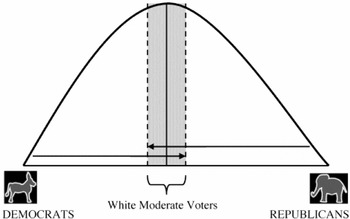
The origins of the median voter theory lie with the work of Anthony Downs (1957). When a normal distribution characterizes voter preferences, parties in a two-party winner-take-all system must at the same time mobilize their traditional core supporters, who could be either on the left or the right of the political spectrum, and attempt to secure sufficient numbers of supporters from the center to construct majority coalitions. The primacy to both parties of moderate voters in the middle is apparent. See Figure 1.

Median Voter Theory
Downs states that one result of such party incentives is that “parties in a two-party system deliberately change their platforms so that they resemble one another” (1957, p. 115). He continues,
Thus political rationality leads parties in a two-party system to becloud their policies in a fog of ambiguity. True, their tendency towards obscurity is limited by their desire to attract voters to the polls, since citizens abstain if all parties seem identical or no party makes testable promises. Nevertheless, competition forces both parties to be much less than perfectly clear about what they stand for (1957, p. 136).
Although this may lead to voters seeming to be irrational in their electoral choices given ambiguity, parties have an incentive not to be too ambiguous because they are constrained by the need of a sufficient number of voters to be able to distinguish between the party and related candidate choices.
Glazer, Grofman, and Owen (1998) model how party incentives can be structured within a Downsian framework when “group-oriented voting” intersects with “racial cleavages” (p. 23). They argue that the “choices of some voters [can] depend in part upon their expectations of each candidates support coalition” (p. 24). They refer to the voters who vote for candidates in this relational fashion as “group-oriented voters” (p. 25). These voters make their choices based on both a candidate's policy proximity and the “proportion [of a candidate's] support coalition [that] comes from members of [a] disliked class of voters” (p. 25). Whether or not candidates will choose to distance themselves from group-oriented voters or disliked voters fundamentally depends on their relative contribution to a needed margin of victory. When disliked voters are a minority of the electorate, and an oppositional majority, comprised in part by group-oriented voters, constitutes a majority winning coalition, the interests of the disliked voters will be marginalized in the campaign.
Alternatively, when the disliked voters are a sufficient size of the electorate to be a critical margin in a competitive election, their interests are much more likely to be the focus of candidate campaigning (Glazer et al., 1998, pp. 26–27). What this research demonstrates is that the likely impact of a minority segment of the electorate in any election very much depends upon its position relative to other segments of the electorate. The key to a minority segment having influence in an election is dependent on the probability that a candidate can win without their votes.
Frymer (1999) applies the Downsian median voter theory to the historical and contemporary role of race in American national politics, discussing how African American voters have often been the disliked voters referred to above. He argues that the origin of the contemporary two-party system of Democrats and Republicans lies in concerns with slavery and race. He states:
the behavior of party leaders reflects their belief that the nation is divided along racial lines, and that the prominence of racial issues is bound to disadvantage one of the parties in a system of two-party competition… The stakes of the winner-take-all electoral system only heighten this ambivalence [about promoting Black interests], since it is crucial for party leaders to respond to the opinions of the median voter. These concerns lead party leaders to attempt to manipulate the two-party system in a manner that denies the primacy of race, all the while confirming that very primacy (1999, p. 34).
Frymer concludes that the current Republican and Democratic parties exhibit a fear of alienating White voters who might have concerns that public policy not address African Americans interests at the cost of White interests. He states:
Party leaders are generally unwilling to take chances by promoting the interests of a group they perceive to be at odds with broader coalition-building … As we know, party leaders respond to what they perceive as strategic advantages and opportunities. On issues such as race, the general perception of party leaders is that actively promoting African American interests is not an optimal electoral strategy (1999, p. 205).
Consistent with the model developed by Glazer, Grofman, and Owen (1998) Frymer argues that the interests of African American voters are rarely at the center of major national candidate campaigns, despite their being the most durable element of the core constituency of the Democratic Party. The Downsian median voter theory demands that candidates be very cautious in aligning themselves too closely with a disliked group when that alignment is likely to lead to the alienation of necessary swing voters. What are the primary similarities and differences in how median voter theory has been utilized by Republicans and Democrats in recent major national elections?
THE REPUBLICAN STRATEGY IN THE
“NEW” SOUTH4 A more concise
discussion of these issues appears in Fraga and Ramírez (2003–2004, pp. 79–80).
A more concise discussion of these issues appears in Fraga and Ramírez (2003–2004, pp. 79–80).
Race has always been one of the most defining dimensions of Southern politics (Key 1949). Interestingly, the strategic manipulation of race-informed campaign politics was fully apparent during the Reconstruction Era (1865–1877) when African Americans in the South first became sizeable segments of statewide electorates (Foner, 1988 [2002], pp. 281–345). Among the challenges confronted by the Radical Republicans in the South was how to build a lasting electoral majority that included both newly enfranchised African American voters and sizeable numbers of White voters. Whites remained a clear majority of the population in all but three states of the Confederacy: South Carolina, Mississippi, and Louisiana. The Republican Party during Reconstruction needed White votes to win office and especially to grow as a major party in Southern states. Attaining this balance between African American and White voters was not easy, however. Of special concern was the need not to alienate too many White voters by being perceived as primarily catering to the interests of African Americans.
Foner quotes a Northerner as observing in 1866 that, “a party sustained only by black votes will not grow old” (1988 [2002], p. 294). Georgia's first Republican Governor referred to “the danger of negro suffrage” in considering the need to minimize the alienation of White voters. Foner also notes that although the Republican Party did well in the South in the 1867 elections, they lost massively in other parts of the country including California, New York, and Ohio, because of Radical Republican support in favor of equal rights for African Americans (1988 [2002] pp. 314–315). In 1867, a man from New York stated in a letter to House Speaker Schuyler Colfax, “Judicious [men must inform] the extreme radicals, thus far have we gone with you, but we cannot go any further… you see the disasters which have happened to our cause in the fall elections, from adopting your views” (As quoted in Foner 1988[2002], p. 315). The demands of the Downsian model were alive and well in the Reconstruction Era and foreshadowed electoral strategizing in the post-war and especially post-civil rights eras.
The South's distinctiveness in post-Second World War national electoral politics as driven by race certainly appeared in the 1948 presidential election.5
For a fuller discussion of the 1948 campaign see Mendelberg (2001, pp. 71–74).
It has become commonplace to explain the rise of the national Republican Party as directly tied to Lyndon Johnson's 1964 election and especially to the civil rights and Great Society legislation that was enacted during his presidency. A number of scholars and commentators have noted that the reaction of many White Southern voters, who had traditionally identified and voted as Democrats, was to look for a clear alternative to a Johnson presidency that was perceived to embrace fully many of the policy interests of African Americans (Black and Black, 2002; Carmines and Stimson, 1989; Edsall and Edsall, 1992; Huckfeldt and Kohfeld, 1989; Mendelberg 2001).6
See Abramowitz (1994) for a competing view.
In the 1968 election the White South again demonstrated its distinctiveness. George Wallace, governor of Alabama and a strict segregationist, ran as the candidate of the Independent Party and won in Louisiana, Arkansas, Mississippi, Alabama, and Georgia. Richard Nixon also did particularly well in other Southern states and won sizeable numbers of votes from White ethnics in northern industrial cities with his Law and Order campaign.
In his 1972 reelection campaign, Nixon used an explicit Southern strategy that included focusing on law and order issues and especially on opposition to school busing. He defeated the Democratic ticket by an overwhelming margin in every state except Massachusetts and the District of Columbia. The South again supported the Republican over the Democrat, and a new pattern of Republican prominence in the South was established.
Ronald Reagan solidified the presence of the Republican Party in the South in 1980. His campaign associated the Democratic Party's embrace of African American interests with the concerns of many Southern Whites about the growth of an activist federal government. The key linkage he made, however, was with taxes. Ronald Reagan and the GOP linked “race, rights, and taxes” (Edsall and Edsall, 1992). Reagan argued that the national government had become so bloated that it no longer served the interests of most of its hard-working, taxpaying, citizens. A plethora of government-funded programs in areas like education, voting rights, employment, housing, and social welfare were said to waste taxpayer money by providing benefits to many non-deserving peoples. Perhaps the most famous phrase of the campaign was that “Government was the problem, not the solution.” This critique of the growth of the national government in domestic policy on the surface was racially neutral, but Edsall and Edsall (1992) argued that White Southerners well understood the racial overtones of this message.
Reagan won every state in the South except Georgia, President Jimmy Carter's home state, in the 1980 election.7
We are not suggesting that the size of the federal government was the only issue of prominence in the 1980 election. The Iran hostage crisis and high inflation were, of course, also important factors.
The White South is now the cornerstone of the national competitiveness of the Republican Party. Republican presidential candidates cannot win the White House without an overwhelming majority of Southern states. By the 1990s, Nixon's Southern strategy had born fruit. As demonstrated in Figure 1, the base of the Republican Party could now make the Democrats a clear minority party in many parts of the country if not in the country as a whole.
Interestingly, the transformation of the Republican Party in the post-civil rights era also had a Latino component. In 1972, President Nixon's campaign outlined a Hispanic strategy to attempt to increase largely Mexican American support for the Republican Party. This effort met with only limited success, but it set a precedent for what is now accepted as the Republican affect for Latino voters.
Writer Tony Castro termed this strategy as an attempted “Republicanization of Mexican America” (Castro 1974, p. 199). Nixon wanted to enhance his competitiveness in the two states with the largest concentrations of Mexican American voters, California and Texas. In 1971 he appointed Henry M. Ramirez, an educator from Whittier, Ca., to revive the Cabinet Committee on Opportunities for Spanish-Speaking People, an organization that had originally been established under the Johnson Administration. Nixon also appointed a Mexican American, Phillip V. Sanchez, another Californian, to serve as the Director of the Office of Economic Opportunity, an agency that had been a central component of President Johnson's War on Poverty. He also appointed a Mexican American California woman, Romana A. Bañuelos, to the largely symbolic position of Treasurer of the United States. Castro reports that by 1972 there were at last fifty mid- to senior-level administrative appointees who were Hispanic (1974, pp. 200–201). Nixon also targeted federal monies for Latino specific projects in both California and Texas. By one estimate, his administration provided 20 million in projects to California and another 17 million in Texas (1974, p. 211).
Nixon's landslide defeat of Senator George McGovern in the 1972 campaign suggests that Latino votes were not critical to his victory. Interestingly, soon after the election, Nixon decided to dismantle the Office of Economic Opportunity and a number of the recent Latinos appointed to administrative positions did not keep their jobs. Although this appeal to expand the Republican base did not ultimately produce long-lasting gains for Latino communities, Castro writes that it perhaps did “produce … a remarkable transformation in the politics of Mexican-Americans from a predictable, homogeneous bloc into a fluid, ticket-splitting electorate.” (1974, p. 214).
THE DEMOCRATIC LEADERSHIP COUNCIL'S THIRD WAY8
The origins of the Democratic Party's efforts to transform itself from the party of liberalism to a party based centrally in the traditional middle-class American mainstream lie squarely with the institutional reforms of 1972 that led the party to minimize the influence of traditional party leaders and enhance the representation of important subgroups of Democrats including women, ethnic and racial minorities, gays and lesbians, and others. The dramatic defeat of George McGovern in 1972 and especially the defeat of President Jimmy Carter in his reelection bid in 1980 led to a group of influential Democrats beginning to forge a new image for the party. This effort was also centrally driven by the demands of median voter theory.
Under the leadership of Al From and Rep. Gillis Long (LA), a group of young, aspiring congressmen including William Gray (PA), Tim Wirth (CO), Al Gore (TN), and Richard Gephardt (MO) met as part of the Democratic Caucus's Committee on Party Effectiveness (CPE) (Baer 2000, p. 39). In 1982, the CPE published a monograph entitled “Rebuilding the Road to Opportunity.” In this monograph the public philosophy of the proposed “new” Democratic Party was outlined: “In these papers, we renew our commitment to the fundamental principles of the Democratic Party—to equal opportunity, to economic growth and full employment, and to a strong national defense” (as quoted in Baer 2000, p. 43). This approach was intended to realign the Democratic Party with the middle class and White ethnic blue-collar workers, especially those who were members of unions. It was explicitly designed to distance the Democratic Party from the image it had gained in the minds of many voters as the party of counter-cultural, liberal, and entitlement-oriented interest groups. In 1985 these efforts culminated in the establishment of the Democratic Leadership Council comprising a group of Democratic elected officials. Its stated philosophy was exactly the same as that of the CPE, and the emphasis was “sustained economic growth, equal and expanding opportunity, and the aggressive defense of freedom with the promotion of democratic values abroad” (Baer 2000, p. 68). The Third Way was well on its way.
The vision of the DLC was further outlined by William Galston and Elaine Kamarck in the short monograph entitled The Politics of Evasion: Democrats and the Presidency (1989). In this piece the authors argued that many Democrats remained misguided by three myths: the myth of mobilization, the myth of liberal fundamentalism, and the myth of the congressional bastion. In their view, each of these myths prevented the party from making the necessary commitment to win back the “heart” of the Democratic Party, “northern ethnics and southern Protestants” (Baer 2000, p. 130). Not surprisingly, this view was not well received by all Democrats and was especially questioned by Jesse Jackson. However, with the establishment of the Progressive Policy Institute (PPI) in 1988 as the think tank behind the DLC and the defeat of Michael Dukakis in that same year, the DLC was primed to become a major player in the 1992 election.
The nomination of Arkansas Governor William Jefferson “Bill” Clinton in 1992 was the first major victory of the DLC and at the same time the first major test of its campaign philosophy. Clinton had been an early and consistent participant in the DLC, and he confidently pursued the centrist strategies of the DLC. When Clinton selected another moderate Southerner as his vice-presidential running mate, Senator Al Gore of Tennessee (who was also an early and consistent DLC member), the Democratic ticket was fully positioned to make a play for the votes of middle America.
Among the earliest and most surprising policy positions taken by Clinton-Gore were those on the economy and need-based social welfare programs. Clinton not only expressed concern for workers and families who were hurt by the then current economic downturn, but he also publicly advocated a strategy to promote economic growth that was based upon reigning in government spending and providing targeted tax breaks to selected businesses.
He also championed the need for the country to commit itself to “reform welfare as we know it.” This position was contrary to any past position of a major Democratic candidate. Need-based social welfare programs were understood by many as the heart of Johnson's Great Society programs, and more important, critical to the survival of some of America's poorest citizens. Clinton was not hesitant to promote his plans for economic growth and welfare reform across the entire country. As indicated in Figure 1, the New Democrats were clearly attempting to expand the party base by appealing explicitly to moderate voters.
The marginalization of the interests of African Americans and Latinos was of great concern to a number of Democrats. Frymer states that the 1992 Democratic Party platform did not mention “redressing racial justice” for the first time in thirty years. Clinton and Gore's book Putting People First (1992) mentioned race only once, and this was to highlight their opposition to racial quotas in employment and education. Frymer also notes that a chapter focusing on urban issues did not discuss the unique challenges of inner city areas such as racial segregation, and “the chapter on civil rights devoted more space to people with physical disabilities than to African Americans” (Frymer 1999, p. 5).
Clinton distanced himself from African Americans in three other ways. In January 2002 he “refused to issue an order of executive clemency” to stop the execution of a mentally retarded Black man who was convicted of two murders, including that of a policeman. After one of the murders the man shot himself and damaged his brain, thereby leaving him very impaired (Applebomes 1992, p. 8). Clinton also publicly denounced the language and imagery of rapper Sista Souljah, characterizing her work as filled with racial hatred and animus toward Whites (Perales 1992, p. H32; Rule 1992, p. A1; Waters 1992, p. A22). Lastly, Clinton spoke critically of Jesse Jackson, the most visible spokesperson on behalf of African Americans (Ifill 1992a, pp. 1–2; Ifill 1992b, p. A1; Ifill 1992c, p. A14). Again, in contrast to the traditional position of Democratic candidates making explicit appeals to African American voters, Clinton developed a campaign image in 1992 that was distinct.
The 1992 election results demonstrated that Clinton's divergence from what had become the Democratic norm did not hurt him.9
It is important to also remember that the candidacy of Ross Perot also helped Clinton beat incumbent President George H. W. Bush in several key states.
This centrist strategy was again pursued by Clinton in 1996. Most indicative of his willingness to take positions that placed him squarely in the center-right of the Democratic Party, Clinton shocked many of his strongest supporters when he signed the 1996 Welfare Reform Bill, and the Personal Responsibility and Work Opportunity Reconciliation Act, that placed a time limit on the receipt of welfare benefits, required recipients to work a minimum number of hours to continue to receive benefits, eliminated eligibility for legal immigrants, and did not include substantial funding for daycare or transportation to help support parents who received welfare benefits. In the 1996 election, Clinton-Gore again won in Louisiana, Arkansas, Tennessee, West Virginia, and, perhaps most surprisingly, in Florida.
This discussion of the Republican Southern Strategy and the Democratic Leadership Council's Third Way leads us to conclude that the electoral strategizing of both the contemporary Republican and Democratic parties directly serves to marginalize the interests of racial and ethnic voters in national party politics. From the Republican perspective, the marginalization is perhaps greatest for African Americans, as the Republican strategy is based on receiving substantial support from White voters who have either defected from the Democratic Party or new voters who see their interests best served by the Republicans. Absolutely no evidence exists that these voters have any interest in the policy concerns of African Americans. The Democratic Party must also distance itself from being perceived as primarily the party of special interests including women, gays and lesbians, unions, and members of ethnic and racial minority groups. Cleary, each party has an overwhelming incentive to cater to the interests of moderate, largely White voters in the middle of the distribution of policy preferences.
It is now time to examine the most recent manifestation of the median voter theory. What impact does the nation's increasing racial and ethnic diversity have on the strategic positions taken by both Republicans and Democrats within the parameters of median voter theory? Do their strategic choices again serve to marginalize the interests of the two largest ethnic-racial segments of the American population, Latinos and African Americans?
MEDIAN VOTER THEORY IN A MULTICULTURAL
ELECTORATE: ELECTION 200010 For a related
discussion see Fraga and Ramírez (2003–2004, pp. 81–82).
For a related discussion see Fraga and Ramírez (2003–2004, pp. 81–82).
The 2000 presidential election again manifested the strategizing discussed above, although the campaign had a twist that median voter theory could not predict. For the first time in the history of American presidential politics, one of the candidates identified Latinos as his preferred ethnic-racial minority group.11
We are grateful to Professor Fernando Guerra, Loyola Marymount University, for this insight.
At least two explanations can be offered for why Bush chose to make his Spanish-speaking ability,12
While there is much criticism of the President's Spanish-speaking ability, he is the only major party presidential candidate who has displayed a consistent willingness to speak Spanish throughout his campaign and throughout his presidency.
George P. Bush is the son of Jeb Bush, governor of Florida, and Columba Bush, who was born and raised in Mexico. “George P.”, who has many Latino physical features, made a number of campaign appearances and commercials on behalf of his uncle.
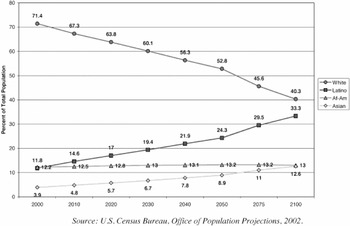
We are well aware that one must be cautious in using such projections. They are based on assumptions of current birth rates, death rates, and immigration rates. Increasing rates of interracial marriage can also affect these projections. However, few question that Whites are declining as a percentage of the American population or that Latinos and Asians continue to grow at rates that far outpace those of both African Americans and especially Whites.

Population Growth 2000–2100
Although it is well known that Latino voter participation does not equal that of African Americans or Caucasians, their votes can still be crucial contributors to the winning margin of victory for any statewide, and therefore, presidential candidate. For example, Latino voters have been primary contributors to the winning margins of Democratic candidates in California in seven of the last thirteen statewide races for governor, U.S. senator, and president. Bill Clinton would not have won California in 1996 without the Latino vote. Neither would U.S. Senator Barbara Boxer in 1992 and 1998, and U.S. Senator Diane Feinstein in 1994 (Fraga and Ramírez, 2003). In addition, Latinos split their votes about two to one in favor of Democrats. That is, a minimum of 20–35% of Latino voters in each state consistently support Republican candidates statewide. This pattern is different from the overwhelming majority of African Americans voters who tend to vote for Democrats at rates of 85–90%. This explanation argues that in 2000 the Republican Party, in catering to Latinos, was simply acknowledging their potential electoral influence in key states and giving itself an opportunity to tap into the largest and fastest growing ethnic-racial segment of the population.
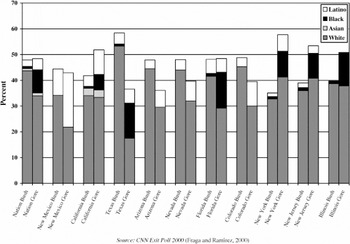
Bush did receive a higher percentage of Latino votes (35%) than did his father in 1992 (24%) or Bob Dole in 1996 (21%; see de la Garza and DeSipio, 1999, p. 8). But as we know, while overall popular vote is indicative of voter preferences, it is far from determinative in presidential elections. More important is determining in which states the Latino vote was critical to determining the outcome of the election. Using a technique developed by Fraga and Ramírez that estimates candidate support taking into account exit poll findings and the Latino percent of the electorate,15
The specific percent of the vote attributed to each candidate is determined by simply multiplying the % support reported by exit polls by the % that each group is estimated to represent of the statewide electorate in the election: candidate support from a specific ethnic/racial group = % exit poll support × % group of statewide electorate.

The Vote for Gore and Bush, 2000
The second explanation is much more strategic and fits precisely with the previous discussion of the Republican Southern strategy within median voter theory. It is imperative that a Republican presidential candidate win a sizeable majority of Southern states if he or she wants to guarantee victory. As stated previously, Reagan won every state in the South except for Georgia in 1980; he won every Southern state in 1984, and George H.W. Bush won every Southern state in 1988. Clinton's success in winning a number of Southern states gave him the necessary margin of victory in the Electoral College. If the Black-White racial divide—whether explicit in expressed racial animus or coded as an element of socially conservative opposition to government social welfare policy—is still a primary basis for how many Whites cast their votes in the South, Republican candidates have great incentive to play “the race card” in the South (Mendelberg 2001). However, such posturing runs the risk of alienating moderate White voters outside the South, whose votes are critical for a Republican candidate winning enough electoral votes to be president. Based on the 2000 election, such states outside the South might include Ohio, Missouri, and Iowa.
Is it not possible that Bush's catering to Latino voters serves the purpose of softening the clear position of social conservatism that is so critical to mobilizing his base of support in the South? Speaking Spanish, talking about his relations with “Hispanics” in his home state, and developing Latino-focused campaign ads can all serve to soften this Southern-focused social conservatism. We are not suggesting that Bush was disingenuous in his demonstrated understanding and respect for cultural practices and other aspects of Latino communities. Such demonstrations of understanding and respect were unique among presidential candidates. We are suggesting, however, that there can be systematic electoral gains for Republican candidates by using Latinos as a way to soften their image as social conservatives and therefore become more palatable to moderate White voters in non-Southern states. We term this effort to appear responsive to Latino communities as symbolic mainstreaming.
There are explicit dimensions to symbolic mainstreaming. The first, mainstreaming, occurs because Latinos are placed at the center of elements of national political reporting and at the center of decision-making for some moderate White voters. For example, it was very common for news coverage to refer frequently to President Bush's ability to speak Spanish and to the Republican Party's efforts to secure the support of Latino voters. Moreover, it was often reported that the Democrats were facing a new challenge with the Bush campaign, which was spending millions of dollars on Spanish-language advertising. Latinos, in other words, were characterized as potentially important to the outcome of the presidential campaign.
The second dimension is symbolic. Although mainstreaming occurs, there is rarely any reference to specific policy proposals that are supported by majorities of Latino voters. There are demonstrations of understanding and respect for Latinos and their communities. However, the material interests of many of these voters, such as for English language training, long-term immigration reform, increased access to adequate health insurance, and greater opportunities for home ownership, are rarely mentioned, if at all. When they are mentioned, such as with early descriptions of educational reform resulting in the No Child Left Behind Act and the need to rethink temporary guest worker programs, the details of funding and implementation are not specified. All candidates make symbolic appeals to many distinct constituencies. The 2000 campaign revealed that Latinos were certainly a distinct group to whom such appeals were made, especially by the Republican candidate.
This strategy of symbolic mainstreaming is very different from the traditional Democratic strategy of making campaign appeals to Latino voters. Democratic presidential candidates have targeted Latino voters in key states such as California and Texas at least since 1960. In the type of symbolic mainstreaming that occurred in 2000, George W. Bush's focus on Latinos was not just an attempt to secure their votes, but it was also, and perhaps primarily, an attempt to position himself as a candidate who truly believed in racial and ethnic inclusion. This was done to soften his image as a social conservative in the minds of moderate White voters. Additionally, unlike the Democratic candidate, Bush's Latino focus became a major part of the campaign image he wanted to portray to both Latino and non-Latino voters.
TESTING SYMBOLIC MAINSTREAMING
In order to investigate best the topics raised by this paper, we would need a battery of questions that have not been asked in any publicly available survey. For instance, we would want to know how the American public viewed the parties, prominent party candidates, and elected officials in terms of their relationships with both Latinos and African Americans. We would also want to ask this question over a period of years because assessing changes would be useful. We might also study those Whites who now vote for Republican candidates, but who previously voted for Democrats or split their tickets. Another part of a comprehensive research design would directly ask respondents whether they felt the Republican Party had moderated its racial stances in recent years, and whether they perceived a Bush outreach to Latino communities. We would want to investigate these issues in key swing states. Focus groups might be particularly helpful in this regard. No such comprehensive data exist, however.
Evaluating White Opinion: Views of the Parties and Latinos
Nonetheless, we can gain some purchase on these issues by examining results from several datasets that include questions about Latinos and politics. The first dataset we use is the 1999 Washington Post/Henry J. Kaiser Family Foundation/Harvard University National Survey on Latinos in America (NSLA). This is a nationally representative sample of 4614 respondents, including 1802 Whites and 2417 Latinos. This survey is important because very few polls include large samples of both populations, and few ask questions that involve Latinos and the political system.
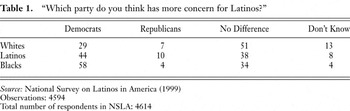
Most importantly, the NSLA asked the following question: “Which party do you think has more concern for Latinos—the Democratic Party, the Republican Party, or is there no difference?” As Table 1 indicates, the most common response for Whites is “no difference (51%), with a significant minority responding “Democratic” (29%), and the remainder answering “don't know” (13%) or “Republican” (7 percent). These answers are very different from those given by Latinos themselves as well as by African-Americans. Respondents from these minority groups are more likely to identify the Democratic Party as the most concerned with Latinos although African Americans are more likely to do so than are Latinos. This White-Minority differential suggests that many Whites view the Republican Party through a relatively positive lens, even though most observers believe the parties have staked out clear differences on questions involving race and ethnicity.
“Which party do you think has more concern for Latinos?”

We might then ask whether opinions about this question are associated with support for the candidates in the 2000 presidential elections. If so, it would suggest that (1) Whites see concern about Latinos as a positive political attribute, and (2) Whites use their opinions about this question to influence candidate evaluation.
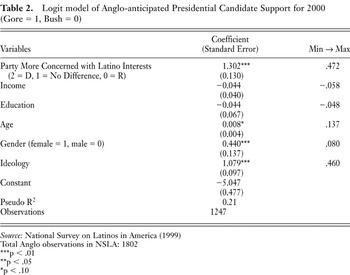
We therefore create a regression for White respondents where the dependent variable is anticipated support for Gore versus Bush in 1999 (Gore = 1, Bush = 0). We then specify the question about which party has the most concerns for Latino interests as 2 = Democrats, 1 = no difference, and 0 = Republicans. We also control for factors including age, income, gender, education, and ideology. As shown in Table 2, this variable is positively associated with support for Gore.
Logit model of Anglo-anticipated Presidential Candidate Support for 2000 (Gore = 1, Bush = 0)

In addition to the statistical significance of this factor and the other variables, we also need to know their substantive significance. By using the program Clarify (King et al., 1999), we are able to list in each table the effect on the dependent variable of a change in each independent variable from its minimum to maximum while holding the other variables constant at their mean.16
The substantive effects of the Latino/Party variables are large, which suggests that voter evaluations of this issue are central to their electoral decisions. This is consistent with our argument that Republicans understand they must convince moderate Anglo swing voters about the GOP's racial tolerance in order to become the majority party. The large substantive significance could be due to voters dichotomously evaluating the GOP in this regard: either the party is seen as tolerant and embracing a new “compassionate conservative” approach toward minorities, or it is seen as intolerant and acting in the mode of traditional racial conservatives. Many Anglos may be reluctant to support the GOP unless they perceive it has met a minimum threshold of tolerance, especially for moderate Anglos who see themselves as financially conservative but socially liberal.
It is also possible that responses to this question capture additional racial and other attitudes. For instance, those who believe that the Democrats are more supportive of Latinos may also believe that the Democrats are more tolerant toward all minorities, or are more generally tolerant toward civil rights and perhaps civil liberties. The substantive impact of evaluations about partisan outreach specifically to Latinos may therefore be less than indicated by the above findings, but it will take additional research to disentangle such attitudes.
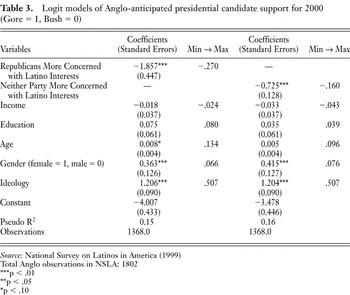
But the point we are making is that Bush's tactics are meant to reassure Whites that Republicans are not too far to the right on race issues. We should therefore be particularly interested in those Whites who see no differences between the parties or who think Republicans care the most about Latinos. Perhaps these White respondents have been the most influenced by the Bush outreach efforts. We therefore create two new dummy variables: (1) 1 = Republicans, 0 = Democrats or no difference, and (2) 1 = no difference, 0 = Democrats or Republicans.
Table 3 contains the models with the two new independent variables. We see that both variables are statistically significant and negatively associated with Gore support, even after controlling for age, income, gender, education, and ideology.
Logit models of Anglo-anticipated presidential candidate support for 2000 (Gore = 1, Bush = 0)

For the first model, one possible response is that Whites who like Bush are simply predisposed to give him high marks for promoting the interests of Latinos and many other groups in America. In that case, the causal arrow runs in the opposite direction.
The above argument does assume, however, that such Whites think that helping Latinos is a positive political attribute—and presumably such Whites do not think Bush would or should help all groups and all peoples. Is it likely that Whites who think the Republican Party is more sympathetic to categories of people such as “welfare recipients,” for example, are more likely to vote for Bush? This is unlikely, as Republicans have traditionally been critical of such groups. We might tentatively conclude, therefore, that Whites who like Bush have internalized the message that helping Latinos is good.
The next question is why do they think this way? Is this concern for Latinos among White Bush supporters a spontaneous development, or was it promoted in a top-down political process? The latter is more likely, as previous elections cycles in recent memory saw campaigns and candidates that often disparaged immigrants and thereby Latinos. It is unlikely that Whites who saw the Republicans as the most sympathetic to Latinos in 1992, for instance, would have been especially likely to vote for George H. W. Bush—or that such Whites would have been more likely to vote for Pete Wilson for governor of California in 1994. This change may be due to George W. Bush and the significant media publicity that portrayed him as interested in and respectful of Latinos.
What is needed is a time series for the question, which would allow us to see if Whites over the last four years increasingly see no difference between the parties on this question. We would also need an additional set of questions asking respondents which party is most sympathetic to a wide variety of social groups.
We are also interested in the second model in Table 3, which shows greater Bush support among Whites who see no partisan differences. While it would have been interesting to see if these respondents also see no party as more concerned for the interests of African Americans, this question was not asked. Nevertheless, we might tentatively conclude that race may have been “taken off the table” for these respondents. The other regressions suggest that if they saw Democrats or Republicans as more concerned for Latinos, they would be more likely to support that party's candidate for president. Because those who perceive no differences are more likely to support Bush than Gore, it suggests that a mental obstacle to White Republican voting was removed. Such Whites can now vote Republican based on economic or other interests and need not worry that they are voting for a race-baiting party.
It would be particularly interesting to know whether the number of people in the above categories had changed over the last few years. If the question had been asked in surveys in 1996, we could see whether there were increases in the percentage of people who see no party differences or who see Republicans as most concerned for Latinos. If so, the result would likely benefit GOP candidates, as there would be fewer voters worried that tax cuts and tolerance were in conflict.
White Views of Latinos and African Americans: Did Bush Choose the “Right” Group?
Are Whites less concerned about Latinos than African Americans? This would make outreach to Latinos less politically risky than outreach to African Americans. To see whether this is the case, we look at both national and state data concerning White attitudes toward these two groups.
The NSLA asked White respondents to indicate how much they had in common with Latinos and African-Americans. The responses are generally positive and indicate few differences between groups. When there are differences, Whites report slightly more commonalities with African Americans than with Latinos. Overall, 72% of Whites reported “a lot” or “a fair amount” of commonality with Latinos and 75% with African Americans.
The 2000 and 1996 National Election Study (NES) asked Whites to evaluate African Americans and Latinos on a one hundred point feeling thermometer. There are only single-digit differences in White evaluations of these two groups, and these differences indicate slightly more affinity for African Americans. This pattern holds for Democrats, Republicans, and Independents.
One difficulty with the above data is that such direct questions about racial opinions do not necessarily elicit honest answers. Many respondents understand that the expression of true opinions may not be socially acceptable, and they may not be willing to admit their feelings to unknown surveyors. Additionally, racial attitudes are complex and cannot be readily deduced from one or two questions.17
See the excellent discussion of the complexity of racial attitudes in Schuman et al. (1997).
A more indirect question was asked by a 2002 statewide telephone survey of 1200 White, Latino, and African American registered voters in Texas. The question asked Whites whether Latinos and African Americans had too much influence.18
The questions were: “What about Hispanics, or Latinos? Would you say they have too much influence, just about the right amount of influence, or too little influence?” and “What about African Americans? Would you say they have too much influence, just about the right amount of influence, or too little influence?”
The same pattern holds true for those respondents, regardless of stated partisanship, who reported feeling “much closer” or “somewhat closer” to the Republican Party in recent years. 9% claim that Latinos have too much influence, while 14% claim that African Americans have too much influence. Independents, whom party candidates particularly wish to attract, exhibit similar patterns. 10% of independents think that Latinos have too much influence, whereas 15% of independents think that African Americans have too much influence.
Although these figures are not large in absolute terms, we should keep in mind that people are reluctant to admit anti-minority feelings on surveys. It is therefore the relative differences of the responses that are important.
We might also ask whether the 2000 NES White feeling thermometer evaluations of Latinos and African Americans are related to Anglo reported partisanship. This is another way to understand whether the Republican Party and Bush were correct to emphasize outreach to Latinos instead of African Americans. To maximize independent White support, the GOP should choose the racial/ethnic group least connected to partisanship. This least-partisan focus would suggest that evaluations are more evenly distributed across the partisan range, which in turn suggests that key independent Whites have relatively more positive feelings toward that group. Outreach to a group that is highly linked to partisanship also entails some risk. Assuming that Democrats are generally more positive toward minorities than are Republicans, a Republican candidate might risk alienating his or her party base by conducting outreach to a group associated with Democratic partisanship.
We therefore conducted χ2 tests on reported Anglo partisanship and thermometers for both groups. The results show that the relationship between partisanship and African Americans is stronger than the relationship between partisanship and Latinos. This suggests, as noted above, that the Bush outreach strategy to Latinos is more likely to appeal to independents than an outreach effort to African Americans. A Latino outreach strategy is also less likely to alienate members of the Republican base.
THE FUTURE OF RACE AND ETHNICITY IN NATIONAL PARTY POLITICS
Our previous discussion clearly shows that the salience of race and ethnicity to national party politics will continue in the foreseeable future. What is less clear is how that salience will be manifested. Least clear is whose interests will be served by the continuing evolution of race and ethnicity in our national body politic.
Research by Schuman, Steeh, Bobo, and Krysan finds that a “great normative shift” (1997, p. 312) has occurred in much of the United States regarding race relations. Overt expressions of racial hostility and discrimination are tolerated much less in the United States today than they were just five decades ago. As these authors state, “the normative definition of appropriate relations between blacks and whites … has changed” (1997, p. 311). However, as these authors also note, this has not led to an identifiable commitment of many Whites to support necessary public policies to “drastically reduc[e] economic and social inequality” that may be necessary to expand opportunities for many African Americans (1997, p. 327).
Mendelberg (2001) terms this change in White attitudes toward African Americans as a change in the “norm of racial equality” (2001, p. 28). However her research demonstrates how vulnerable many Whites still are to “implicit [racial] appeals” (2001, p. 67) such as when candidates refer to states' rights, busing, or affirmative action.19
We are not convinced that Mendelberg's distinction between “explicit” and “implicit” racial appeals is as clear as she argues. If “implicit” appeals are known by candidates to be understood by White voters though a racial lens, such as in the South where the racial implications of a politician's stands are unambiguous when he criticizes busing, affirmative action, or welfare, it may be that little has changed in campaigning other than rhetoric.
These scholars' findings demonstrate that race still matters greatly in American public opinion, with significant implications for national electoral politics. Shifts in norms may have led to changes in campaign rhetoric, but not to meaningful changes in substantive policy discourse. It is certainly the case that the optimal campaign strategies available to both Democrats and Republicans through median voter theory are quite distinct.
Our analysis reveals that the Democratic Party is in a very difficult position. The requisites of median voter theory and its embodiment in the strategies of the Democratic Leadership Council demand that its presidential and other major candidates do all they can to avoid being linked to the perceived interests of African Americans. Only in this way can Democratic presidential candidates have any chance of being competitive in the South, a necessary contributor to all recent successful Democratic candidates. Being perceived as catering to Latino interests carries similar risks, particularly in some states where they comprise sizeable percentages of the population and electorate. Yet, this avoidance may only increasingly lead to the dysfunctional consequence Frymer describes as “electoral capture” where a “group has no choice but to remain in [one] party” because the other party sees no benefit in addressing that group's interests (1999, p. 8).
In contrast, it is also clear that Democratic presidential candidates cannot win in key states without overwhelming support from African American voters. In the 2000 election, Gore would not have won in Delaware, Illinois, Maryland, Michigan, and Pennsylvania had it not been for the African American vote in these states. A Democrat also cannot compete in Florida without a solid African American block vote.
The Republican Party, by contrast, is in a much stronger position to benefit from a strategy that promotes the symbolic mainstreaming of Latinos. By focusing on Latinos the Republican candidate does little to weaken his base with socially conservative voters in the South. Although Latinos are increasingly moving to states such as North Carolina and Georgia, many of these Latinos are non-citizens and therefore cannot vote. It is also the case that many Southern employers welcome Latino immigrants because they work hard for low pay and are less likely than African Americans to advocate for their rights as employees.
The focus on Latinos may also have the benefit of softening a Republican candidate who is perceived as socially conservative, as President Bush has done so effectively, and thus complying with shifting norms of race relations and racial equality. Open expressions of cultural respect, such as speaking Spanish, can go a long way to allowing some swing voters to feel comfortable supporting a candidate who takes consistently conservative stands on many domestic and international issues. The importance for a Republican candidate to appear tolerant of difference, including race and ethnicity, may be critical to winning over sufficient numbers of swing, suburban, middle-class voters.20
See the discussion of the importance of “tolerance” to many middle-class voters in Wolfe (1998) and Himmelfarb (1999).
What we see as the greatest risk of the symbolic mainstreaming of Latinos is that to the extent that this group increasingly supports the Republican Party, and Republican candidates win office, the specific policy concerns of working class Latinos, such as for increased public commitment to expanding health, educational opportunity, and home ownership, may be less and less likely to be enacted. Of perhaps greater concern is the reality that to the extent some Latinos respond favorably to Republican symbolic mainstreaming, this will assuredly serve to marginalize further the interests of many African Americans, and especially African Americans in the South. Latino inclusion within the Republican Party may come at the direct cost of African American and Latino exclusion from much substantive national policy benefits.
What is very clear is that it is the Republican Party under George W. Bush that is primarily in control of the nation's discourse on race and ethnicity. The entire strategy of the Democratic Leadership Council is in response to what the Republicans have done and are likely to do in the near future. Although there is renewed interest within the Democratic Party about ensuring that both Latinos and African Americans perceive themselves to be served fully by the party, such public posturing may be a high-risk strategy. Median voter theory would certainly suggest this. Our examination of how median voter theory affects race and ethnicity in national party politics puts the Republican Party under George W. Bush in the driver's seat. Where both African Americans and Latinos will land at the end of this trip is strikingly unclear, but there is little reason to think where they land will be anywhere near a place that most members of either group wish to be.
Footnotes
An earlier version of this essay was presented at The Color Lines Conference, The Civil Rights Project, Harvard University, August 30–September 1, 2003.
References
REFERENCES
Abramowitz, Alan I.
(1994)
Issue evolution reconsidered: Racial attitudes and partisanship in
the U.S. electorate.
American Journal of Political Science,
38(1):
1–24.Google Scholar
Applebomes, Peter
(1992).
“Arkansas execution raises questions on governor's
politics,”
New York Times,
January 25, p.
8.
Baer, Kenneth S.
(2000).
Reinventing Democrats: The Politics of Liberalism from Reagan to
Clinton.
Lawrence, KS:
University Press of Kansas.
Black, Earl and
Merle Black
(2002).
The Rise of Southern Republicans.
Cambridge, MA:
The Belknap Press of Harvard University Press.
Carmines, Edward G. and
James A. Stimson
(1989).
Issue Evolution: Race and the Transformation of American Politics.
Princeton, NJ:
Princeton University Press.
Castro, Tony
(1974).
Chicano Power: The Emergence of Mexican America.
New York:
E.P. Dutton and Co.
Clinton, Bill and
Al Gore
(1992).
Putting People First: How We Can All Change America.
New York:
Times Books.
De la Garza, Rodolfo, and
Louis DeSipio, Eds.
(1999).
Awash in the Mainstream: Latino Politics in the 1996 Elections.
Boulder, CO:
Westview Press.
Downs, Anthony
(1957).
An Economic Theory of Democracy.
New York:
Harper and Row.
Edsall, Thomas B. and
Mary D. Edsall
(1992).
Chain Reaction: The Impact of Race, Rights, and Taxes on American
Politics.
New York:
W.W. Norton and Co.
Foner, Eric
(1988, 2002).
Reconstruction: America's Unfinished Revolution.
New York:
Perennial Classics, HarperCollins Publishers.
Frymer, Paul
(1999).
Uneasy Alliances: Race and Party Competition in America.
Princeton, NJ:
Princeton University Press.
Fraga, Luis Ricardo and
Ricardo Ramírez
(2000).
Evolving Opportunities: Latinos and the 2000 Election.
Presented at the Census Conference, Center for Public Policy,
University of Houston, Houston, TX, December 8.
Fraga, Luis Ricardo and
Ricardo Ramírez
(2003).
Latino political incorporation in California, 1990–2000. In
David Lopez and
Andrés Jiménez (Eds.),
Latinos and Public Policy in California: An Agenda for Opportunity,
pp.
301–335.
Berkeley, CA:
Berkeley Public Policy Press.
Fraga, Luis Ricardo and
Ricardo Ramirez
(2003–2004).
Demography and political influence: Disentangling the Latino vote.
Harvard Journal of Hispanic Policy,
16:
69–96.Google Scholar
Galston, William and
Elaine Ciulla Kamarck
(1989).
The Politics of Evasion: Democrats and the Presidency.
Washington, DC:
Progressive Policy Insitute.
Glazer, Amihai,
Bernard Grofman, and
Guillermo Owen
(1998)
A Neo-Downsian model of group-oriented voting and racial backlash.
Public Choice,
97:
23–34.CrossRefGoogle Scholar
Himmelfarb, Gertrude
(1999).
One Nation, Two Cultures.
New York:
Alfred P. Knopf.
Huckfeldt, Robert and
Carol Kohfeld
(1989).
Race and the Decline of Class in American Politics.
Urbana, IL:
University of Illinois Press.
Ifill, Gwen
(1992a).
“Jackson sees a ‘character flaw’ in Clinton's
remarks on racism,”
New York Times,
June 1992, p.
A1.
Ifill, Gwen
(1992b).
“Clinton won't back down in tiff with Jackson over a rap
singer,”
New York Times,
June 20, 1992, pp.
1–2.
Ifill, Gwen
(1992c).
“Clinton and Jackson edge toward reconciliation,”
New York Times,
June 24, 1992, p.
A14.
Key, Vladimir O.
(1949).
Southern Politics in State and Nation.
New York:
Knopf.
King, Gary,
Michael Tomz, and
Jason Wittenberg
(1999).
“CLARIFY: Software for Interpreting and Presenting Statistical
Results, Version 1.2.1.”
Cambridge, MA:
Harvard University.
Mendelberg, Tali
(2001).
The Race Card: Campaign Strategy, Implicit Messages, and the Norm
of Racial.
Princeton, NJ:
Princeton University Press.CrossRef
Perales, John
(1992).
“Rapping and politicking: Showtime on the stump,”
New York Times,
June 11, p.
H32.
Rule, Sheila
(1992).
“Rapper, chided by Clinton, calls him a hypocrite,”
New York Times,
June 17, p.
A1.
Schuman, Howard,
Charlotte Steeh,
Lawrence Bobo, and
Maria Krysan
(1997).
Racial Attitudes in America: Trends and Interpretations.
Revised Edition.
Cambridge, MA:
Harvard University Press.
Waters, W. David
(1992).
“Context counts in Sista Souljah's remarks,”
New York Times,
July 1, p.
A22.
Wolfe, Alan
(1998).
One Nation, After All.
New York:
Viking Press.
Median Voter Theory
Population Growth 2000–2100
The Vote for Gore and Bush, 2000
“Which party do you think has more concern for Latinos?”
Logit model of Anglo-anticipated Presidential Candidate Support for 2000 (Gore = 1, Bush = 0)
Logit models of Anglo-anticipated presidential candidate support for 2000 (Gore = 1, Bush = 0)
 You have
Access
- 31
- Cited by