On 28 May 1914, the Viennese press reported that a young man from the sixteenth district in Vienna had attempted suicide.Footnote 1 Sitting on a bench at the Pezzlpark, twenty-one-year-old laborer Karl P. shot himself in the head with a revolver. “The motive,” one newspaper reported, “was said to be unrequited love.” By chance, the same park bench would see more action later that day. Pregnant twenty-three-year-old laborer Marie B. was on her way to a birthing clinic when she went into labor. Sitting on what the newspaper now deemed the Selbstmörderbankerl, with the help of two nearby watchmen, she gave birth to a girl. The headline “Death and Life on a Bench” highlighted one extraordinary coincidence in an otherwise ordinary day in the city.Footnote 2
28 May 1914 was most ordinary. It was a Thursday. The weather in Vienna was fair, if a tad humid. The daily press reported on the comings and goings in this vibrant city of two million residents. “Nothing special” was going on, nothing of apparent interest to the historian 100 years later. It was average, uneventful, routine. 28 May paled in comparison to its future cousin, 28 June, the day on which Francis Ferdinand, heir to the Habsburg throne, was assassinated and the diplomatic wheels of war were put into motion. But what if we were to pull this random day out of historical obscurity and use it as a prism through which to read what was ordinary and expected “on the eve” of World War I? The phrase “on the eve,” ubiquitous in English-language historiography on the war, connotes more than its German equivalent, vor.Footnote 3 It carries an impendingness, a something-about-to-happen.
This article offers a snapshot of 28 May 1914 as it was recorded in eight German-language Viennese daily newspapers and three weekly newspapers that appeared on Thursdays.Footnote 4 What Viennese people read, bought, ate, watched, imagined, feared, and wanted can be gleaned from a close reading of the enormously vibrant press in the capital city. This “day in the life” approach yields a number of findings: First, it allows us to see—contrary to accepted wisdom—that daily press coverage to a large degree transcended the Lager politics that characterized twentieth-century Austria. Second, many of the themes we associate with World War I are there explicitly or in subtext before it all began—dead bodies, destruction, centrality of the military, confusion in the center about political contours in the Balkans, even ersatz goods. Finally, highlighting what was ordinary at a moment in time before the war usefully smudges the dark and definitive line that historians reflexively pencil in at August 1914.
Before sketching the contours of life on this ordinary day, one must address the methodological objections that can easily and obviously be made to such an approach. As one writing in the vein of Alltagsgeschichte, I have argued elsewhere for the necessity of a wide source base to write history in a way that plumbs the depths of politics beneath and beyond parties and printed sources. Newspapers are a useful but limiting resource. Historian Robin Okey criticized an antiquated mode of historical inquiry in which “several leading Viennese papers would be taken to ascertain the Viennese press's view of specific episodes in the later history of the Monarchy.”Footnote 5 This approach presents myriad problems of interpretation: Viennese newspapers did not represent life in the monarchy as a whole; not all residents of Vienna read German-language papers; not all Viennese could read; of those who could, some likely did not pick up a newspaper on 28 May 1914; newspapers tell us much about their editors but little about their readers; newspapers, as public documents, shed little light on the intimate and private realm of historical experience. And the list goes on.
But let us historians stray briefly into a different discipline, one that plays more freely and easily with texts. To take the day as a discrete unit of time, a bounded frame through which to explore the temporal and spatial patterns of the city, is to borrow an established technique from literary modernism. Here the day has been used to good effect. James Joyce's Ulysses records the life of Dublin on a single day, 16 June 1904. “That day was very much like any other,” writes Stuart Gilbert, “unmarked by any important event and, even for the Dubliners who figure in Ulysses, exempt from personal disaster or achievement.”Footnote 6 Virginia Woolf, too, uses the device in her single-day novel, Mrs. Dalloway. The day imposes a “predetermined time frame and structure” on the stream of consciousness of its protagonist. Literary scholar James Schiff notes that the technique “allows the particular (a single day) to reveal the whole (an entire life).”Footnote 7 Unlike the fiction writer, for whom the whole is as deep or shallow as the imagination, the historian can make no pretense of completeness. If there is a whole, reading the newspapers can at best bring into focus some of its pixels.
For this study, newspapers are read not as party organs, as voices of the familiar Lager of Austrian politics, but with an eye toward identifying themes that transcend the Lager model of Austrian society. Despite our assumption that most newspapers represented the views of one particular camp, close reading of them reveals that much of the day's content was reprinted, often verbatim, in newspapers from across the political spectrum. For they all drew content from the same common source: the news agency K.k. Telegraphen-Korrespondenz-Bureau.Footnote 8 A brief example here will demonstrate the sameness of “news” across Lager boundaries. Consider the death of an Austrian in Albania, the hot news spot on 28 May: readers of the Catholic Reichspost read that, “Among the dead was found a certain Rudolf Berger, apparently from Silesia, who was sojourning in Albania as a tourist. He was promptly buried.” The identical story—with the “apparently,” the sojourning and the burial—appeared verbatim in the Arbeiter-Zeitung, the Neue Freie Presse, and the Deutsches Volksblatt.Footnote 9 To be sure, newspapers took potshots at each other; the Arbeiter-Zeitung and the Reichspost sparred on this day over the Pope's recent speech on modernism; the latter called the Neue Freie Presse a liberal Jewish rag and the Arbeiter-Zeitung a purveyor of “Hebraic jokes.”Footnote 10 This entrenched Lager partisanship is well known. But let us also consider that the daily papers were all part of a shared media landscape, engaging with each other and fed their content by the K.k. Telegraphen-Korrespondenz-Bureau.
In what follows, the newspapers are read on this ordinary day. Each section roughly corresponds to a section one might read in the newspaper: weather, front-page headlines, international and domestic news, sports, technology, culture, advertising, obituaries.
The Weather Report
Historians have often fallen back on metaphors of weather and natural disasters to describe Europe in the summer of 1914. Michael Neiberg depicts the Sarajevo assassination as a first clap of thunder, but “[c]oncern about the thunderclap passed quickly when the skies seemed to grow no darker as a result.”Footnote 11 David Fromkin asks of a Europe abruptly plunging, crashing, and exploding, “What tornado wrecked civilized Old Europe and the world it then ruled?”Footnote 12 Europe was “buffeted by high winds.” Europeans were “hit by a bolt they wrongly believed came from out of the blue.”Footnote 13 Mustafa Aksakal detects “the gathering clouds on the European horizon.”Footnote 14 One publication likened the war to the slipping of the earth's crust. “It was an earthquake which had been silently maturing for centuries.”Footnote 15
Weather and natural disasters figured differently in the newspapers of the day. Weather was shifting in the prewar period from a locally experienced condition to a scientific phenomenon that could be tracked and reported across time and space.Footnote 16 But the weather reports for 28 May were patchy. The day would be a pleasant one; the sky was to be “hazy” and “humid.” Or would it? The Volksblatt predicted a high of 21 C, whereas the Neuigkeits-Welt-Blatt listed a temperature in Vienna of 30 C.Footnote 17 Although all newspapers relied on numbers from the Zentralanstalt für Meteorologie und Geodynamik (ZAMG), some reports were of weather past while others predicted what was to come. We can conclude that the printed data from the modern science of meteorology did not necessarily (yet) correspond to the daily experience of heat, precipitation, wind, and the general feeling of being outside.
Weather reports from 28 May are one small way to gauge a geographic consciousness of empire. Readers in Vienna could follow weather in Galicia and Bukovina (sunny), the Adriatic (scirroco), and the Alps, where recent rains had caused considerable flooding. Parts of the Gastein Valley were underwater.Footnote 18 Curiously, weather in Hungary was less reported in the Viennese press, but weather reports did allow Viennese readers to imagine a wider connection to Europe. On this day, they were conjoined in a “very narrow trough of low pressure” that stretched from Italy through Germany to Finland.Footnote 19
Tectonic rumblings below ground also connected readers to Europe and the world. The earth was moving on 28 May. In a “rare case,” a geological vibration somewhere else in the world was causing smaller earthquakes around the Habsburg monarchy. The origin of the distant quake was unclear; it was thought to have come from as far as 11,000 kilometers away. The Arbeiter-Zeitung speculated that the shaking could have originated in the Himalayas but had more likely been generated in the Gulf of Mexico.Footnote 20 Wherever its origin, the Reichspost surmised, “it must have had catastrophic effects [elsewhere].”Footnote 21 Such coverage relied on the seismograph machine, first installed in Vienna in 1904.Footnote 22 Newspapers were simultaneously reporting the event and educating readers on the new science of seismography. “The quake waves moved from the point of origin to the outer edges of the earth's crust.”Footnote 23 Residents of Lemberg and Przemysl felt motion for two seconds. In the Hungarian town of Homonna, terrified residents fled their homes and spent the night outdoors.Footnote 24 The earth under Vienna shifted eleven millimeters.Footnote 25
Patterns above the earth, and rumblings below, tied Vienna to the wider world. Socialist, Catholic, liberal, and nationalist readers all found virtually identical (if equally imprecise) coverage of atmosphere and earth. In short, there was no Lager-weather.
Headline News
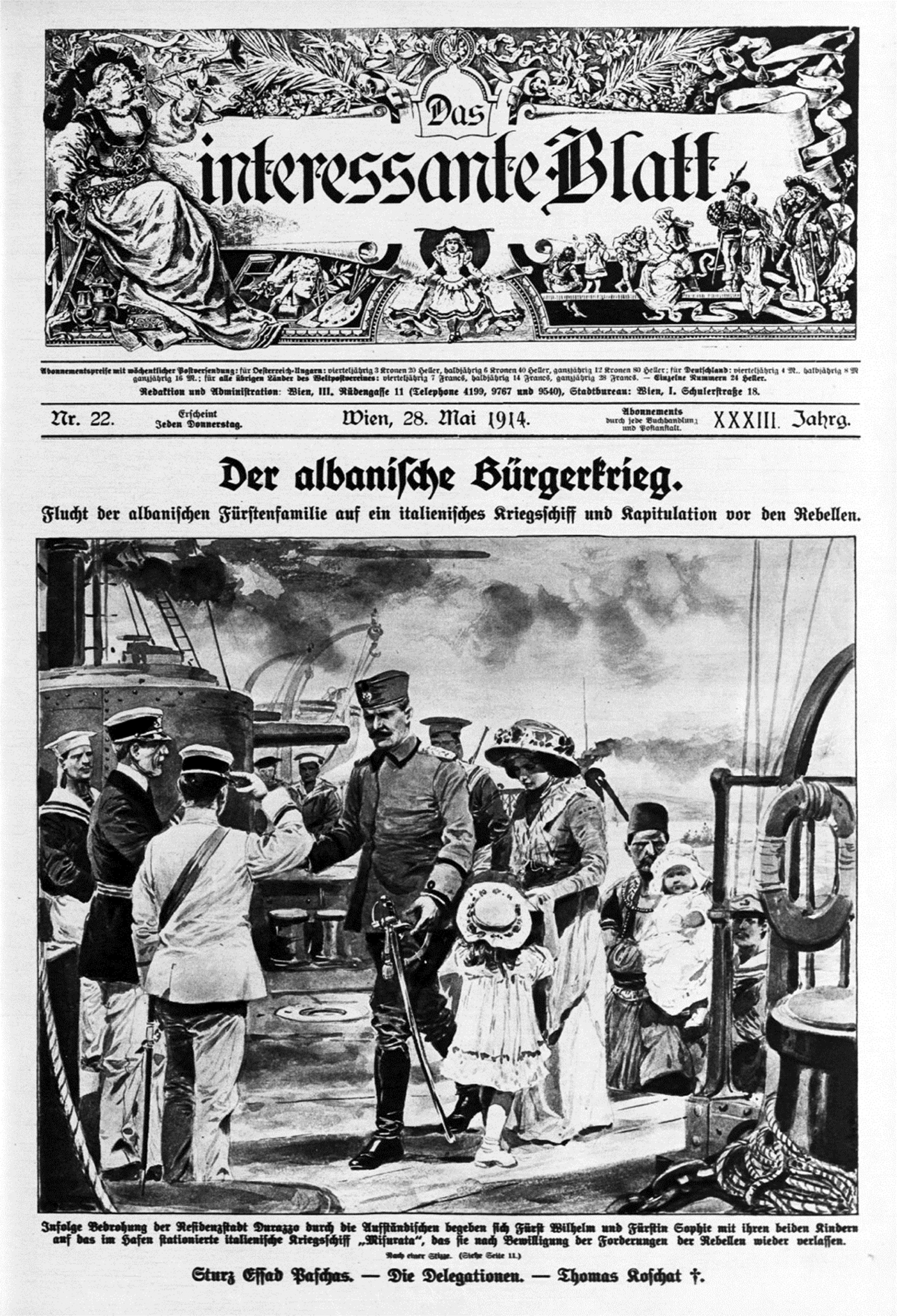
Although Vienna was not yet militarized in the way it would be during the war, military themes were laced through its daily press “on the eve.” Splashed across the day's international headlines was a military entanglement in the Balkans. All eyes were on Albania. A conflagration was taking shape there, but Viennese readers were clearly not up to speed on the intricacies of Albanian politics and needed a primer—the who/what/where of the story. Two newspapers offered this in visual form. Under the headline “The Albanian Civil War,” the Interessante Blatt gave a full-page drawing of the “Albanian” royal family fleeing from bands of approaching Young-Turk rebels. The “Albanians” were in fact the German Prince Wilhelm and his family; Wilhelm had recently been installed as ruler of Albania by the European powers (see Figure 1). The Neue Zeitung featured a full-page drawing of bewildered refugees, fleeing this way and that, lugging their worldly belongings in crates and sacks. The visual message was striking: Chaos reigned in one corner of the Balkans.Footnote 26
“Albania makes headline news.” Interessante Blatt, 28 May 1914, 1.

Beyond the illustrations, newspapers tried to sort out for their readers the major players in the Albanian drama, a sequence of events that historian Fredric Morton later called an “official, political, real-life costume party.”Footnote 27 There was Prince Wilhelm's minister of war, the recently deported Essad Pasha, who may have been plotting a coup against his new boss; his energized clan members; thousands of landless Muslim peasants; Serb intriguers; and behind them all, Young Turks. Several newspapers reported that fifteen men “in Turkish clothing” had been rounded up among the insurgents.Footnote 28 And, as we already know, the ill-fated tourist Rudolf Berger, “apparently of Silesia,” had just been buried in Albanian soil.
In some reporting, Italy was singled out as the villain in the “Albanian commotion.”Footnote 29 Both Austria-Hungary and Italy had been the major supporters of an independent Albania; both were determined to prevent Serb access to the Adriatic.Footnote 30 Despite the Neuigkeits-Welt-Blatt’s contention that the two countries were “steady and unified” on Albania, the Neue Zeitung saw “mutual suspicion” driving the action.Footnote 31 The Neue Freie Presse stepped back from the specifics of the moment to indulge in a bit of colonial prospecting. Despite its “most primitive conditions,” it would be possible “to bring culture to Albania. The fastest way would certainly be through decisive seizure by a great power. As a colony [Albania] could pose considerable difficulties, particularly if one imagined only a Pénétration pacifique.”Footnote 32
Even such a peaceful seizure would necessitate arms. To that end, as the Deutsches Volksblatt reported, Prince Wilhelm had ordered a large cache of weapons from the Skoda factory in Pilsen. A contingent of Austrian officers had been sent to teach the Albanian gendarmes how to use the new equipment.Footnote 33 Where the German nationalist newspaper saw business, the Socialists saw militarism and capitalist exploitation. The Arbeiter-Zeitung decried the deployment of Habsburg officers in the service of a private arms manufacturer and put the unbearable suffering of the Albanian peasants front and center, warning, “The Albanian farmers will keep Europe very busy!”Footnote 34
News of the Soon-to-Be Enemies
Although they did not yet know they were “on the eve” of a great war, newspapers at the end of May charted the military maneuverings of Austria-Hungary's foes. Most newspapers included a brief column inch on the Serbian parliament's passage of a war credit bill.Footnote 35 From Russia, too, military rustling was reported. The tsar had ordered “exercises” (the Arbeiter-Zeitung cast doubt on this term) for up to a million Russian soldiers. The Neue Freie Presse tallied with alarm the high, “never before seen” number of Russian men who would be “in uniform by September,” and the Neue Zeitung concluded that the move signaled Russia's preparation for a “great war.”Footnote 36
But in coverage of culture, sports, and business, the Viennese press was unabashedly admiring of the accomplishments of Austria's soon-to-be enemies. On 28 May, the greatest sensation in the city was the performance of Russian ballerina Anna Pawlowa. In her second night of a visiting performance of the ballet Giselle at the Theater an der Wien, the St. Petersburg prima was a “great success.” The Deutsches Volksblatt pronounced her “magnificent.”Footnote 37According to the Neue Zeitung, “The lean lines of her lithesome body, the unsurpassed technique on the toes, the grace of her movements and her dramatic artistic style drew the whole audience under her spell.” She was “showered with ovations.”Footnote 38 The Reichspost, not to be outdone, panted that language itself could not capture the essence of her performance.Footnote 39
Pawlowa's grace on stage was matched by British prowess on the football pitch. Newspapers reported that the Wiener Athletiksport Club had played Celtic, the visiting team from Scotland, losing 6–2. There was wide admiration for the team referred to as “our English guests.” The Illustriertes Österreichisches Sportblatt noted that Celtic had played a match “the likes of which...we have almost never seen in Vienna.” The Scots’ abilities “both in regard to tactics and techniques” represented “the highest form of achievement in the art of football.”Footnote 40 More generally, England seemed to rule the sport world when it came to equipment. Advertisements for English soccer balls, tennis rackets, bicycle parts, and shoes—“original English make”—illustrate Vienna's high sporting regard for its soon-to-be enemy. Two tennis racket models, the “Conqueror” and the “Defender,” were on sale in May.Footnote 41
In business, too, visitors from the West were eagerly anticipated. Vienna was preparing to host a large delegation of French guests at the International Businessmen's Day, scheduled for the end of June. French registration for the event had been so robust that one charter train had been arranged; a second was being considered.Footnote 42 This was one of many business, sporting, and cultural connections that would be severed with the outbreak of war.
Domestic Politics
While Austrian officers were peddling Skoda armaments in Albania, the Austrian and Hungarian Delegations were meeting in Budapest.Footnote 43 With the Austrian Reichsrat having been indefinitely adjourned in March as a result of nationalist gridlock, the meeting of the sixty delegates was one place where formal party politics were on display. Military matters crowded the daily calendar of the Austrian Delegation. The most extensive treatment of the day's events came in the official Wiener Zeitung. Poor treatment of Slavs in the army, assignment of Slavic troops to undesirable locations, and various protests about language use in the military all came to the fore. So, too, did reform of military pay and the alleged injustice in the selection of officers.Footnote 44 Questions about officers’ behavior also came before the Delegation. One of the more sensational, widely covered stories coming from Budapest was Christian Social delegate Josef Schlegel's appeal regarding a long-standing military tradition: the duel. Schlegel found support even among political foes. The practice of dueling had continued in the prewar period despite consistent opposition from the Catholic Church, Social Democrats, and bourgeois liberal parties.Footnote 45 Recent news of a Hungarian officer's duel provoked Schlegel's ire, but his loyalties were torn; he and other Christian Socials detested the duel but were loath to be seen criticizing the military. Prefacing his appeal with the words of the emperor's hymn, “What the citizens diligently created, may the emperor's power protect,”Footnote 46 Schlegel stated: “If it comes to war, God forbid, we don't want to be the ones to take responsibility for having denied the military” its support.Footnote 47
Newspaper readers who were not following the headlines on Albania or the deliberations on the military in Budapest would nonetheless have felt a military presence around the city. Three news items for 28 May called to mind the Habsburg military past. On a somber note, the Reichspost reminded readers of obligations stemming from the monarchy's previous military exploits. A number of elderly “Radetsky veterans” were reportedly living in dire circumstances and in need of assistance.Footnote 48 More happily, several advertisements alerted readers to a celebration at the Prater, where an earlier military victory was being commemorated. “Anno 1814,” a Festspiel that hailed the defeat of Napoleon and the centenary of the Vienna Congress, drew wide public participation and dozens of personalities from the Viennese stage. Participants dressed, danced, and ate in the spirit of “Alt-Wien 1814.”Footnote 49 In light of events to come, perhaps the most poignant military report from 28 May 1914 was of the flag consecration ceremony for the Infantry Regiment 99 that had taken place in Vienna that week. Several newspapers reported that passersby could witness “a brilliant military parade” as the I.R. 99 maneuvered in front of the Votivkirche. The old flag, which had flown over the battlefield at Solferino, had been placed at the Military Museum; with sabres drawn, officers now swore to honor and defend the newly consecrated flag.Footnote 50 I.R. 99 would go on to suffer enormous losses in the course of World War I.Footnote 51 By the end of August 1914, its regimental flag fluttered over Stary-Zamosc in Russian-Poland where the 99th was suffering heavy casualties. The parents of the deceased Richard Freschl, a Lieutenant in the 99th from near Vienna, were assured in a condolence letter that their son had fulfilled his duty and helped “to bind laurels to our flag.”Footnote 52
The war would bring distant place names like Stary-Zamosc into the Viennese consciousness as residents tracked the whereabouts of loved ones in the field. World War I brought the empire home; for those in the capital, it changed the geographic awareness of the Habsburg lands and of the territory of neighboring states.Footnote 53 It brought nearer what had been distant. In addition to the weather reports, mentioned above, the empire came to Viennese readers in the form of political scandals, employment ads, labor disputes, and above all, sporting events.
In two stories, domestic news from beyond Vienna served as entertaining political spectacle. The Reichspost eagerly detailed the downfall of a disgraced Social Democratic Reichsrat representative from Galicia. After incurring large debt, and borrowing sums from his party colleagues, representative Semen Wityk had fled to America. Comrades in the Ruthenian Social Democratic faction had tried to expel him from the party, but he could be found neither in Lemberg nor in his home district. Declared “missing,” Wityk had dodged his debts and embarked on an Amerikareise.Footnote 54 Meanwhile, closer to home, the trial of fallen Czech National Social Party member Karel Šviha was underway in Prague. In March, the Prague newspaper Národní listy had outed Šviha as a paid undercover police informant. The accused sued for defamation. In its 28 May edition, the Interessante Blatt published photographs of witnesses on their way to the Prague courthouse and promised readers that the case offered “deep insight into the inner mechanisms of Bohemian politics.”Footnote 55
Goings on in Bohemia similarly made the Arbeiter-Zeitung on 28 May, and here we can see labor unrest mapped geographically across Austria-Hungary. Workers at a paper factory in the Bohemian village of Holaubkau near Pilsen were in a dispute with management. The Austrian Social Democratic Party, fearing that the firm would import workers from elsewhere, admonished readers of the Arbeiter-Zeitung in Vienna that an “influx of chemical workers to Holaubkau” was to be strictly avoided. Identical warnings to limit movement of incoming workers were given in the case of a lockout of workers at a Hungarian wagon-making firm and strikes of barbers’ assistants in Slovenia and tailors in Moravia.Footnote 56 These admonitions—do not travel to strike zones—served to prevent the detrimental movement of laborers across picket lines within the monarchy. Here labor unrest sharpened geographic consciousness: distance, movement, and the consequences of crossing lines—spatial and economic—came to the fore.
Sports
The empire “comes together” most organically in newspapers’ sports sections. Here the crossing of lines was the norm; teams met, players were traded. The Illustriertes Österreichisches Sportblatt for 28 May reported scores from football matches in Galicia, Hungary, Bohemia, and Styria. Vienna Rapid had just played a match against DFC Prague, defeating the visitors 6–1. Prague's star striker, Robert Merz, was profiled as “a true child of Vienna” (ein echtes Wiener Kind).Footnote 57 The Sportblatt explicitly promoted the geographic literacy of the monarchy with a contest: “Do you Know Austria?” challenged contestants, for a prize of 1,000 Kronen, to fill in a blank map with the names of thirty cities and towns.Footnote 58 Auto racing, too, allowed readers to follow events around the Habsburg realm. A grand, multileg car race—the Karpathenfahrt 1914—was underway in late May.Footnote 59 Organized by the Hungarian Automobile club, the seven-day race covered 2,500 kilometers. On 28 May, a report filed from Czernowitz noted that a pack of automobiles had raced through the spa town of Dorna-Watra. After dinner, local hosts and the racers, who numbered thirty-three at the start of the race, drank a toast to the Kaiser.Footnote 60 The Deutsches Volksblatt added that the high performance of three Austro-Daimler cars offered “the latest proof of the excellent quality of this domestic brand.”Footnote 61
Technology
Automotive culture in Austria was in its infancy, and the racers of the Karpathenfahrt were an elite few. Yet there are hints that the experience of car travel was expanding to wider circles. The firm of Goldman & Salatsch was advertising to readers of the Neue Freie Presse a complete apparel kit for automobile excursions (windbreakers, caps, goggles),Footnote 62 and for sale in the Interessante Blatt was an actual car, the “Little Wanderer,” billed as “the ideal automobile for doctors, businessmen, and sportsmen.”Footnote 63 In reports of spectacular car crashes, we find a fascination with speed.Footnote 64 On 28 May, readers were drawn to Trieste, where a Baron Edmund Cnobloch and his young chauffeur drove headlong into a canal and drowned.Footnote 65 The chauffeur, reported the Neuigkeits-Welt-Blatt, had been possessed by the “devil of speed” (Schnellfahrtsteufel). Viennese readers were transported to the scene of the accident and given details that would allow them to imagine the event firsthand: unable to open the doors, the two men had been trapped as the car filled with water. “The Baron's watch stood still at 11:15, the moment the catastrophe occurred.” The newspaper offered a moral: on unfamiliar streets one ought to drive slowly.Footnote 66 The love of mechanized speed and acceleration is even reflected in a report from the Vienna horse track. In the “maiden race” for two-year-olds, the winning horse was fittingly named: Motor.Footnote 67
Next to cars, airplanes featured prominently in the day's news. Sprinkled through the newspapers are a number of stories that show an interest in flight and the thrills and dangers it entailed. The 3rd International Flugwoche, set to take place in Vienna at the end of June, promised to dazzle. Domestic and international contestants would compete for a wide range of prizes for fastest speed, ascent, and landing.Footnote 68 Projected for September were a series of flights deemed “Zuverlässigkeitsflüge” around Austria-Hungary.Footnote 69 The event had pilots flying round-trip from Vienna, through Bratislava, Wiener Neustadt, Linz, and Gmunden.Footnote 70 Readers were reminded, however, of the harrowing risks of flight. The Interresante Blatt covered, with photographs, the unveiling of a stark “pilots’ memorial” in Herzegovina. The monument honored Hauptmann Deotatus Andrich, the commander of the Mostar airfield who a year prior had “met his death in a crash.” The monument itself resembled a crash site. A towering, angular stone was surrounded at its base by strewn rocks and rubble, a grim landscape of heights and sharp pitfalls.Footnote 71
One who hoped to follow Andric's soaring career path, but whose life ended in a very different way, was officer cadet Artur Stampach. The youngster committed suicide in May 1914, and several newspapers recounted his end: Stampach was found dead in his room, revolver and note by his side. He had aspired to become a pilot, but saw his dream of flight extinguished when a doctor deemed him unfit because of a heart condition. In his farewell note, Stampach declared that he “lived with heart and soul” for flight, and without aviation his life promised “no joy.”Footnote 72 Literary historian Paul Fussell would surely find Stampach's death an instance of the cultural trope that he used to characterize World War I: irony. A young pilot kills himself for the love of flight just before the World War in which scores of Austria-Hungary's airmen would be killed in battle.Footnote 73
The Interessante Blatt worried that the fascination with the new technologies of speed—cars and airplanes—had overshadowed a “forgotten” marvel of the modern age—trains and the bridges that supported them. It reported on the final safety testing of a new rail bridge for the Westkrainer Bahn in Slovenia. Featuring a sketch of three massive locomotives traversing the new structure, the newspaper hailed colossal bridges “that just a few decades ago would have been completely unfeasible,” but that were now considered unremarkable “even to the everyman.”Footnote 74 The Reichspost meanwhile touted the geopolitical wonder of the same Westkrainer Bahn. Extension “to south and east for our half of the empire constitutes a quiet conquest,” a definitive reply to Hungarian resistance to a rail network linking Austria to Croatia and the Dalmatian coast. With the new bridge, “two lands, standing under one scepter” but separated by political distance, now faced a rosy future together.Footnote 75
Advertising
The most revealing information about what Viennese readers’ consumption patterns may have been in the months preceding the war comes from the advertising sections of the newspapers, which in some cases numbered a dozen or more pages per edition. Ads for businesses, taken together with the want ads (Kleine Anzeigen), constituted a significant portion of the day's print. Anything and seemingly everything was for sale in Vienna on 28 May 1914. The most common ads were for clothing, shoes, and fabric. The Neuigkeits-Welt-Blatt offered garden hoses, sausages, and automated rat traps (“catch up to 40 in one night”); the Reichspost, pillows and pianos; the Interessante Blatt, raincoats, harmonicas, and “American” suitcases; the Arbeiter-Zeitung, a gravestone (“in good condition”) and 45,000 record albums (Schallplatten) from a merchant going out of business. And everywhere there was furniture, furniture, furniture. Only the official Wiener Zeitung was virtually ad-free. Modern advertising gimmicks were on full display in prewar Vienna. “Are you astounded by the cheap prices?” asked one purveyor of clothing.Footnote 76 One finds products for “no-risk” five-day trial periods, free travel guides for loyal readers of a particular newspapers (“mention you saw the ad here”), free catalogs, service guarantees, and of course price reductions. One detects the class orientations of these offers. More than any other newspaper, the Arbeiter-Zeitung's advertisers promised affordability in the form of down payments (auf Raten) and installment plans (Teilzahlung).
The many products and themes in the ads defy easy categorization. But we can conclude a few things from them: first, the Viennese were captivated by appearances—their own and others’. Readers of the daily press were bombarded with ads promising to improve their exteriors. The following products, among others, were on sale: hair thickening crème; anti-dandruff soap; facial hair removal paste; hair coloring products for him and her; mouthwash; crèmes to whiten the skin, combat freckles, and age spots; and even a lotion that would reshape the nose. A whole host of products for the breasts were to be had: plant extracts to firm breasts, miracle preparations to enhance them, brassieres to lift and shape. An unattractive exterior could doom an unlucky person. The Reichspost ran a classified ad seeking donations for a “poor Catholic man” suffering from “chronic lupus vulgaris.” He was unable to earn a living because his face “provoked shock everywhere.”Footnote 77 Rosa Schaffer's long-running ads for cosmetics and beauty treatments sum up the spirit of the day. Schaffer, the turn of the century Viennese cosmetics magnate who claimed the honorific title of “official cosmetics purveyor to the Serbian royal house,” admonished readers on 28 May 1914: “Beauty is wealth. Beauty is power.” (Schönheit ist Reichtum. Schönheit ist Macht.)Footnote 78 These products to improve physical appearance may have been the luxuries of the middle and upper classes. The Arbeiter-Zeitung ran comparatively few beauty ads; it did, however, feature more ads for condoms than other newspapers: “Parisian Specials,” “Carnival and Hercules brands,” “lasting protection for men,” free price list, all to be mailed “discreetly.”Footnote 79
A second observation from the day's advertisements is that the food “substitutions” that the Viennese would be forced to adopt in wartime were already in effect, but for reasons other than dire scarcity. The marketing of Ersatzmittel was robust. Margarine as a butter substitute was advertised in several newspapers. First introduced to the Viennese market by a soap factory in Liesing, the city government had permitted the firm Sarg to sell the new fat made from ox tallow under the name of Prima Wiener Sparbutter.Footnote 80 The promise of “saving” was not targeted only at the working classes; Unikum, a brand of margarine that appeared in several newspapers, was marketed to consumers rich and poor.Footnote 81 The housewife was promised a cost savings of 50 percent by switching from butter to Unikum. Alterations, if not direct substitutions, were made in other products as well. Coffee, for example, came in a number of adulterated forms. The König factory in Schwechat advertised Sparkaffee Moretti made of “ground and mixed vegetable components,” the best Kaffee-Ersatz. Kaffee Hag meanwhile billed regular coffee as a “harmful stimulant” and promised athletes that its caffeine-free substitute would promote a healthy heart and strong nerves.Footnote 82 The firm also invited skeptics and novices to stop by its taste-testing kiosk at the Kohlmarkt to acquaint themselves with the caffeine-free aroma.Footnote 83
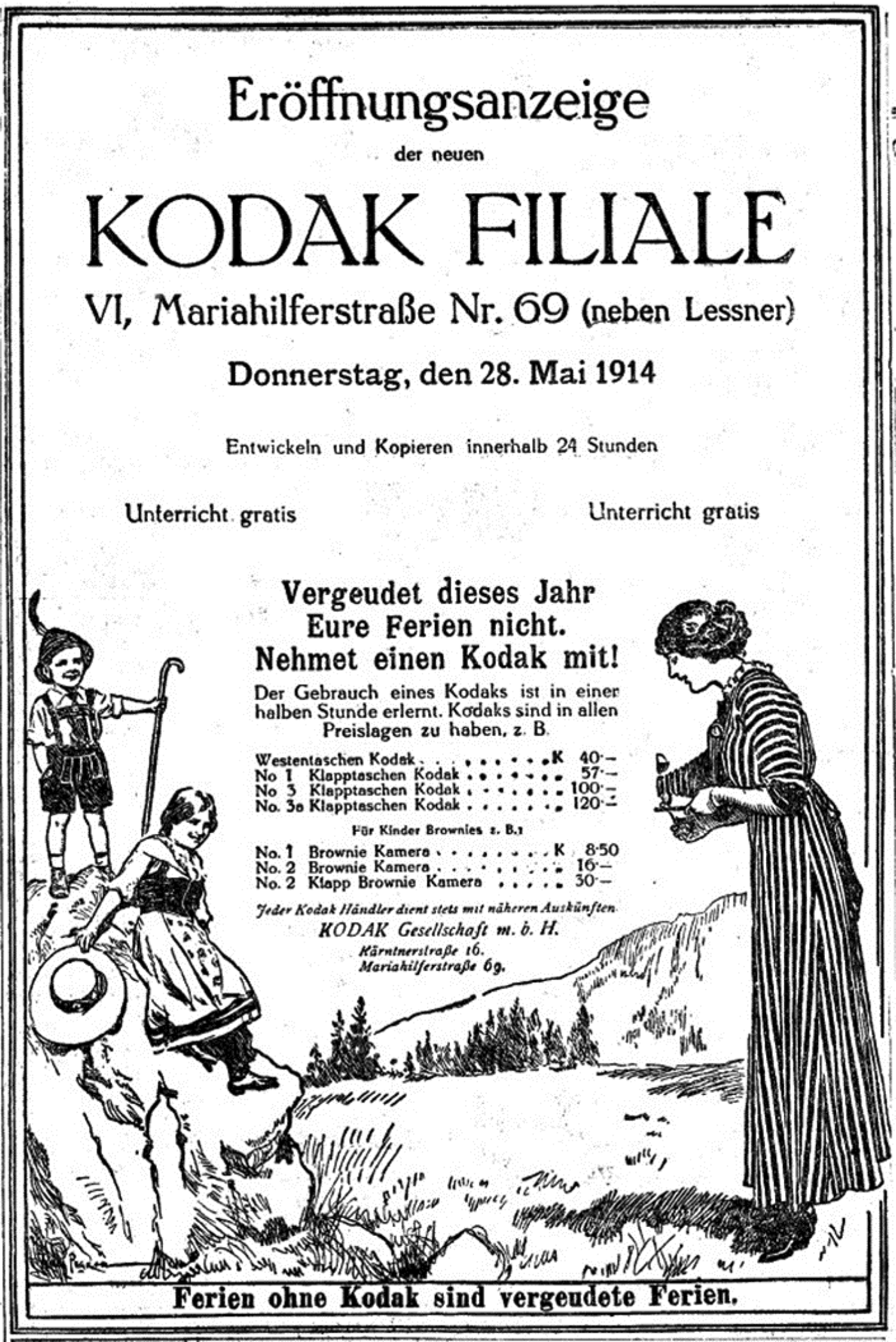
Finally, the advertisements from 28 May give the unmistakable impression that summer was in the air. On this day, a new Kodak Photography branch opened on Vienna's Mariahilferstrasse. An advertisement for the event connected the new popular use of the camera to the prospects for the coming summer holidays. “Holidays without Kodak are squandered holidays,” the new branch advised. “This year” holidays must not be misspent: “Take a Kodak along!” (See Figure 2.) Customers unfamiliar with the new technology were reassured that its use took less than a half an hour to learn, instruction was free of charge in the shop, and even women could learn to operate the device. Prices were in reach of even the poorer classes. An entry-level “Brownie” model sold for just 8.5 Kronen.Footnote 84
“Austrians prepare for summer holidays.” Neue Freie Presse, 28 May 1914, 23.
Elsewhere in the newspapers one feels summer in the air. Pfingsten is approaching. There are ads for bathing suits, reclining deck chairs, and innumerable hotels and pensions. Arrangements were being made for household and childcare. A reader of the Arbeiter-Zeitung posted an ad offering summer childcare: “can take an older child to Styria” during the holidays; meanwhile a Neue Freie Presse reader sought temporary employment for a valued maid: “Seeking [position] for my maid servant: Has worked in my house for four years. Looking for a post with a nice family from 1 July through the end of August.” Not all was rosy on the holiday front, however. For those planning a trip to the Alps, a threatened privatization of the Grossglockner was in the works. A Herr Willer from Bochum had threatened to close certain paths and hiking trails around the glacier during the summer season. The Neue Freie Presse, citing earlier legal precedent, took pains to argue, “The majestic glacier region of the Grossglockner ... may never be closed off by a private owner.”Footnote 85 By the time Herr Willer's plan was to take effect—August 1—holiday-making was no longer of pressing concern to the newspaper or its readers.
Obituaries/Deaths
One striking phenomenon from the newspapers of 28 May is the eerie presence of death in much of the day's reporting. A few dignified obituaries appear here and there, but readers encountered death more typically in stories of gruesome passings: the aforementioned drownings in Trieste, the court case of a poisoned stepdaughter, the fatal stabbing of a young feather decorator by her drunken lover.Footnote 86 Some deaths were accidental. Thirteen-year-old Andreas Hlusty had fallen to his death in a stairwell.Footnote 87 Others were accidentally discovered. On 27 May a worker renovating Vienna's Aspernbrücke had discovered two human skeletons, legs entwined, buried five meters below the earth. There was no danger of a murderer on the loose, however; police determined that the bodies were likely victims of an earlier Danube flood.Footnote 88 Other corpses made the news this day. Under the headlines, “Corpse Trader?” and “Shipment of Body Parts,” several papers revealed that body parts had been sent from Trieste to Vienna's General Hospital.Footnote 89 Reassurance was given: The University of Vienna had “for a long time endured a shortage of corpses.” Because of the rising number of medical students, the so-called “poor corpses,” unclaimed bodies from city morgues, “no longer suffice[d].”Footnote 90 Finally, the Arbeiter-Zeitung reported unrest at the cemetery, where Socialist-Catholic tensions in Ottakring played out graveside. The newspaper lambasted an indolent priest who failed to appear at the funeral of comrade Ernst Planner. Disgruntled crowds mourning Planner and two other unburied corpses let out “unflattering” cries about the priest, and family members contemplated burial without last rites.Footnote 91
Murders and accidents aside, the most frequent death stories by far in the Viennese newspapers were suicides. Suicide reporting transcended Lager orientation altogether. We have mentioned already the life and death coincidence on the Selbstmörderbankerl and the demise by his own hand of the young pilot Stampach. Although one ought to heed historian William Bowman's caution not to “reinforce the cliché of the Habsburg capital as the morbid center of Central Europe,” one could indeed be excused from reaching just such a conclusion from the day's reading.Footnote 92 Not all suicide coverage was sensationalistic. In the official Wiener Zeitung, suicides were reported in bookkeeping fashion alongside all of the other things to be counted—cases of rabies, tuberculosis, herpes. Its unadorned reporting contained features of suicide coverage replicated in other papers: “The day before yesterday 64-year old writer Moritz T. shot himself in the head with a Browning pistol. He committed the deed on account of suffering (wegen eines Leidens). This morning locksmith apprentice Adolf W. shot himself in the left temple with a cane gun. He suffered a severe concussion several years ago and has since repeatedly voiced suicidal intentions.”Footnote 93 The pattern is: name, profession, weapon or method, and “cause.”Footnote 94 In other papers we read: Tuesday evening a man shot himself in the head with a revolver at the Stadtpark. He was twenty-five-year-old musician Franz N. His motive: “weary of life” (Lebensmüde).Footnote 95 Yesterday, an elegantly dressed man shot himself with a revolver in the town of Mariazell. He was Herr Mandl, head of a large floral business in Vienna. His motive: financial distress. Suicide was a commonplace story for the Viennese reader, especially at this time of year—spring was typically the peak season for Austrian suicide.Footnote 96
What many of the suicide reports on 28 May share is the weapon: a gun. It is surprising for the American reader to imagine Vienna as a “gun society.” And yet, it clearly was. The gun was the chosen weapon of many suicides. It is hard to estimate how many guns were in circulation in prewar Vienna. What guns there were in private hands the government was eager to round up once war was imminent. The Imperial Decree 160 of 25 July 1914 ordered the requisition of private firearms.Footnote 97 Although statistics on private gun ownership are hard to find, the advertisements for guns are not. The Carinthian weapons factory “Melichor” advertised hunting rifles with the newest gadgetry and “unparalleled shooting performance.”Footnote 98 The automatic pocket pistol “Steyr” was advertised in an army newspaper as “Absolutely dependable! Available at all gunsmiths and arms dealers.”Footnote 99 On 28 May, it was reported that a shoot-out had occurred on the Rotenturmstrasse: “As is known, a half-crazy man was shooting with a revolver from the roof of a passing omnibus.” Rather than attempting to disarm the shooter, male passersby had apparently fled. The newspaper reporting this scene, Danzer's Armee-Zeitung, commented with disdain on the use of handguns in public and the lack of masculine honor on display in the hedonistic city controlled by “pacifists, monists, Socialists, esperantists, and the like.”Footnote 100
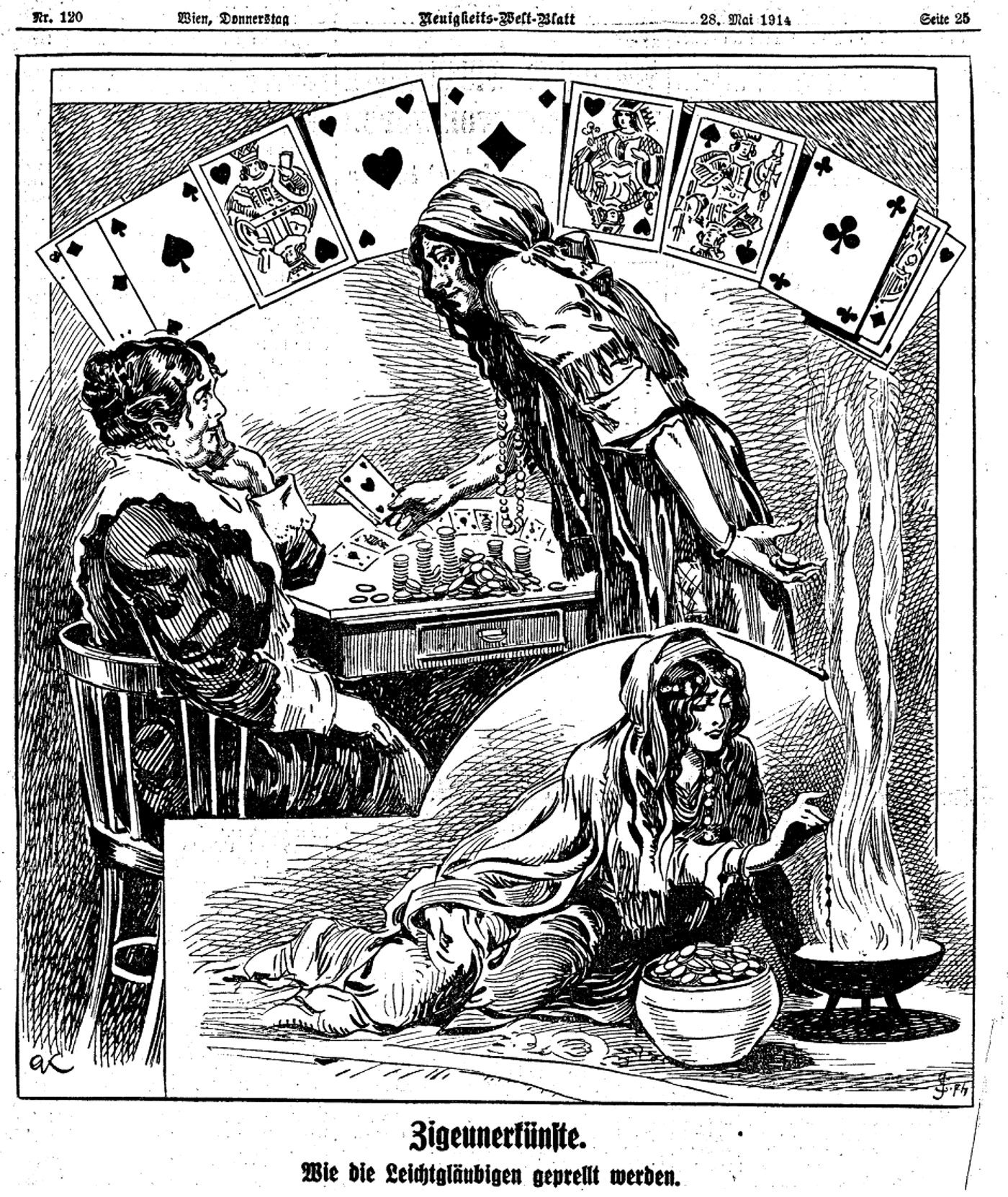
In closing, we have seen that on this average Thursday before the Great War, Vienna was a city of parades and shoot-outs, beauty creams and corpses, soccer matches and suicides. We will avoid trying to foretell whether readers “knew”—or could have known—that in a month's time the rhythm of everyday life would begin to change radically. Speculating so would draw us into the realm of fortune-telling and the occult. By chance, this, too, was on offer on 28 May. A mysterious “Professor Roxroy” offered his services in a prominent quarter-page ad in the Interessante Blatt. He offered customers the chance to learn their fortunes. “Let this man predict your life's destiny!” his ad trumpeted.Footnote 101 Fortune-telling was also depicted in the press as the sinister business of gypsies (see Figure 3). With a full-page illustration of exotic gypsy women seducing gullible souls in Berlin with their card reading and magic potions, the Neuigkeits-Welt-Blatt warned its readers that even “big city people” could be ensnared in the gypsies’ false promises of knowing the future.Footnote 102
“Fortune-telling on the eve of World War I.” Neuigkeits-Welt-Blatt, 28 May 1914, 25.
Alongside “Roxroy” and other fortune-tellers, the Vienna stage offered a third venue for telling of things to come. In late May 1914, Johann Nestroy's comedy Lumpazivagabundus (1833) had been magnificently staged at the Volksprater in a show dubbed “a sensation,” a rollicking performance in a city accustomed to good theater.Footnote 103 In the play, a cobbler is one of three vagabonds being tested by the king of the good fairies and the patron saint of the vagabonds.Footnote 104 He is also an amateur astrologer and predicts that a comet will soon come and destroy the earth. His Kometenlied foretells of the downfall of man and the destruction of the world; its refrain, ominous in May 1914, echoes: “The world surely won't be here much longer.” (Die Welt steht auf kein’ Fall mehr lang.)
“The world,” or more specifically Europe, had already gone to hell in the minds of some conservatives. The comet had already struck. Danzer's Armee-Zeitung for 28 May surveyed European politics and statecraft and denounced bitterly its “hypocrisy, pretenses, shamelessness, lies, and fraudulence.” Wearily watching the events unfold in the Balkans, its editor yawned, “It's fortunate that the dog days of summer are coming soon. Then at least one doesn't have to read the newspaper.”Footnote 105