WOMEN AND GENDERED POLICY CHANGE
Politics and gender scholarship is increasingly trying to show whether, when and how women in politics make a difference to policy outcomes. The scholarly focus has shifted from counting the number of women in politics – the descriptive representation of women – to theorizing and empirically demonstrating the link between their presence and policy change – the substantive representation of women (SRW).Footnote 1 This literature is sceptical of the ‘critical mass’ approach, which crudely predicts that women's impact on politics will be felt when their presence reaches approximately 30 per cent;Footnote 2 instead it demonstrates the importance of the agency or policy entrepreneurship of individual actors, frequently referred to as ‘critical actors’.Footnote 3
While this literature makes a significant theoretical and empirical contribution to understanding the effect of women in politics, there are at least three limits to existing research. First, empirical work on the substantive representation of women has to date tended to focus on women in one of two institutional sites: parliamentsFootnote 4 or women's policy agencies,Footnote 5 defined as ‘institutional arrangements inside democratic states devoted to women's policy questions’.Footnote 6 The emphasis is on where women have gained representation rather than where they actually wield political power and resources. For studies trying to explain how women can shape policy outcomes, this focus is in the wrong place. It is important to put women's political activity in the context of the institutional configuration of a particular political system. This is especially the case in the Westminster model, where policy-making is dominated by the core executive and policy networks,Footnote 7 but it also applies to traditionally corporatist decision-making systems such as those in Sweden or Germany, where decisions are traditionally thrashed out between social partners before they reach parliament.Footnote 8 Similarly, the limitations of the substantive representation of women by means of women's policy agencies are also evident. These institutions are frequently poorly resourced, weakly institutionalized and easily dismantled when the political landscape changes.Footnote 9
Second, studies to date focus on the agency of critical actors in single institutional settings. The literature on women's policy agencies does consider the links with the feminist movement, but not with other actors in formal politics. This slightly blinkered approach overlooks the manner in which actors in different institutional sites interact, cooperate and coordinate action to attain their goals.Footnote 10
Third, the policy focus of the substantive representation literature has remained ‘at the margins’ of legislative activity,Footnote 11 able only to demonstrate policy change in the ‘sector’ of feminist policy.Footnote 12 The literature has, for example, been able to demonstrate convincingly how ‘critical actors’ in a parliamentary setting have brought about isolated instances of policy change. An excellent example is Childs and Withey's study of how one critical actor – backbench MP Christine McCafferty – pushed for the removal of indirect taxation (VAT) on sanitary protection in the United Kingdom (UK).Footnote 13 Other studies have shown the effect of women's policy agencies on issues such as abortion, prostitution or women's political representation.Footnote 14 While not denying the significance of such studies, their limitation is that they are unable to capture the impact of female political actors on ‘mainstream’ areas such as economic or welfare state policies, which carry significant budgetary and fiscal consequences and are more complex to push through.Footnote 15
Some recent critiques of the substantive representation of women in parliament and women's policy agencies have come from scholars who initially advocated this approach.Footnote 16 Celis et al. highlight the shortcomings of conventional approaches to the substantive representation of women that ask ‘Do women represent women?’ and ‘Do women in politics make a difference?’ Celis et al. propose new questions, such as ‘Who claims to act for women?’ and ‘Where, why and how does the SRW occur?’Footnote 17 This gets at the point that not all women, and not only women, will seek to regender policy. It also advocates a more case-by-case approach to understanding the substantive representation of women that opens up the possibility of taking in a number of possible institutional sites. Similarly, Fiona Mackay calls for a ‘thick’ conception of the substantive representation of women that is a ‘contextualised, inter-relational, whole-system approach’ to how women's policy change occurs.Footnote 18 All agree that the focus needs to shift away from women in parliament and women's policy machineries to include other sites and all manner of political ‘critical actors’.Footnote 19 Moreover, in these critiques the institutional context is increasingly often included as a key component of a new research agenda. To understand how the substantive representation of women occurs, it is important to be clear about where the power lies in any institutional context as well as processes of policy change. Fiona Mackay acknowledges that critical actors can be found in parliaments, government, bureaucracy and civil service.Footnote 20 However, empirical research still remains focused on parliaments and women's policy agencies and on one institutional site at a time rather than recognizing the necessary and inevitable interrelation and interaction between feminist critical actors in multiple institutional sites.
While acknowledging the valuable contributions that the politics and gender literature have made, this article moves forward in three important ways. First, it opens up the potential sites of the substantive representation of women, arguing that it is important to look at feminist actors with political power resources, rather than study women in one particular institutional setting. Second, it looks for evidence of how these actors in multiple institutional locations work together. Third, it widens the policy focus to a mainstream element of public policy-making with significant economic implications, namely the welfare state. Empirically, the article draws on research conducted for a project on the gendered reform of welfare policy in the UK under New Labour governments since 1997.Footnote 21 It focuses on the incremental programme of welfare reconfiguration in the direction of an ‘adult worker model’ (AWM) welfare stateFootnote 22 that significantly regendered welfare policy by extending rights to maternity and paternity leave and pay as well as introducing to parents and carers the right to request flexible employment.
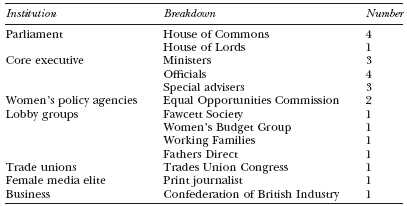
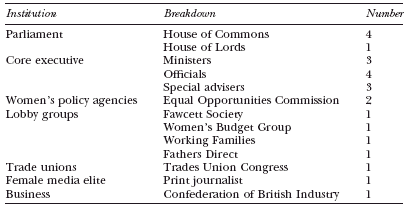
This article identifies who was driving this reform and does so in the following stages. First, it introduces the concept of ‘adult worker model’ welfare reform and the three possible ways that this can be gendered. It then identifies the gendered disposition of recent welfare reform in the UK. Then, by correlating the gendered disposition of the reform outcomes to the priorities of feminist actors in seven institutional settings – through process tracing and 24 elite interviews (see Table 1) – the article demonstrates that these welfare reforms were initiated, carried forward and refined by a coalition of feminist actors located in significant institutional positions in and around the New Labour government. The article shows that the successful implementation of this gendered policy reform relied on a series of ‘strategic actors’ (as opposed to critical actors) who acted as ‘gate openers’ to the key sites of political power in the UK political system. In this way the article presents empirical research findings that make a contribution to the theory of the substantive representation of women.
Institutional Distribution of Interviews
THE GENDERED DISPOSITION OF WELFARE REFORM
Recent processes of social policy reform in a number of European welfare states have entailed a significant reconfiguration of welfare provision. Central to this reform is the redefinition of men and women's roles in formal and informal work and care. Jane Lewis has referred to the change as one from the ‘male breadwinner’ to the ‘adult worker model’ welfare state.Footnote 23 The male breadwinner (MBW) welfare state was one that assumed that there was formal, paid work for men and unpaid, caring roles for women. Women were in turn reliant on the male breadwinner for social rights.Footnote 24 The shift in the direction of the AWM welfare state breaks with this model that dominated the post-1945 welfare state and introduces an assumption that all adults – male and female, able and less-able, old and young – should be economically active and financially independent as this boosts economic growth and reduces the burden on the welfare state.
There is clearly a strong gender dimension to the new AWM welfare state. Women who were previously economically inactive are now being expected and encouraged to take paid employment. However, the welfare systems of the male breadwinner welfare era lack the institutional support to make this possible. Family policy to support women's employment such as childcare and maternity and paternity leaves are underdeveloped in strong male breadwinner welfare states such as the UK, the USA and Germany.
In numerous welfare states there is evidence of social policy reform to align the welfare institutions with the goal of high levels of female employment.Footnote 25 Similar priorities can also be identified at the level of the European Union.Footnote 26 However, positive welfare reform (meaning the implementation of new welfare provision) is not automatic. It depends on governments' policy-making initiatives and, it is argued here, on the campaigning of feminist actors in government for gendered welfare reforms. It is also not to be taken as given that gendered welfare reform will lead to more equal gender outcomes. Indeed, in terms of gender policy outcomes there are three directions that the AWM welfare state could take: they can promote gender neutrality, gender difference or gender equality.
The politics of the AWM can remain gender neutral. This means that the gender division of labour in formal and informal work that became entrenched in the MBW welfare state is ignored. Women are encouraged to work but are not provided with institutional or financial support for combining formal employment with caring duties. No positive reforms to welfare policy are made, and women are required to seek market or private solutions to childcare or work–life balance dilemmas. The USA is cited as a prime example of a gender-neutral, unsupported AWM welfare state.Footnote 27 For example, the federal law Personal Responsibility and Work Opportunity Reconciliation Act (PRWORA), passed in 1996, sought to reduce welfare dependency by making work or employment-related activities a condition for welfare entitlement. Harsh sanctions are imposed on those who do not comply with the work requirements, and welfare entitlement is limited to five years. Lone mothers are required to return to work quickly and are only exempt from work requirements under certain conditions: if they have a disabling health problem, if they care for a family member with a health problem, if they have a baby who is less than three months of age, if they are a teenage parent attending school or if they are over the age of 65.Footnote 28
Two things need to be considered if we are to reframe policy in the gender difference or gender equality frame. The first consideration is the unequal conditions of paid employment for men and women, and the second concerns a distribution of paid and unpaid work in households. The fact that women on the whole earn lower wages than menFootnote 29 means that they are less likely to be able to secure economic independence even if they take employment. Moreover, women's lower wages and poorer career chances in formal employment have an impact on the distribution of roles and duties in the household. As second earners, women are more likely to take on caring roles and this in turn affects their opportunities in the formal labour market.
The disposition of the AWM could be gendered in two alternative ways. One possibility would be to accept and accommodate the gendered differences in paid and unpaid work. This ‘gender difference’ approach to constructing the AWM would recognize and accept as a fact that the burden of responsibility for caring and household work tends to fall on women. The AWM would then be constructed to accommodate women in the labour market as workers and carers. Policy reforms might offer women flexible, quality part-time employment, long periods of maternity leave and contributions to pension schemes for time taken out to fulfil caring responsibilities. While this approach is less likely to meet with the AWM goal of securing economic independence for all adults, and would have the disadvantage of reproducing some of the dependency promoted by the male breadwinner model, it would better respond to the social reality than the gender-neutral model. It also responds to some (controversial) research that suggests that it is just a minority of women whose preference it is to work full time, handing caring responsibilities over to professional carers or male partners.Footnote 30
A second way of gendering the AWM is to remove the obstacles to women's participation in formal employment on equal terms to men. This can be referred to as a ‘gender-equality’ model. The first issue is inequality in the labour market. A series of policies needs to be developed to close the gender pay gap, promote women's employment in the more highly paid occupational sectors and encourage women into senior roles. The second issue is to address the unequal distribution of unpaid work in households, both in terms of caring and housework. If men and women are equally responsible for informal caring work, then women might experience fewer disadvantages in the sphere of formal employment.
This issue of redistributing informal work in households is controversial because it implies an interference of public policy into the private sphere, but that does not mean it is impossible. The Spanish Socialist government, elected in 2004, introduced in 2005 a new clause to marriage contracts to include a commitment to sharing responsibility for household duties.Footnote 31 Alternatively, offering men and women more equal rights to paid parental leave could redistribute the responsibilities for caring for young children from birth. In developing such policies it is important that men's entitlement to leave is independent of a mother's and that a significant part of the father's earnings are compensated for; otherwise take-up among fathers is proven to be low. This needs to be combined with awareness campaigns to encourage active fathering and take-up of paternity/parental leaves. A model to emulate might be the Swedish system of ‘Daddy Months’, that is, parental leave reserved exclusively for the father.Footnote 32 A first month was introduced on 1 January 1995 and a second on 1 January 2002.
Reform of the welfare state in the direction of the adult worker model can clearly take three different gendered paths. The outcome is not automatic but, it is argued here, it depends on the intervention of committed political actors with power and resources to shape welfare policy. A lack of feminist intervention will lead to gender-neutral AWM welfare reform, whereas the campaigning and political activism of committed feminist political actors might lead to gender-difference or gender-equality welfare reforms, depending on their policy preferences. The next section identifies the gendered disposition of one aspect of welfare reform in the UK – reforms to maternity and paternity leave. Then, by correlating the reform with the preferences of key policy actors, the article identifies who was driving this reform.
GENDER DIFFERENCE WELFARE REFORM
Since New Labour came to power in 1997, a series of welfare reforms in the domain of work–life balance have been passed. These have, for example, extended to women and men the rights to take leave when a child is born, as well as the right for parents of young children and for those with other caring responsibilities to request flexible employment. This welfare reform in the UK clearly takes the direction of gender difference, that is to say, it significantly extends welfare rights to women. There is some evidence of policy-framing in the direction of gender equality – offering new rights to fathers as well as mothers to redistribute caring responsibilities – but little in the way of concrete policy change.
For example, in 1998–99 the government extended the entitlement to paid maternity leave from 14 to 18 weeks with an additional 29 weeks' unpaid leave, and implemented the EU parental leave directive, offering parents 13 weeks' unpaid parental leave. Further reforms were introduced incrementally, predominantly through two Green Papers in 2000 and 2005, with the rights being extended and improved at each stage. The first major wave of reforms, set out in the 2000 Work and Parents: Competitiveness and Choice Green Paper,Footnote 33 extended the right to maternity leave to 52 weeks in total, 26 of which were paid. It also introduced to fathers the right to two weeks' paternity leave. Finally, it introduced the right to request flexible employment for parents with children aged under six, or 18 if disabled.
The commitment by Gordon Brown in the 2004 pre-budget spending review to introduce an extension of paid maternity leave from 26 to 39 weeks from April 2007 presented an opportunity for civil servants and the Department for Trade and Industry (DTI) to ‘get cracking with concrete reforms’,Footnote 34 culminating in the 2005 Work and Families: Choice and Flexibility consultation.Footnote 35 This led to a further set of reforms that extended the right to paid maternity leave to 39 weeks, with a commitment to 52 weeks by the end of the 2005–10 legislative period. It also introduced in law the option of allowing a mother to transfer her second six months of maternity leave to the father. The right to request flexible employment was extended to carers of disabled adults.
In 2007 a further Additional Paternity Leave and Pay Administration Consultation was launched to work out the details of the proposed transferable maternity leave scheme. No legislation has been passed, but the Department for Business, Enterprise and Regulatory Reform (BERR) website states that ‘a consultation on the draft regulations will follow’ and that it is ‘the Governments [sic] intention … to introduce Additional Paternity Leave and Pay alongside the extension of maternity pay to 12 months […] before the end of this Parliament’.Footnote 36 It was also planning to extend the right to request flexible employment to all parents with children aged up to 16. However, in October 2008 BERR minister Peter Mandelson suggested that the government may try to ease the impact of the recession on business by delaying plans to extend rights to flexible working and better maternity leave.Footnote 37
It is clear that, overall, the government's welfare reforms in this policy domain are in line with the gender-difference framework: rights have been predominantly extended to mothers. The rights for fathers are minimal and, as they stand, will do little to promote gender equality, that is, a redistribution of work and caring roles between couples. Parental leave is completely unpaid and paternity leave is paid for two weeks at the rate of statutory maternity pay that, as it is lower than the national minimum wage, is unlikely to replace the father's wages. Indeed in 2004 only 20 per cent of fathers were taking up their right to paid paternity leave.Footnote 38 Even the proposal to transfer six months' leave from the mother to the father falls far short of a gender-equality policy. The transferable leave would be in the gift of the mother and would be remunerated at the rate of statutory maternity pay, but only if the mother was still entitled to it. As fathers still tend to be the higher earners in a family and as families can rarely afford to forgo income at this expensive time, take-up is unlikely to be high.
LABOUR PARTY AND LABOUR MOVEMENT FEMINIST COALITION
Having identified concrete examples of gender-difference policy change, the research sought to identify who was driving the reform. The assumption was that feminist advocacy would lead to gender-difference or gender-equality outcomes in the shift to the adult worker model welfare state. To identify the sources of feminist advocacy, the project honed in on seven institutional sites, looking at their role in developing policy frames and outcomes via consultations and interviewing actors to find out who the key players were.
Contrary to the existing scholarship on the substantive representation of women, it was clear that no single critical actor was driving the reform. Although Patricia Hewitt, a committed feminist activist, was secretary of state at the Department of Trade and Industry and minister for women for 2001–5 when the second tranche of reforms were developed and passed, many of the people interviewed explicitly stated that policy change was not down to any one individualFootnote 39 and that other senior feminists in Hewitt's ministerial position – such as Tessa Jowell, Harriet Harman or Clare Short – would have had the same degree of policy success.Footnote 40
The evidence from interviews conducted for this research demonstrated that the reforms were articulated, developed and pushed through by a network or ‘advocacy coalition’Footnote 41 of committed Labour Party and labour movement (LPlm) feminists across a range of institutions. The core actors in this coalition were members of parliament, ministers, political advisers and policy advisers. The LPlm feminist advocacy coalition was not named as a formal grouping in interviews. Instead, repeated reference was made to long-standing, 15- to 30-year links to each other via Labour Party campaigning, trade unions and/or think tanks such as the Institute for Public Policy Research (IPPR).Footnote 42
The origins of the LPlm feminist coalition can be traced back to the 1970s,Footnote 43 but it was particularly cemented during the period of Labour opposition in 1979–97. During that time, it worked principally on policies to improve women's political representation in the UK, for example, through the development of women-only shortlists for parliamentary candidates. Politicized by this, on the election of the New Labour government in 1997 onwards, it pushed for gendered policy reform in more mainstream areas such as the economy, labour market, welfare state and international relations.Footnote 44 However, policies to boost women's political representation were perceived to be the prerequisite to substantive welfare reforms.Footnote 45
In interviews a significant number of actors referred to the importance of these close and long-term relationships with other women for successful welfare reform. One feminist minister referred to how the support she drew on from a specific group of women was crucial for overcoming resistance to reform and pushing for a more radical package of policies.Footnote 46 A former political adviser highlighted that welfare reforms drew on the political and policy resources of a group of women who ‘went back a long way’.Footnote 47 Another feminist minister mentioned that she attended regular informal meetings with other feminist ministers to keep gender issues at the top of the government's agenda.Footnote 48
The significance of this feminist advocacy coalition is confirmed by the fact that the gender frame of policy reforms adopted correlates with their policy preference. The gender frame envisaged and promoted by the LPlm coalition was predominantly in the direction of gender difference, that is, prioritizing the extension of rights to mothers rather than fathers. Indeed in interviews, most feminist advocates identified with the gender-difference framework. One former policy adviser, who played an important role in getting the policy on the agenda, argued that New Labour was responding directly to the demands of women, and was conscious of the role that women played in its election. Significantly, there was no similar demand from men or fathers to which it needed to respond.Footnote 49 A political adviser conceded that those who were developing gender difference policy ‘hadn't caught up with the state of the art in gender equality approaches’, which recognized that an extension of fathers' rights to care are a central component of effective gender-equality policy.Footnote 50 The gender-equality approach was advocated by women's policy agencies such as the Equal Opportunities Commission (EOC)Footnote 51 and advocates for gender equality such as the Fawcett Society, the Women's Budget Group and Fathers Direct, often backed up by academic studies. These organizations were closely involved in the government's consultation process, but were not sufficiently influential to push for equality policy outcomes (see below).
Within the LPlm coalition there were some attempts to introduce the father's perspective and develop the gender-equality frame. Indeed, as secretary of state for trade and industry and minister for women 2001–5, one of Patricia Hewitt's significant contributions was to ‘add the discourse on fathers’.Footnote 52 However, while she managed to bring men into the frame, there have been no effective gender-equality policy outcomes: two weeks' paternity leave at the low rate of statutory maternity pay and 13 weeks' unpaid parental leave is unlikely to redistribute caring responsibilities.
The failure to implement policy to promote a gender-equality approach can be attributed to two major barriers. First, Hewitt's interest in fathers was not taken seriously by officials in the DTI. As one former senior DTI official expressed it in an interview, ‘Patricia was minister for women and no one believed that she was interested in fathers! The paternity stuff came in later, as an afterthought.’Footnote 53 A second constraint to the gender-equality agenda was economic. The feminist advocacy coalition could reconcile the gender-difference frame with the business case: it brings female human capital into the labour market and encourages them to stay. However, the economic case for gender-equality policies that emphasize fathers' rights was harder to make, and a policy adviser confirmed that the cost of effective policies for fathers was a huge and ‘major constraint’.Footnote 54 The alternative to developing policies for fathers would be developing shared parental leave schemes, as is common in the rest of Europe. However, politically and legally these were out of the question as 12 months' maternity leave had already been promised to mothers and this could not subsequently be taken away.Footnote 55
OTHER GENDER-EQUALITY ALLIANCES
In the development of this policy agenda, it is possible to identify a range of actors who collectively campaigned for or against leave policies. Business interests and the policy status quo can be flagged up as opposing coalitions. One feminist minister identified the barrier to reform as ‘men!’Footnote 56 The pro-reform coalition was made up of parents', mothers' and fathers' groups, as well as trade unions and gender-equality bodies. The LPlm feminist advocacy coalition was strengthened by – but, this research finds, not dependent on – alliances with other coalitions and sympathetic actors.
An example of an alternative pro-gender reform coalition was the Working Parents Group, coordinated by the voluntary organization Working Families. The Working Parents Group involved 17 advocacy groups that sought to raise external pressure on government to act on gender and family policy issues. The relationship between this organization and the LPlm coalition was described as ‘mutually reinforcing’.Footnote 57 Policy advisers in the DTI and No. 10 maintained close links with this external coalition, and it was consulted at all stages of the policy process.Footnote 58 Indeed the pro-gender reform campaigners were actively encouraged to lobby for policy change by the LPlm coalition to counter the influence of business in setting the policy agenda. As secretary of state in the DTI, Patricia Hewitt worked hard to build a consensus of support for reforms among all stakeholders. As DTI minister she had good access to business networks and they were compelled to listen to views on gender-equality policy reform.Footnote 59 At the same time, she reached out to a wide range of labour and equality groups. The pro-reform coalition reported unanimously in interviews that Hewitt was particularly receptive to their lobbying.Footnote 60 She actively reached out to speak to them, organizing, for example, regular meetings with the women's officer in the Trade Union Congress (TUC), as she felt she ‘heard enough from the trade union men, but not from the women’.Footnote 61
Despite this access, the success of the Working Parents Group in shaping government policy was limited by two crucial factors. First, its campaigning was not as effective as that of the business lobby. During the early stages of reforms the voice of business in No. 10 was ‘louder than the voluntary sector’Footnote 62 and members of the LPlm coalition had to prod the parents and equality campaigners to activate them and ‘get them to up their game’.Footnote 63 Second, the external coalition for policy reform was divided on a number of issues, most crucially about whether to push for a gender-difference or a gender-equality frame to the reforms.Footnote 64 Trade unions and groups representing mothers tended to advocate rights for women, whereas equality groups and fathers' groups promoted rights for men and women.
The influence of these external lobbies to policy outcomes was identified in this research by correlating the positions of different lobby groups with concrete policy outcomes. The differences in the gender approaches advocated by the campaigning and lobby groups are apparent from the responses to the 2005 Work and Families: Choice and Flexibility consultation, which were analysed for this research. This consultation elicited some 200 responses. Around a third were from individual employers and a further 26 per cent from employer groups. Parents and individual employees made up about 10 per cent of responses, and a number of parent and carer groups responded and some 19 trade unions gave their replies. A further 1 per cent of responses were from charities predominantly representing the views of mothers and working parents. Other responses came from academics and lawyers.Footnote 65
In this consultation process, advocacy groups offered broad responses to the issues as well as their views on the detail of policy. From an analysis of the proposals in the consultation, the responses of key advocacy groups and the DTI's response to the consultation process it was possible to see that many of the details adopted by the government following consultation were in line with the preferences of women and equality coalitions: for example, the rights that women now have when returning to work after a second six months of maternity leave. However, other details, for example, maintaining 60-weeks' employment service as the qualifying period for fathers' leave went in favour of business. Indeed, officials in the DTI insisted that the spoils were shared out equally between business and the pro-reform lobby.Footnote 66
The LPlm coalition was also supported by other significant sets of actors. First, policy advisers who were not working directly on this brief but who were sympathetic to the content of reform worked closely with the core group developing the policies. Policy advisers in No. 10 and the Treasury worked together closely with the LPlm feminist coalition to develop the agenda, broker deals and persuade and motivate their respective bosses to prioritize reform. Significantly, the support of sympathetic or feminist men, some of whom had young families themselves, was important for raising the policy profile and persuading Blair and Brown of the case for reforms. For example, Ed Miliband in the Treasury and Geoffrey Norris in No. 10 were identified in interviews as such actors. Norris worked closely with members of the LPlm feminist coalition to come up with policy proposals that were acceptable to both business and social groups and to convince Blair of the business case for reforms.Footnote 67 Second, in interviews, DTI officials working on the reform proposals were highlighted as very important in developing the agenda. The officials in Hewitt's DTI Work–Life Balance Team were praised on numerous occasions by ministers, special advisers and lobby groups for their commitment to taking on and developing the brief. Janice Mundy, who headed the team, was named as a particularly important figure.Footnote 68 Finally, feminist journalists played an exceptionally important role in raising public awareness of the policy issues and running joint campaigns with politicians. An interview with a feminist journalist confirmed that ‘there is a network of women…made up of feminist journalists and ministers; they have a natural affinity.’Footnote 69 They ran mini-campaigns together and, for a while, met up regularly at the instigation of a high-profile feminist MP to discuss how best to raise issues and campaign for gender policy.
The research found that the LPlm coalition was supported by other coalitions of external sympathetic actors. However, thecoalition's reliance on alliances with other women's policy communities and/or men outside the core could not be clearly demonstrated. The research was not able to prove that any single or group of sympathetic lobby groups outside the core LPlm coalition was successful in shaping policy frames or outcomes. These groups did, however, help strengthen the LPlm coalition's case for policy reform in the face of opposition from the status quo, business or unsympathetic men.
STRATEGIC ACTORS AND GATE OPENERS
A key finding from this research is that policy change was enabled by the presence of feminist ‘strategic actors’ and ‘gate openers’ in the institutional sites that are most important in the process of UK decision-making. Central to the argument being developed here is that in order to instigate policy change in a mainstream policy domain it is essential for political actors to be positioned in the institutional sites that hold resources and wield political power. In the literature on policy-making in the UK it is the core executive that is highlighted as the most significant institutional site.Footnote 70 It is ministers, as heads of government departments with resources and authority who are the key to policy change. At the same time, in the UK since New Labour, No. 10 and the Treasury have grown in importance, and support is needed here to get issues on the agenda and to make policy progress, especially if there are economic implications. Yet, as Annesley and Gains argue, the political opportunities presented by the core executive are gendered in terms of gaining access to the institution, the resources required to make policy change and the networks in which core executive actors are required to operate to make a difference. The institution is, therefore, often closed to feminist attempts to reform policy.Footnote 71
The most important finding of this research is that members of the LPlm coalition were located across key institutions – including the core executive – that were strategically significant for the development of this policy agenda. They thus held positions of power and had access to the resources necessary for policy change. I have opted for the terms ‘strategic actors’ and ‘gate openers’ to highlight the way in which the institutional positioning of these actors in particular facilitated the feminist reform attempt. Their strategic position enabled them to open gates that were otherwise closed to feminist reform attempts. This important point is illustrated with the following examples of strategic actors and/or gate openers.
Patricia Hewitt was secretary of state for trade and industry and minister for women in the DTI for 2001–5. As head of the ministry responsible for the reforms investigated in this study, she presided over the resources and authority to push for policy change. Her resources were further strengthened by the presence of the government's Women and Equality Unit (WEU) in the DTI. As minister, she had good links to policy networks and had the ear of business interests; if business wanted her to listen to them, they first had to listen to her talk about gender issues.Footnote 72 She worked to foster consensus on the reforms to seek long-term change. She was also supported by a good team of officials from across the DTI and WEU who were committed to the agenda,Footnote 73 had feminist policy advisers such as Kitty Ussher (DTI) and Deborah Lincoln (WEU)Footnote 74 and also enjoyed close relationships with other feminist ministers such as Harriet Harman and Margaret Hodge.Footnote 75
The need for a minister as a strategic actor to support, sponsor and push through policy reform is illustrated by looking at the DTI prior to Hewitt. Progress had already been made on work–life balance policies in the DTI without the presence of a feminist minister. The first wave of reforms, outlined above, was passed with Stephen Byers as minister in the DTI. He was not classed as a feminist and was deemed to be responding to pressure from the LPlm coalition rather than initiating the reforms. Nevertheless, he did so ‘very openly and positively…he could have made things a lot more difficult, instead he championed and pushed hard’.Footnote 76 Feminist actors elsewhere were successful in getting Byers to embrace the agenda, and his special adviser, Jo Moore, was a feminist.
Feminist policy actors in No. 10 and the Treasury with close links to Blair and Brown were also strategic actors who played a key role in developing the agenda. They forged support for policies, pushed for action in ministries and helped the policies through to completion. In interviews, Carey Oppenheim, Blair's policy adviser on social policy in No. 10, was repeatedly identified as playing a crucial role in developing policies, building broad coalitions to back them and fostering support from significant actors. As one interviewee remarked, ‘Carey Oppenheim in No. 10 was very important as she was a great policy person, she was policy trained and has campaigned around these issues for a very long time.’Footnote 77 Most importantly, she had very close access to Blair.
Sally Morgan was also identified as highly important.Footnote 78 She served as political secretary to Blair in 1997–2001 and was director of government relations in Blair's office in 2001–5. The director of government relations was commonly referred to as Blair's ‘gatekeeper’, that is, ‘the woman through whom backbenchers and cabinet members had to pass to reach Blair’.Footnote 79 In the context of the reforms outlined in this study, as one of Blair's key advisers, Morgan played a strategic role in getting the policy past Blair. As one interviewee noted, Morgan ‘had an influence in getting this policy agreed and through. She knew what the issues were and needed to be. The policy was created in the DTI but it had to be agreed through No. 10 and No. 11 and to have someone at a senior level, right hand to the PM, helping this along…was the key.’Footnote 80
What stands out is the importance of the institutional setting in which members of the LPlm coalition were operating. It is not sufficient for them to be critical actors committed to policy reforms, they need to be ‘strategic actors’, that is, actors located in the institutional settings that carry resources and wield political power. In the case of the UK this is the core executive, with ministers, No. 10 and the Treasury highlighted as particularly significant. Feminists located in such sites effectively act as ‘gate openers’ to other feminists pursuing reform. They open up the institutions of power that might otherwise be closed to purposeful feminist actors.
THE ROLE OF ACTORS, INSTITUTIONS AND POLITICAL ECONOMY IN THE SUBSTANTIVE REPRESENTATION OF WOMEN
The literature on whether and how women in politics make a difference to policy outcomes – the substantive representation of women – tends to adopt an actor-centred approach. The critical-mass literature made the claim that when women reached a certain proportion of members of parliament – say 30 per cent – substantive women-friendly policy change would be forthcoming. The critical actor approach makes the more realistic claim that some isolated, committed actors might be able to make big contributions to shaping policy outcomes, but recognizes that not all women will be feminist or inclined to act for women (but that some men might be). As identified in this article, the limitations of the actor-centred SRW approach are: the approach only focuses on critical actors located in one of two sites (parliament or women's policy agencies); it only considers actors in single institutional sites; and it focuses on feminist rather than mainstream policy agendas.
This article has contributed an institutionalist theoretical perspective to the SRW literature by investigating the role of actors in a range of institutional sites. The argument made by institutionalist scholars is that political institutions embody power relations that offer unique sets of constraints and opportunities to actors.Footnote 81 For feminist critical actors to make a difference to policy outcomes, they need to be located in sites that are powerful or rich in resources. This argument was confirmed by the empirical research findings presented in this article. Welfare policy reform in the UK under New Labour was not driven by women in parliament or in a women's policy agency such as the EOC. Rather, it was framed, developed and pushed through by a core coalition of MPs, ministers, political advisers and special advisers. These key actors were labelled ‘strategic actors’ and ‘gate openers’ to emphasize that they were in powerful and resource-rich positions in the core executive – in particular the DTI and No. 10 – and that they provided institutional opportunities for feminist actors intent on regendering policy. Significantly, these actors did not work in isolation. They collaborated and cooperated closely with each other and across institutions to achieve their policy goals. The coalition was also supported by other external and peripheral coalitions, including the EOC.
Yet there are still two limitations to this institutionalist SRW approach. First, the research identified a strong coalition of actors in a powerful institutional context but it is unclear whether this coalition is in any way institutionally embedded. Indeed, many of the strategic actors and gate openers identified in this research have since moved away from government and policy-making, suggesting that the phenomenon identified in this research could just be a snapshot of a critical moment in Labour governance history. More research needs to be undertaken to investigate whether the activities of feminist actors at the hub of policy-making activity left any kind of lasting legacy. A second limitation to the institutionalist approach derives from the finding that there were clear limits to what the LPlm coalition could achieve in terms of welfare reform. Despite the activities of resource-rich strategic actors and gate openers, they were ‘only’ able to achieve concrete gender-difference policy reform, that is, a substantial improvement in policy provision for mothers. More ambitious gender-equality reform, with a greater emphasis on fathers and stronger economic implications, was out of reach.
This finding points to the need for a third theoretical perspective to SRW research: a political economy approach. This would recognize that the opportunities open to feminist actors are not just contingent on the power and resources provided by an institutional setting but also by the political-economic environment. This research agenda would include: a recognition of the limits set by the prevailing model of capitalism/welfare capitalism; a study of the role played by business interests in resisting reform; and the impact of economic booms and recessions on the potential for new gender-equality policy reform. An initial analysis of the research presented in this article from a political economy perspective suggests that in the UK the liberal economic model of capitalism and welfare capitalism sets limits to how much welfare state is deemed appropriate; it suggests that the business lobby plays a role in resisting an extension of rights to fathers; and that a window of opportunity for gender-difference reform was presented by 16 years of economic growth in the period 1992–2008, but that further gender-equality reform might be stymied by the global economic downturn.