Introduction
Flavonoids (also called bioflavonoids) are secondary plant metabolites found in all plant species and known to exhibit a number of benefits in terms of plant health and protection, including attraction of pollinating insects, nitrogen fixation, UV filtration and cell cycle inhibition. These are ubiquitous in all plants; however, the highest concentration has been observed in fruit (Brunetti et al., Reference BRUNETTI, DI FERDINANDO, FINI, POLLASTRI and TATTINI2013; Wang et al., Reference WANG, LI and BI2017). After consumption flavonoids exhibit a number of health effects in animals, such as immune-modulation, anti-allergy and antioxidation (Brodowska, Reference BRODOWSKA2017; Shen et al., Reference SHEN, NG and HO2017). From in vitro studies, flavonoids have shown several biological effects including anti-inflammation, anti-viral, anti-bacterial, anti-cancer and anti-fungal activities (Galati and O'Brien, Reference GALATI and O'BRIEN2004; Cushnie and Lamb, Reference CUSHNIE and LAMB2005; Andre et al., Reference ANDRE, ADAMA, ZIAAKA, HERVE, ARISTIDE, HAMDOU and GASTON2017; Figure 1). It has been reported that combined use of multiple flavonoids or in combination with other botanicals had enhanced efficacy, suggesting synergism (Kamboh and Zhu, Reference KAMBOH and ZHU2013a).
Promising biological effects of flavonoids.

Experiments have shown enhancement in productivity, in addition to health and well-being in animals (Kamboh et al., Reference KAMBOH, ARAIN, MUGHAL, ZAMAN, ARAIN and SOOMRO2015; Aldoori et al., Reference ALDOORI, Al-OBAIDI, ABDUL KAREEM and ABDULLAH2015; Nghonjuyi et al., Reference NGHONJUYI, TIAMBO, KIMBI, MANKAA, JUIANO and LISITA2015; Raheema, Reference RAHEEMA2016). Animal studies with flavonoid supplementation have demonstrated significant positive effects on product quality, i.e. meat, eggs and milk (Ahossi et al., Reference AHOSSI, DOUGON, KIKI and HOUSESSIONON2016; Saeed et al., Reference SAEED, ARAIN, KAMBOH, MEMON, UMAR, RASHID, BABAZADEH, El-HACK and ALAGAWANY2017). Consequently, there is a growing trend for the use of flavonoids in poultry diets to improve the colour, pH and oxidative stability of meat (Kamboh and Zhu, Reference KAMBOH and ZHU2013a), and to improve the sensorial quality, shelf-life, and to inhibit microbial and pH-dependent deterioration of meat (Orayaga et al., Reference ORAYAGA, OLUREMI and ADENKOLA2016; Kamboh et al., Reference KAMBOH, MEMON, MUGHAL, MEMON and BKETGUL2017). Moreover, supplementation results in the uniform distribution of supplemented compound in muscles that are important for consumer acceptability (Egert and Rimbach, Reference EGERT and RIMBACH2011; Aldoori et al., Reference ALDOORI, Al-OBAIDI, ABDUL KAREEM and ABDULLAH2015). In the following review, the effects of plant flavonoids on quality characteristics of meat in poultry is evaluated.
Flavonoids as health-promoting compounds
The earliest studies with flavonoid pigments were conducted by Robert Boyle in 1664, which described the effects of acid and bases on the colour of flower extracts and other pigmented tissues. Later research began in 1936, when Hungarian scientist Albert Szent-Gyorgi was investigating the synergy between pure vitamin C and, as yet unidentified, cofactors from the peels of citrus, which he first called ‘citrin,’ and later ‘vitamin P’ (Sandhar et al., Reference SANDHAR, KUMAR, PRASHER, TIWARI, SALHAN and SHARMA2011). Since then, several areas of flavonoid research have grown tremendously, especially their potential to control tumour growth, diabetes, allergies and cardiovascular diseases, (Kamboh, Reference KAMBOH2012).
Other studies have explored their genotoxic and mutagenic (Rietjens et al., Reference RIETJENS, BOERSMA, VAN DER WOUDE, JEURISSEN, SCHUTTE and ALINK2005), and other biological activities (Sacca-Sidi et al., Reference SACCA-SIDI, ALOWANOU, OLOUNLADE, NADEGE-DEDEHOU and HOUNZANGBE-ADOTE2016). Epidemiological studies have shown that these phenolic compounds may play an imperative role in the maintenance of health and the prevention of several chronic diseases (Middleton et al., Reference MIDDLETON, KANDASWAMI and THEOHARIDES2000).
Types and sources of flavonoids
Flavonoids are referred to as ‘functional ingredients’ and ‘health promoting biomolecules’ in published literature (Nijveldt et al., Reference NIJVELDT, VAN NOOD, VAN HOOM, BOELENS, VAN NORREN and VAN LEEUWEN2001). They are polyphenolic phytochemicals with low molecular weight, and based on a flavan moiety (i.e. 2-phenyl-benzo-γ-pyrane). This basic structure includes three ring structures, two benzene rings A and B that are allied through heterocyclic oxygen comprising the pyrane ring C (Middleton, Reference MIDDLETON1996). Flavonoids have been divided into ≥10 subgroups based on their C-ring structure, although some of them are considered more important due to their widespread availability from plant-based diets (Middleton et al., Reference MIDDLETON, KANDASWAMI and THEOHARIDES2000). Over 10,000 different flavonoids have been identified, many which occur in grains, vegetables, fruits, coffee, tea and wine.
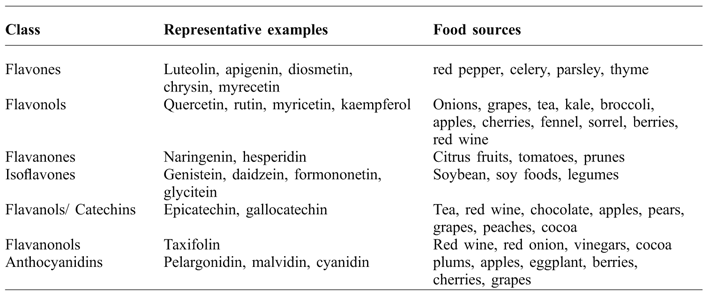
In botanical extracts, flavonoids mostly occur as glycoside derivatives. These belong to several classes of compounds, including isoflavones (e.g. genistein), flavones (e.g. luteolin), flavanols (e.g. catechin), flavanones (e.g. hesperidin), flavonols (e.g. querecetin), flavanonols (e.g. taxifolin) and anthocyanidins (e.g. flavon-3-ols) (Sandhar et al., Reference SANDHAR, KUMAR, PRASHER, TIWARI, SALHAN and SHARMA2011). Commonly occurring flavonoids in plants include quercetin (found in onions, grapes and wines), hesperidin (in citrus fruits and tomatoes), genistein (in soybean and other legumes) and catechins (in tea, coffee and chocolate) (USDA, 2011). The ubiquitously occurring flavonoids and their important food sources are presented in Table 1
Classification of major flavonoids and their food source (Sandhar et al., Reference SANDHAR, KUMAR, PRASHER, TIWARI, SALHAN and SHARMA2011; USDA, 2011).

Absorption and distribution of flavonoids
The absorption of bioflavonoids solely depends on their physico-chemical properties including molecular size, solubility, configuration and lipophilicity. From rodent studies, the ileum was seen to be primarily responsible for the absorption of flavonoids, followed by the jejunum and duodenum. The best absorption occurs at pH 5.0 to 6.8 (Lei et al., Reference LEI, YANG, LEI and YANG2009). It has been suggested that glycosylated forms of flavonoids are absorbed more actively compared to aglycone forms. Flavonoids can be conjugated with glucuronic acid and O-methylation or sulphate ester formation may occur to facilitate uptake. Such biotransformation occurs in the lower parts of gastrointestinal tract (GIT). Unabsorbed flavonoids from the small intestine, and some of the absorbed compounds are secreted with bile, further contributing to the degradation process in the colon, where micro-organisms breakdown their ring structure. For metabolism, two gut regions are involved; (i) lower parts of GIT, liver kidneys and (ii) the colon (Hollman, Reference HOLLMAN2009).
Biological effects of flavonoids
Several investigators have shown that the beneficial activities of flavonoids, from anti-mutagenicity to anti-aging, are due to their potent antioxidant effects (Nijveldt et al., Reference NIJVELDT, VAN NOOD, VAN HOOM, BOELENS, VAN NORREN and VAN LEEUWEN2001). Flavonoids exhibit their antioxidant activity through several means, including direct trapping and scavenging of free radicals, decreasing leukocyte immobilisation, and regulation of nitric oxide and xanthine oxidase activity (Tripoli et al., Reference TRIPOLI, GUARDIA, GIAMMANCO, MAJO and GIAMMANCO2007). Nitric oxide acts as a free radical which has the capacity to react with other radicals and produce highly damaging peroxynitrite. Flavonoids have been reported to directly scavenge these nitric oxide molecules. Thus, it has been speculated that nitric oxide scavenging plays a role in the therapeutic effects of flavonoids (Nijveldt et al., Reference NIJVELDT, VAN NOOD, VAN HOOM, BOELENS, VAN NORREN and VAN LEEUWEN2001). Other enzymatic activities, including glutathione peroxidase, superoxide dismutase and catalase have been proposed as the possible mechanism of action of flavonoids (Nijveldt et al., Reference NIJVELDT, VAN NOOD, VAN HOOM, BOELENS, VAN NORREN and VAN LEEUWEN2001).
Dietary flavonoids and poultry products
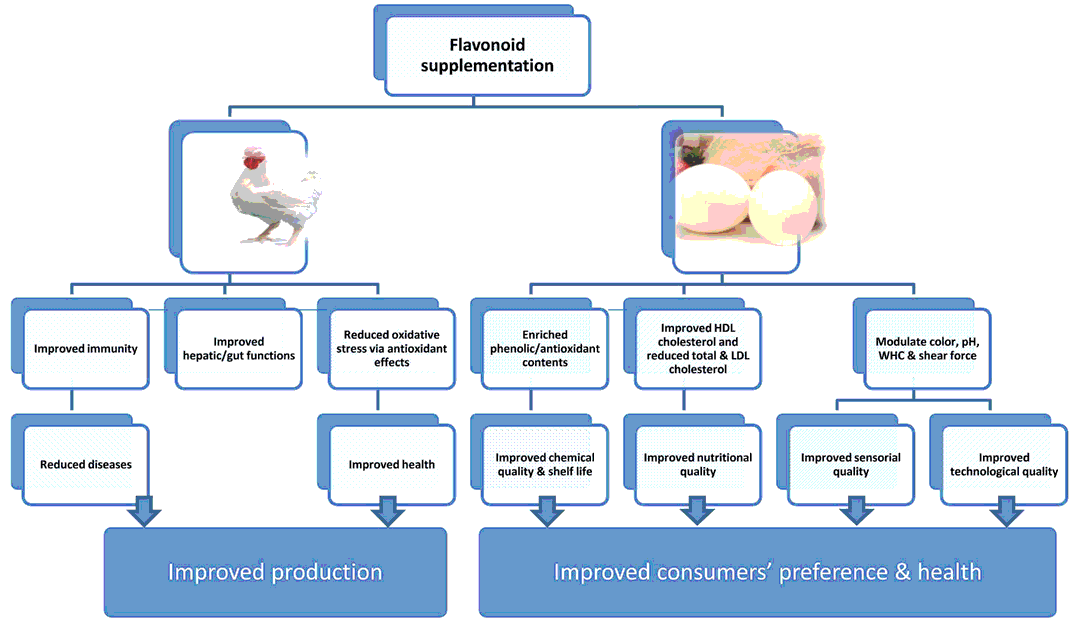
A number of studies have explored the effects of flavonoid supplementation in poultry and the impact on end-product quality (Figure 2).
Positive effects of flavonoids supplementation on chicken health and product quality.

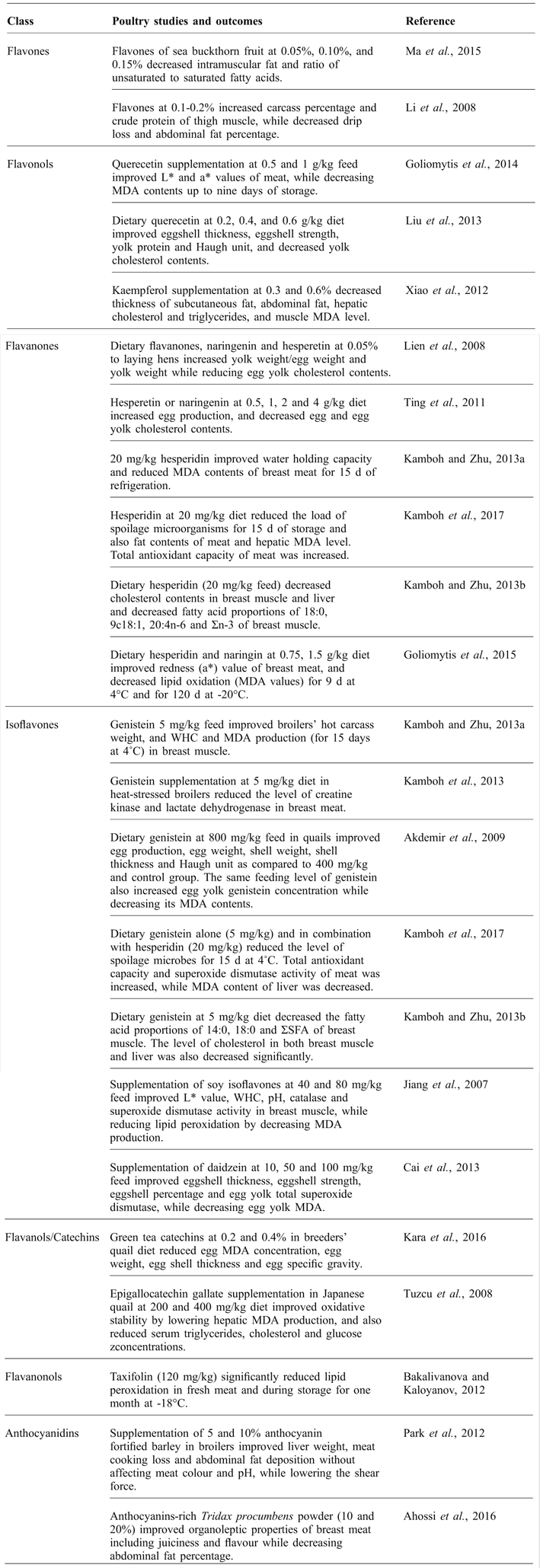
The outcomes of these studies have shown beneficial effects on meat and egg quality, shelf life, nutritional value, fatty acid proportions, and sensorial attributes (Table 2).
Summary of research showing the effects of flavonoid supplementation on meat and egg quality in poultry.

Dietary flavonoids and meat quality
Research has shown that supplementation with flavonoids may improve meat quality and ameliorate the deleterious effects of pre-slaughter stressors (Rajput et al., Reference RAJPUT, ALI, NAEEM, KHAN and WANG2014). Flavonoid supplementation could positively affect the organoleptic qualities of meat (Jiang and Xiong, Reference JIANG and XIONG2016) and positively alter the fat profile (Kamboh and Zhu, Reference KAMBOH and ZHU2013b). An overview of the meat quality improvement via dietary flavonoids in poultry is shown in Table 2.
Meat pH is the most important variable in the quality of chicken meat, and is related to pre-slaughter stresses, such as feed withdrawal, catching and transportation of poultry. It has a direct relationship with water holding capacity/drip loss, colour, tenderness, juiciness and flavour (Huff-Lonergan and Lonergan, Reference HUFF-LONERGAN and LONERGAN2005). A mixture of genistein and hesperidin (1:4) given in broiler feed at a level of 20 mg/kg was seen to improve pH45 (+ 3.1%) and lightness (L*) values (+ 4.8%) in breast muscles (Kamboh and Zhu, Reference KAMBOH and ZHU2013a). Hesperidin alone at the inclusion level of 1.5 g/kg diet improved the pH24, and L* value of breast meat as compared to control and vitamin E supplemented groups (Simitzis et al., Reference SIMITZIS, SYMEON, CHARISMIADOU, AYOUTANTI and DELIGEORGIS2011). In normal situations, muscle glycogen content at the moment of slaughter was higher than 53 mmol/kg (wet weight), which was enough to decrease the final muscle post-mortem pH to 5.4-5.7, maintaining desired meat quality. During stress (e.g. transportation) or after long feed withdrawal periods, muscle glycogen content at the time of slaughter may be inadequate, and the meat pH remains higher than 5.8, which is detrimental for meat quality (Henckel et al., Reference HENCKEL, KARLSSON, JENSEN, OKSBJERG and PETERSEN2002). Flavonoids could significantly ameliorate the negative consequences of environmental stressors on meat quality by regulating pre-slaughter synthesis of catecholamines and glucocorticoids; and post-slaughter muscle pH (Gessner et al., Reference GESSNER, RINGSEIS and EDER2017). If the pH of the meat is too low, meat proteins start to denature, impacting water holding capacity (WHC) and affecting reflection of light (lightness value) from the meat surface that causes the pale colour of surface meat which consumers find unattractive (Huff-Lonergan and Lonergan, Reference HUFF-LONERGAN and LONERGAN2005). Flavonoid supplementation has been shown to improve the lightness (L*) value by 4.8% and WHC by up to 16.2% in pectoralis major muscle compared to an unsupplemented control group (Kamboh and Zhu, Reference KAMBOH and ZHU2013a). In another study, dietary inclusion of soy isoflavones significantly improved the L* value, pH, WHC, catalase and superoxide dismutase activity in the breast muscle (Jiang et al., Reference JIANG, JIANG, LIN, XI, YU and WU2007). The sensorial quality of meat has been reported to improve with dietary inclusion of flavonoids or flavonoid-rich herbal extracts (Kim et al., Reference KIM, JIN and YANG2009; Ouyang et al., Reference OUYANG, XU, JIANG and WANG2016). However, other studies have reported no effects of dietary flavonoids on the sensorial attributes of broiler meat (Kamboh and Zhu, Reference KAMBOH and ZHU2013a).
Another important characteristic for meat quality is oxidative stability, which is the process of oxidation of unsaturated fatty acids in phospholipids and triacylglycerols that contributes to off-flavours. The substrates necessary for lipid oxidation include unsaturated fatty acids, oxygen and chemical species that accelerate these reactions (e.g. iron) and these are abundant in meat displayed aerobically or in high-oxygen modified atmosphere packaging. Meat from non-ruminants contains relatively greater concentrations of unsaturated fatty acids within triacylglycerols and generally displays more rapid lipid oxidation compared to red meat from ruminants. Minced meat experiences greater lipid oxidation compared to whole cuts because the processing procedure includes more exposure to oxygen, reactive components and increased surface area (Faustman et al., Reference FAUSTMAN, SUN, MANCINI and SUMAN2010). Interestingly, there is evidence that indicates an extended shelf-life of meat via dietary flavonoids by reducing lipid oxidation and the growth of spoilage microorganisms (Simitzis et al., Reference SIMITZIS, SYMEON, CHARISMIADOU, AYOUTANTI and DELIGEORGIS2011; Goliomytis et al., Reference GOLIOMYTIS, KARTONAS, CHARISMIADOU, SYMEON, SIMITZIS and DELIGEORGIS2015). Supplementation of genistein (5 mg/kg feed) and hesperidin (20 mg/kg feed) alone or in combination (20%:80% at 5, 10 and 20 mg/kg feed) significantly reduced the load of total viable counts of bacteria as well as numbers of psychrotrophs, lactic acid bacteria, and Enterobacteriaceae for up to 15 d of refrigeration (Kamboh et al., Reference KAMBOH, MEMON, MUGHAL, MEMON and BKETGUL2017). This same study reported enhanced activities of total antioxidant enzymes and superoxide dismutase in meat and liver samples from birds fed flavonoid supplemented diets. Improved antioxidant activities were reported with the supplementation of 40 or 80 mg/kg of soy isoflavones (Jiang et al., Reference JIANG, JIANG, LIN, XI, YU and WU2007) and 2 g/kg of naringenin and hesperetin in broiler meat (Ting, et al., 2011).
Meat frozen commercially for a long period of time under optimal physical and microbiological conditions may be unsafe and toxic for human consumption due to the production of malondialdehyde (MDA), a secondary product of lipid peroxidation that is known to be toxic and mutagenic in nature (Reitznerová et al., Reference REITZNEROVÁ, SUEKOVA, NAGY, MARCINCAK, SEMJOH, CERTIK and KLEMPOVA2017). Evidence from in vitro (direct addition) and in vivo studies (dietary addition) have shown that these compounds significantly reduce the production of MDA in meat. Supplementation with genistein (5 mg/kg diet) reduced MDA production in meat on day 0 by 41.4% and by 31.5% on the 15th day of refrigeration (Kamboh et al., Reference KAMBOH, MEMON, MUGHAL, MEMON and BKETGUL2017). A dose-dependent reduction in MDA contents of meat was reported for 9 d at 4°C and for 120 d at –20°C by dietary supplementation with 0.75 and 1.5 g/kg feed naringin and hesperidin (Goliomytis et al., Reference GOLIOMYTIS, KARTONAS, CHARISMIADOU, SYMEON, SIMITZIS and DELIGEORGIS2015). In another study, dietary quercetin fed at levels of 1 g/kg feed improved the oxidative stability of meat at 3 and 9 d of storage (Goliomytis et al., Reference GOLIOMYTIS, TSOUREKI, SIMITZI, CHARISMADOU, HAGER-THEODORIDES and DELIGEORGIS2014).
Flavonoids have been reported to alter the fatty acid profile of ruminant meat by increasing PUFA/SFA ratio and n-6/n-3 fatty acids. These are known to modify the cholesterol and triglyceride contents in a favourable manner that reduces the risk of cardiovascular disease for consumers (Cavallini et al., Reference CAVALLINI, BEDANI, BOMDESPACHO, VENDRAMINI and ROSSI2009; Tan et al., Reference TAN, ZHONG, TAN, HAN, TANG, XIAO, SUN and WANG2011). Flavonoids dose-dependently decreased the cholesterol and triglyceride content of meat and improved the proportions of total PUFA and the ratio of n-6 to n-3 fatty acids, as well as PUFA to SFA in the breast muscle (Kamboh and Zhu, Reference KAMBOH and ZHU2013b).
Dietary flavonoids and egg quality
Cholesterol levels in eggs remains a concern, somewhat erroneously, for some consumers. Ting et al. (Reference TING, YEH and LIEN2011) reported benefits of citrus flavonoids (naringenin and hesperetin) in laying hens to reduce egg cholesterol. The authors reported this effect for dose levels of 0.5, 1, 2 and 4 g/kg diet, with the most promising result at 2 g/kg diet which significantly lowered the serum cholesterol and triglyceride levels in hens. Similarly, dietary flavanones (Lien et al., Reference LIEN, YEH and SU2008) and quercetin (Liu et al., Reference LIU, LI, LIU, SUO, HU, FENG, ZHANG and JIN2013) have been reported to reduce egg and yolk cholesterol contents. In another study, inclusion levels of 10, 50 and 100 mg/kg feed of dietary daidzein in laying hens improved egg production, mass, yolk total superoxide dismutase and calcium-related quality indexes (i.e. eggshell strength, percentage and thickness), while the malondialdehyde contents of egg yolk was lowered (Cai et al., Reference CAI, GU, SHI and TONG2013). Antioxidant activities, including superoxide dismutase, catalase, and iron-chelating and O2 scavenging abilities, were improved in laying hens, in addition to egg production, by dietary supplementation of hesperetin (an aglycone form of hesperidin) and naringenin (Ting et al., Reference TING, YEH and LIEN2011). In a quail study, dietary genistein (800 mg/kg feed) improved egg production and weight, shell weight and thickness and Haugh unit compared to 400 mg/kg inclusion or the control group. This study reported decreased MDA and increased genistein content in the eggs (Akdemir et al., 2009). Catechins at 0.2 and 0.4% in a breeder quail diet reduced egg MDA concentration, egg shell thickness and specific gravity (Kara et al., Reference KARA, KOCAOGLUGUCLU, ŞENTURK and KONCA2016) as well hepatic MDA production, serum triglyceride and cholesterol concentrations (Tuzcu et al., Reference TUZCU, SAHIN, KARATEPE, CIKIM, KILINC and SAHIN2008).
Conclusions
Dietary supplementation with flavonoids can be used as a strategy to improve meat and egg quality in commercial poultry, in addition to other positive effects on poultry health. Dietary flavonoids enhance the nutritional value of meat and eggs and can improve shelf-life, sensorial and technological attributes, thus positively affecting consumers’ preference for purchasing. However, there is great variation in supplemental dosages, probably because of the heterogeneity of the different molecular structures of different compounds that ultimately affect their biological activities. Thus, further studies are warranted to determine optimal doses for each class/compound of flavonoid family. Studies need to be carried out for long-term supplementation (in hens) particularly in terms of poultry welfare and product safety.