

Introduction
Numerous studies have investigated the relationship between anxiety and performance in various sports settings, yet findings continue to remain inconsistentReference Woodman and Hardy1. Following increased criticism of the inverted-U hypothesisReference Hardy, Jones and Hardy2, research has adopted a multidimensional approach to measure anxiety, in which the arousal response is separated into cognitive and somatic componentsReference Martens, Vealey and Burton3. The development of the Competitive State Anxiety Inventory-2 (CSAI-2) by Martens et al. Reference Martens, Burton, Vealey, Bump, Smith, Martens, Vealey and Burton4 stimulated a new wave of research that supported the separation of cognitive and somatic dimensions, besides the inclusion of self-confidence (SC) in the measurement of the performance anxiety response. HardyReference Hardy, Jones and Hardy2, Reference Hardy5 developed additional anxiety theorems, referred to as catastrophe or ‘cusp’ models, which propose a number of interactive effects between somatic and cognitive components. The additional five-dimensional butterfly catastrophe modelReference Hardy5 suggests that SC moderates the effect that somatic anxiety and cognitive anxiety have on performance. Specifically, even under high levels of arousal, cognitively anxious performers will still be able to perform if they are self-confidentReference Hardy, Jones and Hardy2.
However, a number of researchersReference Edwards and Hardy6, Reference Jones, Hanton and Swain7 have noted a confounding issue in anxiety measurement in sports. The construct of anxiety refers to ‘an unpleasant psychological state in reaction to perceived threat concerning the performance of a task under pressure’ (p. 1)Reference Cheng, Hardy and Markland8. On the other hand, arousal refers to the neutral physiological and psychological stimulation prior to or during a stressful event, without the cognitive evaluation of the situationReference Lazarus and Folkman9. While anxiety measurement inventories such as the CSAI-2 and the revised CSAI-2RReference Cox, Martens and Russell10 claim to assess symptoms of ‘anxiety’, they arguably merely measure intensities of physiological and cognitive symptoms associated with competitive events. Items such as ‘My heart is racing’ or ‘I am concerned about this competition’ are in fact worded neutrally. It is only an individual athlete's perception that signals either a negative affect, such as anxiety, or positive emotional states, such as challenge and excitementReference Burton and Naylor11. Despite the claim that the CSAI-2 and the CSAI-2R assess anxiety, it may be more prudent to assume that what they, in fact, do measure is more likely to be arousal. Many researchers agree that both intensity and interpretation of the symptoms of arousal affect sporting performanceReference Edwards and Hardy6, Reference Jones, Hanton and Swain7. A necessary additional step then would be to determine whether athletes perceive arousal symptoms to be facilitative or debilitative to their upcoming performance by including directional measurements, as originally proposed by Parfitt et al. Reference Parfitt, Jones, Hardy, Jones and Hardy12. The directional subscales ranged from − 3 (very debilitative) to +3 (very facilitative), and thus allowed determination of whether arousal symptoms are perceived as debilitative or facilitative by the athletes. These ‘directional’ interpretations of physiological and somatic arousal (SA) as experienced by the athletes may also assist in explaining the role of SC in moderating the effects of arousal on performance. JonesReference Jones13 suggested that performers who have the most confidence in controlling both themselves and their environment are more likely to report facilitative symptoms of arousal. Not surprisingly perhaps, elite athletes have been found to interpret symptoms of competitive arousal as more facilitative, and also exhibit greater levels of SC than non-elite athletes. In one of the few studies that examined psychological skills in equestrian sports, Meyers et al. Reference Meyers, Bourgeois, LeUnes and Murray14 found that elite riders scored significantly higher in anxiety management than non-elite riders. In a more recent study, Wolframm and MicklewrightReference Wolframm and Micklewright15 showed similar trends, whereby elite riders showed lower levels of SA and greater levels of SC than non-elite riders. The results suggest that in equestrianism, the ability to control symptoms of anxiety is similar to that in other sports, which is one of the contributing factors to superior performance. An elite rider's enhanced ability to control symptoms of arousal and/or anxiety may, in part, be due to greater coping capacities that come along with superior skills and experience in the sport. This in turn may lead to an increase in SC, and subsequently, to more facilitative, and thus performance-enhancing, interpretations of arousal.
Cheng et al. Reference Cheng, Hardy and Markland8 argued that the evolutionary roots of anxiety must also be taken into account when developing anxiety–performance models. Anxiety, at its most fundamental level, serves a protective function by signalling to the individual to prepare for a perceived threat. As such, anxiety, or mere arousal, can also serve to increase motivationReference Eysenck16 and task-relevant focusingReference Carver, Scheier and Schwarzer17 by activating a control system enabling the individual to cope with the demands of the situation. From an evolutionary perspective, anxiety serves not only to alert the individual to a potential threat, but also to mobilize relevant resources to deal with the threatReference Ohman, Lewis and Haviland-Jones18. In addition to the more classical components of anxiety such as the cognitive and physiological elements of arousal, Cheng et al. Reference Cheng, Hardy and Markland8 argued for the need to incorporate a regulatory dimension encompassing coping capacities to deal with the perceived threat, e.g. the competitive situation.
As is the case with most other sports, an athlete's assessment of the demands of the competitive situation is likely to affect both the cognitive and physiological components of arousal on the one hand, and the activation of regulatory resources such as coping strategies on the other hand. However, unlike other sports, this process for equestrian riders is also likely to involve an appraisal of their horses' ability to cope with the demands of the competitive situation. Equestrianism is a sport that by its very nature is dependent on a functioning horse–rider dyad. Ideally, horse and rider communicate effortlessly, with the horse willingly submitting to its rider's wishes, and performing the required movements with ease. Yet, the fact that the horse has a will and motivation of its own and, as a prey animal, is also prone to violent reactions when faced with seemingly threatening situations, makes equestrianism one of the most dangerous sportsReference Sorli19. Effective communication between a horse and rider undoubtedly depends to some considerable degree on the rider's level of experience and skill, especially with a view regard to reacting to unforeseen movements or reactions from the horseReference Visser, Van Reenen, Blokhuis, Morgan, Hassmén and Rundgren20. But in addition to skill and expertise, psychological components such as personality and temperament in both horse and rider are also thought to play a roleReference Visser, Van Reenen, Blokhuis, Morgan, Hassmén and Rundgren20. Not surprisingly then, when selecting a horse, riders base their ultimate choice on the aspects of athleticism, conformation and equine temperamentReference Buckley, Dunn and More21, Reference Paalman22. TullochReference Tulloch23 asserted that temperament as an animal's distinct nature is relatively stable, and as such a psychological trait. In the equid, a number of studies have investigated temperament, and support the notion that horses display stable traits, with ‘high general homogeneity but clear individual distinctiveness’Reference Wolff and Hausberger24, Reference LeScolan, Hausberger and Wolff25. For instance, emotionality (neuroticism) was generally found to be negatively correlated with learningReference LeScolan, Hausberger and Wolff25. Interestingly, studies done by Hausberger et al. Reference Hausberger, Bruderer, LeScolan and Pierre26 indicated that equestrian discipline and personality factors were interrelated, and found that show horses showed greater levels of emotionality than leisure horses. While emotionality arguably reduces the speed at which animals learn, it could be said that a certain amount of ‘excitability’ may prove beneficial in a competition. However, it must be borne in mind that a rider training a horse exhibiting greater emotionality needs to be highly skilled to get the horse to perform. Such research findings further support the idea that equine temperament is an important factor in determining the interaction between a horse and rider, and, ultimately, the horse–rider performance.
Evaluation of equine temperament may be done using behavioural testsReference Visser, van Reenen, Hopster, Schilder and Knaap27, behavioural or physiological measuresReference Visser, van Reenen, Hopster, Schilder and Knaap27, Reference Visser, van Reenen, Engel, Schilder, Barneveld and Blokhuis28 or observer assessmentsReference Visser, van Reenen, Rundgren, Zetterqvist and Blokhuis29. A study done by Morris et al. Reference Morris, Gale and Duffy30 used a modified version of the psychometric inventory that is generally used for human personality assessment, and validated its use for horses. The authors commented on the value of using existing human personality measures to assess animals by allowing a more direct comparison of relevant personality traits.
How a rider perceives their horse and their relationship with that horse, within the added constraints of a competitive situation, is likely to be of considerable influence on the levels of arousal and relevant coping capacities prior to a competition. Beauchamp and WhintonReference Beauchamp and Whinton31 suggested that the levels of self-efficacy in dressage riders are closely related to their perception of their horses' ability to perform. The study also showed that performance parameters were correlated with both riders' self-efficacy and their perception of the horses' ability. Yet, to the authors' knowledge, no additional evidence seems to exist that has investigated the impact of perceived character of a horse on perception of arousal, and potential subsequent effects on performance indicators.
The aims of the present study were threefold. Firstly, the study aimed to investigate the impact of perceived intensity of pre-competitive somatic and cognitive arousal (CA) and SC on riding performance in a showjumping (SJ) and dressage competition. Secondly, the study aimed to determine whether riders perceive their levels of arousal as facilitative or debilitative and their subsequent effects on performance by using additional directional measurements. Lastly, the study aimed to investigate whether perceptions of equine temperament have an impact on the levels and interpretations of arousal and SC as well as on subsequent performance.
Method
Participants
Twenty-two student riders (6 males and 16 females, mean age 23.95 ± 3.86) were recruited for this study. For the duration of the study, participants competed at the International World Equestrian Student Competition. Once a year, students from different nations, including the US, Germany, the Netherlands, Austria and Italy, all studying for a bachelor's degree in equine science or equine business science, compete in teams of four in the disciplines of dressage and SJ. All the participants own one or several horses, and compete on a regular basis in their home country. Fourteen of the participants primarily compete in the discipline of SJ at the heights of 1.10 m up to 1.35 m. Eight of the participants compete primarily in dressage competitions from the novice level up to advanced level. All provided their written informed consent to participate in the study. All the procedures that were used were approved by the University of Essex ethics committee.
All the students had to and did compete in both the disciplines. The host country provided suitable horses for the competition, which were capable of performing at the appropriate level. Riders were required to complete a dressage test at the UK novice level (German level A and Dutch level L). They had to ride a series of simple movements and changes of directions in walk, trot and canter, with the horse moving willingly from the leg into a soft contact and maintaining a rounded outline from poll to tail. Riders were also required to complete a SJ round, including eight jumping efforts at a maximum height of 1.10 m. On the day prior to the competition, all the riders were given the opportunity to familiarize themselves with the horses on which they would compete in each discipline.
Study design
Following the familiarization session with their horses, riders were asked to rate the two horses they had to ride during the competition using a 15-item temperament questionnaire. Immediately before competing in the dressage and SJ events, riders were further asked to complete a modified version of the Revised CSAI-2 (CSAI-2R)Reference Cox, Martens and Russell10 questionnaire.
On the day of the competition, all the riders first competed in the dressage test in the morning, and then they competed in the SJ round in the afternoon.
Performance scoring
The dressage test was judged by an independent, listed judge according to the rules laid down by the International Equestrian Federation. Dressage performance scores included a dressage score, a score for overall performance, a score for horse–rider interaction and a score for style. All scores were given according to the international dressage standard on a scale from 0 ( = not executed) to 10 ( = excellent). The dressage score was the calculated average of scores given to every individual movement throughout the test. The horse–rider interaction score was judged on how the rider communicated with his/her horse using leg, seat and rein aids. Dressage style scores were given for seat and appearance of the rider. Furthermore, scores were given for horse–rider interaction, whereby riders were expected to show that they were able to interact with their horses in a soft, harmonious manner. The overall performance score was given for the general impression, taking into account performance indicators such as style.
Showjumping performance was based on an overall SJ score, SJ faults, SJ time and SJ style. SJ faults were counted as one fault for either one pole down or one refusal, two faults for two poles down or two refusals, etc. Horse–rider combinations with three refusals were eliminated. SJ time was measured in seconds from the moment the horse–rider combination crossed the starting line until it crossed the finish line. A SJ style score (from 0 = not executed to 10 = excellent) was also given according to seat and balance of the rider between and over the fences. A total SJ score was calculated from all three performance scores, with lower scores being considered better.
Modified CSAI-2R including directional indicators
The CSAI-2RReference Cox, Martens and Russell10, a 17-item questionnaire, was used to measure the perceived intensities of SA, CA and SC. Each subscale was composed of the following items: SA = 1, 4, 6, 9, 12, 15, 17; CA = 2, 5, 8, 11, 14; and SC = 3, 7, 10, 13, 16. Each CSAI-2R item is rated on a 4-point Likert scale ranging from 1 = ‘not at all’ to 4 = ‘very much so’. In addition, a ‘direction’ scale developed by Jones and SwainReference Jones and Swain32 was included for all items. Riders were asked to rate each of the CSAI-2R items on a scale from − 3 (very unhelpful) to +3 (very helpful) depending on how helpful they felt each item's intensity to be to their performance. For example, riders may choose to rate item 4 ‘My body feels tense’ with an intensity of 3 = moderately so. If riders felt that this tension was very unhelpful to their performance, they would rate the direction of item 4 with − 3. If, on the other hand, such tension was ‘somewhat helpful’ to their upcoming performance, they would rate it with a+1. In order to determine the final direction score, intensity and raw direction scores were multiplied for each individual item. SA, CA and SC direction scores were then calculated by following the original guidelines provided by Cox et al. Reference Cox, Martens and Russell10.
Equine temperament inventory
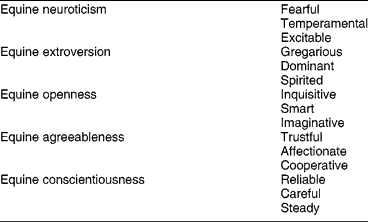
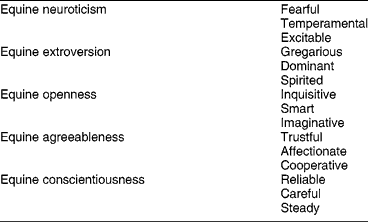
As indicated by Morris et al. Reference Morris, Gale and Duffy30, using existing human personality assessments to measure equine temperament allows for a more direct comparison and ultimately for better understanding of relevant traits. An equine temperament questionnaire was consequently designed based on one of the most common human personality assessments, the five-factor model of personalityReference Goldberg33, drawing on descriptors of the five domains: neuroticism, extraversion, openness to experience, agreeableness and conscientiousness. In order to describe equine temperament traits, the authors first examined the common descriptors of the five factors of personalityReference Goldberg33 to make an initial selection of suitable adjectives to describe equine personality. The authors then drew on previous scientific literature describing equine temperamentReference Visser, van Reenen, Hopster, Schilder and Knaap27, Reference Visser, van Reenen, Rundgren, Zetterqvist and Blokhuis29, Reference Morris, Gale and Duffy30, secondary literatureReference Paalman22, laymen press and personal experience to make the final selection of adjectives, resulting in three adjectives to describe each equine temperament domain (Table 1). In order to avoid researcher bias, the first author of the study developed the initial list of adjectives, which was independently checked by the second author. Items were scored on a 7-point Likert scale (0 = strongly disagree, 6 = strongly agree). In order to attain the final score for each equine temperament, domain scores for the relevant adjectives were added up.
Equine personality domains and relevant descriptive adjectives
The equine temperament inventory was used to describe dressage and SJ horses separately. Each equine temperament inventory was subjected to principal component analysis (PCA) by using Statistical Package for Social Sciences version 15.
Data analysis
The analysis of the data was divided into a number of stages. The first stage involved the calculation of correlation coefficients among the CSAI-2R subscale intensity and direction scores in order to determine whether intensity and direction of the same subscales could be considered conceptually different and be explored separately. Internal consistency of the new direction scales was measured using Cronbach's α. Equine temperament inventories for SJ and dressage horses were analysed separately using PCA to identify main temperament components. Relevant components were then tested for internal consistency using Cronbach's α prior to proceeding with further statistical analysis.
The next stage involved the use of Pearson's product–moment correlation to investigate the relationship of CSAI-2R intensity and direction scores on dressage scores, dressage style, horse–rider interaction scores, overall dressage performance as well as with SJ faults, SJ style, SJ time and overall SJ score. Pearson's product–moment correlation was also used to investigate the relationship between perception of equine temperament using relevant components identified through PCA with SJ and dressage performance scores and CSAI-2R intensity and direction subscales. Following on, Student's t-tests were used to investigate differences in arousal, performance and perception scores between genders. To avoid a type 1 error, the Bonferroni-adjusted significance levels of 0.017 were set when testing the three elements of the CSAI-2R, SA, CA and SC, for significant differences.
Results
Psychometric analysis of the modified CSAI-2R
Cronbach's α reliability coefficients were conducted on three new CSAI-2R direction subscales for dressage and SJ phases separately. In the dressage phase, Cronbach's α was 0.85, 0.83 and 0.73, respectively, for cognitive direction, somatic direction and SC direction. In the SJ phase, Cronbach's α was 0.88, 0.93 and 0.85, respectively, for cognitive direction, somatic direction and SC direction. Values above 0.70 were considered the accepted standard for reliability estimatesReference Kline34. However, low participant numbers pose a limiting factor to psychometric analysis, and results should be considered with some caution.
Psychometric analysis on the equine temperament inventory
For dressage horses, PCA revealed the presence of five components with eigenvalues exceeding 1, explaining 81.6% of the total variance. An inspection of the scree plot revealed a clear break after the third component. It was subsequently decided to retain three components for further analysis. Following varimax rotation, relevant adjectives substantially loaded on only one of the three components.
Further analysis using Cronbach's α tested for internal consistency of each component. For all items showing negative correlations, coding was reversed accordingly. Cronbach's α coefficient for component 1 was 0.83. Corrected item-total correlations were above 0.3 for all items except for inquisitive. Therefore, component 1 was constructed from temperamental, excitable, gregarious, spirited and reversed steady, and was named dressage active.
Cronbach's α coefficient for component 2 was 0.8, with corrected item-total correlations above 0.3 for all items. Component 2 was constructed from smart, cooperative, reliable and imaginative, and was named dressage resourceful.
Cronbach's α coefficient for component 3 was 0.75, with corrected item-total correlations above 0.3 for all items. Component 3 was subsequently constructed from careful, trustful, fearful and reversed dominant, and was named dressage submissive.
For SJ horses, PCA revealed the presence of five components with eigenvalues exceeding 1, explaining 82.5% of the total variance. An inspection of the scree plot revealed a clear break after the third component. It was subsequently decided to retain three components for further analysis. Again, varimax rotation revealed loadings of relevant adjectives on only one of the three components. As with dressage temperament scales, all components were tested for internal reliability using Cronbach's α analysis.
SJ component 1 had Cronbach's α coefficient of 0.84, with all corrected item-total correlations above 0.3. Therefore, SJ component 1 was named SJ active composed of excitable, temperamental, gregarious, spirited, inquisitive and reversed steady.
SJ component 2 also revealed good internal consistency with Cronbach's α coefficient of 0.81 and all corrected item-total correlations above 0.3. SJ component 2 was subsequently named SJ caretaking, and was composed of trustful, careful, smart and reversed dominant. SJ component 3 showed low internal consistency with Cronbach's α coefficient at 0.53. No further analysis was subsequently performed.
Again, the limiting factor of low participant numbers needs to be taken into account, and results are to be interpreted with caution.
CSAI-2R subscale correlations
Positive significant correlations were found between CA intensity and SA intensity scores for dressage and SJ (r = 0.63, P ≤ 0.005; r = 0.71, P ≤ 0.001). Furthermore, a significant, positive relationship was found between self-confidence intensity and SC direction for dressage and SJ (r = 0.51, P ≤ 0.05; r = 0.87, P ≤ 0.001).
For dressage riders, additional strong significant correlations were found between cognitive and SA intensity and SA direction (r = − 0.59, P ≤ 0.01; r = − 0.8, P ≤ 0.001), and between SA and CA intensity and CA direction (r = − 0.56, P < 0.05; r = − 0.75, P ≤ 0.001). Furthermore, positive correlations were found between SC direction scores and SA and CA direction scores (r = 4.9, P < 0.05; r = 5, P < 0.05).
For SJ riders, additional relatively strong significant correlations were found between CA, SA and SC intensity scores and SA direction (r = − 0.75, P ≤ 0.001; r = − 0.7, P < 0.005; r = 0.55, P < 0.05). Significant strong correlations were also found between cognitive, SA and SC intensity scores and CA direction (r = − 0.76, P < 0.001; r = − 0.73, P ≤ 0.001; r = 0.56, P < 0.05). Lastly, significant correlations were detected for CA and SC direction scores (r = 0.69, P < 0.005).
Correlations between CSAI-2R subscale intensity and direction scores on dressage performance
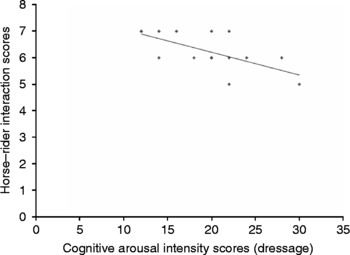
Significant correlations were found between CA intensity scores and dressage scores (r = − 0.5, P < 0.05) and horse–rider interaction scores (r = − 0.67, P < 0.005), which are presented in Fig. 1. SC intensity scores correlated positively, yet not all too strongly, with dressage scores (r = 0.59, P < 0.05) and dressage style scores (r = 0.49, P < 0.05). Somatic and CA direction scores correlated positively with horse–rider interaction scores (r = 0.48, P < 0.05; r = 0.49; P < 0.05). SC direction scores were significantly correlated with dressage score (r = 0.57, P < 0.01) and overall performance scores (r = 0.58, P < 0.05) (Table 2).
Negative correlation between horse–rider interaction and cognitive arousal in the discipline of dressage, with r = − 0.67, P < 0.005

Correlations (P) between CSAI-2R components (intensity and direction) and performance scores (dressage and showjumping)

*P < 0.05; **P < 0.01.
Correlations between CSAI-2R subscale intensity and direction scores on showjumping performance
In the discipline of SJ, significant correlations were found between SA direction scores and SJ faults (r = − 0.5, P < 0.05) (Table 2).
Correlations between rider's perception of equine temperament and CSAI-2R subscale intensity and direction scores
In the discipline of dressage, a positive correlation was found between equine temperament perception scores of ‘dressage active’ and SA intensity scores (r = 0.5, P < 0.05).
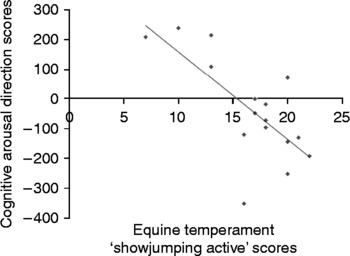
In the discipline of SJ, riders' perception of equine temperament perception scores of ‘SJ active’ correlated negatively with CA direction scores (r = − 0.71, P < 0.005), which are presented in Fig. 2.
Negative correlation between cognitive anxiety direction and equine temperament ‘showjumping active’, with r = − 0.71, P < 0.005

Correlations between riders' perception of equine temperament and dressage and showjumping performance
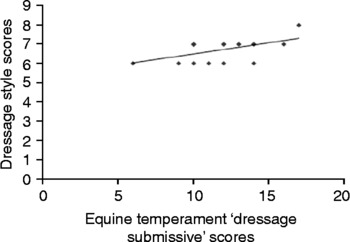
The equine temperament perception scores of ‘dressage submissive’ were positively correlated with dressage style scores (r = 0.55, P < 0.05) (Fig. 3). In SJ, the somewhat weak correlation between riders' perception of equine component ‘SJ caretaking’ and ‘SJ score’ neared significance (r = − 0.48, P = 0.052).
Positive correlation between dressage style and equine temperament ‘dressage submissive’, with r = 0.55, P < 0.05

Discussion
The findings of this study support the idea that intensity of pre-competitive CA and SA influences equestrian performance. In the discipline of dressage, greater levels of CA had a debilitating effect on dressage performance as well as horse–rider interaction scores, while in SJ no such relationship could be found. Processing efficiency theoryReference Eysenck and Calvo35 suggests that CA may enhance performance if the task is not too attentionally demanding, but will impair performance if attentional demands on the athletes are high. In dressage, the riders have to memorize a complex pattern of floor movements, each with a slightly different set of rider aids, which, in combination, will require considerable memory capacity from the riders. Even though riders will also have to memorize a SJ course, most of the courses are built in a fairly logical progression, and the required aids for steering a horse through the course do not differ from fence to fence. Furthermore, a dressage test should be considered a continuous event, with no time for riders to refocus between judged movements. On the other hand, during a SJ round, the riders have, albeit very short, moments between individual fences to recover and refocus. The attentional demands on SJ riders can be considered much lower than those on dressage riders. Therefore, the greater demand on memory capacity in the sport of dressage may lead to this negative linear relationship between CA and performance, including horse–rider interaction. An increase in CA would put a drain on riders' memory resources, which, in a dressage competition, may affect their ability to ride the movement, affecting dressage performance scores. Furthermore, increased levels of CA and the resultant impact on memory resources may also hamper riders' ability to employ the correct aids and react to the horses in the most appropriate manner. Communication between the horse and rider may be disrupted, resulting in lower horse–rider interaction scores.
Results further show that the direction of pre-competitive symptoms seems to influence competitive results, with levels of SC featuring as an important moderator. In SJ, riders' greater SC scores also led to more facilitative interpretations of both CA and SA symptoms, while in the dressage phase, greater levels of SC were related to higher dressage and dressage style scores. Similarly, a more positive interpretation of the feelings of SC in the dressage phase led to more facilitative interpretations of both CA and SA symptoms. These findings support Jones'Reference Jones13 model of debilitative and facilitative anxiety, which suggests that performers who have the most confidence in their own abilities will report facilitative symptoms of arousal, while those athletes who have little SC will experience symptoms of arousal as debilitative. Research done by Hanton et al. Reference Hanton, Thomas and Maynard36 examining the relationship between SC, competitive arousal intensity and symptom interpretation found that pre-competitive symptoms in the absence of SC led to a loss of perception of control, problems with focusing and concentration, and debilitative interpretation of arousal. Athletes who were confident of their abilities also experienced an increase in arousal, yet experienced an increase in motivation and effort and interpreted symptoms as facilitative. In equestrian sports, the notion of control is likely to be of considerable importance to the rider. Only when riders are certain of their ability to control their horses, are they also able to meet the demands of the competitive situation. Horse sports are primarily dependent on effective horse–rider interaction, whereby riders must be able to guide their horses effectively through a combination of seat, legs and hands. Riders who believe themselves not to be in control of their horses, and thus of their immediate competitive environment, are likely to experience additional symptoms of pre-competitive arousal as threatening. Any resultant lack of focus as described by Hanton et al. Reference Hanton, Thomas and Maynard36 is likely to disrupt effective communication between the horse and rider, a notion that is further supported by current findings that facilitative interpretations of both CA and SA positively affect horse–rider interaction scores.
Current findings also indicate that facilitative interpretations of SA lead to fewer SJ faults. Previous research has identified the nature of the sport as an important factor in determining the interpretation of arousal symptomsReference Martens, Burton, Vealey, Bump, Smith, Martens, Vealey and Burton4. Therefore, in short-duration, explosive sports, somatic symptoms may be considered as facilitative to the athlete, while in longer-duration, finely controlled skills, SA may be considered as debilitative. A SJ round will be ridden in less than half the time it takes to ride a dressage test. Therefore, debilitative interpretations of arousal, e.g. somatic anxiety, of dressage riders may be likely to increase continually throughout the duration of a test. On the other hand, a SJ course is always ridden at a fast canter, with explosive efforts from the horse and rider when jumping obstacles. The rider needs to be quick and bold, as any hesitation may lead to a refusal or knockdown. Any symptoms of arousal are, therefore, likely to be interpreted by the successful showjumper as ‘excitement’ or ‘being psyched up’ instead of as ‘anxiety’Reference Jones, Hanton and Swain37, and as such are likely to be of benefit to the rider while competing.
Results further show that the greater the intensity of both CA and SA symptoms, the less facilitative these symptoms were perceived by the riders. This indicates that the greater the level of pre-competitive arousal, the more likely it is that riders do, in fact, perceive arousal as anxiety. Equine training is primarily based on the principles of operant conditioningReference McGreevy and Boakes38, Reference Murphy and Arkins39, by which a horse is taught to associate rider aids with changes in tempo or direction. Any changes in muscular tension by the rider may lead to the ‘distortion’ of certain aids, causing confusion and a lack of cooperation from the horseReference Cheng, Hardy and Markland8. Therefore, it can be assumed that riders are aware of the fact that any substantial increase, particularly in physical tension, will result in a less cooperative horse, and thus may interpret such symptoms as debilitative to performance.
The study also aimed to determine whether riders' perceptions of equine temperament were of influence on the levels of arousal and subsequent competitive performance. Findings revealed that the perception of equine temperament seems to play a considerable role in both elicitation of arousal and performance outcomes. In particular, the perception of equine temperament traits such as excitable, temperamental and spirited, which all formed a part of equine temperament clusters ‘dressage active’ and ‘SJ active’, seemed to elicit an increase in arousal intensity and interpretation. More specifically, riders' perception of dressage horses as ‘active’ elicited an increase in SA, while perceptions of SJ horses as ‘active’ were related to debilitative interpretations of CA. A horse that is viewed as excitable and temperamental in the discipline of SJ is also likely to be viewed as increasing the inherent danger of SJ. Considering that in the current study riders were unfamiliar with the horses they had to ride, such temperamental traits may cause an increase in cognitive components of competitive anxiety, such as worry and concern. While the inherent risk of horse riding is still apparent in dressage, the danger of falling off is not as great as that in SJ. The perception of equine temperament as ‘active’ may thus cause an increase in arousal, perhaps in preparation for greater physical effort to contain and control the horse.
Based on the performance parameters, results demonstrate that riders who perceived their horses in the dressage phase as ‘submissive’, which for the purpose of this study includes carefulness, trustfulness, fearfulness and lack of dominance, scored higher in style scores. The sport of dressage is a jury-sport, and, as such, judged on the appearance of the horse–rider relationship. Riders who believe their horses to be fully submissive to the aids are likely to come across as more confident and in control. In SJ, horses which were perceived as trustful, careful, smart and less dominant seemingly allowed riders to gain a higher overall SJ score. Especially in SJ, a good horse should be able to show a degree of ‘independent thinking’, e.g. to be bold and smart enough to still jump even if the rider makes a mistake. Equally, carefulness is a treasured trait in a showjumper, as it usually means that the horse will try and avoid touching the poles, thereby reducing jumping faults. The perception of these traits is likely to increase riders' ‘other efficacy’, which according to the research done by Beauchamp and WhintonReference Beauchamp and Whinton31 may positively influence behavioural enactment of riders towards successful performance. However, it should be borne in mind that the current study assessed horse–rider combinations competing at an intermediate level. Replicating the study with riders competing at the international level may result in different findings. Equally, the riders participating in this study did not know the horses prior to the competition. If the study were repeated with rider–own-horse combinations, results may also differ somewhat.
The current study contributes considerably towards gaining a better understanding of the impact of pre-competitive arousal on performance, including the role of equine temperament as an additional mediator of arousal and performance. Nevertheless, the research design presents a number of limitations that should be taken into account. The fact that riders were competing on previously unknown horses may cause a slight distortion of results due to additional factors of uncertainty. On the other hand, temperament perceptions are perhaps more objective, as riders are not emotionally attached to the horses. Therefore, the effect of temperament on arousal levels and performance may actually be more consistent if the riders knew their horses well. As with many applied research studies, subject numbers are somewhat low. This is due to the fact that many riders object to participating in a research study prior to a competition, as it may interfere with warm-up times for them and their horses.
Conclusion
The current study provides evidence that, in the equestrian disciplines of SJ and dressage, intensity and direction of the levels of pre-competitive arousal affect performance, with SC being an important moderator. In line with processing efficiency theory, increasing levels of CA seem to negatively affect performance in the discipline of dressage, which places a greater demand on memory resources of the riders. In the SJ phase, more facilitative interpretations of SA led to increased performance. In both dressage and SJ, SC served as an important moderator to interpret arousal level as being facilitative to performance.
Findings also show that perceptions of equine temperament seem to be important mediators of both arousal levels and performance in equestrian athletes. Temperamental, excitable horses, on the one hand, seem to elicit an increase in intensity and direction of arousal levels, and ‘submissive’ and ‘caretaking’ horses, on the other hand, seem to increase the likelihood of successful performance. In order to assist equestrian athletes to increase their performance, future research should investigate the effect of mental training skills to help them interpret arousal symptoms as facilitative.